When green stories make some see red: who protects the reporters?

Who says environment is a ‘safe’ subject for journalists and broadcasters to cover?

Journalist colleagues who work on conflict, security and political topics often have an illusion that environmental reporting is a ‘cosy and comfortable beat’ – one that allows reporters to travel to exotic locations, see cuddly animals, relax in pristine environments and generally take things easy.

That might have been the case some years ago, in another century that’s now receding in our memories. But not any longer: there’s as much conflict, intrigue and complexity in many of today’s environmental topics, and covering them can often be hazardous to the courageous journalists who go after them.
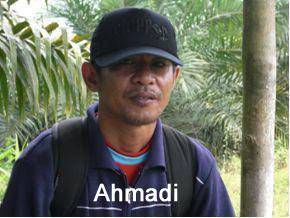
Ahmadi: Beaten up for expose
Just ask Ahmadi, a journalist working for Harian Aceh in Indonesia. Together with a fellow journalist, working for News Investigasi in Medan, he recently investigated a flood that had taken place in the Alapan district in April 2010. During their journey, they met some people cutting up logs. The journalists asked workers who owned these logs and were told that they belonged to the Alapan District Police Station and the Alapan Military Sub-District Command. Hmm…

When confronted with this information, a high ranking military officer reacted quickly and sharply: he wanted the whole story suppressed. In defiance, Harian Aceh published the story on 21 May 2010 — which resulted in Ahmadi being assaulted and threatened with death by the same officer.

“Ahmadi joins the long list of journalists who have been targeted for shedding light on deforestation, which is responsible for at least 18 per cent of the world’s greenhouse gas emissions,” says Reporters Without Borders (RSF), the international watchdog on media freedom.

It says attacks on journalists and bloggers who try to cover any kind of environmental damage are growing steadily all over the world. Among them, those who investigate industrial pollution or the destruction of forests are particularly at risk.
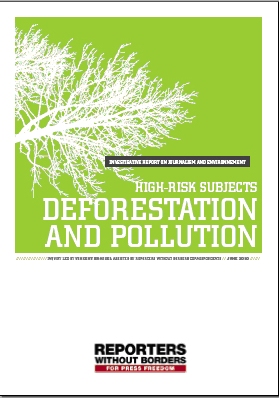
No longer a cosy beat...
This week, on the eve of World Environment Day (5 June), RSF released a new report titled Deforestation and pollution: High-risk subjects. It makes grim reading for all of us who are committed to journalism as if the planet mattered.

It follows and echoes their call last year: “We must defend journalists who expose attacks on the environment”.

The new report, the second of its kind within just a few months from RSF, was prepared with the help of its worldwide network of correspondents. They gathered information about incidents in Indonesia, Argentina, El Salvador, Gabon, India, Azerbaijan, China and Morocco. Behind each of these threats and attacks, there were big corporations, criminal gangs or government officials who had been corrupted by money from mining or logging.

Asia features prominently in the report, which condemns the responsibility of the Vietnamese and Chinese governments in serious press freedom violations that deprive the public of crucial information about cases of pollution or deforestation.

The report describes, for example, the way the government in Hanoi has tried to suppress any debate about the environmental impact of bauxite mines being operated by a Chinese company. A field investigation in Argentina established that journalists are under pressure from both supporters and opponents of a mining project.

Mining companies (Aluminium Corp of China, China Metallurgical Group and the Canadian companies Yamana Gold and Pacific Rim), oil companies (Shell, Addax and Synopec), wood pulp companies (Sinar Mas and Riau Andalan Pulp and Paper) and two French multinationals (Bollor and Areva) are all identified in this report as having a direct or indirect role in cases of intimidation or censorship.

This is the second report that RSF has published on this subject. In September 2009, a report titled “The dangers for journalists who expose environmental issues.“, looked at 15 cases of journalists and bloggers who had been killed, attacked, jailed, threatened or censored for covering environmental problems in Russia, Cambodia, Bulgaria and Brazil.

RSF this week reiterated the appeal it launched during last December’s Copenhagen Summit: The media are needed to gather information and disseminate it to the public. Where climate change was concerned, it reminded everyone one, it was the media who helped to establish credible, independent diagnoses of the state of our planet. Their analyses continue to play a crucial role in helping decision-makers to adopt policies and rules that will lead to the desired changes.

On this blog, we have consistently highlighted the need for safeguarding journalists who pursue environmental stories that threaten vested interests within and across borders. For example:

September 2009: Who will protect journalists fighting for a better planet?

November 2007: Protect journalists who fight for social and environmental justice!

In April 2007, we asked: Can journalists save the planet? Yes, they can be front-runners in the world’s attempts to save species, habitats and entire ecosystems. But only if the rest of society protects and stands by them. When our planetary house is on fire, shooting the messenger isn’t going to save anyone.

7 ‘ups’: A rough guide to engaging social media in the public interest

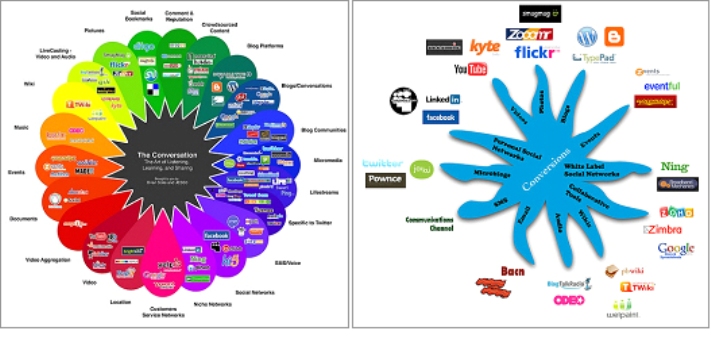
Depictions of social media: Conversations Prism (left) and Social Media Starfish

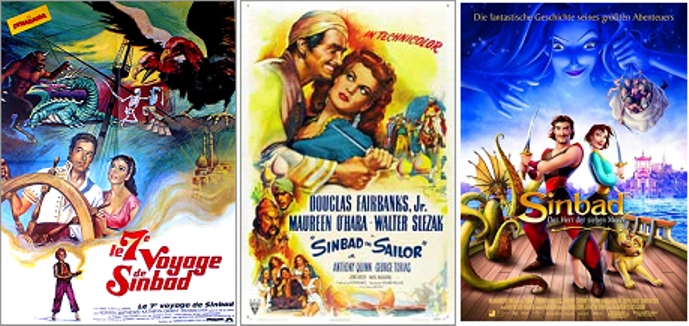
As I wrote in an earlier blog post, in the of social media, we need to be as daring and adventurous as Sinbad. Like the legendary sailor of Baghdad, we have to take our chances and venture into unknown seas. Instead of maps or GPS or other tools, we must rely on our ingenuity, intuition and imagination.

During his seven voyages in the Indian Ocean, Sinbad had fantastic adventures going to magical places, surviving assorted monsters, and encountering a host of supernatural phenomena. Armed simply with his guts, wits and wanderlust, he sailed to places where no man had gone before, and certainly none had returned alive from!

Preparing for my Beijing session last week on using social media to communicate in the public interest, I did a good deal of web browsing and online reading. I came across many attempts to map or visually depict the social media (including two shown above). I also found some interesting lists and guidelines – my favourite so far is 10 Things Your Grandmother can Teach You about Social Media.

This inspired me to come up with my own rough guide to get you started and keep you going. As a salute to Sinbad’s seven voyages, I call it the 7-‘ups’.

Turn up. As Woody Allen famously remarked, eighty per cent of success is just…showing up. You won’t get anywhere by simply observing or critiquing from the sidelines. You have to wade in and set sail — for better or worse.

• Once we join the planetary conversation, we need to do some catch up. Find your feet – and niche – in the online world. The Internet turned 40 in 2009, and its graphical interface – the World Wide Web – is now 20. So much has happened in that time – and a lot has also been superseded. You need to know what’s on, and what’s not.

What's your winning combination?
• After catching up, we also need to keep up — at least with the mega trends. Large companies like Google – as well as hundreds of individual geeks – keep releasing new applications frequently, many for free use. Popular websites (such as Wired, Mashable and their local equivalents) help us navigate through these depths and currents.

• Next one is harder. We have to give up our baggage of old habits and attitudes picked up over the years. For many Digital Immigrants, leaving the comfort zone of paper was scary enough. How can we let go of complete control over our communication products and processes? But that’s just what the social media demand. It’s not a choice, but an imperative.

• It’s also helpful – though not quite essential – if we are less glum, prim, exacting and academic in how we relate to others in social media. In short, ease up, mate! There are some basic norms for online behaviour, but crusty intellectuals or matronly bureaucrats don’t gain much traction. Keep things short, focused and simple. And hey, it’s okay to be funny, cheeky and irreverent…

• Conversations in this realm can last for weeks, months or longer. Some topics and discussions tend to have ‘long tails’. When we start something online, we have to be clear when to engage whom and how. Equally important is knowing when to shut up. (A bore is a bore, offline or online!).

• And if all this is making you feel dizzy…just cheer up: there are no real experts in this field. No one is an authority. Everything is ‘in beta’. We are all learning by doing. Neither is there a definitive road map to the social media world. In fact, in this partly Undiscovered Country, there is plenty of scope to explore, innovate and be original.

Are you a land-lubber who doesn’t trust any seas? Let me then offer you another metaphor. Think of this as hitchhiking or back-packing online. Take your chances. Be adventurous. Discover a whole new world!

We have some advantages over Sinbad. The virtual world poses no real danger to our lives. But beware: social media can be very time-consuming and even addictive.

You have been warned.

Here, for some edu-tainment, is an interesting video on social media that I found on…YouTube:

A more compact version of the 7-Ups appears in MediaHelpingMedia

Sinbad in Beijing: How to tame the many-headed hydra called Social Media

Sinbad: The legend endures, entertains...and inspires!

I have always been intrigued by the tales of Sinbad the legendary sailor. My interest is heightened by living in Serendib, destination of Sinbad’s sixth journey, which is modern-day Sri Lanka.

Being a professional story teller, I always try to connect the old world with the new. So in Beijing this week, I proposed: In the brave new world of social media, we need to be as daring and adventurous as Sinbad.

Like the legendary sailor of Baghdad, we have to take our chances and venture into unknown seas. Instead of maps or GPS or other tools, we must rely on our ingenuity, intuition and imagination.

And we have to be prepared for a potentially perilous journey where we may be lost, shipwrecked or even sunk. On the other hand, with careful planning, hard work and some luck, we may well sail into calmer seas and discover new lands and treasures – just like Sinbad did.

One thing is for sure: it’s not for the faint-hearted. There are no guarantees of success, and certainly no travel insurance…Are we ready to take the plunge?

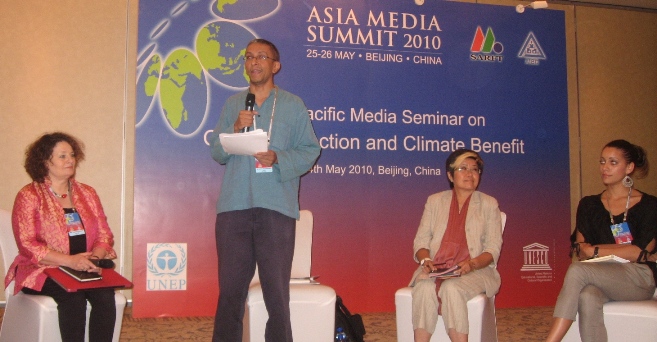
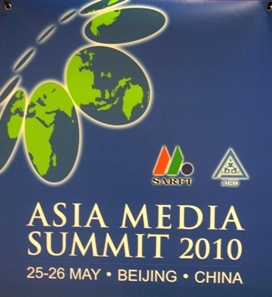
This was the thrust of my opening remarks to a panel on social media that I moderated at the Asia Media Summit 2010 in Beijing, China, this week. The panel was part of the Asia-Pacific Media Seminar on Ozone Protection and Climate Benefit, one of several pre-Summit events held on 24 May 2010.

L to R: Pauline Couture, Nalaka Gunawardene (speaking), Chutharat Thanapaisarnkit and Minna Epps

My enthusiasm for social media was not dampened by the fact that some key social media platforms were not accessible from the Chinese capital because they are officially blocked. Ah, if we aren’t allowed to walk the talk, we story tellers can still talk the talk, right?

In my opening remarks, I added:

Those of us working on development, humanitarian or social issues always have plenty of public interest messages to communicate. We are also keen to amplify grassroots voices so that policy-makers and business leaders would get a reality check.

The social media present many opportunities for all this. They offer us the potential for not just outreach, but sustained engagement. The development community has long wished for more interactive and participatory communications tools. The social media do precisely this! There’s no longer any excuse for not jumping in…

I then added the caution: It’s a big pond, and keeps getting bigger and deeper by the day. Social media is a basket that includes a lot more than (the more visible and controversial) Facebook and YouTube. According to the Wikipedia (itself an example), social media is a collective term to describe online media that is based on two key attributes: conversations, and interactions between people.

One of the many strange creatures that Sinbad encountered on his journeys was the Hydra — a many-headed serpent (or dragon). Chop one off, and two would grow instantly — a bit like how new social media applications are popping up these days!

Modern-day Sinbads have plenty of new horizons and uncharted waters to explore. Yes, it can be cacophonous, confusing, dizzy and even a bit frivolous at times. Hey, so is the real world! We need discernment in both worlds.

Social media started with the geeks, but soon spilled over to involve the rest of us. How can we — the non-geeks — come to terms with this new realm? How do we find our niche that makes us more effective communicators and agents of social change? The key to engaging this bewildering world of social media is to…just do it. And see what works.

I also introduced my own rough guide to get started and keep going in using social media for communicating public interest content. As a salute to Sinbad’s seven voyages, I call it the 7-‘ups’.

MediaHelpingMedia has just published my 7-Ups Rough Guide to using social media.

Appeal to climate reporters everywhere: Don’t follow the Climate Circus!

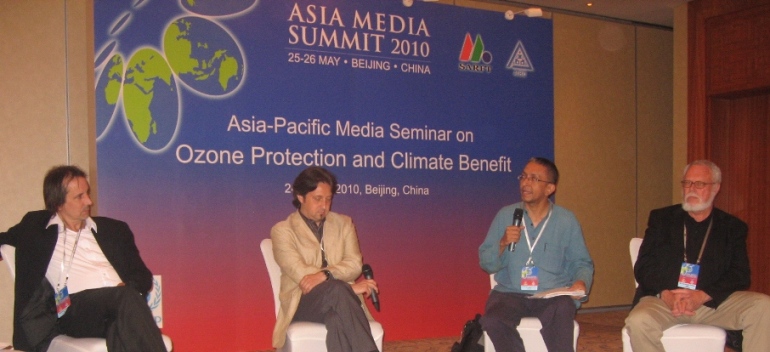
L to R: Sam Labudde (EIA); Eric Soulier (Canal France International); Nalaka Gunawardene (speaking); and Durwood Zaelke (IGSD)

Every year, a couple of weeks before Christmas, a big Climate Circus takes place. The venue city keeps changing, but the process is always the same: it attracts thousands of people – from government officials and scientists to activists and journalists – who huddle in various corners, chat endlessly and gripe often during two chaotic weeks. Then they disperse, rather unhappy with the process…only to return to more of the same a year later.

This is how I see the annual Conference of Parties (COP) of the UN Climate Convention, or UNFCCC. Their last big ‘circus’ was in Copenhagen, Denmark — when the world held its breath for a breakthrough in measures to reduce greenhouse gas emissions that warm up the planet. But, as with many previous conferences, Copenhagen over-promised and under-delivered.

The next COP is to take place in Cancún, Mexico, in December 2010. We can expect more of the same.

I’m not always this cynical. I’m certainly not a climate skeptic or climate change denialist. But I came to this conclusion after covering climate change stories for over 20 years, and having seen the kind of distraction the annual Climate Circus can produce on the media coverage and fellow journalists.

My contention: COPs were intended for treaty-signing governments to come together, bicker among themselves and make slow, painful and incremental progress on what needs to be done to address the massive problems of global climate change. While the core of these conferences remains just that, over the years they have gathered so much else — side events that now completely outweigh the political conference, and often overshadow it. I’m not convinced that this is where the real climate stories are, for discerning journalists.

I made these observations in some plain speaking done during a panel at the Asia Media Summit 2010 in Beijing, China, this week. The occasion was the Asia-Pacific Media Seminar on Ozone Protection and Climate Benefit, one of several pre-Summit events held on 24 May 2010 — and the only one on an environmental issue or topic.

I was on the last panel for the day, which looked at the next “hot” ozone and climate related stories. We were asked to give our views on: what are the great stories on the road to COP16 in Mexico at the end of the year?

Forget Cancun, I said. We already know how little it’s going to change the status quo. Why bother with that promises to be a non-event? Must we be this concerned with non-stories in our media coverage? In fact, I suggested: we should give the entire UNFCCC processes a couple of years of benign neglect. The real climate stories are not in the unmanageable chaos that the annual Climate Circuses have become. They are out there in the real world.

In the real world where frontline states and communities are already bearing the brunt of extreme weather…where green energy is making rapid advances…where communities and economies are trying to figure out how to live with climate change impacts even as they reduce their greenhouse gas emissions.

There are plenty of climate stories out there, covering the full range of journalistic interests: human interest, human enterprise, innovation, scientific research, community resilience and others. The challenge to journalists and other climate communicators is to go out there, unearth the untold stories, and bring them out in whatever media, forum or other platform.

I have nothing against climate COPs per se, and hope they can be restored to their original purpose of climate negotiations and working out acceptable, practical ways forward. (And this is certainly not a case of sour grapes: I’ve turned down all-expenses-paid invitations to COPs more than once.)

But we need to be concerned about the Climate Circus Effect on media, activist and educator groups, who seem to dissipate a good deal of their limited energies and resources in turning up at these mega-events. Copenhagen is said to have attracted over 17,000 persons (over 3,000 among them accredited journalists). How much of fruitful interaction and sharing can happen in such a setting? And when all the major news networks and wire services are covering the key negotiations and activities in considerable detail, what more can individual journalists capture and report to their home audiences?

Living as we do on a warming planet, we are challenged on many fronts to question old habits, and change our business-as-usual. The media pack has been running after the Climate Circus for over a dozen years. We need to pause, take stock and ask ourselves: is this the best way to cover the climate story?

And while at it, here’s something else for the UN, conveners of the annual Climate Circus. On World Environment Day 2008, whose theme was ‘CO2: Kick the Habit’, I asked the UN to kick its own CO2 habit. I suggested: “Adopt and strictly observe for a year or two a moratorium on all large UN gatherings (no matter what they are called – Summits, conferences, symposia, meetings, etc.) that involve more than 500 persons. In this day and age of advanced telecommunications, it is possible to consult widely without always bringing people physically together….Practising what you preach has a strong moral persuasive power — even if it goes against addictive habits formed for over 60 years of the UN’s history.”

PS: A global, comprehensive and legally-binding agreement on climate change is unlikely to be delivered at this year’s (Cancun) conference as well, the outgoing head of the UNFCCC, Yvo de Boer, was reported as saying on 27 May, just a few days after our Beijing seminar. See what I mean?

Twitterless in Beijing: Talking aspirationally about social media…

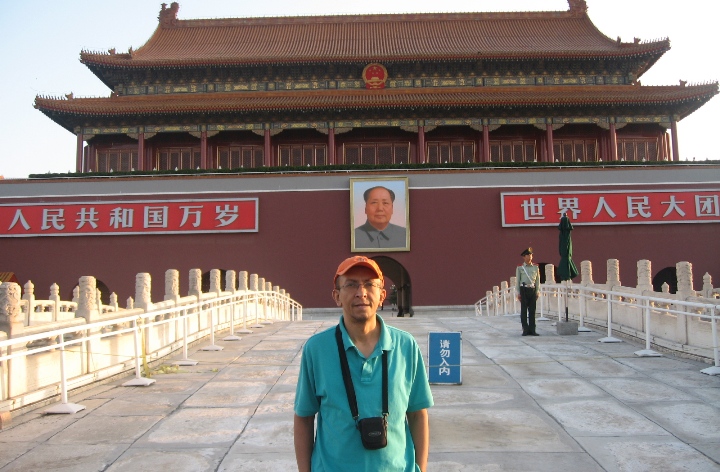
Under Chairman Mao's watchful eyes...

“Reading computer manuals without the hardware is as frustrating as reading sex manuals without the software!”

This is one of the less known, but more entertaining, dicta by Arthur C Clarke – he called it ‘Clarke’s 64th Law’, and I personally know he used to bring it up when meeting with particularly crusty or glum intellectuals. (Not all were amused.)

Clarke’s words kept turning in my mind as I moderated and spoke at a session on social media at Asia Media Summit 2010 held in Beijing China from 24 to 26 May 2010. The country with the world’s largest media market is not exactly the world’s most open or free – and certainly when it comes to social media, it’s a very different landscape to what we are used to…

These days, International visitors arriving in China discover quickly that access to YouTube, Twitter and Facebook is completely blocked. Apparently the brief ‘thaw’ in restrictions, seen before and during the 2008 Beijing Olympics, is now over — the current restrictions have been in place since the spring of 2009.

This doesn’t mean there is no social media in China. In fact, I heard from several Chinese friends and colleagues that there is a very large, dynamic and fast-evolving social media scene in China. For the most part, however, it’s not based on globally used and familiar platforms, and is happening in a digital universe of China’s own — under the watchful eye of the government.

Jump in...but some conditions apply!
For example, I found from this March 2010 blog post by Merritt Colaizzi that:
* 221 million people have blogs, largely in a diary-style.
* 176 million Chinese connect via social networking system (SNS) with their “real” friends and online networks.
* 117 million connect anonymously via bulletin board system (BBS). These interactive online message boards are the heart of social media in China. They’re where people go to find topic-based communities and where consumers talk about products and services.

There are lots of other blogs, mainstream media reports and research commentary on social media in China — just Google and see (now that’s another thing with limited – and uneven – access in China: Google itself is available, but search results come with lots of links that simply aren’t accessible). Much or all of this interaction happens in Chinese, of course. It’s a significant part of the web and social media landscapes, but if you’re in China on a short visit and want to stay connected to your own social media networks, that’s not at all helpful.

And, of course, it undermines one of the key attributes of a globally integrated information society: the interoperability of systems and platforms.

Luckily for me, perhaps, I can survive a few days without my social media fix: I have an appalling record of updating my Facebook account: days pass without me even going there. For the moment, at least, I’m also taking a break from regular blogging (well, sort of). But I’m more regular in my micro-blogging on Twitter, and visit YouTube at least once a day, sometimes more often. I could do neither during the few days in Beijing – and that was frustrating.

So imagine having to talk about social media as a new media phenomenon in such a setting. That’s only a tiny bit better than reading computer manuals without the hardware…But this is just what I did, with all the eagerness that I typically bring into everything I do. I planned and moderated a 90-minute session on Social Media: Navigating choppy seas in search of Treasures?

The session was part of the Asia-Pacific Media Seminar on Ozone Protection and Climate Benefit, so our context was how to use the social media to raise public awareness and understanding on the somewhat technical topics of ozone layer depletion and climate change (two related but distinctive atmospheric phenomena).

With access to key global social media platforms denied, we visitors and Chinese colleagues in the audience could speak mostly generically, theoretically and aspirationally. I didn’t want to place my hosts and seminar organisers in difficulty by harping on what was missing. Instead, we focused on what is possible and happening: how development communicators are increasingly social media networks and platforms to get their messages out, and to create online communities and campaigns in the public interest.

The thrust of my own opening remarks to the session was this: In the brave new world of social media, we all have to be as daring as Sinbad. Like the legendary sailor of Baghdad, we have to take our chances and venture into unknown seas. Instead of maps or GPS or other tools, we have to rely on our ingenuity, intuition and imagination.

More about the session itself in future blog posts.

For now, I want to share this TED Talk by American watcher of the Internet Clay Shirky on how cellphones, Twitter, Facebook can make history. Shirky shows how Facebook, Twitter and TXTs help citizens in repressive regimes to report on real news, bypassing censors (however briefly). The end of top-down control of news is changing the nature of politics.

PS: All this holds more than an academic interest for me, because there have been media reports in recent weeks that the Sri Lankan government is working with Chinese experts in formulating strategies for censoring internet access from Sri Lanka.

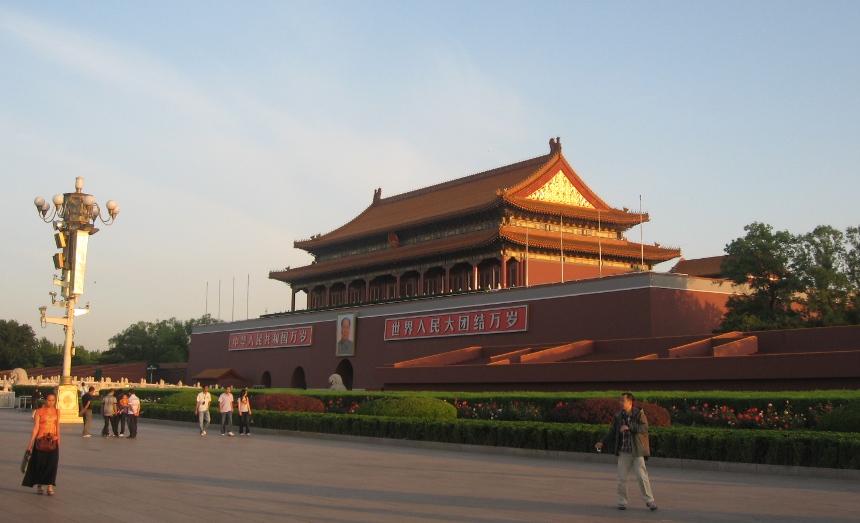
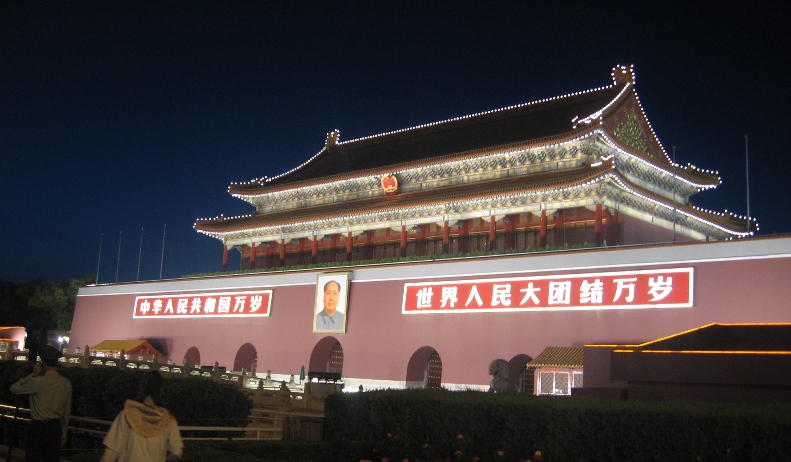
Impressions and images from Tiananmen, Gate of Heavenly Peace…

Tiananmen literally means Gate of Heavenly Peace...hmmm

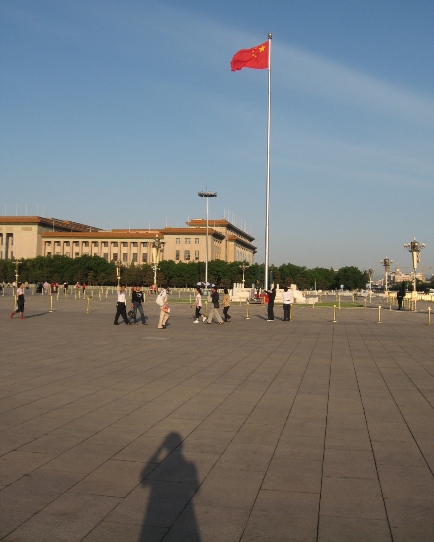
I spent several hours at the Tian’anmen Square in Beijing, China, this week, while attending a media conference. I was returning to this landmark, now a key tourist attraction in modernised and assertive China, after nearly a decade. And much has changed…

Measuring 880 metres by 500 metres, and covering a total area of 440,000 square metres, the Tiananmen Square is the largest city square in the world. But mere superlatives don’t impress me. It’s what goes on behind the claims, labels and stereotypes that interest me.

I’ve been to the square on a couple of previous Beijing visits. The first was in October 1996, during my very first visit to China. I was also taken in a group tour on a later visit. If I remember right, my last sighting of the Square was in 2002 – just before I acquired my first digital camera. (That makes a difference, because Before Digital, my analog photographs on travel were sparingly taken…and my own memory is not a very reliable storage medium.)

Day or night, he keeps vigil over Tiananmen Square...and 1.3 billion people

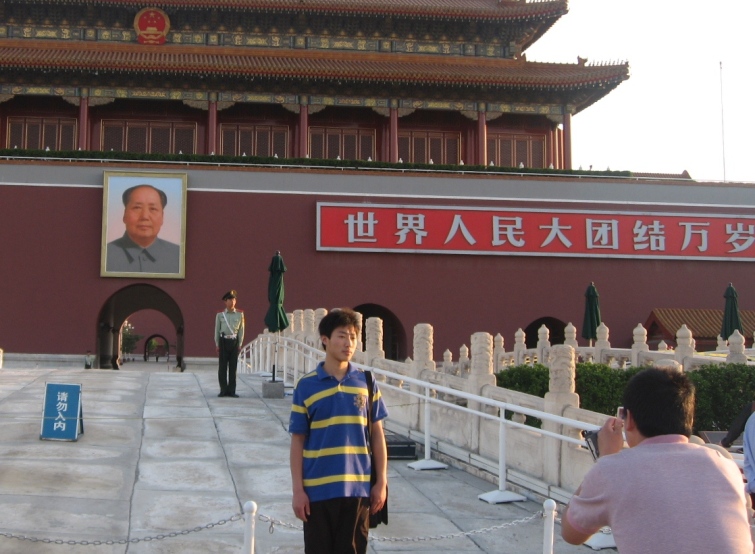
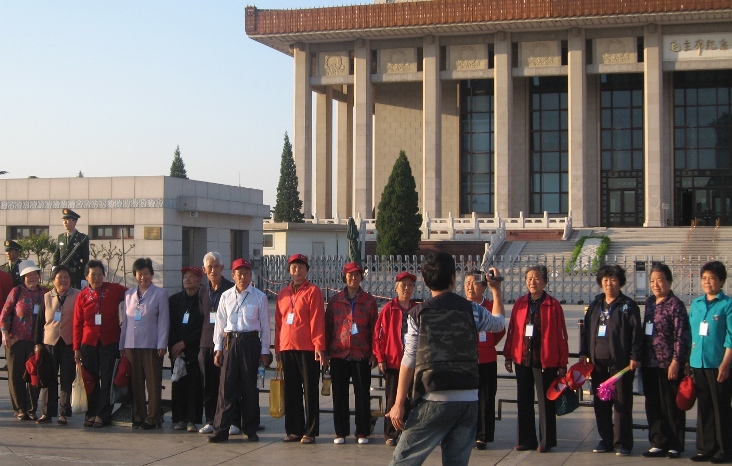
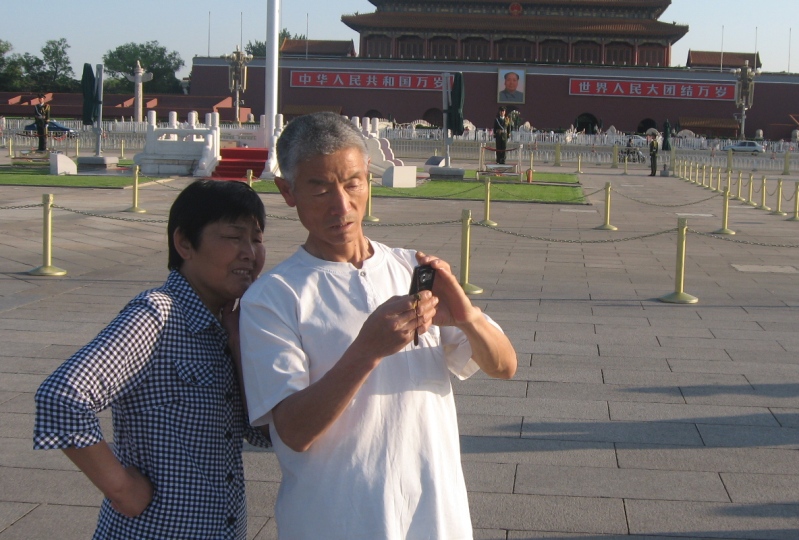
This time, I was armed with my digital camera and ample digital memory — and, it seemed, so were most other visitors! There were the obviously foreign tourists (including the loud and uninformed Americans), but it seemed most people thronging to the square were Chinese…many from out of town. For some, a visit to this centre of power is a rare occasion to be cherished and recorded.

I was impressed by just how many people were clicking away, using either digital cameras or mobile phone cameras. I shouldn’t be surprised by this, for China is the country with the largest number of mobile phones in use: by March 2010, there were some 780 million mobile subscribers, accounting for 58.5 per cent of all people in China.

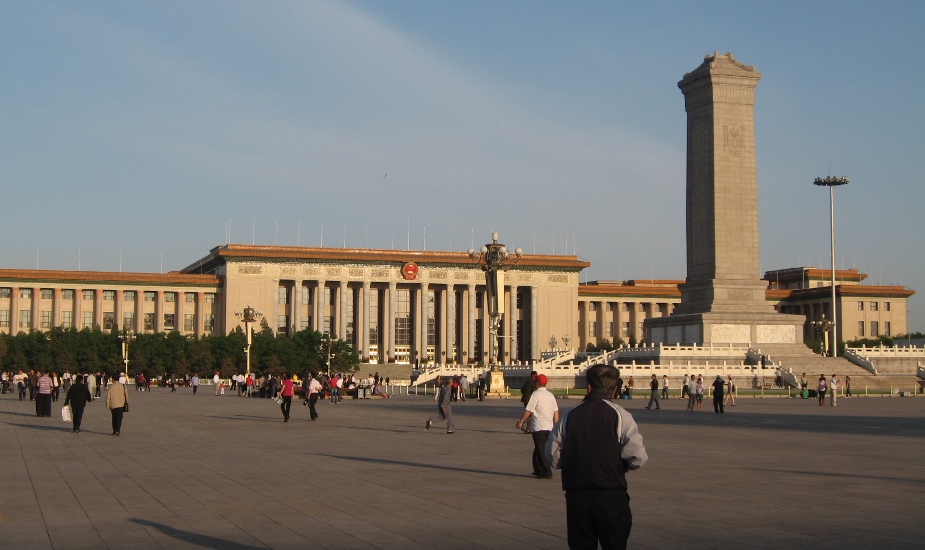
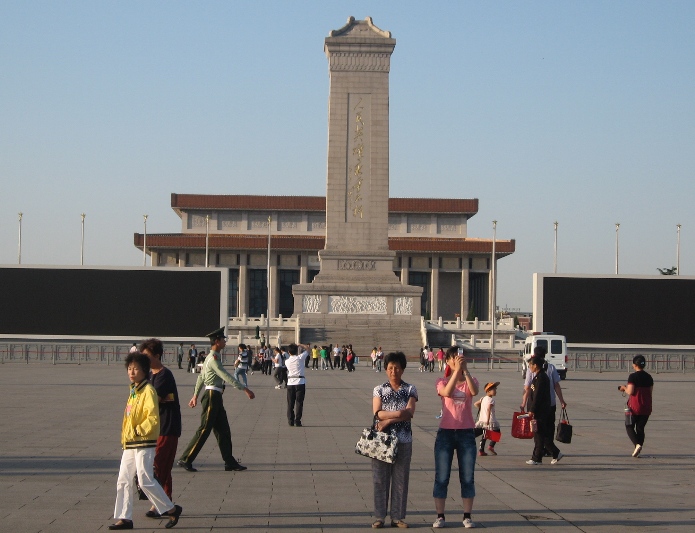
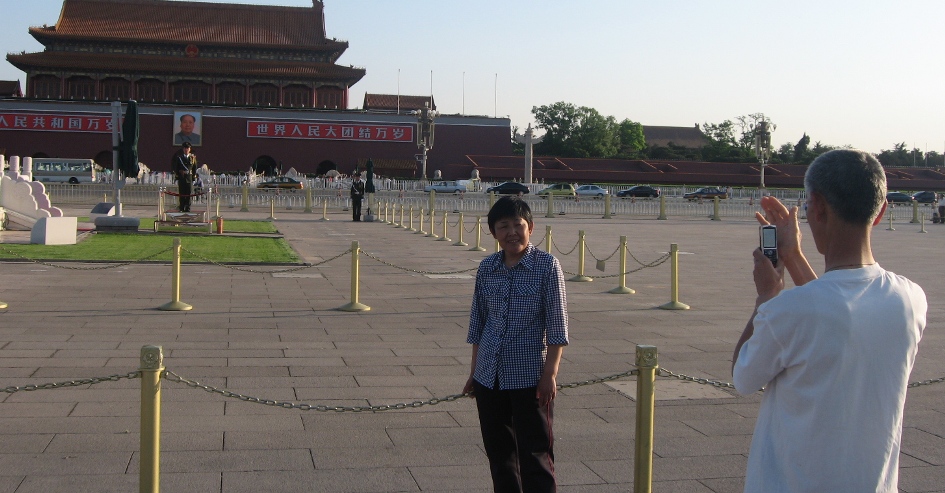
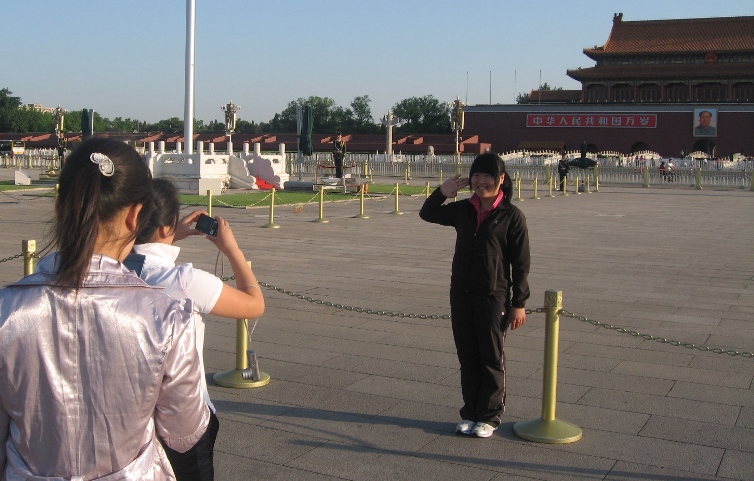
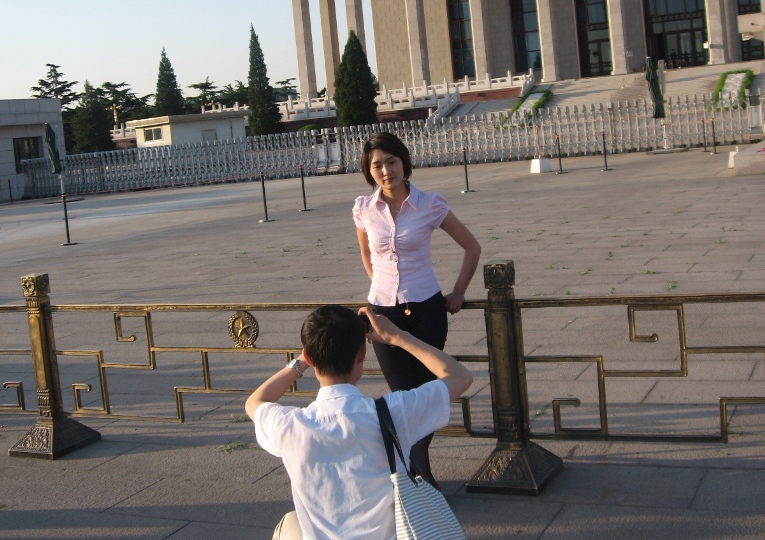
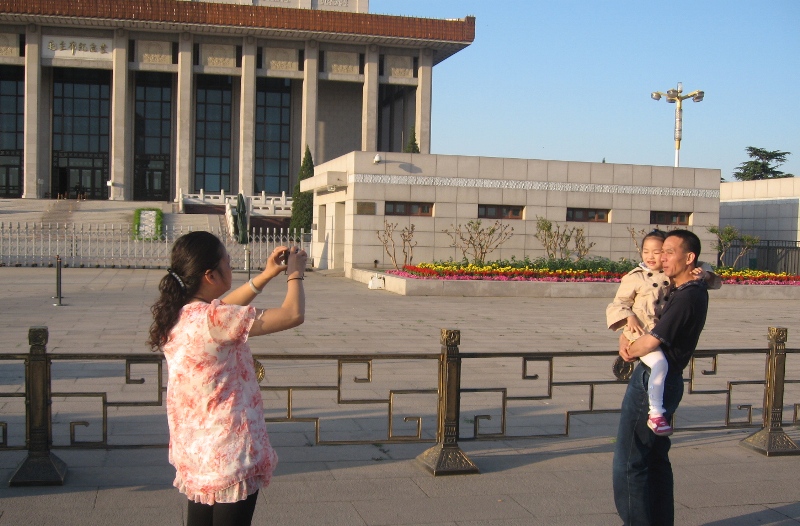
Keen to capture different scenes under varying kinds of daylight and night lights, I made three visits to the Square – including one at 5.30 in the morning to catch daybreak at the Gate of Heavenly Peace (literal meaning of Tiananmen). So here’s a sampling of my several dozen photos – this selection has a bias on people shooting each other, digitally speaking (a far cry from the kind of shooting that took place here 20 years ago).

Look serious, man - he's watching!
Now bring out your best smiles, all!
People milling about with Great Hall of the People in the background
Clicking away at Monument to the People's Heroes

One of the most striking moments I captured was of this elderly couple, very dignified and sprightly in their outlook, as they were taking a stroll on the square early morning and capturing memories on their mobile phone. They are old enough to have known another reality, but this was now and here…

This Square, and we, have seen and heard much in our time...
Did we get it alright?

I also noticed how the younger visitors were clearly at ease with digital technologies, just like their fellow Digital Natives elsewhere in the world. There is also a discernible easing up (not only among unknown people in public places, but also noticeable among older and younger Chinese friends I have): maybe it’s the exuberance of youth, but the NextGen Chinese don’t seem to be as somber and serious as their parents.

Or perhaps the younger people in China today just have more things to smile about?

Would Chairman Mao approve this pose, eh?
Heaven is in the eye of the beholder...
Digital Natives capturing memories for the Next Gen

It was a rushed visit of four nights and three days, so all my impressions are fleeting. They don’t begin to do justice to the nuanced complexity that is modern China. But they tell me one thing: even in a land with a proud history of over 5,000 years, ten years can still make a difference.

Bye for now: I take only photos, and leave only shadows behind...

Note: All photos were taken touristically for my own memory and personal archives, with no other intention.

What’s the point? Taking a break in search of answers…

This Blogger has gone in search of answers. Back...whenever

“The long run is a misleading guide to current affairs. In the long run we are all dead.” – John Maynard Keynes

I’m taking a break from blogging and other forms of public engagement. When I come up for fresh air, I might occasionally tweet – see the twitter feed on the right hand column for such output, but again, don’t bank on it. I have to sort out some Big Ideas in my mind, and seek answers to compelling questions.

Every blogger needs a break. This is mine. We’ll be back as soon as….inspiration permits.

Meanwhile, read this essay that asks – and answers – the Big Question: Is Life Worth Living?

Beware: A planet drunk on oil, now ruining itself…

Who spilled our oil?

A monstrous oil spill is gushing as much as 2,500,000 gallons of crude a day into the Gulf of Mexico.

This disaster is expected to be catastrophic for the land and people in the gulf. The oil has already reached land, contaminating wildlife sanctuaries. Authorities are so concerned about the impacts of more oil reaching land that they are prefer to set the gulf on fire, burning as much of the oil as possible.

Meanwhile, the fossil fuel industry is raking in windfall profits. BP, which operated the sunken rig, more than doubled its first quarter profits in 2010 to $5.65 billion.

I’ve just signed an urgent petition at Avaaz.org urging U.S. law-makers to overturn plans to expand offshore drilling. As the latest massive oil spill shows, offshore drilling isn’t safe or clean. The world needs clean energy investment to tackle climate, not expansion of dangerous and dirty energy sources.

Addressed to President Obama and members of Congress, it reads, simply: “We urge you to permanently call off plans to open up more of the US coastline to dangerous offshore drilling. Instead, invest in a clean and safe energy future.”

As Avvaz.org notes, “Before the spill, U.S. President Obama and Congressional leaders were planning to ramp up offshore drilling. Now, with the spill, the politics have shifted — and an opportunity has opened for the world’s biggest historical climate polluter to shift away from oil and towards climate-safe energy sources. At a moment like this, when leaders are making up their minds, the world’s voices can help tip the balance.”

Let’s hope it works – but the world is so addicted to its oil, and the petro dollars are so powerful – don’t hold your breath on this…

Read my blog post from March 2009: Mixing oil and water: Media’s challenges in covering human security

BBC Analysis, 6 May 2010: Gulf oil spill washes up on political shores

Remastered Star Trek – The Original Series (TOS): A treasure worth waiting for!

I haven’t been blogging much during April. One reason is that I’ve been travelling across space — and time.

I was in London for 10 days, and with its lovely Spring weather, I had every reason to be offline. I’ve also been spending a good deal of time back in 1966-67, and having a great deal of fun doing so. (The 1960s had a charm of their own that’s never been repeated…)

Let me explain. I’ve been watching the digitally remastered original Star Trek episodes, which had their first broadcast in that now far-away year — the same year I was born. And what an exhilerating experience to go back to these superbly crafted stories: they offer me both timeless mental stimulation and a sentimental journey to my own childhood/boyhood.

I’d heard of the digitally remastered DVDs’ release a couple of years ago, and was delighted when I found the last copy of Season 2 in a DVD store in Amsterdam in late March. The remastered episodes look and sound crisp, thanks to digitally restored imagery and audio. But the more daring work involved updating the shows’ visual effects with CGI to bring them more in line with the look and quality of later Trek efforts. That’s proving to be a real treasure – well worth waiting for…

As the promotional blurb reads on Amazon.com: “Star Trek, the NBC series that premiered on 6 September 1966, has become a touchstone of international popular culture. It struggled through three seasons that included cancellation and last-minute revival, and turned its creator, Gene Roddenberry, into the progenitor of an intergalactic phenomenon. Eventually expanding to encompass five separate TV series, an ongoing slate of feature films, and a fan base larger than the population of many third-world countries, the Star Trek universe began not with a Big Bang but with a cautious experiment in network TV programming. Even before its premiere episode (“The Man Trap”) was aired, Star Trek had struggled to attain warp-drive velocity, barely making it into the fall ’66 NBC lineup.”

To boldly go where no man has gone before...

As I’ve said before, I’m as old as Star Trek: we were born a few months apart in 1966 (I’m older by seven months). But because we grew up on opposite sides of planet Earth in the pre-Internet era, our worlds didn’t collide until we were both well into our teens.

I have vivid memories of that delightful first encounter, which changed the course of my life forever. In mid or late 1982, Sri Lanka’s newly launched national TV channel Rupavahini started airing a space adventure series called Star Trek. Although I was already familiar with Star Wars movies (of which two had been made by then), I’d not heard about Star Trek until the publicity accompanying the local broadcast.

Star Trek (the original series, now abbreviated as TOS) aired on my local TV – we had just two channels back then – on Wednesdays from 7 to 8 pm, which was prime time just before the evening news at 8. I remember the series ran for at least a year, during which time around 50 episodes were broadcast. I managed to watch most of them.

That wasn’t as easy as it sounds. Our household didn’t yet have a television set, so I had to go across to my aunt’s house next door to watch Star Trek. My school teacher parents took a long time to warm up to the new medium – we didn’t acquire a TV set until early 1983, almost four years after TV was introduced to Sri Lanka in April 1979. And because they placed such emphasis on studies, I was allowed only an hour of television per week. I have absolutely no regrets that while it lasted, I devoted my entire weekly TV quota for Star Trek.

So every week at the appointed time, the United Star Ship Enterprise and its intrepid crew took my young mind roaming around the universe, providing me a welcome escape from the dull and monotonous routine of my teenhood. Even today, hundreds of movies and many thousands of TV hours later, I can just close my eyes and instantly replay in my mind the evocative theme narration and music of Star Trek TOS:

I sat awestruck by the adventures of Captain James T Kirk (played by William Shatner), First Officer Spock (Leonard Nimoy), chief engineer Lieutenant Commander Montgomery Scott (James Doohan), Dr. Leonard “Bones” McCoy (DeForest Kelley), Communications Officer Uhura (Nichelle Nichols) and others. The stories appealed to me as much for insights into the infinite possibilities (and combinations) of life, technology and power at a cosmic scale, as for the glimpses of the near-Utopian human society in the 23rd century.

See May 2009 blog post: Star Trek: Advocating a world of equality, tolerance and compassion

The series was already 15 years old, and it was showing signs of age. It had the faded Technicolor look and feel of films and TV programmes made in the 1960s and 1970s. The sets were basic and special effects appeared simple — computer-generated images (CGI) was not yet invented. On such technical merits, Star Trek TOS appears elementary when compared to the original Star Wars movie that would roll out just a decade later, in 1977. (A decade is a very long time in the entertainment industry.)

But what the series lacked in looks, the show more than made up in its brilliant story lines and rich imagination. Inadequacies in production values didn’t really matter to me — or to millions of other ‘Trekkies‘ scattered across the planet. The storylines were entertaining and mind-stretching, frequently carrying concepts distilled from the finest in science fiction literature (in fact, some of the genre’s accomplished writers were involved in writing stories for the series, e.g. Robert Bloch, Normal Spinrad, Harlan Ellison and Theodore Sturgeon). The characters were strong, diverse and played by actors who soon developed global fan clubs of their own.

And now, I can relive those journeys again — this time at my leisure, packing as many, or as few, into my private screening schedule. No broadcaster or parent holds me captive any more.

Here’s how the digitally remastered version of the same series opens (aficionados, please spot the differences):

And here are a couple of comparisons between the old and remastered versions that fans have done and released on YouTube:

Of course, remastering a series held in such awe and regard by millions of fans worldwide was a calculated risk.

As Wired noted in a December 2008 story: When Star Trek designer Mike Okuda began remastering the original Star Trek episodes for a series of DVD releases, there was a chance that the show’s more devoted fans would want him beamed to a Klingon prison planet for altering the 1960s classic. To guard against this, Okuda insisted that the new effects would have to be closely based on the originals to retain the visual spirit of the ’60s series.

Wired, December 2008: Star Trek Tweaker Talks Perils of Remastering Original Series

We’re grateful to Mike Okuda and everyone else on the remastering team for giving us the best of both worlds.

Star Trek designer Mike Okuda

London: The skies are alive again with…planes and vapour trails!

With the British air space being reopened last night for flying after six days, the skies over London roared back to life today, 21 April 2010. It was the first full day of flight operations since the airborne ash from Eyjaffjalljokull (a glacial volcano in Iceland) triggered the first ever shut down of air space over Britain – and later several other countries in western Europe.

Stranded with tens of thousands of other air travellers in London, I’ve been watching the situation unfold and following the debate between airlines, British Met Office and the aviation regulator (which ordered the shut down on safety grounds on April 16).

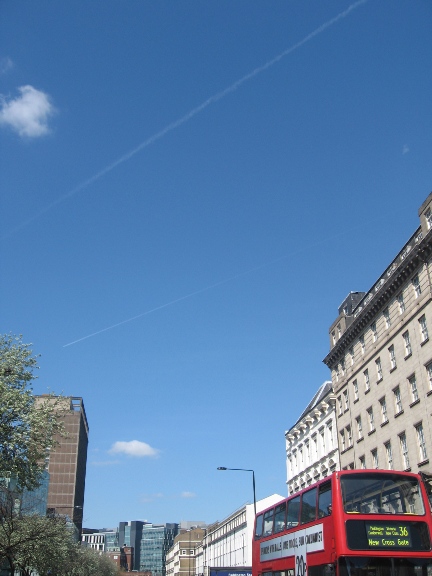
London (and much of Britain) rolled out near-perfect Spring weather in the past few days — clear blue skies and warm, sunny days. But one thing was conspicuously missing: no aeroplanes flying overhead, and no vapour trails drawing temporary lines in the sky.

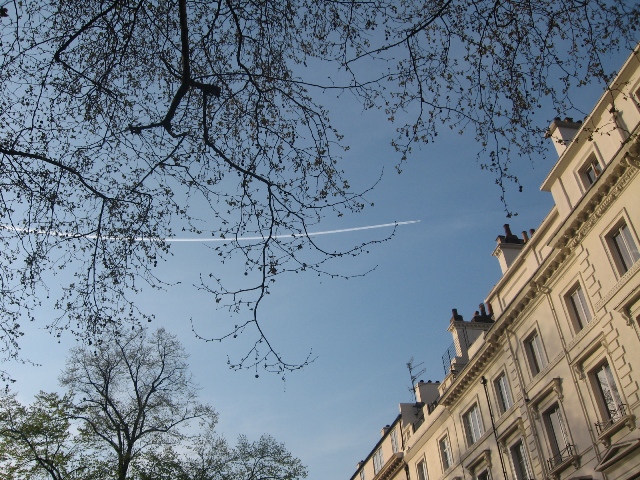
Vapour trails mark the return of flights to London skies, 21 April 2010
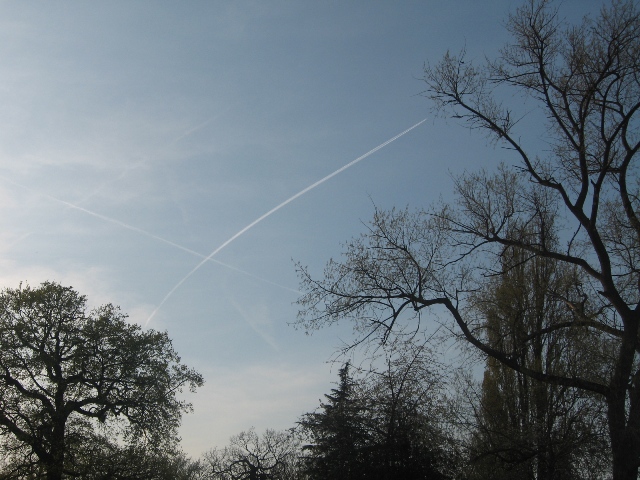
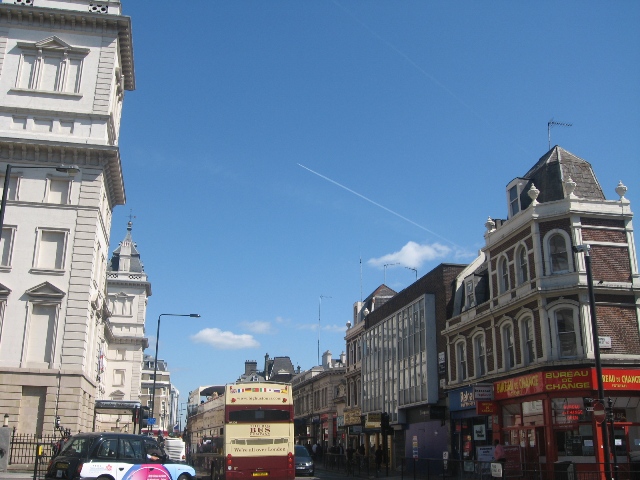
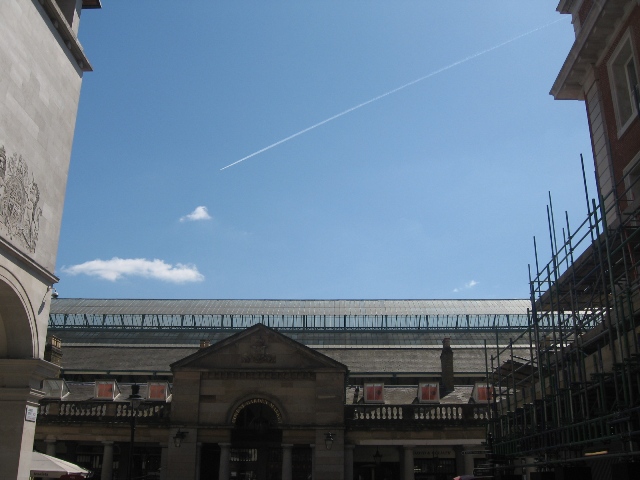
Contrails (“condensation trails”) or vapour trails are artificial ‘clouds’ made by condensed water from the exhaust of aircraft engines. As the hot exhaust gases cool in the surrounding air, they sometimes (but not always) produce a ‘cloud’ of microscopic water droplets.

Today, the planes and their vapour trails were back in abundance. It looked almost as if the trails were the airline industry’s way of sticking their tongue out at the aviation regulator, who is now under immense public and media pressure over its conduct in this incident.

The Evening Standard today ran its front page photo of Andrew Haines, head of the British Civil Aviation Authority whose decision is estimated to have caused losses totalling over one billion Pounds to travel industry and others dependent on air travel services. Their headline: “The man who shut the skies: Aviation chief accused of flights ban blunder”

That debate will rage on for many days to come. Meanwhile, I’m hoping I can fly back home, belatedly yet soon. While waiting to hear that news, I walked around Central London today clicking images of life on the ground and vapour trails across the lovely blue skies. Here are a few — taken in Leicester Square, Convent Garden, Paddington and Hyde Park.

Vapour trails over Hyde Park London, 21 April 2010
London skies over Paddington, 21 April 2010
London skies over Convent Garden, 21 April 2010