Where are all the women cartoonists hiding?

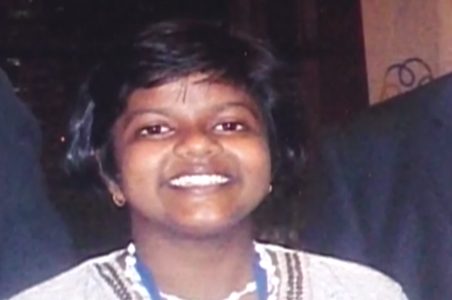
Shamanthi Rajasingham receiving her first prize in climate cartoon contest Sri Lanka

“So how many women cartoonists are working in our newspapers?”

My daughter Dhara, 13, asked me this simple question earlier this month when I was involved in judging Sri Lanka’s first contest of cartoons on climate change, organised by the British Council and the Ken Sprague Fund of UK.

I tried to come up with an answer, and couldn’t think of a single woman cartoonist who works for a print or online media outlet in Sri Lanka. That, despite my long association with the media and also being a great admirer (and collector) of good cartoons.

Later that day, at the awards ceremony for winning and commended climate cartoonists, I posed the same question to leading Lankan cartoonists Wasantha Siriwardena, Winnie Hettigoda and Dharshana Karunatilleke. They too couldn’t name one immediately; later, a single name was mentioned but it’s not one I recognised.

Clearly, cartooning is still a very male dominated profession — but that might soon change, going by the active participation of young women in the climate change cartoon contest.
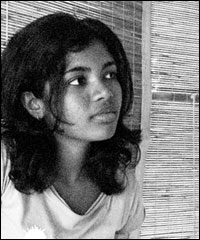
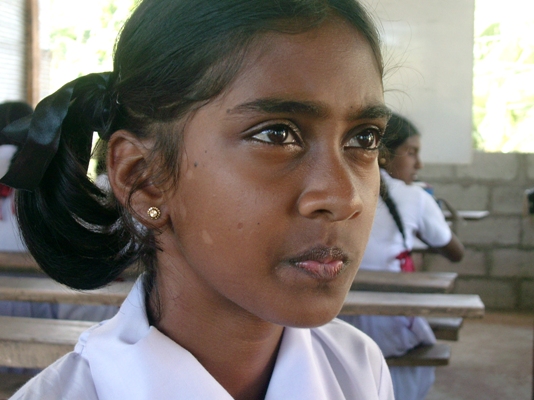
Shamanthi Rajasingham
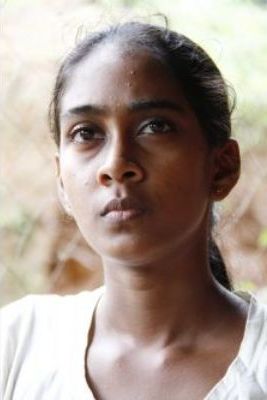
In fact, the first and third prize winners were both women — respectively Shamanthi Rajasingham and W M D Nishani. They beat close to 200 other contestants to get there.

Additionally, there were 6 women among the 22 commended cartoonists, and one woman among those 11 who were highly commended — judged on four criteria. See all winning and commended entries.

W M D Nishani
Okay, the four judges were all male (among us, two professional cartoonists). But during this entire judging process, the identity of artists was withheld and we only knew each entry by a number. In fact, we discovered the names (and gender) of artists only at the awards ceremony.

This would be encouraging news to Dhara and all other aspiring young girls and women who want to pursue careers in media. Let’s hope at least some of the women contestants in the climate cartoons contest would end up being more than just hobby cartoonists…

Meanwhile, it’s not just Sri Lanka that has a shortage of women engaged in cartooning, and awareness of their contribution is lacking. A quick Google search brought up a book titled “The Great Women Cartoonists” by Trina Robbins (Watson-Guptill Publications, 2001). Reviewing it in TIME, Andrew D Arnold wrote: “Name three women cartoonists who worked from 1900 to 1950. Okay, just name one. Couldn’t do it? Neither could I until reading a new, invaluable book…”
SOS from the Next Generation: “We need Good Parents!”

Market forces suspended here?

“Good parents are sooo hard to find these days!” exclaimed my teen-aged daughter Dhara recently. She was talking with her tongue firmly in her cheek — I hope!

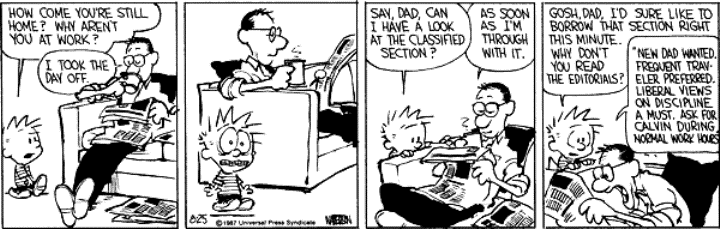
In recent days, she’s been re-reading our collection of Calvin and Hobbes books, where the world’s most cheeky six-year-old keeps making wisecracks about his own mom and dad (‘Your approval ratings among household six-year-olds are way down’, ‘When are you standing for re-election, dad?’, etc.).

But Dhara’s light comment rang true, generally speaking. As every parent discovers sooner or later, parenting is a 24/7 job that lasts for two decades or longer. There’s no help desk or emergency number we can call. It’s more an art than a science, for which there is no comprehensive, fail-proof guide — even though plenty of advice is available on TV and online (some of it better than others).

Generic advice is helpful but not sufficient. Every parent-child situation is unique, and every parent has to find what works for him or her…ideally, the two parents working in tandem.

Does parenting come naturally? If only it did! I don’t believe in this grandma-knew-best kinda romanticising. For sure, some in our grandparents’ generation got it right, but there were also many who never did.

For something so consequential for the future of our species, there’s no minimum age or entry level or qualification. (As Dhara occasionally asks me, “You didn’t have to take any exam for this job, did you, dad?”. Come to think of it, I didn’t — although, in my case, I did give it a lot of thought first. Honest!)

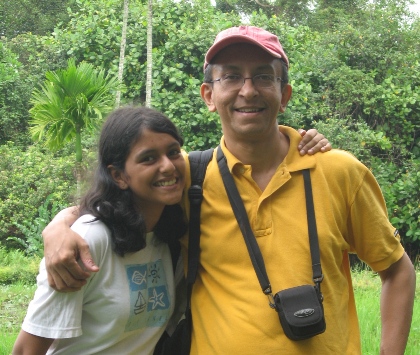
Dhara with her dad-for-life, Jan 2010
Geeks express it a bit differently. “A human being is the best computer available to place in a spacecraft. . . It is also the only one that can be mass produced with unskilled labour,” said the German-American rocket scientist Wernher von Braun, the brains behind the Apollo project that landed men on the Moon.

Although I can’t vouch for its authenticity, a similar quote from the mid 1960s is attributed to the US space agency NASA: “Man is the lowest-cost, 150-pound, nonlinear, all-purpose computer system which can be mass-produced by unskilled labour.”

I don’t like their cynical analysis of something far more nuanced than their usual hardware and software. But they got a point there. Biomedical sciences have advanced much since the Moon landings, and today some medi-geeks are trying to ‘play God’ in creating life in a lab. I’d like to see how they can get a machine to mimic the 20+ year parenting process…

Making babies may be accomplished by unskilled humans in the right age, but raising babies is most decidedly a high skill, high intensity and highly demanding job. Especially in this day and age, when many kids are more tech savvy than their parents: the Digital Natives can easily run virtual rings around their Digital Immigrant parents.

We have to watch out, though, to listen carefully to what our children are saying to us — and also about us!

By the way, as one of my favourite authors, Roald Dahl, reminded us, “To children, all grown ups are like giants — who tell them what to do all the blooming time!”. (The worst parents in my mind are also created by Roald Dahl’s imagination: Mr and Mrs Wormwood, in his 1988 novel Matilda, which was adapted into a movie in 1996. In the movie, Papa Wormwood tells the precocious little Matilda: “Listen, you little wiseacre: I’m smart, you’re dumb; I’m big, you’re little; I’m right, you’re wrong; and there’s nothing you can do about it!”).

The bottomline: am I a good parent? It’s not for me to judge — but I try hard being one. It isn’t an easy act for anyone, and especially for a single parent that I now am.

Someday, I hope, the one-woman jury won’t be too harsh on me…and may she never need to advertise for a replacement.

Afghan boy with a plant: Reza Deghati on nurturing a culture of peace

Capturing the hopes of a nation...

Every photograph has a story behind it, if only we care to ask – or dig deep enough. In October 2007, I wrote about a now iconic photo showing an old Nepali man (Ram Bahadur Tamang) holding a video camera. That image is the logo of Film South Asia festival.

From Reza Deghati, the renowned Iranian-French photojournalist (who works under the name Reza) comes another story – this time from Afghanistan, where the above photo was taken in 1990.

Reza recalls how the photo was taken: “In 1990, the United Nations asked me to put aside my cameras in order to run a humanitarian program in an Afghanistan recently freed from Russian occupation. I had to open a route for wheat shipments needed to feed the population in the Northern Provinces. Eleven years of war against the Soviet Army had devastated the country. Fields lay fallow, roads were impassable, mined or destroyed, and buildings like hospitals and schools were nothing but ruins. I could have given away the wheat. Instead, I decided to barter it for work so as to avoid one of the unfortunate consequences of some humanitarian programs that foster dependence rather than offer new ways to live. Throughout the Province, a new army took shape. This time, men did not carry rifles but shovels.”

“I remember seeing a young Afghan boy coming out of school one day, holding a plant in his hand. He had been watering it carefully. A shoot had sprouted out. I took a picture of him, and asked: ‘What are you going to do with this plant?’ His answer….’I am going to make a tree with it’.

Reza Deghati, photo by Ali Khaligh
Looking back, Reza thinks this may have provided part of the inspiration for setting up Aina, a third-generation humanitarian association that he founded in 2001 in Taliban-free Afghanistan.

Aina now works in Afghanistan, “contributing to the emergence of civil society through actions in the area of education (particularly focusing on women and children), information and communication.” It promotes independent media development and cultural expression as a foundation of democracy.

Reflecting further on the power of images, Reza says on Aina website: “In the early 80s, I discovered wars and the harshest moments of the world as a young photojournalist. I could not just stay there as a mere witness. I was led into thinking over conflicts, repressions, exodus and their burden of known pain, answers as well. As canon roars fade, urgency requires tangible reconstruction. An army of shovel-carrying men starts marching, determined to erase any remaining sign of ruin. Others take care of suffering bodies. Yet, there is an invisible destruction, only known to wounded dignities, that can ruin physical rebuilding efforts in a country and keep it from recovering.

“Those who are not given any intellectual and cultural weapons will go back to their unique reference. The culture of war fosters war. That is how Aina was founded. A third-generation association, Aina has been working on independent media development and culture, everywhere freedom of speech has remained a fragile value. It provides logistical support, state-of-the art technology access and local media and cultural actor training.”

Reza adds, optimistrically: “Today, Aina is like that plant. I hope that it will become a tree of culture, peace and freedom in Afghanistan…”

Cartooning on climate change: Young artists rise to the challenge

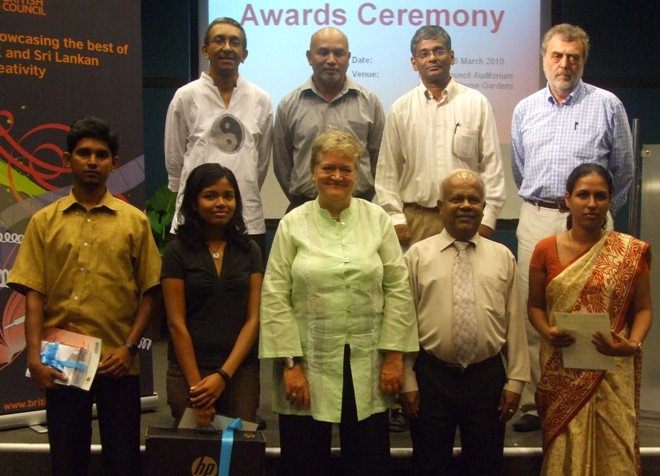
Cartoon contest top prize winners with British Council director and chief guest (all front row) and four judges (all back row) at awards ceremony, Colombo 6 March 2010

Man-made climate change is a complex planetary phenomenon. It has multiple causes and effects – not all of it immediately evident. Different areas of the world are going to be impacted differently and unevenly. Human response to the climate challenge has been patchy, and is mired in so much denial, rhetoric and political posturing.

So how do we capture this multiplicity in visual forms? Photographers go for the evidence and authenticity. Film makers work on both current impacts and future scenarios. What about cartoonists – who have to do their visual metaphors in a limited space that is static and two-dimensional? How much of climate change’s nuance and complexity can they really grasp and convey?

The short answer is: a great deal. On this blog, I’ve written that when it comes to cartoons, less is definitely more. Take, for example, many millions of printed words and probably thousands of minutes of airtime generated around the (over-hyped and under-performing) Copenhagen climate conference in Dec 2009. As I noted in blog posts on 17 Dec, 18 Dec and 21 Dec 2009, it was assorted cartoonists from around the world who summed it all up in a few perceptive strokes. This is why I keep saying that when it comes to commenting on our topsy-turvy times, no one can beat cartoonists for their economy of words.

In late 2009, the British Council and the Ken Sprague Fund of UK organised a cartoon contest on climate change which was open to all Lankan citizens from 18 to 35 years. They offered attractive prizes for anyone who could be ‘seriously funny’ about this global crisis. The participants could submit entries under 6 themes: drought and water shortage; deforestation and rain forest destruction; melting of the ice caps; role of industry in polluting the atmosphere; devastation of our seas and disappearance of marine life; and climate change in an urban environment.

Some 400 entries were received from 175 contestants (each person could submit up to 5 entries) – which surprised and delighted the organisers. During the past few weeks, I have been involved in judging these cartoons to select the top winners and commended entries. Joining me in this enjoyable task were nationally recognised professional cartoonist Wasantha Siriwardena and environmentalist Nimal Perera. We worked with a British counterpart, top cartoonist Michal Boncza Ozdowski.

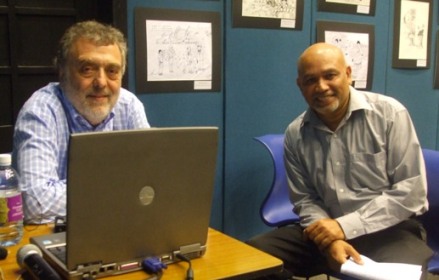
Michal Boncza Ozdowski (L) and Wasantha Siriwardena conducting cartoon workshop
The winners were announced, with awards and certificates, on 6 March 2010. It coincided with a half-day workshop on cartooning conducted by Michal and Wasantha. The chief guest at the ceremony was Camillus Perera, the seniormost Lankan cartoonist still professionally active.

As national judges, we looked at close to 200 cartoon entries that conformed with the contest’s published rules for eligibility. Since comparative ranking of creative works is never easy, we first agreed on four criteria for assessing the very diverse entries: cartoon value and humour; subject relevance to climate change (defined broadly); how effectively the climate related message was being communicated; and clarity and artistic merit of the entry.

Our initial judging coincided with the climate circus in Copenhagen, when we narrowed it down to a shortlist of 40 entries. We then individually scored these cartoons for each of our four criteria. We sometimes had to discuss and demarcate how far the scope of the contest could stretch. For example, when is an entry a good work of art but not a cartoon (more like a poster)? And what are the acceptable limits in the thematic or subject coverage of a vast topic like climate change?

The British Council later shared the full shortlist with Michal Ozdowski, who provided his own rankings and comments. We met again in February 2010 to discuss and reconcile our rankings — and found that our separately done rankings broadly agreed! (Note: During this entire judging process, the identity of artists was withheld and we only knew each entry by a number. In fact, we judges discovered the names only on the day of the awards ceremony, to which all shortlisted contestants were invited.)

Additionally, Michal kindly offered crisp comments about the top three winners, which became citations at the awards ceremony. So here are the winners of climate change cartoon contest 2009:

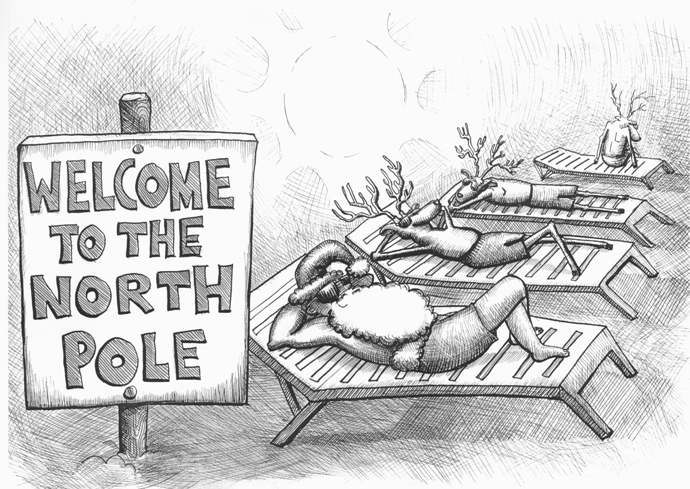
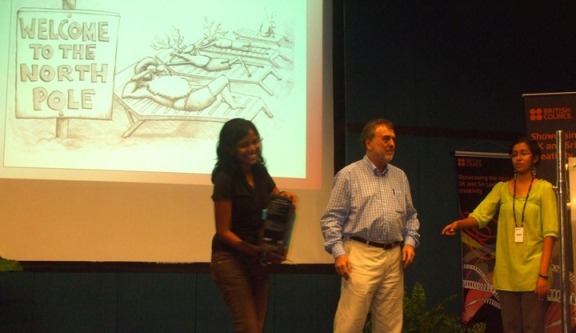
First prize: Welcome to the North Pole! By by Shamanthi Rajasingham

First prize winning climate cartoon - by Shamanthi Rajasingham

Citation for first prize: It is uncomplicated – a great advantage when satirising. Its composition is strong and imaginative, the draughtsmanship confident.

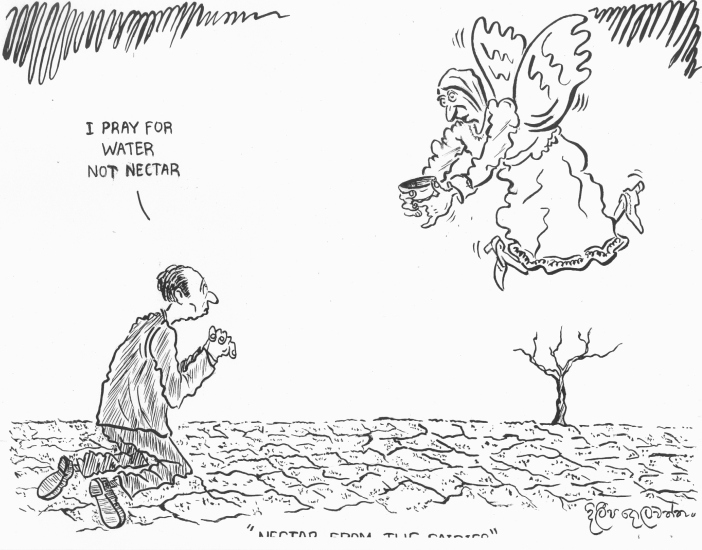
Second Prize: “I pray for water, not nectar” by Dileepa Dolawatte

Second prize winning climate cartoon by Dileepa Dolawatte

Citation for second prize: Apart from the vibrant and highly accomplished draughtsmanship, it lampoons brilliantly the fairy’s naivety – a funny eye-opener. Incorporates very cleverly traditional beliefs and myths. Here we are truly past the dodgy miracles stage in the climate change battles…

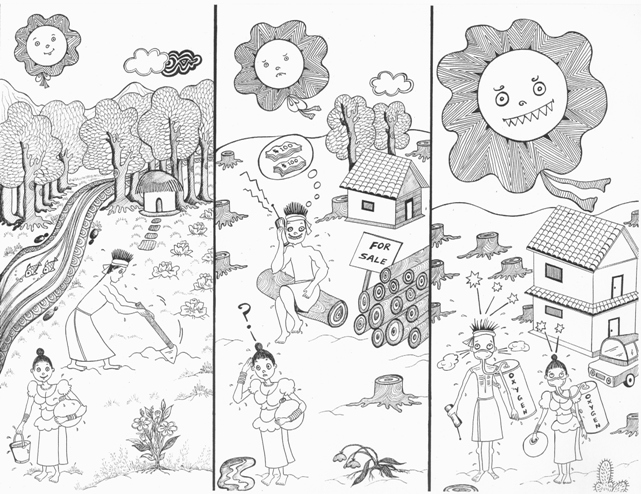
Third Prize: Theme – Drought and water shortage, by W M D Nishani

Third prize winning climate cartoon by W M D Nishani

Citation for third prize: An eloquent, if over-didactic, strip cartoon – could be quite effective in women’s publications. Coherent draughtsmanship catalogues effectively the woes of a ‘get-rich-quick’ development.

See all the highly commended and commended entries on the British Council website.

Back to school for 2010: Beware of friendly new-comers!

Schools across Asia are re-opening this week after the Seasonal holidays. In some countries, as in Sri Lanka, it also marks the beginning of a new school year (we summer-less folks follow the calendar year).

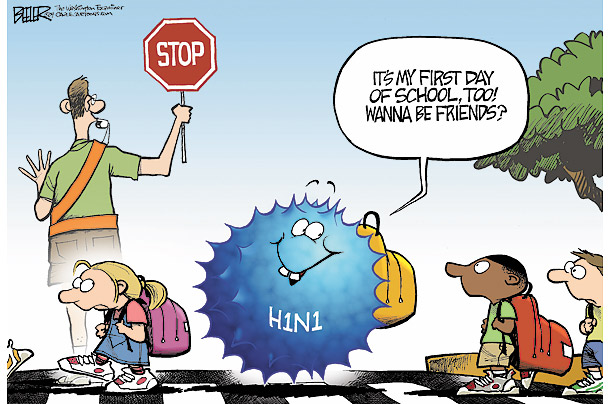
So I want to share this great cartoon, recently drawn by Nate Beeler, the award-winning editorial cartoonist for The Washington Examiner.

New kid on the block?

This is no laughing matter. According to WHO, as of 27 December 2009, worldwide more than 208 countries and overseas territories or communities have reported laboratory confirmed cases of pandemic influenza H1N1 2009, including at least 12220 deaths.

The WHO director-general, Margaret Chan, said on 4 January 2010 that the swine flu — influenza A(H1N1) — pandemic may not be conquered until 2011.

So watch out – but just how do we get kids to stop being…kids?

I still haven’t figured that out. Have you?

Blog post in May 2009: Good communications to combat swine flu?

Plastics-free 2010? No laughing matter, says comedian Tim Minchin

For the first time this Season, I didn’t receive a single paper-based greetings card at home – a sign of our increasingly digital times.

Among the many e-cards and email-based greetings I received was an environmentally conscious friend who sent me the link to an upbeat, meaningful song by Tim Minchin, the British-born Australian comedian, actor and musician. This is a simple song about an everyday matter that has far-reaching implications: how to reduce plastics dumped in our environment.

In this case, simply by carrying a cloth/canvas bag to the supermarket, we can cut down on the needless use of plastic shopping bags.

Last FM wrote about Canvas Bags: “An ‘emotional’ tune that has fun lyrics. Tim Minchin is Australian, but you can’t really tell. Trying to show that he can send out a serious message, Minchin explains how plastic is the bane of the universe and that we can only save our planet by eliminating it and “taking our canvas bags to the supermarket”. Of course, this message is punctuated by the usual splashes of humour that Minchin has made his trademark.”

Canvas Bags by Tim Minchin

Directed by Stephen Leslie, this is the unedited version of Tim Minchin’s Environmental Anthem film clip recorded for BBC3’s Comedy Shuffle.

Here are the first few lines:

Take your canvas bags
When you go
To the supermarket
Why use plastic bags when you know
You know the world can’t take it

Take your canvas bags
When you go
To the supermarket market market
Don’t you use those plastic ones
No, no, no
Don’t you know that you’ll feel better for it…


Read the full lyrics

Asian Tsunami+5: Revisiting survivor Heshani Hewavitharana of Sri Lanka…

Heshani in Feb 2005: Creative and reflective - Photo courtesy TVEAP

Heshani Madushika Hewavitharana, 13, was an eager student in school who also excelled in creative writing, in which she’d won certificates and awards. All of these, along with her school books and everything else her family owned, was lost in the Asian Tsunami of 26 December 2004. Their beach front house, in Suduwella in Sri Lanka’s southern district of Matara, was badly damaged. They escaped with their lives — and were among the luckier ones.

When we found Heshani and family a few weeks after the tragedy, they were taking refuge in a friend’s house. Her fisherman father could not immediately return to his work without his boat and gear, also washed away by the waves. The family was living on the mother’s meagre income from spinning coir ropes.

Despite their plight, Heshani and family agreed to participate in the Children of Tsunami media project, where local film crews in India, Indonesia, Sri Lanka and Thailand tracked how eight survivor families were rebuilding their lives and livelihoods after the Asian tsunami disaster.

We at TVE Asia Pacific documented on TV, video and web the personal recovery stories of eight affected families in these worst affected countries for one year after the disaster. Our many media products — distributed on broadcast, narrowcast and online platforms -– inspired wide ranging public discussion on disaster relief, recovery and rehabilitation. In that process, we were also able to demonstrate that a more engaged, respectful kind of journalism was possible when covering post-disaster situations.

Watch Heshani’s first monthly video update, February 2005:

Not all our participating families recovered from the tsunami’s mighty blow within one year, but we ran out of money and had to stop capturing their stories by the end of 2005, which I called Asia’s longest year. In a goodbye tribute to the courage and resilience of these families, I wrote in December 2005: “Our journey with the eight families ends with the first anniversary. We know their own journeys to recovery are far from finished. We can only wish them well.

Heshani in Nov 2009 - Courtesy Xinhua
Since then, I have often wondered how the eight children were faring. (In March 2007, it suddenly became seven when the Theeban, the boy in Sri Lanka’s east whose story we tracked, was brutally murdered.) However, I have resisted the temptation to revisit the children as I felt we had been intrusive enough already during that first difficult year after the tsunami. They must now be allowed to continue their lives in private.

Yet, I was intrigued by a recent report where two correspondents working for the Chinese news agency Xinhua, Chen Zhanjie and Liu Yongqiu, tracked down Heshani and family. They wrote a story on Xinhua’s website for the Universal Children’s Day in November which focused attention on the protection and welfare of children. Heshani is now 17, and her younger sister Dimalka, 12. Already having passed the GCE Ordinary Level exam, Heshani is now preparing for her Advanced Level exam slated for August 2010.

While Dimalka aspires to be a doctor, Heshani wants to become a banker. Their father believes the tragedy has added a new dimension to the girls’ lives: “They have leant their responsibilities from the tsunami. Now the two girls have no fears.”

Read the full story on Xinhua website: From tsunami to trauma to trek ahead

Making fun of climate change: Calling all cartoonists…

Cartoon courtesy CSE India

My mentor Sir Arthur C Clarke was fond of saying that there is nothing too serious in this world that you can’t make fun of it. (He should know – he once wrote a funny story about the end of the world, the mother of all disasters!)

On this blog, I’ve written about creative efforts at being seriously funny – for example, making fun of HIV/AIDS, and poking fun at politicians through political satire on television.

I’ve also argued that, when it comes to commenting on our topsy-turvy times, no one can beat cartoonists for their economy of words. They offer us popular social philosophy that is piercing, witty and hilarious – all in an amazingly tiny space.

The British Council and the Ken Sprague Fund of UK are currently running a cartoon contest on climate change open to Sri Lankan citizens from 18 to 35 years. They offer attractive prizes for those who can be seriously funny about this global crisis. The award winning and commended entries are to be exhibited in Colombo and Kandy in March 2010.

The deadline for submitting entries is 7 December 2009. More details here.

Declaration of interest: As a long time admirer of cartoons, I have agreed to be on the national selection panel.

Passing the buck or passing the planet? Saving the Planet is everybody’s business!

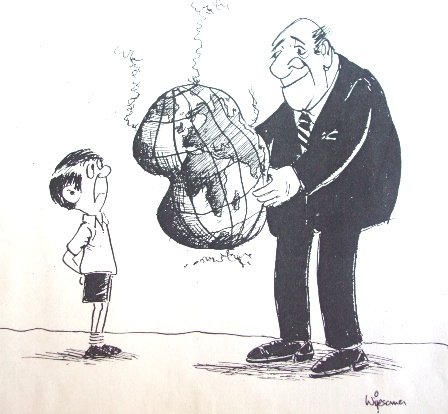
Passing the buck? Cartoon by W R Wijesoma
This was one of the most memorable cartoons drawn by W.R. Wijesoma, Sri Lanka’s pre-eminent political cartoonist (and my one-time colleague). If I remember right, it first appeared sometime in the late 1980s in ‘Mihikatha’, Sri Lanka’s first all-environmental newspaper.

Alas, both Mihikatha and Wijesoma are no more among us. But the message in this cartoon is more timely than ever before.

“Is this what we are going to hand over to our future generations? Please……no!” was the emphatic message from Yugratna Srivastava, a 13-year-old Indian girl who addressed over 100 world leaders gathered at the United Nations headquarters on 22 September 2009 for the historic Summit on Climate Change.

Passing the ball – or buck – is something that governments are good at. Most governments are so narrowly focused on the now and here, and sometimes rightfully so, that they have neither the time nor interest for medium to long term scenarios. As I wrote earlier this week, “it’s going to take many more meetings, bickering and hard bargaining before the leaders begin to think in terms of the next generation.”

This is where citizen action comes in. Governments are not going to save this planet from environmental catastrophes; if at all, it would be the ordinary people. This is the premise of TVE Asia Pacific’s latest Asian TV series, Saving the Planet.

Where does the buck stop?

Governments, experts and big corporations alone cannot solve all these problems. Real change requires changing how each and every human being lives and works. Education becomes the biggest key to achieving environmentally sustainable development at local and global levels.

Filmed in six countries in South and Southeast Asia, Saving the Planet profiles groups working quietly and relentlessly to spread knowledge, understanding and attitudes that inspire action that will help humans to live in harmony with the planet. They often work without external funding and beyond the media spotlight. They have persisted with clarity of vision, sincerity of purpose and sheer determination. Their stories inspire many others to pursue grassroots action for a cleaner and safer planet.

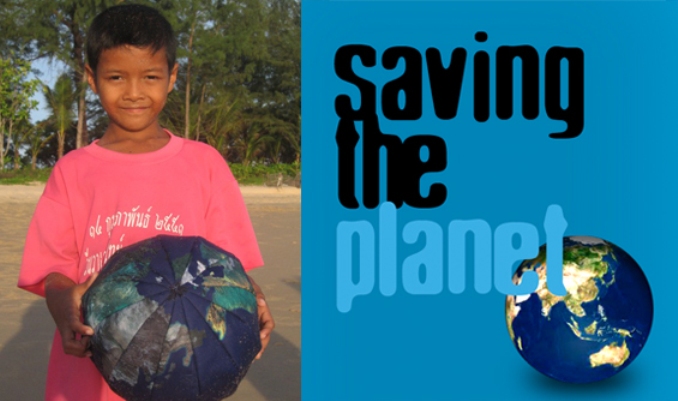
We tried out a creative idea for the series opening sequence (20 seconds), an extended version of which became the series trailer (see below). It was planned and filmed in all the six countries where the stories came from — Cambodia, India, Laos, Nepal, the Philippines and Thailand. In each country, our roving director-producers filmed different individuals – young and old, men and women, in all their Asian diversity – passing around an inflated ball made to look like planet Earth.

I know my colleagues had fun filming these sequences, and back in our studio, it was also great fun to mix and match these various shots to create the apparently seamless passing around of our planet in peril. (Who said planet saving cannot be fun?)

Watch Saving the Planet trailer (1 minute):

Now it can be revealed: our original inspiration came from an unexpected source: the world’s largest media corporation, Google! In one brainstorming, our then production coordinator Buddhini Ekanayake remembered an open challenge that Google had made online just before introducing their email service, GMail. Google asked people to “imagine how an email message travels around the world” using a video camera.

In all, Google received over 1,100 clips from fans in more than 65 countries around the world — each one of them a different creative idea, playing with the iconic Gmail M-velope.

“The clips you submitted were amazing and it was hard to choose selections for the final video,” Google said when releasing the outcome of this collaborative video project.

See Gmail: Behind the Scenes (Final Cut)

Read more about the GMail collaborative video on Google’s blog

Watch all submissions Google received for its GMail promo video.

As Oscar Wilde once said, “Talent borrows. Genius steals.” You can decide which of these we have done!

Next Election or Next Generation? World leaders, time to choose is NOW!

Yugratna Srivastava: Lend me your ears...
This week saw the UN’s invisible man hosting mostly indifferent leaders at a Summit on one of the world’s most pressing challenges: climate change.

Nearly 100 world leaders accepted UN Secretary General Ban Ki-moon’s invitation to participate in an historic Summit on Climate Change in New York on 22 September to mobilise political will and strengthen momentum for a fair, effective and ambitious climate deal in Copenhagen this December.

The call for action at the summit did not just come from world leaders – many of who simply can’t see beyond their next election – but also from the next generation who stand the most to lose if climate talks fail.

On their behalf, Yugratna Srivastava, a 13-year-old Indian girl, spoke forcefully at the podium, sending a wake-up call to those assembled. “We received a clean and healthy planet from our ancestors and we are gifting a damaged one to our successors. What sort of justice is this?,” she said.

She added: “The Himalayas are melting, polar bears are dying, 2 of every 5 people don’t have access to clean drinking water, earth’s temperature is increasing, we are losing the untapped information and potential of plant species, Pacific’s water level has risen,Is this what we are going to hand over to our future generations? Please……no!”

She said the three billion young people in the world need them to take action now to protect the planet for future generations.

Watch part of her speech in this TV news story:

Read full text of her speech

Read Indian TV news channel IBN’s interview with Yugratna Srivastava just after delivering her speech.

Read Ban Ki-Moon’s summary of the Summit, delivered at its end

All this news coverage reminded me of another passionate young girl who similarly addressed – and challenged – the world leaders 17 years ago at the Earth Summit held in Rio de Janeiro, Brazil.

Her name was Severn Cullis-Suzuki, and she was a young Canadian environmental activist. Then 12-year-old Severn closed a Plenary Session with a powerful speech that received a standing ovation.

Raised in Vancouver and Toronto, Severn Cullis-Suzuki is the daughter of writer Tara Elizabeth Cullis and environmental activist and TV personality David Suzuki. When she was 9, she started the Environmental Children’s Organization (ECO), a small group of children committed to learning and teaching other kids about environmental issues. They were successful in many projects before 1992, when they raised enough money to go to the UN’s Earth Summit in Rio. Their aim was to remind the decision-makers of who their actions or inactions would ultimately affect.

Listen to the memorable speech at the Earth Summit by Severn Cullis-Suzuki:

Severn was every bit as sincere, concerned and passionate about the global environment as Yugratna Srivastava was this week. Seventeen years later, notwithstanding the lofty pledges at the Earth Summit and later gatherings, the environmental crises have multiplied and worsened.

Very few of the world leaders who assembled in Rio are still in office — and that underlines part of the problem. Governments have far shorter time horizons than what many of today’s global challenges demand. I am constantly reminded of what the eminent Indian scientist Dr M S Swaminathan told me in my first interview with him in 1990 (yes, even before the Earth Summit): “In democracies, rulers think in terms of the next election. In dictatorships, about the next coup d’état. Nobody is thinking in terms of the next generation!”

It was no small feat for the UN’s Invisible Man to bring 100 heads of state or heads of government together on such a long-term issue. But it’s going to take many more meetings, bickering and hard bargaining before the leaders begin to think in terms of the next generation.

Read my June 2008 comment: Message to the UN on World Environment Day: Kick your own CO2 habit!