I quoted the Filipino academic and social activist Professor Walden Bello, as saying: “Things are pretty savage at the grassroots level in some of our countries. Journalists who investigate and uncover the truth take enormous personal risks – the vested interests hire killers to eliminate such journalists.”
Bello, executive director of the Focus on the Global South, further said: “Journalists living in the provinces and reporting from the grassroots are more vulnerable than those based in the cities. This is precisely why local journalists need greater support and protection to continue their good work.”
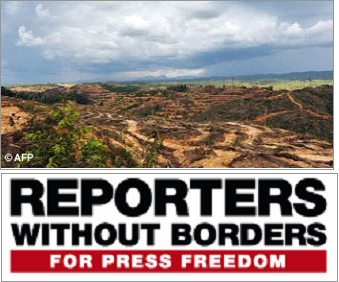
Last week, Reporters Without Borders echoed this call, saying: “We must defend journalists who expose attacks on the environment”.
The press freedom activist group released a new report titled “The dangers for journalists who expose environmental issues.” It highlights the indifference – and even complicity – of some governments and local authorities that make little attempt to protect journalists who take risks to investigate attacks on the environment.
The report looks at 13 cases of journalists and bloggers who have been killed, physically attacked, jailed, threatened or censored for reporting on the environment, and highlights the need for a free press to tackle ecological challenges.
In countries such as Russia, Cambodia, Brazil or even Bulgaria, in Europe, journalists run considerable risks when they try to alert the world about the misdeeds of those who prey on the environment.
Memory is a curious phenomenon. Sometimes memories of our personal past are evoked in the most unexpected manner, reviving nostalgia for days that are forever lost in the sands of time.
I have never visited Poland, but it’s been on my mind in recent days. 1 September 2009 marked the 70th anniversary of the beginning of the Second World War – which was sparked off by Nazi Germany’s invasion of Poland.
That’s also the day when the Anglo-American poet W H Auden wrote his deeply evocative poem, September 1, 1939. He wrote it sitting in a New York bar and distraught by the clouds of hatred gathering over Europe. I’ve been reading and re-reading it this year as the war Sri Lanka – which lasted almost five times longer – officially ended in May 2009.
As I wrote at the time: “Almost 70 years later, at the end of my own 30-year-long war, I have been reading and re-reading September 1, 1939. I’m trying to make sense of what is happening around me. The near hysterical mass euphoria on one side, and bewildered dejection on the other.”
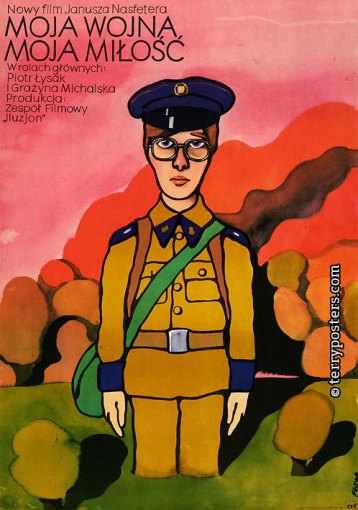
I have only just remembered that Poland in September 1939 holds another significance for me. It has to do with the Polish film Moja Wojna – Moja Milosc (My War-My Love, 1975), which I saw in the summer of 1979 at a Colombo cinema as a 13-year-old school boy.
Not only did I see the film, but I also wrote an essay reviewing it and entered it into a competition organised by the Embassy of Poland. Growing up in a country that didn’t have broadcast television until that very year, I had only seen a handful of movies up to that time. I was no movie critic, but my views on the film and its resonance with my own times must have struck a chord with the judges. For I won the second prize in the Sinhala essay competition.
Being runner-up was no big deal by itself, but this was the first time that my writing was competitively judged and ranked by anyone outside my immediate circles. My prize included a fountain pen, white polyester cloth for school uniforms, and an LP record of Polish music (yes, LPs were still in use, but on their way out at the time!).
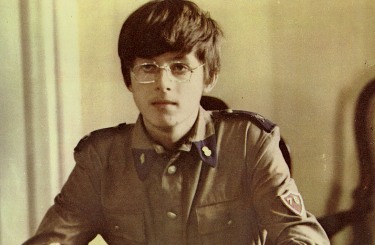
From My War - My LoveI would go on to win many essay competitions during my teens, and one day earn an honest living as a wordsmith. But that movie review – long since lost in the mists of time – was my first success. My career in literary crime was thus forged…thanks to a Polish movie!
From the little that I can still remember, 30 summers later, My War-My Love wasn’t a pretty film. It is set during the week of the Nazi invasion of Poland in 1939. Daring 17-year-old schoolboy Marek (Piotry Lyjak), inspired by the example of the Sobieski cadets during 1831 insurrection, vows to take on Germans single-handedly. He devotes most of his energy to protecting a young girl who lost her mother during the invasion.
As one reviewer wrote, “My War-My Love could not, by its very nature, end altogether happily, but the film can be regarded as life-affirming.”
War has no place for innocence - then or now...That film was my first visual introduction to the horrors of war, a topic that was to dominate my own future for the next 30 years to come. In that Sri Lankan war, child soldiers several years younger than the film’s character Marek would play a prominent role.
At a far more personal level, I had never been in love when I saw My War-My Love. In the three decades to follow, I would fall in love three times — and lose out every time, though for very different reasons (none of which involved ‘my’ war). I must now carry the pain of these lost loves for the rest of my time. But that is another story…
Thanks to the wonders of Google, I’ve been able to track down some specifics about the film. It was directed by Janusz Nasfeter (1920 – 1998), a versatile Polish film maker whose career in writing and directing films spanned from the late 1940s to the early 1980s. He was 19 when the Germans came marching in.
It was one of many films that have used the Second World War as its backdrop. There have been several other Polish films that looked back on the Polish resistance, Poland Holocaust and Warsaw uprising of 1944 and other key events that left an indelible mark on the country. In fact, as this listing in Wikipedia shows, when Janusz Nasfeter made My War-My Love, the theme was pretty much covered by different Polish film makers in numerous ways.
I haven’t seen any of these other Polish films, and even My War-My Love is now only a distant memory. But as a moving image creation that moved my life in a certain direction, it would always have a special place in my heart.
The remains of former Philippine president Corazon Aquino passes through the historical EDSA road with some 300,000 supporters waving to pay their last respect. The road is remembered in 1986 as then anonymous Cory and some 2 million people rallied out the streets to fight a 20-year government dictatorship through peaceful people power revolution. Photo by Arwin Doloricon/ Voyage Film
I know this post appears rather late, but I couldn’t let Cory Aquino’s death on 1 August 2009 pass without comment. The original inspiration for People Power that toppled one of the worst tyrants of the 20th Century, she would now turn the Patron Saint of peaceful democratic struggles everywhere.
Last week, I was reduced to tears reading two links that my Filipino friend Ruth Villarama, who runs Voyage Films in Manila, sent me of new comments posted on their website.
In the first post, A housewife, a leader, an angel in yellow (3 August 2009), Joan Rae Ramirez wrote: “Her death at 3 AM on August 1 has stopped a nation from its apathetic works to once again remember what was once fought by this ordinary housewife. It is on these rarest moments where the oligarchs came down from their kingdoms to pay their respect and mingle with the people who truly represent the real state of the Philippine nation.”
Karen Lim, who works with Voyage Films as a producer and project coordinator, wrote a more personalised piece titled The Famous Anonymous.
It opened with these words: “I see her on TV. In some instances I even covered her for a story. Our relationship did not go deeper than the reporter-subject, or the audience and the watched. Yet I feel a certain affinity to the most revered President. And when she died I got sad, a strange feeling of sadness where the source is unknown.”
Karen was too young to have remembered much of those heady days of the People Power Revolution of February 1986 — a series of nonviolent and prayerful mass street demonstrations in the Philippines that eventually toppled the 20-year autocracy of Ferdinand Marcos. Indeed, a whole generation of Filipinos has been born since. But that doesn’t stop them from relating to the monumental events that unfolded at at Epifanio de los Santos Avenue, known more commonly by its acronym EDSA, in Quezon City, Metropolitan Manila and involved over 2 million ordinary Filipinos as well as several political, military and religious figures.
As Karen wrote in her tribute: “Cory’s life became ours too. We watched her, sometimes we joined her. We experienced her highs and lows. We are her “Mga minamahal kong kababayan”(my beloved fellowman). She did what no stranger did in my family – unite us in prayer for the country, unite us in laughter amidst the uncertainties of those times. I had no personal connection to this lady, but I have now every reason to mourn her passing.”
Woman of the Year 1986I can only echo her Karen’s words. As a politically curious 19-year-old, I had followed with much interest the daring gamble and eventual triumph of People Power unfolding thousands of kilometres away from my Colombo home. In the pre-Internet era, and before satellite TV channels provided 24/7 coverage across Asia, my sources were daily newspapers, evening news bulletins on local TV and, once every few weeks, the second-hand copies of Time magazine passed on to me by an uncle. The housewife in yellow ended up becoming Time Woman of the Year for 1986, with Pico Iyer writing a suitably reflective piece.
In the years since the return of democracy – with all its imperfections and idiosyncrasies – I have stood at EDSA more than once, and wondered what it must have been like to mobilise millions of ordinary, concerned people in the days before email, Internet and mobile phones — communication tools that today’s political activists, and indeed everyone else, take for granted. There is a thin line between a non-violent struggle and a passionate yet violent mob that, ultimately, works against their own interests. I am amazed that Cory and her activists didn’t cross the line, despite provocations and 20 years of repression.
Of course, it wasn’t just the human numbers that turned the tide in EDSA. Cory Aquino’s charismatic leadership and moral authority persuaded other centres of power – including the Catholic church and sections of the military – to align with the struggle to restore democracy. It was this combination, and the sudden change of mind by the Americans who had backed Marcos all along, that enabled People Power to triumph.
Elsewhere in Asia, where these elements didn’t align as forcefully and resolutely in the years that followed, the outcome was not as dramatic or positive. We’ve seen that, for example, in places as diverse as Tiananmen Square in China (1989), Burma (2007) and most recently, in the streets of Tehran, Iran. In contrast, it did indeed work and ushered in regime change in places like Nepal, even though it entailed more protracted struggles.
What interests me, in particular, is the role played by information and communication technologies (ICTs) in such People Power movements. Alex Magno, a political analyst and professor of sociology in Manila, sees clear links between new communications technologies and political agitation. Interviewed on the Canadian documentary Seeing Is Believing: Handicams, Human Rights and the News (2002), he said: “In the last two decades or so, most of the political upheavals had some distinct link to communications technology. The (1979) Iranian Revolution was closely linked to the audio cassette. The first EDSA uprising in the Philippines was very closely linked to the photocopying machine and so we called it the ‘Xerox Revolution’. Tiananmen, the uprising that failed in China, was called the ‘Fax Revolution’, because the rest of the world was better informed than the rest of the neighbourhood because of the fax machine. The January (2002) uprising in the Philippines represents a convergence between electronic mail and text messaging. And that gave that uprising its specific characteristics.”
Mobile phones' role in People Power II acknowledged in a Manila mural But it was People Power II in the Philippines that is perhaps the best known example of ICTs fuelling and sustaining a revolution. The ability to send short text messages on cell phones helped spawn that political revolution in early 2001, a full decade and a half after the original wave that swept Cory Aquino into office.
President Estrada was on trial facing charges of bribery, corruption and breach of the public trust. Despite mounting evidence against him, the President was let off the hook. That was the turning point. According to Ramon Isberto, a vice-president at Smart Telecom in the Philippines: “People saw it on television, and a lot of people were revolted. They started text messaging each other, sending each other messages over the Internet, and that thing created a combustion.”
Because of texting and email, within two hours over 200,000 people converged in the main street of Manila demanding the president’s resignation. The vigil lasted for four days and four nights, until President Estrada finally got the message and stepped down. It ended with Gloria Macapagal-Arroyo taking her oath of office in the presence of the crowd at EDSA, becoming the 14th president of the Philippines.
Those events have been documented, analysed and interpreted by many people from various angles. The Cold War had ended and the geopolitical map of the world had been redrawn. By this time, 24/7 satellite television was commonplace in Asia and the mobile phone was already within ordinary people’s reach. Gloria was no Cory, and Estrada wasn’t Marcos. But the forces and elements once again aligned on EDSA, and with history-making results. The role that the humble mobile phone played is acknowledged, among other places, in a mural in Manila.
One man vs. the mighty Red Army - photo by Jeff Widener for Associated Press
This is of the most famous photos of modern times. The official caption, given by Associated Press, reads: “An anti-government protester stands in front of artillery tanks in Beijing’s Tiananmen Square on June 5, 1989, at the height of the pro-democracy protests.”
It’s a moment deeply etched in the consciousness of our media-saturated world. The solitary, unarmed man was standing up against not just a brute of a tank, but the might of the entire Chinese Red Army, which had just cracked down ruthlessly on pro-democracy student protests.
It was on the morning of June 5 that the Tank Man appeared from nowhere. A line of 18 tanks were pulling out of Tiananmen Square and driving east along the Avenue of Eternal Peace. The previous day, the square had been cleared of students and much blood had been spilled. The streets were now empty except for soldiers.
Suddenly a man in a white shirt and black trousers, with a shopping bag in each hand, steps out on to the road and stands waiting as the tanks approach. The lead vehicle halts, assessing its options.
It moves right to go around him. The man waves the shopping bag in his right hand then dances a few steps to the left to block the tank again. The tank swerves back left to avoid him. The man waves the bag again and stepps to the right. Then both stop. The tank even turned off its engine.
Then more things happened.
Watch a video montage of this breathtaking standoff, captured by western journalists filming from a safe distance:
Watch first few minutes of the 2006 PBS documentary on the Tank Man incident and aftermath:
Twenty years on, the identify of the Tank Man remains a mystery. There are conflicting reports on who he was, and what happened to him after that single, defining act of defiance. Practically all we know is that he wasn’t run down by the tanks, and was instead arrested a few minutes later by the Chinese authorities. Naturally, there are few official comments on the incident or the Tank Man.
But during those few minutes, when individual soldiers hesitated and refrained from running him over, the Unknown Rebel secured his worldwide fame. He probably wasn’t doing it for any notion of posterity – in all likelihood, he was horrified bystander who’d seen the carnage in the preceding days and felt, as we do from time to time, that enough was enough.
And unlike most of us, he decided to risk his life to register his protest. In April 1998, Time magazine included the “Unknown Rebel” in its feature entitled Time 100: The Most Important People of the Century.
Charlie Cole, a Newsweek photographer who captured the moment, says: “Personally I think the government most likely executed him. It would have been in the government’s interest to produce him to silence the outcry from most of the world. But, they never could. People were executed at that time for far less than what he did.”
In early June 2009, a fifth photographer shared his own image of the incident – disclosing photos that had never before been circulated. Associated Press reporter Terril Jones revealed a photo he took showing the Tank Man from ground level, a different angle than all of the other known photos. (Tank Man is the second from left, in the background.) Jones initially didn’t realise what he had captured until a month later when printing his photos from that momentous week.
As we celebrate the memory of the Tank Man – and his defiance of brutal, oppressive use of state power to crush dissent – we must also salute the courage and resourcefulness of photojournalists and TV reporters who risked their own lives to capture this moment for posterity. Tank Man became iconic only because his act was frozen in time by those bearing witness. All too often, states – from Burma to Zimbabwe, and others in between – ensure that there is no one to bear such witness when they unleash the full force of police, armies and weapons on their own people.
There can be no doubt that Tank Man was not the first of his kind, nor would he be the last. Other ordinary men and women have found uncommon courage to stand up against injustice and state brutality wielded in the name of national security, law and order or anti-terrorist crackdown. But in the absence of witnesses – whether professional journalists or citizen journalists – the rest of the world will never know.
Standing up for a pluralistic society
The recently concluded general election in India saw thousands of candidates contest to enter the Indian Parliament. Among the candidates I watched closely were writer Shashi Tharoor (who ran on the Congress ticket and was elected from Kerala state) and dancer Mallika Sarabhai (who ran as an independent candidate in the Gujarat state and didn’t win).
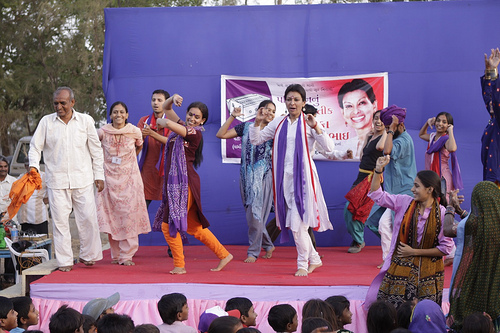
The classical dancer turned social activist had one of the more colourful campaigns in the world’s largest election: her public rallies included dance numbers, and her website (UPDATE in March 2013: no longer online) – featuring interactive elements like blogging, flickr images and online fund raising – was ranked the best by a communication research agency.
But where Mallika – whose performances I have enjoyed watching on successive visits to her home town of Ahmedabad – really stood out was in whom she opposed. She was the independent candidate from Gandhinagar, one of India’s most high-profile constituencies, a state capital that has been polarized along Hindu-Muslim lines since riots in 2002. Her opponent was Lal Krishna Advani, the prime ministerial candidate of the BJP.
Mallika Sarabhai dances during campaign trailThe two candidates couldn’t have been more different. The 82-year-old veteran politician epitomised Hindu nationalism and majority hegemony with its attendant intolerance of minorities. Mallika, hailing from an upper class Indian family of freedom fighters, industrialists and intellectuals (her father Vikram Sarabhai was father of the Indian space programme), stood for pluralism, non-violence and tolerance. When she entered the fray in March 2009, she described her candidature as a Satyagraha against the politics of hatred.
“As a proud Hindu and a proud Indian, I feel vilified by you,” she wrote. “You have reduced the great Sanatana philosophy to a Taliban-style Hindutva. As an Indian, you have tried to reduce my identity to a single factor—Hindu or not. You let your goons, saffron-clad terror units wielding lathis and worse, terrorise us and live above the laws of this country.”
For me, the most insightful paragraph is this where she takes on what it means to live with the huge cultural, social and political diversity that makes up India: “I am a post-Independence Indian. I was brought up to value and treasure my unique Indianness, to value our Constitution, which gives equal rights to all Indians, irrespective of belief, culture, practice or language. I learnt to revel in the differences that made us a rainbow country. We are a salad-like melange of cultures and not a soup where all variations get reduced to a homogeneous pulp—this, to me, is our greatest strength.”
Eschewing grand speeches, microphones, banners and slogans, she just listened to votersSalad or soup – that’s an interesting way of framing the challenge. And not just in the delightful melting pot that is India, but in many other mixed-up, tossed up cultures and societies of today…not the least in my native Sri Lanka, where we have seen the primitive forces of tribalism over-ride all other considerations in recent years. One released, it’s very hard to put this genie back in the bottle.
And how I wish our own privileged upper middle classes would take to the rough and dirty game of politics, if only to stand up against the peddlers of hatred and hegemony. If only…
Mallika could easily have continued her cultural work through the Darpana Academy of Performing Arts and her social activism. She decided to take the plunge this year because she thought the time had come to get into active politics. She was encouraged by her friends, mainly social activists, united under the banner of Friends of Democracy. Mallika is one of the several petitioners demanding justice in the post-Godhra riot cases. She was quoted in The Times of India as saying she decided not to join any party as she believed that there was no party free of corruption, criminalization and horse-trading.
As the Washington Post reported during her campaign trail: “Sarabhai, one of a handful of professional people running as independents in the upcoming elections, rejects the standard Indian political appeals to caste, religion and linguistic ethnicity, and speaks of empowering voters to unseat corrupt and ineffective politicians. Her campaign, she said, seeks to reclaim the shrinking space left for ordinary people’s voices in a democracy dominated by political parties that too often rely on mudslinging, muscle-flexing and money power.”
She and other courageous Indians have miles to go before they can sleep. Encouragingly, she has pledged that her campaign will continue.
As she says signing off her essay in Outlook: “I may have lost this election, but I will continue to work for the disadvantaged and dispossessed, and to ensure that their voice shall be silenced no more.”
Sri Lanka: Island of suspended dreams has a second chance...
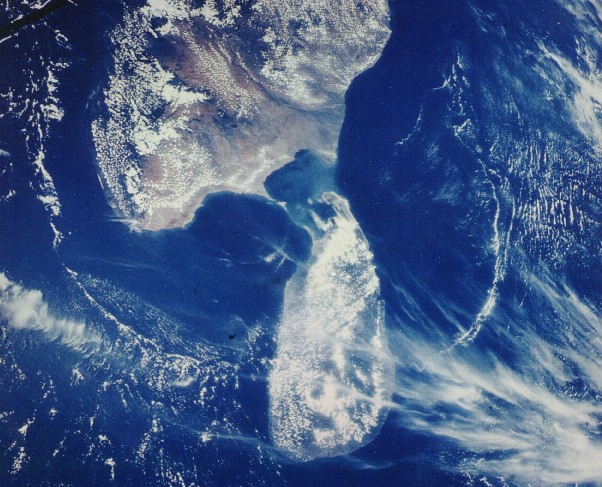
This is one of my favourite images. Showing southern part of India and my native Sri Lanka, it was captured by one of the early US space missions, nearly four decades ago.
Much has happened on the tear-drop shaped island since this image was taken: among other things, we’ve been through a civil war that lasted a generation, and robbed the dreams of at least two generations. That war officially ended on 18 May 2009.
The Day After, on 19 May 2009, I wrote a 1,500-word essay titled Memories of War, Dreams of Peace. The editor of Groundviews, Sri Lanka’s leading citizen journalism website, published it in full, and within minutes of my emailing the text to him.
I look back briefly on the brutal and tragic war – not in anger, but in great sadness. I then look forward in a wistful, dreamy mode. My premise was: “Now that the war is officially over, will this mark the beginning of real peace? I want to believe so. I want to audaciously dream of peace. The alternative is too dreadful to consider.”
This is not exactly what I’ve been trained to do. As a science writer and film-maker, I gather and analyse information, which I try to present in logical, coherent and accessible ways. In recent years, I’ve also been writing op ed essays in areas where I have some competence and experience. In writing this essay, I consciously departed from all that. I’m neither political scientist nor activist to engage in ideological or technocratic discussions, which others have already started in earnest. I wrote this at an emotional level, looking back and looking forward.
But my training did come in handy in framing the timely and necessary questions. My chosen ‘author intro’ for this essay thus reads: “Writer Nalaka Gunawardene has been a dreamer for all his 43 years. He asks more questions than he can answer.”
We've doused the flames of war, but much more needs to be done...If my views come across as naive or idealistic, I shall plead guilty as charged. My emotions this week are best described as cautiously optimistic, but as some readers on Groundviews pointed out in their comments, our high hopes have been betrayed before. But can we afford not to dream privately and publicly at this juncture? I don’t think so. We have suspended our dreams for too long, and it’s time to start dreaming again.
There are as many kinds of dreamers as there are dreams. One of my favourite quotes comes from the British soldier and writer T E Lawrence (of Lawrence of Arabia fame): “All men dream, but not equally…the dreamers of the day are dangerous men, for they may act their dream with open eyes, to make it possible.”
W H Auden (1907 - 1973) It begins in a bar, and ends with a prayer. It was written in another century by a poet on the opposite side of the planet on the day the deadliest war in history broke out.
Almost 70 years later, at the end of my own 30-year-long war, I have been reading and re-reading September 1, 1939. I’m trying to make sense of what is happening around me. The near hysterical mass euphoria on one side, and bewildered dejection on the other.
I was just six when the poet W H Auden died, and only 13 when this bloody, protracted war started. As I wrote in an essay published on the day after the war ended, I have lived all my adult years with this war providing a constantly grim, sometimes highly disruptive backdrop.
I survived the war in its various phases, including uneasy lulls when guns were temporarily silent. I watched most of my own friends join the exodus of genes and talent from a land where they saw no hope or future. I chose to stay on, but questioned the wisdom of it each time a major atrocity took place. I went through six jobs and one marriage, and raised a child who would soon be the same age as I was when the war started.
Are we at the end of the long, dark tunnel? Is the promised land of peace and prosperity now at hand? Have we seen the last of multi-barrel guns, grenade launchers, helicopter gunships, claymore mines and the deadly suicide bombers? Or will national security and anti-terrorism continue to dictate what we can or cannot do as citizens in a free, democratic and finally peaceful country?
I honestly don’t know. Probably it’s too early to tell. But I’m uneasy with celebrations when so much healing and rebuilding need to be done. I’m worried about continuing the simplistic division of people into patriots and traitors. As I wrote earlier this week, this perception of Us and Them is our first landmine on the long road to peace. I don’t know why we as a people continue to insist on everything being in black and white. What happened to the myriad shades of grey?
For some months now, I’ve been turning to classical and modern poems for solace and comfort. When prose fails, verse must take over. Auden himself disliked this poem, but few words in English move me as his line: “We must love one another or die.”
So here it is, the full and original words of September 1, 1939 – for whatever resonance it may offer us across the gulf of seven decades straddling two centuries:
September 1, 1939
I sit in one of the dives
On Fifty-second Street
Uncertain and afraid
As the clever hopes expire
Of a low dishonest decade:
Waves of anger and fear
Circulate over the bright
And darkened lands of the earth,
Obsessing our private lives;
The unmentionable odour of death
Offends the September night.
Accurate scholarship can
Unearth the whole offence
From Luther until now
That has driven a culture mad,
Find what occurred at Linz,
What huge imago made
A psychopathic god:
I and the public know
What all schoolchildren learn,
Those to whom evil is done
Do evil in return.
Exiled Thucydides knew
All that a speech can say
About Democracy,
And what dictators do,
The elderly rubbish they talk
To an apathetic grave;
Analysed all in his book,
The enlightenment driven away,
The habit-forming pain,
Mismanagement and grief:
We must suffer them all again.
Into this neutral air
Where blind skyscrapers use
Their full height to proclaim
The strength of Collective Man,
Each language pours its vain
Competitive excuse:
But who can live for long
In an euphoric dream;
Out of the mirror they stare,
Imperialism’s face
And the international wrong.
Faces along the bar
Cling to their average day:
The lights must never go out,
The music must always play,
All the conventions conspire
To make this fort assume
The furniture of home;
Lest we should see where we are,
Lost in a haunted wood,
Children afraid of the night
Who have never been happy or good.
The windiest militant trash
Important Persons shout
Is not so crude as our wish:
What mad Nijinsky wrote
About Diaghilev
Is true of the normal heart;
For the error bred in the bone
Of each woman and each man
Craves what it cannot have,
Not universal love
But to be loved alone.
From the conservative dark
Into the ethical life
The dense commuters come,
Repeating their morning vow;
“I will be true to the wife,
I’ll concentrate more on my work,”
And helpless governors wake
To resume their compulsory game:
Who can release them now,
Who can reach the deaf,
Who can speak for the dumb?
All I have is a voice
To undo the folded lie,
The romantic lie in the brain
Of the sensual man-in-the-street
And the lie of Authority
Whose buildings grope the sky:
There is no such thing as the State
And no one exists alone;
Hunger allows no choice
To the citizen or the police;
We must love one another or die.
Defenceless under the night
Our world in stupor lies;
Yet, dotted everywhere,
Ironic points of light
Flash out wherever the Just
Exchange their messages:
May I, composed like them
Of Eros and of dust,
Beleaguered by the same
Negation and despair,
Show an affirming flame.
In our troubled times, cartoonists often provide more than mere caricature and entertainment. War and peace are no laughing matters, and neither is the profound advice some cartoons offer us. As a product of our image-saturated, popular culture driven world, I derive part of my insights from cartoonist-philosophers whose economy of words is unbeatable.
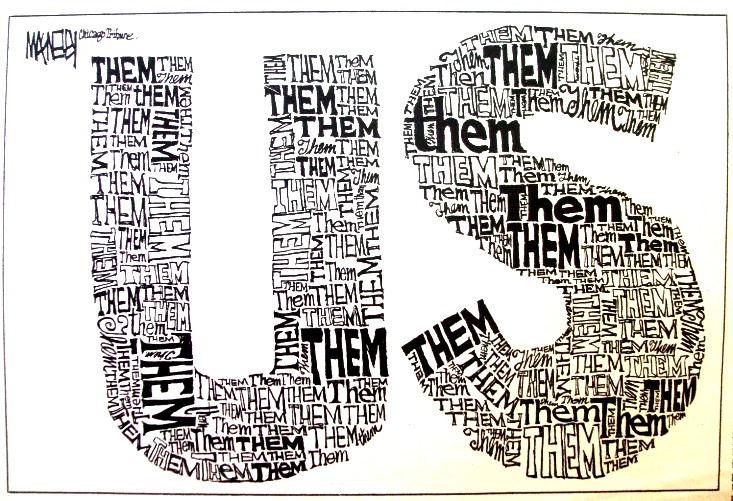
I haven’t discovered exactly what provoked the American cartoonist Jeff MacNelly (1947 – 2000) to draw this brilliantly perceptive cartoon in May 1992. But the three-time Pulitzer prize winning editorial cartoonist of the Chicago Tribune (and creator of popular comic strip Shoe) has captured a sentiment that has characterised so many tensions and suspicions in his land and mine: us and them.
It’s at the root of so much conflict and grief, be it between Islam and the West, or Israel and Palestine, or Sinhalese and Tamils in Sri Lanka. Its entirely a matter of perception, largely a creation of our insecure and insular minds. Yet we argue, wage war and kill each other for the sake of this strong tribal perception.
In an op ed essay published on Sri Lankan citizen journalism website Groundviews today, titled Memories of War, Dreams of Peace, I asked: “Can we as a nation finally stop glorifying the war and its weapons, and return to our cultural heritage of ahimsa? How do we turn the current opportunity for peace into something tangible and lasting, so that we don’t allow political violence and war ever again? Do we have what it takes to go beyond chest thumping and finger pointing, and begin to care and share? Would we eventually be able to liberate our minds from our deep-rooted tribalism that sees everything through the prism of us and them?”
Indeed, one of the first – and hardest – challenges as we try to unify Sri Lankans and rebuild our war-ravaged country is to get over this division.
They say the long and bloody Sri Lankan civil war is over, and I’d say not a moment too soon. I really want to believe it. I simply must: the alternative is too depressing to consider.
Sure, there is no independent verification – it has been a war without witnesses for the last few years. But I am willing to take an unusual leap of faith if that’s what it takes to usher in the long-elusive peace. I will go to the ends of the earth, and suspend disbelief if I have to, in return for lasting and meaningful peace.
As we stand on the threshold of change – with the promise of peace – I am overwhelmed with memories of a tragic past. And I hope we can once again start dreaming of a better future – and make it happen.
After a hiatus of three decades – three quarters of my own life – I dare to dream again. I hope other Lankans will soon revive and resume their suspended dreams.
So what kind of a future Sri Lanka can we, must we, should we now dare to dream about? Where do we look for the vision and inspiration?
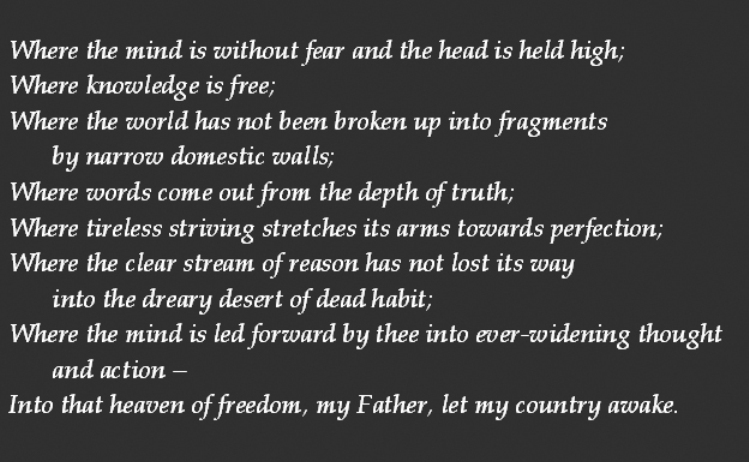
One of the greatest poet philosophers of the East had articulated many decades ago the very essence of my dream for a post-war Sri Lanka. I once heard the late Lakshman Kadirgamar – another tragic casualty of our war – render these momentous words at a South Asian gathering in his impeccable English which brought out all its nuances.
Across the gulf of space and time, Rabindranath Tagore speaks for many of us:
Today, 3 May, is once again World Press Freedom Day. It is recognised by the UN, and observed by media professionals and media activists worldwide to ‘draw attention to the role of independent news and information in society, and how it is under attack’.
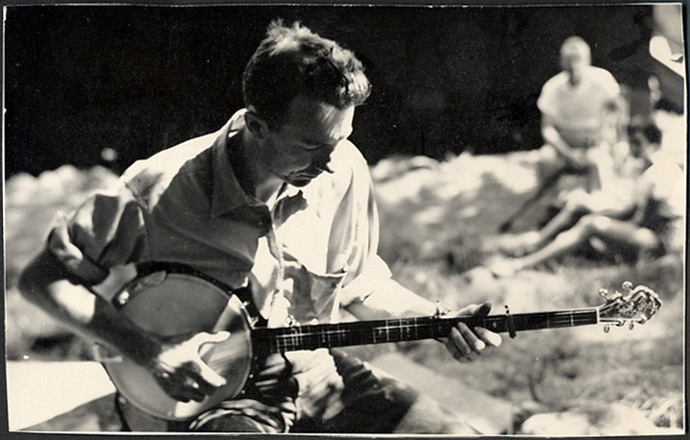
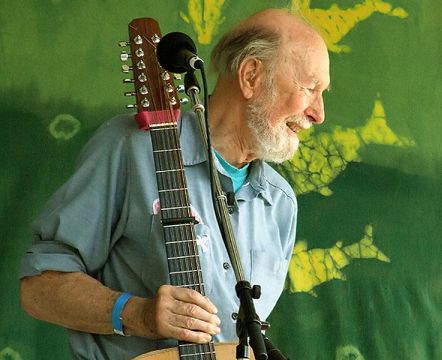
By happy coincidence, today also marks the 90th birthday of Pete Seeger, American folk singer and a pioneer of protest music. Since media freedom is inseparable from the democratic rights to dissent and protest, I will devote this blog post to salute Pete and his many decades of music for worthy causes — ranging from the American civil rights movement and opposing the Vietnam war to saving the environment and nuclear disarmament.
Pete is a hero for at least three generations of music lovers and freedom lovers around the world who believe in human rights, human dignity and democratic freedoms. Armed with nothing more than his banjo and melodious voice, and driven by the courage of his conviction, this small, gentle man has stood up to mighty leaders, generals and officials.
Never underestimate the power of one determined man...Pete is celebrated as much for his artistic and cultural achievements as for standing resolutely for his political beliefs and for lending his voice and music in support of causes be believed in. In 1955, he was called before the now infamous House Un-American Activities Committee, but refused to name personal and political associations on the grounds that this would violate his First Amendment rights. He said: “”I am not going to answer any questions as to my association, my philosophical or religious beliefs or my political beliefs, or how I voted in any election, or any of these private affairs. I think these are very improper questions for any American to be asked, especially under such compulsion as this.”
This defiance resulted in sustained harassment, persecution and professional isolation. As his recent PBS biography noted, “Standing strong for deeply-held beliefs, Seeger went from the top of the pop charts to the top of the blacklist and was banned from American commercial television for more than 17 years. This determined singer/songwriter made his voice heard and encouraged the people of the world to sing out along with him.”
‘If you love your country, you’ll find ways to somehow to speak out, to do what you think is right,” Pete says in this powerful documentary looking back at over half a century of activist singing and music.
Watch opening segment of PBS AMERICAN MASTERS series: Pete Seeger: The Power of Song, directed by Jim Brown and first aired in February 2008
Having pleaded under the First Amendment during the communist witch days of the 1950s, Pete repeatedly paid tribute to the far-sighted American pioneers who introduced the First Amendment guaranteeing the freedom of speech.
“As some judge said, if there is any fixed star in our firmament, that is the First Amendment,” he says in a talk-cum-performance at the Ford Hall Forum. In this audio-only piece, he talks the privilege of living under the First Amendment. He recalls his experience being questioned by the House Unamerican Activities Committee, encounters with censorship, and his relationship with fellow singer Woody Guthrie. It runs for nearly an hour, but is worth every second.
For someone like Pete Seeger who sang alongside Dr Martin Luther King, Jr., and other civil rights movement leaders and activists, it must have been deeply moving to be able to sing at the concert to mark President Barack Obama’s inauguration on 20 January 2009 at the Lincoln Memorial.
Watch Bruce Springsteen sing along with Pete Seeger on Woody Guthrie’s “This Land Is Your Land”. As he often does, Pete invites the euphoric audience to sing along!
One of my favourite Pete Seeger songs is “Turn! Turn! Turn! (to Everything There is a Season)”, often abbreviated to “Turn! Turn! Turn!”. It’s a song adapted entirely from the the Book of Ecclesiastes in the Bible (with the exception of the last line) and composed to music by Pete Seeger in 1959. Seeger waited until 1962 to record it,
Pete Seeger tells how he came to write “Turn Turn Turn.”
I have always believed that we have to get creative and resourceful when the basic freedoms of conscience and freedom of expression are under siege from despotic rulers and fanatical extremists. When we are not allowed to express in factual prose, we must turn to creative prose. And when prose fails, we still have verse, lyrics, satire and drama — the possibilities are only limited by our imagination. This is why I celebrate activist artistes like Pete Seeger, and invoke the memory of activist-poets like Adrian Mitchell and Ken Saro-wiwa. When the barbarians are at our gates and we feel surrounded by the unrelenting forces of hatred, intolerance and tribalism, they remind us that Another World is Possible — but we have to believe in it, stay the course and find ways to sing, dance and laugh our way out of gloom.
And here’s Pete singing another one of my personal favourites, a song that powered the civil rights movement and has since inspired and sustained struggles for social justice around the world: We Shall Overcome.




 Open Minds!