Anand Patwardhan: Film maker as perennial trouble-maker

Anand Patwardhan

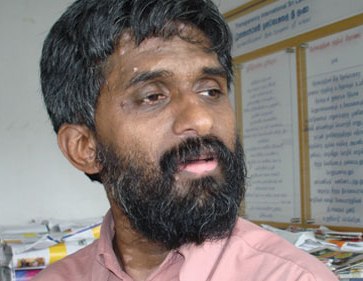
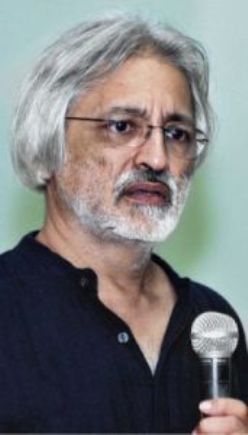
Anand Patwardhan is one of India’s best known and most outspoken documentary film makers. He has been making political documentaries for over three decades, pursuing diverse and controversial issues that are at the crux of social and political life in India. He epitomises the activist film maker and has inspired a generation of socially sensitive film makers.

In the world’s largest democracy that is India, and in a country with a vibrant and diverse media that is considered to be among the most free in the developing world, Anand has constantly run into problems getting his films seen on broadcast television. Many of his films were at one time or another banned by state television channels in India and became the subject of litigation by Anand, who successfully challenged the censorship rulings in court.

As his website notes, several of his films have also incurred the wrath of right wing fundamanentalists both in India and abroad. “In keeping with the uneven nature of India’s democratic institutions and its sharply divided polity, bouquets have been accompanied by brickbats.”

I came across a good interview with Anand Patwardhan in the Indian current affairs magazine Frontline, issue for 4 – 17 December 2010. Here are two questions concerning the censorship problems he has often faced:
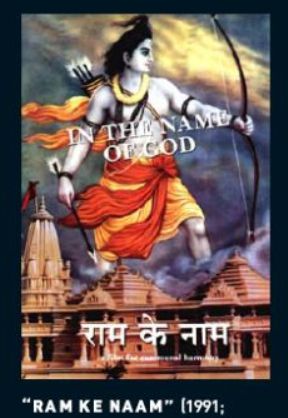
Ram Ke Naam (In the Name of God), 1991
Q: You have had problems getting clearance from the Central Board of Film Certification for almost all your films, and then later they were not allowed to be screened on Doordarshan. Your films are also not screened on private channels. How do you see this constant struggle with these forms of censorship?

A: Right from the first film, I faced censorship in some form or the other. Even the Janata Party after it came to power refused to screen Waves of Revolution though it was against the Emergency. L.K. Advani was the Information and Broadcasting Minister then. I had added an epilogue which said that the janata raj [people’s rule] that the film spoke about was not the same as [that of] the Janata Party now in power. I also drew attention to the political prisoners still being held in jail. Finally, after media pressure built up, the film was screened on Doordarshan.

Prisoners of Conscience also got into trouble with the censor board, and it took a letter from Satyajit Ray to the government saying that they must not stop a film like this to get the required clearance.

Ram Ke Naam followed the rath yatra of Advani and the violence in Ayodhya on October 30, 1990, when the Babri Mosque was attacked for the first time. It was meant to be a warning to the nation about the rise of Hindutva fundamentalism. I had trouble with the censors initially, but it finally got through in 1992 and then I had trouble with Doordarshan, which refused to show it. Finally, after the film won a national award for Best Investigative Documentary, I was able to go to court and argue that the government cannot give me a national award and yet say that I cannot show the film on Doordarshan, which it had been doing systematically. In fact, whenever any film of mine won a national award, I used it to go to court. I argued that not showing such a film on national TV was a denial of my right to freedom of expression and of the viewers’ right to information.

On these grounds I have won seven cases till now – five in the High Courts and two in the Supreme Court after the government went in appeal. Ram Ke Naam was finally shown on Doordarshan in 1997. The judge ordered that the film should be telecast at prime time.

Stills from Anand Patwardhan (courtesy his website)

Q: Why have you not approached private channels to screen your films?

A: The private media, including television, are not about giving people information. They are run by corporates more interested in providing entertainment. Their news and analysis are restricted to five and 10 second [sound] bites. Their clear mandate is commercial. They will ask, “Where are the advertisers who will endorse your product? Who is going to give the money to show this? Are we going to waste one and a half hours of TV time on issues?”

I have also discovered that even in the private domain there is political censorship. A few days before the Allahabad High Court verdict on [the] Ayodhya [title suit] was due, a private channel approached me to screen Ram Ke Naam. They paid me for three broadcasts but stopped after showing the film just once despite extremely positive feedback from viewers. On inquiring, I was told that the channel was pressured not to show the film by both the Information and Broadcasting Ministry and the TV Broadcasters’ Association. Anyone who watches Ram Ke Naam will realise that this censorship was done to protect the interests of unscrupulous politicians who had used the emotive appeal of Ram for financial and political gain.

The situation today is such that you cannot pinpoint where the censorship is coming from. During the Emergency you at least knew who the enemy was. But now what do you do when every wing of society – whether it’s the legal system, and so on – is complicit in a blanket suppression of facts.

Read the full interview in Frontline magazine, issue for 4 – 17 December 2010

Read TVE Asia Pacific profile and interview with Ananda Patwardhan in 2002
Poddala Jayantha: Paying a high price for investigative journalism

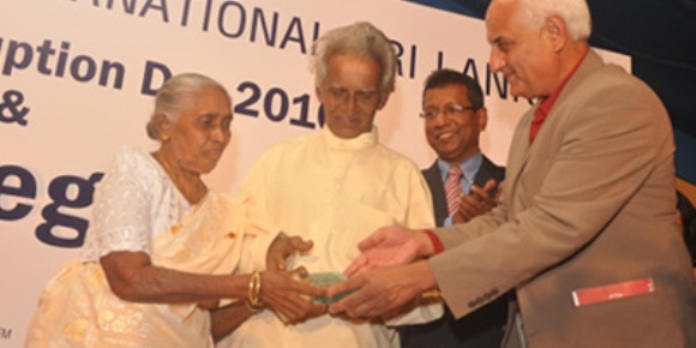
Poddala Jayantha's mother and father receiving award from Kanak Mani dixit (extreme R)

Two persons stood out among the several hundred people gathered at Sri Lanka National Integrity Awards ceremony on December 9 evening in Colombo. Dressed in off-white, the elderly couple looked dignified yet slightly bewildered by the pace of events at Colombo’s top conventions venue.

But when their moment arrived, the parents of investigative journalist Poddala Jayantha rose to the occasion: they accepted the Global Integrity Award presented to him by the anti-corruption watchdog Transparency International (TI).

Jayantha could not turn up in person because his is under threat and fled Sri Lanka for safety. In June 2009, he was abducted by unidentified persons and assaulted. The attack, one among many on journalists in Sri Lanka, left him permanently disabled in his legs. That’s the high price he had to pay for systematically exposing corruption and irregularities in government and corporate sector in Sri Lanka.

TI, which created this award to recognise the courage and determination of individuals and organisations fighting corruption around the world, commended Jayantha for his “dedication to exposing injustice in Sri Lanka”.

It was originally presented at the Global Anti-Corruption Conference in Bangkok in November 2010.

Poddala Jayantha
“I am happy that I could fight against corruption and campaign for press freedom while working for the state media,” he told BBC Sinhala after the awards announcement. “But yes I had to leave the country as a result.”

I’ve long admired Poddala’s courage and meticulous research, and have been amazed that he managed to do so much while working in a state-owned media establishment like Lake House, where he was employed after leaving the independent Ravaya newspaper. Of course he was the exception to the rule, but what a refreshing exception that was — reminding us that even amidst all those sacred cows that state media journalists must tiptoe around, they can still serve the public interest if they want to…

Of course, there were also stories that he never got to write. In November 2008, I wrote about one such example in an essay commenting on the Lankan media’s shameful conduct in relation to our own Ponzi scheme and local Madoff called Sakvithi.

Fellow investigative journalist Dilrukshi Handunnetti has written an excellent tribute to Poddala on Groundviews.

No Pressure, Just Plain Stupidity: UK climate film scores ‘own goal’ for campaigners

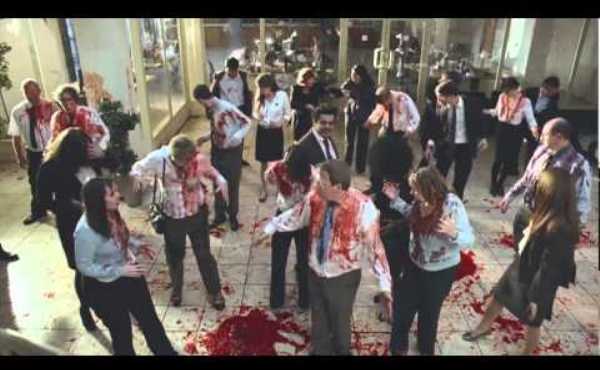
Still from No Pressure film: We do live in The Age of Stupid!
Shock therapy is known to work, when handled carefully. We can sometimes shock people out of apathy or indifference, for sure — but the same shock, if overdone, can also numb people or turn them off completely.

That’s certainly the case with a new climate advocacy video film called No Pressure, released on 1 October 2010 by the by the climate mitigation campaign named 10:10.

Written by Richard Curtis and Franny Armstrong (who made the acclaimed 2009 climate documentary, The Age of Stupid) and directed by Dougal Wilson, the film is a tragi-comic attempt to ridicule those who don’t share the same level of concern on global climate change as the climate activists do.

The four-minute film consists of a series of short scenes in which groups of people are asked if they are interested in participating in the 10:10 project to reduce carbon emissions. Those failing to show sufficient enthusiasm for the cause, including two schoolchildren, are gruesomely executed by being blown to pieces.

Well, see for yourself. Caution: this video contains violent scenes that can be offensive to most sensible people:

The normally balanced UK’s Guardian newspaper, which got the online exclusive, introduced the video on 30 September 2010 calling it “attention grabbing” and “pretty edgy.” There were a few others who found artistic or creative merit in the film, which has got high production values — no basement production, this.

But where it fails miserably is in winning any new friends for the climate cause, or at lease to influence people to change their high carbon lifestyles.

Amdrew Revkin
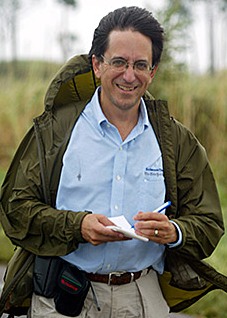
As Andrew Revkin, who writes the Dot Earth blog for the New York Times, wrote on 1 October: “If the goal had been to convince people that environmental campaigners have lost their minds and to provide red meat (literally) to shock radio hosts and pundits fighting curbs on greenhouse gases, it worked like a charm.”

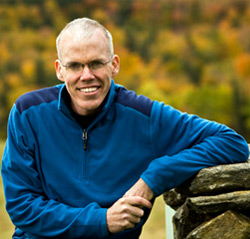
He isn’t alone. Bill McKibben, author, educator and environmentalist — who founded the serious climate group 350.org — wrote on the same day: “The climate skeptics can crow. It’s the kind of stupidity that hurts our side, reinforcing in people’s minds a series of preconceived notions, not the least of which is that we’re out-of-control and out of touch — not to mention off the wall, and also with completely misplaced sense of humor.”

His group, 350.org, issued a statement that emphatically said they had nothing to do with this misplaced British climate extremism. McKibben added, more reflectively: “What makes it so depressing is that it’s the precise opposite of what the people organizing around the world for October 10 are all about. In the first place, they’re as responsible as it’s possible to be: They’ll spend the day putting up windmills and solar panels, laying out bike paths and digging community gardens. And in the second place, they’re doing it because they realize kids are already dying from climate change, and that many many more are at risk as the century winds on. Killing people is, literally, the last thing we want.”

Bill McKibben
Now contrast such concern with the initial reaction from British film maker Franny Armstrong, who wrote a half-hearted, almost defiant apology on the 10:10 UK website, saying: “With climate change becoming increasingly threatening, and decreasingly talked about in the media, we wanted to find a way to bring this critical issue back into the headlines whilst making people laugh. We were therefore delighted when Britain’s leading comedy writer, Richard Curtis – writer of Blackadder, Four Weddings, Notting Hill and many others – agreed to write a short film for the 10:10 campaign. Many people found the resulting film extremely funny, but unfortunately some didn’t and we sincerely apologise to anybody we have offended.”

Adding gross insult to injury, Armstrong signed off saying: “As a result of these concerns we’ve taken it off our website. We won’t be making any attempt to censor or remove other versions currently in circulation on the internet.”

Both the 10:10 UK campaign and its sponsors Sony have been more unequivocal in their apologies in the days that followed. But that’s too little, too late. Enough damage done — climate activists and campaigners worldwide will take months, if not years, to live down this one.

And nothing really goes away on the web — this video will be lurking somewhere for a long time. YouTube currently carries the video in several places, with the warning: “This video or group may contain content that is inappropriate for some users, as flagged by YouTube’s user community.”

Andrew Revkins has posted comments from those who condemned as well as those who found some merit in the offensive climate video. Some of these comments take a dispassionate view, which is to be welcomed.

This incident teaches all of us engaged in environmental communication some important lessons. Environmentalists have over-stated their case before, and every time, that did them (and their causes) far more harm than good. Crying wolf, and ridiculing the non-believers, are never good tactics in winning friends or influencing people.

As Bill McKibben noted: “There’s no question that crap like this (video) will cast a shadow, for a time, over our efforts and everyone else who’s working on global warming. We’re hard at work, as always, but we’re doing it today with a sunk and sad feeling.”

One more thing: even in this age of globalised media, humour doesn’t travel well across cultures and borders. As mainstream corporate media companies have often found out, British humour sometimes doesn’t even cross the Atlantic very well — let alone to other parts of the world. Perhaps this is a key point that this all-British team of film makers and campaigners simply missed.

The world is a bit bigger — and more diverse — than your little island, Ms. Armstrong. By failing to grasp that, and with your crude display of insensitivity, you have really proved the premise of your good climate film.

We do live in the Age of Stupid.

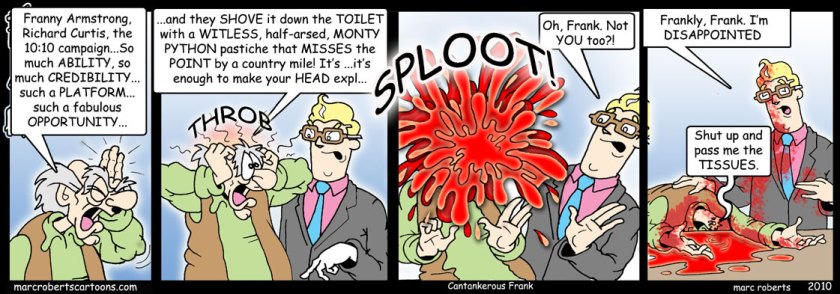
PS: Marc Roberts says it all in this cartoon:

Et tu, Armstrong?

Avatar: Blockbuster film as socio-political and green allegory?


“Pictures are for entertainment, messages should be delivered by Western Union.”

Those words by American film producer and studio founder Sam Goldwyn (1879-1974) sum up Hollywood’s attitude to movie-making for the past many decades.

As I watched James Cameron’s latest blockbuster movie Avatar, I kept wondering how the master film maker managed to subvert this so completely. Beneath the 3D, special effects and riot of other worldly colours, the movie is one long (2 hrs 40 mins) and powerful commentary on why might is not right when it comes to exploiting resources — belonging to other countries, people, or as in this case, other worlds.

This is not just another worthy indie movie made by an idealistic movie maker defiant of Hollywood traditions and big money. James Cameron is one of the most commercially successful directors in the mainstream film industry – and perhaps one of the very few who can get away with this kind of stunt. At a budget of over US$ 300 million , Avatar is one of the most expensive films ever made, and the costliest ever for 20th Century Fox.

The big gamble is certainly paying off. On 26 January 2010 came the news that Avatar has surpassed Titanic as the highest-grossing movie worldwide. According to the studio, worldwide box office total for Avatar at that point stood at US$1.859 billion, beating the US$1.843 billion racked up by Cameron’s romantic drama in 1997-98. Avatar broke that record in a little over six weeks.

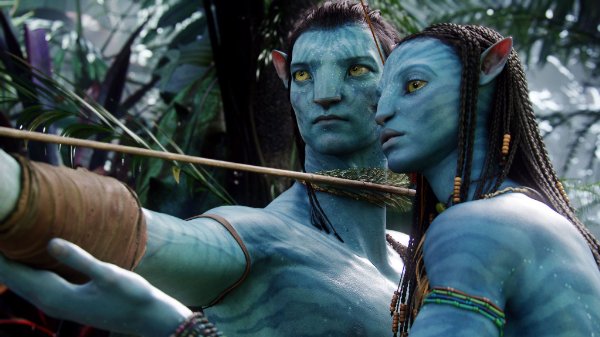
Part of the reason for such appeal is the extraordinary special effects: it’s an action-packed thriller where good and evil battle it out on another planet. The strange landscapes give it a video game like feel, but no small screen can match the theatrical experience, especially if you watch it in IMAX 3D (I didn’t). And for a change, this time the aliens inhabiting planet Pandora are benign, while it’s the humans who are ruthless invaders and brutal killers. Well, at least most of the time…

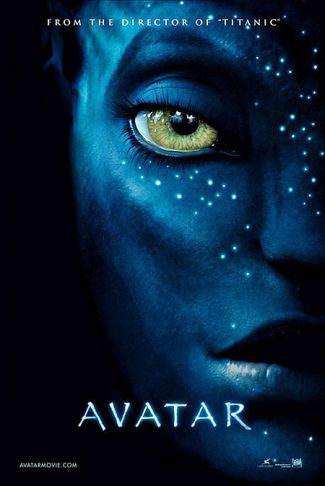
Here’s the official blurb: “Avatar takes us to a spectacular world beyond imagination, where a reluctant hero embarks on an epic adventure, ultimately fighting to save the alien world he has learned to call home. James Cameron, the Oscar-winning director of Titanic, first conceived the film 15 years ago, when the means to realize his vision did not exist yet. Now, after four years of production, AVATAR, a live action film with a new generation of special effects, delivers a fully immersive cinematic experience of a new kind, where the revolutionary technology invented to make the film disappears into the emotion of the characters and the sweep of the story.”

And here’s AVATAR – Official International Launch Trailer (HD)

Film critics and social commentators around the world have noticed the many layers of allegory in the film. Interestingly, depending on where you come from, the movie’s underlying ‘message’ can be different: anti-war, pro-environment, anti-Big Oil, anti-mining, pro-indigenous people, and finally, anti-colonial or anti-American. Or All of the Above…

It looks as if Cameron has made the ultimate DIY allegory movie: he gives us the template into which any one of us can add our favourite injustice or underdog tale — and stir well. Then sit back and enjoy while good triumphs over evil, and the military-industrial complex is beaten by ten-foot-tall, blue-skinned natives brandishing little more than bows and arrows (and with a little help from Ma Nature). If only it works that way in real life…

But the multi-purpose allegory is apparently working well. Take these two from opposite sides of the planet:

Thomas Eddlem wrote in The New American: “Avatar, is a visually stunning epic that is a perfect allegory for any of a dozen or more Indian wars in American history. From King Philip’s War in New England to Tippecanoe in Indiana to Horseshoe Bend in Alabama — and all the way across the American continent, for that matter — the story was the same. Colonists simply take land from the natives, as the Sully explains: ‘This is how it’s done. When people are sitting on something that you want, you make them your enemy so that you can drive them out.’

Mayank Shekhar wrote in The Hindustan Times newspaper: “Between a green worldview and the globe’s war over a natural resource, James Cameron’s twin analogies of present-day politics are fairly complete. They lend his science fiction ‘event picture’ a certain soul, even if not much of a story line.”

So did Cameron set out trying to send a message? Or was it all an incidental byproduct? Listen to the director himself in these two online video stories:

James Cameron’s Vision Featurette

CBS Interview with James Cameron: From Titanic to Avatar

The most compelling social commentary on Avatar I have so far read comes from Naomi Wolf, the American political activist, author and social critic. In an op ed essay written for Project Syndicate, she sees two revealing themes in Avatar: “the raw, guilty template of the American unconscious in the context of the ‘war on terror’ and late-stage corporate imperialism, and a critical portrayal of America – for the first time ever in a Hollywood blockbuster – from the point of view of the rest of the world.”

She adds: “In the Hollywood tradition, of course, the American hero fighting an indigenous enemy is innocent and moral, a reluctant warrior bringing democracy, or at least justice, to feral savages. In Avatar , the core themes highlight everything that has gone wrong with Americans’ view of themselves in relation to their country’s foreign policy.”

Does the box office triumph of Avatar make James Cameron one of the most effective campaigners for social justice on the planet (comparable, in some ways, to Michael Jackson having been one of the biggest environmental communicators of his time)?

And is Avatar the most expensive piece of info-tainment or edu-tainment ever made, just like the Lord of the Rings trilogy was one long (even if unintended) commercial for the breathtaking sights and sounds of New Zealand?

Certainly, mixing messages with entertainment is such a difficult and delicate art that most people who dabble in it fall between the two stools. The entertainment value of Cameron’s latest flick is not in question. Granted, it’s not as heart-breaking as Titanic, and the storyline is oh-so-predictable. But 3D and SFX magic alone can’t hold today’s audiences gripped for 160 long minutes. And if the underlying story starts movie-goers thinking and talking about many parallels between the fictional world of Pandora and our own Earth, he’s certainly getting somewhere.

As Naomi Wolf says: “Ironically, Avatar will probably do more to exhume Americans’ suppressed knowledge about the shallowness of their national mythology in the face of their oppressive presence in the rest of the world than any amount of editorializing, college courses, or even protest from outside America’s borders. But I am not complaining about this. Hollywood is that powerful. But, in the case of Avatar , the power of American filmmaking has for once been directed toward American self-knowledge rather than American escapism.”

Perhaps this wasn’t part of the script, but would the executives at 20th Century Fox care as they laugh all the way to their bank?

Sri Lanka Presidential Election 2010: Choices made, now we move on…

Heads you lose, tails we win...?
With over 10 million others, I voted in Sri Lanka’s sixth Presidential Election yesterday. Today, after the votes were counted and tallied, we were informed that the incumbent President Mahinda Rajapaksa has been re-elected for another six year term. He has won 57.9% of the valid votes.

Nearly 11,000 polling stations had been set up for this purpose, mostly at temples or schools. A quarter of a million public servants were mobilised to handle this massive operation, while close to 100,000 policemen and soldiers were tasked to maintain law and order. And the whole business of choosing the next leader is costing the war-impoverished nation several billion rupees.

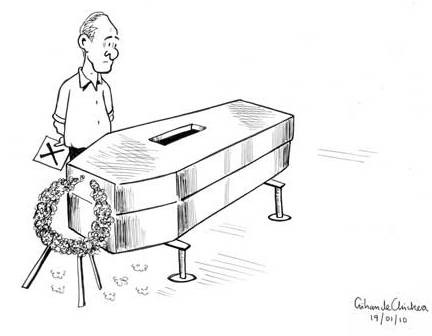
So do the results — basically, more of the same — justify all this cost and effort? Was there real choice for us the hopeful little men (and women) who walked into little booths with little pencils in hand to make a little cross on a (not so) little bit of paper?

Opinion is highly polarised on that last question. The two main candidates not only tried to outpromise each other without coherence or focus, but also made a mockery out of the whole campaign process.

In fact, as I noted in my essay last week titled Open Moment, Closed Minds: “Party politics has always polarised Lankans, but no other election in recent memory has been as divisive…The two main contenders both claim to hold a mutually exclusive key to a better future for our land and people. Their dizzy campaigns bombard us with lofty claims and counter-claims 24/7 delivered through broadcast, broadband, mobile and other media.”

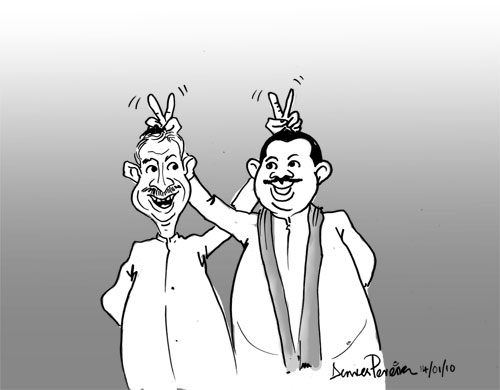
With pre-election violence escalating, the choice before voters looked like this a week before election day.
The election results will be analysed and debated for weeks to come. At first glance, it looks as if the voters used this election to express gratitude to Rajapaksa for having provided the political leadership to end Sri Lanka’s long-drawn civil war.

We can argue whether presidential elections should be turned into referendums on individual performance of candidates – or instead, decided on the vision and policies offered by them. I grant this is a bit more serious than American Idol – or its local variations – where we text our preference for the candidate with the best looks or talent.

In fact, I’m still not convinced whether it’s such a good idea to mix personal gratitude with voting for a head of state.

I’ve voted in four presidential and three general elections (I missed some due to overseas travel). With one exception (1994), all have been ‘protest votes’ – I was voting against an incumbent more than in favour of an aspirant.

But there are more things in heaven and on Earth, dear reader, than are dreamt in our messy politics. Albert Einstein said it so well many decades ago: “Everything that can be counted does not necessarily count; everything that counts cannot necessarily be counted.”

We can only hope that our votes were properly counted — and that they count and matter to the leader whom we have collectively chosen today. That is, if he can see and hear beyond the cacophony of sycophants who surround him 24/7.

And as I tweeted earlier today: As Sri Lanka re-elects the President, we hope ALL 20 million Lankans can share the promise of a Better Future on which he campaigned and won…

Cartoons courtesy: Daily Mirror, Sri Lanka

Open Moment, Closed Minds: New essay to mark 250 days of ‘Peace’ in Sri Lanka

Today marks exactly 250 days since Sri Lanka’s civil war officially ended on 18 May 2009.

In a new op ed essay — titled ‘Open Moment’, Closed Minds! — just published on Groundviews.org, I look back and ask some hard questions.

Here’s an excerpt:

“We all knew the hard-won peace had to be nurtured and consolidated. We also realised just how formidable the challenges of healing and rebuilding were. But could anyone have imagined the dramatic turn of political events since?

“Who would have thought that the victors of the war would soon be engaged in a nasty battle for personal glory and power? Who expected the historical feud between ‘lions’ and ‘tigers’ to be replaced so swiftly by a showdown between self-proclaimed ‘patriots’ and ‘traitors’?”

I raise these questions in the context of a fiercely contested presidential election scheduled for 26 January 2010. I note: “The two main contenders both claim to hold a mutually exclusive key to a better future for our land and people. Their dizzy campaigns bombard us with lofty claims and counter-claims 24/7 delivered through broadcast, broadband, mobile and other media.”

I ask whether either of the leading candidates has the open mind needed to seize the historic ‘open moment’ since the war ended. I recall how we completely missed the last such open moment created by the tsunami of December 2004.

I write: “Having missed the tsunami’s open moment, we cannot afford to bungle again. Rebuilding a nation of lasting peace, pluralism and prosperity will require many sections of society to change their mindset. This is especially and urgently needed in our media, much of which has become uncritical cheerleaders for patriotism and tribalism in recent years.”

Despite the many disappointments of the past 250 days, I still remain cautiously optimistic. But for how long?

The origins of this essay can be traced back to a blog post I wrote on 19 May 2009: Us and Them: Sri Lanka’s first landmine on the road to peace…

Read the full essay, and join the conversation at Groundviews.org

Wanted: ‘Magic Mirrors’ for a Land of the Blind…

Last chance...?
Here’s a winning idea for a new business venture in these lean times: make an always-agreeable ‘magic’ mirror — and the vane and wicked will beat a path to your door.

Well, at least half the politicians in Sri Lanka would. They’d rather not see their true selves on any mirror.

The magic mirror idea was popularised many years ago by Snow White and the Seven Dwarfs, whose wicked and vain queen had an unusual mirror that talked back, each time she asked: ‘Mirror, mirror, on the wall. Who’s the fairest of them all?’.

The queen wasn’t looking for honest answers; she just wanted to hear she was always the prettiest and fairest in the land. (All competition – real and imagined – was dealt with brutally.)

Little has changed, even in this 21st Century. We may not have too many monarchs left in the world, but our uncrowned rulers can be equally vain and ruthless. They are obsessed with self-aggrandizing sycophancy – they’d only tolerate magic mirrors that totally boost their egos.

If I seem to be preoccupied with mirrors, that’s nothing to do with my own vanity. In this digital age, the mirror is still a pretty good metaphor for the media industry that I have been part of, in one way or another, for over 20 years. At its very basic, the media are expected to reflect our society and our times.

But some people don’t like what they see on a true mirror. In 2009, we saw a spate of mirror smashing or media bashing in Sri Lanka. It started on 6 January, when the studio of the Maharaja Television/Broadcasting Network (MTV/MBC, popularly known as Sirasa Group) was attacked by armed gunmen who almost blew up the country’s most popular private broadcast organisation. On 8 January, exactly a year ago today, Lasantha Wickrematunga, editor of The Sunday Leader, was shot dead by two men on a motorcycle as he drove to work in suburban Colombo.

Sirasa & Lasantha: Refused to be magic mirrors
One year later, both crimes remain unsolved. They have joined a long list of crimes against journalists and media organisations in Sri Lanka, most of which have never led to any prosecution of the perpetrators.

As Reporters Without Borders noted in a statement this week: “The emotion and anger have not gone away in the year since this famous Sri Lankan journalist’s death. The anger is being sustained by the government’s flagrant obstruction of the investigation. Lasantha Wickrematunge’s name and memory will not disappear and, in that sense, those who were behind his murder made a mistake.”

Commenting on the MTV/MBC (Sirasa) attack, I described the typical reaction of the mirror-bashers: “…if you don’t like what you see in the mirror – which is what media is to society – just kick it, shatter it and hammer it into dust so that it won’t reflect anymore. Destroy all the mirrors of the land, and we’ll finally be the fairest and prettiest in the whole world. That seems to be the perverse logic that fuels attacks of this nature.”

Rex de Silva, the first editor that Lasantha worked for in the late 1970s cautioned that Lasantha’s murder was the beginning of ‘the sound of silence’ for the press in Sri Lanka. As I asked on the day of Lasantha’s emotionally-charged funeral: “Can this sound of silence be shattered by the silent, unarmed majority of liberal, peace-loving Lankans who were represented at the funeral service and the Colombo cemetery today?”

Owing to these and other threats, pressures and intimidation during the year, Sri Lanka was ranked 162nd out of 175 countries in the 2009 Reporters Without Borders press freedom index. This was the worst ranking of any democratic country. See RSF website section on Sri Lanka.

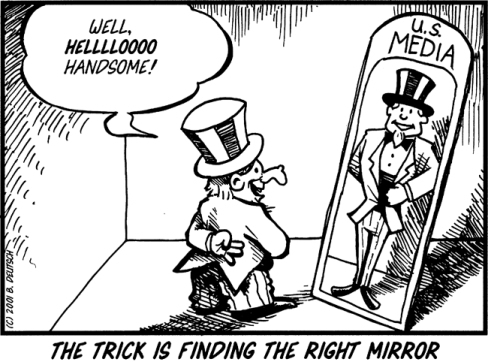
Back to mirrors. While the true mirrors were getting bashed, those who played being ‘magic mirrors’ have done well for themselves (and are probably laughing all the way to their banks). But that’s not a phenomenon confined to the little island of Sri Lanka. A good part of the US Media did the same under the hawkish Bush Administration, which prompted the cartoon below.

It’s not just ‘Dubya’ who is addicted to such agreeable mirrors. Indeed, for many modern-day rulers, an essential trapping of power involves surrounding themselves with spin doctors, press commissioners and other manipulators or manufacturers of image. In mature democracies, there are certain checks and balances which usually guard against the worst excesses (but there are notable exceptions – look at Italy!).

In immature, fragile or pseudo democracies, mirrors obey the laws of physics (optics) at grave risk to themselves. If you want proof, just talk to the staff of Sirasa or The Sunday Leader in Sri Lanka…

Groundviews.org: One year later: A murder unresolved, a government unashamed

Nov 2009 blog post: We need more reflective mirrors in the media!

Dance for the Climate: dance your anger and joys to a U2 tune!

Hopenhagen?
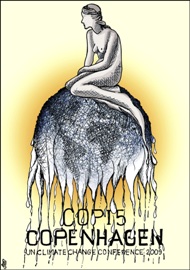
As the UN climate conference culminates today in Copenhagen, there seem to be lots of angry people in the Danish capital. Many civil society and environmental activists, and some journalists, have been frustrated by the inter-governmental bickering process and the occasionally tough crowd control measures by the Danish police.

As author and activist Naomi Klein wrote at the end of the first week: “By the end, around 1,100 people had been arrested. That’s just nuts. Saturday’s march of roughly 100,000 people came at a crucial juncture in the climate negotiations, a time when all signs point either to break down or a dangerously weak deal. The march was festive and peaceful but also tough. ‘The Climate Doesn’t Negotiate’ was the message, and Western negotiators need to head it.”

I’m not in Copenhagen for uptodate news, but the 5,000+ journalists and over 10,000 activists are keeping us well informed on what’s happening (or not happening). Perhaps part of their anger can be dissipated by heeding a creative call to Dance for the Climate.

It’s an alternative way of demonstration, made into an inspiring and hopeful video clip by award winning Belgian film director Nic Balthazar. It shows 12 000 people on a Belgium beach in a truly spectacular simultaneous choreography dancing to the U2 hit single ‘Magnificent’. Bono and his band graciously gave the rights to their music. The message of the clip to politicians in Copenhagen is to ‘start moving, together, before it’s too late. The time is now to change climate change’.

In a recent email, Seppe Verbist, handling international distribution of “Dance for the Climate” clip, wrote: “We believe that the chances of success of the UN Conference are influenced by the clear signals from ordinary people to their politicians. The ‘Dance for the Climate-clip’ wants to contribute to this, and we sincerely hope we can count on your support!”

According to her, the clip has been released three weeks ago and they are now trying to spread it worldwide. In Europe the distribution goes pretty well as the European Broadcasters Network (EBU) offered the clip to all her members. They are picking up the offer and integrating the clip into their Copenhagen content. In Canada weather forecasters from different broadcast networks are organizing an imitation of Dance For The Climate, and the clip will be shown 24/7 at the World Expo 2010 in Shanghai in the Meteo World Pavilion. They’re expecting 100 000 visitors every day for six months. The Al Gore Climate Project also supported the clip and shared it with their network. It’s been on TV in Brazil and Mexico as well.

Dancing can be a powerful way to express not just joy, but a range of emotions. One of my favourite calls to action came from Ken Saro-Wiwa, the Nigerian poet, author, environmentalist and minority rights activist (for his Ogoni people) who was executed by Nigeria’s military on 10 November 1995. While in jail facing an uncertain future, he wrote these momentous words:
“Dance your anger and your joys,
Dance the military guns to silence,
Dance oppression and injustice to death,
Dance my people,
For we have seen tomorrow
And there is an Ogoni star in the sky.”

And today, we must also dance for saving our climate.

Adrian Cowell and ‘The Decade of Destruction’: A film can make a difference!

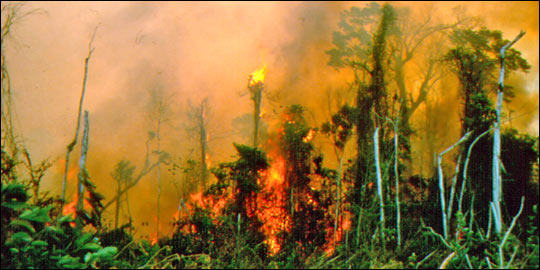
The Amazon burning
The Decade of Destruction A unique chronicle of the destruction of the Amazonian rainforest.

Whatever we might think about Al Gore’s film An Inconvenient Truth, I’m glad it has settled one question: can a single film make a difference in tipping public opinion about a matter of global importance? The answer, where climate change is concerned, is a resounding yes!

But years or decades before Al Gore, other film makers have had their own impact on other environmental issues. One of them is Adrian Cowell, the award-winning British film maker whose quest to tell the story of the destruction of the Amazon forest made politicians listen and the world take note.

According to the Centre for Social Media at the American University, “He catapulted the environmental movement to save the Amazonian rain forests through the television series The Decade of Destruction and Banking on Disaster.”

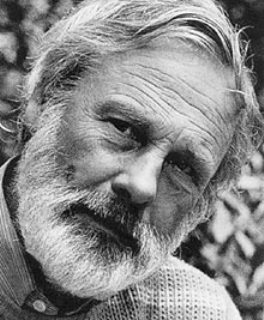
Adrian Cowell
Adrian Cowell
Adrian, whom I have had the pleasure of meeting and talking on several occasions, is a world acclaimed leader in our field. Born in Tongshan, China in 1934 and educated at Cambridge University, Adrian has been making films longer than I have been alive — and luckily for all of us, he is still at it.

He began filming his path-breaking series called The Decade of Destruction in 1980, when the Amazon was first opened up to settlers and developers. He has documented the systematic destruction of the rainforest there into late 1990 when, for the first time, there was an indication that the fires were being brought under control.

As the synopsis says: “Each episode follows the real life stories of people caught up in the frontier’s web of need and greed, stories of personal tragedy and great courage. The programs relate the individual’s struggle to the wider developments going on around them. Together they illustrate the principal issues of Amazonia during the 1980s – its decade of greatest destruction.”

The Chicago Tribune called it an epic, “a brilliantly told story of greed, death, politics, violence, heroism and environmental holocaust.”

I recently came across this brief account by Adrian Cowell himself, looking back at his long engagement with the Amazon:

“In January 1980 we started 10 years of recording the destruction of the Amazon forest. We began by filming colonists invading the territory of the then unknown, and very vulnerable, tribe, the Uru Eu Wau Wau, in the Brazilian state of Rondonia. Many colonists had received, free of charge from the government, plots of 40-50 hectares in the forest traditionally hunted by the Indians. Tragically, within a decade, this ‘colonisation’ process, called the Polonoroeste Project, would not only leave three-quarters of the Indians dead, but also prove a disaster for the colonists themselves. They had been given such poor soil that, within six years, 60% of the land they had so hopefully deforested would be abandoned.

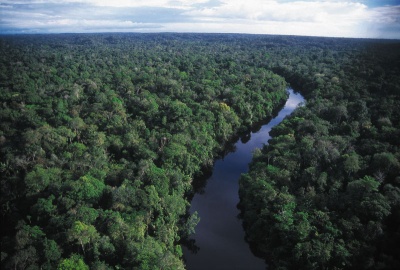
Amazon: The last frontier?“So we were astounded when the World Bank moved in to lend nearly half a billion dollars to the project, and were even more astonished when we realised that what was being played out in front of our cameras was evidence of one of the most disastrous loans the Bank had ever made. Not unnaturally, I went to Washington to find out what could explain the Bank’s loan. And there I met three environmentalists, Bruce Rich, Barbara Bramble and Brent Blackwelder, respectively from the Environmental Defense Fund, the National Wildlife Federation and the Environmental Policy Institute. They were campaigning on how international economic development affected the environment. But by a remarkable coincidence they had decided to focus, not only on the World Bank, but on – of all its hundreds of loans all over the world – the very Polonoroeste Project that we were filming. They asked me to show our film in Congressional hearings and I telephoned José Lutzenberger – more or less the father of Brazilian environmentalism – to ask him to testify. By yet another happy coincidence, an American researcher, Brent Millikan, had written a report giving academic detail to the facts behind what we had filmed. And an American expert on Amazonia, Dr Philip Fearnside, added his authority to the diagnosis of what was going wrong.

“And so, some months later – after a complex chain of legislative and political developments – we were able to record Senator Robert Kasten, the chairman of the powerful Appropriation Committee’s subcommittee on foreign operations, cutting off 20% of the money the US donated annually to the World Bank. Nothing concentrates a banker’s attention more than the withdrawal of some of his money. Within a few months we were able to conclude our programme, Banking on Disaster, by filming World Bank president Barber Conable admitting, for the first time, that a Bank loan, specifically the Polonoroeste Project, had gone wrong. This was to be the beginning of a very slow and gradual greening of World Bank policies.

“Obviously, our television film had played a part in this political change. But though a film may sometimes be the most dramatic way to present a case, it is an illusion to think that it can be more than just one tool or facet of the very complex process behind international and environmental evolution.”

* * * * *

Here’s more biographical background about Adrian:

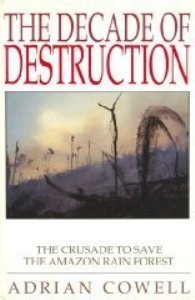
The Decade of Destruction - book cover
Book of the TV series
Adrian Cowell has been making documentary films for five decades. In 1955-56, he joined the Oxford and Cambridge Far Eastern Expedition, an experience which launched his film career and his interest in Burma. The following year, he made his first foray into the rain forest of Brazil, part of a joint Oxford-Cambridge expedition of young filmmakers. These early trips became the seeds of Cowell’s award-winning epic projects. His series Opium was filmed over an eight-year period (including nine months when he was trapped behind the lines in Burma). His ten-year chronicle of the destruction of the Brazilian rain forests during the 1980’s—broadcast as the television series The Decade of Destruction —stirred the world and contributed to the international debate on how the Amazon should be developed. In 1990, The Decade of Destruction was broadcast on Channel Four in Britain and on PBS FRONTLINE in the U.S. Adrian Cowell’s more recent British TV series include The Heroin Wars. It is a follow-up to The Opium Trail (1966), The Opium Warlords (1974) and Opium (1978).

Cowell is an environmental activist, co-founder of the Television Trust for the Environment and the author of two books on Brazilian Indians, The Heart of the Forest (Knopf) and The Tribe that Hides from Man (Stein and Day). He also wrote a companion book to the TV series The Decade of Destruction (Henry Holt and Company).

Read PBS interview with Adrian Cowell on another of his film series, on opium trade in Southeast Asia

Breathing Hope into Kabul: Prince Mostapha Zaher, TIME Hero of the Environment 2009

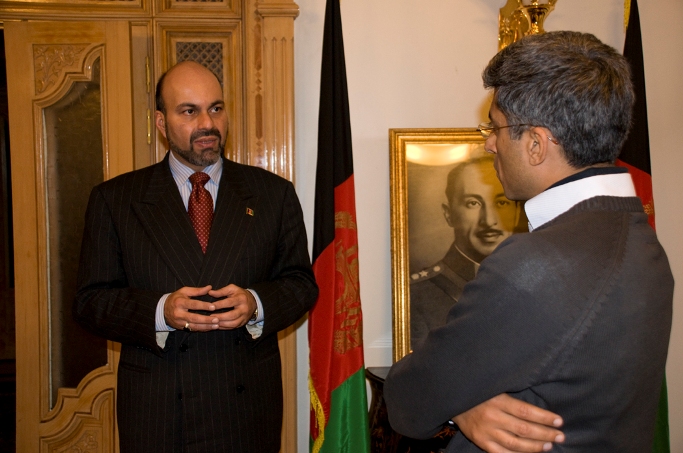
Prince Mostapha Zaher (left) with Indian film-maker Rohit Gandhi in Kabul
Prince Mostapha Zaher (left) with Rohit Gandhi in Kabul

I haven’t yet met Prince Mostapha Zaher in person, but feel almost as if I have. That’s because he features prominently in a short documentary film we released earlier this year on the environmental problems in Kabul, the capital of Afghanistan — where he is now the environmental chief, and where his grandfather was Afghanistan’s last king, Mohammed Zahir Shah (1914-2007).

In January 2009, I was watching a rough edit of the film (Breathing Life into Kabul) in Delhi, where Indian film-maker Rohit Gandhi was putting it together. In the interview, Mostapha Zaher came across as authoritative and resolute.

And does he have formidable challenges to deal with! Since the Taliban regime fell in 2001, people have been returning to Afghanistan after years in neighbouring countries. This massive influx is exerting pressure on the resources and infrastructure of the capital Kabul. Among the effects are high levels of air and water pollution, massive shortages of electricity and mounting problems waste.

Addressing these and other environmental issues is made that much more difficult because Afghanistan is one of the poorest countries in Asia, where large parts of the country are still engulfed in a prolonged conflict with extremists and the Taliban.

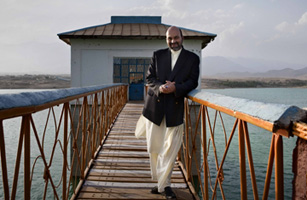
Prince Mostapha Zaher, photographed for TIME
For staying the course in this daunting task, Prince Mostapha Zaher has just been named as one of TIME Magazine’s Heroes of the Environment 2009. He is among ‘Leaders and Visionaries’ from around the world selected by the editors of the international news magazine. The list includes President Mohamed Nasheed of the Maldives, Hollywood star Cameron Diaz, and Indian film maker Mike Pandey.

TIME describes how Zaher gave up his comfortable post as ambassador to Italy to take up the job of director of Afghanistan’s newly formed Afghanistan’s National Environmental Protection Agency (NEPA) in 2004.

Says TIME: “Since then he has worked to rewrite the nation’s environmental laws, enshrining in the constitution an act that declares it the responsibility of every Afghan citizen to “protect the environment, conserve the environment and to hand it over to the next generation in the most pristine condition possible.” In a country ravaged by 25 years of war, it was an extraordinary feat.”

TVE Asia Pacific’s short film looks at how the United Nations Environment Programme (UNEP) is working with NEPA to develop environmental laws, policies and standards.

Watch Breathing hope into Kabul (10 mins):


Read full profile of Prince Mostapha Zaher in TIME Heroes of the Environment 2009


TVEAP News: New film documents environmental restoration in Afghan capital