Prisoners of Volcano Eyjaffjalljokull: ‘Tectonic Terror’ grounds much of Europe

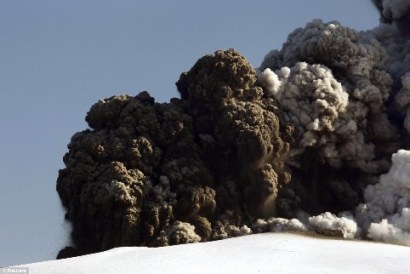
Eyjaffjalljokull erupting away in Iceland
Call it the cough heard around the world.

And boy, what a cough – and with what consequences!

A week ago, most of us had never heard of Eyjaffjalljokull (a glacial volcano in Iceland) — and we’re still struggling to pronounce its name even as it keeps tens of millions of people completely grounded and held ‘hostage’ with its incessant and powerful coughing.

My daughter Dhara and I are currently ‘trapped’ in London: a volcanic ash cloud from Iceland shut down all flights in and over the British Isles on Thursday 15 April 2010. The siege has continued on to the fifth day now, disrupting travel plans of so many people, and causing massive losses to the travel industry. With over 150,000 Britons stranded abroad unable to fly back, the UK is now going into emergency mode to deal with the crisis.

It’s annoying to have an unknown – and unpronounceable! – natural factor crop up and change our carefully laid plans. But things could have been much worse. As I tweeted earlier, as natural disasters go, volcanic ash has been highly disruptive but with no casualties except economic (at least so far).
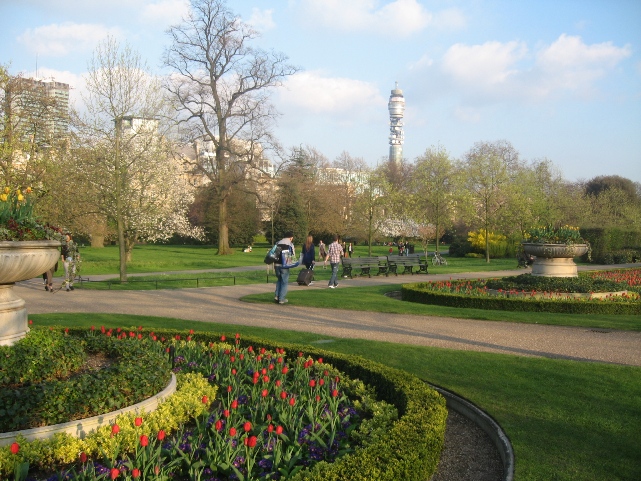
Life goes on in London: Regent's Park, 17 April 2010
Life in London goes on with no visible signs of concern. Dhara and I walked around absorbing the sights, sounds and smells of London, and people were going about with life – and welcoming Spring. Joggers in Hyde Park and Regent’s Park, babies being strolled around, and weekend revelers at Camden Town and Trafalgar Square.

We mixed into all these crowds – it’s Dhara’s first time, so she’s wondering what the fuss is all about! (If you’ve traveled with an energetic teenager, you know what I’m coping with.) Yes, we are being ‘held hostage’, but by an ever-so-gentle force that’s invisible to the naked eye: as if in compensation, London has rolled out sunny blue skies (long may they last!). On balance, I’d rather be caught in this kind of situation than in a devastating earthquake or tsunami…

The British media are covering the unfolding situation in great detail, but I haven’t yet seen an estimate of the number of visitors to the UK forced to stay on as there is no current escape from these islands, at least by air. But that number must be significant – and each one has his or her story to tell, some more desperate than others.

Take, for example, my friend Nadia El-Awady, who was in London for the same annual board meeting of SciDev.Net (and now grounded with the rest of the Board!). She has four young children waiting for her at home, in Cairo. She’s been blogging and tweeting about her plight, which in many ways mirrors my own.

Nadia is being adventurous (or just taking her chances). She is planning to take train or ferry or any other means to France, and then catch a train to southern Europe whose airspace is not yet affected by volcanic ash. Her determination is admirable – she just won’t allow this remote volcano to keep her hostage (she call it Eyja: “Do not expect me to ever know its full name. What kind of parent names their son Eyjafjallajoekull?”).
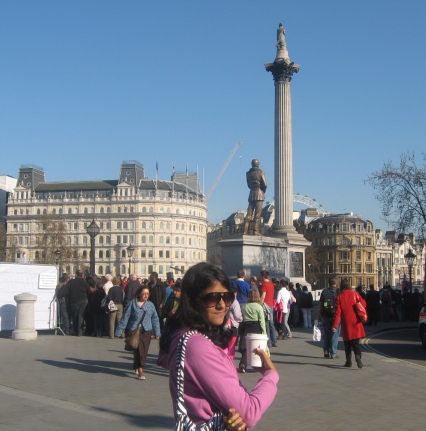
Dhara at Trafalgar Square, 18 April 2010
Meanwhile, Dhara and I will hold out for a couple of days more to see if the skies will clear up and the aviation regulators will ease up. As time passes and the flight suspension begins to bite hard, more and more aviation industry professionals are questioning the complete no-fly ban. Some are calling it a regulatory over-reaction.

Richard North, co-author of Scared To Death – From BSE To Global Warming: Why Scares Are Costing Us The Earth, had an excellent piece in The Mail on Sunday this weekend. He wrote: “What we are witnessing here is not a natural law, enshrined since time immemorial but a policy drawn up by the International Civil Aviation Organisation (ICAO) and then interpreted and enforced by the UK’s National Air Traffic Service (NATS). And that interpretation requires some scrutiny.”

He adds: “The blanket ban under clear blue skies and glorious sunshine is making some wonder whether this ‘one-size-fits-all’ regulation is appropriate to a situation that the regulations did not foresee…In the final analysis, despite the scares, no one has actually been killed in a volcano incident – something which cannot be said for the much more hazardous drive to the airport.”

Meanwhile, the journal Science has unearthed (no pun intended) from its archives an article published in November 2004 about an enormous volcanic eruption from Iceland’s past — and what it means for the country’s future. It looks at researchers studying one of the largest and least appreciated eruptions in recorded history: volcano Laki that killed 10,000 Icelanders in 1783, and according to recent studies, its billowing plumes led to extreme weather and extensive illness that may have claimed thousands more lives in Britain and on the European continent.
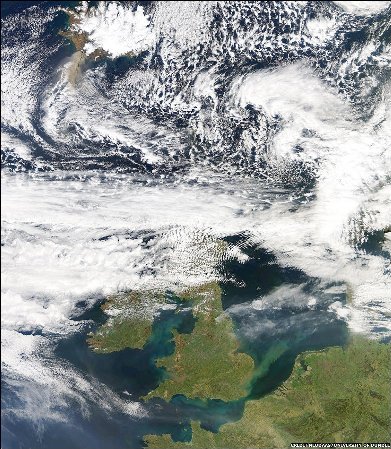
An image made available by NEODAAS/University of Dundee which shows the volcanic ash plume from Iceland, top left, to northern France as pictured by Nasa\'s Terra Satellite on 17 April 2010. Photo courtesy NEODAAS/University of Dundee/AP
It’s not exactly a comforting thought to read how much worse a volcanic eruption could be. The piece was written by science writer Richard Stone (currently their Asia News Editor, and my fellow panelist at the science journalists conference last Summer in London). Interestingly, the headline I gave to that blog post was: Reporting disasters: How to keep a cool head when all hell breaks loose.

Well, easier said than done! It’s challenging for us journalists to keep a level head and report or comment on a mega-disaster for our media. But it’s even harder being caught up and personally affected by forces of Nature (and according Richard North, regulatory over-reaction). I’ve had my house flooded out, and was close enough to ground zero of the 2004 Asian Tsunami. On both occasions, the impact was brutal and immediate.

Eyja’s persistent coughing is different. It’s a distributed, slowly unfolding phenomenon with zero casualties so far, yet affecting millions. At one level, local residents can continue life’s routines with no threat of basic amenities of life being shattered. We travelers can grumble and remain nervous when we can get home, but at the streets of London are nothing like what the doomsday scenario shows in The Children of Men, placed in a near-future London of 2027.

But as Eyja’s strangely gentle yet firm siege continues – succeeding in closing down Britain’s air space in a way that Hitler and Bin Laden couldn’t – we are reminded of who is really in charge.


Open Moment, Closed Minds: New essay to mark 250 days of ‘Peace’ in Sri Lanka

Today marks exactly 250 days since Sri Lanka’s civil war officially ended on 18 May 2009.

In a new op ed essay — titled ‘Open Moment’, Closed Minds! — just published on Groundviews.org, I look back and ask some hard questions.

Here’s an excerpt:

“We all knew the hard-won peace had to be nurtured and consolidated. We also realised just how formidable the challenges of healing and rebuilding were. But could anyone have imagined the dramatic turn of political events since?

“Who would have thought that the victors of the war would soon be engaged in a nasty battle for personal glory and power? Who expected the historical feud between ‘lions’ and ‘tigers’ to be replaced so swiftly by a showdown between self-proclaimed ‘patriots’ and ‘traitors’?”

I raise these questions in the context of a fiercely contested presidential election scheduled for 26 January 2010. I note: “The two main contenders both claim to hold a mutually exclusive key to a better future for our land and people. Their dizzy campaigns bombard us with lofty claims and counter-claims 24/7 delivered through broadcast, broadband, mobile and other media.”

I ask whether either of the leading candidates has the open mind needed to seize the historic ‘open moment’ since the war ended. I recall how we completely missed the last such open moment created by the tsunami of December 2004.

I write: “Having missed the tsunami’s open moment, we cannot afford to bungle again. Rebuilding a nation of lasting peace, pluralism and prosperity will require many sections of society to change their mindset. This is especially and urgently needed in our media, much of which has become uncritical cheerleaders for patriotism and tribalism in recent years.”

Despite the many disappointments of the past 250 days, I still remain cautiously optimistic. But for how long?

The origins of this essay can be traced back to a blog post I wrote on 19 May 2009: Us and Them: Sri Lanka’s first landmine on the road to peace…

Read the full essay, and join the conversation at Groundviews.org

Who’s Afraid of Amateur Radio? And why do our babus fear it?

When I was in my early teens (back in the early 1980s), I developed a great interest in radio. Not just in listening to radio broadcasts, which I did regularly while growing up in a country that had no television, but also in building a radio that could both receive and transmit signals.

My school teacher father, who encouraged me in many of my diverse pursuits, bought transistors, condensers and other ‘building blocks’ for a basic radio set. With the help of an amateur radio handbook, and through trial and error, he and I actually built a functional transmitter. It was exhilarating to listen to local and shortwave broadcasts on a home-made radio set, but even more exciting to be able to transmit rudimentary signals.

Even as a kid, I was not contented in being a passive recipient of information; I wanted to give out as much as I received…

That particular fancy didn’t last long: I soon moved on to other challenges, and never persisted with being a serious amateur radio enthusiast (or ‘radio ham’), but it left a lasting impression. A few years later, after leaving high school, I became a regular freelancer at the local radio station. By age 23, I was hosting my own weekly show on national radio, and my association with the radio medium would last for much of my 20s.

The humble low tech that saved the day...
My interest in amateur radio lay dormant — until five years ago, when I read reports about how radio hams helped revive emergency communications in the immediate aftermath of the Indian Ocean Tsunami.

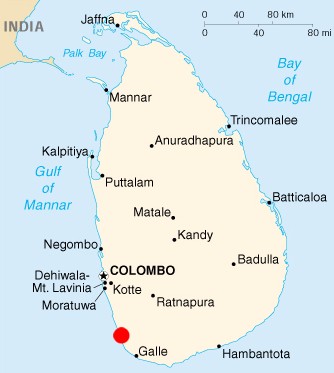
The decades old practice was hailed as the ‘low tech’ miracle that literally helped save lives. Where electricity and telephone services — both fixed and mobile — had been knocked down, radio hams restored the first communication links. They were at the forefront of relief efforts, for example, in the Andaman and Nicobar Islands in India, and in Hambantota in southern Sri Lanka.

This intrigued Sir Arthur C Clarke, inventor of the communications satellite and long time resident of Sri Lanka. Shortly afterwards, he wrote in Wired magazine: “We might never know how many lives they saved and how many minds they put at ease, but we owe a debt to Marconi’s faithful followers.”

If Sir Arthur were alive, he would have been dismayed to find what has happened since. Notwithstanding their celebrated role after the tsunami, radio hams have been sidelined in Sri Lanka. Their very hobby is being frowned upon by the state on the grounds of…national security.

Looking back, it seems like the public-spirited radio hams were given their 15 minutes of fame and then soundly ignored. Worse, the short-lived prominence may have attracted new bureaucratic hurdles.

This is the thrust of my last op ed essay for 2009, published on 31 December 2009 on Groundviews.org under the title: Who’s Afraid of Amateur Radio? Tsunami’s heroic technology has few backers in Sri Lanka

“As the applause died away, everything was forgotten,” I quote Victor Goonetilleke, one time President and current Secretary of the Radio Society of Sri Lanka, which networks amateur radio practitioners in the country.

One reason for this bureaucratic fear and negativity, I argue, may be simple ignorance of what amateur radio really is — reflecting the disturbingly low levels of media literacy in Sri Lanka.

Read the full essay, and join the conversation on Groundviews, or on this blog.

Essay republished on AMIC Alternative Media Portal

Asian Tsunami+5: How a packed train headed to disaster with no warning…

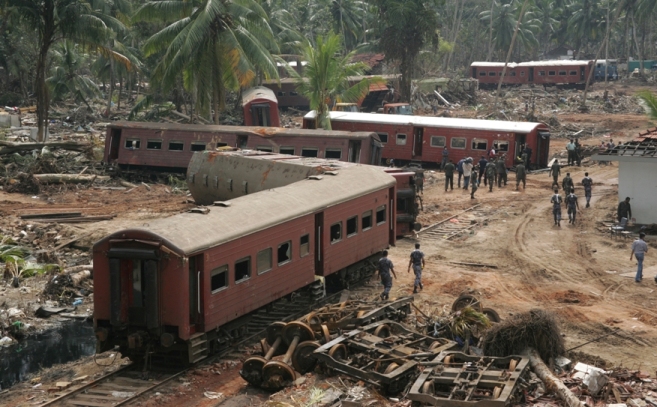
Scene of Peraliya train disaster - in Dec 2005 and Dec 2009 - Photos courtesy AFP

We tend to think of trains and railways as solid, tough objects. When the Asian Tsunami’s killer waves started rolling in without warning, the coastal residents of Telwatte and Peraliya areas in southern Sri Lanka thought a passing train offered them relative safety. They were dead wrong…

The train’s many tons of steel were no match for the enormous seismic energy that the sea waves were transmitting that day. There is no precise estimate of how many people perished on that train, ironically named Samudra Devi (Queen of the Sea) on the morning of 26 December 2004. The estimate ranges between 1,500 and 2,500 – some bodies were never recovered and washed into the sea. They joined a total of nearly 40,000 people dead or missing in Sri Lanka.

This is how the Wikipedia introduces the incident: “The Queen of the Sea rail disaster, the greatest train crash in railroad history, occurred when an overcrowded passenger train was destroyed on a coastal railway in Sri Lanka by the tsunami which followed the 2004 Indian Ocean Earthquake. Up to 2,000 people were killed, making it the world’s worst railway accident and eclipsing the previous record set by the Bihar train disaster in India in 1981, when a train had derailed and fell off a bridge, drowning about 800 people.”

Peraliya, scene of world's biggest train disaster
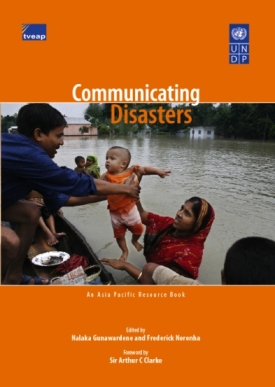
My friend Chanuka Wattegama, engineer turned ICT researcher, has done a detailed analysis of how and why no early warnings were issued anywhere in Sri Lanka that day, thus allowing many preventable deaths to occur. The tsunami, though extremely forceful, impacted only coastal areas and rapid evacuation could certainly have saved lives. He summed up his findings in a chapter on the subject he wrote for Communicating Disasters: An Asia Pacific Resource Book that I co-edited with Frederick Noronha two years ago.

This is what he says about the train tragedy, which sounds every bit gripping like a disaster movie script (but alas, was every bit real):

The railway authorities realise that one of their trains is moving down south, towards a risk prone area. They attempt to call the railway stations en route. The train is parked at the Ambalangoda railway station, when the station master’s phone rings constantly. Nobody answers it. Both the station master and his deputy are busy supervising the unloading of some goods from the train. By the time they receive the message, the train had already left the station. They do not have any way of issuing a warning, as the engine drive does not have a mobile phone.

“The train stops sometime later, in the middle of a village that had already been hit by the first waves. Those who are running for their lives assume the train to be a shield against the waves. They are wrong. The next waves hit the train, carrying it away like a child’s toy. The railway tracks get crumpled like a Möbius strip. If it can be called a railway accident, this would have been the worst train accident the world had ever witnessed. It alone costs more then 2,500 lives. Perhaps many of those lives could have saved if only the engine driver has been given a mobile phone.

We didn’t hear of any responsible official resigning or being sacked even after such massive bungling. But now Sri Lanka Railway has the dubious distinction of allowing the biggest train disaster to happen, which could have been prevented with quick thinking and action. Think about this before you next board a train anywhere in Sri Lanka…


Read full chapter: Nobody told us to run, by Chanuka Wattegama

Peraliya train disaster - photo by Shahidul Alam, Drik

Asian Tsunami+5: Are we sure there won’t be a surprise next time?

A monumental failure in communication...

This is one of the most memorable cartoons about the Asian Tsunami of December 2004. It was drawn by Jim Morin, the Pulitzer Prize winning editorial cartoonist of the Miami Herald.

It summed up, brilliantly, one of the biggest shocks associated with that mega-disaster. As I wrote in my op ed essay to mark the fifth anniversary: “It took a while for the tsunami waves, traversing the Indian Ocean at the speed of a jetliner, to reach India, the Maldives, Sri Lanka and Thailand. Yet, in this age of instantaneous telecom and media messaging, coastal residents and holiday makers were caught completely unawares — there was no public warning in most locations. Institutional, technological and systemic bottlenecks combined to produce this monumental failure in communication.”

Chanuka Wattegama
My friend Chanuka Wattegama, trained as an engineer and now working as a senior research manager at LIRNEasia, has studied this vital aspect of early warnings. He contributed a whole chapter on the subject to Communicating Disasters: An Asia Pacific Resource Book that I co-edited with Frederick Noronha two years ago.

After doing a dispassionate analysis of what went wrong in Sri Lanka in the crucial hours just before and during the 2004 tsunami, he asked: “So what remedies one can suggest so that when the next disaster happens — which may or may not be a tsunami — we do not see the same series of events repeated? What exactly is the role that the media can play?”

He outlined five action areas, all of which can be read in his chapter available for free online access (as is the rest of the book).

Here’s an excerpt:

Disaster warning is everyone’s business: Life for most of us would have been easier had the government taken full charge of disaster warnings. Unfortunately, the things do not work that way. These are some of key stakeholders and they have specific roles that they can play:

Views from Ground Zero of several disasters...
• The scientific community: Develop the early warning systems based on their expertise, support the design of scientific and systematic monitoring and warning services and translate technical information to layman’s language.
• National governments: Adopt policies and frameworks that facilitate early warning, operate Early Warning Systems, issue warnings for their country in a timely and effective manner.
• Local governments: Analyse and store critical knowledge of the hazards to which the communities are exposed. Provide this information to the national governments
• International bodies: Provide financial and technical support for national early warning activities and foster the exchange of data and knowledge between individual countries.
• Regional institutions and organizations: Provide specialized knowledge and advice in support of national efforts, to develop or sustain operational capabilities experienced by countries that share a common geographical environment.
• Non-governmental organizations: Play a critical role in raising awareness among individuals and organizations involved in early warning and in the implementation of early warning systems, particularly at the community level.
• The private sector: Play an essential role in implementing the solutions, using their know-how or donations (in-kind or cash) of goods or services, especially for the communication, dissemination and response elements of early warning.
• The media: It has to play an important role in improving the disaster consciousness of the general population, and disseminating early warnings. This can be the critical link between the agency that offer the warning and the recipients.
• Communities: These are central to people-oriented early warning systems. Their input to system-design and their ability to respond ultimately determines the extent of risk associated with natural hazards.

And here’s his conclusion:
“Technology is important. The sole reason behind the seemingly incredible advancements that have happened in the field of human development is the spurt in the growth of new technology. However without people to handle it properly, the technology per se can achieve little. What we can expect a sophisticate earthquake detecting device to do, if there are no human beings to take note what it indicates? So, while giving technology its due position, let us focus on the people-side of the problems. “

Spoken like an uncommon engineer, for sure.

Read full chapter: Nobody told us to run, by Chanuka Wattegama

Asian Tsunami+5: It’s governance, stupid!

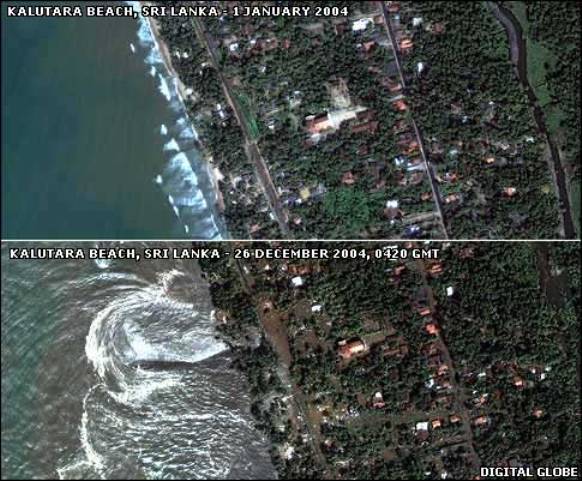
Kalutara beach in south-western Sri Lanka before & during the 2004 tsunami - Satellite image courtesy Digital Globe

This montage of satellite images was taken by the DigitalGlobe Quickbird satellite. It shows a portion of the south-western coast of Sri Lanka, in Kalutara, some 40km south of the capital Colombo. The lower image was taken on Sunday 26 December 2004, at 10.20 am local time, shortly after the moment of impact of the Indian Ocean tsunami that wreaked havoc in South and Southeast Asia that day. For comparison, we have an image of the same location on a normal day a few months earlier.

The tsunami was one of the most widely photographed and videographed disasters in history. In fact, it marked a turning point for citizen journalism in Asia.

For many of us in the media and communication sectors, this was the biggest story of our lives. Because the killer waves hit numerous coastal locations in several countries, this disaster’s ‘Ground Zero’ was scattered far and wide. Not even the largest news organisations could see, hear and capture everything. Everyone had to choose.

And not just geographically, but thematically too, the tsunami’s impact was felt across sectors, issues and concerns. That provided both ample scope and many challenges for journalists, aid workers and others who rushed to the multiple scenes of disaster.

But there was a downside. Because the tsunami’s scale was so vast and its effects spread so wide, no single individual or organisation could comprehend the full picture for months. For many of us in the Indian Ocean rim, culturally unfamiliar with tsunamis, it was as if a Godzilla had stomped through our coasts. Grasping the full, strange phenomenon was hard.

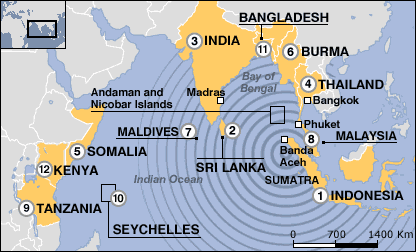
Countries affected by 2004 Dec tsunami - map courtesy BBC
Journalists, professionally trained to hastily produce ‘first drafts of history’, found it a bit like being close to a huge tapestry still being woven: we all absorbed parts of the unfolding complexity. We reported or analysed those elements that held our interest. But we were too close, and too overwhelmed, for much perspective.

Five years on, we can ‘zoom out’ more easily to see the bigger picture. When I do, one overarching factor stands out as the most important and lasting lesson of the tsunami: the need for better governance.

The absence of good governance was at the root of most major stories about the tsunami. It cut across every level in our societies — politics, public institutions, corporate sector, humanitarian agencies, academia and civil society.

This is the thrust of my latest op ed essay, written in time for the tsunami’s fifth anniversary being marked today. I briefly recall three aspects of the tsunami that I covered as a journalist — early warnings, deluge of aid and environmental lessons — to show how the absence of governance aggravated matters in each case.

The lesson is not simply one of academic interest: it holds many practical, survival level implications. I end by quoting Maldivian President Mohamed Nasheed, who argues that democracy and good governance are also the most important elements in climate change adaptation.

Read the full essay online:
Media Helping Media (UK): Tsunami five years on – the lessons learned
OneWorld.Net (UK): The big lesson of the tsunami: better governance
DNA newspaper (India: condensed version): The Tsunami Effect
Groundviews.org: Better governance – The Biggest Lesson of 2004 Tsunami
Himal Southasian Online edition: Better Governance: The biggest lesson of 2004 tsunami
The Sunday Times (Sri Lanka): Better Governance: The biggest lesson of 2004 tsunami

Looking back at Asian Tsunami of 2004…and media response

Nalaka Gunawardene talking about 2004 Asian Tsunami

To mark the fifth anniversary of the Indian Ocean Tsunami of December 2004, TVE Asia Pacific has just released excerpts from an in-depth TV interview I recorded four years ago.

The wide-ranging interview was originally filmed in November 2005 in Bangkok, Thailand, by Thai journalist and film maker friend Pipope Panitchpakdi. He used excerpts at the time for a Thai documentary to mark the first anniversary of the tsunami. It remains one of the best media interviews I have given, for which all credit goes to Pipope.

Selected segments of that interview, in its original English, can now be viewed on TVEAP’s YouTube channel, while the transcript is published on the TVEAP website.

To give a flavour of this belated release of archival material, here are the first two extracts:

Nalaka Gunawardene recalls Asian Tsunami of Dec 2004 Part 1 of 6

Part 2 of 6:


Watch all extracts on TVEAP’s YouTube channel

Asian Tsunami+5: Revisiting survivor Heshani Hewavitharana of Sri Lanka…

Heshani in Feb 2005: Creative and reflective - Photo courtesy TVEAP

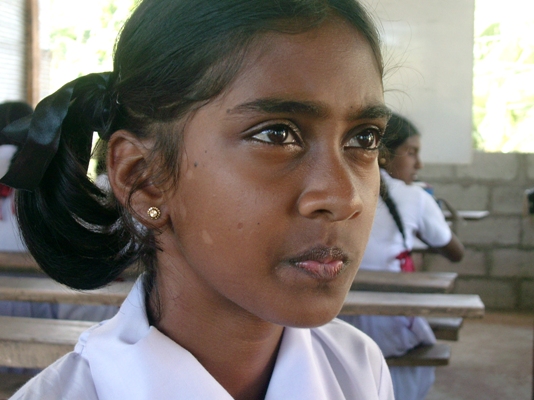
Heshani Madushika Hewavitharana, 13, was an eager student in school who also excelled in creative writing, in which she’d won certificates and awards. All of these, along with her school books and everything else her family owned, was lost in the Asian Tsunami of 26 December 2004. Their beach front house, in Suduwella in Sri Lanka’s southern district of Matara, was badly damaged. They escaped with their lives — and were among the luckier ones.

When we found Heshani and family a few weeks after the tragedy, they were taking refuge in a friend’s house. Her fisherman father could not immediately return to his work without his boat and gear, also washed away by the waves. The family was living on the mother’s meagre income from spinning coir ropes.

Despite their plight, Heshani and family agreed to participate in the Children of Tsunami media project, where local film crews in India, Indonesia, Sri Lanka and Thailand tracked how eight survivor families were rebuilding their lives and livelihoods after the Asian tsunami disaster.

We at TVE Asia Pacific documented on TV, video and web the personal recovery stories of eight affected families in these worst affected countries for one year after the disaster. Our many media products — distributed on broadcast, narrowcast and online platforms -– inspired wide ranging public discussion on disaster relief, recovery and rehabilitation. In that process, we were also able to demonstrate that a more engaged, respectful kind of journalism was possible when covering post-disaster situations.

Watch Heshani’s first monthly video update, February 2005:

Not all our participating families recovered from the tsunami’s mighty blow within one year, but we ran out of money and had to stop capturing their stories by the end of 2005, which I called Asia’s longest year. In a goodbye tribute to the courage and resilience of these families, I wrote in December 2005: “Our journey with the eight families ends with the first anniversary. We know their own journeys to recovery are far from finished. We can only wish them well.

Heshani in Nov 2009 - Courtesy Xinhua
Since then, I have often wondered how the eight children were faring. (In March 2007, it suddenly became seven when the Theeban, the boy in Sri Lanka’s east whose story we tracked, was brutally murdered.) However, I have resisted the temptation to revisit the children as I felt we had been intrusive enough already during that first difficult year after the tsunami. They must now be allowed to continue their lives in private.

Yet, I was intrigued by a recent report where two correspondents working for the Chinese news agency Xinhua, Chen Zhanjie and Liu Yongqiu, tracked down Heshani and family. They wrote a story on Xinhua’s website for the Universal Children’s Day in November which focused attention on the protection and welfare of children. Heshani is now 17, and her younger sister Dimalka, 12. Already having passed the GCE Ordinary Level exam, Heshani is now preparing for her Advanced Level exam slated for August 2010.

While Dimalka aspires to be a doctor, Heshani wants to become a banker. Their father believes the tragedy has added a new dimension to the girls’ lives: “They have leant their responsibilities from the tsunami. Now the two girls have no fears.”

Read the full story on Xinhua website: From tsunami to trauma to trek ahead

Ahead of tsunami, journalist foresaw coastal disaster in Sri Lanka: “A Catastrophe Waiting to Happen”

Dilrukshi Handunnetti in Deep Divide film
Contrary to a popular belief, journalists don’t enjoy being able to say ‘I told you so!’. They much rather prefer if their investigative or analytical work in the public interest are heeded in time.

A few months before the Indian Ocean tsunami of December 2004, my friend and journalist Dilrukshi Handunnetti wrote an investigative story on how coastal zone management laws and regulations were openly flouted by developers. She cautioned that it was a ‘disaster waiting to happen’

She had no idea how forcefully her point will be driven home before that year ended.

“Little did anyone realise the price coastal communities would have to pay for the greed of a few dozen developers,” she said after the tsunami, interviewed for Deep Divide, a South Asian documentary on environmental justice that TVE Asia Pacific produced in 2005.

Watch Deep Divide – story from Sri Lanka:

Here’s the blurb I wrote at the time to promote the story:

Sri Lanka’s economic activities are concentrated in coastal areas: 80 per cent of the tourist related activities are found there, along with one third of the population. Seeking to accelerate economic growth, the Sri Lankan government took measures to develop the island’s coastal regions. Shrimp and prawn farming was encouraged, while many incentives were provided for developing tourist resorts along the island’s scenic beaches.

As the shrimp exports grew and tourist arrivals increased, there was a ‘cost’ that only local residents and a few environmentalists cared about: mangrove forests were cleared, coral reefs were blasted, and the coastal environment was irreversibly changed.

Shrimp farming damaged mangroves, aggravated tsunami impactCoastal zone management regulations and guidelines were openly flouted by developers. Local communities were the last to benefit from this development boom — they watched silently as their fish catch dwindled and their coastal environment was pillaged. But little did anyone realise the price coastal communities would have to pay for the greed of a few dozen developers.

When the tsunami struck, there were very few natural barriers to minimise its impact. More than 40,000 people died or went missing, while hundreds of thousands lost their homes and livelihoods. It was the biggest single disaster in the island’s history.

Dilrukshi reflects: “Post-tsunami, people realised that the mangroves have protected these little, you know, landmass. And where you find a little bit of protected mangroves, you also find the landmass protected.”

She adds: “I think we have committed lot of excesses and we have been made to answer for those sins. Hereafter, we cannot afford to not do it right.”

Filmed on location in India, Nepal and Sri Lanka, Deep Divide explores the reality of environmental justice in South Asia — home to 500 million people living in absolute poverty, or 40 per cent of the world’s total poor. Everywhere, it finds environmental injustice. This investigative film builds on the work by three local journalists, who act as our guides to understanding the complexities and nuances of development amidst poverty and social disparities.

Environment For All book coverThe origins of Deep Divide go back to 2002. Panos South Asia, a regionally operating non-profit organization analyzing development issues, awarded media fellowships to selected journalists from five South Asian countries to explore specific cases of environmental injustice in their countries. They were to investigate issues as varied as land degradation, food and water insecurity, rising pollution, and mismanaged development.

Their findings were initially published in the local media – in the newspapers or magazines they worked for. In 2004, Panos South Asia compiled the articles in a book titled Environment for All. Three stories from this book were adapted into the documentary, directed by Indian film maker Moji Riba.

Children of Tsunami: No More Tears…

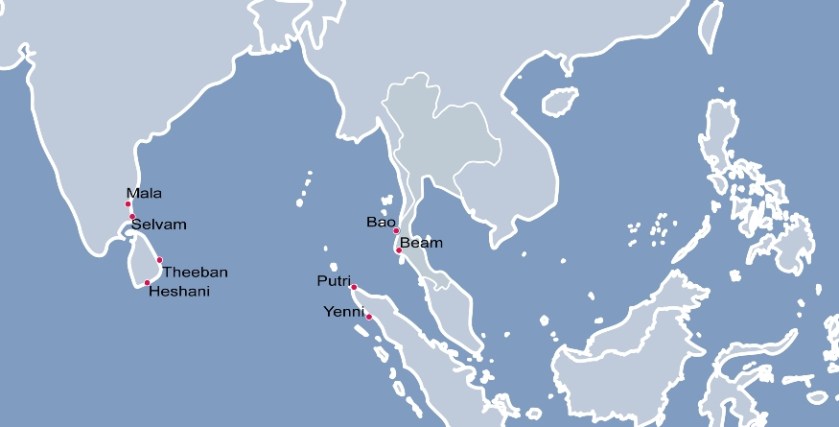
where Children of Tsunami stories were filmed for much of 2005
Four countries, eight locations: where Children of Tsunami stories were filmed for much of 2005

They have never met each other. Some have never travelled beyond their native village. On December 26 2004, the sea rose and rose and took everything they cherished.

Documented over the year, locally-based filmmakers returned to Asia’s battered coasts in India, Indonesia, Sri Lanka and Thailand to track the healing and the hurt through the eyes of children.

Asia’s recovery process from the tsunami is being captured through the stories of three girls and two boys aged 8 to 16 years.

Of different races, worshipping different Gods, they live on different shores in different countries. They are the tsunami generation, sharing the vulnerability of a child and the legacy of the tragic tides.

Young survivors of the Asian tsunami let us into their lives to personalise the mass of statistics, aid pledges and recovery plans. “Children of Tsunami” is a tapestry of intimate stories, woven by voices of individual and collective resilience, heroism and recovery.

Children of Tsunami: No More Tears – Part 1 of 3

Part 2 of 3

Part 3 of 3

Duration: 24 mins
Year of production: 2005
Countries filmed in: India, Indonesia, Sri Lanka, Thailand
In each country, a locally based production crew carried out filming for TVE Asia Pacific.

Regional Production Team
Supervising Producer: Bruce Moir
Production Assistant: Yohan Abeynaike
Production Manager: Manori Wijesekera
Executive Producers: Joanne Teoh Kheng Yau and Nalaka Gunawardene

Co-Produced by: Channel News Asia, Singapore
In partnership with TVE Asia Pacific

Broadcast Asia-wide on the first anniversary of the Asian Tsunami, 26 Dec 2005

For more information, visit: www.childrenoftsunami.info

See also: Channel News Asia – Making of a pan-Asian news channel