Have smartphone, will travel...Just how many Internet users are there in Sri Lanka?
Looks like a simple question, but there’s no simple answer. Trust me, I’ve been looking.
Oh sure, it’s not possible to calculate such numbers precisely because there always are more users than are subscribers. But official and industry sources usually have a good idea. In Sri Lanka’s case, their figures vary considerably.
The Telecommunications Regulatory Commission of Sri Lanka (TRCSL) is the official data collector. It used to publish a quarterly compendium of telecom industry related statistics.
The last such report, for December 2010, cites these cumulative figures for the whole of Sri Lanka by end 2010:
• Mobile phone subscribers: 17,359,312
• Fixed phone subscribers: 3,578,463
• Internet & Email Subscribers – fixed: : 280,000 (provisional figure)
• Mobile Broadband Subscribers: 294,000 (provisional figure)
Although for the same point in time (Dec 2010), it doesn’t tally. TRCSL’s own data, when we add up fixed and mobile subscribers of Internet, comes to 574,000.
Both these state entities seem to be hooked on “email users” — a throw-back to the early dial-up days when some subscribers simply signed up for email facility and didn’t want web browsing as the latter was more costly. As far as I know, that demarcation disappeared years ago. But I may be wrong.
Even if we take the highest case scenario, of a total 574,000 Internet subscribers (fixed and mobile), it still comes to less than 3 per cent of Sri Lanka’s total population of 20 million (exactly how many people live on the island will be known after the latest census is taken in December 2011).
That’s the number of subscribers. The number of users is usually higher. Assuming an average 3 users per subscription, we can imagine around 1.72 million (approx 8 per cent of population) getting online. This calculation brings us closer to the number given for Sri Lanka in the Internet World Stats website. It lists for Sri Lanka: “1,776,200 Internet users as of Jun/10, 8.3% penetration, per ITU.”
The ITU focal point in Sri Lanka is the TRCSL, whose own published data is mentioned above. What am I missing here?
A researcher friend who had access to Wireless Intelligence, a subscription only service containing well over 5 million individual data points on 940 operators (across 2,200 networks) and 55 groups in 225 countries, found yet another statistic.
According to WI, Sri Lanka by end 2010 had:
• 1,971,018 mobile broadband subscribers
• 213,000 fixed broadband subscribers
This produced a total of 2,184,018 — which takes the percentage of population to almost 11%. And if we apply the same average number of 3 users, it could give us 30% of population accessing and using the Internet. But is that assumption of 3 users per subscription equally applicable to mobile devices? I’m not sure. I’ll wait for industry experts to clarify.
In fact, neither industry sources and researchers have a reliable figure of how many smartphones are in use in Sri Lanka. Because a significant number comes in through private channels (via returning travellers or Lankan expatriates), the looking simply at the import figures could be misleading. A conservative estimate is that at least one million smartphones with Internet access capability are in use. The number keeps growing.
Exactly how many such smartphone users go online on a regular basis? What kind of info do they look up? How long on average do they stay online per session?
If you know the answers, or have reflected on these, please share.
Let’s hope more reliable data would emerge from the 2011 countrywide census of population. An early report (July 2010) said: “Information will also be collected for the first time on people’s communication methods.”
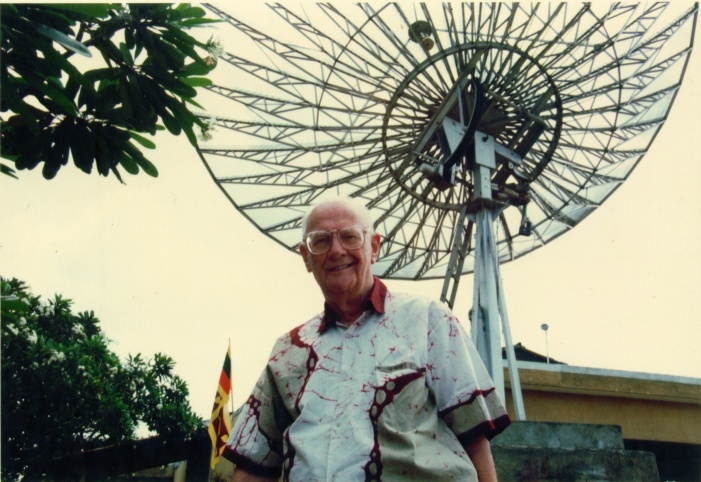
Sir Arthur C Clarke at the ACCIMT in better times For many years, I’ve been explaining and clarifying to everyone that I worked with the late Sir Arthur C Clarke in his personal office in Colombo, which was completely separate from a government entity named the Arthur C Clarke Institute for Modern Technologies in Moratuwa, Sri Lanka. This is not just an institutional demarcation; the latter body set up by the government of Sri Lanka in 1984 and sustained since then with public funding has completely under-served its founding ideals and remains mediocre and unproductive after a quarter century. I have no wish to be associated, even mistakenly, with such an entity.
I remained quiet about this for as long as Sir Arthur was alive, as it was not tactful for me – as part of his team – to criticise a state entity named in his honour. A year after his death, I broke that silence and wrote a media article which was published in the current affairs magazine Montage in April 2009.
That elicited some strange ‘reader comments’ on the magazine’s website — several of which alleged that I was a ‘traitor’ who was out to discredit the hard-working (‘Sinhala Buddhist’) engineers and managers of this institute! I could not fathom how and why the staff’s ethnicity or religious faith was relevant.
Beyond such vitriol, these pseudonymous ‘readers’ never once responded to my specific questions about the public-funded institute’s scientific productivity and public accountability.
Unfortunately, Montage went out of publication and its website, which was located at http://www.montagelanka.com, is also no longer available online. So in the public interest, I’m reproducing my article below, unedited as it appeared in print in April 2009. Alas, I never saved the online comments so those are probably lost forever…
As always, this blog is open to a rational discussion of the core issues raised below, as all the concerns still remain valid. And there are no ‘sacred cows’ in my book!
Monument for Sir Arthur C Clarke: Time to ask some tough questions
By Nalaka Gunawardene
As the first death anniversary of Sir Arthur C Clarke approaches, Lankans are still debating how best to cherish the memory of the celebrated author and visionary who called the island his home for more than half a century.
Ours is a land where private individuals — and governments –- just love to put up ostentatious and often superfluous structures to honour the departed. We typically don’t assess their cost-effectiveness or utility. Neither do we pause to ask how the person being honoured would have felt about it.
The Telecommunications Regulatory Commission of Sri Lanka (TRCSL) recently announced plans to launch the country’s first satellite, which is to be named after Sir Arthur. According to news reports, it will be launched into low earth orbit (LEO) at an estimated cost around US$ 20 million.
Would naming Sri Lanka’s first satellite be a fitting tribute to Sir Arthur, universally acclaimed as inventor of the communications satellite (comsat)? Or should a monument to this ‘one man cheering squad for Sri Lanka’ be more rooted in the Lankan soil, where people can see and feel its presence everyday? And, by the way, what about the state technical institute in Moratuwa that already bears the Arthur Clarke name?
Sir Arthur, with whom I worked closely for 21 years as an aide and a decade as spokesman, would surely have wanted an open and frank debate on this matter. He opted for rational, evidence-based decisions based on cost-benefit analysis. He frowned upon grandiose plans made for their own sake, whether their implementation was going be paid for by public or private funds.
Besides, he already had an asteroid, dinosaur species and a geostationary comsat named after him during his lifetime. Topping that without going over the top would be a challenge indeed.
A living legacy
The tussle for the Clarke legacy started within hours of his death on 19 March 2008. He had left clear written instructions for his funeral to be held on a strictly secular and austere basis. He didn’t want any decorations, and explicitly disallowed official involvement by British or Lankan governments.
As this news spread, it fell on me to explain to government officials why offers of a state funeral and other types of state patronage could not be accommodated. This raised some eyebrows and dashed hopes of some who wanted to turn the sombre event into a carnival. In the end, the state appealed for a symbolic radio silence of two minutes to coincide with the funeral.
In the weeks and months that followed, many have asked me what kind of monument was being planned in Sir Arthur’s memory. The answer, as far as the Arthur Clarke Estate is concerned, is none –- and this seems to surprise many.
Yet it is entirely consistent with Sir Arthur’s personality and vision: he never sought personal edifices in his honour or memory. When a journalist once asked him about a monument, he said: “Go to any well-stocked library, and look around…”
That evokes memories of the well known epitaph for Sir Christopher Wren, one of the greatest architects of all time, who significantly changed London’s skyline: “Lector, Si Monumentum Requiris Circumspice”(“Reader, if you seek his monument, look around”). It also begs the question why Sir Arthur chose not to make any mention of the physical entity that already bore his name: the Arthur C Clarke Institute for Modern Technologies (ACCIMT).
Indeed, the ACCIMT is today a perfect example of a good idea gone astray, becoming a disgrace to the very man it was meant to honour. How did things go wrong to the point where Sir Arthur Clarke distanced himself from the Arthur Clarke Institute in the last few years of his life? These thorny questions need to be asked now that we are discussing matters of legacy.
The world was very different, and aspirations were very high, when ACCIMT was established in 1984 by an Act of Parliament to help transfer and adopt modern technologies in five areas: computers, telecommunications, energy, robotics and space technology. The Institute, initially called the Arthur Clarke Centre, was to undertake research and development as well as train technical professionals in ways that would accelerate economic development and advance the quality of life.
Several leading Lankan professionals were associated with its creation. Among them were civil servant (later Minister) Dr Sarath Amunugama and diplomat (now academic) Dr Naren Chitty. In 1985, President J R Jayewardene appointed the eminent biochemist (and his science advisor) Professor Cyril Ponnamperuma as its founder director.
As patron, Sir Arthur had no executive functions or responsibilities, but generously provided advice, guidance and some funding to the fledgling institute. He donated US$ 35,000 received for the 1982 Marconi Fellowship. Just as importantly, he mobilised his far-flung network of international contacts in scientific, technological and engineering circles. The Arthur Clarke ‘fan club’ stretched far and wide -– from the White House to the Kremlin, and from elite academia to geeky Silicon Valley. Carrying this unique calling card, ACCIMT had access to a global reservoir of goodwill, partnerships and external funding.
Tragically, despite this head start and advantages, the Institute reaped little benefit. While it did show some early promise, it has failed to consolidate itself as a credible and productive technical institute. Its founding aim of becoming a centre of excellence for the developing world also flopped. When assessed using universally accepted measures of scientific productivity -– such as research publications in refereed international journals, peer citations and patents for innovation — it shows a dismally poor track record.
For sure, it has been dabbling with a few everyday technologies such as traffic lights, telephone locks and domestic gas leak alarms. Useful as these applications are in specific situations, they cannot justify 25 years of substantial investment of Lankan tax payer money as well as international donor funds.
March of ICTs
Perhaps an institute with this kind of lofty mandate could have been more influential at the apex policy level. The past 25 years have seen Sri Lanka adopting many new information and communication technologies or ICTs (e.g. mobile telephony in 1989, commercial internet connectivity in 1995). There has been an unprecedented and phenomenal growth in the coverage of telecom services. These developments have thrown up many policy and regulatory challenges for the state and private sector players.
Alas, ACCIMT has not kept up with the rapid evolution of information society, and failed to carve out a clear niche for itself even as Sri Lanka engages the Global Village through a multitude of ICTs. Its voice is neither heard nor heeded in key debates on bridging the digital divide, and on how best to prepare our youth to ‘exploit the inevitable’ in a globalised marketplace. These concerns were very dear to Sir Arthur, who continued to talk and write perceptively about them to the very end of his life. But ACCIMT is still stuck in the obsolete analog concerns of the 1980s.
Peer acceptance and recognition are indicators of any technical institute’s standing. ACCIMT would struggle to demonstrate its worth on these criteria. It is routinely bypassed by state policy making mechanisms and agencies. It is curious how the telecom industry regulator is spearheading the government’s newly announced satellite project. Why is ACCIMT, with a statutory mandate in this subject, not playing a more prominent role in such plans and discussions?
When the rest of government ignores the institute, it’s not surprising that technology-based industries don’t turn to it for advice either. The institute’s principal activity these days is conducting training courses in electronics — useful, no doubt, but for which purpose there already are several dedicated vocational training centres.
For much of its 25 years, the Arthur Clarke institute has taken cover behind its famous patron to avoid adequate public scrutiny. Large sections of society, including many in the media, harboured a misconception that Sir Arthur Clarke was personally involved in its management and research; in practice, he had none.
Early sparks
Things didn’t always look this bleak. For a while, it seemed as if the institute would live up to its founders’ expectations. For example, it was the first to downlink and relay CNN broadcasts in Sri Lanka. CNN founder Ted Turner‘s respect for Sir Arthur made this possible. The institute was also involved designing low-cost dish antennae for households to directly capture satellite TV transmissions in the 1980s when only two terrestrial channels were available. March of technology and commerce later made these services redundant.
One far-sighted activity that Professor Ponnamperuma started was the Science for Youth programme. On a national and competitive basis, 25 of the brightest high school leavers were selected and introduced to modern technologies over six consecutive weekends. Out of that exercise eventually emerged the Young Astronomers’ Association and Computer Society of Sri Lanka, the latter now a professional body.
As part of the 1986 batch, I can personally vouch for the insights and inspiration Science for Youth gave me in those pre-Internet days. I was especially fascinated by the outspoken views of inventor and aviator Ray Wijewardene. The friendship I formed with him has lasted for over two decades and enriched me enormously. Later, as a young science journalist, I used to cover the institute’s public events hosting of visiting tech pioneers and Russian cosmonauts. For a while, ACCIMT was a ‘happening place’.
Then, sometime in the 1990s, the institute abandoned most of its public engagement and outreach activities. This inward looking attitude didn’t change even after the government decided to locate the country’s largest optical telescope (donated by Japan) at the institute. I remember how exasperated Sir Arthur was to hear schools being told that they may visit and look at the telescope during the working hours from 9 am to 5 pm!
But by then, he was not going to intervene. After he turned 80 in 1997, Sir Arthur adopted a policy of ‘benign neglect’ towards the institute on which he had pinned such high hopes only years earlier. Ever conscious of his ‘resident guest’ status, he chose not to criticise the institute in public, although he shared his dismay and disappointment in private.
As we debate how best to preserve Sir Arthur’s illustrious legacy, we cannot afford to continue such ‘benign neglect’ on the publicly-funded Arthur Clarke Institute. A good starting point would be to belatedly ask tough questions and engage in some serious introspection.
Sir Arthur would have expected nothing less.
About the writer: Science writer Nalaka Gunawardene worked for Sir Arthur Clarke’s personal office, which was totally separate from the Arthur Clarke Institute. The views in this article are entirely those of the author.
Photographs courtesy Rohan de Silva, Arthur C Clarke Estate.
Louder, please?Why do people – especially middle aged men – yell into their mobile phones?
This is one of those widely asked questions in relation to communications technologies that have become part of our daily lives. Mobile phone etiquette hasn’t evolved as fast as phone coverage, so this behaviour remains a regular source of irritation at hotels, restaurants, airports and other public places.
So why do people with normal speaking volumes yell into their cell phones? I came across an interesting explanation, which also suggests that it’s a trait more common among Digital Immigrants.
Here’s an extract: “Household telephones, or landlines, have a microphone in the receiver that amplifies your voice into the ear piece. When you talk into a landline, your voice is captured and replayed through the ear piece, so you hear your own voice loud and clear….With cell phones, your own voice is not amplified into the earpiece, so the only sound you hear is from your mouth. Seem like this wouldn’t be a huge difference, but the volume level of words coming from your mouth through the air and into your ear is a pretty big difference from sounds coming from a phone speaker that’s pressed directly against your ear.”
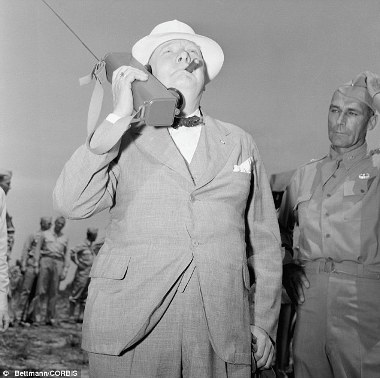
No, Sir Winston is not using an early mobile phone - it's a field radio receiver!Hmm. So there’s hope that the trait will become less common in the coming years.
Of course, the habit goes a long way back to the days when phone lines rarely offered good audio quality. There is the true story of how Sir Winston Churchill had to suffer a Cabinet colleague who was a loud phone talker. During the Second World War, they were sharing crammed war cabins.
One day the Minister was once again talking very loudly on the phone. Churchill asked his secretary to go over and tell Mr Brown not to talk at the top of his voice. The secretary returned and told the PM: ‘Sir, the Minister is talking to Scotland.’
Without batting an eyelid, Churchill replied: ‘Yes, I’m sure he is. But tell him to use the phone!’
“If you’re an alien planning to invade the Earth, choose July 11. Chances are that our planet will offer little or no resistance.
“Today, most members of the Earth’s dominant species – the nearly 7 billion humans – will be preoccupied with 22 able-bodied men chasing a little hollow sphere. It’s only a game, really, but what a game: the whole world holds its breath as the ‘titans of kick’ clash in the FIFA World Cup Final.
“Played across 10 venues in South Africa, this was much more than a sporting tournament. It’s the ultimate celebration of the world’s most popular sport, held once every four years. More popular than the Olympics, it demonstrates the sheer power of sports and media to bring together – momentarily, at least – the usually fragmented and squabbling humanity.”
This is the opening of my latest op ed essay, which appears in several print and online outlets this weekend. It’s timed for the finals of the FIFA World Cup 2010 – the most widely followed sporting event in the world, which will be played in Soccer City, Johannesburg, South Africa today, 11 July 2010. The Netherlands will meet Spain in this culmination of international football that has been distracting a good part of humanity for a month.
This sporting event is tipped to be the most-watched television event in history. Hundreds of broadcasters are transmitting the World Cup to a cumulative TV audience that FIFA estimates to reach more than 26 billion people. Some TV channels offer high definition (HD) or 3-D quality images to enhance the mass viewing experience.
The essay was written a few days ago, after the FIFA World Cup 2010 had reached the semi-finals stage. To be honest, I’m not an ardent football fan. But as an observer of popular culture, I’ve gladly allowed myself to be caught up in the current football frenzy. I just love to watch people who watch the game…
It’s a light piece written to suit the current global mood, but I acknowledge that the World Cup is really more than just a ball game. The basic thrust of my essay is to comment on the powerful mix of fooball and live coverage: “For the past month, the winning formula for unifying the Global Family seemed to be: international football + live broadcasts + live coverage via the web and mobile phones.”
United Colours of Football, courtesy FIFAThe essay builds on themes that I’ve already explored on this blog – for example, how President Nelson Mandela used the 1995 World Cup Rugby championship to unite his racially divided nation, as told in the movie Invictus.
Here’s my parting thought, on which I invite reader comment: “On second thoughts, those invading aliens don’t need to worry too much about the Earth’s political leaders or their armies. Without firing a single shot, the globalised media have quietly taken over our Global Village — and now it’s too late to resist! We can argue on its merits and demerits, but the facts are indisputable.”
Holy cow! How does she do it?Cows have been a part of South Asian cultures, economics and societies for millennia. Many among us are connected to cows in one way or another – some worship them while others feast on them. Even a secular vegetarian in South Asia – like myself – can’t avoid bumping into the occasional cow on our delightfully messy streets…
We probably gave the term ‘sacred cow’ to the English language. It means an object or practice which is considered immune from criticism, especially unreasonably so. As the Wikipedia explains, “The term is based on the popular understanding of the place of cows in Indian religions as objects that have to be treated with respect, no matter how inconvenient.”
Well, some of us beg to differ on modern-day sacred cows. My latest op ed essay, just published on Groundviews.org, is all about sacred cows in rapidly modernising South Asia. It starts with my experience as a young science journalist covering the impending launch of Pakistan’s first digital communications satellite, Badr 1, in early 1990.
At the time, Pakistan had recently returned to civilian rule after many years of dictatorship, and Benazir Bhutto was Prime Minister (in her first term). The political mood was generally upbeat. But I soon found out — from Pakistani journalists and independent scientists — that they weren’t allowed to ask critical questions about the country’s nuclear or space programmes.
In Sacred Cows and Orbital Dreams in Sri Lanka, I write: “The message was clear: democracy or not, some sacred cows always enjoy their privileged status! This has certainly been the case with both the space and nuclear programmes in India and Pakistan: they have been shielded from public and media scrutiny for decades.
What price for having our own?“For the past few months, it seemed as if we too were following this South Asian tradition. Plans to build Sri Lanka’s own satellites were announced and pursued with little information disclosure and no public debate. The government wanted to launch our very own ‘sacred cows’ into orbit. We the public were to just applaud on cue, and then cough up the money for it…”
The essay is a critique of Sri Lanka’s much hyped plans to build its own satellites. The project was announced in February 2009 and appeared to gain momentum during the year. Going by official statements and media reports, the plan was to launch not one but two satellites.
Suddenly, there seems to be a change of heart. In a interview on 6 June 2010 covering a range of issues, head of the Telecom Regulatory Commission (TRC) disclosed that the government was not going ahead with the much-hyped project. At least not in its originally announced form. The reason: the very high cost, and the need to ‘explore other options such as hiring satellites’ instead of building our own.
Hmmm. Better to be wise later than never. This is the first time in over 15 months that the high costs of this high cost project have been acknowledged.
The satellite is not the only mega-science project being pursued in post-war Sri Lanka. In June 2009, the Ministry of Science and Technology directed the Atomic Energy Authority to set up a national committee to study technical and financial aspects of setting up a nuclear power plant.
Again, this mega project has not been opened up for public discussion and debate, in spite of a few citizens and activists expressing concern, highlighting safety and public health risks, high cost of construction and the unresolved problem of nuclear waste disposal.
I end the essay arguing that as long as public safety and public funds are involved, sacred cows – whether orbital or radioactive – can’t be allowed free range.
When I was in my early teens (back in the early 1980s), I developed a great interest in radio. Not just in listening to radio broadcasts, which I did regularly while growing up in a country that had no television, but also in building a radio that could both receive and transmit signals.
My school teacher father, who encouraged me in many of my diverse pursuits, bought transistors, condensers and other ‘building blocks’ for a basic radio set. With the help of an amateur radio handbook, and through trial and error, he and I actually built a functional transmitter. It was exhilarating to listen to local and shortwave broadcasts on a home-made radio set, but even more exciting to be able to transmit rudimentary signals.
Even as a kid, I was not contented in being a passive recipient of information; I wanted to give out as much as I received…
That particular fancy didn’t last long: I soon moved on to other challenges, and never persisted with being a serious amateur radio enthusiast (or ‘radio ham’), but it left a lasting impression. A few years later, after leaving high school, I became a regular freelancer at the local radio station. By age 23, I was hosting my own weekly show on national radio, and my association with the radio medium would last for much of my 20s.
The humble low tech that saved the day...My interest in amateur radio lay dormant — until five years ago, when I read reports about how radio hams helped revive emergency communications in the immediate aftermath of the Indian Ocean Tsunami.
The decades old practice was hailed as the ‘low tech’ miracle that literally helped save lives. Where electricity and telephone services — both fixed and mobile — had been knocked down, radio hams restored the first communication links. They were at the forefront of relief efforts, for example, in the Andaman and Nicobar Islands in India, and in Hambantota in southern Sri Lanka.
This intrigued Sir Arthur C Clarke, inventor of the communications satellite and long time resident of Sri Lanka. Shortly afterwards, he wrote in Wired magazine: “We might never know how many lives they saved and how many minds they put at ease, but we owe a debt to Marconi’s faithful followers.”
If Sir Arthur were alive, he would have been dismayed to find what has happened since. Notwithstanding their celebrated role after the tsunami, radio hams have been sidelined in Sri Lanka. Their very hobby is being frowned upon by the state on the grounds of…national security.
Looking back, it seems like the public-spirited radio hams were given their 15 minutes of fame and then soundly ignored. Worse, the short-lived prominence may have attracted new bureaucratic hurdles.
“As the applause died away, everything was forgotten,” I quote Victor Goonetilleke, one time President and current Secretary of the Radio Society of Sri Lanka, which networks amateur radio practitioners in the country.
One reason for this bureaucratic fear and negativity, I argue, may be simple ignorance of what amateur radio really is — reflecting the disturbingly low levels of media literacy in Sri Lanka.
Read the full essay, and join the conversation on Groundviews, or on this blog.
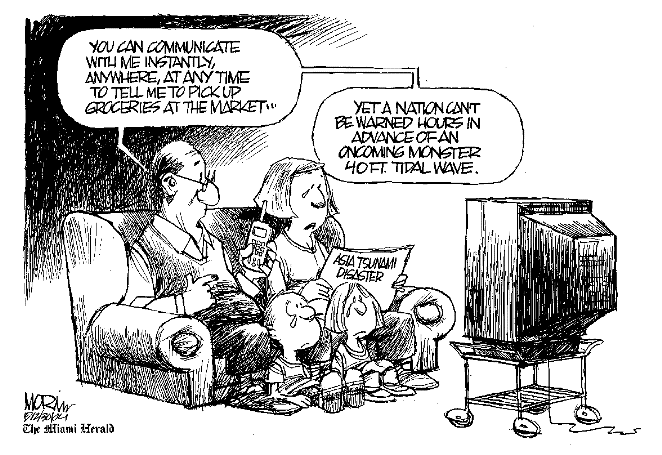
This is one of the most memorable cartoons about the Asian Tsunami of December 2004. It was drawn by Jim Morin, the Pulitzer Prize winning editorial cartoonist of the Miami Herald.
It summed up, brilliantly, one of the biggest shocks associated with that mega-disaster. As I wrote in my op ed essay to mark the fifth anniversary: “It took a while for the tsunami waves, traversing the Indian Ocean at the speed of a jetliner, to reach India, the Maldives, Sri Lanka and Thailand. Yet, in this age of instantaneous telecom and media messaging, coastal residents and holiday makers were caught completely unawares — there was no public warning in most locations. Institutional, technological and systemic bottlenecks combined to produce this monumental failure in communication.”
After doing a dispassionate analysis of what went wrong in Sri Lanka in the crucial hours just before and during the 2004 tsunami, he asked: “So what remedies one can suggest so that when the next disaster happens — which may or may not be a tsunami — we do not see the same series of events repeated? What exactly is the role that the media can play?”
Disaster warning is everyone’s business: Life for most of us would have been easier had the government taken full charge of disaster warnings. Unfortunately, the things do not work that way. These are some of key stakeholders and they have specific roles that they can play:
Views from Ground Zero of several disasters...• The scientific community: Develop the early warning systems based on their expertise, support the design of scientific and systematic monitoring and warning services and translate technical information to layman’s language.
• National governments: Adopt policies and frameworks that facilitate early warning, operate Early Warning Systems, issue warnings for their country in a timely and effective manner.
• Local governments: Analyse and store critical knowledge of the hazards to which the communities are exposed. Provide this information to the national governments
• International bodies: Provide financial and technical support for national early warning activities and foster the exchange of data and knowledge between individual countries.
• Regional institutions and organizations: Provide specialized knowledge and advice in support of national efforts, to develop or sustain operational capabilities experienced by countries that share a common geographical environment.
• Non-governmental organizations: Play a critical role in raising awareness among individuals and organizations involved in early warning and in the implementation of early warning systems, particularly at the community level.
• The private sector: Play an essential role in implementing the solutions, using their know-how or donations (in-kind or cash) of goods or services, especially for the communication, dissemination and response elements of early warning.
• The media: It has to play an important role in improving the disaster consciousness of the general population, and disseminating early warnings. This can be the critical link between the agency that offer the warning and the recipients.
• Communities: These are central to people-oriented early warning systems. Their input to system-design and their ability to respond ultimately determines the extent of risk associated with natural hazards.
And here’s his conclusion: “Technology is important. The sole reason behind the seemingly incredible advancements that have happened in the field of human development is the spurt in the growth of new technology. However without people to handle it properly, the technology per se can achieve little. What we can expect a sophisticate earthquake detecting device to do, if there are no human beings to take note what it indicates? So, while giving technology its due position, let us focus on the people-side of the problems. “
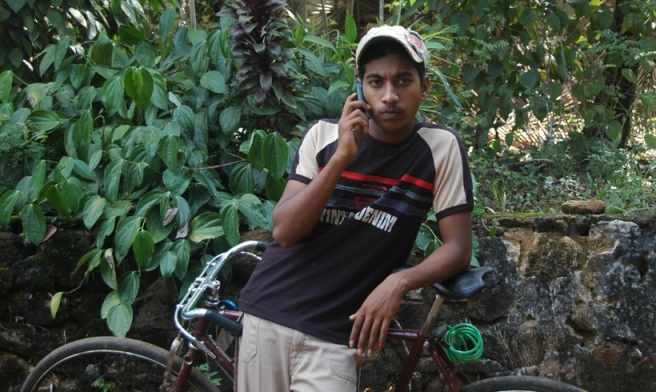
Chamara Pahalawattage: At 18, he is already using his 6th mobile (Photo by Niroshan Fernando, TVEAP)
When many able-bodied young men and women of his age were joining the armed forces in large numbers, Sri Lankan school-leaver Chamara Pahalawattage chose differently. He decided to try his luck with odd jobs at construction sites.
That, by itself, was nothing unusual. Tens of thousands of young men and women like Chamara join the labour market every year. Schools don’t equip them with attitudes or skills for self employment, so most would idle years away looking for regular jobs in Sri Lanka’s public and private sectors. Frustration would prompt some to take to political agitation, or worse.
Chamara is at such crossroads in his own life, but he is unlikely to go astray. The enterprising young man has boosted his chances of part-time work by getting himself a mobile phone.
“After buying a phone, I get calls asking me to come for work. The phone makes it so easy,” he says. “Otherwise people will have to come looking for me…or I have to go to them.”
If a skilled mason or carpenter takes him on as an assistant, Chamara gets a daily wage of LKR 700 (US$ 6 approx) plus a mid-day meal. That income augments the modest LKR 4,000 a month (US$35) his mother makes cooking meals at a nearby factory.
In February 2009, we filmed a day in the life of Chamara, a resident of Gonapola, in Sri Lanka’s western province. This was part of a profiling of telephone users at the bottom of the (income) pyramid – or BOP – in emerging Asian economies, undertaken by TVE Asia Pacific on behalf of the regional ICT research organisation LIRNEasia.
Watch our short video profile of Chamara Pahalawattage:
Going by his household income, Chamara is BOP at the moment – but his aspirations extend above and beyond. An only child raised by his widowed mother, Chamara developed an interest in mobiles while still in his mid teens. He bought his first mobile two years ago, when in Grade 11 at school.
“Almost everyone had phones, so I also wanted one,” he recalls. “From then on, I got used to having a phone!”
And has he been keeping up with technology! He buys second-hand phones for better features: he currently owns his sixth phone in just over two years. He had paid LKR 7,500 (US$ 65) for his latest phone at the beginning of 2009.
Besides voice and SMS (texting), his phone supports MP3, video recording, song downloading, voice recording and some other functions. After a hard day’s work, he unwinds listening to the radio, or swapping songs with friends — all using their mobiles.
Chamra spends an average of US$3 to 4.50 per month on phone use, and – like all other BOP telephone users we interviewed in India, Philippines and Thailand – he is thrifty with value added services that cost extra. This is something that has been confirmed by LIRNEasia’s Teleuse@BOP 2008 survey.
“Some of my friends access the internet through their phones and download songs,” he says. “I then get these songs from them. My phone has bluetooth. I use it to transfer songs from my friends’ phones.”
Chamara has every intention of moving up the labour market – someday, he wants to hold a more regular job, with an assured monthly income. Right now, in spite of being connected, he can’t predict how many days a month he’d find work.
Hello, can you hear our dreams? Photo by Niroshan Fernando, TVEAP“I don’t check newspapers for jobs. Instead I ask the people I know…mostly my friends,” he says. This probably indicates another shift from a wide-spread habit among literate Sri Lankans scanning newspapers for recruitment notices.
LBO 9 March 2009: Sri Lankan low income customers can use mobiles more for business: study
The official end of the 30-year-long war should be good news for Chamara and millions of other tech-savvy, eager youth like him. Like me, they can once again start dreaming of better tomorrows.
Telecommunications would be a good place to start. For several years, it has been the fastest growing sector in the Sri Lankan economy — one that has not only connected people across distances and cultures, but also been a ‘social leveller’.
The telephone subscriber base grew by 35.5% in 2008 (and 47% in 2007). The country’s tele-density (number of telephones per 100 persons) jumped to 71.9 in 2008, from 53.4 in 2007 -– thanks largely to the phenomenal spread of mobile phones.
As I noted last year: “It is not by accident that telecom has remained the fastest growing sector in the economy for a decade. This was triggered and sustained by the far-reaching policy and regulatory reforms which ended the then fully state-owned telecom operator’s monopoly, and allowed the entry of new players, technologies and business models.”
Of course, improved telecommunications are necessary, but not sufficient by itself, for us to evolve into an inclusive information society. Building on technology and systems, we must become discerning creators and users of information. Knowledge – not paranoia or rhetoric – needs to form the basis of policy and actions that propel us to the future.
Photos courtesy Niroshan Fernando, TVE Asia Pacific
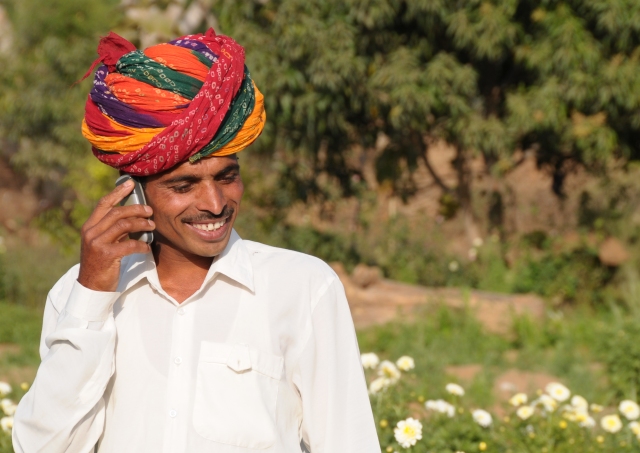
Mobile champion: farmer Sayar Singh in Rajasthan, India - photo by Suchit Nanda for TVEAPAt the end of the world’s largest general election that lasted nearly a month, Indians have just re-elected the Congress Party to govern over the world’s largest democracy for another five year term.
It’s too early to discuss what role, if any, the recently enhanced telecommunications services played in this outcome. But there is no doubt that access to telephones – especially mobiles – has revolutionised the life of the billion plus Indians in the past few years.
Farmer Sayar Singh epitomises this change. Earlier this year, we filmed a day in the life of Sayar, a resident of Pushkar Nala in India’s Rajasthan state. This was part of a profiling of telephone users at the bottom of the (income) pyramid – or BOP – in emerging Asian economies, undertaken by TVE Asia Pacific on behalf of LIRNEasia.
Sayar is definitely BOP: growing wheat and flowers on his ancestral land, he makes around INR 6,000 (USD 115) a month – on which income he sustains an extended family that comprises his wife, four children, elderly father and an unmarried sister. Life isn’t easy for this 33-year-old, but his spirit of enterprise is as abundant as his praise for his newly acquired mobile phone.
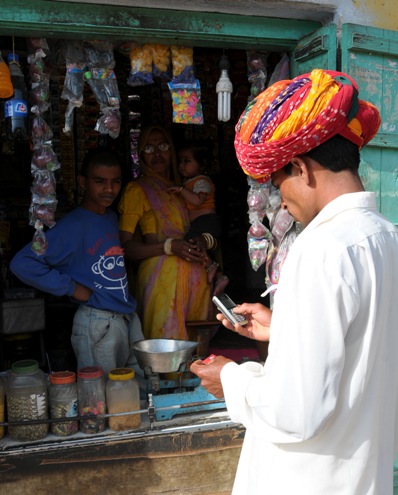
He only bought a mobile in mid 2008, but eight months later, that investment had definitely improved business and social life for him. So much so that his life’s narrative is clearly divided as Before Mobile and After Mobile.
“Our life before the mobile phone was hard,” he says. “I took two days to do what I can now do in a day. Now I can get in touch immediately and all my work happens faster and more easily!”
He now tracks market prices and moves his produce quickly for better profits. With workload reduced and income doubled, Sayar has reaped dual benefits from his mobile.
Watch our short profile of Sayar Singh, ardent promoter of mobile phones in rural India:
This isn’t Sayar’s first experience with owning a telephone. Earlier, he was frustrated with a fixed phone that didn’t work half the time. The service was so bad that he gave up the phone after a while.
He recalls: “Phone wires in our village were often faulty. They used to be out of order for 2 or 4 days, sometimes even half a month! All my work was affected. I couldn’t talk to my brothers and sisters. Call charges were also high. When my phone line was down, I had to call from STD booths or neighbours’ phones.”
In our interview, Sayar kept referring to his fixed phone connection as ‘government phone’ – a reflection of the state-owned former monopoly. It was a reminder of just how bad telecom services were in India until only a few years ago.
As Shashi Tharoor, the former UN Undersecretary General – who, incidentally, has just been elected into Indian Parliament from his native Kerala state – has remarked, India had possibly the worst telephone penetration rates in the world.
He wrote in 2007: “Bureaucratic statism committed a long list of sins against the Indian people, but communications was high up on the list; the woeful state of India’s telephones right up to the 1990s, with only eight million connections and a further 20 million on waiting lists, would have been a joke if it wasn’t also a tragedy — and a man-made one at that.”
Connected and contented: Sayar Singh by Suchit Nanda for TVEAPTharoor recalled the infamous words of Prime Minister Indira Gandhi’s communications minister in the 1970s, C.M. Stephen. In response to questions decrying the rampant telephone breakdowns in the country, the minister declared in Parliament that telephones were a luxury, not a right. He added that ‘any Indian who was not satisfied with his telephone service could return his phone’ — since there was an eight-year waiting list of people seeking this supposedly inadequate product.
According to Tharoor, Mr Stephen’s statement captured perfectly everything that was wrong about the government’s attitude: ignorant, wrong-headed, unconstructive, self-righteous, complacent, unresponsive and insulting. “It was altogether typical of an approach to governance in the economic arena which assumed that the government knew what was good for the country, felt no obligation to prove it by actual performance and didn’t, in any case, care what anyone else thought.”
All this didn’t change overnight, and as Tharoor reflects, the key contribution of the government was ‘in getting out of the way’ — in cutting license fees and streamlining tariffs, easing the overly complex regulations and restrictions that discouraged investors from coming in to the Indian market, and allowing foreign firms to own up to 74 per cent of their Indian subsidiary companies. “The Telecom Regulatory Authority of India (TRAI) has also been a model of its kind, a regulatory agency that saw its role as facilitating the growth of the business it was regulating, rather than stifling it with rules and restrictions.”
It still took time for this revolution to be felt at the bottom of the pyramid. As LIRNEasia says: “Just five years ago, the Indian telecom industry’s massive momentum barely included the poor. The country had slightly over seven access paths (fixed and mobile connections) per 100 people, but in rural India 100 people were served by only 1.5 access paths. Even in urban India, the poor were unconnected.”
Then things started changing rapidly. According to LIRNEasia’s latest teleuse@BOP survey, 45 per cent of Indian BOP teleuser households had a phone in late 2008: 37% had a mobile only; 5% had a fixed phone only; and 3% had both. This is massive progress from the 19 percent of BOP homes with a phone just two years ago. Read more about BOP telephone penetration and use in India.
Tharoor has called this the “mobile miracle” — one that has accomplished something socialist policies talked about but did little to achieve: empowering the less fortunate. Rapid mobile penetration in my native Sri Lanka has had a comparable social transformation – in a commentary last year, I called the ubiquitous mobile ‘Everyman’s new trousers’.
Of course, the mobile revolution is far from over. There are many more millions yet to be connected, and those already connected expect affordable, reliable and value-added services.
“Indian BOP is still in the mobile 1.0 mode using mainly voice and missed calls functionality. Messaging is being used by only a third of the BOP population. Mobile payment and government services use is almost non-existent,” Rohan Samarajiva, chairman and CEO, LIRNEasia, was quoted as saying soon after the latest study was presented in India in February 2009.
How far and how much value added mobile services can penetrate the BOP remains to be seen. Sayar Singh, for example, currently spends US$ 8.6 to 9.5 a month on phone services – over 8% of his enhanced monthly income.
“I haven’t subscribed to any services like cricket news or astrological forecasts. I don’t need them…and I don’t want to spend on them,” he said in our interview.
But mobile telephony is an area where the boldest projections have been exceeded – so never say never.
In this essay, I have expanded some points originally made in two recent blog posts, on 30 April and 1 May 2009.
Here’s an excerpt:
“Flu shots, quarantine measures and hospital care alone cannot counter the current flu outbreak. While medical doctors and researchers spearhead the public health response, we need the mass media and other communicators to mount the public awareness response. Ideally, they should reinforce each other.
“For the first time in history, we now have the technological means to quickly reach out to most of humanity. More than four billion mobile phones are in use, a majority of them in the developing world. Nearly a quarter of the world population (over 1.5 billion people) have access to the web, even if at varying levels of bandwidth. Thousands of radio and TV channels saturate the airwaves – these still are the primary source of news and information for billions.
“Can these information and communication technologies (ICTs) help disseminate the right kind of flu awareness? How fast can we mobilise 24/7 media outlets and telecom networks to inspire preventive and curative action? What can the blogging, texting and twittering new media activists do in such efforts?”
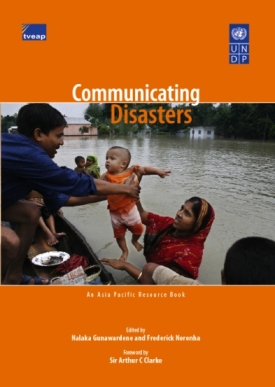
I then return to one of my favourite points about communicating disasters and crises: the need for credible messages and credible messengers. This was a core theme in the Asian book on Communicating Disasters that I co-edited in 2007. I also highlighted it in this interview given to APC in early 2008.
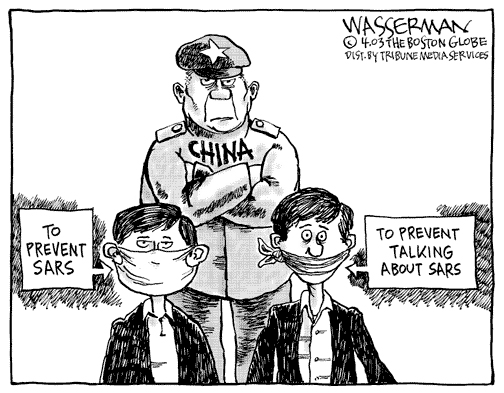
Here’s how my essay ends: “Whether it is SARS, HIV or tsunami, many Asian governments have suffered from a credibility gap in managing information about emergencies. For example, the initially slow and guarded media reporting on SARS allowed the virus to spread quickly in China, with devastating results. We cannot afford to repeat these mistakes with the latest flu pandemic.
“Nearly a century ago, British author H G Wells talked about human history being a race between education and catastrophe. In the coming weeks, we would find out if humanity has what it takes to outrun and outsmart a stubborn virus.”
Read the full essay at MediaChannel.org
My latest essay is a humble birthday present to MediaChannel.org as it completes 10 years. Unique among websites, MediaChannel.org holds the rest of the media accountable with the best of the world’s media criticism and analysis — offering news, diverse global perspectives, and commentaries tracking international news flows. They cover breaking controversies, showcase change-makers, trends and cutting edge issues that you need to know about – produced by journalists for journalists and citizens.
“Our survival alone is a cause for celebration – a decade of growth and impact is impressive in ‘Internet years’,” wrote the website’s founders in a special 10th anniversary message. They added: “Over the past 10 years, we have survived financial crises and organized hack attacks. We have managed to remain relevant and on the cutting edge in a quickly evolving online landscape when many other sites and organizations have come… and gone.”
The team is making an urgent appeal for donations to keep this excellent service going. I’m very happy to amplify this – few services can deliver better value for money, and our troubled times and troubled media sure need the soul-searching constantly provided by MediaChannel.org







 Open Minds!