Everyone seems to have their own recipe for media development, and that’s part of the media’s huge diversity. Media Helping Media asked a number of people who have benefited from media development projects what they felt needs to change in the year ahead. The replies have so far come from The Russian Federation, Indonesia, Azerbaijan, Sri Lanka, Lebanon, Macedonia, Ukraine, Bhutan and Nepal. They make up a challenging list of tips for those who try to help media in need.
Its introduction says: “You have as much to learn as you have to give. That’s the message to those offering media assistance in transition and post-conflict countries from some of those on the receiving end.”
Here’s my own contribution to this interestingly crowd-sourced distillation. David had asked for three key points, but you can see below why I was never very good in arithmetic…
• Media operate as a business, not charity: All media have a social responsibility, but that must be balanced with commercial viability. This is so with state, corporate or community owned media. Bankrupt media can’t serve any public interest.
• ‘Media’ is a plural: Media is a basket term for entities with enormous diversity and variability. One size does not fit all, no matter how well intended. It’s crucial to understand before engaging any media.
• Follow the eyeballs: If you want the biggest bang for your limited buck, start with the mass market end of media such as FM radio, tabloid newspapers and music TV channels. Leave your broadsheet/classical prejudices out of investment decisions.
• Take it easy: Audiences need entertainment as much as information and education. Supporting quality entertainment in the media is just as important for the public good as nurturing investigative journalism or advocating media freedom.
• Sparks of hope: Real world is not an all-or-nothing game. Find oases of innovation and resilience, and nurture them to survive and grow in turbulent times. Back media underdogs of today who can become fierce watchdogs of tomorrow.
In responding to David’s request last month, I’d added this covering sentence which sums up my thinking: “All this is common sense that is often uncommon. I really wish media development organisations would listen and reflect more, and also step beyond their comfort zones and romanticised little bubbles.”
The entire collection is well worth reading, for it distills decades of ground level experience and insight. This guide will help many well-meaning organisations (UN agencies, philanthropic foundations, CSR arms of media companies and others) to be more focused, sensitive and ultimately more effective in developing the media.
All journalism is subjective; it’s just that some of us are better at disguising it! As we head for the end of 2009, we at Moving Images blog take one last fleeting, impressionistic, judgemental and, yes, darn too opinionated look at the past 365 days. That Was The Year That Was…and here’s our list of superlatives!
Best news and biggest relief (national): Sri Lanka’s nearly three decades long and brutal civil war finally ended in mid May 2009 – and not a moment too soon. It rightly created headlines around the world, and also made it to TIME’s top 10 news of the year. Within 24 hours of that much-awaited news, I wrote and published one of my most emotionally charged essays ever, Memories of War, Dreams of Peace. I probably spoke for a whole generation of Lankans: “As we stand on the threshold of peace, I am overwhelmed with memories of our collective tragedy. I hope we can once again resume our long suspended dreams for a better today and tomorrow.” With the hindsight of seven months, I still want to believe every word…although it’s become increasingly hard to cling on to such ideals.
Biggest disappointment (national): Ending the Lankan war entailed tremendous effort, cost and sacrifice, and we all knew that consolidating peace and restoring normalcy were going to be even harder – delivering peace dividends is no mean task. As weeks became months, our cautious optimism slowly turned into disappointment and dismay: it became clear that the triumphalist government was treating the historic ‘open moment’ simply as as blank cheque to do pretty much what it wanted. My May 19 essay on Dreams of Peace had ended with a question that resonated with millions: “Would our leaders now choose the Mandela Road or the Mugabe Road for the journey ahead?” Can we please ask that question again…? Hello, anybody listening?
Most evocative piece of writing: Without competition, that distinction goes to The Last Editorial by Lasantha Wickrematunga, the courageous investigative journalist (and de facto leader of the political opposition) in Sri Lanka, who was brutally slain on January 8 while on his way to work. That editorial, which appeared post-humously in his newspaper The Sunday Leader on 11 January 2009, embodies the best of Lasantha’s liberal, secular and democratic views. Nearly a year after the dastardly daylight crime, his killers have not been caught and independent media remains under siege even in post-war Sri Lanka.
Most memorable quote: While people like Lasantha articulated our cherished dreams for a truly pluralistic society, our billion+ neighbours in India have been building it for over six decades. It’s still a work in progress, and the ideals need occasional reiteration. This is precisely what classical dancer Mallika Sarabhai did when she ran as an independent candidate when India conducted the world’s largest democratic election in April-May. She lost, but wrote one of the most insightful pieces on what it means to live amidst the huge cultural, social and political diversity in India: “We are a salad-like melange of cultures and not a soup where all variations get reduced to a homogeneous pulp—this, to me, is our greatest strength.” (She inspired my own essay: Sri Lanka – Spice Island or Bland Nation?)
Biggest disappointment (global):
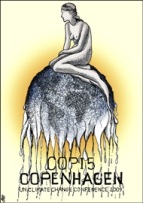
The UN climate conference in Copenhagen, held in December and officially dubbed COP15, ended up in what many activists felt was a cop-out. Greenpeace echoed the frustration of many when they said at the end of what was, at its start, billed as the ’14 days to seal seal history’s judgment on this generation‘: “Don’t believe the hype, there is nothing fair, ambitious or legally binding about this deal. The job of world leaders is not done. Today they shamefully failed to save us all from the effects of catastrophic climate change.” I was glad I wasn’t part of the mega event — I’ve burnt enough aviation fuel this year, but almost all events I participated in on three continents were more productive than the Danish debacle…
Biggest Under-achiever: If the world laboured a mountain and delivered a mouse in Copenhagen, the mid-wife of that process must surely have been the current UN chief Ban Ki Moon. More secretary than general, Ban is, in his own admission, the UN’s Invisible Man. All the top speech writers and PR agents in the world can’t animate this the perennially dull and dour diplomat. Not ideal change-maker when the world is racing against catastrophe. Kofi Annan, we miss you!
Most moving work of moving images: The world’s rich are having a party, and millions living in poverty are the ones footing the bill. This is the premise of Indian journalist and activist Pradip Saha’s latest film, MEAN Sea Level, which looks at the impact of climate change on the inhabitants of Ghoramara and Sagar islands in the the Sundarban delta region in the Bay of Bengal. I found it both deeply moving and very ironic. With minimal narration, he allows the local people to tell their own story. As it turned out, these testimonies were lost on the bickering politicians in Copenhagen…
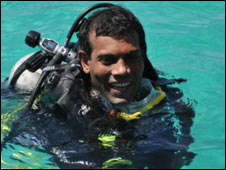
Best media stunts: We are a bit divided here. At a time of ever-shrinking attention spans, it takes much creativity and guts to grab the cacophonous media’s attention, especially for a good cause. Two very different men succeeded where many have failed. In February Bill Gates, the world’s top geek now working for its meek, released some mosquitoes at the TED 2009 conference to highlight the continuing grip that malaria has on the developing world, especially Africa. In October, climate crusader President Mohamed Nasheed of the Maldives held the world’s first underwater cabinet meeting to remind everyone of the watery future that awaits low lying island nations like his when climate change rises sea levels.
Biggest Irony: NASA announced in November that an unmanned space probe that was intentionally crashed on the Moon had discovered the presence of ‘significant amounts’ of water there. That bit of scientific evidence cost US$79 million to obtain…and was not the most comforting news for a planet that rapidly running short of usable freshwater. In the wake of the Apollo Moon landings in the late 1960s, misguided voters in Sri Lanka elected a government that promised ‘to bring rice even from the Moon’. When might we hear politicians promise us water from the Moon?
Well, that’s it folks — the highs and lows of 2009 according to the Blogger-in-Chief and his team of elves here at the Moving Images Media Empire. We’ve waded through our several dozen blog posts to come up with the above, and make no claims for being fair, balanced or comprehensive…
Indeed, we hope you don’t agree with all our picks, and invite you to express alternative – even dissenting – views. All comments that are not outright libellous or blatantly self-promotional will be published.
We take this opportunity to thank each and everyone who read our posts over the year — and especially those who left comments, sometimes radically disagreeing with our views. We also reiterate our pledge to frustrate those few persistent detractors who keep demanding to see our nationalistic, religious or other credentials…
“There are no full-stops in good journalism, only commas,” he declared. He was referring to two of the most commonly used punctuation marks in modern writing.
This metaphor neatly sums up the nature of journalism, whose coverage of public affairs and society is often on-going, unfinished and open-ended. This prompted Phil Graham, the former publisher of the Washington Post, to describe journalism as the “first rough draft of history”. The reason is that journalists, in the performance of their duty often record important events, producing hurried written reports (in text, sound or pictures) often generated on short deadlines.
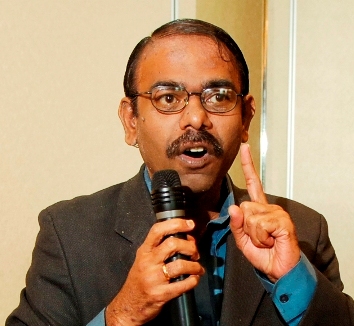
Panneer, who likes to call himself ‘a failed physicist and a failed journalist’, added that the intrinsic value of a journalist as one who tries to bring back the idea of commons — resources that are collectively owned, which can range from physical goods to artistic or creative products.
I always welcome occasions when his and my paths cross as we move in overlapping South Asian circles. Listening to him this time around, I recalled his clear, emphatic words on a previous occasion, at an Asian regional brainstorming on ‘Communicating Disasters: Building on the tsunami experience and responding to future challenges’ that I convened in December 2006 in Bangkok, Thailand.
He said the media is plural term, not a singular one. This implies that the media are not a monolith. Some are excellent; many are mediocre; some are downright bad. Some in the media are also indifferent to some issues but may be outstanding in addressing other issues.
He added that media is also very much a contested and contentious space where arguments rage on. Not everything is moderate, balanced or ‘evidence-based’.
Panneer’s day job is as the executive director of Panos South Asia. He was formerly the managing editor of Sun TV and bureau chief for Outlook magazine in India. Having been with the mainstream media for 20 years, he is now moving in that interesting overlap between media and development sectors. This gives him both insight and perspective.
Contributing a chapter to Communicating Disasters: An Asia Pacific Resource Book in 2007, Panneer wrote: “Development agencies rarely bring journalists into their universe at a stage which can be called ‘work-in-progress’. They usually just come to the media with a finished product. There is hardly any joint exploration. When presented with a finished product, there is just one alternative for a reporter — that is, to review the product that is already done.
“Imagine a scenario where journalists are brought into the process right from the word go. There would have been a series of stories, and when the final report of the development agencies is realised, that may well serve as the winding-up story tracking the entire trajectory.
“A journalist is expected to report and not just reproduce. Development agencies like their versions to be reproduced to a large extent. This becomes an assault on the journalists’ work-pride. He or she would like to do a field report, taking a cue or two from the work of the development agency. But, to merely reproduce a report is seen only as providing a free plug, an unpaid advertisement, and doing a stenographer’s job.”
Evolution or revolution?
I was born three years before the Internet (which turned 40 a few weeks ago), and raised entirely on newspapers and radio in a country where broadcast television didn’t arrive until I was 13.
From the time I could read and write, I always wanted to be a media publisher. In that pre-history of the Personal Computer and Internet, my choices were pretty limited: I published a hand-written household newspaper and was its editor, reporter, printer and distributor all rolled into one. But I was obsessive in my work even then, and the newspaper lasted a couple of years in which over two dozen issues were released (all of them now mercifully lost).
My school teacher parents were my first patrons, supplying me with plenty of paper, pencils and ink. But there must have times when they rather wished that I didn’t indulge in my own brand of independent journalism. I loved to criticise and lampoon the ‘management’ in my editorials — even as a kid, I was already critical of the establishment!
Fortunately for me, the ‘management’ left me alone and to my own devices, but most independent editors in history haven’t been so lucky. As the American journalist A.J. Leibling (1904 -1963) once said, “Freedom of the press is guaranteed only to those who own one.” In his time, this was perfectly true.
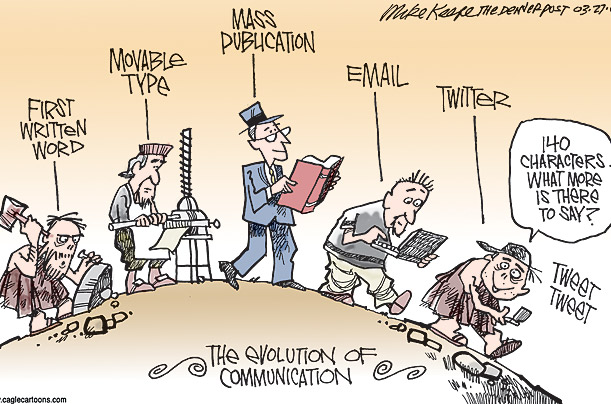
There was a time, until recently, when press barons and media moguls led, and the rest of society followed. In our topsy-turvy times, however, the reverse is increasingly true.
In theory, at least, anyone can be a global broadcaster and publisher in less than two hours using free tools that can be downloaded and activated in minutes.
David Brewer (photo from http://www.i-m-s.dk)My British media activist friend David Brewer has just published an online guide on how to become a publisher or broadcaster in 100 minutes. (Okay, the non-geeks among us might need a bit longer than that, but still, you can be in business in just a few hours.)
David Brewer’s journalistic and managerial experience spans newspapers, radio, television, and online, and he now runs Media Ideas International Ltd, a media strategy consultancy with clients in Europe, the Balkans, the CIS, the Middle East, Asia, Africa and Central America.
David has worked with what I like to call the A-B-C of global broadcasting. He was the launch managing editor of BBC News Online in 1997, and moved to CNN, as managing editor, to set up CNN.com Europe, Middle East and Africa and CNNArabic.com. He was an editorial consultant for the launch of Al Jazeera English in 2006 and continues to work with Al Jazeera English as a new media consultant.
In his spare time, he runs Media Helping Media , a network and online resource to support media in areas where freedom of expression is under threat.
This award is sponsored by TVE Asia Pacific (TVEAP) and is given to “an individual for excellence in environmental reporting that contributes to public awareness and understanding of environmental issues”.
Pierre was selected “for his insightful, analytical and fact finding stories focusing on diverse issues related to environment and climate change”.
I literally dashed from the Indira Gandhi International Airport to the India Habitat Centre in New Delhi to be part of the inaugural ceremony. Despite the best efforts by Delhi’s notorious traffic, I made it just in time to join Dr Farooq Abdullah, Union Minister of New and Renewable Energy, to present the TVEAP award to Pierre Fitter.
Pierre Fitter: TVEAP Environmental Journalist of the YearAarti Dhar of The Hindu newspaper was adjudged as the Best Environment Journalist Award (Print), while my good friend Krishnendu Bose received the prestigious CMS-UNEP Prithvi Ratna Award “for his sustained and concerted efforts towards enhancing people’s understanding and spreading awareness on diverse environmental issues through films and documentaries”. This is the highest honour for wildlife and environmental film making in India.
Pierre Fitter lives in Delhi where he reports on the environment and foreign affairs. He holds a Bachelor’s degree in Socio-Legal Sciences and is studying for a Masters in Political Sciences. Pierre spent a year and a half in China and Russia, where he worked for AIESEC, an international youth leadership development organisation. While with AIESEC, he developed a deep interest in sustainable development and international relations and continues to report on these issues to this day. He has a special interest in Environment and climate change in particular.
Watch Pierre Fitter interviewing Shyam Saran, the Indian Prime Minister’s special envoy on climate change on the current state of climate change in India in early October 2009:
Selection of award winners was based on regular monitoring of Indian news and current affairs TV channels and newspapers by the CMS MediaLab.
CMS VATAVARAN is India’s premier biennial competitive and traveling Environment and Wildlife Film Festival. It was initiated in 2002 towards raising awareness about environmental issues. The CMS Environment Forum and CMS VATAVARAN have ushered in a fresh green global consciousness on an extraordinary scale using environment forums and films. CMS VATAVARAN is an initiative of Centre for Media Studies.
Yugratna Srivastava: Lend me your ears...This week saw the UN’s invisible man hosting mostly indifferent leaders at a Summit on one of the world’s most pressing challenges: climate change.
Nearly 100 world leaders accepted UN Secretary General Ban Ki-moon’s invitation to participate in an historic Summit on Climate Change in New York on 22 September to mobilise political will and strengthen momentum for a fair, effective and ambitious climate deal in Copenhagen this December.
The call for action at the summit did not just come from world leaders – many of who simply can’t see beyond their next election – but also from the next generation who stand the most to lose if climate talks fail.
On their behalf, Yugratna Srivastava, a 13-year-old Indian girl, spoke forcefully at the podium, sending a wake-up call to those assembled. “We received a clean and healthy planet from our ancestors and we are gifting a damaged one to our successors. What sort of justice is this?,” she said.
She added: “The Himalayas are melting, polar bears are dying, 2 of every 5 people don’t have access to clean drinking water, earth’s temperature is increasing, we are losing the untapped information and potential of plant species, Pacific’s water level has risen,Is this what we are going to hand over to our future generations? Please……no!”
She said the three billion young people in the world need them to take action now to protect the planet for future generations.
All this news coverage reminded me of another passionate young girl who similarly addressed – and challenged – the world leaders 17 years ago at the Earth Summit held in Rio de Janeiro, Brazil.
Her name was Severn Cullis-Suzuki, and she was a young Canadian environmental activist. Then 12-year-old Severn closed a Plenary Session with a powerful speech that received a standing ovation.
Raised in Vancouver and Toronto, Severn Cullis-Suzuki is the daughter of writer Tara Elizabeth Cullis and environmental activist and TV personality David Suzuki. When she was 9, she started the Environmental Children’s Organization (ECO), a small group of children committed to learning and teaching other kids about environmental issues. They were successful in many projects before 1992, when they raised enough money to go to the UN’s Earth Summit in Rio. Their aim was to remind the decision-makers of who their actions or inactions would ultimately affect.
Listen to the memorable speech at the Earth Summit by Severn Cullis-Suzuki:
Severn was every bit as sincere, concerned and passionate about the global environment as Yugratna Srivastava was this week. Seventeen years later, notwithstanding the lofty pledges at the Earth Summit and later gatherings, the environmental crises have multiplied and worsened.
Very few of the world leaders who assembled in Rio are still in office — and that underlines part of the problem. Governments have far shorter time horizons than what many of today’s global challenges demand. I am constantly reminded of what the eminent Indian scientist Dr M S Swaminathan told me in my first interview with him in 1990 (yes, even before the Earth Summit): “In democracies, rulers think in terms of the next election. In dictatorships, about the next coup d’état. Nobody is thinking in terms of the next generation!”
It was no small feat for the UN’s Invisible Man to bring 100 heads of state or heads of government together on such a long-term issue. But it’s going to take many more meetings, bickering and hard bargaining before the leaders begin to think in terms of the next generation.
Unthinkable? Not any more...What is to be done? The innocuous question has probably been asked by so many individuals throughout history. Lenin famously asked it in 1901, and then spent the next few years cooking up a revolution that changed history (for better or worse, depends on where you come from).
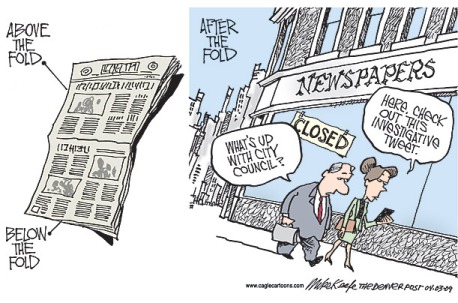
The context was not sparking revolution, but coping with evolution: how to survive and adapt at a time when mainstream media (MSM) is under siege from technological change, loss of public confidence and economic recession.
Why do I care? Unlike my new media activist friends, who cannot wait to see the MSM ‘mediasaurus’ die, I see value and utility in this ‘species’ that has evolved for over 500 years. Yes, there is much that is not right with them – including greed, arrogance and narcissism. But MSM’s outreach still remains unmatched in many parts of developing Asia, where we simply cannot wait until the online/mobile media to evolve, scale up and establish themselves to completely serve the public interest. I will thus engage the dinosaurs as long as they remain useful…
Besides, not all members of the mediasaurus clan are ferocious and carnivorous; there are also many gentle, ‘vegetarian’ ones among them who have always been empathetic and caring. I see merit in the adaptation of these better MSM, if only so that we don’t have to put all our eggs in the online/mobile media basket…
So I spent part of my talk asking aloud how the MSM – under siege – can adapt fast and increase their survival chances. The overall suggestion was that they move out of denial or resistance, and instead try to ‘exploit the inevitable’ (a pragmatic policy if ever there was one!).
Here are some initial thoughts I offered:
• Prepare for coming calamity, by taking advantage of the likely delay in its arrival in our region and our island.
• Consider it a ‘cleansing’ process, a new beginning to do things better.
• Decide what’s really worth saving, and let go of everything else that is no longer useful or relevant.
Let’s remember, too, that the very term ‘media’ is a plural. That means:
• One size doesn’t fit all; one solution won’t help/save everyone.
• Different ‘lifeboats’ can be found for different media outlets.
• You will only find out what works by trying out a few alternatives.
• No solution is fail-proof or ‘unsinkable’.
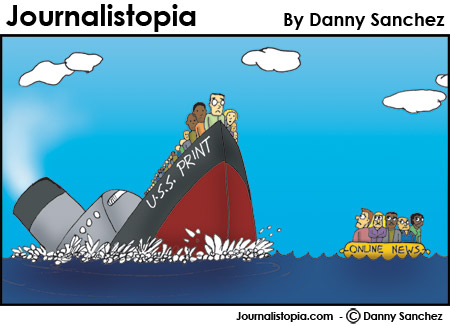
In some ways, mainstream media has behaved with the same kind of arrogance of those who built and operated RMS Titanic, and in this instance, the iceberg has already been spotted. At this stage, should MSM be re-arranging furniture on the ship’s deck — or discussing rescue plans?
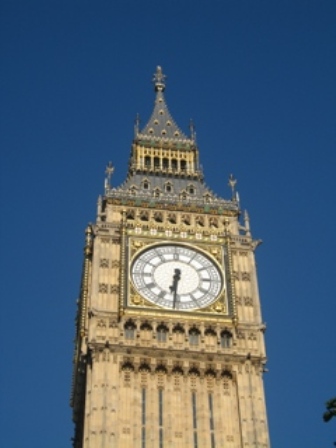
Big Ben at 150: Who'd build one like this today?When the maritime tragedy happened nearly a century ago, on 14 April 1912, it dominated headlines around the world for many days. But MSM was in such nascent stages at the time, newspapers being the sole dominant mass medium. Radio communication had just been discovered, but radio broadcasting still lay a few years in the future.
To adapt and survive, MSM can also learn from how other industries faced vast challenges. For example, take the time-keeper industry:
• A century ago: people had to go to a post office, railway station or another public place to find the time. Clock Towers and public clocks announced time for all.
• Then came personal clocks (elaborate time pieces) that the wealthy people carried around in pockets or handbags.
• This was followed by wrist watches – personalised, affordable and portable.
• Now, mobile phones tell us the date, time and lot else!
Clock tower makers went out of business, and no one misses them now. Watch makers have adapted with the times, and are still competing with mobile makers. The parallels with the media industry are clear enough.
Somebody writing as ‘Global1’ has commented about how the Titanic‘s Band played on to the very end (and went down playing). S/he asks: Could This Be Analogy To The Modern Day MSM? In this analogy, MSM is the band, and their ‘music’ is the news…
Incidentally, the centenary of the Titanic‘s sinking is coming up shortly, in 2012. It would be interesting to see how the MSM/Titanic analogy plays out in the next few years…
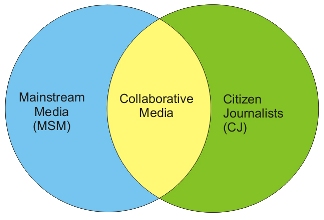
Can this common ground expand? Is there common ground between the mainstream media (MSM) and citizen journalists (CJ) that can be tapped to better serve the public interest?
MSM have gone from denial to dismissal to apprehension about this murky, distributed phenomenon called citizen journalists. But, as I asked, must MSM and CJ always compete? Must they consider each other mutually exclusive? I don’t think so.
Consider these facts: CJs are not an organised, unionised mass of people. They are a scattered, loosely connected group that is a community of practice across geographical borders and time zones. They rarely agree on anything among themselves. CJs are not out to topple MSM.
Once we get those points clarified, we can move beyond chest-thumping egotism. We can then address the fundamental values of why MSMs and CJs are both doing what they do: for the free flow of information, ideas and opinions.
Indeed, we should see how MSM and CJs can join hands more to serve the public interest. CJs today are not just frustrated poets and writers who never found a public outlet in the past. Today’s plethora of CJs include scientific experts, professionals, retirees with loads of experience and tech-savvy geeks among many others. This is a vast resource that MSM can tap into — especially in these days of leaner budgets and fewer staff.
Must everything be All-or-Nothing? No!And why not? Many issues these days are just too complex, technical or nuanced for even the most committed full-time, paid journalists to tackle all on their own. The information is often too vast to wade through in time for deadlines. And things are changing faster too. In such situations, can MSM work collaboratively with CJs, sharing the work load, risk and eventually, the credit?
In fact, MSM have historically relied on citizens to provide part of the content – whether they are letters to the editor, or funniest home videos, or news tips from the public that reporters then pursue. Today’s CJs can take this ‘crowd-sourcing’ to a new level.
I recently came across an interesting example of crowd-sourcing in investigative journalism – a component of journalism that is particularly demanding. Over several weeks in April – May 2009, The Telegraph in the UK disclosed the scandal over many exaggerated or false expense claims made by British Members of Parliament. This left the British public furious, and brought worldwide ridicule on the Mother of all Parliaments.
The story still unfolds. Now, The Guardian has involved readers to dig through the several truckloads of MPs’ expense documents to spot claims that merit further investigation because they seem…a tad suspicious. This is more than what a small team of paid journalists can do on their own: a total of 458,832 pages of documents need be manually checked. So far, 23,262 readers had signed up by 2 August 2009. Many hands make light work for The Guardian, whose editors will then decide which claims are to be further probed and queried.
Mobile: the most subversive ICT of all?Can we expect to see more of such collaborations in time to come? I certainly hope so. Under siege as they are, MSM should be the first one to make the move to search for this common ground – after all, they have everything to gain and little to lose. We can all think of tedious record-scanning, number-crunching tasks that are needed to unearth and/or understand complex stories of our times.
Of course, for such collaborations to work well, the rules of engagement between MSM and CJs need to be clear, transparent and based on mutual trust. That requires some work, but when it works well, everybody stands to gain.
In late 2005, I researched and worked with Sir Arthur C Clarke to write an essay on the rise of citizen journalists, which first appeared in the Indian news weekly Outlook on 17 October 2005. I’m quite proud of how we ended the essay: “There is more than just a generation gap that separates the mainstream media from the increasingly influential online media…Yet one thing is clear: the age of passive media consumption is fast drawing to an end. There will be no turning back on the road from Citizen Kane to citizen journalist.”
Emerging new models of collaboration in media and journalism indicate that this evolutionary road need not be a one-way street. So nearly four years on, I now raise the question that I first put to the media tycoons of Colombo the other day: Can Citizen Kane and Citizen Journalist join hands in the public interest?
I very much hope the answer is a resounding: Yes, We Can!
Who can crack this web 2.0 challenge? Image courtesy i4d magazineAs the 19th Century was drawing to a close, the newspaper publisher William Randolph Hearst (later immortalised in Citizen Kane) cabled a leading astronomer of the day: ‘Is there life on Mars? Please cable one thousand words’.
The scientist replied: ”Nobody knows” – written 500 times.
This would be my answer today, if a modern-day media tycoon were to ask me a different, yet equally compelling question: where are we headed with the bewildering developments in information and communication technologies, in which the mainstream media are a part?
So, with the Indian Ocean lashing gently on the rocky beach only a few feet away, and under the slightly bemused gaze of Sir Arthur, I took my audience on a quick and rough tour of the near future — the one no one about which nobody is an expert!
Here are some excerpts:
Two waves that started separately have combined to radically change how people generate, access, store and share information: the rolling out of broadband internet, and the phenomenal spread of mobile phones.
The headline figures are impressive. For the first time in history, we now have the technological means to quickly reach out to most of humanity:
• More than 4.1 billion mobile phones were in use by end 2008, a majority of them in the developing world.
• Nearly a quarter of the world population (over 1.5 billion people) has access to the web, at varying levels of bandwidth.
• Thousands of radio and TV channels saturate the airwaves – these still are the primary source of news and information for billions.
Where this growth in processing power and proliferation of devices might lead us, we can only guess — no one really knows. This can be both exhilarating for some — and very disconcerting for entities that were previously in control of the free flow of information, such as governments, academics – and dare I say it – the mainstream media!
Is that your final answer? Surely not...?They may not accept this, individual governments, and their collective known as the United Nations, don’t have full control over what is going on. But the ‘information genie’ is now firmly out of the bottle, and evolving by the day that it’s impossible to put it back inside. This is both fascinating and frightening.
If it offers any comfort, even big corporations like Microsoft, Apple or Google are all learning by doing. Everything seems to be permanently in experimental — or beta — mode…
What would emerge from the current chaos? The best brains on the planet are trying to come up with plausible answers.
There is talk about the ‘post-media age’. In the broadcast circles that I move in, they now acknowledge, quietly, that the post-broadcasting age is already dawning.
Is what we hear the death cry of the Old Order…or birth pangs of a new Information Society? Or perhaps both?
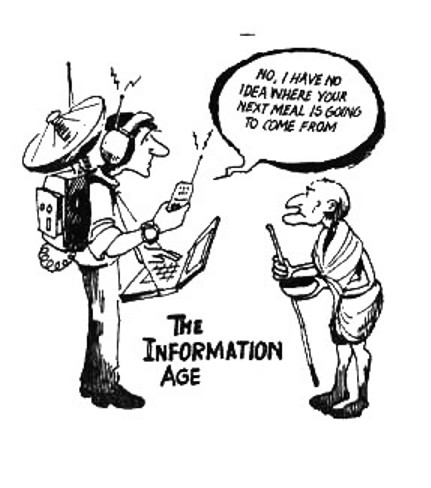
And how inclusive is that information society? As Asia Media Report 2009 reminds us, not everyone is invited to the party. Large sections of Asian society are left out.
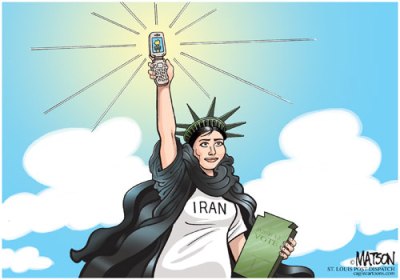
But don’t expect such people to remain excluded for too long. Armed with mobile phones and other ICT tools, they are going to crash the party, whether we like it or not.
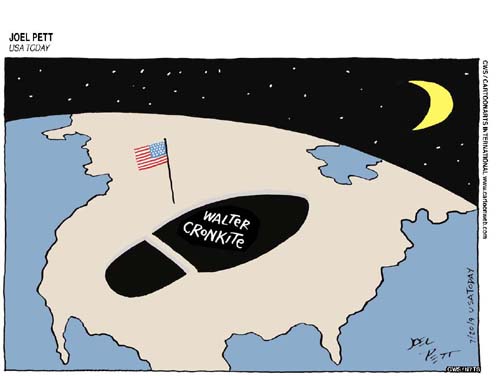
“What matters about Cronkite is that he knew when to stop being reassuring Uncle Walter and to challenge those who betrayed his audience’s trust. He had the guts to confront not only those in power but his own bosses. Given the American press’s catastrophe of our own day — its failure to unmask and often even to question the White House propaganda campaign that plunged us into Iraq — these attributes are as timely as ever.
“That’s why the past week’s debate about whether there could ever again be a father-figure anchor with Cronkite’s everyman looks and sonorous delivery is an escapist parlor game. What matters is content, not style. The real question is this: How many of those with similarly exalted perches in the news media today — and those perches, however diminished, still do exist in the multichannel digital age — will speak truth to power when the country is on the line? This journalistic responsibility cannot be outsourced to Comedy Central and Jon Stewart.”
I cannot agree more with the premise and arguments in this essay, which is well worth a careful, slow read by everyone, everywhere who cares for good journalism — either as practitioners or consumers (and in this media saturated age, don’t we all fall into one or both categories?).
At the same time, without detracting from the value of — and the crying need for — investigative, reflective and ‘serious’ journalism, I believe comedy and especially political satire play a key role today in analysing and critiquing politicians, businessmen and others whose decisions and actions impact public policy and public life.
Anchor, anchor, burning bright...Political satire is nothing new: it’s been around for as long as organised government. Over the centuries, it has manifested in many oral, literary or theatrical traditions, some more memorable and enduring – such as Gulliver’s Travels and Animal Farm. And for over a century, political cartoonists have been doing it with brilliant economy of words – as I have said more than once on this blog, they are among the finest social philosophers of our times.
In the age of electronic media, it’s only natural that the tradition of satire thrives on the airwaves and online. In fact, there is a rich and diverse offering of politically sensitive and/or active satire in the mainstream and online media that we can consider it a genre of its own. Some of it is so clever, authentic and appealing that we might momentarily forget that we are experiencing a work of satire.
Purists might decry this blurring of traditional demarcations between information, commentary and entertainment — but does that really matter?
When we survey the media and cultural scenes in our globalised world, we see things getting hopelessly entangled and mixed up everywhere. Nothing is quite what they seem – or claim – to be anymore. Content that is explicitly labelled as pure news and current affairs is looking more and more like entertainment. My friend Kunda Dixit, who edits the Nepali Times, says this is inevitable when the same mega corporations own both cartoon networks and news channels.
No news is good news -- for whom?If the mainstream news organisations don’t quite live up to our expectations to gather, analyse and reflect on the current affairs of the day, we should at least be grateful that some comedians are stepping into that void. We must welcome, celebrate and wish their tribe would increase!
The rise and rise of political satire is also being chronicled and analysed. A new book tells us why we now have to take satire TV seriously — it turns out to be the bearer of the democratic spirit for the post-broadcast age. Titled Satire TV: Politics and Comedy in the Post-Network Era, the book is co-edited by Jonathan Gray, Jeffrey Jones and Ethan Thompson (NYU Press, April 2009).
Here’s the blurb introducing the book: “Satirical TV has become mandatory viewing for citizens wishing to make sense of the bizarre contemporary state of political life. Shifts in industry economics and audience tastes have re-made television comedy, once considered a wasteland of escapist humor, into what is arguably the most popular source of political critique. From fake news and pundit shows to animated sitcoms and mash-up videos, satire has become an important avenue for processing politics in informative and entertaining ways, and satire TV is now its own thriving, viable television genre. Satire TV examines what happens when comedy becomes political, and politics become funny.”
The book contains a series of original essays focus on a range of popular shows, from The Daily Show to South Park, Da Ali G Show to The Colbert Report, The Boondocks to Saturday Night Live, Lil’ Bush to Chappelle’s Show, along with Internet D.I.Y. satire and essays on British and Canadian satire. “They all offer insights into what today’s class of satire tells us about the current state of politics, of television, of citizenship, all the while suggesting what satire adds to the political realm that news and documentaries cannot.”
Let me summarise the news so far. Intentionally or otherwise, some news anchors and politicians are increasingly behaving like comedians. Meanwhile, a few professional comedians are talking serious politics and current affairs in a genre of media that is growing in popularity by the day.
Are you confused yet? Well, get used to it. This is the shape of things to come.
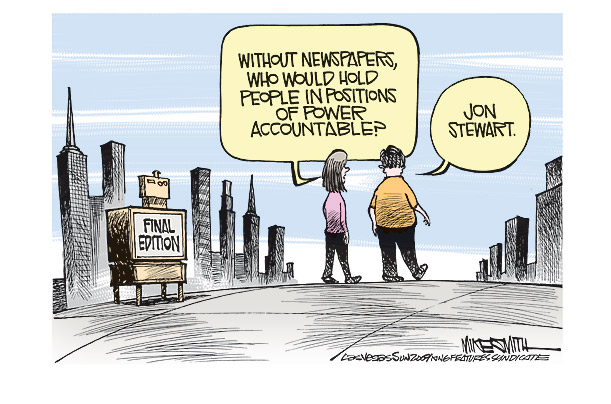
In such topsy-turvy times, we need more Jon Stewarts to puncture the bloated egos and images of not only elected and other public officials, but also of our larger-than-life news anchors, editors and media tycoons. I would any day have conscientious comedians doubling as social and political commentators than suffer shallow, glib newscasters trying to be entertainers. That’s what you call laughing for a good cause.
Parting thought: There is another dimension to satirising the news in immature democracies as well as in outright autocracies where media freedoms are suppressed or denied. When open dissent is akin to signing your own death warrant, and investigative journalists risk their lives on a daily basis, satire and comedy becomes an important, creative – and often the only – way to comment on matters of public interest. It’s how public-spirited journalists and their courageous publishers get around draconian laws, stifling regulations and trigger-happy goon squads. This is precisely what is happening right now in countries like Kenya and Sri Lanka, and it’s certainly no laughing matter. More about this soon.
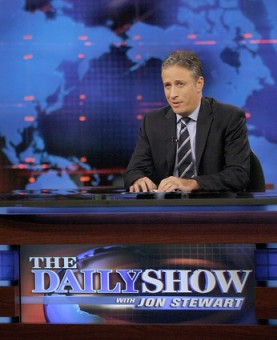
Backgrounder: The news as you never saw it before...The Daily Show with Jon Stewart, is an American late night satirical television programme, airing on Comedy Central, a cable/satellite channel. The half-hour long show is presented as a (fake) newscast. In their own words, the Daily Show team “bring you the news like you’ve never seen it before — unburdened by objectivity, journalistic integrity or even accuracy.” It “takes a reality-based look at news, trends, pop culture, current events, politics, sports and entertainment with an alternative point of view.”
The show premiered in July 1996, and was initially hosted by Craig Kilborn. Jon Stewart took over as host in January 1999, and made it more strongly focused on politics. In each show, anchorman Jon Stewart and his team of correspondents, comment on the day’s stories, employing actual news footage, taped field pieces, in-studio guests and on-the-spot coverage of important news events.
This is what the Wikipedia says: “The program has grown in popularity since Jon Stewart took over hosting, with organizations such as the Pew Research Center claiming that it has become a primary source of news for many young people, an assertion the show’s staff have repeatedly rejected. Critics, including series co-creator Lizz Winstead, have chastised Stewart for not conducting hard-hitting enough interviews with his political guests, some of whom he may have previously lampooned in other segments; while others have criticized the show as having a liberal bias. Stewart and other Daily Show writers have responded to both criticisms by saying that they do not have any journalistic responsibility and that as comedians their only duty is to provide entertainment.”
OK, The Daily Show may not be intentionally serious journalism, anymore than mainstream news channels are intentionally funny. But a significant number of American TV viewers and TV critics, as well as media researchers, have found the analysis and commentary to be highly insightful and incisive. It has won many awards including an Emmy and Peabody Award. It’s been on the cover of Newsweek for its outstanding elections coverage and serious journalism. It’s not to be laughed off easily. After the Last Newspaper...
 Some weeks ago, I wrote a post about How to become a global publisher or broadcaster in just 100 minutes! That was compiled by my British media activist friend David Brewer , who showed how it could be done using free tools that can be downloaded and activated in minutes.








 Open Minds!