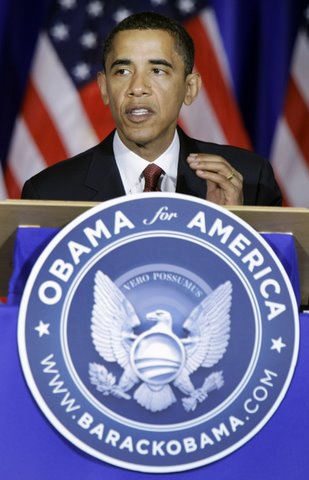
His own brand...Inauguration Day is finally here! Today, 20 January 2009, Barack Obama will be sworn in as the 44th President of the United States of America.
Obama campaigned – and won – on the core promise of change. And even before he moved into the White House, he achieved many firsts. Among them was being the first American leader to understand the power of new media and to use it effectively to harness both campaign contributions and, eventually, votes.
On 6 November 2008, soon after the election results were confirmed, we noted how Obama had just been elected ‘President of the New Media world’. I explained: “Obama’s rise has epitomised change in many ways. Among other things, he is the first elected leader of a major democracy who shows understanding and mastery over the New Media World, which is radically different from the old media order.”
Of course, others had different takes on the same outcome. One of the funniest was by The Onion, which proclaimed: Black Man Given Nation’s Worst Job.’ It read, in part: “African-American man Barack Obama, 47, was given the least-desirable job in the entire country Tuesday when he was elected president of the United States of America. In his new high-stress, low-reward position, Obama will be charged with such tasks as completely overhauling the nation’s broken-down economy, repairing the crumbling infrastructure, and generally having to please more than 300 million Americans and cater to their every whim on a daily basis.”
The sheer magnitude of Obama’s challenges has become clearer in the weeks following the historic election. While the economy will certainly dominate his agenda, he will also have to live up to the many expectations of hope that his campaign sparked off in hundreds of millions of people — and not just in the United States.
How will the ‘President of the New Media world’ remain engaged with the millions of conversations taking place 24/7 on the web and through mobile devices? Is this realistically possible given his roles as the chief executive of beleaguered America, Inc., and commander-in-chief of the world’s only superpower?
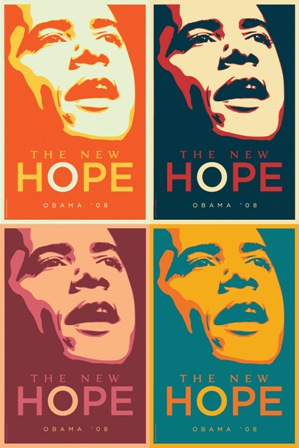
The new face of HopeMore to the point, how long will the mainstream media’s honeymoon with the new President last? And how will citizen journalists, many of who cheerled Obama in his long and arduous campaign, now relate to their man in Washington DC? Can the Obama Administration strike deals with citizen journalists as every administration has done with the mainstream media over the decades? Outside the strict security cocoon of the White House, will this presidency ever be able to have any moments ‘off the record’ with every digitally connected person being a potential citizen journalist?
Remember how his comments about “bitter” small-town Americans clinging to their guns and religion — uttered at a ticket-only and supposedly no-media San Francisco fund-raiser during the campaign — came to be publicised? And that, too, by a pro-Obama blogger writing on the openly pro-Democratic blogger site Huffington Post!
Then there’s the power of moving images moving around online as broadband rolls out across the planet, and speeds improve to support real time video-watching. The day Americans went to the polls to elect Obama, we recalled the hugely popular Obama Girl (‘I got a crush on Obama’) – an internet viral video, first posted on YouTube in June 2007 – and asked Can this little video change history? We had our answer within 24 hours.
While Obama Girl was a well-edited, slick campaign-boosting video released online, the thousands of citizen-filmed videos being posted online are not. And yet, in that no-frills mode, some bring out public interest concerns that have implications for public policy debates and/or law enforcement.
President Obama arrives at the White House to lead the executive of a nation that is unlike any his predecessors faced. His inauguration will be the most digitised, but that’s only the beginning. For four or eight years, Obama’s every move, word and gesture will be captured, dissected and debated to exhaustion by admirers and detractors alike. And his administration will be under scrutiny by thousands of citizen journalists who don’t share much except the digital platforms and social networks on which they post their impressions.
Welcome to the New Media Presidency. The hard work – and real fun – begin now!
As I wrote at the time: “The few of us thus became the first outsiders to see the film which I found both deeply moving and very ironic. With minimal narration, he allows the local people to tell their own story. There’s only one expert who quickly explains just what is going on in this particularly weather-prone part of the world.”
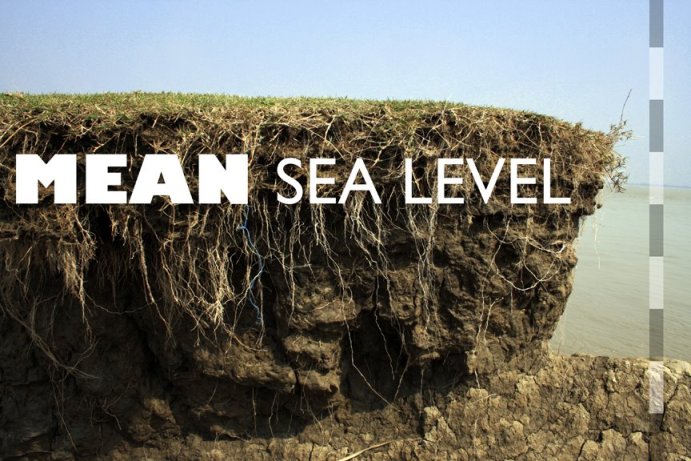
The world’s rich are having a party, and millions living in poverty are the ones footing the bill. This is the premise of the film, which looks at the impact of climate change on the inhabitants of Ghoramara and Sagar islands in the the Sundarban delta region in the Bay of Bengal.
Almost 7,000 inhabitants have been forced to leave Ghoramara in the last 30 years, as the island has become half in size. The biggest island, Sagar which hosted refugees from other islands all these years is witnessing massive erosion now. 70,000 people in the 9 sea-facing islands are at the edge of losing land in next 15 years. For these people climate change is real.
As the sea level rises and takes with it homes and livelihoods in the delta, the villagers of Sagar are paying a hefty price for a problem that they did not create. Meanwhile, middle class India and the political elite are becoming aware of the problem of global warming, but prefer to look the other way.
I’m glad to note that the film is now being screened to various audiences and making ripples. By showing people – including those still not convinced about climate change – what sea level rise is already doing to poor people, the film is stretching the limits of debate and focusing attention on the need to act, not just talk.
It’s also creating ripples in environmental and/or human rights activist circles where all too often, passionate discussions don’t go very far beyond the rhetoric to bring in the real world voices and testimonies. Pradip’s film accomplishes this with authenticity and empathy yet, mercifully, without the shrill and overdose of analysis found in activist-made films. It powerfully and elegantly tells one of the biggest stories of our times.
Pradip SahaIn November 2008, Pradip showed and talked about his film at a screening organised by SACREDMEDIACOW (SMC), an independent postgraduate collective on Indian media research and production (and much more) at the School of Oriental and African Studies (SOAS) at the University of London. Before it started, Pradip told his audience to ‘forget that this is a documentary about climate change’ and just watch.
As one member of his audience, Sophia Furber, later wrote: “The film’s approach to climate change is completely non-didactic. Mean Sea Level is no acronym-fest sermon or disaster story, but an intimate portrait of a way of life which is on the verge of going underwater.”
In his day job as editor of Down to Earth magazine, published from India with a global outlook, Pradip excels in wading through the (rapidly expanding) sea of jargon and acronyms surrounding many topics related to science, environment and development. In typical style, his recently started blog is named alphabet soup @ climate dinner.
Read Sophia Furber’s account of SOAS screening in London
The more Pradip shares his film, the more people who notice the irony that I experienced in Tokyo. A short review by the Campaign against Climate Change says: “There is a greater irony. These poor people got nothing out of the economy that created climate change, nor do they contribute to global warming. Mean Sea Level is a testimony of reckless political economy of our times. Climate change is real, and only a sign of our recklessness.”
Last heard, Pradip was planning to screen MEAN Sea Level on Sagar Island so that the story’s participants can see the film for themselves. The idea was to power the event entirely through renewable energy sources, such as solar power.
I hope he will soon place his film – or at least highlights/extracts – online on YouTube or another video sharing platform. This film is too important to be confined to film festivals and public screenings. Whether it would also be broadcast on television in India and elsewhere, we’ll just have to wait and see. I won’t hold my breath on that one…
Danny Schechter: Moving Images Person of the Year 2008
As 2008 – clearly an Annus horribilis for tens of millions around the world – draws to an end, we announce the Moving Images Person of the Year 2008: Danny Schechter.
Nicknamed “The News Dissector,” Danny is a television producer, independent filmmaker, blogger and media critic who writes and lectures frequently about the media in the United States and worldwide.
He has worked in print, radio, local news, cable news (CNN and CNBC), network news magazines (ABC) and as an independent filmmaker and TV producer with the award-winning independent company Globalvision. He is a blogger and editor of Mediachannel.org, a web and blog site that watches and critiques the print and broadcast media.
Another way to introduce Danny is to recall the scary headlines and TV news images that have dominated 2008 – of reputed banks going bust, leading stock markets crashing and these events triggering a global financial meltdown that, for now, has been slowed but not completely averted by unprecedented governmental intervention…by the very governments of the industrialised countries who should have kept a sharper eye on what was going on in their free market economies.
As the carnage on Wall Street and other global financial centres continued, some hard questions were asked: Did anyone see this coming? If so, why weren’t they listened to? What is the real cause of all this chaos? Where was the news media and why weren’t they doing their job of sounding the alarm?
Well, one man who saw it coming and tried very hard to raise the alarm was Danny Schechter. In 2006, as part of this effort, he made a documentary film called In Debt We Trust. In this, he was the first to expose Wall Street’s connection to subprime loans and predicted the global economic crisis.
This hard-hitting documentary investigated why so many Americans – college and high school students in particular – were being strangled by debt. Zeroing in on how the mall has replaced the factory as America’s dominant economic engine, Emmy Award-winning former ABC News and CNN producer Danny Schechter showed how college students were being forced to pay higher interest on loans while graduating, on average, with more than $20,000 in consumer debt.
An inconvenient truth that America ignored for too long...
The film empowers as it enrages, delivering an accessible and fascinating introduction to what former Reagan advisor Kevin Phillips has called “Financialization” — or the “powerful emergence of a debt-and-credit industrial complex.”
Danny and his film have done for global financial meltdown what Al Gore did for global warming with his own film: investigate rigorously, gather and present the evidence of a gathering storm, sound the alarm — and keep badgering until the warnings were heard. In both cases, the inconvenient truths they presented were ignored for too long — and we are paying the massive price for such indifference.
Watch the Trailer of In Debt We Trust:
Deborah Emin, writing in OpEdNews in October 2008, noted: “In Debt We Trust…brought Schechter a lot of grief. Rather than being seen as a prophet of doom, which in and of itself was not so terrible, he should have been lauded for sounding the alarm when it would have been in time. It is truly an amazing fact of American life that the powers that be can so disastrously determine what information we are able to see based on their subjective judgment of what is too negative or too harsh a view of a specific topic. From this perspective, we should judge all these gatekeepers as those on the Titanic who did not want to alarm the passengers that the ship was going down.”
Watch an extract from In Debt We Trust: How did we get into this mess?
So here’s the trillion-dollar question: if this film was made in 2006, and has since been running to packed houses scaring a lot of thinking and caring people, why was its message not heard in the corridors of power in Washington DC — and elsewhere in the G8 countries’ capitals?
The short answer could be that there have been no thinking and caring people running the American government for the past eight years.
Read all about it!The long answer is found in a book that Danny published in mid 2008. Titled Plunder: Investigating Our Economic Calamity and the Subprime Scandal, it’s an outgrowth of – and update on – his 2006 film. It documents with shocking evidence how debt has restructured the American economy and put Americans under a burden that many will never overcome.
Plunder also offers an analysis based on current events, going behind the scenes, identifying the key players and culprits, challenging the financial industry, government deregulation — and the financial and most sections of the mainstream media who have been cheer-leading the financiers as the latter took ever larger risks. Danny also argues that this has been a criminal enterprise — a point only touched on in most media coverage — and of global significance, given the globalization of markets.
Read my Sep 2008 blog post: Financial Meltdown: Putting pieces together of a gigantic whodunnit
On a personal note, I have been a great admirer of Danny Schechter and his work since I first met him 13 years ago. In the Fall of 1995, he gave an inspiring and provocative talk to a group of journalists and producers from the developing world who were on a UN-organised media fellowship in New York. As part of our tour of media and development agencies in the US East Coast, we visited Danny’s GlobalVision productions.
Danny introduced himself as a ‘network refugee’ — one who had worked for the mainstream network television in the US and had left in disgust. From outside, he was trying to find alternative ways of speaking truth to power — the original mandate of the mass media which many corporatised media companies had abandoned, knowingly or otherwise.
In that pre-Internet era, Danny engaged in his media activism through independent filmmaking, through which he supported and often participated in struggles for social justice in his native United States as well as in places like apartheid-ridden South Africa and strife-torn Palestine.
http://www.newsdissector.comDanny was one of the early media activists to take advantage of the web. In 2000, he co-founded with Rory O’Connor MediaChannel.org, the first media and democracy supersite on web. Operating on shoe-string budgets, it has sustained critical spotlight on the mainstream media (MSM) for 8 years in which the MSM landscape has been completely transformed. While its scrutiny and chronicling of the political economy of the media is more crucial than ever, and veterans like Walter Cronkite whole-heartedly endorse the effort, the non-profit effort struggles for survival.
Now in his 60s, Danny is simply indefatigable. Besides running MediaChannel and GlobalVision, he blogs every few hours, writes a regular column on Huffington Post, lectures on media, writes books and still has time to make investigative films. He is extremely well informed, witty, funny and completely irreverent. He writes and speaks with justified outrage but no malice. That’s a tough balance to maintain.
Danny visits Wall Street on 20 September 2007 – typical of his funny, incisive reporting:
I was delighted to catch up with Danny in May 2008 when we both participated in Asia Media Summit in Kuala Lumpur. He and I were in a small minority of participants who were familiar with the inner works of the mainstream media and transformational potential of the new media. In characteristic style, Danny stirred things up, livening the usually staid proceedings, and I did my best to back him up from the audience. We both enjoyed asking irritating – if not outright annoying – questions from the 400+ media mandarins and press barons who’d come together for the Summit.
One evening, Danny and I had a drink with Malaysiakini’s CEO and leading new media activist Prem Chandran where we talked about the slow but inevitable decline of the mainstream media dinosaurs — or what Michael Crichton called Mediasaurus. The trouble with mediasaurus, we agreed, was that they are taking a long time going extinct and for now, they still command significant numbers of eyeballs and the dollars that follow.
After Prem left, Danny and I continued our chat into the evening. Over a spicy Indian meal, Danny gave me a crash course on subprime crisis (or sub-crime as he calls it) and how that was going to have a domino effect on markets everywhere. I listened with growing comprehension — and deep admiration for the man’s ability to communicate complexities without oversimplification.
Events in the weeks and months that followed have shown how remarkably prescient Danny Schechter was. And what a monumental, global scale mistake it was not to have heeded this man’s cautions in his blogs, films, columns and elsewhere.
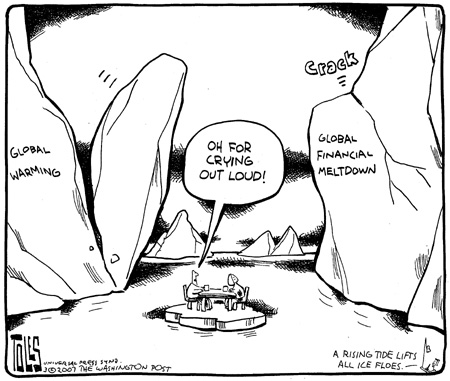
We end 2008 with my cartoon of the year. As I said in a blog post in September 2008: “This cartoon by Pulitzer prize winning Tom Toles first appeared in the Washington Post in 2007 – it brilliantly anticipated the global financial meltdown that we’re now experiencing. Coming in the wake of confirmed global warming, it is a double whammy. Meltdown 2
“The attack on Mumbai by ten highly trained gunmen on the night of Wednesday, November 26, and the drama that followed over the next 60 hours, was physically confined to one corner of a very big city. But it extended its ambit to the rest of the city, the country and the world because of the non-stop media coverage.
“For two days and three nights, television channels gave blanket coverage to the drama around the siege of two hotels, the Taj Mahal Palace and Towers, and the Oberoi and Trident Hotels, as well as Nariman House in Colaba, a synagogue and centre for a Jewish sect. And the entire country watched in horror and fascination.”
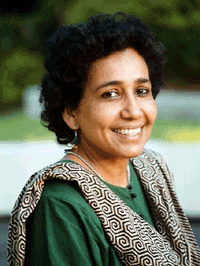
This is how my friend Kalpana Sharma, one of the most respected journalists in India, looks back at the momentous events that took place in her home city of Mumbai from 26 to 30 November 2008. In a thought-provoking analysis published on Tehelka.com, Kalpana assesses 60 hours of continuous media coverage of the Mumbai crisis and notes the significant gaps.
As Mumbai and India recover from the daring attack, the media continue to play the dramatic images over and over. I was in Hyderabad, in southern India (more than 700 km away from Mumbai) for a few days from November 30 and saw this first hand – especially on India’s several dozen 24/7 TV news channels in English and many local languages. Even before arriving in India, I was following the unfolding events on India’s leading English news channel NDTV 24/7 and their website.
Kalpana SharmaI could see that the high adrenaline that every channel and reporter drew on during the 60 hours of drama has now changed into a mix of patriotism, jingoism and an incredible suspension of journalistic ethics and norms. This makes Kalpana’s reflections extremely timely and important.
She is not an armchair critic of the media, and understands the tough challenges that reporters and their gatekeepers face on a daily basis. “When such developments hit a city, it is understandable that there is a time lag before the media, particularly the electronic media, can react,” she acknowledges in her essay, and asks: “The electronic media, in particular, has to ask whether at a time when they were the only source of information for most of the city, and indeed the country, there should have been some restraint placed on information given out.”
I have met some professors of mass communication who have never been inside a news room and well-meaning media activists whose naive idealism makes me laugh. Kalpana, in contrast, counts over three decades of mainstream media experience and retired last year as Deputy Editor of The Hindu newspaper.
Read Kalpana’s full essay here: Unpacking The Pixel
Breaking News 24/7?
Others inside and outside India are also offering critical analysis of media’s role in the siege of Mumbai, or India’s 26/11 as it’s being called. One is by Anjali Deshpande and S K Pande of the Delhi Union of Journalists who have written an interesting commentary in the South Asian mediawatch website, The Hoot.
They acknowledge how “24×7 reporting of terror has indeed been has also been a traumatic experience for our colleagues” and go on to say that “Some of them really did a good job under the circumstances”. But their piece is are less charitable than Kalpana when they say: “If there is one thing the electronic media helped in particular to do in the last three days was to bolster the confidence of terrorists and to give them a sense of achievement far greater than their action may have provided them.”
They note: “The initial role of some of the media was to grab the eyeballs rather than ask questions and reflect all facets of life as they unfold without adding to the tension strife and trauma in such situations. In some cases the ethics evolved over the years was thrown into the dustbin. Add to it all the fact, that when some restraint began more than a touch of jingoism took over.”
They add: “The media behaved as if the country was so terrified it came to a standstill. As if Madhya Pradesh did not go to polls, as if Delhi did not vote, as if a former Prime Minister, V P Singh did not pass away, as if nothing else happened in the country.” Read the full essay in The Hoot: Three Days of Mumbai terror reporting.
There are dozens of other debates underway in the passionately argumentative Indian society, some of which are being conducted in the newspapers, news magazines, on the air and online. One that especially interested me was the role elitism played in how the media covered the siege of Mumbai.
The attacks took place at multiple locations in the heart of Mumbai, which included two leading hotels, a synagogue and Jewish centre and the main train station. But not all attacks lasted as long, and certainly not all of them received equal coverage.
Gnani Sankaran, a writer based in Tamil Nadu, southern India, asks some pertinent questions in a blog post titled Hotel Taj: Icon of whose India? “Watching at least four English news channels surfing from one another during the last 60 hours of terror strike made me feel a terror of another kind. The terror of assaulting one’s mind and sensitivity with cameras, sound bites and non-stop blabbers. All these channels have been trying to manufacture my consent for a big lie called — Hotel Taj the icon of India.
He adds: “It is a matter of great shame that these channels simply did not bother about the other icon that faced the first attack from terrorists – the Chatrapathi Shivaji Terminus (CST) railway station. CST is the true icon of Mumbai. It is through this railway station hundreds of Indians from Uttar Pradesh, Bihar, Rajasthan, West Bengal and Tamilnadu have poured into Mumbai over the years, transforming themselves into Mumbaikars and built the Mumbai of today along with the Marathis and Kolis
Chatrapathi Shivaji (Victoria) Terminus - the true icon of Mumbai
“But the channels would not recognise this. Nor would they recognise the thirty odd dead bodies strewn all over the platform of CST. No Barkha Dutt went there to tell us who they were. But she was at Taj to show us the damaged furniture and reception lobby braving the guards. And the TV cameras did not go to the government-run JJ hospital to find out who those 26 unidentified bodies were. Instead they were again invading the battered Taj to try in vain for a scoop shot of the dead bodies of the Page 3 celebrities.
Gnani Sankaran“In all probability, the unidentified bodies could be those of workers from Bihar and Uttar Pradesh migrating to Mumbai, arriving by train at CST without cell phones and PAN cards to identify them. Even after 60 hours after the CST massacre, no channel has bothered to cover in detail what transpired there.” Read his full blog post: Whose India, whose icon?
He echoes the same point as Gnani Sankaran about the Victoria Terminus being much more iconic than the Taj hotel, and comes to the same conclusion: “I can’t remember the last time that social class so clearly defined the coverage of a public event, or one in which people spoke so unselfconsciously from their class positions. The English news channels became mega-churches in which hotel-going Indians found catharsis and communion. Person after person claimed the Taj as home. Memories of courtship, marriage, celebration, friendship, the quick coffee, the saved-up-for snack, the sneaked lavatory visit, came together to frame the burning Taj in a halo of affection.”
In his closing para, Kesavan also touches on how the foreign media covered the Mumbai attacks: “English and American papers treated the terror attack as an assault on the West. The terrorists had, after all, specifically looked for American and British citizens to murder. Ironically, even as NDTV, CNN-IBN and Times Now put hotel guests at the heart of the horror and bumped train commuters to its periphery, older English-speaking peoples counted their dead and dimly regretted all Indian casualties as collateral damage. In that residual category, if nowhere else, the Indian dead remained one People.”
Another dimension in the media coverage following the Mumbai attacks is how it is affecting the relations between India and Pakistan, both nuclear powers. As The Hindu reported on 1 December 2008: “The escalating tensions between India and Pakistan over the Mumbai attacks have led to the declaration of hostilities in unexpected quarters – Pakistani media has declared a virtual war on Indian media for its ‘knee-jerk’ finger-pointing across the border, and its unquestioning acceptance of the Indian government’s ‘Pakistan-link’ theory.”
Moderate journalists and media-watchers across South Asia are calling for more restraint, self-reflection and plain common sense. On 4 December 2008, Himal Southasian – the independent and outspoken voice of South Asia – ran a special editorial which opened with these words:
“There is an attempt on to generate mass hysteria in India as television channels compete for ratings. The channels are using the Bombay attacks of last week in a dangerous game of TRP-upmanship which can well derail the political process and set back the India-Pakistan peace train. Going far beyond what is required of them even in times of crisis, some media houses are leading campaigns to get citizens to take pledges of patriotism. They are pushing a brittle, monochromatic vision of the resilient country we know as India.”
Beena Sarwar“Media might have brought the people closer but when nationalism rears its head, the beast of 24-hour television news also fuels conflict. This is where the commercial aspect comes in. When something big happens, the public seeks answers. The channels which cater to this need improve their ratings. Sensation sells. With viewers glued to the screens, channels keep them there with a continuous virtual reality show. They fill the time with speculative commentary, ‘expert’ guests and whatever footage is available. Sometimes such footage is repeated ad nauseum — like when the Twin Towers were destroyed on 9/11, when the Marriott hotel was attacked, when the FIA building in Lahore was struck.”
She adds: “Some Indian channels are running the Pakistan factor like a movie trailer, complete with sound effects and watch-for-the-next-episode commentary. This obviously fuels Pakistani indignation. However, this indignation could be tempered by being less reactive and empathising with the Indians’ pain and grief that many Pakistanis share. Zealous commentators could also recall the times that their own media houses sensationalised an issue.
“Journalists may argue that they are just the messenger, reflecting official or public opinion. But the media must also question, and get people to think. The stakes are high in our nuclear-armed countries, in a post-9/11 world where the major players include armed and trained men around the world who subscribe to the ideology of Al Qaeda and the Taliban.”
Ordinary people outside the media industry have also started expressing their concern.
“Media on both sides of the border has stopped reporting and started indulging in senseless rants. The media, particularly in India seems to have thrown logic to the wind,” wrote Anand Bala from Bangalore, in a letter to the South Asian mediawatch website The Hoot. “The screaming for war on the Indian side has reached a din. The media is manufacturing consent for a war and manufacturing consent for the very people who they are blaming – the politicians.”
I would give the last word to Kalpana Sharma: “Media rarely pauses to analyse itself as it hurtles from one breaking story to another. But the Mumbai terror attack shows us that it is essential that reporters be trained to handle such extraordinary situations, that they learn the importance of restraint and cross-checking as at such times the media is the main source of information. Professionalism and accuracy will ensure that we don’t contribute to prejudice and panic.”
Can five unknown Norwegians achieve the worthy goal that has eluded so many leaders and activists – peace within and among nations of our world?
Well, if the individuals happen to be selectors of the world’s most prestigious prize – the Nobel Peace Prize – they stand a better chance than most people. The Norwegian Nobel Committee, appointed by the country’s parliament for six-year terms, may not be very well known beyond their country but their annual selection reverberates around the world and has changed the course of history in the past century.
“It’s the laureates who work tirelessly and sometimes at great personal risk to pursue peace and harmony in their societies or throughout the world,” he told the international advisory council meeting of Fredskorpset, the Norwegian peace corp, held in Oslo on 4 – 5 September 2008. “With the Nobel Peace Prize, we try to recognise, honour and support the most deserving among them.”
Where high profile laureates are concerned, the prize becomes an additional accolade in their already well known credentials. But for those who are less known in the international media or outside their home countries, being awarded the Nobel Peace Prize is akin to being handed over a ‘loud speaker’ — it helps to amplify their causes, struggles and voices, he said.
In today’s media-saturated information society, the value of such an amplifier cannot be overestimated, says Lundestad, who also serves as Secretary to the Nobel Peace Prize selection committee. It allows laureates to rise above the cacophony and babble of the Global Village.
Geir Lundestad, Director, Norwegian Nobel Institute (photo from NRK)
Every year in October, Lundestad makes one of the most eagerly awaited announcements to the world media: the winner of that year’s Nobel Peace Prize. He would typically give a 45 minute advance warning to the laureate – this is the famous ‘call from Oslo’ (and ‘call from Stockholm’ for laureates of other Nobel prizes).
Lundestad, who has held his position since 1990, has had interesting experiences in making this call. For example, the 1995 prize was equally divided between the Pugwash Conferences on Science and World Affairs and Englishman Joseph Rotblat, its founding secretary general, for their efforts to diminish the part played by nuclear arms in international politics. But when he received the call, Rotblat had insisted that it was some sort of mistake; the media had hyped the prospect of then British prime minister John Major winning the prize for his work on Northern Ireland peace process. He went for a long walk and wasn’t home when the world’s media beat a path to his door a short while later.
Such early warning to the laureate does not always happen, especially if the media keeps a vigil at the favourite contender’s home or office. When Al Gore and the UN-IPCC were jointly awarded the 2007 prize, Lundestad rang the New Delhi office of IPCC chairman Dr Rajendra Pachauri shortly before the decision was announced in Oslo. Pretending to be a Norwegian journalist, he asked Pachauri’s secretary whether any media representatives were present. Being told yes, he just hung up.
The Nobel Peace Prize has been awarded to 95 individuals and 20 organizations since it was established in 1901. During this time, the Norwegian Nobel Committee has tried to honour the will of Swedish engineer, chemist and inventor Alfred Nobel. Where the peace prize was concerned, he wrote that it should go “to the person who shall have done the most or the best work for fraternity between nations, for the abolition of standing armies and for the holding and promotion of peace congresses”.
To decide who has done the most to promote peace is a highly political matter, and scarcely a matter of cool scholarly judgement, said Prof Lundestad, who is also one of Norway’s best known historians. He described the thorough selection process and the various checks and balances in place so that the prize does not become, even indirectly, an instrument of Norwegian foreign policy.
Notwithstanding these, the peace prize does not have a perfect record in whom it has selected as well as those it has failed to honour. The most glaring omission of all, he said, was Mahatma Gandhi.
Gandhi was nominated five times – in 1937, 1938, 1939, 1947 and, finally, a few days before he was assassinated in January 1948. The rules of the prize at the time allowed posthumous presentation, but the then committee decided not to (although UN secretary general Dag Hammarskjöld did receive the 1961 prize posthumously after he died in a plane crash). Gandhi’s omission has been publicly regretted by later members of the Nobel Committee; when the Dalai Lama was awarded the Peace Prize in 1989, the chairman of the committee said that this was “in part a tribute to the memory of Mahatma Gandhi”. Read Nobel website’s essay: Mahatma Gandhi: The Missing Laureate
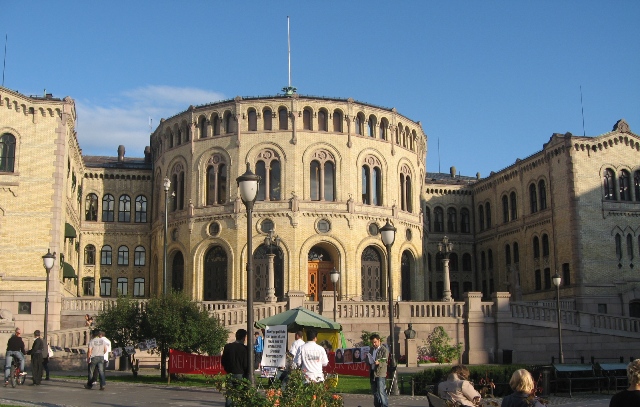
Norwegian Parliament that appoints Nobel Peace Prize Committee
And a few laureates may not have deserved to be so honoured – but Lundestad won’t name any for now (he likes his job and wants to keep it). Perhaps one day, after retirement, he might write a book where this particular insight could be shared.
Controversy has been a regular feature of the prize – both over its selections and exclusions. This is only to be expected when thousands of nominations are received every year, and given the high level political message the selection sends out to the world.
Despite its flaws, there is little argument that the Nobel Peace Prize is the most prestigious of all awards and prizes in the world. At Swedish Krona 10 million, or a little over 1.5 million US Dollars, it isn’t the most lavish prize – but much richer prizes lack the brand recognition this one has achieved over the decades. And it is the best known among over 100 peace prizes in the world.
In recent years, the committee has steadily expanded the scope of the prize to recognise the nexus between peace, human security and environmental degradation (Wangaari Mathaai in 2004; Al Gore and IPCC in 2007) and the link between poverty and peace (Mohammud Yunus, 2006).
The most important question, to many historians and scholars of peace, is the political and social impact of the Nobel Peace Prize. Lundestad is being too modest when he says that it’s the laureates, not the prize itself, that has achieved progress in various spheres ranging from nuclear disarmament and humanitarian intervention to safeguarding human rights and poverty reduction.
“We may have contributed — and that is quite enough,” he says. “We don’t claim to have ended the Cold War, or apartheid in South Africa.”
But the prize’s influence and catalytic effect are indisputable. When the 1983 prize was given to Polish trade union leader Lech Walesa, it triggered a whole series of events that eventually led to the crumbling of the Iron Curtain, collapse of the Berlin Wall and the eventual disintegration of the once mighty Soviet Union. The process culminated when Mikhail Gorbachev became the 1990 laureate. Read Nobel Peace Prize: Revelations from the Soviet Past
In another example, over the years there have been four South African laureates – Albert Lutuli (1960), Bishop Desmond Tutu (1984), Nelson Mandela and F W de Klerk (sharing 1993 prize). Lundestad says: “But we would never claim that the prize was a major factor in ending apartheid in South Africa. The prize was part of the wider international support that built up and sustained pressure on the white minority government. In some respects, the 1960 prize to Lutuli may have been the most significant – for it triggered a process that culminated in the early 1990s.”
He acknowledges, however, that in hot spots like Burma, East Timor and South Africa, the Nobel Peace Prize has enhanced the profile of key political activists and helped maintain the international community’s and media’s interest in these long drawn struggles.
And as Lundestad and the Nobel Peace Prize Committee of five unknown Norwegians know all too well, there is much unfinished business in our troubled and quarrelsome world seeking an elusive peace.
Watch a 2005 interview by University of California television, where host Harry Kreisler talks with Geir Lundestad. They discuss the Nobel Peace Prize, its history, impact and the controversy surrounding some of the awardees (December 2005):
Alexandr Solzhenitsyn: image courtesy New York Times
“For a country to have a great writer … is like having a second government. That’s why no régime has ever loved great writers, only minor ones.”
The great Russian writer Aleksandr Solzhenitsyn, who died 3 August 2008 aged 89, made this remark 40 years ago, in The First Circle(written in the early 1960s, and first published in the West in 1968).
The mighty man, who stood up to one of the most tyrannical states in history – and outlived it by almost 20 years – was buried this week at the Donskoy Monastery, Moscow, as he had wished. That was a far more dignified and respectable departure than what the late, unlamented Soviet Union received when it disintegrated in 1989-90.
From the time his death was reported, post-Soviet Russia, and the rest of the reading and caring world, stood in solemn, grateful silence in awe of the living legend that Solzhenitsyn had become in his own life time. As a small-time writer of no consequence, I join them in my own personal salute.
As every writer – major and minor – who has ever heeded his or her conscience knows, standing up to governments is an extremely hazardous business, especially in a world where might often emerges as right, at least in the short term. In the twenty first century, governments may adopt more subtle methods of suppressing dissent, but their final effect is no less sinister than those brutal ones that Soviet Union followed at the height of the Cold War in the 1950s and 1960s.
I must admit here and now that I haven’t read any of Solzhenitsyn’s celebrated works. But that doesn’t diminish my admiration for him as one of the world’s best known writer-dissidents. Any man who stands up to Big Bad Governments defies all odds, and a man who employs only ideas and words in such a struggle is a greater hero in my mind than anyone else.
A high school teacher of mine, who was a great fan of Solzhenitsyn, once told us: “Never underestimate the power of well written and sincere words.” That was in the mid 1980s, when the writer was living in exile in the United States and the Soviet Union still seemed unshakable. But subsequent events have proved how prophetic those words were.
In a sense, many of us will never quite discover the true Solzhenitsyn. Unless we learn Russian at this stage in life, we can only read Solzhenitsyn through English translations — and as I have discovered this week by browsing widely online for writing by and about him, the quality of these translations vary considerably.
“During all the years until 1961, not only was I convinced that I should never see a single line of mine in print in my lifetime, but, also, I scarcely dared allow any of my close acquaintances to read anything I had written because I feared that this would become known. Finally, at the age of 42, this secret authorship began to wear me down. The most difficult thing of all to bear was that I could not get my works judged by people with literary training. In 1961, after the 22nd Congress of the U.S.S.R. Communist Party and Tvardovsky’s speech at this, I decided to emerge and to offer One Day in the Life of Ivan Denisovich.
“Such an emergence seemed, then, to me, and not without reason, to be very risky because it might lead to the loss of my manuscripts, and to my own destruction. But, on that occasion, things turned out successfully, and after protracted efforts, A.T. Tvardovsky was able to print my novel one year later. The printing of my work was, however, stopped almost immediately and the authorities stopped both my plays and (in 1964) the novel, The First Circle, which, in 1965, was seized together with my papers from the past years. During these months it seemed to me that I had committed an unpardonable mistake by revealing my work prematurely and that because of this I should not be able to carry it to a conclusion.”
Thus, the 1960s was the turning point when hitherto obscure Solzhenitsyn burst into the literary landscape of his native country, and his uncompromising stand against the suffering of his people brought him worldwide attention.
Solzhenitsyn’s open letter to the Fourth Soviet Writers’ Congress, on 16 May 1967, was particularly outspoken and expressive of his views of the social responsibility of writers and artistes: “Literature that is not the breath of contemporary society, that dares not transmit the pains and fears of that society, that does not warn in time against threatening moral and social dangers — such literature does not deserve the name of literature; it is only a façade. Such literature loses the confidence of its own people, and its published works are used as wastepaper instead of being read.”
By then under siege by the entire might of the USSR, and having only his formidable guts and wits as his defence, he already had a strong sense of destiny. In the same open letter, he added: “I am of course confident that I will fulfill my tasks as a writer in all circumstances — from my grave even more successfully and more irrefutably than in my lifetime. No one can bar the road to truth, and to advance its cause I am prepared to accept even death. But may it be that repeated lessons will finally teach us not to stop the writer’s pen during his lifetime? At no time has this ennobled our history.”
Solzhenitsyn’s global stature in the world of letters was reaffirmed in 1970 when he was awarded the Nobel Prize in Literature. But he could not receive the prize personally in Stockholm – he was afraid he would not be allowed back into the Soviet Union. He finally collected his prize only at the 1974 Nobel ceremony after he had been deported from the Soviet Union.
In his Nobel Prize Lecture (delivered to the Swedish Academy but never actually given as a lecture), I came across these words which epitomise the man and his views: “Woe to that nation whose literature is disturbed by the intervention of power. Because that is not just a violation against ‘freedom of print’, it is the closing down of the heart of the nation, a slashing to pieces of its memory. The nation ceases to be mindful of itself, it is deprived of its spiritual unity, and despite a supposedly common language, compatriots suddenly cease to understand one another. Silent generations grow old and die without ever having talked about themselves, either to each other or to their descendants. When writers such as Achmatova and Zamjatin – interred alive throughout their lives – are condemned to create in silence until they die, never hearing the echo of their written words, then that is not only their personal tragedy, but a sorrow to the whole nation, a danger to the whole nation.”
Solzhenitsyn’s writing is studded with such gems that I’ve resolved to discover even if belatedly. After all, I’m now at the exact age (42) when he finally decided to start publishing his work — a monumental personal decision that has left its mark on history.
For now, my favourite Solzhenitsyn quote is one that resonates so well with my own current turmoils in life: “If one is forever cautious, can one remain a human being?”
On World Press Freedom Day 3 May 2008, I wrote a blog post titled Who is Afraid of Citizen Journalists. The answer included the usual suspects: tyrannical governments, corrupt military and business interests, and pretty much everybody else who would like to suppress the free flow of information and public debate.
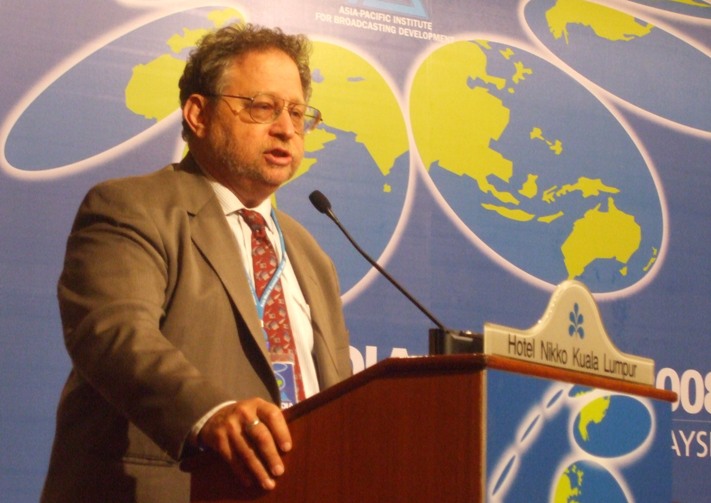
By end May, I realised that some people in the mainstream media (abbreviated MSM, and less charitably called old media or dinonaur media) are also afraid of citizen journalists. That was one insight I drew from attending Asia Media Summit 2008 in Kuala Lumpur, Malaysia (27-28 May 2008).
The two day event drew 530 broadcast CEOs, managing directors, media experts and senior representatives of development and academic institutions from more than 65 countries in Asia, Europe and the Middle East. Over eight plenary sessions and twice as many pre-summit events, they examined ‘new visions and new strategies broadcasters need to pursue to address the demands of new technologies, stiff competition, media liberalization and globalization’.
As I shared in my first impressions from the Summit, this annual event is still warming up to the new media. That’s understandable considering that most participants are those who work in MSM/OM/DM. Some, like myself, have been flirting or experimenting with new media in recent years, but even my own organisation, TVE Asia Pacific, still works largely with television broadcasters going out on terrestrial, cable or satellite platforms.
While the death of MSM/OM/DM has been greatly hyped, it’s a fact that they face more competition today than ever before. And instead of competing for eyeballs (and other sensory organs) with better content and higher levels of product customisation, some sections of MSM/OM/DM are trying to impose their own, obsolete mindset on the new media.
A session on ‘Regulations and New Media Models’ brought this into sharp focus. The session raised questions such as: Should we apply some principles from traditional media (meaning MSM) to the new media? Should we adopt some minimum rules to allow for sufficient legal space for new media businesses to find their niche in the market and evolve to fit the needs of consumers? What are the policy implications of User-Generated Content (UGC) with regard to copyright infringement, information accuracy and content quality?
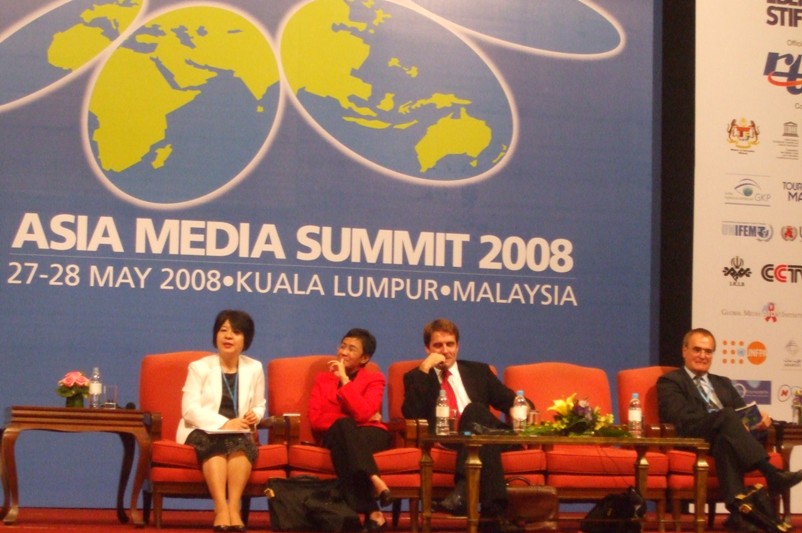
The panel comprised three Europeans and one American, all working in MSM or academia (it wasn’t immediately clear if any of them blogged personally). For the most part, they said predictably nice and kind things about new media. It was interesting to see how these professionals or managers – who have had their careers entirely or mostly working in or studying about MSM – were trying to relate to a new and different sector like the new media.
But the panel’s cautious attitude about the new media went overboard on the matter of regulation. This is where matters are highly contentious and hotly debated: while most of us agree that there should be some basic regulation to ensure cyber security and to keep a check on content that is widely deemed as unacceptable – for example, hate speech – there is no consensus on what content should be regulated by whom under which guiding principles.
Ruling unanimously in Reno v. ACLU, the US Supreme Court declared the Internet to be a free speech zone in 1997, saying it deserved at least as much First Amendment protection as that afforded to books, newspapers and magazines. The government, the Court said, can no more restrict a person’s access to words or images on the Internet than it could be allowed to snatch a book out of a reader’s hands in the library, or cover over a statue of a nude in a museum.
It was during question time that the discussion took a cynical – even hostile – attitude on the new media. Some members of the audience engaged Dr Venkat Iyer, a legal academic from University of Ulster in the UK, in a narrowly focused discussion on how and where bloggers may be sued for the opinions expressed on their blogs. The issue of multiple jurisdictions came up, along with other aspects of cyber libel and how those affected by criticism made online by individual bloggers (as opposed to companies or organisations producing online content) may ‘seek justice’.
From the floor, I remarked that I was disturbed by the tone and narrow vision of this discussion, which merely repeated new media bashing by those who failed to understand its dynamics. Acknowledging the need for restraint where decency and public safety were concerned, I argued that it is a big mistake to analyse the new media from the business models or regulatory frameworks that suit the old media.
There are mischief makers and anti-social elements using the new media just as there have always been such people using the old media. Their presence, which is statistically small, does not warrant a knee-jerk reaction to over-regulate or over-legislate all activity online, as some Summit participants were advocating. To do that would be akin to throwing the baby out with the bathwater.
I continued: “This is not a healthy attitude to adopt, especially when we look at the bigger picture. In many countries where freedom of expression and media freedom are threatened or suppressed by intolerant governments and/or other vested interests, new media platforms have become the only available opportunity for citizens to organise, protest and sustain struggles for safeguarding human rights, better governance and cleaner politics. In countries where the mainstream media outlets are either state owned or under pressure from government (or military), and where newspapers, radio and TV have already been intimidated into silence, citizen journalists are the last line of defence…”
I also noted with interest that on this panel was Mogens Schmidt, UNESCO’s Deputy Assistant Director-General for Communication and Information (in charge of freedom of expression), and said that this was not the kind of rolling back of freedoms of expression that UNESCO was publicly advocating. In a brief response immediately afterwards, Schmidt said that he fully agreed with my views, and that this was UNESCO’s position as well.
Another panel member, Dr Jacob van Kokswijk, secretary of the International Telecom User Group in the Netherlands, noted that the new media required a totally new thinking and approach where its content is concerned – the rules that have worked for the old media can’t be applied in the same manner. He added that only 3 to 4 per cent of Internet content could be considered as ‘bad’ (by whatever definition he was using), and that should not blind us to seizing the potential of new media.
Another panel member, Joaquin F Blaya, a Board member of Radio Free Asia (RFA), made a categorical statement saying he was opposed to any and all forms of censorship. He knows what that means – RFA says its mission is ‘to provide accurate and timely news and information to Asian countries whose governments prohibit access to a free press’.
By the end of the session, I was relieved to see a more balanced view on the new media emerging in our discussion, with more moderate voices taking to the floor. No, we didn’t resolve any of the tough issues of new media regulation during the 90 mins of that session, but we at least agreed that the old media mindset of command-and-control was not going to work in the new media world.
From its inception in 2003, the annual Asia Media Summit has been very slow to come to terms with this reality, but this year the event moved a bit closer to that ideal – partly because they invited leading new media activist Danny Schechter to be a speaker.
The two cities are 2.5 hours and a few thousand kilometres apart, and I just about managed being productive on both fronts. But I don’t recommend the experience: I ended up with a massive sleep deficit that I’m still trying to shake off.
According to the summit organisers, some 530 CEOs, managing directors, media experts and senior representatives of development and academic institutions from 65 countries joined the two-day event and 16 pre- Summit workshops.
The Summit had its moments — a few ‘Aha!’ ones and quite a few others where I found myself nodding (bored out of my mind, and not in agreement with what was going on). Unlike last year, when I chaired part of a pre-Summit seminar and also served as a plenary speaker, I was merely participating this year — which gave me the chance to network, take things easy and ask more questions from the audience.
Of the five Summits held since 2004, I’ve attended four (I missed the first one). The scope, content and quality of this annual event have certainly improved in this time. But I find the Summit still very much a gathering of the movers and shakers in the mainstream media, primarily radio and TV (which dominate the Asian media landscape). Very few new media practitioners – individual bloggers like myself, as well as online audio/video publishers and operators of web portals – turn up at this event.
And the Summit discussions in the past have sometimes been decidedly cynical or dismissive of new media. When this happened in the opening plenary itself at Asia Media Summit 2007, I was so disappointed that I asked if I was actually attending the Asia ‘Mediasaurus’ Summit.
Things could only get better this year – and they did. For one thing, they had invited new media practitioners to speak of their chaotic new world (unlike last time, when we heard fossilised old media worthies pontificate fuzzily on the new media). Perhaps this was the organisers heeding our critique of last year. Or it had something to do with the rise and rise of bloggers in the host country Malaysia: the March 2008 general election there saw five active bloggers being elected to national Parliament from the opposition in the biggest political upheaval Malaysia had seen in half a century.
For this reason, we were looking forward to the Summit’s opening by Malaysian Prime Minister Abdullah Ahmad Badawi, but for the second year running, he decided to skip the event. Instead, he sent his deputy Mohd Najib Tun Abdul Razak in his place to read his speech.
As Malaysia’s pro-government New Straits Times newspaper reported the next day, he urged journalists not to be too taken in by the “bells and whistles of technology”, but to hold to established virtues of accuracy, intelligence, fairness and grit as these formed the competitive advantage of the traditional press in the “anarchic environment of the new age”.
He added: “The right to freedom of speech and expression cannot be used as a pretext or excuse to violate and abuse the reputation and dignity of a people, to slander and libel or to defame religions or religious symbols. If this were the case, there would be no laws of defamation or libel and laws against those who incite racial or ethnic violence.”
DPM Najib and Schechter had very different views on the limits of freedom of speech and how far the new media can and should be allowed to comment on current affairs, especially politics. On the wider issue of human rights, Najib took the populist line and made references to America’s detention camps in Guantanamo Bay and the CIA outsourcing torture. Danny shot back saying that only 20% of the American people now support their president and his policies (and Danny certainly wasn’t one of them). He argued that human rights should be universal. Read Danny’s take on it here, and the more official version in the New Straits Times.
With that slightly bumpy start, AMS 2008 went on to display the mainstream media’s still uneasy relationship with the new media. For sure, the Summit had sessions on user-generated content and new media business models. But for the most part, these sessions brought out the narrow perspective of mainstream media’s managers or its long-standing researchers. With notable exceptions like Danny Schechter, other speakers talked about a fast-changing, rapidly-evolving reality that they’d barely skimmed or experienced themselves.
I would belatedly write more blog posts on some of the discussions that took place in later sessions, which prompted me to intervene several times from the audience.
Today, May 3, is World Press Freedom Day. Proclaimed by the UN General Assembly in 1993, the day is celebrated each year on May 3 — the anniversary of the Declaration of Windhoek, a statement of free press principles put together by African newspaper journalists in 1991.
I’m holed up in a hotel in Singapore this whole weekend, attending the annual Board meeting of Panos South Asia, which works to promote greater public discussion and debate on development issues through the media. Our Board is drawn from Bangladesh, India, Nepal, Pakistan and Sri Lanka and includes leading journalists, publishers and social activists.
I’ve been busy preparing for and attending the intensive Board meeting that I’ve not had the time to do an original blog post on this important day. So like any resourceful journalist, I’m doing the second best thing – ‘recycling’ some material that I was recently associated with in producing.
First, here’s an extract from a chapter that I invited Sri Lankan ICT activist Sanjana Hattotuwa to write for Communicating Disasters: An Asia Pacific Resource Bookthat I edited last year. Sanjana traces the growing role played by digitally empowered citizens while disasters unfold as well as after disasters have struck. He then turns attention to the wider and more generic challenges faced by citizen journalists everywhere, especially in countries where democracy is under siege:
Who’s Afraid of Citizen Journalists?
But is it all good and positive? Put another way, merely because we now have access to a hundred times more content on a disaster than before does not mean that we get any closer to understanding it or responding to it.
Information overload is a real problem, as is the subjectivity of citizens, who only capture what they feel is important and often ignore aspects to a disaster beyond their own comfort zone and prejudices. There is still no widely accepted standard for citizen journalists, though organizations such as the Centre for Citizen Media are actively working towards such standards .
There are other challenges associated with citizen journalism, especially in a context of violent conflict. This author receives vicious hate mail, suffers public insults, is branded a ‘terrorist’ and even receives the occasional death threat – all because of the content he promotes on the citizen journalism websites he edits.
Not all citizens, even when they can do so and have access to digital devices, record disasters or human rights abuses – especially when their own security could be compromised for having done so. Governments can also clamp down hard on citizen journalism. The French Constitutional Council approved a law in early 2007 that criminalizes the filming or broadcasting of acts of violence by people other than professional journalists. The law could lead to the imprisonment of eyewitnesses who film acts of police violence, or operators of Web sites publishing the images. Sri Lanka unofficially banned a pro-Tamil nationalist website in 2007 and regularly cuts off mobile phone and Internet services in the North and East of the country.
Scared by the potential for embarrassment, political debacles and popular uprisings, countries such as Egypt, Iran, Cuba, North Korea and China vigorously censor and monitor content on blogs and exchanges through SMS, prompting Julien Pain, head of the Internet freedom desk at Reporters Without Borders (RSF) to note: “… all authoritarian regimes are now working to censor the Web, even countries in sub-Saharan Africa. The Ethiopian regime of Prime Minister Meles Zenawi has blocked openly critical Web sites and blogs since May 2006, and President Robert Mugabe of Zimbabwe is considering a law allowing security forces to intercept online messages without reference to the courts. One of the first moves by Thailand’s military rulers after their September (2006) coup was to censor news Web sites, even foreign ones, that criticized the takeover.”
The second extract is from my own recent essay under the above title, which was published by the Asia Media website managed by the University of California Los Angeles (UCLA). In this piece, written only a few weeks ago, I comment on a disturbing new threat to media freedom in my native Sri Lanka: misguided citizen vigilantes suspecting and attacking professional journalists engaging in their legitimate news and/or image gathering work in public places. When accredited journalists are affected by this paranoia, I point out how much more difficult it is for citizen journalists who lack the institutionalised media behind them.
Public interest blogging in Sri Lanka has been growing slowly but steadily since the Indian Ocean tsunami of December 2004, which marked a turning point for citizen journalism. According to researcher and new media activist Sanjana Hattotuwa, citizen journalists are increasingly playing a major role in meaningfully reporting deaths, the humanitarian fallout and hidden social costs of violent conflict that are often glossed over or sensationalised by the mainstream media.
Hattotuwa acknowledges, however, that the ready availability of information and communication technologies (ICTs) does not guarantee public-spirited citizen journalism.
“In Sri Lanka, the significant deterioration of democracy in 2006-2007 has resulted in a country where anxiety and fear overwhelm a sense of civic duty to bear witness to so much of what is wrong. No amount of mobile phones and PCs is going to magically erase this deep rooted fear of harm for speaking one’s mind out,” says Hattotuwa.
This makes the courage and persistence of the few citizen journalists even more remarkable. Unlike mainstream journalists, they lack official accreditation, trade unions and pressure groups to safeguard their interests. The state does not recognize bloggers as journalists; despite their growing influence online, most local news websites don’t enjoy any formal status either.
For now, the citizen journalist in Sri Lanka is very much a loner — and very vulnerable.
I have nothing against reality television. It’s a TV programming format that, according to Wikipedia, presents purportedly unscripted dramatic or humorous situations, documents actual events, and features ordinary people instead of professional actors.
In fact, I’ve been telling my friends who are factual film-makers that we can learn a thing or two from the recent successes of some reality TV shows.
But everything has its sane limits — and evidently these were exceeded in the recent controversy involving a British TV production company that stands accused of starting a ‘flu epidemic that left four people from a tribe of isolated Peruvian Indians dead and others seriously ill.
Matt Currington (in photo above, on the right), a London-based documentary maker, has been blamed for triggering a “mini-epidemic” in the village of 250 people which led to the deaths of three children and one adult of the Matsigenka people, who live in the isolated Amazonian Cumerjali area of south-eastern Peru.
The 38-year-old was employed by Cicada Films as researcher when he travelled to the area with a guide last year to scout for locations for the World’s Lost Tribes series, which airs on the Discovery Channel.
Here are some extracts from the story that appeared in The Guardian newspaper in the UK on 27 March 2008, written by its environment correspondent John Vidal:
The regional Indian rights organisation Fenama, government officials and a US anthropologist working in the region said in statements seen by the Guardian that a two-person crew working for London-based Cicada Films had visited groups of isolated Indian communities despite being warned not to. Fenama said the film team travelled far upriver and provoked an epidemic. It accused them of threatening the lives of Indians and called for Cicada Films to be barred from entering the area again.
It is understood the company was scouting for a location to set a TV show for Mark Anstice and Olly Steeds, in which the two British presenters would live with a remote tribe, in exchange for gifts. The company has already filmed episodes in New Guinea.
According to the Peruvian government’s protected areas department, Cicada was given a permit to visit only the community of Yomybato. It expressly prohibited visits to uncontacted or recently contacted Indians. “The Cicada team entered [remote headwaters] which are part of the strictly protected zone,” it said.
The American anthropologist, Glenn Shepard, who met the film team on location, said he had urged them not to make the trip to the Cumerjali settlements, “where people were vulnerable to western illnesses”. “Reality tv seeks ever more dangerous, remote and exotic locales and communities,” he said.
According to Survival International, Cicada Films previously caused controversy with a documentary about an expedition to visit Indians in Ecuador, which allegedly provoked an attack from uncontacted Waorani Indians.
But Cicada is certainly not alone when it comes to exploiting marginalised people in the global South in the course of film-making. And reality TV is not the only format of TV film making that often oversteps the ethical boundaries in search of a ‘good story’.
As I have been saying for sometime now, documentary film-makers and TV news gathering crews are equally guilty of many excesses, lapses and gross abuses all perpetrated in the name of media freedom. Aug 2007 blog: Wanted – Ethical sourcing of international TV News
Nor is this sinister trend entirely new. I opened a September 2007 blog post with this bizarre request: “Can you help us to film a child’s leg being broken?” This was made by a visiting Canadian TV crew in the 1970s to my friend Darryl D’Monte, one of the most senior journalists in India and former editor of the Times of India.
This was in connection with a brutal practice that was believed to exist in India, so that forcefully maimed children could be employed as beggars. When Darryl was outraged, the film crew had shrugged off saying: “It’s going to happen anyway”.
Film-makers and TV journalists roam the planet exercising their license to protect and promote the people’s right to know, and in the public interest. But this privileged position is grossly abused when they allow the end to justify their highly questionable means.
Commenting on TV’s latest crime against voiceless people, India’s Down to Earth magazine (30 April 2008 issue) says:
“These forays of reality tv perpetuate an imagery conceived by a 19th century alliance of anthropologers and photographers, that of tribals in their “innocent” state. It’s another matter these images were taken after the tribal groups were ravaged by colonialism.
“Today in the era of digital images when computer games mimic real wars, it might be hard for even the most naive eye to believe what it sees. But tv casts an enormous sway over audience perception and digitization has, in fact, aided it. We know of the images, not the circumstances in which they were taken. We believe them though they might be contrived. That’s why reality tv is dangerous.”

















 Open Minds!