In the environment and development circles, all the roads these days seem to lead to Copenhagen.
That’s because the Danish capital will be hosting the 15th conference of parties (COP15) of the UN Framework Convention on Climate Change, or UN-FCCC from 7 to 18 December 2009.
All sorts of campaigns are underway to raise awareness and build up consensus — a tough call when nations of the world are bickering endlessly as the planet warms up.
Now, CNN and YouTube have created Raise Your Voice campaign: it allows your voice to be amplified to the world leaders at COP15 – the most important climate change conference in a decade.
Here’s the blurb: As nations seek an agreement to protect the world we want your views from across the spectrum.
What needs to be done?
How do the issues affect you?
Do you agree there needs to be action?
There is a breathtaking short video now on YouTube supporting this call:
Click here to send a video with your views, opinions and questions. The best contributions will be aired during the COP15 CNN/YouTube TV debate on December 15.
Whatever we might think about the artistic and technical merits of his climate film An Inconvenient Truth, it has settled with a resounding ‘yes’ one question: can a single film make a difference in tipping public opinion about a matter of global importance?
But the climate crisis that confronts us is so formidable that we need many more Al Gores to come up with as many moving images creations as they can.
Their call out for all climate films says: “This December thousands of delegates, decision makers, stakeholders and activists will converge on Copenhagen. To be part of this EngageMedia is putting together a compilation of Asia-Pacific climate films to be screened and distributed at the event and around the world. Submit your film to EngageMedia and be part of the action. Global action is urgent and essential – the time for debate is over.”
TVE Asia Pacific, already a partner on EngageMedia platform, is submitting all its recently produced climate change films.
Do they have a story to tell? Who is listening?Piracy has a chequered history, and even the Wikipedia offers a carefully qualified definition. One person’s pirate can be another person’s defender. There’s an argument that the European colonial powers rode on the backs of their pirates or buccaneers. And I’m writing this in English language possibly because the English were more successful in their overseas piracy than other nations!
Piracy is all over the news again, due to increased activity off Somalia. But in the past few weeks, we’ve started hearing another side of the Somali piracy story — one that the mainstream media didn’t tell us.
Johann Hari, a columnist for the London Independent, posted an op ed in Huffington Post on 13 April 2009 that took a different look at Somali pirates. His main argument: “In 1991, the government of Somalia – in the Horn of Africa – collapsed. Its nine million people have been teetering on starvation ever since – and many of the ugliest forces in the Western world have seen this as a great opportunity to steal the country’s food supply and dump our nuclear waste in their seas.”
In recent days, two interesting short videos have been posted by two activist groups to support the same point of view. I haven’t investigated this story myself, but am intrigued by their take on a widely reported topic…especially because it’s an angle that we don’t read or see in the mainstream media!
This film from Awareness Unfolds highlights the fact that the media is lying about the so called “pirates” of Somolia. According to the blurb: “They (media) choose not to tell you about the toxic waste dumping going on by American, European, and Asian countries that have lead to the death of many Somolian citizens.”
As Johann Hari says at the end of his article: “The story of the 2009 war on piracy was best summarised by another pirate, who lived and died in the fourth century BC. He was captured and brought to Alexander the Great, who demanded to know “what he meant by keeping possession of the sea.” The pirate smiled, and responded: “What you mean by seizing the whole earth; but because I do it with a petty ship, I am called a robber, while you, who do it with a great fleet, are called emperor.” Once again, our great imperial fleets sail in today – but who is the robber?”
Johann Hari has reported from Iraq, Israel/Palestine, the Congo, the Central African Republic, Venezuela, Peru and the US, and his journalism has appeared in publications all over the world. In 2007 Amnesty International named him Newspaper Journalist of the Year. In 2008 he became the youngest person ever to win Britain’s leading award for political writing, the Orwell Prize.
In January 2008, I wrote about two short videos made by Pradip Saha and colleagues at the Centre for Science and Environment (CSE) in India on the auto industry’s contribution to worsening traffic congestion, air pollution and public health in metropolitan India.
Now Pradip & Co have come out with another revealing short video. It answers a simple question: of the various types of motorised transport on our roads, which one emits the most carbon dioxide per person that slowly but surely bakes our planet?
Their blurb says:
Watch video to find out who wins in this race to emit more. A blue graph will appear shortly on your screen. Do not be alarmed. It is an attempt to illustrate the Carbon each of us emits while traveling to work everyday.
This short video reminds of what we can do with broadband-enabled online video to raise awareness and catalyse discussion on matters of public interest. I haven’t specifically asked Pradip about this, but it seems like a low-cost, quick-turnaround effort. It’s certainly effective in making a single, important point that has far-reaching policy and practical implications.
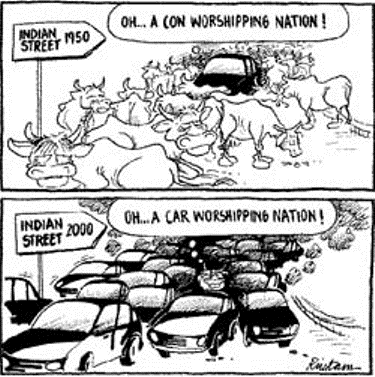
What a difference half a century makes: cartoon courtesy CSE India The big question is: who is listening in modern India that has turned itself into a car-worshipping nation?
Talking to the last drop: All streams flow to Istanbul?
The 5th World Water Forum opens in Istanbul, Turkey, today. It will be held in the historic city – a bridge between the east and west – from 16 to 22 March 2009.
Held every three years, the World Water Forum is the main water-related event in the world. It seeks to put water firmly on the international agenda with a view to fostering collaboration – not confrontation – in sharing and caring for the world’s finite supplies of the life-giving liquid. The forums bring together officials, researchers, activists and media to a few days in which they can drown in their own cacophony…well, almost.
I haven’t been to one of these mega-events – I almost did in 2003, when it was hosted by Kyoto, Japan. That forum was almost entirely eclipsed – as far as the media coverage was concerned – by the United States deciding to invade Iraq during the same week. This inspired me to write an op ed essay on oil, water and media which was syndicated by Panos Features and widely reproduced at the time in newspapers, magazines and even in a few activist and development publications. But six years later, it’s hard to locate it online, so I’m publishing it here, unedited, exactly as I wrote in that eventful week in mid March 2003:
Oil on water: will the media get this Big Story?
By Nalaka Gunawardene: 20 March 2003
“If the wars of this century were fought over oil, the wars of the next century will be fought over water.” Ismail Serageldin, an eminent Egyptian architect and planner, made this remark in 1995 when he was vice president for sustainable development at the World Bank.
Well, we are in that new century now, but old habits die hard. The war in Iraq has been fuelled by oil interests, and – starting at the time it did, on March 20 –effectively sidelined global talks to secure freshwater for all.
Clean water, anyone?Even as the United States launched its attack on the country that sits on the world’s second largest oil reserve, the Third World Water Forum was in progress at the Japanese cities of Kyoto, Shiga and Osaka. The event, running from March 16 to 23, is this year’s biggest international conference on a sustainable development issue and involved hundreds of government and civil society representatives trying to resolve one of the major survival issues of our time: equitably sharing the world’s finite freshwater resources for our homes, farms and factories.
The two processes cannot be more different. One aims to use force while the other seeks to foster co-operation among nations to cope with water scarcity. The increasingly isolated United States has abandoned the United Nations process in its single-minded determination to disarm Iraq, a nation it considers a major threat to peace and security. Meanwhile in Kyoto, the nations of the world – including, but not led by, the United States – were discussing an issue that is far more central to humanity’s security. It has the full blessings of the UN, which has designated 2003 the International Year of Freshwater.
Yet the water forum seems hardly newsworthy to the major news organisations that are preoccupied with war. For months, the global television networks were gearing up for Iraq war coverage. The first Gulf War helped globalise CNN, and this time around, there are other international and regional channels competing for the eye balls. Locked in a battle for dominant market share, CNN International and BBC World are trying to outdo each other in covering the conflict exhaustively — and to the exclusion of everything else. In the do-or-die media marketplace, ‘soft issues’ such as water are easily edged over by conflict. As cynical news editors will confirm, if it bleeds, it leads.
The notions of national and global ‘security’ – on which the Iraq war is being waged – are relics of the Cold War that are completely out of sync with today’s global realities. Who says we have entered the 21st century?
In the closing decade of the last century, as the world grappled with one crisis after another – ranging from famine and drought to global warming and HIV/AIDS – the notion of ‘security’ was radically redefined to include ecological and social dimensions. What is now termed ‘human security’ is concerned not so much with weapons as with basic human dignity and survival. As first articulated in the UN Development Programme’s Human Development Report in 1994, human security includes safety from chronic threats such as hunger, disease and repression, as well as protection from sudden and harmful disruptions in the patterns of daily life.
Mahbub ul HaqThe rationale for this was brilliantly summed up by the late Mahbub ul Haq, former Finance Minister of Pakistan and architect of the Human Development Index: “If people are sleeping on pavements, ministers have no business shopping for modern jets and howitzers. While children suffocate in windowless classrooms, generals go about in their air-conditioned jeeps. Nations might accumulate all the weaponry they want, but they have no strength when their people starve…”
A world in which four out of every ten people live in areas of water scarcity is not secure. And if urgent action is not taken, this will increase to two thirds of humanity by 2005. Ensuring water quality is as important as basic access: preventable diarrhoeal diseases – including cholera and dysentery — kill more than seven million children every year. That is 6,000 deaths every day.
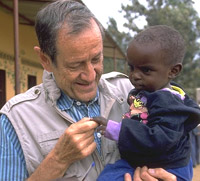
James P GrantJames Grant, former executive director of UNICEF, once used a powerful metaphor to describe this scandalous situation: it was as if several jumbo jets full of children were crashing everyday – and nobody took any notice.
If the media are obsessed with death and destruction, why aren’t these numbers registering on their radars? Why is it that silent emergencies forever remain ignored or are only superficially covered? Even statistics don’t set the media agenda: for example, according to the UN, twice as many people are still dying from diarrhoeal diseases as from HIV/AIDS in China, India and Indonesia. But the international donors and media assign far more importance to HIV than to clean water.
No other factor can distort reality as oil. Oil comes on top of water both in the physical world, and in the murky world of global politics. Our collective dependence on petroleum immediately ensures the Iraq war a disproportionately high rank in public and media concerns.
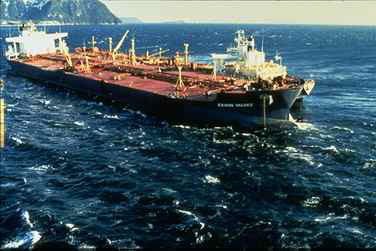
It’s not just the United States that is addicted to oil – we all are. Addicts tend to lose sight of the cost of their dependence, as we have. On 24 March 1989, the oil tanker Exxon Valdez ran aground on in Prince William Sound in Alaska and a fifth of its 1.2 million barrels of oil spilled into the sea, causing massive damage to over 3,800 km of shoreline. Investigations implicated its captain for grossly neglecting duty. Shortly afterwards, Greenpeace ran a major advertising campaign with the headline: “It wasn’t his driving that caused the Alaskan oil spill. It was yours.”
Exxon Valdez: Drunken driving!Greenpeace continued: “It would be easy to blame the Valdez oil spill on one man. Or one company. Or even one industry. Too easy. Because the truth is, the spill was caused by a nation drunk on oil. And a government asleep at the wheel.”
A nation drunk on oil is waging a war that has more to do with oil than anything else. Our news media are behaving just like cheer-leaders.
War is undoubtedly a big story. But so should be water. One in six humans does not have safe drinking water, and one third of humankind lacks adequate sanitation. We may be living on the Blue Planet, but the waters are muddy and life-threatening to billions.
For sure, a bunch of people huddling together in three Japanese cities won’t solve this crisis overnight. But unless knowledge and skills are shared, and a political commitment is secured, safe water for all will forever remain a pipe dream.
Will it take a full-scale war over water in one of the flashpoints around the world for the military-industrial-media complex take sufficient interest in this survival issue? (That might happen sooner than we suspect.)
It’s ironic that the World Water Forum was undermined by the Iraq war breaking out in the very same week. Washington has now poured oil over everybody’s water.
[Nalaka Gunawardene is an award-winning Sri Lankan science writer, journalist and columnist. He heads TVE Asia Pacific, a regional media organisation working on sustainable development issues, and is on the board of Panos South Asia. The views expressed here are his own.]
For me, it was more than a fascinating journey to far corners of our endangered planet in the company of the world’s best known broadcaster, and Britain’s most trusted public figure. I recalled how in this very venue, as an eager teenager growing up in the simpler, pre-web days of the 1980s, I watched his pioneering series Life on Earth (1979) and The Living Planet (1984). These path-breaking series redefined how natural history documentaries were made, and inspired a whole new generation of film-makers and nature lovers. A quarter century later, I’m still hooked.
Over the last 25 years, Attenborough has established himself as the world’s leading natural history programme maker with more landmark series: The Trials of Life (1990), The Private Life of Plants (1995), The Life of Birds (1998), The Life of Mammals (2002) and Life in the Undergrowth (2005). The final chapter in the ‘Life’ series is Life in Cold Blood (2008).
As fellow broadcaster Jeremy Paxman noted in a Time magazine tribute to Attenborough: “Life After Death is almost the only natural-history series yet to be made by Attenborough. In a career that has taken him to every corner of the world, he has explored life in all its richness — from mammals and birds to plants and reptiles. No living person has done more to make the people of Planet Earth aware of the world around them.”
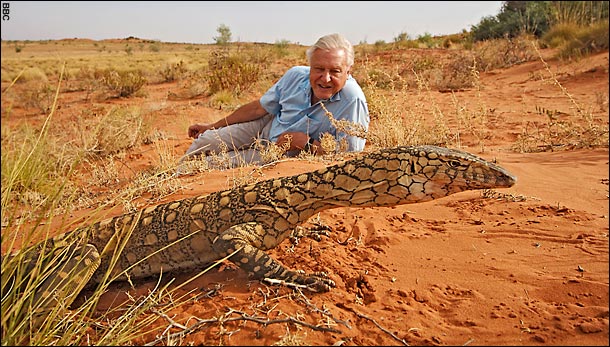
Close encounters?But as I wrote in May 2007, “like all creatures big and small in the great Circle of Life that Sir David has so avidly told us about, he too is mortal. At 81, it’s time for the world to look for the next David Attenborough.”
In his Time tribute, Paxman noted that what distinguishes Attenborough is “that boundless, schoolboyish enthusiasm, the infectious joy of discovering the infinite variety of life”. Yet as the popular song goes, dragons live forever, but not so little boys – so the quest for the next Attenborough has quietly preoccupied the minds of many practising or following the world of natural history and environmental film making.
I’m not obsessed with this question (and I wish Sir David many more years of life on Earth and life on the airwaves), but I today popped it to Jeremy Bristow, a producer of environmental programmes at BBC Television, at the end of his fascinating master class on The role of films in Environmental Conservation. Jeremy’s most recent project has been two films hard-hitting films on Climate Change with Sir David Attenborough for BBC1 and the Discovery Channel.
The bad news is that despite searching far and wide – even some competitions – the David Attenborough has yet to be discovered.
“There are many talented, passionate natural history film makers and some of them also have good screen presence — but none to match Sir David,” said Jeremy Bristow. “I know many in the natural history film world have kept their eyes open for a potential successor.”
Perhaps Sir David is a unique product of his time and circumstances, Jeremy speculated. Certainly, there weren’t too many getting into this business in the early days of television broadcasting. The first major programme series to feature Sir David was BBC’s Zooquest, which ran from 1954 to 1963. And then, one thing led to another…and more than 50 years later, he’s still in the business.
To me, it’s the voice – authoritative without at all being pompous or pontificating – that gives Sir David enduring and endearing appeal. Time called it ‘the voice of the environment’.
Now is the time when that voice of reason, moderation and passion is needed more than ever. A time when the natural world is under siege from human-induced accelerated climate change even as the world of science takes daily beatings from assorted fundamentalist forces.
At 82, Sir David still remains not just our most versatile ambassador to the natural world, but also one of the best spokespersons for the rigors of science and intellectual curiosity.
Here’s a recent example of Sir David – taking us on a quick, animated guide to evolution of life on Earth, in a 2009 documentary called Charles Darwin and the Tree of Lifeto mark 150 years since Charles Darwin published his famous Origin of the Species:
As I wrote at the time: “The few of us thus became the first outsiders to see the film which I found both deeply moving and very ironic. With minimal narration, he allows the local people to tell their own story. There’s only one expert who quickly explains just what is going on in this particularly weather-prone part of the world.”
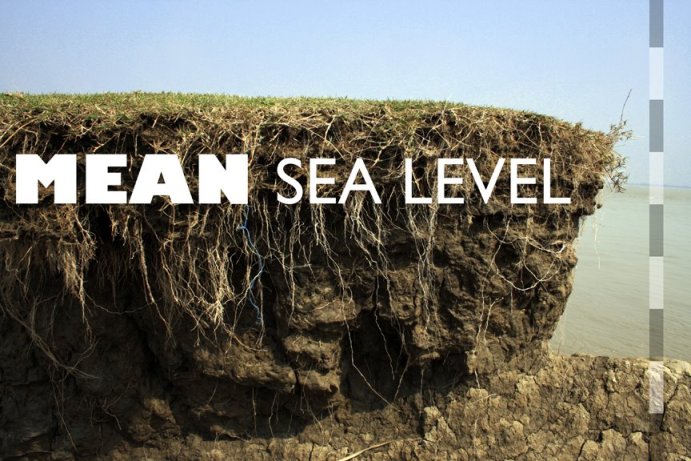
The world’s rich are having a party, and millions living in poverty are the ones footing the bill. This is the premise of the film, which looks at the impact of climate change on the inhabitants of Ghoramara and Sagar islands in the the Sundarban delta region in the Bay of Bengal.
Almost 7,000 inhabitants have been forced to leave Ghoramara in the last 30 years, as the island has become half in size. The biggest island, Sagar which hosted refugees from other islands all these years is witnessing massive erosion now. 70,000 people in the 9 sea-facing islands are at the edge of losing land in next 15 years. For these people climate change is real.
As the sea level rises and takes with it homes and livelihoods in the delta, the villagers of Sagar are paying a hefty price for a problem that they did not create. Meanwhile, middle class India and the political elite are becoming aware of the problem of global warming, but prefer to look the other way.
I’m glad to note that the film is now being screened to various audiences and making ripples. By showing people – including those still not convinced about climate change – what sea level rise is already doing to poor people, the film is stretching the limits of debate and focusing attention on the need to act, not just talk.
It’s also creating ripples in environmental and/or human rights activist circles where all too often, passionate discussions don’t go very far beyond the rhetoric to bring in the real world voices and testimonies. Pradip’s film accomplishes this with authenticity and empathy yet, mercifully, without the shrill and overdose of analysis found in activist-made films. It powerfully and elegantly tells one of the biggest stories of our times.
Pradip SahaIn November 2008, Pradip showed and talked about his film at a screening organised by SACREDMEDIACOW (SMC), an independent postgraduate collective on Indian media research and production (and much more) at the School of Oriental and African Studies (SOAS) at the University of London. Before it started, Pradip told his audience to ‘forget that this is a documentary about climate change’ and just watch.
As one member of his audience, Sophia Furber, later wrote: “The film’s approach to climate change is completely non-didactic. Mean Sea Level is no acronym-fest sermon or disaster story, but an intimate portrait of a way of life which is on the verge of going underwater.”
In his day job as editor of Down to Earth magazine, published from India with a global outlook, Pradip excels in wading through the (rapidly expanding) sea of jargon and acronyms surrounding many topics related to science, environment and development. In typical style, his recently started blog is named alphabet soup @ climate dinner.
Read Sophia Furber’s account of SOAS screening in London
The more Pradip shares his film, the more people who notice the irony that I experienced in Tokyo. A short review by the Campaign against Climate Change says: “There is a greater irony. These poor people got nothing out of the economy that created climate change, nor do they contribute to global warming. Mean Sea Level is a testimony of reckless political economy of our times. Climate change is real, and only a sign of our recklessness.”
Last heard, Pradip was planning to screen MEAN Sea Level on Sagar Island so that the story’s participants can see the film for themselves. The idea was to power the event entirely through renewable energy sources, such as solar power.
I hope he will soon place his film – or at least highlights/extracts – online on YouTube or another video sharing platform. This film is too important to be confined to film festivals and public screenings. Whether it would also be broadcast on television in India and elsewhere, we’ll just have to wait and see. I won’t hold my breath on that one…
Death has no sense of timing, but it sometimes leaves traces of irony. The day Americans were electing an energetic and articulate senator from Chicago as their next president, one of Chicago’s most celebrated citizens lost his battle with cancer.
Michael Crichton, who died on 4 November 2008, was trained as a medical doctor but played several roles in the creative arts world. He was a prolific author of science fiction and medical fiction, whose books have sold over 150 million copies worldwide. He also produced and directed techno-thriller movies, and was the creator of the highly successful medical drama series on television, ER (Emergency Room), now in its 15th season.
In the domain of popular culture, Crichton was best known for writing Jurassic Park (1990). This cautionary tale on unrestrained biological tinkering was turned into a blockbuster movie by Steven Spielberg in 1993. It became the highest earning film up until that time.
Before and since, Crichton used his technical training, vivid imagination and mastery of English to spin some of the most enjoyable – and scary – stories that often depicted scientific advancements going awry, resulting in the worst-case scenarios. A notable recurring theme in Crichton’s plots is the pathological failure of complex systems and their safeguards, whether biological (Jurassic Park), military/organizational (The Andromeda Strain), technical (Airframe) or cybernetic (Westworld).
Crichton was also a talented essayist who wrote perceptive pieces of non-fiction about science, society and culture – including the role of media. It is one such essay that I would like to recall in his memory.
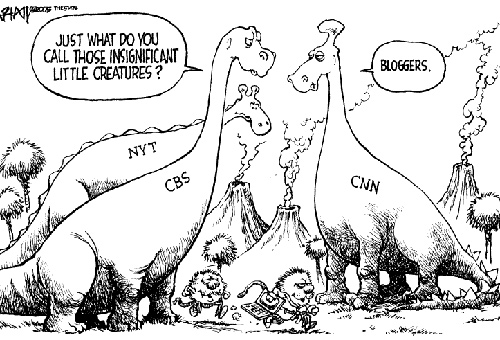
The media world was very different when, in 1993, Crichton riled the news business with an essay titled “Mediasaurus“. In this essay, written for the newly launched Wired magazine, he prophesied the death of the mass media — specifically the New York Times and the American commercial TV networks.
“To my mind, it is likely that what we now understand as the mass media will be gone within ten years. Vanished, without a trace,” he wrote.
Building on his credentials as the author of a best-seller on dinosaurs, Crichton called this endangered beast ‘mediasaurus’.
Mediasaurus - courtesy Slate He added: “There has been evidence of impending extinction for a long time. We all know statistics about the decline in newspaper readers and network television viewers. The polls show increasingly negative public attitudes toward the press – and with good reason.”
He talked about technological advances — “artificial intelligence agents roaming the databases, downloading stuff I am interested in, and assembling for me a front page” — that would drive the mediasaurus to their inevitable doom.
Only those nimble, adaptable media products would survive, he said, noting that CNN and C-SPAN were steps in the right direction, giving viewers direct access to events as they happen.
But he had no sympathy for the media. “The media are an industry, and their product is information. And along with many other American industries, the American media produce a product of very poor quality. Its information is not reliable, it has too much chrome and glitz, its doors rattle, it breaks down almost immediately, and it’s sold without warranty. It’s flashy but it’s basically junk. So people have begun to stop buying it.”
Like most people who dabble in the imperfect art of foreseeing the future, Crichton got the trend right but the timing somewhat wrong. The mainstream media (MSM) were indeed on the decline but not at the dramatic rate that he envisaged.
In February 2002, Jack Shafer wrote a piece in the online magazine Slate titled “Who You Calling Mediasaurus?” Its subtitle was: “The New York Times dodges Michael Crichton’s death sentence”. It asked and tried an answer the question: Where did Crichton go wrong?
Shafer wrote: “Fables of the near future have a way of never materializing, whether they be fevered dreams of nuclear energy too cheap to meter or fossil fuels too expensive to burn. To be fair, Crichton wasn’t the only one to get puking drunk on the new media moonshine. Many of us spent a lost weekend—sometimes months—in a stupor after reading early issues of Wired. But instead of blotting out conventional media, the emerging Infotopia seems only to have made the conventional media more ubiquitous.”
Shafer asked: “Who would have predicted in 1993 that America’s great dailies (minus the Wall Street Journal) and the news networks would dodge both extinction and irrelevance by erecting Web sites overnight and giving their content away? That they would use their Web sites to keep us informed 24-hours-a-day in a way that we take for granted today but that would have astonished us nine years ago?”
In an email interview with Shafer at the time, Crichton acknowledged his own limitations: “I don’t have a lot invested in whether my predictions are right or wrong; I assume that nobody can predict the future well. But in this particular case, I doubt I’m wrong, it’s just too early.”
In that interview, Crichton said he wished he had foreseen “the effect of big media conglomerates combined with the universal decision to make news into entertainment. It’s all headlines and chat now. Factual content is way down, accuracy has vanished (it’s not even a goal any longer), and public confidence in media is at an astonishing low. Not surprisingly, audiences are shrinking.”
Crichton admitted at the time that the personalized ‘infotopia’ he envisioned in 1993 had yet to arrive. He scoffed at the Web for being too slow. “Its page metaphor, too limiting. Design, awful. Excessive hypertexting, too distracting. Noise-to-signal ratio, too high.”
Who succeeds mediasaurus?Now fast-forward to May 2008. The same Jack Shafer, once again writing in Slate, published a piece titled “Michael Crichton, Vindicated”. It was introduced as: “His 1993 prediction of mass-media extinction now looks on target”.
In this essay, Shafer wrote: “As we pass his prediction’s 15-year anniversary, I’ve got to declare advantage Crichton. Rot afflicts the newspaper industry, which is shedding staff, circulation, and revenues. It’s gotten so bad in newspaperville that some people want Google to buy the Times and run it as a charity! Evening news viewership continues to evaporate, and while the mass media aren’t going extinct tomorrow, Crichton’s original observations about the media future now ring more true than false. Ask any journalist.”
Read Jack Shafer’s full interview with Michael Crichton in Slate, May 2008
Revealed: the weapon that killed MediasaurusBy this time, Crichton was more positive about the web. He noted that the Web has “made it far easier for the inquisitive to find unmediated information, such as congressional hearings.” It’s much faster than it used to be, and more of its pages are professionally assembled.
Crichton suggested that readers and viewers could more objectively measure the quality of the news they consume by pulling themselves “out of the narcotizing flow of what passes for daily news.” Look at a newspaper from last month or a news broadcast.
“Look at how many stories are unsourced or have unnamed sources. Look at how many stories are about what ‘may’ or ‘might’ or ‘could’ happen,” he said. “Might and could means the story is speculation. Framing as I described means the story is opinion. And opinion is not factual content.”
He summed it up with something we already know: “The biggest change is that contemporary media has shifted from fact to opinion and speculation.”
It was interesting to note how mainstream media outlets paid tributes to Crichton this week. He was remembered for the entertaining story teller he truly was, and some even questioned his mixed legacy, for example being an ardent skeptic of global warming – thus batting for the fossil fuel cartels even if only inadvertently.
But I could find few references to his perceptive critique of the mass media.
Who says media likes to turn the spotlight on itself?
Al Gore used to have a reputation as a very smart man who was very stiff and aloof especially in his public speaking.
I didn’t notice this the only time I listened to him in person, at an environmental journalists conference at MIT in Boston, Massachusetts, in the Fall of 1995. Perhaps because he was speaking to a group of over 200 journalists, Gore was especially charming. He delivered a well prepared speech passionately, and then took a dozen questions.
I still remember one incident during question time. A Bangladeshi participant lined up to ask him something and started addressing him as ‘Mr President’. Gore smilingly interjected: ‘Not yet!’. The journalist, not the least shaken by his slip of the tongue, said: ‘Well, I hope you will be one day!’.
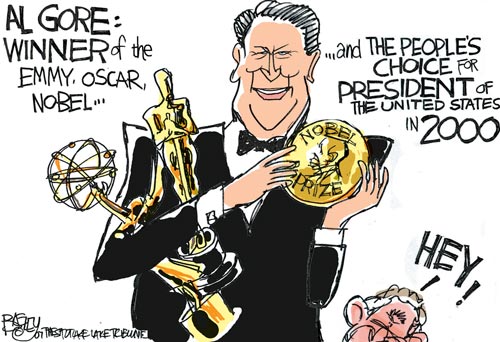
All that sounds so long ago, now that Gore has emerged as the world’s best known climate crusader. There are many who feel that he is more effective in his current role than as a politician.
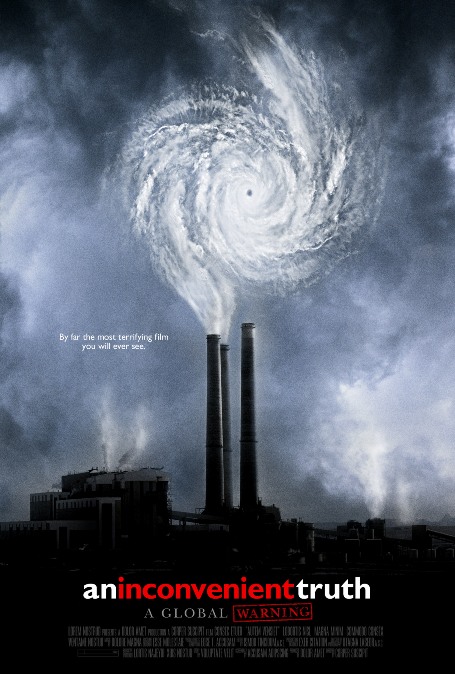
His 2006 film, An Inconvenient Truth, helped move the climate change debate forward in a decisive manner.
Whatever we might think about the film’s artistic and technical merits, I’m glad it has settled one question: can a single film make a difference in tipping public opinion about a matter of global importance?
The answer, where climate change is concerned, is a resounding yes!
For sure, the film arrived at a time when the climate change debate had been going on for nearly two decades. Scientific evidence was mounting for human responsibility for accelerated changes in our climate. Political and business leaders, in denial for years, were finally beginning to take note — perhaps sensing votes or dollars.
Official film posterComing in at the time it did — in the Summer of 2006 –- Al Gore’s film tipped the public opinion to agree that climate change was for real and responses were urgently needed.
“It is now clear that we face a deepening global climate crisis that requires us to act boldly, quickly and wisely,” says the former US Vice President introducing his film.
An Inconvenient Truth focuses on Al Gore and his travels in support of his efforts to educate the public about the severity of the climate crisis. Gore says, “I’ve been trying to tell this story for a long time and I feel as if I’ve failed to get the message across.”
The film closely follows a Keynote presentation (dubbed “the slide show”) that Gore presented throughout the world. It intersperses Gore’s exploration of data and predictions regarding climate change and its potential for disaster with Gore’s life story.
An Inconvenient Truth is not a particularly stunning or dramatic documentary. Some have called it a ‘dramatised PowerPoint presentation’ (although Gore actually uses Apple’s Keynote presentation software). There aren’t cuddly animals, deadly chemicals, forest infernos or gory animal hunts that make environmental films appeal to a mass audience.
In fact, it hangs together — and sustains for nearly an hour and a half — due to the sheer star power of Al Gore. And when we take a closer look, we see how hard Gore and his team at Participant Productions have tried to engage audiences.
The film, made on a budget of around US$1 million (modest by Hollywood standards) went on to earn US$49 million at the box office worldwide. As at late 2008, it ranks as the fourth-highest-grossing documentary film in the United States, after Fahrenheit 9/11, March of the Penguins and Sicko.
I first saw An Inconvenient Truth at a cinema in Virginia, USA, while it was still on its initial theatrical release in the Fall of 2006. I reviewed it in early 2007, and recently returned to discussing the film during a presentation I made to our Asia Pacific regional workshop on changing climate and moving images, held in Tokyo in early October 2008.
My thrust was: now that Al Gore and his film have helped turn the climate debate, how can we continue to use moving images in search of solutions? In other words, how do we stand on the shoulders of Al Gore?
The Great Warming: Another excellent film on climate change
I looked back at Gore’s film and another excellent Canadian film that came out the same year, The Great Warming. Discussing their merits, I noted how both films appeal as much to our emotions as they do to our rational intellect. “Facts, figures and analysis alone cannot engage a diverse, sometimes sceptical or indifferent audience. That’s why they try a different approach: appealing to the emotions.”
Here are some excerpts from my remarks:
We often see environmental documentaries failing to engage audiences because they pack too much information, or worse, preach too heavily and directly. Some film-makers feel strongly that they must ‘inform and educate’ their viewers at all costs.
To engage people, both are neededIt’s story telling that works best with moving images –- and what better stories to tell than the personalised ones of real people dealing with real world problems and challenges?
With ‘moving images, moving people’ as our slogan, we at TVE Asia Pacific believe in the power of well-made films to reach out to people’s hearts and minds.
Our experience shows that moving images can indeed move people, but only when:
• They are used in the right context;
• They form part of a bigger effort or campaign;
• Audio-visual’s strengths are maximised; and
• Audio-visuals limitations are properly recognised.
It’s the combination of broadcast and narrowcast spheres that has a better chance of changing people’s attitudes and, ultimately, their behaviour.
The global climate is indeed changing, but not everyone is equally affected by it – or bothered about it either. Take, for example, the majority of India’s 300 million+ middle class, which is roughly the size of the entire population of the United States.
According to environmental activist and independent film-maker Pradip Saha, it’s not a question of ignorance, but apathy.
“Our educated middle classes understand what’s happening, but they are also big contributors to the problem – with their frenzy to burn oil and coal. They look for any excuses for not acting on this issue,” Pradip said during a recent regional workshop in Tokyo, Japan.
Pradip, associate director of the Centre for Science and Environment – a leading research and advocacy organisation – has been tracking climate change issues for two decades. He sees this Big Issue in three ways: science of climate change, politics of climate change and feelings of climate change.
To fully understand how the complex Indian society perceives and responds to the climate crisis, all three dimensions need to be studied, he says. And particular attention must be paid to the plight of those who are already experiencing changes in their local climate.
From the Himalayan mountains to the small islands in the Bay of Bengal, millions of Indians are living and coping with climate change. “Large sections of our poor feel it, and are among the worse impacted.”
Many such affected people may never have heard of climate change. They are bewildered by rapid changes in rainfall, river flows, sunshine and other natural phenomena.
Pradip drew an example from the Sundarban delta region in the Bay of Bengal. With 10,000 square kilometres of estuarine mangrove forest and 102 islands, it is the world’s largest delta. Here, some islands are slowly being eroded and submerged by rising sea levels. Three small islands have already gone underwater. Others are experiencing problems of salt water intrusion, posing major difficulties for the local people.
Sundarban delta as seen from space
Analysis of surface data near Sagar island in the Sundarbans reveals a temperature increase of 0.9 degree celsius per year. Experts are of the opinion that this is one of the first regions bearing the brunt of climate change.
But the islanders – like most other poor people in India – don’t have enough or any voice to express their concerns to the policy makers, civil society groups and captains of industry. For these members of the middle class, the Sundarbans mean just one thing: the Royal Bengal Tiger.
And most of them probably have never heard of Sagar island. They might just shrug it off, saying: It’s Not In My Backyard (NIMBY).
During the past few months, Pradip has been filming on these islands trying to capture the unfolding human and environmental crisis. He was inspired by an investigative story that appeared in early 2008 in the Down to Earth science and environmental magazine where he is managing editor.
Pradip screened the 64-minute long film, aptly titled Mean Sea Level, at our workshop. The few of us thus became the first outsiders to see the film which I found both deeply moving and very ironic. With minimal narration, he allows the local people to tell their own story. There’s only one expert who quickly explains just what is going on in this particularly weather-prone part of the world.
Confronted with middle class apathy and indifference, activists and journalists like Pradip Saha face an uphill task. “Knowledge is not turning into action because those who know (about climate change causes and responses) are also the biggest culprits,” he says.
To make matters worse, government policies are not formulated with adequate public consultations. Sections of central and state governments in India have also started responding to individual effects of climate change without understanding the bigger picture. Such piecemeal solutions can do more harm than good.
Pradip’s views on climate change activism in India resonates with those of the Filipino academic-activist Walden Bello. Speaking at the Greenaccord international media forum in Rome in November 2007, he called for a mass movement at the grassroots across the developing countries of the global South to deal with climate change – the biggest environmental threat faced by the planet today.
As I quoted him saying, such a movement might be unpopular not only with the Southern elite but also with sections of the urban-based middle class sectors that have been the main beneficiaries of the high-growth economic strategy that has been pursued since the early 1990s.










 Open Minds!