Communicating disasters on film: Experts, please don’t cross this line!

Global Platform bannerExperts should let film-makers produce professional films in simple terms that are more appropriate for public audiences, instead of trying to produce films that have little chance of being broadcast or distributed in other ways. There is a role for technical experts – but that’s not in the crafting and directing of films, but in providing the knowledge, clarifications and guidance to film-makers and journalists who are professionals in communicating complex issues to non-specialist publics.

Self-evident as it may be, these home truths are well worth reiterating every now and then — especially to experts and officials who keep forgetting them (sometimes with disastrous and expensive results!). So I was very glad to read that these points were emphatically made at a ‘film debate’ held in Geneva last week.

The occasion was a panel discussion, ambitiously titled ‘The role of film-makers in promoting climate change adaptation and disaster risk reduction stories’. It was held on 17 June 2009 as part of the Second Session of the Global Platform for Disaster Risk Reduction in Geneva.

Moderated by the well known journalist, writer and producer Edward Girardet, from Media21, Geneva, it involved five panelists drawn from media/communication sector and the disaster/humanitarian sectors. Among the panelists was my colleague Robert Lamb, director of One Planet Pictures, UK, and consultant producer with dev.tv, Switzerland.

The debate’s premise was simple: So far much of the thrust of the film industry, NGOs, UN organizations and media in portraying disasters and climate change has focused on outcome – which is more visually stimulating – rather than showcasing vital prevention and adaptation solutions. This is necessary, but not sufficient. What can be done to improve the interaction between the film/news industry and leading organizations dealing with disaster risk management and climate change adaptation on a daily basis?
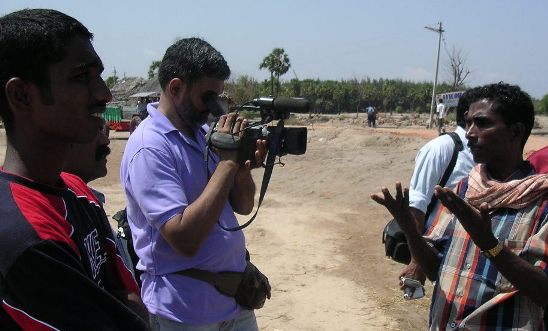
Interviewing tsunami survivor in Tamil Nadu, India - image from TVEAP
This was similar to the approach we had in TVE Asia Pacific’s Communicating Disasters project in Asia (2006-2007). We too explored the common ground for these two sectors, with their distinctive needs, and asked how the two can support each other without stepping on each others’ toes.

The same discussion continued in Geneva. I’ve limited information on what actually transpired during the debate, and am hoping someone will soon write it up. For now, here’s a summary adapted from UN-ISDR daily coverage (the official language is theirs, not mine):

“More than 150 participants attended a thought-provoking film debate. The five panelists discussed how to enhance the interaction between the film/news industry and leading organizations dealing with climate change adaptation (CCA) and disaster management to increase CCA visibility which is very limited today in film productions.

“Eight short films were presented during the session, among them a short trailer of ‘An Inconvenient Truth’ and a CCA film shot in Burkina Faso produced by Christian Aid. After identifying a number of challenges due to their formats and audiences, film-makers and experts agreed it was important to work more closely to make more films on the solutions offered by CCA.

“Film-makers suggested that experts should let them produce professional films in simple terms that are more appropriate to their audiences and focus on bringing expert knowledge to enrich the content of their current productions instead of producing films that have little chance to be broadcast or distributed.”

All this reminds me of a discussion we had around an earlier blog post where I asked: Anyone can make video film, right? So why do we need professionals?
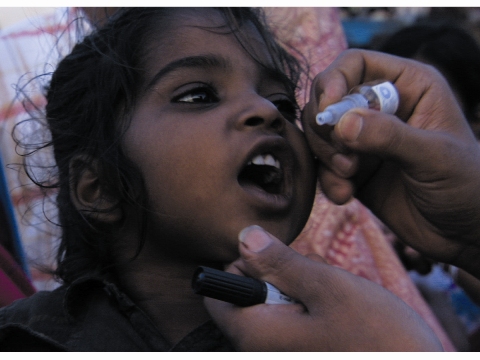
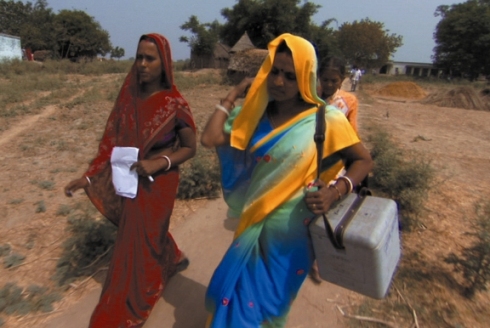
‘The Final Inch’: Real ‘Oscar’ would be polio’s global eradication!

Not longer just a drop in the ocean...
No longer just a drop in the ocean..?
The Final Inch didn’t win the Oscar for the best short documentary film made in 2008. But the nomination has given a boost to the film and its cause: even before its official release in April 2009, it is already raising global awareness on the major public health challenge of banishing polio from the planet.

The Final Inch is a testament of the health workers around the world laboring to make polio the second globally eliminated disease behind small pox, says director Irene Taylor Brodsky.

The 37-minute film, due to air on HBO on 1 April 2009, looks at the “the final stages of a 20 year initiative” to eradicate polio. It focuses the polio vaccine efforts in India and Pakistan, which are among the last four countries where polio is still endemic (the other two being Afghanistan and Nigeria).

Watch the trailer for The Final Inch:

The campaign to eradicate polio is now 21 years old. World Health Organisation (WHO), UNICEF and Rotary Foundation embarked on this campaign in earnest in 1988, and as a young (and equally earnest) science journalist, I remember writing about its early strategies, goals and targets. But the virus has proven to be a lot more stubborn than originally expected.

Well, the campaign has scored remarkable victories, and a little over 1,600 people in the world were stricken by polio in 2008. (AIDS and malaria, in contrast, killed more than three million people.) Compare that with 350,000 cases per year when the global onslaught started, and we see there has indeed been progress.

But the virus – and the crippling disease it causes – persists in several poor, densely populated countries in Asia and Africa. Updates are available from Global Polio Eradication Initiative.

Thus it’s the ‘last inch’ – or last mile, if you like – that’s proving the hardest to traverse. In a perceptive essay published in Newsweek in January 2009, Fred Guterl noted: “It’s not easy to wipe a disease off the face of the planet—especially one like polio, which spreads easily and quickly through contact and occasionally through contaminated food and water. Only one in 200 children who contract the virus shows symptoms (usually paralysis), which makes the other 199 silent carriers.”

It’s not just biology that polio eradicators are up against. Indeed, human superstition and religious dogma have made the final inch particularly contentious and treacherous for public health workers.

In 2005, TVE Asia Pacific started distributing a global documentary on immunisation called Fragile Lives: Immunization at Risk. It showed how at least 2 million children die every year from diseases that that vaccination could easily prevent.

Foot soldiers of the largest non-military army in history engaged in its final battle
At one point, the film takes us to Uttar Pradesh, in northern India, to show how polio, eradicated in most of the world, stubbornly persists in a few countries. This very poor state with its 272 million inhabitants had two thirds of the world’s polio. We talk to the glamorous young cricketer, Mohamed Kaif, who helps publicise a massive campaign to get every single child to the vaccination booths. The film discovers the strange reason behind why so many Muslim parents refuse to have their children vaccinated.

The Final Inch features the heroic efforts of Munzareen Fatima, a field worker in Meerut, Uttar Pradesh, who is a part of UNICEF’s Social Mobilisation Network for ensuring vaccination coverage. She reaches out to her target group through personal and public intervention programmes.

As she told IANS: “It has been a tough journey for me over the last five years to convince 470 families at Dufferin block in Khairnagar to administer polio drops to their children. I met with resistance from the families, who initially refused to immunise their children. The conservative community also belittled me for stepping out of home to campaign against polio.”

India is not alone. If anything, misplaced resistance to polio vaccination has been stronger in Pakistan. As IPS reported in August 2006, the country’s drive against polio was hit by both rumours and litigation.

The news story, filed by Ashfaq Yusufzai in Peshawar, noted: “The reliability and safety of oral polio vaccine (OPV) has been put under scrutiny in Pakistan after wild rumours that it causes impotency snowballed into a writ petition in a high court.”

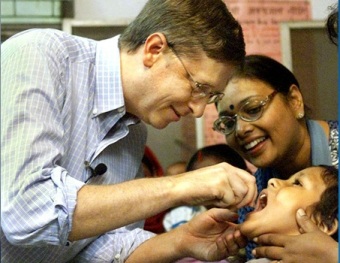
Bill Gates: geek power and bucks to battle polio...
Religion-inspired superstitions have often stood in the way of achieving sufficient vaccination coverage, leaving room for viruses to spread again. Religious leaders sometimes strengthen the hand of those making pseudoscientific claims, says South African science writer George Claassen. Writing in SciDev.Net in April 2008, he noted: “Attempts to eliminate polio in Nigeria, for example, ran into problems when Datti Ahmed, the chair of the Supreme Council for Sharia in Kano state, referred to the Global Polio Eradication Initiative as ‘modern-day Hitlers… who have deliberately adulterated the oral polio vaccines with antifertility drugs and contaminated them with certain viruses which are known to cause HIV and AIDS.'”

This brings up an interesting scenario of virus vs. virus. Richard Dawkins, the well known British evolutionary biologist and writer, has called religion the most malevolent form of a ‘mind virus’. According to Dawkins, faith − belief that is not based on evidence − is one of the world’s great evils. He claims it to be analogous to the smallpox virus, though more difficult to eradicate.

Of course, the mistrust of vaccines is not just limited to the developing world, nor is it always inspired by religion or superstition. Sometimes over-protective moms can be just as irrational. Fragile Lives, for example, took us to Dublin, Ireland, where there have been two serious outbreaks of measles – largely due to mothers rejecting vaccination because of the MMR controversy. In some parts of Ireland only 60% instead of the necessary 95%, have been vaccinated.

Sharing archives: Will broadcasters (finally) put planet before profit?

I have long wondered if both radio and TV broadcasters store their archival material in black holes – into which everything disappears and nothing ever comes out. And certainly, nothing is shared with anyone else.

In a widely reproduced and commented op ed essay written for SciDev.Net in November 2008, titled Planet before profit for climate change films, I noted:
“It isn’t just climate-related films that are locked up with copyright restrictions. Every year, hundreds of television programmes or video films — many supported by public, corporate or philanthropic funds — are made on a variety of development and conservation topics.

“These are typically aired once, twice or at best a few times and then relegated to a shelf somewhere. A few may be released on DVD or adapted for online use. But the majority goes into archival ‘black holes’, from where they might never emerge again. Yet most of these films have a long shelf life and could serve multiple secondary uses outside the broadcast industry.”

Escape from the Southern 'black hole'?
Well, it seems things are changing, albeit very slowly. Last month, we welcomed the announcement from Al Jazeera sharing their news footage online through a Creative Commons license — the first time that video footage produced by a news broadcaster is released for commercial and non-commercial use.

Now comes the news that Australia’s public broadcaster ABC is releasing selected content from its vast archives for non-commercial use by others. And we must thank Charles Darwin for that.

On 12 February 2009, to celebrate Charles Darwin’s 200th birthday, ABC started releasing some archival materials, all based loosely around the theme of evolution and mutation. This Australian first was achieved through ABC’s collaborative media site, Pool.

In an imaginatively named effort called Gene Pool, ABC started off with a recording from its archives of genetics professor Steve Jones talking about Darwin’s life and work.

The next offering to Gene Pool would be a clip from ABC’s Monday Conference in 1971 featuring Stanford entomologist Paul Ehrlich talking about climate change (yes, it’s from 38 years ago!).

These materials are being released under the Creative Commons 3.0 licence allowing people to reuse or remix them in any way they like — as long as it’s for non-commercial use.

On Gene Pool website, ABC said: “You can also create your own work exploring the themes of evolution and mutation in lateral ways, and share them back into the Gene Pool.”

A framework for sharing...
As Creative Commons Australia explained: “This means that people can tweak, twist and remix the files to create their own creative interpretation of the themes of evolution and mutation, and share these results with the rest of the world. The idea is to build a whole community up around the project, remixing and reusing the ABC archival material in new and previously unthought of ways. This all culminates in a public exhibition of Gene Pool pieces at Melbourne’s RMIT on November 24th – the 150th anniversary of the publication of Darwin’s book The Origin of Species.”

They added: “Just imagine what gems might be hidden away in ABC filing cabinets, waiting to be discovered and put to good use by the population that payed for them in the first place.”

That’s precisely what I’ve been saying for a long time – the taxpayer-funded broadcasters like BBC, NHK or ABC (and their equivalents in other countries) have no moral right to lock away their archives on legal or technical grounds. And to think that some of the content thus held up could actually help us in winning history’s eternal race between education and catastrophe!

Nothing escapes this one...for now
Nothing escapes from this one...for now
The BBC – hailed as a model public broadcaster worldwide – is among the worst offenders on this count. It holds one of the largest archives on environment, natural history and wildlife filmed all over the planet for several decades, yet it stubbornly refuses to share this material with anyone, even when it’s only for strict non-commercial, educational use. Read one example in my July 2007 blog post, The Lawyers who locked up the Butterfly Tree.

This myopic selfishness is contrasted (and put to shame) by exceptional film-makers like Richard Brock (who worked with BBC Natural History Unit for 35 years before leaving it unhappy over its rights management) who have decided to open up their personal video archives for non-commercial use especially in the majority world where such material is in short supply.

We can only hope that ABC’s move would build up pressure on the stubborn old Auntie BBC to finally relent. In fact, this might be a chance for all those public broadcasters – many of them now ‘Aunties without eyeballs’ – to redeem themselves at last, ending decades of copyrights tyranny. (And if that puts their inhouse lawyers out of a job, they can join greedy bankers now lining up for public forgiveness!)

ABC says about its tentative steps to the world of open archives: “It’s a small offering to start but there’ll be a lot more to come. We’re working madly behind the scenes getting clearance to release more more more.”

Watch this space…and keep an eye on that Gene Pool!

Shooting wildlife or wild-life: Environmental film-makers’ dilemma

Speaking of wild-life to a mild audience....
Speaking of wild-life to a mild audience....Photo by Niroshan Fernando, TVEAP

The Wildscreen film festival got underway at the British Council Colombo this morning.

The keynote address was delivered by Sri Lankan minister of environment and natural resources. The British Council asked me to speak a few words at the opening as TVE Asia Pacific is a local partner for this event.

Here’s what I said, which sums up why we are in this business:

We are delighted to be partners in hosting Wildscreen film festival in Sri Lanka. We thank our friends at the British Council and Wildscreen festival for this opportunity to join hands.

May I say a brief word about ourselves. We’re Television for Education Asia Pacific — trading as TVE Asia Pacific. We’re a regionally operating media foundation anchored in Colombo and engaging developing countries of Asia. We were set up in 1996 by a group of Asian and European filmmakers and TV professionals to cover the full range of development issues using broadcast television, narrowcast video and now, the web.

We are driven by a belief that what is happening in the world’s largest and most populous region has far-reaching implications not just for our region — but also for the entire planet.

When introducing our work, I like to recall the words of Mahatma Gandhi. Once, when asked by a visiting foreign journalist for his views on wildlife in India, he said: “Sadly, wildlife is declining in our jungles, but wild – life is increasing in our cities.”

It is precisely this wild–life that interests us more. In our work we keep asking: when life itself is going wild, what hope and prospects are there for wildlife, Nature and environment?

For example, we’ve literally just finished a short film looking at environmental restoration of Afghanistan. This will be screened to the environmental minister from around the world who will gather shortly for the UN Environment Programme’s Governing Council meeting in Nairobi.

We can't just walk into a glorious sunset and forget real world challenges - Photo by Niroshan Fernando, TVEAP

Capturing wild-life is now the focus and concern of wildlife and environmental film makers everywhere. There was a time, not too long ago, when films used to simply capture the beauty of Nature and the diversity or behaviour of plants and animals. Such documentation is still very necessary and useful — but it’s no longer sufficient.

In the past couple of decades, all film makers have been challenged to look at how our own ‘wild’ ways of living affects:
– each other in our own human species;
– the rest of Nature and other species; and
– also, the future of life on Earth.

We see this transformation reflected in the content of films entering Wildscreen and other film festivals. I saw early signs of this when I served as a juror at Wildscreen 2000 festival. This process has gathered momentum since.

To remain relevant and topical, films can no longer just cover ‘green’ subjects — they have to acknowledge the ‘brown’ issues as well as the harsh black-and-white, life-or-death concerns such as climate change.

At the same time, we have seen a rapid diversification of formats or genres — especially with the emergence of online and mobile platforms. These now compete with broadcast television to engage audiences. This is both good news and bad news for us engaged in film making and film outreach. Yes, we now have more ways of reaching people than ever before. But engaging audiences is harder: people have more choice — and more distractions!

Of course, we can’t just give up the good struggle and walk away into those beautiful sunsets. At TVE Asia Pacific, we believe that making good films is only half the job done. Distributing them far and wide is just as important. This is why the slogan of our own organisation is: Moving images, moving people!

In that process, film festivals such as this one play a key role. We’re very happy to add an extra day of screenings to this event. On Saturday in this auditorium, we’ll be showing a number of films on climate change and sustainable development drawn from our own catalogue of films we distribute to broadcast, civil society and educational users across Asia.

These are small efforts in a big world. I can only hope all these help us in winning history’s greatest race – which, according to H G Wells, is one between education and catastrophe!

MEAN Sea Level: An ironic film from the frontline of climate change

What does sea level rise mean to you and me?
In October 2008, while attending an Asian regional workshop on moving images and changing climate in Tokyo, I had the chance to see Indian writer and film-maker Pradip Saha‘s latest film, MEAN Sea Level.

As I wrote at the time: “The few of us thus became the first outsiders to see the film which I found both deeply moving and very ironic. With minimal narration, he allows the local people to tell their own story. There’s only one expert who quickly explains just what is going on in this particularly weather-prone part of the world.”

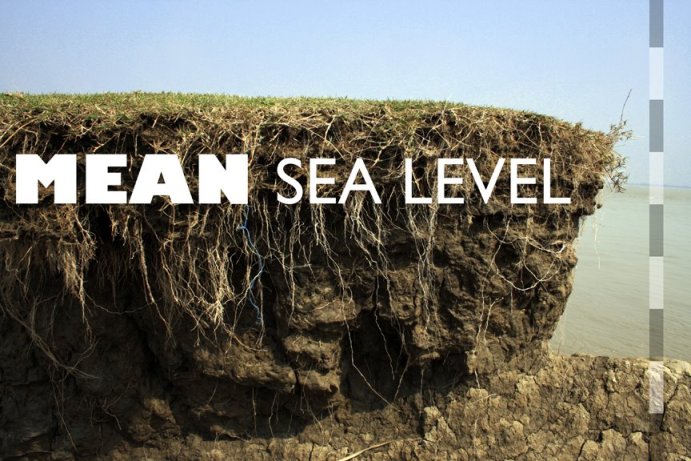
The world’s rich are having a party, and millions living in poverty are the ones footing the bill. This is the premise of the film, which looks at the impact of climate change on the inhabitants of Ghoramara and Sagar islands in the the Sundarban delta region in the Bay of Bengal.

Almost 7,000 inhabitants have been forced to leave Ghoramara in the last 30 years, as the island has become half in size. The biggest island, Sagar which hosted refugees from other islands all these years is witnessing massive erosion now. 70,000 people in the 9 sea-facing islands are at the edge of losing land in next 15 years. For these people climate change is real.

As the sea level rises and takes with it homes and livelihoods in the delta, the villagers of Sagar are paying a hefty price for a problem that they did not create. Meanwhile, middle class India and the political elite are becoming aware of the problem of global warming, but prefer to look the other way.

I’m glad to note that the film is now being screened to various audiences and making ripples. By showing people – including those still not convinced about climate change – what sea level rise is already doing to poor people, the film is stretching the limits of debate and focusing attention on the need to act, not just talk.

It’s also creating ripples in environmental and/or human rights activist circles where all too often, passionate discussions don’t go very far beyond the rhetoric to bring in the real world voices and testimonies. Pradip’s film accomplishes this with authenticity and empathy yet, mercifully, without the shrill and overdose of analysis found in activist-made films. It powerfully and elegantly tells one of the biggest stories of our times.

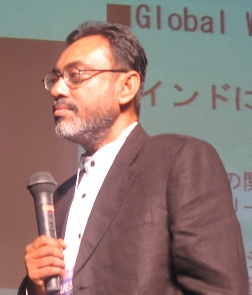
Pradip Saha
Pradip Saha
In November 2008, Pradip showed and talked about his film at a screening organised by SACREDMEDIACOW (SMC), an independent postgraduate collective on Indian media research and production (and much more) at the School of Oriental and African Studies (SOAS) at the University of London. Before it started, Pradip told his audience to ‘forget that this is a documentary about climate change’ and just watch.

As one member of his audience, Sophia Furber, later wrote: “The film’s approach to climate change is completely non-didactic. Mean Sea Level is no acronym-fest sermon or disaster story, but an intimate portrait of a way of life which is on the verge of going underwater.”

In his day job as editor of Down to Earth magazine, published from India with a global outlook, Pradip excels in wading through the (rapidly expanding) sea of jargon and acronyms surrounding many topics related to science, environment and development. In typical style, his recently started blog is named alphabet soup @ climate dinner.

Read Sophia Furber’s account of SOAS screening in London

The more Pradip shares his film, the more people who notice the irony that I experienced in Tokyo. A short review by the Campaign against Climate Change says: “There is a greater irony. These poor people got nothing out of the economy that created climate change, nor do they contribute to global warming. Mean Sea Level is a testimony of reckless political economy of our times. Climate change is real, and only a sign of our recklessness.”

Last heard, Pradip was planning to screen MEAN Sea Level on Sagar Island so that the story’s participants can see the film for themselves. The idea was to power the event entirely through renewable energy sources, such as solar power.

I hope he will soon place his film – or at least highlights/extracts – online on YouTube or another video sharing platform. This film is too important to be confined to film festivals and public screenings. Whether it would also be broadcast on television in India and elsewhere, we’ll just have to wait and see. I won’t hold my breath on that one…


Down to Earth: Is climate changing? Yes, say Sundarbans Islanders

International Herald Tribune, 10 April 2007: Living on the Edge: Indians watch their islands wash away

Look carefully...
Look carefully...

Climate Neros: Films chained, unchained…

down-to-earth

“Twenty centuries ago, Emperor Nero fiddled while Rome burned. Today, some media companies are squabbling over copyrights while the planet is warming.”

These words, which I first uttered during an Asian workshop on moving images and changing climate in Tokyo in early October 2008, have resonated with many journalists, producers and activists concerned about climate change.

The latest outlet to carry my views is Down to Earth, the fortnightly magazine on science and environment published from New Delhi, India. They have included a condensed version of my remarks in their issue for 15 December 2008, under the heading: Films chained, unchained

It’s part of a special issue to mark the 14th Conference of Parties to the United Nations Framework Convention on Climate Change (UNFCCC) and the fourth meeting of Parties to the Kyoto Protocol, being held in the Polish city of Poznan from 1 to 12 December 2008.

In fact, Down to Earth editor Pradip Saha was part of our Tokyo workshop which called for climate change to be recognised as a copyright free zone.

When Down to Earth editors first mooted the idea of carrying my views, they suggested a catchy headline: Climate’s Niros. I rather liked that…but that didn’t survive their copyediting. Ah, well…

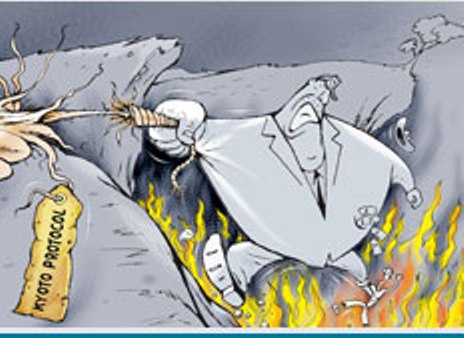
Last chance for Kyoto Protocol? Courtesy Down to Earth
Last chance for Kyoto Protocol?
In its preamble to the special climate change issue, Down to Earth editors say:
“Eleven years after the Kyoto Protocol was signed — only to be consigned to irrelevance over the subsequent decade — nations are meeting in Poland to negotiate post-2012 action.

“The realities of climate change are clearer than ever, and the cost of action is mounting. Rich countries, historically responsible for climate change, are proposing new mechanisms to share the burden. Leading developing countries such as India and China need to negotiate hard as well and make a big push for renewables…” Read full story

On 5 November 2008, SciDev.Net published my op ed essay:
Planet before profit for climate films

On 7 November 2008, Asia Media Forum published a longer version of this essay:
Climate Change or (c)limate (c)hange: Guarding copyrights on a warming planet

These have been linked to, or commented upon, by various blogs and websites. Interestingly, the big time TV/video production companies and broadcasters have been keeping quiet in this debate.

Perhaps they are too busy counting their money accruing from license fees?

Climate change and copyrights: What intellectual property on a dead planet?

Twenty centuries ago, Emperor Nero fiddled while Rome burned. Today, some media companies are squabbling over copyrights while the planet is warming.

This is the main thrust of my latest op ed essay, just published by the Science and Development Network (SciDev.Net) anchored in London, UK. It’s titled: Planet before profit for climate change films.

I have adapted for this commentary some of my ideas initially expressed on this blog – especially the post on 12 Oct 2008: Climate in Crisis and planet in peril – but we’re squabbling over copyrights!

Broadcasting on a warming planet

In writing this essay, I’ve also drawn on the excellent discussions we had last month during the Asia Pacific workshop on Changing Climate and Moving Images in Tokyo.

I’m challenging broadcasters to put their money where their mouth is.

Here’s an excerpt:

“Broadcast mandarins routinely support global struggles against poverty, HIV, corruption and climate change by offering free airtime to carry public interest messages. But few let go of their own products on these very subjects for non-broadcast uses.

“Making climate change a ‘copyright free zone’ for media products would increase the resource materials available to thousands of educators, social activists and trainers struggling to communicate this complex topic to audiences across the world. Moving images would make their task easier.

“The climate crisis challenges everyone to adopt extraordinary measures. Broadcasters and film-makers need to balance their financial interests with planetary survival.

“What use is intellectual property on a dead planet?”

Read my full essay on SciDev.Net: Planet before profit for climate change films.

In September 2006, speaking at the United Nations headquarters (photo below), I called for poverty to be recognised as a copyright free zone. The idea was to have broadcasters and other electronic publishers release copyrights on TV, video and online content relating to poverty and development issues -– at least until (MDG target year of) 2015.

The TV broadcast and film communities have reacted to this proposal with disdain or indifference, but I keep badgering on. If poverty didn’t motivate broadcasters to change business as usual, I hope, the planetary threat posed by climate change would.

‘Climate Challenge’ marks turning point in Vietnam’s climate concerns

Seeking local solutions for a global problem
Climate Challenge TV series: Seeking local solutions for a global problem

Many media reports and documentaries on climate change tend to be scary. Even the most balanced and scientifically informed ones caution us about dire scenarios that can rapidly change the world as we know it.

But it’s not all doom and gloom. Like every crisis, climate change too presents humanity with formidable challenges that can become opportunities to do things differently — and better.

Climate Challenge is a rare TV series that adopts this positive attitude. The 6-part series co-produced by One Planet Pictures in the UK and dev.tv in Switzerland, links the global climate crisis with location action for both mitigation (trying to reduce further aggravation) and adaptation (learning to cope with impacts).

It also makes the point: in the fight against global warming, developed and developing countries must work hand-in-hand to find viable solutions for all.

The film-makers of Climate Challenge focus on some of the most promising approaches to turning down the global thermostat. Climate Challenge goes in search for solutions that won’t put a break on economic growth.

The series had its original run on BBC World News in April – May 2007. Shortly afterwards, TVE Asia Pacific (TVEAP) started distributing it to TV channels, educational institutions and civil society groups across the Asia Pacific region. It has been one of the more popular items on our catalogue of international TV films on sustainable development and social justice.

Our deal with Asia Pacific broadcasters is a barter arrangement. TVEAP clears copyrights for developing countries in our region (more than 30 countries or territories) and offers films free of license fee that normally prevent many southern broadcasters from using this content.

We offer a new set of titles every two months to our broadcast partners – now numbering over 40 channels. They select and order what interests them, and often pay for the cost of copying on to professional tape and dispatch by courier.

When they receive the tapes, accompanied by time-coded scripts, many TV stations version the films into their local language/s using sub-titles or voice-dubbing. They do this at their expense, and then assign a good time slot for airing the films once or several times. They are free to re-run the films as often as they want. The only expectation is that they give us feedback on the broadcasts, so that we can report to the copyright owners once a year.

This arrangement works well, and bilateral relationships have developed between TVEAP’s distribution team and programme managers or acquisition staff at individual TV stations across Asia. Everything happens remotely — through an online ordering system and by email. It’s rarely that we at TVEAP get to meet and talk with our broadcast colleagues in person.

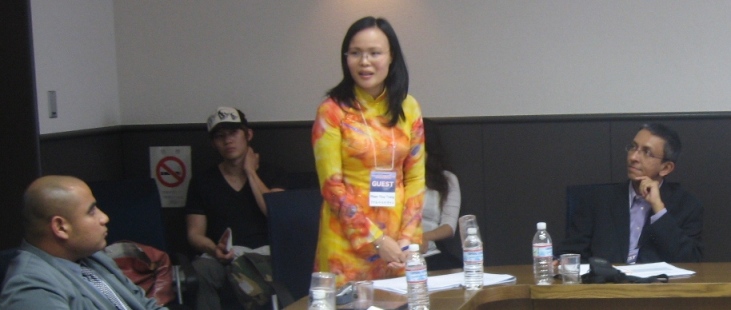
Pham Thuy Trang speaks in Tokyo

I was delighted, therefore, to meet one of our long-standing broadcast colleagues in Tokyo earlier this month when we ran a regional workshop on changing climate and moving images. Pham Thuy Trang, a reporter with news and current affairs department of Vietnam Television (VTV), was one of the participants. She turned out to be an ardent fan of our films.

She told the Tokyo workshop how the Climate Challenge series marked a turning point in Vietnam’s public discussion and understanding of climate change issues.

In mid 2007, VTV was one of many Asian broadcasters who ordered Climate Challenge. Having versioned it into Vietnamese, VTV broadcast the full series in December 2007 to coincide with the 13th UN climate change conference in Bali, Indonesia.

“This was the first time the issue received indepth coverage on TV,” Trang said. This was particularly significant because a 2007 survey had revealed low levels of interest in climate issues by the media in Vietnam.

Vietnam has a 3,000km long coastline
“In fact, the World Bank has identified Vietnam, with its 3,000 km long coastline, as among the countries most vulnerable to climate change impact. Our media has been reporting some developments – such as increased coastal erosion – as purely local incidents without making the climate link,” she noted.

The series, originally broadcast in the foreign documentaries slot, was noticed by the VTV senior management who then arranged for its repeat broadcast in the long-established environmental slot. The latter slot, well established for a decade, commands a bigger audience.

“Our Director General was impressed by our receiving such a good series on an important global issue,” Trang recalled. She added: “We need more films like this – that explain the problem and help us to search for solutions.”

Trang kept on thanking TVEAP for Climate Challenge and other films that bring international environment and development concerns to millions of Vietnamese television viewers. I said we share the credit with generous producers like One Planet Pictures and dev.tv, who let go of the rights to their creations for the global South.

If only more producers of TV content on climate and other development issues think and act as they do. That was also the call we made at the end of our workshop: recognise climate change as a copyright free zone.


Related blog post: Climate in crisis and planet in peril – but we’re squabbling over copyrights!

Climate in Crisis and planet in peril – but we’re squabbling over copyrights!

Climate in Crisis - a global documentary

On my recent visit to Tokyo for a regional workshop on changing climate and moving images, I watched a number of excellent documentary films on the subject. One of them was Crude: The Incredible Journey of Oil, the excellent Australian film that I wrote about in March.

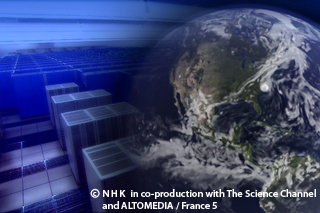
Another was Climate in Crisis, an outstanding global documentary in two parts (2 x 52 mins) co-produced in 2006 by Japan’s public broadcaster NHK together with The Science Channel and ALTOMEDIA/France 5.

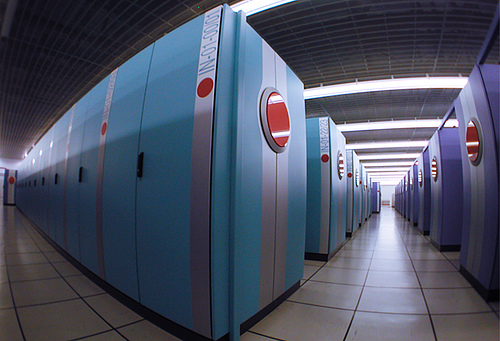
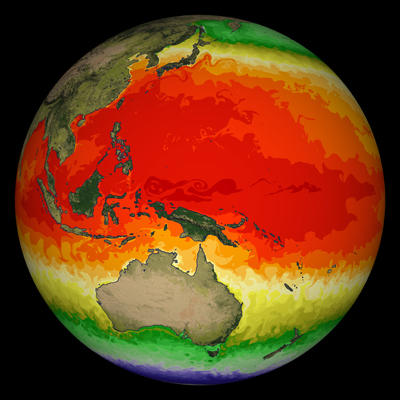
Directed by Fujikawa Masahiro, the film draws heavily on the Earth Simulator — one of the world’s most powerful supercomputers — which Japanese scientists used to project the climatic disasters in next 100 years. The system was developed in 1997 for running global climate models to evaluate the effects of global warming and problems in solid earth geophysics. It has been able to run holistic simulations of global climate in both the atmosphere and the oceans — down to a resolution of 10 km.

NEC Earth Simulator in Japan

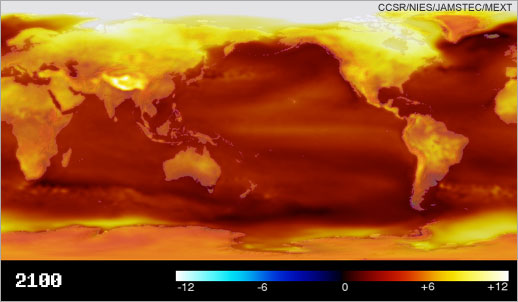
The results, captured in this documentary, are truly mind-boggling. Atmospheric temperatures may rise by as much as 4.2 degrees Celsius, more hurricanes may attack and deserts may spread from Africa to southern Europe, and half of the Amazon rainforest may be gone. Climate in Crisis shows a severe projection on environmental destruction based on rigorous scientific data and considers whether humankind can avoid this.

This film, made in the same year as Al Gore’s Oscar-winning film An Inconvenient Truth, has won several awards including the Earth Vision Award at the 15th Earth Vision Tokyo Global Environmental Film Festival.

I was curious why this excellent film – in my view, better made than Al Gore’s one – hasn’t been more widely seen, talked about and distributed. To be honest, I’d not even heard of this one until my Japan visit — and I try to keep myself informed on what’s new in my field of endeavour.

The reasons soon became apparent: copyright restrictions! The co-producers are keeping the rights so tight that only the highest bidders will be allowed to acquire it on a license fee.

This is a standard broadcast industry practice that didn’t surprise me. But I was taken aback by how jealously the rights are guarded. All other films that were part of our event, including high budget commercial productions like Crude, were screened to the public at the Parthenon in Tama New Town in Tokyo.

Not so with Climate in Crisis, which we – the overseas participants to the workshop – had to watch at a theatre inside NHK’s Tokyo headquarters. No public screening was possible. As we later heard, NHK itself was willing to allow a public screening (after all, it draws a good part of its income from the Japanese public), but their international co-producing partners, especially the Science Channel, would simply not agree to it. Wow.

Twenty centuries ago, emperor Nero fiddled while Rome burned. Today, some people are squabbling over copyrights while the whole planet is in peril.

Earth in 2100 - as seen by Earth Simulator

Our workshop participants came from solid backgrounds in broadcasting or independent film-making, and we are not naive activists asking hard-nosed broadcasters to let go of their precious rights which generates vital income. But we would have expected them to allow films such as Climate in Crisis to circulate a bit more freely in everybody’s interest.

This reminded me of correspondence I had last year with the Canadian producers of another outstanding climate film titled The Great Warming. The initial discussions with its director were promising, but when the distribution people started talking about ‘revenue optimising’, our negotiations stalled.

It also reminded me of similar experiences of other environment and natural history film makers, such as South Africa’s Neil Curry. He had a long struggle with the BBC to clear the non-broadcast use rights of his own film that he wanted to take back to the locations in Botswana where it was filmed.

Many broadcast and production companies in the west don’t realise that TV broadcasters in developing Asia operate on a very different basis. Talking about broadcast ‘pre-sales’ or ‘commissions’ loses meaning when many stations are operating on tiny budgets — or in some cases, no budgets — for factual content. Many are struggling to survive in tough, emerging economies.

Is this our future?
Is this our future?

TVE Asia Pacific operates a regional film distribution service that brings environment and development films within reach of such broadcasters. We operate without getting mired in license fees or royalties.

Our 2-day workshop called for climate change to be recognised as a ‘copyright free zone’. This would enable audio-visual media content on the subject to move freely across borders and to be used widely for broadcast and narrowcast purposes.

Here’s the full reference from our statement of concern:

“Prevailing copyright regimes prevent the sharing and wider use of outstanding TV programmes and video films on climate and development issues. We are deeply concerned that even content developed partly or wholly with public funding (government grants, donor funds or lottery funds) remain unfairly locked into excessive copyright restrictions. Sometimes film-makers and producers themselves are willing but unable to allow their creations to be used for non-commercial purposes by educational, civil society and advocacy groups. We appreciate the media industry’s legitimate needs for intellectual property management and returns on investment. At the same time, the climate crisis challenges us to adopt extraordinary measures, one of which can and should be recognising climate change as a ‘copyright free zone’. Such agreement would encourage media organisations and independent producers to share content across borders, and with entities outside the media industry engaged in climate education, advocacy and activism.”

Here’s the simple question I raised during the workshop, which is worth being posed to all those who hesitate to even discuss this issue:

Can anyone manage their intellectual property rights on a dead planet?

This is the real question!

Can Your Film Change the World? Find out on Pangea Day!

Here’s an extraordinary invitation to all who love to watch, create or critique moving images.

Either watch the above video, linked to PangeaDay YouTube channel, or (if your bandwidth does not allow easy playing of online video) read the text I have just transcribed off the video:

In this age
Images are powerful.
Powerful enough to divide…
…to spread fear…
…to remove hope.

Powerful enough to unite
to build trust, to inspire action.

Until now, images of the many
have been held in the hands of the few.

Finally, that is changing.

Millions of people around the world
are telling their own stories.

For the first time in history
we have a chance to see the world differently.
To see it through the eyes of each other.

Imagine if we could get inside
each other’s heads for a day!
What would we see?

We are about to find out.
A worldwide search has begun
to find films of unique power.

Films that provoke…
…entertain…
…inspire.

Films made by the world
for the world.

On May 10, 2008
millions of people across the globe
will gather to witness these films
in a spectacular event
broadcast live to the entire world.

Visionaries…
…and musicians
will join the celebration.

And it will continue afterwards in cyberspace
as a newly connected global community.

You can be part of it.

Pangea Day.

Here’s the blurb from the official website:

Pangea Day taps the power of film to strengthen tolerance and compassion while uniting millions of people to build a better future.

In a world where people are often divided by borders, difference, and conflict, it’s easy to lose sight of what we all have in common. Pangea Day seeks to overcome that – to help people see themselves in others – through the power of film.

On May 10, 2008 – Pangea Day – sites in Cairo, Dharamsala, Kigali, London, New York City, Ramallah, Rio de Janeiro, and Tel Aviv will be videoconferenced live to produce a 4-hour program of powerful films, visionary speakers, and uplifting music.