Ozone: Once and Future Story? A tale of two images…

A tale of two iconic images...

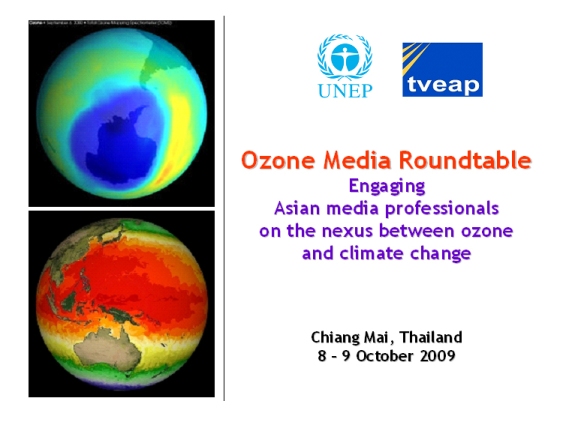
I am in Chiang Mai, northern Thailand, conducting the Ozone Media Roundtable, a high level event to engage Asian media professionals on the nexus between ozone depletion and climate change. The meeting, held on 8 – 9 October 2009, is organised jointly by the United Nations Environment Programme (UNEP) and TVE Asia Pacific for invited senior journalists and broadcasters from the Asia Pacific region.

The past 22 years of implementing the Montreal Protocol, adopted in 1987, hold many relevant lessons and experiences for countries currently trying to negotiate a new multilateral environmental arrangement to succeed the Kyoto Protocol of the UN Framework Convention on Climate Change, UN-FCCC. These insights could be particularly helpful for the inter-governmental negotiations leading to, and during, the 15th conference of parties (COP15) of UN-FCCC in Copenhagen in December 2009.

TVE Asia Pacific and UNEP convened the roundtable meeting in Chiang Mai to explore the ozone/climate nexus from a communications perspective. We brought together a small group of senior journalists and broadcasters who have been covering ozone and/or climate issues. We also invited a few ozone and climate technical experts to discuss the close links between ozone layer protection and climate change mitigation.

I work with moving images, but I also know the power of still images — especially when they are highly symbolic. Looking for a good visual link between ozone depletion and climate change, I came up with two images of our planet, seen in different ways that represent the two global environmental challenges.
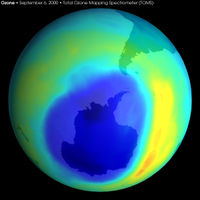
Largest ever Ozone hole, Sept 2000
The first image is better known, and is a colour enhanced satellite image of the Ozone Hole that was discovered in 1985 by British scientists Joesph Farman, Brian Gardiner and Jonathan Shanklin of the British Antarctic Survey. The ozone “hole” is really a reduction in concentrations of ozone high above the earth in the stratosphere. It is defined geographically as the area wherein the total ozone amount is less than 220 Dobson Units.

This discover was largely responsible for galvanising international attention and response to the threat of ozone depletion. After a series of inter-governmental meetings and negotiations, the Montreal Protocol on Substances that Deplete the Ozone Layer was finally agreed upon on 16 September 1987 at the headquarters of the International Civil Aviation Organization in Montreal.
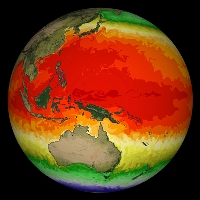
Temperature projection for Year 2100
The second image is not as widely known, but represents an even greater environmental calamity that is currently unfolding: global warming and rapid changes in climate it has triggered. The image is a colour enhanced image of the Earth’s temperatures in 2100 AD (less than a century from now), as projected by the Earth Simulator — one of the world’s most powerful supercomputers — which Japanese scientists use to project the climatic disasters in next 100 years.

The system was developed in 1997 for running global climate models to evaluate the effects of global warming and problems in solid earth geophysics. It has been able to run holistic simulations of global climate in both the atmosphere and the oceans — down to a resolution of 10 km.

Between these two images, we are looking at two of the biggest environmental challenges of our times. How the climate crisis can learn valuable lessons from the ozone crisis is what we discussed at the Ozone Media Roundtable.

More about the meeting’s outcome soon.

One minute to midnight — or just one minute to save the world?

How much can you pack into 60 seconds?

How much can you pack in to one minute, or 60 seconds? That’s a lot of air time, as broadcasters and advertisers know very well.

One Minute to Midnight‘ has been a favourite metaphor of dooms-dayers – and is the title of a 2008 book. It was widely used in relation to the world drawing closer to nuclear war during the second half of the 20th century.

Now, as global climate change surpasses fears of global nuclear war, we are given just one minute to save the world.

One Minute to Save the World is an international short film competition to raise awareness of climate change. Entries are currently being sought from professionals and amateurs, with 31 October 2009 as the deadline. There is also a category for under 18s and for entries shot on mobile phones.

The idea is to enable anyone, anywhere, to deliver a short but powerful message to the world on climate change. The winning films will be sent around the world in November as an online campaign to raise awareness of the Copenhagen Climate Conference in December 2009.

Good planets are hard to find...
British TV presenter and adventurer Bruce Parry, a founder of the competition, says: “Together we will be looking for films that convey a powerful message about how climate change affects you and those around you. Were you a flood victim? Have you seen a change in the plants and wildlife in your garden? How has your world been affected and how can we address it?

He adds: “So, we hope you’ll all get thinking and shooting – whether you’re a seasoned pro or just someone who cares. Your planet needs you and your talents. One minute might not seem like a long time but it’s actually longer than many advertisers spend hundreds of thousands of pounds on. It’s also an easy length of time to hold people’s attention. And that is one of the things we urgently need to do if we’re going to turn things around for our planet before it’s too late.”

The winning entries will be judged by an international panel that includes Parry himself, award-winning director and climate change activist Shekhar Kapur; Franny Armstrong, director of Age of Stupid and The Guardian‘s environment editor John Vidal.

The website will become an online film festival which requires no travel or celebrity status to attend – all you need is access to a computer. “And as everyone knows, the power of the net can make the most unexpected video attract the attention of millions globally,” says Bruce Parry.

Read Bruce Parry on One Minute to Save the World

One Minute to Save the World competition rules and more info

Watch entries on YouTube

Calling All Climate Films: Engage the world with EngageMedia!

May a million Al Gores rise to this challenge!

Exactly this time last year, in early October 2008, I spoke to a group of Asian broadcasters and film-makers gathered in Tokyo on what it takes to stand on Al Gore’s shoulders.

Whatever we might think about the artistic and technical merits of his climate film An Inconvenient Truth, it has settled with a resounding ‘yes’ one question: can a single film make a difference in tipping public opinion about a matter of global importance?

But the climate crisis that confronts us is so formidable that we need many more Al Gores to come up with as many moving images creations as they can.

EngageMedia, a video sharing site about social justice and environmental issues in the Asia Pacific, has put out a call for video/TV films on climate crisis, climate action, climate justice and climate solutions. They plan to ‘put the best stories on a DVD and in an online package to be screened and distributed before, during and after the United Nations Framework Convention on Climate Change (UNFCCC) Summit meeting in Copenhagen in December 2009.

Their call out for all climate films says: “This December thousands of delegates, decision makers, stakeholders and activists will converge on Copenhagen. To be part of this EngageMedia is putting together a compilation of Asia-Pacific climate films to be screened and distributed at the event and around the world. Submit your film to EngageMedia and be part of the action. Global action is urgent and essential – the time for debate is over.”

TVE Asia Pacific
, already a partner on EngageMedia platform, is submitting all its recently produced climate change films.

Read the full text of Climate Crisis Video Call-Out: Time for Reel Action!

Asians prominent in TIME Magazine’s Heroes of the Environment 2009

Celebrating Heroes
Celebrating Heroes

Asian environmental leaders, activists and visionaries feature prominently in TIME Magazine’s Heroes of the Environment 2009 list, published in its issue dated 5 October 2009.

This isn’t surprising, since the Asia Pacific accounts for nearly two thirds of humanity. As I’ve been saying for some years, the quest for sustainable development will be won – or lost – in Asia.

By happy coincidence, I have met three of the two dozen remarkable men and women in this year’s Heroes list — and count two of them among my extended network of friends across Asia.

One friend is the Indian film-maker Mike Pandey, who has been making environment and wildlife films for over 30 years in India, where he is one of the most respected names in conservation circles.

The other is Sheri Liao, Founder of the Global Village of Beijing (GVB), one of the earliest non-governmental organisations addressing environmental issues in China. She is an indefatigable Chinese activist and campaigner whom I first met on my first visit to Beijing in 1996. Our paths have crossed a couple of times since then, and I have always admired her zeal and single-minded pursuit of ‘greening’ China. Added on 17 Oct 2009: Blog post on Sheri Liao and greening the airwaves in China

The third ‘hero’ is the amiable and technocratic Mohamed Nasheed, President of the Maldives. I filmed an exclusive TV interview with him a few weeks ago, which I am currently editing into a short documentary on climate change. His country, the smallest independent state in Asia (by both land area and population), is on the frontlines of impact from rising sea levels and extreme weather events triggered by global warming.

heroes_1005“From saving wild mountain rivers in China to measuring the Arctic’s icy expanse, our green heroes are informed by this simple notion: We can all make a difference,” Time editors wrote in introducing this year’s list.
I just wrote a separate blog post on Prince Mostapha Zaher, Afghanistan’s environmental chief.

And I have already blogged about another TIME Hero well ahead of their selection: environmental lawyer Syeda Rizwana Hasan, a determined environmental activist who keeps dozens of ships from coming to die on the beaches of her native Bangladesh.

In the coming days and weeks, I plan to write separate posts on these other heroes whose selection is both timely and inspiring to all of us working in the broader development sector.

Rising from the Ashes: The Ayta’s struggle to preserve their heritage

Rising from the Ashes, teh Ayta struggle to keep their traditions alive
Rising from the Ashes, the Ayta struggle to keep their traditions alive

This weekend, Tropical Storm Ketsana triggered the worst flooding in decades in the Philippine capital Manila and nearby provinces.

The Philippines, an archipelago nation comprising some 7,000 islands, is one of the world’s most disaster-prone countries. It leads a World Bank list of nations most in danger of facing frequent and more intense storms because of climate change. In 2008, it was one of three countries that experienced the most disasters, according to the Brussels-based Centre for Research on the Epidemiology of Disasters.

Apart from the typhoons that blow in from the Pacific Ocean, the Philippines also sits on the Pacific Rim of Fire where periodic earthquakes occur, and active volcanoes are found.

Disasters not only kill or injure people and cause property damage; they also disrupt livelihoods and cultural practices. That’s what happened when the volcanic Mount Pinatubo erupted in 1991, its lava and ashes destroyed many surrounding villages – including the traditional homeland of the Ayta, indigenous people descending from the first inhabitants of the Philippines. They had fled to the hills from the lowlands during the protracted Spanish conquest of the Philippines which first commenced in 1565.

Today, resettled elsewhere on Luzon island, the Ayta are trying to preserve their traditional culture and community integrity through education and theatre. These efforts are supported by the Ayta organisation PBAZ, part of the Education for Life Foundation. Going back to the abandoned village is one way of keeping memories alive.

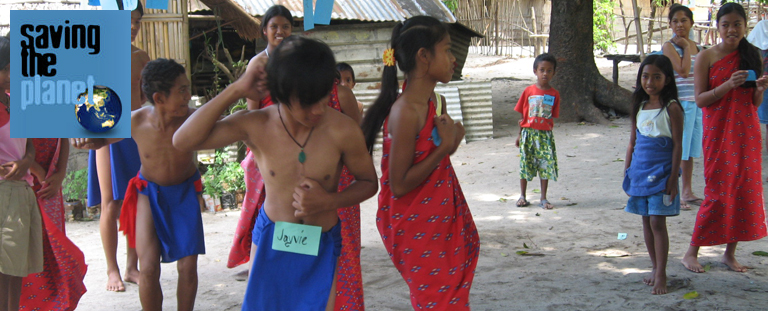
This is the story of Rising from the Ashes, one film in Saving the Planet, TVE Asia Pacific’s new regional TV series showcasing Asian communities thinking globally and acting locally.

Passing the buck or passing the planet? Saving the Planet is everybody’s business!

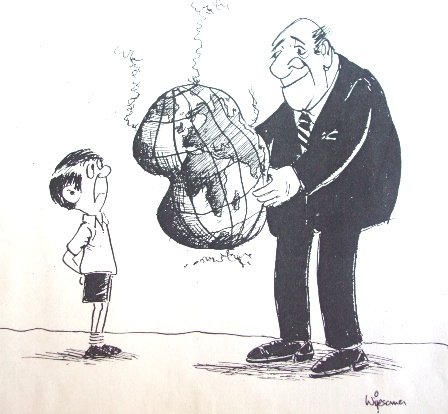
Passing the buck? Cartoon by W R Wijesoma
This was one of the most memorable cartoons drawn by W.R. Wijesoma, Sri Lanka’s pre-eminent political cartoonist (and my one-time colleague). If I remember right, it first appeared sometime in the late 1980s in ‘Mihikatha’, Sri Lanka’s first all-environmental newspaper.

Alas, both Mihikatha and Wijesoma are no more among us. But the message in this cartoon is more timely than ever before.

“Is this what we are going to hand over to our future generations? Please……no!” was the emphatic message from Yugratna Srivastava, a 13-year-old Indian girl who addressed over 100 world leaders gathered at the United Nations headquarters on 22 September 2009 for the historic Summit on Climate Change.

Passing the ball – or buck – is something that governments are good at. Most governments are so narrowly focused on the now and here, and sometimes rightfully so, that they have neither the time nor interest for medium to long term scenarios. As I wrote earlier this week, “it’s going to take many more meetings, bickering and hard bargaining before the leaders begin to think in terms of the next generation.”

This is where citizen action comes in. Governments are not going to save this planet from environmental catastrophes; if at all, it would be the ordinary people. This is the premise of TVE Asia Pacific’s latest Asian TV series, Saving the Planet.

Where does the buck stop?

Governments, experts and big corporations alone cannot solve all these problems. Real change requires changing how each and every human being lives and works. Education becomes the biggest key to achieving environmentally sustainable development at local and global levels.

Filmed in six countries in South and Southeast Asia, Saving the Planet profiles groups working quietly and relentlessly to spread knowledge, understanding and attitudes that inspire action that will help humans to live in harmony with the planet. They often work without external funding and beyond the media spotlight. They have persisted with clarity of vision, sincerity of purpose and sheer determination. Their stories inspire many others to pursue grassroots action for a cleaner and safer planet.

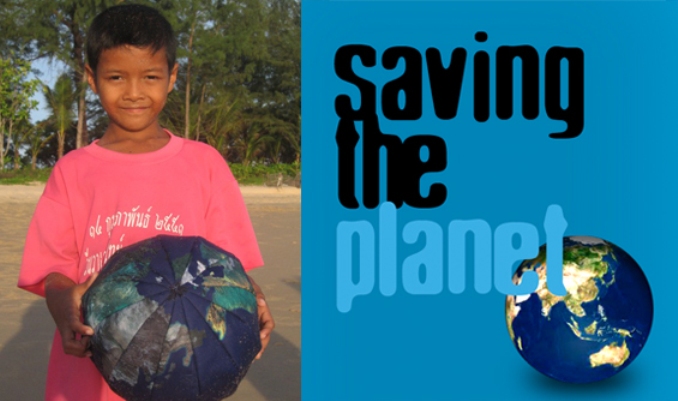
We tried out a creative idea for the series opening sequence (20 seconds), an extended version of which became the series trailer (see below). It was planned and filmed in all the six countries where the stories came from — Cambodia, India, Laos, Nepal, the Philippines and Thailand. In each country, our roving director-producers filmed different individuals – young and old, men and women, in all their Asian diversity – passing around an inflated ball made to look like planet Earth.

I know my colleagues had fun filming these sequences, and back in our studio, it was also great fun to mix and match these various shots to create the apparently seamless passing around of our planet in peril. (Who said planet saving cannot be fun?)

Watch Saving the Planet trailer (1 minute):

Now it can be revealed: our original inspiration came from an unexpected source: the world’s largest media corporation, Google! In one brainstorming, our then production coordinator Buddhini Ekanayake remembered an open challenge that Google had made online just before introducing their email service, GMail. Google asked people to “imagine how an email message travels around the world” using a video camera.

In all, Google received over 1,100 clips from fans in more than 65 countries around the world — each one of them a different creative idea, playing with the iconic Gmail M-velope.

“The clips you submitted were amazing and it was hard to choose selections for the final video,” Google said when releasing the outcome of this collaborative video project.

See Gmail: Behind the Scenes (Final Cut)

Read more about the GMail collaborative video on Google’s blog

Watch all submissions Google received for its GMail promo video.

As Oscar Wilde once said, “Talent borrows. Genius steals.” You can decide which of these we have done!

Next Election or Next Generation? World leaders, time to choose is NOW!

Yugratna Srivastava: Lend me your ears...
This week saw the UN’s invisible man hosting mostly indifferent leaders at a Summit on one of the world’s most pressing challenges: climate change.

Nearly 100 world leaders accepted UN Secretary General Ban Ki-moon’s invitation to participate in an historic Summit on Climate Change in New York on 22 September to mobilise political will and strengthen momentum for a fair, effective and ambitious climate deal in Copenhagen this December.

The call for action at the summit did not just come from world leaders – many of who simply can’t see beyond their next election – but also from the next generation who stand the most to lose if climate talks fail.

On their behalf, Yugratna Srivastava, a 13-year-old Indian girl, spoke forcefully at the podium, sending a wake-up call to those assembled. “We received a clean and healthy planet from our ancestors and we are gifting a damaged one to our successors. What sort of justice is this?,” she said.

She added: “The Himalayas are melting, polar bears are dying, 2 of every 5 people don’t have access to clean drinking water, earth’s temperature is increasing, we are losing the untapped information and potential of plant species, Pacific’s water level has risen,Is this what we are going to hand over to our future generations? Please……no!”

She said the three billion young people in the world need them to take action now to protect the planet for future generations.

Watch part of her speech in this TV news story:

Read full text of her speech

Read Indian TV news channel IBN’s interview with Yugratna Srivastava just after delivering her speech.

Read Ban Ki-Moon’s summary of the Summit, delivered at its end

All this news coverage reminded me of another passionate young girl who similarly addressed – and challenged – the world leaders 17 years ago at the Earth Summit held in Rio de Janeiro, Brazil.

Her name was Severn Cullis-Suzuki, and she was a young Canadian environmental activist. Then 12-year-old Severn closed a Plenary Session with a powerful speech that received a standing ovation.

Raised in Vancouver and Toronto, Severn Cullis-Suzuki is the daughter of writer Tara Elizabeth Cullis and environmental activist and TV personality David Suzuki. When she was 9, she started the Environmental Children’s Organization (ECO), a small group of children committed to learning and teaching other kids about environmental issues. They were successful in many projects before 1992, when they raised enough money to go to the UN’s Earth Summit in Rio. Their aim was to remind the decision-makers of who their actions or inactions would ultimately affect.

Listen to the memorable speech at the Earth Summit by Severn Cullis-Suzuki:

Severn was every bit as sincere, concerned and passionate about the global environment as Yugratna Srivastava was this week. Seventeen years later, notwithstanding the lofty pledges at the Earth Summit and later gatherings, the environmental crises have multiplied and worsened.

Very few of the world leaders who assembled in Rio are still in office — and that underlines part of the problem. Governments have far shorter time horizons than what many of today’s global challenges demand. I am constantly reminded of what the eminent Indian scientist Dr M S Swaminathan told me in my first interview with him in 1990 (yes, even before the Earth Summit): “In democracies, rulers think in terms of the next election. In dictatorships, about the next coup d’état. Nobody is thinking in terms of the next generation!”

It was no small feat for the UN’s Invisible Man to bring 100 heads of state or heads of government together on such a long-term issue. But it’s going to take many more meetings, bickering and hard bargaining before the leaders begin to think in terms of the next generation.

Read my June 2008 comment: Message to the UN on World Environment Day: Kick your own CO2 habit!

Timeless Gandhian advice: Be the change you wish to see in the world…

Biggest gap: between rhetoric and practice!
It happened a decade ago, but I still remember the incident.

I was visiting London while the British Isles were having their typically limited experience with summer. My then colleague and I had gone for a business meeting, and were returning by Tube, or the London underground railway. Being the afternoon rush hour, the trains were packed to capacity.

My colleague didn’t say much on the journey, but I noticed her look of dismay. As we emerged from the tube station, she finally spoke: “Gosh, it’s another world down there, isn’t it? I didn’t know people smell so much!”

The warm and sweaty summer would surely have added to the experience, but as Londoners know well, the tube is the best mode of transport to get around quickly and inexpensively in that metropolis. It was only then that I realised my liberal, bleeding-heart colleague was not a regular user of public transport. She either uses taxis or drives around in her own Volvo car. She doesn’t normally commute with the Great Unwashed…

Yet, the same snooty ex-colleague speaks and writes so passionately on the virtues of public transport and mass transit systems as a means to better manage urban challenges in the developing world. Listening to her, one could hardly imagine her disdain for using public transport in her own city.

Practise what you preach. That’s a simple yet profound piece of advice for everyone promoting public interest causes in development, conservation or anything else. Or, as Mahatma Gandhi put it: you must be the change you wish to see in the world.

Saving the Planet: Living the Change

‘Living the change’ is also the title, and underlying message, of one film in Saving the Planet, TVE Asia Pacific’s new regional TV series showcasing communities thinking globally and acting locally.

The series features outstanding efforts in education for sustainable development (ESD) in South and Southeast Asia. It goes in search of answers to these key questions:
• What can ordinary people do for our planet, now under siege from multiple environmental crises?
• How can we change attitudes and lifestyles to consume less and generate less waste?

Here’s the synopsis of the India story:

For people in Dindigul in India’s Tamil Nadu state, waste isn’t really a problem – it’s just a resource in the wrong place. School children and housewives have been at the forefront in collecting household and market waste to turn them into compost. They have not only cleaned up the streets, but also persuaded people to grow organic food. As the word spreads, more towns and villages are emulating this example set by CLEAN India project and Gandhigram Trust.

Watch Saving the Planet: Living the Change

Read more information on this effort on Saving the Planet website.

Full credits and acknowledgements here

Radio Sagarmatha: Voice of a Valley and Hope of a nation

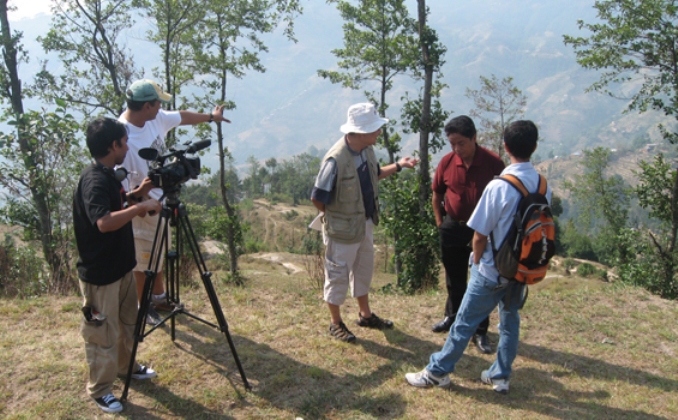
Location filming Saving the Planet in Nepal

I have written more than once in this blog about Radio Sagarmatha of Nepal, the first independent community broadcasting station in South Asia.

In May 2007, on the occasion of their 10th anniversary, I called it Kathmandu Valley’s beacon of hope. I have known and admired the Nepali friends who are running the award-winning, public-spirited radio station.

I’m delighted, therefore, to be able to make a short film about one facet of Radio Sagarmatha: their contribution to education for sustainable development, ESD for short.

Radio Sagarmatha’s path-breaking work in the resort town of Nagarkot is the story in one film of Saving the Planet, TVE Asia Pacific’s new regional TV series showcasing communities thinking globally and acting locally.

The six-episode series, which was 18 months in the making, features outstanding efforts in education for sustainable development in South and Southeast Asia.

It goes in search of answers to these key questions: Can ordinary people help save our planet under siege from multiple environmental crises? How can everyone change attitudes and lifestyles to consume less and generate less waste?

Here’s the official synopsis of the Nepal story, titled Voice of a Valley:

Tourism generates incomes, jobs and markets for the people of Nagarkot, a popular resort close to the Nepali capital Kathmandu. But it had a bumpy start when hoteliers initially bypassed local communities. These tensions were diffused by Radio Sagarmatha, the country’s first independent public radio station, which brought all interested parties together on the air. This example shows how media can do more than just report. By inspiring discussion and debate, media can help communities to find the best solutions or compromises for their development needs.

Watch Saving the Planet: Voice of a Valley

Many thanks to friends at the Nepal Forum of Environmental Journalists (NEFEJ), for their help in making this short film about one of their most outstanding efforts.

Find the full credits of the film here

RSF: Who will protect journalists fighting for a better planet?

RSF: We must defend journalists who fight for the planet
In November 2007, I wrote a blog post calling for greater protection for local journalists who cover social and environmental justice issues risking their life and limbs.

I quoted the Filipino academic and social activist Professor Walden Bello, as saying: “Things are pretty savage at the grassroots level in some of our countries. Journalists who investigate and uncover the truth take enormous personal risks – the vested interests hire killers to eliminate such journalists.”

Bello, executive director of the Focus on the Global South, further said: “Journalists living in the provinces and reporting from the grassroots are more vulnerable than those based in the cities. This is precisely why local journalists need greater support and protection to continue their good work.”

Last week, Reporters Without Borders echoed this call, saying: “We must defend journalists who expose attacks on the environment”.

The press freedom activist group released a new report titled “The dangers for journalists who expose environmental issues.” It highlights the indifference – and even complicity – of some governments and local authorities that make little attempt to protect journalists who take risks to investigate attacks on the environment.

The report looks at 13 cases of journalists and bloggers who have been killed, physically attacked, jailed, threatened or censored for reporting on the environment, and highlights the need for a free press to tackle ecological challenges.

In countries such as Russia, Cambodia, Brazil or even Bulgaria, in Europe, journalists run considerable risks when they try to alert the world about the misdeeds of those who prey on the environment.

Read the full report online

Read my June 2007 tribute to Joey Lozano, a courageous Filipino journalist who risked his life to fight for environmental and social justice issues