Lakshani: A child of the sea travels beyond the seas…

Lakshani photo by TVEAP

Our teacher said our country is small and is surrounded by the sea….she showed it on the globe.”

With these words, young Lakshani Fernando (photo, above) begins telling us the compact story of her short life.

Lakshani, 9, has lived by the sea (Indian Ocean) from the time she was born. When she was just six, the Asian Tsunami of December 2004 destroyed their beachfront house in Koralawella, Moratuwa, on Sri Lanka’s western coast. More than three years later, when my colleague Buddhini Ekanayake met Lakshani in March 2008, the family was still struggling to raise their heads from that massive blow.

A day in Lakshani’s life is the story of a short, 3-minute film that Buddhini produced for TVE Asia Pacific a few weeks ago. It’s part of an Asian and African television co-production project that is about, for and by children.

In the film, Lakshani shares the highlights of a typical day. That includes going for a walk on the polluted beach with her fisherman father, spending a few hours at the nearby school and playing with neighbourhood children. While at it, she tells us her wishes for a cleaner beach and a better neighbourhood.

Buddhini called Lakshani a ‘Child of the Sea’. Even the cruel waves of the tsunami didn’t scare Lakshani away for too long.

I love to play with waves…” Lakshani says towards the end of the film. Then she looks far out at the horizon, and talks again. “There are ships far out at sea. That’s all there is…

She might not yet imagine lands beyond ships and waves, but last week, her story travelled across the seas. Over 500 broadcast media managers, journalists and researchers from around the world, who’d gathered in Kuala Lumpur, Malaysia, for Asia Media Summit 2008, had a glimpse of Lakshani when the first 90 seconds of the film was screened during plenary.

Elizabeth Smith, secretary general of the Commonwealth Broadcasting Association (CBA), chose an extract from Lakshani’s story to introduce the media initiative. Sitting in the audience, I immediately texted the news to Buddhini.

Watch “I am A Child of the Sea”:

This film forms part of a series that has 20 TV producers from 13 countries engaging in a co-production of a short programmes series (mini documentaries) about and for children. The series is the outcome of a regional project organised by the Asia Pacific Institute for Broadcasting Development (AIBD) in collaboration with the French Ministry of Foreign affairs, the Commonwealth Broadcasting Association (CBA), Thomson Foundation, Prix Jeunesse, Children and Broadcasting Foundation for Africa and RTM-IPTAR of Malaysia.

The project tries to capture cultural diversity through the eyes of children. When its concept first reached us, it was defined very narrowly in terms of ethnicity and/or religion. TVE Asia Pacific being a strictly secular organisation, we couldn’t fit into such a tight range. Besides, we realised that many modern day children have a self identity that goes above and beyond the race and religion that blind chance of birth assigned to them.

So we took an editorial decision: instead of doing a story that highlights factors that utterly and bitterly divide humanity (such as race and religion, both of which fuel the long-drawn war in Sri Lanka), we would look for a unifying factor. The tsunami’s killer waves, when they rolled in, didn’t care for our petty human divisions. For a few days and weeks following the tragedy, Sri Lanka was united in shock and grief in a manner I have never seen in my 42 years of living here. (Then we went back to killing each other again.)

The result of our search was Lakshani and her story captured in ‘I am a Child of the Sea’.

Buddhini chose to feature Lakshani after interviewing 10 children from different localities and a diversity of cultural backgrounds. (Never once did she ask for the child’s religion, which unlike ethnicity is not always apparent from the name.) There was some significance in featuring a child who identifies herself closely with the Sea in a country where tens of thousands of tsunami-affected people have still not come to terms with the sea. Even after the tsunami destroyed their home, Lakshani’s family moved to a ‘temporary’ shelter within sight of the sea. Thus, her story had a close association with the sea which formed part of her lifestyle, environment and culture.

Buddhini developed the script after several leisurely chats with Lakshani, based partly on the child’s own writing about herself. Filming the story took place in early March 2008, with the full consent of her parents, extended family and neighbours. Read more about the making of this film on TVEAP website and on Buddhini’s own blog.

TVEAP crew filming Lakshani's story

Lakshani’s story is symbolic at another level. It reveals how, despite receiving a massive outpouring of donations from all over the world, some tsunami-affected families are still struggling to put together their shattered lives. The litany of woes, missed opportunities and sometimes outright plundering of donations came out strongly in the first hand accounts of affected people (in India, Indonesia, Sri Lanka and Thailand) who spoke to us during the Children of Tsunami media project. Read our reflections on the project in Communicating Disasters book published in 2007.

Lakshani’s family is not typical of Sri Lanka’s tsunami affected persons. Unlike most such families, the Fernandos live on the western coast, relatively close to Colombo. Although wave action destroyed or damaged beachfront homes in these areas, most attention was focused on areas in the south, east and north of the island that were hit much harder. So those affected and living on the west coast have often been overlooked or dismissed lightly. In this sense, Lakshani’s family has some parallels with what I called ‘step-children of tsunami’.

There is a bit more cheerful post-script to this story. During several visits to Lakshani and family for researching, filming and editing this film, Buddhini (who has a daughter aged four herself) bonded with the girl. It became more than a mere film-making venture, and has led to a lasting relationship. Meanwhile, young voice artiste Shanya Fernando, who rendered Lakshani’s Sinhala voice into English for an international audience, has also felt an attachment to the ‘star’ of our film.

While the film was made with the informed consent of Lakshani’s family who received no material benefits for their participation, both Buddhini and Shanya have since presented some basic educational gifts to Lakshani — who is certainly in need of such help. And who am I to stand in the way of such gestures of human kindness?
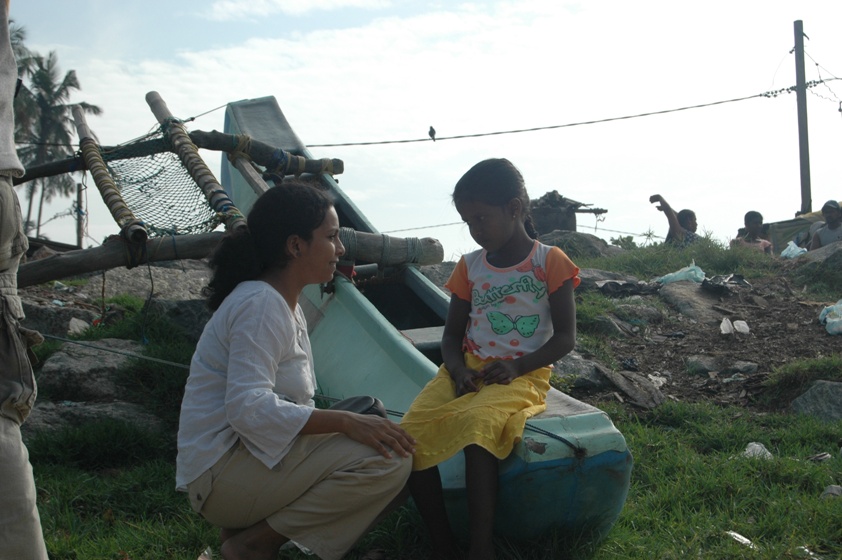
Producer BUddhini with Lakshani

Photos by Amal Samaraweera, TVE Asia Pacific
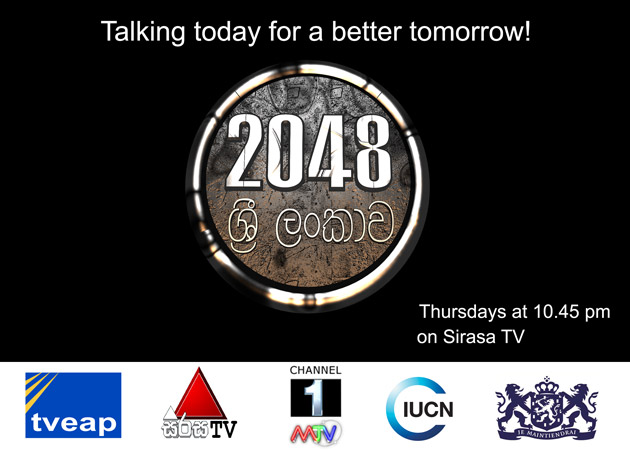
Sri Lanka 2048: Talking today for a better tomorrow!

Sri Lanka 2048 - TV Debate series on sustainable futures for Sri Lanka

I’m just coming up for fresh air after two hectic weeks – this blog was silent during that time as I was deep immersed in doing something new and interesting.

With my team at TVE Asia Pacific, I’m involved in producing a new TV series started airing on May 22 on Sri Lanka’s ratings-leading, privately-owned, most popular channel, Sirasa TV.

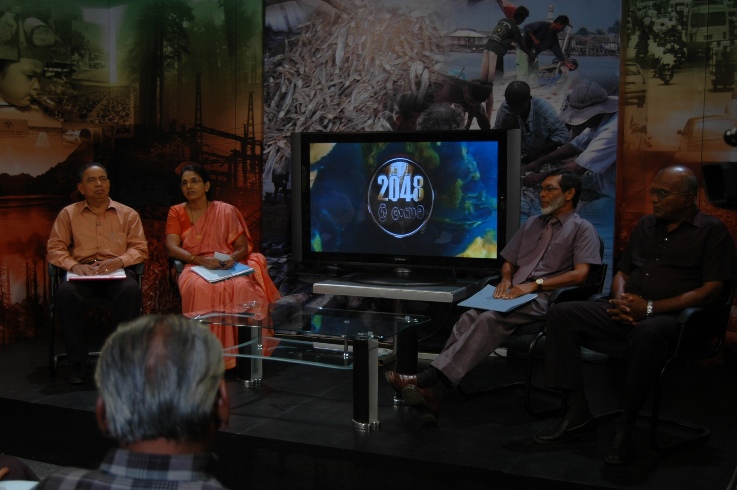
Named Sri Lanka 2048, it is an innovative series of one-hour television debates that explore prospects for a sustainable future for Sri Lanka in the Twenty First Century.

Each debate will involves -– as panel and studio audience -– over two dozen Sri Lankans from academic, civil society, corporate and government backgrounds. They are recorded ‘as live’ and broadcast every Thursday at 10.45 pm, which, in Sri Lankan TV viewing patterns, is the favoured time for serious current affairs and political programmes.

The debates are being co-produced by TVE Asia Pacific, the educational media foundation that I head, in partnership with IUCN, the International Union for Conservation of Nature, and MTV Channel (Private) Limited, which runs a bevy of radio and TV channels including Sirasa TV and Channel One MTV.

The editorially independent series will accommodate a broad spectrum of expertise and opinion.
The debates are based on topics such as managing our waste, reducing air pollution, protecting biodiversity on land and in the seas, and buffering communities from disasters. Two debates in English will look at the nexus between business and the environment, and coping with climate change.

Read detailed news story on TVEAP website
Read series line up and broadcast schedule

Sri Lanka 2048 image montage by The Nation newspaper

The series is based on the overall premise that Sri Lanka has abundant land and ocean resources that can be used to build such a future -– but it faces many challenges in taking the right action at the right time. We believe that public discussion and debate on issues, choices and alternatives is an essential part of this process. Read more on why this series.

Why 2048? For one thing, it’s the year Sri Lanka will mark 100 years of political independence. Being 40 years in the future, the year lies slightly more than a generation ahead, allowing ample time and opportunity to resolve deep-rooted problems of balancing development with conservation.

Sri Lanka 2048 follows an informal, talk show format that allows ample interaction between the panel and empowered audience. Although they take place within a clearly defined scope that enables some focus, all debates are unscripted.

Our amiable moderator Kingsly Rathnayaka (centre in the photo montage above), one of the most versatile presenters on Sri Lankan television today, keeps the panel and audience engaged. By design, we ask more questions than we are able to answer in a television hour (48 mins). But then, we don’t expect to resolve these burning issues in that time – all we can hope to do is to stretch the limits of public discussion.

Logistics and studio size limit the number of our audience to a two dozen. We’ve tried hard to ensure a good mix among them, drawn from all walks of life. To bring in additional voices and perspectives, we insert into each debate 2 or 3 short video reports produced in advance. These highlight solutions to environment or development problems that have been tried out by individuals, communities, NGOs, government agencies or private companies. Played at key points during debates, these help steer discussion in a particular direction.

Sri Lanka 2048 by TVE Asia Pacific

We are already receiving favourable media reviews and coverage. Here are some that appeared in English language newspapers (more have come up in Sinhala newspapers, the language in which most of this series is produced and broadcast):
The Morning Leader, 28 May 2008: Timely action to sustain Sri Lanka’s development

The Sunday Times, 18 May 2008: TV Debate series to create a sustainable future
The Nation, 1 June 2008: Pick the best at Sri Lanka 2048

Sri Lanka 2048 is the culmination of months of research, development and pre-production work carried out by TVE Asia Pacific’s production team in collaboration with IUCN Sri Lanka. Our preparatory work involved consultations with dozens of experts, activists, officials, entrepreneurs – and their various organisations or companies. We synthesize and package their information, opinions and experiences with the dynamic and creative production team at MTV Channel (Pvt) Limited.

The inspiration for this series came from my mentor Sir Arthur C Clarke, with whom I wrote an essay 10 years ago that outlined his personal vision for his adopted country in 2048. The celebrated futurist that he was, Sir Arthur often said that there is a range of possible futures, and our actions – and inaction – determine what kind of future actually happens. Desirable futures don’t just happen; they need to be worked on.

Sri Lanka 2048 is an attempt to discuss how Sri Lankans can pursue economic prosperity without trading off their good health, natural wealth and public order. This is not a series preaching narrowly focused green messages to a middle class audience. We want to rise above and beyond the shrill of green activists, and engage in informed, wide ranging discussions on the tight-rope balancing act that emerging economies like Sri Lanka have to perform between short term economic growth and long term health of people and ecosystems.

Contrary to popular perception, ‘sustainable development’ is not some utopian or technical ideal of environmental activists. It’s about creating a liveable society here and today – where everyone has an acceptable quality of life, ample opportunities to learn and earn, and the freedom to pursue their own dreams.

Doing good television takes a good deal of time, effort and money. This TV series is supported under the Raising Environmental Consciousness in Society (RECS) project of IUCN Sri Lanka, which is funded by the Government of the Netherlands. But neither is responsible for editorial content or analysis, which rests on my shoulders as the executive producer of the series.

And I, in turn, stand on the shoulders of dedicated, hard working production teams drawn from TVE Asia Pacific and MTV Channel (Pvt) Limited. Doing good television is all team work.
Sri Lanka 2048 - Fisheries panel at Sirasa Studio - Photo by TVEAP

All photos courtesy TVE Asia Pacific

Arthur C Clarke on the Future of Food: We need a smarter and kinder world

The leading Indian newspaper The Hindu has just published (on 4 May 2008) my article on the future of food, based on the views of Sir Arthur C Clarke. It can be found here.

I originally wrote this article in mid 2000, based on an interview with the late Sir Arthur Clarke. It was produced at the request of the UN Food and Agriculture Organisation (FAO), which included it in an information pack to mark World Food Day in October that year. No doubt they circulated it among the charmed development circle, but as far as I know (or Google can find), it never appeared in a public media outlet – until now.

I came across this in the weeks following Sir Arthur’s death on March 19, when I was going through manuscripts of our collaborative essays and my interviews with him over the years. The Hindu‘s Sunday Magazine, which earlier printed my essay on Sir Arthur’s views on nuclear weapons in South Asia, agreed to publish it, which they did on 4 May 2008.

The essay, written in Sir Arthur’s first person narrative, makes a number of points that are very relevant to discussions on today’s global food crisis. In fact, these points are more valid today than when they were first made eight years ago.

An extract:

“Meeting everybody’s basic nutritional needs requires a combined approach of the mind and heart – of intellect and compassion. How can we explain the fact that one sixth of humanity goes to bed hungry every night, when the world already produces enough food for all?

“The short answer is that there are serious anomalies in the distribution of food. Capricious and uncaring market forces prevent millions of people from having at least one decent meal a day, while others have an abundance. For the first time in history, the number of severely malnourished persons now equals the number suffering from over-consumption: about a billion each!

“To adapt a remark that my late friend Buckminster Fuller once made about energy: there is no shortage of food on this planet; there is, however, a serious shortage of intelligence. And, I might add, compassion.

Sir Arthur then runs up his famous ‘crystal ball’ to gaze at the near and far future on how humanity can feed itself without damaging the planet. He offers some useful lateral thinking and suggests some unlikely new sources of food.

But all these are short term solutions, he says, because “eventually, the matter will be resolved when we are able to synthesise all the food we ever need, thus no longer depending on other animals to satisfy our hunger.”

Towards the end of the essay, he takes the big picture view:

“Improved communications and the free flow of information will not, by themselves, eradicate either hunger or poverty — but they can be instrumental in the struggle to create a world without these. And when the world’s collective conscience finally succeeds in mobilising sufficient political will and resources to banish those twin scourges, we will be left with another, far more insatiable but far less destructive substitute — the hunger for knowledge and wisdom.”

Read the full essay: The future of food – Arthur C Clarke talks to Nalaka Gunawardene

The other side of Reality TV: When Cicadas kill innocent people…

I have nothing against reality television. It’s a TV programming format that, according to Wikipedia, presents purportedly unscripted dramatic or humorous situations, documents actual events, and features ordinary people instead of professional actors.

In fact, I’ve been telling my friends who are factual film-makers that we can learn a thing or two from the recent successes of some reality TV shows.

But everything has its sane limits — and evidently these were exceeded in the recent controversy involving a British TV production company that stands accused of starting a ‘flu epidemic that left four people from a tribe of isolated Peruvian Indians dead and others seriously ill.

Matt Currington (in photo above, on the right), a London-based documentary maker, has been blamed for triggering a “mini-epidemic” in the village of 250 people which led to the deaths of three children and one adult of the Matsigenka people, who live in the isolated Amazonian Cumerjali area of south-eastern Peru.

The 38-year-old was employed by Cicada Films as researcher when he travelled to the area with a guide last year to scout for locations for the World’s Lost Tribes series, which airs on the Discovery Channel.

Here are some extracts from the story that appeared in The Guardian newspaper in the UK on 27 March 2008, written by its environment correspondent John Vidal:

The regional Indian rights organisation Fenama, government officials and a US anthropologist working in the region said in statements seen by the Guardian that a two-person crew working for London-based Cicada Films had visited groups of isolated Indian communities despite being warned not to. Fenama said the film team travelled far upriver and provoked an epidemic. It accused them of threatening the lives of Indians and called for Cicada Films to be barred from entering the area again.

It is understood the company was scouting for a location to set a TV show for Mark Anstice and Olly Steeds, in which the two British presenters would live with a remote tribe, in exchange for gifts. The company has already filmed episodes in New Guinea.

According to the Peruvian government’s protected areas department, Cicada was given a permit to visit only the community of Yomybato. It expressly prohibited visits to uncontacted or recently contacted Indians. “The Cicada team entered [remote headwaters] which are part of the strictly protected zone,” it said.


Read the full story: British reality TV crew accused as flu kills four in isolated Peruvian tribe

In case you think this is some left-wing or liberal conspiracy, read also The Times London story: TV researcher brought fatal flu to Amazon tribe.

The American anthropologist, Glenn Shepard, who met the film team on location, said he had urged them not to make the trip to the Cumerjali settlements, “where people were vulnerable to western illnesses”. “Reality tv seeks ever more dangerous, remote and exotic locales and communities,” he said.

Stephen Corey of the international tribal rights organization, Survival International, agreed. “There has been a whole rash of bizarre and extreme programmes on tribal rights. The key issue here is sensitivity which is not often a priority for television companies,” he said.

Survival International news: British TV company accused of bringing ‘epidemic’ to isolated Indians

British TV company deny allegations about Peru visit

Image from Survival International Image from Survival International

According to Survival International, Cicada Films previously caused controversy with a documentary about an expedition to visit Indians in Ecuador, which allegedly provoked an attack from uncontacted Waorani Indians.

But Cicada is certainly not alone when it comes to exploiting marginalised people in the global South in the course of film-making. And reality TV is not the only format of TV film making that often oversteps the ethical boundaries in search of a ‘good story’.

As I have been saying for sometime now, documentary film-makers and TV news gathering crews are equally guilty of many excesses, lapses and gross abuses all perpetrated in the name of media freedom.
Aug 2007 blog: Wanted – Ethical sourcing of international TV News

Nor is this sinister trend entirely new. I opened a September 2007 blog post with this bizarre request: “Can you help us to film a child’s leg being broken?” This was made by a visiting Canadian TV crew in the 1970s to my friend Darryl D’Monte, one of the most senior journalists in India and former editor of the Times of India.

This was in connection with a brutal practice that was believed to exist in India, so that forcefully maimed children could be employed as beggars. When Darryl was outraged, the film crew had shrugged off saying: “It’s going to happen anyway”.

December 2007: “Hands up who’s poor, speaks English – and looks good on TV!”

Film-makers and TV journalists roam the planet exercising their license to protect and promote the people’s right to know, and in the public interest. But this privileged position is grossly abused when they allow the end to justify their highly questionable means.

Commenting on TV’s latest crime against voiceless people, India’s Down to Earth magazine (30 April 2008 issue) says:

“These forays of reality tv perpetuate an imagery conceived by a 19th century alliance of anthropologers and photographers, that of tribals in their “innocent” state. It’s another matter these images were taken after the tribal groups were ravaged by colonialism.

“Today in the era of digital images when computer games mimic real wars, it might be hard for even the most naive eye to believe what it sees. But tv casts an enormous sway over audience perception and digitization has, in fact, aided it. We know of the images, not the circumstances in which they were taken. We believe them though they might be contrived. That’s why reality tv is dangerous.”

Read Down to Earth leader: Television has new stars

Don’t say a word: Men, women and Bruno Bozzetto

I just wrote a blog post titled Children of Heaven: Appreciating the sound of silence. Reviewing the 1997 movie by Majid Majidi, I remarked about his strategic use of silences in his soundtrack – we must never underestimate its power in the right place.

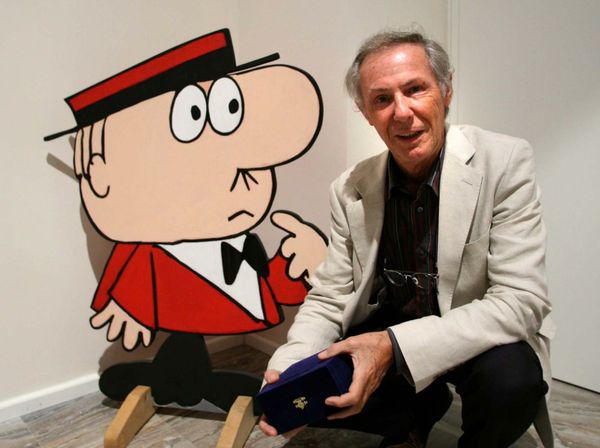
Other creators of moving images do their magic with a good sound track – but sometimes without using a word of dialog. Here’s a clever example I’ve found on YouTube – it is by Italy’s leading animator, Bruno Bozzetto (photos below, courtesy Bruno Bozzetto website).

Bruno Bozzetto

Titled Femminile & Maschile (Feminine and Masculine), this 2-D animation was made in 2004. I can’t find a synopsis online, but one website introduced it simply as follows: Some situations that show the difference of behaviour between men and women in the everyday life.

Anyone with a sense of humour can appreciate this piece – and I hope that includes die-hard feminists…

Here’s the intro from Wikipedia:
Bruno Bozzetto (born March 3, 1938 in Milan, Italy) is an Italian cartoon animator, creator of many short pieces, mainly of a political or satirical nature. He created his first animated short “Tapum! the weapons’ story” in 1958 at the age of 20. His most famous character, a hapless little man named “Signor Rossi” (Mr. Rossi), has been featured in many animated shorts as well as starring in three feature films: “Mr. Rossi Looks for Happiness” (1976), “Mr. Rossi’s Dreams” (1977), and “Mr. Rossi’s Vacation” (1977). Read the rest of his profile on Wikipedia

Earlier this week, to mark Earth Day on 22 April 2008, I took part in a half hour, live interview with Sri Lanka’s highest rated, most popular channel, Sirasa TV. I wanted to relate the global to not just the local but also to the individual and family level. To discuss how our lifestyle choices and consumer decisions affect that planet, I used a series of brilliant cartoon animations that Bruno Bozzetto had done some years ago for WWF.

Again, without having his characters utter a single word, Bozzetto gives out profound messages through images and musical sound track. This is why I keep saying that when it comes to the sheer economy of words, we writers just can’t beat cartoonists.

Sorry, I can’t locate these anywhere online (YouTube lists dozens of his other creations, but not this series — which I can’t even find on his own website.) It’s time for someone to revive this series, for their message is even more relevant for today’s climate-challenged world…

Bruno Bozzetto entry on Internet Movie Database
Visit the official website of Bruno Bozzetto
Watch other Bruno Bozzetto short animations online

Children of Heaven: Appreciating the sound of silence

Courtesy Wikipedia

What’s it with children and shoes? Those who have none dream of owning their first pair. Those who have one, or some, still dream about a better, or perfect, pair. Shoes are worth dreaming about, crying (even fighting?) over, and running races for.

Like Ali did, in Majid Majidi’s superbly crafted 1997 movie Children of Heaven. For 90 minutes this afternoon, my team and I ran the race with little boy Ali, sharing his dreams, sorrows and eventual (albeit bitter-sweet) triumph.

I had seen this film before, but this time around, the experience felt even better than I remembered it. I already knew the story, but I was spell-bound by the film’s culmination – the children’s race where Ali wanted to come third, but ended up winning. I followed the last few minutes with tears in my eyes and the heart beating faster.

This is what good story telling is all about.

Read Children of Heaven synopsis on Wikipedia

Of course, Majid Majidi didn’t work this miracle alone. The superb cinematography of Parviz Malekzaade was well packaged by its editor Hassan Hassandoost. His work is uncluttered and elegant: the story flows in a simple, linear manner with no flashbacks or flash-forwards; no special effects to jazz things up; and the scenes are so seamlessly meshed together with hardly a second being wasted.

And the soundtrack played a vital part in shaping the whole experience. It’s not just the music. As my colleague Buddhini remarked, it also made clever, strategic use of silence.

We might call it the sound of silence – and never underestimate its power in the right place.

All this reminded me of what our Australian film-maker colleague Bruce Moir often said when we worked with him: “We’ve got to remember that film appeals to people’s hearts more than their minds. The way to people’s heads is through their hearts, from the chest upwards — and not the other way round.”

A year ago, I invited him as my special guest to a talk I gave at the University of Western Sydney in Australia – in his home city. There, he once again made the point: “Our fundamental job is to tell a story – one that holds an audience’s interest and moves their heart, regardless of language, cultural context or subject….I have always believed that film achieves its optimal impact by aiming to ‘get at the audience’s head via their heart’…”

April 2007 blog post: Moving images moving heart first, mind next

As I then wrote, I hope this was an ‘Aha!’ moment to some in our largely academic and activist audience. Many who commission films or even a few who make films tend to overlook this. Especially when they set out trying to ‘communicate messages’.

Bruce never tires of saying: “Film is a lousy medium to communicate information. It works best at the emotional level.”

Children of Heaven is living proof of this. It has no lofty agenda to deliver information or communicate messages of any kind. Yet, by telling a universal story set in modern day Iran, it brings up a whole lot of development related issues that can trigger hours of discussion: not just the rich/poor or rural/urban disparities, but other concerns like how a country like Iran is portrayed in the western news media.

As a colleague remarked after today’s film, she had no idea of this aspect of life in Iran — the version we constantly hear is of an oil-rich, nuke-happy, terror-sponsoring theocracy that, to the incumbent US president at least, is part of the ‘axis of evil‘. And the Al Jazeera International channel, packed with BBC discards or defectors, has done little to change this popular perception.

We watched the movie as part of our monthly screening of a feature film. We are lining up critically acclaimed films from different cinematic traditions of the world. And then we discuss its artistic, technical and editorial aspects.

As for me, I totally agree with the famous movie critic Roger Ebert, who wrote in the Chicago Sun-Times at the time of the movie’s first US release: “Children of Heaven is very nearly a perfect movie for children, and of course that means adults will like it, too. It lacks the cynicism and smart-mouth attitudes of so much American entertainment for kids and glows with a kind of good-hearted purity. To see this movie is to be reminded of a time when the children in movies were children and not miniature stand-up comics.”

As he summed it up: “Children of Heaven is about a home without unhappiness. About a brother and sister who love one another, instead of fighting. About situations any child can identify with. In this film from Iran, I found a sweetness and innocence that shames the land of Mutant Turtles, Power Rangers and violent video games. Why do we teach our kids to see through things, before they even learn to see them?”

Note: The film, originally made in Persian, was named Bacheha-Ye aseman . It was nominated for an Academy (Oscar) Award for the best foreign film in 1998, but lost out to a worthy competitor, Roberto Benigni’s Life is Beautiful.

Women on the Frontline: Reporting from the battlefront at…home!

“Violence against women threatens the lives of more young women than cancer, malaria or war. It affects one in three women worldwide. It leaves women mentally scarred for life — and it is usually inflicted by a family member.”

With these words, Annie Lennox, the British singer and social activist, presents a new global series of investigative television documentaries called Women on the Frontline that begins on the global satellite TV channel BBC World today, 18 April 2008.

The seven half-hour films shine a light on violence against women and girls in different parts of the world – East and West, North and South. The series takes the front to homes, villages and cities of our world where a largely unreported war against females is being waged.

Read my Feb 2008 blog post: Half the sky, most of the suffering…

The films cover Nepal, where thousands of women are trafficked each year; Turkey, where killing in the name of honour continues; Morocco, where women political activists who have survived torture and imprisonment testify before a government truth and reconciliation commission; the DRC, where women bear the brunt of a 10-year war in the eastern provinces; Colombia, where women have been tortured in the shadow of a guerilla war; Mauritania, where women who have been raped may go to prison; and Austria, where, under a new law, perpetrators of domestic violence are forced to leave home.

Here’s the line up of depressing reports in this series, produced by Geneva-based dev tv and London-based One Planet Pictures – both international partners of TVE Asia Pacific.

Nepal: A Narrow Escape
Turkey: Killing in the Name of Honour
Morocco: Never Again
Democratic Republic of Congo: Find a Word for It
Austria: Showing the Red Card
Mauritania: No film name known yet
Colombia: Justice in the Region of Death

Check dev tv website for broadcast times on BBC World

On the Frontline… is a ‘vehicle’ for independent producers to tell compelling stories about the people who uphold civil society where it is most at threat. The strand started with the 2006 pilot series Doctors on the Frontline, a profile of Medecins Sans Frontieres (MSF) field doctors made by Dev TV film-makers.

Since then, the series has covered villages battling desertification and land degradation, nurses and para-medics on humanitarian missions in hot spots of the world, and children living with social and environmental disintegration.

On the Frontline has gone behind the lines with rebels and filmed among violent street gangs but this time we’ve taken the frontline mostly into the home, where even after 20 years in production, I’m still shocked to see how many obstacles lie between women and equality, and the violence they must still endure,” said Robert Lamb, Executive Director of the series.

A number of UN agencies, including UNFPA and UNIFEM, donor countries such as Austria, non-governmental organizations and other partners provided information and support for the latest series of Women on the Frontline.

Soon after its initial run on BBC World, the series will be distributed in the Asia Pacific region by TVE Asia Pacific.

Read official brochure of Women on the Frontline TV series

March 2008 blog post: Unseen women, unheard voices

Mallika Wanigasundara: Trail-blazer in issue-based journalism

I seem to be writing many obituaries and tributes these days. Following the several I wrote on Sir Arthur C Clarke and the blog post I did on Cambidian photojournalist Dith Pran, I want to share this tribute I wrote today on a senior Sri Lankan journalist who embarked on her final voyage this weekend.


Mallika Wanigasundara:
Trail-blazer in issue-based journalism

Mallika Wanigasundara, who passed away on 4 April 2008 aged 81, was a talented and sensitive Sri Lankan journalist who went in search of causes and process that shape the everyday news headlines. In doing so, she blazed new trails in issue-based journalism, covering topics ranging from health and environment to children, women and social justice.

It was only last year that the Editors Guild of Sri Lanka and the Sri Lanka Press Institute presented her the Lifetime Achievement Gold Medal for Excellence in Journalism.

Mallika was associated with the Sri Lankan media in one capacity or another for over half a century. Starting her professional career in 1956 with the Sinhala evening daily Janatha, she later moved on to English language journalism at Lake House where she worked first in The Observer and then at Daily News. It was as Features Editor of this oldest English daily that she played a key role in practising and nurturing development journalism. She helped evolve the genre to new levels of professionalism, liberating it from the typecast of politically motivated, sometimes fabricated ‘sunshine’ stories that had been forced on the state-owned Lake House newspapers during the 1970s.

Mallika also helped put Sri Lanka on the world map of development journalism. Beginning in the early 1980s, she contributed Sri Lankan stories to Depthnews, published by the Press Foundation of Asia based in Manila, and to Panos Features, syndicated globally by the Panos Institute in London. In those pre-web days, these services – when printed in newspapers and magazines – were among the most dependable sources for ground level reporting from far corners of the world. (Alas, both services have since gone the way of the Dodo – not to mention Asiaweek, South and Gemini.)

Although I grew up in the 1980s reading her writing in Daily News, my own contacts with Mallika were few and far between. The first was indirect and happened in the late 1980s, when as an eager young reporter I started contributing to Panos Features, syndicated from London to several hundred newspapers around the world. Mallika remained the Panos Sri Lanka correspondent and I was merely a stringer. Donatus de Silva, then head of programmes at Panos London, somehow found a clear niche for both of us. At the time, Mallika and I exchanged occasional communications.

As a novice, I studied Mallika’s approach and style, and emulated them both. Hers was an easy, reader-friendly prose: it brought in both expert views and grassroots insights, but with none of the technicality or pomposity – and very little editorialising. Although she was fully supportive of the various social and environmental causes, she didn’t allow activist rhetoric to dominate her journalism. She also ventured beyond the predictable ‘green’ issues to cover many ‘brown’ issues. Two decades after the Brundtland Commission on Environment and Development (1987) that thrust sustainable development into the global agenda, it’s precisely this kind of journalism that’s needed to make sense of our fast-moving, slowly-baking, topsy-turvy world.

Mallika continued to be an active freelancer after she retired from Lake House. She seemed more prolific in retirement – she continued to chronicle the rise of the environmental movement in Sri Lanka, which emerged from citizen campaigns to save the Sinharaja rain forest from state-sponsored logging and evolved through crises and protests in the 1980s and beyond.

In 1990, she was selected by the United Nations Environment Programme for the Global 500 award that recognised environmental achievements of individuals and organisations. She was the first Sri Lankan journalist to be thus honoured, and one of only four Sri Lankans to be inducted into this global roll of honour that eventually included over 600 persons or entities worldwide.

At the time, I was hosting a weekly TV quiz show on Rupavahini (national TV) and decided to set one of my questions on Mallika receiving the Global 500. I phoned her to offer my congratulations and asked for a photo that we may use on the TV show. She was happy to be the basis of a question, but declined giving a photo, saying: ‘I don’t look good in photos or on TV’.

It was characteristic of many accomplished journalists of her generation that they remained mostly in the background, shaping news coverage and analysis. Some even didn’t nurture a personal by-line, writing under pseudonyms or simply not signing their names on their work. What a contrast with the image-conscious, in-your-face radio and TV journalism of today, where even respected newspaper editors eagerly pursue parallel careers as talk show hosts or TV pundits.

Read my essay on environmental journalism 20 years after Brundtland, published in SciDev.Net in April 2007

TVE Asia Pacific says Thank You to Sir Arthur C Clarke

In his 1992 book How the World Was One, Sir Arthur C Clarke described a dream: one day in the near future, CNN founder (and then owner) Ted Turner is offered the post of World President, but he politely turns it down – because he didn’t want to give up power!

Just three years later, the then Secretary General of the UN suggested that CNN should be the 16th member of the Security Council. Sir Arthur was fond of quoting this, and once famously told Turner: “You owe me 10 per cent of your income”.

These references – illustrating the power of globalised satellite television – are recalled in TVE Asia Pacific‘s official tribute to Sir Arthur C Clarke, who passed away on March 19 aged 90.

“With the death of Sir Arthur C Clarke, TVE Asia Pacific has lost a long-standing friend and supporter,” the tribute says.

It adds: “Since our establishment in 1996, Television for Education Asia Pacific – to use our full name – has been engaged in pursuing Sir Arthur’s vision of using the potential of moving images to inform and educate the public. Our founders chose to focus on covering development and social issues, with emphasis on the Asia Pacific region – home to half of humanity and where Sir Arthur spent the last half century of his life.”

Although he never held a formal position at TVEAP, Sir Arthur was an informal adviser and mentor to the regional media organisation whose work across Asia Pacific is only possible thanks to the comsat that invented and the web that he inspired.

By the time TVEAP was created in the mid 1990s, the satellite TV revolution was well underway in the Asia Pacific region, and the internet revolution was just taking off. In informal discussions, Sir Arthur advised us to always keep our eyes open on what’s coming up. In the ICT sector, he cautioned, being too closely wedded to one technology or system could lead to rapid obsolescence.

The tribute mentions Sir Arthur’s specific support for the Children of Tsunami media project, and the Communicating Disasters publication.

We also talk about Sir Arthur’s concerns about using information and communication technologies (ICTs) to benefit the poor and other disadvantaged groups – a process that he aptly described as ‘geek to meek’.

We end by recalling how TVEAP recorded and uploaded to YouTube Sir Arthur’s last public video address – his 90th birthday reflections in December 2007.

Read TVEAP’s tribute to Sir Arthur C Clarke, 1917-2008

sir-arthur-clarke-reflecting-on-90-orbits.jpg

Listen to our Planet in Distress: Arthur C Clarke’s Last Call

Author and underwater explorer Arthur C Clarke, who died last week aged 90, may not have been a placard-carrying, greener-than-green environmental activist. But in his own unique style, he supported a range of environmental concerns – from the conservation of gorillas, whales and dolphins (among his favourite species) to the search for cleaner energy sources that would enable humanity to kick its addiction to oil.

This interest was sustained to the very end. In his last public speech delivered a month before his demise, he stressed: “There has never been a greater urgency to restore our strained relationship with the Earth.”

The speech was an audio greeting to the global launch of the International Year of Planet Earth (IYPE), held on 12 – 13 February 2008 at UNESCO Headquarters in Paris. Sir Arthur provided the closing remarks for the 2-day meeting attended by diplomats, scientists and youth from all corners of the world.

In that address, which he had recorded from his sick bed in Colombo, Sri Lanka, in early February, Sir Arthur said:
“The International Year of Planet Earth is being observed at a crucial juncture in our relationship with the planet. There are now clear signs that our growing numbers and our many activities are impacting the Earth’s natural systems, causing planetary stress.”

IYPE

He added: “We have had local or regional indicators of this stress for decades, and more recently we have confirmed our unmistakable role in climate change. If we’re looking for the smoking gun, we only need to look in the mirror…”

He outlined his wish for the ambitious IYPE, which is led by geoscientists around the world to raise more awareness and inspire action on understanding how our planet works. “I sincerely hope that the Year of Planet Earth would mark a turning point in how we listen to Earth’s distress call — and how we respond to it with knowledge, understanding and imagination.”

The full text of Sir Arthur’s greeting is found as a pdf on IYPE’s official website, which also offers the actual greeting as an audio file – but only in Apple Quicktime. For those who are not part of that limited universe, I reproduce Sir Arthur’s speaking text in full below.

I had the privilege of once again working on this text with Sir Arthur as I did for many years on various other video/audio greetings and essays. This was originally going to be a video greeting, but we decided to just capture it in audio as Sir Arthur was confined to bed with a back injury since early 2008.

Listen to the audio track on TVEAP’s YouTube channel:

Audio greeting by Sir Arthur C Clarke
to the global launch event of International Year of Planet Earth 2008
UNESCO Headquarters, Paris: 12 – 13 February 2008

Hello! This is Arthur Clarke, speaking from my home in Colombo, Sri Lanka.

I’m very happy to join you on this occasion, when the International Year of Planet Earth is being inaugurated at the UNESCO Headquarters in Paris.

I’m sorry that my health does not permit me to join you in person.
I have fond memories of attending major international conferences at UNESCO over the years. I’ve always cherished my close association with the organisation, especially since I received the UNESCO-Kalinga prize for popularisation of science in 1961 – a date that now seems to belong to the Jurassic era!

The International Year of Planet Earth is being observed at a crucial juncture in our relationship with the planet. There are now clear signs that our growing numbers and our many activities are impacting the Earth’s natural systems, causing planetary stress. We’ve had local or regional indicators of this stress for decades, and more recently we’ve confirmed our unmistakable role in climate change. If we’re looking for the smoking gun, we’ve only got to look in the mirror…

So there has never been a greater urgency to restore our strained relationship with the Earth.

In such a conversation, who speaks for the Earth?

Almost 30 years ago, my late friend astronomer Carl Sagan posed this question in his trail-blazing television series Cosmos. And this is how he answered it:
“Our loyalties are to the species and to the planet. We speak for earth. Our obligation to survive and flourish is owed not just to ourselves, but also to that cosmos ancient and vast from which we spring!”

I sincerely hope that the Year of Planet Earth would mark a turning point in how we listen to Earth’s distress call — and how we respond to it with knowledge, understanding and imagination.

My mind goes back to the International Geophysical Year, which was observed in 1957 – 58. Both the former Soviet Union and the United States launched artificial satellites during that period, thus ushering in the Space Age. Going to space was an important evolutionary step for our species – one that distinguishes our period in history from all the preceding ones. For the first time, we could look back on our home planet from a vantage point in space, and that gave us a totally new perspective.

The beautiful images of Earth from space inspired much public interest that led to the Earth Day and the global environmental movement in the 1970s.

Of course, I’ve suggested that ‘Earth’ is a complete misnomer for our planet when three quarters of it is covered by ocean. But I guess it’s a bit too late now to change the name to planet Ocean!

Fifty years after the IGY and the dawn of the Space Age, do we know enough about how our planet operates?

Thanks to advances in earth sciences and space sciences, we have unravelled many mysteries that baffled scientists for generations. We now monitor the land, atmosphere and ocean from ground-based and space-based platforms. Armies of scientists are pouring over tera-bytes of data routinely gathered by our many sentinels keeping watch over our planet.

We don’t yet fully understand certain phenomena, and there are still gaps in how we process and disseminate scientific knowledge. This is why, for example, the Indian Ocean tsunami of December 2004 arrived without public warnings in Sri Lanka and many other coastal regions. Within minutes of the undersea quake off Sumatra, geologists and oceanographers around the world knew what was happening. But they lacked the means of reaching authorities who could evacuate people to safety.

For this reason, I’m very glad to hear that the Year of Planet Earth is placing equal emphasis on creating new knowledge and its public outreach. Today, more than ever, we need the public understanding and engagement of science. As UNESCO has been advocating for 60 years, public engagement is essential for
science to influence policy and improve lives.

In fact, with our planet under stress, we often have to act before we fully understand some natural processes. That is where we have to combine our best judgement and imagination.

We also need to change the way our resources and energy are used. Our modern civilisation depends on energy, but we can’t allow oil and coal to slowly bake all life on our planet. In my 90th birthday reflections a few weeks ago, I listed three wishes I dearly want to see happen. One of them is to kick our current addiction to oil, and instead adopt clean energy sources. For over a decade, I’ve been monitoring various new energy experiments, which have yet to produce commercial scale results. Climate change has now added a new sense of urgency to this quest.

So we face many challenges as we embark on the International Year of Planet Earth. I hope this year’s many activities will help us to better listen to our home planet, and then to act with knowledge and imagination.

This is Arthur Clarke, wishing you every success in this endeavour.

Earth Day Flag


Listen to the audio file on IYPE website (only with Apple Quicktime)