Appeal to climate reporters everywhere: Don’t follow the Climate Circus!

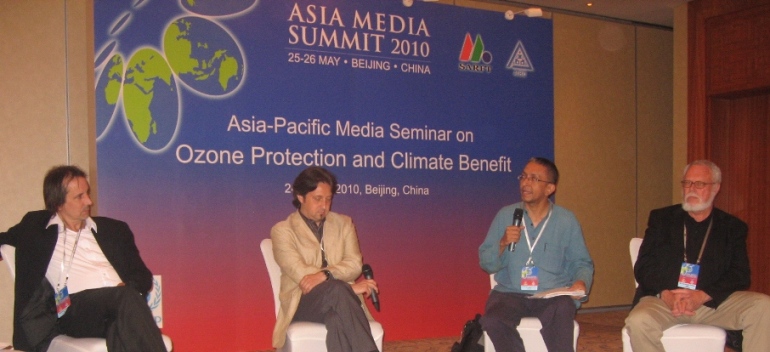
L to R: Sam Labudde (EIA); Eric Soulier (Canal France International); Nalaka Gunawardene (speaking); and Durwood Zaelke (IGSD)

Every year, a couple of weeks before Christmas, a big Climate Circus takes place. The venue city keeps changing, but the process is always the same: it attracts thousands of people – from government officials and scientists to activists and journalists – who huddle in various corners, chat endlessly and gripe often during two chaotic weeks. Then they disperse, rather unhappy with the process…only to return to more of the same a year later.

This is how I see the annual Conference of Parties (COP) of the UN Climate Convention, or UNFCCC. Their last big ‘circus’ was in Copenhagen, Denmark — when the world held its breath for a breakthrough in measures to reduce greenhouse gas emissions that warm up the planet. But, as with many previous conferences, Copenhagen over-promised and under-delivered.

The next COP is to take place in Cancún, Mexico, in December 2010. We can expect more of the same.

I’m not always this cynical. I’m certainly not a climate skeptic or climate change denialist. But I came to this conclusion after covering climate change stories for over 20 years, and having seen the kind of distraction the annual Climate Circus can produce on the media coverage and fellow journalists.

My contention: COPs were intended for treaty-signing governments to come together, bicker among themselves and make slow, painful and incremental progress on what needs to be done to address the massive problems of global climate change. While the core of these conferences remains just that, over the years they have gathered so much else — side events that now completely outweigh the political conference, and often overshadow it. I’m not convinced that this is where the real climate stories are, for discerning journalists.

I made these observations in some plain speaking done during a panel at the Asia Media Summit 2010 in Beijing, China, this week. The occasion was the Asia-Pacific Media Seminar on Ozone Protection and Climate Benefit, one of several pre-Summit events held on 24 May 2010 — and the only one on an environmental issue or topic.

I was on the last panel for the day, which looked at the next “hot” ozone and climate related stories. We were asked to give our views on: what are the great stories on the road to COP16 in Mexico at the end of the year?

Forget Cancun, I said. We already know how little it’s going to change the status quo. Why bother with that promises to be a non-event? Must we be this concerned with non-stories in our media coverage? In fact, I suggested: we should give the entire UNFCCC processes a couple of years of benign neglect. The real climate stories are not in the unmanageable chaos that the annual Climate Circuses have become. They are out there in the real world.

In the real world where frontline states and communities are already bearing the brunt of extreme weather…where green energy is making rapid advances…where communities and economies are trying to figure out how to live with climate change impacts even as they reduce their greenhouse gas emissions.

There are plenty of climate stories out there, covering the full range of journalistic interests: human interest, human enterprise, innovation, scientific research, community resilience and others. The challenge to journalists and other climate communicators is to go out there, unearth the untold stories, and bring them out in whatever media, forum or other platform.

I have nothing against climate COPs per se, and hope they can be restored to their original purpose of climate negotiations and working out acceptable, practical ways forward. (And this is certainly not a case of sour grapes: I’ve turned down all-expenses-paid invitations to COPs more than once.)

But we need to be concerned about the Climate Circus Effect on media, activist and educator groups, who seem to dissipate a good deal of their limited energies and resources in turning up at these mega-events. Copenhagen is said to have attracted over 17,000 persons (over 3,000 among them accredited journalists). How much of fruitful interaction and sharing can happen in such a setting? And when all the major news networks and wire services are covering the key negotiations and activities in considerable detail, what more can individual journalists capture and report to their home audiences?

Living as we do on a warming planet, we are challenged on many fronts to question old habits, and change our business-as-usual. The media pack has been running after the Climate Circus for over a dozen years. We need to pause, take stock and ask ourselves: is this the best way to cover the climate story?

And while at it, here’s something else for the UN, conveners of the annual Climate Circus. On World Environment Day 2008, whose theme was ‘CO2: Kick the Habit’, I asked the UN to kick its own CO2 habit. I suggested: “Adopt and strictly observe for a year or two a moratorium on all large UN gatherings (no matter what they are called – Summits, conferences, symposia, meetings, etc.) that involve more than 500 persons. In this day and age of advanced telecommunications, it is possible to consult widely without always bringing people physically together….Practising what you preach has a strong moral persuasive power — even if it goes against addictive habits formed for over 60 years of the UN’s history.”

PS: A global, comprehensive and legally-binding agreement on climate change is unlikely to be delivered at this year’s (Cancun) conference as well, the outgoing head of the UNFCCC, Yvo de Boer, was reported as saying on 27 May, just a few days after our Beijing seminar. See what I mean?

Remembering Saneeya Hussain of Absurdistan, five years on…

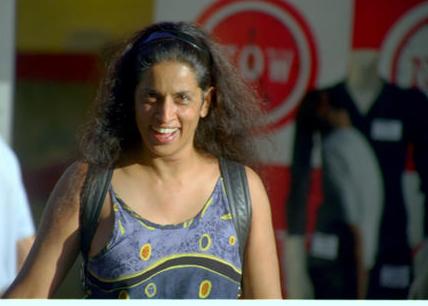
Saneeya Hussain (1954 - 2005)
Exactly five years ago today, journalist and activist Saneeya Hussain left us. Hers was a needless death that left a deep impression in numerous friends she had around the world. We still remember.

We remember Saneeya as a journalist who took a special interest in environment and human rights issues. All her working life, she campaigned tirelessly for a cleaner, safer and more equitable society for everyone, everywhere.

We remember Saneeya as one who supported pluralism – not just in her own country Pakistan, but everywhere. She hated autocrats and military dictators. She spoke out and wrote against unfair domination and agenda setting by a handful of (usually graying) men. She had the courage to suggest re-naming her country as Absurdistan!

We remember Saneeya as a fun-loving, easy-going if slightly absent-minded friend. She wasn’t the most organised person, but was diligent and relentless on causes and issues that she passionately believed in.

Saneeya’s worldwide network of friends have keep her flame alive, and this blog post is as much a tribute to them as it is for Saneeya. Officially, the Saneeya Hussain Trustcontinues her vision and mission.

In fact, the chairperson of the trust (and Saneeya’s mother) Najma Hussain just wrote us a group email, saying: “Let’s share happy memories of Saneeya and celebrate her life.”

She asked: “If you have any anecdotes to share with us please write back. We will love to hear from you.” Saneeya Hussain Trust can be contacted here.

Read my blog post written on Saneeya’s second death anniversary, 20 April 2007, for more of my own memories

Our mutual friend Beena Sarwar has made a 14-minute documentary called Celebrating Saneeya. Here’s the shorter version available on YouTube:

Celebrating Saneeya (August 2005; 14 mins; language: English; Filmed in Karachi, Pakistan, with archives and footage from Brazil, South Africa and Nepal)

Synopsis: Saneeya, with her joyful laugh, lightness of spirit, striking height and long hair, embodied “feminism” and “women’s rights” in the most un-dogmatic way. Living life on her own terms, she countered the trends that militate against women’s individual freedoms in Pakistan. During the repressive years of military dictator General Ziaul Haq she worked as a journalist and was active in the women’s movement that defied the military rule. She also pioneered environmental journalism in Pakistan. Later, while working with the World Commission on Dams in South Africa she met a Brazilian geographer eleven years her junior. Their love story transcended age, culture, religion and nationalities.

In 2004, a severe allergic reaction stopped Saneeya’s breathing and her breathing stopped during a traffic jam in Sao Paulo, preventing her from reaching the hospital in time and sending her into a coma. This documentary is a celebration of her life and all that she stood for, through interviews with her husband, family and friends, and archive material. Sticker on Saneeya’s fridge: “Life is uncertain, eat dessert first”.

Read more about Saneeya Hussain on the trust website

Asia Pacific Rice Film Award 2008/09 – And the winner is…

Winners of the Asia Pacific Rice Film Award 2008-2009 were announced this week. The award was established ‘to recognise excellence in audio-visual creations on rice-related issues in Asia, where most of the world’s rice is grown and consumed’.

The co-organisers, Pesticide Action Network Asia and the Pacific (PAN AP), TVE Asia Pacific (TVEAP) and Public Media Agency (PMA) of Malaysia, invited innovative film-makers from the Asia Pacific region to submit short creative television, video or cinematic films on rice. I was part of the regional panel of judges.

The film winning the first prize is titled SRI – Challenging Traditions, Transforming Lives (10 mins, 2008). It is directed by Gautam Chintamani in Haryana, India.

I found it a well-focused, positive story compellingly told, with an unhurried script — just enough information, not bombarding the viewer with facts and figures. It’s about a new, more efficient way of growing rice called System of Rice Intensification (SRI).

But this is far from a boring instructional film. It focuses on lives of farmers on and off the field (e.g. SRI’s benefits to women farmers – such as less labour and time intensive). The visual experience is completed by the excellent camera work, sound track and seamless editing – altogether a highly professional production that is also a persuasive advocacy film.

Here’s the official synopsis for the film, taken from Vatavaran 2009 film festival website:
A revolutionary method, System of Rice Intensification (SRI) requires almost no standing water for paddy to grow and is fast transforming the rice cultivation. Developed by a French priest Henri De Launi in the 1980’s in Madagascar, SRI not only uses almost half of the water required but drastically reduces the physical labor associated with rice farming besides increasing the yield by almost one and a half times. For a country like India rice is more than just a mere crop.

There are myths attached to its cultivation. While SRI offers an alternate and a very sustainable method of growing rice it also battles hard with the age-old traditional approach of growing rice. The perils of global warming, the drying up of perennial rivers and the excessive use of fertilizers pose numerous threats to rice cultivation; making life very hard for the humble farmer. SRI offers a workable solution to all problems related to traditional rice cultivation.

SRI- Challenging Tradition, Transforming Lives looks at how SRI is helping the modern farmer cultivate India’s traditional crop without the burden that it had become. In addition the film highlights the transformation in the lives of millions of women who toil the hardest in Indian farmers thanks to SRI reducing the need for manual labor. To its critics the System of Rice Intensification might not be the greatest thing but the fact that SRI significantly reduces the demand for water for rice cultivation makes it worthwhile in the current scenario of the world.

Starting out in 2001-02, Gautam Chintamani worked in the capacity of Associate Producer on India’s first daily news spoof show Khabarein Khabardar. There on he did freelance writing for numerous shows for MTV, Sony and Zee amongst others. He has written and directed an 18 min short film, Alterations. In addition to writing for television Gautam Chintamani regualraly writes for the print and electronic media. He has extensively written for Man’s World, Hard News, Media Trans-Asia and MidDay, rediff.com and Buzz in Town. Gautam also worked in the capacity of Associate Director and Executive Producer of the Hindi feature film, Amavas. Of his television work the law drama, Siddhanth (Star One) was nominated for an Emmy in the International Drama section. Gautam’s episode dealing with an HIV positive college student who fights for her basic right to education was selected as a case study for a Writers workshop conducted by Hero’s Group in Hyderabad & Chennai.

Earth Hour 2010: Feels good, but how about tackling ‘vampire power’?

This year’s Earth Hour was observed around the globe this weekend. On Saturday 27 March 2010, millions of businesses and households switched off some or most night lights from 8:30 to 9:30 pm local time.

An estimated one billion people, along with thousands of cities and hundreds of globally famous monuments, switched off their lights according to the organisers, WWF (World Wide Fund for Nature). I couldn’t participate personally, as I was flying through that night from Amsterdam to Singapore.

Originating in Australia in 2007, Earth Hour has become a global event held on the last Saturday of March every year. It asks households and businesses everywhere to voluntarily turn off their non-essential lights and other electrical appliances for one hour (60 minutes) as a way to raise awareness on the need to act on climate change.

For sure, Earth Hour is mostly symbolic – we can’t save enough electricity in just an hour to make any dent in our planetary energy consumption. But it reminds us of the need to conserve energy whenever and wherever we can — and reinforces the fact that the climate crisis is very closely linked to how we generate and use energy.

Indeed, night lights are one of the most visible indicators of energy use. In my writing and talks, I keep using this composite NASA image of the Earth at night shows, energy use is also proportionate to the level of economic activity and social development. Asia accounts for a good deal of the world’s lights at night.

Earth at night - NASA composite image

There is a better way to involve everyone, everywhere in an on-going way to save significant amounts of electricity: tackle the growing concern about Standby power.

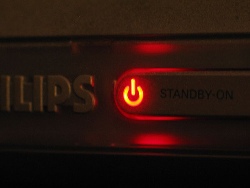
A large number of electronic and electrical products — from TVs and microwave ovens to air-conditioners — cannot be switched off completely without being unplugged. These consume power 24 hours a day, often without the knowledge of the consumer. This is called ‘standby power’, also known variously as vampire power, vampire draw, phantom load, or leaking electricity. (These vampires draw electricity!).

Standing by, costing us -- and warming the planet...
A very common “electricity vampire” is a power adapter which has no power-off switch. Some such devices offer remote controls and digital clock features to the user, while other devices, such as power adapters for laptop computers and other electronic devices, consume power without offering any features.

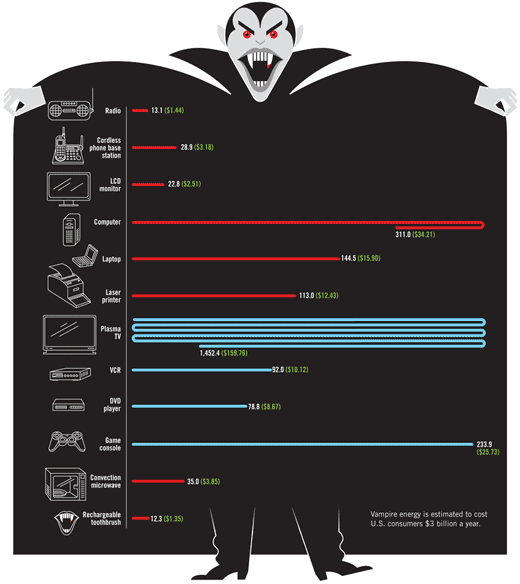
Another example is the typical microwave oven. Over its lifespan, it consumes more electricity powering its digital clock than it does heating food. Yes, heating food requires more than 100 times as much power as running the clock, but then, most microwave ovens stand idle —in “standby” mode – more than 99% of the time.

It’s the cumulative effect that matters here. The wasted standby power (vampire energy loss) of an individual household is typically very small, but the sum of all such devices within the household becomes significant. When we add up millions of such households, it suddenly becomes a whopping number.

Here’s a short video made by Good Magazine, in association with Nigel Holmes, explaining everything about standby power:

In fact, the International Energy Agency (IEA) estimates that standby power accounts for 1% of the world’s total carbon dioxide emissions. For context, all the world’s air travel contributes around 2.5% of global CO2 emissions. But airlines, airports and flights have drawn much more attention – and considerable flak – than this widely distributed energy leakage happening right under most of our roofs…

Standby power consumed by different devices - courtesy Geeks Are Sexy website

Industrialised countries are now more aware of this situation. “An individual product draws relatively little standby power (see here for examples), but a typical American home has forty products constantly drawing power. Together these amount to almost 10% of residential electricity use,” says an entire website dedicated to this topicby the US government’s top-ranked Lawrence Berkeley National Laboratory (LBNL).

Across the Atlantic, the British Government’s 2006 Energy Review found that standby modes on electronic devices account for 8% of all British domestic power consumption.

A similar study in France in 2000 found that standby power accounted for 7% of total residential consumption. Further studies have since come to similar conclusions in other developed countries, including the Netherlands, Australia and Japan. Some estimates put the proportion of consumption due to standby power as high as 13%.

In helpful tips to consumers on saving electricity, the US Department of Energy says: “Many appliances continue to draw a small amount of power when they are switched off. These ‘phantom’ loads occur in most appliances that use electricity, such as VCRs, televisions, stereos, computers and kitchen appliances. These phantom loads can be avoided by unplugging the appliance or using a power strip and using the switch on the power strip to cut all power to the appliance.”

It also advises consumers to unplug battery chargers when the batteries are fully charged or the chargers are not in use. Technical solutions to the problem of standby power exist in the form of a new generation of power transformers that use only 100 milliwatts in standby mode and thus can reduce standby consumption by up to 90%. Another solution is the ‘smart’ electronic switch that cuts power when there is no load and restores it immediately when required.

LBNL also offers advice on how to reduce standby power consumption in our households and offices.

Standby power is receiving more attention at the supply end too, with manufacturers and regulators getting into the act. The One Watt Initiative is an energy saving proposal by the IEA to reduce standby power use in all appliances to just one watt.

The initiative, launched in 1999, aimed to ensure that by 2010 all new appliances sold in the world only use one watt of electricity in their standby mode. The IEA estimates that this can help reduce CO2 emissions by 50 million tons in the OECD countries alone by 2010 — the equivalent to removing 18 million cars from the roads.

IEA fact sheet on reducing standby power

IEA/OECD policy paper (2001): Things that go blip in the night: Standby power and how to limit it

Related June 2008 blog post: Broadcasters and climate change: Turn off your lights, but not your minds!

Counting growth on a warming planet: It’s the eco2nomy, stupid!

‘Climate change is the greatest market failure the world has ever seen,’ said the Stern Review on the Economics of Climate Change that the UK government published in November 2006. This 579-page assessment on the economics of climate change was headed by Sir Nicholas Stern, a former chief economist at the World Bank. The report warned that the world economy will suffer a serious blow if action to slow down climate change was not taken soon. According to Stern,’There is still time to avoid the worst impacts of climate change, if we take strong action now.’

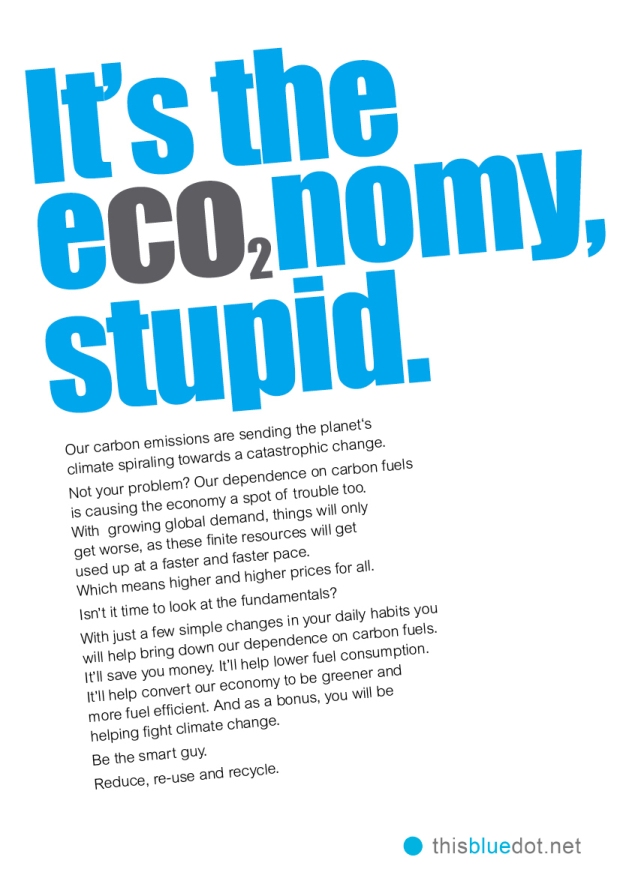
Though not in the same league, this interesting call to action just caught my eye – it reminds us of a slogan that rode Bill Clinton to office in the 1990s, but takes on a whole new meaning now on a warming planet.

The reference given, http://www.palebluedot.net, did not have a working website as at today, 27 March 2010.

The Stern Review is the most comprehensive, rigorous and terrifying report published todate by a finance ministry. It points out that carbon emissions have already increased global temperatures by more than 0.5°C and that with no action to cut greenhouse gases, we will warm the planet another 2 to 3°C within the next 50 years. This will transform the physical geography of the planet and the way we live, with floods, disease, storms and water shortages becoming more frequent.

Stern and his team – no crying-wolf greenies, them – cautioned that the effects of climate change could cost the world between 5% and 20% of GDP, prompting the worst recession since the 1920s. Action to reduce greenhouse gas emissions and the worst of global warming, on the other hand, would cost 1% of global GDP.

Now who’s being stupid?

So you think you can be a Hot-shot? Go right ahead…

A few days ago, commenting on cartoons on climate change, I wrote: “So how do we capture climate change’s multiplicity in visual forms? Photographers go for the evidence and authenticity. Film makers work on both current impacts and future scenarios…”

Now here comes a chance for photographers everywhere to bear witness to the climate crisis slowly unfolding all around us.

The Deutsche Welle Global Media Forum 2010 has started an online photo competition called Hot Shots, to bring attention to the effects that climate change is having on people all over the world.

As the website says, “Hot Shots is…designed to create a visual record of these personal impressions by and for people around the world. The focus is not only on spectacular events, but also on climate change from people’s own, personal perspective.”

Send your photos to hotshots@dw-world.de and show how climate change and global warming are affecting your personal environment. Click here for details on participating and information about prizes.

TV Will Save the World, says Charles Kenny in TIME’s ’10 ideas for next 10 years’

Photo by Reza Deghati

This is one of my favourite photos in media and development. It was taken by Reza Deghati, the renowned Iranian-French photojournalist (who works under the name Reza). I don’t know the story behind this photo, but even without a single word of annotation, it says a great deal.

I like this photo partly because it symobolises the enduring appeal of broadcast television in much of the developing world. For long years, the old-fashioned, boxy TV set used to be the top-selling consumer electronic item in the world — until the mobile phone came along. But even now, the much-maligned idiot box hasn’t lost its appeal to a significant section of humanity, never mind what the jaded academics and geeks might say.

So I was intrigued to read, in the latest issue of TIME Magazine, development economist Charles Kenny, reminding us that television is still the most influential medium around. In this gizmo-ridden new media age, it takes much courage to say so in public.

In a powerful short essay titled ‘TV Will Save the World’, he writes: “Forget Twitter and Facebook, Google and the Kindle. Forget the latest sleek iGadget. Television is still the most influential medium around. Indeed, for many of the poorest regions of the world, it remains the next big thing — poised, finally, to attain truly global ubiquity. And that is a good thing, because the TV revolution is changing lives for the better.”

Across the developing world, he says, some 60% of the households had their own TV set in 2005 — up from 45% in 1995. He adds: “Five million more households in sub-Saharan Africa will get a TV over the next five years. In 2005, after the fall of the Taliban, which had outlawed TV, 1 in 5 Afghans had one. The global total is another 150 million by 2013 — pushing the numbers to well beyond two-thirds of households.”

He ends his essay with these words that strongly resonate with me: “Too much TV has been associated with violence, obesity and social isolation. But TV is having a positive impact on the lives of billions worldwide, and as the spread of mobile TV, video cameras and YouTube democratize both access and content, it will become an even greater force for humbling tyrannical governments and tyrannical husbands alike.”

As Sir Arthur C Clarke, inventor of the communications satellie whose second death anniversary we mark this week, told me in a 2003 interview: “I’m not impressed by the attacks on television because of some truly dreadful programmes. I believe that every TV programme has some educational content. The cathode ray tube – and now the plasma screen – is a window to the world. Often it may be a very murky window, but I’ve slowly come to the conclusion that, on balance, even bad TV is preferable to no TV at all.”

Kenny’s essay is one of 10 ideas for the next 10 years that TIME has put together for its annual innovation issue.

Image courtesy Foreign Policy
The TIME essay is a much compacted version of what he wrote in November 2009 issue of Foreign Policy magazine, titled Revolution in a Box. That article noted the continuing global spread of television sets and an explosion of viewer choice driven by cable, satellite and digital technologies. It suggested this is a good thing, pointing to evidence that access to competitive television can improve womens’ standing in the home, increase girls schooling, reduce fertility rates, lower drug use, improve governance and (possibly) help foster global peace.

The editors of Foreign Policy ran the following blurb: “It’s not Twitter or Facebook that’s reinventing the planet. Eighty years after the first commercial broadcast crackled to life, television still rules our world. And let’s hear it for the growing legions of couch potatoes: All those soap operas might be the ticket to a better future after all.”

The full essay is well worth a careful read. At a time when I have been questioning many of the founding premises of my own work at TVE Asia Pacific, he has provided conceptual clarity and sharper focus.

Where are all the women cartoonists hiding?

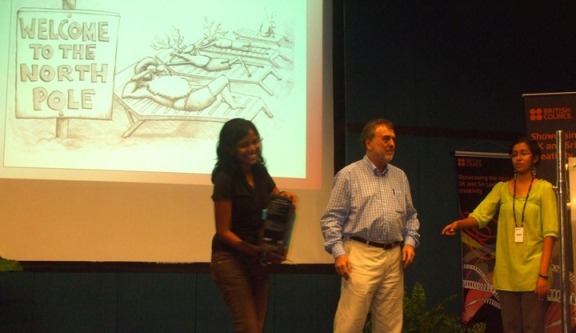
Shamanthi Rajasingham receiving her first prize in climate cartoon contest Sri Lanka

“So how many women cartoonists are working in our newspapers?”

My daughter Dhara, 13, asked me this simple question earlier this month when I was involved in judging Sri Lanka’s first contest of cartoons on climate change, organised by the British Council and the Ken Sprague Fund of UK.

I tried to come up with an answer, and couldn’t think of a single woman cartoonist who works for a print or online media outlet in Sri Lanka. That, despite my long association with the media and also being a great admirer (and collector) of good cartoons.

Later that day, at the awards ceremony for winning and commended climate cartoonists, I posed the same question to leading Lankan cartoonists Wasantha Siriwardena, Winnie Hettigoda and Dharshana Karunatilleke. They too couldn’t name one immediately; later, a single name was mentioned but it’s not one I recognised.

Clearly, cartooning is still a very male dominated profession — but that might soon change, going by the active participation of young women in the climate change cartoon contest.

Shamanthi Rajasingham
In fact, the first and third prize winners were both women — respectively Shamanthi Rajasingham and W M D Nishani. They beat close to 200 other contestants to get there.

Additionally, there were 6 women among the 22 commended cartoonists, and one woman among those 11 who were highly commended — judged on four criteria. See all winning and commended entries.

W M D Nishani
Okay, the four judges were all male (among us, two professional cartoonists). But during this entire judging process, the identity of artists was withheld and we only knew each entry by a number. In fact, we discovered the names (and gender) of artists only at the awards ceremony.

This would be encouraging news to Dhara and all other aspiring young girls and women who want to pursue careers in media. Let’s hope at least some of the women contestants in the climate cartoons contest would end up being more than just hobby cartoonists…

Meanwhile, it’s not just Sri Lanka that has a shortage of women engaged in cartooning, and awareness of their contribution is lacking. A quick Google search brought up a book titled “The Great Women Cartoonists” by Trina Robbins (Watson-Guptill Publications, 2001). Reviewing it in TIME, Andrew D Arnold wrote: “Name three women cartoonists who worked from 1900 to 1950. Okay, just name one. Couldn’t do it? Neither could I until reading a new, invaluable book…”

Afghan boy with a plant: Reza Deghati on nurturing a culture of peace

Capturing the hopes of a nation...

Every photograph has a story behind it, if only we care to ask – or dig deep enough. In October 2007, I wrote about a now iconic photo showing an old Nepali man (Ram Bahadur Tamang) holding a video camera. That image is the logo of Film South Asia festival.

From Reza Deghati, the renowned Iranian-French photojournalist (who works under the name Reza) comes another story – this time from Afghanistan, where the above photo was taken in 1990.

Reza recalls how the photo was taken: “In 1990, the United Nations asked me to put aside my cameras in order to run a humanitarian program in an Afghanistan recently freed from Russian occupation. I had to open a route for wheat shipments needed to feed the population in the Northern Provinces. Eleven years of war against the Soviet Army had devastated the country. Fields lay fallow, roads were impassable, mined or destroyed, and buildings like hospitals and schools were nothing but ruins. I could have given away the wheat. Instead, I decided to barter it for work so as to avoid one of the unfortunate consequences of some humanitarian programs that foster dependence rather than offer new ways to live. Throughout the Province, a new army took shape. This time, men did not carry rifles but shovels.”

“I remember seeing a young Afghan boy coming out of school one day, holding a plant in his hand. He had been watering it carefully. A shoot had sprouted out. I took a picture of him, and asked: ‘What are you going to do with this plant?’ His answer….’I am going to make a tree with it’.

Reza Deghati, photo by Ali Khaligh
Looking back, Reza thinks this may have provided part of the inspiration for setting up Aina, a third-generation humanitarian association that he founded in 2001 in Taliban-free Afghanistan.

Aina now works in Afghanistan, “contributing to the emergence of civil society through actions in the area of education (particularly focusing on women and children), information and communication.” It promotes independent media development and cultural expression as a foundation of democracy.

Reflecting further on the power of images, Reza says on Aina website: “In the early 80s, I discovered wars and the harshest moments of the world as a young photojournalist. I could not just stay there as a mere witness. I was led into thinking over conflicts, repressions, exodus and their burden of known pain, answers as well. As canon roars fade, urgency requires tangible reconstruction. An army of shovel-carrying men starts marching, determined to erase any remaining sign of ruin. Others take care of suffering bodies. Yet, there is an invisible destruction, only known to wounded dignities, that can ruin physical rebuilding efforts in a country and keep it from recovering.

“Those who are not given any intellectual and cultural weapons will go back to their unique reference. The culture of war fosters war. That is how Aina was founded. A third-generation association, Aina has been working on independent media development and culture, everywhere freedom of speech has remained a fragile value. It provides logistical support, state-of-the art technology access and local media and cultural actor training.”

Reza adds, optimistrically: “Today, Aina is like that plant. I hope that it will become a tree of culture, peace and freedom in Afghanistan…”

Cartooning on climate change: Young artists rise to the challenge

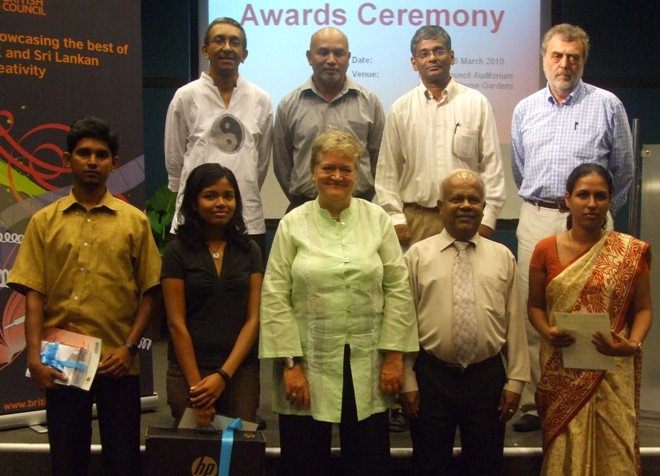
Cartoon contest top prize winners with British Council director and chief guest (all front row) and four judges (all back row) at awards ceremony, Colombo 6 March 2010

Man-made climate change is a complex planetary phenomenon. It has multiple causes and effects – not all of it immediately evident. Different areas of the world are going to be impacted differently and unevenly. Human response to the climate challenge has been patchy, and is mired in so much denial, rhetoric and political posturing.

So how do we capture this multiplicity in visual forms? Photographers go for the evidence and authenticity. Film makers work on both current impacts and future scenarios. What about cartoonists – who have to do their visual metaphors in a limited space that is static and two-dimensional? How much of climate change’s nuance and complexity can they really grasp and convey?

The short answer is: a great deal. On this blog, I’ve written that when it comes to cartoons, less is definitely more. Take, for example, many millions of printed words and probably thousands of minutes of airtime generated around the (over-hyped and under-performing) Copenhagen climate conference in Dec 2009. As I noted in blog posts on 17 Dec, 18 Dec and 21 Dec 2009, it was assorted cartoonists from around the world who summed it all up in a few perceptive strokes. This is why I keep saying that when it comes to commenting on our topsy-turvy times, no one can beat cartoonists for their economy of words.

In late 2009, the British Council and the Ken Sprague Fund of UK organised a cartoon contest on climate change which was open to all Lankan citizens from 18 to 35 years. They offered attractive prizes for anyone who could be ‘seriously funny’ about this global crisis. The participants could submit entries under 6 themes: drought and water shortage; deforestation and rain forest destruction; melting of the ice caps; role of industry in polluting the atmosphere; devastation of our seas and disappearance of marine life; and climate change in an urban environment.

Some 400 entries were received from 175 contestants (each person could submit up to 5 entries) – which surprised and delighted the organisers. During the past few weeks, I have been involved in judging these cartoons to select the top winners and commended entries. Joining me in this enjoyable task were nationally recognised professional cartoonist Wasantha Siriwardena and environmentalist Nimal Perera. We worked with a British counterpart, top cartoonist Michal Boncza Ozdowski.

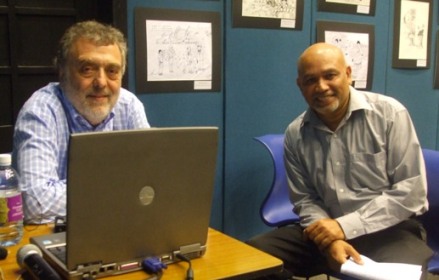
Michal Boncza Ozdowski (L) and Wasantha Siriwardena conducting cartoon workshop
The winners were announced, with awards and certificates, on 6 March 2010. It coincided with a half-day workshop on cartooning conducted by Michal and Wasantha. The chief guest at the ceremony was Camillus Perera, the seniormost Lankan cartoonist still professionally active.

As national judges, we looked at close to 200 cartoon entries that conformed with the contest’s published rules for eligibility. Since comparative ranking of creative works is never easy, we first agreed on four criteria for assessing the very diverse entries: cartoon value and humour; subject relevance to climate change (defined broadly); how effectively the climate related message was being communicated; and clarity and artistic merit of the entry.

Our initial judging coincided with the climate circus in Copenhagen, when we narrowed it down to a shortlist of 40 entries. We then individually scored these cartoons for each of our four criteria. We sometimes had to discuss and demarcate how far the scope of the contest could stretch. For example, when is an entry a good work of art but not a cartoon (more like a poster)? And what are the acceptable limits in the thematic or subject coverage of a vast topic like climate change?

The British Council later shared the full shortlist with Michal Ozdowski, who provided his own rankings and comments. We met again in February 2010 to discuss and reconcile our rankings — and found that our separately done rankings broadly agreed! (Note: During this entire judging process, the identity of artists was withheld and we only knew each entry by a number. In fact, we judges discovered the names only on the day of the awards ceremony, to which all shortlisted contestants were invited.)

Additionally, Michal kindly offered crisp comments about the top three winners, which became citations at the awards ceremony. So here are the winners of climate change cartoon contest 2009:

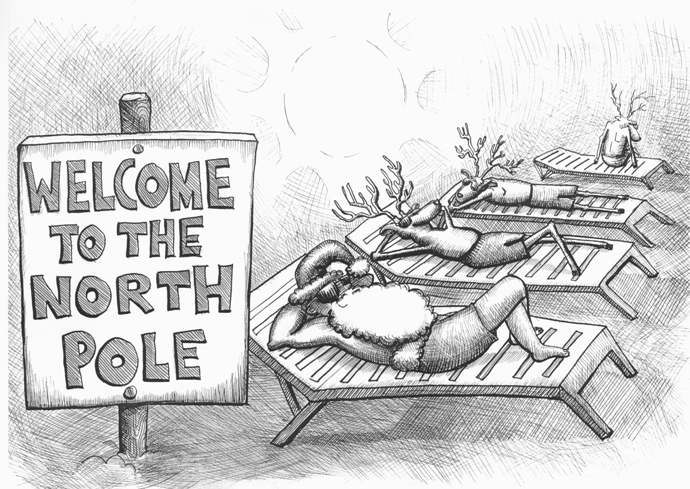
First prize: Welcome to the North Pole! By by Shamanthi Rajasingham

First prize winning climate cartoon - by Shamanthi Rajasingham

Citation for first prize: It is uncomplicated – a great advantage when satirising. Its composition is strong and imaginative, the draughtsmanship confident.

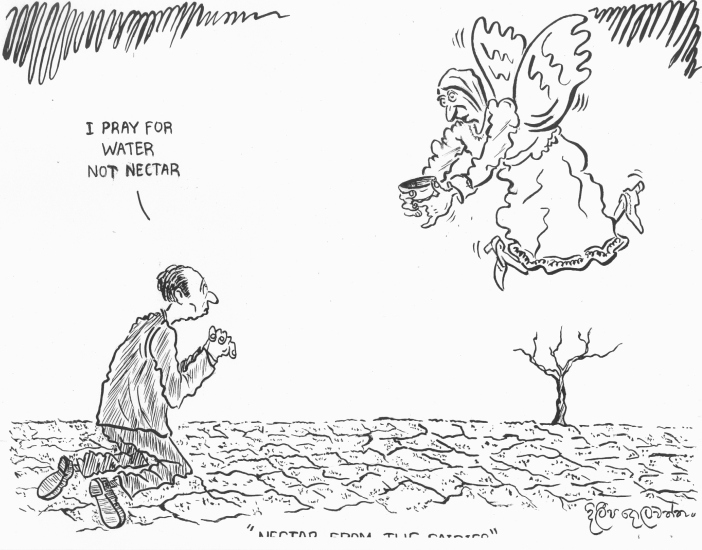
Second Prize: “I pray for water, not nectar” by Dileepa Dolawatte

Second prize winning climate cartoon by Dileepa Dolawatte

Citation for second prize: Apart from the vibrant and highly accomplished draughtsmanship, it lampoons brilliantly the fairy’s naivety – a funny eye-opener. Incorporates very cleverly traditional beliefs and myths. Here we are truly past the dodgy miracles stage in the climate change battles…

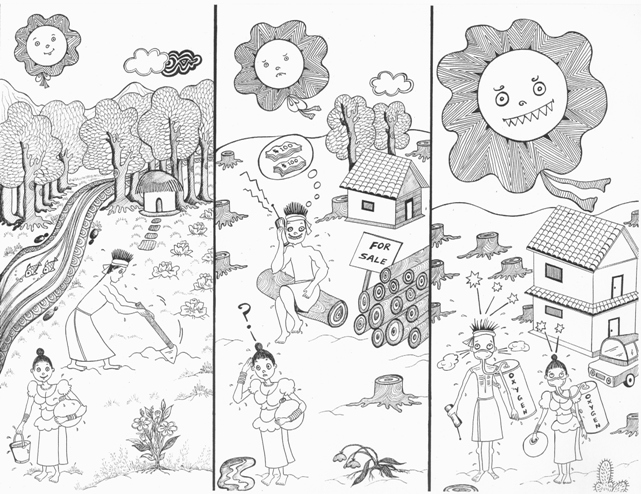
Third Prize: Theme – Drought and water shortage, by W M D Nishani

Third prize winning climate cartoon by W M D Nishani

Citation for third prize: An eloquent, if over-didactic, strip cartoon – could be quite effective in women’s publications. Coherent draughtsmanship catalogues effectively the woes of a ‘get-rich-quick’ development.

See all the highly commended and commended entries on the British Council website.