Remembering the Children of Tsunami, four years later…

Jantakarn Thep-Chuay, known as Beam

For many weeks, Jantakarn Thep-Chuay — nicknamed Beam -– did not understand why her father was not coming home. The eight-year-old girl, in Takuapa in Thailand’s southern district of Phang Nga, had last seen him go to work on the morning of 26 December 2004.

“On that Sunday, the day there was a wave, my dad wore his tennis shoes,” she recalls as she gets into his pair of sandals. “My dad didn’t have to do much work — he just walked around looking after workers.”

Beam’s father Sukaroak –- a construction supervisor at a new beach resort in Khao Lak –- was one of thousands of Thais and foreign tourists killed when the Asian Tsunami hit without warning. His body was never found.

For months, Beam would draw pictures of her family. These, and family photos of happier times, helped her to slowly come to terms with what happened.

The first year was long and hard for the family Sukaroak left behind: Beam, her two-year-old brother Boom, and mother Sumontha, 28. The determined young widow struggled to keep home fires burning -– and to keep her troublesome in-laws at bay.

As if that were not enough, she also had to engage assorted bureaucracies: even obtaining an official death certificate for her late husband entailed much effort.

Just a few weeks after the disaster, the local authorities approached Sumontha suggesting that she gives away one or both her children for adoption. Apparently a foreigner was interested. She said a firm ‘No’.

“Her dad wanted Beam to become an architect. He was hoping for a day when he could build something she draws,” says Sumontha. “If I am still alive, I want to raise my own children. I am their mother. For better or worse, I want to raise them myself.”

The Tsunami destroyed Beam’s school, but she continued to attend a temporary school set up with local and foreign help. Before the year ended, she moved to a brand new ‘Tsunami School’ that the King of Thailand built to guarantee education for all children affected by the disaster.

Sumontha, Beam and Boom are three ordinary Asians who have shown extraordinary courage, resilience and resourcefulness as they coped with multiple challenges of rebuilding their lives after the Tsunami. Theirs is one of eight families that we followed throughout 2005, under our empathetic communication initiative called Children of Tsunami: Rebuilding the Future.

It was a multi-country, multi-media project that tracked how ordinary Asians rebuilt their lives, livelihoods and futures after one of the biggest disasters in recent years. We at TVE Asia Pacific documented on TV, video and web the personal recovery stories of eight affected families in India, Indonesia, Sri Lanka and Thailand for a year after the disaster. Our many media products — distributed on broadcast, narrowcast and online platforms -– inspired wide ranging public discussion on disaster relief, recovery and rehabilitation. In that process, we were also able to demonstrate that a more engaged, respectful kind of journalism was possible when covering post-disaster situations.
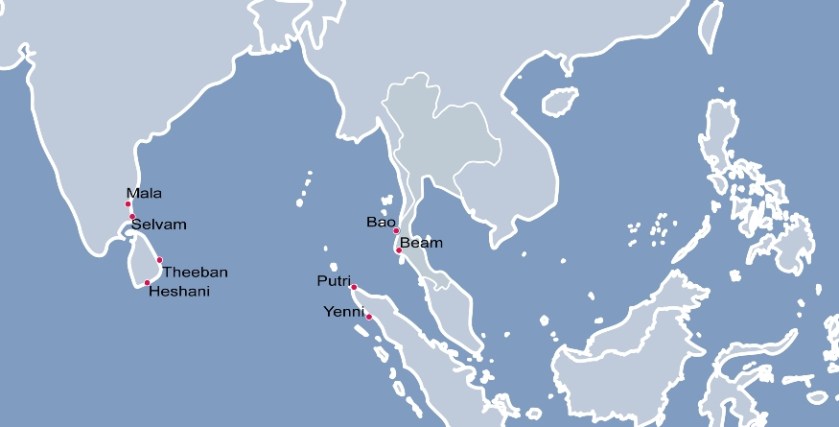
where Children of Tsunami stories were filmed for much of 2005
Four countries, eight locations: where Children of Tsunami stories were filmed for much of 2005

Meet the Children of Tsunami

They have never met each other. Yet they were united first in grief, then in survival. Five girls and three boys, between 8 to 16 years of age, living in eight coastal locations in four countries. Their families were impacted by the Asian Tsunami in different ways. Some lost one or both parents -– or other family members. Some had their homes or schools destroyed. Others found their parents thrown out of a job. During the year, these families faced many hardships and challenges in rebuilding their futures.

These remarkable children were our personal heroes for 2005:
Selvam, 13, Muzhukkuthurai, Tamil Nadu state, India
Mala, 11, Kottaikkadu, Tamil Nadu state, India
Putri, 8, Lampaya, Aceh province, Indonesia
Yenni, 15, Meulaboh, Aceh province, Indonesia
Heshani, 13, Suduwella, southern Sri Lanka
Theeban, 14, Karaitivu, eastern Sri Lanka
Bao, 16, Kuraburi, Phang Nga district, Thailand
Beam, 8, Takuapa, Phang Nga district, Thailand

With their trust and cooperation, we captured their unfolding realities unscripted and unprompted.

Read and experience much more on the Children of Tsunami dedicated website
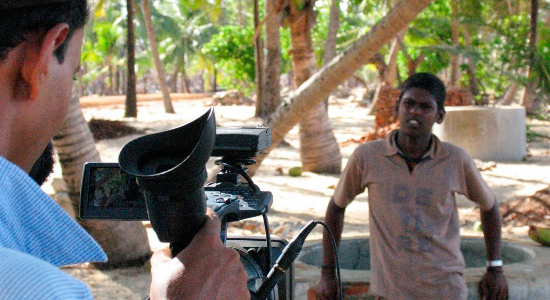
Filming with Theeban in eastern Sri Lanka...now only a memory

As I recalled in early 2007, when we tragically lost one of eight survivor children – Theeban – to Sri Lanka’s civil war: As journalists, we have been trained not to get too attached to the people or subjects we cover, lest they affect our judgment and dilute our objectivity. The four production teams involved in Children of Tsunami initially agreed to follow this norm when we met in Bangkok in early 2005 for our first (and only) planning meeting. We also resolved not to reward our participating families in cash or kind, as they were all participating voluntarily with informed consent.

“But the ground reality was different. 2005, Asia’s longest year, wore on. As survivors slowly patched their lives together again, our film teams found themselves becoming friends of families or playing Good Samaritan. Sometimes our teams would find a survivor family close to starvation and — acting purely as human beings, not journalists — they would buy dry rations or a cooked meal. At other times, finding the children restless or aimless, they would buy them a football, kite or some other inexpensive toy that would produce hours of joy and cheer.

“As commissioners and publishers of Children of Tsunami stories, we didn’t object to these acts of kindness. Journalism with empathy was far preferable to the cold detachment that textbooks recommend.

In 2007, my colleague Manori Wijesekera – who served as production manager of this challenging effort – and I wrote up our definitive account of the project for Communicating Disasters: An Asia Pacific Resource Book. That chapter can be read online here.

Children of Tsunami: The Journey Continues
(25mins) was the end-of-year film that captured the highlights and ‘lowlights’ of our families’ first year following the disaster. It can be viewed online at the Children of Tsunami website.

Children of Tsunami: No More Tears (25 mins) was the shorter version of the end-of-year film that captured the highlights and ‘lowlights’ of our families’ first year following the disaster. We co-produced it with the Singapore-based regional broadcaster Channel News Asia.

Watch the first few minutes on YouTube:

All images courtesy TVE Asia Pacific
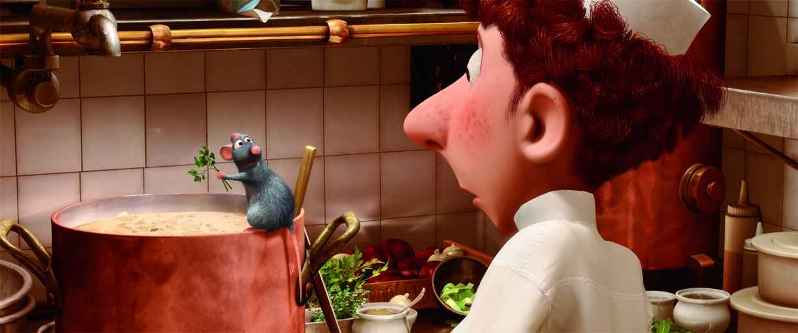
Anyone can make video film, right? Why do we need professionals?

Anyone can cook, right?

I really enjoyed the Disney/Pixar film Ratatouille (2007), which won the year’s best animated feature film Oscar award and deserved it.

Here’s the plot summary from IMDB: Remy is a young rat in the French countryside who arrives in Paris, only to find out that his cooking idol is dead. When he makes an unusual alliance with a restaurant’s new garbage boy, the culinary and personal adventures begin despite Remy’s family’s skepticism and the rat-hating world of humans. Read full synopsis on IMDB

The movie opens with a TV show featuring Chef Auguste Gusteau, owner of the best restaurant in Paris, talking about his bestselling cookbook, which proudly bears his mantra “Anyone Can Cook!”

Well, that’s heretical to the fine artistes of gourmet. But it’s revived the age old debate between fully-trained professionals and new-entrant amateurs, and inspired some interesting discussions online. One blogger thought: “Remy the rat is a perfect metaphor for the non-expert Web 2.0 knowledge maker. He has no credentials and must prove himself through his actual knowledge and application of knowledge rather than through credentials.”

He added: “What’s the moral of the story? Even without being an acknowledged expert on a topic, if you work hard to express your ideas in clever ways, you too can be respected for what you know.”

I’ve only just read these views, but they resonate with what I felt when I watched the movie in late 2007. The story certainly reminded me of a heated debate in my own field of moving images: can anybody and everybody make video, now that the tech barriers and costs have come down? If this is the case, what’s the point of having highly trained, better paid professionals who do it for a living?

I shan’t try to resolve that debate here. But here’s an interesting take on the debate from the Onion News Network. They report: YouTube is offering a cash prize to the first user to upload a video with a shred of originality or artistic merit.

Michael Crichton (1942-2008): Foresaw the fate of ‘Mediasaurus’

Death has no sense of timing, but it sometimes leaves traces of irony. The day Americans were electing an energetic and articulate senator from Chicago as their next president, one of Chicago’s most celebrated citizens lost his battle with cancer.

Michael Crichton
, who died on 4 November 2008, was trained as a medical doctor but played several roles in the creative arts world. He was a prolific author of science fiction and medical fiction, whose books have sold over 150 million copies worldwide. He also produced and directed techno-thriller movies, and was the creator of the highly successful medical drama series on television, ER (Emergency Room), now in its 15th season.

In the domain of popular culture, Crichton was best known for writing Jurassic Park (1990). This cautionary tale on unrestrained biological tinkering was turned into a blockbuster movie by Steven Spielberg in 1993. It became the highest earning film up until that time.

Before and since, Crichton used his technical training, vivid imagination and mastery of English to spin some of the most enjoyable – and scary – stories that often depicted scientific advancements going awry, resulting in the worst-case scenarios. A notable recurring theme in Crichton’s plots is the pathological failure of complex systems and their safeguards, whether biological (Jurassic Park), military/organizational (The Andromeda Strain), technical (Airframe) or cybernetic (Westworld).

Crichton was also a talented essayist who wrote perceptive pieces of non-fiction about science, society and culture – including the role of media. It is one such essay that I would like to recall in his memory.

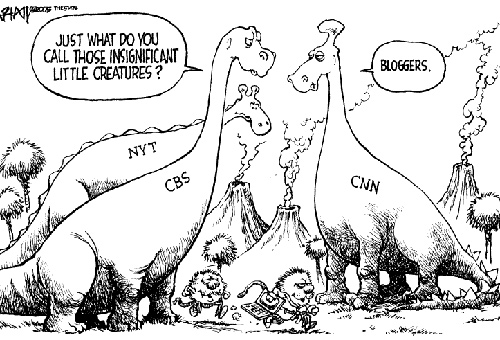
The media world was very different when, in 1993, Crichton riled the news business with an essay titled “Mediasaurus“. In this essay, written for the newly launched Wired magazine, he prophesied the death of the mass media — specifically the New York Times and the American commercial TV networks.

“To my mind, it is likely that what we now understand as the mass media will be gone within ten years. Vanished, without a trace,” he wrote.

Building on his credentials as the author of a best-seller on dinosaurs, Crichton called this endangered beast ‘mediasaurus’.

Mediasaurus - courtesy Slate
He added: “There has been evidence of impending extinction for a long time. We all know statistics about the decline in newspaper readers and network television viewers. The polls show increasingly negative public attitudes toward the press – and with good reason.”

He talked about technological advances — “artificial intelligence agents roaming the databases, downloading stuff I am interested in, and assembling for me a front page” — that would drive the mediasaurus to their inevitable doom.

Only those nimble, adaptable media products would survive, he said, noting that CNN and C-SPAN were steps in the right direction, giving viewers direct access to events as they happen.

But he had no sympathy for the media. “The media are an industry, and their product is information. And along with many other American industries, the American media produce a product of very poor quality. Its information is not reliable, it has too much chrome and glitz, its doors rattle, it breaks down almost immediately, and it’s sold without warranty. It’s flashy but it’s basically junk. So people have begun to stop buying it.”

Read the full essay: Mediasaurus by Michael Crichton, Wired Oct/Nov 1993

Like most people who dabble in the imperfect art of foreseeing the future, Crichton got the trend right but the timing somewhat wrong. The mainstream media (MSM) were indeed on the decline but not at the dramatic rate that he envisaged.

In February 2002, Jack Shafer wrote a piece in the online magazine Slate titled “Who You Calling Mediasaurus?” Its subtitle was: “The New York Times dodges Michael Crichton’s death sentence”. It asked and tried an answer the question: Where did Crichton go wrong?

Shafer wrote: “Fables of the near future have a way of never materializing, whether they be fevered dreams of nuclear energy too cheap to meter or fossil fuels too expensive to burn. To be fair, Crichton wasn’t the only one to get puking drunk on the new media moonshine. Many of us spent a lost weekend—sometimes months—in a stupor after reading early issues of Wired. But instead of blotting out conventional media, the emerging Infotopia seems only to have made the conventional media more ubiquitous.”

Shafer asked: “Who would have predicted in 1993 that America’s great dailies (minus the Wall Street Journal) and the news networks would dodge both extinction and irrelevance by erecting Web sites overnight and giving their content away? That they would use their Web sites to keep us informed 24-hours-a-day in a way that we take for granted today but that would have astonished us nine years ago?”

In an email interview with Shafer at the time, Crichton acknowledged his own limitations: “I don’t have a lot invested in whether my predictions are right or wrong; I assume that nobody can predict the future well. But in this particular case, I doubt I’m wrong, it’s just too early.”

In that interview, Crichton said he wished he had foreseen “the effect of big media conglomerates combined with the universal decision to make news into entertainment. It’s all headlines and chat now. Factual content is way down, accuracy has vanished (it’s not even a goal any longer), and public confidence in media is at an astonishing low. Not surprisingly, audiences are shrinking.”

Crichton admitted at the time that the personalized ‘infotopia’ he envisioned in 1993 had yet to arrive. He scoffed at the Web for being too slow. “Its page metaphor, too limiting. Design, awful. Excessive hypertexting, too distracting. Noise-to-signal ratio, too high.”

Who succeeds mediasaurus?
Now fast-forward to May 2008. The same Jack Shafer, once again writing in Slate, published a piece titled “Michael Crichton, Vindicated”. It was introduced as: “His 1993 prediction of mass-media extinction now looks on target”.

In this essay, Shafer wrote: “As we pass his prediction’s 15-year anniversary, I’ve got to declare advantage Crichton. Rot afflicts the newspaper industry, which is shedding staff, circulation, and revenues. It’s gotten so bad in newspaperville that some people want Google to buy the Times and run it as a charity! Evening news viewership continues to evaporate, and while the mass media aren’t going extinct tomorrow, Crichton’s original observations about the media future now ring more true than false. Ask any journalist.”

Read Jack Shafer’s full interview with Michael Crichton in Slate, May 2008

the weapon that killed Mediasaurus
Revealed: the weapon that killed Mediasaurus
By this time, Crichton was more positive about the web. He noted that the Web has “made it far easier for the inquisitive to find unmediated information, such as congressional hearings.” It’s much faster than it used to be, and more of its pages are professionally assembled.

Crichton suggested that readers and viewers could more objectively measure the quality of the news they consume by pulling themselves “out of the narcotizing flow of what passes for daily news.” Look at a newspaper from last month or a news broadcast.

“Look at how many stories are unsourced or have unnamed sources. Look at how many stories are about what ‘may’ or ‘might’ or ‘could’ happen,” he said. “Might and could means the story is speculation. Framing as I described means the story is opinion. And opinion is not factual content.”

He summed it up with something we already know: “The biggest change is that contemporary media has shifted from fact to opinion and speculation.”

It was interesting to note how mainstream media outlets paid tributes to Crichton this week. He was remembered for the entertaining story teller he truly was, and some even questioned his mixed legacy, for example being an ardent skeptic of global warming – thus batting for the fossil fuel cartels even if only inadvertently.
But I could find few references to his perceptive critique of the mass media.

Who says media likes to turn the spotlight on itself?

PS: I was intrigued to see The New York Times’ reasonably benign obit on the author who predicted their demise. Here’s a collection of Times commentary on him – and some op eds he wrote for them.

Barack Obama: Just elected President of the New Media world

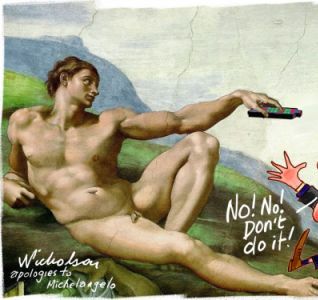
President Obama and the call at 3 am...

“Congratulations for restoring sanity and intelligence to Washington…and giving the world its first President. Real hard work begins now. Look after him!”

This was my brief message to American friends soon after they elected Barack Obama as the 44th President of the United States of America.

It was entirely appropriate that I sent this message via mobile phone text (SMS). For Obama’s trail-blazing campaign to the White House used the new media innovatively while also using the old media (such as broadcast television) in a complementary manner.

Obama’s rise has epitomised change in many ways. Among other things, he is the first elected leader of a major democracy who shows understanding and mastery over the New Media World, which is radically different from the old media order.

As AFP reported in a story titled ‘Obama surfs the web to the White House‘: “Social networks and Twitter messages may have helped but analysts agree it was the Democrat’s impressive online organization and Internet fund-raising that fueled his victory over Republican John McCain in Tuesday’s election.”

It quoted Julie Germany, director of George Washington University’s Institute for Politics Democracy & the Internet, as saying: “No one’s going to say Obama won the election because of the Internet but he wouldn’t have been able to win without it. From the very beginning the Obama campaign used the Internet as a tool to organize all of its efforts online and offline. It was like the central nervous system of the campaign.”

Both Obama and McCain campaigns had slick websites and TV campaigns. But additionally, Obama inspired thousands of web-savvy volunteers to extend his message way beyond the official outreach. Doing so risked diluting the campaign or losing tight control, but that gamble paid off.

Al Gore, US vice president from 1992 to 2000, also understood the potential of new media, especially the transformative nature of the Internet. But at the time he was in office, the new media tools were not being used by sufficiently large numbers of people for it to make a difference in political campaigning or citizen engagement.

Both the timing and technologies favoured Obama, who successfully tapped into Digital Natives — those relatively younger people who have grown up with digital technology such as computers, the Internet, mobile phones and MP3. (In contrast, Digital Immigrants are those individual who grew up without digital technology and adopted it later.)

But as many commentators are pointing out, the real fight has just begun. It remains to be seen how Obama and his team use New Media tools, platforms and potential to deliver the promise of change.

Meanwhile, my own favourite cartoon of Obama election is the one above – and funnily enough, it concerns a piece of old technology: the good old fixed phone. If you recall, in long-drawn campaign for Obama to secure Democratic Party nomination, his rival Hillary Clinton ran this TV commercial which peddled her credentials for being familiar with the corridors of power.

It’s 3 AM and your children are safe and asleep. But there’s a phone in the White House and it’s ringing.
Something’s happening in the world. Your vote will decide who answers that call…


Hillary’s original ad:

Obama’s official response:

There were various unofficial spoofs created by Digital Natives who love to play with new media tools. Just run a search for ‘3 am’ or ‘red phone’ on YouTube and you can watch many of these online!

By the way, isn’t it time that the old-fashioned Red Phone in the White House – the American President’s Hotline to save the world – was replaced with a more modern looking instrument? One more thing for the New Media President Obama…

‘War for the Whitehouse’: Obama, McCain and The Onion

Onion News Network - for news you can't afford to miss

The American presidential election race is entering its last lap. And the world watches the campaign trail with baited breath.

Democratic presidential candidate Barack Obama enjoys more international support than his Republican rival John McCain, as most people outside the US prefer the Democrat leader to become next US president, according to a BBC poll in September 2008. Most of the people questioned in the global poll conducted by international polling institute GlobeScan believe that US relations with the rest of the world would improve under the presidentship of Obama.

While so much of American and international news media time is being spent on covering the campaign and various opinion polls, some comic relief comes from The Onion – that wickedly funny and innovative website which now produces a steady stream of videos spoofing the news media’s worse excesses.

The Onion calls it the ‘War for the White House’ and has set up its ‘election analysis bunker’ from where its intrepid reporters are bringing us news that you – and major news organisations – have somehow managed to miss. They call is Onion News Network, ONN for short.

They’ve been doing it for the better part of a year, and here are some of my favourites from The Onion YouTube channel:

Caution: There’s a slight bias towards Senator Obama in some of these news reports, but then, he’s been the liberal media’s darling for much of this campaign year.

October 2008: McCain Left On Campaign Bus Overnight
Campaign officials downplayed the incident, saying the senator was fine as soon as he was fed and taken to the bathroom.

October 2008: Gifted Youngster Sells Cookies To Buy Attack Ad
In this installment of Beyond The Facts, a precocious 8-year-old girl participates in grown-up politics by spreading smears and lies.

September 2008: McCains Economic Plan: ‘Everyone Marry A Beer Heiress’
McCain pointed to his personal success in marrying a wealthy beer heiress to prove how the plan could benefit every American.

September 2008: Obama Runs Constructive Criticism Ad On McCain
In response to Republican attacks, Barack Obama unleashed a series of slightly negative ads that gently point out how McCain could be doing a better job.

August 2008: Portrayal Of Obama As Snob Hailed As Step Forward For Blacks
Overjoyed civil rights leaders say that Barack Obama has paved the way for future black politicians to be smeared as country club snobs.

March 2008: Poll: Bullshit Is Most Important Issue For 2008 Voters
For a majority of likely voters, meaningless bullshit will be the most important factor in deciding who they will vote for in 2008.

January 2008: The Onion: More Candidates Court Fat Vote
Presidential candidates are reaching out to fat voters on the campaign trail by eating large amounts of fattening food.

See all election videos of ONN

ONN’s self-introduction says its “style of hard-hitting, on-the-ground coverage of live news events has become a standard in the news industry. The network can be viewed in 92.2 million U.S. households and more than 500,000 American prison cells, making it the most-watched cable network in the world. It can currently be seen in 312 countries, with broadcasts in 52 different languages“.

Wow!

The Onion - The Nation's finest news source...

A J Gunawardana: Remembering a lost colleague…and discovering online gaps

A J Gunawardana with film director Lester James Peries
A J Gunawardana (left) with film director Lester James Peries

I have just written a 2,000-word essay recalling my times with a senior colleague and fellow media-watcher, the late Dr A J Gunawardana.

AJ, as he was affectionately known, was an outstanding university teacher, writer/journalist, cinema personality and art critic. When he died in September 1998 at the relatively young age of 65, we lost a rare intellectual who had his feet firmly on the ground, and constantly built bridges linking media, culture and society.

We shared more than our surname and involvement in the media. In fact, when I was beginning to be noticed for my journalistic writing in late 1980s and early 1990s, people kept asking me if I was AJ’s son, or at least a relation. I had to disappoint them.

My association with him was in the last decade of his life. His junior by a generation, I related to the genial professor as a fellow writer and occasional partner in mischief in the domains of media and popular culture. These are the times I have recalled in the tribute, just published on Groundviews citizen journalism website.

AJ started his career as a journalist with the then privately owned flagship of Sri Lankan journalism, Ceylon Daily News, where he was a noted arts and culture correspondent in the 1960s. He went on to obtain a doctorate in performing arts from New York University. Upon return, he pursued a career in academia as a professor of English at the Vidyodaya University (later University of Sri Jayawardenapura) and was closely associated with film and media education. He chaired a Presidential Committee of Inquiry on the Sri Lankan film industry, which issued its report in 1985.

In the arts world, he is perhaps best remembered for the screenplays he wrote for three films by Sri Lanka’s best known director Lester James Peries: Baddegama (1980), Kaliyugaya (1982) and Yuganthaya (1985). The latter two are included among the best of Sri Lankan cinema as compiled by the British Film Institute.

At the time of his death, AJ was working on a biography of the doyen of the Sri Lankan cinema, which was posthumously published in 2005 as LJP: Lester James Peries: Life and Work.

Read my full tribute:
Remembering A J Gunawardana: A creative public intellectual

In researching for this essay, I wanted to verify some biographical and filmographical specifics about AJ. The usually reliable Encyclopaedia of sri Lanka (2006) edition, compiled by Charles Gunawardena (note how we all spell our same surname differently!) had no entry on AJ, which is a bit disappointing considering the far more obscure personalities featured in this reference.

My next step was Googling for A J, using the various spellings for his and my shared surname. (Don’t ask me how and why different clans spell it differently – which must drive foreigners crazy – but it matters to us). Considering AJ published most of his journalistic writing before commercial Internet connectivity became widely available and newspapers started publishing their web editions, I wasn’t surprised by how little I could find online. I didn’t come across a single piece of AJ’s incisive writing online, although perhaps a specialised search might yet unearth a few from some depth of an archive.

This highlights an unmet need where many Asian newspapers and magazines are concerned: their archives only go back to a decade or a dozen years. Even when publishers are willing to unlock their archives and make it available, the sheer logistics involved must daunt them. This could change in time to come, with Google’s recently announced initiative to digitise newspaper archives. The search giant has begun scanning microfilm from some newspapers’ historic archives to make them searchable online, first through Google News and eventually on the papers’ own Web sites.

An aside: I remember making the same point to assembled ITU, UNESCO and other UN worthies at the WSIS Asia Preparatory Meeting in Tokyo in January 2003. In a world where search for information and records is moving increasingly to the web, I said, the old sources of Asia’s news, information and culture need to be progressively placed online. This is a huge undertaking even if we just consider only the newspaper archives. But if not done, these valuable sources may soon begin to be ignored as references.

I then turned to the Internet Movie Database, IMDB, for some specifics and was disappointed again. AJ’s main entry on IMDB listed only one of his three films, and there was no other information about him, at least in the areas allowed for free access. It was only later that I stumbled upon another IMDB entry for AJ, where the last two letters of his surname are lopped off, which keeps it out of most searches.

When the two entries are put together, one begins to get an idea of AJ’s cinematic accomplishments, but it still completely leaves out his work as a film critic.

These gaps are not unique to AJ. In fact, even though IMDb is said to be “one of the largest accumulation of data about films, television programs, direct-to-video products, and video games, reaching back to each medium’s respective beginning”, I imagine a large number of film industry creations and professionals from outside the mainstream English language cinema is currently missing or poorly indexed on it.

Clearly, there is work to be done – by film buffs from Asia, whose want their cinematic traditions and professionals featured adequately on IMDB. Although I occasionally edit entries on the Wikipedia, I haven’t figured out how to do it on IMDB.

In this era of user-generated content, we can’t just sit back and complain that the web is biased towards the English speaking west. It’s still the case, but web 2.0 allows us the opportunity and tools to go and do something about it.

Go ahead, just say the word: Condom! Now say it again…

not an easy task...
Acting out condoms in broad daylight in India: not an easy task...

Condom!

No one is certain how or where the word originated, but it has become one of those ubiquitous items in modern society.

It’s a two syllable word, fairly easy to pronounce. Then how come so many people – at least in South Asia, home to a fifth of humanity – get their tongues tied or twisted in saying it?

That’s because it’s to do with sex! That’s not a subject that many South Asians still feel comfortable in talking about, in public or even private.

Sex may be a very private matter, but individuals’ sexual behaviour has direct and serious public health implications. Especially today when the world is still struggling to contain and overcome the spread of HIV that causes AIDS.

Condoms originally came into wide use to help prevent unwanted pregnancies and the spread of sexually transmitted diseases (STDs). In the past quarter century, condoms have become a major weapon against HIV.

Despite this, condoms still remain a hush-hush topic among many grown ups, even as the younger generation warms up to them. Across South Asia, we still have some hurdles to clear in normalising condoms – or making it socially and culturally acceptable for people to talk about condom use, and to go out and buy them without fear or shame.

They come in all colours and shapes!

This is the challenge that various communication groups have taken up, especially in India. According to a 2007 survey by UNAIDS and India’s National AIDS Control Organisation (NACO), at least 2.5 million people live with the HIV virus in India, placing the country third in the world after South Africa and Nigeria. However, AIDS prevention in the country is not an easy job. Many people, especially in rural areas, cling on to preconceived taboos about sex — and are often hesitant to use condoms.

In recent weeks, I’ve heard from two campaigns that are trying to change this. One is the BBC World Service Trust working with Indian broadcasters and other partners to normalise condom use through a campaign. I’ll be writing a separate blog post on that effort.

Last month, I received en email from someone called ‘Spread Word for a Better World’, who shared with me web links on a socio-cultural group based in Hyderabad, who are using the performing arts to promote condom awareness.

For over a decade, the Nrityanjali Academy has been singing and dancing their way to the glorification of condom use. They see it as a crucial fight in their central region, where 2 per cent of the population is HIV positive.

P Narsingh Rao, director of Nrityanjali, recently told France 24 online: “Our main target groups are people vulnerable to the HIV virus like sex workers, transsexuals or truck drivers. We tour villages in mobile video vans to show the film. The screening is followed by a question and answer session about condom use and sexually transmitted diseases.”

He added: “We also encourage the use of female condoms, a relatively new concept. We tell the women to negotiate the use of female condoms with their male partners: for men with little sex education, the insertion of the female condom in the vagina can in itself be an erotic act.”

Here are some YouTube videos showcasing their work:

This is an entertaining and educational video in Telugu language on Condom usage, to prevent from sexually transmitted infections and HIV:

A more instructional video on how to use condoms properly:

And finally, an HIV/AIDS song in Telugu – with all the fast-beat music, gyrating and riot of colours we typically associate Bollywood movies and songs with:

The videos speak for themselves. They are matter of fact, engaging and presented by ordinary people (trained entertainers) rather than by jargon-totting medical doctors or health workers. There is none of the awkwardness typically associated with conversations of this subject. No one is tip-toeing around perceived or real cultural taboos. They just get on with it.

Importantly, they involve both men and women, both in performances and in their audiences.

Training young men on just how to do it right...

Related blog posts:

July 2007: The Three Amigos: Funny condoms with a serious mission

April 2007: Beware of Vatican Condoms – and global warming!

Images courtesy France 24’s The Observers.

Thailand’s people power gets a boost from satellite TV

Street protests in Bangkok - image from DayLife

Thailand, which had built up a reputation as a relatively stable country, has been under siege for much of this year. Confrontations between the coalition government, elected in December 2007, and the anti-government People’s Alliance for Democracy (PAD) have affected civil administration, law enforcement and economy, especially tourism.

On 10 September 2008, Thai prime minister Samak Sundaravej was forced to step down when a court found him guilty of accepting money from a TV station to host a popular cooking show. Bizarre as this reason was for his ouster, it has only added to the confusion that currently dominates Thai life.

Although I have been visiting Thailand regularly for the past 20 years, I don’t claim to understand the murky world of Thai politics. But until recently, Thais had somehow managed to keep their politics and business separate, allowing the latter to continue largely unaffected.


Pro-democracy struggles are not new to Thai people. But this time around, there is a new player involved: Asia Satellite Television (ASTV) a relatively new entrant into Thailand’s TV world which is dominated by commercial TV stations that offer a staple of light talk shows, soap operas and gossip programmes.

ASTV’s programmes, since May 2008, has consisted of speeches beamed from a stage set up at the site of a Bangkok protest rally, led by the PAD.

In early September 2008, around 200 PAD supporters banded together to guard the ASTV station and Manager newspaper offices on Phra Athit road amid rumours Prime Minister Samak Sundaravej was going to take the cable TV channel off the air.

In an interesting news analysis filed from Bangkok, Inter Press Service (IPS) noted on 5 September: “ASTV makes little effort to hide its political mission as the principle broadcaster of the PAD. After all, its founder, Sondhi Limthongkul, a fiery speaker, is one of the PAD’s leaders. His sustained attacks on the government and Thai democracy — that the prevailing elections system does not work, and the country needs a largely appointed parliament — have resonated with the thousands drawn to the PAD rallies after first hearing them on ASTV.”

Much of the PAD’s mass mobilisation has been possible due to ASTV’s reach, which is currently estimated at 20 million viewers. ‘’Our audience has doubled since 2006, when we had 10 million viewers, because we present the political side of the news that is not available on national TV,” the article quoted Chadaporn Lin, managing editor of the station’s English-language channel, as saying.

The Manager owns ASTV
Viewers who cannot access the station through a satellite dish or a provincial cable company turn to the website of ‘Manager,’ the newspaper produced by ASTV’s parent company. The site has seen the number of regular visitors rise and is now placed third among the top 10 Thai-language websites.

Read the full IPS article: THAILAND: Satellite TV Boosts Anti-Gov’t Protests By Marwaan Macan-Markar

To make sense of what’s going on, I turned to Pipope Panitchpakdi, a Thai friend who has worked in the broadcast media industry for many years:

Pipope Panitchpakdi, independent Thai journalist

He says: “It’s just too bad that the ideology behind the ASTV movement is identified by many as right-winged and nationalistic. For me, the movement itself is quite progressive in its post-modernistic use of everything that works to topple the existing government. In a way, it’s going back to the muckraking days of partisan journalism, which may be in need when mainstream media are no longer functioning during Thaksin/Samuk’s administration (with his equally keen media strategist team).”

Pipope adds: “Few mentioned that ASTV is self sponsoring through viewers’ subscriptions. That’s, to me, says a lot about the station. In my opinion what is unacceptable is when NBT (National Broadcasting Television) starts to give air time to government politician to bash the ASTV and to report heavily distorted news on the anti-government movement. They said it is the counter measure to what the ASTV is doing.”

He continues: “NBT, which is a free to air TV, funded by tax money and has a nation wide coverage, now becomes the state propaganda in the true sense of the word and by being such, there is no telling what kind of political fervor the NBT can stir.”

The argument of using NBT to project government view is a familiar one in other fragile or immature democracies across Asia. To understand it, we need to recall how rapidly broadcasting has changed in the past two decades.

In 1990, most Asian viewers had access to an average of 2.4 TV channels, all of them state owned. This has changed dramatically — first with the advent of satellite television over Asia in 1991, and then through the gradual (albeit partial) broadcast liberalisation during the 1990s. Asian audiences, at last freed from the unimaginative, propaganda-laden state channels, exercised their new-found choice and quickly migrated to privately owned, commercially operated channels. Soon, state owned TVs and radios found themselves with ever-shrinking audiences and declining revenue. For the past decade, most have survived only because governments infused them with massive amounts of tax payer money. Their public service remit is long forgotten.

In recent years, some governments have taken the view that since a growing number of private channels provide an outlet to political opposition and other dissenting views, the state channels are justified in peddling the ruling party (or ruling military junta) view – often exclusively. This convenient argument overlooks the fact that Pipope points out: state channels are funded mostly or wholly by tax payer money (as many lack the entrepreneurial skill to compete in a market environment). They have a moral and legal obligation to serve the public interest — and that does not coincide with the ruling party’s or junta’s self interest.

There are some who accuse ASTV of Thailand, and its equivalents such as courageous Geo TV of Pakistan (which stood up to the once mighty, now fallen general Musharaf), of being partisan. Perhaps they are, and in ASTV’s case it unashamedly and openly is. But in my view, they offer a much-needed counter balance to the disgusting excesses of state TV that prostitute the airwaves.

Supinya Klangnarong
Supinya Klangnarong

Supinya Klangnarong, deputy head of the Campaign for Popular Media Reform (CPMR), an independent local group lobbying for media rights, told IPS: “ASTV is offering knowledge and political information and new ideas that have never been seen on Thai TV. They have opened a new space for TV. There is 100 percent media freedom. You can say anything against the elected government and get away.’’

But she warned that while such a media agenda has tapped into an older audience that has felt left out by the dominant trends on the existing commercial stations, where youth is the focus, it is also creating a following that could become increasingly intolerant. “They are creating a culture of hate by the one-sided opinions being broadcast. They are promoting very conservative and very nationalistic ideas.’’

She added: “And if it attracts more people, ASTV may take over the role that has always been played by Thai newspapers of setting the political agenda for the country. That will be a win for those who say that Thailand has become too liberal, open and globalised… like my mother’s generation.’’

PAD protests hold Thai capital under siege - image from DayLife

Vulnerability Exposed: Micro films on how climate change affects YOU!

Vulnerability Exposed!

Never underestimate the power of moving images. Al Gore tipped the balance in the long-drawn climate change debate with his Oscar-winning film, An Inconvenient Truth. The rest is recent history.

Thanks to the film – and sustained advocacy of hundreds of scientists and activists – climate change is no longer a speculative scenario; it’s widely accepted. The challenge now is to understand how it impacts different people in a myriad ways.

Now the World Bank wants people to use their video cameras to capture how climate change may already be affecting their ways of living and working. The Bank’s Social Development Department has just announced the launch of a worldwide documentary competition that will highlight the social aspects of climate change as experienced and/or observed by the film-maker(s).

Called Vulnerability Exposed, the contest is open to anyone anywhere in the world who wishes to have their voice heard. The submitted films should innovatively illustrate the consequences of climate change through one of the following theme categories: conflict, migration, the urban space, rural institutions, drylands, social policy, indigenous peoples, gender, governance, forests, and/or human rights. The submission period ends on 24 October 2008.

Caroline Kende-Robb, Acting Director, Social Development Department, said, “There is a need to see climate change as an issue of global social justice. The rights, interests and needs of those affected by climate change must be acknowledged.”

Watch the Bank’s short video, where she explains further:

The contest has two award categories:
1) Social Dimensions of Climate Change Award (general category) – open to professional and amateur; and
2) Young Voices of Climate Change (youth category) – open to entries submitted by filmmakers under 24 years old.

Award winners will be chosen through a combination of public voting and a judging panel. The film with the most public votes in each theme category will receive honorable mention.

Judging process
Vulnerability Exposed film competition: Judging process

This contest indicates that the World Bank is slowly but surely opening up to the currently untapped communication potential of web 2.0 – the very point I made in a recent op ed essay.

There are several noteworthy aspects in this competition, some more positive than others. I offer this critique in the spirit of improving a commendable initiative.

Three cheers to the bank for accommodating both amateurs and professionals. It’s about time those who don’t video film for a living (some of who are no less talented in the craft) had more opportunities to showcase their products.

It’s good to see the preference for shorter films, in this contest defined between 2 and 5 mins in duration. This certainly resonates with TVE Asia Pacific’s experience with Asian broadcasters, many of who now prefer shorter films. Longer films have their place, of course, but shorter ones are clear favourites of 24/7 news channels and also online.

Most film contests are judged exclusively by an all-powerful jury (I’ve been on several over the years), but here the online public have a chance to vote for their favourite entries. Let’s hope the judges will consider the story telling power of entries as the most important deciding factor. (The examples in the YouTube film given above are misleading – they all seem extracts from expensively made documentaries.)

The big challenge for many aspiring contestants would be to relate climate change to daily realities in their societies. Despite global headlines and the development community’s current frenzy about it, climate change as a phrase and concept still isn’t clearly understood in all its ramifications. If science now knows 100 facts about the murky processes of climate change, the average public knows less than 25 and understands even less. So it will be interesting to see how entries relate the big picture to their individual small pictures.

I’m a bit disappointed that the World Bank is not offering any cash prize to the winners. Instead, “the winners will receive an all expenses paid trip to Washington, DC for a screening of their film and will have the opportunity to attend a series of networking and learning events organized by…the World Bank in December 2008.” This is all useful, but video – even at the low end – is not exactly cheap, and even labour of love creations cost money to make. We are currently running a comparable the Asia Pacific Rice Film Award – which seeks entries no longer than 10 mins on any aspect of rice – and despite being a non-profit, civil society initiative we have a prize of US$ 2,000 to the winner. And we wish we could offer more.

But my biggest concern is the unequal, unfair terms of copyrights found in the small print of the competition rules. This is where the lawyers have done their usual handiwork, and with the usually lopsided results. The World Bank wants all contestants to make absolutely sure that all material used is fully owned by the contestants, or properly licensed. That’s fine. But tucked away on page 7, under section 12 titled Entrant’s permission to the organiser, is a set of conditions which will allow all affiliated institutions of the World Bank group to use the submitted material for not just promoting this contest (a standard clause in most competitions), but for ‘climate change work program of the organiser’.

What this means, in simpler terms, is that without offering a single dollar in prize money, the World Bank is quietly appropriating the unlimited user rights for any and all the submitted material. These are the core materials in the moving images industry, and nothing is more precious to their creators.

I have long advocated a more balanced, equitable and liberal approach to managing copyrights and intellectual property by both the broadcast television industry and development community — especially where public funded creations are concerned. I have nothing but contempt for lawyers and accountants who often determine the copyrights policies in large broadcast and development organisations. They set out terms that may be justified in strict legal terms, but are totally unfair, unjust and, in the end, counterproductive to the development cause and process. It seems that while our friends in the social and communication divisions were not looking, the Bank’s lawyers have done their standard hatchet job.

While this doesn’t detract from the overall value of Vulnerability Exposed, it diminishes its appeal and potential. Many professional video film-makers who value their footage – gathered with much trouble and expense – may not want to sign future user rights away for simply entering this contest. And worse, the unsuspecting enthusiasts who don’t necessarily earn their living from making films – but are entitled to the same fair treatment of their creations – would be giving away material whose industrial value they may not even fully appreciate.

It’s certainly necessary and relevant for development organisations like the World Bank and the UN system to engage web 2.0. But they must be careful not to import or impose rigid, one-sided and outdated copyright regimes of the past on this new media.

I hope the Bank would consider revising these unfair copyright terms, and treat the submitted material with greater discretion and respect. If not, all entrants risk seeing their material popping out of bluechip films produced by top-dollar production companies in North America and Europe who have ‘mining rights’ to the Bank’s video archives.

Vulnerability Exposed can have more meanings than one. We’d rather not consider some.

Beyond Babu SAARC: Liberating airwaves for South Asians

“Watching the current SAARC jamboree unfold over television news, my young daughter asked why none of the officials were smiling. The SAARC Secretary General, Dr. Sheel Khant Sharma, was always scowling. Others didn’t have smiles on their faces either, even insincere ones. They all looked stressed out, wearing glum, miserable faces.

“I could only hazard a guess. Perhaps the assorted babus have too much to worry about, as they get through their very serious and grim business of fostering regional cooperation. On the other hand, after all these years of endless meetings and declarations, they might have forgotten the simple joys of smiling and enjoying each other’s company.”

With these words I open my latest op ed essay, just published on the Sri Lankan citizen journalism website Groundviews.

Anti-people, Pro-Babu SAARC in Colombo

The essay is my personal response to the meetings of the South Asian Association for Regional Cooperation or SAARC, taking place in my home city of Colombo this week. Assorted babus (a derogatory South Asian term for pompous officials) from all over South Asia have invaded the city, displacing its people and severely disrupting normal life and work.

And all for what? So that the unsmiling babus can congratulate each other on how little they have accomplished since the last such gathering in New Delhi in April 2007!

As I note in my essay: Make no mistake: SAARC is a good idea hijacked by unimaginative and pompous, unsmiling babus of South Asia and run to the ground. The self-congratulatory rhetoric of the inter-governmental merry-go-round is once again deafening us as the 15th SAARC takes place in Colombo. In reality, SAARC at 23 has the mental development of a 3-year-old (if that). There isn’t, in fact, much to smile about.

The SAARC Sec Gen is always scowling, with never a smile on his face...

I go on to note:
The proof of the SAARC pudding is not in over-hyped Summits or crusty declarations, but in the free flow of people, ideas, creativity and culture across the political boundaries jealously guarded by governments and their militaries. Most SAARC initiatives miserably fail this test. Typical of this arrested development is the SAARC Audio-Visual Exchange, SAVE.

The rest of my essay is a critique of SAVE, and how it has failed to foster greater regional understanding among the people of South Asia through the airwaves. This is because SAVE brought together only the state-owned radio and television stations of South Asia which are no more than propaganda organs for ruling parties and/or militaries that are running our countries.

I go on to cheer the recent initiative called TV South Asia, a collaboration involving 5 private TV broadcasters in South Asia. Without any of the pomposity of SAVE or SAARC, TV South Asia is quietly doing what SAVE has failed for nearly a quarter of a century.

The essay builds on my 6 July 2008 blog post TV South Asia: Nothing official about it, yipee!

Read my full op ed essay on Groundviews

More unsmiling SAARC babus - they certainly dont speak for me!
More unsmiling SAARC babus - they certainly don't speak for me!
Never a smile on their faces!
Foreign secretaries of SAARC: Never a smile on their faces!

All images courtesy Daily News, Sri Lanka