Why do Development Rip Van Winkles prefer ‘Aunties’ without eye-balls?

When I was growing up in suburban Colombo in the 1980s, we had a family friend who worked at the Sri Lanka Broadcasting Corporation (SLBC). When anyone asked him where he worked, he would simply reply: “I’m in broadcasting.”

That answer was perfectly adequate at the time, when the fully state-owned and government-controlled SLBC was the only domestic broadcaster. The FM radio band was eerily silent, and only die-hard enthusiasts would persist with shortwave crackle to listen to foreign broadcasts like BBC, Voice of America or Radio Veritas from thousands of kilometres away. We also had two state TV channels still learning the ropes.

Today, that kind of answer would mean nothing. Two dozen FM radio channels crowd the airwaves. In the western province, there are 15 free-to-air terrestrial TV channels – and counting.

Most of these are privately owned and commercially operated channels, all started after broadcasting was (partially) liberalised in 1992. They compete fiercely for a share of audience – and advertising revenue. While that can sometimes be a race to the bottom, it’s infinitely better than the bad old days when we had no choice but to tune into ruling party propaganda masquerading as public broadcasting.

The situation is broadly the same in many other countries in the Asia Pacific region. With a few exceptions, the state-owned, government-controlled broadcasters have seen their monopolies end – and as their long-suffering audiences might confirm, not a moment too soon. They now have to compete with younger, more dynamic and decidedly more interesting private channels.

And in every market, former monopolists have seen their audience share shrink, in some cases dramatically. The one-time lords of the airwaves have been reduced to minority players. Many are struggling to make ends meet, and some are kept alive only because governments keep pumping in large volumes of tax-payer funds.

Meanwhile, the eye-balls and advertising revenues have migrated to the privately owned, commercially operated TV stations. They entertain, amuse and sometimes titillate. But they also inform and occasionally educate their audiences.

And yes, many are making money too – and that’s neither illegal nor immoral in market economies.

Alas, the former monopolists haven’t yet stopped crying foul. They allege that the commercial stations are playing by a different set of rules, allowing the latter to play the market and maximise returns. In contrast, the government channels claim to have a ‘public service mandate’ that’s harder to fulfill and not always popular or populist.

Note that I have not used the term ‘public broadcaster’ to describe the government channels – because, whatever their founding documents might say, most of them are not serving the public interest. In developing Asia, which lacks sufficient checks and balances to ensure independence of state broadcasters, the only thing public about such channels is that they are often a drain on public money collected through taxes. Their service and loyalties are entirely to whichever political party, coalition or military dictator in government.

When the divide between governments and the public interest is growing, most ‘public’ channels find themselves on the wrong side. No wonder, then, that discerning views have abandoned them.

Interestingly, old habits and brand loyalty might explain why at least a minority audience still remains for state broadcasters. The state channels have been around for longer, and for years, they were the only show in town. Some of them occupy large swaths of the UHF and VHF spectrum, making their signals easier to catch.

But these advantages would diminish over time. For one thing, young people far outnumber older persons in most parts of developing Asia (almost 62 per cent of the world’s youth – aged between 15 and 24 – are in Asia: that was 716 million in 2005). For another thing, the more dynamic private competition is finding new pathways to reach youthful audiences.

State broadcasters may be venerable to some, but no one thinks of them as ‘cool’. Even the BBC – which is far better shielded from governmental manipulation than its Asian counterparts – has yet to shed its old nickname and image of “Auntie”, originating from its old-fashioned “Auntie knows best” attitude.

In Asia, now home to the world’s largest combined television audience, it’s more a case of grandma knows best. The other day, I asked a young Filipino film-maker and TV journalist about who watches her country’s National Broadcasting Network. “In my family, only grandma watches it,” she replied, adding that the only time others tune in to that channel is to watch lottery results.

This is not an isolated insight. Across Asia, FM radio and commercial TV have captured the markets of the young and young-at-heart.

Nobody grudges grandmas and grandpas being served by their favourite channels. But we have to ask how and why decades of public investments in broadcast infrastructure and institutions are not serving a wider spectrum of the population. Dishing out lottery results and pandering to Narcissistic politicians cannot quite pass as serving the public interest.

Meanwhile, in a welcome trend, the market-leading commercial broadcasters are increasingly turning their massive outreach and influence to serve the public interest. It goes against the conventional wisdom of ivory tower researchers and media activists who cry themselves hoarse accusing commercial broadcasters of reaping profits without returning something to the community. But it’s real.

In market after market, country after country all over the Asia Pacific, privately owned, commercially successful radio and TV channels are championing the public interest. They may not have a UNESCO-articulated grand agenda, but they see it as serving the needs and wants of their loyal audiences.

The services are as diverse as the needs themselves. Some channels are dispensing practical information and advice on all sorts of everyday matters from traffic congestion and vaccination to school admissions and crime prevention. Others have gone further, for example launching national campaigns against narcotic drugs or corruption, and advocating better care for persons living with HIV.

In covering these and other public interest or development issues, commercial channels bring in a healthy dose of creativity, dynamism and innovation. They don’t preach or pontificate. Instead they make it fun, hop and cool to do what we should be doing anyway in our self interest.

See, for example, my Sep 2007 blog post on MTV Exit: Entertainment TV takes on human trafficking

And I don’t mind if some of them laugh all the way to their banks at the end of each financial year. (In reality, many operate on thin margins and few make significant profits.)

A few commercial broadcasters go even further. On a visit to Manila last week, I heard how ABS-CBN – the country’s privately owned, market-leading broadcast group – is doing much for science popularisation and public education. These are done through charitable foundations that deliver public goods through private means.

While all this is happening, the development community seems trapped in a time warp – clinging on to an outdated notion that state broadcasters alone can serve the public interest (if you ask me, they never did). Perhaps out of habit, they keep turning to such channels with their ever-shrinking audiences.

A few weeks ago, a senior official at Sri Lanka’s largest development organisation Sarvodaya told me how hard it was for them to have their development films broadcast. The two state broadcasters had both demanded money for air time.

Strangely, he had not even considered engaging a commercial broadcaster. “After all, we want to be seen our national channels,” he explained.

This Rip Van Winkle attitude doesn’t help anyone, and least of all those communities that development agencies are trying to reach through media-based communication.

As I asked at a recent UNEP-convened meeting in Bangkok: “If in our technical work we are evidence-based, why can’t we be evidence-based in our communication strategies and decisions as well? We must define the priority audiences we want to reach, and find out their media preferences. We need to use independent audience ratings, and not personal perceptions or biases in choosing which stations we work with.”

Thus, if the development community is serious about engaging the broadcast media, they must first awake from their long slumber and quickly update themselves on current realities in Asian broadcasting.

It’s not who owns that decides the public spirited character of a radio or TV station. In today’s complex and nuanced media landscape, it’s the performance and delivery that count.

Aunties without eyeballs can trudge along on government’s crutches. The rest of us have miles to go before we can rest.

Release Ozzy Ozone held prisoner by brand guardians!

In September 2007, I wrote about Ozzy Ozone, an energetic, cheerful little ozone molecule – part of the ozone layer in the upper atmosphere that prevents the Sun’s harmful ultra-violet rays from coming through and causing skin cancer, cataract and other health problems.

Ozzy Ozone is part of a global public education effort by the UN Environment Programme (UNEP) to tell everyone how harmful UV rays are to our health, and how Ozzy and his fellow ozone molecules are literally protecting life on earth from being zapped out.

I called Ozzy the little molecule on a big mission — to tell all humans to soon phase out using certain chemicals that, when released to the air, go up and destroy his kind.

Last week, while attending a UNEP meeting in Bangkok to plan the next ozone communication strategy for Asia Pacific, I heard some disturbing news: little Ozzy has become a prisoner of his brand guardians. As a result, he is not as free as he could be to roam the planet, spreading the vital ozone message.

Anne Fenner, Information Officer of UNEP’s OzonAction Programme revealed how she routinely turns down requests to produce toys and other material using the popular character.

“I have had so many requests from companies, but we cannot allow commercial exploitation of this brand,” Anne said.

I was stunned. Here is one of the more popular communication products to emerge from the UN, not generally known for such successful engagement of popular culture. And there we were, brainstorming on ways to get the ozone message to large, scattered (and distracted) audiences.

Ozzy was created by a graphic artist in Barbados, as part of a government-supported campaign to raise public awareness on ozone layer thinning. This cartoon character served as a “mascot” and was very effective in raising awareness in Barbados. The cartoon series was printed in local newspapers. Additionally, promotional items produced for local public awareness and education campaigns using the Ozzy graphic include posters, key rings, rulers, erasers, refrigerator magnets, mouse pads, pens, pencils, stickers, and envelopes.

The character was so popular that UNEP struck a deal with Barbados to ‘globalize’ Ozzy. An animated video was produced, along with a dedicated website, comic strips and other media adaptations.

Ozzy has been a run-away success, giving UNEP a high profile, widely popular character — and a great deal of media coverage and interest. The kind of media engagement that is typically enjoyed by Unicef, the most media-savvy of all UN agencies.

But we now know that Ozzy’s brand guardians don’t allow him to go as far as he could. They may be playing by the rules, but do they realise that huge opportunities are being lost?

There we were, a small group of journalists, communicators, scientists and government officials discussing for three days how to get the biggest bang for our collectively limited buck where ozone messaging is concerned.

It was frustrating to know that the best brand ambassador has been locked up in brand integrity and copyright restrictions.

I suggested to Anne Fenner that protecting the brand integrity need not be so rigidly pursued. For example, careful franchising could be undertaken based on a set of guidelines — and the royalty could go into a trust fund that supports ozone communication work.

Indeed, the challenge for development communicators everywhere is to find the common ground between the public interest and the commercial interest. In this era of globalised media and CSR, the two interests are no longer mutually exclusive. Some might argue they never were.

The long-established copyright regimes themselves are being questioned, challenged and bypassed by a growing number of research, advocacy and activist groups. Many now publish their academic or artistic work under Creative Commons licenses, that enable their creators to be acknowledged and retain some control — and yet allow many types of uses without excessive restriction.

When TVE Asia Pacific recently released an Asian regional book called Communicating Disasters, our co-publisher UNDP Regional Centre in Bangkok proposed that the book be under Creative Commons Attribution 3.0 license. We were happy to go along.

UNEP has some catching up to do. Turning the pages of lavishly illustrated Ozzy Ozone comic story books (of which 3 titles have come out so far), I found that UNEP has the standard copyright restriction. However, they add a line: “This publication may be reproduced in whole or part and in any form for educational or non-profit purposes without special permission from the copyright holder, provided acknowledgement of the source is made.”

That’s encouraging – but not good enough. What happens if a commercially operated media organisation wants to use this content for public interest? Will they qualify under ‘educational or non-profit purposes’?

Probably not. And that’s when the dreaded copyright lawyers could come marching out.

It’s the assorted lawyers and over-cautious officials who are keeping Ozzy Ozone a virtual prisoner.

And sadly, little Ozzy is not alone. Everywhere in the publishing and media world, we can find many examples of how creative works are being held back – usually by over-protective lawyers or accountants. Sometimes that’s the case even if the artistes or media professionals themselves would much rather let go of the rights.

In July 2007, I wrote a blog post called ‘The lawyers who locked up the butterfly tree’ — which revealed how lawyers working for the publicly-funded BBC had systematically blocked a multi-award winning African documentary film from being used for environmental education, awareness and advocacy. All because the BBC had partly funded its production, and therefore had a claim on its copyright.

So here’s our plea to Ozzy’s brand guardians in UNEP: let him roam free, taking the vital message to millions. And while at it, let him make some money (from franchisees) which can suppot the rest of UNEP’s ozone communication work.

And if some spoilsport of a copyright lawyer gets in the way, tell him/her to take a beach vacation — without sunblock.

Related links:
Sep 2006: Make poverty a copyright free zone

May 2007: TVEAP renews call for poverty as a copyright free zone

Can Your Film Change the World? Find out on Pangea Day!

Here’s an extraordinary invitation to all who love to watch, create or critique moving images.

Either watch the above video, linked to PangeaDay YouTube channel, or (if your bandwidth does not allow easy playing of online video) read the text I have just transcribed off the video:

In this age
Images are powerful.
Powerful enough to divide…
…to spread fear…
…to remove hope.

Powerful enough to unite
to build trust, to inspire action.

Until now, images of the many
have been held in the hands of the few.

Finally, that is changing.

Millions of people around the world
are telling their own stories.

For the first time in history
we have a chance to see the world differently.
To see it through the eyes of each other.

Imagine if we could get inside
each other’s heads for a day!
What would we see?

We are about to find out.
A worldwide search has begun
to find films of unique power.

Films that provoke…
…entertain…
…inspire.

Films made by the world
for the world.

On May 10, 2008
millions of people across the globe
will gather to witness these films
in a spectacular event
broadcast live to the entire world.

Visionaries…
…and musicians
will join the celebration.

And it will continue afterwards in cyberspace
as a newly connected global community.

You can be part of it.

Pangea Day.

Here’s the blurb from the official website:

Pangea Day taps the power of film to strengthen tolerance and compassion while uniting millions of people to build a better future.

In a world where people are often divided by borders, difference, and conflict, it’s easy to lose sight of what we all have in common. Pangea Day seeks to overcome that – to help people see themselves in others – through the power of film.

On May 10, 2008 – Pangea Day – sites in Cairo, Dharamsala, Kigali, London, New York City, Ramallah, Rio de Janeiro, and Tel Aviv will be videoconferenced live to produce a 4-hour program of powerful films, visionary speakers, and uplifting music.

Communicating Disasters: Lessons From Titanic to Asian Tsunami by Arthur C Clarke

What do the RMS Titanic, which sank on her maiden voyage in April 1912, and the Asian Tsunami of December 2004 have in common?

Both were maritime disasters and, when they happened, both shook the world as few others did before or since.

And now, Sir Arthur C Clarke has linked the two tragedies that happened 92 years apart: he says they both illustrate how communications failures can compound the impact of a disaster.

Writing a foreword to Communicating Disasters: An Asia Pacific Resource Book (co-edited by myself and Frederick Noronha, and just released), the inventor of the communications satellite revisits the two disasters that left deep impressions in his mind.

communicating-disasters-an-asia-pacific-resource-book-by-tveap-and-undp.jpg sir-arthur-clarke-by-shahidul-alam.jpg

Arthur C Clarke was born five years after the sinking of the ‘unsinkable’ RMS Titanic while on her maiden voyage. His home town Minehead, in Somerset, was not more than a couple of hundred kilometres from Southampton, from where the Titanic set off, he says, adding: “All my life, I have been intrigued by the Titanic disaster.”

He is particularly interested in what happened to the Titanic’s distress call after she hit the iceberg at 11.40 pm on the night of 14 April 1912. “A series of unfortunate factors compounded the disaster. The most ironic among them was that the wireless operator on the Californian, located closest to the Titanic, had shut down for the day just 30 minutes before the first distress call was sent out. Had the Californian been listening, it could have responded hours before the Carpathia, the eventual rescue vessel.”

The Titanic disaster prompted the shipping community to introduce a 24-hour radio watch on all ships at sea. It also consolidated the role of maritime radio in distress signalling and rescue operations.

But, as fate would have it, the absence of a timely warning once again characterised the second disaster to touch Sir Arthur’s life. Arriving 10 days after his 87th birthday, the Asian Tsunami of December 2004 left a massive trail of destruction in his adopted country Sri Lanka and several other countries bordering the Indian Ocean.

He reflects:
“Astonishingly, a full century after the invention of radio, the Tsunami arrived without any public warning. The disaster’s death toll could have been drastically reduced if its occurrence — already known to scientists — was disseminated quickly and effectively to millions of coastal dwellers living on its predictable path. Even a half hour’s notice would have allowed people to run away from the coast, and in many affected locations there was just enough time to get to safety. But alas, that didn’t happen — and tens of thousands perished.

“It was appalling that our sophisticated local and global communications systems completely failed us that fateful day. The communications satellites that I invented, and the global Internet that one of my stories inspired, could have spread the warning, with the hundreds of radio and television channels across coastal Asia amplifying it.

“It is now known that the failures were human, not technological. To ensure better results next time, we need to achieve an optimum mix of technology, management systems and community preparedness — not just for tsunamis, but for many other hazards that we live with. We have to remember that delivering credible early warnings to those who are most at risk is both an art and a science.”

copy-of-tsunamis-legacy-in-southern-sri-lanka.jpg

In his foreword, Sir Arthur sees the Asian Tsunami as a turning point for citizen journalism – ordinary people armed with digital tools bearing witness to unfolding events and then sharing it with others. He writes: “On 26 December 2004, many holiday-makers on affected beaches were armed with video cameras, and it was their ‘amateur’ images that later showed us the full force and fury of the unfolding disaster. Because it was distributed over a large area and occurred during peak holiday season, the Asian Tsunami was probably the most widely filmed disaster in history.”

This was not the first disaster that ‘citizen journalists’ covered, says Sir Arthur, but it marked a turning point in the growing phenomenon enabled by information and communications technologies (ICTs). “The post-Tsunami coverage showed that the professional and amateur divide had now blurred; there is a clear (and complementary) role that each can play.”

ICTs can do much in good times and bad, but as Sir Arthur recalls, the Tsunami also reminded us how disasters can make our information society vulnerable. “When electricity and telephone services — both fixed and mobile – went down in the worst affected areas, a century old technology came to the rescue: amateur radio enthusiasts restored the first communication links with the outside world, sometimes using the Morse Code to economise the power of car batteries.”

He quotes the President of the Radio Society of Sri Lanka as saying, “When all else is dead, short wave is alive.”

Sir Arthur’s perceptive foreword is a sobering counterpoint to the post-tsunami frenzy that we witnessed in the Indian Ocean rim countries. Yes, lacking a tsunami warning system – such as the one Pacific Ocean countries have – is a big gap that needed to be filled. But governments and development donors have rushed into setting up high tech, high cost early warning systems without due consideration for social, cultural and political realities of the intended beneficiary countries.

As we saw with some subsequent undersea quakes – such as the one off the resort town of Pangandaran, Java, on 17 July 2006, and the one off off Bengkulu, Sumatra, on 12 September 2007 – we have yet to achieve the right mix of technology, management systems and community preparedness in most coastal countries in Asia.

Governments, donors and UN agencies would do well do heed the wise words of Sir Arthur Clarke, who concludes his Foreword with these words:

“Communicating disasters — before, during and after they happen — is fraught with many challenges. Today’s ICT tools enable us to be smart and strategic in gathering and disseminating information. But there is no silver bullet that can fix everything. We must never forget how even high tech (and high cost) solutions can fail at critical moments. We can, however, contain these risks by addressing the cultural, sociological and human dimensions — aspects that this book explores in some depth and detail, from the perspective of both media professionals and disaster managers.

“The lessons of history are clear: if we are not careful, we can easily lull ourselves into the same kind of false confidence that doomed the Titanic.”

Read the full text of “Communicating Disasters: A Century of Lessons”, By Sir Arthur C Clarke
communicating-disasters-a-century-of-lessons-by-arthur-c-clarke.pdf

Or download foreword as contained in the printed book

Impressions of GK3: All geek but very little meek…and at what high cost?

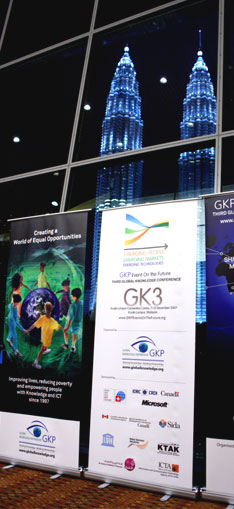
I spent a good part of my last week (9 – 13 December 2007, both days inclusive) in the Malaysian capital of Kuala Lumpur participating in the Third Global Knowledge Conference or GK3.

GK3 was organised by a network called the Global Knowledge Partnership, as a platform for those interested in using information and communications technologies (ICTs) for the greater good – to solve real world problems of poverty, under-development, illiteracy and various other disparities that afflict our world.

Those within the GKP call it ICT for Development, abbreviated as ICT4D. I prefer the more catchy phrase ‘Geek2Meek’ (or using geeks’ tools/toys to serve the needs of the meek).

In the spirit of spawning endless acronyms and abbreviations that contribute to the Alphabet Soup, I will compress this as G2M.

GK3 was meant to showcase the best of G2M products, practices and processes in every area of human endeavour — education, health, natural resource management, poverty reduction, empowering youth and women, promoting enterprise, etc.

klcc-gk3-03.jpg nalaka-gunawardene-at-gk3.jpg

After spending a good deal of my time and energy sampling many of GK3’s offerings, my cumulative impression was: there was a lot of geek for sure, but very little of the meek.

And the nexus between geek (tools) and meek (needs) was hopelessly lost in the incredible volume of hype, PR and spin generated by the platform organisers. What a missed opportunity it was for everyone!

To be fair, GK3 was not a single conference, but a whole platform of events sharing the large physical space of the KL Convention Centre and spread through the week of 9 to 13 December 2007. During that time and using that space, various groups organised diverse events and activities — ranging from the usual talk sessions and workshops to training, exhibitions, quiz shows, a TV debate and a documentary film festival. There were also several social events that provided many hours networking among individuals and organisations.

Event platforms like GK3 mean very different things to different people. Some turn up mainly to show and tell (or share) what they are doing. Some attend simply to find out what’s going on. Others look for markets, partners or opportunities. With some planning and work, most participants get to take away something in the end.

All this certainly happened during GK3 to one extent or another. It brought together hundreds of people from all over the world who share an interest in G2M — according to official figures, a total of 1,766 registered participants from 135 countries, comprising 19% from public sector, 21% from private sector, 29% from civil society, 20% from international organisations, 5% from media and 6% from academia. Among them, 82% of participants were from developing countries. And half of all participants were from Asia, which was not surprising given their easier access to KL.

These participants — most of them eager, energetic and creative individuals — talked and mixed in a myriad combinations around the overall platform theme: how the threads of emerging people, markets and technologies will intertwine to deliver the future. There was discussion, debate, sharing and networking.

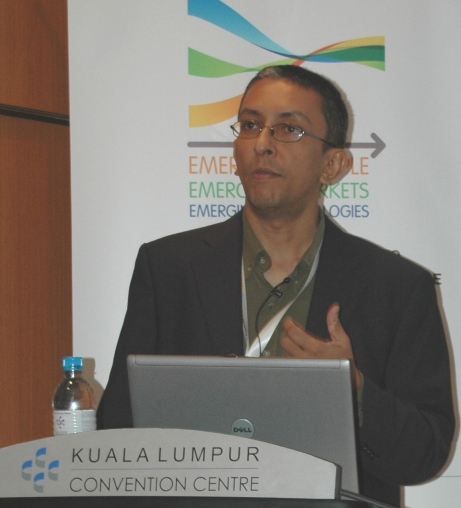
I myself did all of this. I attended part of the 3rd World Electronic Media Forum, joined the GKP’s 10th birthday celebration, sat through some plenary and parallel sessions and moderated two sessions myself. Some TVE Asia Pacific documentary films that I had scripted or directed were screened at the i4d film festival, a key side event. The week also saw the release of two Asian regional books that I was involved in creating (one I co-edited, and the other I wrote a chapter for).

But being the professional skeptic that I am, I don’t buy the GK3 secretariat’s post-event claim that “An overwhelming number of participants indicated that GK3 is the only event of its kind, is absolutely critical and worthwhile.” I have no doubt that a statistically higher number of people made nice and kind remarks about the week’s offerings, as many such people are wont to, especially if their participation was supported by travel scholarships. (I would be interested to know how many of the 1,700 people came on their own steam, as I did.)

In fact, style (and hype) over substance characterised the entire GK3 platform — the hype had actually started months before the event, with all registered participants being bombarded by endless promotional emails that I found simply intolerable. (And no, the organisers didn’t offer us the option of unsubscribing.) So much time, energy and donor funds were spent – nay, squandered – on dressing it up and inflating everything to the point of losing all credibility. If anyone was laughing all the way to their banks after GK3, it must be the assorted spin doctors!

copy-of-all-inf-no-solutions.jpg
As I have written and spoken (for example in an op ed article in i4d magazine, June 2006), the gulf between the (expensive) hype and reality in ICT circles can be wide and shocking. What is worth investigating is the development effectiveness of this whole platform, and the value for money it delivered.

Take, for example, an email circular sent out by the GK3 organisers days after the platform ended. Under ‘key initial findings’, they list the following for emerging technologies, the area that interests me the most (verbatim reproduction here):

Four future-oriented outlook involving technologies were highlighted – media, cybersecurity, low cost devices, and green technologies.
* Increased convergence of different media allows single broadcasting (one to many) to be complemented by social broadcasting (many to many), and in turn increases interactivity in the exchange of information.
* Cybersecurity, cybercrimes and cyberwaste are becoming real dangers which deserve special attention.
* More new low cost devices are needed to facilitate affordable access to information, knowledge, communication and new forms of learning.
* Demand for innovative green technologies is welcomed and growing.

I don’t see how any of this can be labelled as ‘findings’ — these are not even articulate expressions of already known trends, conditions or challenges. Is this how the ‘Event of the Future’ going to be recorded for posterity? Surely, GK3 achieved more than this – probably below the radar of its spin doctors?

GK3 to me was more evidence of the disturbing and very unhealthy rise of spin in international development circles, where both development organisations and development donors are increasingly investing in propagandistic, narcissistic communications products and processes. While publicity in small doses does little harm, it is definitely toxic in the large volume doses that are being peddled whether in relation to MDGs or humanitarian assistance or, as with GK3, in relation to Geek2Meek. Full-page, full-colour paid advertisements in the International Herald Tribune don’t come cheap — but they come at the expense of the poor and marginalised.

I was also struck by how web 1.0 the GK3 organising effort was — all official statements, images and communication products (and even social events) were so carefully crafted, orchestrated, controlled. Whatever spontaneous action came not from the Big Brotherly organisers but from some free-spirited participants who seized the opportunity to express or experiment. The defining characteristics of web 2.0 – of being somewhat anarchic, highly participatory and interactive – were not the hallmarks of GK3. Again, a missed opportunity.

Then there was the ridiculously named Moooooooooooooo – sorry, it was actually MoO, an abbreviation for ‘Marketplace of Opportunities’, which GK3 was supposed to create or inspire for all those engaged in Geek2Meek work.

The MoO turned out to be just another exhibition where two or three dozen organisations put up their ware to show and tell (and a few did brag and sing, but that’s allowed at places like this). Strangely for an ICT gathering, there was so much paper floating around — posters, leaflets, booklets, books, postcards, you name it! And very few CDs, DVDs and electronic formats being distributed.

Oct 2007 Blog post: Say Moooooooooo – Mixing grassroots and iCT in KL

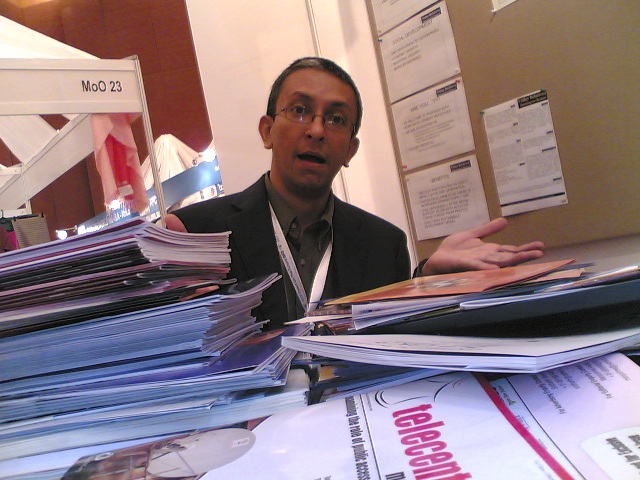
In the last hour of the final day, I walked around the MoO (I must admit I was half curious to see if the cows have come home!). I was stunned by the massive volumes of mixed up paper lying around everywhere. The week’s events were drawing to an end, and it was unlikely there would be too many more takers for all this paper. My colleague Manori captured on her mobile phone this image of an exasperated me surrounded by mountains of paper.

nalaka-gunawardene-sinking-in-a-sea-of-paper-at-gk3-dec-2007.jpg

The MoO exhibitors were not alone in their profligacy and wastefulness – the GK3 secretariat easily wins the prize for producing the greatest volume of glossy, expensive paper-based promotional material for at least a year preceding the event. These were often sent in multiple copies to heaven knows how many thousands of people all over the planet.

All this happened in a year (2007) when scientific confirmation of global climate change prompted governments, industry and civil society to realise that business as usual cannot continue, and more thrifty ways to consume energy and resources must be adopted. Ironically, GK3 was largely ignored by the world’s news media who focused much more attention on the UN Climate Change conference underway in neighbouring Indonesia’s Bali island.

I have commented separately on the missing link between KL and Bali. It is highly questionable what value-for-money benefit an ICT event like GK3 could derive from the abundance of paper-based materials produced to promote it. It’s revealing that the GKP’s oft-repeated claims of attracting 2,000 participants to GK3 were under-achieved despite excessive promotion.

Writing in October 2007, I said: “An informed little bird saysGK3 has milked development donors well and truly for this 3-day extravaganza. I hope someone will calculate the cost of development aid dollars per ‘Mooo’…”

poor-hungry-boy-cartoon.jpg

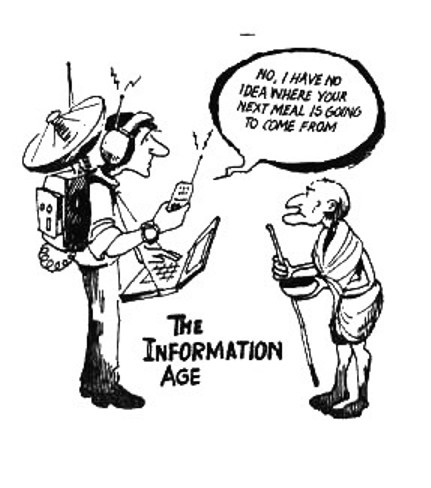
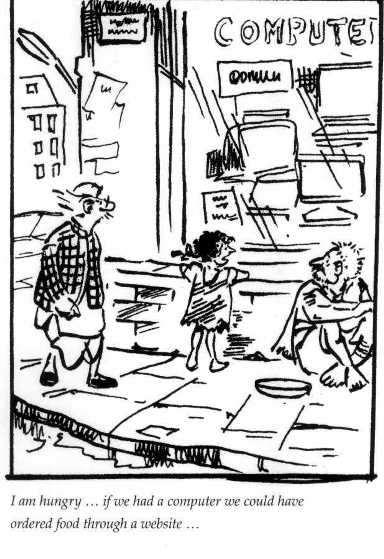
Well, now is the time to ask those difficult questions. The donor agencies of several developed countries — and from Canada and Switzerland in particular — invested heavily in the GK3 extravaganza. These are public funds collected through taxes, given in trust to these agencies for rational and prudent spending. And it’s fair to say that most of this official development assistance (ODA) money is given with the noble aim of reducing poverty, suffering and socio-economic disparities in the majority world.

The GK3 organisers — that is, the GKP Secretariat — often talk in lofty terms about good governance, extolling the virtues of accountability and transparency. Here’s your chance to practise what you preach to the governments and corporations of the world: disclose publicly how much in total was collected for GK3 (from development donors, corporate sponsors, hefty registration fees), and how this money was spent. In sufficient detail, please!

We will then decide for ourselves whether GK3 provided value for money in the truest sense of that concept, and assess if GK3 was ‘absolutely critical and worthwhile’ as the organisers so eagerly claim.

It’s easy for like-minded people to become buddies and get cosy in international development networks. It’s also common to engage in self congratulatory talk and mutual back-slapping at and after gatherings like GK3. But too much manufactured (spun?) consensus and applause can blind our collective vision and lead us astray.

If we genuinely want to engage in Geek2Meek (or, ICT4D), we have to keep repeating the vital questions: what is the value addition that ICTs bring to the development process, and what is the value addition that mega-events like GK3 provide for turning geek tools to serve the meek? Answers must be honest, evidence-based and open to discussion (and dissension, if need be).

In not sharing the euphoria of GK3 organisers, I probably sound like that little boy who dared to point out that the mighty emperor had no clothes. If nobody talks these inconvenient truths and asks some uncomfortable questions, we would be going round and round in our cosy little grooves till the cows come home.

Did someone say Mooooooooooooo?

Read my November 2005 op ed essay written just after WSIS II: Waiting for pilots to land in Tunis

From KL to Bali: Why were ICT and climate change debates worlds apart?

Communicating Disasters in digitally empowered Asia: A tale of two books

I have just spent a hectic week in Kuala Lumpur, and am just coming up for fresh air. That explains why this blog was silent for a few days.

I was at the Third Global Knowledge Conference (GK3) held in the Malaysian capital from 11 to 13 December 2007. With several related events preceding the main conference, my week was completely full.

GK3 was a global platform for all those engaged in using ICTs (information and communication technologies) for meeting the real world’s needs and solving its problems — to reduce poverty, increase incomes, create safer communities, create sustainable societies and support youth enterprise, etc. (Read my impressions of GK3 in this blog post.)

The week’s assorted events saw two separate video films produced by TVE Asia Pacific being screened as integral components of two sessions. These were The Long Last Mile (on community-based warning of rapid onset disasters) and Teleuse@BOP (on telephone use patterns among low income groups in five emerging Asian economies).

That wasn’t surprising because we produce and distribute films that capture Asia’s quest for improving lives through sustainable development. But unusually for myself, I also had two books coming out during the week — one that I had edited, and another that carried a chapter I had written.

communicating-disasters-an-asia-pacific-resource-book-by-tveap-and-undp.jpg

The first was Communicating Disasters: An Asia Pacific Resource Book, which I co-edited with Indian journalist Frederick Noronha. It was the culmination of a year-long process that began with an Asian brainstorming meeting on Communicating Disasters that TVEAP convened in December 2006 in Bangkok. That meeting, attended by three dozen participants drawn from media and disaster management sectors, identified the need for a handbook that can strengthen cooperation of these two communities before, during and after disasters.

The book, comprising 19 chapters contributed by 21 authors, has a foreword written by Sir Arthur C Clarke, inventor of the communication satellite. Pulling together these contributions from the specialist authored scattered across the globe was no easy task for co-editor Fred and myself.

The book’s blurb reads as follows:

“Where there is no camera, there is no humanitarian intervention,” said Bernard Kouchner, co-founder of Medecins Sans Frontieres who later became the Foreign Minister of France. Disaster managers and relief agencies acknowledge the mass media’s key role at times of distress. Yet, the relationship between media practitioners and those managing disasters can often be stressful, difficult and fraught with misunderstandings. Communicating about disasters sometimes ends up as communication disasters.

How can these mishaps be minimised, so that the power of conventional and new media can be harnessed to create more disaster resilient communities? What value addition can the new information and communication technologies (ICTs) bring in? In this book, media and development professionals from across the Asia Pacific share their views based on decades of experience in covering or managing a variety of disasters – cyclones, droughts, earthquakes, floods, landslides and tsunamis.

This book is aimed at journalists, disaster managers and civil society groups who want to use information and communication to create safer societies and communities.

The other book that came out in KL was Digital Review of Asia Pacific, 2007-2008 edition. It was launched during a workshop on Emerging Knowledge Opportunities (The Progress of ICT in Asia-Pacific and Other Parts of the World) on 12 December 2007.

The completely updated edition of the Digital Review of Asia Pacific contains authoritative reports on how 31 economies are using ICT in business, government and civil society written by senior authors who live and work in the region.

I have written the Sri Lanka chapter for the book, continuing a tradition I started back in 2003 with the first edition of the book. I was only sorry that I missed the session during GK3 where the book was launched — because I was moderating another session exactly at the same time in another room. But I was glad to join at least part of the post-launch reception and to meet with some fellow authors who were attending GK3.

Both books are multi-author books, and both have been in the making for a year or longer. It was quite a challenge to get 20 other contributors to come up with their chapters for Communicating Disasters. They were genuinely interested and supportive, but everyone being so busy, it took time and effort to pull together all the strands.

I was not the only common author in these books. My colleague and one-time co-author Chanuka Wattegama (now with LIRNEasia) has written two distinctive chapters on ICTs and disaster communication for the two books.

Many years ago, my friend (now international expert on terrorism and widely published academic author) Rohan Gunaratna told me that writing a book was like waging a small war. I don’t normally use military metaphors, because I deplore all things military, but I can’t resist extending Rohan’s analogy to say that compiling a multi-author book is a bit like waging a mini-war with a coalition of the willing!

GlobalVision at 20: Insiders turned outsiders keep kicking


GlobalVision, the path-breaking media company anchored in New York with a truly global outlook and a strong commitment to social justice, completed 20 years this week.

It was launched in November 1987 out of one room in Soho (New York) as a mission-driven company with little money but a big idea: to improve news coverage of the world through an “inside-out” approach that would offer voices not usually heard on the air in the US.

The founders were Danny Schechter, who became, in his words, a “network refugee” from ABC News 20/20 and Rory O’Connor, then with CBS News 48 Hours.

As the company introduction says:

“The whole world is watching… From Baghdad to Beijing, from Madrid to Manhattan, information is moving at the speed of light. Media and communications technology are transforming our lives — and those of our six billion neighbors. But in the emerging global village, whose stories get told — and who gets to tell them?

“At Globalvision, we believe in telling stories from the inside out. That means working with other cultures — not at them –and helping people to tell their own stories in their own way, to a world that’s getting smaller every day.”

In an industry saturated with media companies known more for their style than substance, Global Vision has not only blazed new trails, but used moving images in ways that moved people towards social change, political reform and – just as importantly – constantly question and challenge conventional wisdom and traditional authority.

They have also never hesitated to challenge the fellow journalists and corporate media on their servility, acquiescence and willing suspension of journalistic norms in the United States, especially under the current Bush administration.

They have won numerous awards and professional recognition for its pioneering international newsmagazine South Africa Now, which first broke through censorship to smuggle footage out of what was once the land of apartheid — and later chronicled Nelson Mandela’s transition from prisoner to President.

The company followed up with another award winning series, Rights & Wrongs: Human Rights Television with Charlayne Hundter-Gault, which aired for four years in sixty-two countries around the world.

Danny and Rory have also directed and produced more than thirty hard-hitting documentaries, many involving controversial issues and investigations — some for the PBS “Frontline” series” and others for television systems worldwide. Current films deal with subjects such as America’s child farm workers, bridging the global digital divide, flawed media coverage of the War in Iraq, and the ongoing debt crisis that threatens the global economic system.

I met Danny in person only once – in the Fall of 1995, when I spent a few weeks in New York on a fellowship to study the United Nations. Danny was one of the more colourful people we met (besides lots of men in suits from the UN, only a few of whom I can now recall by name). Danny introduced himself as a (TV) ‘network refugee’ — and gave a workshop on television journalism in defence of the public interest and human rights that had a lasting influence on myself.

Ever since, I have followed his books, incisive NewsDissector blog and Global Vision output with much interest.

So here’s wishing Danny, Rory and team at GlobalVision many more years of kicking ass!

MediaChannel.org: Global Vision marks 20th anniversary

Read Danny Schechter on: The Days of Our Dominion: Global Vision celebrations 20 years in the trenches

Rory O’Connor’s tribute to the late Anita Roddick, a long-standing supporter of Global Vision

“Hands up who is poor, speaks English – and looks good on TV!”

“Hands up who is poor, speaks English – and looks good on TV!”

With that title, I opened my panel remarks to the 8th Annual Symposium on Poverty Research in Sri Lanka on the morning of 30 November 2007.

Sri Lanka’s Centre for Poverty Analysis (CEPA) had invited me to speak during a session on ‘Taking it off the page: Alternative mediums of communication to influence change’. The theme of the overall symposium was ‘Communicating research and influencing change’.

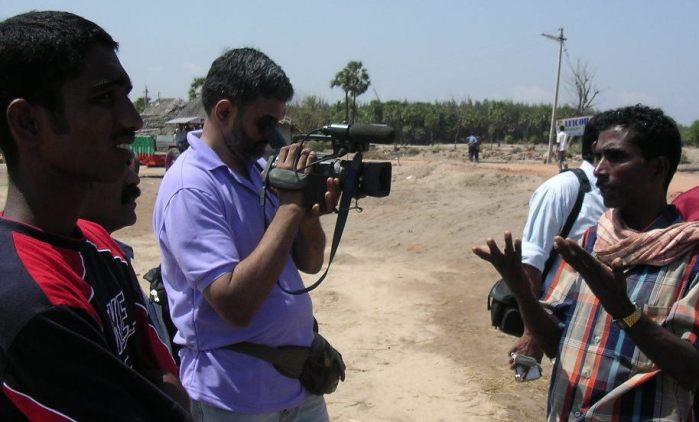
Part of my talk was on challenges in using moving images to communicate development related research. The other part was on how most sections of the mainstream media covers stories of the poor — or those living at the bottom of the income pyramid.

I noted that as Asia’s billions strive for a better today and better tomorrow, there are millions of stories at the bottom of the pyramid. But most mainstream media manage to miss these stories due to their ignorance, or arrogance, or both.

But reporting from the bottom of the pyramid need not be all about doom, gloom and alarm. In fact, so much is happening there that a well informed story-teller won’t have much time to spend on negativity (while acknowledging a great deal of suffering that remains).

interviewing-tsunami-survivor-in-tamil-nadu-india.jpg

In my remarks, I emphasised that to discover these stories and tell them with empathy and accuracy, we as story-tellers need to recognise a few basic realities:
• The poor are not another species to be treated as if they were endangered! They are living and loving human beings as complex and nuanced as anyone in this room.
• Nor are the poor a ‘sub-human species’ with a simpler set of needs and aspirations. They have as many primary, secondary and tertiary needs – just like anyone else!
• When it comes to information, they have not only survival and practical information needs (which many development projects try to provide), but also what I call ‘information wants’ – cultural and social information – which many development projects completely ignore.
• The poor have opinions too — and are often more articulate and expressive when someone cares to listen and capture these.

So telling media stories from the Bottom of Pyramid needs the knowledge base, socio-cultural understanding and ethical framework in which to gather and process these stories. We at TVE Asia Pacific don’t claim to have got everything right, here are our basic rules of engagement:
• We treat the rich, middle class and poor alike – extending the same courtesy and respect (including obtaining personal clearances for interviews).
• We caption everyone on-screen by name and location, irrespective of their social and economic status.
• We film people – for interviews or generic footage – only with informed consent.
• Wherever possible, we take our the finished TV products back to where they were filmed and share with those who told us their stories. (We are not alone in this: I have written blog posts about Earthcare Films of India and the Brock Initiative of the UK who are also doing this.)

Our industry of broadcast TV is not always known for its class-less treatment of every human being with respect and dignity. In fact, the poor often become ‘Canon-fodder’ for camera crews looking for dramatic images of human suffering.

from-mediachannelorg.jpg from-mediachannelorg.jpg

The globalised media continue to use stereotyped images of the global South – captured mostly by northern photographers and camera crews. As my friend Shahidul Alam, founder of Drik Picture Library in Bangladesh, says: “Invariably, films about the plight of people in developing countries show how desperate and helpless they are…. Wide angle black and white shots, grainy, high contrast images characterise the typical third world helpless victim.”

This explained my title: “Hands up who is poor, speaks English and looks good on TV!” It’s a caricature of how some camera crews go looking for that convenient sound-bite with some doom-and-gloom visuals to match.

But it’s not just the northern media who sensationalise and oversimplify life at the bottom of the pyramid in the South. Many of our own media outlets, rooted in the cities and obsessed with middle class life styles, are also good (or bad) in this game!

And the media are not alone. When development agencies and ‘pro-poor’ activists presume – in their middle class arrogance – that the poor only need survival or sustenance related information, the latter is immediately reduced to sub-human status.

Nov 2005 op ed: Communication rights and communication wrongs


Nov 2006 op ed: Ethical news gathering: Al Jazeera’s biggest challenge

Aug 2007 blog post: Wanted: Ethical sourcing of international TV News

Moving images moving research…beyond academic circles!

Although I’ve dabbled in some media research at times, I don’t think of myself as a researcher. So when Sri Lanka’s Centre for Poverty Analysis (CEPA) invited me to speak at their 8th Annual Symposium on Poverty Research in Sri Lanka, I spoke on what I know a little bit about — communicating research using the audio-visual media.

My panel remarks, delivered on the morning of 30 November 2007, were on ‘alternative mediums of communication to influence change’. I opened with the provocative title “Hands up who is poor, speaks English – and looks good on TV!” (see separate blog post on media related aspects of my talk).

These days, so much of research in physical, biological and social sciences is justified in the name of poverty reduction. Yes, studying and understanding development problems is the essential first step of solving them. But without properly communicating this research, the results won’t help the poor — or anyone else.

We at TVE Asia Pacific are committed to covering Asia’s development issues using TV, video and web. Our small challenge is to capture the many and varied facets of how Asians are working for a better today and better tomorrow. Reducing and eventually eliminating poverty is a significant part of that process.

As Asia’s billions strive for better lives, there are millions of stories at the bottom of the income pyramid. But most mainstream media manage to miss these stories due to their ignorance, or arrogance, or both.

For us, one key source of information and analysis is researchers – people who study trends and conditions, and keep reflecting on how and why. Their knowledge and insights are invaluable for us to tell stories from and about the bottom of the pyramid.

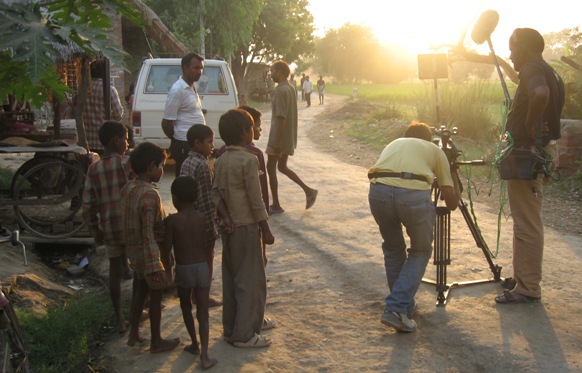
filming-living-labs-in-uttar-pradesh-india.jpg

As I told the researchers in my audience: “Part of our challenge is to know what you are studying — and then figure out the public interest and human interest angles of your work. As communicating research to those outside the scientific or research communities is more an art than a science.”

I cited three recent examples where we had produced engaging TV/video content to communicate research directly relevant or related to the poor.

Digits4Change
was our attempt to understand and document how information and communication technologies (ICTs) are changing the way Asians live, work and play. We covered technologies such as Internet, computers, mobile phones and satellite communications applied in education, healthcare and rural business development. The knowledge base for this 2006 series came from IDRC’s Pan Asia programme which supports action research that addresses specific problems.

Also in 2006, we produced The Greenbelt Reports to take a close look at the environmental lessons of the Indian Ocean tsunami. We visited a dozen locations in India, Indonesia, Sri Lanka and Thailand to find out how community and conservation interests can be balanced in relation to coral reefs, mangroves and sand dunes. In telling these stories, we worked with researchers from global agencies like IUCN the World Conservation Union and UNEP as well as national organisations like the M S Swaminathan Research Foundation in India.

The Greenbelt Reports

Living Labs is our most recent series, released in March 2007. Filmed in 9 countries in Africa, Asia, Europe and Latin America, it looked at how researchers are addressing different aspects of a major challenge in agriculture: how to grow more food with less water. We worked with a global action research project called the CGIAR Challenge Programme on Water and Food, which gave us exclusive access to their on-going field work and emerging findings in nine major river basins of the developing world.

living-labs-by-tveap.jpg

In telling these and other stories, we work within a certain framework we have defined for ourselves. Among its salient points:
• We don’t set out trying to communicate messages; we just want to tell good stories and development communication is a by-product.
• We look for under-reported/ignored development issues, or a less covered angle in a widely reported story.
• We don’t just talk to technical experts but to many other individuals involved or affected – women, men and children from all walks of life.
• We seek and accommodate different points of view, not allowing single-issue activists or one source to dominate/monopolise a story.
• Our finished products are informed by science but never immersed in science – we always keep in mind that our audience is non-specialsits.

All our stories cover real people dealing with real world issues and challenges. And since Asia has more people living in poverty than anywhere else in the world, most of the time our stories concern what’s happening at the bottom of the pyramid – or what can directly impact people living there.

And without exception, all these TV series and individuals films are available free of any license fees for broadcast, civil society and educational use. They are also available for online viewing at TVE Asia Pacific’s channel on YouTube.

Communicating research through moving images is not easy. Packing years of hard work into a few mins of engaging visuals and narration involves ruthless condensation which sometimes leaves some researcher egos bruised. When covering the work of large research organisations, we’ve also had deal with internal politics and hierarchies: for example, what to do when a junior researcher is more authentic and articulate than her supervisor?

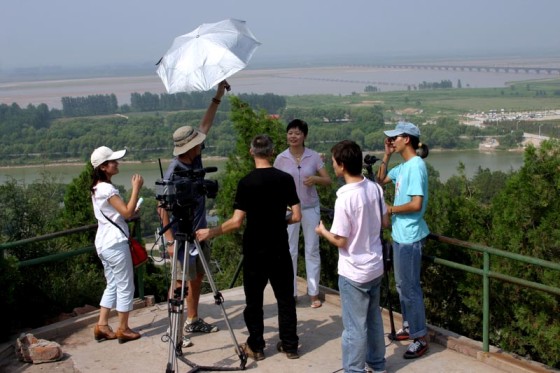
Producing Living Labs based on filming in 9 countries on 3 continents in just 5 months during 2006 was a challenge in both logistics and political negotiations. As editor-in-chief, I had to balance the public accessibility of our end product with researchers’ keenness to pack their stories with facts and figures.

living-labs-being-filmed-in-yellow-river-basin-china.jpg

We didn’t please everyone. One senior researcher told us that his multi-faceted, multi-year nad multi-million dollar was like an elephant — and we’d only glimpsed just one part of that big creature!

That’s just the point: we can never cover the whole elephant in a media product intended for non-specialists. So we choose which part of the elephant is most interesting and present it in a way that will make viewers realise — and hopefully, appreciate — that there’s a lot more that’s worth finding out.

Moving image products often act only as ‘teasers’ — communicating highlights of research, and directing those interested to online or offline sources that offer more information.

Because they act as a/v versions of executive summaries, these ‘teasers’ by themselves are a powerful way of reaching out those who are unlikely to look up the details: that includes many policy makers, government officials and business people.

Winston Churchill used to ask his staff to give him everything ‘on one page’. These days, he might have asked for everything to be summed up in a five minute video — as we often do.

Road to Bali: Beware of ‘Bad weather friends’!

unfcccnew-c.jpg

All the environmental roads — well, actually flights — seem to lead to Bali in the coming days.

The Indonesian ‘Island of the Gods’, famed as a tourist resort, will play host to the 13th United Nations Climate Change Conference from 3 to 14 December 2007.

The Conference, hosted by the Government of Indonesia, brings together representatives of over 180 countries together with observers from inter-governmental and non-governmental organizations, and the media. The two week period includes the sessions of the Conference of the Parties to the UN Framework Convention on Climate Change (UNFCCC), its subsidiary bodies as well as the Meeting of the Parties of the Kyoto Protocol.

The Bali meeting will be a turning point in the global response to climate change, an issue which has moved above and beyond being a simple ‘green’ concern to one with economic, security and social implications. The annual meeting returns to Asia after five years, since New Delhi, India, hosted the 8th meeting in November 2002.

In the build up to Bali, a new report released on 19 November 2007 says that without immediate action, global warming is set to reverse decades of social and economic progress across Asia, home to over 60 per cent of the world’s population.

Up in Smoke? Asia and the Pacific – with a foreword by Dr Rajendra K Pachauri, Chairman of the Nobel prize-winning Inter-governmental Panel on Climate Change (IPCC) – is the most extensive and concluding chapter of a unique, four-year long exercise by the Up in Smoke coalition, an alliance of the UK’s major environment and development groups.

The report shows “how the human drama of climate change will largely be played out in Asia, where almost two thirds of the world’s population live, effectively on the front line of climate change.”

When our friends at the International Institute for Environment and Development (IIED) in London sent me the press release about the report last week, something caught my eye. Among the several accompanying quotes was this one concerning the media:

“In many Asian countries climate change stories don’t make it into the media, so the public are left out of the debate. The challenge for decision-makers and the media is to stimulate interest in their work and translate the complex issues into stories that capture the public’s imagination. Climate change above all requires the engagement of everyone in creating the changes required.”

This sweeping statement is attributed to Rod Harbinson, Head of Environment, Panos London.

I know Panos London well, and am surprised to read an official remark of this nature emerging from that organisation which, until recently, has tried to relate to the majority world media as a friend and supporter. In fact, the first time I had one of my own pieces internationally syndicated was by Panos Features, back in 1989.

Come to think of it, the second article I wrote for Panos Features concerned how the low-lying, Indian Ocean island nation of Maldives was preparing for adverse impacts of climate change. That was years before the web, so there’s no link I can provide.

As a development writer and journalist who has covered global climate change among other issues for two decades, I have problems with Mr Harbinson’s remark.

Drik/Majorityworld
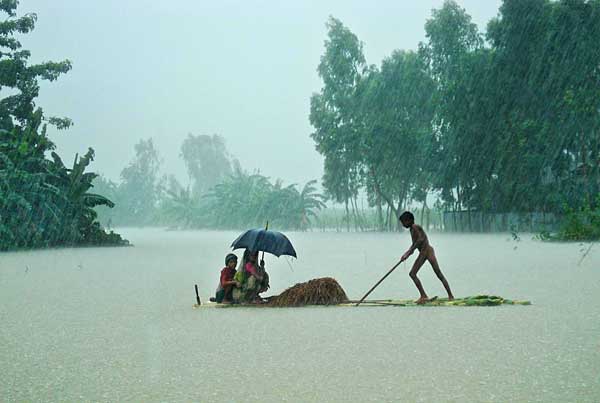
Photo: A family looks for shelter using a raft made of banana trees during the last Monsoon: 31 July 2007: Gaibandha, Bangladesh © Quddus Alam/DrikNews Linked from Shahidul News

I’m in full agreement on the need to ‘translate the complex issues into stories that capture the public’s imagination’. There is also no argument that climate change requires the engagement of everyone.

But I would be very interested to know on what statistical or analytical basis he says “in many Asian countries climate change stories don’t make it into the media, so the public are left out of the debate’.

Asia, as Mr Harbinson should surely know, is not just China, India and Indonesia. It is large and highly diverse region, containing five sub-regions as defined by the UN. It is home to nearly two thirds of humanity, who live in over three dozen independent states or dependent territories.

Living in Asia and trying to work at regional level, I know how difficult it is to make any generalisations about this rich and constantly changing assortment of economies, cultures and societies branded as Asia (which, taken together with the small island nations of the South Pacific, is known as the Asia Pacific). In fact, it’s wise not to speak about Asia as a whole, for there is little in common, say, between Japan and Laos, or between China and Maldives.

The Asian media are as diverse as the region, and have been undergoing rapid change in recent years. Unshackled from the state’s crushing grip in most countries, the broadcast media (radio, TV) have proliferated and emerged as the primary source of information for a majority of Asians. New media – web, mobile devices and multimedia combinations – are now changing the way many Asia’s communicate and access information.

I have always been curious how Panos London, perched at its cosy home in London’s White Lion Street, assesses what goes on in the majority world. In this case, how much of Asia does Mr Harbinson know and is really familiar with? How many Asian media outlets has he or Panos monitored, assessed and sampled before coming to this sweeping and damning conclusion about the lack of climate change stories in the Asian media?

And how many of these outlets are radio and TV, and in languages other than English? I would really like to know.

If Panos London believes in evidence-based analysis, then it owes us in Asia an explanation as to on what basis its head of environment makes such statements about an entire continent, whose media output is predominantly in Asian languages, not English. And whose principal media are broadcast, not print.

And what constitutes a climate story? Tracking the endless array of inter-governmental babble in the name of working out some compromised partial solution to the major problem? Or reporting on campaigns to clean up polluting industries or sectors (such as transport) that generate most of the greenhouse gases? Or focusing on how humble communities in remote corners of the world are finding how their lifestyles and livelihoods are suddenly threatened by something they hardly understand?

To me, it’s all of the above — and a lot more. Climate change is akin to a prism through which many, many development issues and topics can be analysed. Just as HIV/AIDs long ago ceased to be a simple medical or health story, climate change has moved well beyond being an environmental story.

The more angles, perspectives and topics that are covered in the media, the better. And all of it need not be in that staid, cautiously balanced style of The Guardian or BBC that Panos London must be more familiar with.

Panos London, in its statement of beliefs, says ‘Freedom of information and media pluralism are essential attributes of sustainable development’. Surely, then, they realise that media pluralism includes speaking in a multitude of tongues, and analysing from many different perspectives — as happens in the Asian media 24/7, if Mr Harbinson and his colleagues care to spend more time in the region and keep their eyes and ears open.

But instead, they seem more like a group of well-meaning people with a solution in search of a problem. For the past many months, Panos London has been crying wolf about the allegedly poor coverage of climate issues in the majority world media.

That was the main thrust of a report they published in late 2005, titled Whatever the weather – media attitudes to reporting climate change.

According to Panos London website that I have accessed today, “…the survey found that there is little knowledge among journalists about these important choices and they are rarely discussed. The dramatic impacts of extreme weather events, for example, rarely feature in relation to climate change and the topic remains low on editors’ story sheets.”

The survey was based on ‘interviews conducted with journalists and media professionals in Honduras, Jamaica, Sri Lanka and Zambia’ and claimed to ‘give insights into the attitudes of journalists and the status of the media in these countries.’

Well, I was one of those majority world journalists covered by the survey — and I had major reservations about how they used my responses. Being cautious, I had used email (and not the phone) to respond to their survey questions – I therefore have a complete record of everything I said. When the draft report was shared on my request, I found some of my responses being distorted or taken out of context. I had to protest very strongly before some accuracy was restored. I later regretted having agreed to be part of this dubious survey.

It was flawed in many ways. The questionnaire was very poorly conceived and structured. I actually declined to answer some questions which were worded in such a way as to elicit just the kind of response that Panos London wanted — to make a case that journalists in the majority world are so incompetent that they need help.

A glaring omission in the final report was that it carried no list of journalists interviewed. I had to ask several times before I could even find out how many others participated in the survey (apparently some three dozen). But my requests for a list of other survey respondents were repeatedly declined by Panos London, who said it was privileged information. They later took the position that European data protection laws did not allow them to disclose this information!

In an email sent to Rod Harbinson on 22 Feb 2006, I said: “I would argue that Panos London had pre-conceived notions that it wanted to present in this report, and used superficial and largely unprofessional interview surveys with a few scattered journalists as a rubber-stamping exercise to publish what it wanted to say anyway. This is further borne out by the fact that some of my more outspoken responses have been completely ignored.”

I have seen or heard nothing since to change the above view. And the contents of Whatever the weather – media attitudes to reporting climate change are consistent with what Rod Harbinson says in the IIED press release that prompted me to make this comment.

Yes, climate change is the Big Issue of our times that needs everyone to rally around and search for ‘common but differentiated’ solutions and responses. But no issue or global threat is too big to warrant the willing suspension of time-honoured journalistic or academic values of honesty, integrity and balance. Issuing lop-sided ‘survey reports’ and making sweeping negative statements do not help the cause of improving public discussion and debate on climate change.

The road to Bali and beyond is going to be an arduous journey. On that treacherous road, we in the majority world need to beware of ‘bad weather friends’ who come bearing bad surveys and self-serving offers of ‘help’.

— Nalaka Gunawardene

Note: In the spirit of communication for development and media pluralism, I invite Panos London to respond to the above critique, and offer to publish their response in full.

I remain a critical cheer-leader of the global Panos family, and serve on the Board of Panos South Asia, an entirely independent entity that has excellent relations with Panos London. Like all families, we don’t always agree – and that’s part of media pluralism!

Related blog posts:

Nov 2007: True ‘People Power’ needed to fight climate change
Nov 2007: Beyond press release journalism: Digging up an environmental business story
Oct 2007: The Al and Pachy Show: Climate Change gains public momentum

Aug 2007: Arthur Clarke’s climate friendly advice: Don’t commute; communicate!
June 2007: Sex and the warming planet: A tip for climate reporters
April 2007: Can journalists save the planet?
April 2007: Beware of Vatican Condoms and global warming
April 2007: Pacific ‘Voices from the Waves’ on climate change
April 2007: Wanted – human face of climate change!