Asking questions. Connecting the dots. Explaining matters.
These actions sum up what I have been doing in the spheres of communication and development for over 20 years. They form the cornerstone in my attempts to make sense of our globalised world and heady times.
As a journalist, I was trained to look for what’s New, True and Interesting (‘NTI Test’). Early on, I went beyond just reporting events, and probed the underlying causes and processes. With experience, I can now offer my audiences something more: perspective and seasoned opinion.
I look back (slightly) and look around (a lot) in a half-hour, in-depth TV interview with media researcher/activist and fellow citizen journalist Sanjana Hattotuwa. This was part of The Interview (third series) produced by Young Asia Television, and broadcast on two Sri Lankan TV channels, TNL and ETv on May 8 (with repeats).
Watch the full interview online: Sanjana Hattotuwa talks to Nalaka Gunawardene
I have always worn multiple ‘hats’, and dabbled in multiple pursuits rather than follow narrow paths of enquiry. I see myself continuing to oscillate between the ‘geeks’ and greens, and where possible, bridging their worlds.
I sometimes feel a strange kinship with the ancient Greeks, who first asked some fundamental questions about the universe. They didn’t always get the answers right, and neither do I.
But it’s very important that we question and critique progress – I do so with an open mind, enthusiasm and optimism.
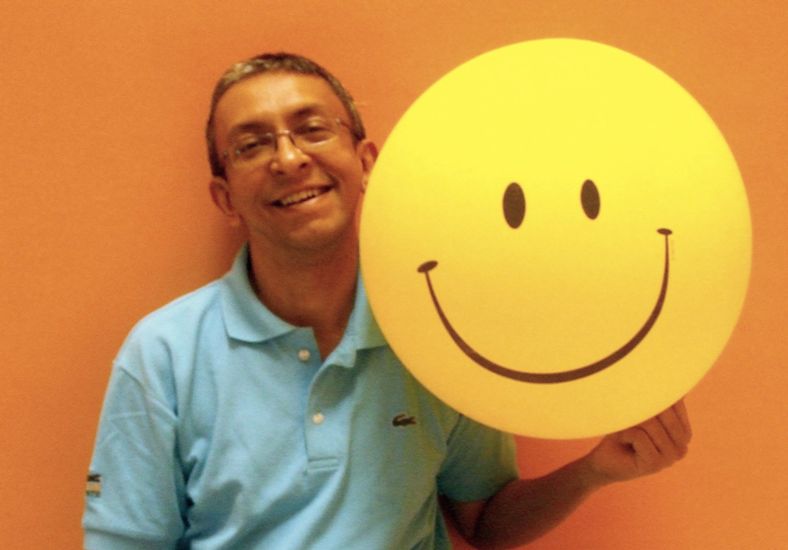
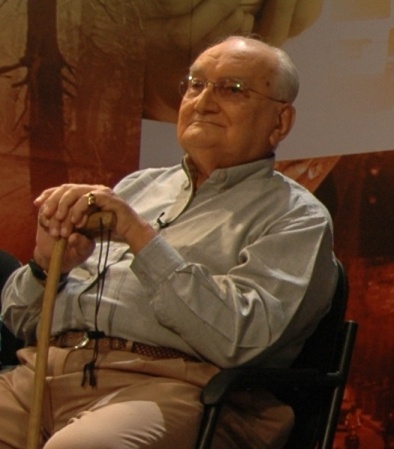
Nalaka Gunawardene at 45: Captured on 13 Feb 2011 by Dhara Gunawardene
As I turn 45 today, I can’t do better than to quote one of my favourite poets, Ogden Nash, who wrote these ‘Lines on Facing Forty’: I have a bone to pick with fate,
Come here and tell me girly:
Do you think my mind is maturing late,
Or simply rotting early?
I first heard these words quoted by the late Tarzie Vittachi, a pioneer in development journalism – and an early influence on my career – at a talk he gave circa 1990. At the time, Tarzie was already in his late 60s, but he hadn’t lost the capacity to poke fun at himself.
More than two decades later, I can better appreciate both Tarzie Vittachi and Ogden Nash. I’m now more convinced than ever that a good sense of humour – whether plain, wry or wicked – is an essential element in our survival kit as we fumble along the path of life. In my case, I’ve pledged never to take myself too seriously; however, I’m passionate and serious about what I do.
I used to give this simple caution to all my newly recruited staff members: “If you take me too seriously, you will lose your mind.
If you don’t take me seriously enough, you might (possibly) lose your job…”
After a while, I was told that it was prone to be highly misunderstood, partly because not everyone shared my play with words, and partly due to some people lacking any sense of humour. I no longer utter these words; the practical implications remain!
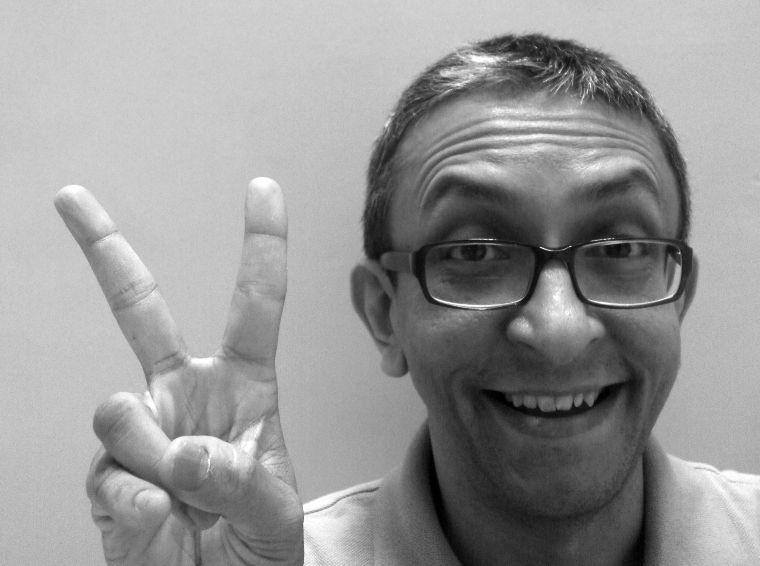
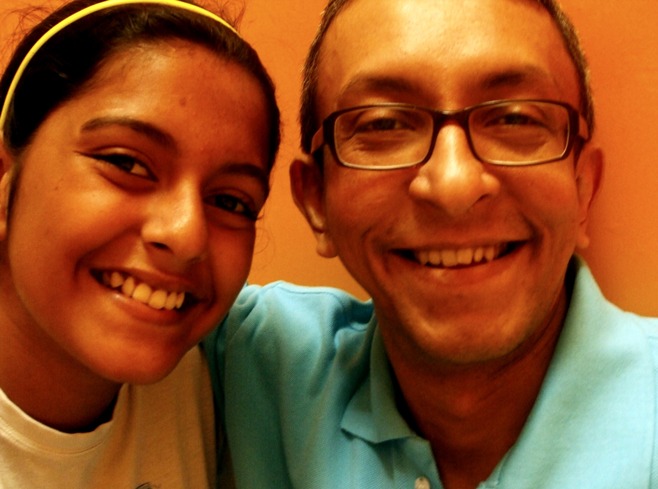
On more cheerful matters, my photographically keen daughter Dhara offered to shoot me as part her birthday present. I’m always happy to face cameras (and just love to make faces), so I readily agreed. Here are some of the better results, carefully chosen by the editor-publisher of this blog:
Nalaka G - with Mouth and Mind wide open...Photo by Dhara GunawardeneI promise never to act my age!Posing with the family photographer!
By the way, I’m perfectly happy with my salt-and-pepperish hair, and have resolved never to join the growing number of my friends quietly signing up to the ‘Godrej Brigade’ (I have no objections to others dyeing their hair: each one to her own self…).
In computing terms, I’m a WYSIWYG (pronounced: WIZ-ee-wig): an acronym for ‘what you see is what you get’. The term is used to describe a system in which content displayed during editing (on-screen) appears very similar to the final output.
2011 is here! We’re not ones to be easily affected by a mere landmark in our particular system of chronology, but as watchers of popular culture, we go along with the mood of the moment — if only to blend in with the planet’s natives…
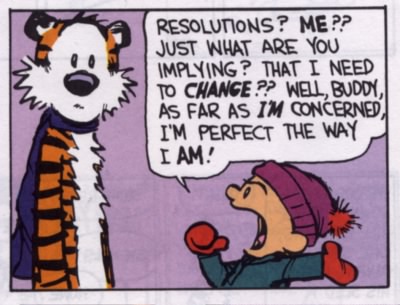
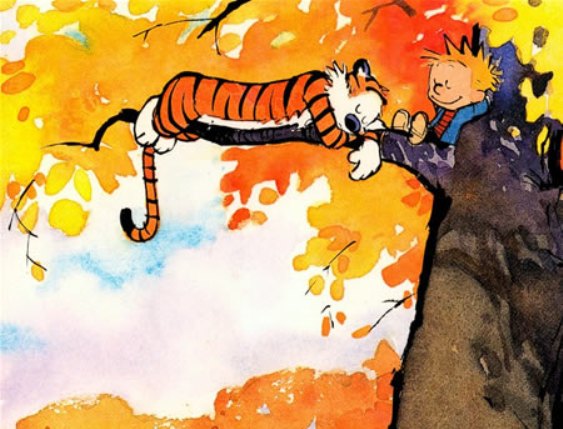
As for our own mind (which is large and contains multitudes), Bill Watterson – the inimitable creator of Calvin and Hobbes – has once again captured my thoughts so well…and so colourfully.
The future isn't what it used to be!
As for resolutions, the only one I have is that I get to write more, and get read more widely. What more can a wordsmith ask for?
Besides, I tend to agree with Calvin when he says here…
In transit are we all,
On this Third Rock from the Sun
Waiting for our onward journeys
From Here to Eternity.
Some of us, the steady types
Stay longer in this transit,
Welcoming dozens of years
As they arrive, endure and depart.
Some leave a mark
In the ‘sands of time’ as they say
Legacies of brick or flesh
Or just fond, loving memories.
But remember this, New Year:
There are a few of us,
Precious few, as it turns out,
Who don’t measure our worth
By the number of years
Whose passage we count.
My DIY as POY: Famous at last?“All I can hear I me mine, I me mine, I me mine.
Even those tears I me mine, I me mine, I me mine.
No-one’s frightened of playing it
Ev’ryone’s saying it,
Flowing more freely than wine,
All thru’ your life I me mine…”
When George Harrison sang those words in the 1970 Beatles song ‘I-Me-Mine’, he was in two minds about expressing in the first person (or ego). He wasn’t alone: mainstream journalism has long had reservations about where ‘I’ fit in journalistic narratives.
“Never bring yourself into what you write,” we were told in journalism school 20 years ago. Journalists, as observers and chroniclers of events, write the first drafts of history – and without the luxury of time or perspective that historians and biographers take for granted. We often have to package information and provide analysis on the run. Bringing ourselves into that process would surely distort messages and confuse many, it was argued. We had to keep our feelings out of our reportage lest it affects our ‘objectivity’.
In other words, we were simply mirrors reflecting (and recording) the events happening around us. Mirrors can’t – and shouldn’t — emit light of their own.
Occasionally, if we felt the urge to express how we personally felt about such trends and events, we were allowed the luxury of an op-ed or commentary piece. Of course, as long as we ensured that it was a measured and guarded expression. And if we really wanted to bring ourselves into the narrative, we could use the archaic phrase ‘this writer…’ to refer to ourselves.
But never use I-Me-Mine! That would surely sour, taint and even contaminate good journalism – right?
Well, it used to be the ‘norm’ for decades — but mercifully, not any longer. Thanks largely to the new media revolution triggered by the Internet, writing in the I-Me-Mine mode is no longer frowned upon as egotistic or narcissistic. It sometimes is one or both these, but hey, that’s part of cultural diversity that our information society has belatedly learnt to live with…
We journalists are late arrivals to this domain. The first person narrative was always valued in other areas of creative arts such as literary fiction, poetry and the cinema. In such endeavours, their creators are encouraged to tell the world exactly how they feel and what they think.
Of course, some writers ignored orthodoxy and wrote in the first person all along. One example I know personally is the acclaimed writer of science fiction and science fact, Sir Arthur C Clarke. Shortly after I’d started working with him in 1987, Sir Arthur encouraged me to fearlessly use the first person narrative even in technical and business writing. A lot of writing ended up being too dull and dreary, he said, because their writers were afraid of speaking their minds.
Yet we had to wait for the first decade of the Twenty First Century to see I-Me-Mine being widely accepted in the world of journalism. Did the old guard finally cave in, or (as sounds more likely) did Generation Me just redefine the rules of the game?
Whatever it is, I-Me-Mine is now very much in vogue. And not a moment too soon!
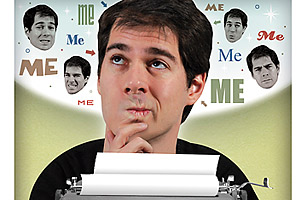
Joel Stein (Photo-illustration by John Ueland for TIME)As Time columnist Joel Stein, who often writes with his tongue firmly in his cheek, noted in a recent column: “All bloggers write in first person, spending hours each day chronicling their anger at their kids for taking away their free time. Every Facebook update and tweet is sophomoric, solipsistic, snarky and other words I’ve learned by Googling myself.”
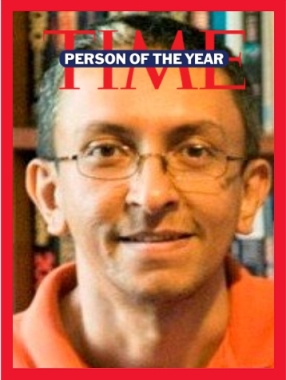
And look at what Time just tempted me to do: put myself on their cover, as the Person of the Year (POY), no less. While designating Facebook’s founder Mark Zuckerberg as its POY 2010, Time teamed up with the social media network to introduce a new application that allows anyone to become POY with just a few key strokes. Provided you have a Facebook account, of course.
Joel Stein quotes Jean M Twenge, professor of psychology at San Diego State University, as saying that we are living in the Age of Individualism, a radical philosophical shift that began with Sigmund Freud. It has exploded during the past decade with reality television, Facebook and blogging. “You’re supposed to craft your own image and have a personal brand. That was unheard of 10 years ago,” Twenge says.
What a difference a decade can make. Although trained in the pre-me era, I was never convinced as to why I had to keep myself out of what I write. However, my use of I-Me-Mine was done sparingly in the late 1980s (when I started my media work) and during the 1990s. It was only in the 2000s that I finally found both the freedom to speak my mind – and the ideal platforms for doing so: blogging and tweeting.
As my regular readers know, I blog about my family, friends, pet, travels, writing and conference speaking. I liberally sprinkle photographs of myself doing various things. I tell you more than you really want to know about my life. Ah yes, I’m self-referential too.
And not just on this blog. I’ve also been writing op ed essays for various mainstream media outlets for much of the past decade, and have never hesitated in expressing what I think, feel and even dream about. (Isn’t that what opinion pieces are meant to be?)
But the Digital Immigrant that I am, all my writing is shaped by my pre-Internet training. Even for a blog post or tweet, I still gather information, marshal my thoughts and agonise over every word, sentence and paragraph.
As my own editor and publisher on the blog, I don’t have gatekeepers who insist on any of this. My readers haven’t complained either. Yet I write the way I do for a simple reason. I may indulge in a lot of I-Me-Mine, but I don’t write just for myself. You, gentle reader, are the main reason why I strive for coherence and relevance.
(OK, if you really must know, it also ensures a joyful read when I occasionally go back and read my own writing…)
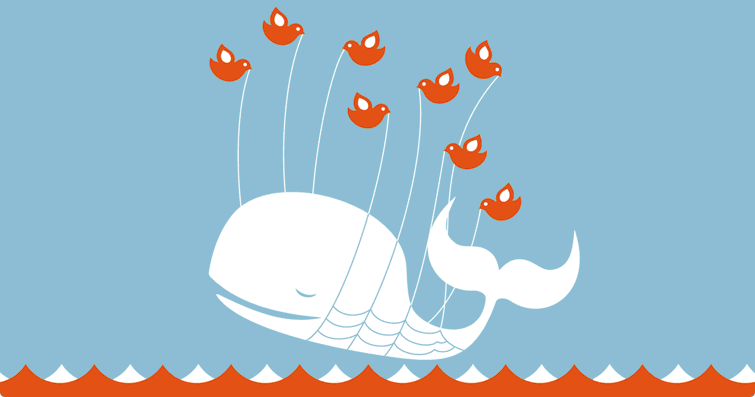
Please bear with us while we're out makin' an honest living...
When Twitter experiences over-capacity (i.e. too many demands on its system), users see this delightful image. Known as the “fail whale” error message, it is an image created by Yiying Lu, an artist and a designer in Sydney, Australia. The New York Times Magazine called it ‘a successful failure’.
Well, I’m over-capacity too these days! That’s because I’m out there earning an honest living and that takes most of my waking hours. As a result, I’ve been blogging less and less in recent weeks. On such days, I have just enough energy for a quick tweet or two, but not for a fully-fledged blog post. (Yes, I take my blogging seriously.)
Sorry about that folks! I don’t look anything like the Fail Whale, although I’ve always been fascinated by these creatures. Right now, I’m as over-capacity as Twitter sometimes gets.
As Woody Woodpecker used to say: Don’t go away! We’ll be back soon….
Are they really free - or prisoners of elements like all of us?“Ah, but a man’s reach should exceed his grasp, or what’s a heaven for?” – Robert Browning
Show me a ‘free man’
And I’ll show you a prisoner:
Of time and space,
Of elements and gravity,
Firmly and forever
In the grips of
Forces of Nature
And Laws of Physics,
With no prospect
Of any release,
Or any escape.
Gravity holds us captive,
Time holds us in its grip,
We are prisoners of oxygen,
And confined to bits of land
On this Blue Planet Ocean.
We may breathe the air
But can never fly through it
On our own power:
We’ve dreamed of it
Before and since Icarus
But we’re truly stuck
On the thin, crowded crust
Of our Home Planet
Between air and water.
Between past and future.
So who can still claim
To be a free man or woman?
We are prisoners
One and all,
Of time and space,
Of elements and gravity,
Firmly and forever
In the grips of
Forces of Nature
And Laws of Physics,
With no prospect
Of any release,
Or any escape.
Except, that is —
In our imagination:
May we forever
Dream of being free!
– Nalaka Gunawardene
Colombo, 25 August 2010
Dedicated to Ray Wijewardene: high flyer, dreamer and imagineer.
Ad astra per ardua!
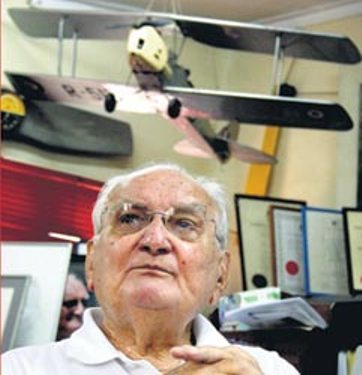
Ray Wijewardene: Freed from gravity, at last!I went straight from a paddy field, where I was filming much of the morning, to the funeral of my mentor and friend Ray Wijewardene early afternoon at the General Cemetery Colombo.
Ray would have approved: despite being a high flyer in every sense of that phrase, he had his feet firmly on the ground — and sometimes in the mud. He was fond of saying, “Agriculture is my bread and butter, while aviation is the jam on top of it”.
Dr Philip Revatha (Ray) Wijewardene, who passed away on August 18 aged 86, was an accomplished engineer, aviator, inventor, Olympian and a public intellectual of the highest calibre. He was also one of the most practical and down to earth people I’ve known.
He preferred to introduce himself as a farmer and mechanic ‘who still got his hands dirty’. Perhaps that’s how he wanted to be remembered — but each one of us will carry our own vivid memories of this colourful, jovial and altogether remarkable human being.
I’ve already written a quick introduction about Ray for Groundviews.org, which has published a long interview I did with Ray 15 years ago, originally for an Indian science magazine. That exchange is a reminder of the imaginative thinker, life-long experimenter and outspoken scientist that Ray always was.
I’ll be writing more about Ray Wijewardene in the coming weeks, exploring his many different facets. I’ve known and walked alongside him for almost a quarter century. For now, I’ll remember him for one facet that I didn’t share despite many offers and invitations: flying.
per ardua ad astra...Ray just loved to fly. Most humans share this age old dream, but Ray wasn’t contented just being flown around on commercial jets — which to him were merely large, sealed up cylinders. He far preferred the small, propeller-driven aircraft – single or twin seaters that gave their passengers a true sense flying and a real taste of the sky.
Looking back, it was quite apt that I first met Ray at the Ratmalana Airport, just south of Colombo, from where he took off and landed hundreds of times over the decades. One sunny morning in mid 1986, he took time off from his flying to talk to a group of high school leavers who were participating in the first Science for Youth programme. It exposed us to various (then) modern technologies over six consecutive weekends. Much of the knowledge we gained has long been obsolete, but its inspirational value was timeless….and continues to propel me forward.
Much of that inspiration came from Ray Wijewardene, who talked to us – with lots of practical demonstrations – about problem solving and innovations in three areas close to his heart: energy, agriculture and transport. I remember how he was experimenting with improvements to the humble bicycle at the time, so that riders could optimise performance with modest efforts.
He also talked about growing our food and energy. But it was his flying experience that most fascinated us starry-eyed youngsters. As a pilot, Ray was licensed to fly three kinds of flying machines: fixed-wing aircraft, helicopters and autogyros. But this pilot was flying not only factory-fitted, mass-manufactured units. He also experimented with building and flying his own ultra-light aircraft and helicopters – he was particularly interested in building amphibious small planes that could land on, and take off from, Sri Lanka’s numerous inland lakes and reservoirs.
All this and more made Ray a journalist’s dream, but as I soon found out, he wasn’t an easy subject to cover! In 1988, The Island newspaper asked me to interview Ray and write an article about the dream and reality of flying. He happily talked with me for two hours — yet, in the end, didn’t want his name mentioned in print. For all his accomplishments and outspoken views, Ray was completely publicity shy. He didn’t mind his views being reported, but with little or no mention of the source.
It’s the song that matters, not the singer, he said — and I heartily disagreed. I pointed out that we journalists needed to attribute wherever possible for greater credibility of what we write (I didn’t tell him that we also love good news-makers: the more informed and opinionated they are, the better!). This became a running argument that Ray and I had for two decades. Within a few years, he trusted me enough to talk to me on the record. But what he said off the record was always more interesting…
When he was approaching 75, Ray told me how nervous he was when he had to go for renewals of his pilot’s license. In the end, it wasn’t age that ended his flying career: along with everyone else, he was ‘grounded’ when private flying was first restricted and then banned during the latter years of Sri Lanka’s long-drawn war.
During the 1990s, Ray had repeatedly invited me to share a flight on one of his home-built light planes. He assured me they were perfectly safe — among satisfied customers was Prof Cyril Ponnamperuma, one time science advisor to the President of Sri Lanka and an internationally renowned biochemist. (Ray did acknowledge that he’d crash landed his various planes thrice — and each time, he lived to tell the tale. He believed that test flying one’s own aircraft designs quickly eliminated bad designers!)
I kept deferring my own tryst with the open skies and was too preoccupied with earthly matters — and suddenly, it was too late. By the time Sri Lanka’s war ended in May 2009, Ray’s flying days were over (and our skies are not yet fully free for private domestic aviation).
Gravity, bureaucracy and age may have conspired to keep Ray confined to the ground in the last few years of his life — but only just. His spirit soared even when the body wasn’t allowed to: in all my years and encounters with him, I’ve never seen him ‘down’ (concerned and reflective, yes; depressed, no).
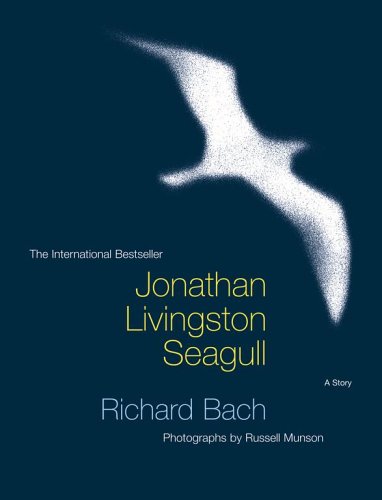
A lone spirit, on a long journey....That passion, enthusiasm and spirit of adventure characterised Ray and influenced everything he did, on the ground and in the air. Born in the 1920s and raised as part of the first generation of humans for whom private flying was available, he was infected with the ‘flying bug’ in the same way that American author and aviator Richard Bach was. In fact, Ray knew Bach and was a devoted fan of the latter’s books, especially Jonathan Livingston Seagull.
Perhaps Ray saw himself in Jonathan: a seagull tired of the monotonous life in his clan. He rather experiments with new – always more daring – flying techniques…which means he must fly solo most of the time, and confront the travails of life on his own.
Ray wasn’t a loner (to the contrary, he was very much a team player in everything he did). But sometimes he was racing ahead of us – or just flying at a higher altitude. Although I’ve never heard him say it, perhaps this unattributed quote partly explains the phenomenon: “When once you have tasted flight, you will forever walk the earth with your eyes turned skyward, for there you have been, and there you will always long to return.”
What Ray did quote, frequently, were these words of Robert Browning: “Ah, but a man’s reach should exceed his grasp, or what’s a heaven for?”
It was entirely fitting that a grand daughter would recite the poem ‘High Flight’ by John Gillespie Magee, Jr., a favourite verse among aviators and, more recently, astronauts.
High Flight
by John Gillespie Magee, Jr.
Oh! I have slipped the surly bonds of Earth
And danced the skies on laughter-silvered wings;
Sunward I’ve climbed, and joined the tumbling mirth
of sun-split clouds, — and done a hundred things
You have not dreamed of—wheeled and soared and swung
High in the sunlit silence. Hov’ring there,
I’ve chased the shouting wind along, and flung
My eager craft through footless halls of air….
Up, up the long, delirious, burning blue
I’ve topped the wind-swept heights with easy grace
Where never lark nor even eagle flew—
And, while with silent lifting mind I’ve trod
The high untrespassed sanctity of space,
Put out my hand, and touched the face of God.
On returning from the simple yet moving funeral, I tweeted: No longer a prisoner of gravity: sky-lover, pilot & light aircraft builder Ray Wijewardene blasted off heavenwards. Farewell, high flyer!
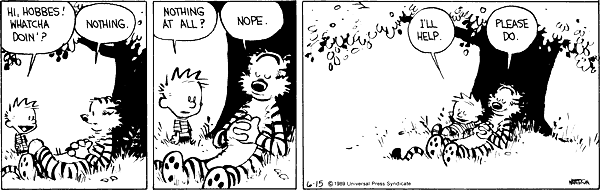
As kids, we had no difficulty in filling our time with completely esoteric, fantastic stuff that had no measurable value in the adult world…what the grown-ups would describe as ‘unproductive’ (a very subjective term!). We all specialised in the art and science of goofing off, and our school vacations and even weekends were all filled with…doing nothing in particular!
What happened? I’m still not sure if I’ve grown up – my own child and close friends are convinced I haven’t – but I no longer seem to have the time or skill to just hang loose, goof off and do absolutely nothing at all. Even if I rest my tired body, my mind wanders in all sorts of directions. Even my dreams are too dramatic, layered and nuanced.
When I browse, I find whole heaps of books and websites that offer to teach me how to do nothing. From Zen to Chinmoy to Robin Sharma, everyone is offering wisdom about nothing. But I hesitate. I don’t want structured, step-by-step guidance that feels like…a personal development course.
I want to unwind. I want to just take it easy, get completely and hopelessly lost in my day dreams and have no care in the world. At least for a few days every year. I’ve not done that for a long, long time.
So I need help to re-learn how to do nothing at all, and to enjoy that without any feeling of guilt about lost time or opportunities. I want a friend – furry like Hobbes or otherwise – who can help me in this journey of re-discovery.
Don't run races with me...
I’m a slow reader. Let me qualify that: I’m a slow reader of books.
I can read fast when I need to — and I do that with newspapers, magazines, websites and many other displays of text that surrounds us. It’s almost an essential survival skill for today’s information society.
But when it comes to books, I take my time. Especially with good books (and I try to discern). Books are not to be rushed through; they are to be taken slowly, one page and one chapter at a time. I savour books as I savour a good meal. (And unlike with a meal, I regurgitate good books, which further slows me down.)
As a writer myself, I enjoy good writing by others. I can appreciate how hard it is to produce readable and enjoyable prose out of an alphabet of 26 letters (I write only in English) and a handful of punctuation marks. If a fellow writer went to all that trouble to create something out of nothing, the least I can do is to absorb and digest it well. (I should also add: I’m ruthlessly discerning in what I choose to read.)
Those around me are sometimes amused and puzzled by this. They know my capacity to marshal information and ideas, so they can’t figure why I don’t read books fleetingly. My friends as exasperated by another trait: how I read several books at the same time, progressing through multiple titles by switching between them. I guess this means I have Attention Deficit Disorder (ADD). Ah, well…
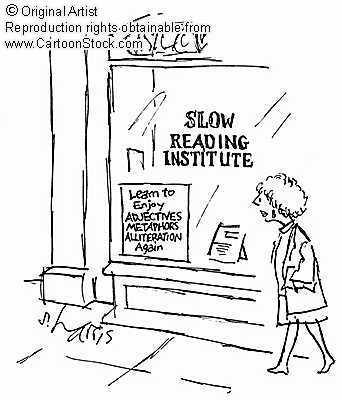
I was delighted to discover recently that there are others who cherish slow, reflective reading. There is, in fact, a slow reading movement — an eclectic group of academics and writers who want us to switch off our computers every so often and rediscover both the joy of personal engagement with physical texts, and the ability to process them fully.
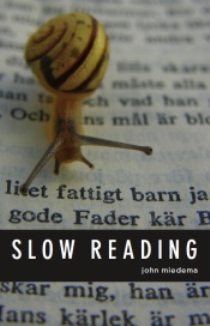
Read a book, lately?“Readers make choices in the kinds of attention they give to texts–from scanning, skimming and speed reading to deep reading and rereading,” says Professor Catherine L Ross, Faculty of Information & Media Studies, University of Western Ontario when reviewing a recent book, Slow Reading by John Miedema.
Miedema, a technology specialist at IBM in Ottawa, Ontario, draws on both his personal reading experience and the extensive research literature on reading to make a powerful case for the deep pleasures of engaged, reflective reading.
He likens the slow reading movement to the Slow Food movement, which was founded in Italy in the mid 1980s as a backlash against American-style fast food. Both movements encourage increased mindfulness in the conduct of routine activity. As he says: “It’s not just about students reading as slowly as possible. Slow reading is about bringing more of the person to bear on the book.”
In a recent essay in Newsweek, Malcolm Jones asked if slow reading is antidote for a fast world. As he wrote: “…But it doesn’t take a rocket scientist to realize that we are all reading too much too fast these days. Yes, we’re drowning in information, but, clearly, reading faster and faster is not the way out of the deep end.”
It’s from this article that I found out there is now an International Day of Slowness, June 21. The Canadians, reflective and thoughtful people as they’ve always been, are giving leadership to it. By the time I read about it (slowly, of course), the day had already passed. But there’s always next year…
Another article, in The Guardian a few days ago, posed related questions: Has endlessly skimming short texts on the internet made us stupider? The writer, Patrick Kingsley, summed up recent research suggesting that an increasing number of experts think so. He came to the same conclusion as Miedema: it’s time to slow down…
Here’s part of the book’s promotional blurb: “Slow Reading brings attention to emerging ideas in technology and culture. The traditional technologies of print and the book have persisted as part of our information ecology because of the need for slow reading and deep comprehension. The theme of locality in the Slow Movement provides insight into the importance of physical location in our relationship with information. Most of all, Slow Reading represents a rediscovery of the pleasure of reading for its own sake.”
I want to read this book — but not online. I’ll get hold of it and meander slowly through it, as I do with any good book. This particular writer would expect nothing less.





 Open Minds!