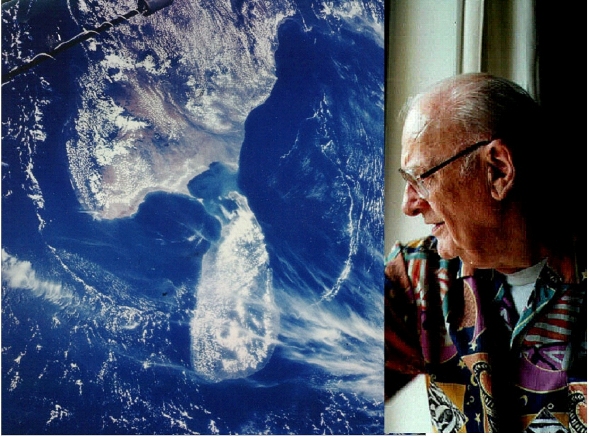
Thor, Superman and Arthur C Clarke’s Third Law: Technology or Magic?

Thor: Another spectacular moving image creation from Marvel
Last evening, I wanted an escape from reality. So I walked into a local cinema with two friends and watched Thor – the latest cinematic production from Marvel Comics.

It’s another superhero spectacle, with lots of special effects and great fireworks. Not entirely plausible in the universe as we know it, but hey – we enter cinema halls willing to suspend disbelief. As C S Lewis was fond of saying, the only people really against escapism are…jailers!

Thor even has some reasonable acting and occasionally enjoyable dialogue. Half way into the story, I was pleasantly surprised to see Natalie Portman’s character quote Arthur C Clarke’s Third Law (of prediction): “Any sufficiently advanced technology is indistinguishable from magic”.

Then I realised how much the story depends on this ‘Law’ to make it plausible. Returning home, I asked my resident magician Google for some insights, and she found others have already noted this.

On Discovery magazine’s blog, Kyle Munkittrick has an interesting post titled Thor Pays Tribute to Arthur C. Clarke’s Rule About Magic and Technology. He says:

“…the Marvel universe is internally consistent… Clarke’s rule of magical tech helps create some of that consistency. I both love and loathe Clarke for that statement. Love because it strikes at the heart of what technology is: a way for humans to do things previously believed not just implausible, but impossible. Loathe because it creates an infinite caveat for lazy authors and screenwriters. It seems like anytime some preposterous technology is injected into a narrative either as a McGuffin or a deus ex machina, that damn quotation from Clarke gets trotted out as the defense.”

He adds: “Thor does not pull a George Lucas and attempt to over-science the magical elements. Thor is not superhuman because he has some Norse equivalent of midichlorians. He is superhuman because he is magical. Sure, that magic is allegedly based in technology, but technology so incredibly advanced, we can’t distinguish it from magic. That lack of distinguishability is the indicator of just how advanced the Asgardians actually are. It’s also what let’s us enjoy the movie for what it is.” Read the full post.

On the indispensable Internet Movie Database, it says: “This acknowledgement that one man’s science is another man’s magic/faith (with a hat tip to Arthur C. Clarke’s “Third Law”) is just enough to make Marvel’s comic book appropriation of mythology palatable for a mainstream Hollywood audience.”

So Clarke’s Third Law keeps popping up in popular culture, and as Kyle Munkittrick says, it’s so very convenient for script writers! The grandmaster of science fiction has given them a blanket cover to take whatever creative liberties…

And some don’t always acknowledge the source when they take cover in this quote/law. For example, the Third Law was famously uttered by Lex Luthor in Superman Returns (2006) — but without any mention of the source.

At that time, I was working with Sir Arthur as his research assistant, and remember how much the late author was intrigued by this reference. For a brief few seconds, he was (slightly) miffed that there was no attribution — and then he cheered up. He accepted that Clarke’s Three Laws are now out there in popular culture and the public imagination, having assumed a momentum and identity of their own. The product of his fertile mind was roaming free.
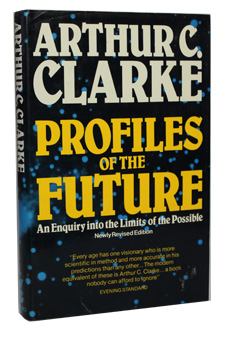
Profiles of the Future - 1982 UK edition
It’s about time too. The Three Laws have been in print for nearly half a century, in various forms. The first law was published in an essay titled “Hazards of Prophecy: The Failure of Imagination'” in the timeless Arthur C Clarke non-fiction classic Profiles of the Future: An Enquiry into the Limits of the Possible, 1962. The book itself was a collection of essays exploring the far future, written during the period 1959 – 1961, and originally published in various popular magazines — most notably Playboy, where many Clarke pieces first appeared in the 1950s and 1960s.

The First Law read: “When a distinguished but elderly scientist states that something is possible, he is almost certainly right. When he states that something is impossible, he is very probably wrong.”

In the original essay, Sir Arthur actually offered further insights on the threshold of elderly: “Perhaps the adjective ‘elderly’ requires definition. In physics, mathematics and astronautics, it means over thirty; in the other disciplines, senile decay is sometimes postponed to the forties. There are, of course, glorious exceptions; but as every researcher just out of college knows, scientists of over fifty are good for nothing except board meetings, and should at all costs be kept out of the laboratory.”

The Second Law was included as a simple observation in the same essay; its status as Clarke’s Second Law was conferred on it by others. That read: “The only way of discovering the limits of the possible is to venture a little way past them into the impossible.”

In an endnote to the ‘Hazards of Prophecy’ chapter (two) in the 1982 revised edition of the book, Sir Arthur wrote: “Originally, I had only one law, but my French editor started numbering them. The Third, which arises from material in this chapter, is perhaps the most interesting (and most widely quoted).”

In fact, this best known Third Law didn’t appear in its currently known form until the 1973 revision of Profiles of the Future. He wanted to round out the number, he said, and added: “Since three laws were sufficient for both the Isaacs — Newton and Asimov — I have decided to stop here. At least for the present…”

The first and second Laws of Clarke are known and cited among scientists and other technical experts. But it’s the Third Law that is the best known among the public: in fact, Wikipedia has compiled a collection of citations in other works.
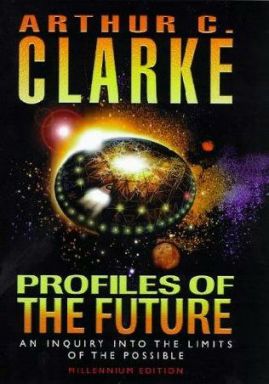
Profiles of the Future - 1999 Millennium edition
As Sir Arthur’s biographer, Neil McAleer, wrote in the 1992 biography Odyssey: “Profiles of the Future has been, and continues to be, an influential book for all those interested in science, technology and the future. Some thirty years after its original publication, it still stands out from the dozens of less important books that attempted to imitate it.”

Neil quotes Gene Roddenberry, creator of Star Trek, as saying how Profiles left a lasting impression on him. Says Roddenberry: “I read Childhood’s End, of course, and was mightily moved by it. And I should say that Profiles of the Future was the next most important Clarke work in my life because a great deal of what I did on Star Trek was guided by that.”

Star Trek: The Original Series debuted on US network television in September 1966. The publication of Profiles, four years earlier, was clearly fortuitous. Star Trek would have been made anyway, without or without Profiles — but the 23rd Century universe might well have been different…

Profiles of the Future was revised by Sir Arthur Clarke on three occasions — in 1973, 1982 and again in 1999. The last revision, where I played a part in assisting the author, came out as the Millennium Edition.

These revisions were not extensive. As the cover blurb of the first revision noted: “Since it (the book) was concerned with ultimate possibilities, and not with achievements to be expected in the near future, even the remarkable events of the last decade have dated it very little.”

The same held for the last revision. But by then, the First Law was updated for Political Correctness:
“When a distinguished but elderly scientist states that something is possible, (s)he is almost certainly right. When (s)he states that something is impossible, (s)he is very probably wrong.”

Next year, 2012, will mark the 50th anniversary of this future-shaping book’s first publication. Fans of science fiction and science fact should perhaps do something to mark the occasion — and not leave it entirely to the whim and fancy of Hollywood script writers.

Read also:
May 2009 blogpost: Star Trek: Advocating a world of equality, tolerance and compassion

‘The Futurist’ Interview with Sir Arthur C Clarke, published shortly after his death in March 2008
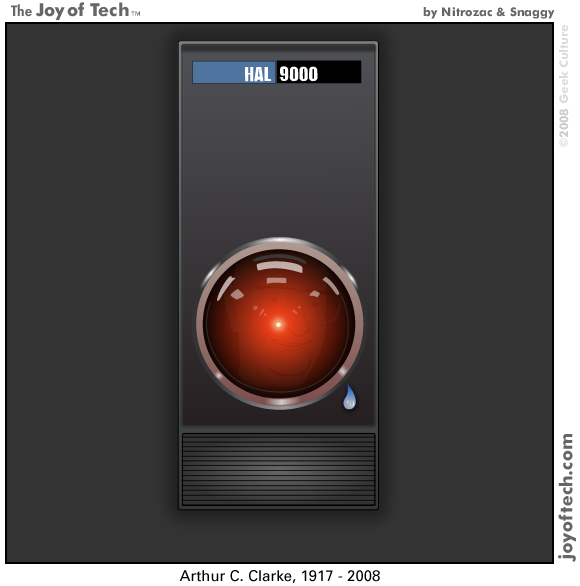

Wiz Quiz 9: Arthur C Clarke’s HAL, are you here yet?

Joy of Tech tribute to Arthur C Clarke, 19 March 2008
This week marks the third death anniversary of Sir Arthur C Clarke, author and futurist.

Among the numerous tributes that poured out all over the world following his departure, I found one especially poignant. It was the ‘Joy of Tech’ cartoon above, showing the sentient computer HAL 9000 (from 2001: A Space Odyssey) shedding a single tear in his memory…

In fact, researchers in artificial intelligence (AI) are still trying to create a real-life HAL, which remains the ‘Holy Grail’ in their line of work: a machine-based intelligence that mimics the human mind in all its nuances, and not just in raw processing power.

This is proving much harder than creating chess-playing or quiz-winning computers: human beings are capable of a wide range of emotions some of which – such as intuition and sense of humour – are still not within the capabilities of advanced AI systems.

In this week’s Wiz Quiz, I pay tribute to both HAL and his creator with a few questions on the march of supercomputers. We ask the long-running question: Can computers outsmart us?

Indeed, that prospect is becoming more real every passing year. An IBM supercomputer named Deep Blue created history in May 1997 when it won a six-game match by two wins to one with three draws against the then world chess champion. A few weeks ago, another human bastion fell — and this one concerns me more as a quiz enthusiast (I never learnt the rules of chess, and don’t understand what all that fuss is about.)

On 17 February 2011, a supercomputer owned by the IBM Corporation beat two veteran quizzers to win a high profile game in the long-running US quiz show called Jeopardy. The supercomputer won with US$77,147, while its nearest rival Ken Jennings, a 74-time winner of the popular trivia quiz, came in second with US$24,000. Brad Rutter, who has in previous appearances won a total of US$3.3 million, was third with US$21,600. IBM plans to donate the computer’s winnings to charity.

What was the name of this quiz-winning supercomputer?

In HAL 9000’s name, what did the letters HAL stand for?

Which famous rocket scientist once said: “Man is the best computer we can put aboard a spacecraft…and the only one that can be mass produced with unskilled labour”?

These are among the 15 questions in this week’s Wiz Quiz. Test your brains against ours (supercomputers may not participate!).

When the Twerms Came: The PLAYBOY Comic Strip is found!

Skip Williamson's Facebook profile photo
Wow, isn’t the Facebook a great place to connect people, ideas and creativity? I never thought much about it, but maybe I ought to spend more time there…

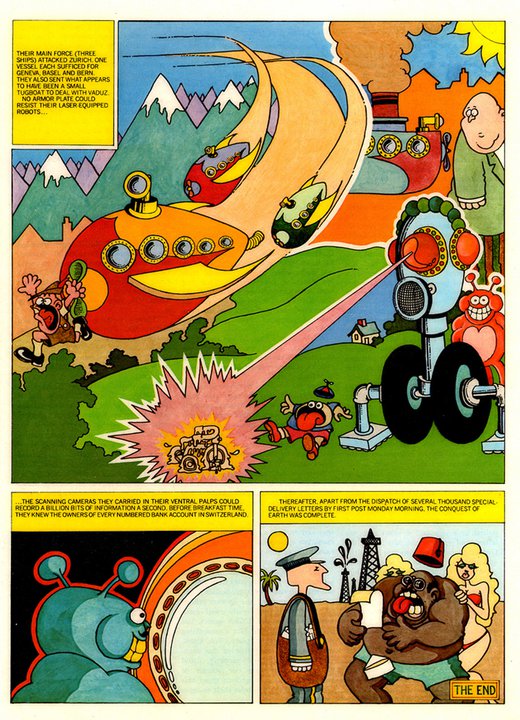
Yesterday, I published a semi-serious essay called WikiLeaks, Swiss Banks and Alien invasions, which was about an obscure short story by Arthur C Clarke describing an unlikely alien invasion of the Earth. For once, the invaders used brain and cunning rather than fire power, and against this onslaught, our planet’s rulers had no defence…

I mentioned how PLAYBOY Magazine had used that story as the basis for a psychedelic comic strip illustrated by the American underground cartoonist Skip Williamson. At the time of writing, I had not been able to locate the comic strip that was published in their issue of May 1972. I wondered: “…it’s either behind a pay-wall, or lies somewhere with little or no indexing by search engines.”

Turns out to be the latter. In less than 24 hours, there was a response from Skip Williamson himself saying the artwork is on his Facebook page, http://www.facebook.com/skip.williamson.

Many thanks to Skip Williamson for posting the link…and while at it, for all his brilliantly cheeky and subversive creations over the years! I hope he doesn’t mind my reproducing the comic strip (all of 2 pages) below:

When the Twerms Came - Comic Strip - Page 1 of 2
When the Twerms Came - Comic Strip page 2 of 2

When the Twerms Came: Arthur C Clarke’s easy guide for aliens to invade Earth?

Why waste all that energy when there are smarter ways? Image courtesy movie 'Independence Day'

It’s time to come clean: I have a fascination with alien invasions of our planet.

As a kid, I was an avid listener of radio (my only electronic medium, as I grew up in a land without television, and in a time before the Internet) — and expected the regular transmissions to be interrupted any moment to break the news of an alien invasion underway. The spoilsports shattered my childhood dreams everyday.

Now slightly older, I keep looking for the perfect moments for that history-shattering event. A widely reproduced op ed essay I wrote in July 2010 opened with these words:

“If you’re an alien planning to invade the Earth, choose July 11. Chances are that our planet will offer little or no resistance. Today, most members of the Earth’s dominant species – the nearly 7 billion humans – will be preoccupied with 22 able-bodied men chasing a little hollow sphere. It’s only a game, really, but what a game: the whole world holds its breath as the ‘titans of kick’ clash in the FIFA World Cup Final…”

The careless aliens didn’t heed my advice, but I live in hope. I keep looking for the strategic moments and smart ways to take over the planet — with as little violence as possible. After all, I’m a peace-loving person (even if I’m unhappy with the planet’s current management).

I’m not alone in this noble quest. Science fiction writers have been at it for decades, and future Earth invaders are well advised to first study these useful instructions masquerading as popular literature. In an op ed essay published today, I highlight one such story by Sir Arthur C Clarke.

Click on this ONLY if you're a prude...
I wrote WikiLeaks, Swiss Banks and Alien invasions with my tongue in my cheek about half the time (go figure!). I’ve been following the WikiLeaks cablegate saga for several weeks, and was intrigued to read that other critically sensitive secrets — that have nothing to do with garrulous American diplomats — were also reaching this online platform for assorted whistle-blowers.

One such story, appearing in the London Observer on 16 January 2011, reported how the Swiss whistleblower Rudolf Elmer plans to hand over offshore banking secrets of the rich and famous to WikiLeaks. That reminded me of an obscure short story that Arthur C Clarke had written more than 40 years ago, which is not as widely known as it should be. This short essay is an attempt to revive interest in it.

I describe how PLAYBOY Magazine used the story as a basis for a psychedelic comic strip illustrated by the American underground cartoonist Skip Williamson. That appeared in their issue for May 1972 — and I’m still trying to locate that story. All in the interests of pop culture, of course.

Read WikiLeaks, Swiss Banks and Alien invasions on Groundviews.org

Facebook’s Mark Zuckerberg: Digital Pied Piper of our times?

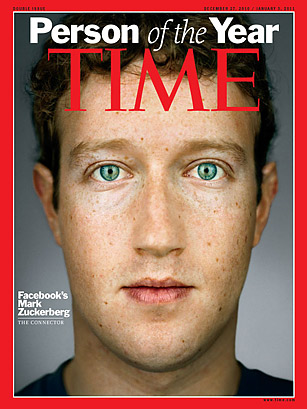
The Face of Facebook

“For connecting more than half a billion people and mapping the social relations among them, for creating a new system of exchanging information and for changing how we live our lives, Mark Elliot Zuckerberg is TIME’s 2010 Person of the Year,” TIME magazine’s editors announced on 15 December 2010.

As if to support their choice, their profile of Facebook’s co-founder added: “One out of every dozen people on the planet has a Facebook account. They speak 75 languages and collectively lavish more than 700 billion minutes on Facebook every month. Last month the site accounted for 1 out of 4 American page views. Its membership is currently growing at a rate of about 700,000 people a day.”

As usual, TIME’s selection was eagerly awaited, and the most popular choice online was WikiLeaks founder Julian Assange. He ended as a runner-up as the next four newsmakers of 2010 — perhaps it was too controversial a choice for TIME’s editors considering the heavy polarisation of views at home about WikiLeaks?

I first read about this selection on Twitter. By coincidence, I was just finishing my latest essay, which was more about the challenges of living in the WikiLeakable world that we now find ourselves in. But Mark Zuckerberg and Facebook get honourable mentions in there.

The essay, now published as Living in the Global Glass House: An Open Letter to Sir Arthur C Clarke, includes these paras:

“I’m not so sure what you might have made of this thing called Facebook. With more than 500 million active members, the social networking website is the largest of its kind (well ahead of its nearest rival Myspace, owned by your friend Rupert).

“Going by the sheer numbers, Facebook is behind only China and India in population terms. But those who compare it to a major league country don’t imagine far enough — it’s really becoming another planet…

An essential survival skill in this Info Age...
“While Facebook’s high numbers are impressive, not everyone is convinced of its usefulness and good intentions. Can we trust so much power in the hands of a few very bright (and by now, very rich) twentysomethings? How exactly is Facebook going to safeguard our privacy when we (wittingly or unwittingly) reveal so much of our lives in there?

“I raise these concerns not only as a long-time ICT-watcher, but also as the father of a teenager who is an avid Facebooker. I once called Facebook co-founder Mark Zuckerberg a ‘Digital Pied Piper’: might we someday see Hamelin the sequel?”

Read the full essay: Living in the Global Glass House: An Open Letter to Sir Arthur C Clarke

PS: On 1 Oct 2010, when the movie The Social Network (based on the Facebook story) opened, I tweeted: “www.thesocialnetwork-movie.com Story of da world’s biggest Pied Piper. And his 500 million+ rats!”

Living in the Global Glass House: An Open Letter to Sir Arthur C Clarke

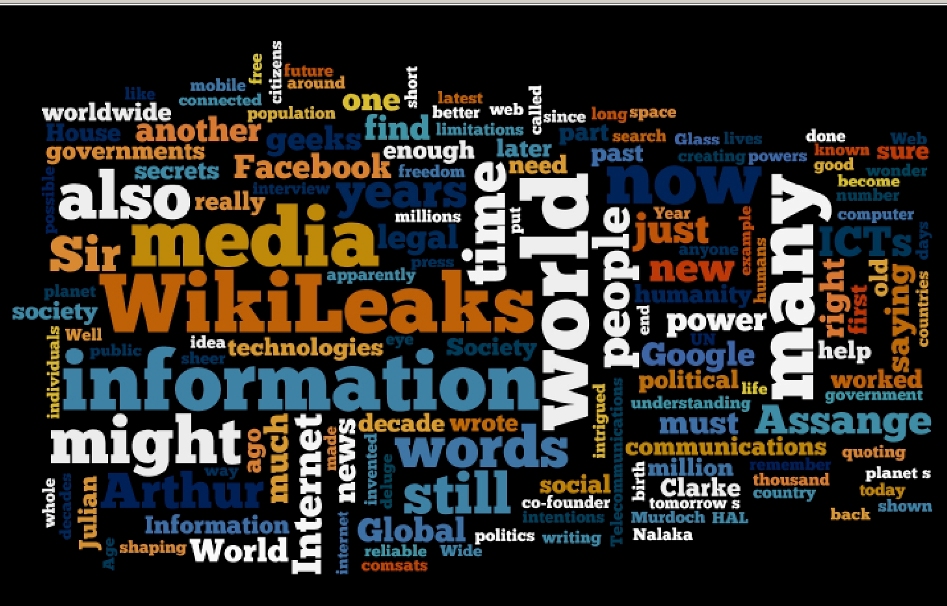
Word map created using http://www.wordle.net

“In the struggle for freedom of information, technology — not politics — will be the ultimate decider.”

These words, by Sir Arthur C Clarke, have been cited in recent days and weeks in many debates surrounding WikiLeaks, secrecy and the public’s right to know.

I invoke these words, and many related reflections by the late author and futurist, in a 2,250-word essay I have just written. Titled Living in the Global Glass House, it is presented in the form of an Open Letter to Sir Arthur C Clarke. It has just been published by Groundviews.org

This is my own attempt to make sense of the international controversy – and confusion – surrounding WikiLeaks. Taking off from the current concerns, I also look at what it means for individuals, corporations and governments to live in the Age of Transparency that has resulted from the Information Society we’ve been building for years.

Sir Arthur foresaw these developments year or decades ago, and wrote perceptively and sometimes in cautionary terms about how we can cope with these developments. As a research assistant and occasional co-author to Sir Arthur from 1987 to 2008, I had the rare privilege of sharing his views firsthand. In this essay, I distill some of the best and most timely for wider dissemination. The above Wordle graphic illustrates the keywords in my essay.

The essay was also prompted by recent experiences. Here’s that story behind the story:

By happy coincidence, I arrived in London on 28 November 2010, the very day the WikiLeaks Cablegate erupted all over the web, beginning to spill out what would eventually be over 250,000 secret international ‘cables’ within the US diplomatic corps.

The Guardian UK that day published an interactive map-based visualization of the leaks. By moving the mouse over the map, readers can find key stories and a selection of original documents by country, subject or people

During the week I spent in London, I experienced not only uncharacteristically early and intense snow storms, but a mounting international storm on the web over the leaked cables. WikiLeaks’ co-founder and chief editor Julian Assange was also somewhere in the UK, playing cat and mouse at the time with the Swedish police and Interpol. (He later turned himself in to the British authorities.)

Sir Arthur Clarke: The legacy continues...
On December 1, the British Interplanetary Society invited me to join their annual Christmas get-together where they were remembering their founder member and past chairman Arthur C Clarke. They talked mostly about the man’s contribution to space exploration, but listening to those fond memories against the wider backdrop of WikiLeaks very likely inspired me to write this essay.

Soon after I returned to Colombo, Transparency International Sri Lanka asked me to speak at a workshop on the right to information they had organised for journalists. Given my reputation as a geek-watcher and commentator on the Information Society, they asked to talk about what WikiLeaks means for investigative journalism. Two days later, the Ravaya newspaper did a lengthy interview with me on the same topic which they have just published in their issue for 19 December 2010.

All these elements and experiences combined in writing this essay. Being confined to home by a nasty cold and cough also helped! In fact, on 16 December when Sir Arthur’s 93rd Birth Anniversary was marked, I was too weak to even step out of the house to visit his gravesite. In the end, I finished writing this Open Letter to him on the evening of that day.

My daughter Dhara and I would normally have taken flowers to Sir Arthur’s grave on his birth anniversary. This year, instead, I offer him 2,250 words in his memory. The fine writer would surely appreciate this tribute from a small-time wordsmith.

Read Living in the Global Glass House: An Open Letter to Sir Arthur C Clarke


Compact version published in Daily Mirror, Sri Lanka, on 21 Dec 2010

Can Humanity Survive the Information Deluge? Reflecting on WikiLeaks…

Keeping up with new info technologies...

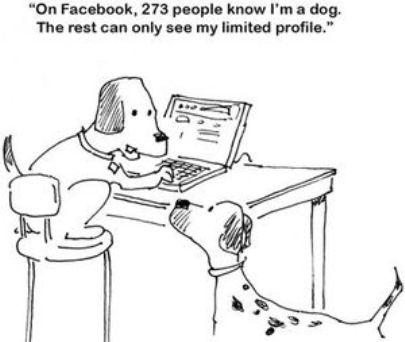
This is one of my favourite cartoons on new information and communications technologies, or ICTs. It was on a Season’s Greetings card I received some years ago (when paper-based cards were still in wide use).

As an avid watcher of ICTs and the Information Society they help create, I have always been interested in how new technologies are perceived and adopted by different individuals and communities.

In the wake of WikiLeaks, there is renewed interest in the free flow of information. Governments and large corporations are naturally anxious about their secrets being leaked. Journalists and activists are working overtime to produce coherent stories or advocacy positions out of the massive volumes of hitherto classified information being released by WikiLeaks. And the rest of society is bewildered on just how to make sense of it all.

Can humanity survive the deluge of information unleashed by ICTs?

This is the question I posed to Sir Arthur C Clarke in a wide-ranging interview I did on the eve of the first World Summit on the Information Society (WSIS) in December 2003. The full exchange was published on OneWorld.net, where it is still archived.

Here’s the relevant Q&A:

Q: So you are confident that humanity will survive the current deluge of information?

A: Undoubtedly. There are many who are genuinely alarmed by the immense amount of information available to us through the Internet, television and other media. To them, I can offer little consolation other than to suggest that they put themselves in the place of their ancestors at the time the printing press was invented. ‘My God,’ they cried, ‘now there could be as many as a thousand books. How will we ever read them all?’

Strangely, as history has shown, our species survived that earlier deluge of information, and some say, even advanced because of it. I am not so much concerned with the proliferation of information as the purpose for which it is used. Technology carries with it a responsibility that we are obliged to consider.

Read the full interview: Humanity will survive information deluge – Sir Arthur C Clarke

British Interplanetary Society (BIS) remembers Sir Arthur C Clarke

Humanity’s journey to the stars began here…Photo by Greg Fewer


I seem to have a knack for visiting the UK just when Nature decides to remind the hapless islanders who is really in charge. Last April it was the Icelandic volcano Eyjaffjalljokull coughing up. Last week it was sub-zero temperatures and freezing winds coming all the way, with love, from Siberia…

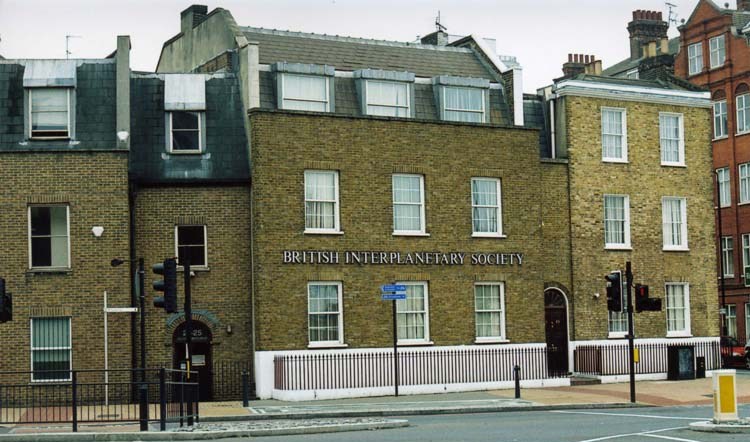
But London’s spirits are not so easily dampened by ash or snow (but they all groaned when their bid for FIFA World Cup 2018 lost to Russia’s). A highlight of my week’s stay was a visit to the British Interplanetary Society (BIS) headquarters on South Lambeth Road.

BIS, founded in 1933 by Phil E Cleator, is the oldest organisation in the world whose aim is exclusively to support and promote astronautics and space exploration. It was originally set up not only to promote and raise the public profile of astronautics, but also to undertake practical experiments in rocketry. But the pioneering British ‘space cadets’ soon discovered that Britain’s the Explosives Act of 1875 prevented any private testing of liquid-fuel rockets.

Undaunted, they continued with their thought experiments, discussions and public advocacy. Perhaps it was just as well that they didn’t get into the messy (and potentially hazardous) business of rocketry. For over 75 years, they have been preparing humanity’s engagement with the realm and challenges of space. Unlike its American and German counterparts, the BIS never became absorbed into the rocket or space industries that developed after the Space Age began in 1957.

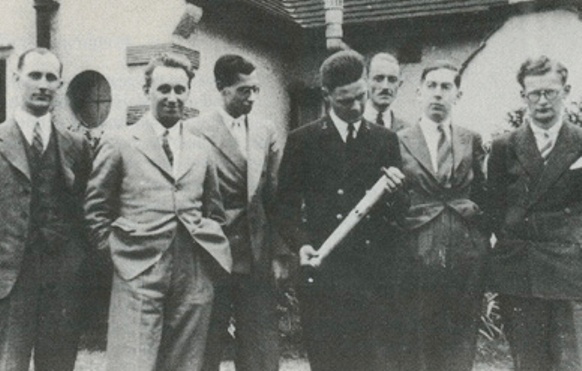
Arthur C. Clarke (far right) and other members of the British Interplanetary Society had a visit from rocket pioneer Robert Truax (holding the rocket model) in 1938

I have always admired the BIS for their pioneering role in popularising space travel, and having ha the audacity to dream of it and in public too. So I was delighted to be invited to the BIS annual Christmas get-together on the evening of December 1. This year, they celebrated the life and times of their founder member and two-time chairman, Arthur C Clarke.

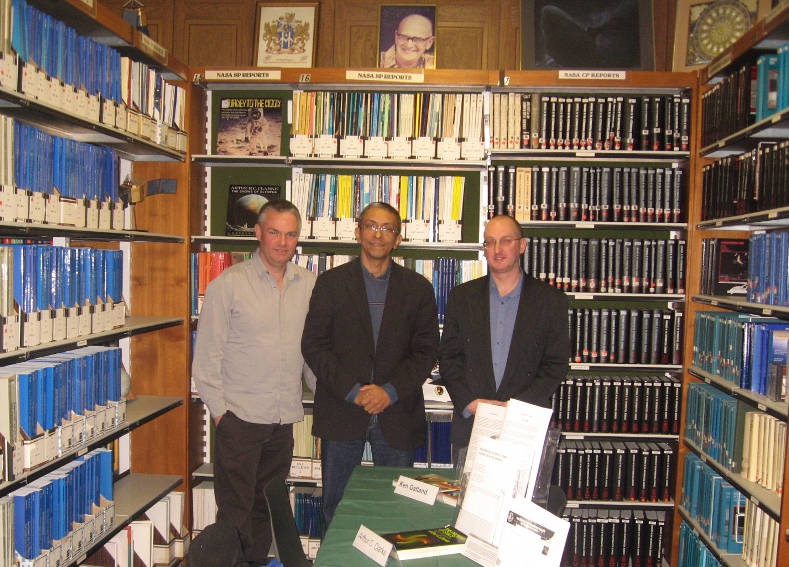
Mark Stewart, the energetic librarian and archivist at BIS, heard I was visiting London and invited me to join their members-only event. Mark is currently looking after one of the finest collections on astronautics on this side of the Atlantic. Some records and documents at the BIS Library go back to the 1930s.

It was good to finally visit ‘ground zero’ of where it all began — nothing less than humanity’s long (and eventual) journey to the stars, hatched by a group of starry-eyed youth as an entirely private, citizen initiative. It took another 20 years — and considerable battering of London by Germany’s V2 rockets — for the British government to take it seriously.

I spent the afternoon chatting with Mark and Colin Philip, a BIS Fellow. Joining us later was Mark’s teenage son Alex, a next-gen space cadet already volunteering at the society. They gave me the guided tour — only a few months ago, I heard, a certain N. Armstrong had been similarly shown around. The society is certainly proud of its history and Sir Arthur’s photos, books, papers and posters are prominently displayed.

L to R – Colin Philip, Naaka Gunawardene, Mark Stewart, BIS Library 1 Dec 2010

The evening gathering was attended by 40 – 50 members, who were treated to an illustrated talk by Mat Irvine, British TV personality who has worked on many science and science fiction shows over the years, gave an illustrated talk about his friend Arthur. (Confession: I was so engrossed in his talk that I forgot to take any photos of him making it!)

I was familiar with much of the ground that Mat covered, but there were occasional revelations. For example, I didn’t know that circa 1995, Mat and (Sir Arthur’s brother) Fred Clarke had worked with the Isle of Man Post Office to issue some stamps bearing Sir Arthur’s visage and other iconic images associated with him, e.g. the monolith from 2001, comsats, etc. Alas, the plans didn’t work out, but Mat still has the designs and is hopeful that the British Post Office might consider it for the author’s birth centenary in 2017. Of course, some lobbying will be needed…but there’s plenty of time for that.

Like all non-profits these days, the BIS is struggling financially. It also faces the challenge of recruiting younger members – the average age of the Christmas gathering seemed to be 55 or 60. They have fascinating stories to tell (among them: the inside story how Apollo 13 was saved), but forward transmission requires more new blood.

The Council, I heard, is working on repositioning the society for the Facebook generation, and I wish them every success. ‘Imagination to reality’ is their motto, and they have seen a good deal of day-dreaming of the pioneering space cadets come true.

Nalala Gunawardene (L) with Mark Stewart at BIS Library

Twitterless in Beijing: Talking aspirationally about social media…

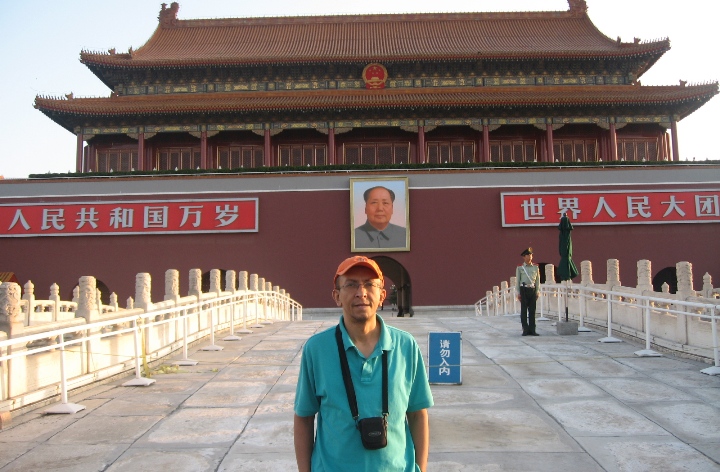
Under Chairman Mao's watchful eyes...

“Reading computer manuals without the hardware is as frustrating as reading sex manuals without the software!”

This is one of the less known, but more entertaining, dicta by Arthur C Clarke – he called it ‘Clarke’s 64th Law’, and I personally know he used to bring it up when meeting with particularly crusty or glum intellectuals. (Not all were amused.)

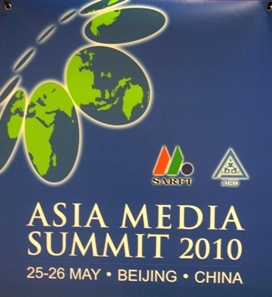
Clarke’s words kept turning in my mind as I moderated and spoke at a session on social media at Asia Media Summit 2010 held in Beijing China from 24 to 26 May 2010. The country with the world’s largest media market is not exactly the world’s most open or free – and certainly when it comes to social media, it’s a very different landscape to what we are used to…

These days, International visitors arriving in China discover quickly that access to YouTube, Twitter and Facebook is completely blocked. Apparently the brief ‘thaw’ in restrictions, seen before and during the 2008 Beijing Olympics, is now over — the current restrictions have been in place since the spring of 2009.

This doesn’t mean there is no social media in China. In fact, I heard from several Chinese friends and colleagues that there is a very large, dynamic and fast-evolving social media scene in China. For the most part, however, it’s not based on globally used and familiar platforms, and is happening in a digital universe of China’s own — under the watchful eye of the government.

Jump in...but some conditions apply!
For example, I found from this March 2010 blog post by Merritt Colaizzi that:
* 221 million people have blogs, largely in a diary-style.
* 176 million Chinese connect via social networking system (SNS) with their “real” friends and online networks.
* 117 million connect anonymously via bulletin board system (BBS). These interactive online message boards are the heart of social media in China. They’re where people go to find topic-based communities and where consumers talk about products and services.

There are lots of other blogs, mainstream media reports and research commentary on social media in China — just Google and see (now that’s another thing with limited – and uneven – access in China: Google itself is available, but search results come with lots of links that simply aren’t accessible). Much or all of this interaction happens in Chinese, of course. It’s a significant part of the web and social media landscapes, but if you’re in China on a short visit and want to stay connected to your own social media networks, that’s not at all helpful.

And, of course, it undermines one of the key attributes of a globally integrated information society: the interoperability of systems and platforms.

Luckily for me, perhaps, I can survive a few days without my social media fix: I have an appalling record of updating my Facebook account: days pass without me even going there. For the moment, at least, I’m also taking a break from regular blogging (well, sort of). But I’m more regular in my micro-blogging on Twitter, and visit YouTube at least once a day, sometimes more often. I could do neither during the few days in Beijing – and that was frustrating.

So imagine having to talk about social media as a new media phenomenon in such a setting. That’s only a tiny bit better than reading computer manuals without the hardware…But this is just what I did, with all the eagerness that I typically bring into everything I do. I planned and moderated a 90-minute session on Social Media: Navigating choppy seas in search of Treasures?

The session was part of the Asia-Pacific Media Seminar on Ozone Protection and Climate Benefit, so our context was how to use the social media to raise public awareness and understanding on the somewhat technical topics of ozone layer depletion and climate change (two related but distinctive atmospheric phenomena).

With access to key global social media platforms denied, we visitors and Chinese colleagues in the audience could speak mostly generically, theoretically and aspirationally. I didn’t want to place my hosts and seminar organisers in difficulty by harping on what was missing. Instead, we focused on what is possible and happening: how development communicators are increasingly social media networks and platforms to get their messages out, and to create online communities and campaigns in the public interest.

The thrust of my own opening remarks to the session was this: In the brave new world of social media, we all have to be as daring as Sinbad. Like the legendary sailor of Baghdad, we have to take our chances and venture into unknown seas. Instead of maps or GPS or other tools, we have to rely on our ingenuity, intuition and imagination.

More about the session itself in future blog posts.

For now, I want to share this TED Talk by American watcher of the Internet Clay Shirky on how cellphones, Twitter, Facebook can make history. Shirky shows how Facebook, Twitter and TXTs help citizens in repressive regimes to report on real news, bypassing censors (however briefly). The end of top-down control of news is changing the nature of politics.

PS: All this holds more than an academic interest for me, because there have been media reports in recent weeks that the Sri Lankan government is working with Chinese experts in formulating strategies for censoring internet access from Sri Lanka.

Sri Lanka General Election 2010: Voting for the ‘Undiscovered Country’?

Keeping an eye on his beloved island...?

To melancholic Hamlet, death was an undiscovered country. In Shakespeare’s most famous soliloquy, the Prince of Denmark hesitates in his consideration of suicide not because of an absolute Christian belief in divine retribution, but because he is afraid of an afterlife of which he cannot be sure.

For the more cheerful among us, the Future is the great Undiscovered Country. It’s a notion that has been used widely by science fiction writers, and in 1991, it was popularised by Star Trek VI: The Undiscovered Country is the sixth feature film in the Star Trek science fiction franchise.

In the movie, Klingon Chancellor Gorkon – talking peace with the Earth Federation – gives a toast to “the undiscovered country — the future”. Spock recognizes the line from Hamlet, and Gorkon tells Spock that one has never read Shakespeare properly until reading the text in “the original Klingon”…

All this forms the backdrop (well, sort of!) to my latest op ed essay, just published by Groundviews citizen journalism website. Titled Voting for the ‘Undiscovered Country’?, and timed for Sri Lanka’s general election 2010, it takes a look at the most important common element discussed and debated during the election campaigns by all parties: Sri Lanka’s future prosperity.

As I note: “Our endlessly bickering political parties rarely agree on anything, so it’s refreshing to see a broad consensus on what this election is fundamentally about: future prosperity.

“That’s no coincidence. This is the first time we elect our law makers since the long drawn and brutal civil war ended in May 2009. We have been looking back — or nervously looking around — for much of the past three decades. It’s about time we finally looked forward.”

I go on to say: “How we wish Sir Arthur C Clarke was still with us at this crucial juncture in our history! For half a century up to his death in March 2008, the author, explorer and visionary was Sri Lanka’s amiable ‘tour guide’ to that ‘Undiscovered Country’ called the Future.

“Whoever wins this week’s election, shaping a better future will need clarity of purpose, hard work and persistence. Those looking for long term vision can start with the substantial volume of essays, interviews and speeches that Clarke has left behind…”

The rest of the essay is a concise exploration of Sir Arthur Clarke’s advice offered to his adopted homeland over several decades, and covering different areas of public policy and public interest such as education, technology, environmental conservation and managing human diversity.

Read the full essay on Groundviews, and join the online discussion.

Note: This essay is partly based on the Arthur C Clarke memorial address I gave at the British Council Colombo on 17 March 2010.