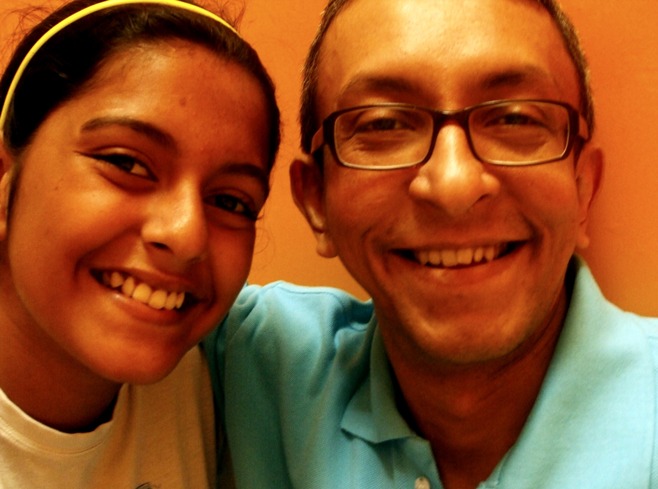
Nalaka Gunawardene at 45: Captured on 13 Feb 2011 by Dhara Gunawardene
As I turn 45 today, I can’t do better than to quote one of my favourite poets, Ogden Nash, who wrote these ‘Lines on Facing Forty’: I have a bone to pick with fate,
Come here and tell me girly:
Do you think my mind is maturing late,
Or simply rotting early?
I first heard these words quoted by the late Tarzie Vittachi, a pioneer in development journalism – and an early influence on my career – at a talk he gave circa 1990. At the time, Tarzie was already in his late 60s, but he hadn’t lost the capacity to poke fun at himself.
More than two decades later, I can better appreciate both Tarzie Vittachi and Ogden Nash. I’m now more convinced than ever that a good sense of humour – whether plain, wry or wicked – is an essential element in our survival kit as we fumble along the path of life. In my case, I’ve pledged never to take myself too seriously; however, I’m passionate and serious about what I do.
I used to give this simple caution to all my newly recruited staff members: “If you take me too seriously, you will lose your mind.
If you don’t take me seriously enough, you might (possibly) lose your job…”
After a while, I was told that it was prone to be highly misunderstood, partly because not everyone shared my play with words, and partly due to some people lacking any sense of humour. I no longer utter these words; the practical implications remain!
On more cheerful matters, my photographically keen daughter Dhara offered to shoot me as part her birthday present. I’m always happy to face cameras (and just love to make faces), so I readily agreed. Here are some of the better results, carefully chosen by the editor-publisher of this blog:
Nalaka G - with Mouth and Mind wide open...Photo by Dhara GunawardeneI promise never to act my age!Posing with the family photographer!
By the way, I’m perfectly happy with my salt-and-pepperish hair, and have resolved never to join the growing number of my friends quietly signing up to the ‘Godrej Brigade’ (I have no objections to others dyeing their hair: each one to her own self…).
In computing terms, I’m a WYSIWYG (pronounced: WIZ-ee-wig): an acronym for ‘what you see is what you get’. The term is used to describe a system in which content displayed during editing (on-screen) appears very similar to the final output.
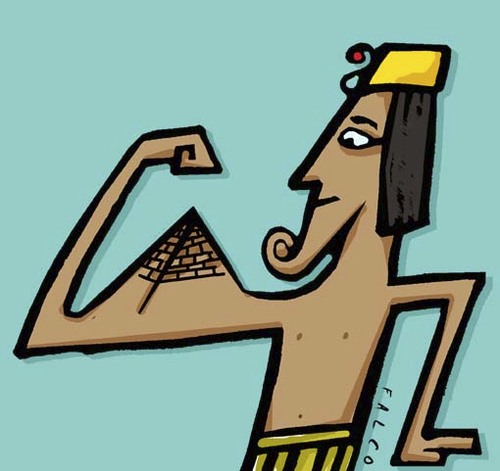
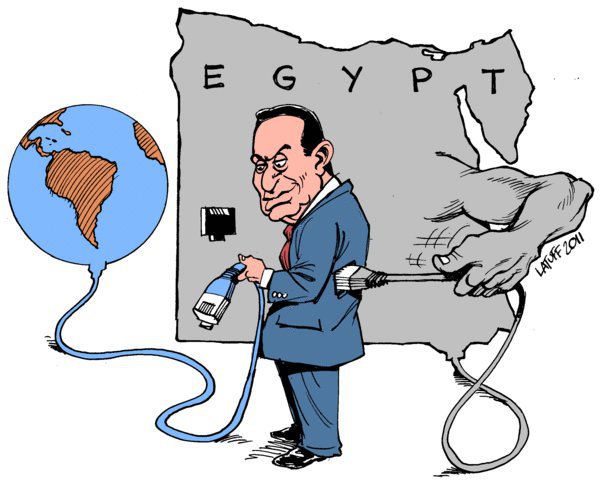
This is one of the more popular cartoons about People Power revolution in Egypt. The icon of pyramid has been irresistible for many cartoonists, but this one is especially profound: it says so much with so little!
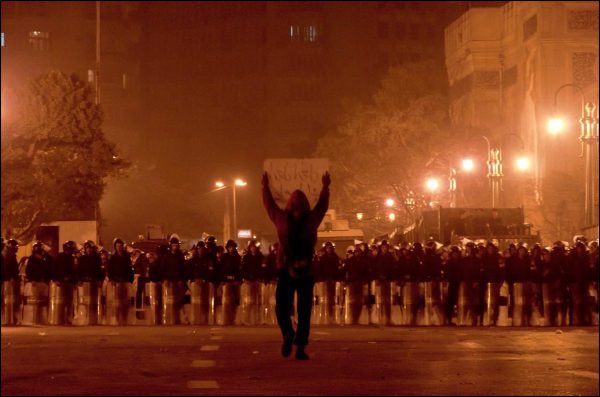
We salute all ordinary Egyptians whose 18 days of resolve and agitation have driven out the dictator Hosni Mubarak. But as I tweeted to my Egyptian friend Nadia El-Awady on the night of 11 February soon after hearing Mubarak’s resignation: “One huge roadblock is now gone; we hope you’ll persist in your long march to democratic freedom.”
Toppling an unpopular, ruthless dictator is never easy, but the immediate aftermath is the most decisive – and dangerous – moment. This is when the ultra-nationalists and fundamentalists will compete with the democrats and liberals to fill the void. In Iran, when the Shah fell in 1979 after prolonged people power, it was a theocracy that replaced the autocracy. So people power requires constant vigilance, especially now.
People Power does not – and should not – stop at elections or revolutions in any country: regime change is only half of the struggle won. Ensuring people have a say in how their governments are run requires constant engagement by their citizens. This is a topic I have long been interested in, and written about. I also helped produce a global TV documentary on the subject in 2004. See these blog posts and web story about that film:
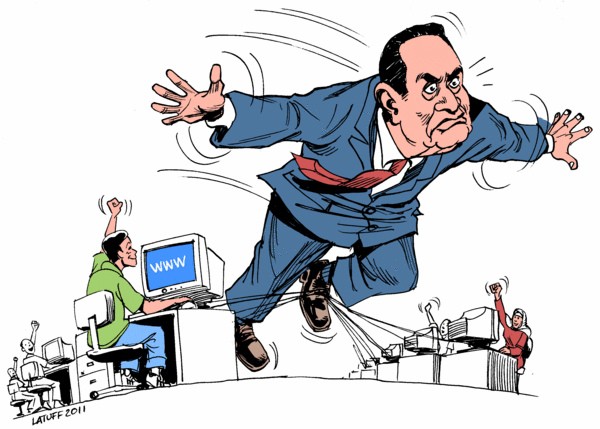
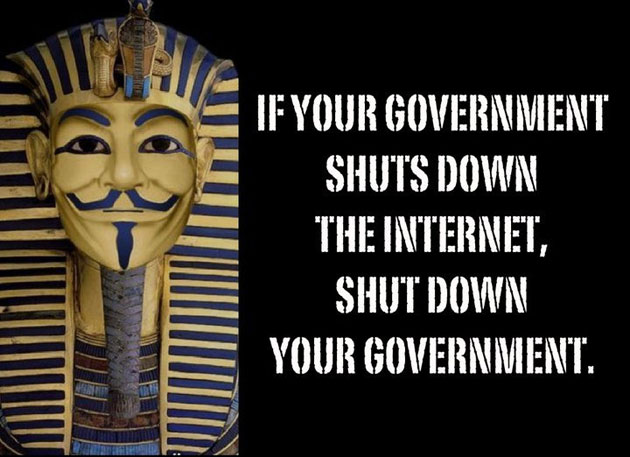
18 Days that changed Egypt: 25 Jan to 11 Feb 2011The geeky Davids bring down the mighty Goliath of Mubarak: Bravo!!!Don't meddle with a proud nation that's 5,000 years old!Mubarak unplugged Egypt from the Internet; Angry Egyptians unplugged him!
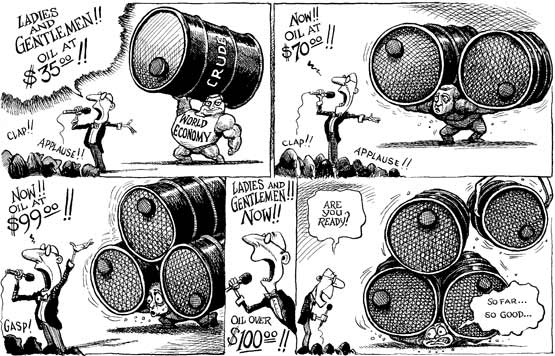
Oil prices going up, up and up...
The international selling price of unrefined petroleum (commonly referred to as the oil price) has once again gone up to US Dollars 100 per barrel, causing concerns worldwide.
The ‘oil barrel’ is an old measure that has survived from the early days of the petroleum industry that originated in the Pennsylvania oil fields.
In the early 1860s, when oil production began, there was no standard container for oil, so whiskey barrels were used. Although actual barrels are no longer used to transport crude oil — and most petroleum is now moved around in pipelines or oil tankers — the measure is still in use. Since it was standardized in 1872, how many US gallons are in one barrel of oil?
This is one of 15 questions I asked in this week’s Wiz Quiz column in the Daily News, titled Of Oil Prices and Food Crises…
Once again, my co-compiler Vindana Ariyawansa and I offer a ‘mixed bag’ of questions, covering subjects ranging from culture and sports to science and business. These take off from some recent news stories and current concerns. For example, we hear about world oil prices rising (again!), and extreme weather causing food shortage in some parts of the world. When news reports mention oil barrels and talk about Malthusian scenarios, do we know what they really mean?
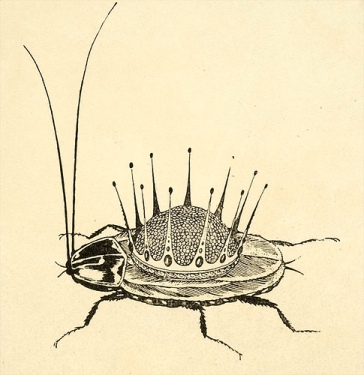
Tarankanische (The Terrible Cockroach) original book cover, 1925
Sometime ago, when I gave a talk at the Sri Lanka Rationnalists’ Association, a member of my audience asked if parents should be banned from reading fairy tales to their children. His argued that children should be raised on reality and not fantasy. I was talking about science fiction and their social relevance, and I answered: there is absolutely no harm in fairy tales as they nurture in our young minds those vital qualities of imagination and sense of wonder. I quoted C S Lewis as saying that the only people really against escapism were…jailers!
These days, not all children’s stories are fairy tales and some of them actually carry very down-to-earth messages either overtly or covertly. Members of that largest club in the world – Parenthood – keep discovering new depths and insights in some children’s stories.
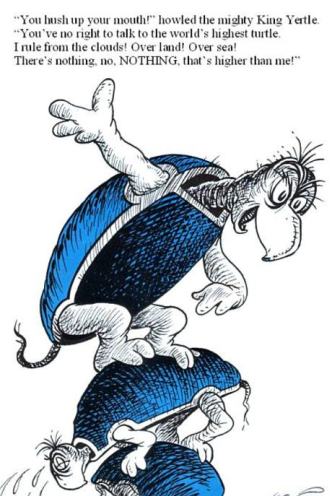
On 30 January, as people power struggles were unfolding in Tunisia and Egypt, I wrote a blog post titled Wanted: More courageous little ‘Mack’s to unsettle Yertle Kings of our times!. I related how, while following the developments on the web, I have been re-reading my Dr Seuss. In particular, the delightfully inspiring tale of Yertle the Turtle King. To me, that is the perfect example of People Power in action — cleverly disguised as children’s verse!
Turns out another parent on the opposite side of the planet had a similar insight, but from an even older children’s story written in Russia! Philip Shishkin has shared his experience in the latest issue of Newsweek.
Tarankanische, or ‘The Terrible Cockroach’ (also translated as ‘The Giant Cockroach’) is a children’s story written by the Russian author Kornei Chukovsky (1882-1969). The first edition, with illustrations by Sergeii Chekhonin, was published in (then) Leningrad 1925.
I was raised on translated Russian children’s stories (the only books of that genre we could access in the closed-economy, socialist misadventures of Sri Lanka during the early 1970s). Whatever economic realities that thrust those books on my childhood, many of them were very fine stories, always well illustrated. But I had somehow missed out on this one — so I quickly did some web searching for this story. And what a fantastic fable it is!
Tarankanische tells the nonsense tale of a threatening cockroach who is so fierce that he terrifies all the animals who are out to enjoy a picnic. Even the mighty elephants are helpless in his presence. The cockroach bullies and scares animals much larger than itself, and demands they surrender their cubs so he can eat them. He is seen as “a terrible giant: the red-haired, big-whiskered cockroach.”
Tarankanische, or The Terrible Cockroach, Sergeii Chekhonin, illustrator, 1925The little tyrant rules the whole jungle on a mix of fear, submission and misery. A laughing kangaroo points out that it’s no giant, but merely a cockroach. The hippos tell him to shut up: “You’ll make things worse for us”. Then, one day, Nature finally restores balance (as it always does): a sparrow comes along and gobbles up the Terrible Cockroach.
In his essay titled Watching the Mighty Cockroach Fall, Philip Shishkin writes: “It is hard not to read the poem as an allegory for the rise and fall of a dictatorship. Despots tend to appear invincible while they rule, and then laughably weak when they fall. Once their subjects call them out on their farce, dictators look ridiculous. Often, they react by killing and jailing people, which buys them more time in power (Iran, Belarus, and Uzbekistan come to mind). But just as often, when faced with a truly popular challenge, dictators shrink to the size of their inner cockroaches.”
Shishkin then raises an interesting question: Did Kornei Chukovsky have Joseph Stalin in mind when he wrote it? Was Stalin prominent enough when the story was first published in 1925? To find out, read the full essay.
According to his mini-bio on IMDB, Chukovsky was a praised Russian translator of Charles Dickens, Mark Twain, Walt Whitman, and other English and American authors. His writings for children are regarded as classics of the form. His best-known poems for children are “Krokodil”, “Moydodyr”, “Tarakanische”, and “Doctor Aybolit” (Doctor Ouch).
As a journalist, I was trained to look for what’s New, True and Interesting (‘NTI Test’). Early on, I went beyond just reporting events, and probed the underlying causes and processes. With experience, I can now offer my audiences something more: perspective and seasoned opinion. These are needed today more than ever as we wade through massive volumes of information, trying to make sense of it all.
I’ve been privileged to chronicle and comment on the closing decade of the 20th Century and the opening one of the 21st – years of unprecedented change, and considerable turmoil, in my country (Sri Lanka), region (Asia) and the world. In my chosen areas of science, technology and sustainable development, changes have happened at a dazzling and often bewildering speed.
As a science writer and development film maker, I work with researchers, activists and officials across Asia who struggle to balance ecological concerns with economic development imperatives. I call myself a ‘critical cheer-leader’ of their efforts. Through TVE Asia Pacific, SciDev.Net and my other affiliations, I seek to enhance the public understanding of complex issues and choices required in pursuing sustainable development.
I sometimes feel a strange kinship with the ancient Greeks, who first asked some fundamental questions about the universe. They didn’t always get the answers right, and neither do I. But it is very important that we question and critique progress – I do so with an open mind, enthusiasm and optimism. On some occasions, this involves asking uncomfortable questions that irk those in positions of power and authority. In that sense, I sometimes play the role of that little boy who told the Emperor had no clothes on. (Does anyone know what happened to the boy after that?).
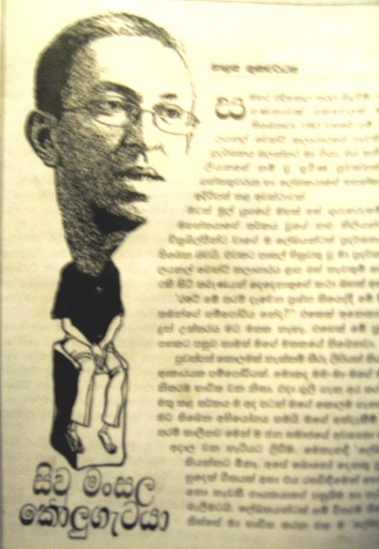
This is the basic premise for a new weekly newspaper column I am writing from this month in the Sinhala weekend newspaper Ravaya. A few weeks ago, the executive editor of Ravaya invited me to write a regular column, which I accepted after some hesitation. My hesitation was not about them; it was about my own ability to express myself in Sinhala, a language I studied more than a quarter century ago, but have not worked in for over 20 years. But I’ve decided to take it on as a challenge, and see how far I can go and how well I can write on topics and issues that are close to my heart: science, technology, environment and development. The first column has just appeared in the Ravaya issue for 6 Feb 2011. Ravaya: Always Open for Debate
I have been a regular reader of Ravaya in all its 25 years of publication. As I wrote in a book review last year: “It is an extraordinary publication that has, for nearly a quarter of a century, provided a platform for vibrant public discussion and debate on social and political issues. It does so while staying aloof of political party loyalties and tribal divisions. While it cannot compete directly (for circulation) with newspapers published by the state or press barons, this sober and serious broadsheet commands sufficient influence among a loyal and discerning readership.”
Published by a company owned by journalists themselves, Ravaya is almost unique among Lankan newspapers for another reason: its columnists and other contributors are allowed to take positions that are radically different from those of its formidable editor, Victor Ivan. I’m not sure how soon I will get to test this, but such pluralism is very rare in today’s mainstream media in Sri Lanka.
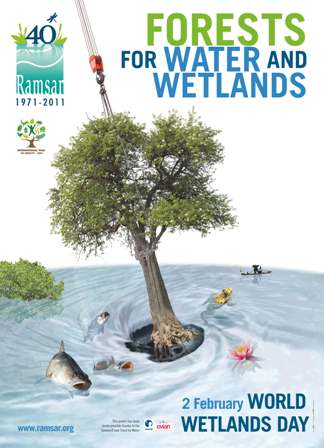
World Wetlands Day 2011 posterWorld Wetlands Day is observed every year on 2 February. It marks the date of adopting a global treaty on wetlands 40 years ago, on 2 February 1971, in the Iranian city of Ramsar on the shores of the Caspian Sea.
Each year since 1997, government agencies, conservation organisations and citizen groups around the world have used this anniversary to undertake actions aimed at raising public awareness of wetland values and benefits in general — and of the Ramsar Convention in particular.
In this International Year of Forests 2011, the theme for World Wetlands Day is: Forests for water and wetlands. It also marks the 40th anniversary of the Ramsar Convention.
Bordering between dry land and total water, wetlands are one of Nature’s most productive regions, and home to a high number of plant and animal species. Covering about 6 per cent of the Earth’s surface, wetland types include swamps, marshes, lakes, salt marshes, mudflats, mangroves, coral reefs, fens, peat bogs, and other bodies of water – whether natural or artificial, permanent or temporary. Water within these areas may be static or flowing; fresh, brackish or saline; and can include inland rivers and coastal or marine water to a depth of six metres at low tide. There are even underground wetlands.
How fluid is your wetlands knowledge?My weekly quiz in Daily News this week is devoted to the theme of wetlands — exploring their diversity, ecosystem services and threats to their survival.
Their blurb: “Violent clashes between police and demonstrators as over ten thousand gather on the streets of Cairo. The Egyptian people have endured a tyrant’s rule for far too long, millions struggle each day to find where their next meal is coming from. January 25th, 2011 marks the day when the people rise and take back what’s rightfully there’s. This isn’t the end, but hopefully the beginning to a long awaited regime change! Send to everyone and let them know.”
Song: “Into the Fire” – Thirteen Senses
Thanks to the following news sources for their footage
Daily News Egypt
The Guardian
CNN
New York Times
Al Masry Al Youm
January 2011 has been an eventful month for democratic reform in the Middle East. As People Power successfully toppled the deeply entrenched dictator Ben Ali in Tunisia, and the ordinary Egyptians intensified their pressure on own 30-year-long regime of Hosni Mubarak, commentators around the world have been trying to make sense of the rapidly unfolding developments. One of them, David Kravets, writing in Wired linked to a blog post of mine that talked about the experience of one of the earliest successful demonstrations of people power — in the Philippines, when they toppled a long-misruling dictator in 1986.
Amidst all this, and while following the developments on the web, I have been re-reading my Dr Seuss. In particular, the delightfully inspiring tale of Yertle the Turtle King. To me, that is the perfect example of People Power in action — cleverly disguised as children’s verse!
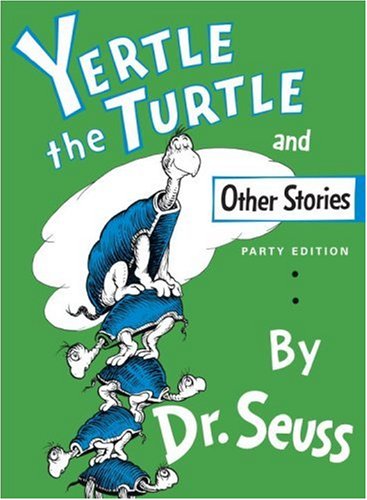
The story was first published in April 1958, in a picture book collection by Theodor Geisel, published under his more commonly-known pseudonym, Dr. Seuss. In 2001, Publishers Weekly listed it at No 125 on a list of the best-selling children’s books of all time.
For those poor Seuss-deprived readers, here’s a helpful summary I have adapted from Wikipedia:
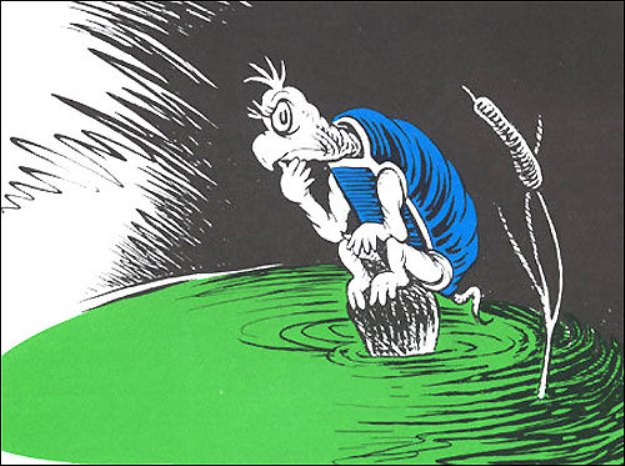
The story is about Yertle the Turtle, the king of the pond in the far-away island of Sala-ma-Sond. Unsatisfied with the stone that serves as his throne, he commands the other turtles to stack themselves beneath him so that he can see further and expand his kingdom (he considers himself the master of all he can see). However, the stacked turtles are in pain. Mack, a very ordinary little turtle at the very bottom of the pile, asks Yertle for a respite, but Yertle just tells him to shut up. Dissent is suppressed.
King Yertle is still not happy: he wants ‘to expand his kingdom’. So he commands more and more turtles to add to his throne. Mack again asks for a respite because the increased weight is now causing extreme pain to the turtles at the bottom. Again Yertle yells at Mack to shut up. At this point, little Mack decides he has had enough and decides to do something to vent his anger and frustration: he just burps. That simple action shakes up the entire stack of turtles, and the mighty king comes crashing down into the pond — and all turtles are freed at last!
Years ago, when I first read the story to my then very young daughter, I could immediately see strong parallels between the vain, merciless Yertle the turtle king and the equally egotistic megalomaniacs in the world of human politics and governance. I would later learn that Dr Seuss meant Yertle to be Adolf Hitler: the turtle’s rule of the pond and takeover of the surrounding areas signified Hitler’s regime in Germany and invasion of surrounding Europe.
The ordinary but courageous Mack epitomises long-suffering Everyman and Everywoman in all countries where autocratic or dictatorial regimes rule, piling ever more burdens on their people. Like the turtles in the stack, the people can go on for years taking a great deal of suffering and sacrifice while the despots plunder and make merry. But there comes a day when a ‘Mack’ says enough is enough…and emits a humble ‘burp’ that shakes up everyone.
As Dr Seuss wrote (and this is my favourite part!):
But, as Yertle, the Turtle King, lifted his hand
And started to order and give the command,
That plain little turtle below in the stack,
That plain little turtle whose name was just Mack,
Decided he’d taken enough. And he had.
And that plain little lad got a bit mad.
And that plain little Mack did a plain little thing.
He burped!
And his burp shook the throne of the king!
And Yertle the Turtle, the king of the trees,
The king of the air and the birds and the bees,
The king of a house and a cow and a mule…
Well, that was the end of the Turtle King’s rule!
For Yertle, the King of all Sala-ma-Sond,
Fell off his high throne and fell Plunk! in the pond!
And today the great Yertle, that Marvelous he,
Is King of the Mud. That is all he can see.
And the turtles, of course… all the turtles are free
As turtles and, maybe, all creatures should be.
I don’t mean to oversimplify or belittle the enormous courage and resolve it takes for ordinary people to take on a brutal regime, but as pop-culture metaphors go, it’s hard to find a better one than Mack and his defiant burp. That little burp by a tiny turtle brought a vain king down, and its real-world equivalent is called people power: when long-oppressed ordinary people take to the streets to protest against the accumulated excesses of their rulers, demanding reform or regime change.
Not all such ‘burps’ bring all ‘Yertles’ down in the real world. The mighty Soviet Union crumbled in the late 1980s thanks to the courage and persistence of ordinary people who stood up and stepped out. It also worked twice in the Philippines: first against an outright dictator (Marcos) in 1986, and then against a renegade elected president (Estrada) in 2001. A variation of it happened in Nepal against the brutal King Gyanendra, who was dumped into the dustbin of history with the entire monarchy in 2006. Each case had its own history, dynamics and outcomes but shared the common feat of people power.
Sounds familiar? That's because it's all too common!But elsewhere, as in Tiananmen Square of China (1989) Burma (2007) and Thailand (2010), people power failed to change regimes and led to much violence and bloodshed. What particular combination of social, political and technological factors make people power work is currently the subject of intense study and debate among scholars, diplomats and activists.
But there’s no doubt that recent history has been shaped and made by Macks who broke the silence and, figuratively speaking, burped. Some such burps were heard around the world, and some Macks went on to lead prolonged revolutions that ended with them becoming rulers themselves: Lech Walesa, Cory Aquino and Valclav Havel come to mind.
For every ‘Mack’ who succeeds, though, there are many who go unsung —or much worse. We still have no idea what happened to that much photographed and celebrated ‘Tank Man’ who stood up against the Red Army’s tanks on Tiananman Square one fateful day in June 1989. We don’t even know his name, but his defiance against such enormous odds still inspires assorted Macks all over the world.
For sure, our world is a tiny bit larger — and more complex — than that muddy pond in far away Sala-ma-Sond. And we have an abundance of Yertles, of various colours and hues, riding literally on the backs of their fellow people.
At least some of these tyrants must be following the recent developments in Tunisia and Egypt with growing anxiety. We can only hope that there will be a steady stream of courageous little ‘Macks’ in all such countries who will finally speak up and say: ‘Oi, Enough is enough!’
And then…BURP!
PS: Interesting footnote: Dr Seuss was the first to use the word “burp” in print. That apparently was cause for some concern before publication. According to him, the publishers at Random House, including the president, had to meet to decide whether or not they could use “burp” because “nobody had ever burped before on the pages of a children’s book”.
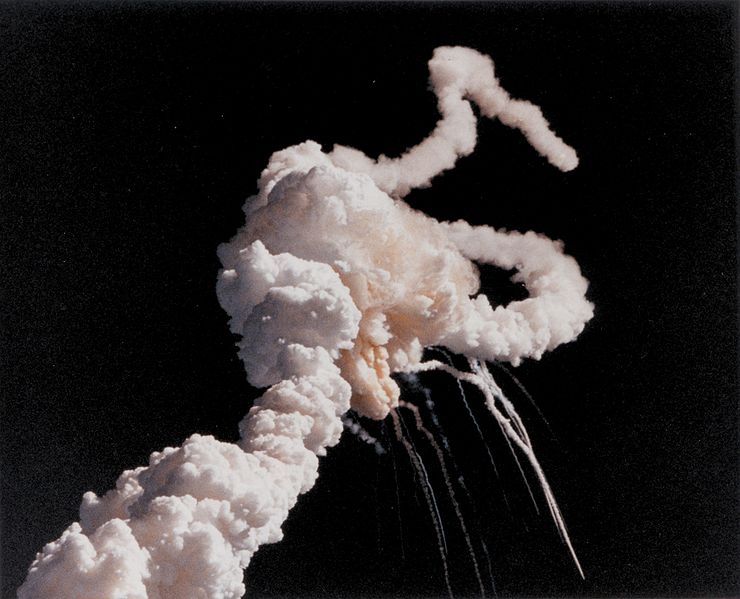
Space Shuttle Challenger's smoke plume after in-flight breakup that killed all seven crew members
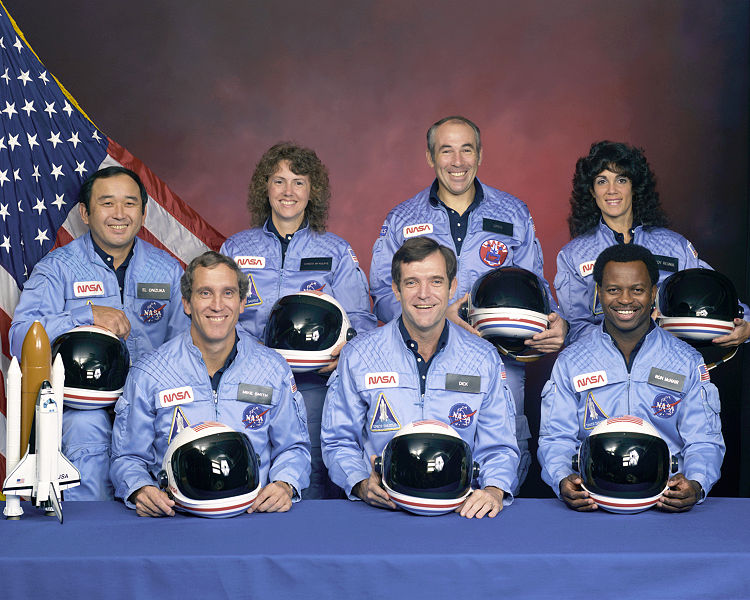
Today marks the 25th anniversary of the Space Shuttle Challenger disaster. It was the worst accident in the history of manned space exploration up to that time. All seven crew members died in the disaster — among them was Christa McAuliffe, who was selected to be the first teacher in space, and the first strict civilian to go to space as part of the US space programme.
Challenger was destroyed as it broke up in mid-flight in the second minute of its 10th mission, on 28 January 1986 at 11:38:00 am Eastern Standard Time. The break-up was later found to have been due to the failure of an O-ring on its right solid-fuel rocket booster (SRB). The O-rings are used to seal the joints between the multiple segments of the SRBs.
STS-51-L crew (front row) Michael J. Smith, Dick Scobee, Ronald McNair; (back row) Ellison Onizuka, Christa McAuliffe, Gregory Jarvis, Judith Resnik.
While the presence of Christa McAuliffe on the crew had provoked some media interest, shuttle launches had become commonplace by this time and there was little live broadcast coverage of the launch. The only live national TV coverage available publicly was provided by CNN.
Challenger Disaster Live on CNN
The accident was thoroughly investigated and has been well documented. What interests me are the communication lessons drawn from the incident – it continues to be cited as a case study in subjects as diverse as engineering safety, the ethics of whistle-blowing, effective communications, and the perils of group decision-making.
According to the Wikipedia, Roger Boisjoly, the engineer who had warned about the effect of cold weather on the O-rings, left his job at Morton Thiokol and became a speaker on workplace ethics. For his honesty and integrity leading up to and directly following the shuttle disaster, Roger Boisjoly was awarded the Prize for Scientific Freedom and Responsibility from the American Association for the Advancement of Science. Many colleges and universities have also used the accident in classes on the ethics of engineering.
Information designer Edward Tufte has used the Challenger accident as an example of the problems that can occur from the lack of clarity in the presentation of information. He argues that if Morton Thiokol engineers had more clearly presented the data that they had on the relationship between low temperatures and burn-through in the solid rocket booster joints, they might have succeeded in persuading NASA managers to cancel the launch.
To me, it was extraordinary how President Ronald Reagan handled the aftermath of the tragedy. On the night of the disaster, he was scheduled to give his annual State of the Union Address. He postponed it by a week and instead gave a national address on the Challenger disaster from the Oval Office. The speech, written by author Peggy Noonan who was the president’s primary speech writer, is a fine piece that combines grief, tribute and resolve in just the right proportions. No lofty intellectualisation or pontification. Just plain, short sentences that appeal to the hearts. Ably delivered by the Great Communicator, it remains an excellent study in how a national leader can counsel a nation in grief without descending into either despair or denial. Draw your own contrasts with other tragedies before and since.
Ronald Reagan’s speech to the nation after the Challenger Shuttle explosion
President Reagan spoke at 5 pm EST from the Oval Office at the White House. The address was broadcast live on nationwide radio and television. Here is the full text of his speech (emphasis is mine):
Ladies and gentlemen, I’d planned to speak to you tonight to report on the state of the Union, but the events of earlier today have led me to change those plans. Today is a day for mourning and remembering. Nancy and I are pained to the core by the tragedy of the shuttle Challenger. We know we share this pain with all of the people of our country. This is truly a national loss.
Nineteen years ago, almost to the day, we lost three astronauts in a terrible accident on the ground. But we’ve never lost an astronaut in flight; we’ve never had a tragedy like this. And perhaps we’ve forgotten the courage it took for the crew of the shuttle. But they, the Challenger Seven, were aware of the dangers, but overcame them and did their jobs brilliantly. We mourn seven heroes: Michael Smith, Dick Scobee, Judith Resnik, Ronald McNair, Ellison Onizuka, Gregory Jarvis, and Christa McAuliffe. We mourn their loss as a nation together.
For the families of the seven, we cannot bear, as you do, the full impact of this tragedy. But we feel the loss, and we’re thinking about you so very much. Your loved ones were daring and brave, and they had that special grace, that special spirit that says, “Give me a challenge, and I’ll meet it with joy.” They had a hunger to explore the universe and discover its truths. They wished to serve, and they did. They served all of us. We’ve grown used to wonders in this century. It’s hard to dazzle us. But for 25 years the United States space program has been doing just that. We’ve grown used to the idea of space, and perhaps we forget that we’ve only just begun. We’re still pioneers. They, the members of the Challenger crew, were pioneers.
And I want to say something to the schoolchildren of America who were watching the live coverage of the shuttle’s takeoff. I know it is hard to understand, but sometimes painful things like this happen. It’s all part of the process of exploration and discovery. It’s all part of taking a chance and expanding man’s horizons. The future doesn’t belong to the fainthearted; it belongs to the brave. The Challenger crew was pulling us into the future, and we’ll continue to follow them.
I’ve always had great faith in and respect for our space program, and what happened today does nothing to diminish it. We don’t hide our space program. We don’t keep secrets and cover things up. We do it all up front and in public. That’s the way freedom is, and we wouldn’t change it for a minute. We’ll continue our quest in space. There will be more shuttle flights and more shuttle crews and, yes, more volunteers, more civilians, more teachers in space. Nothing ends here; our hopes and our journeys continue. I want to add that I wish I could talk to every man and woman who works for NASA or who worked on this mission and tell them: “Your dedication and professionalism have moved and impressed us for decades. And we know of your anguish. We share it.”
There’s a coincidence today. On this day 390 years ago, the great explorer Sir Francis Drake died aboard ship off the coast of Panama. In his lifetime the great frontiers were the oceans, and an historian later said, “He lived by the sea, died on it, and was buried in it.” Well, today we can say of the Challenger crew: Their dedication was, like Drake’s, complete.
The crew of the space shuttle Challenger honored us by the manner in which they lived their lives. We will never forget them, nor the last time we saw them, this morning, as they prepared for their journey and waved goodbye and “slipped the surly bonds of earth” to “touch the face of God.”








 Open Minds!