Stop that Traffick: ‘The Girl Next Door’ becomes ‘Trade’ the Movie

Image from Trade the Movie Image from Trade the Movie

When 13-year-old Adriana (played by Paulina Gaitan) is kidnapped by sex traffickers in Mexico City, her 17-year-old brother, Jorge (Cesar Ramos), sets off on a desperate mission to save her. Trapped by an underground network of international thugs who earn millions exploiting their human cargo, Adriana’s only friend throughout her ordeal is Veronica (Alicja Bachleda), a young Polish woman captured by the same criminal gang. As Jorge dodges overwhelming obstacles to track the girl’s abductors, he meets Ray (Kevin Kline), a Texas cop whose own family loss leads him to become an ally.

From the barrios of Mexico City and the treacherous Rio Grande border, to a secret internet sex slave auction and a tense confrontation at a stash house in suburban New Jersey, Ray and Jorge forge a close bond as they frantically pursue Adriana’s kidnappers before she is sold and disappears into a brutal underworld from which few victims ever return.

This is the synopsis of Trade, a feature film that opens across the United States on 28 September 2007.

Inspired by Peter Landesman’s chilling NY Times Magazine story on the U.S. sex trade, “The Girls Next Door,” (published in January 2004), TRADE is a thrilling story of courage and a devastating expose of one of the world’s most heinous crimes. The American debut of Marco Kreuzpaintner, one of Germany’s leading young directors, TRADE is produced by Roland Emmerich and Rosilyn Heller from a screenplay by Academy Award(R) nominee Jose Rivera (The Motorcycle Diaries).

Watch the trailer for Trade the movie

Image from Trade the Movie

Explaining the social context to this dramatised story, the movie’s website says:
“The practice of slavery in the US is something most people think ended with the 13th Amendment in 1865, but in recent years it has returned in an even more virulent form. Fueled by the collapse of the Soviet Union and other eastern European countries, new technologies like the internet, and sieve-like borders, the traffic in human beings has become an epidemic of colossal dimensions. The State Department estimates that as many as 800,000 people are trafficked over international frontiers each year, largely for sexual exploitation. Eighty percent are female and over fifty percent are minors. Many people in this country push this atrocity out of their minds, believing that it only occurs in faraway countries like Thailand, Cambodia, the Ukraine and Bosnia. The truth is that the United States has become a large-scale importer of sex slaves. Free the Slaves, America’s largest anti-slavery organization estimates that at least 10,000 people a year are smuggled or duped into this country by sex traffickers.”

Image courtesy Trade the Movie

The film’s makers, Roadside Attractions, says it will donate 5 per cent of the opening week box-office gross divided among four organisations participating in the release of the film; United Nations Office on Drugs and Crime (UNODC), Equality Now, International Justice Mission (IJM), and David Batstone’s Not For Sale Campaign.

On 19 September 2007, they held a benefit premiere at the United Nations headquarters in New York that included supper in the UN Delegates dining room. This marked the first film premiere event ever to take place at the United Nations, with the crusty UN officials mingling with film stars and artistes.

Read about the film-makers

Get involved in anti-traffick activism

Image courtesy Trade the movie

UN-ODC press release about Trade the movie

All images courtesy Trade the movie website

MTV Exit: Entertainment TV takes on human trafficking

mtv-exit.jpg

Television gets blamed for lots of things that go wrong in our world. This isn’t surprising, given it’s the world’s most powerful medium and the key role it plays in our cultural, social and political lives.

A sociological study some years ago said broadcast TV was partly responsible for the movement of millions of people from villages to cities in search of jobs, higher incomes and better living standards. The glitzy lifestyles dramatised on TV was creating illusions in the minds of rural women and men, especially the youth, it said.

Of course, such migrants soon discover a very different reality in the cities. But few want to go back to where they came from. As they hang on in the cities, some fall prey to human traffickers, always on the prowl for vulnerable people to trade in.

The United Nations estimates that the total market value of human trafficking is 32 billion dollars — one of the most lucrative illicit trades in the world. The International Labour Organisation (ILO) estimates that worldwide, about 2.5 million people are victims of trafficking.

If TV indirectly contributed to this human perversion, it can also help society stand up and fight against it. As Music Television (MTV) is now doing.

MTV, the most popular music channel in the Asia Pacific region, will be playing a different tune in the weeks to come. For half an hour at least, beginning 18 September 2007 for MTV Thailand, live and hip music will give way to the harrowing accounts of three victims of human trafficking. This is part of the MTV Exit campaign.

Trafficking of people in the region will be given a human face through the personal accounts of Anna, Eka and Min Aung. Anna was forced into prostitution in the Philippines, while Eka is an Indonesian who was an abused domestic worker in Singapore. Min Aung from Burma recounts his sad experiences working and being practically imprisoned in a factory in Thailand for two years.

Lynette Lee Corporal writing for Inter Press Service (IPS) quotes MTV Thailand campaign director Simon Goff as saying: “We worked with organisations and talked with experts to see what forms of trafficking we would focus on, the most prevalent forms that affect our audiences. We selected regions that would best represent the issue. Then, finally we brought in a production team, led by a Thai producer and a director from the UK.”

More extracts from her article:

Goff said that it took them six weeks of pre-production work, including research and sourcing, another six weeks to shoot the documentary, and six weeks more of post-production work. It took about four and a half months of “solid production,” he added.

Beyond the emotional and unsettling accounts of the trafficking survivors and the disturbing re-enactments of rape, beatings and abuse, the documentary also had interviews with a trafficker and a ‘client’ who openly admitted to the crime. In an interview with ‘The Chairman’, a Filipino recruiter who forces young girls into prostitution, revealed the horrific experiences young girls go through, and this was reinforced by what ‘Ama’ , a Chinese client who admitted to paying for sex with trafficked girls, narrated.

The challenge now, said Goff, is to break the people’s apathy and denial about human trafficking. “Ultimately, time will tell. We have launched the campaign and it’s already out there in the media. We hope that the show will make people realise that they are both a part of and a solution to the problem,” he said.

In Thailand’s case, he added that it is also important for Thais to realise that it is not just about Thai victims being trafficked abroad, but it’s also “necessary to look that we have other nationalities, such as Min Aung, who has been trafficked here”.

Read the full article on The Asian Eye website of IPS Asia Pacific

Watch or download the celebrity-presented MTV EXIT documentaries for Asia Pacific and South Asia

United Nations Office on Drugs and Crime website on human trafficking

More information on trafficking and how to fight it

Shimu: Bangladesh’s real life ‘Meena’ enthralls millions on TV

Meena’s uncle has arranged for his daughter Rita to marry Babu, a shopkeeper’s son. But Rita is only 15 and has not yet finished school. With Meena’s help, it comes to light that Babu, who is studying to be a doctor, does not want to get married yet, especially since he knows it is unsafe for young girls to become mothers. To everyone’s satisfaction, the marriage is postponed until Rita is 18 and has completed her education.

That’s the storyline in Meena: Too Young to Marry, which is part of the hugely successful cartoon animation series Meena, which Unicef produced with leading animation houses in South Asia during the 1990s. It was part of the Meena Communication Initiative.

Its central character is Meena: a spirited, nine-year-old girl, living in a typical South Asian village, facing all the usual challenges of growing up — whether in her efforts to go to school, or having enough to eat, or in fighting the stigma surrounding HIV/AIDS in her village. In a sub-region where many families still favour boys over girls, life is not easy for Meena, but she finds ways to not just cope but flourish.

Now comes the news of a real life Meena in Bangladesh.

Shimu - photo courtesy Washington Post

Alo Amar Alo is the name of a live action television drama series that promotes girls’ education in Bangladesh. Launched in July 2007, it is currently running on Bangladesh Television, BTV.

Alo Amar Alo (“Light My Light”) centers around a girl named ‘Alo’ who stops going to school when she completes Class V. Throughout 26 episodes, the story follows Alo as she struggles to overcome life’s challenges through the support and friendship of a renowned actress.

Playing the role of Alo is 13-year-old Shimu, who suddenly finds herself the star of the country’s most popular television series.

In an article profiling her, The Washington Post wrote on 14 September 2007: “Shimu, a youthful Bangladeshi version of Winona Ryder, is recognized across the country for her moving role as the spunky 11-year-old heroine Alo. On Wednesday nights, more than 10 million viewers tune in after the 8 p.m. news to see her character put through the gantlet of family entanglements and financial strains that afflict many of the young girls in this desperately poor, densely populated South Asian nation. Alo must fight to stay in the fifth grade while her uncle demands that she work in a garment factory and other family members urge her to marry so they will have one less mouth to feed.”

“Teachers say that Shimu’s photograph hangs in classrooms across the country on posters advertising the show and that her story has become a symbol of the struggle to keep girls in school.”

Elsewhere, the article notes:
“As in Latin America’s telenovelas and many African and South Asian TV dramas, story lines in Bangladeshi programs are often infused with messages decrying social ills such as child labor, domestic violence and early marriage. Many of the shows are low-budget productions funded by nonprofit organizations or the government. Shimu’s show…is funded by the Education Ministry and UNICEF; actors receive modest stipends.

Being a TV star has not changed Shimu’s life, says Washington Post writer Emily Wax. Even though Shimu is on television, her family does not own a TV set. She and her friends watch the show at the theater group’s center.

Her grandfather, Mohamed Siddiq, 61, is quoted saying he wants Shimu to stay in school but is worried that she may end up marrying or working, since their family is being evicted in a month and has no savings.

“We are illiterate. I really want Shimu to stay in classes,” Siddiq said. “It’s just so hard to survive here.”

Read the full article about Shimu in The Washington Post online

The Alo Amar Alo series is funded by Unicef and the Ministry of Education in Bangladesh. It’s part of a communication strategy which includes interactive popular theatre shows, folksong performances, wall paintings and Meena Communication Initiatives.

“These have been extremely effective in raising awareness on the value of education as well as reaching the remote corners of the country through the mass media. Parents have shown more willingness to send girls to school. The increase in the enrollment of girls has also been the impact of multiple awareness raising campaigns,” says Unicef Bangladesh.

But big challenges remain. The Washington Post article draws parallels between the character Alo and child actor Shimu.

“Sometimes I feel she should support me,” Shimu’s grandmother, Ayesha, 49, who was herself married at 12, is quoted as saying. “Boys want to marry her. They are always harassing her. Even though she is known for her acting, it’s very hard to make a living here. If she were married, we wouldn’t have to worry about feeding her.”

To which Shimu says, simply: “It’s better to stay in learning for the future. I want to try.”

One concern is I have why Unicef is exploiting a child actor without adequate pay. The article refers to actors receiving ‘modest stipends’. If Shimu was paid better for her natural talent as well as considerable time she doubtless spends on acting in Alo Amar Alo, surely that can make a difference in one child’s life? Or is that not statistically significant for Unicef?

Photo of Shimu courtesy The Washington Post

Meena image courtesy Unicef

A Silent Emergency: More television sets than toilets!

Read a later blog post: Faecal Attraction: There’s no such thing as a convenient flush…

It was September 2004. My daughter Dhara, eight years at the time (or ‘eight plus’ as she insisted on saying), had a complaint.

The toilets in her school were not clean enough. She was finding it squeamish to use them. So she was doing her best to avoid going to the loo: she’d drink less, and try to ‘hold back’ until she could rush home.

Like many sheltered middle class kids, she was still coming to terms with the wider world outside her home. And she attends a well endowed private school where, I am told, toilets are cleaned regularly by janitors engaged by the school.

Now we cut to eleven-year-old Susheela, a girl growing up in neighbouring India. I’ve never met her in person, but this sentence summed up her tragic story:
“I was always first in the class. I am very much interested in studies. I want to become a lawyer. But my mother stopped me from going to school after Class V as the middle school I was attending, 5 km from my house, had no toilet. Can someone help me?”

This was the opening of an article on water and sanitation written by Indian journalist Dr Asha Krishnakumar and published in the news magazine Frontline (part of The Hindu group) at the end of 2003. It was titled: A Silent Emergency.

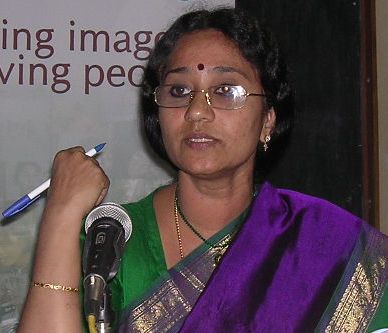
dr-asha-krishnakumar.jpg Image courtesy WSSCC

It was several months later that I actually read Asha’s article. By coincidence, my daughter was having her own ‘toilet issue’ at the time — and the contrast was striking.

Asha’s article continued:
Susheela’s anguish is shared by a large number of girls in India who drop out of school for what sounds like an absurd reason: want of a toilet in school. “Sanitation is closely linked to female literacy in India,” says a United Nations Children’s Fund (UNICEF) study. According to V. Balakrishnan, convener of the Tamil Nadu Primary Schools Improvement Campaign, the lack of proper toilet facilities in schools has a definite and significant bearing on the drop-out rate of girls, particularly around the time they reach Class VIII. In 2000, barely 10 per cent of Tamil Nadu’s 40,000 government schools had usable toilets; the figure is much lower for the country as a whole.

I’d been covering development issues in the media for over 15 years, but this stark reality had not occurred to me. In some developing countries, girls face a greater struggle in enrolling in school and staying on. There are cultural, social and economic factors working against educating girls.

And as Asha’s article revealed, there are other, less known factors adding to this burden.

I shouldn’t have been surprised. Indian census data had revealed in 2001 that, some parts of the country had more television sets than toilets.

Asha’s was one of three dozen excellent media articles on water and sanitation that I read that month as a judge in an international award scheme to recognise the best media reporting on the issue. Organised by the Water Supply and Sanitation Collaborative Council (WSSCC), it was meant to to encourage broader media coverage of water supply, sanitation and hygiene (WASH) issues in the developing world.

The initiative, first launched in 2002, is open to journalists from developing countries, who write or broadcast original investigative reports on WASH issues. The Collaborative Council seeks to use the WASH Media Awards as part of the broader goals of fostering sustainable relations with journalists in developing nations, and increasing media coverage of WASH issues.

WASH has recently announced the next media awards, covering print and broadcast media coverage from 1 July 2007 to 30 April 2008. This time around, it also involves the Stockholm International Water Institute (SIWI).

Winning entries will be presented at the World Water Week in Stockholm , Sweden in August 2008. Deadline for the submission of entries is on or before May 15, 2008. Read the announcement

In 2004, the recipient of the first WASH Media Award was Nadia El-Awady from Egypt for her outstanding article “The Nile and its People”. It illustrated the impacts of industrial pollution, sewage and solid waste management on people’s health and dignity along the River Nile.

We evaluated a large number of high quality entries and decided to give special recognition and Certificates of Appreciation to several other journalists. Asha was one of them.

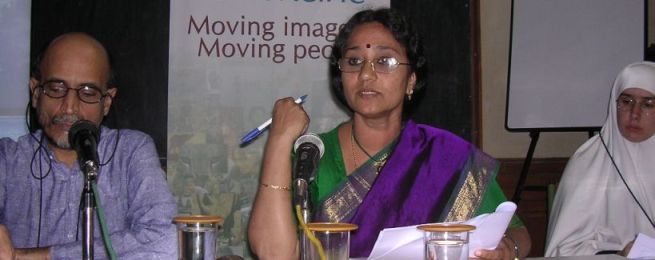
A few months later, it was my privilege to meet Asha in person at a workshop on media and sustainable development that TVE Asia Pacific organised as part of the Education for a Sustainable Future conference in Ahmedabad, India, in January 2005. The photo shows Asha addressing our workshop while Darryl D’Monte, fellow judge in WASH media awards looks on.

l-to-r-darryl-dmonte-asha-krishnakumar-and-nadia-el-awady.jpg

By another coincidence, the lady on the right is Nadia El-Awady who was overall winner of the WASH media award. At the time she was the Health and Science Page Editor of IslamOnline.net. She has since been promoted.

Either the world is smaller than we think, or our networks are larger than we imagine.

But I will always be grateful to Asha for opening my eyes on a silent emergency. One that I have since explained to my daughter. She no longer complains.

Read the WASH press release on 2004 media award winners

Read the publication on WASH Media Awards 2004

Read WASH media guide on The Biggest Scandal of the last 50 Years

Photos by Janaka Sri Jayalath, TVE Asia Pacific

Love Thy Mangrove: A Greenbelt Report from Pra Thong island, Thailand

jureerat-pechsai-deun.jpg

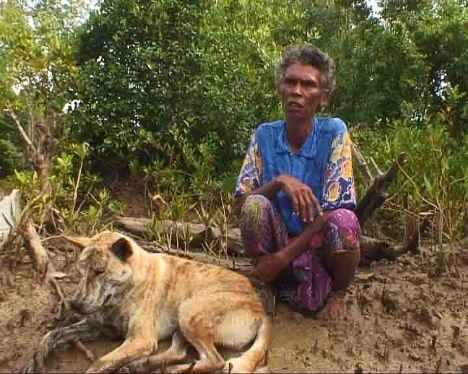
This is Jureerat Pechsai, nicknamed Deun.

She is a member of the Moken community – indigenous people living on the coast and islands on Thailand’s southern coast. Their nomadic lifestyle has earned them the name Sea Gypsies. In Thai, they are called Chao Ley — or people of the sea.

They traditionally live on small boats and move from place to place. When the Monsoon rains make the seas rough, they set up temporary huts on islands – such as Pra Thong Island, where Deun lives.

Pra Thong is an hour’s boat ride from the mainland city of Phuket — some conservationists call it one of the “Jewels of the Andaman” for its biodiversity. It is also an important nesting beach for turtles.

It was on this island that my colleagues from TVE Asia Pacific met and filmed with her in late 2006 for our Asian TV series, The Greenbelt Reports.

The Asian Tsunami of December 2004 devastated the Moken way of life. Their temporary huts were destroyed, and many families lost loved ones. The losses would have been greater if not for the mangrove forest close to the Moken village.

“Moken loves the water, the forest and everything. And we love the mangrove forest the most. The mangrove forest is like a living creature that has helped the Moken people for years. It’s our most beloved place on the island,” says Khiab Pansuwan, an older woman who is a leader in Deun’s community.

After the Tsunami, some Moken felt that they could not return to their nomadic lives. They have chosen to live on the mainland where they feel safe from the waves. Others who remained on their island had new, permanent houses built for them. But the Moken are quick to abandon these whenever they hear rumours of more Tsunamis.

Watch The Greenbelt Reports: Love Thy Mangrove on YouTube:

The mangrove replanting work on Pra Thong island is led by two women, Khiab and Deun.

Deun has been a volunteer with conservation organisations. She learnt about ecosystems and how to protect mangroves and endangered species like sea turtles. She can see many changes in her environment after the tsunami.

“After the tsunami, there are a lot of changes. We didn’t have much grass before, but now weeds are everywhere. The weeds are now more than grass,” says Deun. “In the past, we used to have more and more beach every year. But now the sea has come so close…”

khiab-pansuwan.jpg

The Tsunami’s impact is not the only factor affecting the mangroves here. Dynamite fishing, oil from boats, foam from fish and oyster nets are all damaging this life-saving greenbelt. Some people also cut down mangrove trees.

But Khiab and Deun are determined to rally everyone around to replant and regenerate their mangroves.

Says Khiab: “The community forest is part of the Moken people. We don’t want to cut the trees or clear it. We want to replant the trees so the forest is like before. We don’t want anyone to cut down trees because the mangrove forest saved many Moken lives.”

The two women are determined to rally everyone around to replant and regenerate their mangroves.

Replanted mangroves will ensure not only protection from the waves, but also a continued supply of shell fish and crabs – the main source of income and food for the Moken.

The Moken have traditionally managed the mangroves sustainably. They fish in different areas of the forest during the year, giving time for fish stocks to regenerate. Logging for firewood is done only in moderation, in designated areas.

But these mangroves are now under threat from outsiders who see it as a source of firewood and shell fish. Only a few Moken are left in the village to protect the forest from these intrusions.

Khiab and Deun have much work to do.

NOTE: We are now looking for more stories like this to be featured in the second Asian TV series of The Greenbelt Reports. See TVEAP website news story calling for story ideas.

All images and video courtesy TVE Asia Pacific

Bill Moyers & Ammu Joseph: Journalists are beachcombers…

I had an ‘aha!’ moment last week during the session on ‘Reporting the world through a gender lens’ at Asia Media Summit 2007 in Kuala Lumpur, Malaysia.

Ammu Joseph, the passionate and articulate Indian journalist and women’s rights activist, was speaking on gender sensitivity in disaster related coverage in South Asian media. She always speaks drawing on her rich and varied experiences, and offers refreshing perspectives on oft-discussed topics.

At one point, she quoted one of my journalism heroes, Bill Moyers, as saying:
“We journalists are simply beachcombers on the shores of other people’s knowledge, other people’s experience, and other people’s wisdom. We tell their stories.”

How very true!

Bill MoyersAmmu Joseph

I researched where Bill Moyers said this, and it turns out it was part of his speech accepting Harvard Medical School’s Global Environment Citizen Award in December 2004. Read the full speech, which is highly inspiring.

Reading further, I came across another Bill Moyers gem:
“One challenge we journalists face – how to tell such a story without coming across as Cassandras, without turning off the people we most want to understand what’s happening, who must act on what they read and hear.”

That is more relevant today than when he first said it: with climate change becoming the latest worldwide scare, it is indeed a huge challenge for us to report, analyse and explore issues without crying wolf.

But crying wolf is what characterised a good part of the session on reporting climate change during the Asia Media Summit. It had some good speakers, who knew what they were talking about, but was very poorly moderated by a man who had no idea what he was taking on.

That’s when I so wished we could clone a few more Bill Moyers — this planet is seriously in need of more like him!

And we need more like Ammu Joseph to tell us jouralism and broadcasting are not just industries or professions; that they involve and require more. Here’s her short profile:

Ammu Joseph is an independent journalist and author based in Bangalore, and writing primarily on issues relating to gender, human development and the media. Her publications include five books: Whose News? The Media and Women’s Issues (Sage, 1994 and 2006 — revised edition, co-authored/edited with Kalpana Sharma), Women in Journalism: Making News (Konark, 2000 and Penguin India, 2005 — revised edition), Terror, Counter-Terror: Women Speak Out (Kali for Women, 2003, co-authored/edited with Kalpana Sharma), Storylines: Conversations with Women Writers, and Just Between Us: Women Speak about their Writing (Women’s World India/Asmita, 2003, co-authored/edited with Vasanth Kannabiran, Ritu Menon, Gouri Salvi and Volga).

Read Ammu Joseph detailed profile

Read some of Ammu Joseph’s recent writing on India Together

The ‘Rural Romance’ lives on in the ICT Age: Urban poor need not apply

Poor rice farmers running up laptops in paddy fields.

Fishermen navigating their ramshackle vessels using satellite-guided global positioning systems (GPS).

A wide-eyed girl child seated in front of a computer screen, looking completely awe-struck.

A saffron-robed Buddhist monk gleefully chatting away on a mobile phone.

Do these images sound a bit familiar to you? That’s because you keep seeing them on magazine covers, posters and various other items produced and distributed to show how modern-day communication gadgets are making a difference in the majority world.

The majority world is where a majority of people live in poverty or hover close to it.

Some influential members of the development community – which includes aid giving nations, UN agencies, researchers and assorted charities working on humanitarian and development issues – now try to fix poverty with gadgets. Or, to use the proper term, unleash information and communication technologies (ICTs) to help combat poverty.

Photo courtesy SciAm Image courtesy Panos Image courtesy Panos

ICT is a basket term that includes the well established services like radio, television and fixed phones as well as newer technologies such as computers, Internet and mobile phones.

Can ICTs help developing countries overcome the current income, social and other disparities? In an editorial written for the Global Knowledge Partnership (GKP) three years ago, I answered this question as a conditional ‘yes’ — with the caution that ICTs are not a panacea that can fix deep-rooted ills.

Read my full essay in GKP Partners Newsletter (My essay is the last one, so keep scrolling down, down, down.)

I said:
ICTs cannot turn bad development into good development; they can only make good development, better. However, when used strategically and as part of a wider development process, ICTs can offer substantial value addition.

But that presumes there is a rigorous assessment of the needs and rational investment of the limited resources. What happens when experts and activists act on their perceptions and prejudices, and not on evidence?

The development community’s obsession with everything rural is one key factor creating such distortions. Sharad Shankardass, Spokesperson for the United Nations Human Settlements Programme (UN-HABITAT), once described this as the development community’s ‘rural romance’.

In 2003 – 2004, Sharad joined us at TVE Asia Pacific in running two regional workshops for training Asian TV journalists in covering sustainability related issues. As the UN agency that chronicles humanity’s urbanization, his agency has all the facts and figures to draw evidence-based conclusions.

The amiable and articulate Sharad summed it up well: more than half the world’s population – including significant numbers of its poor – now live in cities or semi-urban areas. Yet, most members of the development community continue to think of poverty and under-development as an exclusively rural phenomenon.

In other words, they are hooked on a romanticised notion of the rural poor and cannot see (or choose to ignore) a more multi-faceted reality.

Image courtesy UN HABITAT Image courtesy TVE Asia Pacific

Here’s the blurb for State of the World’s Cities 2006/2007 report, published by UN-HABITAT:
“It is generally assumed that urban populations are healthier, more literate and more prosperous than rural populations. However, UN-HABITAT’s State of the World’s Cities Report 2006/7 has broken new ground by showing that the urban poor suffer from an urban penalty: Slum dwellers in developing countries are as badly off if not worse off than their rural relatives.”

Read State of the World’s Cities 2006/2007 online, as pdf chapters

This kind of evidence is being ignored by researchers, activists and UN officials who have fallen (or sleep-walked) into a ‘rural romance trap’. To them, the unmet needs of millions of urban poor are not a concern, or at least not a priority.

In their strange logic, it’s not just a low income level and deprivation of basic human amenities that qualify someone for support under various poverty reduction efforts. That person must also live in an idyllic village, away from major signs of civilization, and preferably in a mud hut surrounded by starving children and emaciated cattle.

That’s picture perfect poverty for you. Urban poor, living in the shadow of highrise buildings and skytrains, rather spoil this pristine image!

Last week while visiting Kuala Lumpur, Malaysia, for Asia Media Summit 2007, I had two separate encounters related to this rural romance.

First was a pre-summit workshop on Connecting Communities through Community Broadcasting and ICTs that brought together some 25 – 30 participants, mostly activists and researchers. In my remarks to the workshop (where I spoke and chaired a session), I urged everyone not to romanticize either communities or broadcasting.

“Communities in need are no longer rural and idyllic as some of you might imagine,” I cautioned. “And broadcasting isn’t what it used to be either. Things have moved on. So must we.”

During question time, a communications advisor from UNESCO New Delhi took me to task for saying this. “We are working with 45 years of solid experience behind us,” she reminded me and everyone else. “You can’t just dismiss this body of work.”

She seemed affected by my questioning the strong or exclusive focus that community radio promoters have on rural areas and rural poor in particular.

I didn’t want to split hairs on this when bigger issues were at stake. I just said that what had worked in the first century of radio will not work in that same form in the medium’s second century that we have now entered. New thinking based on a century’s experience was needed.

Why are organizations like UNESCO so resistant to change and new thinking? Why do they go around spreading development myths that actually do more harm than good?

Read my 2004 essay that exposes the UNESCO-sponsored myth of ‘community radio’ in my native Sri Lanka

And they are not alone. Other UN agencies and development practitioners still plan and deliver development aid and support based on a reality that prevailed in the 1980s or earlier.

My Malaysian friend Chong Sheau Ching, whom I met last week after two years, told me a recent experience that corroborates it.

Chong Sheau Ching, photo courtesy IDRC e-homemakers

Sheau Ching is a remarkable woman. She combines many roles – social entrepreneur, columnist and single mom among them. She is a leading voice in Southeast Asia for using modern ICTs to help women – especially single moms — to find work that they can do from home yet earn decent incomes.

She is founder and head of e-homemakers, a non-profit organisation that networks over 13,000 Malaysian women who are home workers, home-based entrepreneurs and home-makers. These women live and work in cities or towns, and now take advantage of Malaysia’s well-developed telecommunications infrastructure.

Sheau Ching was an invited speaker at Asia Telecentre Forum held in the Malaysian capital on 6 – 8 February 2007. In her presentation, she had spoken about the ICT needs and uses of urban women, including the poor women living in cities. She had questioned why the tele-centre movement was focusing almost entirely on rural areas.

Guess what? The organisers didn’t like such outspokenness at all – she had been reprimanded in public during the rest of the session as well as ‘scolded’ in private after it ended. So much for plurality of views!

Sheau Ching is full of such stories, even if some of them make us feel outraged at the stupidity of people or institutions involved.

Here’s another one, recounting an experience at the World Summit on the Information Society in Tunis, Tunisia in November 2005:

At WSIS Tunis, I gave a short presentation to a small group of bankers from developing countries on using low cost ICT4D innovations for urban poor women to generate income. One politely said to me as he handed out dinner invitations, “We are interested in big projects for youth and the rural people.” I was the only woman in the group, the only one from the civil society, and needless to say, the only one who was not invited to the fancy dinner in a five-star hotel in North Tunis.
Read her full essay, Unsexy and voiceless!!

Next time when UN agencies and other bleeding-heart do-gooders turn on their rhetoric about busting poverty, ask a simple question: Are they fighting poverty no matter where it exists, or is it only poverty in rural, idyllic settings where they like to visit and take photographs?

Like those images I mentioned at the beginning.

Read IDRC profile on Chong Sheau Ching

Remembering Saneeya Hussain

20 April 2007: It’s exactly two years ago that Saneeya Hussain left us.

Saneeya was a journalist who took a special interest in environment and human rights issues. All her working life, she campaigned tirelessly for a cleaner, safer and more equitable society for everyone — not just in her native Pakistan, but everywhere.

Ironically, it was the urban nightmare that we have collectively created that finally snatched her away at the prime of her career. She was 51.

saneeya-hussain.jpg

I first met Saneeya when we both worked for the same global organisation – IUCN, The World Conservation Union. She headed IUCN Pakistan’s Communication Division while I started a similar division for IUCN in Sri Lanka in the early 1990s. In fact, the trails she and her team had blazed in Pakistan was a model and inspiration for us.

In 1998, Saneeya moved to Cape Town in South Africa to work with the World Commission on Dams, an independent group of experts that had a tough mandate: consult widely to resolve the controversial issues associated with large dams. When the Commission held its South Asia consultations in Colombo, Sri Lanka, Saneeya approached us at TVE Asia Pacific to handle all the media relations.

It was while working in Cape Town that Saneeya met Luis Ferraz, a Brazilian geographer, whom she married later.

saneeya-and-luis-taking-an-everest-flight.jpg

In 2002, Saneeya became the Executive Director of Panos South Asia, a regional media organisation with its headquarters in Kathmandu, Nepal. As a Board member of Panos, I worked closely with Saneeya in a number of projects and activities.

Although everyone at Panos and in Kathmandu liked her, Saneeya’s stay there was cut short by what her successor at Panos, A S Panneerselvan, called her Siamese twin: asthma.

It was asthma that forced Saneeya to leave Nepal – and the Panos director’s job – as she just couldn’t cope with Kathmandu’s polluted air. As a fellow asthmatic, I fully empathised with her. She moved to Sao Paulo, where she set up what was to be her final home.

What happened in April 2005 has been written and discussed widely by Saneeya’s far-flung network of friends in the past two years. I can only reproduce the last few paras of a tribute I wrote in May 2005, which was privately circulated at the time:

When Saneeya suffered an acute attack of asthma in Sao Paulo on April 7, her husband Luis rushed her to hospital in his car. It was rush hour at 6.30 in the evening, and it took him 20 minutes to drive to the hospital only 2 kilometres away. Saneeya — who had walked to the car — stopped breathing five minutes into the journey. Luis drove as fast as the traffic would allow him, but as it turned out, not nearly fast enough.

Her brain suffered too much damage due to oxygen deprivation, and she never recovered.

As Luis was to remark later, it was not asthma but the traffic that killed Saneeya.

Similar tragic scenarios unfold on South Asia’s mean streets every day. Heart and stroke patients fail to reach help in time. Ambulences and fire engines, with their sirens blaring, only manage to proceed at a snail’s pace. It’s not uncommon for expectant mothers in labour to give birth on their way to hospitals. Then there is the slow, insidious poisoning that goes on 24/7.

So let us be forewarned. If the air pollution doesn’t get us, the traffic jams will. And if we survive both, our road accidents will wait for us. It’s only a matter of time.

Not one but several serial killers are out there.

And we unleashed them all.

beena-sarwar-left-and-saneeya-hussain-photo-courtesy-b-sarwar.jpg

Our mutual friend Beena Sarwar (in the photo above, with Saneeya) has made a 14-minute documentary called Celebrating Saneeya. It was screened at the 5th Karachi International Film Festival in December 2005.

See also my essay ‘Grappling with Asia’s Tsunami of the Air’ (December 2006).

All photos from Saneeya Yahoo Group that links her friends around the world.

Caught between mines and starvation

Today, April 4, is being observed worldwide as Mine Action Day.

The UN General Assembly declared the International Day for Mine Awareness and Assistance in Mine Action, which was first observed in 2006.

Mine Action says on its website:“Landmines and explosive remnants of war continue to kill or injure as many as 15,000 people a year. The overwhelming majority are civilians who trigger these devices years or even decades after a conflict ends. In some countries, such as Afghanistan, the majority of victims are under the age of 18.

Some progress has been made. Mine action programmes and the anti-personnel mine-ban treaty or “Ottawa Convention,” have contributed to a reduction in the annual number of casualties from an estimated 26,000 10 years ago to between 15,000 and 20,000 today.

But not nearly enough. I remember a short video film I watched during my first visit to Cambodia in mid 1996. After 30 years of civil war, Cambodia was left with a deadly legacy of between 4 and 6 million landmines – nobody knows quite how many. And progress has been slow to detect, deactivate and remove these millions of death-traps lying all around in this one of the poorest countries in Asia.

Our friends at the Women’s Media Centre of Cambodia, a media advocacy group run by women, showed me a campaign video they had made advocating mine action. Used for screenings at key UN meetings in Geneva and New York, it showed the plight of poor Cambodians, especially women and children, who have no choice but to live and work with landmine hazards.

Sorry, a decade later I can’t recall the title of this film. A Google search didn’t bring up any links either. But there was a sequence that I remember well.

In rural Cambodia, some women spoke their mind about the many hazards that surround them, small arms and landmines being just two of them.

What’s our choice here, one woman asked. “Everytime we step out of our homes and go to the fields, we can get blown up by a landmine. Yet if we stay at home, we will starve to death.”

She’s not alone. Millions of people – women, children and men – across the global South face this reality everyday. The men in suits in Geneva and New York, who issue lofty statements on mine action from the safety of their glasshouses, need to be aware of this stark choice.

Note: Women’s Media Centre in Cambodia does some good work. At the time we worked with them, they were running an FM radio station, producing lots of videos, and training Cambodian women to use media to support development and personal advancement.