Now she's green inside and out! I always thought Tinker Bell was a bit green — with envy, that is. Peter Pan’s faithful fairy sidekick was far too possessive of him: every time another female appeared to get close, Tink would try to chase her away. She typifies the Jealous Female.
The announcement came just prior to a screening at UN Headquarters in New York of the world premiere of the Walt Disney animated film, “Tinker Bell and the Lost Treasure.”
In the new movie, being released on DVD and BluRay on 27 October 2009, the feisty fairy first seen in 1953’s Peter Panclassic animation movie finally gets a makeover for her journey away from the magical land of Pixie Hollow.
The new and improved Tink looks more tomboyish: more of her body is covered in clothes, yet she still retains her curvy figure. “We wanted to make Tink as real as possible in Lost Treasure,” says director Klay Hall. “It made sense she was going to put on a jacket, leggings and boots. This is sort of a new phase for Tink, and the look brings her up to the current feeling we are trying to convey,” such as the belt she uses to carry items she needs.
“We’re delighted Tinker Bell has agreed to be our Honorary Ambassador of Green,” said Kiyo Akasaka, Under-Secretary-General for Communications and Public Information. “This beloved animated character can help us inspire kids and their parents to nurture nature and do what they can to take care of the environment.”
The UN event was intended to promote environmental awareness in the lead-up to the UN climate change conference in Copenhagen in December, where countries will aim to ‘seal the deal’ on a new global agreement to curb greenhouse gas emissions.
Protecting the environment is an underlying theme of the Tinker Bell movies, according to the UN Department of Public Information (DPI), which finds that the Walt Disney Company uses its storytelling to inspire a love of nature and spirit of conservation in its audience.
In the latest film, Tinker Bell’s greatest adventure takes place in autumn, as the fairies in Pixie Hollow are busy changing the colours of the leaves, tending to pumpkin patches and helping geese fly south for the winter. When Tinker Bell accidentally puts all of Pixie Hollow in jeopardy, she must venture out on a secret quest to set things right.
Tinker Bell Director Klay Hall, Producer Sean Lurie and cast members Mae Whitman (Tinker Bell) and Raven Symoné (Iridessa) were among those attending the premiere, hosted by DPI as part of the Secretary-General’s Creative Community Outreach Initiative.
The Initiative links the UN and producers, directors, writers and new media professionals seeking a working relationship with the world body with the goal of raising awareness of critical global issues.
Well, I can think of one Big Challenge for the creative community worldwide: find some way, any way, to ‘animate’ (i.e. bring to life!) the chronically dull and dour Ban Ki-Moon, Secretary General of the UN, who in his own admission is often invisible!
But hey, some feats are beyond even the most creative people! So just enjoy these two online videos…
Kathmandu to Copenhagen - in three minutes?The trend to make ever shorter films has been fuelled by the growth of online video, where the dominant value seems to be: less is certainly more! This is the premise, for example, of the current competition One Minute to Save the World.
In Nepal, they were more generous — and allowed three minutes. I recently came across the winners of the UK Nepal Climate Change Film Competition, where Nepali film makers were invited to “make short, effective films of up to 3 minutes on the theme of Climate Change”. The submitted films had to be original in concept, innovative and highly motivational – no restrictions were set in terms of discipline or genre. It was organised by our friends at Himal Association, better known for sustaining Film South Asia festival for a decade.
The winning film, Act locally think globally, was directed by Santoshi Nepal and Ishu Lama:
First runner-up, Jeopardy, is an animation directed by Shiva Sharan Koirala:
Second runner-up, 3 Cs of Climate Change, directed by Binod K Dhami and Padam Raj Paneru:
The competition attracted an impressive 124 entries. Angelo D’Silva, an educationist and media critic in Kathmandu, recently reviewed the entries in Himal Southasian special issue on climate change. He wrote: “In cash-strapped times, these contests focusing on climate change prove to be a cost-effective strategy in generating content. With no funding directed to the filmmaker for production, and prize money amounting to NPR 130,000 (USD 1700) for the three winners, the climate-change film contest is a way to make a splash on the cheap.”
He added: “While the filmmakers, all of whom were Nepali, exhibited an impressive range and quality, it was a range obscured by the selection of some fairly typical public-service-announcement-type finalists. Hopefully, however, two sets among the entries will soon see the light of day: those documenting the effects of climate change on Nepali communities, and those exploring (and exploiting) anxieties and fears about the burgeoning climate crisis.”
Read full review here.
I have only seen the three winning entries that are available online, so it would be unfair to comment on other entries. But I found the three winners predictably text-bookish. For sure, simple awareness raising is always helpful, but much more is needed – and urgently so – to deal with climate change. Film can be a powerful force for changing lifestyles, and not all of them have to be feature film length in Al Gore style.
Tata Young, 28, is a Thai-American singer, model and actress who is one of the best known performers in Thailand, with a growing following across Southeast Asia. Last week, she was among the performers at the “What on Earth!” concert in Bangkok, part of the EU Green Days event to coincide with the latest round of negotiations of the UN Framework Convention on Climate Change, UN-FCCC.
Tata is the latest Asian entertainment celebrity to join the climate bandwagon. Inside the UN Convention Centre in Bangkok, the climate negotiations were making slow progress. Environmental activists and campaigners were trying every trick in their books to speed things up — but governments bickered over selfish interests even as the planet heated up.
Tata’s newest album, Ready for Love, has its cover printed on recycled paper and sports a sticker that says “Protect the Ozone Layer”. Her interest in campaigning for ozone was sparked when she donated her time filming an ozone related public service announcement for UNEP last year.
The PSA is one of four that UNEP’s ozone team in Asia produced in 2008 as part of their public awareness campaign. They all draw attention to an important date that is drawing close: by or before 1 January 2010, all consumption and production of chlorofluorocarbons, or CFCs, one of the main destroyers of the ozone layer would be phased out in all countries of the world. That is a significant achievement under the Montreal Protocol that nations of the world adopted in 1987 to save the endangered ozone layer.
The PSAs started screening in movie theatres in the Philippines earlier this year, to be followed by Thailand and other countries in the region.
Watch Tata Young’s ozone PSA for UNEP:
In June this year, talking to journalist Nirmal Ghosh, Tata Young said: “It’s important that people are aware of the little things you can do to protect our world, are aware (of ozone) and know what’s going on, especially because unlike garbage and other types of pollution, you can’t see the ozone layer.”
Tata is now singing and speaking for the ozone layer on her own steam. Unlike some other UN agencies, UNEP does not have a formal goodwill ambassador programme. But she has de facto become one.
Full credit to her for this choice. After all, the Ozone Layer – located between 10 and 50 kilometres above the Earth, and invisible to the naked eye – is not something tangible like cuddly animals or endangered plants. Moving ordinary people to care for something they can’t see or touch is that much harder, even if all life on Earth depends critically on it (the Ozone Layer absorbs most of the Sun’s harmful ultra-violet days).
Tata used to hit the headlines in Thailand for some songs which were considered a little too ‘hot’ for the conservative guardians of culture. But looking at the less-than-glacial pace kept by climate change talks in Bangkok, perhaps activists should roll out Tata Young to turn on the heat…
If an alien spaceship were to randomly descend to the one third of our planet that is not covered by ocean, chances are high that it would land on a rice field.
So I was told a few years ago, when spending time with some rice researchers. Rice is the most widely cultivated food crop in the world. It is also the most important staple food for a large part of the world’s human population, especially in East Asia, South Asia, Southeast Asia, Latin America and the West Indies. From risotto to sushi to paella, food-savvy consumers are using rice as the main ingredient in recipes from around the world. Rice lends substance and texture to many dishes.
Despite all this, rice is under some pressures both economically and culturally. For one thing, it has been taken for granted by many of those who regularly have a ‘rice day’ and think nothing further about it.
How effective do you think this award will be?
When we set out on this joint effort, we posed two big questions: What feeds 3 billion people? And what is slowly but surely disappearing without anyone noticing it? The answer to both questions is Rice! We wanted this film award to draw attention to the central role that rice plays in Asian and Pacific cultures and economies. The measure of our success will be a long term one, and will depend on how many take part in this competition and how far and wide we will be able to distribute their creative efforts.
Why do you think Asia is in need for a wake up call on the subject of rice?
Rice one of our most revered treasures in the Asia Pacific, and many of us take it for granted. It is central to the Asian way of life — its cultural heritage and diversity, spirituality and traditions. This precious rice heritage is under threat from corporate or industrialized agriculture, neo-liberal globalization, private control of the rice seeds, and genetic engineering of the rice genome. Rice lands are also being torn away from small rice farming communities in the name of “development” projects such as special economic zones, cash cropping, and agro-fuel plantations.
Pesticide Action Network Asia Pacific (PAN-AP) has for the last two decades championed the food sovereignty of the grassroots, namely, farmers, agricultural workers, indigenous people and consumers. In 2003, PAN-AP launched the SAVE OUR RICE CAMPAIGN. It is founded on Five Pillars of Rice Wisdom: Rice Culture, Community Wisdom, Biodiversity based Ecological Agriculture, Safe Food and Food Sovereignty. Last year, PAN-AP joined TVE Asia Pacific and Public Media Agency to organise this film competition as part of the on-going campaign. We all share the ideals of promoting rice in Asia and the Pacific.
APRFA co-organisersWhat would you be looking out for in the short films?
The Asia Pacific Rice Film Award will be presented to creators of short innovative television, video or cinematic films that effectively educate the public on the role of rice in Asian cultures, economies and communities/societies. The films should use the ‘Five Pillars of Rice Wisdom’ as guiding principles. They should enhance appreciation of the rice heritage of Asia; raise public awareness of the issues on and threats to rice; highlight the role of small farmers, women in rice; strengthen the people’s resolve and action to save rice; and encourage a stronger role for youth in rice.
Any tips for the participants?
We are looking for short films that are innovative, imaginative and ultimately effective in raising public awareness. Rice may be a pervasive topic in Asia, but the threats to rice are not yet widely appreciated. How do we take this message to the three billion rice growers and eaters of Asia using moving images? How do we engage the YouTube generation – predominantly youthful populations of Asia – with films that open eyes and provoke minds to think further? What would work best — factual reportage, drama, humour, performing arts or other formats? These questions are worth pondering. As organisers, we are open to all formats. We want to be surprised!
After all this, what would be the next step/project?
As I said, this is an on-going campaign, so the winning and commended entries will become new tools and resources for that campaign. Making films and ranking them is only the first half of our shared challenge. We then have to get these films distributed far and wide, using broadcast, narrowcast, webcast and mobile platforms. Three billion people means six billion eye balls that need to be reached! That should keep all of us busy for a while…
Whatever we might think about the artistic and technical merits of his climate film An Inconvenient Truth, it has settled with a resounding ‘yes’ one question: can a single film make a difference in tipping public opinion about a matter of global importance?
But the climate crisis that confronts us is so formidable that we need many more Al Gores to come up with as many moving images creations as they can.
Their call out for all climate films says: “This December thousands of delegates, decision makers, stakeholders and activists will converge on Copenhagen. To be part of this EngageMedia is putting together a compilation of Asia-Pacific climate films to be screened and distributed at the event and around the world. Submit your film to EngageMedia and be part of the action. Global action is urgent and essential – the time for debate is over.”
TVE Asia Pacific, already a partner on EngageMedia platform, is submitting all its recently produced climate change films.
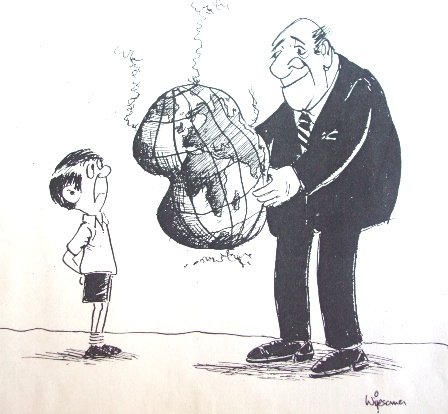
Passing the buck? Cartoon by W R WijesomaThis was one of the most memorable cartoons drawn by W.R. Wijesoma, Sri Lanka’s pre-eminent political cartoonist (and my one-time colleague). If I remember right, it first appeared sometime in the late 1980s in ‘Mihikatha’, Sri Lanka’s first all-environmental newspaper.
Alas, both Mihikatha and Wijesoma are no more among us. But the message in this cartoon is more timely than ever before.
“Is this what we are going to hand over to our future generations? Please……no!” was the emphatic message from Yugratna Srivastava, a 13-year-old Indian girl who addressed over 100 world leaders gathered at the United Nations headquarters on 22 September 2009 for the historic Summit on Climate Change.
Passing the ball – or buck – is something that governments are good at. Most governments are so narrowly focused on the now and here, and sometimes rightfully so, that they have neither the time nor interest for medium to long term scenarios. As I wrote earlier this week, “it’s going to take many more meetings, bickering and hard bargaining before the leaders begin to think in terms of the next generation.”
This is where citizen action comes in. Governments are not going to save this planet from environmental catastrophes; if at all, it would be the ordinary people. This is the premise of TVE Asia Pacific’s latest Asian TV series, Saving the Planet.
Where does the buck stop?
Governments, experts and big corporations alone cannot solve all these problems. Real change requires changing how each and every human being lives and works. Education becomes the biggest key to achieving environmentally sustainable development at local and global levels.
Filmed in six countries in South and Southeast Asia, Saving the Planet profiles groups working quietly and relentlessly to spread knowledge, understanding and attitudes that inspire action that will help humans to live in harmony with the planet. They often work without external funding and beyond the media spotlight. They have persisted with clarity of vision, sincerity of purpose and sheer determination. Their stories inspire many others to pursue grassroots action for a cleaner and safer planet.
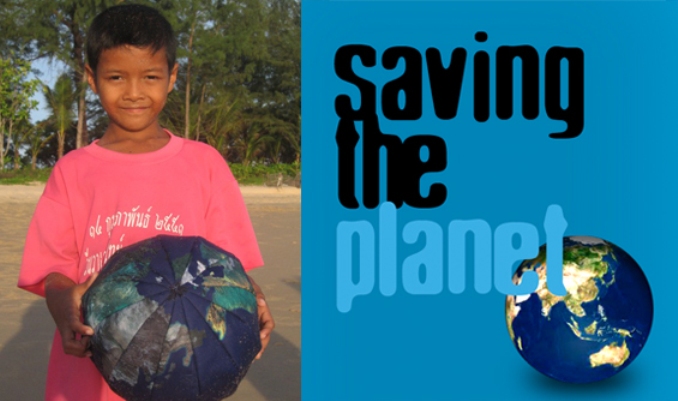
We tried out a creative idea for the series opening sequence (20 seconds), an extended version of which became the series trailer (see below). It was planned and filmed in all the six countries where the stories came from — Cambodia, India, Laos, Nepal, the Philippines and Thailand. In each country, our roving director-producers filmed different individuals – young and old, men and women, in all their Asian diversity – passing around an inflated ball made to look like planet Earth.
I know my colleagues had fun filming these sequences, and back in our studio, it was also great fun to mix and match these various shots to create the apparently seamless passing around of our planet in peril. (Who said planet saving cannot be fun?)
Watch Saving the Planet trailer (1 minute):
Now it can be revealed: our original inspiration came from an unexpected source: the world’s largest media corporation, Google! In one brainstorming, our then production coordinator Buddhini Ekanayake remembered an open challenge that Google had made online just before introducing their email service, GMail. Google asked people to “imagine how an email message travels around the world” using a video camera.
In all, Google received over 1,100 clips from fans in more than 65 countries around the world — each one of them a different creative idea, playing with the iconic Gmail M-velope.
“The clips you submitted were amazing and it was hard to choose selections for the final video,” Google said when releasing the outcome of this collaborative video project.
Yugratna Srivastava: Lend me your ears...This week saw the UN’s invisible man hosting mostly indifferent leaders at a Summit on one of the world’s most pressing challenges: climate change.
Nearly 100 world leaders accepted UN Secretary General Ban Ki-moon’s invitation to participate in an historic Summit on Climate Change in New York on 22 September to mobilise political will and strengthen momentum for a fair, effective and ambitious climate deal in Copenhagen this December.
The call for action at the summit did not just come from world leaders – many of who simply can’t see beyond their next election – but also from the next generation who stand the most to lose if climate talks fail.
On their behalf, Yugratna Srivastava, a 13-year-old Indian girl, spoke forcefully at the podium, sending a wake-up call to those assembled. “We received a clean and healthy planet from our ancestors and we are gifting a damaged one to our successors. What sort of justice is this?,” she said.
She added: “The Himalayas are melting, polar bears are dying, 2 of every 5 people don’t have access to clean drinking water, earth’s temperature is increasing, we are losing the untapped information and potential of plant species, Pacific’s water level has risen,Is this what we are going to hand over to our future generations? Please……no!”
She said the three billion young people in the world need them to take action now to protect the planet for future generations.
All this news coverage reminded me of another passionate young girl who similarly addressed – and challenged – the world leaders 17 years ago at the Earth Summit held in Rio de Janeiro, Brazil.
Her name was Severn Cullis-Suzuki, and she was a young Canadian environmental activist. Then 12-year-old Severn closed a Plenary Session with a powerful speech that received a standing ovation.
Raised in Vancouver and Toronto, Severn Cullis-Suzuki is the daughter of writer Tara Elizabeth Cullis and environmental activist and TV personality David Suzuki. When she was 9, she started the Environmental Children’s Organization (ECO), a small group of children committed to learning and teaching other kids about environmental issues. They were successful in many projects before 1992, when they raised enough money to go to the UN’s Earth Summit in Rio. Their aim was to remind the decision-makers of who their actions or inactions would ultimately affect.
Listen to the memorable speech at the Earth Summit by Severn Cullis-Suzuki:
Severn was every bit as sincere, concerned and passionate about the global environment as Yugratna Srivastava was this week. Seventeen years later, notwithstanding the lofty pledges at the Earth Summit and later gatherings, the environmental crises have multiplied and worsened.
Very few of the world leaders who assembled in Rio are still in office — and that underlines part of the problem. Governments have far shorter time horizons than what many of today’s global challenges demand. I am constantly reminded of what the eminent Indian scientist Dr M S Swaminathan told me in my first interview with him in 1990 (yes, even before the Earth Summit): “In democracies, rulers think in terms of the next election. In dictatorships, about the next coup d’état. Nobody is thinking in terms of the next generation!”
It was no small feat for the UN’s Invisible Man to bring 100 heads of state or heads of government together on such a long-term issue. But it’s going to take many more meetings, bickering and hard bargaining before the leaders begin to think in terms of the next generation.
Biggest gap: between rhetoric and practice!It happened a decade ago, but I still remember the incident.
I was visiting London while the British Isles were having their typically limited experience with summer. My then colleague and I had gone for a business meeting, and were returning by Tube, or the London underground railway. Being the afternoon rush hour, the trains were packed to capacity.
My colleague didn’t say much on the journey, but I noticed her look of dismay. As we emerged from the tube station, she finally spoke: “Gosh, it’s another world down there, isn’t it? I didn’t know people smell so much!”
The warm and sweaty summer would surely have added to the experience, but as Londoners know well, the tube is the best mode of transport to get around quickly and inexpensively in that metropolis. It was only then that I realised my liberal, bleeding-heart colleague was not a regular user of public transport. She either uses taxis or drives around in her own Volvo car. She doesn’t normally commute with the Great Unwashed…
Yet, the same snooty ex-colleague speaks and writes so passionately on the virtues of public transport and mass transit systems as a means to better manage urban challenges in the developing world. Listening to her, one could hardly imagine her disdain for using public transport in her own city.
Practise what you preach. That’s a simple yet profound piece of advice for everyone promoting public interest causes in development, conservation or anything else. Or, as Mahatma Gandhi put it: you must be the change you wish to see in the world.
The series features outstanding efforts in education for sustainable development (ESD) in South and Southeast Asia. It goes in search of answers to these key questions:
• What can ordinary people do for our planet, now under siege from multiple environmental crises?
• How can we change attitudes and lifestyles to consume less and generate less waste?
Here’s the synopsis of the India story:
For people in Dindigul in India’s Tamil Nadu state, waste isn’t really a problem – it’s just a resource in the wrong place. School children and housewives have been at the forefront in collecting household and market waste to turn them into compost. They have not only cleaned up the streets, but also persuaded people to grow organic food. As the word spreads, more towns and villages are emulating this example set by CLEAN India project and Gandhigram Trust.
Apollo still photos were much better than broadcast images: how come?
In theory, it can happen to anyone recording moving images on tape or digital media: absent-mindedly or carelessly re-use the recording media, and thus lose the original content. If no copy exists, such an accident means an irrevocable loss.
But if the images were the most expensively shot in the whole of human history — literally costing billions of dollars and involving the genius and labour of half a million people over several years — we would expect these to be archived and preserved with great care, right?
Well, not necessarily — if the custodian is a government agency. On eve of the 40th anniversary of the first Moon landing by Apollo 11, the US space agency NASA dropped a bombshell: it admitted that the original recordings of that historic moment were accidentally erased years later.
One British newspaper called it “the scientific equivalent of recording an old episode of EastEnders over the prized video of your daughter’s wedding day”.
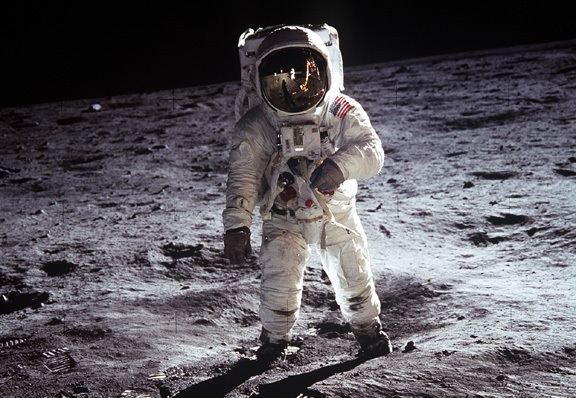
Can you see the Moon on the Moon? Well, only just...The loss became public when the Sydney Morning Herald broke the story in August 2096. “A desperate search has begun amid concerns the tapes will disintegrate to dust before they can be found,” it said.
While the media rushed with oops-style headlines like ‘One giant blunder for mankind’, NASA quietly investigated what really happened. Last week, they revealed the hard truth: the tapes were part of a batch of 200,000 that were degaussed – or magnetically erased — and re-used. It was a standard money-saving measure at NASA in those pre-digital days to reuse the 14-inch tape reels after several years in storage. Agency officials fear that the original Apollo 11 tapes were buried among an estimated 350,000 that were recycled in the 1970s and 1980s and the data was lost for ever.
But the historic visuals are not entirely lost: luckily, broadcasters who used NASA’s expensively obtained footage had archived their transmissions for posterity. For many months, NASA has worked with a leading digital imaging company in Hollywood to restore good copies of the Apollo 11 broadcast found in the archives of CBS News and some recordings called kinescopes found in film vaults at Johnson Space Center.
On 16 July 2009, NASA released the first glimpses of a complete digital make-over of the original landing footage that looked decidedly sharper and clearer than the blurry and grainy images of Neil Armstrong and Buzz Aldrin walking on the Moon.
And we have to admit, the new video is definitely better than the ones we’ve seen for 40 years!
Raw Video: Restored Video of Apollo 11 Moonwalk
Another montage of digitally restored Apollo 11 mission highlights:
The full set of recordings, being cleaned up by Burbank, California-based Lowry Digital, are to be released in September 2009.
I had often wondered why the original images from the Moon were so grainy: it wasn’t typical even for that time. And if NASA spent between US$ 22 to 25 billion on landing men on the Moon, surely they’d have harnessed the best available technology to capture and share their moments of triumph, I assumed.
Actually, the video coverage that was broadcast around the world — to an estimated audience of 500 to 750 million people — and has since been endlessly redistributed was not quite what came from the Moon. It was a diluted version. Stanley Lebar, the NASA engineer in charge of developing the lunar camera, now calls a “bastardized” version of the actual footage.
Here is the “as-it-happened” broadcast from CBS News that day, with the legendary Walter Cronkite anchoring to the biggest TV audience the world had known. (Footnote: You’ll see the first electronic “character generators” in use.)
The story is technically complex, but here’s the essence: live images from the Moon couldn’t be fed directly to the American TV networks using the NTSC broadcast standard. Audiences worldwide would be holding their breath that a delayed broadcast, even by a few minutes, would not have been as effective as ‘live from the Moon’. Under such time pressures, no conversions could be attempted. So a regular TV camera was pointed at the huge wall monitor at mission control in Houston.
This is known as kinescope, or telerecording: a recording of a television program made by filming the picture from a video monitor. That resulted in the grayish, blotchy images that everyone saw on their home TV sets. In other words, It was a copy of a copy, with significant quality losses in that process!
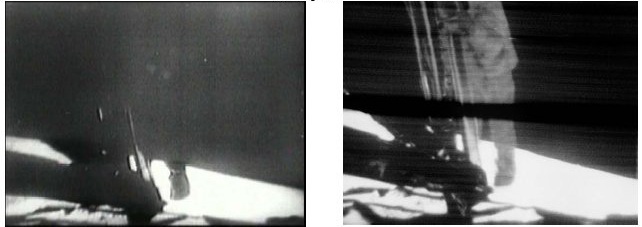
Scan-converted broadcast image of Armstrong descending the lunar module ladder taken at Goldstone tracking station. This was the image the world saw of the first human on the Moon. But a Polaroid picture of the Slow-Scan television image of Armstrong coming down the ladder reveals far greater detail. Image Courtesy: John Sarkissian/CSIRO Parkes Radio Observatory
A new documentary, released in January 2009, offers new insights into one of the most challenging feats in international live broadcasting – how those images from the Moon were delivered to TV audiences around the world. Produced by Spacecraft Films and directed by Mark Gray Live from the Moon: The Story of Apollo Television
It tells how for the first time in history millions of people could share, in real time, the experience of frontier exploration.
The story behind the camera...finally!“Placing a man on the moon and returning him safely to the Earth was hard enough in 1969,” says Gray. “‘Live From The Moon’ tells the story of how television, still a technological toddler, was developed for space flight, and examines the impact of the iconic passages that were returned.”
To tell that story, Gray literally circled the Earth, shooting interviews at the deep space communication stations in California and Australia, as well as at space facilities and museums in Houston, Baltimore, Los Angeles, Princeton, Kennedy Space Center, Huntsville, Ala., Washington, DC and Weatherford, Oklahoma.
Along the way, he interviewed astronauts, flight directors, mission controllers, tracking station operators, historians and those who built the television cameras for the space program…. “Live from the Moon” is told with the insight of moonwalker Alan Bean; Apollo 10 commander Tom Stafford; flight director Chris Kraft; Neil Mason, who drove the Parkes Telescope; Westinghouse camera team leader Stan Lebar; and the voice of mission control Jack King, among others.
“Every single one of them believed that the TV was one of the most important legacies of Apollo. And many of them admitted candidly that they didn’t give the TV much thought during the actual missions,” recalled Gray.
Lights, camera...budget action! Image courtesy 'This Is Nollywood'Here’s a general knowledge question: Everyone knows India’s Bollywood is the world’s largest producer of movies (by number). Which country’s movie industry comes second?
If you said Hollywood, that’s a dated answer. America’s movie industry used to be the second largest in the world — until an unlikely contender turned up from…Nigeria!
Bollywood produced 1,091 feature-length films in 2006 compared to 872 productions (in video format) from Nigeria’s film industry, commonly referred to as Nollywood. In contrast, the United States produced 485 major films.
The three heavyweights were followed by eight countries that produced more than 100 films: Japan (417), China (330), France (203), Germany (174), Spain (150), Italy (116), South Korea (110) and the United Kingdom (104).
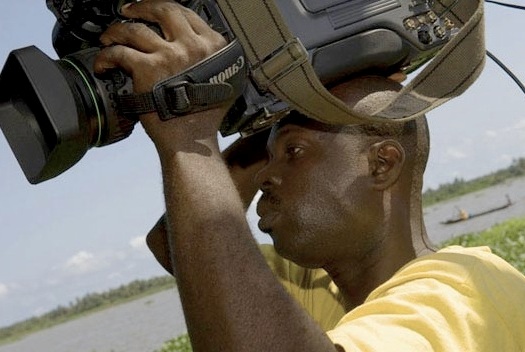
Nigerian filmmakers rely on video instead of film to reduce production costs. And as the survey points out, Nigeria has virtually no formal cinemas. About 99% of screenings occur in informal settings, such as “home theatre”.
This is NollywoodThe UNESCO survey reveals another key element of the Nigerian success story: multilingualism. About 56% of Nollywood films are produced in Nigeria’s local languages, namely Yoruba (31%), Hausa (24%) and Igbo (1%). English remains a prominent language, accounting for 44%, which may contribute to Nigeria’s success in exporting its films.
Nollywood’s rising has been chronicled in a 2007 documentary by Franco Sacchi and Robert Caputo. Called This is Nollywood, it tells the story of the Nigerian film industry – a revolution enabling Africans with few resources to tell African stories to African audiences. Despite all odds, Nigerian directors produce between 500 and 1,000 movies a year. The disks sell wildly all over the continent – Nollywood actors have become stars from Ghana to Zambia.
Says Zambia-born director Franco Sacchi: “When I first read about Nigerian directors producing hundreds of feature-length films with digital cameras, a week, and a few thousand dollars, I found the subject irresistible. Here was not only a rare positive story about Africa, but one that embodied the egalitarian promise of digital technology—anybody can make a movie. And Nollywood was virtually unknown.”
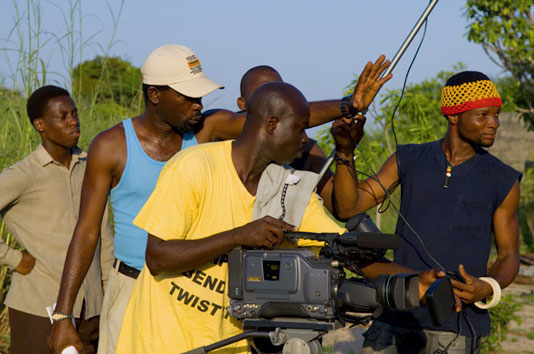
This is Nollywood takes us behind the sets and scenes in one Nigerian movie being made on the cheap — and fast. Acclaimed director Bond Emeruwa sets out to make a feature-length action film in just nine days. Armed only with a digital camera, two lights, and about $20,000, Bond faces challenges unimaginable in Hollywood and Bollywood.
Emeruwa says: “We are telling our own stories in our own way, our Nigerian way, African way. I cannot tell the white man’s story. I don’t know what his story is all about. He tells me his story in his movies. I want him to see my stories too.”
Watch This is Nollywood: Movie Trailer
I then came across this TED Talk by Franco Sacchi, where he takes us through Nollywood (at the time he gave his talk, the world’s third largest and now second only to Bollywood). He talks about ‘guerrilla film-making’ and brilliance under pressure from crews that can shoot a full-length feature in a week.
Welcome to Nollywood is another 2007 documentary film, directed by Jamie Meltzer, that looked at the Nigerian film industry. Its findings were similar to those of This is Nollywood. Traveling to the country’s chaotic capitol, Lagos, Meltzer spent ten weeks following three of Nigeria’s hottest directors, each different in personality and style, as they shot their films about love, betrayal, war, and the supernatural.
At around US$250 million per year (and rising), Nollywood’s capital outlay is far below that of Hollywood and Bollywood. For perspective, that’s a bit less than what it cost to make Spiderman 3in 2007 (budget: US$ 258 million) — the second most expensive film made. See list of most expensive Hollywood films.
Telling their own stories....But what it lacks in capital, Nollywood more than makes up in numbers and mass appeal. As the Wikipedia notes, Nigerian directors adopt new technologies as soon as they become affordable. Bulky videotape cameras gave way to their digital descendents, which are now being replaced by HD cameras. Editing, music, and other post-production work is done with common computer-based systems.
As Colin Freeman wrote in the Daily Telegraph, UK: “While the likes of Serpent in Paradise and Evil Finger may not be as slick as their Hollywood counterparts, they offer one thing that the likes of George Clooney and Brad Pitt can never provide: characters and stories with which an African audience can identify.”
And according to The Economist, it all started in 1992, when Kenneth Nnebue, a Nigerian trader based in Onitsha, was trying to sell a large stock of blank videocassettes he had bought from Taiwan. He decided that they would sell better with something recorded on them, so he shot a film called “Living in Bondage” about a man who achieves power and wealth by killing his wife in a ritualistic murder, only to repent later when she haunts him. The film sold more than 750,000 copies, and prompted legions of imitators.

 “We’re delighted Tinker Bell has agreed to be our Honorary Ambassador of Green,” said Kiyo Akasaka, Under-Secretary-General for Communications and Public Information. “This beloved animated character can help us inspire kids and their parents to nurture nature and do what they can to take care of the environment.”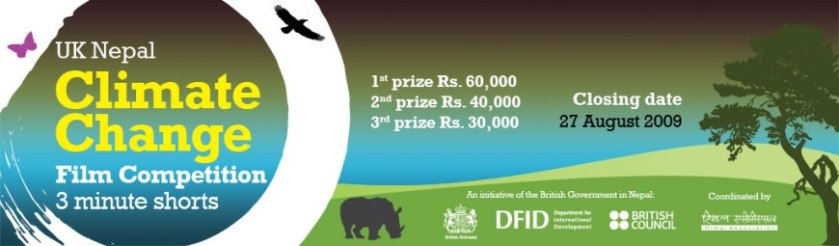








 Open Minds!