Nobel Peace Prize: A ‘Loud speaker’ for quiet peace-makers of our troubled world…

Can five unknown Norwegians achieve the worthy goal that has eluded so many leaders and activists – peace within and among nations of our world?

Well, if the individuals happen to be selectors of the world’s most prestigious prize – the Nobel Peace Prize – they stand a better chance than most people. The Norwegian Nobel Committee, appointed by the country’s parliament for six-year terms, may not be very well known beyond their country but their annual selection reverberates around the world and has changed the course of history in the past century.

But Professor Geir Lundestad, Director of the Norwegian Nobel Institute, says the Nobel Peace Prize cannot claim to have achieved peace on its own.

“It’s the laureates who work tirelessly and sometimes at great personal risk to pursue peace and harmony in their societies or throughout the world,” he told the international advisory council meeting of Fredskorpset, the Norwegian peace corp, held in Oslo on 4 – 5 September 2008. “With the Nobel Peace Prize, we try to recognise, honour and support the most deserving among them.”

Where high profile laureates are concerned, the prize becomes an additional accolade in their already well known credentials. But for those who are less known in the international media or outside their home countries, being awarded the Nobel Peace Prize is akin to being handed over a ‘loud speaker’ — it helps to amplify their causes, struggles and voices, he said.

In today’s media-saturated information society, the value of such an amplifier cannot be overestimated, says Lundestad, who also serves as Secretary to the Nobel Peace Prize selection committee. It allows laureates to rise above the cacophony and babble of the Global Village.

Geir Lundestad, Director, Norwegian Nobel Institute (photo from NRK)

Every year in October, Lundestad makes one of the most eagerly awaited announcements to the world media: the winner of that year’s Nobel Peace Prize. He would typically give a 45 minute advance warning to the laureate – this is the famous ‘call from Oslo’ (and ‘call from Stockholm’ for laureates of other Nobel prizes).

Lundestad, who has held his position since 1990, has had interesting experiences in making this call. For example, the 1995 prize was equally divided between the Pugwash Conferences on Science and World Affairs and Englishman Joseph Rotblat, its founding secretary general, for their efforts to diminish the part played by nuclear arms in international politics. But when he received the call, Rotblat had insisted that it was some sort of mistake; the media had hyped the prospect of then British prime minister John Major winning the prize for his work on Northern Ireland peace process. He went for a long walk and wasn’t home when the world’s media beat a path to his door a short while later.

Such early warning to the laureate does not always happen, especially if the media keeps a vigil at the favourite contender’s home or office. When Al Gore and the UN-IPCC were jointly awarded the 2007 prize, Lundestad rang the New Delhi office of IPCC chairman Dr Rajendra Pachauri shortly before the decision was announced in Oslo. Pretending to be a Norwegian journalist, he asked Pachauri’s secretary whether any media representatives were present. Being told yes, he just hung up.

The Nobel Peace Prize has been awarded to 95 individuals and 20 organizations since it was established in 1901. During this time, the Norwegian Nobel Committee has tried to honour the will of Swedish engineer, chemist and inventor Alfred Nobel. Where the peace prize was concerned, he wrote that it should go “to the person who shall have done the most or the best work for fraternity between nations, for the abolition of standing armies and for the holding and promotion of peace congresses”.

To decide who has done the most to promote peace is a highly political matter, and scarcely a matter of cool scholarly judgement, said Prof Lundestad, who is also one of Norway’s best known historians. He described the thorough selection process and the various checks and balances in place so that the prize does not become, even indirectly, an instrument of Norwegian foreign policy.

Notwithstanding these, the peace prize does not have a perfect record in whom it has selected as well as those it has failed to honour. The most glaring omission of all, he said, was Mahatma Gandhi.

Gandhi was nominated five times – in 1937, 1938, 1939, 1947 and, finally, a few days before he was assassinated in January 1948. The rules of the prize at the time allowed posthumous presentation, but the then committee decided not to (although UN secretary general Dag Hammarskjöld did receive the 1961 prize posthumously after he died in a plane crash). Gandhi’s omission has been publicly regretted by later members of the Nobel Committee; when the Dalai Lama was awarded the Peace Prize in 1989, the chairman of the committee said that this was “in part a tribute to the memory of Mahatma Gandhi”.
Read Nobel website’s essay: Mahatma Gandhi: The Missing Laureate
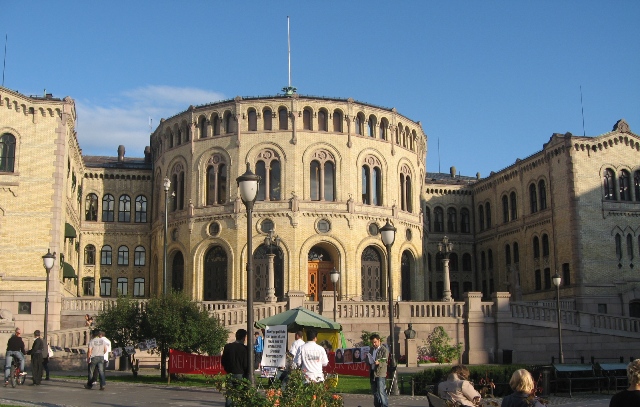
Norwegian Parliament that appoints Nobel Peace Prize Committee

The prize does not have a very good track record in gender balance either. Only 12 of the 95 individual winners are women. Heroines of Peace: profiles of women winners (up to 1997)

And a few laureates may not have deserved to be so honoured – but Lundestad won’t name any for now (he likes his job and wants to keep it). Perhaps one day, after retirement, he might write a book where this particular insight could be shared.

Controversy has been a regular feature of the prize – both over its selections and exclusions. This is only to be expected when thousands of nominations are received every year, and given the high level political message the selection sends out to the world.

Despite its flaws, there is little argument that the Nobel Peace Prize is the most prestigious of all awards and prizes in the world. At Swedish Krona 10 million, or a little over 1.5 million US Dollars, it isn’t the most lavish prize – but much richer prizes lack the brand recognition this one has achieved over the decades. And it is the best known among over 100 peace prizes in the world.

In recent years, the committee has steadily expanded the scope of the prize to recognise the nexus between peace, human security and environmental degradation (Wangaari Mathaai in 2004; Al Gore and IPCC in 2007) and the link between poverty and peace (Mohammud Yunus, 2006).

The most important question, to many historians and scholars of peace, is the political and social impact of the Nobel Peace Prize. Lundestad is being too modest when he says that it’s the laureates, not the prize itself, that has achieved progress in various spheres ranging from nuclear disarmament and humanitarian intervention to safeguarding human rights and poverty reduction.

“We may have contributed — and that is quite enough,” he says. “We don’t claim to have ended the Cold War, or apartheid in South Africa.”

But the prize’s influence and catalytic effect are indisputable. When the 1983 prize was given to Polish trade union leader Lech Walesa, it triggered a whole series of events that eventually led to the crumbling of the Iron Curtain, collapse of the Berlin Wall and the eventual disintegration of the once mighty Soviet Union. The process culminated when Mikhail Gorbachev became the 1990 laureate.
Read Nobel Peace Prize: Revelations from the Soviet Past

In another example, over the years there have been four South African laureates – Albert Lutuli (1960), Bishop Desmond Tutu (1984), Nelson Mandela and F W de Klerk (sharing 1993 prize). Lundestad says: “But we would never claim that the prize was a major factor in ending apartheid in South Africa. The prize was part of the wider international support that built up and sustained pressure on the white minority government. In some respects, the 1960 prize to Lutuli may have been the most significant – for it triggered a process that culminated in the early 1990s.”

He acknowledges, however, that in hot spots like Burma, East Timor and South Africa, the Nobel Peace Prize has enhanced the profile of key political activists and helped maintain the international community’s and media’s interest in these long drawn struggles.

And as Lundestad and the Nobel Peace Prize Committee of five unknown Norwegians know all too well, there is much unfinished business in our troubled and quarrelsome world seeking an elusive peace.

Read Geir Lundestad’s 2001 essay on the first century of the Nobel Peace Prize.
Read his 1999 essay ‘Reflections on the Nobel Peace Prize’

Watch a 2005 interview by University of California television, where host Harry Kreisler talks with Geir Lundestad. They discuss the Nobel Peace Prize, its history, impact and the controversy surrounding some of the awardees (December 2005):
Banishing poverty to a museum: The grand vision of Muhammad Yunus

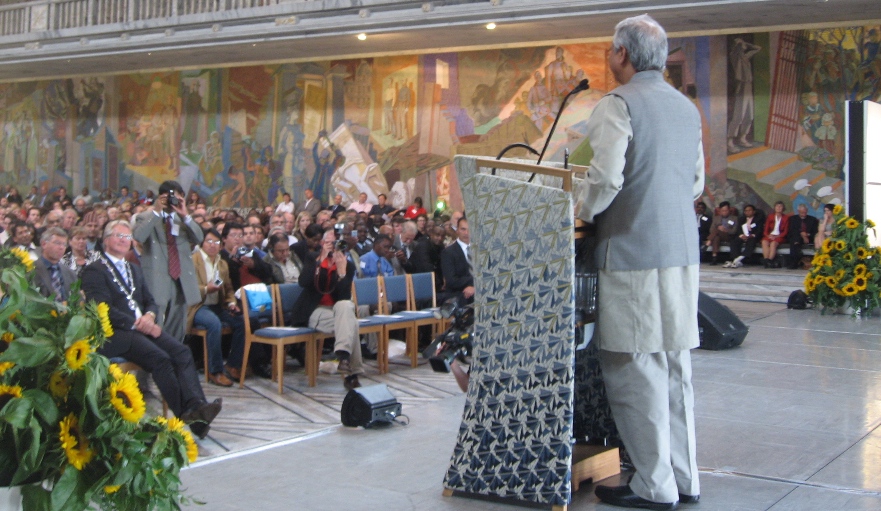
Muhammad Yunus speaking at Oslo City Hall on 4 Sep 2008

The celebrated Bangladeshi economist and anti-poverty activist Muhammad Yunus returned to Oslo’s City Hall today, more than one and a half years after he accepted the 2006 Nobel Peace Prize there. In a passionate, insightful talk to a full house of over 900 people, he revisited his favourite topic: how to banish poverty from our planet.

The occasion was 2008 North-South Forum, convened and hosted by Fredskorpset, the Norwegian peace corp, together with the city council of Oslo. I was among the 350 international participants who have come from 50 countries to participate in this event.

In his talk, the founder of the Grameen Bank reiterated the central message in his recent book, Creating a World Without Poverty: Social Business and the Future of Capitalism.

“We can and must chip away at poverty, and get rid of it – just like what they did to the Berlin Wall,” he said. “I’m dreaming of the day when there is no more poverty on this planet…the day when our future generations would have to visit a museum to see what it was like to live in poverty.”

Wistfully, he added: “I would then want to offer a million dollar prize to anyone who can find a poor person.”

He tempered this idealistic vision with the economist’s strong realism: to overcome poverty, we first need to understand and come to terms with factors that cause and sustain it.

“There is nothing intrinsically wrong with poor people,” Yunus said. “They are ordinary people like you and me – many of them talented and capable. But they have never had the opportunity to do well in life. Poverty is not created by poor people, but by the (social and economic) system we have created around us.”

Banishing poverty is not just a matter of social justice – it is also an ‘insurance’ against social disintegration and other major problems of our times like crime and terrorism.

Prof Yunus made the same points in this interview with the Nobel Prize website:

See full interview on Nobel website

For several years, Yunus has been voicing concerns about the so-called war on terror diverting much needed attention and resources away from the war on poverty. In his Nobel Prize lecture delivered in the same hall on 10 December 2006, he said: “I believe terrorism cannot be won over by military action. Terrorism must be condemned in the strongest language. We must stand solidly against it, and find all the means to end it. We must address the root causes of terrorism to end it for all time to come. I believe that putting resources into improving the lives of the poor people is a better strategy than spending it on guns.”

When Yunus speaks, he sounds far more like an amiable story teller than the professor of economics that he once was. He appeals to the heart and mind of his listeners, in that order. He did not dazzle his audience with endless facts and figures. There were no fancy Power Points or endless charts – the essential tools of poverty researchers. And, mercifully, he never once referred to the dubious millennium development goals or MDGs, the favourite mantra of assorted UN types. (They started off as a well-intended set of targets, but have become self-limiting, self-serving distractions for the development community.)

Instead, he drew from the practical, real life experiences of the Grameen Bank that he founded in 1976, when working as a professor at the University of Chittagong in Bangladesh. Grameen’s three decades of work providing small loans to the poorest of the poor is ample evidence, he said, that the vicious cycles of poverty, debt and misery can be broken by ‘tiny interventions, sustained over time’. Grameen started with 27 poor people in a single village. Today, it has over 7 million participating in its micro credit programes, 97 per cent of them women.

Read Shahidul Alam’s account of Grameen and its founder

Yunus offers a grand vision without grandiose claims or pomposity. He is fond of the word ‘tiny’ – using it to describe the various initiatives he and his team have been taking to attack poverty from many different fronts. The results are anything but tiny.

In his new book, Professor Yunus describes the role of business in promoting social reform and his vision for an innovative business model that would combine the power of free markets with a quest for a more humane, egalitarian world that could help alleviate world poverty, inequality, and other social problems. He calls it ‘social business’ – a hybrid of the profit-maximising corporate sector and charitable non-profit sector.

Listen to Muhammad Yunus speak at Google New York City campus on 10 January 2008 about ideas captured in his new book:

In 2006, the Nobel Peace Prize was awarded to Muhammad Yunus and Grameen Bank for their efforts to create economic and social development from below. In doing so, the Norwegian Nobel Committee noted: “Lasting peace can not be achieved unless large population groups find ways in which to break out of poverty. Micro-credit is one such means. Development from below also serves to advance democracy and human rights.” Read full statement

Watch an indepth interview with Yunus by the US journalist and doyen of TV interviewers, Charlie Rose:

Vulnerability Exposed: Micro films on how climate change affects YOU!

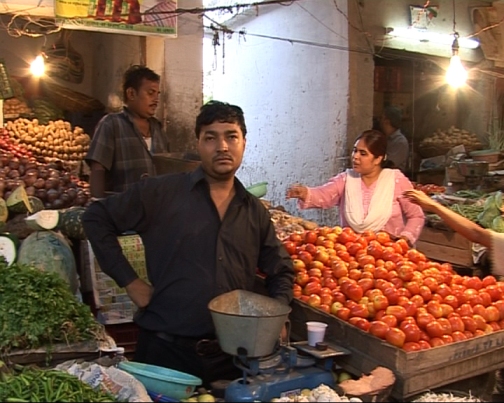
Vulnerability Exposed!

Never underestimate the power of moving images. Al Gore tipped the balance in the long-drawn climate change debate with his Oscar-winning film, An Inconvenient Truth. The rest is recent history.

Thanks to the film – and sustained advocacy of hundreds of scientists and activists – climate change is no longer a speculative scenario; it’s widely accepted. The challenge now is to understand how it impacts different people in a myriad ways.

Now the World Bank wants people to use their video cameras to capture how climate change may already be affecting their ways of living and working. The Bank’s Social Development Department has just announced the launch of a worldwide documentary competition that will highlight the social aspects of climate change as experienced and/or observed by the film-maker(s).

Called Vulnerability Exposed, the contest is open to anyone anywhere in the world who wishes to have their voice heard. The submitted films should innovatively illustrate the consequences of climate change through one of the following theme categories: conflict, migration, the urban space, rural institutions, drylands, social policy, indigenous peoples, gender, governance, forests, and/or human rights. The submission period ends on 24 October 2008.

Caroline Kende-Robb, Acting Director, Social Development Department, said, “There is a need to see climate change as an issue of global social justice. The rights, interests and needs of those affected by climate change must be acknowledged.”

Watch the Bank’s short video, where she explains further:

The contest has two award categories:
1) Social Dimensions of Climate Change Award (general category) – open to professional and amateur; and
2) Young Voices of Climate Change (youth category) – open to entries submitted by filmmakers under 24 years old.

Award winners will be chosen through a combination of public voting and a judging panel. The film with the most public votes in each theme category will receive honorable mention.

Judging process
Vulnerability Exposed film competition: Judging process

This contest indicates that the World Bank is slowly but surely opening up to the currently untapped communication potential of web 2.0 – the very point I made in a recent op ed essay.

There are several noteworthy aspects in this competition, some more positive than others. I offer this critique in the spirit of improving a commendable initiative.

Three cheers to the bank for accommodating both amateurs and professionals. It’s about time those who don’t video film for a living (some of who are no less talented in the craft) had more opportunities to showcase their products.

It’s good to see the preference for shorter films, in this contest defined between 2 and 5 mins in duration. This certainly resonates with TVE Asia Pacific’s experience with Asian broadcasters, many of who now prefer shorter films. Longer films have their place, of course, but shorter ones are clear favourites of 24/7 news channels and also online.

Most film contests are judged exclusively by an all-powerful jury (I’ve been on several over the years), but here the online public have a chance to vote for their favourite entries. Let’s hope the judges will consider the story telling power of entries as the most important deciding factor. (The examples in the YouTube film given above are misleading – they all seem extracts from expensively made documentaries.)

The big challenge for many aspiring contestants would be to relate climate change to daily realities in their societies. Despite global headlines and the development community’s current frenzy about it, climate change as a phrase and concept still isn’t clearly understood in all its ramifications. If science now knows 100 facts about the murky processes of climate change, the average public knows less than 25 and understands even less. So it will be interesting to see how entries relate the big picture to their individual small pictures.

I’m a bit disappointed that the World Bank is not offering any cash prize to the winners. Instead, “the winners will receive an all expenses paid trip to Washington, DC for a screening of their film and will have the opportunity to attend a series of networking and learning events organized by…the World Bank in December 2008.” This is all useful, but video – even at the low end – is not exactly cheap, and even labour of love creations cost money to make. We are currently running a comparable the Asia Pacific Rice Film Award – which seeks entries no longer than 10 mins on any aspect of rice – and despite being a non-profit, civil society initiative we have a prize of US$ 2,000 to the winner. And we wish we could offer more.

But my biggest concern is the unequal, unfair terms of copyrights found in the small print of the competition rules. This is where the lawyers have done their usual handiwork, and with the usually lopsided results. The World Bank wants all contestants to make absolutely sure that all material used is fully owned by the contestants, or properly licensed. That’s fine. But tucked away on page 7, under section 12 titled Entrant’s permission to the organiser, is a set of conditions which will allow all affiliated institutions of the World Bank group to use the submitted material for not just promoting this contest (a standard clause in most competitions), but for ‘climate change work program of the organiser’.

What this means, in simpler terms, is that without offering a single dollar in prize money, the World Bank is quietly appropriating the unlimited user rights for any and all the submitted material. These are the core materials in the moving images industry, and nothing is more precious to their creators.

I have long advocated a more balanced, equitable and liberal approach to managing copyrights and intellectual property by both the broadcast television industry and development community — especially where public funded creations are concerned. I have nothing but contempt for lawyers and accountants who often determine the copyrights policies in large broadcast and development organisations. They set out terms that may be justified in strict legal terms, but are totally unfair, unjust and, in the end, counterproductive to the development cause and process. It seems that while our friends in the social and communication divisions were not looking, the Bank’s lawyers have done their standard hatchet job.

While this doesn’t detract from the overall value of Vulnerability Exposed, it diminishes its appeal and potential. Many professional video film-makers who value their footage – gathered with much trouble and expense – may not want to sign future user rights away for simply entering this contest. And worse, the unsuspecting enthusiasts who don’t necessarily earn their living from making films – but are entitled to the same fair treatment of their creations – would be giving away material whose industrial value they may not even fully appreciate.

It’s certainly necessary and relevant for development organisations like the World Bank and the UN system to engage web 2.0. But they must be careful not to import or impose rigid, one-sided and outdated copyright regimes of the past on this new media.

I hope the Bank would consider revising these unfair copyright terms, and treat the submitted material with greater discretion and respect. If not, all entrants risk seeing their material popping out of bluechip films produced by top-dollar production companies in North America and Europe who have ‘mining rights’ to the Bank’s video archives.

Vulnerability Exposed can have more meanings than one. We’d rather not consider some.

UNEP’s search for God: Here’s the way forward to save the planet!

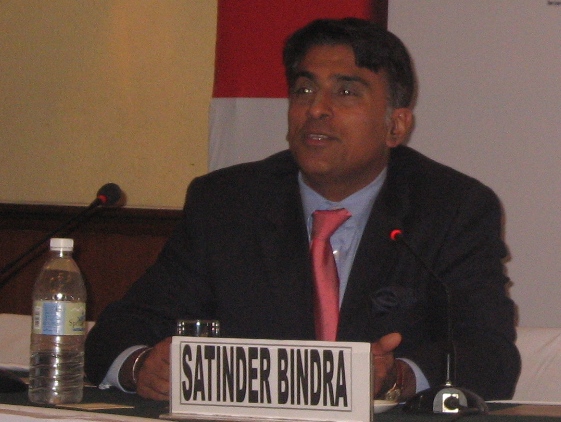
Satinder Bindra
Satinder Bindra: Voice of the Planet?

“Content is king — but distribution is God!”

With these words, UNEP’s newly appointed Director of Communications and Public Information, Satinder Bindra (photo, above), engaged my attention at a meeting in Paris earlier this week.

I almost jumped up in total agreement — this is just what we’ve been saying for years, especially to those who support information, education and communication activities in UN agencies.

Unlike many career UN officials, Satinder knows what he’s talking about. He comes to UNEP with over two decades of wide and varied experience in journalism and broadcasting – the last 10 years spent as a Senior International Correspondent/South Asia Bureau Chief for CNN based in New Delhi, India.

In the hard headed and hard nosed world of international news and current affairs television, distribution and outreach can make or break any content provider. This is something that the two leading news channels BBC World and CNN International know very well — and the more recent entrant Al Jazeera English is still finding out.

Satinder’s remark, in this instance, was more to do with how to get information and analysis on sustainable development out to as many people as possible in all corners of the planet. This is part of UNEP’s core mission since its founding in 1972 — and as chief of communication and public information, Satinder now takes on this formidable challenge.

In Paris, he was listening, taking notes and talking to everyone in the small group who’d come together for the annual partner meeting of the Com Plus Alliance of Communicators for Sustainable Development.

Com+ is a “partnership of international organizations and communications professionals from diverse sectors committed to using communications to advance a vision of sustainable development that integrates its three pillars: economic, social and environmental”. TVE Asia Pacific was admitted to the partnership a few months ago.

As I’m sure Satinder realises, at stake in his new assignment is a lot more than audience ratings, market share or revenue stream of a single broadcaster. Those are important too, but not in the same league as ensuring life on Earth – in all its diversity and complexity – continues and thrives.

Satinder struck me as a practical and pragmatic journalist who wants to get the job done efficiently. We can only hope the rest of UNEP will keep up with him — or at least they don’t get too much in his way!

As he finds his way around the globally spread, multidisciplinary and sometimes heavily bureaucratic UN organisation, Satinder will come across some incongruities, cynicism and institutional inertia all of which have held UNEP back from being the dynamic global leader in our pursuit of elusive sustainable development.

At the big picture level, communication at UNEP has often been defined narrowly as institutional promotion – delivering UNEP logo to the news media of the world, or boosting the image of its executive director and other senior officials. We don’t grudge anyone enjoying their 15 minutes of fame, but a technical agency like UNEP has so much more to offer — in terms of rigorous science, multiple perspectives, wide ranging consultation and bringing diverse players to a common platform.

The Nobel Peace Prize winning Inter-governmental Panel on Climate Change (IPCC), co-supported by UNEP and World Meteorological Organisation, is a good recent example of how solid science, communicated through the media, can inspire governments, industry and rest of society to find solutions to a major global challenge.

The 20-year success of the Montreal Protocol to save the ozone layer is another example. Again, UNEP was a key player in this accomplishment, and is still engaged in the race to phase out the use of a basket of chemicals that damage the protecting ozone layer in the upper atmosphere.

There’s a lot more good science and tons of good stories lurking inside UNEP — if only its experts know how to get these out, and if only its bean-counters won’t stand in the way.

Ironically, elsewhere in the same UNEP Paris building that we were having the Com Plus meeting, the adorable cartoon character Ozzy Ozone (below) was being holed up by excessive rules and regulations. He is one of the best known public communication products to come out of the organisation. Yet, as I wrote earlier this year, he is bottled up and kept captive by an unimaginative UN system.

Then there is the whole scandalous situation where UNEP-funded environmental films are released with needlessly excessive copyright restrictions. As I have been saying, this is the big mismatch in environment and development film-making: many films are made using donor (i.e. public or tax payer) funds, but due to the ignorance or indifference of funders, the copyrights are retained by private individuals or companies involved in the production.

In UNEP’s case, for years it has been commissioning (and sometimes funding) a London-based production company, with a charitable arm, to produce environmental films. That’s certainly a choice for UNEP if the agency feels it continues to get value for its money. But tragically, the producers jealously guard all the copyrights, releasing these only under rigid conditions to a select few.

Whatever outreach figures they might claim, these cannot match what the same films would achieve if the copyrights were not so restrictive. Freed from crushing rights, such environmental films – made with UNEP funding or blessings or both – could benefit thousands of groups engaged in awareness, advocacy, activism, education and training.

For sure, we’ve heard the arguments in favour of tight copyright regimes. Film-makers have every right to be acknowledged for their creative efforts, but public funded products must not be locked up by greedy lawyers and accountants — or even by selfish film-making charities. And millions of users around the world should be able to access such products without having to get through the eye of the copyright needle first.
July 2007 blog post: Lawyers who locked up the butterfly tree

Can Satinder Bindra overcome these hurdles that have for so long inhibited UNEP from reaching its potential? We just have to wait and see.

When he talks about distribution being God, we have to readily agree. But he will soon find some elements within UNEP – or in crony partnerships with UNEP – that stand between him and this God.

To be fair, there’s only so much that an inter-governmental agency like UNEP – beholden to its member governments – can really accomplish. That’s why it needs partners from corporate, civil society, activist and academic spheres. Some of us can easily say and do things that UNEP would, in all sincerity, like to — but cannot.

Satinder sounds like he can forge broad alliances that go beyond monopolist partnerships. Here’s wishing him every success….for everyone’s sake!

Photo courtesy UNEP Climate Neutral Network

Message to the UN on World Environment Day: Kick your own CO2 habit!

World Environment Day 2008 logo

The theme for this year’s World Environment Day (WED), being marked on 5 June 2008, is Kick the Habit! Towards a Low Carbon Economy.

Responding to worldwide concerns on climate change, the UN Environment Programme (UNEP) is asking countries, companies and communities to focus on greenhouse gas emissions and how to reduce them. UNEP says it plans to “highlight resources and initiatives that promote low carbon economies and life-styles, such as improved energy efficiency, alternative energy sources, forest conservation and eco-friendly consumption”.

UNEP has suggested 12 steps to help kick the CO2 habit. It also lists a series of examples of how groups or countries have reduced their carbon emissions. This emphasis on Carbon Dioxide is because it’s an important greenhouse gas that traps the Sun’s heat and warms up our planet.

All this is well and good — except that the United Nations does not practise what it preaches. UNEP or any other part of the UN system telling the world to kick the carbon habit is a bit like a heavily drunken person extolling the virtues of staying off liquor. It just doesn’t sound credible.

Let me explain. Having been a UN-watcher and critical cheer-leader of the UN system (though not always of individual agencies), I have personally seen how carbon thrift – or indeed, any kind of thrift – is not a strong point in that system.

Consider these well known facts.

The UN has long been known as a formidable ‘paper factory’ because of the millions of documents it cranks out every year. On an average, it produces over 700 million printed pages every year (2005 figures). The cost of printing documents in its New York and Geneva offices is over 250 million dollars annually.
IPS May 2005 story: World’s celebrated paper factory tries to save forests

And despite recent claims of trying to become carbon neutral, the UN system – including specialised agencies – convene thousands of international meetings every year. Only a few of them produce tangible outputs (some merely agree to meet again!) and even fewer are covered in the public media. But beneath media’s radar and public scrutiny, the UN officials and their buddies (mostly) in governments continue to huddle together in key world cities and some exotic locations.

A random example is Bali, Indonesia, which hosted a massive climate change conference in December 2007 that reportedly attracted over 12,000 participants from all over the world – most of who flew thousands of kilometres to get there. Yes, the meeting’s organisers claimed all their carbon emissions will be offset, and let us presume that they indeed kept their word (even if we question the measurable outcome of the mega-event for long-term climate change coping strategies).

But the mega talk shop in Bali (photo, below) did nothing to restore the UN’s already damaged credibility. How can the UN expect the ordinary people to adopt austere, low-carbon lifestyles when its own operations display such profligacy where resources and energy are concerned?

It would be worth investigating if the number and magnitude of numerous meetings convened by the UN system have shown any marked decrease since climate concerns rose to the top of the public agenda during the past couple of years.

Similarly, with the rise of electronic means of information storage and distribution, it would be interesting to find out if the UN’s endless churning out of paper-based documents has been reduced.

I doubt if either has happened, but we can keep looking for some evidence.

What I have noticed in recent months is the proliferation of meetings – convened or endorsed by the UN system – that address different aspects of climate change. That has become the latest excuse for the development set and its academic friends to have endless physical meetings.

The contradictions and incongruities reach dizzy heights when agencies like the International Telecommunications Union – keeping track of the world’s telecom and ICT developments – convene meeting after meeting to discuss how ICTs can help mitigate climate change.

Our regular readers know we’ve been pushing a simple yet effective slogan for this: Don’t commute; communicate!. Alas, that’s the very message that ITU and the world’s leading telecom/ICT companies managed to miss in Bali last December.

So what is to be done?

On this World Environment Day, let’s turn things around — and ask the United Nations secretariat and its specialised agencies (especially UNEP) to heed their own clarion call. Let change begin with them, and let’s see how (and if) the UN sets an example for the rest of the world.

So here’s a modest proposal that can have far-reaching benefits for the planet. Adopt and strictly observe for a year or two a moratorium on all large UN gatherings (no matter what they are called – Summits, conferences, symposia, meetings, etc.) that involve more than 500 persons. In this day and age of advanced telecommunications, it is possible to consult widely without always bringing people physically together.

It’s not just the carbon emissions of air travel that I’m talking about (aviation accounts for less than 5% of worldwide carbon emissions). Much more important is the message such UN austerity would send out to the world. Practising what you preach has a strong moral persuasive power — even if it goes against addictive habits formed for over 60 years of the UN’s history.

After all, the UN wants everyone on the planet to ‘kick the habit’. So let the ladies and gentlemen of the UN Secretariat and agencies lead by personal and institutional example — kicking their own addiction for meetings, more meetings and more paper.

PS: Don’t be too shy to turn up at Hydrocarbons Anonymous.

March 2007 blog post: Kicking the oil addiction: Miles to go

Declaration of interest: I have attended my share of UN meetings in the past 20 years, but the last mega event I joined was WSSD in Johannesburg in mid 2002. In 2007, I declined three sponsored invitations to go to Bali, and now selectively attend very few small meetings that promise clear focus and output.

I just called to say….I love my mobile phone!

On this World Telecommunication and Information Society Day (May 17), I have a confession to make. I carry a murder weapon on my person every day and night, and I go to bed with it next to me within easy reach. I rely on it for my work, my leisure and my pleasure. And I won’t part with it under any circumstances.

Neither would more than 3.3 billion people worldwide — or half of humanity.

I’m talking about the humble and increasingly ubiquitous mobile phone, now the world’s most widely used and fastest spreading consumer technology item.

And if any paranoid law enforcement agency worries about its murder potential…relax, people – we are talking figuratively here!

How come it’s a murder weapon when it has no sharp edges and is too light weight to do much damage?

What the mobile has already stabbed, and is in the process of effectively finishing off, is the development sector’s over-hyped and under-delivered phenomenon called the ‘telecentre’.

For those outside the charmed development circles (which is most of humanity), the Wikipedia describes telecentre as “a public place where people can access computers, the Internet and other digital technologies that enable people to gather information, create, learn and communicate with others while they develop essential 21st century digital skills.”

So how is the mobile phone slowly killing the telecentres, into which governments, the United Nations agencies and other development organisations have pumped tens of millions of dollars of development aid money in the past decade?

Well, it’s rapidly making telecentres redundant by putting most or all of their services into literally pocket-sized units. If everyone could carry around a miniaturised, personalised gadget that has the added privacy value, why visit a community access point?

At least this is the persuasive point made by LIRNEasia researcher Helani Galpaya, who made a presentation in September 2007 at the Annenberg School for Communication in the US.

Courtesy Joy of Tech

She argued that, although telecentres, which have become the bright “stars” in many e-development programs in Asian countries, do have a role to play in providing ‘higher’-end citizen services to people at the bottom of the pyramid (BOP) in India, Sri Lanka, Pakistan, Philippines and Thailand, telephones are the cheaper, immediate and ubiquitous tool for Asian governments to inform, transact and interact with almost 400 million of their most needy citizens.

And in these emerging Asian economies, when we talk of telephones it’s predominantly mobiles. In my native Sri Lanka, for example, there were 10.7 million phone subscribers by end 2007 – of them, almost 8 million were mobile users. Mobiles outnumber fixed phones by 3 to 1, and the disparity continues to widen.

Mobile kills the telecentre star‘ was the title of Helani’s presentation – it’s a play on a 1979 song celebrating the golden era of radio, “Video killed the radio star.” For the trivia buffs, it was the first music video shown on MTV.

The song has been the subject of various parodies, and Helani’s isn’t the first or last. But in this instance, I would heartily cheer the rapid demise of the telecentre, which is both conceptually and operationally flawed in many developing countries where it has been tried out. (While at it, let me repeat something that baffles me: how is it that not a single development donor or UN agency foresaw the phenomenal rise of mobile phones in the majority world, and instead bet all their ICT money on computers and internet? And why can’t some of them still appreciate the potential of mobiles, keep harping on obsolete telecentres and other troubled initiatives like One Laptop Per Child?).

It’s also worth noting that hard core development activists were initially against mobile phones, arguing instead for more public payphones, especially in rural areas. Only very recently have they started acknowledging that, just maybe, mobile phone can create or improve jobs, generate incomes and move millions out of poverty. In the humanitarian sector, as I wrote in October 2007, aid workers are still uncertain how to make best use of mobiles in their relief work.

Why are mobile phones somehow not ‘sexy enough’ for these men and women in suits who typically look at our real world problems from 33,000 feet above the ground?

But hey, why bother with doomed concepts like telecentres, when we can instead discuss about the lively and vibrant mobiles? (When the telecentres finally die after being kept on life support by gullible aid donors for a few more years, I hope to write a suitable obituary.)

Meanwhile, who’s afraid of mobile phones except the failed prophets of development and unimaginative humanitarian workers? There’s a handful of crusty, old fashioned people, usually those who can’t figure out just how to use the new fangled devices that do a lot more than just talk. Then there are tyrannical governments who fear the power of instant communication being in the hands of their own people.

The rest of us have now adjusted to Life After the Mobile Arrived. We may love it, or love to hate it — but can we imagine life without it?

And since we’re a blog about moving images, here’s a short film that I wrote and TVE Asia Pacific produced for LIRNEasia in late 2007. It was filmed in the Philippines and Sri Lanka, and was based on
LIRNEasia’s path-breaking 2006 survey on telephone use at the bottom of the pyramid in emerging Asia. We
premiered at the 3rd Global Knowledge conference in Kuala Lumpur in December 2007.

The film’s synopsis reads:
With the next billion telecom users expected mainly from the emerging markets, we urgently need to understand telecom use, especially at the bottom of the pyramid. Who is using what devices for which purposes — and how much are they willing or able to pay? Capturing highlights of LIRNEasia’s 2006 survey in India, Pakistan, the Philippines, Sri Lanka and Thailand, this film shows that when it comes to phone use, the poor are not very different from anyone else.

Teleuse@BOP Part 1 of 2

Teleuse@BOP Part 2 of 2

And now, just when you think I’m a harmless mobile junkie, here’s my real confession:
I own more than one mobile phone (hey, doesn’t everybody?) and stashed away in my travel bag I have a collection of SIM cards with active mobile accounts in half a dozen Asian countries that I visit regularly.

One day soon, when there are enough people like myself moving across jealously guarded political borders, those ITU statistics on ICTs would become seriously skewed….

TVE Asia Pacific News: Film highlights telephone revolution in Asia’s emerging markets
Teleuse@BOP Film screened at GK3
LIRNEasia 2006 survey on telephone use at the bottom of the pyramid in emerging Asia

Amitav Ghosh on Cyclone Nargis: High tech alone can’t save us!

Whenever Burma hits the international news headlines, I think of author Amitav Ghosh. His 2002 historical novel, The Glass Palace, was my introduction to Burma’s recent history. It describes – with historical accuracy and detail – how the British colonised a land of prosperity in 1824 and left it an impoverished nation in 1948.

I was intrigued, therefore, to read an excellent op ed essay by Amitav Ghosh in The New York Times of 10 May 2008. Titled When Death Comes Ashore, it is a commentary on the aftermath of Cyclone Nargis that particularly hit Burma in recent days. Ghosh offers both comfort and worry.

The bad news, as he puts it, is that “for the rapidly growing countries that surround the Bay of Bengal there is an increasing urgency to find a way to protect themselves. They have experienced some of the world’s most devastating storms.”

Courtesy Wikipedia

He makes a strong call for cooperation among the countries who surround the Bay of Bengal, which means Bangladesh, Burma, India, (part of) Indonesia and Thailand.

As he says: “Nation-states tend to see their interests as being confined within their own borders. But the reality is that the people who live around the Bay of Bengal have a vital interest in common that they do not share with their compatriots in the hinterlands: they are joined by the furies (and let it be said also, the blessings) of that body of water.”

To me, the most important point he makes is about disaster preparedness, a topic we covered in some depth and detail in Communicating Disasters: An Asia Pacific Resource Book that I co-edited last year.

“Recent experience has demonstrated in spectacular ways that rich, technologically advanced nations are not invulnerable to extreme weather. What has also been demonstrated, but more quietly, is that a nation need not be wealthy or technologically advanced to be well prepared for natural disasters.”

Ghosh talks about Mauritius, a small Indian Ocean island that meteorologists call a ‘cyclone factory’, which has “evolved a sophisticated system of precautions, combining a network of cyclone shelters with education (including regular drills), a good early warning system and mandatory closings of businesses and schools when a storm threatens.

He adds: Mauritius is a country that has learned, through trial and experience, that early warnings are not enough — preparation also demands public education and political will. In an age when extreme weather events are clearly increasing in frequency, the world would do well to learn from it.”

Let’s hope the Indian Ocean rim countries – especially those that share the Bay of Bengal’s blessings and lashings – would heed the celebrated Indian author’s call. After the 2004 tsunami, we saw a flurry of activity to set up high-tech and high cost early warning systems for future tsunamis. The United Nations and development donors huddled together in various exotic locations of our region to work out the details.

But I wrote in a SciDev.Net opinion piece in December 2005: “Setting up a state-of-the-art, high tech and high cost system is not a solution by itself. Because the most advanced early warning system in the world can only do half the job: alert governments and other centres of power (e.g. military) of an impending disaster. The far bigger challenge is to disseminate that warning to large numbers of people spread across vast areas in the shortest possible time“.

I called it the Long Last Mile (sorry, metric fans, it just doesn’t read right to say the last kilometre!), a phrase that I also used in the book chapter and the short film that I scripted for TVE Asia Pacific in 2007.

LIRNEasia’s National early warning system for Sri Lanka

LIRNEasia’s 2006-2007 project to Evaluate the Last Mile Hazard Information Dissemination

Read the full essay: Death Comes Ashore, By AMITAV GHOSH, in The New York Times, 10 May 2008
(requires free registration to read online)

Arthur C Clarke on the Future of Food: We need a smarter and kinder world

The leading Indian newspaper The Hindu has just published (on 4 May 2008) my article on the future of food, based on the views of Sir Arthur C Clarke. It can be found here.

I originally wrote this article in mid 2000, based on an interview with the late Sir Arthur Clarke. It was produced at the request of the UN Food and Agriculture Organisation (FAO), which included it in an information pack to mark World Food Day in October that year. No doubt they circulated it among the charmed development circle, but as far as I know (or Google can find), it never appeared in a public media outlet – until now.

I came across this in the weeks following Sir Arthur’s death on March 19, when I was going through manuscripts of our collaborative essays and my interviews with him over the years. The Hindu‘s Sunday Magazine, which earlier printed my essay on Sir Arthur’s views on nuclear weapons in South Asia, agreed to publish it, which they did on 4 May 2008.

The essay, written in Sir Arthur’s first person narrative, makes a number of points that are very relevant to discussions on today’s global food crisis. In fact, these points are more valid today than when they were first made eight years ago.

An extract:

“Meeting everybody’s basic nutritional needs requires a combined approach of the mind and heart – of intellect and compassion. How can we explain the fact that one sixth of humanity goes to bed hungry every night, when the world already produces enough food for all?

“The short answer is that there are serious anomalies in the distribution of food. Capricious and uncaring market forces prevent millions of people from having at least one decent meal a day, while others have an abundance. For the first time in history, the number of severely malnourished persons now equals the number suffering from over-consumption: about a billion each!

“To adapt a remark that my late friend Buckminster Fuller once made about energy: there is no shortage of food on this planet; there is, however, a serious shortage of intelligence. And, I might add, compassion.

Sir Arthur then runs up his famous ‘crystal ball’ to gaze at the near and far future on how humanity can feed itself without damaging the planet. He offers some useful lateral thinking and suggests some unlikely new sources of food.

But all these are short term solutions, he says, because “eventually, the matter will be resolved when we are able to synthesise all the food we ever need, thus no longer depending on other animals to satisfy our hunger.”

Towards the end of the essay, he takes the big picture view:

“Improved communications and the free flow of information will not, by themselves, eradicate either hunger or poverty — but they can be instrumental in the struggle to create a world without these. And when the world’s collective conscience finally succeeds in mobilising sufficient political will and resources to banish those twin scourges, we will be left with another, far more insatiable but far less destructive substitute — the hunger for knowledge and wisdom.”

Read the full essay: The future of food – Arthur C Clarke talks to Nalaka Gunawardene

Women on the Frontline: Reporting from the battlefront at…home!

“Violence against women threatens the lives of more young women than cancer, malaria or war. It affects one in three women worldwide. It leaves women mentally scarred for life — and it is usually inflicted by a family member.”

With these words, Annie Lennox, the British singer and social activist, presents a new global series of investigative television documentaries called Women on the Frontline that begins on the global satellite TV channel BBC World today, 18 April 2008.

The seven half-hour films shine a light on violence against women and girls in different parts of the world – East and West, North and South. The series takes the front to homes, villages and cities of our world where a largely unreported war against females is being waged.

Read my Feb 2008 blog post: Half the sky, most of the suffering…

The films cover Nepal, where thousands of women are trafficked each year; Turkey, where killing in the name of honour continues; Morocco, where women political activists who have survived torture and imprisonment testify before a government truth and reconciliation commission; the DRC, where women bear the brunt of a 10-year war in the eastern provinces; Colombia, where women have been tortured in the shadow of a guerilla war; Mauritania, where women who have been raped may go to prison; and Austria, where, under a new law, perpetrators of domestic violence are forced to leave home.

Here’s the line up of depressing reports in this series, produced by Geneva-based dev tv and London-based One Planet Pictures – both international partners of TVE Asia Pacific.

Nepal: A Narrow Escape
Turkey: Killing in the Name of Honour
Morocco: Never Again
Democratic Republic of Congo: Find a Word for It
Austria: Showing the Red Card
Mauritania: No film name known yet
Colombia: Justice in the Region of Death

Check dev tv website for broadcast times on BBC World

On the Frontline… is a ‘vehicle’ for independent producers to tell compelling stories about the people who uphold civil society where it is most at threat. The strand started with the 2006 pilot series Doctors on the Frontline, a profile of Medecins Sans Frontieres (MSF) field doctors made by Dev TV film-makers.

Since then, the series has covered villages battling desertification and land degradation, nurses and para-medics on humanitarian missions in hot spots of the world, and children living with social and environmental disintegration.

On the Frontline has gone behind the lines with rebels and filmed among violent street gangs but this time we’ve taken the frontline mostly into the home, where even after 20 years in production, I’m still shocked to see how many obstacles lie between women and equality, and the violence they must still endure,” said Robert Lamb, Executive Director of the series.

A number of UN agencies, including UNFPA and UNIFEM, donor countries such as Austria, non-governmental organizations and other partners provided information and support for the latest series of Women on the Frontline.

Soon after its initial run on BBC World, the series will be distributed in the Asia Pacific region by TVE Asia Pacific.

Read official brochure of Women on the Frontline TV series

March 2008 blog post: Unseen women, unheard voices

Listen to our Planet in Distress: Arthur C Clarke’s Last Call

Author and underwater explorer Arthur C Clarke, who died last week aged 90, may not have been a placard-carrying, greener-than-green environmental activist. But in his own unique style, he supported a range of environmental concerns – from the conservation of gorillas, whales and dolphins (among his favourite species) to the search for cleaner energy sources that would enable humanity to kick its addiction to oil.

This interest was sustained to the very end. In his last public speech delivered a month before his demise, he stressed: “There has never been a greater urgency to restore our strained relationship with the Earth.”

The speech was an audio greeting to the global launch of the International Year of Planet Earth (IYPE), held on 12 – 13 February 2008 at UNESCO Headquarters in Paris. Sir Arthur provided the closing remarks for the 2-day meeting attended by diplomats, scientists and youth from all corners of the world.

In that address, which he had recorded from his sick bed in Colombo, Sri Lanka, in early February, Sir Arthur said:
“The International Year of Planet Earth is being observed at a crucial juncture in our relationship with the planet. There are now clear signs that our growing numbers and our many activities are impacting the Earth’s natural systems, causing planetary stress.”

IYPE

He added: “We have had local or regional indicators of this stress for decades, and more recently we have confirmed our unmistakable role in climate change. If we’re looking for the smoking gun, we only need to look in the mirror…”

He outlined his wish for the ambitious IYPE, which is led by geoscientists around the world to raise more awareness and inspire action on understanding how our planet works. “I sincerely hope that the Year of Planet Earth would mark a turning point in how we listen to Earth’s distress call — and how we respond to it with knowledge, understanding and imagination.”

The full text of Sir Arthur’s greeting is found as a pdf on IYPE’s official website, which also offers the actual greeting as an audio file – but only in Apple Quicktime. For those who are not part of that limited universe, I reproduce Sir Arthur’s speaking text in full below.

I had the privilege of once again working on this text with Sir Arthur as I did for many years on various other video/audio greetings and essays. This was originally going to be a video greeting, but we decided to just capture it in audio as Sir Arthur was confined to bed with a back injury since early 2008.

Listen to the audio track on TVEAP’s YouTube channel:

Audio greeting by Sir Arthur C Clarke
to the global launch event of International Year of Planet Earth 2008
UNESCO Headquarters, Paris: 12 – 13 February 2008

Hello! This is Arthur Clarke, speaking from my home in Colombo, Sri Lanka.

I’m very happy to join you on this occasion, when the International Year of Planet Earth is being inaugurated at the UNESCO Headquarters in Paris.

I’m sorry that my health does not permit me to join you in person.
I have fond memories of attending major international conferences at UNESCO over the years. I’ve always cherished my close association with the organisation, especially since I received the UNESCO-Kalinga prize for popularisation of science in 1961 – a date that now seems to belong to the Jurassic era!

The International Year of Planet Earth is being observed at a crucial juncture in our relationship with the planet. There are now clear signs that our growing numbers and our many activities are impacting the Earth’s natural systems, causing planetary stress. We’ve had local or regional indicators of this stress for decades, and more recently we’ve confirmed our unmistakable role in climate change. If we’re looking for the smoking gun, we’ve only got to look in the mirror…

So there has never been a greater urgency to restore our strained relationship with the Earth.

In such a conversation, who speaks for the Earth?

Almost 30 years ago, my late friend astronomer Carl Sagan posed this question in his trail-blazing television series Cosmos. And this is how he answered it:
“Our loyalties are to the species and to the planet. We speak for earth. Our obligation to survive and flourish is owed not just to ourselves, but also to that cosmos ancient and vast from which we spring!”

I sincerely hope that the Year of Planet Earth would mark a turning point in how we listen to Earth’s distress call — and how we respond to it with knowledge, understanding and imagination.

My mind goes back to the International Geophysical Year, which was observed in 1957 – 58. Both the former Soviet Union and the United States launched artificial satellites during that period, thus ushering in the Space Age. Going to space was an important evolutionary step for our species – one that distinguishes our period in history from all the preceding ones. For the first time, we could look back on our home planet from a vantage point in space, and that gave us a totally new perspective.

The beautiful images of Earth from space inspired much public interest that led to the Earth Day and the global environmental movement in the 1970s.

Of course, I’ve suggested that ‘Earth’ is a complete misnomer for our planet when three quarters of it is covered by ocean. But I guess it’s a bit too late now to change the name to planet Ocean!

Fifty years after the IGY and the dawn of the Space Age, do we know enough about how our planet operates?

Thanks to advances in earth sciences and space sciences, we have unravelled many mysteries that baffled scientists for generations. We now monitor the land, atmosphere and ocean from ground-based and space-based platforms. Armies of scientists are pouring over tera-bytes of data routinely gathered by our many sentinels keeping watch over our planet.

We don’t yet fully understand certain phenomena, and there are still gaps in how we process and disseminate scientific knowledge. This is why, for example, the Indian Ocean tsunami of December 2004 arrived without public warnings in Sri Lanka and many other coastal regions. Within minutes of the undersea quake off Sumatra, geologists and oceanographers around the world knew what was happening. But they lacked the means of reaching authorities who could evacuate people to safety.

For this reason, I’m very glad to hear that the Year of Planet Earth is placing equal emphasis on creating new knowledge and its public outreach. Today, more than ever, we need the public understanding and engagement of science. As UNESCO has been advocating for 60 years, public engagement is essential for
science to influence policy and improve lives.

In fact, with our planet under stress, we often have to act before we fully understand some natural processes. That is where we have to combine our best judgement and imagination.

We also need to change the way our resources and energy are used. Our modern civilisation depends on energy, but we can’t allow oil and coal to slowly bake all life on our planet. In my 90th birthday reflections a few weeks ago, I listed three wishes I dearly want to see happen. One of them is to kick our current addiction to oil, and instead adopt clean energy sources. For over a decade, I’ve been monitoring various new energy experiments, which have yet to produce commercial scale results. Climate change has now added a new sense of urgency to this quest.

So we face many challenges as we embark on the International Year of Planet Earth. I hope this year’s many activities will help us to better listen to our home planet, and then to act with knowledge and imagination.

This is Arthur Clarke, wishing you every success in this endeavour.

Earth Day Flag


Listen to the audio file on IYPE website (only with Apple Quicktime)