Today is World Malaria Day. It’s a day to reflect on an ancient disease that continues to kill and sicken so many people in the majority (developing) world.
Malaria accounts for one death every 30 seconds. Malaria kills more than 1 million people every year. Each year, between 350 million and 500 million people are infected with malaria.
Malaria plagued Europe and North America as recently as 60 years ago. Simple public health measures were crucial to eliminating the disease and helping those regions achieve growth, prosperity and stability. Many countries in Africa, Asia and Latin America have yet to achieve this level of control.
Public health officials have been trying to contain and control malaria for decades, most measures targeting the malaria vector mosquitoes. In recent years, educators have joined hands — for stopping malaria begins with awareness on how it spreads and what simple measures can be taken to prevent it.
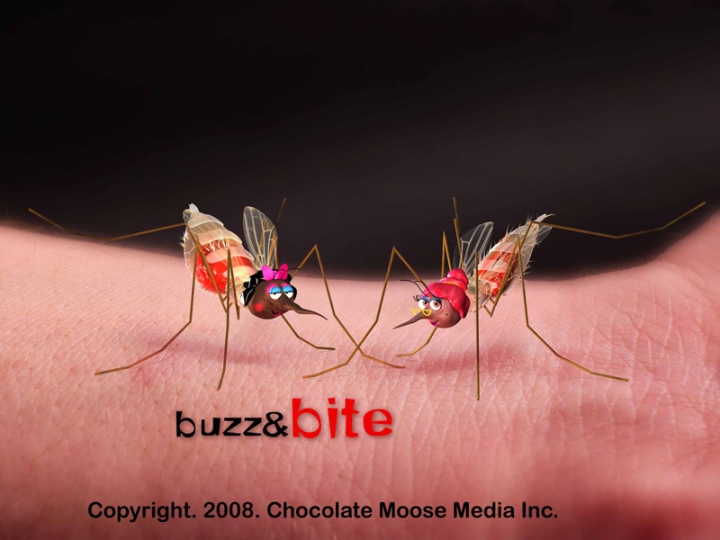
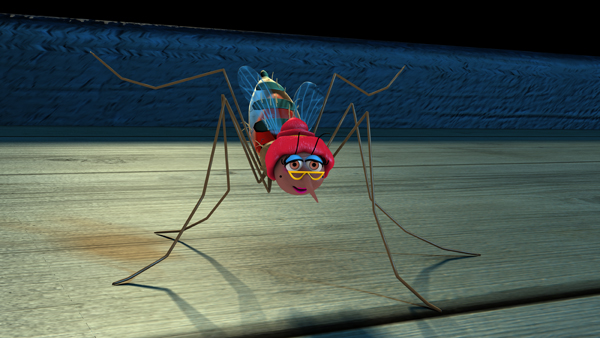
The Buzz and Bite Campaign is the creation of Canadian animation producer and director Firdaus Kharas, working with a team of skilled professionals. Firdaus earlier took on another public health challenge, HIV/AIDS, through his highly popular animation series The Three Amigos.
Watch a sample Buzz and Bite Spot (in English, British Accent)
According to the Buzz and Bite website, PSAs have so far been produced in 22 languages, and are being adapted into more. “The goal is to enable a potential reach of 80% of the world’s malaria at-risk population or over 5 billion people in their own language.”
The PSAs are available to any television broadcaster, radio station, NGO, hospital, doctor, community group, university, school, educator or other user, free of charge, anywhere in the world.
Malaria has been eradicated in many parts of the world but continues to thrive and even grow in other parts, especially in tropical areas. “This anti-malaria campaign focuses on sub-Saharan Africa (where up to 90 per cent of all malaria fatalities occur), on South America, and on South and South-East Asia, where the rates of malaria are alarmingly high,” says the website, adding: “Malaria is preventable. The easiest and cheapest way to prevent malaria infection is through the use of long-lasting insecticide-treated bed-nets (LLINs) which can last up to 5 years. This campaign promotes the use of nets.”
Syeda Rizwana Hasan: Goldman Prize winner 2009In Greek legend, Helen of Troy was the ‘face that launched a thousand ships’. Now meet Syeda Rizwana Hasan, a determined environmental activist who keeps dozens of ships from coming to die on the beaches of her native Bangladesh.
Rizwina is an environmental lawyer who is working hard to reduce the impact of Bangladesh’s exploitative and environmentally-devastating ship breaking industry. She has spearheaded a legal battle resulting in increased government regulation and heightened public awareness about the dangers of ship breaking. For this, she has just been honoured as the Asia winner of the prestigious Goldman Environmental Prize 2009.
Ship breaking is a lucrative yet highly hazardous business. Decommissioned ships from around the world are sent to Bangladesh, where they are dismantled by hand on the beaches by unskilled workers who are often paid less than one dollar per day. Lacking in sufficient mineral deposits for metal mining, Bangladesh relies on the iron and other materials from the ships for some of its metal. The scrap metal, along with other parts of the ships — including sinks, toilets, beds, appliances, and light bulbs — are resold in huge open markets lining the roads of Chittagong, the main ship breaking region.
Ship-breaking is done by around 20,000 workers – mostly young men, some as young as 14, who come from the northern parts of Bangladesh. They are paid very little, housed in the most basic of shelters, and provided with little or no medical care. It is estimated that, on average, one ship breaking worker dies at the yards in Bangladesh every week and every day one worker is injured.
Rizwana Hasan, 40, is a lawyer and Executive Director of the Bangladesh Environmental Lawyers Association (BELA), a public interest law firm. Growing up in a politically-engaged family, Hasan committed herself to public service and, after receiving her master’s degree in law at age 24, joined BELA. She soon became one of the country’s leading voices for the environment. Today, she manages six offices with nearly 60 staff and is one of the leading young lawyers enrolled with the Supreme Court of Bangladesh.
The Goldman Environmental Prize, now in its 20th year, is awarded annually to grassroots environmental heroes from each of the world’s six inhabited continental regions and is the largest award of its kind with an individual cash prize of $150,000. This year’s prizes were awarded in San Francisco on 20 April 2009.
The 2009 Goldman Environmental Prize recipients are a group of fearless grassroots leaders taking on government and corporate interests and working to improve the environment for people in their communities. Other winners this year came from Gabon, Indonesia, Russia, Suriname and USA.
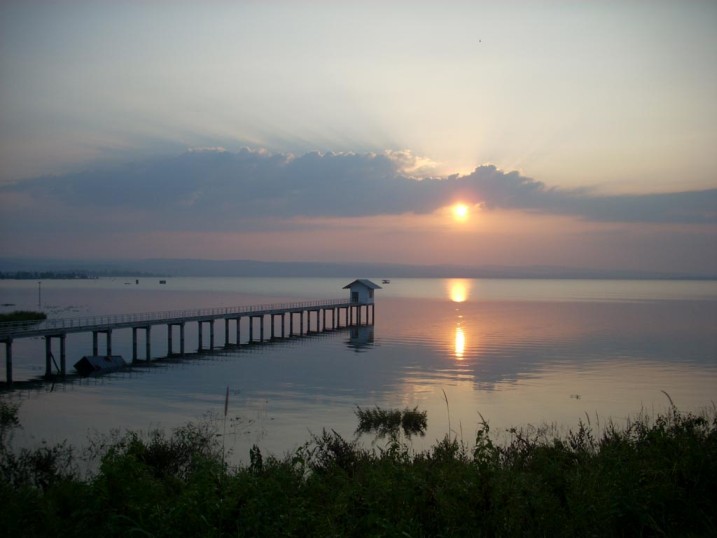
Calm now, turbulent tomorrow? View of Upper Mun Reservoir on the Mekong in northern Thailand: image courtesy TVE Asia PacificThe Greater Himalaya region is known as the water tower of Asia: the continent’s nine largest rivers emerging from its ice-capped mountains provide 1.5 billion people with water and 3 billion people with their food and power.
With more ice stored here than anywhere outside the Arctic and Antarctic, the region has even been called the earth’s third pole. But the ice fields of the Himalayas are melting, and at a faster pace than anywhere else on the planet.
A river that is going to be affected is the Mekong – one of Asia’s major rivers, and the twelfth longest in the world. TVE Asia Pacific has just produced a short film looking at how current and anticipated environmental changes could impact water users in the six countries of Southeast Asia which share its waters. We released it online this week, just in time for World Water Day 2009, March 22.
Mekong: Watch that River!
Along its journey of nearly 5,000 kilometres (3,000 miles), the Mekong nurtures a great deal of life in its waters – and in the wetlands, forests, towns and villages along its path. Starting in the Tibetan highlands, it flows through China’s Yunan province, and then across Myanmar, Thailand, Laos and Cambodia…before entering the sea from southern Vietnam.
The Mekong River Basin is the land surrounding all the streams and rivers that flow into it. This covers a vast area roughly the size of France and Germany combined. The basin supports more than 65 million people who share Mekong waters for drinking, farming, fishing and industry. Along the way, the river also generates electricity for South East Asia’s emerging economies.
The Mekong has sustained life for thousands of years. But growing human demands are slowly building up environmental pressures on the river. A new study, commissioned by the UN Environment Programme (UNEP), cautions that climate change could add to this in the coming years.
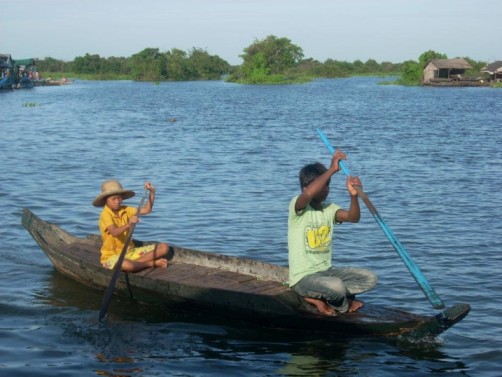
Fishing on the Tonle Sap lake in Cambodia: An 'ecological hot spot' on the MekongThe study, carried out under a project named “Vulnerability Assessment of Freshwater Resources”, was headed by Dr Mukand Babel at the Asian Institute of Technology (AIT) in Bangkok. It probed how climate change can impact the river from the highlands to the delta….affecting the survival and prosperity of millions.
Dr Babel says on the film: “Climate change would affect…the amount of rainfall which is received. Under climate change conditions, we expect less rainfall to be observed and that would bring less flows in the river which would affect the water users in the downstream areas.”
He adds: “At the same time, the sea level rise which is an associated impact of climate change, would bring more sea water intrusion into the river systems and groundwater systems in the delta in Vietnam.”
Salt water could go upstream by 60 to 70 kilometres, degrading the land and water in the Mekong delta. This would add to pressures already coming from growing human numbers, expanding economies and disappearing forests.
So the Mekong will be affected at both ends, by different processes that are triggered by climate change.
To find out how these changes could affect the Mekong’s millions, my colleagues filmed in two
‘ecological hot spots’ in the river basin identified by the study: the Upper Mun River, a tributary of the Mekong, and the Tonlé Sap lake in Cambodia.
The UNEP-AIT study recommends Mekong river countries to improve how they manage their water and land. This needs better policies, institutions and systems.
Dr. Young-Woo Park, Regional Director, UNEP, says on the film: “Countries sharing the Mekong river…have to act together and they have to develop the policies on how to conserve and how to conserve the Mekong river and also how to properly manage the Mekong river.”
The study found the Mekong river basin ‘moderately vulnerable’ to environmental changes. There aren’t any major water shortages in this river basin as yet. For now, the Mekong is holding up despite many pressures.
But all this can change if less water is flowing down the river and the demand for water keeps growing.
That’s why we named this film ‘Mekong: Watch that River!’
Talking to the last drop: All streams flow to Istanbul?
The 5th World Water Forum opens in Istanbul, Turkey, today. It will be held in the historic city – a bridge between the east and west – from 16 to 22 March 2009.
Held every three years, the World Water Forum is the main water-related event in the world. It seeks to put water firmly on the international agenda with a view to fostering collaboration – not confrontation – in sharing and caring for the world’s finite supplies of the life-giving liquid. The forums bring together officials, researchers, activists and media to a few days in which they can drown in their own cacophony…well, almost.
I haven’t been to one of these mega-events – I almost did in 2003, when it was hosted by Kyoto, Japan. That forum was almost entirely eclipsed – as far as the media coverage was concerned – by the United States deciding to invade Iraq during the same week. This inspired me to write an op ed essay on oil, water and media which was syndicated by Panos Features and widely reproduced at the time in newspapers, magazines and even in a few activist and development publications. But six years later, it’s hard to locate it online, so I’m publishing it here, unedited, exactly as I wrote in that eventful week in mid March 2003:
Oil on water: will the media get this Big Story?
By Nalaka Gunawardene: 20 March 2003
“If the wars of this century were fought over oil, the wars of the next century will be fought over water.” Ismail Serageldin, an eminent Egyptian architect and planner, made this remark in 1995 when he was vice president for sustainable development at the World Bank.
Well, we are in that new century now, but old habits die hard. The war in Iraq has been fuelled by oil interests, and – starting at the time it did, on March 20 –effectively sidelined global talks to secure freshwater for all.
Clean water, anyone?Even as the United States launched its attack on the country that sits on the world’s second largest oil reserve, the Third World Water Forum was in progress at the Japanese cities of Kyoto, Shiga and Osaka. The event, running from March 16 to 23, is this year’s biggest international conference on a sustainable development issue and involved hundreds of government and civil society representatives trying to resolve one of the major survival issues of our time: equitably sharing the world’s finite freshwater resources for our homes, farms and factories.
The two processes cannot be more different. One aims to use force while the other seeks to foster co-operation among nations to cope with water scarcity. The increasingly isolated United States has abandoned the United Nations process in its single-minded determination to disarm Iraq, a nation it considers a major threat to peace and security. Meanwhile in Kyoto, the nations of the world – including, but not led by, the United States – were discussing an issue that is far more central to humanity’s security. It has the full blessings of the UN, which has designated 2003 the International Year of Freshwater.
Yet the water forum seems hardly newsworthy to the major news organisations that are preoccupied with war. For months, the global television networks were gearing up for Iraq war coverage. The first Gulf War helped globalise CNN, and this time around, there are other international and regional channels competing for the eye balls. Locked in a battle for dominant market share, CNN International and BBC World are trying to outdo each other in covering the conflict exhaustively — and to the exclusion of everything else. In the do-or-die media marketplace, ‘soft issues’ such as water are easily edged over by conflict. As cynical news editors will confirm, if it bleeds, it leads.
The notions of national and global ‘security’ – on which the Iraq war is being waged – are relics of the Cold War that are completely out of sync with today’s global realities. Who says we have entered the 21st century?
In the closing decade of the last century, as the world grappled with one crisis after another – ranging from famine and drought to global warming and HIV/AIDS – the notion of ‘security’ was radically redefined to include ecological and social dimensions. What is now termed ‘human security’ is concerned not so much with weapons as with basic human dignity and survival. As first articulated in the UN Development Programme’s Human Development Report in 1994, human security includes safety from chronic threats such as hunger, disease and repression, as well as protection from sudden and harmful disruptions in the patterns of daily life.
Mahbub ul HaqThe rationale for this was brilliantly summed up by the late Mahbub ul Haq, former Finance Minister of Pakistan and architect of the Human Development Index: “If people are sleeping on pavements, ministers have no business shopping for modern jets and howitzers. While children suffocate in windowless classrooms, generals go about in their air-conditioned jeeps. Nations might accumulate all the weaponry they want, but they have no strength when their people starve…”
A world in which four out of every ten people live in areas of water scarcity is not secure. And if urgent action is not taken, this will increase to two thirds of humanity by 2005. Ensuring water quality is as important as basic access: preventable diarrhoeal diseases – including cholera and dysentery — kill more than seven million children every year. That is 6,000 deaths every day.
James P GrantJames Grant, former executive director of UNICEF, once used a powerful metaphor to describe this scandalous situation: it was as if several jumbo jets full of children were crashing everyday – and nobody took any notice.
If the media are obsessed with death and destruction, why aren’t these numbers registering on their radars? Why is it that silent emergencies forever remain ignored or are only superficially covered? Even statistics don’t set the media agenda: for example, according to the UN, twice as many people are still dying from diarrhoeal diseases as from HIV/AIDS in China, India and Indonesia. But the international donors and media assign far more importance to HIV than to clean water.
No other factor can distort reality as oil. Oil comes on top of water both in the physical world, and in the murky world of global politics. Our collective dependence on petroleum immediately ensures the Iraq war a disproportionately high rank in public and media concerns.
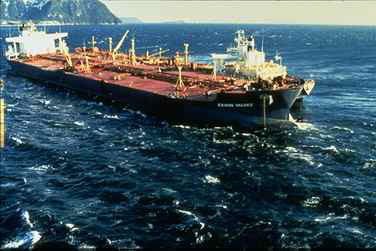
It’s not just the United States that is addicted to oil – we all are. Addicts tend to lose sight of the cost of their dependence, as we have. On 24 March 1989, the oil tanker Exxon Valdez ran aground on in Prince William Sound in Alaska and a fifth of its 1.2 million barrels of oil spilled into the sea, causing massive damage to over 3,800 km of shoreline. Investigations implicated its captain for grossly neglecting duty. Shortly afterwards, Greenpeace ran a major advertising campaign with the headline: “It wasn’t his driving that caused the Alaskan oil spill. It was yours.”
Exxon Valdez: Drunken driving!Greenpeace continued: “It would be easy to blame the Valdez oil spill on one man. Or one company. Or even one industry. Too easy. Because the truth is, the spill was caused by a nation drunk on oil. And a government asleep at the wheel.”
A nation drunk on oil is waging a war that has more to do with oil than anything else. Our news media are behaving just like cheer-leaders.
War is undoubtedly a big story. But so should be water. One in six humans does not have safe drinking water, and one third of humankind lacks adequate sanitation. We may be living on the Blue Planet, but the waters are muddy and life-threatening to billions.
For sure, a bunch of people huddling together in three Japanese cities won’t solve this crisis overnight. But unless knowledge and skills are shared, and a political commitment is secured, safe water for all will forever remain a pipe dream.
Will it take a full-scale war over water in one of the flashpoints around the world for the military-industrial-media complex take sufficient interest in this survival issue? (That might happen sooner than we suspect.)
It’s ironic that the World Water Forum was undermined by the Iraq war breaking out in the very same week. Washington has now poured oil over everybody’s water.
[Nalaka Gunawardene is an award-winning Sri Lankan science writer, journalist and columnist. He heads TVE Asia Pacific, a regional media organisation working on sustainable development issues, and is on the board of Panos South Asia. The views expressed here are his own.]
“This year alone, more than 500,000 women will die during pregnancy or childbirth. That’s one woman missing every minute of every day. We call these women ‘missing’ because their deaths could have been avoided. In fact, 80 per cent of maternal deaths could be averted if women had access to essential maternal health services.
“We know where and how these women are dying, and we have the resources to prevent these deaths. Yet, maternal mortality is still one of the most neglected problems internationally.”
Unfortunately, critical issues like these often don’t make the news – or worse, are relegated to the background as inevitable. As Joseph Stalin said in a different context, one death is a tragedy; a million deaths a mere statistic.
The challenge to the development community is to go beyond simply counting deaths in cold, clinical terms. UNICEF has recently released a two minute video, “Missing Mothers” as a tool for international development professionals to use in raising awareness of the issue of mothers dying needlessly.
Having a baby is both a very natural process and a joyous occasion for the parents and extended family concerned. Yet having a baby still remains one of the biggest health risks for millions of women worldwide.
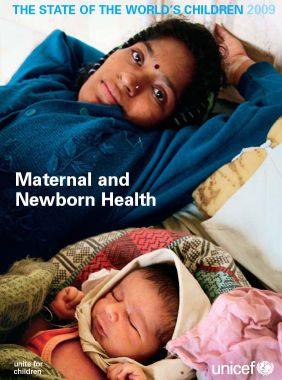
Time to make missing women count...As Unicef’s 2009 State of the World’s Children report reminded us recently, 1,500 women die every day in the world due to complications arising during pregnancy and childbirth. The chances of a woman in developing countries dying before or during childbirth are 300 times greater than for a woman in an industrialised country like the United States. Such a gap does not exist in any other social indicator.
She noted: “The solution has been known for years. The problem is the will to make it work. We also know that the solution would benefit everyone, not just women. Yet, affordable and accessible health care, for instance, has not received the thrust that is needed.”
The Missing Women video suggests to activists and campaigners that action can start with five steps: 1. Educate girls, young women and yourself; 2. Respect their rights; 3. Empower them to participate; 4. Invest in maternal health; 5. Protect against violence and abuse. The Unicef website, meanwhile, lists 10 ways in which concerned individuals can make a difference.
All very commendable and necessary — but not sufficient. With all the good intentions in the world, Unicef’s experts and officials come across as, well, detached and geeky. They don’t connect well enough to the real world people whose needs and interests they are genuinely trying to serve. Their messages are lost somewhere in their precise terms, jargon and endless acronyms.
Just take, for example, the very phrase of maternal mortality itself. Precise but also very stiff and dry. Who outside the medical and development circles uses such terms in conversation? When I write or make films about the issue, I prefer to call it ‘mothers dying needlessly while having babies’. Yes, it’s more wordy and perhaps less exacting. But most ordinary people would get what I’m talking about.
If the jargon-ridden language reads dry in text, it completely puts off people when they watch such words being spoken on video. Such films may pander to the Narcissism of Unicef mandarins, but they completely flop in terms of public communication and engagement.
This is the same point I made in October 2008 when commenting on the Unicef-inspired first Global Handwashing Day: “Passion used to be the hallmark of UNICEF during the time of its legendary executive director James Grant, who strongly believed in communicating messages of child survival and well-being. He gave UNICEF a head start in working with the media, especially television.”
Jim Grant’s deputy, journalist Tarzie Vittachi, who came over to the UN children’s agency after a stint at the UN population fund, used to say: “Governments don’t have babies; people do”. We might extend that to: inter-governmental agencies don’t have babies; real women do. That may be why Unicef insists on delivering its life-saving messages so riddled in politically and scientifically correct, but so sterile language.
Unicef’s YouTube channel has a number of short videos related to what they insist on calling maternal mortality. Here’s an example where Unicef’s Chief of Health Dr. Peter Salama says it’s really an unconscionable number of deaths, and a human tragedy on a massive scale:
We have now passed the half way mark, but progress has been patchy and unimpressive. And it will remain so as long as the UN agencies and other development players insist on peddling jargon and acronyms. Considering the issues of life and death involved here, we must view bad communication as a killer — joining the ranks of unsafe drinking water and violence against women and girls.
Writing an editorial for SciDev.Net in September 2005, I noted: “All development workers and UN officials should take a simple test: explain to the least technical person in your office the core message and relevance of your work. Many jargon-using, data-wielding, acronym-loving development workers would probably fail this test. But unless development-speak is translated into simpler language, the MDGs will remain a buzzword confined to development experts and activists.”
I don’t believe in ghosts, but it’s time to bring back the spirits of Jim Grant and Tarzie Vittachi to Unicef to again humanise the agency so mired in its own ‘geekspeak’. The intellectual rigours of evidence-based, scientific analysis must be balanced with clarity and accessibility. It’s fine to be informed by science, but learn to say it simply, clearly and concisely.
The lives of half a million women and millions of children depend on it.
What happens when a small and culturally diverse group is flown in from different parts of the world, put up in a comfortable hotel, fed well — and mandated to watch two or three dozen excellent films and asked to come up with a selection of ‘the best of the best’?
That pretty much sums up the experience of the final jury process of international film festivals that have a competitive element. The festival secretariat lines up the logistics but entrusts all the rankings and selections of entries to an independent jury – which typically serves without pay, and works long and hard.
Hosting the Wildscreen Film Festival in Colombo, Sri Lanka, which ended last evening, brought back memories from eight years ago, when I served on the global jury of Wildscreen festival in Bristol in October 2000. It wasn’t just the turn of the millennium that made the festival especially remarkable that year. In some ways, Wildscreen 2000 marked a significant change in how wildlife and natural history films are assessed and honoured.
I’ve done this a few times before and since 2000 — among them Earth Vision (Tokyo) in 1993 and Japan Wildlife Festival (Toyama) in 2003. But being on Wildscreen jury was special, for it’s considered to be the world’s largest and most prestigious wildlife and environmental film festival — the ‘green’ equivalent of the Oscars.
Serving on film festival juries can be both tedious and highly rewarding. On the plus side, I get to watch the best of contemporary factual film making on these subjects from all over the world, and then discuss their relative merits with some of the best professionals in the industry. The downside is that no jury can ever satisfy all film makers who enter their work, nor come up with a selection that is universally accepted: after every festival, there are those who feel their creations didn’t receive the recognition they deserved.
While all the film juries I have served on managed to reach consensus decisions, it often wasn’t easy. Much depends on the jury chair’s ability to find common ground among jury members who hold diverse – sometimes even opposite – views. Wildscreen 2000 jury was very ably chaired by Peter Goodchild, who came from a background of science film making, and was once editor of BBC’s Horizon science series (He was called in on short notice when the chair designate Christopher Parsons, co-founder of Wildscreen, fell ill.)
Endless golden sunsets...Among my fellow jurors were conservationist Dr Lee Durrell and Canadian film-maker and co-inventor of Imax Roman Kroitor. Jane Krish, then Executive Director of Wildscreen, kept us going and made sure there wasn’t too much blood on the expensively carpeted floors of the Bristol Marriot hotel where we were holed up.
Details of what happened during that week is now buried too deep beneath sediments of memory. I remember watching and discussing some great films in great company and racing against time to reach our decisions for the awards night. Parallel to this, the festival’s multiple events were taking place in nearby venues but we couldn’t join them – except some social events in the evenings.
I’m only sorry that I haven’t got a single photograph of that occasion in my personal collection – it was a year or two later that I started the routine of taking my camera on all my travels. But I’ve just located, from the digital archives two laptops ago, the opening remarks that Peter Goodchild made at the awards ceremony, which he’d typed out on my machine. That neatly sums up our extraordinary experience:
“In the past week my jury and I have, in effect, left the human race. During our four days’ viewing we have seen no less than 54 films. And in that time we have tramped over billions of tons of sand, swum in every ocean of the world with trillions of fish, experienced 80 full moons, watched the production of 30 tons of elephant droppings, around 120 copulations (not ourselves), 15 rapes (not ourselves), 210 killings including 30 infanticides, several thousand insect bites, and we have done all this in temperatures of 50 degrees Fahrenheit below and temperatures of 50 degrees Centigrade above.
“In those aforementioned copulations we were privy to the sight of a pair of 1 ton testicles accompanied by what looked like 3 meters of stout garden hose, but was referred, very tastefully, by the narrator as a ‘flexible friend’.
“And so it goes on, 73 assorted prehistoric animals, 18 symphony orchestras, around half a dozen heavenly choirs and — we have refrained from killing each other and we learned that Nature is prolific, but merciless, that humankind has screwed things up quite a bit, and still is, but we are beginning to try to remedy our ignorance and mistakes. And now we return to you here with the results of our deliberations amongst what is, with one or two exceptions, an embarrassment of riches…”
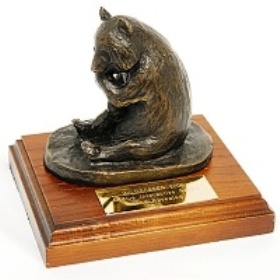
Panda Award, a.k.a. 'Green Oscar'From then on, each member of the jury took turns in announcing winners in various categories, some technical and others more editorial. Each winner received the coveted Panda Award, affectionately (and unofficially) known as the ‘Green Oscar’. Wildlife film-makers from Australia, Britain, France, India, the Netherlands, Norway, South Africa and the United States shared the honours that evening.
Each Panda award was introduced with a brief citation. I presented two: the Conservation/Environment Award and the award for the best film entry from a country that did not have a long tradition of making natural history films.
When presenting the latter, I noted: “It is tempting to draw parallels between the natural world and the world of natural history film making. There are enormous inequalities and disparities in both. Film makers everywhere find it increasingly difficult to raise adequate budgets, but this has always been a stark fact of life for film makers in those parts of the world that lack a long tradition of producing natural history films. In these harsh conditions, the resourcefulness and ingenuity of film makers are tested on many fronts.
“This festival received relatively few entries from such parts of the world and from such film makers, but we understand that it is better than last time. This indicates the presence of talented professionals working against many odds, and trying to exploit the medium to raise public understanding of the environment. The finalists we saw bear testimony to the resolve and commitment of their film makers — who clearly know the art of story telling on television in ways that best engage their audiences. And we need to remember that some of them reach out to hundreds of millions of viewers. These people can make a difference for the planet.”
The award went to Indian film maker Mike Pandey, for his film Shores of Silence: Whale Sharks in India. The 25-minute film, made in early 2000, was the first ever revelation of the killing of whale sharks on the Indian coastline. It so stirred the collective conscience of the authorities, that the government banned the hunting of these endangered marine creatures seven months later.
Every jury’s selection sends out signals, and this is especially so when it concerns the natural history film industry’s most coveted awards. Beyond selecting the winners, our jury also recommended the expansion of the festival’s scope in two ways.
Firstly, we pointed out that simply documenting animal and plant behaviour and their habitats was no longer adequate in a world facing a multitude of environmental crises. There was an urgent need, we said, to mainstream films that looked at the nexus between the natural environment and human society – both conflict and harmony between the two.
Secondly, we recognised the rapid changes taking place in the worlds of broadcasting and web, which challenges film makers to try out new formats or genres, including some that used much shorter durations than those used in wildlife and natural history films until recently. Reviewing eligible film formats was necessary, we said, in an industry that was embracing multimedia to retain or attract eyeballs.
As Peter Goodchild noted in his remarks: “There’s little doubt that there will be increasing demands for personality led programmes, for cheaper format programmes and, because a valuable award – a panda on the mantelpiece – is one potent way of moderating any feared slides into banality, it seemed to us that the Festival needed to create an award rooted in entertainment, where good work in this kind of programming would be recognised.”
It’s heartening to note that Wildscreen festival took note of these recommendations, as evidenced by changes in subsequent editions of the festival. But Peter’s words still hold true: “What is needed, in our view, is to keep testing alternative forms and approaches, expanding the range of programming and avoiding the dangers of a rut based on a past successes.”
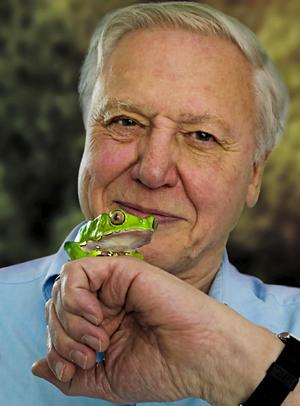
For me, it was more than a fascinating journey to far corners of our endangered planet in the company of the world’s best known broadcaster, and Britain’s most trusted public figure. I recalled how in this very venue, as an eager teenager growing up in the simpler, pre-web days of the 1980s, I watched his pioneering series Life on Earth (1979) and The Living Planet (1984). These path-breaking series redefined how natural history documentaries were made, and inspired a whole new generation of film-makers and nature lovers. A quarter century later, I’m still hooked.
Over the last 25 years, Attenborough has established himself as the world’s leading natural history programme maker with more landmark series: The Trials of Life (1990), The Private Life of Plants (1995), The Life of Birds (1998), The Life of Mammals (2002) and Life in the Undergrowth (2005). The final chapter in the ‘Life’ series is Life in Cold Blood (2008).
As fellow broadcaster Jeremy Paxman noted in a Time magazine tribute to Attenborough: “Life After Death is almost the only natural-history series yet to be made by Attenborough. In a career that has taken him to every corner of the world, he has explored life in all its richness — from mammals and birds to plants and reptiles. No living person has done more to make the people of Planet Earth aware of the world around them.”
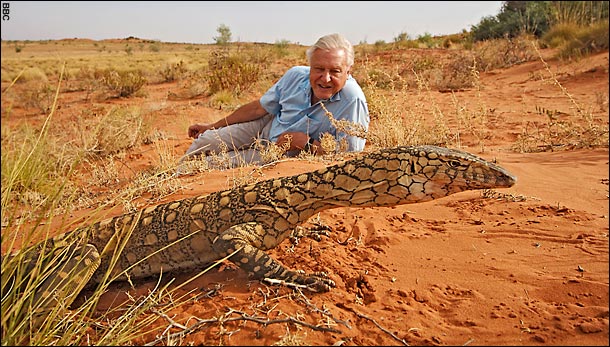
Close encounters?But as I wrote in May 2007, “like all creatures big and small in the great Circle of Life that Sir David has so avidly told us about, he too is mortal. At 81, it’s time for the world to look for the next David Attenborough.”
In his Time tribute, Paxman noted that what distinguishes Attenborough is “that boundless, schoolboyish enthusiasm, the infectious joy of discovering the infinite variety of life”. Yet as the popular song goes, dragons live forever, but not so little boys – so the quest for the next Attenborough has quietly preoccupied the minds of many practising or following the world of natural history and environmental film making.
I’m not obsessed with this question (and I wish Sir David many more years of life on Earth and life on the airwaves), but I today popped it to Jeremy Bristow, a producer of environmental programmes at BBC Television, at the end of his fascinating master class on The role of films in Environmental Conservation. Jeremy’s most recent project has been two films hard-hitting films on Climate Change with Sir David Attenborough for BBC1 and the Discovery Channel.
The bad news is that despite searching far and wide – even some competitions – the David Attenborough has yet to be discovered.
“There are many talented, passionate natural history film makers and some of them also have good screen presence — but none to match Sir David,” said Jeremy Bristow. “I know many in the natural history film world have kept their eyes open for a potential successor.”
Perhaps Sir David is a unique product of his time and circumstances, Jeremy speculated. Certainly, there weren’t too many getting into this business in the early days of television broadcasting. The first major programme series to feature Sir David was BBC’s Zooquest, which ran from 1954 to 1963. And then, one thing led to another…and more than 50 years later, he’s still in the business.
To me, it’s the voice – authoritative without at all being pompous or pontificating – that gives Sir David enduring and endearing appeal. Time called it ‘the voice of the environment’.
Now is the time when that voice of reason, moderation and passion is needed more than ever. A time when the natural world is under siege from human-induced accelerated climate change even as the world of science takes daily beatings from assorted fundamentalist forces.
At 82, Sir David still remains not just our most versatile ambassador to the natural world, but also one of the best spokespersons for the rigors of science and intellectual curiosity.
Here’s a recent example of Sir David – taking us on a quick, animated guide to evolution of life on Earth, in a 2009 documentary called Charles Darwin and the Tree of Lifeto mark 150 years since Charles Darwin published his famous Origin of the Species:
The keynote address was delivered by Sri Lankan minister of environment and natural resources. The British Council asked me to speak a few words at the opening as TVE Asia Pacific is a local partner for this event.
Here’s what I said, which sums up why we are in this business:
We are delighted to be partners in hosting Wildscreen film festival in Sri Lanka. We thank our friends at the British Council and Wildscreen festival for this opportunity to join hands.
May I say a brief word about ourselves. We’re Television for Education Asia Pacific — trading as TVE Asia Pacific. We’re a regionally operating media foundation anchored in Colombo and engaging developing countries of Asia. We were set up in 1996 by a group of Asian and European filmmakers and TV professionals to cover the full range of development issues using broadcast television, narrowcast video and now, the web.
We are driven by a belief that what is happening in the world’s largest and most populous region has far-reaching implications not just for our region — but also for the entire planet.
When introducing our work, I like to recall the words of Mahatma Gandhi. Once, when asked by a visiting foreign journalist for his views on wildlife in India, he said: “Sadly, wildlife is declining in our jungles, but wild – life is increasing in our cities.”
It is precisely this wild–life that interests us more. In our work we keep asking: when life itself is going wild, what hope and prospects are there for wildlife, Nature and environment?
For example, we’ve literally just finished a short film looking at environmental restoration of Afghanistan. This will be screened to the environmental minister from around the world who will gather shortly for the UN Environment Programme’s Governing Council meeting in Nairobi.
We can't just walk into a glorious sunset and forget real world challenges - Photo by Niroshan Fernando, TVEAP
Capturing wild-life is now the focus and concern of wildlife and environmental film makers everywhere. There was a time, not too long ago, when films used to simply capture the beauty of Nature and the diversity or behaviour of plants and animals. Such documentation is still very necessary and useful — but it’s no longer sufficient.
In the past couple of decades, all film makers have been challenged to look at how our own ‘wild’ ways of living affects:
– each other in our own human species;
– the rest of Nature and other species; and
– also, the future of life on Earth.
We see this transformation reflected in the content of films entering Wildscreen and other film festivals. I saw early signs of this when I served as a juror at Wildscreen 2000 festival. This process has gathered momentum since.
To remain relevant and topical, films can no longer just cover ‘green’ subjects — they have to acknowledge the ‘brown’ issues as well as the harsh black-and-white, life-or-death concerns such as climate change.
At the same time, we have seen a rapid diversification of formats or genres — especially with the emergence of online and mobile platforms. These now compete with broadcast television to engage audiences. This is both good news and bad news for us engaged in film making and film outreach. Yes, we now have more ways of reaching people than ever before. But engaging audiences is harder: people have more choice — and more distractions!
Of course, we can’t just give up the good struggle and walk away into those beautiful sunsets. At TVE Asia Pacific, we believe that making good films is only half the job done. Distributing them far and wide is just as important. This is why the slogan of our own organisation is: Moving images, moving people!
In that process, film festivals such as this one play a key role. We’re very happy to add an extra day of screenings to this event. On Saturday in this auditorium, we’ll be showing a number of films on climate change and sustainable development drawn from our own catalogue of films we distribute to broadcast, civil society and educational users across Asia.
These are small efforts in a big world. I can only hope all these help us in winning history’s greatest race – which, according to H G Wells, is one between education and catastrophe!
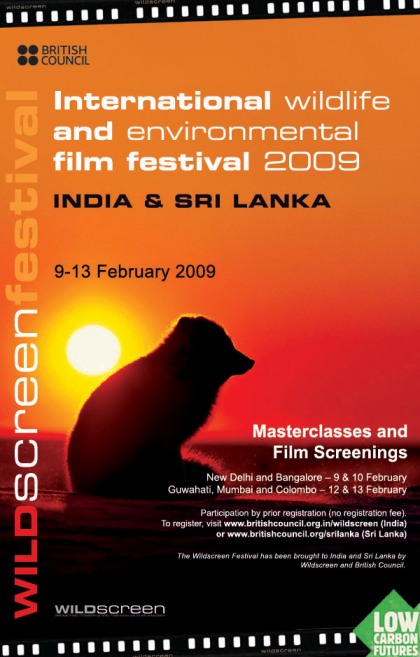
Wildscreen comes to ColomboWildscreen, the world’s largest and most prestigious wildlife and environmental film festival, will be touring India and Sri Lanka in February 2009.
Nine wildlife or environmental filmmakers from the UK will be coming to India and Sri Lanka as part of this event, organized by the British Council. The festival will also see screenings of wildlife and environmental films from across the world, some of them winners of the Wildscreen festival’s Panda Awards, the environmental equivalent of the Oscars.
The Wildscreen Festival was founded by Sir Peter Scott in 1982. It has been organised every alternate year for the past 25 years, and is now considered to be the world’s largest and most prestigious wildlife and environmental film festival. Held in Bristol, UK, it attracts hundreds of delegates from around the globe who work in film, television and new media, as well as those involved in environmental conservation.
The Festival is coming to Sri Lanka for the first time. The programme, held at the British Council Colombo on 12 – 13 February 2009, will screen several award winning films on climate change and wildlife, showcasing the best of current environmental film making worldwide. On 14 February 2009, TVE Asia Pacific will present a selection of films on environment and sustainable development drawn from their global catalogue, which includes some Sri Lankan and South Asian titles.
More bugs from Gates...Bill Gates can’t seem to get enough of bugs.
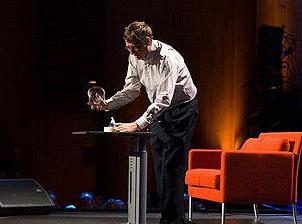
On 4 February 2009, he let loose a swarm of mosquitoes at the TED 2009 technology, entertainment and design conference in California to highlight the dangers of malaria.
“Malaria is spread by mosquitoes,” he reminded his audience of leading scientists, designers, researchers and entrepreneurs. Turning to an upturned jar on stage, he announced: “I brought some. Here…I’ll let them roam around. There is no reason only poor people should be infected.”
Luckily, the mosquitoes were not carrying the disease. But it had the intended effect. Wired editor Chris Anderson, curator of the show, suggested a headline: “Gates releases more bugs into the world”.
Watch Bill Gates’s mosquito moment:
Watch the full 20-minute video of Bill Gates at TED 2009
As stunts go, this one was pretty mild and harmless. There are many shocking ways in which the harsh daily realities of the world’s poor can be brought into gatherings of the rich and famous. They could be served glasses of the contaminated, sludgy (and often smelly) water that tens of millions drink everyday. Or all the toilets could be locked up and the keys thrown away – for good. Or electricity supply could be cut off, or frequent ‘black-outs’ or ‘brown-outs’ could be staged. You get the idea…
Of course, few event organisers would dare try any of these, if only for health and safety considerations. Reminds me of a rare exception: when he was director of information with the UN’s population agency (UNFPA), journalist-turned-UN official Tarzie Vittachi once hosted delegates of a high level meeting to lunch which consisted soley of a bread roll and a glass water. He told his guests: the meal was better more than what most poor people in the global South on any given day.
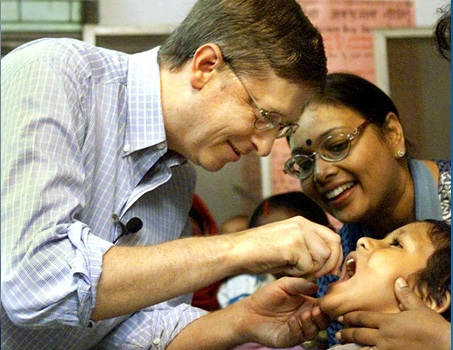
Bill to the rescue...Meanwhile, billions of poor and needy – and not just those in the majority world – are glad that Bill Gates caught the ‘development bug’ and has switched his formidable creative energies (not to mention his billions) to address their survival issues. The Bill & Melinda Gates Foundation – which carefully manages the giving away of Gates wealth – operates on the belief that all lives have equal value. “We think all people deserve the chance to have healthy, productive lives”.
They have set priorities such as improving health and reducing extreme poverty in the developing world, and improving high school education in the United States.
The New York Times columnist Nicholas Kristof recently described it as a paradox: “In these brutal economic times, one of the leading advocates for the world’s poorest people is one of the richest.”
He noted: “Mr. Gates ended his full-time presence at Microsoft last July and since then has thrown himself into work at his foundation. He is now trying to do to malaria, AIDS, polio and lethal childhood diarrhea what he did to Netscape, and he just may succeed.”
In his TED talk, Bill Gates addressed two questions that occupy much of his time these days: How do we stop Malaria? How do you make a teacher great?
Look, no computers!He said: “The market does not drive scientists, thinkers, or governments to do the right things. Only by paying attention and making people care can we make as much progress as we need to.”
He called for greater distribution of insect nets and other protective gear, and revealed that an anti-malaria vaccine funded by his foundation and currently in development would enter a more advanced testing phase in the coming months.
“I am an optimist; I think any tough problem can be solved,” he said. That’s the geek in him talking: marshall all information, analyse problems, respond strategically — and keep at it.
A friend who now works with the Gates Foundation confirms how the charity seeks evidence and rigour in all its social investments. This is no bleeding-heart do-gooding or ‘social work’ for its CSR value. The new wave of geeks lining up to serve the meek bring business acumen to the development sector long under-served by unimaginative aid agencies and self-serving UN organisations.
As Kristof wrote: “Gates ended his full-time presence at Microsoft last July and since then has thrown himself into work at his foundation. He is now trying to do to malaria, AIDS, polio and lethal childhood diarrhea what he did to Netscape, and he just may succeed.”
In late January 2009, the billionaire philanthropist released the first ‘Annual Letter from Bill Gates‘ where he discussed his work at the foundation and spoke candidly about what has gone well, what hasn’t.
He compared his earlier work at Microsoft with the challenges he now tackles at the charitable foundation. “What I’ve found now is that really those same key elements are there. The opportunity for big breakthroughs is absolutely just as great–now it’s vaccines, it’s seeds that have better yield, it’s ways of sharing teaching practices…they will take the same kind of patience that we had for software breakthroughs.”
Just ahead of the letter’s release, Nicholas Kristof talked with Bill Gates about why aid to developing countries is more important during the economic downturn and vaccine breakthroughs on the horizon. Watch the interview:




 I’ve done this a few times before and since 2000 — among them



 Open Minds!