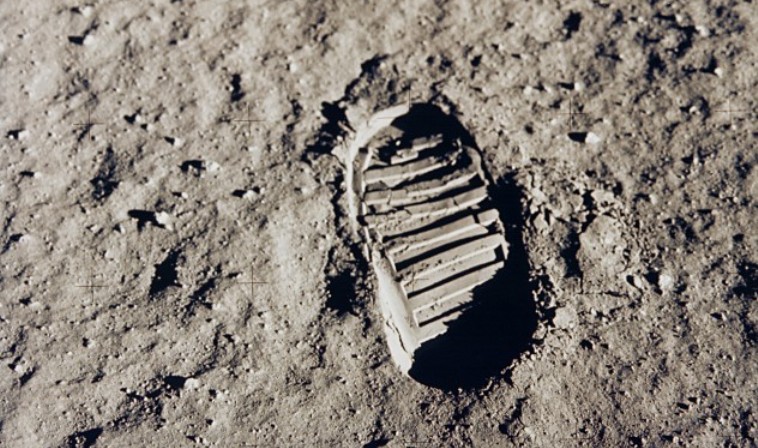
The most expensively obtained footprint in history, this can outlast us all on the airless Moon...
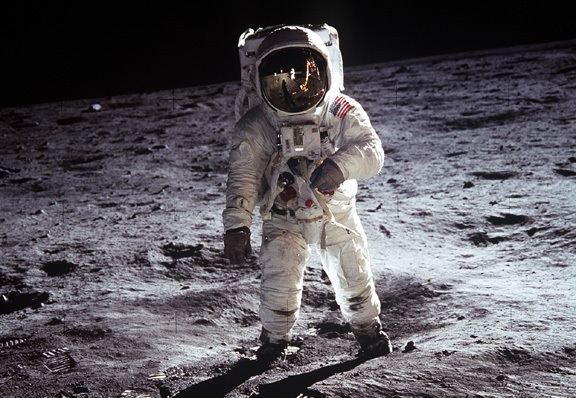
When Neil Armstrong took that first ‘small step’ on to the Moon, at 10.56 pm Eastern Standard Time on 20 July 1969, it was already 21 July in many other parts of the world. It didn’t matter: day or night, East or West, people all over followed the mission’s progress over TV or radio. As Armstrong climbed down the lunar module’s ladder, more than 750 million people back on Earth had collectively held their breath.
This event holds special significance for me personally. It’s the earliest childhood memory that I have which can be pinned down to a specific date. And what a date!
I was a little over three years old at the time (as I like to put it, I’m the same age as Star Trek!). The year 1969 was already the most eventful yet in my (very short) life: in April that year, a younger sister was born. And at the beginning of July, I started in pre-school. I should think that at least the ‘headlines’ of such key events would be imprinted in my (usually good and sharp) memory. But those events are buried deep beneath the sediments of memory, and I have to turn to secondary (parental) sources to get any details.
What I do remember, to this day, is the excitement over the first Moon landing. My father was listening to the live radio broadcast on Voice of America. Sri Lanka had no television broadcasts then (that medium would arrive only 10 years later), so the only choice was to tune in to radio and imagine the pictures….or wait for the next day’s newspapers.
The crackling shortwave transmission came in loud and (mostly) clear through the large radiogram that sat in a prominent corner of our spacious living room. At over three feet in height, and encased in neatly polished wood, the instrument must have appeared formidable to little me. That was our solitary window to the outside world.
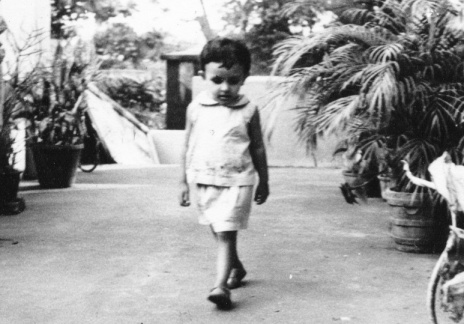
One of my earliest childhood photos, circa late 1968...not long after I took my own first 'small steps'Although I realised something pretty important was happening, I didn’t understand what the commentary said. English was still an alien language – heck, at that tender age, I was still picking my mother tongue! But the inquisitive brat that I was, I asked my father to give me occasional summaries of what was going on. His school teacher experience must have helped him to distill the essence for me.
After all these years, I can’t remember too many details. But the highlights linger on, if only as distant headlines. Neil Armstrong’s one small step was taken. Neil and Buzz hopped around like kangaroos, enjoying the lower lunar gravity. They planted the American flag and set up scientific instruments. Then collected lunar soil samples. They often talked as they worked. Mission Control closely followed their every move…as did the whole world, a quarter of a million miles away.
Then it was time to head back. I would later find out that leaving the Moon after two and a half hours of exploration was a particularly tensed moment in the mission. The astronauts had one chance to rejoin the ‘mother ship’ orbiting the Moon. If their lunar module failed to take off, they’d be marooned on the Moon — with absolutely no hope of a rescue.
Having spent just about 1,000 days on Earth myself, I had no clue about any of these dangers. But the one ‘tough’ question I still remember asking my father is: “What could happen if the astronauts can’t return?”
I’m not sure what answer, if any, he gave me. His background was in history and languages, not science. But that sure was an indication that I had the knack for asking difficult, sometimes irritating, questions.
Apollo still photos were much better than broadcast images: how come?
In theory, it can happen to anyone recording moving images on tape or digital media: absent-mindedly or carelessly re-use the recording media, and thus lose the original content. If no copy exists, such an accident means an irrevocable loss.
But if the images were the most expensively shot in the whole of human history — literally costing billions of dollars and involving the genius and labour of half a million people over several years — we would expect these to be archived and preserved with great care, right?
Well, not necessarily — if the custodian is a government agency. On eve of the 40th anniversary of the first Moon landing by Apollo 11, the US space agency NASA dropped a bombshell: it admitted that the original recordings of that historic moment were accidentally erased years later.
One British newspaper called it “the scientific equivalent of recording an old episode of EastEnders over the prized video of your daughter’s wedding day”.
Can you see the Moon on the Moon? Well, only just...The loss became public when the Sydney Morning Herald broke the story in August 2096. “A desperate search has begun amid concerns the tapes will disintegrate to dust before they can be found,” it said.
While the media rushed with oops-style headlines like ‘One giant blunder for mankind’, NASA quietly investigated what really happened. Last week, they revealed the hard truth: the tapes were part of a batch of 200,000 that were degaussed – or magnetically erased — and re-used. It was a standard money-saving measure at NASA in those pre-digital days to reuse the 14-inch tape reels after several years in storage. Agency officials fear that the original Apollo 11 tapes were buried among an estimated 350,000 that were recycled in the 1970s and 1980s and the data was lost for ever.
But the historic visuals are not entirely lost: luckily, broadcasters who used NASA’s expensively obtained footage had archived their transmissions for posterity. For many months, NASA has worked with a leading digital imaging company in Hollywood to restore good copies of the Apollo 11 broadcast found in the archives of CBS News and some recordings called kinescopes found in film vaults at Johnson Space Center.
On 16 July 2009, NASA released the first glimpses of a complete digital make-over of the original landing footage that looked decidedly sharper and clearer than the blurry and grainy images of Neil Armstrong and Buzz Aldrin walking on the Moon.
And we have to admit, the new video is definitely better than the ones we’ve seen for 40 years!
Raw Video: Restored Video of Apollo 11 Moonwalk
Another montage of digitally restored Apollo 11 mission highlights:
The full set of recordings, being cleaned up by Burbank, California-based Lowry Digital, are to be released in September 2009.
I had often wondered why the original images from the Moon were so grainy: it wasn’t typical even for that time. And if NASA spent between US$ 22 to 25 billion on landing men on the Moon, surely they’d have harnessed the best available technology to capture and share their moments of triumph, I assumed.
Actually, the video coverage that was broadcast around the world — to an estimated audience of 500 to 750 million people — and has since been endlessly redistributed was not quite what came from the Moon. It was a diluted version. Stanley Lebar, the NASA engineer in charge of developing the lunar camera, now calls a “bastardized” version of the actual footage.
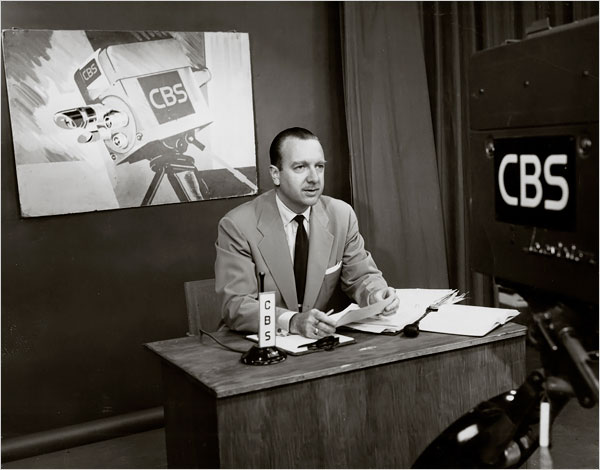
Here is the “as-it-happened” broadcast from CBS News that day, with the legendary Walter Cronkite anchoring to the biggest TV audience the world had known. (Footnote: You’ll see the first electronic “character generators” in use.)
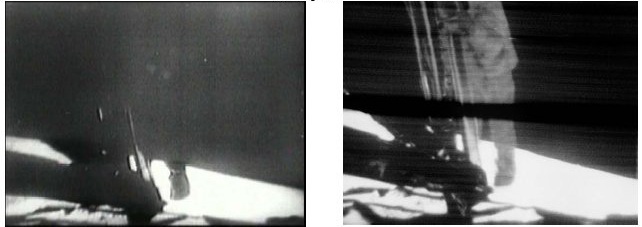
The story is technically complex, but here’s the essence: live images from the Moon couldn’t be fed directly to the American TV networks using the NTSC broadcast standard. Audiences worldwide would be holding their breath that a delayed broadcast, even by a few minutes, would not have been as effective as ‘live from the Moon’. Under such time pressures, no conversions could be attempted. So a regular TV camera was pointed at the huge wall monitor at mission control in Houston.
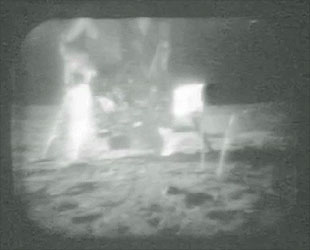
This is known as kinescope, or telerecording: a recording of a television program made by filming the picture from a video monitor. That resulted in the grayish, blotchy images that everyone saw on their home TV sets. In other words, It was a copy of a copy, with significant quality losses in that process!
Scan-converted broadcast image of Armstrong descending the lunar module ladder taken at Goldstone tracking station. This was the image the world saw of the first human on the Moon. But a Polaroid picture of the Slow-Scan television image of Armstrong coming down the ladder reveals far greater detail. Image Courtesy: John Sarkissian/CSIRO Parkes Radio Observatory
A new documentary, released in January 2009, offers new insights into one of the most challenging feats in international live broadcasting – how those images from the Moon were delivered to TV audiences around the world. Produced by Spacecraft Films and directed by Mark Gray Live from the Moon: The Story of Apollo Television
It tells how for the first time in history millions of people could share, in real time, the experience of frontier exploration.
The story behind the camera...finally!“Placing a man on the moon and returning him safely to the Earth was hard enough in 1969,” says Gray. “‘Live From The Moon’ tells the story of how television, still a technological toddler, was developed for space flight, and examines the impact of the iconic passages that were returned.”
To tell that story, Gray literally circled the Earth, shooting interviews at the deep space communication stations in California and Australia, as well as at space facilities and museums in Houston, Baltimore, Los Angeles, Princeton, Kennedy Space Center, Huntsville, Ala., Washington, DC and Weatherford, Oklahoma.
Along the way, he interviewed astronauts, flight directors, mission controllers, tracking station operators, historians and those who built the television cameras for the space program…. “Live from the Moon” is told with the insight of moonwalker Alan Bean; Apollo 10 commander Tom Stafford; flight director Chris Kraft; Neil Mason, who drove the Parkes Telescope; Westinghouse camera team leader Stan Lebar; and the voice of mission control Jack King, among others.
“Every single one of them believed that the TV was one of the most important legacies of Apollo. And many of them admitted candidly that they didn’t give the TV much thought during the actual missions,” recalled Gray.
When Apollo 11 astronauts landed on the Moon 40 years ago this week, they were more than just Americans taking that historic first step on to another celestial body.
Yes, they planted the US flag there – after all, it was the American tax payers who financed the massive operation. But they left on the Moon other items that signified the universal nature of their mission.
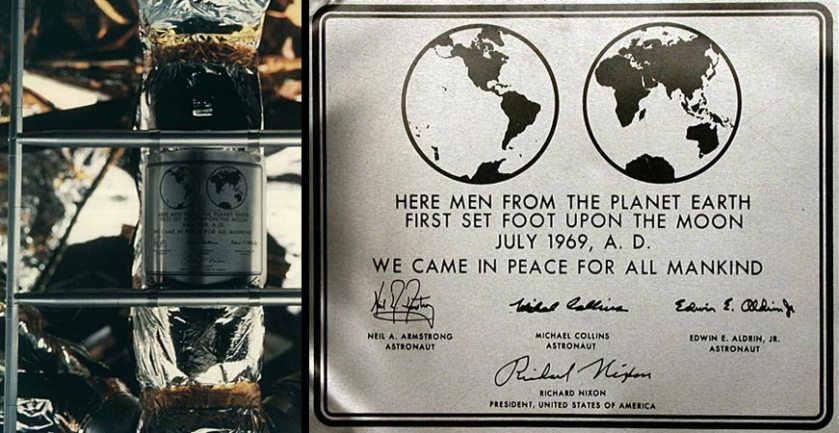
One was a plaque (photo, above) saying “Here men from the Planet Earth first set foot upon the Moon, July 1969 A.D. We came in peace for all mankind.” It bore the signature of the three astronauts –- Neil Armstrong, Edwin (Buzz) Aldrin, Jr., and Michael Collins –- and then US President Richard Nixon. Another was a golden olive branch.
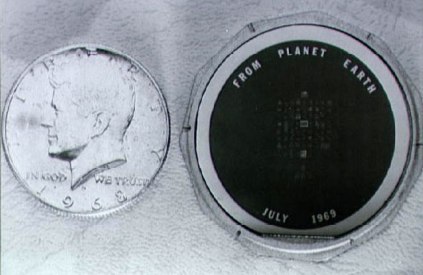
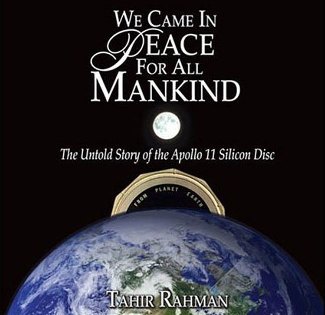
The silicon disc (right) next to a US 50 cents coin for comparison of sizeThese letters were received by NASA during the final weeks running up to the launch on 16 July 1969, yet this disc helped turn the Apollo 11 mission into an international endeavour.
It was only in June 1969 that the US State Department authorised NASA to solicit messages of goodwill from world leaders to be left on the Moon. This triggered a minor diplomatic frenzy, with invitations going out from Thomas O Paine, the NASA Administrator.
In all, 116 countries were contacted through their embassies in Washington DC, but only 73 responded in time. Sri Lanka, then Ceylon, responded. But for some unknown and unexplained reason, then Prime Minister Dudley Senanayake declined to send a message to the Moon.
When I first heard about it about 18 months ago, I was both intrigued and curious. Was it some misplaced geopolitical considerations, or simple diplomatic arrogance that led to Ceylon’s negative decision? After all these years, we might never find out.
I have now written this up in an article titled ‘How Sri Lanka Missed the Moon’, which appears this weekend in the mainstream media and online in two different versions.
Uncovering forgotten historyThe book documents the full story behind this little known facet of the very widely covered Apollo 11 mission. It also reproduces each of the 73 goodwill messages, as well as those which were received too late for inclusion on the disc.
“I was amazed at how NASA and the State Department rushed to get these messages before launch,” says Rahman. He took two months to locate from the Library of Congress the boxes in which NASA Administrator Paine had preserved the full correspondence.
While researching for this article, I contacted Rahman hoping for some additional insights, but he replied: “I do not have any information about why Sri Lanka did not send an Apollo 11 goodwill message.”
Sir Arthur C Clarke, with whom I worked for over 20 years, was also intrigued by Ceylon’s decision, which he didn’t know about until Rahman’s book reprinted the official letter. His only remark: “Mysterious are the ways governments think and work.”
Reading the messages, whose English translations are available online, is like entering a time capsule. Only two of the world leaders are still holding office (Queen Elizabeth II of Britain, and King of Thailand); most of them are dead. Some countries have since changed names. Others have been subsumed by neighbours, or broken into two or more independent states. Geopolitical map of the world has been completely redrawn.
The story of the Apollo 11 silicon disc is more a history and politics lesson, and less a science story. But I’m glad that I found a little known facet of the very widely covered Apollo missions to write about on its 40th anniversary.
Watch Tahir Rahman interviewed on Fox News network:
Walter Cronkite (1916 - 2009): The man who ruled American airwaves
Walter Cronkite, the broadcast journalist and newscaster who redefined television news of his generation, has just signed off for the very last time. A leading light in the history of moving images is gone. What a light…and what a voice.
The New York Times reported the loss as its front page lead: “Walter Cronkite, who pioneered and then mastered the role of television news anchorman with such plain-spoken grace that he was called the most trusted man in America, died Friday at his home in New York. He was 92.”
Cronkite was best known as anchorman for the CBS Evening News for 19 years (1962–81). He was at the helm at a time when television became the dominant news medium of the United States. His influence spread well beyond one network, one medium and one generation.
America's favourite uncle...Danny Schechter, the News Dissector and head of MediaChannel.org, said in a tribute: “He figuratively held the hand of the American public during the civil rights movement, the space race, the Vietnam war, and the impeachment of Richard Nixon.”
His own former network, CBS, noted in a tribute: “Known for his steady and straightforward delivery, his trim moustache, and his iconic sign-off line – ‘That’s the way it is’ – Cronkite dominated the television news industry during one of the most volatile periods of American history. He broke the news of the Kennedy assassination, reported extensively on Vietnam and Civil Rights and Watergate, and seemed to be the very embodiment of TV journalism.”
The New York Times report added: “On the day President John F. Kennedy was assassinated, Mr. Cronkite briefly lost his composure in announcing that the president had been pronounced dead at Parkland Memorial Hospital in Dallas. Taking off his black-framed glasses and blinking back tears, he registered the emotions of millions.”
Walter Cronkite announces death of President John F Kennedy: 22 November 1963
He is especially remembered for publicly opposing the Vietnam War. In 1968, he traveled to Vietnam, where he called the war a stalemate and advocated a negotiated peace. “If I’ve lost Cronkite, I’ve lost middle America,” President Lyndon B. Johnson said after seeing the broadcast, according to Bill Moyers, an aide to the president at the time.
In July 1969, Cronkite anchored the historic 32-hour CBS broadcast that covered the first Moon landing, which became the most widely watched live broadcast event worldwide up to that time. When Neil Armstrong stepped on the moon, Cronkite exclaimed, “Oh, boy!” — another rare show of emotion for the leading anchorman of his era who chose to keep his opinions separate from the news he covered and presented.
Cronkite missed the 40th anniversary of Apollo only by a few days. He will be sadly missed when astronauts and space buffs mark the event.
In this excerpt from for a 4-hour interview filmed for the Archive of American Television in 1998, Cronkite explains the origin of “That’s the way it is”– his signature sign-off:
The true professional he was, he never retired. Long after leaving CBS News, he remained fully active, engaged and supportive of good journalism in the United States and around the world. He lent his name to educational and charitable causes nurturing investigative journalism.
Danny Schechter writes in his blog: “In his later years, Walter Cronkite abandoned the pretense of only being above the fray and started speaking out as an internationalist for arms control and world federalism, and on many other global issues. He supported progressive causes but never too blatantly. He was very conscious of his image and reputation and identification with the media and power elite. He lived up the street from the United Nations and was often a speaker at UN events.”
Reproduced in full below is the endorsement Walter Cronkite gave our friends at MediaChannel.org, an online media activist group that keeps the spotlight on the media. In the dark during our own war, and in the days since the war ended, I have often found solace, inspiration and courage in his words.
* * * * * * Walter Cronkite On The Media And The MediaChannel.
Good evening, I’m Walter Cronkite. I really wanted to be with you in person tonight for Globalvision New Media’s launch of the new Internet site the Media Channel, but unfortunately I was called out of the country. Yet the issues that led to the creation of this unique global resource, and the crisis that’s facing all of us who work in and care about journalism and the media, are so profound that I simply felt compelled to tape this message so that you would know that I am with you in spirit at least.
As you know, I’ve been increasingly and publicly critical of the direction that journalism has taken of late, and of the impact on democratic discourse and principles. Like you, I’m deeply concerned about the merger mania that has swept our industry, diluting standards, dumbing down the news, and making the bottom line sometimes seem like the only line. It isn’t and it shouldn’t be.
We report, you decide...At the same time, I’m impressed that so many other serious and concerned people around the world are also becoming interested in holding media companies accountable and upholding the highest standards of journalism.
The Media Channel will undoubtedly be worth watching and taking part in. I am intrigued by its potential, and its global reach. The idea that so many leading groups and individuals around the whole world have come together to share resources and information about a wide range of media concerns is very promising, and I urge you to make the Media Channel your media ‘bookmark’ and your portal to the Internet.
I’m particularly excited about one aspect of the Media’s Channel’s work: its encouragement to people inside the media to speak up to speak out about their own experiences. Corporate censorship is just as dangerous as government censorship, you know, and self-censorship can be the most insidious form of pulling punches. Pressures to go along, to get along, or to place the needs of advertisers or companies above the public’s need for reliable information distort a free press and threaten democracy itself.
I’m pleased that the Media Channel opens an immediately available resource for media whistle-blowers. Anonymity will be protected, of course if their stories check out, of course. And, of course, are backed up with the facts.
We have all been supportive for years of dissidents around the world who take great risks to stand up for what they believe in. But here at home, in our own industry, we need to make it possible for people to speak out when they feel they’ve been wronged, even if it means shaming newsrooms to do the right thing. Journalists shouldn’t have to check their consciences at the door when they go to work for a media company. It ought to be just the reverse.
As I’ve said on other occasions, the strength of the American system is possible and can be nurtured only if there is lively and provocative dissent. In a healthy environment dissent is encouraged and considered essential to feed a cross-fertilization of ideas and thwart the incestuous growth of stultifying uniformity.
We need to encourage and support those among us who face either overt or covert threats or even a more subtle absence of encouragement to search out the truth. We all know that economic pressures and insecurities within news organizations have reduced the scope and range of investigative reporting. Sometimes projects are spiked with just a simple phrase: “It’s not for us.”
We’re always ready to speak out when journalists are at risk. But today we must speak out because journalism itself is at risk. That’s why I’m speaking out and reaching out to you tonight, to tell you that I like the idea of the Media Channel and want to encourage your participation.
And that’s the way it is.
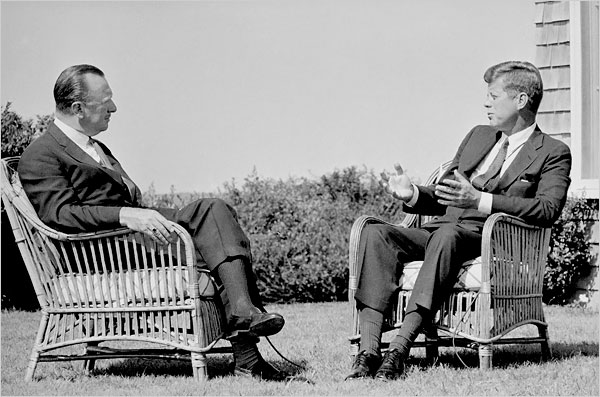
Walter Cronkite interviews President Kennedy - Photo courtesy Associated Press
She couldn't shatter the glass ceiling to space... Exactly 40 years ago, on 16 July 1969, Apollo 11 blasted off carrying three American astronauts to the Moon. Four days later, history was made when Neil Armstrong and Edwin (Buzz) Aldrin, Jr., become the first human beings to set foot on another celestial body, while their colleague Michael Collins circled the Earth.
When Armstrong stepped on the Moon, he said: “That’s one small step for man, one giant leap for mankind“. Man on the Moon was very much the news highlight of 1969, and at the time, the term ‘mankind’ was understood to include women as well. The more gender-neutral term ‘humankind’ would come into popular use some years later.
Beginning with Apollo 11, the Apollo programme landed a dozen astronauts on the Moon, all of who returned safely – as did the astronauts of the disaster-stricken mission, Apollo 13. Without exception, all of them were white and male. While they were all highly qualified, disciplined and trained men who had worked long and hard to earn their places in history, they did not fully represent the diversity of their nation, let along of the planet whose emissaries they were portrayed to be.
Women, celebrated across cultures as holding half the sky, took a long time to travel beyond the sky to outer space.
Although a Russian (Valentina Tereshkova) had become the first woman in space early on in 1963, it took the Americans another 20 years to have their first woman astronaut: Sally Ride, who traveled to Earth orbit on the Space Shuttle in June 1983.
A recent British documentary reveals how America could have sent a woman to the Moon during the Apollo programme. It reveals, belatedly, one of history’s great might-have-beens.
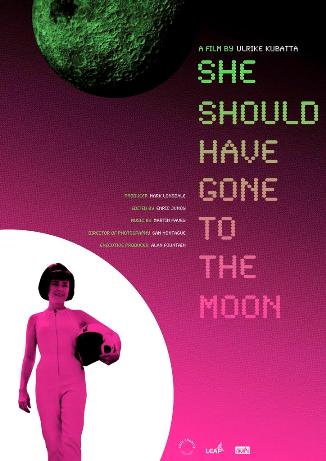
She Should Have gone To The Moon (58 mins, 2008), written and directed by Ulrike Kubatta isn’t quite story that the American space agency NASA would like to be reminded of as it marks Apollo 11’s 40th anniversary.
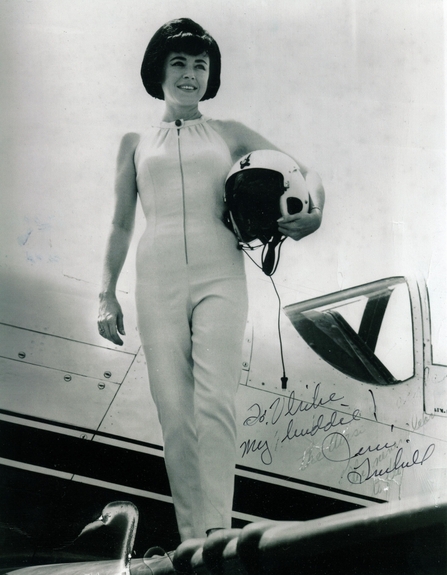
Jerri Truhill, astronaut in training: Not 'monkey enough' for men who ran NASA?The film tells the astonishing story of the pilot and pioneer, Jerri Truhill, who was trained in 1961, as part of NASA’s top secret Mercury 13 programme, to become on of the first woman astronauts. The documentary is a lyrical journey propelled by childhood aspirations, shattered dreams and a lifelong battle against female sterotypes and male prejudice.
Truhill tells how the women outperformed men in all the training tests (including water tank isolation) but how ultimately, the authorities, with the approval of President Johnson, stipulated that they would “rather send monkeys into space than a woman”.
In the film, the tough talking and sharp witted Jerri Truhill looks back at her compelling life via a phone call with the film-maker. This conversation becomes the catalyst for the director’s imagining of key events in Truhill’s potent narrative and inspires a journey to meet the heroine in Texas. Along the way the film-maker places herself in Truhill’s story, first wandering across the surreal landscape of White Sands and then suspended in zero gravity inside a water tank.
Included are staged scenes, dreamt-up moments from Truhill’s story, which evoke the popular melodrama of 1950s American cinema. These fictional moments bridge the gaps of time and distance between the filmmaker and her subject. Their stylised and dreamlike quality is counterpointed by shots from both Truhill’s and NASA’s film archive. The various strands produce the film’s heady timeline, as they circle through real and imagined spaces, past and present.
On LEEDVD.TV’s YouTube channel, I found this segment of another documentary named Rocket Girl, but Google does not bring up too much other info about this film.
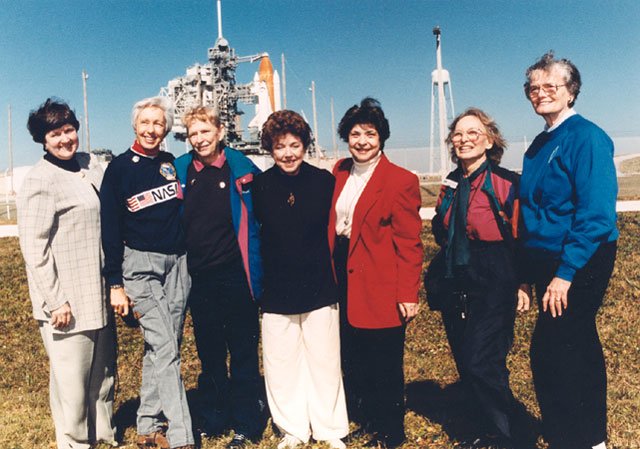
Seven of the “Mercury 13” gathered at the Kennedy Space Center in 1995. In the photo below, from left to right, are: Gene Nora Jessen, Wally Funk, Jerrie Cobb, Jerri Truhill, Sarah Rutley, Myrtle Cagle and Bernice Steadman. They came to watch Eileen Collins become the first woman to pilot a space shuttle. NASA has come a long way.
Mercury 13 women reunion in 1995 - NASA image
As I wrote in May 2009, the path-breaking TV series Star Trek, which started airing on television in the US in September 1966, was way ahead of reality. When neither the mainstream television nor the space programme reflected America’s true diversity, Star Trek created a multi-ethnic crew for the Starship Enterprise, roaming the universe in the 23rd century. It included an African-American woman, a Scotsman, a Japanese American, and a super intelligent alien, the half-Vulcan Spock.
Reality took a long time catching up. It was only in August 1983 that Guion “Guy” Bluford, Jr., became the first black American astronaut. Another nine years passed before Dr. Mae Jemison became the first African-American woman to go to space, when she joined a Space Shuttle mission in September 1992. In fact, she cited Star Trek character Uhura as an influence in her decision to pursue a career in space.
Multi-cultural crews did not become commonplace until the late 1990s, when the International Space Station became operational. Space travel has yet to reach the utopian ideals of Star Trek.
Images related to ‘She should have gone to the Moon’ courtesy Ulrike Kubatta. Other images courtesy NASA
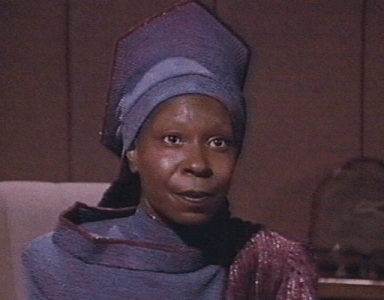
Actress Whoopi Goldberg was a child of 10 when the original series of Star Trek started its first broadcast on NBC in the US in September 1966. The futuristic science fiction series – about a spaceship travelling across space and time in the 23rd century in search of new civilisations – was to leave a lasting impression on many members of her generation.
In Whoopi’s case, it went beyond just general inspiration. Something in the show seemed incredible to the African-American child growing up in a land where colour and race were still divisive factors. She recalls running around the house, screaming: “Hey mom, look! There’s a negro woman on TV — and she ain’t cooking dinner!”.
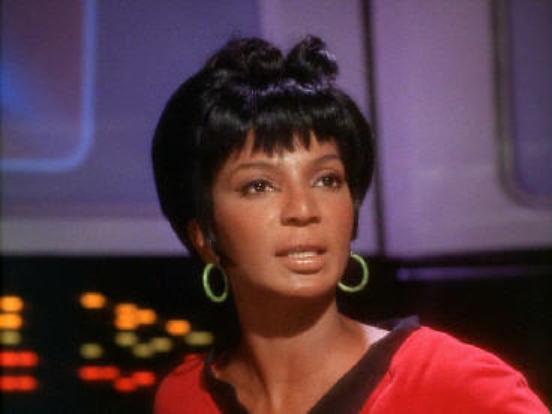
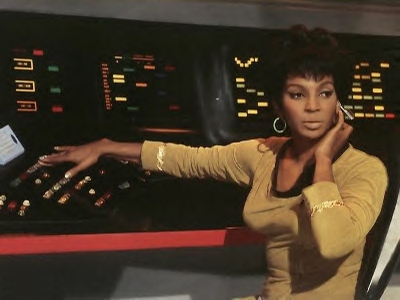
‘That woman’ was the character Nyota Uhura, played by Nichelle Nichols. This anecdote is captured in the 1997 documentary Trekkies, which explored the global fandom inspired by the show, which has gone on to become a franchise covering several TV series, 11 feature films (including the latest ‘origins’ film released on 8 May 2009), an animation series, as well as numerous books, video games and computer games. As Forbes magazine once noted, the allure is comparable only to that of Star Wars.
Sometimes, less is more!Uhura featured as the communications officer on board the USS Enterprise in Star Trek: The Original Series, Star Trek: The Animated Series, and the first six Star Trek films. She is significant as one of the first major black characters on an American television series and for engaging in a then-taboo interracial kiss with Captain James T. Kirk (William Shatner). In the 2009 film, a younger Uhura is portrayed by actress Zoë Saldana.
The inclusion of Uhura, a black woman, in a critical technical position was certainly idealistic in the mid 1960s when the American civil rights movement was still agitating for equal rights for African Americans. She one of the first black women featured in a major television series not playing a servant; her prominent supporting role as a female black bridge officer was unprecedented.
As I’ve just noted in another blog post: “At a time when there were few non-white or foreign roles in American television dramas, Gene Roddenberry created a multi-ethnic crew for the Enterprise, including an African woman, a Scotsman, a Japanese American, and—most notably—an alien, the half-Vulcan Spock. In the second season, reflecting the contemporaneous Cold War, Roddenberry added a Russian crew member.”
But was the character, donning a sexy mini skirt uniform, somewhat tokenistic? Perhaps. But it still had considerable inspirational value – which is never to be under-estimated.
In fact, after the first season of Star Trek, Nichols had become frustrated at her relative lack of lines. At one point, she considered quitting the show, but was talked out of this decision by the civil rights leader Dr Martin Luther King, Jr.. MLK told her that a show that depicted a black woman working alongside whites in a position of importance was important for the goal of racial equality.
Another version of the story has MLK telling Nichols that he was a big fan of the series, and she “could not give up” since she was playing a vital role model for black children and young women across the country. It is also often reported that Dr. King added that “Once that door is opened by someone, no one else can close it again.”
After NBC executives cancelled Star Trek in 1969, Nichols went on to star in other roles — and also worked for NASA in a campaign to encourage African Americans to join the space service. Among those she helped recruit was Dr. Mae Jemison, the first African-American woman to fly aboard the Space Shuttle, in September 1992. Jemison has cited Star Trek as an influence in her decision to pursue a career in space.
Goldberg: From inspiration to a regular roleMeanwhile, things came full circle for actress Whoopi Goldberg, who was to get her own regular role in Star Trek: The Next Generation whose original run lasted from 1987 to 1994. In this successor series, she played the recurring El-Aurian female character Guinan.
Things have also moved on in the real world, where Barack Obama is now the President of the United States, with Michelle Obama as one of the most influential – if not powerful – women in the world. On 28 April 2009, CNN ran a story titled Why Michelle Obama inspires women around the globe. It noted: “Those who focus on Michelle Obama’s impact on America are underestimating her reach. The first lady is inspiring women of color around the globe to look at themselves, and America, in fresh ways.”
There is no linear link between Nyota Uhura and Michelle Obama, and the real world has very far to go to reach the utopian ideals of Star Trek. But the very fact that we have the Obamas where they are is an assurance that things can slowly move towards Gene Roddenberry’s grand vision.
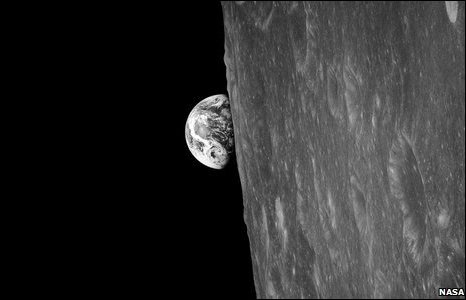
Earthrise: Apollo 8's enduring legacy (image courtesy NASA)
I can never have enough of this photo — the first ever snapshot of Earth.
This photo of “Earthrise” over the lunar horizon was taken by the Apollo 8 crew on Christmas eve 1968, showing Earth for the first time as it appears from deep space. It forever changed how humans look at – and feel about – their home planet.
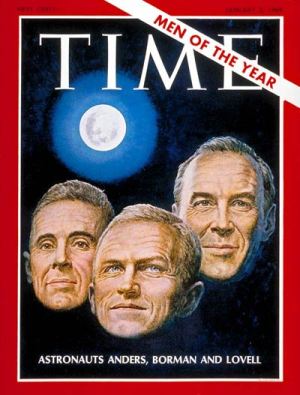
And here’s the best part: this image was captured by accident! In all the meticulous planning for the Apollo 8 mission, no one had anticipated or thought about it. All attention was on the Moon itself, which humans would be viewing at such close range for the first time. None of the astronauts on board Apollo 8 – Mission Commander Frank Borman, Command Module Pilot James Lovell and Lunar Module Pilot William Anders – were ready for the opportunity to witness their own Earthrise.
And if they had stuck to the mission plan, and not acted spontaneously, this image might never have been captured at the time it was.
Earth's photographers frozen in TIME... As Apollo historian and film-maker Dr Christopher Riley recalled on the 40th anniversary of this remarkable event a few days ago:
For the first three orbits, preoccupied by the Moon and their latest TV broadcast, the spacecraft was not orientated to give them a chance to see the Earth. But as Apollo 8 nosed its way back from the far side of the Moon for the fourth time, one of the crew spotted the view by chance from a window, his reaction captured by the on board tape recorder.
“Oh, my God! Look at that picture over there!” he exclaimed. “Isn’t that something…”
After a quick joke about the fact that it was not in their flight plan to photograph it, the crew abandoned protocol and scrambled to get a snap of the occasion with their stills camera.
The Hasselblad only had a black and white film magazine in, resulting in the image (below) – the first photograph of Earthrise taken by a human as he watched it happen.
The first Earthrise ever photographed; a colour photograph followed minutes later
But this first historic picture is rarely reproduced. Not content with this first monochromatic image, the astronauts rushed to find a colour film, and Bill Anders managed to snap two more frames which became the choice of photo editors for the rest of history.
Apollo 8 was an important prelude to actually landing on the Moon (which took place in July 1969). It achieved many firsts — including the first manned launch from NASA’s new Moonport, first manned mission to leave the earth’s gravitational field and reenter the earth’s atmosphere at tremendous speeds, first pictures taken by humans of the Earth from deep space, and first live TV coverage of the lunar surface. A Christmas Eve reading from the book of Genesis from Apollo 8 was heard by an estimated 2 billion people, the biggest TV audience in history.
Some might consider Apollo 8 as no more than a technological rehearsal to the eventual landing on the Moon, by astronauts of Apollo 11, but the images of Earthrise have had far-reaching implications. The rise of the global environmental movement in the 1970s was partly inspired by this new perspective of our planet. In his Oscar-award winning film An Inconvenient Truth, Al Gore acknowledges this as he sets the stage with a series of images of Earth in space, helping us to appreciate the beauty and fragility of our planet in distress.
In an op ed essay to mark the 40th anniversary, Oliver Morton wrote in the New York Timeson 24 December 2008: “The photograph of that earthrise by the astronaut Bill Anders forms part of the Apollo program’s enduring legacy — eclipsing, in many memories, any discoveries about the Moon or renewed sense of national pride. It and other pictures looking back at the Earth provided a new perspective on the thing that all humanity shares. As Robert Poole documents in his history, ‘Earthrise: How Man First Saw the Earth‘, that perspective had deep cultural effects, notably in the emotional resonance it offered the growing environmental movement. Seen from the Moon, the Earth seemed so small, so isolated, so terribly fragile.”
He goes on to argue that the planet is not as fragile or vulnerable as some suggest. But he ends with these words: ““Earthrise” showed us where we are, what we can do and what we share. It showed us who we are, together; the people of a tough, long-lasting world, shot through with the light of a continuous creation.”
The lessons of Earthrise images have been on other people’s minds as the anniversary passed. On his informative blog Dot Earth, New York Times reporter Andrew C. Revkin recently asked his readers to share what the Earthrise images meant to them. He has received a wide range of comments from people as diverse as former astronauts, scientists, school teachers and children.
Watch Jim Lovell & Apollo 8: Christmas Eve Heard Round the World – WGN (Chicago)’s producer Pam Grimes takes a look back at the 1968 Apollo mission through the eyes of astronaut Jim Lovell:
And here is how NASA Television looked back at their historic mission, 40 years later. In this video Astronauts Frank Borman, James Lovell and Bill Anders recount man’s first voyage around the moon:
One final comment: The world is grateful to NASA, America’s space agency, for adopting from the early days of space exploration a far-sighted, public spirited policy that all its space images are made available free of copyrights to anyone, anywhere on the planet. This is what enables me to use space images on my blog – and keeps tens of thousands of such images in the public domain. Space agencies of other countries, also funded by tax-payer money, have been far less generous when it comes to sharing copyrights. The Heavens may be free, but some images of it are not.
Read my October 2007 blog post: No copyright on this planet – thank Heavens (and NASA) for that!
The tsunami was triggered by a massive quake that erupted off the coast of Sumatra, and 6 miles deep under the Indian Ocean’s seabed. The estimated 9.1 to 9.3 magnitude earthquake was the strongest in 40 years and the fourth largest in a century. The U.S. Geological Survey later estimated that the amount of energy released was equivalent to the energy of 23,000 Hiroshima-type atomic bombs.
Despite a lag of up to several hours between the earthquake and the impact of the tsunami, nearly all affected people were taken completely by surprise. There were no tsunami warning systems in the Indian Ocean to detect tsunamis or to warn those living on the Indian Ocean rim areas. This cost the lives of over 225,000 people in 11 countries — many of who could have lived if only they had a timely warning to rush inland.
In the past four years, there have been various efforts to set up such early warning systems – as well as effective ways to deliver credible warnings to large numbers of people quickly. These are meant to provide 24/7 coverage to Indian Ocean countries in the same way the Pacific Tsunami Warning Centre has been covering Pacific Ocean countries for many years.
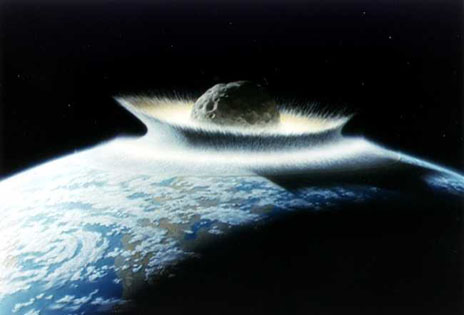
All this is necessary – but not sufficient – to guard ourselves against future tsunamis. For it’s not just earthquakes undersea that can trigger tsunamis. An asteroid impact could trigger the mother of all tsunamis that can impact coastal areas all over the planet.
An asteroid that struck the Earth 65 million years ago wiped out the dinosaurs and 70 per cent of the species then living on the planet. The destruction of the Tunguska region of Siberia in June 1908 – whose centenary was marked this year – is known to have been caused by the impact of a large extraterrestrial object.
Space artist David Hardy's vision...When discussing the possible consequences of asteroid impacts on Earth, more attention has been given to the destruction it can cause by such a falling piece of the sky hitting inhabited areas of land. Some people seem to be comforted by the fact that two thirds of the planet’s surface is ocean — thus increasing changes that an impact would likely happen at sea.
In fact, we should worry more. Duncan Steel, an authority on the subject, has done some terrifying calculations. He took a modest sized space rock, 200 metres in diameter, colliding with Earth at a typical speed of 19 kilometres per second. As it is brought to a halt, it releases kinetic energy in an explosion equal to 600 megatons of TNT — 10 times the yield of the most powerful nuclear weapon tested (underground). Even though only about 10 per cent of this energy would be transferred to the tsunami, such waves will carry this massive energy over long distances to coasts far away. They can therefore cause much more diffused destruction than would have resulted from a land impact. In the latter, the interaction between the blast wave and the irregularities of the ground (hills, buildings, trees) limits the area damaged. On the ocean, the wave propagates until it runs into land.
Scientists have been talking about asteroid impact danger for decades. Arthur C Clarke suggested – in his 1973 science fiction novel Rendezvous with Rama – that as soon as the technology permitted, we should set up powerful radar and optical search systems to detect Earth-threatening objects. The name he suggested was Spaceguard, which, together with Spacewatch, has now been widely accepted.
In November 2008, a group of the world’s leading scientists urged the United Nations to establish an international network to search the skies for asteroids on a collision course with Earth. The spaceguard system would also be responsible for deploying spacecraft that could destroy or deflect incoming objects.
The group – which includes the Royal Society president Sir Martin Rees and environmentalist Sir Crispin Tickell – said that the UN needed to act as a matter of urgency. Although an asteroid collision with the planet is a relatively remote risk, the consequences of a strike would be devastating.
Not if, but when...The International Panel on Asteroid Threat Mitigation, chaired by former American astronaut Russell Schweickart, urged: “The international community must begin work now on forging three impact prevention elements – warning, deflection technology and a decision-making process – into an effective defence against a future collision.”
This is exactly the message in an excellent documentary called Planetary Defence made by Canadian filmmaker M Moidel, who runs the Space Viz production company. Over the past many months, the film has been screened at the United Nations, on various TV channels and at high level meetings of people who share this concern.
Its main thrust: Scientists and the military have only recently awakened to the notion that asteroid impacts with Earth do happen. Planetary Defense meets with both the scientific and military communities to study our options to mitigate an impact. It makes the pivotal point: “Civilization is ill prepared for the inevitable. It’s not if an impact will happen with the Earth, it’s when!”
In such an event, the film asks, who will save Earth? The 48 minute documentary explores the efforts underway to detect and mitigate an impact with Earth from asteroids and comets, collectively known as NEO’s (Near Earth Objects).
Watch the trailer of Planetary Defence on YouTube:
Neil deGrasse Tyson, Astrophysicist and Director, American Museum of Natural History, in New York, says: “Planetary Defense, the film, is a documentary that explores how ill-prepared we are to prevent our own extinction from asteroid and comet impacts. Filmmaker M Moidel interviewed all the right people, asked them all the right questions, and leaves the viewer scared for our future, but empowered to do something about it.”
Although we have never met, I have been in email contact with M Moidel for several years. I know how deeply committed he is to each of his documentary projects. Working on incredibly tight budgets and performing multiple tasks on his own, this brilliant Canadian has made some eminently accessible, timely and captivating documentaries on ‘big picture’ topics such as the search for intelligent life in the universe, the future of space exploration and, of course, coping with asteroid impacts.
Sir Arthur, whose Sri Lankan diving school was destroyed by the 2004 tsunami, wrote a few days after the disaster: “Contrary to popular belief, we science fiction writers don’t predict the future — we try to prevent undesirable futures. In the wake of the Asian tsunami, scientists and governments are scrambling to set up systems to monitor and warn us of future hazards from the sea.
“Let’s keep an eye on the skies even as we worry about the next hazard from the depths of the sea.”
No, this had nothing to do with religion, a notion Clarke publicly dismissed as a dangerous ‘mind virus’. Rather, it’s the prospect of life elsewhere in the cosmos – an idea that always fascinated him, and on which he wrote many stimulating stories and essays.
“I would like to see some evidence of extra-terrestrial life,” Clarke said, wistfully. “I have always believed that we are not alone in the universe. But we are still waiting for ETs to call us – or give us some kind of a sign. We have no way of guessing when this might happen – I hope sooner rather than later!”
Watch the video on TVE Asia Pacific channel on YouTube:
That ultimate ‘call’ never arrived in time for Clarke. And we have no way of telling which of his wishes would materialize first (the other two being adopting clean energy sources worldwide, and achieving peace in Sri Lanka, where he lived for over half a century).
When it came to ETs, Clarke had a good idea of the probabilities of a positive result in his own lifetime. He knew how it had eluded at least four generations of seekers, including the inventor of radio telegraph itself.
Accepting the Marconi Prize and Fellowship in 1982, Clarke recalled how Guglielmo Marconi had been interested in this prospect. He quoted from a letter he (Clarke) had written to the editor of the BBC’s weekly magazine, The Listener, in February 1939: “…On other planets of other stars there must be consciousness; on them there must be beings with minds…some far more developed than our own. Wireless messages from such remote conscious beings must be possible.”
The letter, sent via the then fledgling British Interplanetary Society, ended as follows: “The only time I met Marconi, he told me of his search for such messages. So far, we have failed to find them.”
After a century of radio and 60 years since its inventor’s death, such proof has yet to be found. However, as Carl Sagan – possibly the best known proponent of the subject – was fond of saying, the absence of evidence is not evidence of absence.
Clarke himself is widely attributed as saying: “Sometimes I think we’re alone in the universe, and sometimes I think we’re not. In either case the idea is quite staggering.”
Clarke not only wrote and talked passionately about the subject for decades, but also supported – in cash and kind – various groups engaged in the search for extra-terrestrial intelligence, or SETI.
“SETI is the most important quest of our time, and it amazes me that governments and corporations are not supporting it sufficiently,” he said in a 2006 letter supporting public donations to the SETI@Home project at the University of California, Berkeley.
In the early 1990s, he applauded Steven Spielberg, director of ET: The Extra-Terrestrial (1982) for donating US$ 100,000 to SETI efforts. “It seems only appropriate that Steven…should put his money where his mouth is,” Clarke noted.
Clarke welcomed ET‘s box office success, as it departed from the Hollywood tradition of depicting aliens as malevolent. By showing a highly intelligent being as both benign and vulnerable, the movie stretched the public’s imagination to consider other possibilities. Not all aliens would arrive here to take over our world -– or to serve humanity, medium rare…
But Clarke realised how the vastness of space would make inter-stellar travel difficult and infrequent. It was more likely that signals from advanced alien civilisations would roam the universe at the speed of light.
Together with his long-time friend Carl Sagan, Clarke explored the philosophical implications of SETI – and its eventual success. It should be the concern of every thinking person, he said, “because it deals with one of the most fundamental questions that can possibly be asked: what is the status of Homo sapiens in the cosmic pecking order?”
Clarke believed the detection of intelligent life beyond the Earth would forever change our outlook on the Universe. “At the very least, it would prove that intelligence does have some survival value – a reassurance that is well worth having after a session with the late night news.”
Clarke speculated that ETs may be continuously broadcasting an easily decoded “Encyclopaedia Galactica” for the benefit of their less advanced neighbours. “It may contain answers to almost all the questions our philosophers and scientists have been asking for centuries, and solutions to many of the practical problems that beset mankind.”
He was sometimes ambivalent about the value of such an influx of new knowledge, noting that even the most well intentioned contacts between cultures at different levels of development can have disastrous results – especially for the less advanced ones. He recalled how a tribal chief once remarked, when confronted with the marvels of modern technology: ‘You have stolen our dreams’.
But Arthur C Clarke the perennial optimist continued: “I believe that the promise of SETI is far greater than its perils. It represents the highest possible form of exploration. And when we cease to explore, we’ll cease to be human.”
Clarke’s interest in ETs remained undiminished to the end. In his last media interview, given to IEEE Spectrum in January 2008 from his hospital bed in Colombo, Sri Lanka, he said: “I’m sure the ETs are all over the place. I’m surprised and disappointed they haven’t come here already… Maybe they are waiting for the right moment to come.”
He added, with a chuckle: “And I hope they are not hungry!”
The world’s best known writer of science fiction, Sir Arthur C Clarke turns 90 on 16 December 2007. Scientific, literary and media communities around the world plan to mark this event.
In this 9 minute video, the visionary writer, explorer and science populariser looks back at his illustrious career spanning nearly 70 years and notes: “Growing up in the 1920s and 1930s, I never expected to see so much happen in the span of a few decades.”
He offers a quick assessment of two sectors where he has left his mark: space travel and communications technology. Ever the optimist, he believes that the best is yet to come in both areas.
“I still can’t quite believe that we’ve just marked the 50th anniversary of the Space Age,” Sir Arthur says. “We’ve accomplished a great deal in that time, but the ‘Golden Age of Space’ is only just beginning.”
Noting that good communications are necessary, but not sufficient, for human progress, he makes a strong plea for tolerance and compassion to achieve greater understanding between peoples and nations. To him, true globalization would require overcoming “our tribal divisions and begin to think and act as if we were one family”.
In the video, which we recorded in Colombo in the first week of December, Sir Arthur mentions three personal wishes – proof of life outside the Earth, clean energy to overcome global warming, and peace in Sri Lanka, his adopted country.
He ends the message indicating his preferred legacy: “I want to be remembered most as a writer – one who entertained readers, and, hopefully, stretched their imagination as well.”
In a technical paper written in 1945, Clarke was the first to propose the idea of communications satellites, which have today become a global industry supporting broadcast and telecommunications needs. One of his short stories inspired the World Wide Web, while another was later expanded to make the movie 2001: A Space Odyssey, which he co-wrote with director Stanley Kubrick. He has lived in Sri Lanka since 1956.






 Open Minds!