The book, co-edited by Rohan Samarajiva (in photo, below) and Ayesha Zainudeen, is published jointly by Sage Books and Canada’s IDRC. It is based largely on the work of my friends and colleagues at LIRNEasia.
Although the book showcases recent telecom and ICT reform experiences in five economies in South and Southeast Asia (Bangladesh, India, Indonesia, Nepal and Sri Lanka), my review takes a closer look at the Sri Lankan situation partly because I live and work there, and because the review was intended more at a Sri Lankan readership.
Here’s my opening:
“In the early 1990s, I had to wait for nearly six years for my first (fixed) telephone – I refused to pay bribes or use ‘connections’ to bypass thousands of others on the notorious waiting list. Earlier this year, when I bought an extra mobile phone SIM from Dialog GSM, it took six hours for the company to connect it. I found that a bit too long.
“How things have changed! Connectivity without (social) connections, and practically off-the-shelf, is now possible in most parts of Sri Lanka. Telecommunications is the fastest growing sector in the economy, recording 47 per cent growth in 2007 (and 58 per cent in 2006). The country’s tele-density (number of telephones per 100 persons) jumped to 54 in 2007, from 36 at the end of 2006 -– thanks largely to the phenomenal spread of mobile phones, which now outnumber fixed phones by three to one.”
In my review, I make the point: “It was a stark reminder, if any were needed, of the turbulent settings and often paranoid times in which telecom liberalisation has been taking place in many parts of emerging Asia.”
And I return to the larger political reality in my conclusion, as follows: “Now that the ICT genie has been set loose, it’s impossible to push it back into the dusty lamp of the monopolist past, even under that much-abused bogey of ‘national security’ (or its new, freshly squeezed version, ‘war against terror’). Despite this, the officialdom and its ultra-nationalist cohorts don’t give up easily. While this book was in ‘state custody’, Sri Lankans experienced the first government-sanctioned blocking of mobile phone SMS – ironically on the day marking 60 years of political independence.”
Photo below shows several contributing authors at the book’s launch in Chennai in December 2007
On this World Telecommunication and Information Society Day (May 17), I have a confession to make. I carry a murder weapon on my person every day and night, and I go to bed with it next to me within easy reach. I rely on it for my work, my leisure and my pleasure. And I won’t part with it under any circumstances.
I’m talking about the humble and increasingly ubiquitous mobile phone, now the world’s most widely used and fastest spreading consumer technology item.
And if any paranoid law enforcement agency worries about its murder potential…relax, people – we are talking figuratively here!
How come it’s a murder weapon when it has no sharp edges and is too light weight to do much damage?
What the mobile has already stabbed, and is in the process of effectively finishing off, is the development sector’s over-hyped and under-delivered phenomenon called the ‘telecentre’.
For those outside the charmed development circles (which is most of humanity), the Wikipedia describes telecentre as “a public place where people can access computers, the Internet and other digital technologies that enable people to gather information, create, learn and communicate with others while they develop essential 21st century digital skills.”
So how is the mobile phone slowly killing the telecentres, into which governments, the United Nations agencies and other development organisations have pumped tens of millions of dollars of development aid money in the past decade?
Well, it’s rapidly making telecentres redundant by putting most or all of their services into literally pocket-sized units. If everyone could carry around a miniaturised, personalised gadget that has the added privacy value, why visit a community access point?
At least this is the persuasive point made by LIRNEasia researcher Helani Galpaya, who made a presentation in September 2007 at the Annenberg School for Communication in the US.
She argued that, although telecentres, which have become the bright “stars” in many e-development programs in Asian countries, do have a role to play in providing ‘higher’-end citizen services to people at the bottom of the pyramid (BOP) in India, Sri Lanka, Pakistan, Philippines and Thailand, telephones are the cheaper, immediate and ubiquitous tool for Asian governments to inform, transact and interact with almost 400 million of their most needy citizens.
And in these emerging Asian economies, when we talk of telephones it’s predominantly mobiles. In my native Sri Lanka, for example, there were 10.7 million phone subscribers by end 2007 – of them, almost 8 million were mobile users. Mobiles outnumber fixed phones by 3 to 1, and the disparity continues to widen.
The song has been the subject of various parodies, and Helani’s isn’t the first or last. But in this instance, I would heartily cheer the rapid demise of the telecentre, which is both conceptually and operationally flawed in many developing countries where it has been tried out. (While at it, let me repeat something that baffles me: how is it that not a single development donor or UN agency foresaw the phenomenal rise of mobile phones in the majority world, and instead bet all their ICT money on computers and internet? And why can’t some of them still appreciate the potential of mobiles, keep harping on obsolete telecentres and other troubled initiatives like One Laptop Per Child?).
It’s also worth noting that hard core development activists were initially against mobile phones, arguing instead for more public payphones, especially in rural areas. Only very recently have they started acknowledging that, just maybe, mobile phone can create or improve jobs, generate incomes and move millions out of poverty. In the humanitarian sector, as I wrote in October 2007, aid workers are still uncertain how to make best use of mobiles in their relief work.
Why are mobile phones somehow not ‘sexy enough’ for these men and women in suits who typically look at our real world problems from 33,000 feet above the ground?
But hey, why bother with doomed concepts like telecentres, when we can instead discuss about the lively and vibrant mobiles? (When the telecentres finally die after being kept on life support by gullible aid donors for a few more years, I hope to write a suitable obituary.)
Meanwhile, who’s afraid of mobile phones except the failed prophets of development and unimaginative humanitarian workers? There’s a handful of crusty, old fashioned people, usually those who can’t figure out just how to use the new fangled devices that do a lot more than just talk. Then there are tyrannical governments who fear the power of instant communication being in the hands of their own people.
The rest of us have now adjusted to Life After the Mobile Arrived. We may love it, or love to hate it — but can we imagine life without it?
The film’s synopsis reads:
With the next billion telecom users expected mainly from the emerging markets, we urgently need to understand telecom use, especially at the bottom of the pyramid. Who is using what devices for which purposes — and how much are they willing or able to pay? Capturing highlights of LIRNEasia’s 2006 survey in India, Pakistan, the Philippines, Sri Lanka and Thailand, this film shows that when it comes to phone use, the poor are not very different from anyone else.
Teleuse@BOP Part 1 of 2
Teleuse@BOP Part 2 of 2
And now, just when you think I’m a harmless mobile junkie, here’s my real confession:
I own more than one mobile phone (hey, doesn’t everybody?) and stashed away in my travel bag I have a collection of SIM cards with active mobile accounts in half a dozen Asian countries that I visit regularly.
One day soon, when there are enough people like myself moving across jealously guarded political borders, those ITU statistics on ICTs would become seriously skewed….
The leading Indian newspaper The Hindu has just published (on 4 May 2008) my article on the future of food, based on the views of Sir Arthur C Clarke. It can be found here.
I originally wrote this article in mid 2000, based on an interview with the late Sir Arthur Clarke. It was produced at the request of the UN Food and Agriculture Organisation (FAO), which included it in an information pack to mark World Food Day in October that year. No doubt they circulated it among the charmed development circle, but as far as I know (or Google can find), it never appeared in a public media outlet – until now.
I came across this in the weeks following Sir Arthur’s death on March 19, when I was going through manuscripts of our collaborative essays and my interviews with him over the years. The Hindu‘s Sunday Magazine, which earlier printed my essay on Sir Arthur’s views on nuclear weapons in South Asia, agreed to publish it, which they did on 4 May 2008.
The essay, written in Sir Arthur’s first person narrative, makes a number of points that are very relevant to discussions on today’s global food crisis. In fact, these points are more valid today than when they were first made eight years ago.
An extract:
“Meeting everybody’s basic nutritional needs requires a combined approach of the mind and heart – of intellect and compassion. How can we explain the fact that one sixth of humanity goes to bed hungry every night, when the world already produces enough food for all?
“The short answer is that there are serious anomalies in the distribution of food. Capricious and uncaring market forces prevent millions of people from having at least one decent meal a day, while others have an abundance. For the first time in history, the number of severely malnourished persons now equals the number suffering from over-consumption: about a billion each!
“To adapt a remark that my late friend Buckminster Fuller once made about energy: there is no shortage of food on this planet; there is, however, a serious shortage of intelligence. And, I might add, compassion.
Sir Arthur then runs up his famous ‘crystal ball’ to gaze at the near and far future on how humanity can feed itself without damaging the planet. He offers some useful lateral thinking and suggests some unlikely new sources of food.
But all these are short term solutions, he says, because “eventually, the matter will be resolved when we are able to synthesise all the food we ever need, thus no longer depending on other animals to satisfy our hunger.”
Towards the end of the essay, he takes the big picture view:
“Improved communications and the free flow of information will not, by themselves, eradicate either hunger or poverty — but they can be instrumental in the struggle to create a world without these. And when the world’s collective conscience finally succeeds in mobilising sufficient political will and resources to banish those twin scourges, we will be left with another, far more insatiable but far less destructive substitute — the hunger for knowledge and wisdom.”
Today, May 3, is World Press Freedom Day. Proclaimed by the UN General Assembly in 1993, the day is celebrated each year on May 3 — the anniversary of the Declaration of Windhoek, a statement of free press principles put together by African newspaper journalists in 1991.
I’m holed up in a hotel in Singapore this whole weekend, attending the annual Board meeting of Panos South Asia, which works to promote greater public discussion and debate on development issues through the media. Our Board is drawn from Bangladesh, India, Nepal, Pakistan and Sri Lanka and includes leading journalists, publishers and social activists.
I’ve been busy preparing for and attending the intensive Board meeting that I’ve not had the time to do an original blog post on this important day. So like any resourceful journalist, I’m doing the second best thing – ‘recycling’ some material that I was recently associated with in producing.
First, here’s an extract from a chapter that I invited Sri Lankan ICT activist Sanjana Hattotuwa to write for Communicating Disasters: An Asia Pacific Resource Bookthat I edited last year. Sanjana traces the growing role played by digitally empowered citizens while disasters unfold as well as after disasters have struck. He then turns attention to the wider and more generic challenges faced by citizen journalists everywhere, especially in countries where democracy is under siege:
Who’s Afraid of Citizen Journalists?
But is it all good and positive? Put another way, merely because we now have access to a hundred times more content on a disaster than before does not mean that we get any closer to understanding it or responding to it.
Information overload is a real problem, as is the subjectivity of citizens, who only capture what they feel is important and often ignore aspects to a disaster beyond their own comfort zone and prejudices. There is still no widely accepted standard for citizen journalists, though organizations such as the Centre for Citizen Media are actively working towards such standards .
There are other challenges associated with citizen journalism, especially in a context of violent conflict. This author receives vicious hate mail, suffers public insults, is branded a ‘terrorist’ and even receives the occasional death threat – all because of the content he promotes on the citizen journalism websites he edits.
Not all citizens, even when they can do so and have access to digital devices, record disasters or human rights abuses – especially when their own security could be compromised for having done so. Governments can also clamp down hard on citizen journalism. The French Constitutional Council approved a law in early 2007 that criminalizes the filming or broadcasting of acts of violence by people other than professional journalists. The law could lead to the imprisonment of eyewitnesses who film acts of police violence, or operators of Web sites publishing the images. Sri Lanka unofficially banned a pro-Tamil nationalist website in 2007 and regularly cuts off mobile phone and Internet services in the North and East of the country.
Scared by the potential for embarrassment, political debacles and popular uprisings, countries such as Egypt, Iran, Cuba, North Korea and China vigorously censor and monitor content on blogs and exchanges through SMS, prompting Julien Pain, head of the Internet freedom desk at Reporters Without Borders (RSF) to note: “… all authoritarian regimes are now working to censor the Web, even countries in sub-Saharan Africa. The Ethiopian regime of Prime Minister Meles Zenawi has blocked openly critical Web sites and blogs since May 2006, and President Robert Mugabe of Zimbabwe is considering a law allowing security forces to intercept online messages without reference to the courts. One of the first moves by Thailand’s military rulers after their September (2006) coup was to censor news Web sites, even foreign ones, that criticized the takeover.”
The second extract is from my own recent essay under the above title, which was published by the Asia Media website managed by the University of California Los Angeles (UCLA). In this piece, written only a few weeks ago, I comment on a disturbing new threat to media freedom in my native Sri Lanka: misguided citizen vigilantes suspecting and attacking professional journalists engaging in their legitimate news and/or image gathering work in public places. When accredited journalists are affected by this paranoia, I point out how much more difficult it is for citizen journalists who lack the institutionalised media behind them.
Public interest blogging in Sri Lanka has been growing slowly but steadily since the Indian Ocean tsunami of December 2004, which marked a turning point for citizen journalism. According to researcher and new media activist Sanjana Hattotuwa, citizen journalists are increasingly playing a major role in meaningfully reporting deaths, the humanitarian fallout and hidden social costs of violent conflict that are often glossed over or sensationalised by the mainstream media.
Hattotuwa acknowledges, however, that the ready availability of information and communication technologies (ICTs) does not guarantee public-spirited citizen journalism.
“In Sri Lanka, the significant deterioration of democracy in 2006-2007 has resulted in a country where anxiety and fear overwhelm a sense of civic duty to bear witness to so much of what is wrong. No amount of mobile phones and PCs is going to magically erase this deep rooted fear of harm for speaking one’s mind out,” says Hattotuwa.
This makes the courage and persistence of the few citizen journalists even more remarkable. Unlike mainstream journalists, they lack official accreditation, trade unions and pressure groups to safeguard their interests. The state does not recognize bloggers as journalists; despite their growing influence online, most local news websites don’t enjoy any formal status either.
For now, the citizen journalist in Sri Lanka is very much a loner — and very vulnerable.
I just wrote a blog post titled Children of Heaven: Appreciating the sound of silence. Reviewing the 1997 movie by Majid Majidi, I remarked about his strategic use of silences in his soundtrack – we must never underestimate its power in the right place.
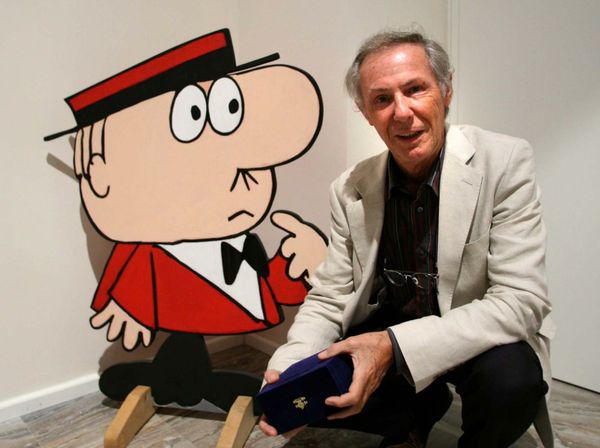
Other creators of moving images do their magic with a good sound track – but sometimes without using a word of dialog. Here’s a clever example I’ve found on YouTube – it is by Italy’s leading animator, Bruno Bozzetto (photos below, courtesy Bruno Bozzetto website).
Bruno Bozzetto
Titled Femminile & Maschile (Feminine and Masculine), this 2-D animation was made in 2004. I can’t find a synopsis online, but one website introduced it simply as follows: Some situations that show the difference of behaviour between men and women in the everyday life.
Anyone with a sense of humour can appreciate this piece – and I hope that includes die-hard feminists…
Here’s the intro from Wikipedia:
Bruno Bozzetto (born March 3, 1938 in Milan, Italy) is an Italian cartoon animator, creator of many short pieces, mainly of a political or satirical nature. He created his first animated short “Tapum! the weapons’ story” in 1958 at the age of 20. His most famous character, a hapless little man named “Signor Rossi” (Mr. Rossi), has been featured in many animated shorts as well as starring in three feature films: “Mr. Rossi Looks for Happiness” (1976), “Mr. Rossi’s Dreams” (1977), and “Mr. Rossi’s Vacation” (1977). Read the rest of his profile on Wikipedia
Earlier this week, to mark Earth Day on 22 April 2008, I took part in a half hour, live interview with Sri Lanka’s highest rated, most popular channel, Sirasa TV. I wanted to relate the global to not just the local but also to the individual and family level. To discuss how our lifestyle choices and consumer decisions affect that planet, I used a series of brilliant cartoon animations that Bruno Bozzetto had done some years ago for WWF.
Again, without having his characters utter a single word, Bozzetto gives out profound messages through images and musical sound track. This is why I keep saying that when it comes to the sheer economy of words, we writers just can’t beat cartoonists.
Sorry, I can’t locate these anywhere online (YouTube lists dozens of his other creations, but not this series — which I can’t even find on his own website.) It’s time for someone to revive this series, for their message is even more relevant for today’s climate-challenged world…
“Violence against women threatens the lives of more young women than cancer, malaria or war. It affects one in three women worldwide. It leaves women mentally scarred for life — and it is usually inflicted by a family member.”
With these words, Annie Lennox, the British singer and social activist, presents a new global series of investigative television documentaries called Women on the Frontline that begins on the global satellite TV channel BBC World today, 18 April 2008.
The seven half-hour films shine a light on violence against women and girls in different parts of the world – East and West, North and South. The series takes the front to homes, villages and cities of our world where a largely unreported war against females is being waged.
The films cover Nepal, where thousands of women are trafficked each year; Turkey, where killing in the name of honour continues; Morocco, where women political activists who have survived torture and imprisonment testify before a government truth and reconciliation commission; the DRC, where women bear the brunt of a 10-year war in the eastern provinces; Colombia, where women have been tortured in the shadow of a guerilla war; Mauritania, where women who have been raped may go to prison; and Austria, where, under a new law, perpetrators of domestic violence are forced to leave home.
Here’s the line up of depressing reports in this series, produced by Geneva-based dev tv and London-based One Planet Pictures – both international partners of TVE Asia Pacific.
On the Frontline… is a ‘vehicle’ for independent producers to tell compelling stories about the people who uphold civil society where it is most at threat. The strand started with the 2006 pilot series Doctors on the Frontline, a profile of Medecins Sans Frontieres (MSF) field doctors made by Dev TV film-makers.
Since then, the series has covered villages battling desertification and land degradation, nurses and para-medics on humanitarian missions in hot spots of the world, and children living with social and environmental disintegration.
“On the Frontline has gone behind the lines with rebels and filmed among violent street gangs but this time we’ve taken the frontline mostly into the home, where even after 20 years in production, I’m still shocked to see how many obstacles lie between women and equality, and the violence they must still endure,” said Robert Lamb, Executive Director of the series.
A number of UN agencies, including UNFPA and UNIFEM, donor countries such as Austria, non-governmental organizations and other partners provided information and support for the latest series of Women on the Frontline.
Soon after its initial run on BBC World, the series will be distributed in the Asia Pacific region by TVE Asia Pacific.
A wounded Japanese photographer, Kenji Nagai, lay before a Burmese soldier yesterday in Yangon, Myanmar, as troops attacked protesters. Mr. Nagai later died. Published 28 September 2007 (Adrees Latif, Reuters)
This dramatic photograph, one of the harrowing and yet enduring images of 2007, has just won its photographer a Pulitzer Prize, announced in New York on 7 April 2008.
Ironically, the last defiant act of one courageous photojournalist has landed one of journalism’s most prestigious awards for another of his kind. Adrees Latif, a Pakistan-born American, had concealed his identity by blending in with the crowd in Rangoon/Yangon, and captured Nagai’s killing on film.
For a distinguished example of breaking news photography in black and white or color, which may consist of a photograph or photographs, a sequence or an album, in print or online or both, Ten thousand dollars ($10,000).
Awarded to Adrees Latif of Reuters for his dramatic photograph of a Japanese videographer, sprawled on the pavement, fatally wounded during a street demonstration in Myanmar.
Born in Lahore, Pakistan on July 21, 1973, Adrees Latif lived in Saudi Arabia before immigrating with his family to Texas in 1980. Latif worked as a staff photographer for The Houston Post from 1993 to 1996 before joining Reuters. Latif graduated from the University of Houston in 1999 with a Bachelor of Arts in Journalism. Latif has worked for Reuters in Houston, Los Angeles before moving to Bangkok in 2003 where he covers news across Asia.
Latif’s collection of photos from his days in Burma, “Myanmar Marooned,” recently won an award given by the prestigious Japanese photographic magazine Days Japan.
I seem to be writing many obituaries and tributes these days. Following the several I wrote on Sir Arthur C Clarke and the blog post I did on Cambidian photojournalist Dith Pran, I want to share this tribute I wrote today on a senior Sri Lankan journalist who embarked on her final voyage this weekend.
Mallika Wanigasundara:
Trail-blazer in issue-based journalism
Mallika Wanigasundara, who passed away on 4 April 2008 aged 81, was a talented and sensitive Sri Lankan journalist who went in search of causes and process that shape the everyday news headlines. In doing so, she blazed new trails in issue-based journalism, covering topics ranging from health and environment to children, women and social justice.
It was only last year that the Editors Guild of Sri Lanka and the Sri Lanka Press Institute presented her the Lifetime Achievement Gold Medal for Excellence in Journalism.
Mallika was associated with the Sri Lankan media in one capacity or another for over half a century. Starting her professional career in 1956 with the Sinhala evening daily Janatha, she later moved on to English language journalism at Lake House where she worked first in The Observer and then at Daily News. It was as Features Editor of this oldest English daily that she played a key role in practising and nurturing development journalism. She helped evolve the genre to new levels of professionalism, liberating it from the typecast of politically motivated, sometimes fabricated ‘sunshine’ stories that had been forced on the state-owned Lake House newspapers during the 1970s.
Mallika also helped put Sri Lanka on the world map of development journalism. Beginning in the early 1980s, she contributed Sri Lankan stories to Depthnews, published by the Press Foundation of Asia based in Manila, and to Panos Features, syndicated globally by the Panos Institute in London. In those pre-web days, these services – when printed in newspapers and magazines – were among the most dependable sources for ground level reporting from far corners of the world. (Alas, both services have since gone the way of the Dodo – not to mention Asiaweek, South and Gemini.)
Although I grew up in the 1980s reading her writing in Daily News, my own contacts with Mallika were few and far between. The first was indirect and happened in the late 1980s, when as an eager young reporter I started contributing to Panos Features, syndicated from London to several hundred newspapers around the world. Mallika remained the Panos Sri Lanka correspondent and I was merely a stringer. Donatus de Silva, then head of programmes at Panos London, somehow found a clear niche for both of us. At the time, Mallika and I exchanged occasional communications.
As a novice, I studied Mallika’s approach and style, and emulated them both. Hers was an easy, reader-friendly prose: it brought in both expert views and grassroots insights, but with none of the technicality or pomposity – and very little editorialising. Although she was fully supportive of the various social and environmental causes, she didn’t allow activist rhetoric to dominate her journalism. She also ventured beyond the predictable ‘green’ issues to cover many ‘brown’ issues. Two decades after the Brundtland Commission on Environment and Development (1987) that thrust sustainable development into the global agenda, it’s precisely this kind of journalism that’s needed to make sense of our fast-moving, slowly-baking, topsy-turvy world.
Mallika continued to be an active freelancer after she retired from Lake House. She seemed more prolific in retirement – she continued to chronicle the rise of the environmental movement in Sri Lanka, which emerged from citizen campaigns to save the Sinharaja rain forest from state-sponsored logging and evolved through crises and protests in the 1980s and beyond.
In 1990, she was selected by the United Nations Environment Programme for the Global 500 award that recognised environmental achievements of individuals and organisations. She was the first Sri Lankan journalist to be thus honoured, and one of only four Sri Lankans to be inducted into this global roll of honour that eventually included over 600 persons or entities worldwide.
At the time, I was hosting a weekly TV quiz show on Rupavahini (national TV) and decided to set one of my questions on Mallika receiving the Global 500. I phoned her to offer my congratulations and asked for a photo that we may use on the TV show. She was happy to be the basis of a question, but declined giving a photo, saying: ‘I don’t look good in photos or on TV’.
It was characteristic of many accomplished journalists of her generation that they remained mostly in the background, shaping news coverage and analysis. Some even didn’t nurture a personal by-line, writing under pseudonyms or simply not signing their names on their work. What a contrast with the image-conscious, in-your-face radio and TV journalism of today, where even respected newspaper editors eagerly pursue parallel careers as talk show hosts or TV pundits.
Dith, who died on March 30 in New Jersey, USA, had both the talent and tenacity for his chosen profession. His experience as an interpreter for The New York Times, for which he later worked as a photographer after migrating to the US, and his ordeal surviving the Khmer Rouge became the basis of the Hollywood movie The Killing Fields (1984).
Watch the trailer for The Killing Fields here:
Here’s Dith’s story as summed up in his Wikipedia entry:
In 1975, Pran and New York Times reporter Sydney Schanberg stayed behind in Cambodia to cover the fall of the capital Phnom Penh to the communist Khmer Rouge forces. Schanberg and other foreign reporters were allowed to leave, but Pran was not permitted to leave the country. When Cambodians were forced to work in forced labor camps, Pran had to endure four years of starvation and torture before finally escaping to Thailand in 1979. He coined the phrase “killing fields” to refer to the clusters of corpses and skeletal remains of victims he encountered during his 40-mile escape. His three brothers were killed back in Cambodia.
“I’m a very lucky man to have had Pran as my reporting partner and even luckier that we came to call each other brother,” Schanberg was quoted in the New York Times tribute to Dith Pran. “His mission with me in Cambodia was to tell the world what suffering his people were going through in a war that was never necessary. It became my mission too. My reporting could not have been done without him.”
In another tribute to Dith, the executive editor of the New York Times, Bill Keller, said: “To all of us who have worked as foreign reporters in frightening places, Pran reminds us of a special category of journalistic heroism — the local partner, the stringer, the interpreter, the driver, the fixer, who knows the ropes, who makes your work possible, who often becomes your friend, who may save your life, who shares little of the glory, and who risks so much more than you do.”
This is a highly significant statement, coming from a major media house of the western world. Acknowledging – let alone celebrating – the contributions of unsung local counterparts is not yet a routine practice among many western media professionals covering the global South. More often then not, the fixers are used, paid and dismissed. They are lucky to get proper credit. And if things go wrong, the western media companies would bring in top lawyers and diplomatic pressures to get their own out of trouble; never mind what happens to the locals who are part of that same team.
Even after being released, Saleem Samad was hounded and harassed in his native country that he went into exile in Canada. Read his profile here, and connect to his blog.
This scenario keeps repeating with different names and in different southern locations all the time. In such a harsh, selfish world, Dith Pran was certainly fortunate to have worked with Sydney Schanberg who stood by and for his local colleague. When Schanberg returned to the US and was awarded a Pulitzer Prize for his reporting from Cambodia, he accepted it on behalf of Dith as well.
Schanberg continued to search for, and write about Dith in newspaper articles – one was in The New York Times Magazine, in a 1980 cover article titled “The Death and Life of Dith Pran., which later became a book by the same title in 1985. Dith’s story became the basis of The Killing Fields.
Haing Ngor, the Cambodian-American doctor who played Dith Pran in the movie, worked with Dith in real life to promote human rights in their native Cambodia and to prevent genocide everywhere. Ngor was shot dead in 1996 in Los Angeles.
As the New York Times noted, Dith’s greatest hope was to see leaders of the Khmer Rouge tried for war crimes against his native country; preparations for these trials are finally under way.
A 1974 photo by Mr. Dith of the wife and mother of a government soldier as they learned of the soldier’s death in combat southwest of Phnom Penh. (Photo: Dith Pran/The New York Times)
In 1979, Mr. Dith escaped over the Thai border. He returned to Cambodia in the summer of 1989, at the invitation of Prime Minister Hun Sen. At left, Mr. Dith visited an old army outpost in Siem Riep where skulls of Khmer Rouge victims were kept. (Photo: Steve McCurry/Magnum)
Mr. Dith joined The Times in 1980 as a staff photographer. He photographed people rallying in Newark in support of the rights of immigrants on Sept. 4, 2006. (Photo: Michael Nagle/Getty Images)
In his 1992 book How the World Was One, Sir Arthur C Clarke described a dream: one day in the near future, CNN founder (and then owner) Ted Turner is offered the post of World President, but he politely turns it down – because he didn’t want to give up power!
Just three years later, the then Secretary General of the UN suggested that CNN should be the 16th member of the Security Council. Sir Arthur was fond of quoting this, and once famously told Turner: “You owe me 10 per cent of your income”.
“With the death of Sir Arthur C Clarke, TVE Asia Pacific has lost a long-standing friend and supporter,” the tribute says.
It adds: “Since our establishment in 1996, Television for Education Asia Pacific – to use our full name – has been engaged in pursuing Sir Arthur’s vision of using the potential of moving images to inform and educate the public. Our founders chose to focus on covering development and social issues, with emphasis on the Asia Pacific region – home to half of humanity and where Sir Arthur spent the last half century of his life.”
Although he never held a formal position at TVEAP, Sir Arthur was an informal adviser and mentor to the regional media organisation whose work across Asia Pacific is only possible thanks to the comsat that invented and the web that he inspired.
By the time TVEAP was created in the mid 1990s, the satellite TV revolution was well underway in the Asia Pacific region, and the internet revolution was just taking off. In informal discussions, Sir Arthur advised us to always keep our eyes open on what’s coming up. In the ICT sector, he cautioned, being too closely wedded to one technology or system could lead to rapid obsolescence.
We also talk about Sir Arthur’s concerns about using information and communication technologies (ICTs) to benefit the poor and other disadvantaged groups – a process that he aptly described as ‘geek to meek’.







 Open Minds!