If an alien spaceship were to randomly descend to the one third of our planet that is not covered by ocean, chances are high that it would land on a rice field.
So I was told a few years ago, when spending time with some rice researchers. Rice is the most widely cultivated food crop in the world. It is also the most important staple food for a large part of the world’s human population, especially in East Asia, South Asia, Southeast Asia, Latin America and the West Indies. From risotto to sushi to paella, food-savvy consumers are using rice as the main ingredient in recipes from around the world. Rice lends substance and texture to many dishes.
Despite all this, rice is under some pressures both economically and culturally. For one thing, it has been taken for granted by many of those who regularly have a ‘rice day’ and think nothing further about it.
How effective do you think this award will be?
When we set out on this joint effort, we posed two big questions: What feeds 3 billion people? And what is slowly but surely disappearing without anyone noticing it? The answer to both questions is Rice! We wanted this film award to draw attention to the central role that rice plays in Asian and Pacific cultures and economies. The measure of our success will be a long term one, and will depend on how many take part in this competition and how far and wide we will be able to distribute their creative efforts.
Why do you think Asia is in need for a wake up call on the subject of rice?
Rice one of our most revered treasures in the Asia Pacific, and many of us take it for granted. It is central to the Asian way of life — its cultural heritage and diversity, spirituality and traditions. This precious rice heritage is under threat from corporate or industrialized agriculture, neo-liberal globalization, private control of the rice seeds, and genetic engineering of the rice genome. Rice lands are also being torn away from small rice farming communities in the name of “development” projects such as special economic zones, cash cropping, and agro-fuel plantations.
Pesticide Action Network Asia Pacific (PAN-AP) has for the last two decades championed the food sovereignty of the grassroots, namely, farmers, agricultural workers, indigenous people and consumers. In 2003, PAN-AP launched the SAVE OUR RICE CAMPAIGN. It is founded on Five Pillars of Rice Wisdom: Rice Culture, Community Wisdom, Biodiversity based Ecological Agriculture, Safe Food and Food Sovereignty. Last year, PAN-AP joined TVE Asia Pacific and Public Media Agency to organise this film competition as part of the on-going campaign. We all share the ideals of promoting rice in Asia and the Pacific.
APRFA co-organisersWhat would you be looking out for in the short films?
The Asia Pacific Rice Film Award will be presented to creators of short innovative television, video or cinematic films that effectively educate the public on the role of rice in Asian cultures, economies and communities/societies. The films should use the ‘Five Pillars of Rice Wisdom’ as guiding principles. They should enhance appreciation of the rice heritage of Asia; raise public awareness of the issues on and threats to rice; highlight the role of small farmers, women in rice; strengthen the people’s resolve and action to save rice; and encourage a stronger role for youth in rice.
Any tips for the participants?
We are looking for short films that are innovative, imaginative and ultimately effective in raising public awareness. Rice may be a pervasive topic in Asia, but the threats to rice are not yet widely appreciated. How do we take this message to the three billion rice growers and eaters of Asia using moving images? How do we engage the YouTube generation – predominantly youthful populations of Asia – with films that open eyes and provoke minds to think further? What would work best — factual reportage, drama, humour, performing arts or other formats? These questions are worth pondering. As organisers, we are open to all formats. We want to be surprised!
After all this, what would be the next step/project?
As I said, this is an on-going campaign, so the winning and commended entries will become new tools and resources for that campaign. Making films and ranking them is only the first half of our shared challenge. We then have to get these films distributed far and wide, using broadcast, narrowcast, webcast and mobile platforms. Three billion people means six billion eye balls that need to be reached! That should keep all of us busy for a while…
How much can you pack in to one minute, or 60 seconds? That’s a lot of air time, as broadcasters and advertisers know very well.
‘One Minute to Midnight‘ has been a favourite metaphor of dooms-dayers – and is the title of a 2008 book. It was widely used in relation to the world drawing closer to nuclear war during the second half of the 20th century.
Now, as global climate change surpasses fears of global nuclear war, we are given just one minute to save the world.
One Minute to Save the World is an international short film competition to raise awareness of climate change. Entries are currently being sought from professionals and amateurs, with 31 October 2009 as the deadline. There is also a category for under 18s and for entries shot on mobile phones.
The idea is to enable anyone, anywhere, to deliver a short but powerful message to the world on climate change. The winning films will be sent around the world in November as an online campaign to raise awareness of the Copenhagen Climate Conference in December 2009.
Good planets are hard to find...British TV presenter and adventurer Bruce Parry, a founder of the competition, says: “Together we will be looking for films that convey a powerful message about how climate change affects you and those around you. Were you a flood victim? Have you seen a change in the plants and wildlife in your garden? How has your world been affected and how can we address it?
He adds: “So, we hope you’ll all get thinking and shooting – whether you’re a seasoned pro or just someone who cares. Your planet needs you and your talents. One minute might not seem like a long time but it’s actually longer than many advertisers spend hundreds of thousands of pounds on. It’s also an easy length of time to hold people’s attention. And that is one of the things we urgently need to do if we’re going to turn things around for our planet before it’s too late.”
The winning entries will be judged by an international panel that includes Parry himself, award-winning director and climate change activist Shekhar Kapur; Franny Armstrong, director of Age of Stupid and The Guardian‘s environment editor John Vidal.
The website will become an online film festival which requires no travel or celebrity status to attend – all you need is access to a computer. “And as everyone knows, the power of the net can make the most unexpected video attract the attention of millions globally,” says Bruce Parry.
Whatever we might think about the artistic and technical merits of his climate film An Inconvenient Truth, it has settled with a resounding ‘yes’ one question: can a single film make a difference in tipping public opinion about a matter of global importance?
But the climate crisis that confronts us is so formidable that we need many more Al Gores to come up with as many moving images creations as they can.
Their call out for all climate films says: “This December thousands of delegates, decision makers, stakeholders and activists will converge on Copenhagen. To be part of this EngageMedia is putting together a compilation of Asia-Pacific climate films to be screened and distributed at the event and around the world. Submit your film to EngageMedia and be part of the action. Global action is urgent and essential – the time for debate is over.”
TVE Asia Pacific, already a partner on EngageMedia platform, is submitting all its recently produced climate change films.
Celebrating Heroes
Asian environmental leaders, activists and visionaries feature prominently in TIME Magazine’s Heroes of the Environment 2009 list, published in its issue dated 5 October 2009.
This isn’t surprising, since the Asia Pacific accounts for nearly two thirds of humanity. As I’ve been saying for some years, the quest for sustainable development will be won – or lost – in Asia.
By happy coincidence, I have met three of the two dozen remarkable men and women in this year’s Heroes list — and count two of them among my extended network of friends across Asia.
One friend is the Indian film-maker Mike Pandey, who has been making environment and wildlife films for over 30 years in India, where he is one of the most respected names in conservation circles.
The other is Sheri Liao, Founder of the Global Village of Beijing (GVB), one of the earliest non-governmental organisations addressing environmental issues in China. She is an indefatigable Chinese activist and campaigner whom I first met on my first visit to Beijing in 1996. Our paths have crossed a couple of times since then, and I have always admired her zeal and single-minded pursuit of ‘greening’ China. Added on 17 Oct 2009: Blog post on Sheri Liao and greening the airwaves in China
The third ‘hero’ is the amiable and technocratic Mohamed Nasheed, President of the Maldives. I filmed an exclusive TV interview with him a few weeks ago, which I am currently editing into a short documentary on climate change. His country, the smallest independent state in Asia (by both land area and population), is on the frontlines of impact from rising sea levels and extreme weather events triggered by global warming.
“From saving wild mountain rivers in China to measuring the Arctic’s icy expanse, our green heroes are informed by this simple notion: We can all make a difference,” Time editors wrote in introducing this year’s list.
And I have already blogged about another TIME Hero well ahead of their selection: environmental lawyer Syeda Rizwana Hasan, a determined environmental activist who keeps dozens of ships from coming to die on the beaches of her native Bangladesh.
In the coming days and weeks, I plan to write separate posts on these other heroes whose selection is both timely and inspiring to all of us working in the broader development sector.
Passing the buck? Cartoon by W R WijesomaThis was one of the most memorable cartoons drawn by W.R. Wijesoma, Sri Lanka’s pre-eminent political cartoonist (and my one-time colleague). If I remember right, it first appeared sometime in the late 1980s in ‘Mihikatha’, Sri Lanka’s first all-environmental newspaper.
Alas, both Mihikatha and Wijesoma are no more among us. But the message in this cartoon is more timely than ever before.
“Is this what we are going to hand over to our future generations? Please……no!” was the emphatic message from Yugratna Srivastava, a 13-year-old Indian girl who addressed over 100 world leaders gathered at the United Nations headquarters on 22 September 2009 for the historic Summit on Climate Change.
Passing the ball – or buck – is something that governments are good at. Most governments are so narrowly focused on the now and here, and sometimes rightfully so, that they have neither the time nor interest for medium to long term scenarios. As I wrote earlier this week, “it’s going to take many more meetings, bickering and hard bargaining before the leaders begin to think in terms of the next generation.”
This is where citizen action comes in. Governments are not going to save this planet from environmental catastrophes; if at all, it would be the ordinary people. This is the premise of TVE Asia Pacific’s latest Asian TV series, Saving the Planet.
Where does the buck stop?
Governments, experts and big corporations alone cannot solve all these problems. Real change requires changing how each and every human being lives and works. Education becomes the biggest key to achieving environmentally sustainable development at local and global levels.
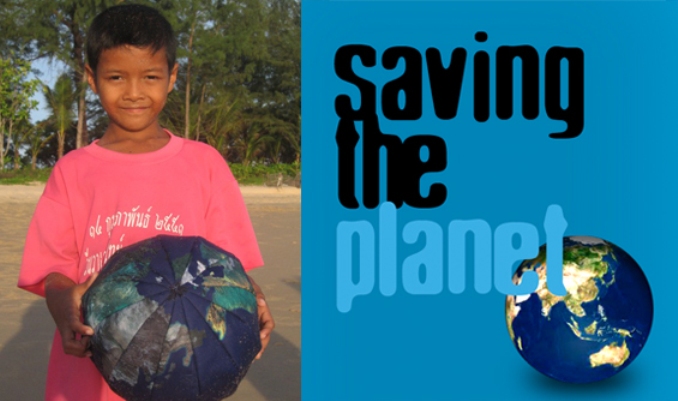
Filmed in six countries in South and Southeast Asia, Saving the Planet profiles groups working quietly and relentlessly to spread knowledge, understanding and attitudes that inspire action that will help humans to live in harmony with the planet. They often work without external funding and beyond the media spotlight. They have persisted with clarity of vision, sincerity of purpose and sheer determination. Their stories inspire many others to pursue grassroots action for a cleaner and safer planet.
We tried out a creative idea for the series opening sequence (20 seconds), an extended version of which became the series trailer (see below). It was planned and filmed in all the six countries where the stories came from — Cambodia, India, Laos, Nepal, the Philippines and Thailand. In each country, our roving director-producers filmed different individuals – young and old, men and women, in all their Asian diversity – passing around an inflated ball made to look like planet Earth.
I know my colleagues had fun filming these sequences, and back in our studio, it was also great fun to mix and match these various shots to create the apparently seamless passing around of our planet in peril. (Who said planet saving cannot be fun?)
Watch Saving the Planet trailer (1 minute):
Now it can be revealed: our original inspiration came from an unexpected source: the world’s largest media corporation, Google! In one brainstorming, our then production coordinator Buddhini Ekanayake remembered an open challenge that Google had made online just before introducing their email service, GMail. Google asked people to “imagine how an email message travels around the world” using a video camera.
In all, Google received over 1,100 clips from fans in more than 65 countries around the world — each one of them a different creative idea, playing with the iconic Gmail M-velope.
“The clips you submitted were amazing and it was hard to choose selections for the final video,” Google said when releasing the outcome of this collaborative video project.
Biggest gap: between rhetoric and practice!It happened a decade ago, but I still remember the incident.
I was visiting London while the British Isles were having their typically limited experience with summer. My then colleague and I had gone for a business meeting, and were returning by Tube, or the London underground railway. Being the afternoon rush hour, the trains were packed to capacity.
My colleague didn’t say much on the journey, but I noticed her look of dismay. As we emerged from the tube station, she finally spoke: “Gosh, it’s another world down there, isn’t it? I didn’t know people smell so much!”
The warm and sweaty summer would surely have added to the experience, but as Londoners know well, the tube is the best mode of transport to get around quickly and inexpensively in that metropolis. It was only then that I realised my liberal, bleeding-heart colleague was not a regular user of public transport. She either uses taxis or drives around in her own Volvo car. She doesn’t normally commute with the Great Unwashed…
Yet, the same snooty ex-colleague speaks and writes so passionately on the virtues of public transport and mass transit systems as a means to better manage urban challenges in the developing world. Listening to her, one could hardly imagine her disdain for using public transport in her own city.
Practise what you preach. That’s a simple yet profound piece of advice for everyone promoting public interest causes in development, conservation or anything else. Or, as Mahatma Gandhi put it: you must be the change you wish to see in the world.
The series features outstanding efforts in education for sustainable development (ESD) in South and Southeast Asia. It goes in search of answers to these key questions:
• What can ordinary people do for our planet, now under siege from multiple environmental crises?
• How can we change attitudes and lifestyles to consume less and generate less waste?
Here’s the synopsis of the India story:
For people in Dindigul in India’s Tamil Nadu state, waste isn’t really a problem – it’s just a resource in the wrong place. School children and housewives have been at the forefront in collecting household and market waste to turn them into compost. They have not only cleaned up the streets, but also persuaded people to grow organic food. As the word spreads, more towns and villages are emulating this example set by CLEAN India project and Gandhigram Trust.
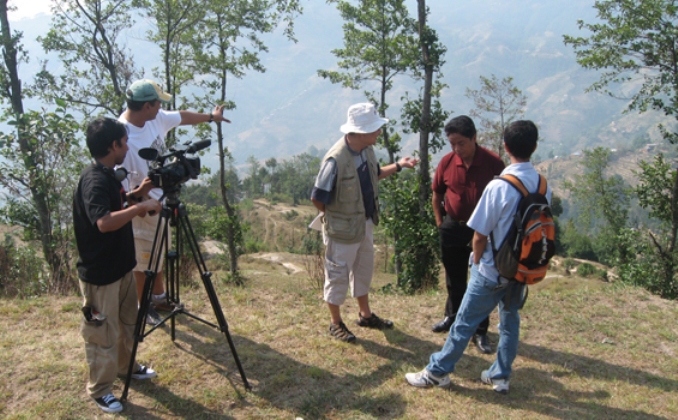
Location filming Saving the Planet in Nepal
I have written more than once in this blog about Radio Sagarmatha of Nepal, the first independent community broadcasting station in South Asia.
The six-episode series, which was 18 months in the making, features outstanding efforts in education for sustainable development in South and Southeast Asia.
It goes in search of answers to these key questions: Can ordinary people help save our planet under siege from multiple environmental crises? How can everyone change attitudes and lifestyles to consume less and generate less waste?
Here’s the official synopsis of the Nepal story, titled Voice of a Valley:
Tourism generates incomes, jobs and markets for the people of Nagarkot, a popular resort close to the Nepali capital Kathmandu. But it had a bumpy start when hoteliers initially bypassed local communities. These tensions were diffused by Radio Sagarmatha, the country’s first independent public radio station, which brought all interested parties together on the air. This example shows how media can do more than just report. By inspiring discussion and debate, media can help communities to find the best solutions or compromises for their development needs.
Low Carbon, High PrioritySome 100 world leaders are due to gather at the United Nations headquarters in New York this week for the highest level summit meeting on climate change ever convened.
As the New York Times reported: “In convening the meeting, the United Nations is hoping that collectively the leaders can summon the will to overcome narrow nationalinterests and give the negotiators the marching orders needed to cut at least the outline of a deal.”
Recognising climate change as one of the greatest social, economic, political and environmental challenges facing our generation, the British Council has launched the Low Carbon Futures project. It has focus on mitigating the effects of climate change in an urban environment. It is part of the British Council’s major global climate security project and India is, along with China, one of the top two priority countries for this work. Sri Lanka, with less than 2% of India’s population and correspondingly lower carbon emissions, is a lower priority.
One strand in the Low Carbon Futures project is to engage communications professionals – journalists, writers and film makers to help them better understand the issues around mitigation and get across key messages to readers/viewers more effectively.
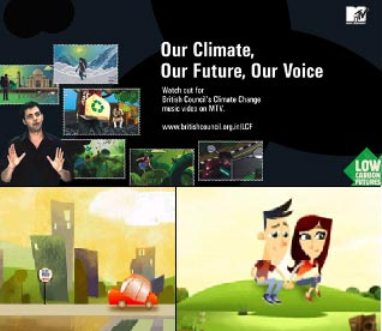
As part of this project, the British Council collaborated with Music Television (MTV) to produce a music video and two viral video animations on climate friendly, low-carbon lifestyles.
British Council’s first Music Video on Climate Change produced by MTV features VJ Cyrus Sahukar. Combining animation, lyrics and melody, the video talks about how small individual actions can help conserve natural resources and save the climate. MTV VJs have a cult following and the video ends with Cyrus Sahukar, MTV’s face in India, encouraging young people to take that first step. The video was launched in New Delhi on 1 June 2009 in the presence of 50 International Climate Champions from across India & Sri Lanka.
According to the British Council India website, “The video has created a flutter and there is growing demand to screen the video on various institutional networks across India and even outside fulfilling higher level objectives of impacting young urban aspirants. Young Indians are an emerging generation who are ambitious and internationally minded with the potential to be future leaders. The MTV video aims to influence this influential group.”
The Low Carbon Futures project has also released two short, powerful, animated messages that are ‘tongue-in-cheek’- making use of everyday events with a touch of humour. “We are hoping that the messages will be seen as creative, funny and innovative to tempt the recipient to forward it to their peer group. As the virus spreads, so will the message. The British High Commission and the The Energy and Resources Institute (TERI) are also promoting these virals to spread the message amongst the staff members and their external audiences,” says the project website.
The first viral video animation is called Green Journey, and shows a little known benefit of car pooling. Its blurb reads, simply: Meet 3 Mr Rights on the wrong side of the road!
The second viral video animation is called Play Cupid, and gives us one more reason to plant more trees! Blurb: Lets leave the young couples in peace and solitude of nature!
Memory is a curious phenomenon. Sometimes memories of our personal past are evoked in the most unexpected manner, reviving nostalgia for days that are forever lost in the sands of time.
I have never visited Poland, but it’s been on my mind in recent days. 1 September 2009 marked the 70th anniversary of the beginning of the Second World War – which was sparked off by Nazi Germany’s invasion of Poland.
That’s also the day when the Anglo-American poet W H Auden wrote his deeply evocative poem, September 1, 1939. He wrote it sitting in a New York bar and distraught by the clouds of hatred gathering over Europe. I’ve been reading and re-reading it this year as the war Sri Lanka – which lasted almost five times longer – officially ended in May 2009.
As I wrote at the time: “Almost 70 years later, at the end of my own 30-year-long war, I have been reading and re-reading September 1, 1939. I’m trying to make sense of what is happening around me. The near hysterical mass euphoria on one side, and bewildered dejection on the other.”
I have only just remembered that Poland in September 1939 holds another significance for me. It has to do with the Polish film Moja Wojna – Moja Milosc (My War-My Love, 1975), which I saw in the summer of 1979 at a Colombo cinema as a 13-year-old school boy.
Not only did I see the film, but I also wrote an essay reviewing it and entered it into a competition organised by the Embassy of Poland. Growing up in a country that didn’t have broadcast television until that very year, I had only seen a handful of movies up to that time. I was no movie critic, but my views on the film and its resonance with my own times must have struck a chord with the judges. For I won the second prize in the Sinhala essay competition.
Being runner-up was no big deal by itself, but this was the first time that my writing was competitively judged and ranked by anyone outside my immediate circles. My prize included a fountain pen, white polyester cloth for school uniforms, and an LP record of Polish music (yes, LPs were still in use, but on their way out at the time!).
From My War - My LoveI would go on to win many essay competitions during my teens, and one day earn an honest living as a wordsmith. But that movie review – long since lost in the mists of time – was my first success. My career in literary crime was thus forged…thanks to a Polish movie!
From the little that I can still remember, 30 summers later, My War-My Love wasn’t a pretty film. It is set during the week of the Nazi invasion of Poland in 1939. Daring 17-year-old schoolboy Marek (Piotry Lyjak), inspired by the example of the Sobieski cadets during 1831 insurrection, vows to take on Germans single-handedly. He devotes most of his energy to protecting a young girl who lost her mother during the invasion.
As one reviewer wrote, “My War-My Love could not, by its very nature, end altogether happily, but the film can be regarded as life-affirming.”
War has no place for innocence - then or now...That film was my first visual introduction to the horrors of war, a topic that was to dominate my own future for the next 30 years to come. In that Sri Lankan war, child soldiers several years younger than the film’s character Marek would play a prominent role.
At a far more personal level, I had never been in love when I saw My War-My Love. In the three decades to follow, I would fall in love three times — and lose out every time, though for very different reasons (none of which involved ‘my’ war). I must now carry the pain of these lost loves for the rest of my time. But that is another story…
Thanks to the wonders of Google, I’ve been able to track down some specifics about the film. It was directed by Janusz Nasfeter (1920 – 1998), a versatile Polish film maker whose career in writing and directing films spanned from the late 1940s to the early 1980s. He was 19 when the Germans came marching in.
It was one of many films that have used the Second World War as its backdrop. There have been several other Polish films that looked back on the Polish resistance, Poland Holocaust and Warsaw uprising of 1944 and other key events that left an indelible mark on the country. In fact, as this listing in Wikipedia shows, when Janusz Nasfeter made My War-My Love, the theme was pretty much covered by different Polish film makers in numerous ways.
I haven’t seen any of these other Polish films, and even My War-My Love is now only a distant memory. But as a moving image creation that moved my life in a certain direction, it would always have a special place in my heart.
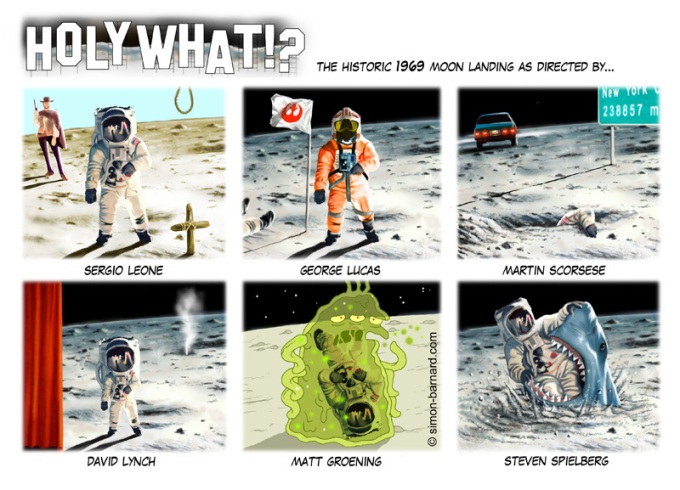
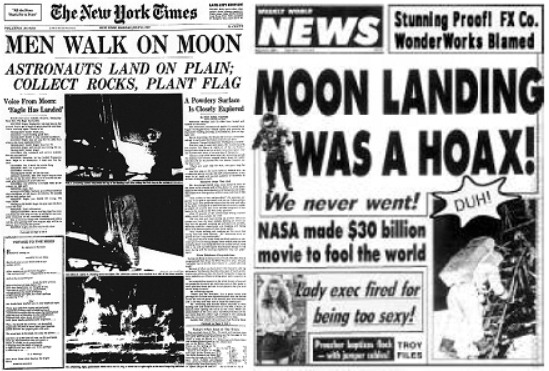
Is this how it really happened? Just kidding!When NASA announced last week that they were working with a leading digital imaging company in Hollywood to remaster the original Apollo 11 Moon walk video footage, I told myself: that’s one more cannon to the conspiracy theorists!
Everyone would welcome a quality improvement in those murky, grainy moving images capturing humanity’s grand achievement. But the choice of Lowry Corporation, best known for restoring old Hollywood films, could fuel the fire of conspiracy theorists who argue that the entire Moon landing was faked by NASA with the connivance and participation of Hollywood. They believe that the entire Apollo programme – that landed people on the moon six times between 1969 and 1972 – was staged on a movie set or secret military base.
This link didn’t bother Richard Nafzger, the NASA engineer who oversaw television processing at the ground-tracking sites during the Apollo 11 mission, and now involved in their restoration. “This company is restoring historic video. It mattered not to me where the company was from,” Nafzger was quoted as saying.
Technically and officially, NASA is right. The US space agency has always dismissed the conspiracy theorists, and not spent much time discussing the outrageous idea. As it says on NASA website: “The Apollo Moon landings were among the most completely documented and observed events in history. Moon rocks have been examined by scientists from all over the world, not just the U.S. Video special effects were in their infancy in the late 60’s so that faking a landing on the Moon would probably have been more difficult than actually going there, and it seems highly unlikely that the hundreds or even thousands of people who would have had to be involved in such a conspiracy would have kept it a secret for so long.”
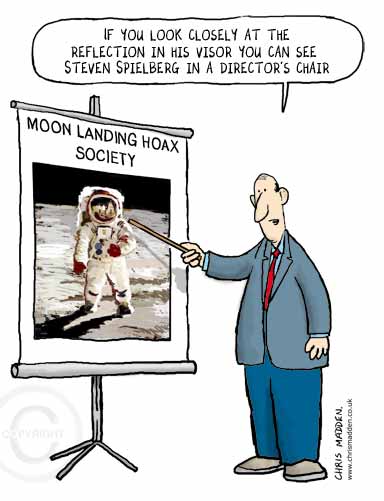
Err, Wasn't Spielberg only 23 at the time...?Independent scientists point out that it would be impossible for tens of thousands of NASA employees and Apollo contractors to keep such a whopping secret for almost four decades. Tell that to those who are deeply suspicious of anything to do with governments, who historically don’t have the best record for transparency and full disclosure!
So the conspiracy theory lingers. Like many other crazy ‘theories’, it has spread rapidly with the growth of the Internet. It’s really an old one: even at the time Apollo astronauts landed on the Moon, a few people refused to believe it as it apparently conflicted with their religious beliefs.
The Moon Hoax, as it’s popularly called, accuses NASA of manufacturing, destroying, or tampering with evidence — including photos, telemetry tapes, transmissions, and rock samples; and that the deception continues to this day. These theorists concede that the Apollo launches did take place. But instead of going to the Moon, which they say was technologically impossible at the time, the astronauts just orbited the Earth for a few days while NASA carefully fed the media with manufactured images. And then they returned to a heroes’ welcome!
My curiosity in conspiracy theories stems from my interest in popular culture. In this instance, I’m intrigued to note how moving images have fuelled the Moon Hoax theory in a number of ways. A cornerstone in the doubters’ argument is that NASA’s photos and videos from the moon contained ‘suspicious anomalies’ (all of which, by the way, have been satisfactorily explained by scientists.)
Superb entertainment, but it was just that...Some believe that these theories inspired the 1978 movie Capricorn One, where NASA fakes a Mars landing on a military base on Earth, and then goes to desperate lengths to cover it up. It’s entirely possible that some people can’t discern fact from fiction. Or why allow facts to get in the way of a damn good story?
At one point in the early 1990s, he wrote to the NASA Administrator, with his tongue firmly in his cheek, saying: “Dear Sir, On checking my records, I see that I have never received any payment for this work. Could you please look into this matter with some urgency? Otherwise, you will be hearing from my solicitors, Messrs Geldsnatch, Geldsnatch and Blubberclutch.”
Of course, he never received – nor expected – a reply. But when media reports about this appeared, some with no sense of humour considered it further ‘proof’ of a cover-up!
And here’s another connection: Peter Hyams, who directed Capricorn One, went on to direct the movie adaptation of Arthur C Clarke’s 2010: Odyssey Two, which was released in 1984.
More seriously, in later years Sir Arthur was concerned that at one point a few years ago, millions of Americans harboured doubts whether the Moon landings actually took place. That indicated a failure of the education system to produce people with critical thinking abilities, he said.
The conspiracies received a boost when, on 15 February 2001, the Fox News TV network aired Conspiracy Theory: Did We Land on the Moon?. Hosted by X-Files actor Mitch Pileggi, this hour-long, sensational documentary peddled what it called eerie “inconsistencies” in NASA’s Apollo images and TV footage. Among them: no blast craters are visible under the landing modules; shadows intersect instead of running parallel, suggesting the presence of an unnatural light source; and a planted American flag appears to ripple in a breeze although there’s no wind on the moon.
It concluded that the whole Apollo Moon landings were faked in the Nevada desert because, cccording to the conspiracy theorists, NASA did not have the technical capability of going to the Moon, but pressure due to the Cold War with the Soviet Union forced them to fake it. Fox TV did preface the programme with a notice saying: “The following programme deals with a controversial subject. The theories expressed are not the only possible interpretation. Viewers are invited to make a judgement based on all available information.” But skeptics felt Fox didn’t do enough to provide a minimum level of balance in their discussion.
Warning: This is a funny cartoon and not meant to be taken seriouslyThe documentary’s ‘evidence’ has since been refuted point by point. NASA has also dismissed the documentary’s claims. It prompted Sir Arthur Clarke to protest to his long-time friend Rupert Murdoch, owner of the Fox TV network, for peddling unscientific nonsense.
Rather than being a ‘true believer’, Fox TV may have been trying to boost its audience ratings. But others in the moving images industry apparently take the matter very seriously. Among them is the film-maker Bart Sibrel. His aggressive interview tactics once provoked astronaut Buzz Aldrin (second man to walk on the Moon) to punch him in the face in a 2002 encounter.
“I don’t want to call attention to the individuals who are trying to promote and shuffle off this hoax on people,” Aldrin told CNN in a recent interview. “I feel sorry for the gullible people who’re going to go along with them. I guess it’s just natural human reaction to want to be a part of ‘knowing something that somebody doesn’t know.’ But it’s misguided. It’s just a shame.”
One of the strongest rebuttals of the Moon hoax on TV has come from the Mythbusters series of popular science programmes produced by Beyond Television Productions, originally for the Discovery Channel. The series features special effects experts Adam Savage and Jamie Hyneman, who use basic elements of the scientific method to test the validity of various rumors, myths, movie scenes, internet videos and news stories in popular culture.
In August 2008, they tackled a number of pervasive myths associated with the Moon landing, debunking them one by one. To film the episode, Adam, Jamie and the rest of the Mythbusters team visited the NASA Marshall Space Flight Center in Alabama. A team of Marshall scientists helped the Mythbusters with several of their tests. Here are two excerpts:
As the 40th anniversary of the first Moon landing passes, the scientific community and rationalists will have to make some hard choices. How much more time and energy must they expend countering such wildly fanciful theories and fantasies? In a world that still has a (dwindling?) number of people who believe in more ancient concepts like the Flat Earth theory, is it really surprising that the Space Age would inspire its own share of modern-day myths?
No matter what the scientists say and how overwhelming the evidence is, conspiracy theories will always believe what they want. Often their convictions border on a blind faith – and as Arthur C Clarke was fond of saying (in relation to religions), one definition of faith is ‘believing in what you know isn’t true!’.
In a pluralistic world, people choose what to believe inThen there is simple demographics. The total world population in 1969 was 3.6 billion. Today, it has surpassed 6.7 billion. This means nearly half of the people alive today were not even born when Neil and Buzz stepped on to the Moon. At 43, even I have only a headline memory of Apollo 11, even if it’s a strong one.
NASA itself is well aware of this. “As the number of people who were not yet born at the time of the Apollo program increases, the number of questions [about the moon landings] also may increase,” NASA said in a statement on the eve of the anniversary. “Conspiracy theories are always difficult to refute because of the impossibility of proving a negative.”
Perhaps what the Moon Hoax debate really needs is what Sir Arthur Clarke once proposed as a response to the obsession with UFOs and alien abductions: a decade or so of benign neglect. Conspiracy theorists and myth-makers thrive on counter-arguments and debate. When they don’t get it for long enough, they’ll probably run out of steam.
Meanwhile, networks like Fox News should stick to making entertainment programming that is labeled as such. Who can find fault with creations like The Simpsons?

 Pesticide Action Network Asia Pacific (PAN-AP) has for the last two decades championed the food sovereignty of the grassroots, namely, farmers, agricultural workers, indigenous people and consumers. In 2003, PAN-AP launched the SAVE OUR RICE CAMPAIGN. It is founded on Five Pillars of Rice Wisdom: Rice Culture, Community Wisdom, Biodiversity based Ecological Agriculture, Safe Food and Food Sovereignty. Last year, PAN-AP joined TVE Asia Pacific and Public Media Agency to organise this film competition as part of the on-going campaign. We all share the ideals of promoting rice in Asia and the Pacific.




 “From saving wild mountain rivers in China to measuring the Arctic’s icy expanse, our green heroes are informed by this simple notion: We can all make a difference,”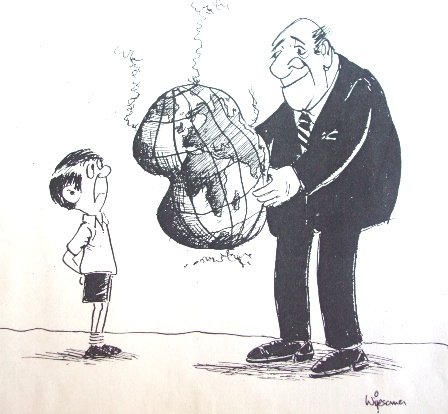






 Open Minds!