“The bamboo that bends is stronger than the oak that resists,” says a Japanese Proverb.
In these times of climate change, we all need to bear this in mind. It’s not how we resist the battering, but how we pick up again after repeated onslaughts.
Bamboo is an amazingly versatile plant (actually, a grass) with many uses in Asian cultures. We use it for buildings, furniture, outdoor infrastructure, artistic decor and even eat parts of it.
Beyond these utility functions, the bamboo holds a philosophical lesson that the ancient Japanese and Chinese knew very well: its flexibility is its strength. It can bend and move with the wind or water or other element, rather than being rigid, unyielding and ultimately vulnerable to an unexpected jolt and sideways shift.
Resilience was discussed and interpreted in a number of ways at the conference. But participants broadly agreed that it is the ability of any individual or community or system to absorb external shocks, bounce back and transform or continue to grow.
Such bouncing back, in some climate related situations, could be to alternatives rather than to the original condition. For example, if poorly built structures are damaged in a disaster or extreme weather condition, the recovery could – and should – be to build back better.
Indeed, the bamboo metaphor is widely used in various fields from business management to self-help counseling. See these interesting links for further insights:
What does Livelihood Resilience mean to them?
I am at Resilience 2011: Asia Regional Conference on Building Livelihood Resilience in Changing Climate, being held in Kuala Lumpur, Malaysia, from 3 – 5 March 2011. It is jointly organised by Wetlands International-South Asia (WISA), International Development Research Center (IDRC), The Climate and Development Knowledge Network (CDKN), Cordaid and ekgaon technologies
The conference has attracted three dozen researchers, practitioners and policy makers from across the Asia Pacific region, and from different ‘domains’: Disaster Risk Reduction (DRR) and disaster management; Ecosystem services and conservation; and livelihoods and socio-economic development.
I like hobnob with researchers and activists from whom I learn much. As a science and development communicator, I sit through their often very technical discussions and find ways of relating them to the bigger realities. For a start, I created a word map of the keywords being used in the conference. That gives an idea of concerns at a glance.
I then tried to make sense of the conference introduction note, published on the event website. It looks and reads like the work of a committee, and not the easiest to read and absorb unless one is deep immersed in these areas. Since most of us aren’t, I spent an hour or two rewriting it in my own language. Here it is — my version of what Resilience 2011 conference is trying to accomplish:
Building Livelihood Resilience in Changing Climate Asia Regional Conference
Kuala Lumpur, Malaysia, 3 – 5 March 2011
A layman’s interpretation of the vision, scope and aims of the conference
Asia, home to over 60 per cent of all human beings, is the largest and most diverse geographical region in the world. It is also a region of sharp contrasts and disparities in economic and social development.
Some Asian economies have been growing faster than any other on the planet, and even the global recession has not slowed them down too much. This growth has helped push tens of millions of people out of poverty during the past three decades. Yet, Asia still has the largest number of people living in poverty and food insecurity.
In some respects, gains have been lost. For example, the UN Millennium Development Goals Report for 2010 revealed that the proportion of undernourished Asians has increased recently to levels last seen during the 1990s. Two thirds of the world’s undernourished people live in Asia. At the same time, the natural resources on which food supplies depend – land, water and biodiversity – are degrading rapidly. Food shortages and water scarcities are already being experienced, or anticipated, in many countries.
Growing number and intensity of disasters adds further pressures. According to the international disaster database EM DAT, Asia accounted for nearly half (46 per cent) of the all water related disasters in the world, and 90 per cent of all affected people during 1980 to 2006. During this period, disasters in Asia caused a total of US$ 8 billion worth of economic damage. These disasters impacted disproportionately on the poor and vulnerable sections of society.
Climate change impacts will make this situation worse for everyone, and especially for the poor who already have limited options and ability to adjust to rapid changes. It is now clear that all efforts aimed at reducing poverty and protecting the socially vulnerable groups need to factor in the additional pressures created by changing climate.
To cope with these challenges, we need better understand how livelihoods are threatened, and what strategies can be adopted to improve resilience especially at the grassroots. Researchers and practitioners in natural resource management and poverty reduction are now focusing more and more on the nexus between resources, climate changes and livelihoods.
New ways of looking at the inter-linked challenges have emerged:
• Humanitarian aid workers active on disasters now focus on disaster risk reduction, expanding the scope of risk management to include preparedness and risk reduction.
• Development practitioners working on poverty reduction emphasize on increasing access to various capitals to help address disaster risk and poverty.
• A ‘systems approach’ is being used to look at poverty in broader terms of well-being of people and ecosystem services of Nature.
In addition, researchers and activists emphasize the value of freedoms for participation, economic facilities, social opportunities, transparency guarantees, protective security and ecological security. It is only by ensuring these freedoms that the poor will have a meaningful chance to assert their rights and make their own choices in what they do, and how they do it.
The slowly but steadily warming planet challenges everyone to rethink their conceptual frameworks, and redefine or reconfigure how they work. If there is one thing certain about these uncertain and turbulent times, it is business-as-usual won’t do!
What do we seek to achieve?
Each sector has accumulated a knowledge base, set of best practices and lessons learnt exist within individual domains. Each sector’s theories, approaches and actions within various domains differ on how to make livelihoods more resilient, especially in the often harsh realities of the developing world.
They are all necessary, but not sufficient. Taken individually, no single approach or solution can help make everybody’s livelihoods resilient from the multitude of pressures and impacts. Yet, what one strand cannot withstand on its own, a bundle of strands very likely can: bringing different areas of research, advocacy and practice is the way forward to ensuring better resilience at the grassroots.
This is easier said than done. Both researchers and practitioners have long worked in their own silos or compartments, with occasional nods at each other’s work and periodic exchanges. From this, we need to evolve more integrated framework that brings in the ecologists, disaster managers, social scientists and everyone else who share an interest in making lives better at the grassroots and at the bottom of the income pyramid.
The Kuala Lumpur conference attempts to address this formidable challenge. It will provide a common platform to practitioners and researchers from various ‘domains’ related to livelihoods to work out a shared vision on livelihoods resilience by seeking answers to these questions:
• What are the existing challenges to achieving livelihood resilience?
• What are the gaps in existing livelihood frameworks in relation to disaster, climate change adaptation and conservation in addressing livelihood resilience?
• What are the challenges in scaling up pilot models of Livelihood Resilience?
• How does social adaptation occur in resilience building?
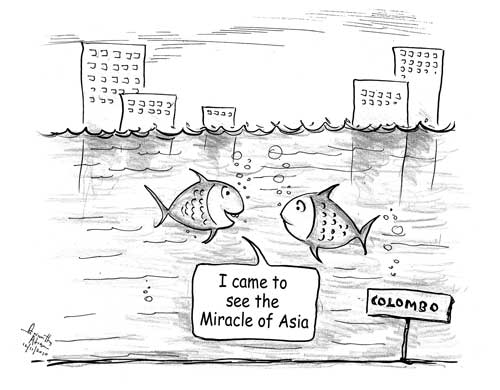
Cartoon in Daily Mirror, Sri Lanka, on 12 November 2010
Why do movie audiences in this part of the world cheer every time they see alien invaders blow up the White House? For a long time I thought it had something to do with anti-American sentiments; then I heard that many US audiences react the same way. Perhaps some among us get a kick out of seeing overbearing governments in trouble?
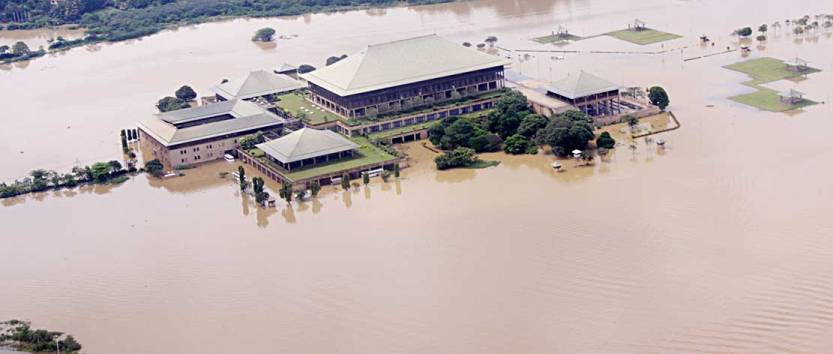
That might explain the gleeful tone with which the Colombo media reported the Sri Lankan Parliament being flooded after torrential rains in mid-November. Newspapers and television channels repeatedly showed images of the Parliamentary complex – built three decades ago on a marshland – completely marooned. The hapless people’s representatives were ferried across the expanse by the military, to take part in a brief session to extend Emergency Regulations. The symbolism was inescapable.
When the trapped rainwater engulfed many areas in and around Colombo, thousands of affected people groaned, but no one was really surprised. By now Sri Lankans know this is almost an annual routine. As I sat knee-deep in my own flooded office, I had a strong sense of déjà vu.
This is the opening of an op ed essay I’ve just written for Himal Southasian magazine, whose March issue carries a cover story on disasters in South Asia.
My essay, titled Drowning in media indifference, takes a personalised look at how the Lankan media have covered different disasters in the past two decades.
“Once again, the mainstream media in Sri Lanka has proven itself irrelevant in reporting and responding to catastrophic flooding,” says the intro — and that pretty much sums it up.
Sri Lankan Parliament flooded after torrential rains in mid-November 2010. The complex, built on a marshland, was completely marooned.
I recall how, back in 1992-93, the then media (fewer in number, with broadcasting still a state monopoly) provided saturation coverage for a major flood in the capital Colombo while under-reporting an even worse flood in the provinces a few months later.
“Fast forward to the present – and how little things have changed! During the past three months, as the fury of the formidable little girl (La Niña, the global weather anomaly) played havoc on the island, I have been struck by the similarly lop-sided coverage in the country’s mainstream print and broadcast media. Urban flooding once again received ample front-page coverage and ‘breaking news’ treatment. Everyone, from cartoonists and editorialists to talk-show hosts and radio DJs, ranted about what was taking place. Yet the much worse flooding, once again in the north, east and centre of the country, received proportionately much less attention. There were a few honourable exceptions, but by and large the 1992-93 disparity was repeated wholesale.”
I have been both an insider and outsider in this issue. I consider myself to be part of the extended mass media community in Sri Lanka for over two decades: I have worked for newspapers, magazines, radio and TV stations. At the same time, I retain the ability – and independence – to steps back and take a more critical and objective look at the media industry and community.
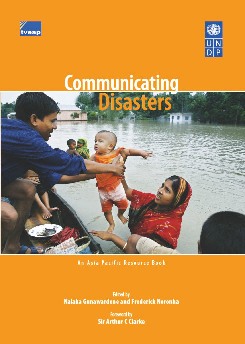
My interest in how disasters are covered and communicated go back to the time when my own house was flooded in mid 1992. I have since researched and commented extensively on this issue, and co-edited the 2007 book Communicating Disasters: An Asia Pacific Resource Book (TVEAP/UNDP).
In this latest essay, I reiterate an argument I’ve been making for sometime: “Media researchers have long accused the Western and globalised news media of having an implicit ‘hierarchy’ of death and destruction, in terms of how they report disasters in developing countries. But Sri Lanka’s own media’s indifference is equally appalling – the story of a quarter-million displaced people languishing in squalid conditions for weeks on end did not constitute front-page news. A starlet entering hospital after a domestic brawl excites news editors more than thousands of flood-affected provincial people starving while waiting for relief.”
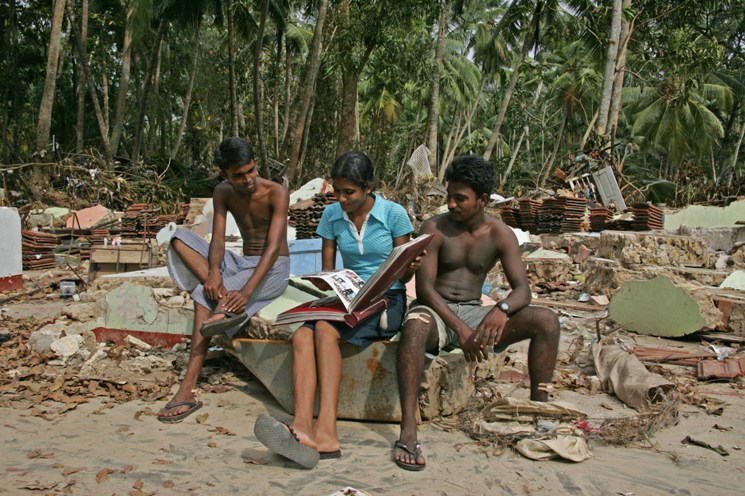
Tsunami survivors look at an lbum of family photos in Telwatte, Sri Lanka - Photo by Shahidul Alam
Today marks the 6th anniversary of the Boxing Day Tsunami of December 2004. The occasion is being marked solemnly in many locations hit by the waves all along the Indian Ocean rim countries.
Among them is Peraliya, close to Telwatte, where the worst train crash in railroad history occurred that day — when an overcrowded passenger train was destroyed on a coastal railway in Sri Lanka by the tsunami. The government-owned Sri Lanka Railways will never be able to live down their day of infamy when a packed train headed to disaster with no warning… They have the gumption — and insensitivity — to operate a memorial train today along the same path that led more than 2,000 passengers to a watery grave six years ago.
After six years, most survivors have moved on and rebuilt their shattered lives. Memories are also beginning to fade a bit, but for those directly affected, they will remember 26 December 2004 for the rest of their lives. And we who shared their tragedy and misery will keep reliving the memories through photographs, videos and the growing body of creative writing that the region-wide disaster inspired.
Photographs stand out as possibly the most enduring memory aids of a disaster. As disaster survivors sift through what is left of their homes, family photo albums are among the most cherished possessions they seek to recover. Why are snapshots of frozen moments so powerfully evocative to individuals, communities and the world?
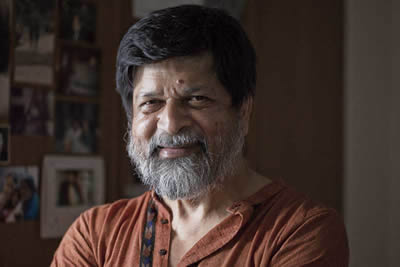
Titled Capturing Nature’s Fury, the chapter drew on Shahidul’s experiences not only with the tsunami, which he covered in Sri Lanka, but also the earthquakes in Bam, Iran (December 2003) and Kashmir (October 2005), and cyclones and floods in his native Bangladesh.
Shahidul Alam. Photo: Rahnuma Ahmed/Drik/Majority WorldDescribing the circumstances of the above photo, Shahidul wrote: “In the ruins of Telwatte, where the fateful train disaster had taken place, I came across a family that had gathered in the wreckage of their home. I wanted to ask them their stories, find out what they had seen, but stopped when I saw them pick up the family album. They sat amidst the rubble and laughed as they turned page after page.”
Zooming out, he further reflected:
“I had seen it before. As people rummaged through the ruins of their homes, the first thing they searched for was photographs. Years earlier at a disaster closer to home, I had photographed a group of children amidst the floods of 1988. The children insisted on being photographed. As I pressed the shutter, I realised that the boy in the middle was blind. He would never see the photograph he was proudly posing for. Why was it so important for the blind boy to be photographed?
“Though my entry into photography had been through a happy accident, my choice of becoming a photographer had been a very conscious one. Having felt the power of the image I recognised its ability to move people. The immediacy of an iconic image, its ability to engage with the viewer, its intimacy, the universality of its language, means it is at once a language of the masses, but also the key that can open doors.
“For both the gatekeepers and the public, the image has a visceral quality that is both raw and delicate. It can move people to laughter and to tears and can touch people at many levels. The iconic image lingers, long after the moment has gone. We are the witnesses of our times and the historians of our ages. We are the collective memories of our communities.
My friend Kalpana Sharma just stepped down after serving on the Panos South Asia board for over a decade. The Executive Director A S Panneerselvan asked me to write a personalised piece felicitating her. Part of this was read at the annual meeting of the Board held in Dhaka last weekend. Here’s the full essay — a couple of mutual friends who read it say it isn’t too eulogistic! Now you can decide for yourself…
* * * * *
The Curious Ms Sharma of Mumbai
I knew Kalpana Sharma from her by-line long before I met her in person. Now, more than a dozen years after we became friends, she remains an inspiration and a role model.
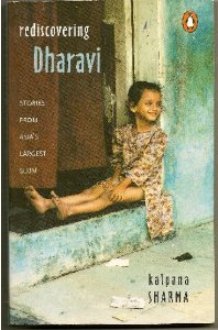
Kalpana SharmaKalpana has been a path-finder and trail-blazer in journalism that cares. She has set the gold standard in investigating and critiquing development in the Indian media. Today, she continues her nearly four decades of association with the Indian media as a respected columnist, journalist and writer. Her stock in trade is a mix of curiosity, sense of social justice, wanderlust and a deep passion for people and issues. She is living proof that quality journalism can be pursued even in these turbulent and uncertain times for the mainstream, corporatised media.
Kalpana has been covering the ‘other India’ that is largely ignored by the Indian media. Its denizens are some 456 million people living under the global poverty line of $1.25 per day — a third of the world’s poor. (If they declared independence, they would immediately become the world’s third most populous nation.) Kalpana’s reporting from the ‘Ground Zero’ of many disasters and conflict zones has highlighted the multiple deprivations of these people living on the margins of survival.
For many such communities, a headline-creating event is just the latest episode in their prolonged and silent suffering. The media pack that descends on them after a sudden development can’t seem very different from the assorted politicians who turn up periodically during election campaigns. For too long, the grassroots have been treated merely as a grazing ground for stories or votes.
Kalpana doesn’t hesitate to be part of the media pack when duty calls, but once in the field, she sees connections often missed by other journalists looking for a quick sound byte or dramatic image. Unlike some news hounds, she doesn’t exploit the misery of affected people (“Hands up who’s poor, speaks English – and looks good on TV!”). And she returns to the same locations months or years later to follow up.
For all these reasons, Kalpana was our first choice to write the last chapter in a regional book on disasters and media that I co-edited with Indian journalist Frederick Noronha in 2007. Her 2,000-word reflective essay should be required reading for any journalist covering disasters and social disparity in South Asia.
Here is a passage that sums up her views on the subject: “Much of disaster reporting sounds and reads the same because the reporters only see what is in front of them, not what lies behind the mounds of rubble, figuratively speaking. What was this region before it became this disaster area? How were social relations between different groups? What was its history? What were its relations with the state government? Was it neglected or was it favoured? How important was it to the politics of the state?”
Kalpana has been asking such probing questions all her professional life. And it’s not just in the rural hinterland of India that Kalpana has travelled extensively listening and talking to people from all walks of life. Living in the world’s second most populous city Mumbai, she has been equally concerned with its burning issues of urban poverty, gender disparity, environmental mismanagement and governance.
In her quest for untold human stories, Kalpana has taken a particular interest in the plight of poor women. She has written many authentic and moving stories about women who struggle on the margins of the margin. A recurrent theme in her writing is how invisible ‘superwomen’ hold the social fabric together in much of India. Many communities and production systems –ranging from domestic work and child care to waste disposal and farming – would simply grind to a halt if these unseen and unsung women took even a single day off. In reality, of course, they just can’t afford such luxuries.
Kalpana’s column The Other Half, which started in The Indian Express and now appears in The Hindu, is a regular eye-opener. She takes a current topic – from politics, culture, sport or environment — and explores its gender dimensions. She does so by carefully blending facts, personal insights and opinion that makes her writing very different to the rhetorical shrill of gender activists.
Make no mistake: Kalpana is an activist in her own right, and one of the finest in modern India. It’s just that her approach is more subtle, rational and measured – and in the long run, wholly more effective. Long ago, she found how to balance public interest journalism with social activism. This is one more reason why I look up to her.
Partners in crime: Nalaka and Kalpana speaking at the Education for Sustainable Future conference in Ahmedabad, India, January 2005.
In her writing, television appearances and public speaking, Kalpana stays well within the boundaries of good, old-fashioned journalism based on its A, B and C: accuracy, balance and credibility. In my view, she enriches the mix by adding a ‘D’ and ‘E’: depth and empathy. Without these qualities, mere reporting is sterile and dispassionate.
And once we get to know her, we also discover the ‘F’ in Kalpana Sharma: she is a fun-loving, cheerful woman who doesn’t take herself too seriously. We can count on her to be adventurous, enthusiastic and endlessly curious.
Cultivating these attributes would certainly enrich any journalist. I can’t agree more when Kalpana says (in her chapter to a recent book on environmental journalism in South Asia): “Journalists are good or bad, professional or unprofessional. I am not sure if other labels, such as ‘environmental’ or ‘developmental’, ought to be tagged on to journalists.”
I hope Kalpana has no retirement plans. She has earned a break after a dozen years on the Board of Panos South Asia. But we want her to remain a guiding star – a bundle of energy that shines a light into the Darkness, and helps make sense of the tumult and frenzy that surrounds us.
Smart but fleeting mobs?‘Smart mobs’ is an interesting term for like-minded groups that behave intelligently (or just efficiently) because of their exponentially increasing network links.
The idea was first proposed by author Howard Rheingold in his 2002 book, Smart Mobs: The Next Social Revolution. It deals with the social, economic and political changes implicated by developing information and communications technology. The topics range from text-messaging culture and wireless internet to the impact of the web on the marketplace.
In the eight years since the book first appeared, we’ve seen a proliferation and evolution of smart mobs, fuelled by the growth web 2.0 tools and, more recently, the many and varied social media. In fact, author Rheingold is credited with inventing the term virtual communities.
But the reality is that smart mobs can also be very fickle — their attention can be easily distracted. A smart mob can disperse just as fast as it forms, even while its original provocation remains.
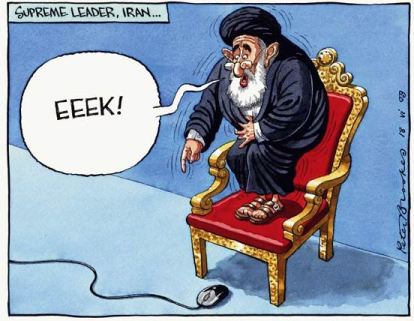
This was demonstrated in dramatic terms in June 2009. Following a hotly disputed presidential election in Iran, there was a surge of online support for pro-democracy activists there who launched a massive protest. A main point of convergence for online reporting and agitation was micro-blogging platform Twitter. Within a few days, mainstream media like TIME and Washington Post were all talking about this phenomenon in gushing terms.
As I wrote at the time: “I have no idea if the Ayatollahs are closet fans of Michael Jackson. But they must surely have thanked the King of Pop for creating a much-needed diversion in cyberspace precisely when the theocracy in Tehran needed it most.”
Other recent experiences have demonstrated how online interest can both build up and dissipate very fast. Staying with a single issue or cause seems hard in a world where news is breaking 24/7.
Here’s a current example. Following the massive oil spill in the Gulf of Mexico that started on 20 April 2010, local communities and environmental activists deployed various social media tools to track the unfolding disaster. BP, the giant oil company implicated in the disaster, has also tried to use social media to communicate its positions, but not too successfully. On Twitter, it was not BP’s official account but the satirical @BPGlobalPR that was dominating the online conversation. As one commentator wrote: “It is an object lesson in how social media can shape and control a company’s message during a crisis.”
Beyond PR?By early July 2010, however, there were already signs that online interest on the issue was already waning — even as the oil continued to leak from this largest offshore oil spill in US history. In a detailed analysis of main social media platforms’ coverage of the issue, Mashable noted last week: “An estimated 100 million gallons or more of oil have surged into the Gulf of Mexico…Yet on Twitter, Google, blogs and even YouTube, we’re already wrapping up our collective discussion of the oil spill and how to repair its damage.”
Riding the wave can be fun, but waves form and break quickly. Those who want to use social media tools for social activism still need to learn how to hitch a ride with the ocean current beneath the fickle waves.
A monstrous oil spill is gushing as much as 2,500,000 gallons of crude a day into the Gulf of Mexico.
This disaster is expected to be catastrophic for the land and people in the gulf. The oil has already reached land, contaminating wildlife sanctuaries. Authorities are so concerned about the impacts of more oil reaching land that they are prefer to set the gulf on fire, burning as much of the oil as possible.
Meanwhile, the fossil fuel industry is raking in windfall profits. BP, which operated the sunken rig, more than doubled its first quarter profits in 2010 to $5.65 billion.
I’ve just signed an urgent petition at Avaaz.org urging U.S. law-makers to overturn plans to expand offshore drilling. As the latest massive oil spill shows, offshore drilling isn’t safe or clean. The world needs clean energy investment to tackle climate, not expansion of dangerous and dirty energy sources.
Addressed to President Obama and members of Congress, it reads, simply: “We urge you to permanently call off plans to open up more of the US coastline to dangerous offshore drilling. Instead, invest in a clean and safe energy future.”
As Avvaz.org notes, “Before the spill, U.S. President Obama and Congressional leaders were planning to ramp up offshore drilling. Now, with the spill, the politics have shifted — and an opportunity has opened for the world’s biggest historical climate polluter to shift away from oil and towards climate-safe energy sources. At a moment like this, when leaders are making up their minds, the world’s voices can help tip the balance.”
Let’s hope it works – but the world is so addicted to its oil, and the petro dollars are so powerful – don’t hold your breath on this…
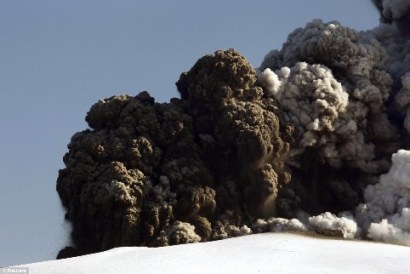
Eyjaffjalljokull erupting away in IcelandCall it the cough heard around the world.
And boy, what a cough – and with what consequences!
A week ago, most of us had never heard of Eyjaffjalljokull (a glacial volcano in Iceland) — and we’re still struggling to pronounce its name even as it keeps tens of millions of people completely grounded and held ‘hostage’ with its incessant and powerful coughing.
My daughter Dhara and I are currently ‘trapped’ in London: a volcanic ash cloud from Iceland shut down all flights in and over the British Isles on Thursday 15 April 2010. The siege has continued on to the fifth day now, disrupting travel plans of so many people, and causing massive losses to the travel industry. With over 150,000 Britons stranded abroad unable to fly back, the UK is now going into emergency mode to deal with the crisis.
It’s annoying to have an unknown – and unpronounceable! – natural factor crop up and change our carefully laid plans. But things could have been much worse. As I tweeted earlier, as natural disasters go, volcanic ash has been highly disruptive but with no casualties except economic (at least so far).
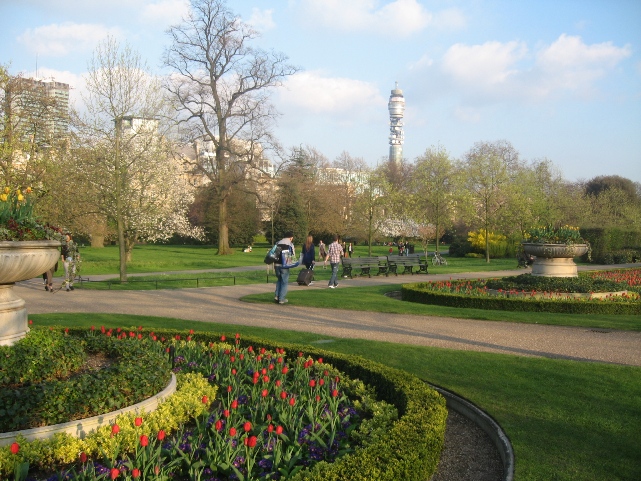
Life goes on in London: Regent's Park, 17 April 2010Life in London goes on with no visible signs of concern. Dhara and I walked around absorbing the sights, sounds and smells of London, and people were going about with life – and welcoming Spring. Joggers in Hyde Park and Regent’s Park, babies being strolled around, and weekend revelers at Camden Town and Trafalgar Square.
We mixed into all these crowds – it’s Dhara’s first time, so she’s wondering what the fuss is all about! (If you’ve traveled with an energetic teenager, you know what I’m coping with.) Yes, we are being ‘held hostage’, but by an ever-so-gentle force that’s invisible to the naked eye: as if in compensation, London has rolled out sunny blue skies (long may they last!). On balance, I’d rather be caught in this kind of situation than in a devastating earthquake or tsunami…
The British media are covering the unfolding situation in great detail, but I haven’t yet seen an estimate of the number of visitors to the UK forced to stay on as there is no current escape from these islands, at least by air. But that number must be significant – and each one has his or her story to tell, some more desperate than others.
Nadia is being adventurous (or just taking her chances). She is planning to take train or ferry or any other means to France, and then catch a train to southern Europe whose airspace is not yet affected by volcanic ash. Her determination is admirable – she just won’t allow this remote volcano to keep her hostage (she call it Eyja: “Do not expect me to ever know its full name. What kind of parent names their son Eyjafjallajoekull?”).
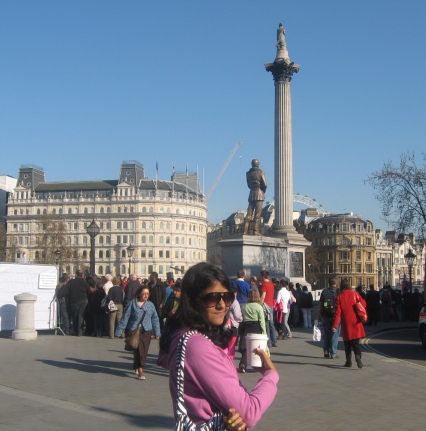
Dhara at Trafalgar Square, 18 April 2010Meanwhile, Dhara and I will hold out for a couple of days more to see if the skies will clear up and the aviation regulators will ease up. As time passes and the flight suspension begins to bite hard, more and more aviation industry professionals are questioning the complete no-fly ban. Some are calling it a regulatory over-reaction.
He adds: “The blanket ban under clear blue skies and glorious sunshine is making some wonder whether this ‘one-size-fits-all’ regulation is appropriate to a situation that the regulations did not foresee…In the final analysis, despite the scares, no one has actually been killed in a volcano incident – something which cannot be said for the much more hazardous drive to the airport.”
Meanwhile, the journal Science has unearthed (no pun intended) from its archives an article published in November 2004 about an enormous volcanic eruption from Iceland’s past — and what it means for the country’s future. It looks at researchers studying one of the largest and least appreciated eruptions in recorded history: volcano Laki that killed 10,000 Icelanders in 1783, and according to recent studies, its billowing plumes led to extreme weather and extensive illness that may have claimed thousands more lives in Britain and on the European continent.
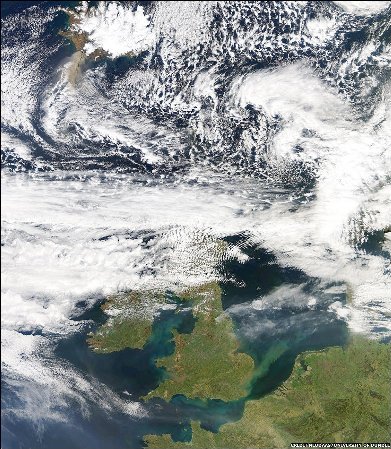
An image made available by NEODAAS/University of Dundee which shows the volcanic ash plume from Iceland, top left, to northern France as pictured by Nasa\'s Terra Satellite on 17 April 2010. Photo courtesy NEODAAS/University of Dundee/APIt’s not exactly a comforting thought to read how much worse a volcanic eruption could be. The piece was written by science writer Richard Stone (currently their Asia News Editor, and my fellow panelist at the science journalists conference last Summer in London). Interestingly, the headline I gave to that blog post was: Reporting disasters: How to keep a cool head when all hell breaks loose.
Well, easier said than done! It’s challenging for us journalists to keep a level head and report or comment on a mega-disaster for our media. But it’s even harder being caught up and personally affected by forces of Nature (and according Richard North, regulatory over-reaction). I’ve had my house flooded out, and was close enough to ground zero of the 2004 Asian Tsunami. On both occasions, the impact was brutal and immediate.
Eyja’s persistent coughing is different. It’s a distributed, slowly unfolding phenomenon with zero casualties so far, yet affecting millions. At one level, local residents can continue life’s routines with no threat of basic amenities of life being shattered. We travelers can grumble and remain nervous when we can get home, but at the streets of London are nothing like what the doomsday scenario shows in The Children of Men, placed in a near-future London of 2027.
But as Eyja’s strangely gentle yet firm siege continues – succeeding in closing down Britain’s air space in a way that Hitler and Bin Laden couldn’t – we are reminded of who is really in charge.
This is no Avatar: It's Real!A few days ago, reviewing the blockbuster movie Avatar, I wrote: “Film critics and social commentators around the world have noticed the many layers of allegory in the film. Interestingly, depending on where you come from, the movie’s underlying ‘message’ can be different: anti-war, pro-environment, anti-Big Oil, anti-mining, pro-indigenous people, and finally, anti-colonial or anti-American. Or All of the Above…”
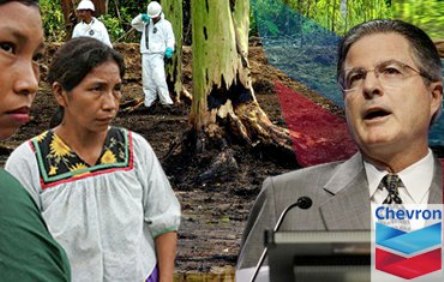
Indeed, an Avatar-like struggle is unfolding in the Amazon forest right now. The online campaigning group Avaaz have called it a ‘Chernobyl in the Amazon’. According to them: “Oil giant Chevron is facing defeat in a lawsuit by the people of the Ecuadorian Amazon, seeking redress for its dumping billions of gallons of poisonous waste in the rainforest.”
From 1964 to 1990, Avaaz claims, Chevron-owned Texaco deliberately dumped billions of gallons of toxic waste from their oil fields in Ecuador’s Amazon — then pulled out without properly cleaning up the pollution they caused.
In their call to action, they go on to say: “But the oil multinational has launched a last-ditch, dirty lobbying effort to derail the people’s case for holding polluters to account. Chevron’s new chief executive John Watson knows his brand is under fire – let’s turn up the global heat.”
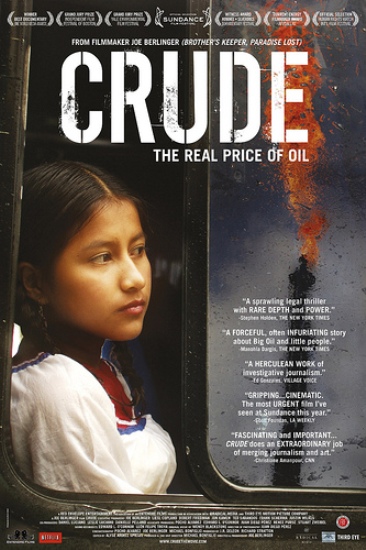
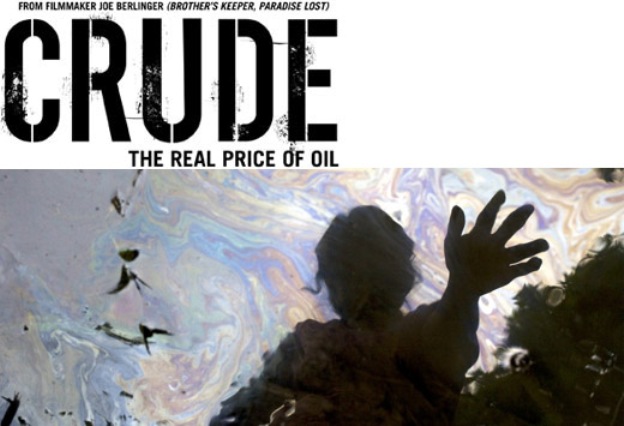
Others have been highlighting this real life struggle for many months. Chief among them is the documentary CRUDE: The Real Price of Oil, made by Joe Berlinger.
The award-winning film, which had its World Premiere at the 2009 Sundance Film Festival, chronicles the epic battle to hold oil giant Chevron (formerly Texaco) accountable for its systematic contamination of the Ecuadorian Amazon – an environmental tragedy that experts call “the Rainforest Chernobyl.”
Here’s the official blurb: Three years in the making, this cinéma-vérité feature from acclaimed filmmaker Joe Berlinger is the epic story of one of the largest and most controversial legal cases on the planet. An inside look at the infamous $27 billion Amazon Chernobyl case, CRUDE is a real-life high stakes legal drama set against a backdrop of the environmental movement, global politics, celebrity activism, human rights advocacy, the media, multinational corporate power, and rapidly-disappearing indigenous cultures. Presenting a complex situation from multiple viewpoints, the film subverts the conventions of advocacy filmmaking as it examines a complicated situation from all angles while bringing an important story of environmental peril and human suffering into focus.
Watch the official trailer of Crude: The Real Price of Oil
According to Amazon Watch website: “With key support from Amazon Watch and our Clean Up Ecuador campaign, people are coming together to promote (and see) this incredible film, and then provide ways for viewers to support the struggle highlighted so powerfully by the film.”
They go on to say: “A victory for the Ecuadorian plaintiffs in the lawsuit will send shock waves through corporate boardrooms around the world, invigorating communities fighting against injustice by oil companies. The success of our campaign can change how the oil industry operates by sending a clear signal that they will be held financially liable for their abuses.”
While Avatar‘s story unfolds in imaginary planet Pandora — conjured up by James Cameron’s imagination and created, to a large part, with astonishing special effects, the story of Crude is every bit real and right here on Earth. If one tenth of those who go to see Avatar end up also watching Crude, that should build up much awareness on the equally brutal and reckless conduct of Big Oil companies.
Civilisation's ultimate addiction?
Others have been making the same point. One of them is Erik Assadourian, a Senior Researcher at Worldwatch Institute, whom I met at the Greenaccord Forum in Viterbo, Italy, in November 2009.
He recently blogged: “The Ecuadorians aren’t 10-feet tall or blue, and cannot literally connect with the spirit of the Earth (Pachamama as Ecuadorians call this or Eywa as the Na’vi call the spirit that stems from their planet’s life) but they are as utterly dependent—both culturally and physically—on the forest ecosystem in which they live and are just as exploited by those that see the forest as only being valuable as a container for the resources stored beneath it.”
Erik continues: “Both movies were fantastic reminders of human short-sightedness, one as an epic myth in which one of the invading warriors awakens to his power, becomes champion of the exploited tribe and saves the planet from the oppressors; the other as a less exciting but highly detailed chronicle of the reality of modern battles—organizers, lawyers, and celebrities today have become the warriors, shamans, and chieftains of earlier times.”
Going to the movies has been a shared cultural activity for at least four generations. In that time, technology has marched forward in leaps and bounds — but the core experience remains the same. And we still keep going to the movies, at the cinema, even though we now have other ways of seeing the same films. Why?
On the penultimate day of 2009, I went to the local cinema to see 2012, Roland Emmerich’s latest depiction of the mother of all disasters. For 158 gripping minutes, I willingly suspended disbelief and allowed the myth-makers of Hollywood to thoroughly scare me out of my wits. As did, it seemed, the few hundred other people watching it on wide screen with surround sound. There is no way the literally earth-shattering scenes of this movie would seem and feel remotely realistic anywhere else…
But cinemas are far from perfect – for instance, we had put up with a bunch of screaming brats whose parents had unwisely brought them for the wrong kind of movie. I’ve sat through far more noisy and boorish behaviour at cinemas: notable among them is watching Titanic at a massive, packed cinema in downtown Mumbai sometime in 1998 — and discovering how ‘interactive’ Indian movie-goers can get. (After the initial irritation wears off, I became almost oblivious to the distractions, thanks to James Cameron’s superb story telling.)
I just refuse to see such blockbusters on a small screen. (Ok, I might watch movies on long flights when I get tired of reading, but I have never been able to bring myself to watching a movie on an ipod…)
In fact, the movie industry is as much caught up in the digital wave as all other aspects of media. As Manohla Dargis of the New York Timesnoted in a perceptive essay this week: “How much our world of moving-image entertainment has changed in the past decade! We now live in a world of the 24-Hour Movie, one that plays anytime and anywhere you want (and sometimes whether you want it to or not). It’s a movie we can access at home by pressing a few buttons on the remote (and agreeing to pay more for it than you might at the local video store) or with a few clicks of the mouse. The 24-Hour Movie now streams instead of unspools, filling our screens with images that, more and more, have been created algorithmically rather than photographically.”
Yet, unlike in other media experiences, the changes in the movie industry have gone largely unnoticed by ordinary viewers. As Dargis writes: “Film is profoundly changing — or, if you believe some theorists and historians, is already dead — something that most moviegoers don’t know. Yet, because the visible evidence of this changeover has become literally hard to see, and because the implications are difficult to grasp, it is also understandable why the shift to digital has not attracted more intense analysis outside film and media studies.”
Dargis is probably right: by adapting and evolving with the times, the cinema has survived for over a century. As Donald Clarke noted in The Irish Times at the beginning of December 2009: “Television failed to kill movies. Video failed to kill movies. Internet piracy – not to mention all the other diversions available online – has also failed to annihilate this most stubbornly resilient of art forms. Film-makers will, it is true, tell you that it is now more difficult than ever to negotiate financing for movies that cost between $3 million and $15 million. But you couldn’t say that the current recession has crippled the movie business.”
All this makes me wonder what movie-going might be like in another decade or two. 3D and IMAX are no longer so uncommon or special, and the entertainment industry is working hard to relate to not just our seeing and hearing, but other senses as well. (Did you know that, as long ago as 1960, they tried to introduce smelling movies? Smell-O-Vision was a system that released odors during the projection of a film so that the viewer could “smell” what was happening in the movie. The technique injected 30 different smells into a movie theater’s seats when triggered by the film’s soundtrack. For some reason, it never caught on…)
Perhaps it’s not simply a matter of money or technology. There is also a whole sociology of movie going and movie watching – many of us go to the cinema (not nearly often enough in my case) not just for the personal sensory experience of a celluloid dream, but also for the shared experience of it. I like bumping into friends at cinemas. At a premiere or special screening, I also get to steal a few glimpses of the glitterati of the film world.
Have you been to a film musical and had the uncontrollable urge to burst into song? London’s Prince Charles Cinema not only allows, but encourages viewers to do just this — though only on certain days of the month. Their most famous offering is Sing-a-long-a Sound of Music: a few years ago, I joined several hundred other assorted ‘nuns’, von Trapp family members and Julie Andrews look-a-likes in such a memorable experience. I have the digitally remastered DVD of the 1965 movie, an ever-green title in my household. But watching it at home can’t compare with the sense of community that one feels when the lyrics for all the songs appear on the movie screen, giving the audience every reason to sing their hearts out…
I’m not sure how popular (or even acceptable) such community movie watching would be in different cultures. But going to the movies retains its charm and appeal in this digital age, even if we have come a long way since the glorious days of movie going as captured in this wonderful and memorable song from the musical Annie (1982) – Let’s Go To The Movies







 Open Minds!
