Wash Your Hands – yes, UNICEF, but only if you ask us nicely!

Global Handwashing Day logo

October 15 was marked as the first Global Handwashing Day (GHD). It’s simple yet important mission was to promote the practice of handwashing with soap.

Washing hands can save lives. Washing hands with soap can save more lives. This is the simple message reinforced on this day with public campaigns focusing on schools and school children.

In this UN-declared International Year of Sanitation 2008, the GHD will echo and reinforce its call for improved hygiene practices.

GHD is a Unicef-led initiative involving governments, civil society, volunteers and others around the world.

“Turning handwashing with soap before eating and after using the toilet into an ingrained habit could save more lives than any single vaccine or medical intervention, cutting deaths from diarrhea by almost half and deaths from acute respiratory infections by one-quarter,” says the GHD official website, explaining the background.

IYS 2008 logo
IYS 2008 logo
Trying saying that aloud in one breath – I can’t. Evidently, the crusty technocrat who wrote that text wanted to pack all the rationale into one long, clumsy sentence.

But this message is too important to be spoilt by an inarticulate official. Washing hands with soap can prevent diahrroeal diseases and pneumonia, which together kill more than 3.5 million children under five every year. That’s 400 needless deaths every hour, round the clock.

Fortunately, the campaigning material that went out using moving images were better produced. Here are two good examples (and a bad one).

The popular Australian children’s musical entertainers, The Wiggles, produced and donated a song to mark the Global Handwashing Day. This simple and catchy tune “seeks to motivate millions of children around the world, to transform the simple act of handwashing with soap from an abstract and seldom practiced behaviour into an automatic and enjoyable habit”.

Meanwhile, in India, cricket star Sachin Tendulkar joined forces with UNICEF to get Indian children to improve their health and hygiene as part of GHD. Tendulkar features in a public service announcement (PSA) being broadcast this month in 14 languages across India. It will target students in more than 6 million schools.

And finally, here’s Unicef’s own news story posted this week on its YouTube channel telling us more on GHD. It’s technically well made, but absolutely lacks passion. The narrator delivers her script in such an indifferent, detached tone, and UNICEF Senior Adviser for Sanitation and Hygiene pontificates also in a tone that will not win her many followers. Scenes of senior UN officials washing their hands in a demonstration are laughable. The only saving grace in this story is when we see Hayley Westenra, the well known singer from New Zealand and youngest UNICEF Goodwill Ambassador, visiting water and sanitation projects in Ghana.

If only the rest of GHD promoters had the enthusiasm and passion that Hayley Westenra exudes! Passion used to be the hallmark of UNICEF during the time of its legendary executive director James Grant, who strongly believed in communicating messages of child survival and well-being. He gave UNICEF a head start in working with the media, especially television.

Alas, large UN agencies like UNICEF have little or no institutional memory for more than just a few years. Because if they did, GHD campaigns could have effectively used, at least in South Asia (where nearly half of all people lack access to toilets) an episode of the hugely popular Meena cartoon animation series.

Meena is the enchanting heroine of an animated film series produced by UNICEF in South Asia. The films are part of a package of communication materials promoting the status of the girl child in this region. UNICEF co-produced the series a decade ago with leading animators in the US and South Asia.
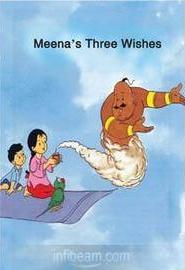
Meena's Three Wishes
In Meena’s Three Wishes, Meena dreams of a magic genie that will grant her three wishes so that everyone would be healthy and never again get sick from poor sanitation and unsafe water. When Meena wakes up, she realizes that she must make her dream come true. With the help of her brother Raju, other children in the village, and Mithu, her pet parrot, Meena convinces people to build and use latrines, to use safe water and to wash their hands to stop the spread of germs and disease.

I don’t particularly enjoy it when UN agencies try to play nanny to the whole world, especially if they talk to us in such jargon-ridden, dispassionate terms. Their messages are tremendously important, and deserve wider dissemination — they can literally save lives.

That’s why public campaigns should be left in the hands of communication professionals who know how to reach out beyond the charmed development circle. For the rest of UNICEF, they should perhaps take a lesson or two in passionate communication from Hayley Westenra, The Wiggles – and their own little Meena!

Lakshani: A child of the sea travels beyond the seas…

Lakshani photo by TVEAP

Our teacher said our country is small and is surrounded by the sea….she showed it on the globe.”

With these words, young Lakshani Fernando (photo, above) begins telling us the compact story of her short life.

Lakshani, 9, has lived by the sea (Indian Ocean) from the time she was born. When she was just six, the Asian Tsunami of December 2004 destroyed their beachfront house in Koralawella, Moratuwa, on Sri Lanka’s western coast. More than three years later, when my colleague Buddhini Ekanayake met Lakshani in March 2008, the family was still struggling to raise their heads from that massive blow.

A day in Lakshani’s life is the story of a short, 3-minute film that Buddhini produced for TVE Asia Pacific a few weeks ago. It’s part of an Asian and African television co-production project that is about, for and by children.

In the film, Lakshani shares the highlights of a typical day. That includes going for a walk on the polluted beach with her fisherman father, spending a few hours at the nearby school and playing with neighbourhood children. While at it, she tells us her wishes for a cleaner beach and a better neighbourhood.

Buddhini called Lakshani a ‘Child of the Sea’. Even the cruel waves of the tsunami didn’t scare Lakshani away for too long.

I love to play with waves…” Lakshani says towards the end of the film. Then she looks far out at the horizon, and talks again. “There are ships far out at sea. That’s all there is…

She might not yet imagine lands beyond ships and waves, but last week, her story travelled across the seas. Over 500 broadcast media managers, journalists and researchers from around the world, who’d gathered in Kuala Lumpur, Malaysia, for Asia Media Summit 2008, had a glimpse of Lakshani when the first 90 seconds of the film was screened during plenary.

Elizabeth Smith, secretary general of the Commonwealth Broadcasting Association (CBA), chose an extract from Lakshani’s story to introduce the media initiative. Sitting in the audience, I immediately texted the news to Buddhini.

Watch “I am A Child of the Sea”:

This film forms part of a series that has 20 TV producers from 13 countries engaging in a co-production of a short programmes series (mini documentaries) about and for children. The series is the outcome of a regional project organised by the Asia Pacific Institute for Broadcasting Development (AIBD) in collaboration with the French Ministry of Foreign affairs, the Commonwealth Broadcasting Association (CBA), Thomson Foundation, Prix Jeunesse, Children and Broadcasting Foundation for Africa and RTM-IPTAR of Malaysia.

The project tries to capture cultural diversity through the eyes of children. When its concept first reached us, it was defined very narrowly in terms of ethnicity and/or religion. TVE Asia Pacific being a strictly secular organisation, we couldn’t fit into such a tight range. Besides, we realised that many modern day children have a self identity that goes above and beyond the race and religion that blind chance of birth assigned to them.

So we took an editorial decision: instead of doing a story that highlights factors that utterly and bitterly divide humanity (such as race and religion, both of which fuel the long-drawn war in Sri Lanka), we would look for a unifying factor. The tsunami’s killer waves, when they rolled in, didn’t care for our petty human divisions. For a few days and weeks following the tragedy, Sri Lanka was united in shock and grief in a manner I have never seen in my 42 years of living here. (Then we went back to killing each other again.)

The result of our search was Lakshani and her story captured in ‘I am a Child of the Sea’.

Buddhini chose to feature Lakshani after interviewing 10 children from different localities and a diversity of cultural backgrounds. (Never once did she ask for the child’s religion, which unlike ethnicity is not always apparent from the name.) There was some significance in featuring a child who identifies herself closely with the Sea in a country where tens of thousands of tsunami-affected people have still not come to terms with the sea. Even after the tsunami destroyed their home, Lakshani’s family moved to a ‘temporary’ shelter within sight of the sea. Thus, her story had a close association with the sea which formed part of her lifestyle, environment and culture.

Buddhini developed the script after several leisurely chats with Lakshani, based partly on the child’s own writing about herself. Filming the story took place in early March 2008, with the full consent of her parents, extended family and neighbours. Read more about the making of this film on TVEAP website and on Buddhini’s own blog.

TVEAP crew filming Lakshani's story

Lakshani’s story is symbolic at another level. It reveals how, despite receiving a massive outpouring of donations from all over the world, some tsunami-affected families are still struggling to put together their shattered lives. The litany of woes, missed opportunities and sometimes outright plundering of donations came out strongly in the first hand accounts of affected people (in India, Indonesia, Sri Lanka and Thailand) who spoke to us during the Children of Tsunami media project. Read our reflections on the project in Communicating Disasters book published in 2007.

Lakshani’s family is not typical of Sri Lanka’s tsunami affected persons. Unlike most such families, the Fernandos live on the western coast, relatively close to Colombo. Although wave action destroyed or damaged beachfront homes in these areas, most attention was focused on areas in the south, east and north of the island that were hit much harder. So those affected and living on the west coast have often been overlooked or dismissed lightly. In this sense, Lakshani’s family has some parallels with what I called ‘step-children of tsunami’.

There is a bit more cheerful post-script to this story. During several visits to Lakshani and family for researching, filming and editing this film, Buddhini (who has a daughter aged four herself) bonded with the girl. It became more than a mere film-making venture, and has led to a lasting relationship. Meanwhile, young voice artiste Shanya Fernando, who rendered Lakshani’s Sinhala voice into English for an international audience, has also felt an attachment to the ‘star’ of our film.

While the film was made with the informed consent of Lakshani’s family who received no material benefits for their participation, both Buddhini and Shanya have since presented some basic educational gifts to Lakshani — who is certainly in need of such help. And who am I to stand in the way of such gestures of human kindness?

Producer BUddhini with Lakshani

Photos by Amal Samaraweera, TVE Asia Pacific

Children of Heaven: Appreciating the sound of silence

Courtesy Wikipedia

What’s it with children and shoes? Those who have none dream of owning their first pair. Those who have one, or some, still dream about a better, or perfect, pair. Shoes are worth dreaming about, crying (even fighting?) over, and running races for.

Like Ali did, in Majid Majidi’s superbly crafted 1997 movie Children of Heaven. For 90 minutes this afternoon, my team and I ran the race with little boy Ali, sharing his dreams, sorrows and eventual (albeit bitter-sweet) triumph.

I had seen this film before, but this time around, the experience felt even better than I remembered it. I already knew the story, but I was spell-bound by the film’s culmination – the children’s race where Ali wanted to come third, but ended up winning. I followed the last few minutes with tears in my eyes and the heart beating faster.

This is what good story telling is all about.

Read Children of Heaven synopsis on Wikipedia

Of course, Majid Majidi didn’t work this miracle alone. The superb cinematography of Parviz Malekzaade was well packaged by its editor Hassan Hassandoost. His work is uncluttered and elegant: the story flows in a simple, linear manner with no flashbacks or flash-forwards; no special effects to jazz things up; and the scenes are so seamlessly meshed together with hardly a second being wasted.

And the soundtrack played a vital part in shaping the whole experience. It’s not just the music. As my colleague Buddhini remarked, it also made clever, strategic use of silence.

We might call it the sound of silence – and never underestimate its power in the right place.

All this reminded me of what our Australian film-maker colleague Bruce Moir often said when we worked with him: “We’ve got to remember that film appeals to people’s hearts more than their minds. The way to people’s heads is through their hearts, from the chest upwards — and not the other way round.”

A year ago, I invited him as my special guest to a talk I gave at the University of Western Sydney in Australia – in his home city. There, he once again made the point: “Our fundamental job is to tell a story – one that holds an audience’s interest and moves their heart, regardless of language, cultural context or subject….I have always believed that film achieves its optimal impact by aiming to ‘get at the audience’s head via their heart’…”

April 2007 blog post: Moving images moving heart first, mind next

As I then wrote, I hope this was an ‘Aha!’ moment to some in our largely academic and activist audience. Many who commission films or even a few who make films tend to overlook this. Especially when they set out trying to ‘communicate messages’.

Bruce never tires of saying: “Film is a lousy medium to communicate information. It works best at the emotional level.”

Children of Heaven is living proof of this. It has no lofty agenda to deliver information or communicate messages of any kind. Yet, by telling a universal story set in modern day Iran, it brings up a whole lot of development related issues that can trigger hours of discussion: not just the rich/poor or rural/urban disparities, but other concerns like how a country like Iran is portrayed in the western news media.

As a colleague remarked after today’s film, she had no idea of this aspect of life in Iran — the version we constantly hear is of an oil-rich, nuke-happy, terror-sponsoring theocracy that, to the incumbent US president at least, is part of the ‘axis of evil‘. And the Al Jazeera International channel, packed with BBC discards or defectors, has done little to change this popular perception.

We watched the movie as part of our monthly screening of a feature film. We are lining up critically acclaimed films from different cinematic traditions of the world. And then we discuss its artistic, technical and editorial aspects.

As for me, I totally agree with the famous movie critic Roger Ebert, who wrote in the Chicago Sun-Times at the time of the movie’s first US release: “Children of Heaven is very nearly a perfect movie for children, and of course that means adults will like it, too. It lacks the cynicism and smart-mouth attitudes of so much American entertainment for kids and glows with a kind of good-hearted purity. To see this movie is to be reminded of a time when the children in movies were children and not miniature stand-up comics.”

As he summed it up: “Children of Heaven is about a home without unhappiness. About a brother and sister who love one another, instead of fighting. About situations any child can identify with. In this film from Iran, I found a sweetness and innocence that shames the land of Mutant Turtles, Power Rangers and violent video games. Why do we teach our kids to see through things, before they even learn to see them?”

Note: The film, originally made in Persian, was named Bacheha-Ye aseman . It was nominated for an Academy (Oscar) Award for the best foreign film in 1998, but lost out to a worthy competitor, Roberto Benigni’s Life is Beautiful.

What’s local in our mixed up, globalised world?

I belong to what’s arguably the biggest club in the world, whose members number not in millions but billions. Everywhere I go, I meet fellow members and, sooner or later, conversation drifts to our shared membership in – parenthood.

Last weekend, I was absorbing the sights, sounds and smells of the Laguna province in the Philippines in the exalted company of academic colleagues from the College of Development Communications, University of Philippines Los Banos. At one point, we walked past some old houses designed in Spanish style – a reminder of the country’s strong Spanish legacy.

I heard how the Filipino language has absorbed or adapted hundreds of Spanish words, so much so that the younger generations don’t realise the Spanish origins of many words they use everyday.

One colleague related a story. Her daughter (now 16) had been a fan of ‘Madeline‘ – an animated series based on the popular children’s books by Ludwig Bemelmans, an American author of Austrian and German origins. Read more about Madeline animated TV series.

Happy coincidence: my daughter Dhara (still 11) and I are fans too of the smart and adventurous little French girl who lives with 11 other kids Miss Clavelle’s boarding school in Paris. Although the smallest girl, Madeline nevertheless manages to get herself into one predicament after another, giving her friends and teachers much to worry about. In the end, though, she always comes out all right.

Madeline is a good friend of the Spanish Ambassador’s son, Pepito. The young boy occasionally slips in a few Spanish words or phrases. This happened in one episode when Pepito was talking about sombreros.

The Filipino girl was excited. She exclaimed: “Mom, Pepito is talking in Filipino!”

It’s a small reminder of how delightfully mixed up our cultures are – and not just in language. Many of our metaphors, references and other expressions have been borrowed and adapted from other cultures and traditions in far corners of the planet. After a generation or two, few remember the origins.

It’s becoming impossible to discern or define what is ‘local’ anymore in this rapidly globalising and integrating world. Sociologists and communication researchers who split hairs about preserving ‘local content’ have a romanticised notion that is hard to find in the real world.

‘Content creation’ describes something that we journalists, as well as film-makers, writers and creative artistes have been doing for centuries. For much of that period, content was entirely local. It was only in recent decades that information and communications technologies (ICTs) enabled content to be swapped around the world at the speed of light.

And some ICT activists feel the need to make content more local again. No doubt an ideal. But I keep asking them: just what is local anymore in our rapidly integrating and hopelessly mixed up world?

Does it really matter anyway, except to the cultural purists who live in ivory towers?

Dewitt Wallace, the American founder of the Reader’s Digest magazine, was fond of pointing out how much his publication had become a part of the everyday lives of millions of people worldwide. One of his favourite anecdotes was about two children born and raised on a Caribbean island.

On their first visit to the United States, the kids were walking on the streets of New York, in the magazine’s home state of New York (Reader’s Digest is owned and published by The Reader’s Digest Association, a privately held company based in Chappaqua, New York, but the mailing address is actually Pleasantville, New York). On seeing the magazine on sale at newsstands, one of them exclaimed: “Look dad, they have the Reader’s Digest here too!”.

I personally think we should focus more on content that is locally relevant and locally useful. If it is also locally generated, that’s well and good — but does the point of origin matter too much in this knowledge society, when we are swapping electrons and ideas across political boundaries?

Release Ozzy Ozone held prisoner by brand guardians!

In September 2007, I wrote about Ozzy Ozone, an energetic, cheerful little ozone molecule – part of the ozone layer in the upper atmosphere that prevents the Sun’s harmful ultra-violet rays from coming through and causing skin cancer, cataract and other health problems.

Ozzy Ozone is part of a global public education effort by the UN Environment Programme (UNEP) to tell everyone how harmful UV rays are to our health, and how Ozzy and his fellow ozone molecules are literally protecting life on earth from being zapped out.

I called Ozzy the little molecule on a big mission — to tell all humans to soon phase out using certain chemicals that, when released to the air, go up and destroy his kind.

Last week, while attending a UNEP meeting in Bangkok to plan the next ozone communication strategy for Asia Pacific, I heard some disturbing news: little Ozzy has become a prisoner of his brand guardians. As a result, he is not as free as he could be to roam the planet, spreading the vital ozone message.

Anne Fenner, Information Officer of UNEP’s OzonAction Programme revealed how she routinely turns down requests to produce toys and other material using the popular character.

“I have had so many requests from companies, but we cannot allow commercial exploitation of this brand,” Anne said.

I was stunned. Here is one of the more popular communication products to emerge from the UN, not generally known for such successful engagement of popular culture. And there we were, brainstorming on ways to get the ozone message to large, scattered (and distracted) audiences.

Ozzy was created by a graphic artist in Barbados, as part of a government-supported campaign to raise public awareness on ozone layer thinning. This cartoon character served as a “mascot” and was very effective in raising awareness in Barbados. The cartoon series was printed in local newspapers. Additionally, promotional items produced for local public awareness and education campaigns using the Ozzy graphic include posters, key rings, rulers, erasers, refrigerator magnets, mouse pads, pens, pencils, stickers, and envelopes.

The character was so popular that UNEP struck a deal with Barbados to ‘globalize’ Ozzy. An animated video was produced, along with a dedicated website, comic strips and other media adaptations.

Ozzy has been a run-away success, giving UNEP a high profile, widely popular character — and a great deal of media coverage and interest. The kind of media engagement that is typically enjoyed by Unicef, the most media-savvy of all UN agencies.

But we now know that Ozzy’s brand guardians don’t allow him to go as far as he could. They may be playing by the rules, but do they realise that huge opportunities are being lost?

There we were, a small group of journalists, communicators, scientists and government officials discussing for three days how to get the biggest bang for our collectively limited buck where ozone messaging is concerned.

It was frustrating to know that the best brand ambassador has been locked up in brand integrity and copyright restrictions.

I suggested to Anne Fenner that protecting the brand integrity need not be so rigidly pursued. For example, careful franchising could be undertaken based on a set of guidelines — and the royalty could go into a trust fund that supports ozone communication work.

Indeed, the challenge for development communicators everywhere is to find the common ground between the public interest and the commercial interest. In this era of globalised media and CSR, the two interests are no longer mutually exclusive. Some might argue they never were.

The long-established copyright regimes themselves are being questioned, challenged and bypassed by a growing number of research, advocacy and activist groups. Many now publish their academic or artistic work under Creative Commons licenses, that enable their creators to be acknowledged and retain some control — and yet allow many types of uses without excessive restriction.

When TVE Asia Pacific recently released an Asian regional book called Communicating Disasters, our co-publisher UNDP Regional Centre in Bangkok proposed that the book be under Creative Commons Attribution 3.0 license. We were happy to go along.

UNEP has some catching up to do. Turning the pages of lavishly illustrated Ozzy Ozone comic story books (of which 3 titles have come out so far), I found that UNEP has the standard copyright restriction. However, they add a line: “This publication may be reproduced in whole or part and in any form for educational or non-profit purposes without special permission from the copyright holder, provided acknowledgement of the source is made.”

That’s encouraging – but not good enough. What happens if a commercially operated media organisation wants to use this content for public interest? Will they qualify under ‘educational or non-profit purposes’?

Probably not. And that’s when the dreaded copyright lawyers could come marching out.

It’s the assorted lawyers and over-cautious officials who are keeping Ozzy Ozone a virtual prisoner.

And sadly, little Ozzy is not alone. Everywhere in the publishing and media world, we can find many examples of how creative works are being held back – usually by over-protective lawyers or accountants. Sometimes that’s the case even if the artistes or media professionals themselves would much rather let go of the rights.

In July 2007, I wrote a blog post called ‘The lawyers who locked up the butterfly tree’ — which revealed how lawyers working for the publicly-funded BBC had systematically blocked a multi-award winning African documentary film from being used for environmental education, awareness and advocacy. All because the BBC had partly funded its production, and therefore had a claim on its copyright.

So here’s our plea to Ozzy’s brand guardians in UNEP: let him roam free, taking the vital message to millions. And while at it, let him make some money (from franchisees) which can suppot the rest of UNEP’s ozone communication work.

And if some spoilsport of a copyright lawyer gets in the way, tell him/her to take a beach vacation — without sunblock.

Related links:
Sep 2006: Make poverty a copyright free zone

May 2007: TVEAP renews call for poverty as a copyright free zone

Sri Lanka: What killer waves united, killer humans divided again…

Today is the third anniversary of the Indian Ocean tsunami, which left a trail of destruction in many countries in South and Southeast Asia.

Today we remember those who perished and salute those who survived and endured enormous hardships.

We thank everyone everywhere who donated to help, and curse those who plundered or squandered the outcome of that generosity.

As I wrote in my only published verse, When the Waves Came, written on 28 December 2004 – when the disaster’s full impact was dawning on the world:

When the waves came
Roaring and moving mightily,
Unleashing the power of
A million bombs exploding at once,
They didn’t care
And just didn’t discern
Who or what was in their way.

My basic premise was that the killer waves had been a brutal ‘equaliser’ of all men and women. It no longer mattered on which side of law, morality, economics or social class they stood. This was particularly apt for Sri Lanka, a land divided for a quarter of a century by an armed separatist struggle that has hardened fundamentalist positions at both Sinhalese and Tamil ends of our ethnic spectrum. Towards the end of the verse, I noted:

As we in the aftermath tiptoe
Through endless depressing scenes
Of death and utter devastation
Can we tell the difference
Between Sinhala and Tamil,
Or Muslim and Burgher,
Or soldier and rebel
Or policeman and prisoner
Or rich and poor?

For a few days after the tsunami, there was a flicker of hope that the lashing from the seas might finally convince everyone of the complete futility of war. Political cartoonists in Sri Lankan newspapers were among the first to make this point. One cartoon, appearing two days after the disaster, showed a government soldier and Tiger rebel swimming together in the currents, struggling to save their lives. (Indeed, there were some reports of them helping each other in the hour of need.)

The cartoonists and other media commentators asked a common question: what happened to the land, and the dividing border that both sides had fought so hard and long for?

Alas, what Nature proposed we humans (Sri Lankans) disposed. While the tsunami helped usher in a negotiated settlement to the long-drawn armed struggle in Aceh, Indonesia, it only created a temporary lull in the Sri Lankan conflict. As soon as both sides recovered from Nature’s blow, they were back at each others’ throats again. (This contrast has been studied by various groups – see, for example, the summary of a Worldwatch Institute study Beyond Disasters: Creating Opportunities for Peace).

Looking back three years later, all I can say is that the land killer waves temporarily and forcibly united, killer human beings have managed to divide again for petty political, communal and personal gains.

theeban-survived-the-tsunami-but-not-sri-lankas-conflict.jpg

This boy, Thillainayagam Theeban, epitomizes that bigger tragedy. He survived the tsunami — but not the escalation of Sri Lanka’s ethnically driven civil war, which consumed his life in March 2007.

Theeban was one of eight surviving children – from India, Indonesia, Sri Lanka and Thailand – whose remaining families we tracked and filmed for a year in Children of Tsunami media project, a citizens’ media response to the Indian Ocean Tsunami.

Theeban was murdered by unidentified gunmen who stormed into his ‘temporary’ tsunami shelter on 3 March 2007. The death was linked to political violence that has engulfed Sri Lanka since 2006.

theeban.jpg

When the shocking news reached us three days later, our Sri Lankan camera team at Video Image and we at TVE Asia Pacific just couldn’t believe it. We were all in tears, and some of us were also angry. Theeban, who survived the killer waves 26 months earlier (but lost his mom and kid brother in the disaster) suffered many indignities in displacement. And now, he is gone.

We still don’t know who killed Theeban. He was abducted by an armed group sometime in 2006, from whom he escaped in early 2007. It is believed that Theeban was killed as a punishment for running away — and as a warning to all others.

He was 16 years at the time of his death. It is unlikely that his killers would ever face justice.

As I wrote in my personal tribute to Theeban in March 2007, published by UCLA’s Asia Media and MediaHelpingMedia, UK: “The disaster’s Sri Lankan death toll (close to 40,000 dead or missing) shocked the world when it happened within a few hours or days. Yet, at least twice as many people -– most of them unarmed and uninvolved civilians — have been killed in over a quarter century of fighting. That doesn’t always grab headlines.

“Thillainayagam Theeban has become another statistic in a ‘low-intensity conflict’ (as some researchers call it). And while this war lasts, it will continue to consume thousands of other young lives — a grim roll call of Sri Lanka’s Lost Generation.”

The third anniversary of the tsunami is a reminder – if any were needed – that man’s inhumanity to man is often worse than Nature’s fury.

March 2007 blog post: Remembering Theeban

April 2007 blog post: More memories of Theeban

Children of Tsunami: Documenting Asia’s Longest Year

Thillainayagam Theeban (1990 – 2007)

Shimu: Bangladesh’s real life ‘Meena’ enthralls millions on TV

Meena’s uncle has arranged for his daughter Rita to marry Babu, a shopkeeper’s son. But Rita is only 15 and has not yet finished school. With Meena’s help, it comes to light that Babu, who is studying to be a doctor, does not want to get married yet, especially since he knows it is unsafe for young girls to become mothers. To everyone’s satisfaction, the marriage is postponed until Rita is 18 and has completed her education.

That’s the storyline in Meena: Too Young to Marry, which is part of the hugely successful cartoon animation series Meena, which Unicef produced with leading animation houses in South Asia during the 1990s. It was part of the Meena Communication Initiative.

Its central character is Meena: a spirited, nine-year-old girl, living in a typical South Asian village, facing all the usual challenges of growing up — whether in her efforts to go to school, or having enough to eat, or in fighting the stigma surrounding HIV/AIDS in her village. In a sub-region where many families still favour boys over girls, life is not easy for Meena, but she finds ways to not just cope but flourish.

Now comes the news of a real life Meena in Bangladesh.

Shimu - photo courtesy Washington Post

Alo Amar Alo is the name of a live action television drama series that promotes girls’ education in Bangladesh. Launched in July 2007, it is currently running on Bangladesh Television, BTV.

Alo Amar Alo (“Light My Light”) centers around a girl named ‘Alo’ who stops going to school when she completes Class V. Throughout 26 episodes, the story follows Alo as she struggles to overcome life’s challenges through the support and friendship of a renowned actress.

Playing the role of Alo is 13-year-old Shimu, who suddenly finds herself the star of the country’s most popular television series.

In an article profiling her, The Washington Post wrote on 14 September 2007: “Shimu, a youthful Bangladeshi version of Winona Ryder, is recognized across the country for her moving role as the spunky 11-year-old heroine Alo. On Wednesday nights, more than 10 million viewers tune in after the 8 p.m. news to see her character put through the gantlet of family entanglements and financial strains that afflict many of the young girls in this desperately poor, densely populated South Asian nation. Alo must fight to stay in the fifth grade while her uncle demands that she work in a garment factory and other family members urge her to marry so they will have one less mouth to feed.”

“Teachers say that Shimu’s photograph hangs in classrooms across the country on posters advertising the show and that her story has become a symbol of the struggle to keep girls in school.”

Elsewhere, the article notes:
“As in Latin America’s telenovelas and many African and South Asian TV dramas, story lines in Bangladeshi programs are often infused with messages decrying social ills such as child labor, domestic violence and early marriage. Many of the shows are low-budget productions funded by nonprofit organizations or the government. Shimu’s show…is funded by the Education Ministry and UNICEF; actors receive modest stipends.

Being a TV star has not changed Shimu’s life, says Washington Post writer Emily Wax. Even though Shimu is on television, her family does not own a TV set. She and her friends watch the show at the theater group’s center.

Her grandfather, Mohamed Siddiq, 61, is quoted saying he wants Shimu to stay in school but is worried that she may end up marrying or working, since their family is being evicted in a month and has no savings.

“We are illiterate. I really want Shimu to stay in classes,” Siddiq said. “It’s just so hard to survive here.”

Read the full article about Shimu in The Washington Post online

The Alo Amar Alo series is funded by Unicef and the Ministry of Education in Bangladesh. It’s part of a communication strategy which includes interactive popular theatre shows, folksong performances, wall paintings and Meena Communication Initiatives.

“These have been extremely effective in raising awareness on the value of education as well as reaching the remote corners of the country through the mass media. Parents have shown more willingness to send girls to school. The increase in the enrollment of girls has also been the impact of multiple awareness raising campaigns,” says Unicef Bangladesh.

But big challenges remain. The Washington Post article draws parallels between the character Alo and child actor Shimu.

“Sometimes I feel she should support me,” Shimu’s grandmother, Ayesha, 49, who was herself married at 12, is quoted as saying. “Boys want to marry her. They are always harassing her. Even though she is known for her acting, it’s very hard to make a living here. If she were married, we wouldn’t have to worry about feeding her.”

To which Shimu says, simply: “It’s better to stay in learning for the future. I want to try.”

One concern is I have why Unicef is exploiting a child actor without adequate pay. The article refers to actors receiving ‘modest stipends’. If Shimu was paid better for her natural talent as well as considerable time she doubtless spends on acting in Alo Amar Alo, surely that can make a difference in one child’s life? Or is that not statistically significant for Unicef?

Photo of Shimu courtesy The Washington Post

Meena image courtesy Unicef

The Step-children of Tsunami: Overlooked and forgotten

india-malas-family-lost-their-home-jobs.jpg

Meet Mala. She lives in in Kottaikkadu village in Kancheepuram District in India’s southern Tamil Nadu state.

She was 11 years old when, in December 2004, the Asian Tsunami crashed into village without warning. This made her very poor family desperate and destitute.

The disaster didn’t kill anyone in her village, but caused considerable property damage. In her case, the waves that rolled in spared their small hut, but her fisherman father was nearly drowned: he survived with some injuries.

But the family’s fishing boat and gear were gone. That was a mighty blow.

After the waves had retreated, they returned to their house and started rebuilding their lives. They thought the world’s generosity in responding to the Asian Tsunami will somehow bring some help.

They were wrong.

When the Tsunami triggered massive aid donations, all affected countries pledged to distribute it in a fair, equitable and transparent manner. But as the aid trickled down layers of government and charities, various biases and distortions crept in.

What happened in Mala’s village was an example. We came across the situation when tracking Mala’s family for a whole year (2005) after the Tsunami, documenting their long road to recovery as part of our Children of Tsunami media project.

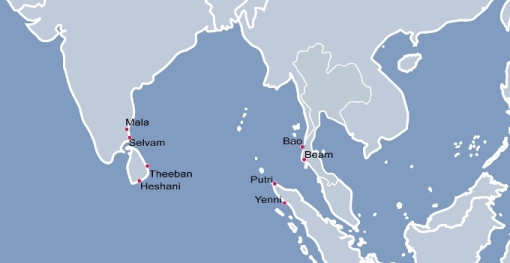
We tracked two affected families each in India, Indonesia, Sri Lanka and Thailand, filming their progress — or the lack of it — every month and producing video reports that were uploaded to a dedicated website.

Follow Mala’s story through monthly video reports on our website

The most striking example of aid disparity came from India. Even months after the disaster, Mala’s family — or anyone else in her village — received absolutely no relief or recovery assistance.

Officially, it was because ‘no one was killed’ in her village. But everybody in Kottaikkadu village knew the real reason: in the Indian social hierarchy, they occupy the lowest level, known as ‘Dalits’.

Apparently, that was why both government agencies and charities stayed clear of the village.

Our India production team, led by senior journalist and film-maker Satya Sivaraman (with video camera in the photo, below), investigated further. They compared Kottaikadu with its adjoining village of Alambara. Both had suffered similar damage during the Tsunami: people lost their boats and nets, but there were no deaths.

Image from Children of Tsunami website

Yet the people of Alambara – who belong to a supposedly higher caste of fishermen — received food items, boats and fishing nets from various outside sources.

In fact, they felt quite sorry for their neighbours in Kottaikkadu. “On the day of the tsunami we ran over 15 kilometers,” said Kuppuraj, a resident of Alambara. “Kottaikadu villagers, who live just 600 meters away…ran with us — but nobody has helped them to recover.”

There was another incident that showed up the caste-based discrimination, which my colleague Manori Wijesekera, production manager of Children of Tsunami, has just reminded me.

In March 2005, our India film crew found Mala’s father seriously ill with a lung infection (triggered by his near-drowning during the Tsunami) and his family so helpless that they were unable to even seek medical attention.

So the crew put their filming gear aside, and became good Samaritans: they rushed the sick man to a nearby government-run hospital. But once there, doctors refused to admit or treat him — all due to the patient’s supposedly low caste!

It was only when Satya and crew threatened to film the entire sorry episode, and have it broadcast on television later that day, that medical attention was finally provided. Discarding their production plans, our crew stayed with Mala’s family at the hospital through the night and next day to ensure the doctors gave her father the correct medical attention. The family believes that the production team saved her father’s life that day.

Read more about what happened at Children of Tsunami website

Watch the March 2005 video report that covered the hospitalisation incident

mala-with-her-neighbours.jpg

While their father was recovering, Mala’s mother toiled as a labourer to keep the home fires burning. Mala has one younger sister and two younger brothers.

Children of Tsunami: Rebuilding the Future was TVE Asia Pacific’s response to largely superficial media coverage of the Indian Ocean Tsunami of December 2004. It tracked on TV, video and web the personal recovery stories of eight affected families in India, Indonesia, Sri Lanka and Thailand for a year after the disaster. Its many media products — distributed on broadcast, narrowcast and online platforms -– inspired public discussion on aid management and optimum rehabilitation choices.

As we discovered along the way, some of the affected could be better described as Step-children of Tsunami.

In one of my early blog posts, I paid a tribute to the most extreme example of such a child, Thillainayagam Theeban.

The Tsunami has become yesterday’s news, but there are thousands of affected children, women and men who are still living on the edge of survival.

Related links:

Children of Tsunami: Documenting Asia’s longest year

Children of Tsunami revisited two years later

All images courtesy Children of Tsunami media project, TVE Asia Pacific

Moving images moving heart first, mind next

“Film is a lousy medium to communicate information. It works best at the emotional level.”

Bruce Moir, one of Australia’s seniormost film professionals made this remark soon after I had presented TVE Asia Pacific’s Children of Tsunami experience to OUR Media 6 conference in Sydney last afternoon.

After more than 35 years in documentary and feature film production for both cinematic and broadcast industries, in different parts of the English speaking world, Bruce knows a thing or two about moving people with moving images.

I was delighted and privileged to have Bruce join my presentation. He’d come at my invitation to the conference happening in his city.

“We’ve got to remember that film appeals to people’s hearts more than their minds,” Bruce explained. “The way to people’s heads is through their hearts, from the chest upwards — and not the other way round.”

I hope this was an ‘Aha!’ moment to at least some in our audience. I’ve personally heard Bruce say this before, but it bears repetition – because many film professionals tend to overlook this. Especially those who are trying to ‘communicate messages’.

Even a few weeks ago, I quoted him in a review as saying: “Our fundamental job is to tell a story – one that holds an audience’s interest and moves their heart, regardless of language, cultural context or subject….I have always believed that film achieves its optimal impact by aiming to ‘get at the audience’s head via their heart’ rather than the other way around.”

Bruce Moir

Without Bruce’s involvement, Children of Tsunami would have turned out to be very different. He was our Supervising Producer for the entire effort, advising and guiding our national film production teams tracking the progress of Tsunami survivor families in India, Indonesia, Sri Lanka and Thailand for one year afer the Asian Tsunami.

As Bruce recalled, the four teams came with different backgrounds, skill levels and film-making traditions of their own – ranging from television news and current affairs to development film-making, the type usually commissioned by UN agencies. Bringing them to be ‘on the same page’ was no easy task.

Film-makers are not particularly known for their patience or people-skills. Many I know have a ‘just-get-on-with-it-never-mind-the-niceties’ attitude. Bruce is one of the most patient persons I know: he would spend days and weeks relating to our production teams – usually by email or phone – gently nudging them in certain directions.

For sure, there’s no one right way to make a film. But there are some tried and tested principles in good story telling, which is what Bruce excels in. And which he willingly shares with others.

The year-long, 4-country and 8-location Children of Tsunami project was the biggest logistical operation TVE Asia Pacific has mounted in its 11 years of existence. (We’re in no great hurry to top that one!). Our production teams – operating from Bangkok, Colombo, Ubud (Indonesia) and Chennai – related to our regional production team based in two cities: Colombo, where TVEAP office is currently anchored, and Sydney, where Bruce lives.

We only came together face to face just once, in Bangkok, early on in the process. That meeting agreed on styles and formats, and also helped build the human relationships.

The rest of the time it was all through communications technologies. As you can imagine, lots of tapes moved around, as did many Gigabytes of video over the web. (DHL should have become a sponsor – they had lots of business from us!)

children-of-tsunami-locations.jpg

As I explained in my talk, Children of Tsunami was not just a film project. We published a monthly video report online on each of the eight families we were tracking, plus maintained a dedicated website with growing volumes of text, images and links. The monthly videos were edited and post-produced in the countries of filming, by our production teams themselves. It was distributed film-making, even if everyone worked to a common format.

With all that frenzy now behind us, the products of Children of Tsunami continue to be distributed, showcased and discussed at film festivals and conferences like OUR Media.

As I said yesterday to my predominantly academic audience: we’ve got a story telling and journalistic practice, and we now need a theory for it.

Related links:

Children of Tsunami: Documenting Asia’s longest year

Children of Tsunami revisited two years later

Pacific ‘Voices from the Waves’ on climate change

Some of you have asked to share more information on Truth Talking: Voices from the Waves, the half-hour documentary on climate change and its impact on the South Pacific people that we produced in 2002.

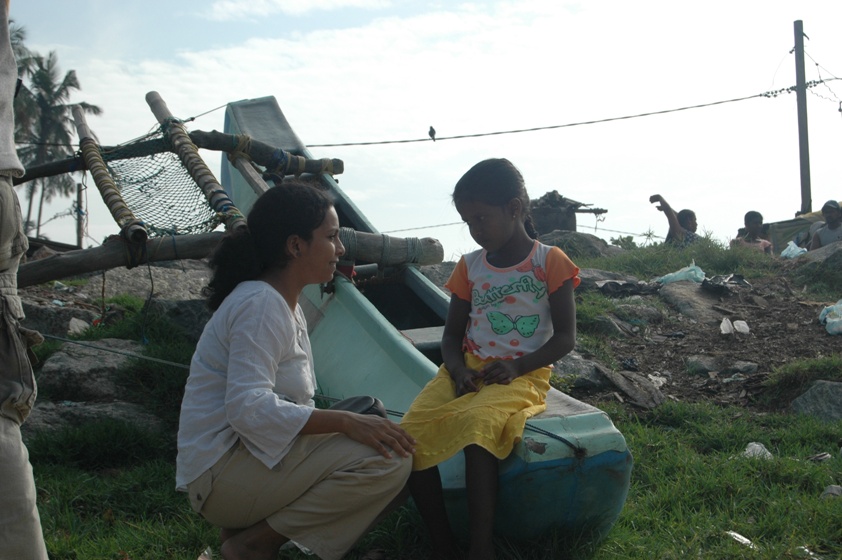
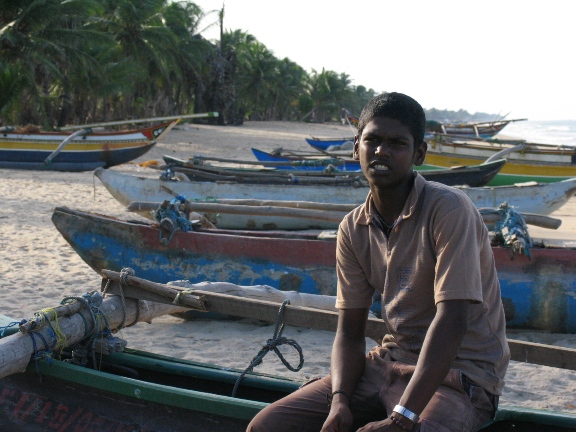
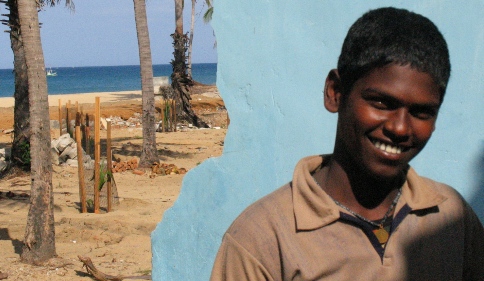
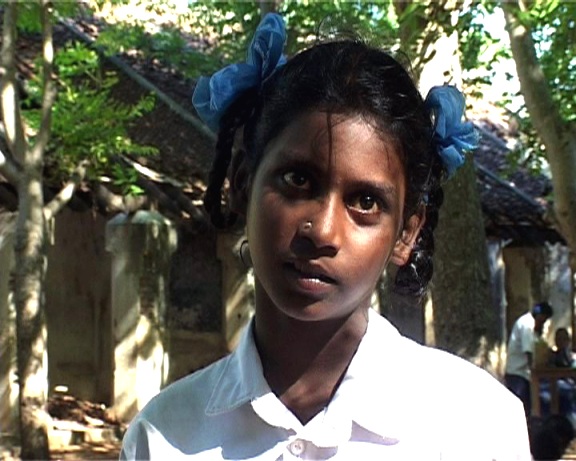
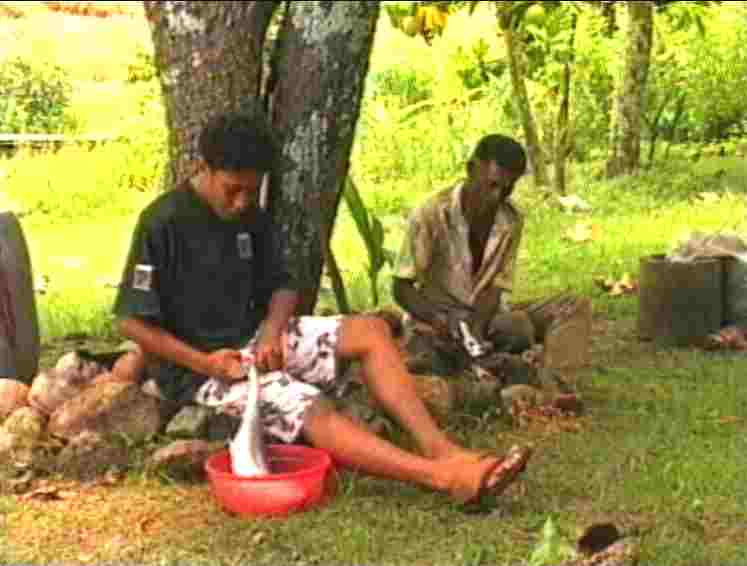
It was the first-ever documentary on climate change and the South Pacific, made by a native Pacific islander (all films till then had been made by visiting foreign film crews). Directed and produced by Bernadette Masianini of Fiji (photo on extreme right below), its story was based on the experience and impressions of two teenagers growing up on two islands, a girl and boy, both facing uncertain futures.

Here’s what I wrote for the Truth Talking book that accompanied the film series.

gutting-fish.jpg fish-trap.jpg ttplogofin.jpg copy-of-berni.jpg

Dilagi loves her village. Her parents and grandparents, and generations before them, were born and raised in this village. Her family has lived here for centuries, but by the time Dilagi has children of her own, her village might no longer exist.

In Fiji, where Dilagi lives, traditions and cultures are rooted in the home; the village is an integral part of a person’s identity. Like most of the eight million people who live in the Pacific island states, Dilagi’s village is located close to the sea. The bounty of the ocean has long sustained the islanders, but now the same waters have begun to threaten their future. Every year, the shoreline seems to move a little inland, and the beach gets a bit smaller. Before the current century ends, according to scientific projections, many low-lying Pacific islands will go under the rising seas either in part or full – and their histories, traditions and unique cultures will be lost forever.

Dilagi is somewhat aware of this perilous future, but can do nothing about it. The changes in global climate that are causing sea levels to rise and triggering severe storms and cyclones are the result of pollution and environmental degradation generated thousands of miles away in the industrialised world. Says Dilagi: “The villagers cannot understand why the waves are coming on to shore. They think these are signs that the end of the world is near.”

The Pacific contains 22 states, made up of thousands of small islands, with a multitude of cultures and traditions. Diverse as they are, they all share Dilagi and her neighbours’ concerns about the future.

Two thousand and five hundred kilometres north-east of Fiji, sitting on the island of Kiribati, Bernard stares at the same ocean that seems to be lashing out at his tiny island nation with increasing force every year. One of the lowest lying islands in the world, no place on Kiribati is higher than four metres (13 feet).

Building sea walls has provided only a temporary respite against the waves. Not even the grave yards or tombstones are spared. Bernard visits Mrs Saipolua’s house, which she has had to move twice to escape from rising seas. In her backyard, the gravestones of ancestors are being constantly battered by the waves. “Even the final resting places of our loved ones are not spared…the sea action had cracked the gravestones,” she says.

“With our islands being so small, the sea is our biggest resource,” says Bernard. “Over the years, the generations have perfected the ways to use the oceans respectfully for our survival. Ironically, it is the very ocean on which we depend that now threatens us.”

All Pacific islands – including Kiribati and Fiji — have their own unique culture and traditions. They may share the world’s largest ocean and sometimes common ethnicity, but no two island cultures are the same. From the way they collect their food to how they celebrate festivals, their traditions revolve around the geography and natural resources of the islands and the sea.

voices-from-the-waves-image1.jpg

In this intricate tapestry weaving islands with humans, everything has a place and purpose. For example, the traditional dances entertain and also record the people’s history. Costumes for these dances are produced from plants unique to the Pacific and decorative garlands are made from the brightly coloured flowers. Extreme weather events and climate anomalies that now threaten the environment of these islands may soon drive many plants and animals into extinction. As Bernard asks, “If changes to the climate affect our environment, how long will these aspects of our culture survive?”

For a majority of Pacific island people, climate change is a very real concern that is already impacting them; it’s not a doomsday scenario sometime in the future. Closely linked as they are to their islands and the sea, they just cannot accept relocation in a far away land as a survival option.

“Everything I need in my life is here on this island — my elders, my parents, my friends,” says Bernard. “I cannot imagine life anywhere else, and I cannot imagine that I might have to go and live in another country if my islands are no longer habitable….”

From across the sea, Dilagi agrees: “Our villagers have lived here for hundreds of years. Their traditions and cultures are rooted in this area. They cannot imagine life anywhere else.”

Order this film on DVD or VHS from TVEAP e-shop