Global Green Awards for Creativity in Sustainability 2010
China’s emergence as a major automobile market has led to high levels of air pollution in the cities. It has also caused an increase in the country’s carbon dioxide emissions that warm the planet.
Now, an innovative outdoor campaign, called green pedestrian crossing, is urging Chinese people to walk more and drive less.
This campaign targeted young Chinese people who chose to drive over walking. The campaign involved the creation of an outdoor poster advertisement on pedestrian crossings across 7 thoroughfares in Shanghai.
The Green Awards, presented from the UK, culminated on December 2 with a glittering, ‘green carpet’ event at the Natural History Museum in London. The awards ceremony announced winners for all 16 categories and the 2010 Grand Prix. I was one of the international judges for this year’s awards.
The Green Awards Grand Prix is given to the overall winner which is judged the best amongst all the entries. It is meant to recognise a campaign which, in the opinion of the expert judging panel, best exemplified an outstanding environmental message, and had the greatest capacity to raise public awareness.
Judges were impressed by the creativity shown by the campaign and the simple and effective use of local knowledge. Moreover, the results of the campaign supported the judges’ decision. The campaign reached an estimated 3.9 million people and increased general public awareness about environmental awareness by 86%.
From aspiration to reality...looking for honest people who stand their ground
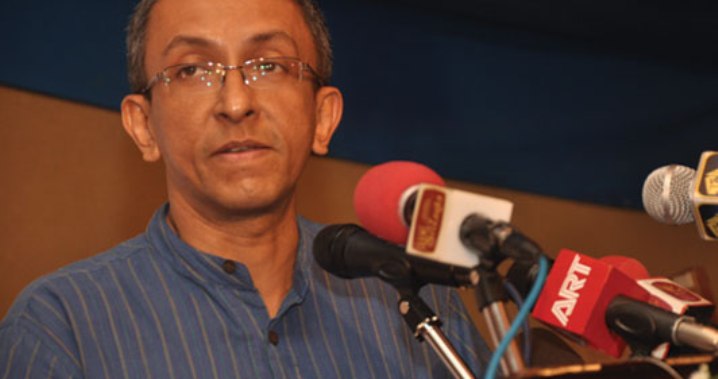
Sri Lanka’s National Integrity Award ceremony 2010 was held at BMICH, Colombo, on 9 December evening. This marked the culmination of weeks of work in reviewing nominations and verifying information. I was part of the three-member independent award committee that chose the winners.
The occasion was both solemn and quietly inspiring. It was telling that the winner of this year’s award has been dead for nine years – killed for being honest and forthright in his work.
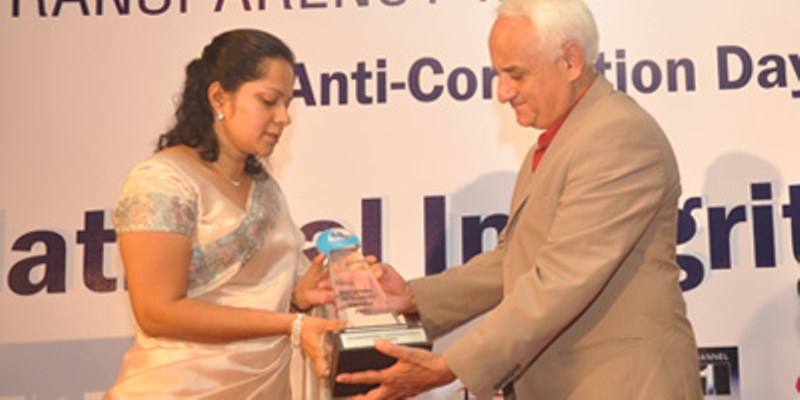
The late Sujith Prasanna Perera, a former Assistant Superintendent of Customs, paid the price with his life standing up against corruption and promoting integrity in his own department. It was a moving moment when the wife accepted the award from my Nepali friend Kanak Mani Dixit, who was chief guest.
The audience stood up and observed two minutes silence as a mark of respect. Some people who never knew the winner in person were in tears.
Angela Perera, wife of late Sujith Prasanna Perera, receives the award from Kanak Dixit
A Maulavi (Muslim priest) from Kinniya in the Eastern Province, M Y Hathiyathullah won recognition with a Special Mention for his active involvement in anti-corruption activities.
“Having studied this year’s nominations, we feel that more work needs to done to enhance the public understanding of corruption. This cancer is not limited to isolated acts of bribery or influence peddling or subverting the rules. Indeed, these are merely the tip of the iceberg — and there are many other ways in which corruption and mal-governance erode our entire social fabric. When people can better recognise the many ugly heads and tentacles of corruption, we hope it would motivate more public-spirited individuals to counter them.
“In our view, the various legal, regulatory and other structural arrangements are all necessary – but not sufficient – to combat corruption. Corruption is deep rooted in human greed. The temptations and opportunities for corruption are greater today than ever before. Faced with these stark realities, we must find the bulwark of resistance in our individual and collective values.
“In the end, the journey to a cleaner, honest and more equitable society begins with each one of us – the man or woman in the mirror. Each one of us is corruptible. At the same time, each one of us also has the potential to counter corruption. In this era of mobile phones and WikiLeaks, the opportunities are only limited by our courage and imagination. No act is too small or too insignificant. And silently looking away is not an option.
“I would like to end by quoting the Malaysian social activist Anwar Fazal, whose words sum up what the National Integrity Award is all about. Begin quote ‘In a world that is increasingly violent, wasteful and manipulative, every effort at developing islands of integrity, wells of hope and sparks of action must be welcomed, multiplied and linked…’ End quote”
Still from No Pressure film: We do live in The Age of Stupid!Shock therapy is known to work, when handled carefully. We can sometimes shock people out of apathy or indifference, for sure — but the same shock, if overdone, can also numb people or turn them off completely.
That’s certainly the case with a new climate advocacy video film called No Pressure, released on 1 October 2010 by the by the climate mitigation campaign named 10:10.
Written by Richard Curtis and Franny Armstrong (who made the acclaimed 2009 climate documentary, The Age of Stupid) and directed by Dougal Wilson, the film is a tragi-comic attempt to ridicule those who don’t share the same level of concern on global climate change as the climate activists do.
The four-minute film consists of a series of short scenes in which groups of people are asked if they are interested in participating in the 10:10 project to reduce carbon emissions. Those failing to show sufficient enthusiasm for the cause, including two schoolchildren, are gruesomely executed by being blown to pieces.
Well, see for yourself. Caution: this video contains violent scenes that can be offensive to most sensible people:
The normally balanced UK’s Guardian newspaper, which got the online exclusive, introduced the video on 30 September 2010 calling it “attention grabbing” and “pretty edgy.” There were a few others who found artistic or creative merit in the film, which has got high production values — no basement production, this.
But where it fails miserably is in winning any new friends for the climate cause, or at lease to influence people to change their high carbon lifestyles.
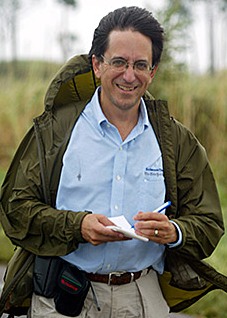
Amdrew RevkinAs Andrew Revkin, who writes the Dot Earth blog for the New York Times,wrote on 1 October: “If the goal had been to convince people that environmental campaigners have lost their minds and to provide red meat (literally) to shock radio hosts and pundits fighting curbs on greenhouse gases, it worked like a charm.”
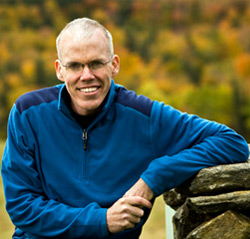
He isn’t alone. Bill McKibben, author, educator and environmentalist — who founded the serious climate group 350.org — wrote on the same day: “The climate skeptics can crow. It’s the kind of stupidity that hurts our side, reinforcing in people’s minds a series of preconceived notions, not the least of which is that we’re out-of-control and out of touch — not to mention off the wall, and also with completely misplaced sense of humor.”
His group, 350.org, issued a statement that emphatically said they had nothing to do with this misplaced British climate extremism. McKibben added, more reflectively: “What makes it so depressing is that it’s the precise opposite of what the people organizing around the world for October 10 are all about. In the first place, they’re as responsible as it’s possible to be: They’ll spend the day putting up windmills and solar panels, laying out bike paths and digging community gardens. And in the second place, they’re doing it because they realize kids are already dying from climate change, and that many many more are at risk as the century winds on. Killing people is, literally, the last thing we want.”
Bill McKibbenNow contrast such concern with the initial reaction from British film maker Franny Armstrong, who wrote a half-hearted, almost defiant apology on the 10:10 UK website, saying: “With climate change becoming increasingly threatening, and decreasingly talked about in the media, we wanted to find a way to bring this critical issue back into the headlines whilst making people laugh. We were therefore delighted when Britain’s leading comedy writer, Richard Curtis – writer of Blackadder, Four Weddings, Notting Hill and many others – agreed to write a short film for the 10:10 campaign. Many people found the resulting film extremely funny, but unfortunately some didn’t and we sincerely apologise to anybody we have offended.”
Adding gross insult to injury, Armstrong signed off saying: “As a result of these concerns we’ve taken it off our website. We won’t be making any attempt to censor or remove other versions currently in circulation on the internet.”
Both the 10:10 UK campaign and its sponsors Sony have been more unequivocal in their apologies in the days that followed. But that’s too little, too late. Enough damage done — climate activists and campaigners worldwide will take months, if not years, to live down this one.
And nothing really goes away on the web — this video will be lurking somewhere for a long time. YouTube currently carries the video in several places, with the warning: “This video or group may contain content that is inappropriate for some users, as flagged by YouTube’s user community.”
Andrew Revkins has posted comments from those who condemned as well as those who found some merit in the offensive climate video. Some of these comments take a dispassionate view, which is to be welcomed.
This incident teaches all of us engaged in environmental communication some important lessons. Environmentalists have over-stated their case before, and every time, that did them (and their causes) far more harm than good. Crying wolf, and ridiculing the non-believers, are never good tactics in winning friends or influencing people.
As Bill McKibben noted: “There’s no question that crap like this (video) will cast a shadow, for a time, over our efforts and everyone else who’s working on global warming. We’re hard at work, as always, but we’re doing it today with a sunk and sad feeling.”
One more thing: even in this age of globalised media, humour doesn’t travel well across cultures and borders. As mainstream corporate media companies have often found out, British humour sometimes doesn’t even cross the Atlantic very well — let alone to other parts of the world. Perhaps this is a key point that this all-British team of film makers and campaigners simply missed.
The world is a bit bigger — and more diverse — than your little island, Ms. Armstrong. By failing to grasp that, and with your crude display of insensitivity, you have really proved the premise of your good climate film.
Smart but fleeting mobs?‘Smart mobs’ is an interesting term for like-minded groups that behave intelligently (or just efficiently) because of their exponentially increasing network links.
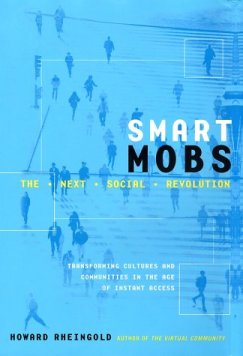
The idea was first proposed by author Howard Rheingold in his 2002 book, Smart Mobs: The Next Social Revolution. It deals with the social, economic and political changes implicated by developing information and communications technology. The topics range from text-messaging culture and wireless internet to the impact of the web on the marketplace.
In the eight years since the book first appeared, we’ve seen a proliferation and evolution of smart mobs, fuelled by the growth web 2.0 tools and, more recently, the many and varied social media. In fact, author Rheingold is credited with inventing the term virtual communities.
But the reality is that smart mobs can also be very fickle — their attention can be easily distracted. A smart mob can disperse just as fast as it forms, even while its original provocation remains.
This was demonstrated in dramatic terms in June 2009. Following a hotly disputed presidential election in Iran, there was a surge of online support for pro-democracy activists there who launched a massive protest. A main point of convergence for online reporting and agitation was micro-blogging platform Twitter. Within a few days, mainstream media like TIME and Washington Post were all talking about this phenomenon in gushing terms.
As I wrote at the time: “I have no idea if the Ayatollahs are closet fans of Michael Jackson. But they must surely have thanked the King of Pop for creating a much-needed diversion in cyberspace precisely when the theocracy in Tehran needed it most.”
Other recent experiences have demonstrated how online interest can both build up and dissipate very fast. Staying with a single issue or cause seems hard in a world where news is breaking 24/7.
Here’s a current example. Following the massive oil spill in the Gulf of Mexico that started on 20 April 2010, local communities and environmental activists deployed various social media tools to track the unfolding disaster. BP, the giant oil company implicated in the disaster, has also tried to use social media to communicate its positions, but not too successfully. On Twitter, it was not BP’s official account but the satirical @BPGlobalPR that was dominating the online conversation. As one commentator wrote: “It is an object lesson in how social media can shape and control a company’s message during a crisis.”
Beyond PR?By early July 2010, however, there were already signs that online interest on the issue was already waning — even as the oil continued to leak from this largest offshore oil spill in US history. In a detailed analysis of main social media platforms’ coverage of the issue, Mashable noted last week: “An estimated 100 million gallons or more of oil have surged into the Gulf of Mexico…Yet on Twitter, Google, blogs and even YouTube, we’re already wrapping up our collective discussion of the oil spill and how to repair its damage.”
Riding the wave can be fun, but waves form and break quickly. Those who want to use social media tools for social activism still need to learn how to hitch a ride with the ocean current beneath the fickle waves.
FIFA World Cup Football enters its final few days this week, culminating a month of international football at the highest level.
Played across 10 venues in South Africa, this is much more than a sporting tournament. It’s the ultimate celebration of the world’s most popular sport, held once every four years. More popular than the Olympics, it demonstrates the sheer power of sports and media to bring together – momentarily, at least – the usually fragmented and squabbling humanity.
And one upbeat song has characterised this World Cup more than any other: the FIFA World Cup Anthem, “Wavin’ Flag” (The Celebration Mix). Sung by K’naan (born Keinan Abdi Warsame) a Somali-Canadian poet, rapper, singer, songwriter, and instrumentalist.
It opens with these now famous words:
…Singing forever young, singing songs underneath that sun
Lets rejoice in the beautiful game,
And together at the end of the day.
We all say
When I get older I will be stronger
They’ll call me freedom, just like a wavin’ flag…
“Wavin’ Flag” is the third official single (eighth single overall) from K’naan’s Troubadour album. He specially recorded a version of the song for the tournament, hosted by South Africa. The remix of “Wavin’ Flag” is part of Coca-Cola’s global integrated marketing campaign “inspired by the joyous dance celebrations familiar to Africa.”
The song is popping up and pouring out from billions of radio and TV sets, mobile phones, websites and other devices. So much so that I wonder if it might as well be our planetary anthem — an idea that some social activists and artistes have dreamed about for decades?
Last year, shortly after Michael Jackson’s sudden death, I wrote a blog post that looked back at his songs that celebrated social and environmental themes. Referring to one, I said: “…the Earth Song had much wider and more lasting appeal, almost becoming an anthem for the global environmental movement in the past decade. But its real impact was not among the converted – with this song, Jackson took the green message to the heartland of the Facebook generation.”
We can argue about that (please do!). For now, here’s the celebrated song, currently the most popular on the planet:
FIFA Wold Cup Anthem “Wavin’ Flag” (The Celebration Mix) by K’naan
Wavin’ Flag lyrics (Celebration Mix) by K’naan
Ooooooh Wooooooh Ooooooh Wooooooh
Give me freedom, give me fire, give me reason, take me higher
See the champions, take the field now, unify us, make us feel proud
In the streets are, hands are liftin’, as we lose our inhibition
Celebration, its around us, every nations, all around us
Singin’ forever young, singin’ songs underneath that sun
Lets rejoice in the beautiful game
And together at the end of the day
WE ALL SAY
When I get older, I will be stronger
They’ll call me freedom
Just like a wavin’ flag
And then it goes back…And then it goes back…
And then it goes back…And then it goes…
When I get older, I will be stronger
They’ll call me freedom
Just like a wavin’ flag
And then it goes back…And then it goes back…
And then it goes back…And then it goes…
Ooooooh Wooooooh Ooooooh Wooooooh
Give you freedom, give you fire, give you reason, take you higher
See the champions, take the field now, unify us, make us feel proud
In the streets are, hands are lifting, every loser inhibition
Celebration, its around us, every nations, all around us
Singin’ forever young, singin’ songs underneath that sun
Lets rejoice in the beautiful game
And together at the end of the day
WE ALL SAY
When I get older, I will be stronger
They’ll call me freedom
Just like a wavin’ flag
And then it goes back…And then it goes back…
And then it goes back…And then it goes…
When I get older, I will be stronger
They’ll call me freedom
Just like a wavin’ flag
And then it goes back…And then it goes back…
And then it goes back…And then it goes….
Ooooooh Wooooooh Ooooooh Wooooooh
WE ALL SAY
When I get older, I will be stronger
They’ll call me freedom
Just like a wavin’ flag
And then it goes back…And then it goes back…
And then it goes back…And then it goes…
When I get older, I will be stronger
They’ll call me freedom
Just like a wavin’ flag
And then it goes back…And then it goes back…
And then it goes back…And then it goes…
A monstrous oil spill is gushing as much as 2,500,000 gallons of crude a day into the Gulf of Mexico.
This disaster is expected to be catastrophic for the land and people in the gulf. The oil has already reached land, contaminating wildlife sanctuaries. Authorities are so concerned about the impacts of more oil reaching land that they are prefer to set the gulf on fire, burning as much of the oil as possible.
Meanwhile, the fossil fuel industry is raking in windfall profits. BP, which operated the sunken rig, more than doubled its first quarter profits in 2010 to $5.65 billion.
I’ve just signed an urgent petition at Avaaz.org urging U.S. law-makers to overturn plans to expand offshore drilling. As the latest massive oil spill shows, offshore drilling isn’t safe or clean. The world needs clean energy investment to tackle climate, not expansion of dangerous and dirty energy sources.
Addressed to President Obama and members of Congress, it reads, simply: “We urge you to permanently call off plans to open up more of the US coastline to dangerous offshore drilling. Instead, invest in a clean and safe energy future.”
As Avvaz.org notes, “Before the spill, U.S. President Obama and Congressional leaders were planning to ramp up offshore drilling. Now, with the spill, the politics have shifted — and an opportunity has opened for the world’s biggest historical climate polluter to shift away from oil and towards climate-safe energy sources. At a moment like this, when leaders are making up their minds, the world’s voices can help tip the balance.”
Let’s hope it works – but the world is so addicted to its oil, and the petro dollars are so powerful – don’t hold your breath on this…
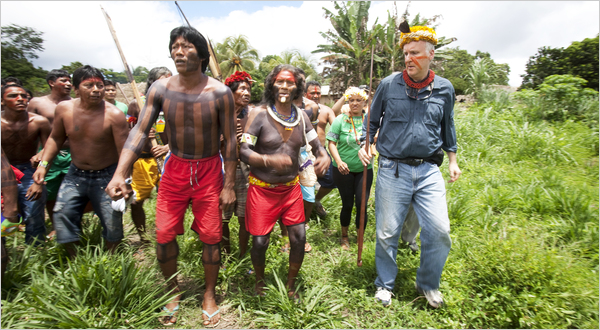
James Cameron in the Amazon - Photo by André Vieira for The New York Times
This encounter was bound to happen: Hollywood movie director James Cameron, creator of the blockbuster movie Avatar, meets a group of indigenous tribes in the Brazilian Amazon.
But this wasn’t part of a movie plot or promotional stunt: Cameron took time off to make his first ever visit to the Amazon because of a real world environmental cause.
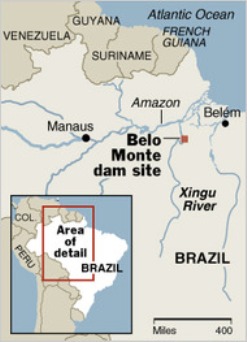
He was visiting Volta Grande Do Xingu last week to discuss the Belo Monte dam being planned by the Brazilian government. According to The New York times: “It would be the third largest in the world, and environmentalists say it would flood hundreds of square miles of the Amazon and dry up a 60-mile stretch of the Xingu River, devastating the indigenous communities that live along it. For years the project was on the shelf, but the government now plans to hold an April 20 auction to award contracts for its construction.”
Map courtesy The New York TimesThe dam is a “quintessential example of the type of thing we are showing in ‘Avatar’ — the collision of a technological civilization’s vision for progress at the expense of the natural world and the cultures of the indigenous people that live there,” the newspaper quotes Cameron as saying.
Cameron had derived inspiration from decades long struggles to save the Amazon, but he didn’t know of this specific project until recently. Apparently he first became aware of the issue in February 2010, when he was presented with a letter from advocacy organizations and Native American groups saying they wanted Mr. Cameron to highlight “the real Pandoras in the world”.
As I noted in my first comments on Avatar in January 2010: “It looks as if Cameron has made the ultimate DIY allegory movie: he gives us the template into which any one of us can add our favourite injustice or underdog tale — and stir well. Then sit back and enjoy while good triumphs over evil, and the military-industrial complex is beaten by ten-foot-tall, blue-skinned natives brandishing little more than bows and arrows (and with a little help from Ma Nature). If only it works that way in real life…”
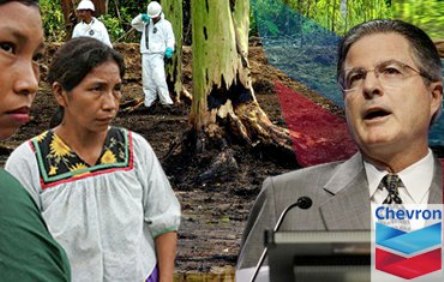
A few days later, I followed up with another post I titled Avatar unfolds in the Amazon – a comparison with an investigative documentary, Crude: The Real Price of Oil, made by Joe Berlinger, which chronicles the epic battle to hold oil giant Chevron (formerly Texaco) accountable for its systematic contamination of the Ecuadorian Amazon – an environmental tragedy that experts call “the Rainforest Chernobyl.”
And now, within weeks, the Avatar-maker and Amazon-savers have joined hands!
Winners of the Asia Pacific Rice Film Award 2008-2009 were announced this week. The award was established ‘to recognise excellence in audio-visual creations on rice-related issues in Asia, where most of the world’s rice is grown and consumed’.
I found it a well-focused, positive story compellingly told, with an unhurried script — just enough information, not bombarding the viewer with facts and figures. It’s about a new, more efficient way of growing rice called System of Rice Intensification (SRI).
But this is far from a boring instructional film. It focuses on lives of farmers on and off the field (e.g. SRI’s benefits to women farmers – such as less labour and time intensive). The visual experience is completed by the excellent camera work, sound track and seamless editing – altogether a highly professional production that is also a persuasive advocacy film.
Here’s the official synopsis for the film, taken from Vatavaran 2009 film festival website:
A revolutionary method, System of Rice Intensification (SRI) requires almost no standing water for paddy to grow and is fast transforming the rice cultivation. Developed by a French priest Henri De Launi in the 1980’s in Madagascar, SRI not only uses almost half of the water required but drastically reduces the physical labor associated with rice farming besides increasing the yield by almost one and a half times. For a country like India rice is more than just a mere crop.
There are myths attached to its cultivation. While SRI offers an alternate and a very sustainable method of growing rice it also battles hard with the age-old traditional approach of growing rice. The perils of global warming, the drying up of perennial rivers and the excessive use of fertilizers pose numerous threats to rice cultivation; making life very hard for the humble farmer. SRI offers a workable solution to all problems related to traditional rice cultivation.
SRI- Challenging Tradition, Transforming Lives looks at how SRI is helping the modern farmer cultivate India’s traditional crop without the burden that it had become. In addition the film highlights the transformation in the lives of millions of women who toil the hardest in Indian farmers thanks to SRI reducing the need for manual labor. To its critics the System of Rice Intensification might not be the greatest thing but the fact that SRI significantly reduces the demand for water for rice cultivation makes it worthwhile in the current scenario of the world.
Starting out in 2001-02, Gautam Chintamani worked in the capacity of Associate Producer on India’s first daily news spoof show Khabarein Khabardar. There on he did freelance writing for numerous shows for MTV, Sony and Zee amongst others. He has written and directed an 18 min short film, Alterations. In addition to writing for television Gautam Chintamani regualraly writes for the print and electronic media. He has extensively written for Man’s World, Hard News, Media Trans-Asia and MidDay, rediff.com and Buzz in Town. Gautam also worked in the capacity of Associate Director and Executive Producer of the Hindi feature film, Amavas. Of his television work the law drama, Siddhanth (Star One) was nominated for an Emmy in the International Drama section. Gautam’s episode dealing with an HIV positive college student who fights for her basic right to education was selected as a case study for a Writers workshop conducted by Hero’s Group in Hyderabad & Chennai.
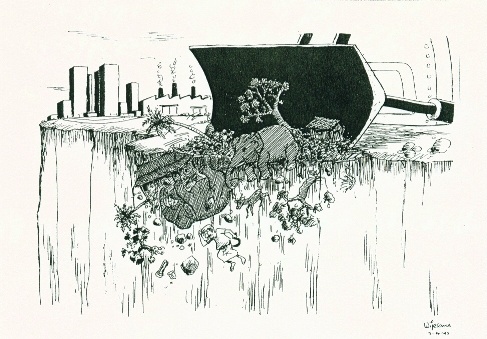
Price of Development, as seen by Cartoonist W R Wijesoma, 1993
Environmental activist and communicator Piyal Parakrama’s sudden death last week, of a heart attack, jolted Sri Lanka’s closely-knit green community. The activist community may bicker and argue endlessly among themselves, but there is also strong kinship among its cacophonous members. Many of them are still trying to come to terms with the loss.
As indeed am I – even if I’m not quite a certified member of the activist community, I consider myself a fellow traveler. I turn to words – either reflective prose or verse – when I want to make sense of something, and over the last weekend I wrote a new essay. It runs into 1,800 words and, as with all my tributes to public figures, this one is also social commentary laced in anecdotal reminiscence. It expands on initial thoughts that first appeared on this blog .
Here’s an excerpt where I talk about challenges faced by Sri Lanka’s environmental activists:
Piyal Parakrama on Sri Lanka 2048 TV showDuring the past three decades, Piyal and fellow activists have taken up the formidable challenges of conserving Sri Lanka’s biodiversity, long under multiple pressures such as growing human numbers, rising human aspirations, and gaps in law enforcement. Adding to the sense of urgency was the 1999 designation of Sri Lanka as one of the world’s biodiversity hotspots, where high levels of endemic species (found nowhere else in the wild) were threatened with extinction. Public and media attention is disproportionately focused on a few charismatic mega-fauna like elephants and leopards; in reality, dozens of other animal and plant species are being edged out.
In search of viable solutions for entrenched conservation problems, Piyal collaborated with scientists, educators, journalists and grassroots activists. Some industrialists and investors hated his guts, but he was much sought after by schools, universities and community groups across the country. Concerned researchers and government officials sometimes gave him sensitive information which he could make public in ways they couldn’t.
Some eco-protests grew into sustained campaigns. Among them were the call to save the Buona-Vista reef at Rumassala and struggles against large scale sugarcane plantations in Bibile. A current campaign focuses on the Iran-funded Uma Oya multipurpose project, which involves damming a river for irrigation and power generation purposes.
While environmentalists ultimately haven’t block development projects, their agitations helped increase environmental and public health safeguards. Occasionally, projects were moved to less damaging locations – as happened in mid 2008, when Sri Lanka’s second international airport was moved away from Weerawila, next to the Bundala National Park.
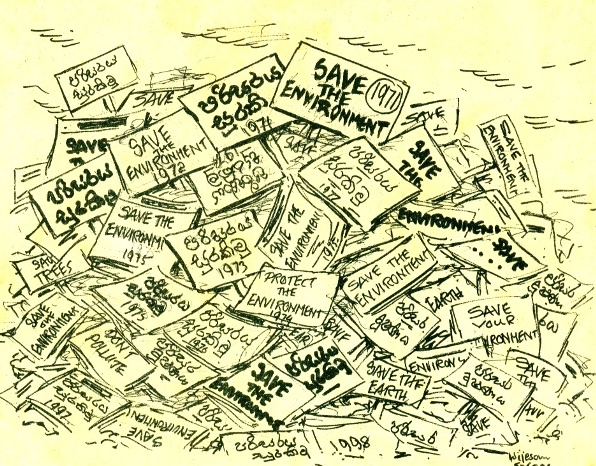
The hard truth, however, is that our green activists have lost more struggles than they have won since the economy was liberalized in 1977. They have not been able to stand up to the all-powerful executive presidency, ruling the country since 1978 — most of that time under Emergency regulations. In that period, we have had ‘green’ and ‘blue’ parties in office, sometimes in coalitions with the ‘reds’. But their environmental record is, at best, patchy. In many cases, local or foreign investors — acting with the backing of local politicians and officials — have bulldozed their way on promises of more jobs and incomes. Environmentalists have sometimes been maligned as anti-development or anti-people. In contemporary Sri Lanka, that’s just one step away from being labeled anti-national or anti-government.
At the end of the essay, I try to sum up the multiple challenges faced by ALL activists in Sri Lanka today:
“Activism is not an easy path anywhere, anytime, and especially so in modern day Sri Lanka. All activists – whether working on democracy, governance, social justice or environment – are struggling to reorient themselves in the post-conflict, middle-income country they suddenly find themselves in. Their old rhetoric and strategies no longer seem to motivate the people or influence either the polity or policy. Many of them haven’t yet crossed the Other Digital Divide, and risk being left behind by the march of technology.”
After all, I want our activists to be effective and successful as society’s conscience. My suggested author intro for this latest essay, somehow now included in the published version, read: “Science writer Nalaka Gunawardene dreams of becoming an activist one day, but for now, he remains a ‘critical cheer-leader’ of those who are more courageous.”
This is no Avatar: It's Real!A few days ago, reviewing the blockbuster movie Avatar, I wrote: “Film critics and social commentators around the world have noticed the many layers of allegory in the film. Interestingly, depending on where you come from, the movie’s underlying ‘message’ can be different: anti-war, pro-environment, anti-Big Oil, anti-mining, pro-indigenous people, and finally, anti-colonial or anti-American. Or All of the Above…”
Indeed, an Avatar-like struggle is unfolding in the Amazon forest right now. The online campaigning group Avaaz have called it a ‘Chernobyl in the Amazon’. According to them: “Oil giant Chevron is facing defeat in a lawsuit by the people of the Ecuadorian Amazon, seeking redress for its dumping billions of gallons of poisonous waste in the rainforest.”
From 1964 to 1990, Avaaz claims, Chevron-owned Texaco deliberately dumped billions of gallons of toxic waste from their oil fields in Ecuador’s Amazon — then pulled out without properly cleaning up the pollution they caused.
In their call to action, they go on to say: “But the oil multinational has launched a last-ditch, dirty lobbying effort to derail the people’s case for holding polluters to account. Chevron’s new chief executive John Watson knows his brand is under fire – let’s turn up the global heat.”
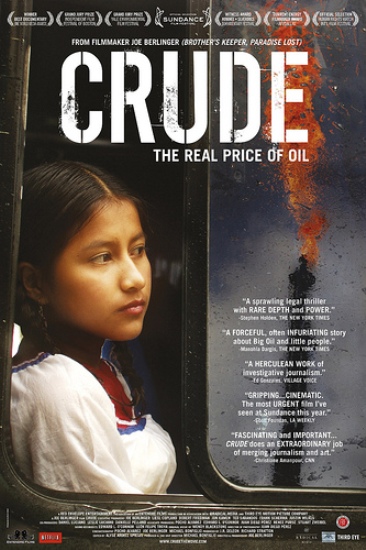
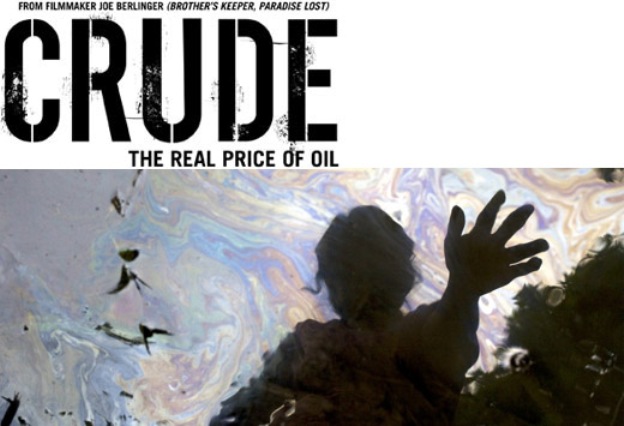
Others have been highlighting this real life struggle for many months. Chief among them is the documentary CRUDE: The Real Price of Oil, made by Joe Berlinger.
The award-winning film, which had its World Premiere at the 2009 Sundance Film Festival, chronicles the epic battle to hold oil giant Chevron (formerly Texaco) accountable for its systematic contamination of the Ecuadorian Amazon – an environmental tragedy that experts call “the Rainforest Chernobyl.”
Here’s the official blurb: Three years in the making, this cinéma-vérité feature from acclaimed filmmaker Joe Berlinger is the epic story of one of the largest and most controversial legal cases on the planet. An inside look at the infamous $27 billion Amazon Chernobyl case, CRUDE is a real-life high stakes legal drama set against a backdrop of the environmental movement, global politics, celebrity activism, human rights advocacy, the media, multinational corporate power, and rapidly-disappearing indigenous cultures. Presenting a complex situation from multiple viewpoints, the film subverts the conventions of advocacy filmmaking as it examines a complicated situation from all angles while bringing an important story of environmental peril and human suffering into focus.
Watch the official trailer of Crude: The Real Price of Oil
According to Amazon Watch website: “With key support from Amazon Watch and our Clean Up Ecuador campaign, people are coming together to promote (and see) this incredible film, and then provide ways for viewers to support the struggle highlighted so powerfully by the film.”
They go on to say: “A victory for the Ecuadorian plaintiffs in the lawsuit will send shock waves through corporate boardrooms around the world, invigorating communities fighting against injustice by oil companies. The success of our campaign can change how the oil industry operates by sending a clear signal that they will be held financially liable for their abuses.”
While Avatar‘s story unfolds in imaginary planet Pandora — conjured up by James Cameron’s imagination and created, to a large part, with astonishing special effects, the story of Crude is every bit real and right here on Earth. If one tenth of those who go to see Avatar end up also watching Crude, that should build up much awareness on the equally brutal and reckless conduct of Big Oil companies.
Civilisation's ultimate addiction?
Others have been making the same point. One of them is Erik Assadourian, a Senior Researcher at Worldwatch Institute, whom I met at the Greenaccord Forum in Viterbo, Italy, in November 2009.
He recently blogged: “The Ecuadorians aren’t 10-feet tall or blue, and cannot literally connect with the spirit of the Earth (Pachamama as Ecuadorians call this or Eywa as the Na’vi call the spirit that stems from their planet’s life) but they are as utterly dependent—both culturally and physically—on the forest ecosystem in which they live and are just as exploited by those that see the forest as only being valuable as a container for the resources stored beneath it.”
Erik continues: “Both movies were fantastic reminders of human short-sightedness, one as an epic myth in which one of the invading warriors awakens to his power, becomes champion of the exploited tribe and saves the planet from the oppressors; the other as a less exciting but highly detailed chronicle of the reality of modern battles—organizers, lawyers, and celebrities today have become the warriors, shamans, and chieftains of earlier times.”
 The China Environmental Protection Foundation, in association with DDB China Group (a marketing communications company), has won the Grand Prix at the 2010 Global Green Awards for Creativity in Sustainability.









 Open Minds!