The stats helper monkeys at WordPress.com mulled over how this blog did in 2010, and here’s a high level summary of its overall blog health:
The Blog-Health-o-Meter™ reads Wow.
Crunchy numbers
The Louvre Museum has 8.5 million visitors per year. This blog was viewed about 210,000 times in 2010. If it were an exhibit at The Louvre Museum, it would take 9 days for that many people to see it.
In 2010, there were 91 new posts, growing the total archive of this blog to 575 posts. There were 284 pictures uploaded, taking up a total of 22mb. That’s about 5 pictures per week.
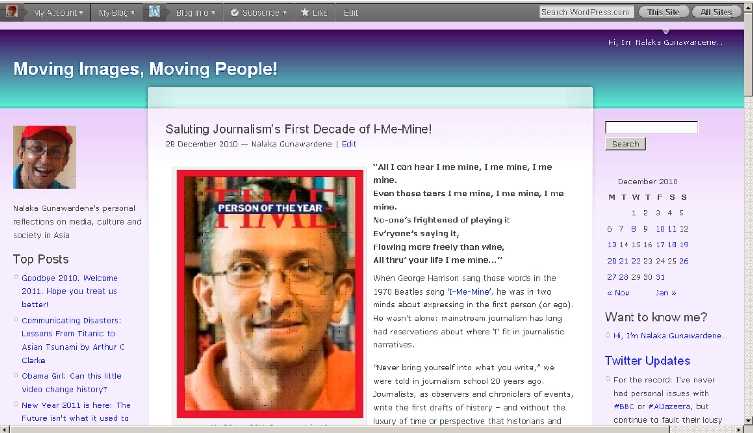
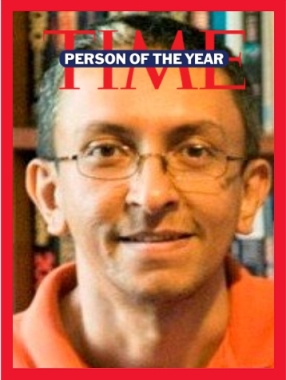
My DIY as POY: Famous at last?“All I can hear I me mine, I me mine, I me mine.
Even those tears I me mine, I me mine, I me mine.
No-one’s frightened of playing it
Ev’ryone’s saying it,
Flowing more freely than wine,
All thru’ your life I me mine…”
When George Harrison sang those words in the 1970 Beatles song ‘I-Me-Mine’, he was in two minds about expressing in the first person (or ego). He wasn’t alone: mainstream journalism has long had reservations about where ‘I’ fit in journalistic narratives.
“Never bring yourself into what you write,” we were told in journalism school 20 years ago. Journalists, as observers and chroniclers of events, write the first drafts of history – and without the luxury of time or perspective that historians and biographers take for granted. We often have to package information and provide analysis on the run. Bringing ourselves into that process would surely distort messages and confuse many, it was argued. We had to keep our feelings out of our reportage lest it affects our ‘objectivity’.
In other words, we were simply mirrors reflecting (and recording) the events happening around us. Mirrors can’t – and shouldn’t — emit light of their own.
Occasionally, if we felt the urge to express how we personally felt about such trends and events, we were allowed the luxury of an op-ed or commentary piece. Of course, as long as we ensured that it was a measured and guarded expression. And if we really wanted to bring ourselves into the narrative, we could use the archaic phrase ‘this writer…’ to refer to ourselves.
But never use I-Me-Mine! That would surely sour, taint and even contaminate good journalism – right?
Well, it used to be the ‘norm’ for decades — but mercifully, not any longer. Thanks largely to the new media revolution triggered by the Internet, writing in the I-Me-Mine mode is no longer frowned upon as egotistic or narcissistic. It sometimes is one or both these, but hey, that’s part of cultural diversity that our information society has belatedly learnt to live with…
We journalists are late arrivals to this domain. The first person narrative was always valued in other areas of creative arts such as literary fiction, poetry and the cinema. In such endeavours, their creators are encouraged to tell the world exactly how they feel and what they think.
Of course, some writers ignored orthodoxy and wrote in the first person all along. One example I know personally is the acclaimed writer of science fiction and science fact, Sir Arthur C Clarke. Shortly after I’d started working with him in 1987, Sir Arthur encouraged me to fearlessly use the first person narrative even in technical and business writing. A lot of writing ended up being too dull and dreary, he said, because their writers were afraid of speaking their minds.
Yet we had to wait for the first decade of the Twenty First Century to see I-Me-Mine being widely accepted in the world of journalism. Did the old guard finally cave in, or (as sounds more likely) did Generation Me just redefine the rules of the game?
Whatever it is, I-Me-Mine is now very much in vogue. And not a moment too soon!
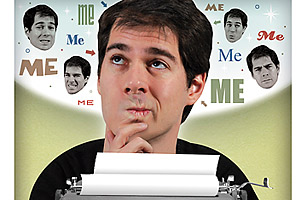
Joel Stein (Photo-illustration by John Ueland for TIME)As Time columnist Joel Stein, who often writes with his tongue firmly in his cheek, noted in a recent column: “All bloggers write in first person, spending hours each day chronicling their anger at their kids for taking away their free time. Every Facebook update and tweet is sophomoric, solipsistic, snarky and other words I’ve learned by Googling myself.”
And look at what Time just tempted me to do: put myself on their cover, as the Person of the Year (POY), no less. While designating Facebook’s founder Mark Zuckerberg as its POY 2010, Time teamed up with the social media network to introduce a new application that allows anyone to become POY with just a few key strokes. Provided you have a Facebook account, of course.
Joel Stein quotes Jean M Twenge, professor of psychology at San Diego State University, as saying that we are living in the Age of Individualism, a radical philosophical shift that began with Sigmund Freud. It has exploded during the past decade with reality television, Facebook and blogging. “You’re supposed to craft your own image and have a personal brand. That was unheard of 10 years ago,” Twenge says.
What a difference a decade can make. Although trained in the pre-me era, I was never convinced as to why I had to keep myself out of what I write. However, my use of I-Me-Mine was done sparingly in the late 1980s (when I started my media work) and during the 1990s. It was only in the 2000s that I finally found both the freedom to speak my mind – and the ideal platforms for doing so: blogging and tweeting.
As my regular readers know, I blog about my family, friends, pet, travels, writing and conference speaking. I liberally sprinkle photographs of myself doing various things. I tell you more than you really want to know about my life. Ah yes, I’m self-referential too.
And not just on this blog. I’ve also been writing op ed essays for various mainstream media outlets for much of the past decade, and have never hesitated in expressing what I think, feel and even dream about. (Isn’t that what opinion pieces are meant to be?)
But the Digital Immigrant that I am, all my writing is shaped by my pre-Internet training. Even for a blog post or tweet, I still gather information, marshal my thoughts and agonise over every word, sentence and paragraph.
As my own editor and publisher on the blog, I don’t have gatekeepers who insist on any of this. My readers haven’t complained either. Yet I write the way I do for a simple reason. I may indulge in a lot of I-Me-Mine, but I don’t write just for myself. You, gentle reader, are the main reason why I strive for coherence and relevance.
(OK, if you really must know, it also ensures a joyful read when I occasionally go back and read my own writing…)
Please bear with us while we're out makin' an honest living...
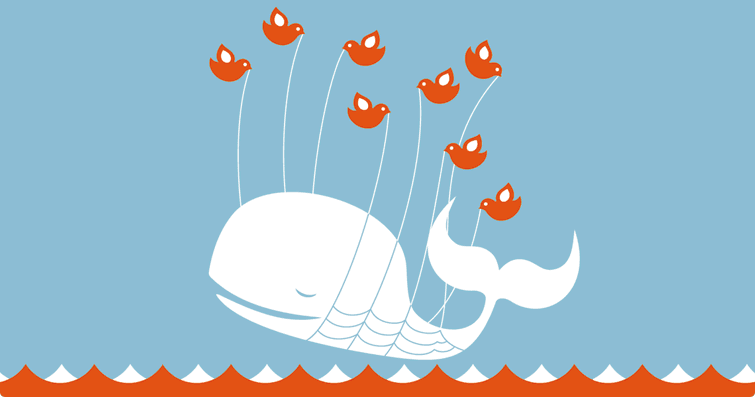
When Twitter experiences over-capacity (i.e. too many demands on its system), users see this delightful image. Known as the “fail whale” error message, it is an image created by Yiying Lu, an artist and a designer in Sydney, Australia. The New York Times Magazine called it ‘a successful failure’.
Well, I’m over-capacity too these days! That’s because I’m out there earning an honest living and that takes most of my waking hours. As a result, I’ve been blogging less and less in recent weeks. On such days, I have just enough energy for a quick tweet or two, but not for a fully-fledged blog post. (Yes, I take my blogging seriously.)
Sorry about that folks! I don’t look anything like the Fail Whale, although I’ve always been fascinated by these creatures. Right now, I’m as over-capacity as Twitter sometimes gets.
As Woody Woodpecker used to say: Don’t go away! We’ll be back soon….
“Reading computer manuals without the hardware is as frustrating as reading sex manuals without the software!”
This is one of the less known, but more entertaining, dicta by Arthur C Clarke – he called it ‘Clarke’s 64th Law’, and I personally know he used to bring it up when meeting with particularly crusty or glum intellectuals. (Not all were amused.)
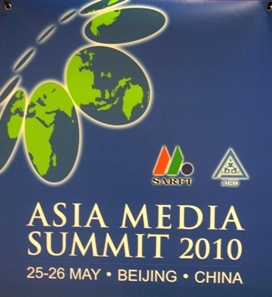
Clarke’s words kept turning in my mind as I moderated and spoke at a session on social media at Asia Media Summit 2010 held in Beijing China from 24 to 26 May 2010. The country with the world’s largest media market is not exactly the world’s most open or free – and certainly when it comes to social media, it’s a very different landscape to what we are used to…
These days, International visitors arriving in China discover quickly that access to YouTube, Twitter and Facebook is completely blocked. Apparently the brief ‘thaw’ in restrictions, seen before and during the 2008 Beijing Olympics, is now over — the current restrictions have been in place since the spring of 2009.
This doesn’t mean there is no social media in China. In fact, I heard from several Chinese friends and colleagues that there is a very large, dynamic and fast-evolving social media scene in China. For the most part, however, it’s not based on globally used and familiar platforms, and is happening in a digital universe of China’s own — under the watchful eye of the government.
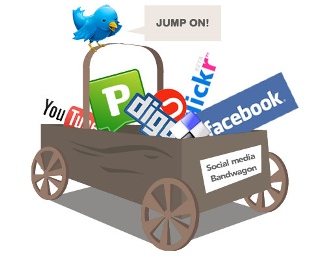
Jump in...but some conditions apply!For example, I found from this March 2010 blog post by Merritt Colaizzi that:
* 221 million people have blogs, largely in a diary-style.
* 176 million Chinese connect via social networking system (SNS) with their “real” friends and online networks.
* 117 million connect anonymously via bulletin board system (BBS). These interactive online message boards are the heart of social media in China. They’re where people go to find topic-based communities and where consumers talk about products and services.
There are lots of other blogs, mainstream media reports and research commentary on social media in China — just Google and see (now that’s another thing with limited – and uneven – access in China: Google itself is available, but search results come with lots of links that simply aren’t accessible). Much or all of this interaction happens in Chinese, of course. It’s a significant part of the web and social media landscapes, but if you’re in China on a short visit and want to stay connected to your own social media networks, that’s not at all helpful.
And, of course, it undermines one of the key attributes of a globally integrated information society: the interoperability of systems and platforms.
Luckily for me, perhaps, I can survive a few days without my social media fix: I have an appalling record of updating my Facebook account: days pass without me even going there. For the moment, at least, I’m also taking a break from regular blogging (well, sort of). But I’m more regular in my micro-blogging on Twitter, and visit YouTube at least once a day, sometimes more often. I could do neither during the few days in Beijing – and that was frustrating.
So imagine having to talk about social media as a new media phenomenon in such a setting. That’s only a tiny bit better than reading computer manuals without the hardware…But this is just what I did, with all the eagerness that I typically bring into everything I do. I planned and moderated a 90-minute session on Social Media: Navigating choppy seas in search of Treasures?
With access to key global social media platforms denied, we visitors and Chinese colleagues in the audience could speak mostly generically, theoretically and aspirationally. I didn’t want to place my hosts and seminar organisers in difficulty by harping on what was missing. Instead, we focused on what is possible and happening: how development communicators are increasingly social media networks and platforms to get their messages out, and to create online communities and campaigns in the public interest.
The thrust of my own opening remarks to the session was this: In the brave new world of social media, we all have to be as daring as Sinbad. Like the legendary sailor of Baghdad, we have to take our chances and venture into unknown seas. Instead of maps or GPS or other tools, we have to rely on our ingenuity, intuition and imagination.
More about the session itself in future blog posts.
For now, I want to share this TED Talk by American watcher of the Internet Clay Shirky on how cellphones, Twitter, Facebook can make history. Shirky shows how Facebook, Twitter and TXTs help citizens in repressive regimes to report on real news, bypassing censors (however briefly). The end of top-down control of news is changing the nature of politics.
This Blogger has gone in search of answers. Back...whenever
“The long run is a misleading guide to current affairs. In the long run we are all dead.” – John Maynard Keynes
I’m taking a break from blogging and other forms of public engagement. When I come up for fresh air, I might occasionally tweet – see the twitter feed on the right hand column for such output, but again, don’t bank on it. I have to sort out some Big Ideas in my mind, and seek answers to compelling questions.
Every blogger needs a break. This is mine. We’ll be back as soon as….inspiration permits.
Meanwhile, read this essay that asks – and answers – the Big Question: Is Life Worth Living?
All journalism is subjective; it’s just that some of us are better at disguising it! As we head for the end of 2009, we at Moving Images blog take one last fleeting, impressionistic, judgemental and, yes, darn too opinionated look at the past 365 days. That Was The Year That Was…and here’s our list of superlatives!
Best news and biggest relief (national): Sri Lanka’s nearly three decades long and brutal civil war finally ended in mid May 2009 – and not a moment too soon. It rightly created headlines around the world, and also made it to TIME’s top 10 news of the year. Within 24 hours of that much-awaited news, I wrote and published one of my most emotionally charged essays ever, Memories of War, Dreams of Peace. I probably spoke for a whole generation of Lankans: “As we stand on the threshold of peace, I am overwhelmed with memories of our collective tragedy. I hope we can once again resume our long suspended dreams for a better today and tomorrow.” With the hindsight of seven months, I still want to believe every word…although it’s become increasingly hard to cling on to such ideals.
Biggest disappointment (national): Ending the Lankan war entailed tremendous effort, cost and sacrifice, and we all knew that consolidating peace and restoring normalcy were going to be even harder – delivering peace dividends is no mean task. As weeks became months, our cautious optimism slowly turned into disappointment and dismay: it became clear that the triumphalist government was treating the historic ‘open moment’ simply as as blank cheque to do pretty much what it wanted. My May 19 essay on Dreams of Peace had ended with a question that resonated with millions: “Would our leaders now choose the Mandela Road or the Mugabe Road for the journey ahead?” Can we please ask that question again…? Hello, anybody listening?
Most evocative piece of writing: Without competition, that distinction goes to The Last Editorial by Lasantha Wickrematunga, the courageous investigative journalist (and de facto leader of the political opposition) in Sri Lanka, who was brutally slain on January 8 while on his way to work. That editorial, which appeared post-humously in his newspaper The Sunday Leader on 11 January 2009, embodies the best of Lasantha’s liberal, secular and democratic views. Nearly a year after the dastardly daylight crime, his killers have not been caught and independent media remains under siege even in post-war Sri Lanka.
Most memorable quote: While people like Lasantha articulated our cherished dreams for a truly pluralistic society, our billion+ neighbours in India have been building it for over six decades. It’s still a work in progress, and the ideals need occasional reiteration. This is precisely what classical dancer Mallika Sarabhai did when she ran as an independent candidate when India conducted the world’s largest democratic election in April-May. She lost, but wrote one of the most insightful pieces on what it means to live amidst the huge cultural, social and political diversity in India: “We are a salad-like melange of cultures and not a soup where all variations get reduced to a homogeneous pulp—this, to me, is our greatest strength.” (She inspired my own essay: Sri Lanka – Spice Island or Bland Nation?)
Biggest disappointment (global):
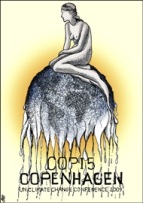
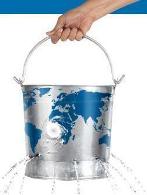
The UN climate conference in Copenhagen, held in December and officially dubbed COP15, ended up in what many activists felt was a cop-out. Greenpeace echoed the frustration of many when they said at the end of what was, at its start, billed as the ’14 days to seal seal history’s judgment on this generation‘: “Don’t believe the hype, there is nothing fair, ambitious or legally binding about this deal. The job of world leaders is not done. Today they shamefully failed to save us all from the effects of catastrophic climate change.” I was glad I wasn’t part of the mega event — I’ve burnt enough aviation fuel this year, but almost all events I participated in on three continents were more productive than the Danish debacle…
Biggest Under-achiever: If the world laboured a mountain and delivered a mouse in Copenhagen, the mid-wife of that process must surely have been the current UN chief Ban Ki Moon. More secretary than general, Ban is, in his own admission, the UN’s Invisible Man. All the top speech writers and PR agents in the world can’t animate this the perennially dull and dour diplomat. Not ideal change-maker when the world is racing against catastrophe. Kofi Annan, we miss you!
Most moving work of moving images: The world’s rich are having a party, and millions living in poverty are the ones footing the bill. This is the premise of Indian journalist and activist Pradip Saha’s latest film, MEAN Sea Level, which looks at the impact of climate change on the inhabitants of Ghoramara and Sagar islands in the the Sundarban delta region in the Bay of Bengal. I found it both deeply moving and very ironic. With minimal narration, he allows the local people to tell their own story. As it turned out, these testimonies were lost on the bickering politicians in Copenhagen…
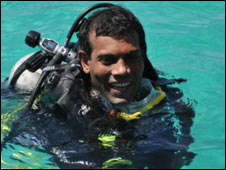
Best media stunts: We are a bit divided here. At a time of ever-shrinking attention spans, it takes much creativity and guts to grab the cacophonous media’s attention, especially for a good cause. Two very different men succeeded where many have failed. In February Bill Gates, the world’s top geek now working for its meek, released some mosquitoes at the TED 2009 conference to highlight the continuing grip that malaria has on the developing world, especially Africa. In October, climate crusader President Mohamed Nasheed of the Maldives held the world’s first underwater cabinet meeting to remind everyone of the watery future that awaits low lying island nations like his when climate change rises sea levels.
Biggest Irony: NASA announced in November that an unmanned space probe that was intentionally crashed on the Moon had discovered the presence of ‘significant amounts’ of water there. That bit of scientific evidence cost US$79 million to obtain…and was not the most comforting news for a planet that rapidly running short of usable freshwater. In the wake of the Apollo Moon landings in the late 1960s, misguided voters in Sri Lanka elected a government that promised ‘to bring rice even from the Moon’. When might we hear politicians promise us water from the Moon?
Well, that’s it folks — the highs and lows of 2009 according to the Blogger-in-Chief and his team of elves here at the Moving Images Media Empire. We’ve waded through our several dozen blog posts to come up with the above, and make no claims for being fair, balanced or comprehensive…
Indeed, we hope you don’t agree with all our picks, and invite you to express alternative – even dissenting – views. All comments that are not outright libellous or blatantly self-promotional will be published.
We take this opportunity to thank each and everyone who read our posts over the year — and especially those who left comments, sometimes radically disagreeing with our views. We also reiterate our pledge to frustrate those few persistent detractors who keep demanding to see our nationalistic, religious or other credentials…
Evolution or revolution?
I was born three years before the Internet (which turned 40 a few weeks ago), and raised entirely on newspapers and radio in a country where broadcast television didn’t arrive until I was 13.
From the time I could read and write, I always wanted to be a media publisher. In that pre-history of the Personal Computer and Internet, my choices were pretty limited: I published a hand-written household newspaper and was its editor, reporter, printer and distributor all rolled into one. But I was obsessive in my work even then, and the newspaper lasted a couple of years in which over two dozen issues were released (all of them now mercifully lost).
My school teacher parents were my first patrons, supplying me with plenty of paper, pencils and ink. But there must have times when they rather wished that I didn’t indulge in my own brand of independent journalism. I loved to criticise and lampoon the ‘management’ in my editorials — even as a kid, I was already critical of the establishment!
Fortunately for me, the ‘management’ left me alone and to my own devices, but most independent editors in history haven’t been so lucky. As the American journalist A.J. Leibling (1904 -1963) once said, “Freedom of the press is guaranteed only to those who own one.” In his time, this was perfectly true.
There was a time, until recently, when press barons and media moguls led, and the rest of society followed. In our topsy-turvy times, however, the reverse is increasingly true.
In theory, at least, anyone can be a global broadcaster and publisher in less than two hours using free tools that can be downloaded and activated in minutes.
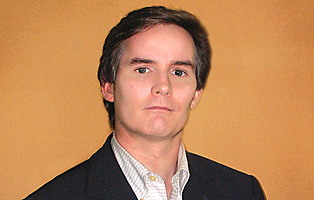
David Brewer (photo from http://www.i-m-s.dk)My British media activist friend David Brewer has just published an online guide on how to become a publisher or broadcaster in 100 minutes. (Okay, the non-geeks among us might need a bit longer than that, but still, you can be in business in just a few hours.)
David Brewer’s journalistic and managerial experience spans newspapers, radio, television, and online, and he now runs Media Ideas International Ltd, a media strategy consultancy with clients in Europe, the Balkans, the CIS, the Middle East, Asia, Africa and Central America.
David has worked with what I like to call the A-B-C of global broadcasting. He was the launch managing editor of BBC News Online in 1997, and moved to CNN, as managing editor, to set up CNN.com Europe, Middle East and Africa and CNNArabic.com. He was an editorial consultant for the launch of Al Jazeera English in 2006 and continues to work with Al Jazeera English as a new media consultant.
In his spare time, he runs Media Helping Media , a network and online resource to support media in areas where freedom of expression is under threat.
I quoted the Filipino academic and social activist Professor Walden Bello, as saying: “Things are pretty savage at the grassroots level in some of our countries. Journalists who investigate and uncover the truth take enormous personal risks – the vested interests hire killers to eliminate such journalists.”
Bello, executive director of the Focus on the Global South, further said: “Journalists living in the provinces and reporting from the grassroots are more vulnerable than those based in the cities. This is precisely why local journalists need greater support and protection to continue their good work.”
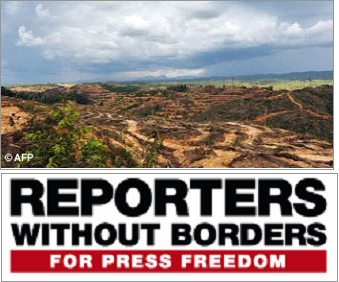
Last week, Reporters Without Borders echoed this call, saying: “We must defend journalists who expose attacks on the environment”.
The press freedom activist group released a new report titled “The dangers for journalists who expose environmental issues.” It highlights the indifference – and even complicity – of some governments and local authorities that make little attempt to protect journalists who take risks to investigate attacks on the environment.
The report looks at 13 cases of journalists and bloggers who have been killed, physically attacked, jailed, threatened or censored for reporting on the environment, and highlights the need for a free press to tackle ecological challenges.
In countries such as Russia, Cambodia, Brazil or even Bulgaria, in Europe, journalists run considerable risks when they try to alert the world about the misdeeds of those who prey on the environment.
“There is soon going to be a mass extinction event for the media (as we know it) – it’s triggered by the spreading of online media, and accelerated by the economic recession. Very few media organisations will survive…”
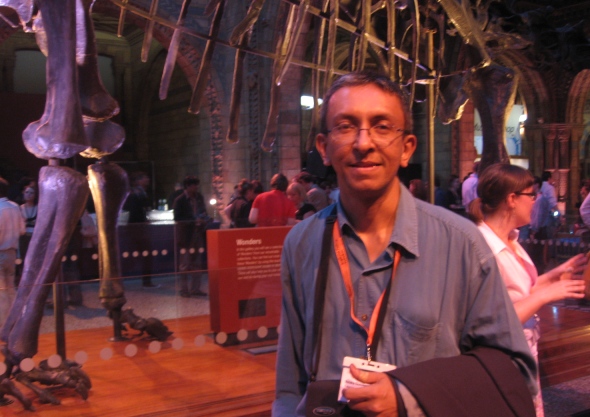
John Rennie (photo courtesy Yale University)He added: “Only some very large media organisations and a few really small ones will be able to withstand this mass extinction.”
He then posed the critical question to the several hundred journalists, editors and broadcasters from all over the world: does the rest of us deserve to survive?
He wasn’t so sure – no media organisation, however large or prestigious it may be, and how deep its pockets are, can carry on business as usual amidst this transformative event. In other words, adapt fast – or go the way of the dinosaurs…
It’s probably time for editors to redefine what constitutes science news, he said. “We should move away from the current model of reporting the ‘big paper of the week’.”
Calling such news the ‘low-hanging fruit’, he challenged his peers: “We need to be better than that. Good bloggers can now match us in most of our routine work. So how and where do professional journalists add value?”
We can always depend on Rennie to sum up complex issues in an interesting soundbite or two. My blog post from the previous WCSJ in Melbourne, where he talked (joked) about Vatican condoms and global warming, has drawn consistently high levels of visitor interest since.
Strangely symbolic? WCSJ 2009 delegates were entertained at London's Natural History Museum...around the skeleton of a Diplodocus!
He didn’t actually use the term ‘mediasaurus’, but clearly his remarks tally with what the American writer Michael Crichton had anticipated as far back as 1993, in a landmark essay titled “Mediasaurus“. In this essay, written for the then newly launched Wired magazine, he prophesied the death of the mass media — specifically the New York Times and the American commercial TV networks.
“To my mind, it is likely that what we now understand as the mass media will be gone within ten years. Vanished, without a trace,” he wrote. Building on his credentials as the author of a best-seller on dinosaurs, Crichton called this endangered beast ‘mediasaurus’.
As later events showed, Crichton foresaw the trend ahead of most people, but didn’t get the timeline right. He was off by a few years — but only a few.
John Rennie is only the seventh editor in chief in the 164-year history of Scientific American magazine. Since his appointment in late 1994, he has been the executive force behind the modernization and reinvigoration of this great publishing institution. So it seems that he is at least trying to prepare his own publication for the coming mass extinction event…
A film to reveal what the old media didn't show...When Barack Obama and his running made Joe Biden won the US Presidential Election held on 4 November 2008, they not only beat the Republican duo McCain-Palin but also a host of other also-rans. It’s too soon to tell, but that date might also mark the beginning of the end for the old media, also called the mediasaurus, who have been dominating the public’s access to news, information and commentary for over a century.
But how did it all happen? Who can tell us the real story as it happened, and why, without filters and biases so rampant among the mediasaurus?
On this blog, we have watched with deep interest and some fascination the rise of Barack Obama from relative obscurity to become the President of the United States. On 6 November 2008, soon after the election results were confirmed, we noted how Obama had just been elected ‘President of the New Media world’. I explained: “Obama’s rise has epitomised change in many ways. Among other things, he is the first elected leader of a major democracy who shows understanding and mastery over the New Media World, which is radically different from the old media order.”
On 20 January 2009, when he was inaugurated, we wrote: “For four or eight years, Obama’s every move, word and gesture will be captured, dissected and debated to exhaustion by admirers and detractors alike. And his administration will be under scrutiny by thousands of citizen journalists who don’t share much except the digital platforms and social networks on which they post their impressions. Welcome to the New Media Presidency. The hard work – and real fun – begin now!”
And now, one of the world’s leading new media activists, Danny Schechter, is about to release a new documentary on how the Obama campaign rode the new media wave to the White House — and more importantly, how the same new media can help the American public to keep Obama Administration accountable.
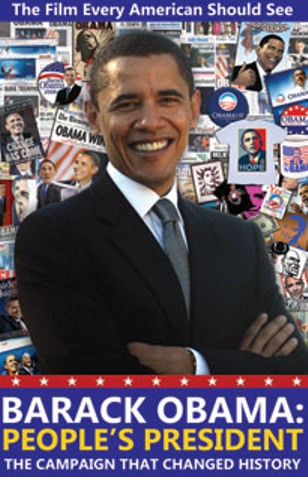
The film “Barack Obama, People’s President”, (slated for DVD release later this month by ChoiceMedia.net), documents the online and on the ground techniques that were used to win the highest office in the land.
As the film’s advance promo blurb says: The one story that most TV outlets didn’t tell in the 2008 election was the most important one -how did a young and relatively unknown candidate become President? If you voted for Barack Obama or not, this is a story you will want to know because it shows how the face of presidential politics changed forever. Barack Obama used techniques never seen before in a nationwide election — his grassroots mobilization and use of the internet was unprecedented, inspiring and effective. You have seen the rest of the coverage — now see the real story.
The film goes inside the official and unofficial campaign to show how Barack Obama was turned into a political brand to appeal to young first time voters. It shows how social networking on the internet — blogs, Facebook, texting and other techniques — were used carry the message to the masses and to raise tens of millions of dollars for the campaign. Popular online videos such as “Obama Girl”, along with those created by regular yet passionate supporters to engage their own communities, became one of the most important tools in the campaign’s success.
Watch the trailer of “Barack Obama, People’s President” directed by Danny Schechter:
Emmy award winning film-maker Danny Schechter, who is also blogger-in-chief at MediaChannel.org that keeps a critical eye on the media, just wrote this explaining why he made this film:
“It is hard to remember that two years earlier Obama was barely known, registering on the radar screen for just 10% of voters. He was also hardly a brand name as a first term Senator who spent more time in state politics in Illinois than on the national stage. Moreover, he was young and a man of color — not qualities that usually prevail in a presidential arena which tends to draw far older, far whiter, and far more centrist candidates. The thought that he would beat frontrunner Hillary Clinton in the primaries was, quite frankly, unthinkable to most of the elite.
“And yet he prevailed, as he used a phrase appropriated from labor organizer and Latino legend Caesar Chavez. Obama turned the farm workers Spanish language slogan “Si Se Puede” into “Yes We Can.” Rather than focus on specific political issues, he built a campaign on the promise of “Hope.” Rather than just rely on traditional fundraising — although by the end, he was plush with it — he reached out over the internet for smaller donations from millions of donors.
Perils of the New Media Generation...“Few in the major media gave him a chance, but he was not discouraged because he had created his own grassroots media operation using sophisticated organizing and social networking techniques to build a bottom-up movement, not the usual top-down apparatus. While his campaign ran the show, he encouraged independent initiatives including citizen-generated media, music videos, personalized websites, twittering and texting, etc..
“This is the new direction our politics has taken. It is a story that may be somewhat threatening to old media – and older activists – who prefer a one to many approach to communication, as opposed to forging a more interactive empowering platform. There is no question that young people — especially those mobilized by Obama — prefer online media and that choice is making it harder and harder for traditional outlets to sustain their influence and, in some cases, even their organizations. Old media may be on the way out.
“This is why our film is, in my mind, so important, not just as a record of how Obama won and what happened in 2008, but in what will happen, can happen, and is happening in the future. This is why I believe its critical for Americans to see it — and others in the world as well — to recognize how Obama represents more than just another politician, but a whole new approach to politics. That old adage is worth remembering: “It’s not the ship that makes the wave, it’s the motion of the ocean.”
“Obama, for all his shortcomings, which are becoming more obvious by the day, has pioneered the way change must be won — not by people on the top, but by all of us. It remains for “us” to hold him accountable. We live in a culture of amnesia – it is important to learn the lessons of the recent past.”
Read the full comment: New Film Tells Unreported Story of Obama’s Election on MediaChannel.org




 Open Minds!