Who speaks for most of the world’s poor people…living in Asia?

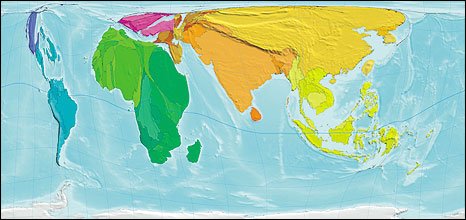
World map of human poverty...shows Asia harbouring over half

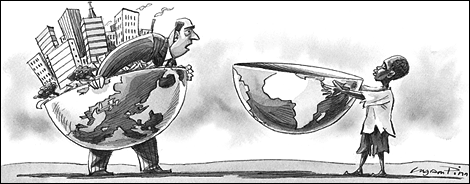
Take a close look at this map. What’s happened to our familiar world?

This is the map of human poverty — showing the proportion of poor people living in each country.

The size of each country/territory shows the overall level of poverty, quantified as the population of the territory multiplied by the Human Poverty Index. The index is used by the UNDP to measure the level of poverty in different territories. It attempts to capture all elements of poverty, such as life expectancy and adult literacy.

This map is from the recently released new book, Atlas of the Real World. It uses software to depict the nations of the world, not by their physical size, but by their demographic importance on a range of subjects.

It carries maps constructed to represent data, such as population, migration and economics. But instead of a conventional map being coloured in different shades, for instance, the maps in this Atlas are differently sized. For instance, a country with twice as many people as another is shown twice the size; a country three times as rich as another is three times the size. And so on.

When depicted in this manner, a very different view of our real world emerges. The one on the distribution of poverty, shown above, reminds us something often overlooked: there are more poor people in Asia than anywhere else in the world.

It takes a map like this to drive home such a basic fact. In most discussions on international development or poverty reduction, it is Africa that dominates the agenda. Even those organisations and activists who claim to be evidence-based don’t always realise that when it comes to absolute numbers, and not just percentages, poverty and under-development affects far more Asians than Africans.

Atlas of the Real World, which I haven’t yet seen except through glimpses offered by The Telegraph (UK) and BBC Online, offers many such insights on what our topsy-turvey world is really like.

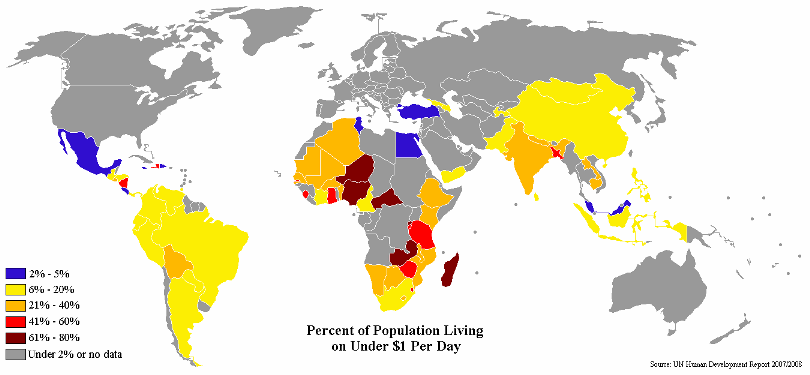
Their map of human poverty draws on the same data that this standard depiction does, in a map I found on Wikipedia sourcing the UN Human Development Report 2007/2008.
UN)
Percentage population living on less than 1 dollar day 2007-2008 (Source: UN)

There are many ways of measuring income poverty, and experts don’t always agree on methods and outcome. But we will leave those technicalities to them. Global Issues is a good website that discusses these issues without too much jargon.

Accurately drawing a two-dimensional map of our spherical world has been a challenge for centuries. Today’s most widely used Mercator projection represents our usual view of the world – with north at the top and Europe at the centre. People in other parts of the world may not always agree with this view.

The Peters Projection World Map is one of the most stimulating, and controversial, images of the world. Introduced in the early 1970s, it was an attempt to correct many imbalances and distortions in the Mercator map.

An example: in the traditional Mercator map, Greenland and China look to be the same size but in reality, China is almost 4 times larger! Peters map shows the two countries in their relative sizes.

Atlas of the Real World also carries one map where the size of each territory represents exactly its land area in proportion to that of the others, giving a strikingly different perspective from the Mercator projection most commonly used. It is very similar to the Peters map of the world.
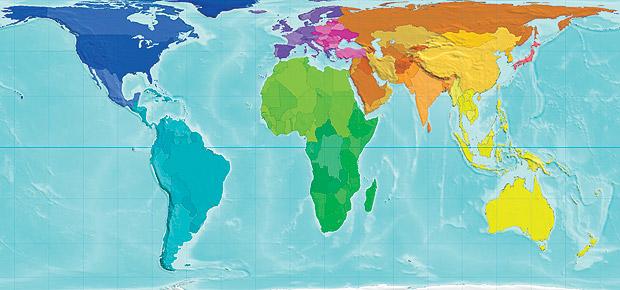
Our world depicted by each country's land area

The UNDP has been producing its influential Human Development Report since 1990. As far as I can discern, the HDR always uses conventional (Mercator?) maps, depicting data using the standard colour-coding or gray tones. The one I have reproduced in this post is an example.
Indeed, the UN’s Cartographic Section seems to favour these.

When would the UNDP – and other members of the UN family – start using more innovative ways such as those used in Atlas of the Real World? How much more effective can the UN’s analysis be if they move out of the comfort zone of Mercator?


‘Climate Challenge’ marks turning point in Vietnam’s climate concerns

Seeking local solutions for a global problem
Climate Challenge TV series: Seeking local solutions for a global problem

Many media reports and documentaries on climate change tend to be scary. Even the most balanced and scientifically informed ones caution us about dire scenarios that can rapidly change the world as we know it.

But it’s not all doom and gloom. Like every crisis, climate change too presents humanity with formidable challenges that can become opportunities to do things differently — and better.

Climate Challenge is a rare TV series that adopts this positive attitude. The 6-part series co-produced by One Planet Pictures in the UK and dev.tv in Switzerland, links the global climate crisis with location action for both mitigation (trying to reduce further aggravation) and adaptation (learning to cope with impacts).

It also makes the point: in the fight against global warming, developed and developing countries must work hand-in-hand to find viable solutions for all.

The film-makers of Climate Challenge focus on some of the most promising approaches to turning down the global thermostat. Climate Challenge goes in search for solutions that won’t put a break on economic growth.

The series had its original run on BBC World News in April – May 2007. Shortly afterwards, TVE Asia Pacific (TVEAP) started distributing it to TV channels, educational institutions and civil society groups across the Asia Pacific region. It has been one of the more popular items on our catalogue of international TV films on sustainable development and social justice.

Our deal with Asia Pacific broadcasters is a barter arrangement. TVEAP clears copyrights for developing countries in our region (more than 30 countries or territories) and offers films free of license fee that normally prevent many southern broadcasters from using this content.

We offer a new set of titles every two months to our broadcast partners – now numbering over 40 channels. They select and order what interests them, and often pay for the cost of copying on to professional tape and dispatch by courier.

When they receive the tapes, accompanied by time-coded scripts, many TV stations version the films into their local language/s using sub-titles or voice-dubbing. They do this at their expense, and then assign a good time slot for airing the films once or several times. They are free to re-run the films as often as they want. The only expectation is that they give us feedback on the broadcasts, so that we can report to the copyright owners once a year.

This arrangement works well, and bilateral relationships have developed between TVEAP’s distribution team and programme managers or acquisition staff at individual TV stations across Asia. Everything happens remotely — through an online ordering system and by email. It’s rarely that we at TVEAP get to meet and talk with our broadcast colleagues in person.

Pham Thuy Trang speaks in Tokyo

I was delighted, therefore, to meet one of our long-standing broadcast colleagues in Tokyo earlier this month when we ran a regional workshop on changing climate and moving images. Pham Thuy Trang, a reporter with news and current affairs department of Vietnam Television (VTV), was one of the participants. She turned out to be an ardent fan of our films.

She told the Tokyo workshop how the Climate Challenge series marked a turning point in Vietnam’s public discussion and understanding of climate change issues.

In mid 2007, VTV was one of many Asian broadcasters who ordered Climate Challenge. Having versioned it into Vietnamese, VTV broadcast the full series in December 2007 to coincide with the 13th UN climate change conference in Bali, Indonesia.

“This was the first time the issue received indepth coverage on TV,” Trang said. This was particularly significant because a 2007 survey had revealed low levels of interest in climate issues by the media in Vietnam.

Vietnam has a 3,000km long coastline
“In fact, the World Bank has identified Vietnam, with its 3,000 km long coastline, as among the countries most vulnerable to climate change impact. Our media has been reporting some developments – such as increased coastal erosion – as purely local incidents without making the climate link,” she noted.

The series, originally broadcast in the foreign documentaries slot, was noticed by the VTV senior management who then arranged for its repeat broadcast in the long-established environmental slot. The latter slot, well established for a decade, commands a bigger audience.

“Our Director General was impressed by our receiving such a good series on an important global issue,” Trang recalled. She added: “We need more films like this – that explain the problem and help us to search for solutions.”

Trang kept on thanking TVEAP for Climate Challenge and other films that bring international environment and development concerns to millions of Vietnamese television viewers. I said we share the credit with generous producers like One Planet Pictures and dev.tv, who let go of the rights to their creations for the global South.

If only more producers of TV content on climate and other development issues think and act as they do. That was also the call we made at the end of our workshop: recognise climate change as a copyright free zone.


Related blog post: Climate in crisis and planet in peril – but we’re squabbling over copyrights!

India’s climate change NIMBYsm and middle class apathy

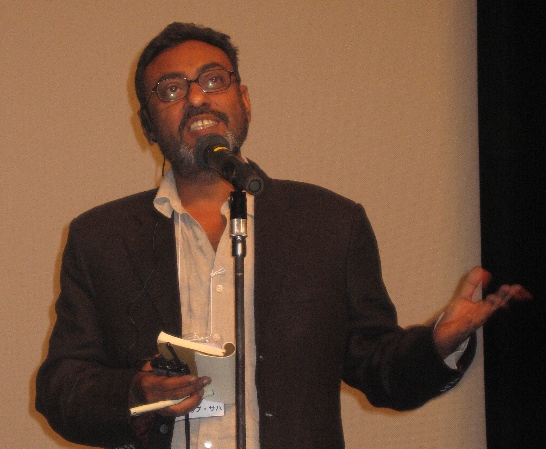
Pradip Saha in Tokyo

The global climate is indeed changing, but not everyone is equally affected by it – or bothered about it either. Take, for example, the majority of India’s 300 million+ middle class, which is roughly the size of the entire population of the United States.

According to environmental activist and independent film-maker Pradip Saha, it’s not a question of ignorance, but apathy.

“Our educated middle classes understand what’s happening, but they are also big contributors to the problem – with their frenzy to burn oil and coal. They look for any excuses for not acting on this issue,” Pradip said during a recent regional workshop in Tokyo, Japan.

The Asia Pacific workshop on ‘Changing Climate and Moving Images’, held in Tama New Town, Tokyo, was organised by TVE Japan in collaboration with TVE Asia Pacific and supported by Japan Fund for Global Environment.

Pradip, associate director of the Centre for Science and Environment – a leading research and advocacy organisation – has been tracking climate change issues for two decades. He sees this Big Issue in three ways: science of climate change, politics of climate change and feelings of climate change.

To fully understand how the complex Indian society perceives and responds to the climate crisis, all three dimensions need to be studied, he says. And particular attention must be paid to the plight of those who are already experiencing changes in their local climate.

From the Himalayan mountains to the small islands in the Bay of Bengal, millions of Indians are living and coping with climate change. “Large sections of our poor feel it, and are among the worse impacted.”

Many such affected people may never have heard of climate change. They are bewildered by rapid changes in rainfall, river flows, sunshine and other natural phenomena.

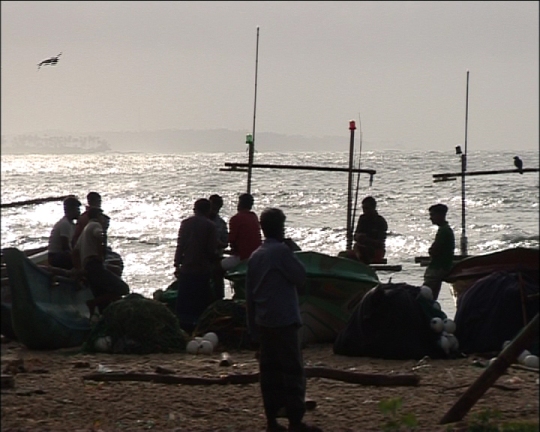
Pradip drew an example from the Sundarban delta region in the Bay of Bengal. With 10,000 square kilometres of estuarine mangrove forest and 102 islands, it is the world’s largest delta. Here, some islands are slowly being eroded and submerged by rising sea levels. Three small islands have already gone underwater. Others are experiencing problems of salt water intrusion, posing major difficulties for the local people.

Sundarban delta as seen from space

Analysis of surface data near Sagar island in the Sundarbans reveals a temperature increase of 0.9 degree celsius per year. Experts are of the opinion that this is one of the first regions bearing the brunt of climate change.

But the islanders – like most other poor people in India – don’t have enough or any voice to express their concerns to the policy makers, civil society groups and captains of industry. For these members of the middle class, the Sundarbans mean just one thing: the Royal Bengal Tiger.

And most of them probably have never heard of Sagar island. They might just shrug it off, saying: It’s Not In My Backyard (NIMBY).

During the past few months, Pradip has been filming on these islands trying to capture the unfolding human and environmental crisis. He was inspired by an investigative story that appeared in early 2008 in the Down to Earth science and environmental magazine where he is managing editor.

Pradip screened the 64-minute long film, aptly titled Mean Sea Level, at our workshop. The few of us thus became the first outsiders to see the film which I found both deeply moving and very ironic. With minimal narration, he allows the local people to tell their own story. There’s only one expert who quickly explains just what is going on in this particularly weather-prone part of the world.

Confronted with middle class apathy and indifference, activists and journalists like Pradip Saha face an uphill task. “Knowledge is not turning into action because those who know (about climate change causes and responses) are also the biggest culprits,” he says.

To make matters worse, government policies are not formulated with adequate public consultations. Sections of central and state governments in India have also started responding to individual effects of climate change without understanding the bigger picture. Such piecemeal solutions can do more harm than good.

Then there is India’s obsession with motor cars – a topic on which Pradip has already made a short film.

Pradip’s views on climate change activism in India resonates with those of the Filipino academic-activist Walden Bello. Speaking at the Greenaccord international media forum in Rome in November 2007, he called for a mass movement at the grassroots across the developing countries of the global South to deal with climate change – the biggest environmental threat faced by the planet today.

As I quoted him saying, such a movement might be unpopular not only with the Southern elite but also with sections of the urban-based middle class sectors that have been the main beneficiaries of the high-growth economic strategy that has been pursued since the early 1990s.

Read my April 2007 post: Fossil Fools in India

Climate in Crisis and planet in peril – but we’re squabbling over copyrights!

Climate in Crisis - a global documentary

On my recent visit to Tokyo for a regional workshop on changing climate and moving images, I watched a number of excellent documentary films on the subject. One of them was Crude: The Incredible Journey of Oil, the excellent Australian film that I wrote about in March.

Another was Climate in Crisis, an outstanding global documentary in two parts (2 x 52 mins) co-produced in 2006 by Japan’s public broadcaster NHK together with The Science Channel and ALTOMEDIA/France 5.

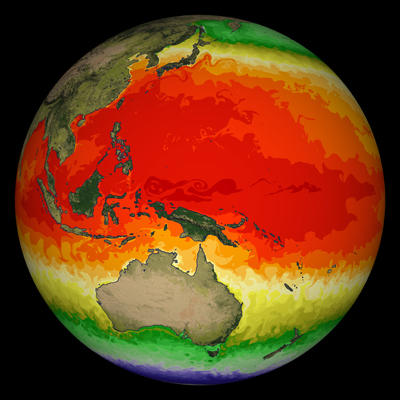
Directed by Fujikawa Masahiro, the film draws heavily on the Earth Simulator — one of the world’s most powerful supercomputers — which Japanese scientists used to project the climatic disasters in next 100 years. The system was developed in 1997 for running global climate models to evaluate the effects of global warming and problems in solid earth geophysics. It has been able to run holistic simulations of global climate in both the atmosphere and the oceans — down to a resolution of 10 km.

NEC Earth Simulator in Japan

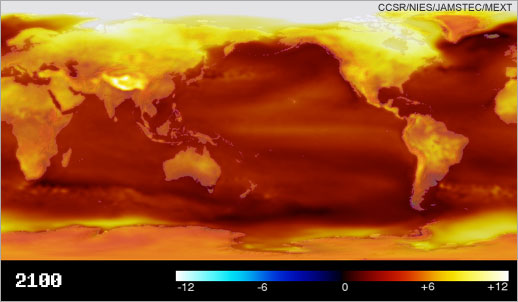
The results, captured in this documentary, are truly mind-boggling. Atmospheric temperatures may rise by as much as 4.2 degrees Celsius, more hurricanes may attack and deserts may spread from Africa to southern Europe, and half of the Amazon rainforest may be gone. Climate in Crisis shows a severe projection on environmental destruction based on rigorous scientific data and considers whether humankind can avoid this.

This film, made in the same year as Al Gore’s Oscar-winning film An Inconvenient Truth, has won several awards including the Earth Vision Award at the 15th Earth Vision Tokyo Global Environmental Film Festival.

I was curious why this excellent film – in my view, better made than Al Gore’s one – hasn’t been more widely seen, talked about and distributed. To be honest, I’d not even heard of this one until my Japan visit — and I try to keep myself informed on what’s new in my field of endeavour.

The reasons soon became apparent: copyright restrictions! The co-producers are keeping the rights so tight that only the highest bidders will be allowed to acquire it on a license fee.

This is a standard broadcast industry practice that didn’t surprise me. But I was taken aback by how jealously the rights are guarded. All other films that were part of our event, including high budget commercial productions like Crude, were screened to the public at the Parthenon in Tama New Town in Tokyo.

Not so with Climate in Crisis, which we – the overseas participants to the workshop – had to watch at a theatre inside NHK’s Tokyo headquarters. No public screening was possible. As we later heard, NHK itself was willing to allow a public screening (after all, it draws a good part of its income from the Japanese public), but their international co-producing partners, especially the Science Channel, would simply not agree to it. Wow.

Twenty centuries ago, emperor Nero fiddled while Rome burned. Today, some people are squabbling over copyrights while the whole planet is in peril.

Earth in 2100 - as seen by Earth Simulator

Our workshop participants came from solid backgrounds in broadcasting or independent film-making, and we are not naive activists asking hard-nosed broadcasters to let go of their precious rights which generates vital income. But we would have expected them to allow films such as Climate in Crisis to circulate a bit more freely in everybody’s interest.

This reminded me of correspondence I had last year with the Canadian producers of another outstanding climate film titled The Great Warming. The initial discussions with its director were promising, but when the distribution people started talking about ‘revenue optimising’, our negotiations stalled.

It also reminded me of similar experiences of other environment and natural history film makers, such as South Africa’s Neil Curry. He had a long struggle with the BBC to clear the non-broadcast use rights of his own film that he wanted to take back to the locations in Botswana where it was filmed.

Many broadcast and production companies in the west don’t realise that TV broadcasters in developing Asia operate on a very different basis. Talking about broadcast ‘pre-sales’ or ‘commissions’ loses meaning when many stations are operating on tiny budgets — or in some cases, no budgets — for factual content. Many are struggling to survive in tough, emerging economies.

Is this our future?
Is this our future?

TVE Asia Pacific operates a regional film distribution service that brings environment and development films within reach of such broadcasters. We operate without getting mired in license fees or royalties.

Our 2-day workshop called for climate change to be recognised as a ‘copyright free zone’. This would enable audio-visual media content on the subject to move freely across borders and to be used widely for broadcast and narrowcast purposes.

Here’s the full reference from our statement of concern:

“Prevailing copyright regimes prevent the sharing and wider use of outstanding TV programmes and video films on climate and development issues. We are deeply concerned that even content developed partly or wholly with public funding (government grants, donor funds or lottery funds) remain unfairly locked into excessive copyright restrictions. Sometimes film-makers and producers themselves are willing but unable to allow their creations to be used for non-commercial purposes by educational, civil society and advocacy groups. We appreciate the media industry’s legitimate needs for intellectual property management and returns on investment. At the same time, the climate crisis challenges us to adopt extraordinary measures, one of which can and should be recognising climate change as a ‘copyright free zone’. Such agreement would encourage media organisations and independent producers to share content across borders, and with entities outside the media industry engaged in climate education, advocacy and activism.”

Here’s the simple question I raised during the workshop, which is worth being posed to all those who hesitate to even discuss this issue:

Can anyone manage their intellectual property rights on a dead planet?

This is the real question!

Sleeping easy along the shore: Going the Last Mile with hazard warnings

creating-disaster-resilience-everywhere.jpg

October 8 is the International Day for Disaster Reduction. The United Nations system observes the day ‘to raise the profile of disaster risk reduction, and encourage every citizen and government to take part in building more resilient communities and nations’.

Disaster risk reduction (abbreviated as DRR) is the common term for many and varied techniques that focus on preventing or minimising the effects of disasters. DRR measures either seek to reduce the likelihood of a disaster occurring, or strengthen the people’s ability to respond to it.

DRR is not just another lofty piece of developmentspeak. Unlike many other development measures that are full of cold statistics and/or hot air, this one directly (and quietly) saves lives, jobs and properties.

And it gives people peace of mind – we can’t put a value on that. That was the point I made in a blog post written in December 2007, on the third anniversary of the Indian Ocean Tsunami. Taking the personal example of J A Malani, an ordinary Sri Lankan woman living in Hambantota, on the island’s southern coast, I talked about how she has found peace of mind from a DRR initiative.

‘Evaluating Last Mile Hazard Information Dissemination Project’ (HazInfo project for short) was an action research project by LIRNEasia to find out how communication technology and training can be used to safeguard grassroots communities from disasters. It involved Sarvodaya, Sri Lanka’s largest development organisation, and several other partners including my own TVE Asia Pacific. It was supported by International Development Research Center (IDRC) of Canada.

Recently, IDRC’s inhouse series ‘Research that Matters’ has published an article about the project. Titled “For Easy Sleep Along the Shore: Making Hazard Warnings More Effective” its blurb reads: “In Sri Lanka, a grassroots pilot study combines advanced communication technologies with local volunteer networks to alert coastal villages to danger coming from the sea.”

The article has adapted a lot of the information and quotes I originally compiled for a project introductory note in April 2006.

The outcome of the project’s first phase, which ended in mid 2007, is well documented. My own reflective essay on this project is included as a chapter in our book Communicating Disasters: An Asia Pacific Resource Book, published by TVE Asia Pacific and UNDP in December 2007.

TVE Asia Pacific also made a short video film in late 2007. Called The Long Last Mile , it can be viewed on YouTube in two parts:

The Long Last Mile, part 1 of 2:

The Long Last Mile, part 2 of 2:

The recent IDRC article ends with this para: “A related challenge concerns the shortness of any society’s attention span. In the absence of frequent crises and alerts, how can a nation — or even a village — sustain the continuing levels of preparedness essential to ensure that, when the next big wave comes rolling in and the sirens sound, its people will have the motivation and the capacity to act? The follow-up project seeks to address this worry by preparing the hotels and villages to respond to different types of hazards, rather than only to the relatively rare tsunamis.”

Watch this space.

Download pdf of IDRC’s Research That Matters profile on Last Mile Hazard Warning Project

Warning: Is climate change the new HIV of our times?

From www.sprattiart.com
From http://www.sprattiart.com


Is climate change the new HIV of our times?

I asked this question when addressing a group of television journalists and film-makers from the Asia Pacific last week. I was making introductory remarks to an Asia Pacific Workshop and Open Film Screening on ‘Changing Climate and Moving Pictures‘ held on 3 – 4 October 2008 in Tokyo, Japan. It was organised by TVE Japan in collaboration with TVE Asia Pacific, and supported by the Japan Fund for Global Environment.

I acknowledged that climate change was not just another environmental issue or even the latest planetary scare. “This time we’re in deep trouble – and still finding out how deep,” I said.

Climate change has brought into sharp focus the crisis in:
• how we grow economically;
• how we share natural resources and energy; and
• how we relate to each other in different parts of the world.

In that sense, I noted, climate change is acting like a prism — helping to split our worldly experience into individual issues, concerns and problems that combine to create it. Just like an ordinary prism splits sunlight into the seven colours (of the rainbow) that it’s made of.

“Climate shows up the enormous development disparities within our individual societies and also between them. When this happens, we realise that climate is not just a scientific or environmental problem, but one that also has social, political, security, ethical and human rights dimensions,” I added.

Climate change in an uneven world

I then outlined some parallels between the current climate crisis and the HIV/AIDS pandemic that emerged some 25 years ago.

Consider these similarities:
• When HIV was first detected, it was considered a medical issue affecting specific sections of society.
• It took years for the wider societal, development and human rights aspects of HIV to be understood and then accepted.
• Some countries and cultures wasted precious years in HIV denial; a few are still in this mode.
• It took overwhelming impact evidence and mounting pressure from affected persons for states and international community to respond.
• Then…everybody jumped the bandwagon and HIV became a fundable, profitable enterprise.

I have been commenting in this blog about this ugly side of HIV/AIDS in my own country Sri Lanka, where some NGOs and charities have turned HIV activism into a self-serving, lucrative industry. There are fierce ‘turf wars’ to claim persons living with HIV as their institutional ‘property’. Some have appropriated HIV as their own virus, and would rather not allow others to work in this area.

And it’s not just NGOs who are riding the HIV gravy train. The United Nations programme for AIDS, or UNAIDS, created by the UN system in response to the global crisis, has evolved into a behemoth whose efficacy and relevance are now being widely questioned.

UNAIDS “is obsolete and an obstacle to improving healthcare in developing countries” claims Roger England, an international health expert. Writing in the British Medical Journal in May 2008, England pointed out that HIV causes 3.7 per cent of mortality and kills fewer people than pneumonia or diabetes, yet it received 25 per cent of all international healthcare aid and a big chunk of domestic expenditure. This has resulted in wasting vast sums of funding on esoteric disciplines instead of beefing up public health capacity. Despite this criticism, UNAIDS is calling for huge increases in its funding — from its current US$9 billion to US$54 billion by 2015.

All this makes me wonder: is climate the new HIV of our times? This is the question I raised in Tokyo.

I added: “If so, I sincerely hope it does not evolve in the same manner that HIV crisis did. There are worrying signs that the drive towards a low carbon economy is being exploited by various groups – including some in civil society – for self gain.”

Certain development agencies and ‘think tanks’ are clearly exploiting climate change to make money. Suddenly, everybody is ‘climate-proofing’ their activities — meaning they are talking about climate change no matter what they do, whether it is teacher training or micro-credit.

In the run up to the Bali climate conference in late 2007, I wrote a blog post titled ‘Beware of bad weather friends’ about a London-based NGO engaging in some media training on climate issues, but deriving its legitimacy from a dubious survey. This post apparently irked the party concerned a great deal.

In Tokyo, a workshop participant confirmed that this was already happening in his country.

“Every crisis today is being turned into a business opportunity – and not just by the corporate sector,” said Pradip Saha, associate director of the Centre for Science and Environment in India.

He added: “Consultancy companies and some NGOs have realised there is big money to be made in climate related areas like carbon offsets and the Clean Development Mechanism. They are already riding the climate bandwagon!”.

Read the full text of my introductory remarks to the Tokyo workshop.changing-climate-moving-images-nalaka-gunawardene-intro-3-oct-2008

NHK: A public broadcaster that cares for its public

NHK is Japan's sole public broadcaster

My regular readers know the disdain with which I hold the so-called public broadcasters in my part of the world. In developing Asia, which lacks sufficient checks and balances to ensure independence of state broadcasters, the only thing ‘public’ about such channels is that they are often a drain on public money collected through taxes. Their service and loyalties are entirely to whichever political party, coalition or military dictator heading the government in office. A few months ago, I described Burmese TV as a good example.

I was delighted, therefore, to visit the headquarters of Japan’s sole public broadcaster NHK this week and find out how exceptional they are in being a public broadcaster that really cares for its funding and viewing public.

Nippon Hōsō Kyōkai has always identified itself to its audiences by the English pronunciation of its initials, NHK. Started as a radio service in 1926, it added television in 1953. Today, NHK runs two terrestrial TV channels, three satellite channels and three radio services – and has started offering more content online and for mobile devices as well. It also has international offerings in TV, radio and web through NHK World.

This massive broadcast operation is financed primarily by a license fee (called ‘receiving fee’ in Japan) paid by each Japanese household that owns a television set. Its TV channels don’t carry any advertising, although the corporation exploits its massive archive and often repurposes its products for commercial gain.

As NHK’s website says, “This (license) system enables the Corporation to maintain independence from any governmental and private organisation, and ensures that the opinions of viewers and listeners are assigned top priority.”

NHK’s license fee system is not unanimously endorsed by the Japanese public, and I later found out that growing numbers of households are declining to pay what currently works out to around US$30 per month (or a dollar a day). This debate has been sustained for several years, with public calls for administrative reform at NHK.

NHK Studio Park entrance

But NHK’s eagerness to engage the public is clearly evident, even to a visitor like myself who spent only an afternoon at NHK’s Studio Park in Shibuya. This is where the corporation’s production facilities are opened to the public every week day from 10 am to 5.30 pm.

NHK Studio Park is a living exhibit – the corporation’s executives and technical staff carry on with their real work amidst (mostly Japanese public) visitors who get to see how TV content is made. Part of the attraction is a museum of TV 55 years of TV broadcasting in Japan.

You're in our bigger picture!
Welcome to NHK: You're in our bigger picture!

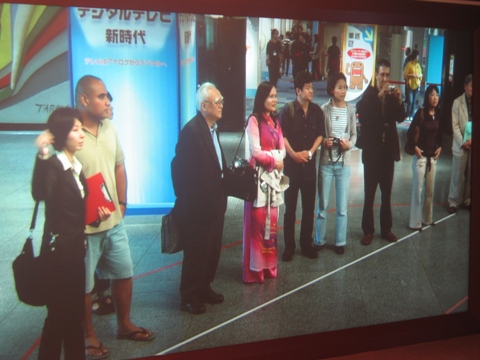
Every visitor is welcomed by being captured by a TV camera with the image being projected live on to a giant screen at the reception. The camera zoomed in on each one in our tour party of ten – and gave us our 10 seconds of fame!

From then on, it offers various displays and interactive opportunities to find out how TV broadcasting has evolved, where it is today – and glimpses of where it is headed. NHK has been an industry leader in technological innovation. It launched digital satellite TV broadcasting in December 2000 and introduced digital terrestrial broadcasts in December 2003. The core technology is Hi-Vision (HDTV), which delivers clear, vivid pictures and CD-quality sound. More than 90% of the programming on NHK is now produced and aired in Hi-Vision.

Japan's countdown to analog switch-off

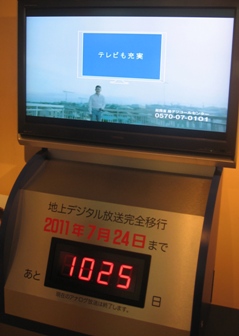
In fact, Japan will be fully switching on to digital and switching off all analog TV transmissions on 24 July 2011. The countdown has already started and on the day I visited NHK (2 October 2008), it was 1,025 days away.

Studio Park makes good use of corridor space for varied displays of photos and archival videos on memorable moments in Japanese and world broadcasting history. Highlights of NHK’s most enduring productions in news, current affairs, culture programming and sports are also shared.

Some of NHK’s cultural and entertainment programmes have been exported successfully to other parts of Asia, offering some counterbalance to the western TV content. One that I recognised was Oshin, a serial drama of 297 episodes made in the early 1980s that has since been aired in close to 60 countries.

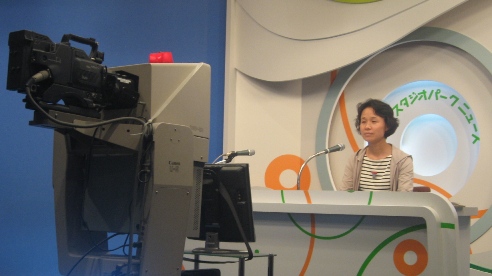
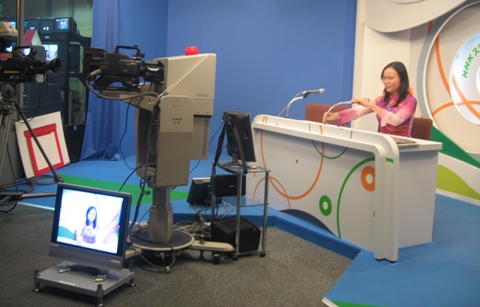
One of Studio Park’s star attractions offers to make a star of any visitor for a few minutes. It’s a newscasting studio where the visitor may sit and face the live camera and read a few lines suggested by the teleprompter – the device that enables news readers to look at their audience while sticking to a flowing text. The teleprompter text is available in Japanese and several other Asian languages.

Hu Jincao of China faces NHK camera
Pham Thuy Trang from Vietnam reads NHK news

Two members of our tour party took this news challenge (photos above), and being broadcast professionals, they performed admirably! While it was fun and games for us who are familiar with the medium’s inner working, I can imagine the educational and public relations value of this for people who only consume what television delivers every day and night.

We were also treated to a screening of what was called the world’s first 3D television without special glasses. It was a breathtaking film of about 10 minutes showing underwater scenes. In the dimly lit theatre, the screen felt more like a fish tank – the 3D effect was very real. Not being a techie, I don’t know how to verify the claim of this being a world first, but when this catches on, watching television will never be the same again…

As visitors move in and out of these interesting offerings, it was another day at work for NHK’s staff who carried on with their real productions in studios we passed by. We were allowed to photograph everything except across the viewing glass inside a studio when a recording was underway (lest the camera flashlights disturb it). The freedom to explore and experience, helped by the eternally courteous tour guides, was refreshing.

And what a contrast to many so-called public broadcast stations elsewhere in Asia which are more like battle fortresses with armed guards firmly keeping the public out (I suppose they expect their irate public to attack the stations because of the truly dreadful content they carry?).

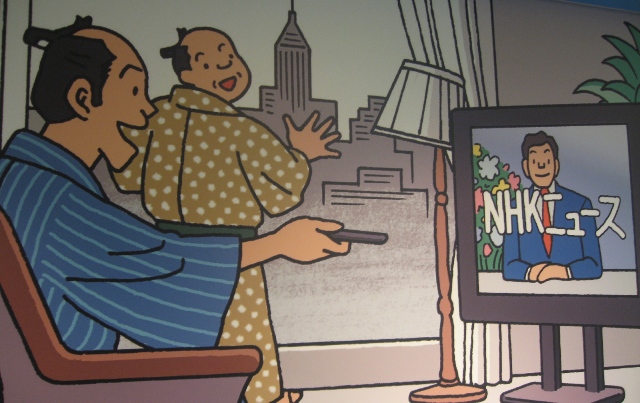
Well, at least NHK seems to know who their masters are – the paying public. And as this image in one exhibit shows, NHK is aware of that little gadget in every viewer’s hand that can instantly nullify all the irinvestment, technology and creativity. If wielded for long enough by sufficient numbers, this can put mighty broadcasters out of business.

It’s a message that Asia’s other broadcasters – public and private – would do well to remember.

NHK knows who its bosses are...

Note: My visit to Tokyo did not involve NHK funding in any manner. I was the guest of our partner TVE Japan, who paid for our admission tickets to enter NHK Studio Park.

Explore 50 years of NHK Television online

A J Gunawardana: Remembering a lost colleague…and discovering online gaps

A J Gunawardana with film director Lester James Peries
A J Gunawardana (left) with film director Lester James Peries

I have just written a 2,000-word essay recalling my times with a senior colleague and fellow media-watcher, the late Dr A J Gunawardana.

AJ, as he was affectionately known, was an outstanding university teacher, writer/journalist, cinema personality and art critic. When he died in September 1998 at the relatively young age of 65, we lost a rare intellectual who had his feet firmly on the ground, and constantly built bridges linking media, culture and society.

We shared more than our surname and involvement in the media. In fact, when I was beginning to be noticed for my journalistic writing in late 1980s and early 1990s, people kept asking me if I was AJ’s son, or at least a relation. I had to disappoint them.

My association with him was in the last decade of his life. His junior by a generation, I related to the genial professor as a fellow writer and occasional partner in mischief in the domains of media and popular culture. These are the times I have recalled in the tribute, just published on Groundviews citizen journalism website.

AJ started his career as a journalist with the then privately owned flagship of Sri Lankan journalism, Ceylon Daily News, where he was a noted arts and culture correspondent in the 1960s. He went on to obtain a doctorate in performing arts from New York University. Upon return, he pursued a career in academia as a professor of English at the Vidyodaya University (later University of Sri Jayawardenapura) and was closely associated with film and media education. He chaired a Presidential Committee of Inquiry on the Sri Lankan film industry, which issued its report in 1985.

In the arts world, he is perhaps best remembered for the screenplays he wrote for three films by Sri Lanka’s best known director Lester James Peries: Baddegama (1980), Kaliyugaya (1982) and Yuganthaya (1985). The latter two are included among the best of Sri Lankan cinema as compiled by the British Film Institute.

At the time of his death, AJ was working on a biography of the doyen of the Sri Lankan cinema, which was posthumously published in 2005 as LJP: Lester James Peries: Life and Work.

Read my full tribute:
Remembering A J Gunawardana: A creative public intellectual

In researching for this essay, I wanted to verify some biographical and filmographical specifics about AJ. The usually reliable Encyclopaedia of sri Lanka (2006) edition, compiled by Charles Gunawardena (note how we all spell our same surname differently!) had no entry on AJ, which is a bit disappointing considering the far more obscure personalities featured in this reference.

My next step was Googling for A J, using the various spellings for his and my shared surname. (Don’t ask me how and why different clans spell it differently – which must drive foreigners crazy – but it matters to us). Considering AJ published most of his journalistic writing before commercial Internet connectivity became widely available and newspapers started publishing their web editions, I wasn’t surprised by how little I could find online. I didn’t come across a single piece of AJ’s incisive writing online, although perhaps a specialised search might yet unearth a few from some depth of an archive.

This highlights an unmet need where many Asian newspapers and magazines are concerned: their archives only go back to a decade or a dozen years. Even when publishers are willing to unlock their archives and make it available, the sheer logistics involved must daunt them. This could change in time to come, with Google’s recently announced initiative to digitise newspaper archives. The search giant has begun scanning microfilm from some newspapers’ historic archives to make them searchable online, first through Google News and eventually on the papers’ own Web sites.

An aside: I remember making the same point to assembled ITU, UNESCO and other UN worthies at the WSIS Asia Preparatory Meeting in Tokyo in January 2003. In a world where search for information and records is moving increasingly to the web, I said, the old sources of Asia’s news, information and culture need to be progressively placed online. This is a huge undertaking even if we just consider only the newspaper archives. But if not done, these valuable sources may soon begin to be ignored as references.

I then turned to the Internet Movie Database, IMDB, for some specifics and was disappointed again. AJ’s main entry on IMDB listed only one of his three films, and there was no other information about him, at least in the areas allowed for free access. It was only later that I stumbled upon another IMDB entry for AJ, where the last two letters of his surname are lopped off, which keeps it out of most searches.

When the two entries are put together, one begins to get an idea of AJ’s cinematic accomplishments, but it still completely leaves out his work as a film critic.

These gaps are not unique to AJ. In fact, even though IMDb is said to be “one of the largest accumulation of data about films, television programs, direct-to-video products, and video games, reaching back to each medium’s respective beginning”, I imagine a large number of film industry creations and professionals from outside the mainstream English language cinema is currently missing or poorly indexed on it.

Clearly, there is work to be done – by film buffs from Asia, whose want their cinematic traditions and professionals featured adequately on IMDB. Although I occasionally edit entries on the Wikipedia, I haven’t figured out how to do it on IMDB.

In this era of user-generated content, we can’t just sit back and complain that the web is biased towards the English speaking west. It’s still the case, but web 2.0 allows us the opportunity and tools to go and do something about it.

Thailand’s people power gets a boost from satellite TV

Street protests in Bangkok - image from DayLife

Thailand, which had built up a reputation as a relatively stable country, has been under siege for much of this year. Confrontations between the coalition government, elected in December 2007, and the anti-government People’s Alliance for Democracy (PAD) have affected civil administration, law enforcement and economy, especially tourism.

On 10 September 2008, Thai prime minister Samak Sundaravej was forced to step down when a court found him guilty of accepting money from a TV station to host a popular cooking show. Bizarre as this reason was for his ouster, it has only added to the confusion that currently dominates Thai life.

Although I have been visiting Thailand regularly for the past 20 years, I don’t claim to understand the murky world of Thai politics. But until recently, Thais had somehow managed to keep their politics and business separate, allowing the latter to continue largely unaffected.


Pro-democracy struggles are not new to Thai people. But this time around, there is a new player involved: Asia Satellite Television (ASTV) a relatively new entrant into Thailand’s TV world which is dominated by commercial TV stations that offer a staple of light talk shows, soap operas and gossip programmes.

ASTV’s programmes, since May 2008, has consisted of speeches beamed from a stage set up at the site of a Bangkok protest rally, led by the PAD.

In early September 2008, around 200 PAD supporters banded together to guard the ASTV station and Manager newspaper offices on Phra Athit road amid rumours Prime Minister Samak Sundaravej was going to take the cable TV channel off the air.

In an interesting news analysis filed from Bangkok, Inter Press Service (IPS) noted on 5 September: “ASTV makes little effort to hide its political mission as the principle broadcaster of the PAD. After all, its founder, Sondhi Limthongkul, a fiery speaker, is one of the PAD’s leaders. His sustained attacks on the government and Thai democracy — that the prevailing elections system does not work, and the country needs a largely appointed parliament — have resonated with the thousands drawn to the PAD rallies after first hearing them on ASTV.”

Much of the PAD’s mass mobilisation has been possible due to ASTV’s reach, which is currently estimated at 20 million viewers. ‘’Our audience has doubled since 2006, when we had 10 million viewers, because we present the political side of the news that is not available on national TV,” the article quoted Chadaporn Lin, managing editor of the station’s English-language channel, as saying.

The Manager owns ASTV
Viewers who cannot access the station through a satellite dish or a provincial cable company turn to the website of ‘Manager,’ the newspaper produced by ASTV’s parent company. The site has seen the number of regular visitors rise and is now placed third among the top 10 Thai-language websites.

Read the full IPS article: THAILAND: Satellite TV Boosts Anti-Gov’t Protests By Marwaan Macan-Markar

To make sense of what’s going on, I turned to Pipope Panitchpakdi, a Thai friend who has worked in the broadcast media industry for many years:

Pipope Panitchpakdi, independent Thai journalist

He says: “It’s just too bad that the ideology behind the ASTV movement is identified by many as right-winged and nationalistic. For me, the movement itself is quite progressive in its post-modernistic use of everything that works to topple the existing government. In a way, it’s going back to the muckraking days of partisan journalism, which may be in need when mainstream media are no longer functioning during Thaksin/Samuk’s administration (with his equally keen media strategist team).”

Pipope adds: “Few mentioned that ASTV is self sponsoring through viewers’ subscriptions. That’s, to me, says a lot about the station. In my opinion what is unacceptable is when NBT (National Broadcasting Television) starts to give air time to government politician to bash the ASTV and to report heavily distorted news on the anti-government movement. They said it is the counter measure to what the ASTV is doing.”

He continues: “NBT, which is a free to air TV, funded by tax money and has a nation wide coverage, now becomes the state propaganda in the true sense of the word and by being such, there is no telling what kind of political fervor the NBT can stir.”

The argument of using NBT to project government view is a familiar one in other fragile or immature democracies across Asia. To understand it, we need to recall how rapidly broadcasting has changed in the past two decades.

In 1990, most Asian viewers had access to an average of 2.4 TV channels, all of them state owned. This has changed dramatically — first with the advent of satellite television over Asia in 1991, and then through the gradual (albeit partial) broadcast liberalisation during the 1990s. Asian audiences, at last freed from the unimaginative, propaganda-laden state channels, exercised their new-found choice and quickly migrated to privately owned, commercially operated channels. Soon, state owned TVs and radios found themselves with ever-shrinking audiences and declining revenue. For the past decade, most have survived only because governments infused them with massive amounts of tax payer money. Their public service remit is long forgotten.

In recent years, some governments have taken the view that since a growing number of private channels provide an outlet to political opposition and other dissenting views, the state channels are justified in peddling the ruling party (or ruling military junta) view – often exclusively. This convenient argument overlooks the fact that Pipope points out: state channels are funded mostly or wholly by tax payer money (as many lack the entrepreneurial skill to compete in a market environment). They have a moral and legal obligation to serve the public interest — and that does not coincide with the ruling party’s or junta’s self interest.

There are some who accuse ASTV of Thailand, and its equivalents such as courageous Geo TV of Pakistan (which stood up to the once mighty, now fallen general Musharaf), of being partisan. Perhaps they are, and in ASTV’s case it unashamedly and openly is. But in my view, they offer a much-needed counter balance to the disgusting excesses of state TV that prostitute the airwaves.

Supinya Klangnarong
Supinya Klangnarong

Supinya Klangnarong, deputy head of the Campaign for Popular Media Reform (CPMR), an independent local group lobbying for media rights, told IPS: “ASTV is offering knowledge and political information and new ideas that have never been seen on Thai TV. They have opened a new space for TV. There is 100 percent media freedom. You can say anything against the elected government and get away.’’

But she warned that while such a media agenda has tapped into an older audience that has felt left out by the dominant trends on the existing commercial stations, where youth is the focus, it is also creating a following that could become increasingly intolerant. “They are creating a culture of hate by the one-sided opinions being broadcast. They are promoting very conservative and very nationalistic ideas.’’

She added: “And if it attracts more people, ASTV may take over the role that has always been played by Thai newspapers of setting the political agenda for the country. That will be a win for those who say that Thailand has become too liberal, open and globalised… like my mother’s generation.’’

PAD protests hold Thai capital under siege - image from DayLife

Thailand’s TV chef PM ousted: Is this how to serve democracy?

Elected political leaders are driven out of office by various factors – ranging from military coup de’tat and popular revolt to corruption or sex scandals. But it’s not common for a head of government to lose his job for appearing on television.

But that’s just what happened on 9 September 2008 to Thailand’s prime minister…and the headline writers worldwide couldn’t resist every imaginable cooking cliche at his expense: “Cooking show lands Thai PM in hot water”, “Thai PM grilled over cooking show”, “Thai PM in a soup”, etc.

Prime Minister Samak Sundaravej was forced from office along with his Cabinet after Thailand’s Constitutional Court ruled that he had broken a conflict-of-interest law by hosting TV cooking shows while in office.

Samak Sundaravej has hosted Tasting and Complaining cooking show for years on Thai TV
Samak Sundaravej has hosted "Tasting and Complaining" cooking show for years on Thai TV

The court judgment, broadcast live on television and radio, was greeted with loud cheers and claps from Samak’s opponents who have occupied his office compound since Aug. 26 to demand his resignation. Some protesters wept with emotion.

The 73-year-old Samak, who has cooked for visiting leaders, hosted a popular television cooking show — “Tasting and Complaining” — for seven years before becoming prime minister in early 2008 after his his People Power Party (PPP) and five others won a general election. He returned Thailand to civilian rule after the army had captured power in September 2006, ousting the former populist prime minister Thaksin Shinawatra.

Some say this is the first time a professional chef has become prime minister anywhere. Samak had made several TV appearances after taking office, which the court held was breaking a constitutional prohibition on private employment while in office.

Tasting and Complaining on air
To serve the Kingdom of Thailand...medium rare?

The defiant PPP, whose government is facing stiff opposition by supporters of the People’s Alliance for Democracy (PAD), initially tried to renominate Samak as PM. But they dropped the idea like a hot potato in just a couple of days. Samak also bowed out as leader of the PPP.

As of this writing, the ruling coalition is trying to find a political leader who can form a government. The street demonstrators, one of whose main demands was the resignation of PM Samak, are watching developments with a sharp eye.

In recent weeks Samak’s government, though duly elected, has been under siege from PAD which draws its strength from among city dwellers and the elite. Although I have been visiting Thailand for 20 years, I don’t claim to understand the murky world of Thai politics. But until recently, Thais had somehow managed to keep their politics and business separate, allowing the latter to continue largely unaffected.

In the end, Samak lost his job not for any substantive lapses of governance – his opponents had lined up a long list of these – but on a legal technicality.

Samaks TV show branding
Samak's TV show branding
Samak has been involved in Thai politics for over 30 years, and since the 1990s has been promoting the art of Thai cooking on both radio and television. He started cooking at the age of 7, and his popular cookbook Chimpai Bonpai (“Tasting, Complaining”) is now in it’s 9th edition. One innovative Samak recipe: he makes pork leg stew with coca-cola.

Surely, Samak is not the first or last politician to sustain a parallel second career on television – the most dominant mass medium in most parts of Asia. Serving and aspiring leaders across Asia have deals with popular television networks that help boost their image and help their approval ratings. And in immature democracies, state-owned TV networks are grossly abused by politicians of ruling parties for outright propaganda.

Samak’s mistake was not so much continuing his TV career, but getting paid for it while holding public office. He should have just stuck to the publicity value. After all, with Thai cuisine among the most popular in the world, he could have gone far combining his culinary talents with hosting TV shows. Instead, he cooked up an avoidable storm…

Here’s the bright side: if Samak leaves politics, he has a choice of at least two lucrative careers.

Celebrity Thai chefs, anyone?

Watch the ousted Thai PM cooking in this news report on ITN News (UK):

Would the Samak cooking saga make a good film? Find out what the Guardian’s film blogger thinks!