Message placement: Gates Foundation discovers TV soaps are good for health!

There's still time for TV to redeem itself...
In the developing (or majority) world, we have been doing it for years: embedding subtle messages on health, environment, family planning or civic behaviour in popular, highly-rated entertainment shows on television.

In parts of Asia, Africa and Latin America, there is a long history of collaboration among non-formal educators, advocacy groups and broadcast companies to mix entertainment with public education — a difficult balance to achieve without putting off viewers who tune in for entertainment. See, for example, my coverage of the BBC World Service Trust’s work in India.

Now, it seems, this ‘edu-tainment‘ approach is also being tried out seriously in the home of ‘soap operas’ or television drama: the United States.

A recent report in the New York Times describes how the Bill and Melinda Gates Foundation is working with video production companies and broadcast networks to shape story lines and insert health-related messages into popular entertainment like the television shows “ER,” “Law & Order: SVU” and “Private Practice.”

Already, the foundation’s messages on HIV prevention, surgical safety and the spread of infectious diseases have found their way into these shows.

The report, written by Tim Arango and Brian Stelter, said: “Now the Gates Foundation is set to expand its involvement and spend more money on influencing popular culture through a deal with Viacom, the parent company of MTV and its sister networks VH1, Nickelodeon and BET.”

They called it “message placement”: the social or philanthropic corollary to product placement deals in which marketers pay to feature products in shows and movies. Instead of selling Coca-Cola or G.M. cars, they promote education and healthy living.

Some viewers in television-saturated US might say: it’s about time! In the past, many American companies producing entertainment content have resisted approaches from social activists to use the mass medium for public good.

In the late 1980s, when I shared some Asian experiences of mixing television drama and public education at an international science communication conference in Spain, American academics and journalists in the audience were intrigued. “But this can never happen in the United States…we keep our education and entertainment separate, and with good reason!” one of them said during question time.

Clearly, those hard attitudes have been changing slowly. As the NYT article says: “The efforts of philanthropies to influence entertainment programming is not new…. The Kaiser Family Foundation, which focuses on health issues, has been doing such work for a dozen years. It has worked story lines about H.I.V. and AIDS into programs on CBS and UPN (now known as the CWnetwork), including the reality show “America’s Next Top Model.”
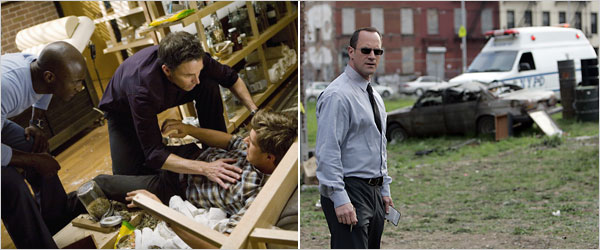
Left, ABC’s “Private Practice,” and NBC’s “Law & Order: SVU.” The story lines of both shows have spread the health-related messages of the Gates Foundation. Images courtesy ABC & NBC

The Norman Lear Center at the University of Southern California’s Annenberg School for Communication is at the forefront of blending entertainment with public education. “There’s a lot of research that shows that when a character in a series says, ‘I’m going to be an organ donor,’ it’s effective, more effective than giving out a pamphlet,” said Martin Kaplan, director of the Centre.

The Centre has a Hollywood, Health & Society programme that provides entertainment industry professionals with accurate and timely information for health storylines. It organises meetings between health specialists and script writers for entertainment shows – not just drama, but also reality and variety shows.

“Our view is you don’t have to sacrifice entertainment value to be accurate,” Kaplan is quoted as saying in the NYT article.

That’s a view – and experience – shared by TV writers, producers and programme managers from Mexico to South Africa, and from India to the Philippines. In fact, this is an approach the Gates Foundation should consider rolling out in the majority world countries where they are already a key player in selected areas of health and development. Despite the recent spread of broadband internet, broadcast television is still the dominant mass medium – and primary source of news and entertainment – for most people in much of the developing world. That’s billions of eyeballs we’re talking about – and the cost of producing quality entertainment (even with education subtly embedded in some places) is significantly less than in the west.

In short, Gates can get a bigger bang for its bucks on the airwaves in the global South. And there’s really no need to convince TV industry gate-keepers and producers on how edu-tainment works: they’ve been at it for years, using whatever resources they can find.

Read full article: Messages With a Mission, Embedded in TV Shows, NYT 2 April 2009
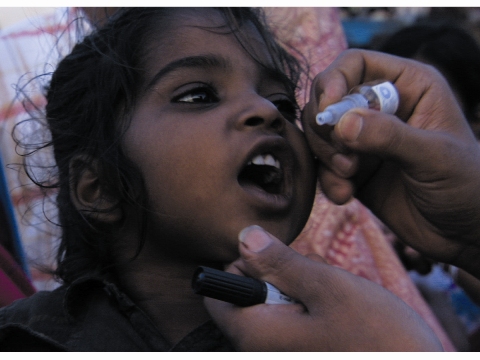
‘The Final Inch’: Real ‘Oscar’ would be polio’s global eradication!

Not longer just a drop in the ocean...
No longer just a drop in the ocean..?
The Final Inch didn’t win the Oscar for the best short documentary film made in 2008. But the nomination has given a boost to the film and its cause: even before its official release in April 2009, it is already raising global awareness on the major public health challenge of banishing polio from the planet.

The Final Inch is a testament of the health workers around the world laboring to make polio the second globally eliminated disease behind small pox, says director Irene Taylor Brodsky.

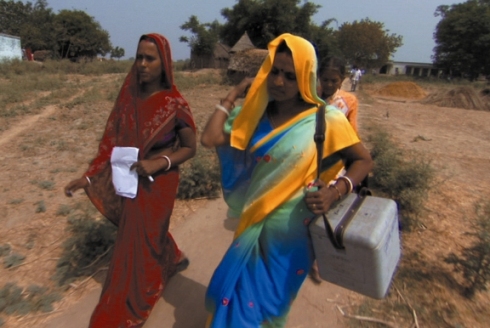
The 37-minute film, due to air on HBO on 1 April 2009, looks at the “the final stages of a 20 year initiative” to eradicate polio. It focuses the polio vaccine efforts in India and Pakistan, which are among the last four countries where polio is still endemic (the other two being Afghanistan and Nigeria).

Watch the trailer for The Final Inch:

The campaign to eradicate polio is now 21 years old. World Health Organisation (WHO), UNICEF and Rotary Foundation embarked on this campaign in earnest in 1988, and as a young (and equally earnest) science journalist, I remember writing about its early strategies, goals and targets. But the virus has proven to be a lot more stubborn than originally expected.

Well, the campaign has scored remarkable victories, and a little over 1,600 people in the world were stricken by polio in 2008. (AIDS and malaria, in contrast, killed more than three million people.) Compare that with 350,000 cases per year when the global onslaught started, and we see there has indeed been progress.

But the virus – and the crippling disease it causes – persists in several poor, densely populated countries in Asia and Africa. Updates are available from Global Polio Eradication Initiative.

Thus it’s the ‘last inch’ – or last mile, if you like – that’s proving the hardest to traverse. In a perceptive essay published in Newsweek in January 2009, Fred Guterl noted: “It’s not easy to wipe a disease off the face of the planet—especially one like polio, which spreads easily and quickly through contact and occasionally through contaminated food and water. Only one in 200 children who contract the virus shows symptoms (usually paralysis), which makes the other 199 silent carriers.”

It’s not just biology that polio eradicators are up against. Indeed, human superstition and religious dogma have made the final inch particularly contentious and treacherous for public health workers.

In 2005, TVE Asia Pacific started distributing a global documentary on immunisation called Fragile Lives: Immunization at Risk. It showed how at least 2 million children die every year from diseases that that vaccination could easily prevent.

Foot soldiers of the largest non-military army in history engaged in its final battle
At one point, the film takes us to Uttar Pradesh, in northern India, to show how polio, eradicated in most of the world, stubbornly persists in a few countries. This very poor state with its 272 million inhabitants had two thirds of the world’s polio. We talk to the glamorous young cricketer, Mohamed Kaif, who helps publicise a massive campaign to get every single child to the vaccination booths. The film discovers the strange reason behind why so many Muslim parents refuse to have their children vaccinated.

The Final Inch features the heroic efforts of Munzareen Fatima, a field worker in Meerut, Uttar Pradesh, who is a part of UNICEF’s Social Mobilisation Network for ensuring vaccination coverage. She reaches out to her target group through personal and public intervention programmes.

As she told IANS: “It has been a tough journey for me over the last five years to convince 470 families at Dufferin block in Khairnagar to administer polio drops to their children. I met with resistance from the families, who initially refused to immunise their children. The conservative community also belittled me for stepping out of home to campaign against polio.”

India is not alone. If anything, misplaced resistance to polio vaccination has been stronger in Pakistan. As IPS reported in August 2006, the country’s drive against polio was hit by both rumours and litigation.

The news story, filed by Ashfaq Yusufzai in Peshawar, noted: “The reliability and safety of oral polio vaccine (OPV) has been put under scrutiny in Pakistan after wild rumours that it causes impotency snowballed into a writ petition in a high court.”

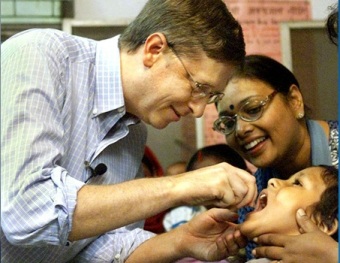
Bill Gates: geek power and bucks to battle polio...
Religion-inspired superstitions have often stood in the way of achieving sufficient vaccination coverage, leaving room for viruses to spread again. Religious leaders sometimes strengthen the hand of those making pseudoscientific claims, says South African science writer George Claassen. Writing in SciDev.Net in April 2008, he noted: “Attempts to eliminate polio in Nigeria, for example, ran into problems when Datti Ahmed, the chair of the Supreme Council for Sharia in Kano state, referred to the Global Polio Eradication Initiative as ‘modern-day Hitlers… who have deliberately adulterated the oral polio vaccines with antifertility drugs and contaminated them with certain viruses which are known to cause HIV and AIDS.'”

This brings up an interesting scenario of virus vs. virus. Richard Dawkins, the well known British evolutionary biologist and writer, has called religion the most malevolent form of a ‘mind virus’. According to Dawkins, faith − belief that is not based on evidence − is one of the world’s great evils. He claims it to be analogous to the smallpox virus, though more difficult to eradicate.

Of course, the mistrust of vaccines is not just limited to the developing world, nor is it always inspired by religion or superstition. Sometimes over-protective moms can be just as irrational. Fragile Lives, for example, took us to Dublin, Ireland, where there have been two serious outbreaks of measles – largely due to mothers rejecting vaccination because of the MMR controversy. In some parts of Ireland only 60% instead of the necessary 95%, have been vaccinated.

Who speaks for most of the world’s poor people…living in Asia?

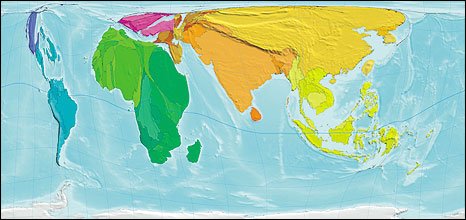
World map of human poverty...shows Asia harbouring over half

Take a close look at this map. What’s happened to our familiar world?

This is the map of human poverty — showing the proportion of poor people living in each country.

The size of each country/territory shows the overall level of poverty, quantified as the population of the territory multiplied by the Human Poverty Index. The index is used by the UNDP to measure the level of poverty in different territories. It attempts to capture all elements of poverty, such as life expectancy and adult literacy.

This map is from the recently released new book, Atlas of the Real World. It uses software to depict the nations of the world, not by their physical size, but by their demographic importance on a range of subjects.
It carries maps constructed to represent data, such as population, migration and economics. But instead of a conventional map being coloured in different shades, for instance, the maps in this Atlas are differently sized. For instance, a country with twice as many people as another is shown twice the size; a country three times as rich as another is three times the size. And so on.

When depicted in this manner, a very different view of our real world emerges. The one on the distribution of poverty, shown above, reminds us something often overlooked: there are more poor people in Asia than anywhere else in the world.

It takes a map like this to drive home such a basic fact. In most discussions on international development or poverty reduction, it is Africa that dominates the agenda. Even those organisations and activists who claim to be evidence-based don’t always realise that when it comes to absolute numbers, and not just percentages, poverty and under-development affects far more Asians than Africans.

Atlas of the Real World, which I haven’t yet seen except through glimpses offered by The Telegraph (UK) and BBC Online, offers many such insights on what our topsy-turvey world is really like.

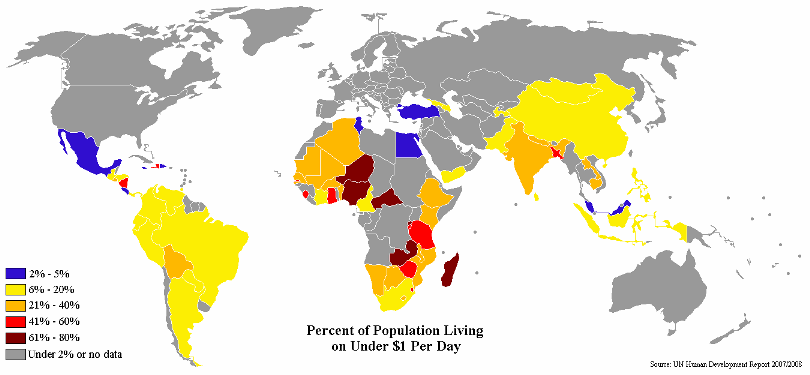
Their map of human poverty draws on the same data that this standard depiction does, in a map I found on Wikipedia sourcing the UN Human Development Report 2007/2008.

UN)
Percentage population living on less than 1 dollar day 2007-2008 (Source: UN)

There are many ways of measuring income poverty, and experts don’t always agree on methods and outcome. But we will leave those technicalities to them. Global Issues is a good website that discusses these issues without too much jargon.

Accurately drawing a two-dimensional map of our spherical world has been a challenge for centuries. Today’s most widely used Mercator projection represents our usual view of the world – with north at the top and Europe at the centre. People in other parts of the world may not always agree with this view.

The Peters Projection World Map is one of the most stimulating, and controversial, images of the world. Introduced in the early 1970s, it was an attempt to correct many imbalances and distortions in the Mercator map.

An example: in the traditional Mercator map, Greenland and China look to be the same size but in reality, China is almost 4 times larger! Peters map shows the two countries in their relative sizes.

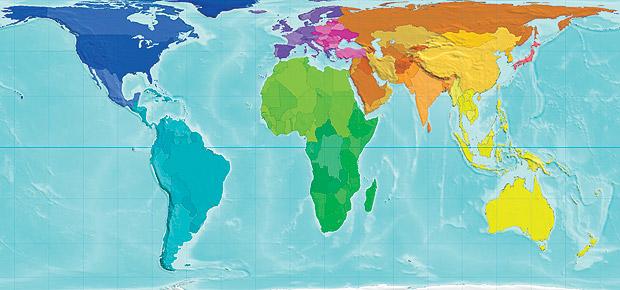
Atlas of the Real World also carries one map where the size of each territory represents exactly its land area in proportion to that of the others, giving a strikingly different perspective from the Mercator projection most commonly used. It is very similar to the Peters map of the world.

Our world depicted by each country's land area

The UNDP has been producing its influential Human Development Report since 1990. As far as I can discern, the HDR always uses conventional (Mercator?) maps, depicting data using the standard colour-coding or gray tones. The one I have reproduced in this post is an example.
Indeed, the UN’s Cartographic Section seems to favour these.

When would the UNDP – and other members of the UN family – start using more innovative ways such as those used in Atlas of the Real World? How much more effective can the UN’s analysis be if they move out of the comfort zone of Mercator?

Celebrating Nelson Mandela…and South Africa’s television revolution

Nelson Mandela

Nelson Mandela‘s long walk to freedom is an epic story of our times, one that continues to inspire millions everywhere who are deprived of that freedom by state tyranny or economic hardships.

As Mandela turns 90 years today, we join people all over the world to celebrate his life and reiterate his message.

Send your greetings to Nelson Mandela on his birthday!

And as Mandela himself reminded us in London during the June 2008 mega musical concert to celebrate his 90th birthday: “Even as we celebrate, let us remind ourselves that our work is far from complete. Where there is poverty and sickness, including AIDS, where human beings are being oppressed , there is more work to be done. Our work is for freedom for all.

American film-maker, social activist and blogger Danny Schechter — who filmed Mandela’s struggle to end apartheid and restore democracy in South Africa — has just remarked: He (Mandela) is one of those leaders who not only helped free his own country and people but became an icon and symbol for freedom in the world. At a time when darkness seems to be descending again, with the economy on the edge amidst protracted wars and pervasive abuses of powers, he is the one person that people the world over look to as a symbol of that saying that ‘another world is possible.’ He is not perfect – who is? He has taken great risks, and made his share of mistakes, but the love and adoration he inspires speaks to how special he is – even as he sees himself as part of a collective, a movement…

The Mandela story has been told many times by many film-makers, writers and journalists. Few other leaders have engaged the media’s attention and popular imagination — both in and out of office — as Mandela has, and with reason.

This is how the BBC in the UK reported the release of Nelson Mandela, by then the world’s most celebrated prisoner, on 11 February 1990.

I find it interesting to go back and watch TV coverage of important events as they unfolded. They say journalists write the first draft of history — that’s done on the run, without the benefit of hindsight or chance to reflect for too long.

In that sense, this BBC television reportage did reasonably well to capture the historic moment of Mandela’s release — the reporter and presenter couldn’t have known what lay ahead for South Africa.

In the report, available on YouTube, there’s a reference to South African television giving live coverage for Mandela’s release. That would have been perfectly logical from a ‘breaking news’ point of view — but there is something very significant and symbolic about that.

During the 1950s and 1960s, South Africa was the only wealthy country in the world that did not have a national television broadcasting service. In fact, despite being the most economically advanced country on the continent, South Africa was among the last in Africa to introduce television broadcasting. The main reason: television was viewed as potentially undermining the apartheid government’s ideology. The white minority regime saw it as a threat to its control of the broadcasting media, even though the state-controlled South African Broadcasting Corporation (SABC) had a virtual monopoly on radio broadcasting.

The minister of broadcasting, Albert Hertzog, simply refused to permit television. He said that TV would come to South Africa “over my dead body”. He denounced it as “a miniature bioscope [cinema] over which parents would have no control.” He also argued that “South Africa would have to import films showing race mixing; and advertising would make (non-white) Africans dissatisfied with their lot.”

Many white South Africans, including Afrikaners, didn’t share Hertzog’s views, and regarded the hostility towards what he called “the little black box” as absurd. When Neil Armstrong became the first man to walk on the moon in 1969, South Africa was one of the few countries unable to watch the event live, prompting one newspaper to remark that “The moon film has proved to be the last straw… The situation is becoming a source of embarrassment for the country.”

But Hertzog was adamant. A few months later, in an interview with The Cape Times on 1 Dec 1969, he admitted: “If, at the present time, you introduce television, you will pay for it with the end of the white man…”

That was an extremely perceptive remark. From the white minority regime’s point of view, the minister was right: if the pen is mightier than the sword, the camera can be mightier than both.

No wonder that most governments, whether liberal or otherwise, try to control – or manipulate – what appears on television, especially domestic transmissions that a majority of their people regularly watch. The power of the idiot box is not to be underestimated, even if it’s often dominated by….well, idiots.

As events turned out, the national and international media – especially television – did play a major role in the transformation of South Africa during the last two decades of the twentieth century.

And we now know: Albert Hertzog’s worst fears came true.

But the world’s worst fears of South Africa descending into utter chaos did not — thanks, largely, to the compassionate vision and leadership of Nelson Mandela.

Watch Nelson Mendela’s inauguration speech, when he was sworn in as the 11th President of South Africa on 27 April 1994:

Historical footnote from Wikipedia:
In 1971, the SABC was finally allowed to introduce a television service. Initially, the proposal was for two television channels, one in English and Afrikaans, aimed at white audiences, and another, known as TV Bantu, aimed at black viewers, but when television was finally introduced, there was only one channel. Experimental broadcasts in the main cities began on 5 May 1975, before nationwide service commenced on 5 January 1976.

The Mandela legacy continues, on air and off air, and more films are still being made about his remarkable life and times. The latest is a new documentary being released this month to mark his 90th birthday. SABC television will premiere it in 18 July during prime time – how times have changed!

Here’s part of the press release from the South African production company that made it:

Viva Madiba: A Hero For All Seasons, a feature length film produced by Anant Singh and Videovision Entertainment as a 90th Birthday Tribute to former president, Nelson Mandela, will have its World Premiere when it is broadcast on Friday, 18 July 2008 on SABC 2 at 21h00.

Viva Madiba: A Hero For All Seasons is a celebration of Nelson Mandela’s epic life and his status as an international icon. In this, the year of his 90th birthday, he remains a man at the centre of attention, not only in South Africa, but around the world as a moral leader, an elder statesman and an exceptional human being.

Viva Madiba: A Hero For All Seasons takes one on a journey behind the headlines and away from the public eye and looks at Madiba as a loyal friend, a dependable comrade, a trusted confidant, a respected mentor, and a man who has touched and transformed countless lives.

For the first time his complete story is being told – a life of struggle, humanity, destiny and greatness is recalled and celebrated by those who knew him best and who worked with him in the quest to break the chains of oppression, taking us beyond the political and into the personal. The programme features exclusive interviews with politicians, close friends and comrades of Madiba, among whom are Archbishop Desmond Tutu, Oliver Tambo, George Bizos, Ahmed Kathrada, Pik Botha, Dorothy Masuka, Nthato Motlana, Cyril Ramaphosa, Helen Suzman, Zolani Mkiva, Jessie Duarte, Francois Pienaar, Sydney Kentridge, Mac Maharaj, Christo Brand and Gill Marcus.

Read and watch Danny Schechter talk about his role supporting the making of Viva Madiba


Happy 90th, (ex) prisoner 46664!

Nelson Mandela turns 90 on 18 July 2008.

Moving Images blog joins the world in wishing him many happy returns of the day — and many more birthdays to come!

To mark the occasion, we feature the song 46664 (That’s My Number) Nelson Mandela recorded some years ago to draw attention to HIV/AIDS.

This background story comes from the YouTube channel of Andrew Heath:

46664
was Nelson Mandela’s prison number when he was incarcerated on Robbin Island, Cape Town for 18 years.

46664 is a global movement fighting against HIV/AIDS in Africa and around the globe and MUSIC is a key element of the 46664 campaign.

In 2003 Jacqui Joseph (TV Presenter & Director of GHC Productions) was asked to host the first “live” Nelson Mandela 46664 Concert at Green Point Stadium in Cape Town with an audience of 40,000 that was broadcast globally and on the internet to 2 Billion people.

Jacqui provided her services for free and interviewed all the artists performing at the concert including Beyonce, Bono, The Edge, Peter Gabriel, Dave Stewart, Brian May, Roger Taylor, Ladysmith Black Mambazo and Angelique Kidjo and did the voice over for the official 46664 DVD.

As a result of her charity work and involvement with 46664 Jacqui and all involved in the campaign became official Ambassadors to the Nelson Mandela Foundation. Although a number of years have passed since Jacqui fronted the first big 46664 music event she now feels the time is right to re-energise and raise the public awareness and profile for the 46664 campaign.

In order to do this, Jacqui asked Max & Andy (remixer/producers) to come up with a fresh musical anthem & video for the 46664 campaign.

In 2006 Max & Andy completed the track and video and the result is: 46664 (THAT’S MY NUMBER)

46664 (That’s my Number) combines samples taken from Nelson Mandela’s inaugural 46664 speech in 2003 over dubbed onto an infectious re-mix of pop, ska and reggae classics.

The 46664 (that’s my number) video includes images sampled from the first official 46664 DVD and live concert shot in 2003 as well as original clips filmed for the GHC Productions video.

Nelson Mandela 46664

Journalists and scientists seeking Green Accord

Can journalists save the planet?

This was the question I raised in a blog post written in April 2007. Arguing that environmental journalists alone cannot adequately address the multitude of complex environmental challenges faced today, I wrote: “We urgently need more good journalism that covers sustainable development as an integral part of mainstream human affairs.”

For the past five years, an Italian non-profit cultural association named Greenaccord has been attempting just this. In the (northern hemisphere) Fall of each year, they invite and host 50 – 60 journalists and scientists from all over the world to discuss how the media can be an integral part of society’s response to today’s environmental crises. In fact, they believe the media must play a path-finder role in our search for solutions.

During this week, I have been attending the V Greenaccord International Media Forum on the Protection of Nature, held from 7 to 11 Novmeber 2007 at the historic Villa Mondragone in Frascati, some 20km south east of Rome.

It has been a time to meet old friends again and to make new ones. I have been part four of the five Greenaccord media forums since the first one was held in Rapolane Terme, in the Tuscany valley in northern Italy in 2002.

Greenaccord is the only regular (annual) meeting that I know of where practising journalists and media gatekeepers come together from all regions of the world to discuss the state of the planet and state of their profession.

Each year, we have some ‘regulars’ returning while new participants join the growing network. As some old hands noted this week, it is evolving into an extended family.

That family consists mainly of print and broadcast media journalists from Africa, Asia, Europe, Latin America and the Caribbean. Many are engaged in ‘deadline journalism’ of news and current affairs, while a few of us, like myself, have moved on to more reflective and analytical kind of journalism. We also have a few researchers, activists and public information officers among us, enriching our discussions with a diversity of perspectives.

To engage this group of participants over three and a half days, Greenaccord invites a dozen or so scientific or industry experts from different regions of the world and different disciplines. This year’s theme, ‘Capitalising on the Environment’, was explored by business leaders, fair trade activists, economists and a number of technical experts specialising in fields such as clean energy, clean technology and organic farming.

greenaccord-v-forum-in-progress-nov-2007.jpg

As with all meetings, some speakers were far more interesting than others. And some sessions were blessed with competent chairpersons who kept overenthusiastic speakers in check and allowed meaningful discussion and debate to happen.

Sitting through such meetings is a bit like gem mining. One has to sift through a lot of gravel to find a rare precious gem. When that happens, it’s well worth the hassle.

Well, I’ve had my share of gravel moments (zzzzzzzzzzzzzzzzz!) and precious moments (Eureka!) this week. I’ll write separate blog posts on some of the latter. They are indeed worth sharing.

The real stars (or gems if you like) in this whole exercise are the participants themselves. We come from such diverse backgrounds – the sessions are supported by simultaneous interpretation in English, Spanish and Italian, with an occasional remark in French – that we enrich each other by simply being there.

emanuela-gasbarroni-from-tve-med-intervenes.jpg

Some of us can barely contain our passion for what we do, and keep making comments or asking questions at every available opportunity. Others are more quiet during sessions but expressive during the many hours of networking and socialising over fine Italian wine, coffee and gastronomical treats. All these are part of Greenaccord’s cultural diversity that we contribute to, and then celebrate.

Even if we don’t take ourselves too seriously, we do discuss sobering issues. On the one hand, the planet is in peril, largely thanks to human bungling over generations. On the other, mass media itself is in crisis in many countries — under siege from oppressive governments, grappling with limitations of money and skills, and facing competition from new media platforms grabbing audiences and revenue.

For example, a colleague from Cameroon found the government closing down his privately owned FM radio station just a couple of days before he left for Rome. Others had worrying tales to share about official censorship, physical violence unleashed on media organisations and journalists, and the tension between media owners’ interests and the public interest.

We expressed solidarity and support for all Greenaccord colleagues currently experiencing difficulties of various kinds. The spirit of camaraderie in this network is strong – and keeps growing.

So is all this networking and meeting hopping a distraction from real work, which each one of us have to perform at our desks, or in our studios, on an individual basis? I don’t think so. Far from being a drag on my time, I find gatherings like Greenaccord inspiring and energising. They also remind me that I’m not alone in the daily struggle and drudgery of deadlines, government bureaucracies, funding crises and a never-ending race to keep up with new media technologies.

A planet in peril and a media in crisis need more platforms like this to connect and support many more of our kind who weren’t in Rome this week. Greenaccord isn’t perfect (we’re working on it), but it has lit more than a few candles against the looming darkness.

– Nalaka Gunawardene, Frascati, Rome: 10 November 2007

zilia-castrillon-speaking-at-greenaccord-v-nov-2007.jpg


Meeting photos courtesy Adrian Gilardoni’s Flickr account

Can somebody please update ‘The Development Set’ by Ross Coggins?

At the UN European Headquarters in Geneva this week, while attending a conference of humanitarian aid workers from around the world, I heard two of them compare the flat-beds in business class of two international airlines.

The conversation was more than just a passing one. They were passionately discussing the relative merits of different business class seats and perks.

I almost felt like butting in and saying that Singapore Airlines – the world’s finest airline, no argument – has just created a new product that they can now lust after: personal cabin suites in the air.

Coincidentally this week, on 25 October 2007, Singapore Airlines began operating the first commercial flights of the new Airbus380 double-decker super-jumbo.

Here are two images from the airlines’s website:

From Singapore Airlines

I’m all for humanitarian aid workers being well paid, well protected and well cared for. After all, they risk life and limb for the rescue, relief and recovery of large numbers of people caught in disasters or conflicts.

Perhaps I’m being naive, but there’s something incongruent about aid workers aspiring to flat-beds and space beds in the air.

Which reminds me, it’s about time somebody updated the well known poem, The Development Set, by Ross Coggins. First published in “Adult Education and Development” September 1976, it’s now more than 30 years old — the luxuries both in the air and on the ground have evolved a bit in that time.

Graham Hancock’s book “Lords of Poverty: The Power, Prestige, and Corruption of the International Aid Business” gleefully reprinted this poem in the 1980s.

I’m no poet, but there’s a need to update this to include GPS, satellite phones, four-wheel drives, and yes, business class beds.

If you are not familiar with the original poem, here it is:

The Development Set
by Ross Coggins

Excuse me, friends, I must catch my jet
I’m off to join the Development Set;
My bags are packed, and I’ve had all my shots
I have traveller’s checks and pills for the trots!

The Development Set is bright and noble
Our thoughts are deep and our vision global;
Although we move with the better classes
Our thoughts are always with the masses.

In Sheraton Hotels in scattered nations
We damn multi-national corporations;
injustice seems easy to protest
In such seething hotbeds of social rest.

We discuss malnutrition over steaks
And plan hunger talks during coffee breaks.
Whether Asian floods or African drought,
We face each issue with open mouth.

We bring in consultants whose circumlocution
Raises difficulties for every solution —
Thus guaranteeing continued good eating
By showing the need for another meeting.

The language of the Development Set
Stretches the English alphabet;
We use swell words like “epigenetic”
“Micro”, “macro”, and “logarithmetic”

It pleasures us to be esoteric —
It’s so intellectually atmospheric!
And although establishments may be unmoved,
Our vocabularies are much improved.

When the talk gets deep and you’re feeling numb,
You can keep your shame to a minimum:
To show that you, too, are intelligent
Smugly ask, “Is it really development?”

Or say, “That’s fine in practice, but don’t you see:
It doesn’t work out in theory!”
A few may find this incomprehensible,
But most will admire you as deep and sensible.

Development set homes are extremely chic,
Full of carvings, curios, and draped with batik.
Eye-level photographs subtly assure
That your host is at home with the great and the poor.

Enough of these verses – on with the mission!
Our task is as broad as the human condition!
Just pray god the biblical promise is true:
The poor ye shall always have with you.

Message to aid workers: Go mobile — or get lost!

banner.jpg

“MY NAME is Mohammed Sokor, writing to you from Dagahaley refugee camp in Dadaab. Dear Sir, there is an alarming issue here. People are given too few kilograms of food. You must help.”

This short, urgent message of a single individual has already joined the global humanitarian lore. It was sent by SMS (a.k.a. mobile texting) from the sender’s own mobile phone to the mobiles of two United Nations officials, in London and Nairobi. Sokor found these numbers by surfing at an internet café at the north Kenyan camp.

The Economist used this example to illustrate how the information dynamics are changing in humanitarian crises around the world. In an article on 26 July 2007, titled ‘Flood, famine and mobile phones’, it noted:
The age-old scourge of famine in the Horn of Africa had found a 21st-century response; and a familiar flow of authority, from rich donor to grateful recipient, had been reversed. It was also a sign that technology need not create a ‘digital divide’: it can work wonders in some of the world’s remotest, most wretched places.”

Elsewhere in the article, it added: “Disaster relief is basically a giant logistical operation. Today’s emergency responders can no more dispense with mobile phones or electronically transmitted spreadsheets than a global courier company can. But unlike most couriers, aid donors operate amid chaos, with rapidly changing constraints (surges of people, outbreaks of disease, attacks by warlords). Mobile phones increase the flow of information, and the speed at which it can be processed, in a world where information used to be confused or absent. The chaos remains, but coping with it gets easier.

image-from-wikimedia.jpg
Image courtesy WikiMedia

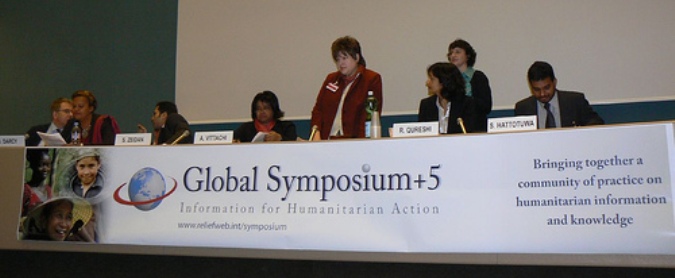
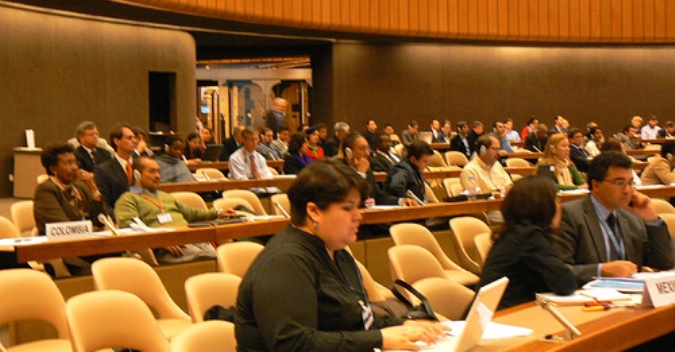
All available indicators suggest that the future of humanitarian assistance is going to be largely dependent on mobile communications. Despite this reality, old habits die hard. I sat through an entire presentation on ‘Innovation to Improve Humanitarian Action’ at the Global Symposium+5 on ‘Information for Humanitarian Action’ in Geneva this week — and not once did I hear mobile phones being mentioned. A group of 15 – 20 people had deliberated for 2 days to come up with their vision of ‘the potential of emerging technologies and approaches used in the field and globally to strengthen information sharing, coordination and decision-making’ in humanitarian work.

It might be that aid workers are all frustrated computer geeks…because all their talk was about collaborative and networking software, Geographic Information Systems (GIS), the use of really high resolution (read: oh-so-sexy) satellite imagery, and the latest analytical tools — all requiring high levels of skill and personal computers with loads of processing power.

But no mobile phones! This was too much to let pass, so I raised the question: did you guys even consider this near ubiquitous, mass scale technology and its applications in crisis and disaster situations? And how do you engage the digitally empowered, better informed disaster survivors and crisis-affected communities?

I also recalled the example of Aceh tsunami survivors keeping each other informed about the latest arrivals of relief supplies – all through their mobile phones (as cited by the head of MERCY Malaysia on the previous day).

It turned out that they did discuss mobiles — well, sort of. Amidst all the gee-whiz talk about high tech gadgets, I received a short answer: widespread as mobile phones now are, ‘these systems are not fully integrated or compatible with other information platforms’ — whatever that means! The group’s spokespersons also pointed out that since mobile services are all operated by commercial (telecom) service providers, using their networks involves lots of ‘negotiations’. (I would have thought it’s the same with those who operate earth-watching or communications satellites.)

The message I heard was: mobile phones are probably too down-market, low-tech and entirely too common for the great humanitarian aid worker to consider them as part of their expensive information management systems. For sure, everybody uses them to stay in touch in the field, but what use beyond that?

What uses, indeed. If today’s aid workers ignore the mobile phone revolution sweeping Africa, Asia Pacific and, to a lesser extent, Latin America, they risk marginalising their own selves. The choice seems to be: go fully mobile, or get lost.

Fortunately, the panel discussion that followed — on ‘Envisioning the Future’ — partly redressed this imbalance. The panel, comprising telecom industry, citizen media and civil society representatives, responded to the question: what will our humanitarian future look like and what role will information play in supporting it?

panel-3-on-envisioning-the-future.jpg

Leading the ‘defence’ of mobiles was Rima Qureshi, head of Ericsson Response, part of the global mobile phone manufacturer’s social responsibility initiatives. She reminded us there were now 3.4 billion (3,400 million) mobile phones in the world — and it was growing at 6 new mobile connections every second. By the time she ended her 8-minute talk, she said, some 3,000 new mobiles would have been connected for the first time.

This represents a huge opportunity, she said, to put information into everyone’s hands whenever and wherever they need it. And mobiles are all about two-way communication.

The new generation of mobile phones now coming out are not locked into a single telecom network, and have built-in global positioning (GPS) capability. This means the phone’s location can be pinpointed precisely anywhere on the planet — which can be invaluable in searching for missing persons in the aftermath of a disaster.

Wearing her Ericsson prophet’s hat, Rima said: “Everything we can do on a personal computer will soon become possible on a mobile. Mass availability of mobile phones, able to connect to the global Internet, will represent a big moment for human communication.”

And not just Ericsson, but many other mobile phone makers and network operators are rolling out new products and services. The new mobiles are easier to use, more versatile and durable, and come with longer-lasting or renewable sources of power. Wind-up phone chargers have been on the market for some years, and some new mobile phones come with a hand-cranking charging device that makes them entirely independent of mains electricity. With all this, the instruments keep getting cheaper too.

And if aid workers ignore these and other aspects of mobile realities, they shouldn’t be in their business!

1743641460_63092b452a.jpg

Rima described another Ericsson initiative called Communication for All. It’s trying to harness the power of shared network, across commercial telecom operators and networks (but with some development funding from the World Bank) to deliver coverage to rural areas that aren’t as yet covered fully. The rolling out of coverage would have profound implications for disaster managers and aid workers.

As James Darcy, Director of humanitarian aid policy at the UK’s Overseas Development Institute, noted from the chair, the future of humanitarian communication is already here — but the sector needs to have more imagination in applying already available technologies for new and better uses.

My colleague Sanjana Hattotuwa, ICT researcher and activist from Sri Lanka, made the point that 3.4 billion mobiles raise new ethical considerations. For example, while it is now technologically possible to track the movement of every mobile phone – and therefore, in theory, each unit’s owner – this knowledge can be abused in the wrong hands. (I’ll write a separate blog post on Sanjana’s other remarks.)

Not everyone in the audience was convinced about the future being mobile. Soon enough, the predictable naysayer popped up: saying only 2.4 per cent of people in Sub-Saharan Africa as yet owned mobile phones, and Internet access was limited to only one per cent. Blah, blah, blah! (I was half expecting someone to blurt out the now completely obsolete – but sadly, not fully buried – development myth that there are more phones in New York city than in the whole of sub-Saharan Africa. That didn’t happen.)

Funny thing was, we were discussing all this at the Palais des Nations, the European headquarters of the UN, which is just literally across the street from the headquarters of the International Telecommunication Union (ITU), the authoritative monitor of telecom and ICT industry data and trends! It seemed that the gulf between some humanitarian workers and the telecom industry was much bigger than that.

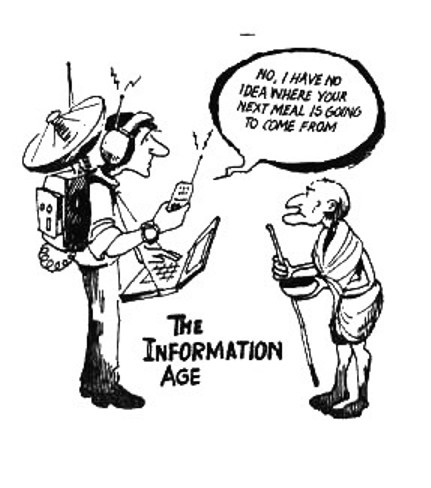
Of course, being connected – to mobile, satellite and every other available information network – is only the first step. We can only hope humanitarian workers don’t end up in this situation, captured in one of my all-time favourite ICT cartoons (courtesy Down to Earth magazine):

copy-of-all-inf-no-solutions.jpg

Read about Sri Lanka’s pathfinding action research by LIRNEasia and others: Last Mile Hazard Information Dissemination Project

All Geneva photos courtesy UN-OCHA Flickr on Global Symposium+5

Making fun of HIV: Welcome to the Scenarios from Africa

General Assembly of Diseases: In the city of Contaminobo, assorted germs in an emergency session. Tuberculosis, Polio, Hepatitis and others are all angry and afraid because their favourite target – humans – are fighting back. Enter ‘His Royal Heinous, Overlord AIDS’. Hope at last! When he attacks the immune system of humans, other germs can still have a chance…The humans are so careless, that it’s easy for AIDS to quickly spread from one to many. But wait a minute – somebody has been listening into all their talk. Which means the secret of defending humans from HIV and his cronies is out.

Iron Will: Moussah is a young man with a healthy, or bubbling, interest in girls. His male friends advise him to be play it safe — carefree sex can easily expose him to HIV, for which there is no cure. They talk about condoms, and another strategy that is an alternative to using the rubber latex. But Moussah doesn’t quite understand the expression ‘iron will’. He interprets it differently, and gets custom made iron underpants made — much to the amusement of his friends, who remind him the most important sex organ is…the brain!

Just Once: A man returns from the field and feels like making love to his wife. She is living with HIV and insists that he uses a condom — but they’ve run out of stocks. So he cycles far and wide in search of condoms – where is a rubber when you need one? Finally he succeeds and rushes home, only to find that his wife did have one last, unused condom with her. So why didn’t you tell me, he asks in exasperation. Her answer is revealing….

Intrigued? There’s a lot more where they came from.

These three stories are part of Scenarios from Africa — a highly successful and popular pan-African initiative to use moving images to get young people talking and acting on HIV/AIDS. The decade-long project has been carried out with and for young people, with community mobilisation, education and media elements.

Integral to this communication effort are television drama vignettes about different scenarios involving HIV in everyday life.

Some are very funny while others are very moving. They cover many dimensions of the HIV epidemic, from preventing the virus spreading to taking care of persons living with HIV. Underlying themes include safe sex, removing social stigma from the epidemic and dispelling misconceptions about how HIV spreads or does not spread.

The project was started in 1997 and is coordinated by the non-profit Global Dialogues Trust. It gave African children and young adults an exciting opportunity to educate themselves and others about HIV/AIDS by inviting them to participate with internationally acclaimed directors in the production of these short films.

The films are based on ideas thought up by young people in a series of contests. So far, over 105,000 young people from 37 African countries have taken part in these contests. Over 1,000 local and international partner organisations have been involved in organising the contests and selecting the winning ideas.

The films range in duration from just under 2 minutes to almost 15 minutes. They were produced by top fiction film-makers and animation specialists in Africa.

All stories use African actors, locations and situations – and employ different story telling tactics.

Scenarios from Africa is a multi-media communication project that has been widely acclaimed by practitioners, activists and scholars worldwide. The films are supported by a user’s guide and online discussion points that help teachers, trainers and activists to make the best use of these stories in their work.

The films are all distributed on a non-commercial basis across Africa and beyond, for broadcast and narrowcast use. The Scenarios films have been broadcast on locally-based television stations in almost every country in sub-Saharan Africa. The films are also collected on compilation DVDs and video cassettes for use by organisations and schools. Some 60,000 copies of the films (DVDs and video cassettes) of the films have been distributed to date.

The films are now available in a wide and growing range of African and European languages, and are reaching tens of millions of people.

Says Daniel Enger of the Global Dialogues Trust: “Although the films were originally produced for the sub-Saharan African cultural context, we have been pleased to learn over the years that the films have proven useful as awareness-raising tools in many countries of the Asia Pacific area. Indeed, most of the HIV-related topics raised in the Scenarios from Africa collections have universal relevance, making the films useful discussion starters across the globe.”

TVE Asia Pacific has recently taken on the task of distributing all Scenarios films across the Asia Pacific region. As with all other films in its catalogue, TVEAP will distribute Scenarios on a non-exclusive, non-commercial basis to broadcast, civil society and educational. We have been promoting the Scenarios films since we screened them to packed houses during the 2004 AIDS Film Festival in Bangkok

Meanwhile, the 5th Scenarios contest will be held from 1 December 2007 to 15 March 2008. Please contact for more information.

Watch Scenarios films on the official website (RealPlayer required)

Scenarios from Africa now available from TVE Asia Pacific

All images used in this post are courtesy Global Dialogues Trust.

Read my other blog posts on HIV:
HIV: Stigma a bigger killer than the virus?
Three Amigos: Funny condoms with a serious mission
Beware of Vatican condoms!
50? In South African terms, you’re probably dead!
Ratomate’s best cup of tea
A girl named Nan-nan

“If we don’t tell our stories, no one else will”

Image courtesy Maisha Labs

An unpretentious, matter-of-fact press release arrived in my email overnight from Maisha Film Lab in Kampala, Uganda. It started as follows:

“MAISHA, the annual training program for East African Filmmakers founded by director Mira Nair (Namesake, Mississippi Masala, Monsoon Wedding) is now in its third year of operation. Housed in Munyonyo, Kampala, the three-week lab (which takes place from July 21st to August 11th, 2007) is currently training 9 filmmakers, 3 sound mixers, 3 cinematographers, and 3 editors with world-renowned filmmaking professionals.”

The press release then listed Maisha’s 2007 mentors. Among them:
– Jason Filardi (Writer, Bringing Down The House)
– Joshua Marston (Writer/Director, Maria Full of Grace)
– Alison Maclean (Writer/Director, Jesus’ Son)
– David Keating (Writer/Director, Last of the High Kings)
– Drew Kunin (Production Sound Mixer, Crouching Tiger Hidden Dragon, Zodiac)
– Kerwin DeVonish (2nd Unit DP, Inside Man)
– Barry Alexander Brown (Editor, Inside Man, Malcolm X), and
– Fellipe Barbosa (Director, Salt Kiss)

Wow – Mira has succeeded in rounding up some of the best film industry talent in North America. All these professionals are donating their time, so that African film-makers can sharpen their skills in making better moving images.

But it’s the mission of Maisha that interests me most — because it so resonates with what we at TVE Asia Pacific have been advocating in Asia in our own small way: equipping and empowering local film-makers to tell their own stories to their people and the world.

Maisha’s tagline says it all: “If we don’t tell our stories, no one else will”

As their website explains: “Film is easily one of the most far-reaching mediums in the modern world, one that essentially validates a culture. In the entire African continent, there are few, if any, training programs for aspiring filmmakers.

“The few films that take place in East Africa are often made by foreigners without local crews, and generally focus on the political turmoil that plagues the region. While there is a flourishing and vital writing and theatre culture in the region, the bridge to convert this talent into screenplays and films has yet to be built.

MAISHA (meaning “life” in Kiswahili) provides new screenwriters and film directors from East Africa (Uganda, Kenya, Tanzania and Rwanda) and South Asia (India, Pakistan, Sri Lanka and Bangladesh) with access to the professional training and production resources necessary to articulate their visions.

Mira Nair image from Harvard University Gazette

Maisha aims to preserve, cultivate and unleash local voices from these regions, and to become one of the first targeted programs to offer structured and accessible resources to these emerging filmmakers. MAISHA is motivated by the belief that a film which explores the truths and idiosyncrasies of the specifically local often has the power to cross over and become significantly universal.

Read more about Maisha Filmmaker Lab

Maisha has selected three short films from this year’s participants’ submitted screenplays. These films are currently in production, crewed entirely by Maisha trainees. The cast is culled from the Kampala theater community. They are:

Must be a God-Fearing Christian Girl
Directed by Wanjiru Kairu, Kenya
John Webuye is a smart, successful man- living at home with his mother. After some failed attempts at internet dating, he finds love in the most unexpected of places.
Assistant director: Consodyne Buzabo, Production Manager: Victor Dimo Okello, Cinemtaographer: Ronald Kasirye, Sound Mixer: Richard Ndung’u, Editor: Risper Mbuthia.

The Trip
Directed by James Gayo, Tanzania
Pembe and Kaniki are two brothers on their way to interview for new jobs. Their bus breaks down along the way- and Kaniki’s wandering eye leads them in a different direction than they had anticipated.
Assistant Director: Jennifer Gatero, Production Manager: Kwezi Kaganda Runihda, Cinematographer: George Karugu, Sound Mixer: Theirry Dushimirimana, Editor: Zipporah Kimundu.

What Happened in Room 13
Directed by Dilman Dila, Uganda
Peter’s wife, Oliva, is pregnant and in the hospital, which gives her wayward husband an excuse to run off to a cheap motel with his best friend’s wife, Prossy. After their encounter leaves Prossy fatally injured, Peter tries desperately to cover his tracks.
Assistant Director: Ayuub Kasasa Mago, Production Manager: Anthony Njeru Thandi, Cinematographer: Nicholas Mtenga, Sound Mixer: Moses Hussain, Editor: Patrick Sekyaya.

Read: June 2004: Mira Nair Launches MAISHA, Film Laboratory for East Africans, South Asians

Read Mira Nair’s profile on Maisha website

Note: One of my claims to fame is that Mira Nair and I are both on the Board of Governors of Ujala TV, the South Asian educational broadcasting venture that I wrote about a few weeks ago. And last month, Mira’s latest film Namesake reduced me to tears in public.