Low Carbon, High PrioritySome 100 world leaders are due to gather at the United Nations headquarters in New York this week for the highest level summit meeting on climate change ever convened.
As the New York Times reported: “In convening the meeting, the United Nations is hoping that collectively the leaders can summon the will to overcome narrow nationalinterests and give the negotiators the marching orders needed to cut at least the outline of a deal.”
Recognising climate change as one of the greatest social, economic, political and environmental challenges facing our generation, the British Council has launched the Low Carbon Futures project. It has focus on mitigating the effects of climate change in an urban environment. It is part of the British Council’s major global climate security project and India is, along with China, one of the top two priority countries for this work. Sri Lanka, with less than 2% of India’s population and correspondingly lower carbon emissions, is a lower priority.
One strand in the Low Carbon Futures project is to engage communications professionals – journalists, writers and film makers to help them better understand the issues around mitigation and get across key messages to readers/viewers more effectively.
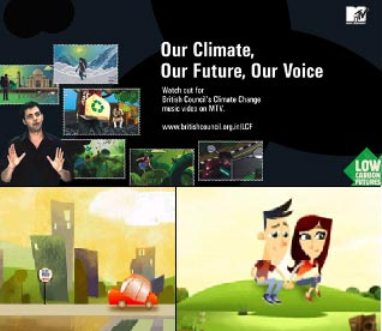
As part of this project, the British Council collaborated with Music Television (MTV) to produce a music video and two viral video animations on climate friendly, low-carbon lifestyles.
British Council’s first Music Video on Climate Change produced by MTV features VJ Cyrus Sahukar. Combining animation, lyrics and melody, the video talks about how small individual actions can help conserve natural resources and save the climate. MTV VJs have a cult following and the video ends with Cyrus Sahukar, MTV’s face in India, encouraging young people to take that first step. The video was launched in New Delhi on 1 June 2009 in the presence of 50 International Climate Champions from across India & Sri Lanka.
According to the British Council India website, “The video has created a flutter and there is growing demand to screen the video on various institutional networks across India and even outside fulfilling higher level objectives of impacting young urban aspirants. Young Indians are an emerging generation who are ambitious and internationally minded with the potential to be future leaders. The MTV video aims to influence this influential group.”
The Low Carbon Futures project has also released two short, powerful, animated messages that are ‘tongue-in-cheek’- making use of everyday events with a touch of humour. “We are hoping that the messages will be seen as creative, funny and innovative to tempt the recipient to forward it to their peer group. As the virus spreads, so will the message. The British High Commission and the The Energy and Resources Institute (TERI) are also promoting these virals to spread the message amongst the staff members and their external audiences,” says the project website.
The first viral video animation is called Green Journey, and shows a little known benefit of car pooling. Its blurb reads, simply: Meet 3 Mr Rights on the wrong side of the road!
The second viral video animation is called Play Cupid, and gives us one more reason to plant more trees! Blurb: Lets leave the young couples in peace and solitude of nature!
Memory is a curious phenomenon. Sometimes memories of our personal past are evoked in the most unexpected manner, reviving nostalgia for days that are forever lost in the sands of time.
I have never visited Poland, but it’s been on my mind in recent days. 1 September 2009 marked the 70th anniversary of the beginning of the Second World War – which was sparked off by Nazi Germany’s invasion of Poland.
That’s also the day when the Anglo-American poet W H Auden wrote his deeply evocative poem, September 1, 1939. He wrote it sitting in a New York bar and distraught by the clouds of hatred gathering over Europe. I’ve been reading and re-reading it this year as the war Sri Lanka – which lasted almost five times longer – officially ended in May 2009.
As I wrote at the time: “Almost 70 years later, at the end of my own 30-year-long war, I have been reading and re-reading September 1, 1939. I’m trying to make sense of what is happening around me. The near hysterical mass euphoria on one side, and bewildered dejection on the other.”
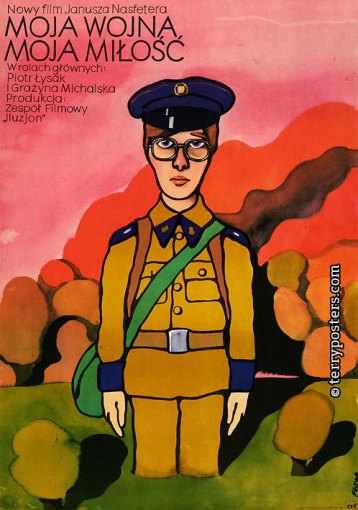
I have only just remembered that Poland in September 1939 holds another significance for me. It has to do with the Polish film Moja Wojna – Moja Milosc (My War-My Love, 1975), which I saw in the summer of 1979 at a Colombo cinema as a 13-year-old school boy.
Not only did I see the film, but I also wrote an essay reviewing it and entered it into a competition organised by the Embassy of Poland. Growing up in a country that didn’t have broadcast television until that very year, I had only seen a handful of movies up to that time. I was no movie critic, but my views on the film and its resonance with my own times must have struck a chord with the judges. For I won the second prize in the Sinhala essay competition.
Being runner-up was no big deal by itself, but this was the first time that my writing was competitively judged and ranked by anyone outside my immediate circles. My prize included a fountain pen, white polyester cloth for school uniforms, and an LP record of Polish music (yes, LPs were still in use, but on their way out at the time!).
From My War - My LoveI would go on to win many essay competitions during my teens, and one day earn an honest living as a wordsmith. But that movie review – long since lost in the mists of time – was my first success. My career in literary crime was thus forged…thanks to a Polish movie!
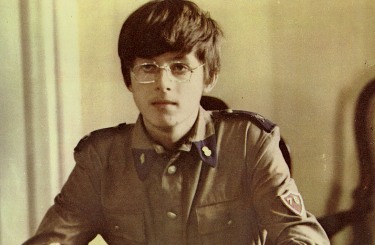
From the little that I can still remember, 30 summers later, My War-My Love wasn’t a pretty film. It is set during the week of the Nazi invasion of Poland in 1939. Daring 17-year-old schoolboy Marek (Piotry Lyjak), inspired by the example of the Sobieski cadets during 1831 insurrection, vows to take on Germans single-handedly. He devotes most of his energy to protecting a young girl who lost her mother during the invasion.
As one reviewer wrote, “My War-My Love could not, by its very nature, end altogether happily, but the film can be regarded as life-affirming.”
War has no place for innocence - then or now...That film was my first visual introduction to the horrors of war, a topic that was to dominate my own future for the next 30 years to come. In that Sri Lankan war, child soldiers several years younger than the film’s character Marek would play a prominent role.
At a far more personal level, I had never been in love when I saw My War-My Love. In the three decades to follow, I would fall in love three times — and lose out every time, though for very different reasons (none of which involved ‘my’ war). I must now carry the pain of these lost loves for the rest of my time. But that is another story…
Thanks to the wonders of Google, I’ve been able to track down some specifics about the film. It was directed by Janusz Nasfeter (1920 – 1998), a versatile Polish film maker whose career in writing and directing films spanned from the late 1940s to the early 1980s. He was 19 when the Germans came marching in.
It was one of many films that have used the Second World War as its backdrop. There have been several other Polish films that looked back on the Polish resistance, Poland Holocaust and Warsaw uprising of 1944 and other key events that left an indelible mark on the country. In fact, as this listing in Wikipedia shows, when Janusz Nasfeter made My War-My Love, the theme was pretty much covered by different Polish film makers in numerous ways.
I haven’t seen any of these other Polish films, and even My War-My Love is now only a distant memory. But as a moving image creation that moved my life in a certain direction, it would always have a special place in my heart.
It’s a show called the XYZ Show, broadcast weekly on Kenya’s Citizen TV. Started in mid May 2009, the first season introduced Kenyan viewers to a new form of satire television, with life-sized puppets made to resemble famous persons, mostly politicians.
Now comes the report that the show has riled some Kenyan politicians – surprise, surprise! I have only just come across this Citizen TV news report, broadcast a couple of weeks ago:
Controversy Over The XYZ Show
The satirical puppet show XYZ on Citizen Television every Sunday night, has attracted the attention of non other than the Public Service Minister Dalmas Otieno. The Minister says the caricature show is depicting politicians in bad light. The Director of Communication Ezekiel Mutua avers that, the show is representative of just how free the media is, in Kenya.
Well, what can we say? We thought politicians in general had thicker skins. Perhaps some Kenyan politicians are in danger of forgetting that timeless piece of Swahilian advice: Hakuna matata!
Hakuna matata is a Swahili phrase that is literally translated as “There are no worries”. It is sometimes translated as “no worries”, although is more commonly used similarly to the English phrase “no problem”.
I explained: I keep asking more questions than I can answer. The ancient Greeks did the same – they were the first to ask many fundamental questions in philosophy and science. They didn’t always get the answers right, but started quests that lasted for millennia…
As Ed Johnson recently wrote: “We have so many things to thank the Greeks for, from philosophy to democracy. They were the ones who established the first civilization, governed by free citizens. Individual liberty has been the basis of civilization ever since.”
It so happens that I recently completed 40 years in this business of playing the Greek. As I recalled a few weeks ago on the 40th anniversary of the first Moon landing, I had an early start in asking difficult, sometimes irritating, questions.
I’m fortunate to be welcomed among media practitioners as well as media researchers. I’m not a card-carrying member of either group, but I have great fun hobnobbing with both. This is what Irish journalist-cum-academic Conor Cruise O’Brien once called ‘having a foot in both graves’!
And I’m also grateful for being allowed into the community of geeks, especially of the IT, ICT and gadget-wielding kind.
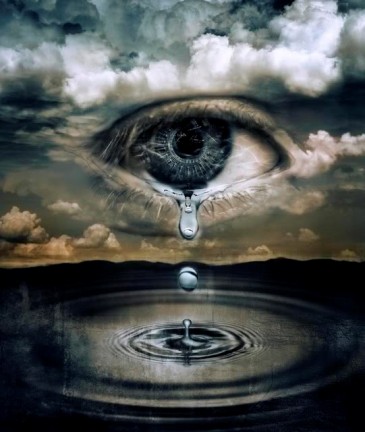
I cry, therefore I am“If you have tears, prepare to shed them now,” urged Mark Antony to fellow Romans after Julius Caesar died.
But what if you simply don’t have any tears to shed? That’s what my eye doctor recently cautioned me, after a routine examination. The natural tearing in my eye, necessary for keeping it moist and clean, wasn’t quite working. There is nothing to worry, he hastened to add, for it sometimes happens as our bodies slowly age. He asked me to use eye drops twice a day for a while.
This set me thinking about the value and power of tears. Although most land mammals have a lacrimation system to keep their eyes moist, humans are the only mammal generally accepted to cry emotional tears.
In my circles, I’m known to be an emotional guy. I have never believed in that macho myth of men not crying. I shed tears of joy and tears of sorrow, sometimes in public. I cry when people I know, admire or love leave this world, sometimes at the most unexpected moments. Powerful movie moments of triumph or despair often move me to tears, as do simple joys of life — such as seeing my kid perform well on stage in a school concert.
Despite what my doctor says, I’ve been shedding plenty of tears this year.
I openly wept when journalist colleague Lasantha Wickrematunge was gunned down in broad daylight on a cruel January day. He was Sri Lanka’s real leader of the opposition.
My eyes were completely misty when the news of the original TV news anchorman and broadcast giant Walter Cronkite passed away on 18 July 2009 after an illustrious career spanning decades.
Have tears, will shed...Two weeks later, I joined millions of Filipinos in mourning the passage of Cory Aquino, the courageous woman who led the world’s first People Power revolution, toppling one of the worst tyrants of the 20th century.
In contrast, Michael Jackson’s death on 25 June didn’t immediately move me to tears, even though I quickly wrote a tribute. But the live broadcast of his star-studded funeral service on 6 July did. I watched it in the solitude of a hotel room in Amsterdam on a warm summer evening, and cried — as much for the tragic end of the man as what he stood for. Those tears inspired the op ed essay on the two Moonwalks.
I can add more to this list if I think long enough. The point is: my eye specialist’s clinical examination didn’t capture these highlights (lowlights?). There’s a part of our emotional lives that our doctors may never fathom. We ourselves are often barely aware of it.
A recent article in Reader’s Digest (March 2009 issue), titled Big Boys Don’t Cry — and Other Myths About Men and Their Emotions, said new research reveals that a man’s emotional life is as complex and rich as a woman’s, but often remains a mystery to him as well as to any woman who loves him. You can say that again!
Conventional wisdom doesn’t encourage or celebrate grown men crying. One of my favourite poems is ‘Solitude’ by Ella Wheeler Wilcox, which opens with these memorable lines:
“Laugh, and the world laughs with you;
Weep, and you weep alone;
For the sad old earth must borrow its mirth,
But has trouble enough of its own.
Sing, and the hills will answer;
Sigh, it is lost on the air;
The echoes bound to a joyful sound,
But shrink from voicing care.”
My close friends think I’m melancholic by nature, and long ago I came to terms with who and what I am. I don’t spend my days lamenting or weeping, for sure, but I also don’t hesitate to cry when the emotion warrants it.
It's planet saving time...and everybody is invited!
Can ordinary people help save our planet?
What does it take to change their attitudes and lifestyles to consume and waste less?
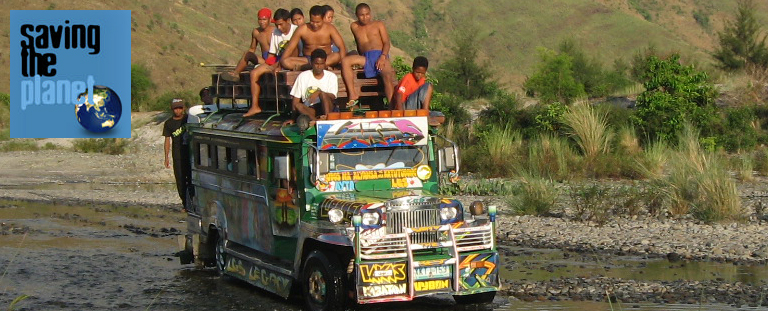
For over two years, my team at TVE Asia Pacific and I have been working on a new TV series, modestly called Saving the Planet. It will be released at a regional conference in Tokyo, Japan, on 22 August 2009.
In this Asian series, produced in partnership with Asia Pacific Cultural Centre for UNESCO (ACCU), we profile successful initiatives that combine knowledge, skills and passion to create cleaner and healthier environments.
It was filmed in six countries in South and Southeast Asia: Cambodia, India, Laos, Nepal, the Philippines and Thailand.
The groups profiled in Saving the Planet often work without external funding and beyond the media spotlight. They have persisted with clarity of vision, sincerity of purpose and sheer determination. Their stories inspire many others to pursue grassroots action for a cleaner and safer planet.
I ended a recent blog post, News wrapped in laughter, with this thought: “There is another dimension to satirising the news in immature democracies as well as in outright autocracies where media freedoms are suppressed or denied. When open dissent is akin to signing your own death warrant, and investigative journalists risk their lives on a daily basis, satire and comedy becomes an important, creative – and often the only – way to comment on matters of public interest. It’s how public-spirited journalists and their courageous publishers get around draconian laws, stifling regulations and trigger-happy goon squads. This is precisely what is happening right now in countries like Kenya and Sri Lanka, and it’s certainly no laughing matter.”
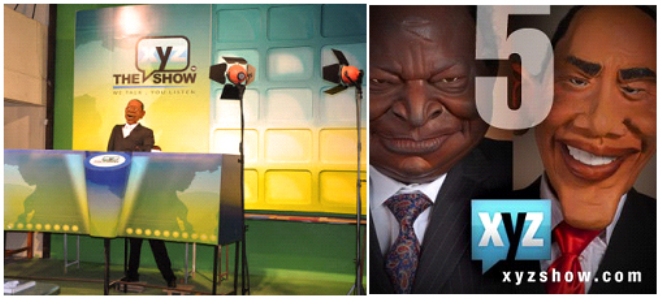
An interesting experiment in political satire on Kenyan television has just ended its first season on 9 August 2009. It’s a show called the XYZ Show, which was broadcast weekly on Kenya’s Citizen TV. Started in mid May 2009, the first season introduced Kenyan viewers to a new form of satire television, with life-sized puppets made to resemble famous persons, mostly politicians.
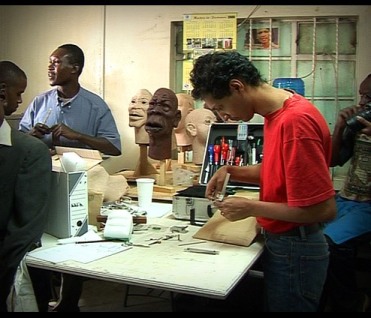
Gado the CreatorThe XYZ Show was inspired by famous puppet satire series like the British “Spitting Image” and the French “Les Guignols de l’Info” shows. In the XYZ Show, the puppets commented on news and current events from both Kenya and overseas.
The XYZ Show was developed by a team led by Kenyan cartoonist Godfrey Mwampembwa, alias Gado. He is the most widely syndicated cartoonist in East and Central Africa. He publishes a daily cartoon in The Nation, the largest newspaper in Kenya, and his work has been published in Le Monde (France), Washington Times (US), De Standaard (Belgium) and The Japan Times.
According to its creators, the XYZ Show challenged famous figures from Kenyan high society and politics using humour and satire. It aimed to become a new forum for social and political debate, one that provides room for open discussion.
Watch XYZ Show’s first episode trailer, produced one year ago:
Says the Prince Claus Fund of the Netherlands, which supported the show’s production: “Although freedom of the press is a constitutional right in Kenya, it is difficult for many journalists to practice their profession without interference. Gado and his team hope that the XYZ Show will contribute positively to strengthening freedom of the press and increasing political and social awareness among the people of Kenya. The show provides commentary on current social and political developments and aims to use humour and artistry to reinforce freedom of speech in Kenya.”
From what I’ve been able to watch online, on the show’s YouTube channel and elsewhere, the production values are at a high standard, comparable to such shows made in Europe and East Asia. The puppets are attractive, movements convincing and the pace quick and slick.
Who pulls his strings?The producers have also tried hard to make XYZ more than just a TV show. The website, in English, shows how the content is being adapted for the web (as webisodes) and mobile phones (as mobisodes). The show’s official blog takes us on to the set and shares with us the story behind the story, and introduces us to the artists and technical geniuses involved. Full marks for trying to engage the audience.
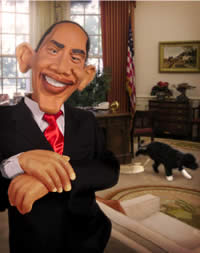
Then there is Barack Obama. Using his Kenyan connections, the show casts him (really, a puppet in his image) in a ‘supporting actor’ role. This has clearly inspired some interest in the show beyond Kenya.
So far, so good. But how does it work with the audience? The show is directed mainly at local audiences, and even if it’s presented in a mix of English and local language, it’s not something a complete outsider like myself can appreciate.
So I ‘crowd-sourced’ by asking a Kenyan reader of my blog, Marion N N, for her opinion. Marion is part of Sojourner, which her blog introduces as “a social enterprise that exists to promote the origination, production and distribution of African viewpoints through visual media. We are passionate about African film-making and seek its viable promotion globally”.
Marion wrote a comment in her blog after watching one episode a few weeks ago. She lives and works in Kenya, and her views are far more valid than my own.
Behind the screen, creators at work...She wrote: “My first off impression was fascination about the quality of the show in terms of animation which is very new to the local TV production scene in Kenya. Once past the fascination of the animation, I found that the content failed to hold my interest, connect with me or engage me as an audience. As a socio-political spoof show, humor ideally should be the hook that captures audience but in this case, humor comes across as mindless, illogical or simply stupid action on the screen. As if in evidence to this fact, at some point my husband in between laughter remarked ‘This show is really stupid’. I would imagine this would be a compliment to the Production becuase it provoked laughter in a viewer. However beyond that moment, it seemed only natural for us to flick over to more substantial entertainment having enjoyed that brief flight of fancy that failed to arouse an appetite for more.”
Marion also wondered what the show’s intended audience was, and highlighted the many challenges in getting the levels and balances right in doing political satire: “That politicians sometimes (nay, most times) behave ridiculously is not new or fresh. But the treatment, underlying themes, ideas communicated to audiences should be. Why do I suggest this? Because political satire by its nature speaks to an audience that is fairly mature, and exposed. To use childish humor that is poorly developed will not hold the audience’s attention. Infact at some point the content may become a tad irritating to watch. Political satire needs to be treated with a peppering of fact, wit, fresh perspective or take -out: The achievement of some underlying objective and not just mindless visual gimmicks that lead to the feeling of ‘stooping to idiocy; by audiences. This seeming insult of intelligence causes us as an audience to switch off.”
In my own view, The XYZ Show had at least three major challenges. Doing any puppet show is hard enough, and these days the on-air competition is neither local nor fair: it comes from global entertainment corporations like MTV and their regional variations, usually with deep pockets. Doing political satire is even harder, especially if the political culture is intolerant or repressive. To get the look, feel and balances right in a country where such a show is being done locally for the first time is a formidable challenge by itself.
But I’ll let Marion have the last word. In spite of the various concerns, she feels that the XYZ Show has ‘room to grow and conquer the airwaves’. But, as she notes, “The production team have their work cut out for them in pre-production. It’s back to the drawing board and ask who is my audience? What appeals to them? How do I connect with them, define an objective for the show and its audiences? Research facts and opinions about national sentiment on issues then develop scripts and sequences…”
The remains of former Philippine president Corazon Aquino passes through the historical EDSA road with some 300,000 supporters waving to pay their last respect. The road is remembered in 1986 as then anonymous Cory and some 2 million people rallied out the streets to fight a 20-year government dictatorship through peaceful people power revolution. Photo by Arwin Doloricon/ Voyage Film
I know this post appears rather late, but I couldn’t let Cory Aquino’s death on 1 August 2009 pass without comment. The original inspiration for People Power that toppled one of the worst tyrants of the 20th Century, she would now turn the Patron Saint of peaceful democratic struggles everywhere.
Last week, I was reduced to tears reading two links that my Filipino friend Ruth Villarama, who runs Voyage Films in Manila, sent me of new comments posted on their website.
In the first post, A housewife, a leader, an angel in yellow (3 August 2009), Joan Rae Ramirez wrote: “Her death at 3 AM on August 1 has stopped a nation from its apathetic works to once again remember what was once fought by this ordinary housewife. It is on these rarest moments where the oligarchs came down from their kingdoms to pay their respect and mingle with the people who truly represent the real state of the Philippine nation.”
Karen Lim, who works with Voyage Films as a producer and project coordinator, wrote a more personalised piece titled The Famous Anonymous.
It opened with these words: “I see her on TV. In some instances I even covered her for a story. Our relationship did not go deeper than the reporter-subject, or the audience and the watched. Yet I feel a certain affinity to the most revered President. And when she died I got sad, a strange feeling of sadness where the source is unknown.”
Karen was too young to have remembered much of those heady days of the People Power Revolution of February 1986 — a series of nonviolent and prayerful mass street demonstrations in the Philippines that eventually toppled the 20-year autocracy of Ferdinand Marcos. Indeed, a whole generation of Filipinos has been born since. But that doesn’t stop them from relating to the monumental events that unfolded at at Epifanio de los Santos Avenue, known more commonly by its acronym EDSA, in Quezon City, Metropolitan Manila and involved over 2 million ordinary Filipinos as well as several political, military and religious figures.
As Karen wrote in her tribute: “Cory’s life became ours too. We watched her, sometimes we joined her. We experienced her highs and lows. We are her “Mga minamahal kong kababayan”(my beloved fellowman). She did what no stranger did in my family – unite us in prayer for the country, unite us in laughter amidst the uncertainties of those times. I had no personal connection to this lady, but I have now every reason to mourn her passing.”
Woman of the Year 1986I can only echo her Karen’s words. As a politically curious 19-year-old, I had followed with much interest the daring gamble and eventual triumph of People Power unfolding thousands of kilometres away from my Colombo home. In the pre-Internet era, and before satellite TV channels provided 24/7 coverage across Asia, my sources were daily newspapers, evening news bulletins on local TV and, once every few weeks, the second-hand copies of Time magazine passed on to me by an uncle. The housewife in yellow ended up becoming Time Woman of the Year for 1986, with Pico Iyer writing a suitably reflective piece.
In the years since the return of democracy – with all its imperfections and idiosyncrasies – I have stood at EDSA more than once, and wondered what it must have been like to mobilise millions of ordinary, concerned people in the days before email, Internet and mobile phones — communication tools that today’s political activists, and indeed everyone else, take for granted. There is a thin line between a non-violent struggle and a passionate yet violent mob that, ultimately, works against their own interests. I am amazed that Cory and her activists didn’t cross the line, despite provocations and 20 years of repression.
Of course, it wasn’t just the human numbers that turned the tide in EDSA. Cory Aquino’s charismatic leadership and moral authority persuaded other centres of power – including the Catholic church and sections of the military – to align with the struggle to restore democracy. It was this combination, and the sudden change of mind by the Americans who had backed Marcos all along, that enabled People Power to triumph.
Elsewhere in Asia, where these elements didn’t align as forcefully and resolutely in the years that followed, the outcome was not as dramatic or positive. We’ve seen that, for example, in places as diverse as Tiananmen Square in China (1989), Burma (2007) and most recently, in the streets of Tehran, Iran. In contrast, it did indeed work and ushered in regime change in places like Nepal, even though it entailed more protracted struggles.
What interests me, in particular, is the role played by information and communication technologies (ICTs) in such People Power movements. Alex Magno, a political analyst and professor of sociology in Manila, sees clear links between new communications technologies and political agitation. Interviewed on the Canadian documentary Seeing Is Believing: Handicams, Human Rights and the News (2002), he said: “In the last two decades or so, most of the political upheavals had some distinct link to communications technology. The (1979) Iranian Revolution was closely linked to the audio cassette. The first EDSA uprising in the Philippines was very closely linked to the photocopying machine and so we called it the ‘Xerox Revolution’. Tiananmen, the uprising that failed in China, was called the ‘Fax Revolution’, because the rest of the world was better informed than the rest of the neighbourhood because of the fax machine. The January (2002) uprising in the Philippines represents a convergence between electronic mail and text messaging. And that gave that uprising its specific characteristics.”
Mobile phones' role in People Power II acknowledged in a Manila mural But it was People Power II in the Philippines that is perhaps the best known example of ICTs fuelling and sustaining a revolution. The ability to send short text messages on cell phones helped spawn that political revolution in early 2001, a full decade and a half after the original wave that swept Cory Aquino into office.
President Estrada was on trial facing charges of bribery, corruption and breach of the public trust. Despite mounting evidence against him, the President was let off the hook. That was the turning point. According to Ramon Isberto, a vice-president at Smart Telecom in the Philippines: “People saw it on television, and a lot of people were revolted. They started text messaging each other, sending each other messages over the Internet, and that thing created a combustion.”
Because of texting and email, within two hours over 200,000 people converged in the main street of Manila demanding the president’s resignation. The vigil lasted for four days and four nights, until President Estrada finally got the message and stepped down. It ended with Gloria Macapagal-Arroyo taking her oath of office in the presence of the crowd at EDSA, becoming the 14th president of the Philippines.
Those events have been documented, analysed and interpreted by many people from various angles. The Cold War had ended and the geopolitical map of the world had been redrawn. By this time, 24/7 satellite television was commonplace in Asia and the mobile phone was already within ordinary people’s reach. Gloria was no Cory, and Estrada wasn’t Marcos. But the forces and elements once again aligned on EDSA, and with history-making results. The role that the humble mobile phone played is acknowledged, among other places, in a mural in Manila.
Unthinkable? Not any more...What is to be done? The innocuous question has probably been asked by so many individuals throughout history. Lenin famously asked it in 1901, and then spent the next few years cooking up a revolution that changed history (for better or worse, depends on where you come from).
The context was not sparking revolution, but coping with evolution: how to survive and adapt at a time when mainstream media (MSM) is under siege from technological change, loss of public confidence and economic recession.
Why do I care? Unlike my new media activist friends, who cannot wait to see the MSM ‘mediasaurus’ die, I see value and utility in this ‘species’ that has evolved for over 500 years. Yes, there is much that is not right with them – including greed, arrogance and narcissism. But MSM’s outreach still remains unmatched in many parts of developing Asia, where we simply cannot wait until the online/mobile media to evolve, scale up and establish themselves to completely serve the public interest. I will thus engage the dinosaurs as long as they remain useful…
Besides, not all members of the mediasaurus clan are ferocious and carnivorous; there are also many gentle, ‘vegetarian’ ones among them who have always been empathetic and caring. I see merit in the adaptation of these better MSM, if only so that we don’t have to put all our eggs in the online/mobile media basket…
So I spent part of my talk asking aloud how the MSM – under siege – can adapt fast and increase their survival chances. The overall suggestion was that they move out of denial or resistance, and instead try to ‘exploit the inevitable’ (a pragmatic policy if ever there was one!).
Here are some initial thoughts I offered:
• Prepare for coming calamity, by taking advantage of the likely delay in its arrival in our region and our island.
• Consider it a ‘cleansing’ process, a new beginning to do things better.
• Decide what’s really worth saving, and let go of everything else that is no longer useful or relevant.
Let’s remember, too, that the very term ‘media’ is a plural. That means:
• One size doesn’t fit all; one solution won’t help/save everyone.
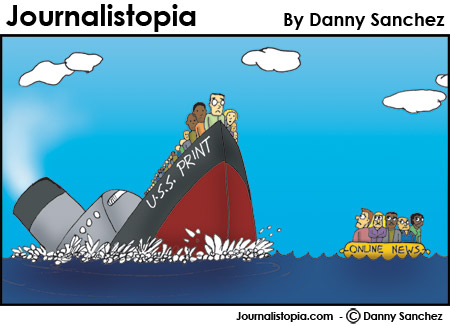
• Different ‘lifeboats’ can be found for different media outlets.
• You will only find out what works by trying out a few alternatives.
• No solution is fail-proof or ‘unsinkable’.
In some ways, mainstream media has behaved with the same kind of arrogance of those who built and operated RMS Titanic, and in this instance, the iceberg has already been spotted. At this stage, should MSM be re-arranging furniture on the ship’s deck — or discussing rescue plans?
Big Ben at 150: Who'd build one like this today?When the maritime tragedy happened nearly a century ago, on 14 April 1912, it dominated headlines around the world for many days. But MSM was in such nascent stages at the time, newspapers being the sole dominant mass medium. Radio communication had just been discovered, but radio broadcasting still lay a few years in the future.
To adapt and survive, MSM can also learn from how other industries faced vast challenges. For example, take the time-keeper industry:
• A century ago: people had to go to a post office, railway station or another public place to find the time. Clock Towers and public clocks announced time for all.
• Then came personal clocks (elaborate time pieces) that the wealthy people carried around in pockets or handbags.
• This was followed by wrist watches – personalised, affordable and portable.
• Now, mobile phones tell us the date, time and lot else!
Clock tower makers went out of business, and no one misses them now. Watch makers have adapted with the times, and are still competing with mobile makers. The parallels with the media industry are clear enough.
Somebody writing as ‘Global1’ has commented about how the Titanic‘s Band played on to the very end (and went down playing). S/he asks: Could This Be Analogy To The Modern Day MSM? In this analogy, MSM is the band, and their ‘music’ is the news…
Incidentally, the centenary of the Titanic‘s sinking is coming up shortly, in 2012. It would be interesting to see how the MSM/Titanic analogy plays out in the next few years…









 Open Minds!