Life saving sand...This week marks the 10th anniversary of the deadly cyclone that hit India’s eastern state of Orissa.
The 1999 Orissa cyclone, also known as Cyclone 05B, and Paradip cyclone, was the deadliest Indian Ocean tropical cyclone since the 1991 Bangladesh cyclone, and deadliest Indian storm since 1971. The storm made landfall just weeks after a Category 4 storm hit the same general area.
A tropical depression formed over the Malay Peninsula on October 25. It moved to the northwest and became a tropical storm on October 26. It continued to strengthen into a cyclone on the 27th. On October 28, it became a severe cyclone with a peak of 160 mph (260 km/h) winds. It hit India the next day as a 155 mph (250 km/h) cyclone. It caused the deaths of over 10,000 people, and heavy to extreme damage in its path of destruction.
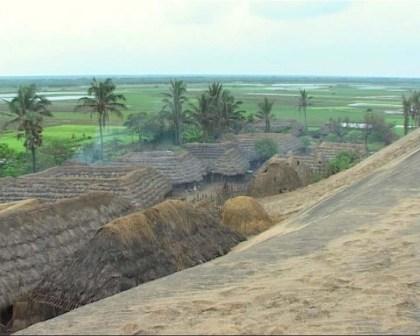
In 2006, during the production of TVE Asia Pacific‘s TV series The Greenbelt Reports, we visited the coastal village of Satabhaya, located on the edges of the Bhitara-kanika National Park in Orissa. A giant sand dune separates the village from the Indian Ocean.
The dune is the source of regular sand storms that force people to stay indoors for hours. Each storm can cover their houses with several inches of sand. Yet, they are not complaining. They remember the super cyclone of October 1999 – it was the natural sand dune that reduced the impact of that super-cyclone. The Satabhaya people know that it’s their only protection.
After the cyclone, they have devised traditional methods to trap the sand and create dunes to protect their village.
The Greenbelt Reportsseries It looks at how communities, researchers or environmental activists are trying to find a balance between conserving coastal greenbelts – coral reefs, mangroves and sand dunes – and deriving economic benefits for local people.
Watch The Greenbelt Reports: Surround Sand on YouTube:
Now she's green inside and out! I always thought Tinker Bell was a bit green — with envy, that is. Peter Pan’s faithful fairy sidekick was far too possessive of him: every time another female appeared to get close, Tink would try to chase her away. She typifies the Jealous Female.
The announcement came just prior to a screening at UN Headquarters in New York of the world premiere of the Walt Disney animated film, “Tinker Bell and the Lost Treasure.”
In the new movie, being released on DVD and BluRay on 27 October 2009, the feisty fairy first seen in 1953’s Peter Panclassic animation movie finally gets a makeover for her journey away from the magical land of Pixie Hollow.
The new and improved Tink looks more tomboyish: more of her body is covered in clothes, yet she still retains her curvy figure. “We wanted to make Tink as real as possible in Lost Treasure,” says director Klay Hall. “It made sense she was going to put on a jacket, leggings and boots. This is sort of a new phase for Tink, and the look brings her up to the current feeling we are trying to convey,” such as the belt she uses to carry items she needs.
“We’re delighted Tinker Bell has agreed to be our Honorary Ambassador of Green,” said Kiyo Akasaka, Under-Secretary-General for Communications and Public Information. “This beloved animated character can help us inspire kids and their parents to nurture nature and do what they can to take care of the environment.”
The UN event was intended to promote environmental awareness in the lead-up to the UN climate change conference in Copenhagen in December, where countries will aim to ‘seal the deal’ on a new global agreement to curb greenhouse gas emissions.
Protecting the environment is an underlying theme of the Tinker Bell movies, according to the UN Department of Public Information (DPI), which finds that the Walt Disney Company uses its storytelling to inspire a love of nature and spirit of conservation in its audience.
In the latest film, Tinker Bell’s greatest adventure takes place in autumn, as the fairies in Pixie Hollow are busy changing the colours of the leaves, tending to pumpkin patches and helping geese fly south for the winter. When Tinker Bell accidentally puts all of Pixie Hollow in jeopardy, she must venture out on a secret quest to set things right.
Tinker Bell Director Klay Hall, Producer Sean Lurie and cast members Mae Whitman (Tinker Bell) and Raven Symoné (Iridessa) were among those attending the premiere, hosted by DPI as part of the Secretary-General’s Creative Community Outreach Initiative.
The Initiative links the UN and producers, directors, writers and new media professionals seeking a working relationship with the world body with the goal of raising awareness of critical global issues.
Well, I can think of one Big Challenge for the creative community worldwide: find some way, any way, to ‘animate’ (i.e. bring to life!) the chronically dull and dour Ban Ki-Moon, Secretary General of the UN, who in his own admission is often invisible!
But hey, some feats are beyond even the most creative people! So just enjoy these two online videos…
Some films, like certain books, are in the making for years or decades. My latest film, Small Islands, Big Impact, just released online by TVE Asia Pacific, is quite short: slightly under 6 minutes long. But it has been forming in my mind for the past 20 years.
As a science journalist, I have been covering its story since 1989: how the Indian Ocean archipelago of the Maldives – Asia’s smallest country by area and population – is on the ‘frontline’ of climate change impact.
The Maldives packs 325,000 people into a combined land area just under 300 square kilometres spread over 1,192 islands and islets. With an average ground level of 1.5 metres (5 feet) above sea level, it is also the lowest country on the planet. When I first visited the Maldives in late 1988, they were still recovering from a massive storm surge in 1987. Although the damage was limited, the experience showed how vulnerable the Maldives can be to even a small rise in sea levels – this prompted the then President Maumoon Abdul Gayoom to take up the issue internationally. (It was President Gayoom who took up climate crusading at statesman level, well before Al Gore turned up on the scene.)
Interestingly, my first encounter with President Gayoom had nothing to do with climate – it concerned a celestial phenomenon: the Maldives was witnessing an annual solar eclipse and the President wanted to observe it in the company of amateur astronomers from their nearest neighbour, Sri Lanka. So he invited a couple of us over (I was active in the Young Astronomers’ Association of Sri Lanka at the time.)
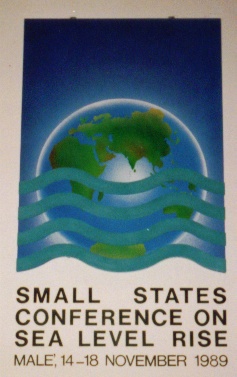
I returned to the Maldives in November 1989, that time as a member of the international media covering the first ever small states conference on sea level rise. Held at the Kurumba island resort, it was one of the earliest international gatherings on climate impacts on low lying states, a topic that was to gain public interest and momentum in the years to come. Among the participants were delegates from practically all the small states in different parts of the world (defined as those with less than 1 million population), and scientists from disciplines such as oceanography, climatology, meteorology and geology.
This was one of the first international scientific events that I covered as an eager young science journalist. I was a foreign correspondent for Asia Technology, a monthly magazine on Asian science and technology published from Hong Kong (now defunct), and freelancing for The Island daily newspaper in Sri Lanka. (There’s nothing online from that coverage as it was in the pre-web era!)
The conference had technical sessions where experts debated scenarios and implications, and a political segment where delegations made their official statements. In the end, they issued the Malé Declaration on Global Warming and Sea Level Rise, which urged for inter-governmental action on the issue.
Our Maldivian hosts knew that scientists and officials alone couldn’t send out a powerful message to the world on what climate change meant for low lying islands of the world – many of them mere specks on the world map, barely registering in media’s radar. So on the last day of the conference, we were taken to the Maldivian capital of Malé, where a demonstration and public rally were held by school children and ordinary people.
That turned out to be the most striking moment of the whole week. I had been listening to experts and officials talk about impacts, scenarios and mitigation measures for several days, on which I’d filed several stories. But unless I go back to my personal archives, I can no longer remember those details. My lingering memories of this event are in a few photos I took, showing school children telling delegates – and the world – what it means to be living on the front lines of climate change impact.
After 1989, I visited the Maldives on a couple of occasions for professional purposes during the 1990s. After I started working with TVE Asia Pacific in 1996, I was keen to return to the story of the Maldives and climate change – this time, in moving images – but I never had the chance until this year.
But I was covering the bigger story of climate change and its impact on the Asia Pacific from other locations. For example, in 2002, I commissioned and executive produced Voices from the Waves, the first-ever documentary on climate change in the South Pacific made by a native Pacific islander. Directed by Fijian film-maker Bernadette Masianini, the story revolved around two teenagers growing up on Fiji and Kiribati, each facing an uncertain future because of climate change.
In November 2007, the Maldives once again hosted representatives from small island states to discuss climate change. Eighteen years after the original meeting, the subject was no longer a fringe concern; it was now on everybody’s agenda. The meeting urged the the human dimension of global climate change to be included in the agenda of UN Climate Change Summit in Bali (December 2007), and sought the international community’s commitment “to protect people, planet and prosperity by taking urgent action to stabilize the global climate change”.
This time, the Male’ Declaration on the Human Dimension of Global Climate Change called for the UN High Commissioner for Human Rights to assess the human rights implications of climate change and “to conduct a study into the effects of climate change on the full enjoyment of human rights”. It also requested the UN Human Rights Council to convene a debate on human rights and climate change.
I wasn’t present at the 2007 meeting, but followed the process online. While climate change emerged as a major global concern, political change and reforms were underway in the Maldives. The country moved to a multi-party democracy, and in November 2008, the Maldivian Democratic Party‘s candidate Mohamed Nasheed won the presidential election.
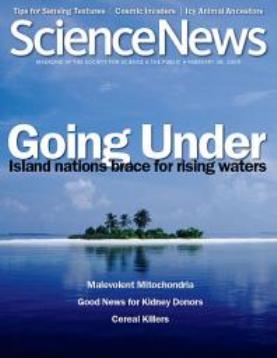
Science News cover - 28 Feb 2009President Nasheed continues the climate advocacy that President Gayoom had sustained for nearly a quarter of a century. President Nasheed has emerged as an outspoken and pragmatic voice speaking on behalf of his and other small island states, grouped under the Alliance of Small Island States (AOSIS).
In early 2009, President Nasheed announced that the Maldives would become the world’s first fully carbon-neutral nation within a decade. To accomplish this, they would vigorously pursue renewable energies and green energy sources to replace current dependence on fossil fuels.
The final inspiration for Small Islands, Big Impact came in February 2009, when Science News magazine in the United States carried a cover feature on the challenges faced by Kiribati and the Maldives because of climate change. Written by senior science writer Cristine Russell, the article noted: “The Maldives and Kiribati highlight a hidden challenge for coping with climate change. It’s not just about slowing the emissions of greenhouse gases. It’s also about figuring out what to do for localities threatened with the possibility of extinction from rising ocean waters.”
My original plan was to film interviews with President Anote Tong of Kiribati, and President Nasheed. While sharing the same overall concerns, the two leaders (and their governments) have adopted somewhat different responses to the challenges posed by climate change. Unfortunately, the interview with President Tong did not come through in time, even though I had a Kiribati TV crew standing by to film it. So I decided to go ahead with the film focusing solely on the Maldives.
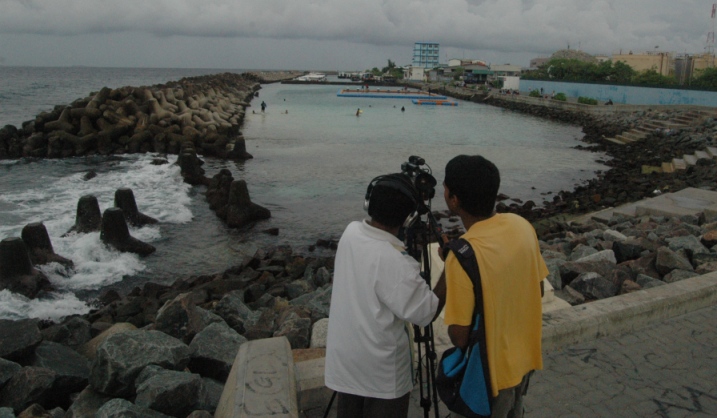
Location filming in Male - Hussein Makzoom (left) and Ibrahim Yasir As with all TVEAP films, I was keen to make it with a local crew. Mariam Niuma, an engaging young Maldivian woman who had worked for nearly two years with us as an intern, helped me find a very capable crew in Ibrahim Yasir and his colleague Hussein Makzoom.
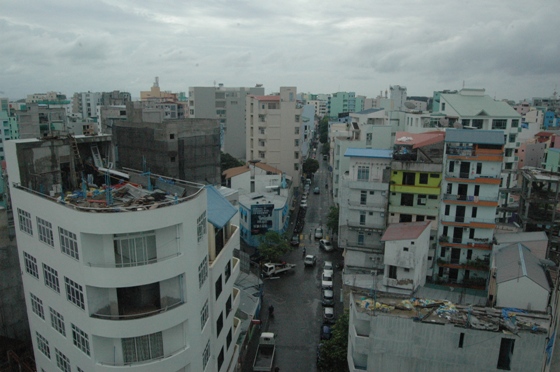
Niuma had been urging us to make a film about her country and was delighted that we were finally able to take it up. She helped us in numerous ways with local knowledge, introductions and advice. She also took time off her work with a local charity to show me around the Male’ island – which I was returning after a dozen years, in which time it had changed almost beyond recognition. (Male’ is one of the most crowded places on Earth – every one in four Maldivians lives on the tiny capital island.)
Small Islands, Big Impact was filmed on location over a few days in late August in Male’ and the nearby island of Vilingili. Our tiny production budget didn’t allow us to spend longer or venture further into the more remote islands and atolls (coral island formations, 26 of which make up the Maldives).
Overcrowded Malé, capital of the MaldivesThe timing wasn’t ideal either – the Monsoon was still active, and rain often interrupted our filming. There was some irony that a climate film was being shot in inclement weather. Sometimes we filmed in spite of the rain – one ferry ride we took from Male’ to Vilingili island had to cross very choppy seas that made me (a land lubber!) quite nervous. For our Maldivian crew, however, it was all in a day’s work…
President Nasheed’s media team had been quick and supportive in accommodating our interview request, but when actually filming it, we faced an unexpected challenge which I’ve described in an earlier blog post. (Clue: In addition to inclement weather, we had to deal with a nasty influenza virus). With the month-long Ramadan fast period about to begin, which would significantly affect the pace of work in the 100% islamic Maldives, we had no choice but to persist with our filming, improvising as we went along.
I returned to Colombo with five camera tapes rich in footage, one of which contained a 15-minute interview with the amiable and technocratic President Nasheed. Over the next few weeks, I worked with our editor Umesha Fernando in distilling this material into a short, compact film less than six minutes. It took a good deal of time and effort — especially since I chose not to have any narration and to let President Nasheed tell the story in his own voice, interspersed with text-supported transitions.
Because of this style, soundtrack mattered a great deal, and we agonised over custom-composing the music. As I put everything this together, I kept recalling the wise words of senior Australian film-maker Bruce Moir: “Film is a lousy medium to communicate information. It works best at the emotional level.”
I can’t judge my own film, but I have tried hard to strike a balance between its intellectual and emotional appeal. My team and I set out to tell a compelling story about a country on the frontlines of climate impact. No less a person than its dynamic head of state stars in our modest effort, made on an incredibly tiny budget.
Note: Small Islands, Big Impact was produced on an editorially independent basis by TVE Asia Pacific in collaboration with COM+ Alliance of Communicators for Sustainable Development. As with all other TVEAP productions, this series comes without license fees, where only copying and dispatch costs are payable. To order broadcast master tapes, please contact:
It may also be ordered in high resolution on DVD (without regional coding) from TVEAP’s e-shop.
In the environment and development circles, all the roads these days seem to lead to Copenhagen.
That’s because the Danish capital will be hosting the 15th conference of parties (COP15) of the UN Framework Convention on Climate Change, or UN-FCCC from 7 to 18 December 2009.
All sorts of campaigns are underway to raise awareness and build up consensus — a tough call when nations of the world are bickering endlessly as the planet warms up.
Now, CNN and YouTube have created Raise Your Voice campaign: it allows your voice to be amplified to the world leaders at COP15 – the most important climate change conference in a decade.
Here’s the blurb: As nations seek an agreement to protect the world we want your views from across the spectrum.
What needs to be done?
How do the issues affect you?
Do you agree there needs to be action?
There is a breathtaking short video now on YouTube supporting this call:
Click here to send a video with your views, opinions and questions. The best contributions will be aired during the COP15 CNN/YouTube TV debate on December 15.
How much can you pack in to one minute, or 60 seconds? That’s a lot of air time, as broadcasters and advertisers know very well.
‘One Minute to Midnight‘ has been a favourite metaphor of dooms-dayers – and is the title of a 2008 book. It was widely used in relation to the world drawing closer to nuclear war during the second half of the 20th century.
Now, as global climate change surpasses fears of global nuclear war, we are given just one minute to save the world.
One Minute to Save the World is an international short film competition to raise awareness of climate change. Entries are currently being sought from professionals and amateurs, with 31 October 2009 as the deadline. There is also a category for under 18s and for entries shot on mobile phones.
The idea is to enable anyone, anywhere, to deliver a short but powerful message to the world on climate change. The winning films will be sent around the world in November as an online campaign to raise awareness of the Copenhagen Climate Conference in December 2009.
Good planets are hard to find...British TV presenter and adventurer Bruce Parry, a founder of the competition, says: “Together we will be looking for films that convey a powerful message about how climate change affects you and those around you. Were you a flood victim? Have you seen a change in the plants and wildlife in your garden? How has your world been affected and how can we address it?
He adds: “So, we hope you’ll all get thinking and shooting – whether you’re a seasoned pro or just someone who cares. Your planet needs you and your talents. One minute might not seem like a long time but it’s actually longer than many advertisers spend hundreds of thousands of pounds on. It’s also an easy length of time to hold people’s attention. And that is one of the things we urgently need to do if we’re going to turn things around for our planet before it’s too late.”
The winning entries will be judged by an international panel that includes Parry himself, award-winning director and climate change activist Shekhar Kapur; Franny Armstrong, director of Age of Stupid and The Guardian‘s environment editor John Vidal.
The website will become an online film festival which requires no travel or celebrity status to attend – all you need is access to a computer. “And as everyone knows, the power of the net can make the most unexpected video attract the attention of millions globally,” says Bruce Parry.
Apart from the typhoons that blow in from the Pacific Ocean, the Philippines also sits on the Pacific Rim of Fire where periodic earthquakes occur, and active volcanoes are found.
Disasters not only kill or injure people and cause property damage; they also disrupt livelihoods and cultural practices. That’s what happened when the volcanic Mount Pinatubo erupted in 1991, its lava and ashes destroyed many surrounding villages – including the traditional homeland of the Ayta, indigenous people descending from the first inhabitants of the Philippines. They had fled to the hills from the lowlands during the protracted Spanish conquest of the Philippines which first commenced in 1565.
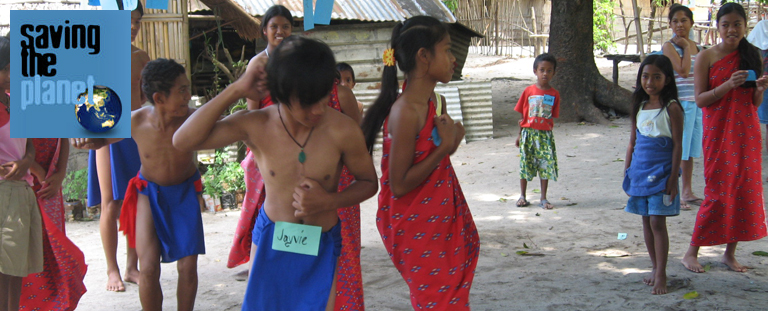
Today, resettled elsewhere on Luzon island, the Ayta are trying to preserve their traditional culture and community integrity through education and theatre. These efforts are supported by the Ayta organisation PBAZ, part of the Education for Life Foundation. Going back to the abandoned village is one way of keeping memories alive.
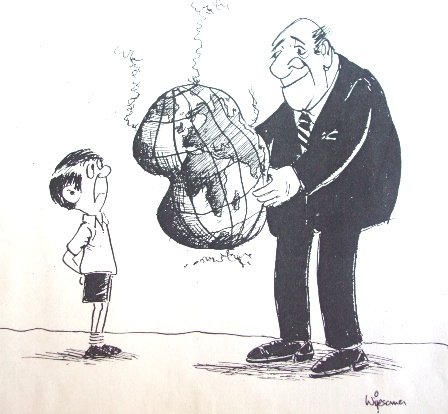
Passing the buck? Cartoon by W R WijesomaThis was one of the most memorable cartoons drawn by W.R. Wijesoma, Sri Lanka’s pre-eminent political cartoonist (and my one-time colleague). If I remember right, it first appeared sometime in the late 1980s in ‘Mihikatha’, Sri Lanka’s first all-environmental newspaper.
Alas, both Mihikatha and Wijesoma are no more among us. But the message in this cartoon is more timely than ever before.
“Is this what we are going to hand over to our future generations? Please……no!” was the emphatic message from Yugratna Srivastava, a 13-year-old Indian girl who addressed over 100 world leaders gathered at the United Nations headquarters on 22 September 2009 for the historic Summit on Climate Change.
Passing the ball – or buck – is something that governments are good at. Most governments are so narrowly focused on the now and here, and sometimes rightfully so, that they have neither the time nor interest for medium to long term scenarios. As I wrote earlier this week, “it’s going to take many more meetings, bickering and hard bargaining before the leaders begin to think in terms of the next generation.”
This is where citizen action comes in. Governments are not going to save this planet from environmental catastrophes; if at all, it would be the ordinary people. This is the premise of TVE Asia Pacific’s latest Asian TV series, Saving the Planet.
Where does the buck stop?
Governments, experts and big corporations alone cannot solve all these problems. Real change requires changing how each and every human being lives and works. Education becomes the biggest key to achieving environmentally sustainable development at local and global levels.
Filmed in six countries in South and Southeast Asia, Saving the Planet profiles groups working quietly and relentlessly to spread knowledge, understanding and attitudes that inspire action that will help humans to live in harmony with the planet. They often work without external funding and beyond the media spotlight. They have persisted with clarity of vision, sincerity of purpose and sheer determination. Their stories inspire many others to pursue grassroots action for a cleaner and safer planet.
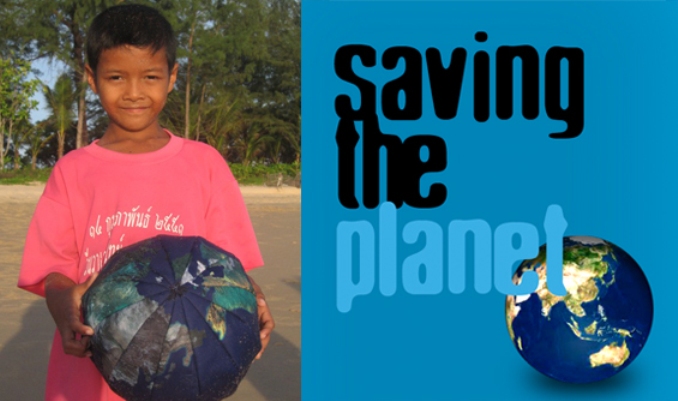
We tried out a creative idea for the series opening sequence (20 seconds), an extended version of which became the series trailer (see below). It was planned and filmed in all the six countries where the stories came from — Cambodia, India, Laos, Nepal, the Philippines and Thailand. In each country, our roving director-producers filmed different individuals – young and old, men and women, in all their Asian diversity – passing around an inflated ball made to look like planet Earth.
I know my colleagues had fun filming these sequences, and back in our studio, it was also great fun to mix and match these various shots to create the apparently seamless passing around of our planet in peril. (Who said planet saving cannot be fun?)
Watch Saving the Planet trailer (1 minute):
Now it can be revealed: our original inspiration came from an unexpected source: the world’s largest media corporation, Google! In one brainstorming, our then production coordinator Buddhini Ekanayake remembered an open challenge that Google had made online just before introducing their email service, GMail. Google asked people to “imagine how an email message travels around the world” using a video camera.
In all, Google received over 1,100 clips from fans in more than 65 countries around the world — each one of them a different creative idea, playing with the iconic Gmail M-velope.
“The clips you submitted were amazing and it was hard to choose selections for the final video,” Google said when releasing the outcome of this collaborative video project.
Yugratna Srivastava: Lend me your ears...This week saw the UN’s invisible man hosting mostly indifferent leaders at a Summit on one of the world’s most pressing challenges: climate change.
Nearly 100 world leaders accepted UN Secretary General Ban Ki-moon’s invitation to participate in an historic Summit on Climate Change in New York on 22 September to mobilise political will and strengthen momentum for a fair, effective and ambitious climate deal in Copenhagen this December.
The call for action at the summit did not just come from world leaders – many of who simply can’t see beyond their next election – but also from the next generation who stand the most to lose if climate talks fail.
On their behalf, Yugratna Srivastava, a 13-year-old Indian girl, spoke forcefully at the podium, sending a wake-up call to those assembled. “We received a clean and healthy planet from our ancestors and we are gifting a damaged one to our successors. What sort of justice is this?,” she said.
She added: “The Himalayas are melting, polar bears are dying, 2 of every 5 people don’t have access to clean drinking water, earth’s temperature is increasing, we are losing the untapped information and potential of plant species, Pacific’s water level has risen,Is this what we are going to hand over to our future generations? Please……no!”
She said the three billion young people in the world need them to take action now to protect the planet for future generations.
All this news coverage reminded me of another passionate young girl who similarly addressed – and challenged – the world leaders 17 years ago at the Earth Summit held in Rio de Janeiro, Brazil.
Her name was Severn Cullis-Suzuki, and she was a young Canadian environmental activist. Then 12-year-old Severn closed a Plenary Session with a powerful speech that received a standing ovation.
Raised in Vancouver and Toronto, Severn Cullis-Suzuki is the daughter of writer Tara Elizabeth Cullis and environmental activist and TV personality David Suzuki. When she was 9, she started the Environmental Children’s Organization (ECO), a small group of children committed to learning and teaching other kids about environmental issues. They were successful in many projects before 1992, when they raised enough money to go to the UN’s Earth Summit in Rio. Their aim was to remind the decision-makers of who their actions or inactions would ultimately affect.
Listen to the memorable speech at the Earth Summit by Severn Cullis-Suzuki:
Severn was every bit as sincere, concerned and passionate about the global environment as Yugratna Srivastava was this week. Seventeen years later, notwithstanding the lofty pledges at the Earth Summit and later gatherings, the environmental crises have multiplied and worsened.
Very few of the world leaders who assembled in Rio are still in office — and that underlines part of the problem. Governments have far shorter time horizons than what many of today’s global challenges demand. I am constantly reminded of what the eminent Indian scientist Dr M S Swaminathan told me in my first interview with him in 1990 (yes, even before the Earth Summit): “In democracies, rulers think in terms of the next election. In dictatorships, about the next coup d’état. Nobody is thinking in terms of the next generation!”
It was no small feat for the UN’s Invisible Man to bring 100 heads of state or heads of government together on such a long-term issue. But it’s going to take many more meetings, bickering and hard bargaining before the leaders begin to think in terms of the next generation.
Biggest gap: between rhetoric and practice!It happened a decade ago, but I still remember the incident.
I was visiting London while the British Isles were having their typically limited experience with summer. My then colleague and I had gone for a business meeting, and were returning by Tube, or the London underground railway. Being the afternoon rush hour, the trains were packed to capacity.
My colleague didn’t say much on the journey, but I noticed her look of dismay. As we emerged from the tube station, she finally spoke: “Gosh, it’s another world down there, isn’t it? I didn’t know people smell so much!”
The warm and sweaty summer would surely have added to the experience, but as Londoners know well, the tube is the best mode of transport to get around quickly and inexpensively in that metropolis. It was only then that I realised my liberal, bleeding-heart colleague was not a regular user of public transport. She either uses taxis or drives around in her own Volvo car. She doesn’t normally commute with the Great Unwashed…
Yet, the same snooty ex-colleague speaks and writes so passionately on the virtues of public transport and mass transit systems as a means to better manage urban challenges in the developing world. Listening to her, one could hardly imagine her disdain for using public transport in her own city.
Practise what you preach. That’s a simple yet profound piece of advice for everyone promoting public interest causes in development, conservation or anything else. Or, as Mahatma Gandhi put it: you must be the change you wish to see in the world.
The series features outstanding efforts in education for sustainable development (ESD) in South and Southeast Asia. It goes in search of answers to these key questions:
• What can ordinary people do for our planet, now under siege from multiple environmental crises?
• How can we change attitudes and lifestyles to consume less and generate less waste?
Here’s the synopsis of the India story:
For people in Dindigul in India’s Tamil Nadu state, waste isn’t really a problem – it’s just a resource in the wrong place. School children and housewives have been at the forefront in collecting household and market waste to turn them into compost. They have not only cleaned up the streets, but also persuaded people to grow organic food. As the word spreads, more towns and villages are emulating this example set by CLEAN India project and Gandhigram Trust.
Low Carbon, High PrioritySome 100 world leaders are due to gather at the United Nations headquarters in New York this week for the highest level summit meeting on climate change ever convened.
As the New York Times reported: “In convening the meeting, the United Nations is hoping that collectively the leaders can summon the will to overcome narrow nationalinterests and give the negotiators the marching orders needed to cut at least the outline of a deal.”
Recognising climate change as one of the greatest social, economic, political and environmental challenges facing our generation, the British Council has launched the Low Carbon Futures project. It has focus on mitigating the effects of climate change in an urban environment. It is part of the British Council’s major global climate security project and India is, along with China, one of the top two priority countries for this work. Sri Lanka, with less than 2% of India’s population and correspondingly lower carbon emissions, is a lower priority.
One strand in the Low Carbon Futures project is to engage communications professionals – journalists, writers and film makers to help them better understand the issues around mitigation and get across key messages to readers/viewers more effectively.
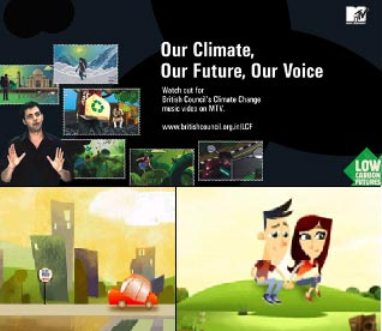
As part of this project, the British Council collaborated with Music Television (MTV) to produce a music video and two viral video animations on climate friendly, low-carbon lifestyles.
British Council’s first Music Video on Climate Change produced by MTV features VJ Cyrus Sahukar. Combining animation, lyrics and melody, the video talks about how small individual actions can help conserve natural resources and save the climate. MTV VJs have a cult following and the video ends with Cyrus Sahukar, MTV’s face in India, encouraging young people to take that first step. The video was launched in New Delhi on 1 June 2009 in the presence of 50 International Climate Champions from across India & Sri Lanka.
According to the British Council India website, “The video has created a flutter and there is growing demand to screen the video on various institutional networks across India and even outside fulfilling higher level objectives of impacting young urban aspirants. Young Indians are an emerging generation who are ambitious and internationally minded with the potential to be future leaders. The MTV video aims to influence this influential group.”
The Low Carbon Futures project has also released two short, powerful, animated messages that are ‘tongue-in-cheek’- making use of everyday events with a touch of humour. “We are hoping that the messages will be seen as creative, funny and innovative to tempt the recipient to forward it to their peer group. As the virus spreads, so will the message. The British High Commission and the The Energy and Resources Institute (TERI) are also promoting these virals to spread the message amongst the staff members and their external audiences,” says the project website.
The first viral video animation is called Green Journey, and shows a little known benefit of car pooling. Its blurb reads, simply: Meet 3 Mr Rights on the wrong side of the road!
The second viral video animation is called Play Cupid, and gives us one more reason to plant more trees! Blurb: Lets leave the young couples in peace and solitude of nature!

 “We’re delighted Tinker Bell has agreed to be our Honorary Ambassador of Green,” said Kiyo Akasaka, Under-Secretary-General for Communications and Public Information. “This beloved animated character can help us inspire kids and their parents to nurture nature and do what they can to take care of the environment.”
 I returned to the Maldives in November 1989, that time as a member of the international media covering the first ever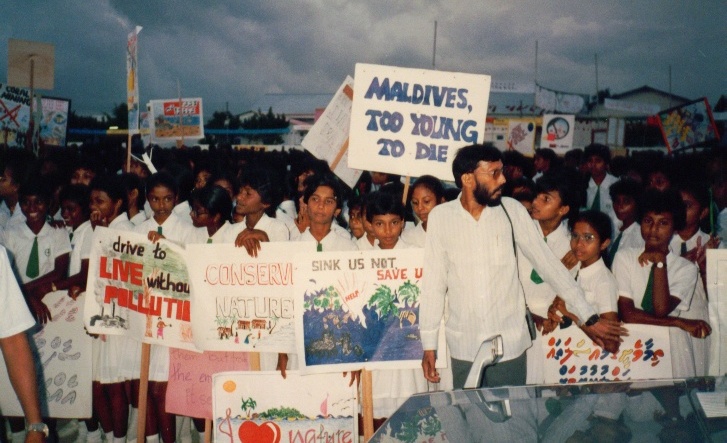






 Open Minds!