Go ahead, just say the word: Condom! Now say it again…

not an easy task...
Acting out condoms in broad daylight in India: not an easy task...

Condom!

No one is certain how or where the word originated, but it has become one of those ubiquitous items in modern society.

It’s a two syllable word, fairly easy to pronounce. Then how come so many people – at least in South Asia, home to a fifth of humanity – get their tongues tied or twisted in saying it?

That’s because it’s to do with sex! That’s not a subject that many South Asians still feel comfortable in talking about, in public or even private.

Sex may be a very private matter, but individuals’ sexual behaviour has direct and serious public health implications. Especially today when the world is still struggling to contain and overcome the spread of HIV that causes AIDS.

Condoms originally came into wide use to help prevent unwanted pregnancies and the spread of sexually transmitted diseases (STDs). In the past quarter century, condoms have become a major weapon against HIV.

Despite this, condoms still remain a hush-hush topic among many grown ups, even as the younger generation warms up to them. Across South Asia, we still have some hurdles to clear in normalising condoms – or making it socially and culturally acceptable for people to talk about condom use, and to go out and buy them without fear or shame.

They come in all colours and shapes!

This is the challenge that various communication groups have taken up, especially in India. According to a 2007 survey by UNAIDS and India’s National AIDS Control Organisation (NACO), at least 2.5 million people live with the HIV virus in India, placing the country third in the world after South Africa and Nigeria. However, AIDS prevention in the country is not an easy job. Many people, especially in rural areas, cling on to preconceived taboos about sex — and are often hesitant to use condoms.

In recent weeks, I’ve heard from two campaigns that are trying to change this. One is the BBC World Service Trust working with Indian broadcasters and other partners to normalise condom use through a campaign. I’ll be writing a separate blog post on that effort.

Last month, I received en email from someone called ‘Spread Word for a Better World’, who shared with me web links on a socio-cultural group based in Hyderabad, who are using the performing arts to promote condom awareness.

For over a decade, the Nrityanjali Academy has been singing and dancing their way to the glorification of condom use. They see it as a crucial fight in their central region, where 2 per cent of the population is HIV positive.

P Narsingh Rao, director of Nrityanjali, recently told France 24 online: “Our main target groups are people vulnerable to the HIV virus like sex workers, transsexuals or truck drivers. We tour villages in mobile video vans to show the film. The screening is followed by a question and answer session about condom use and sexually transmitted diseases.”

He added: “We also encourage the use of female condoms, a relatively new concept. We tell the women to negotiate the use of female condoms with their male partners: for men with little sex education, the insertion of the female condom in the vagina can in itself be an erotic act.”

Here are some YouTube videos showcasing their work:

This is an entertaining and educational video in Telugu language on Condom usage, to prevent from sexually transmitted infections and HIV:

A more instructional video on how to use condoms properly:

And finally, an HIV/AIDS song in Telugu – with all the fast-beat music, gyrating and riot of colours we typically associate Bollywood movies and songs with:

The videos speak for themselves. They are matter of fact, engaging and presented by ordinary people (trained entertainers) rather than by jargon-totting medical doctors or health workers. There is none of the awkwardness typically associated with conversations of this subject. No one is tip-toeing around perceived or real cultural taboos. They just get on with it.

Importantly, they involve both men and women, both in performances and in their audiences.

Training young men on just how to do it right...

Related blog posts:

July 2007: The Three Amigos: Funny condoms with a serious mission

April 2007: Beware of Vatican Condoms – and global warming!

Images courtesy France 24’s The Observers.

Vulnerability Exposed: Micro films on how climate change affects YOU!

Vulnerability Exposed!

Never underestimate the power of moving images. Al Gore tipped the balance in the long-drawn climate change debate with his Oscar-winning film, An Inconvenient Truth. The rest is recent history.

Thanks to the film – and sustained advocacy of hundreds of scientists and activists – climate change is no longer a speculative scenario; it’s widely accepted. The challenge now is to understand how it impacts different people in a myriad ways.

Now the World Bank wants people to use their video cameras to capture how climate change may already be affecting their ways of living and working. The Bank’s Social Development Department has just announced the launch of a worldwide documentary competition that will highlight the social aspects of climate change as experienced and/or observed by the film-maker(s).

Called Vulnerability Exposed, the contest is open to anyone anywhere in the world who wishes to have their voice heard. The submitted films should innovatively illustrate the consequences of climate change through one of the following theme categories: conflict, migration, the urban space, rural institutions, drylands, social policy, indigenous peoples, gender, governance, forests, and/or human rights. The submission period ends on 24 October 2008.

Caroline Kende-Robb, Acting Director, Social Development Department, said, “There is a need to see climate change as an issue of global social justice. The rights, interests and needs of those affected by climate change must be acknowledged.”

Watch the Bank’s short video, where she explains further:

The contest has two award categories:
1) Social Dimensions of Climate Change Award (general category) – open to professional and amateur; and
2) Young Voices of Climate Change (youth category) – open to entries submitted by filmmakers under 24 years old.

Award winners will be chosen through a combination of public voting and a judging panel. The film with the most public votes in each theme category will receive honorable mention.

Judging process
Vulnerability Exposed film competition: Judging process

This contest indicates that the World Bank is slowly but surely opening up to the currently untapped communication potential of web 2.0 – the very point I made in a recent op ed essay.

There are several noteworthy aspects in this competition, some more positive than others. I offer this critique in the spirit of improving a commendable initiative.

Three cheers to the bank for accommodating both amateurs and professionals. It’s about time those who don’t video film for a living (some of who are no less talented in the craft) had more opportunities to showcase their products.

It’s good to see the preference for shorter films, in this contest defined between 2 and 5 mins in duration. This certainly resonates with TVE Asia Pacific’s experience with Asian broadcasters, many of who now prefer shorter films. Longer films have their place, of course, but shorter ones are clear favourites of 24/7 news channels and also online.

Most film contests are judged exclusively by an all-powerful jury (I’ve been on several over the years), but here the online public have a chance to vote for their favourite entries. Let’s hope the judges will consider the story telling power of entries as the most important deciding factor. (The examples in the YouTube film given above are misleading – they all seem extracts from expensively made documentaries.)

The big challenge for many aspiring contestants would be to relate climate change to daily realities in their societies. Despite global headlines and the development community’s current frenzy about it, climate change as a phrase and concept still isn’t clearly understood in all its ramifications. If science now knows 100 facts about the murky processes of climate change, the average public knows less than 25 and understands even less. So it will be interesting to see how entries relate the big picture to their individual small pictures.

I’m a bit disappointed that the World Bank is not offering any cash prize to the winners. Instead, “the winners will receive an all expenses paid trip to Washington, DC for a screening of their film and will have the opportunity to attend a series of networking and learning events organized by…the World Bank in December 2008.” This is all useful, but video – even at the low end – is not exactly cheap, and even labour of love creations cost money to make. We are currently running a comparable the Asia Pacific Rice Film Award – which seeks entries no longer than 10 mins on any aspect of rice – and despite being a non-profit, civil society initiative we have a prize of US$ 2,000 to the winner. And we wish we could offer more.

But my biggest concern is the unequal, unfair terms of copyrights found in the small print of the competition rules. This is where the lawyers have done their usual handiwork, and with the usually lopsided results. The World Bank wants all contestants to make absolutely sure that all material used is fully owned by the contestants, or properly licensed. That’s fine. But tucked away on page 7, under section 12 titled Entrant’s permission to the organiser, is a set of conditions which will allow all affiliated institutions of the World Bank group to use the submitted material for not just promoting this contest (a standard clause in most competitions), but for ‘climate change work program of the organiser’.

What this means, in simpler terms, is that without offering a single dollar in prize money, the World Bank is quietly appropriating the unlimited user rights for any and all the submitted material. These are the core materials in the moving images industry, and nothing is more precious to their creators.

I have long advocated a more balanced, equitable and liberal approach to managing copyrights and intellectual property by both the broadcast television industry and development community — especially where public funded creations are concerned. I have nothing but contempt for lawyers and accountants who often determine the copyrights policies in large broadcast and development organisations. They set out terms that may be justified in strict legal terms, but are totally unfair, unjust and, in the end, counterproductive to the development cause and process. It seems that while our friends in the social and communication divisions were not looking, the Bank’s lawyers have done their standard hatchet job.

While this doesn’t detract from the overall value of Vulnerability Exposed, it diminishes its appeal and potential. Many professional video film-makers who value their footage – gathered with much trouble and expense – may not want to sign future user rights away for simply entering this contest. And worse, the unsuspecting enthusiasts who don’t necessarily earn their living from making films – but are entitled to the same fair treatment of their creations – would be giving away material whose industrial value they may not even fully appreciate.

It’s certainly necessary and relevant for development organisations like the World Bank and the UN system to engage web 2.0. But they must be careful not to import or impose rigid, one-sided and outdated copyright regimes of the past on this new media.

I hope the Bank would consider revising these unfair copyright terms, and treat the submitted material with greater discretion and respect. If not, all entrants risk seeing their material popping out of bluechip films produced by top-dollar production companies in North America and Europe who have ‘mining rights’ to the Bank’s video archives.

Vulnerability Exposed can have more meanings than one. We’d rather not consider some.

Children of Heaven: Appreciating the sound of silence

Courtesy Wikipedia

What’s it with children and shoes? Those who have none dream of owning their first pair. Those who have one, or some, still dream about a better, or perfect, pair. Shoes are worth dreaming about, crying (even fighting?) over, and running races for.

Like Ali did, in Majid Majidi’s superbly crafted 1997 movie Children of Heaven. For 90 minutes this afternoon, my team and I ran the race with little boy Ali, sharing his dreams, sorrows and eventual (albeit bitter-sweet) triumph.

I had seen this film before, but this time around, the experience felt even better than I remembered it. I already knew the story, but I was spell-bound by the film’s culmination – the children’s race where Ali wanted to come third, but ended up winning. I followed the last few minutes with tears in my eyes and the heart beating faster.

This is what good story telling is all about.

Read Children of Heaven synopsis on Wikipedia

Of course, Majid Majidi didn’t work this miracle alone. The superb cinematography of Parviz Malekzaade was well packaged by its editor Hassan Hassandoost. His work is uncluttered and elegant: the story flows in a simple, linear manner with no flashbacks or flash-forwards; no special effects to jazz things up; and the scenes are so seamlessly meshed together with hardly a second being wasted.

And the soundtrack played a vital part in shaping the whole experience. It’s not just the music. As my colleague Buddhini remarked, it also made clever, strategic use of silence.

We might call it the sound of silence – and never underestimate its power in the right place.

All this reminded me of what our Australian film-maker colleague Bruce Moir often said when we worked with him: “We’ve got to remember that film appeals to people’s hearts more than their minds. The way to people’s heads is through their hearts, from the chest upwards — and not the other way round.”

A year ago, I invited him as my special guest to a talk I gave at the University of Western Sydney in Australia – in his home city. There, he once again made the point: “Our fundamental job is to tell a story – one that holds an audience’s interest and moves their heart, regardless of language, cultural context or subject….I have always believed that film achieves its optimal impact by aiming to ‘get at the audience’s head via their heart’…”

April 2007 blog post: Moving images moving heart first, mind next

As I then wrote, I hope this was an ‘Aha!’ moment to some in our largely academic and activist audience. Many who commission films or even a few who make films tend to overlook this. Especially when they set out trying to ‘communicate messages’.

Bruce never tires of saying: “Film is a lousy medium to communicate information. It works best at the emotional level.”

Children of Heaven is living proof of this. It has no lofty agenda to deliver information or communicate messages of any kind. Yet, by telling a universal story set in modern day Iran, it brings up a whole lot of development related issues that can trigger hours of discussion: not just the rich/poor or rural/urban disparities, but other concerns like how a country like Iran is portrayed in the western news media.

As a colleague remarked after today’s film, she had no idea of this aspect of life in Iran — the version we constantly hear is of an oil-rich, nuke-happy, terror-sponsoring theocracy that, to the incumbent US president at least, is part of the ‘axis of evil‘. And the Al Jazeera International channel, packed with BBC discards or defectors, has done little to change this popular perception.

We watched the movie as part of our monthly screening of a feature film. We are lining up critically acclaimed films from different cinematic traditions of the world. And then we discuss its artistic, technical and editorial aspects.

As for me, I totally agree with the famous movie critic Roger Ebert, who wrote in the Chicago Sun-Times at the time of the movie’s first US release: “Children of Heaven is very nearly a perfect movie for children, and of course that means adults will like it, too. It lacks the cynicism and smart-mouth attitudes of so much American entertainment for kids and glows with a kind of good-hearted purity. To see this movie is to be reminded of a time when the children in movies were children and not miniature stand-up comics.”

As he summed it up: “Children of Heaven is about a home without unhappiness. About a brother and sister who love one another, instead of fighting. About situations any child can identify with. In this film from Iran, I found a sweetness and innocence that shames the land of Mutant Turtles, Power Rangers and violent video games. Why do we teach our kids to see through things, before they even learn to see them?”

Note: The film, originally made in Persian, was named Bacheha-Ye aseman . It was nominated for an Academy (Oscar) Award for the best foreign film in 1998, but lost out to a worthy competitor, Roberto Benigni’s Life is Beautiful.

The Meatrix Reality: Mixing animation, activism and spoof

When I gave up eating all meat nearly 15 years ago, I had some explaining to do.

Breaking away from the pack is never that easy. Friends and colleagues wanted to know if I had suddenly gone religious (most certainly not: I practise no religion and frown upon all); or become an animal-hugger (well, not quite); or if I was too sick to eat a ‘normal diet’ anymore.

That last one was closer to the truth. I became a partial vegetarian because I wanted to stay healthy. I realised how unhygienic meat production and distribution were in my part of the world, and yes, I was also sensitive about the excessive cruelty to animals who end up on dining tables.

And it’s not just in Asia that organised meat production is increasingly hazardous to human health (not to mention the untold suffering by farm animals and the growing power of big agri-business companies). Animal rights and environmental activists have been pointing these out for years. And as powerful documentaries like Fast Food Nation (2006) documented, it is not only meat that’s crushed in the powerful mincing machine, but the whole of society.

But just how do we carry this message to the young Digital Natives who are the most eager consumers of meat and fast food? As we discussed some months ago, the big challenge is to take complex development issues in the right durations (shorter the better) and right formats (mixed or pure entertainment).

The Meatrix Moopheus

I was delighted, therefore, to belatedly discover the innovative and insightful series called The Meatrix. Funnily, I heard about it from two sources almost at the same time. A Malaysian activist I was visiting in Georgetown, Penang, last week highly recommended it. Two days later, my colleague Manori Wijesekera returned from having screened one of our own films at the 16th Earth Vision Film Festival in Tokyo – where The Meatrix was a finalist in the children’s environmental film category.

The Meatrix is an animated spoof on The Matrix trilogy (1999 – 2003). It uses humor and thinly veiled characters and situations from the original Matrix films to educate the uninitiated about factory farms.

Evidently, it was made with the blessings of the Wachowski brothers who created the science fiction thriller series. The first animation, The Meatrix, starts when Moopheus the Cow finds Leo the Pig at a family farm and informs him that corporations are taking over the way farms used to be. By taking the blue pill, Leo can remain at ease in his current situation, or by taking the red pill, Leo can see just how far the rabbit hole goes. (Of course, the good Leo takes the red one.)

Watch the first animation on YouTube:

In this case, the Meatrix is the illusion created by big time agricultural corporations who have taken over most family-run farms in the west, and turned them into ruthless factories producing meat and dairy products. Those who take on the Meatrix – at grave risk to their life and limbs – reveal how these factory farms are pumping steroids, antibiotics and growth hormones to maximise production, exposing unsuspecting consumers to major health risks like mad cow disease and antiobiotic resistance.

There are two short sequels to the original Meatrix: The Meatrix II: Revolting, and The Meatrix II½. They all pack action, suspense and even a bit of romance….just like the Matrix films did. And all the Meatrix animations are under five minutes in duration – just right for the fast media generation!

The Meatrix is collaboration between GRACE (Global Resource Action Center for the Environment) and Free Range, a cutting-edge design company with a social conscience. It’s the mission of GRACE to eliminate factory farming and to preach the message that sustainable agriculture is both a better environmental and economic choice for rural communities.

In February of 2003, Free Range developed the Free Range Flash Activism Grant, offering the prize of a flash movie production to forward the work of a worthy nonprofit. GRACE was the first recipient, in recognition of its important work on farm reform.

When The Meatrix I launched in November 2003, the viral grassroots film broke new ground in online advocacy, creating a unique vehicle in which to educate, entertain and motivate people to create change. The Meatrix movies have been translated into more than 30 languages and are now the most successful online advocacy films ever with over 15 million viewers worldwide.

Read more about the creators of The Meatrix.

Read more about healthy farm products – information from Sustainabletable

Get involved – what you can do to stop the Meatrix from marching on and on to restaurants and homes of the world

The Meatrix animations and the interactive website built around them are fine examples of crossing the other digital divide (between Digital Immigrants and Digital Natives) that I have been writing about. This is Education for Sustainable Development (ESD) with none of the pomposity and preaching of UN agencies and other development organisations who are, sadly, trapped in their own version of a Verbiage Matrix where text, text and more text seems to be their whole reality.

It’s time some of our development friends took a red pill to see what lies outside their charmed and illusory circles.

PS: By the way, I still eat fish and other seafood, largely because on my frequent travels in Asia I turn up in places where being a complete vegetarian is simply not realistic (try Korea, for example). I now say I eat only those creatures that swim, but none that walks on land. One of these days, I will give up temptations for all flesh…

Why do Development Rip Van Winkles prefer ‘Aunties’ without eye-balls?

When I was growing up in suburban Colombo in the 1980s, we had a family friend who worked at the Sri Lanka Broadcasting Corporation (SLBC). When anyone asked him where he worked, he would simply reply: “I’m in broadcasting.”

That answer was perfectly adequate at the time, when the fully state-owned and government-controlled SLBC was the only domestic broadcaster. The FM radio band was eerily silent, and only die-hard enthusiasts would persist with shortwave crackle to listen to foreign broadcasts like BBC, Voice of America or Radio Veritas from thousands of kilometres away. We also had two state TV channels still learning the ropes.

Today, that kind of answer would mean nothing. Two dozen FM radio channels crowd the airwaves. In the western province, there are 15 free-to-air terrestrial TV channels – and counting.

Most of these are privately owned and commercially operated channels, all started after broadcasting was (partially) liberalised in 1992. They compete fiercely for a share of audience – and advertising revenue. While that can sometimes be a race to the bottom, it’s infinitely better than the bad old days when we had no choice but to tune into ruling party propaganda masquerading as public broadcasting.

The situation is broadly the same in many other countries in the Asia Pacific region. With a few exceptions, the state-owned, government-controlled broadcasters have seen their monopolies end – and as their long-suffering audiences might confirm, not a moment too soon. They now have to compete with younger, more dynamic and decidedly more interesting private channels.

And in every market, former monopolists have seen their audience share shrink, in some cases dramatically. The one-time lords of the airwaves have been reduced to minority players. Many are struggling to make ends meet, and some are kept alive only because governments keep pumping in large volumes of tax-payer funds.

Meanwhile, the eye-balls and advertising revenues have migrated to the privately owned, commercially operated TV stations. They entertain, amuse and sometimes titillate. But they also inform and occasionally educate their audiences.

And yes, many are making money too – and that’s neither illegal nor immoral in market economies.

Alas, the former monopolists haven’t yet stopped crying foul. They allege that the commercial stations are playing by a different set of rules, allowing the latter to play the market and maximise returns. In contrast, the government channels claim to have a ‘public service mandate’ that’s harder to fulfill and not always popular or populist.

Note that I have not used the term ‘public broadcaster’ to describe the government channels – because, whatever their founding documents might say, most of them are not serving the public interest. In developing Asia, which lacks sufficient checks and balances to ensure independence of state broadcasters, the only thing public about such channels is that they are often a drain on public money collected through taxes. Their service and loyalties are entirely to whichever political party, coalition or military dictator in government.

When the divide between governments and the public interest is growing, most ‘public’ channels find themselves on the wrong side. No wonder, then, that discerning views have abandoned them.

Interestingly, old habits and brand loyalty might explain why at least a minority audience still remains for state broadcasters. The state channels have been around for longer, and for years, they were the only show in town. Some of them occupy large swaths of the UHF and VHF spectrum, making their signals easier to catch.

But these advantages would diminish over time. For one thing, young people far outnumber older persons in most parts of developing Asia (almost 62 per cent of the world’s youth – aged between 15 and 24 – are in Asia: that was 716 million in 2005). For another thing, the more dynamic private competition is finding new pathways to reach youthful audiences.

State broadcasters may be venerable to some, but no one thinks of them as ‘cool’. Even the BBC – which is far better shielded from governmental manipulation than its Asian counterparts – has yet to shed its old nickname and image of “Auntie”, originating from its old-fashioned “Auntie knows best” attitude.

In Asia, now home to the world’s largest combined television audience, it’s more a case of grandma knows best. The other day, I asked a young Filipino film-maker and TV journalist about who watches her country’s National Broadcasting Network. “In my family, only grandma watches it,” she replied, adding that the only time others tune in to that channel is to watch lottery results.

This is not an isolated insight. Across Asia, FM radio and commercial TV have captured the markets of the young and young-at-heart.

Nobody grudges grandmas and grandpas being served by their favourite channels. But we have to ask how and why decades of public investments in broadcast infrastructure and institutions are not serving a wider spectrum of the population. Dishing out lottery results and pandering to Narcissistic politicians cannot quite pass as serving the public interest.

Meanwhile, in a welcome trend, the market-leading commercial broadcasters are increasingly turning their massive outreach and influence to serve the public interest. It goes against the conventional wisdom of ivory tower researchers and media activists who cry themselves hoarse accusing commercial broadcasters of reaping profits without returning something to the community. But it’s real.

In market after market, country after country all over the Asia Pacific, privately owned, commercially successful radio and TV channels are championing the public interest. They may not have a UNESCO-articulated grand agenda, but they see it as serving the needs and wants of their loyal audiences.

The services are as diverse as the needs themselves. Some channels are dispensing practical information and advice on all sorts of everyday matters from traffic congestion and vaccination to school admissions and crime prevention. Others have gone further, for example launching national campaigns against narcotic drugs or corruption, and advocating better care for persons living with HIV.

In covering these and other public interest or development issues, commercial channels bring in a healthy dose of creativity, dynamism and innovation. They don’t preach or pontificate. Instead they make it fun, hop and cool to do what we should be doing anyway in our self interest.

See, for example, my Sep 2007 blog post on MTV Exit: Entertainment TV takes on human trafficking

And I don’t mind if some of them laugh all the way to their banks at the end of each financial year. (In reality, many operate on thin margins and few make significant profits.)

A few commercial broadcasters go even further. On a visit to Manila last week, I heard how ABS-CBN – the country’s privately owned, market-leading broadcast group – is doing much for science popularisation and public education. These are done through charitable foundations that deliver public goods through private means.

While all this is happening, the development community seems trapped in a time warp – clinging on to an outdated notion that state broadcasters alone can serve the public interest (if you ask me, they never did). Perhaps out of habit, they keep turning to such channels with their ever-shrinking audiences.

A few weeks ago, a senior official at Sri Lanka’s largest development organisation Sarvodaya told me how hard it was for them to have their development films broadcast. The two state broadcasters had both demanded money for air time.

Strangely, he had not even considered engaging a commercial broadcaster. “After all, we want to be seen our national channels,” he explained.

This Rip Van Winkle attitude doesn’t help anyone, and least of all those communities that development agencies are trying to reach through media-based communication.

As I asked at a recent UNEP-convened meeting in Bangkok: “If in our technical work we are evidence-based, why can’t we be evidence-based in our communication strategies and decisions as well? We must define the priority audiences we want to reach, and find out their media preferences. We need to use independent audience ratings, and not personal perceptions or biases in choosing which stations we work with.”

Thus, if the development community is serious about engaging the broadcast media, they must first awake from their long slumber and quickly update themselves on current realities in Asian broadcasting.

It’s not who owns that decides the public spirited character of a radio or TV station. In today’s complex and nuanced media landscape, it’s the performance and delivery that count.

Aunties without eyeballs can trudge along on government’s crutches. The rest of us have miles to go before we can rest.

Engaging new media: prepare to lose control!

The development community never tires of talking about the value of participatory, two-way communication. Every workshop, report and discussion has a dose of this mantra sprinkled all over.

Yet when it comes to actually practising communication, most development agencies I know are so concerned with complete control – they want to edit endlessly, fine-tune their messages to the last letter and comma, and regulate how and where the message is disseminated.

There’s no harm in being organised and focused. But when communication officers are pushed into becoming publicity agents (or worse, spin doctors!) for their agencies, controlling the message becomes obsessive.

I’ve had more than my fair share of this. One example was when working on a documentary for a leading UN agency in Asia that my organisation, TVE Asia Pacific, was commissioned to produce. Now, films cannot be made by committees, but UN agencies never stop trying. At one point, over-zealous agency officials were tinkering with the post-shooting script so much that they edited even the interview clips included in the draft.

That only stopped when I pointed out that hey, those are transcribed verbatim from interviews we’d already filmed!

So imagine how hard it would be for such organisations to let go of the Complete Control over communications that they’ve aspired to perfect for so long.

And yet, as I told a small meeting convened by UNEP in Bangkok last week to plan their next ozone communication strategy for Asia Pacific, that’s not a choice, but an imperative with today’s new media.

In the four years since we worked on the last ozone communication strategy and action plan for the Asia Pacific, we have seen the emergence of web 2.0 – which is really a catch-all term that covers many second generation, interactive platforms and opportunities that have emerged using the global Internet.

Among these are blogs, wikis, social networking sites (e.g. MySpace, Facebook), social bookmarking (e.g. del.icio.us), video exchange platforms (e.g. YouTube), online games and mobile applications.

These and other new media tools enable development communicators to reach out to, and engage, many people – especially the youth who make up more than half of all Asians.

web-20-illustrationsvg.png

But that’s part of the challenge, I said, referring to what I call the ‘Other Digital Divide’ – one that separates (most members of) the development community from ‘Digital Natives’, young people who have grown up taking these digital media and tools completely for granted.

I referred to my remarks at the IUCN Asia Conservation Forum in Kathmandu in September 2007, where I stressed the urgent need for the conservation and development communities to cross this divide if they want to reach out to the dominant demographic group in our vast region, home to half of humanity.

Engaging new media is not just setting up a Facebook account, taking a YouTube channel or opening a blog that’s infrequently updated. All that’s useful, for sure, but they represent only the tentative first steps to the wide and varied new media world.

As with the more established print and broadcast media, development organisations need to have a strategy and a plan based on some research, analysis and reflection.

And willing to let go of that control – so cherished by so many development professionals – is an essential part of that adjustment to the new media reality.

Failure to adjust can result in future shocks – and in the very near future! Perhaps I should also have drawn their attention to what I wrote in October 2007: New media tsunami hits global humanitarian sector; rescue operations now on

We didn’t spend too much time talking about new media at the Bangkok meeting, but I did caution that there is a lot of digital hype out there. I’m no expert on this (is anyone, really?) but my team at TVEAP and I keep trying new ways of doing things with the new media. So here are a few quick insights I offered the UNEP meeting:

• New media lot more interactive, which means they demand a lot of time and effort to engage the audience – which in turn generates huge capacity requirements for any development organisation venturing into such media.

• You can’t always control your messages on new media! This unnerves many development agencies and professionals who are so used to exercising such control – in the new media world, they just have to learn to let go!

• A core value is user-generated content (USG). You need to find creative ways to allow your audiences to generate part of the content. Control lost again!

• Citizen journalists have now established themselves online as text and/or video bloggers. Governments and corporations have acknowledged their presence — serious bloggers have recently been granted media accreditation to the UN. What does this mean for future ozone media training and journalists engagement?

• There are many companies and agencies claiming to have cracked the new media challenge – and don’t believe them! Everyone is learning, some admittedly faster than others, but there’s no substitute to actually doing it.

• And there’s no road map to the new media world, which is being created every day and night by an army of geeks and enthusiasts. There are only a few rough guides and travellers’ tales from some like ourselves who have ventured into this realm.

Note: I am grateful to my colleagues at TVE Asia Pacific who have developed and/or tested out some ideas in this blog post: Manori Wijesekera, Indika Wanniarachchi and Nadeeja Mandawala. I stand on their shoulders, hopefully lightly!

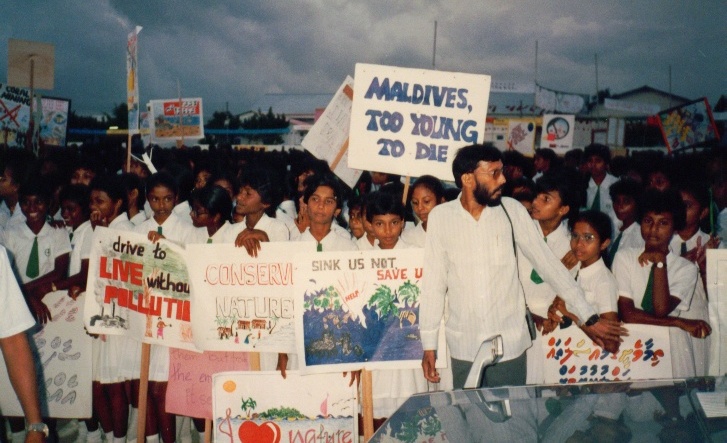
Little voices from the waves: Maldives too young to die!

maldives-too-young-to-die-say-school-children-nov-1989.jpg

My post last week on the Maldives on the frontline of climate change reminds me that I have been covering this story for the better part of 20 years. I have just located this photo from the depths of my personal image collection.

I first visited the Maldives in 1988, which was within months of the Indian Ocean archipelago nation suffering from a massive storm surge in 1987. Although the damage was minimal, the experience was a forceful reminder of how vulnerable the Maldives can be to even a small rise in sea levels – this is what prompted the low lying nation to take up the issue internationally.

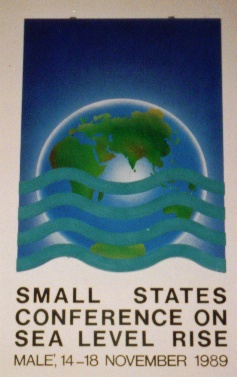
In November 1989, the Maldives hosted the first ever small states conference on sea level rise, held at the Kurumba island resort.

It was also one of the earliest international gatherings on this issue, which was to gain public interest and momentum in the years that followed. Among the participants were delegates from practically all the small states in different parts of the world (defined as those with less than 1 million population), and scientists from disciplines such as oceanography, climatology, meteorology and geology.

This was one of the first international scientific events that I covered as an eager young science journalist. I was then a roving South Asian correspondent for Asia Technology, a popular monthly on Asian science and technology published from Hong Kong (which, alas, folded up in 1991) – there’s nothing online as it was in the pre-web era!

The conference had technical sessions where experts debated scenarios and implications, and a political segment where delegations made their official statements. In the end, they issued the Malé Declaration on Global Warming and Sea Level Rise, which urged for inter-governmental action on the issue.

small-states-conference-on-sea-level-rise-logo.jpg small-states-conference-on-sea-level-rise-logo.jpg

Some 18 years later, I’m still eager but not so young – and I’ve covered more than my share of international environmental conferences to know that they can’t save the world. At least not on their own.

But many serve a useful function in rallying around concerned parties, helping them to agree on advocacy positions. Progress at inter-governmental level can be painfully slow and incremental. Sustaining public and media interest is one way to keep pressure on the endlessly bickering governments.

Following the November 1989 conference, small island states played a key role in negotiations that led to the UN Framework Convention on Climate Change adopted in 1992. This is the precursor to Kyoto, Bali and other processes that are now very much in the news.

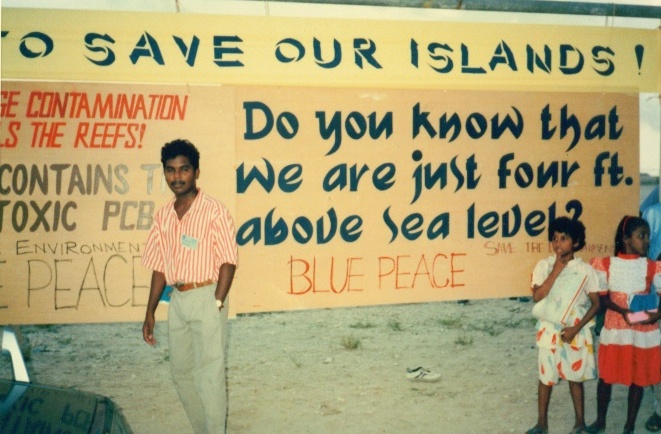
The Maldivian hosts knew that scientists and officials alone could not send out a powerful message to the world on what climate change means to low lying islands of the world – many of them no more than a few feet above sea level.

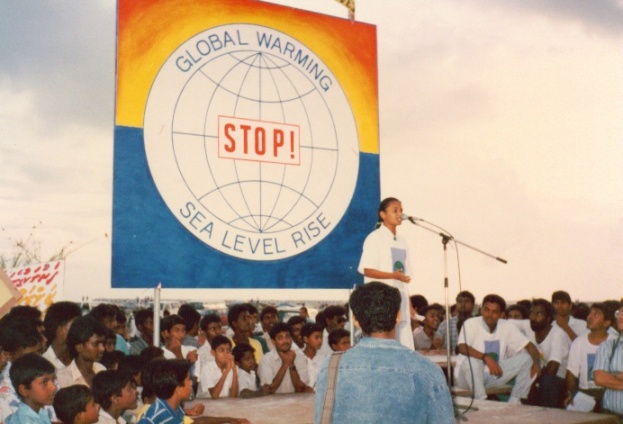
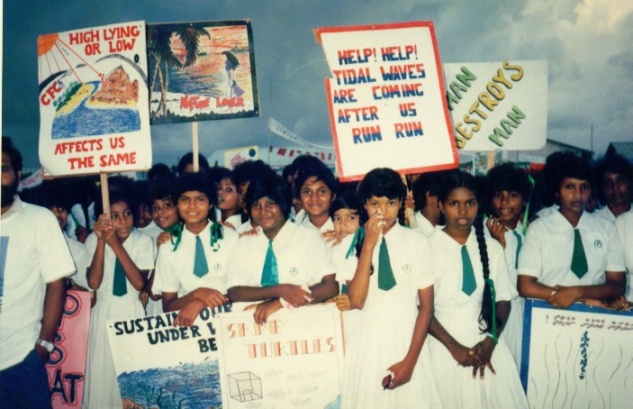
So on the last day evening, we were all taken to the Maldivian capital of Male, where we saw a demonstration and meeting held by the school children and ordinary people. To me, at least, this was the most striking moment of the whole week.

Leading up to this, I had been listening to competent experts and concerned officials talk about impacts, scenarios and mitigation measures for several days. Based on my notes and interviews, I filed several stories that captured highlights.

But unless I go back to my personal archives and look up those stories, I can no longer remember what I wrote. My lingering memories of this event are in these images, showing school children telling delegates – and the world – what it means to be living on the front lines of climate change impact.

listen-to-our-voice-from-the-waves-maldives-nov-1989.jpg

maldivian-school-children-worried-about-sea-level-rise-nov-1989.jpg

Then newly formed Maldivian environmental organisation Bluepeace was also part of the demonstration:

bluepeace-calls-for-global-attention.jpg

I worked for several years as a science and technology reporter. I was trained to gather, process and present facts and, preferably, expert opinion. But over the years I have realised that while hard facts and expert opinions are necessary, these tell only one part of complex stories we cover.

We need to bring in the human face of our stories — how ordinary children, women and men feel about issues and how they react to situations. This is why I now argue that we should not allow the human face of climate change to be lost in our well-meaning technical and economic discussions about climate change mitigation and adaptation.

We can cover carbon neutrality, zero emissions and common but differentiated responsibilities for all we like, but if we don’t pause to listen to these little voices from the waves – from the frontlines that are already feeling the heat – we will miss the bigger picture of what climate change is all about.

Dec 2007: Road to Bali – Beware of ‘Bad Weather Friends’

Photos by Nalaka Gunawardene, Male island, November 1989

Return to Paradise: Maldives on the frontline of climate change

Related blog post: 6 Jan 2008: Little voices from the waves: Maldives too young to die

Mariyam Niuma - photo by TVEAP

All of us at TVE Asia Pacific are missing Mariyam Niuma.

This bubbly, happy-go-lucky intern returns to her native Maldives this week after working with us for over a year as a programme assistant. She plans to spend more time with her family, and explore work opportunities in the Indian Ocean archipelago nation of 370,000 people.

Niuma, in her early 20s, applied for a staff position in late 2006. Among other things, she came with skill and dexterity in graphic design, web research and English proficiency — always useful for a regional communication organisation like ourselves.

“I want to learn as much as I can how a non-profit organisation works,” she told as at the recruitment interview. She had plans of taking the knowledge and skills back to her home atoll, hoping to make life better for her people.

I hope she found what she was looking for. We found in her an energetic young person with good attitude – one who could be challenged to work on tough (and sometimes tedious) tasks on a regular basis.

“The last year has been a very challenging and fulfilling year for me, and being at TVEAP helped a lot,” she wrote in an email on her last day at work. “I will miss you all and being a part of you and will always remember the good times and everything I have learnt here both professionally and personally.”

Some months into her internship, Niuma gave us a presentation on her home country, home atoll and life at home. To many outsiders, Maldives evokes images of palm-fringed sandy beaches, shallow seas of an exquisitely azure blue, high end resorts, crystal clear blue waters for diving…and plenty of sunshine all the year round. (Image shows Kurumba resort, Maldives.)

Well, all that’s true as widely advertised. But Maldives is a whole lot more – a history going back to at least 1,500 BC, distinctive island culture, and a nation that is struggling to reconcile tradition with modernity. Divehi, the Maldivian language, contributed the word “atoll” (a ring-shaped coral reef) to the English language.

The former British protectorate, which became independent in 1965 and a republic in 1968, has a pro-democracy movement sustained over the past few years. If such political turbulences create a sense of uncertainty in the minds of Maldivians about their future, it’s only one source of concern.

They also have to worry about whether their nation would have a collective future. That’s because of climate change that scientists now confirm are underway, aggravated by human action.

Most of the 1,200 islands in the Maldives are no more than 1m (3 feet) above sea level. Even a modest rise in sea levels could inundate these lands. Within 100 years the Maldives could become uninhabitable.

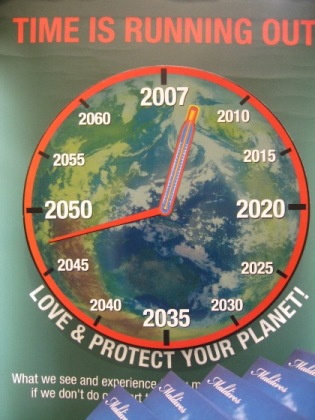
Time is indeed running out for Niuma and her country — as this poster produced by The Body Shop reminds us.

Time is running out...and not just for the Maldives

In 1987 and 1991 storm surges flooded a large number of islands, including one-third of the capital where one-quarter of the country’s population lives. Unusually high waves forced the international airport to be closed, causing great damage to tourism and constraining emergency relief operations. On 26 December 2004, the Asian tsunami battered the Maldives, forcing the evacuation of 13 of its 200 inhabited islands. These incidents indicate how vulnerable the islands are to wave action.

Maldives was among the first countries in the world to raise climate change as a serious issue at the United Nations. President Maumoon Abdul Gayoom raised the alarm back in 1987, when most people had not even realised the problem and scientific evidence was just beginning to come in.

The Maldives did more than raise the issue. The country played a lead role in rallying around other small island states worldwide that would be among the first to be impacted when sea levels rise due to thermal expansion and melting of polar ice.

In November 1989, the Maldives hosted the first ever small states conference on sea level rise, which was one of the first international scientific events that I covered as an eager young science journalist.

The conference issued the Malé Declaration on Global Warming and Sea Level Rise, which urged for inter-governmental action on the issue. The small island states played a key role in negotiations that led to the UN Framework Convention on Climate Change adopted in 1992. This is the precursor to Kyoto, Bali and other processes that are now very much in the news.

Just a few weeks ago, in mid November 2007, the Maldives once again hosted representatives from small island states to discuss climate change. Eighteen years after the original meeting, the subject is no longer a fringe concern; it’s now on everybody’s agenda.

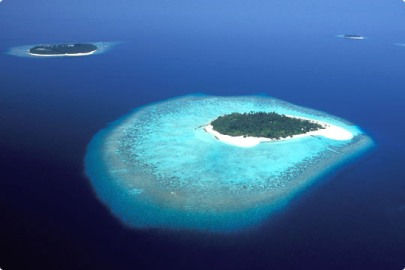
Maldives from the air: tiny specs in the ocean
The meeting urged the the human dimension of global climate change to be included in the agenda of UN Climate Change Summit in Bali (December 2007), and sought the international community’s commitment “to protect people, planet and prosperity by taking urgent action to stabilize the global climate change”.

This time, the Male’ Declaration on the Human Dimension of Global Climate Change called for the UN High Commissioner for Human Rights to assess the human rights implications of climate change and “to conduct a study into the effects of climate change on the full enjoyment of human rights”. It requested the UN Human Rights Council to convene in March 2009 a debate on human rights and climate change.

I wasn’t at the November 2007 Male meeting, but was glad that the meeting stressed the need for adding a human face to the complex, nuanced challenge of climate change. This resonates very much with my own experience.

Read my April 2007 blog post: Wanted – human face of climate change

Mariyam Niuma takes me a bit closer to the realities of what climate change means to communities living on the frontline. Unlike Niuma, who is web savvy and connected with the wider world, many are blissfully unaware of the problem.

Our challenge is to bring their voices, stories and aspirations to the global news agenda and the myriad discussions now underway searching for solutions.

I hope someday we can work with Niuma again — perhaps amplifying her story in moving images.

Nov 2007 blog post: True people power needed to fight climate change

Related blog post: 6 Jan 2008: Little voices from the waves: Maldives too young to die

Photos of Mariyam Niuma courtesy Manori Wijesekera of TVEAP

Sri Lanka: What killer waves united, killer humans divided again…

Today is the third anniversary of the Indian Ocean tsunami, which left a trail of destruction in many countries in South and Southeast Asia.

Today we remember those who perished and salute those who survived and endured enormous hardships.

We thank everyone everywhere who donated to help, and curse those who plundered or squandered the outcome of that generosity.

As I wrote in my only published verse, When the Waves Came, written on 28 December 2004 – when the disaster’s full impact was dawning on the world:

When the waves came
Roaring and moving mightily,
Unleashing the power of
A million bombs exploding at once,
They didn’t care
And just didn’t discern
Who or what was in their way.

My basic premise was that the killer waves had been a brutal ‘equaliser’ of all men and women. It no longer mattered on which side of law, morality, economics or social class they stood. This was particularly apt for Sri Lanka, a land divided for a quarter of a century by an armed separatist struggle that has hardened fundamentalist positions at both Sinhalese and Tamil ends of our ethnic spectrum. Towards the end of the verse, I noted:

As we in the aftermath tiptoe
Through endless depressing scenes
Of death and utter devastation
Can we tell the difference
Between Sinhala and Tamil,
Or Muslim and Burgher,
Or soldier and rebel
Or policeman and prisoner
Or rich and poor?

For a few days after the tsunami, there was a flicker of hope that the lashing from the seas might finally convince everyone of the complete futility of war. Political cartoonists in Sri Lankan newspapers were among the first to make this point. One cartoon, appearing two days after the disaster, showed a government soldier and Tiger rebel swimming together in the currents, struggling to save their lives. (Indeed, there were some reports of them helping each other in the hour of need.)

The cartoonists and other media commentators asked a common question: what happened to the land, and the dividing border that both sides had fought so hard and long for?

Alas, what Nature proposed we humans (Sri Lankans) disposed. While the tsunami helped usher in a negotiated settlement to the long-drawn armed struggle in Aceh, Indonesia, it only created a temporary lull in the Sri Lankan conflict. As soon as both sides recovered from Nature’s blow, they were back at each others’ throats again. (This contrast has been studied by various groups – see, for example, the summary of a Worldwatch Institute study Beyond Disasters: Creating Opportunities for Peace).

Looking back three years later, all I can say is that the land killer waves temporarily and forcibly united, killer human beings have managed to divide again for petty political, communal and personal gains.

theeban-survived-the-tsunami-but-not-sri-lankas-conflict.jpg

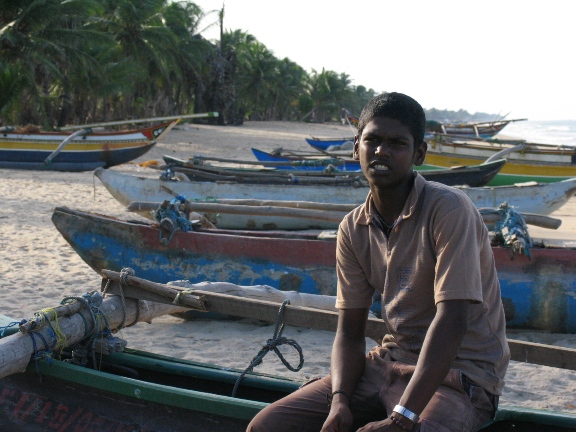
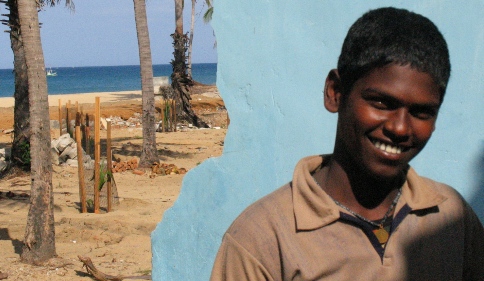
This boy, Thillainayagam Theeban, epitomizes that bigger tragedy. He survived the tsunami — but not the escalation of Sri Lanka’s ethnically driven civil war, which consumed his life in March 2007.

Theeban was one of eight surviving children – from India, Indonesia, Sri Lanka and Thailand – whose remaining families we tracked and filmed for a year in Children of Tsunami media project, a citizens’ media response to the Indian Ocean Tsunami.

Theeban was murdered by unidentified gunmen who stormed into his ‘temporary’ tsunami shelter on 3 March 2007. The death was linked to political violence that has engulfed Sri Lanka since 2006.

theeban.jpg

When the shocking news reached us three days later, our Sri Lankan camera team at Video Image and we at TVE Asia Pacific just couldn’t believe it. We were all in tears, and some of us were also angry. Theeban, who survived the killer waves 26 months earlier (but lost his mom and kid brother in the disaster) suffered many indignities in displacement. And now, he is gone.

We still don’t know who killed Theeban. He was abducted by an armed group sometime in 2006, from whom he escaped in early 2007. It is believed that Theeban was killed as a punishment for running away — and as a warning to all others.

He was 16 years at the time of his death. It is unlikely that his killers would ever face justice.

As I wrote in my personal tribute to Theeban in March 2007, published by UCLA’s Asia Media and MediaHelpingMedia, UK: “The disaster’s Sri Lankan death toll (close to 40,000 dead or missing) shocked the world when it happened within a few hours or days. Yet, at least twice as many people -– most of them unarmed and uninvolved civilians — have been killed in over a quarter century of fighting. That doesn’t always grab headlines.

“Thillainayagam Theeban has become another statistic in a ‘low-intensity conflict’ (as some researchers call it). And while this war lasts, it will continue to consume thousands of other young lives — a grim roll call of Sri Lanka’s Lost Generation.”

The third anniversary of the tsunami is a reminder – if any were needed – that man’s inhumanity to man is often worse than Nature’s fury.

March 2007 blog post: Remembering Theeban

April 2007 blog post: More memories of Theeban

Children of Tsunami: Documenting Asia’s Longest Year

Thillainayagam Theeban (1990 – 2007)

Tsunami Stories: How a film saved lives in Kosgoda, southern Sri Lanka

With the third anniversary of the Asian Tsunami drawing close, we are reliving memories of the mega-disaster that hit many parts of coastal Asia on 26 December 2004.

On 10 October 2007, I wrote the story of Tilly Smith, the 11-year-old English school girl whose geography knowledge helped save hundreds of lives on the Maikhao Beach in Thailand that day.

Here’s another story, which was related by Thyagee de Zoysa, a young Sri Lankan woman who until recently was working as Project Officer of CEE Sri Lanka, a non-profit educational charity that I am associated with.

In January 2007, Thyagee spoke at the European launch of TVE Asia Pacific’s latest environmental television series, The Greenbelt Reports</em>, held in Athens, Greece. There she made a passionate appeal for education and awareness to be put into action.

She drew from her personal experience, having survived the Indian Ocean Tsunami in her native village of Kosgoda in southern Sri Lanka. These are her exact words:

“I, myself, am particularly willing to participate in this project, as I was at my home on the 26th of December 2004, with my parents, until we heard a young man crying ‘Run to the temple, run to the hill, the sea is coming’. We ran — and it saved our lives.

“The young man told me later that he knew that the sea was going to come with full power because of a film that he had seen. A film, which was about a meteorite impact with earth and how a tsunami happens after that. He knew that, if there comes a day when the sea goes back towards the horizon, it then comes back again to take your life.

“It does not matter in what way you create awareness on the environment, be it books, films or the Internet. What matters is that you do it and make somebody understand the possible actions to take up. Believe me, I am grateful to this young man for saving my life and that of my family…”

Neither Thyagee nor the young life-saver could recall the name of the film, but it doesn’t matter. The film left a bit of knowledge in the young man’s mind which surfaced instantly just when it was needed. That helped save lives.

Alas, there were very few Sri Lankans – young or old – who had any idea about tsunamis prior to that fateful Boxing Day 2004.

Writing a foreword to Communicating Disasters: An Asia Pacific Resource Book (co-edited by Nalaka Gunawardene and Frederick Noronha), Sir Arthur C Clarke refers to another rare exception: a retired sailor living in the coastal village of Galbokka recognised the tell-tale signs of the on-coming tsunami and rushed the entire community to safety.

The challenge we still face is to build everybody’s awareness on multiple hazards and what to do when hazards turn into disasters.