Appeal to climate reporters everywhere: Don’t follow the Climate Circus!

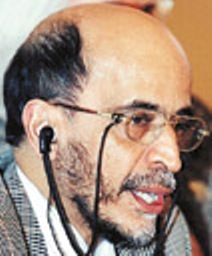
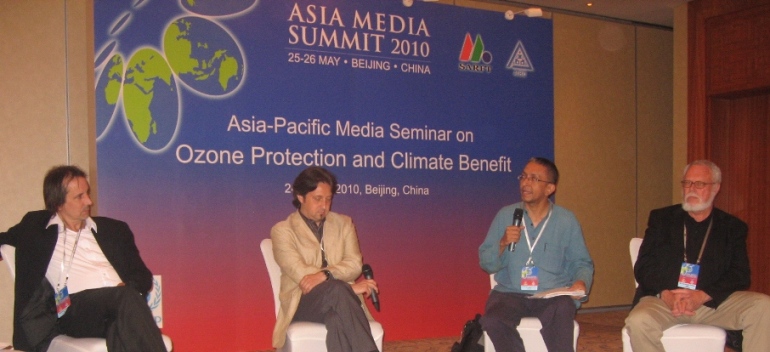
L to R: Sam Labudde (EIA); Eric Soulier (Canal France International); Nalaka Gunawardene (speaking); and Durwood Zaelke (IGSD)

Every year, a couple of weeks before Christmas, a big Climate Circus takes place. The venue city keeps changing, but the process is always the same: it attracts thousands of people – from government officials and scientists to activists and journalists – who huddle in various corners, chat endlessly and gripe often during two chaotic weeks. Then they disperse, rather unhappy with the process…only to return to more of the same a year later.

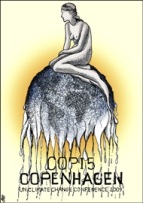
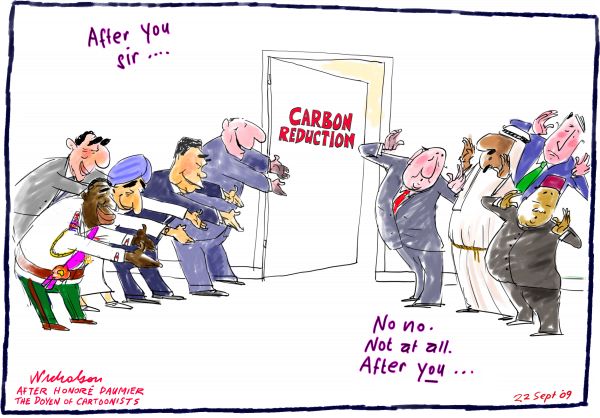
This is how I see the annual Conference of Parties (COP) of the UN Climate Convention, or UNFCCC. Their last big ‘circus’ was in Copenhagen, Denmark — when the world held its breath for a breakthrough in measures to reduce greenhouse gas emissions that warm up the planet. But, as with many previous conferences, Copenhagen over-promised and under-delivered.

The next COP is to take place in Cancún, Mexico, in December 2010. We can expect more of the same.

I’m not always this cynical. I’m certainly not a climate skeptic or climate change denialist. But I came to this conclusion after covering climate change stories for over 20 years, and having seen the kind of distraction the annual Climate Circus can produce on the media coverage and fellow journalists.

My contention: COPs were intended for treaty-signing governments to come together, bicker among themselves and make slow, painful and incremental progress on what needs to be done to address the massive problems of global climate change. While the core of these conferences remains just that, over the years they have gathered so much else — side events that now completely outweigh the political conference, and often overshadow it. I’m not convinced that this is where the real climate stories are, for discerning journalists.

I made these observations in some plain speaking done during a panel at the Asia Media Summit 2010 in Beijing, China, this week. The occasion was the Asia-Pacific Media Seminar on Ozone Protection and Climate Benefit, one of several pre-Summit events held on 24 May 2010 — and the only one on an environmental issue or topic.

I was on the last panel for the day, which looked at the next “hot” ozone and climate related stories. We were asked to give our views on: what are the great stories on the road to COP16 in Mexico at the end of the year?

Forget Cancun, I said. We already know how little it’s going to change the status quo. Why bother with that promises to be a non-event? Must we be this concerned with non-stories in our media coverage? In fact, I suggested: we should give the entire UNFCCC processes a couple of years of benign neglect. The real climate stories are not in the unmanageable chaos that the annual Climate Circuses have become. They are out there in the real world.

In the real world where frontline states and communities are already bearing the brunt of extreme weather…where green energy is making rapid advances…where communities and economies are trying to figure out how to live with climate change impacts even as they reduce their greenhouse gas emissions.

There are plenty of climate stories out there, covering the full range of journalistic interests: human interest, human enterprise, innovation, scientific research, community resilience and others. The challenge to journalists and other climate communicators is to go out there, unearth the untold stories, and bring them out in whatever media, forum or other platform.

I have nothing against climate COPs per se, and hope they can be restored to their original purpose of climate negotiations and working out acceptable, practical ways forward. (And this is certainly not a case of sour grapes: I’ve turned down all-expenses-paid invitations to COPs more than once.)

But we need to be concerned about the Climate Circus Effect on media, activist and educator groups, who seem to dissipate a good deal of their limited energies and resources in turning up at these mega-events. Copenhagen is said to have attracted over 17,000 persons (over 3,000 among them accredited journalists). How much of fruitful interaction and sharing can happen in such a setting? And when all the major news networks and wire services are covering the key negotiations and activities in considerable detail, what more can individual journalists capture and report to their home audiences?

Living as we do on a warming planet, we are challenged on many fronts to question old habits, and change our business-as-usual. The media pack has been running after the Climate Circus for over a dozen years. We need to pause, take stock and ask ourselves: is this the best way to cover the climate story?

And while at it, here’s something else for the UN, conveners of the annual Climate Circus. On World Environment Day 2008, whose theme was ‘CO2: Kick the Habit’, I asked the UN to kick its own CO2 habit. I suggested: “Adopt and strictly observe for a year or two a moratorium on all large UN gatherings (no matter what they are called – Summits, conferences, symposia, meetings, etc.) that involve more than 500 persons. In this day and age of advanced telecommunications, it is possible to consult widely without always bringing people physically together….Practising what you preach has a strong moral persuasive power — even if it goes against addictive habits formed for over 60 years of the UN’s history.”

PS: A global, comprehensive and legally-binding agreement on climate change is unlikely to be delivered at this year’s (Cancun) conference as well, the outgoing head of the UNFCCC, Yvo de Boer, was reported as saying on 27 May, just a few days after our Beijing seminar. See what I mean?


TWTYTW: Our own (very subjective) list of best and worst of 2009…

All journalism is subjective; it’s just that some of us are better at disguising it! As we head for the end of 2009, we at Moving Images blog take one last fleeting, impressionistic, judgemental and, yes, darn too opinionated look at the past 365 days. That Was The Year That Was…and here’s our list of superlatives!

Best news and biggest relief (national): Sri Lanka’s nearly three decades long and brutal civil war finally ended in mid May 2009 – and not a moment too soon. It rightly created headlines around the world, and also made it to TIME’s top 10 news of the year. Within 24 hours of that much-awaited news, I wrote and published one of my most emotionally charged essays ever, Memories of War, Dreams of Peace. I probably spoke for a whole generation of Lankans: “As we stand on the threshold of peace, I am overwhelmed with memories of our collective tragedy. I hope we can once again resume our long suspended dreams for a better today and tomorrow.” With the hindsight of seven months, I still want to believe every word…although it’s become increasingly hard to cling on to such ideals.

Biggest disappointment (national): Ending the Lankan war entailed tremendous effort, cost and sacrifice, and we all knew that consolidating peace and restoring normalcy were going to be even harder – delivering peace dividends is no mean task. As weeks became months, our cautious optimism slowly turned into disappointment and dismay: it became clear that the triumphalist government was treating the historic ‘open moment’ simply as as blank cheque to do pretty much what it wanted. My May 19 essay on Dreams of Peace had ended with a question that resonated with millions: “Would our leaders now choose the Mandela Road or the Mugabe Road for the journey ahead?” Can we please ask that question again…? Hello, anybody listening?

Most evocative piece of writing: Without competition, that distinction goes to The Last Editorial by Lasantha Wickrematunga, the courageous investigative journalist (and de facto leader of the political opposition) in Sri Lanka, who was brutally slain on January 8 while on his way to work. That editorial, which appeared post-humously in his newspaper The Sunday Leader on 11 January 2009, embodies the best of Lasantha’s liberal, secular and democratic views. Nearly a year after the dastardly daylight crime, his killers have not been caught and independent media remains under siege even in post-war Sri Lanka.

Most memorable quote: While people like Lasantha articulated our cherished dreams for a truly pluralistic society, our billion+ neighbours in India have been building it for over six decades. It’s still a work in progress, and the ideals need occasional reiteration. This is precisely what classical dancer Mallika Sarabhai did when she ran as an independent candidate when India conducted the world’s largest democratic election in April-May. She lost, but wrote one of the most insightful pieces on what it means to live amidst the huge cultural, social and political diversity in India: “We are a salad-like melange of cultures and not a soup where all variations get reduced to a homogeneous pulp—this, to me, is our greatest strength.” (She inspired my own essay: Sri Lanka – Spice Island or Bland Nation?)

Biggest disappointment (global):
The UN climate conference in Copenhagen, held in December and officially dubbed COP15, ended up in what many activists felt was a cop-out. Greenpeace echoed the frustration of many when they said at the end of what was, at its start, billed as the ’14 days to seal seal history’s judgment on this generation‘: “Don’t believe the hype, there is nothing fair, ambitious or legally binding about this deal. The job of world leaders is not done. Today they shamefully failed to save us all from the effects of catastrophic climate change.” I was glad I wasn’t part of the mega event — I’ve burnt enough aviation fuel this year, but almost all events I participated in on three continents were more productive than the Danish debacle…

Biggest Under-achiever: If the world laboured a mountain and delivered a mouse in Copenhagen, the mid-wife of that process must surely have been the current UN chief Ban Ki Moon. More secretary than general, Ban is, in his own admission, the UN’s Invisible Man. All the top speech writers and PR agents in the world can’t animate this the perennially dull and dour diplomat. Not ideal change-maker when the world is racing against catastrophe. Kofi Annan, we miss you!

Most moving work of moving images: The world’s rich are having a party, and millions living in poverty are the ones footing the bill. This is the premise of Indian journalist and activist Pradip Saha’s latest film, MEAN Sea Level, which looks at the impact of climate change on the inhabitants of Ghoramara and Sagar islands in the the Sundarban delta region in the Bay of Bengal. I found it both deeply moving and very ironic. With minimal narration, he allows the local people to tell their own story. As it turned out, these testimonies were lost on the bickering politicians in Copenhagen…

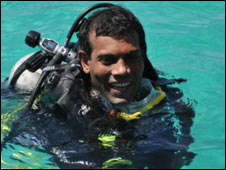
Best media stunts: We are a bit divided here. At a time of ever-shrinking attention spans, it takes much creativity and guts to grab the cacophonous media’s attention, especially for a good cause. Two very different men succeeded where many have failed. In February Bill Gates, the world’s top geek now working for its meek, released some mosquitoes at the TED 2009 conference to highlight the continuing grip that malaria has on the developing world, especially Africa. In October, climate crusader President Mohamed Nasheed of the Maldives held the world’s first underwater cabinet meeting to remind everyone of the watery future that awaits low lying island nations like his when climate change rises sea levels.

Biggest Irony: NASA announced in November that an unmanned space probe that was intentionally crashed on the Moon had discovered the presence of ‘significant amounts’ of water there. That bit of scientific evidence cost US$79 million to obtain…and was not the most comforting news for a planet that rapidly running short of usable freshwater. In the wake of the Apollo Moon landings in the late 1960s, misguided voters in Sri Lanka elected a government that promised ‘to bring rice even from the Moon’. When might we hear politicians promise us water from the Moon?

Well, that’s it folks — the highs and lows of 2009 according to the Blogger-in-Chief and his team of elves here at the Moving Images Media Empire. We’ve waded through our several dozen blog posts to come up with the above, and make no claims for being fair, balanced or comprehensive…

Indeed, we hope you don’t agree with all our picks, and invite you to express alternative – even dissenting – views. All comments that are not outright libellous or blatantly self-promotional will be published.

We take this opportunity to thank each and everyone who read our posts over the year — and especially those who left comments, sometimes radically disagreeing with our views. We also reiterate our pledge to frustrate those few persistent detractors who keep demanding to see our nationalistic, religious or other credentials…

May the cacophony continue and intensify in 2010!

Media melee at Copenhagen: Chasing a hazy story in a crazy conference?

Polite or dodgy? Did anything more than this happen in Copenhagen?

What happens when over 3,500 journalists from all over the world roam around a two-week long UN conference that saw plenty of loud bickering and hot air in the name of saving the planet from global warming? Well, the media pack adds to the noise levels and hot air, for sure — and they are not above bickering themselves.

At least, that’s the report from Copenhagen, where the UN climate conference COP15 ended on Dec 18 with a watered down, disappointing something called the Copenhagen Accord.

Darryl D'Monte
I’ve just read an interesting report filed from the Ground Zero of that half-event by my Indian friend (and senior journalist turned climate columnist) Darryl D’Monte.

He says: “The media in Copenhagen has been an unmanageable and unruly lot. There are some 3,500 of us covering the summit, most having come this week, and journalists – once again, the electronic media – don’t think twice about carrying on conversations at the loudest decibel levels, turning the room into a virtual Tower of Babel. The TV crews in particular are like packs of wolves. They station themselves at every available nook and corner where some VIP may enter and exit and try to get that exclusive byte as he or she makes an appearance“.

Read the full story at InfoChange India:
Media melee at Copenhagen, By Darryl D’Monte

Was it a non-event, half event or what?

Have they dropped the ball (Earth) in Copenhagen?

The news from Copenhagen, on the last day of the UN climate conference, has been a bit confusing. Have they got a climate deal, or have they simply agreed to meet again and talk more while the planet warms up?

As one news item put it: “Representatives of 192 countries quibbled over every word through the night as a weak political declaration started to emerge out of the climate summit once scheduled to finalise a treaty that would tackle global warming.”

The declaration remains “weak” and “wishy washy” in the absence of agreement over the main sticking points dogging this December 7-18 UN Framework Convention of Climate Change (UNFCCC) conference – the refusal by industrialised countries to commit more emission reductions and their unwillingness to put on the table money to help poor countries cope with climate change effects.

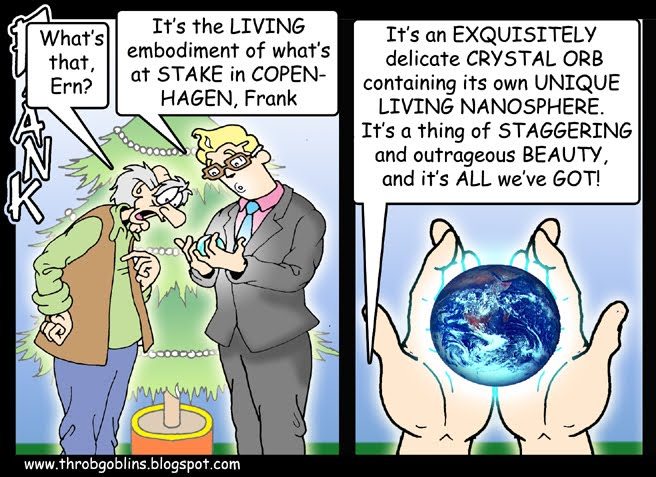
So, less than one week to go for Christmas, have the men (and few women) in suits dropped the ball (read: Earth) in Copenhagen? Clarity and interpretations will soon flow. I still hope it won’t come to what cartoonist Marc Roberts envisaged in this cartoon, originally drawn a year ago:

THROBGOBLINS INTERNATIONAL brings dark green humour to brighten your day

Please Help the World: The call to Copenhagen climate conference

Earlier this week, United Nations Climate Change Conference 2009 (COP15) in Copenhagen opened with an apocalyptic video showing the world torn asunder from a variety of disasters.

As one reviewer wrote: “The portrayal sought to play up on the fears of the world should a worst case scenario develop from global warming. The entire video is reminiscent of the recent disaster movie blockbuster, 2012 that was released in movie theatres in recent months.

I haven’t yet seen 2012, now showing in a theatre close to me, so I can’t comment on the comparison. But here’s the video, now playing on COP15 channel on YouTube:

In the video, a child goes to sleep peacefully but wakes to find herself in a desert wasteland. As she sets out to explore, the very land on which she stands begins to crack open and she flees. The girl doesn’t make it far before she looks up to see the world’s largest tornado tearing a city apart and flood waters approaching. The child leaps to a tree branch as the waters overtake her and she screams. It is then that she wakes from what is only a dream and decides to make a home video saying, “Please help the world.”

Will the bickering and myopic leaders of the world heed this call? We shall know in the next few days.

Meanwhile, here are the credits for this film:
Director: Mikkel Blaabjerg Poulsen
Producers: Stefan Fjeldmark and Marie Peuliche
Cinematographer: Dan Laustsen
Production designer: Peter de Neergaard
Editor: Morten Giese
Composer: Davide Rossi
Sound design: Carl Plesner
Production company: Zentropa RamBuk
Advisory consultants: Mogens Holbøll, Bysted A/S and Christian Søndergaard, Attention Film ApS.

For some comparisons, here is the official trailer for 2012:

Copenhagen: ‘Fourteen days to seal history’s judgment on this generation’

Today, 7 December 2009, the latest UN-FCCC climate negotiations begin in Copenhagen, Denmark. It’s not just another environmental conference – this one can make or break the future of our world.

Recognising this, 56 newspapers from 45 countries across the world have up with common editorial and demanded that world leaders put aside their differences and step up to seal the deal. The text was drafted by a Guardian team during more than a month of consultations with editors from more than 20 of the papers involved. Like the Guardian most of the newspapers have taken the unusual step of featuring the editorial on their front page.

It’s indeed rare for the world’s cacophonous media to agree on such nuance and detail, but uncommon unity is indeed what we need to ensure a common, shared future.

At Moving Images, we add our own modest echo to this call by reproducing the editorial in full, as is:

One World, One Climate, One Editorial...


Copenhagen climate change conference: ‘Fourteen days to seal history’s judgment on this generation’


This editorial calling for action from world leaders on climate change is published today by 56 newspapers around the world in 20 languages.

Today 56 newspapers in 45 countries take the unprecedented step of speaking with one voice through a common editorial. We do so because humanity faces a profound emergency.

Unless we combine to take decisive action, climate change will ravage our planet, and with it our prosperity and security. The dangers have been becoming apparent for a generation. Now the facts have started to speak: 11 of the past 14 years have been the warmest on record, the Arctic ice-cap is melting and last year’s inflamed oil and food prices provide a foretaste of future havoc. In scientific journals the question is no longer whether humans are to blame, but how little time we have got left to limit the damage. Yet so far the world’s response has been feeble and half-hearted.

Climate change has been caused over centuries, has consequences that will endure for all time and our prospects of taming it will be determined in the next 14 days. We call on the representatives of the 192 countries gathered in Copenhagen not to hesitate, not to fall into dispute, not to blame each other but to seize opportunity from the greatest modern failure of politics. This should not be a fight between the rich world and the poor world, or between east and west. Climate change affects everyone, and must be solved by everyone.

The science is complex but the facts are clear. The world needs to take steps to limit temperature rises to 2C, an aim that will require global emissions to peak and begin falling within the next 5-10 years. A bigger rise of 3-4C — the smallest increase we can prudently expect to follow inaction — would parch continents, turning farmland into desert. Half of all species could become extinct, untold millions of people would be displaced, whole nations drowned by the sea. The controversy over emails by British researchers that suggest they tried to suppress inconvenient data has muddied the waters but failed to dent the mass of evidence on which these predictions are based.

Few believe that Copenhagen can any longer produce a fully polished treaty; real progress towards one could only begin with the arrival of President Obama in the White House and the reversal of years of US obstructionism. Even now the world finds itself at the mercy of American domestic politics, for the president cannot fully commit to the action required until the US Congress has done so.

But the politicians in Copenhagen can and must agree the essential elements of a fair and effective deal and, crucially, a firm timetable for turning it into a treaty. Next June’s UN climate meeting in Bonn should be their deadline. As one negotiator put it: “We can go into extra time but we can’t afford a replay.”

At the deal’s heart must be a settlement between the rich world and the developing world covering how the burden of fighting climate change will be divided — and how we will share a newly precious resource: the trillion or so tonnes of carbon that we can emit before the mercury rises to dangerous levels.

Rich nations like to point to the arithmetic truth that there can be no solution until developing giants such as China take more radical steps than they have so far. But the rich world is responsible for most of the accumulated carbon in the atmosphere – three-quarters of all carbon dioxide emitted since 1850. It must now take a lead, and every developed country must commit to deep cuts which will reduce their emissions within a decade to very substantially less than their 1990 level.

Developing countries can point out they did not cause the bulk of the problem, and also that the poorest regions of the world will be hardest hit. But they will increasingly contribute to warming, and must thus pledge meaningful and quantifiable action of their own. Though both fell short of what some had hoped for, the recent commitments to emissions targets by the world’s biggest polluters, the United States and China, were important steps in the right direction.

Social justice demands that the industrialised world digs deep into its pockets and pledges cash to help poorer countries adapt to climate change, and clean technologies to enable them to grow economically without growing their emissions. The architecture of a future treaty must also be pinned down – with rigorous multilateral monitoring, fair rewards for protecting forests, and the credible assessment of “exported emissions” so that the burden can eventually be more equitably shared between those who produce polluting products and those who consume them. And fairness requires that the burden placed on individual developed countries should take into account their ability to bear it; for instance newer EU members, often much poorer than “old Europe”, must not suffer more than their richer partners.

The transformation will be costly, but many times less than the bill for bailing out global finance — and far less costly than the consequences of doing nothing.

Many of us, particularly in the developed world, will have to change our lifestyles. The era of flights that cost less than the taxi ride to the airport is drawing to a close. We will have to shop, eat and travel more intelligently. We will have to pay more for our energy, and use less of it.

But the shift to a low-carbon society holds out the prospect of more opportunity than sacrifice. Already some countries have recognized that embracing the transformation can bring growth, jobs and better quality lives. The flow of capital tells its own story: last year for the first time more was invested in renewable forms of energy than producing electricity from fossil fuels.

Kicking our carbon habit within a few short decades will require a feat of engineering and innovation to match anything in our history. But whereas putting a man on the moon or splitting the atom were born of conflict and competition, the coming carbon race must be driven by a collaborative effort to achieve collective salvation.

Overcoming climate change will take a triumph of optimism over pessimism, of vision over short-sightedness, of what Abraham Lincoln called “the better angels of our nature”.

It is in that spirit that 56 newspapers from around the world have united behind this editorial. If we, with such different national and political perspectives, can agree on what must be done then surely our leaders can too.

The politicians in Copenhagen have the power to shape history’s judgment on this generation: one that saw a challenge and rose to it, or one so stupid that we saw calamity coming but did nothing to avert it. We implore them to make the right choice.

Taste the Waste: Uncovering a crime against humanity and Nature

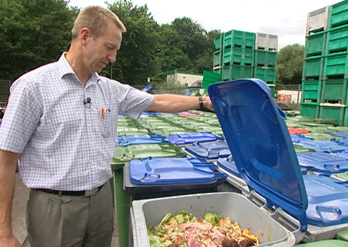
Opening the lid...

“How can we explain the fact that one sixth of humanity goes to bed hungry every night, when the world already produces enough food for all?

“The short answer is that there are serious anomalies in the distribution of food. Capricious and uncaring market forces prevent millions of people from having at least one decent meal a day, while others have an abundance of it. For the first time in history, the number of severely malnourished persons now equals the number suffering from over-consumption: about a billion each!”

That was the opening of an article on the future of food, co-authored by Sir Arthur Clarke and myself in 2000. It was circulated by the UN Food and Agriculture Organisation (FAO) to mark World Food Day that year, and was reproduced in 2008 in The Hindu newspaper, India.

Nearly a decade after we wrote those words, the situation hasn’t really improved. There still are a billion people for whom chronic hunger is a grim fact of life. About 25,000 people die of hunger every day. Meanwhile, at the other end of the spectrum, the number of obese people has grown to 1.5 billion.

Talk about a world of contrast and disparity!

Here’s more shocking news: we routinely throw away half of all food produced in this world. Between plough and plate, or from farms to homes, we waste almost as much food as we eat.

Eyes Wide Shut?
Many countries don’t have the slightest idea how much is wasted. Britain made an effort to measure the waste pile and came to a staggering 15 million tons of food a year. This includes 484 million unopened tubs of yoghurt, 1.6 billion untouched apples, bananas worth £370 million and 2.6 billion slices of bread.

In his recent book Waste: Uncovering the Global Food Scandal, Tristram Stuart documented the extent of waste in the food industry worldwide.

Taste the Waste is a new documentary film linked to an online campaign that shows us what is being thrown away: where, why, when and by whom.

The film maker turned campaigner, Valentin Thurn, has come up with one more reason why we should stem this callous waste: “Cutting food waste is an easy solution to reduce climate emissions and hunger,” he says.

Reducing food waste means a big opportunity to reduce greenhouse gas emissions – if we threw away only half of the avoidable waste, the consequences for the climate would be the same as taking one out of five cars off our roads.

It would also help the hungry, because they also depend on the global food cycle. Cash crops from all over the world are traded on the stock exchange. The agricultural resources on this planet are limited. The farmland taken up to produce the food that we throw away could instead be producing food for them.

Young activists protest against this situation by rescuing the wasted food. People eating rubbish – a habit that sounds disgusting until you see the loads of perfectly edible food in the bins of your supermarket or sandwich shop around the corner.

Thurn’s call to action: “We need your help! Go out, look around and tell us about the food in the bins where you live. Send texts, photos, videos, and help to reveal the huge scandal of how we are wasting food.”

Watch the film’s trailer on YouTube:


According to the latest FAO figures, there are more hungry people in the Asia Pacific (642 million) than all other regions combined. This is followed by Sub-Saharan Africa (265 million), Latin America and the Caribbean (53 million), and the Near East and North Africa (42 million). Sub-Saharan Africa has the highest percentages of people living in hunger, while the Middle East and North Africa saw the most rapid growth in the number of hungry people (13.5%) during 2008.

The UN’s definition of hunger is based on the number of calories consumed. Depending on the relative age and gender ratios of a given country, the cutoff varies between 1,600 and 2,000 calories a day.

Starting in 2008, activist groups worldwide observe 16 October as World Foodless Day. Their argument: World Food Day is a mockery and is much better named World Foodless Day.

It’s a day of global action on the crises that beleaguer the people. The objectives are to: “create public awareness and media attention on the root causes of the food crisis; provide policy recommendations and organize meetings with government officials, opinion makers and leaders; organise activities to raise our voices against neoliberal policies and their impact; and highlight people’s recommendations to respond to the world food crisis.”

Watch PAN-Asia Pacific’s video for World Foodless Day 2008:


Read an excellent review of Tristram Stuart’s book: Watching our wasteline, By Darryl D’Monte

Satinder Bindra: It’s the message, stupid (and never mind the UN branding)!

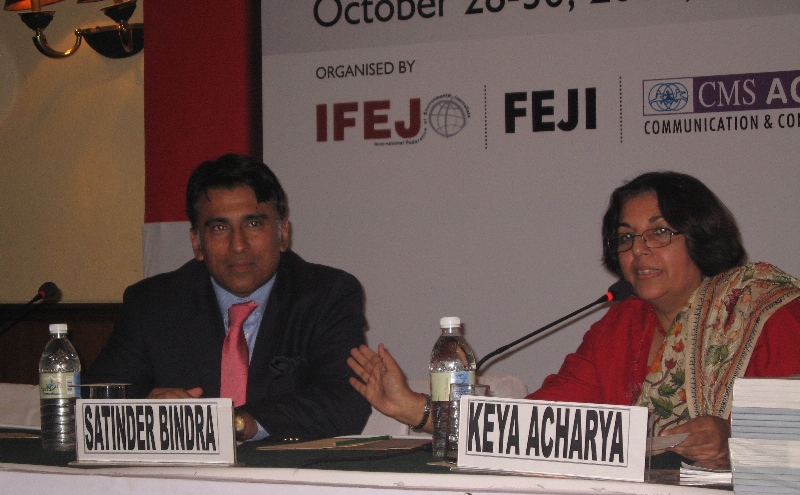
Satinder Bindra (left) and Keya Acharya
Satinder Bindra (left) and Keya Acharya at IFEJ 2009 Congress

Satinder Bindra left active journalism a couple of years ago when he joined the UN Environment Programme (UNEP) as its Director of the Division of Communications and Public Information (DCPI) based at UNEP Headquarters in Nairobi. But thank goodness he still thinks and acts like a journalist.

Satinder, whom I first met in Paris in the summer of 2008 soon after he took up the new post, gave a highly inspiring speech to the latest congress of the International Federation of Environmental Journalists (IFEJ), held at India Habitat Centre in New Delhi from 28 to 30 October 2009.

We have gone beyond the cautionary stage of climate change, and are now acting out ‘Part II’ where we have to focus on what people can do, he said. “Climate change is no longer in doubt, and if anything, the IPCC’s scenarios are turning out to be under-estimates.”

He was referring to the IFEJ congress theme, “Bridging North-South Differences in Reporting Climate Change: Journalists’ role in Reaching an Ambitious Agreement at COP15 in Copenhagen”.

Satinder sounded emphatic when he said: “We have a limited time in which to reach as many people as possible. Environment is the single biggest challenge we face in the world today, and we as journalists have a tremendous responsibility in providing the latest, accurate information to our audiences.”

He added: “There is still a debate among journalists on whether or not we should be advocates for the environment. We should not be scared to push the best science, even if we don’t choose to engage in advocacy journalism.”

Satinder mentioned the “Paris Declaration on Broadcast Media and Climate Change,” adopted by delegates at the first UNESCO Broadcast Media and Climate Change conference held in Paris on 4-5 September 2009. It resolved to “strengthen regional and international collaboration, and encourage production and dissemination of audiovisual content to give a voice to marginalized populations affected by climate change”.

Satinder, who was a familiar face on CNN as its South Asia bureau chief until 2007, acknowledged that the media landscape was evolving faster than ever before. “Thanks to the web and mobile media, our distribution modes and business models are changing. YouTube has emerged as a key platform. Viral is the name of the game.”

His message to broadcasters, in particular, was: “You may be rivals in your work, but when it comes to saving the planet, put those differences aside.”

Copy of Seal the Deal
A call to the whole planet...
Satinder is spearheading, on behalf of UNEP, the UN-wide Seal the Deal Campaign which aims to galvanize political will and public support for reaching a comprehensive global climate agreement in Copenhagen in December.

To me at least, the most important part of Satinder’s speech was when he said that he was not seeking to promote or position the UNEP or United Nations branding. His open offer to all journalists and broadcasters: “If you need to use the hundreds of UNEP films, or make use of our footage in your own work, go right ahead. We want you to make journalistic products. There’s no need or expectation to have the UN branding!”

Wow! This is such a refreshing change — and a significant departure — from most of his counterparts at the other UN agencies, who still think in very narrow, individual agency terms. They just can’t help boxing the lofty ideals of poverty reduction, disaster management, primary health care and everything else within the agenda setting and brand promotion needs of their own agencies.

I have serious concerns about this which I have shared on a number of occasions on this blog. See, for example:
May 2007: Feeding Oliver Twists of the world…and delivering UN logos with it!
August 2007: ‘Cheque-book Development’: Paying public media to deliver development agency logos
October 2007: The many lives of PI: Crisis communication and spin doctors
July 2009: Why can’t researchers just pay the media to cover their work?

In a widely reproduced op ed essay published originally on MediaChannel.org in August 2007, I wrote:

“As development organisations compete more intensely for external funding, they are increasingly adopting desperate strategies to gain higher media visibility for their names, logos and bosses.

“Communication officers in some leading development and humanitarian organisations have been reduced to publicists. When certain UN agency chiefs tour disaster or conflict zones, their spin doctors precede or follow them. Some top honchos now travel with their own ‘embedded journalists’ – all at agency expense.

“In this publicity frenzy, these agencies’ communication products are less and less on the issues they stand for or reforms they passionately advocate. Instead, the printed material, online offerings and video films have become ‘logo delivery mechanisms’.”

Let’s sincerely hope that the pragmatic and passionate Satinder Bindra will be able to shake up the communication chiefs and officers of the UN system, and finally get them to see beyond their noses and inflated egos. It’s about time somebody pointed out that vanity does not serve the best interests of international development.

See also April 2007 blog post: MDG: A message from our spin doctors?

New-and-improved Tinker Bell: UN’s latest Honorary Ambassador of Green

Tinker Bell and the Lost Treasure
Now she's green inside and out!

I always thought Tinker Bell was a bit green — with envy, that is. Peter Pan’s faithful fairy sidekick was far too possessive of him: every time another female appeared to get close, Tink would try to chase her away. She typifies the Jealous Female.

And now, Tinker Bell is very officially green, too: The United Nations has just named the Disney animated character Tinker Bell an “Honorary Ambassador of Green” to help promote environmental awareness among children.

The announcement came just prior to a screening at UN Headquarters in New York of the world premiere of the Walt Disney animated film, “Tinker Bell and the Lost Treasure.”

In the new movie, being released on DVD and BluRay on 27 October 2009, the feisty fairy first seen in 1953’s Peter Pan classic animation movie finally gets a makeover for her journey away from the magical land of Pixie Hollow.

The new and improved Tink looks more tomboyish: more of her body is covered in clothes, yet she still retains her curvy figure. “We wanted to make Tink as real as possible in Lost Treasure,” says director Klay Hall. “It made sense she was going to put on a jacket, leggings and boots. This is sort of a new phase for Tink, and the look brings her up to the current feeling we are trying to convey,” such as the belt she uses to carry items she needs.

Tomboyish yet curvy...“We’re delighted Tinker Bell has agreed to be our Honorary Ambassador of Green,” said Kiyo Akasaka, Under-Secretary-General for Communications and Public Information. “This beloved animated character can help us inspire kids and their parents to nurture nature and do what they can to take care of the environment.”
The UN event was intended to promote environmental awareness in the lead-up to the UN climate change conference in Copenhagen in December, where countries will aim to ‘seal the deal’ on a new global agreement to curb greenhouse gas emissions.

Protecting the environment is an underlying theme of the Tinker Bell movies, according to the UN Department of Public Information (DPI), which finds that the Walt Disney Company uses its storytelling to inspire a love of nature and spirit of conservation in its audience.

In the latest film, Tinker Bell’s greatest adventure takes place in autumn, as the fairies in Pixie Hollow are busy changing the colours of the leaves, tending to pumpkin patches and helping geese fly south for the winter. When Tinker Bell accidentally puts all of Pixie Hollow in jeopardy, she must venture out on a secret quest to set things right.

Tinker Bell Director Klay Hall, Producer Sean Lurie and cast members Mae Whitman (Tinker Bell) and Raven Symoné (Iridessa) were among those attending the premiere, hosted by DPI as part of the Secretary-General’s Creative Community Outreach Initiative.

The Initiative links the UN and producers, directors, writers and new media professionals seeking a working relationship with the world body with the goal of raising awareness of critical global issues.

Well, I can think of one Big Challenge for the creative community worldwide: find some way, any way, to ‘animate’ (i.e. bring to life!) the chronically dull and dour Ban Ki-Moon, Secretary General of the UN, who in his own admission is often invisible!

But hey, some feats are beyond even the most creative people! So just enjoy these two online videos…

Tinker Bell and The Lost Treasure: First 6 Minutes

Disney’s TinkerBell Named UN “HONORARY AMBASSADOR OF GREEN”

Imelda Abano: Asia’s Development Journalist of the Year 2009

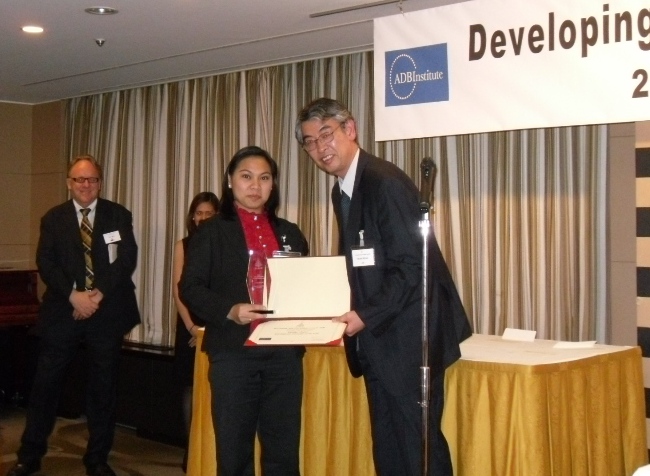
Imelda Abano receives her award in Tokyo, Oct 23

I was delighted to hear the news that Filipino science and environmental journalist Imelda Abano has just won the Developing Asia Journalism Awards (DAJA) for 2009.

“We are all winners,” said Imelda at the Awards ceremony organized by the Asian Development Bank Institute (ADBI) at the Foreign Correspondents’ Club of Japan. “We should continue writing compelling stories to make a difference.”

Imelda Abano, whom I have known and admired for several years, won one of two special awards for her story titled “Scorched Earth”, published on 19 May 2009, in the Business Mirror newspaper in the Philippines.

“Among all the articles, the judges were very impressed with the way Abaño’s article presented the
complex issues on climate change. It was a comprehensive and extra-ordinary piece that was made simple for the readers to understand,” said Monzurul Huq, one of the four judges and the president of the Foreign Correspondents’ Club of Japan.

“We judges were each very impressed by the overall high quality of entries for this year. The awards were meant to recognize the efforts made by Asian and Pacific journalists who provide high-quality coverage of issues affecting growth and development in developing countries,” said Anthony Rowley, presiding judge of the 2009 ADBI awards.

Imelda Abano was honored last year by the United Nations as the Gold Prize Winner for excellence in reporting on humanitarian and development affairs. She was also this year’s recipient of the 10 Young Leaders Award in the Philippines given out by the Philippines Graphic magazine for her reporting on development and environmental issues. In 2002, she won the Asian category of the Global Awards on Environmental Reporting organized by Reuters and IUCN.

The Developing Asia Journalism Awards (DAJA) scheme was launched in 2004 by the Asian Development Bank Institute in Tokyo, for journalists covering development issues in the Asia Pacific. It received around 200 entries this year, of which 22 journalists from 17 ADB developing nations were selected as finalists.

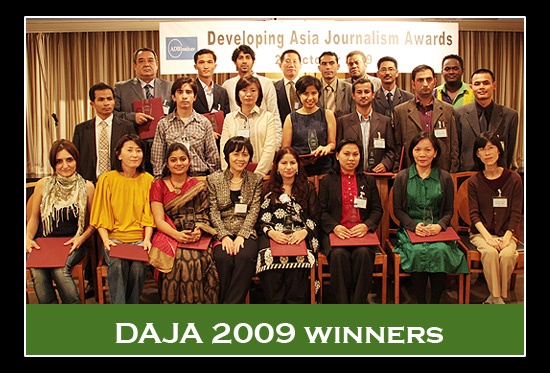
Supriya Khandekar from India won Young Development Journalist of the Year Award. Other winners are Sithav An from Cambodia for the Poverty Impact of the Global Financial Crisis category, Raknish Wijewardene from Sri Lanka for the Government Responses to the Global Financial Crisis category, Zhu Yan from China for the Infrastructure Development category and Moffat Ghala Mamu from the Solomon Islands for the Climate Change Adaptation category. Full list of winners

DAJA 2009 winners
DAJA 2009 winners