Sri Lanka: Island of suspended dreams has a second chance...
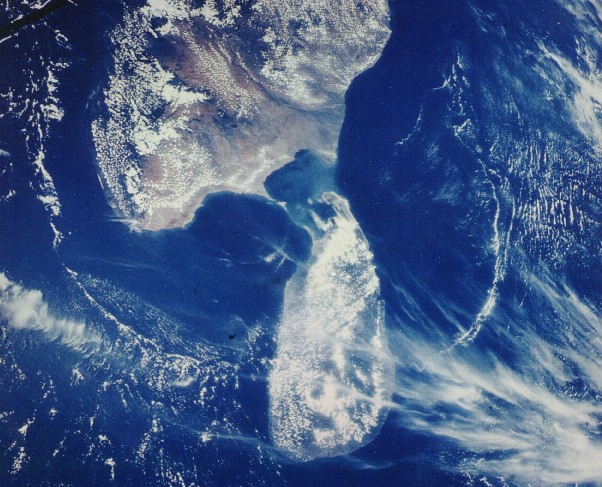
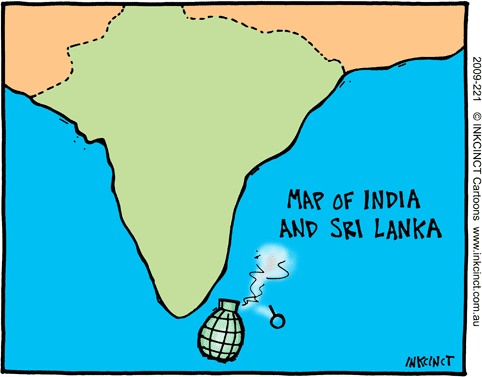
This is one of my favourite images. Showing southern part of India and my native Sri Lanka, it was captured by one of the early US space missions, nearly four decades ago.
Much has happened on the tear-drop shaped island since this image was taken: among other things, we’ve been through a civil war that lasted a generation, and robbed the dreams of at least two generations. That war officially ended on 18 May 2009.
The Day After, on 19 May 2009, I wrote a 1,500-word essay titled Memories of War, Dreams of Peace. The editor of Groundviews, Sri Lanka’s leading citizen journalism website, published it in full, and within minutes of my emailing the text to him.
I look back briefly on the brutal and tragic war – not in anger, but in great sadness. I then look forward in a wistful, dreamy mode. My premise was: “Now that the war is officially over, will this mark the beginning of real peace? I want to believe so. I want to audaciously dream of peace. The alternative is too dreadful to consider.”
This is not exactly what I’ve been trained to do. As a science writer and film-maker, I gather and analyse information, which I try to present in logical, coherent and accessible ways. In recent years, I’ve also been writing op ed essays in areas where I have some competence and experience. In writing this essay, I consciously departed from all that. I’m neither political scientist nor activist to engage in ideological or technocratic discussions, which others have already started in earnest. I wrote this at an emotional level, looking back and looking forward.
But my training did come in handy in framing the timely and necessary questions. My chosen ‘author intro’ for this essay thus reads: “Writer Nalaka Gunawardene has been a dreamer for all his 43 years. He asks more questions than he can answer.”
We've doused the flames of war, but much more needs to be done...If my views come across as naive or idealistic, I shall plead guilty as charged. My emotions this week are best described as cautiously optimistic, but as some readers on Groundviews pointed out in their comments, our high hopes have been betrayed before. But can we afford not to dream privately and publicly at this juncture? I don’t think so. We have suspended our dreams for too long, and it’s time to start dreaming again.
There are as many kinds of dreamers as there are dreams. One of my favourite quotes comes from the British soldier and writer T E Lawrence (of Lawrence of Arabia fame): “All men dream, but not equally…the dreamers of the day are dangerous men, for they may act their dream with open eyes, to make it possible.”
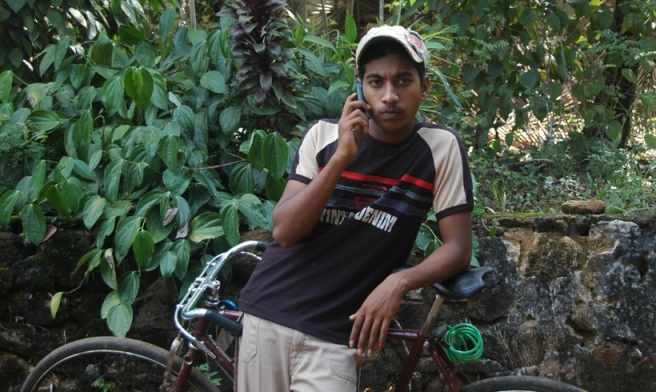
Chamara Pahalawattage: At 18, he is already using his 6th mobile (Photo by Niroshan Fernando, TVEAP)
When many able-bodied young men and women of his age were joining the armed forces in large numbers, Sri Lankan school-leaver Chamara Pahalawattage chose differently. He decided to try his luck with odd jobs at construction sites.
That, by itself, was nothing unusual. Tens of thousands of young men and women like Chamara join the labour market every year. Schools don’t equip them with attitudes or skills for self employment, so most would idle years away looking for regular jobs in Sri Lanka’s public and private sectors. Frustration would prompt some to take to political agitation, or worse.
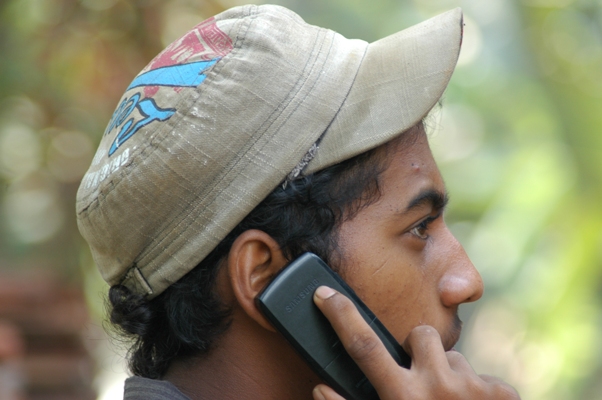
Chamara is at such crossroads in his own life, but he is unlikely to go astray. The enterprising young man has boosted his chances of part-time work by getting himself a mobile phone.
“After buying a phone, I get calls asking me to come for work. The phone makes it so easy,” he says. “Otherwise people will have to come looking for me…or I have to go to them.”
If a skilled mason or carpenter takes him on as an assistant, Chamara gets a daily wage of LKR 700 (US$ 6 approx) plus a mid-day meal. That income augments the modest LKR 4,000 a month (US$35) his mother makes cooking meals at a nearby factory.
In February 2009, we filmed a day in the life of Chamara, a resident of Gonapola, in Sri Lanka’s western province. This was part of a profiling of telephone users at the bottom of the (income) pyramid – or BOP – in emerging Asian economies, undertaken by TVE Asia Pacific on behalf of the regional ICT research organisation LIRNEasia.
Watch our short video profile of Chamara Pahalawattage:
Going by his household income, Chamara is BOP at the moment – but his aspirations extend above and beyond. An only child raised by his widowed mother, Chamara developed an interest in mobiles while still in his mid teens. He bought his first mobile two years ago, when in Grade 11 at school.
“Almost everyone had phones, so I also wanted one,” he recalls. “From then on, I got used to having a phone!”
And has he been keeping up with technology! He buys second-hand phones for better features: he currently owns his sixth phone in just over two years. He had paid LKR 7,500 (US$ 65) for his latest phone at the beginning of 2009.
Besides voice and SMS (texting), his phone supports MP3, video recording, song downloading, voice recording and some other functions. After a hard day’s work, he unwinds listening to the radio, or swapping songs with friends — all using their mobiles.
Chamra spends an average of US$3 to 4.50 per month on phone use, and – like all other BOP telephone users we interviewed in India, Philippines and Thailand – he is thrifty with value added services that cost extra. This is something that has been confirmed by LIRNEasia’s Teleuse@BOP 2008 survey.
“Some of my friends access the internet through their phones and download songs,” he says. “I then get these songs from them. My phone has bluetooth. I use it to transfer songs from my friends’ phones.”
Chamara has every intention of moving up the labour market – someday, he wants to hold a more regular job, with an assured monthly income. Right now, in spite of being connected, he can’t predict how many days a month he’d find work.
Hello, can you hear our dreams? Photo by Niroshan Fernando, TVEAP“I don’t check newspapers for jobs. Instead I ask the people I know…mostly my friends,” he says. This probably indicates another shift from a wide-spread habit among literate Sri Lankans scanning newspapers for recruitment notices.
LBO 9 March 2009: Sri Lankan low income customers can use mobiles more for business: study
The official end of the 30-year-long war should be good news for Chamara and millions of other tech-savvy, eager youth like him. Like me, they can once again start dreaming of better tomorrows.
Telecommunications would be a good place to start. For several years, it has been the fastest growing sector in the Sri Lankan economy — one that has not only connected people across distances and cultures, but also been a ‘social leveller’.
The telephone subscriber base grew by 35.5% in 2008 (and 47% in 2007). The country’s tele-density (number of telephones per 100 persons) jumped to 71.9 in 2008, from 53.4 in 2007 -– thanks largely to the phenomenal spread of mobile phones.
As I noted last year: “It is not by accident that telecom has remained the fastest growing sector in the economy for a decade. This was triggered and sustained by the far-reaching policy and regulatory reforms which ended the then fully state-owned telecom operator’s monopoly, and allowed the entry of new players, technologies and business models.”
Of course, improved telecommunications are necessary, but not sufficient by itself, for us to evolve into an inclusive information society. Building on technology and systems, we must become discerning creators and users of information. Knowledge – not paranoia or rhetoric – needs to form the basis of policy and actions that propel us to the future.
Photos courtesy Niroshan Fernando, TVE Asia Pacific
In our troubled times, cartoonists often provide more than mere caricature and entertainment. War and peace are no laughing matters, and neither is the profound advice some cartoons offer us. As a product of our image-saturated, popular culture driven world, I derive part of my insights from cartoonist-philosophers whose economy of words is unbeatable.
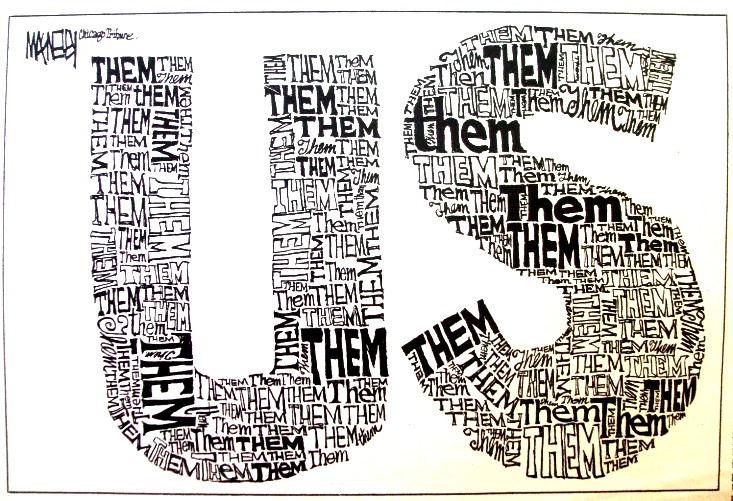
I haven’t discovered exactly what provoked the American cartoonist Jeff MacNelly (1947 – 2000) to draw this brilliantly perceptive cartoon in May 1992. But the three-time Pulitzer prize winning editorial cartoonist of the Chicago Tribune (and creator of popular comic strip Shoe) has captured a sentiment that has characterised so many tensions and suspicions in his land and mine: us and them.
It’s at the root of so much conflict and grief, be it between Islam and the West, or Israel and Palestine, or Sinhalese and Tamils in Sri Lanka. Its entirely a matter of perception, largely a creation of our insecure and insular minds. Yet we argue, wage war and kill each other for the sake of this strong tribal perception.
In an op ed essay published on Sri Lankan citizen journalism website Groundviews today, titled Memories of War, Dreams of Peace, I asked: “Can we as a nation finally stop glorifying the war and its weapons, and return to our cultural heritage of ahimsa? How do we turn the current opportunity for peace into something tangible and lasting, so that we don’t allow political violence and war ever again? Do we have what it takes to go beyond chest thumping and finger pointing, and begin to care and share? Would we eventually be able to liberate our minds from our deep-rooted tribalism that sees everything through the prism of us and them?”
Indeed, one of the first – and hardest – challenges as we try to unify Sri Lankans and rebuild our war-ravaged country is to get over this division.
They say the long and bloody Sri Lankan civil war is over, and I’d say not a moment too soon. I really want to believe it. I simply must: the alternative is too depressing to consider.
Sure, there is no independent verification – it has been a war without witnesses for the last few years. But I am willing to take an unusual leap of faith if that’s what it takes to usher in the long-elusive peace. I will go to the ends of the earth, and suspend disbelief if I have to, in return for lasting and meaningful peace.
As we stand on the threshold of change – with the promise of peace – I am overwhelmed with memories of a tragic past. And I hope we can once again start dreaming of a better future – and make it happen.
After a hiatus of three decades – three quarters of my own life – I dare to dream again. I hope other Lankans will soon revive and resume their suspended dreams.
So what kind of a future Sri Lanka can we, must we, should we now dare to dream about? Where do we look for the vision and inspiration?
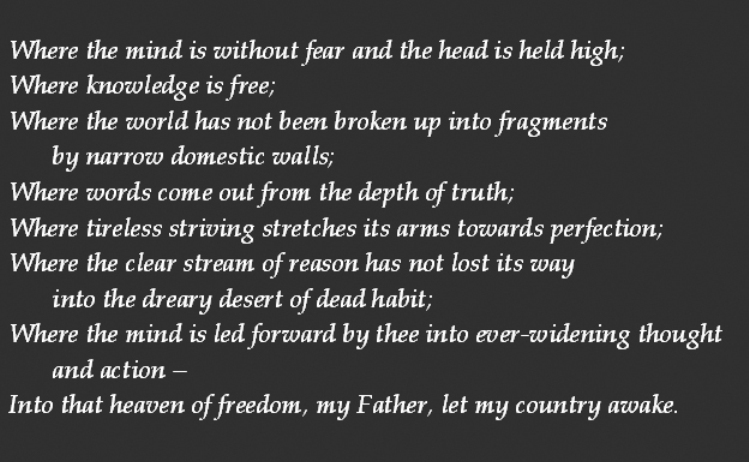
One of the greatest poet philosophers of the East had articulated many decades ago the very essence of my dream for a post-war Sri Lanka. I once heard the late Lakshman Kadirgamar – another tragic casualty of our war – render these momentous words at a South Asian gathering in his impeccable English which brought out all its nuances.
Across the gulf of space and time, Rabindranath Tagore speaks for many of us:
The legend lives on: Arthur C Clarke (1917 - 2008) - photos by Rohan de Silva
Today we mark the first death anniversary of Sir Arthur C Clarke. Exactly one year ago, when he passed away aged 90, I was thrust into a media frenzy. I’d been Sir Arthur’s research assistant and, in later years, his media spokesman and in the hours and days following his death, the family asked me to continue that role.
This blog recorded my experiences and emotions as they happened (see several posts in the latter half of March 2008). A year later, all of us who worked closely with him still miss Sir Arthur, but I can now take a more detached, longer-term view. And that’s what I’ve just done.
In an op ed essay published today in Groundviews website, I argue that sparking imagination and nurturing innovation are the best ways in which Sri Lanka can cherish Sir Arthur’s memory in the land he called home for half a century.
Despite his well known ego, Sir Arthur never sought personal edifices to be put up in his honour or memory. When a visiting journalist once asked him about monuments, he said: “Go to any well-stocked library, and just look around…”
In the weeks and months following Sir Arthur’s death, many have asked me what kind of monument was being planned in his memory. As far as the Arthur C Clarke Estate is concerned, there is none –- and that seems to surprise many.
Yet it is fully consistent with the man of ideas, imagination and dreams that Sir Arthur Clarke was. Monuments of brick and mortar — or even of steel and silicon — seem superfluous for a writer who stretched the minds of millions. Commemorative lectures or volumes cannot begin to capture the spirit and energy of the visionary who invented the communications satellite and inspired the World Wide Web.
A life of no regrets...except for a minor complaint In my essay, I suggested: “Instead of dabbling in these banalities, Sri Lanka should go for the ‘grand prize’: nurturing among its youth the intellectual, cultural and creative attributes that made Arthur C Clarke what he was. In other words, we must identify and groom the budding Arthur Clarkes of the 21st century!”
Easier said than done. In fact, in a country like Sri Lanka that is still partly feudal, insular and stubbornly clinging on to the past instead of facing the present and future, this becomes formidable. This is why I noted: “But can imagination and innovation take root unless we break free from the shackles of orthodoxy? For transformative change to happen, we will need to rethink certain aspects of our education, bureaucracy, social hierarchies and culture. Are we willing and able to attempt these?”
I then discuss some of the key challenges involved in nurturing imagination and innovation. I end my essay with these words: “Let’s not kid ourselves: sparking imagination and innovation is much harder than launching a gleaming new satellite in Sir Arthur’s name. But the rewards would also be greater: if we get it right this time, Sri Lanka can finally take its rightful place in the 21st century.”
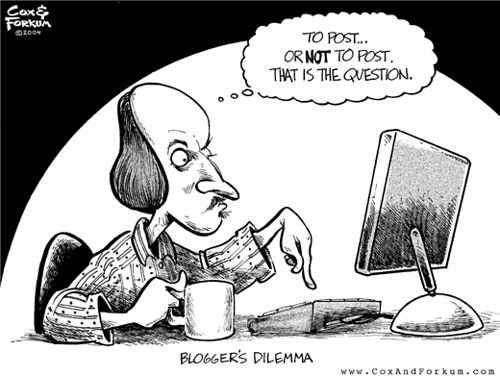
Blogs put ME back into MEdia...The Moving Images blog completes two years today. So we pause briefly to look back – and forward.
I launched the blog with two posts from near-freezing Washington DC on 17 March 2007, while participating in the DC Environmental Film Festival. Both concerned my own offering to the festival: Children of Tsunami: The Journey Continues, product of monthly filming with 8 survivor families in 4 countries for nearly one year after the Asian tsunami.
Since then, this blog’s own journey has continued: in 24 months, we have produced 342 posts in 134 categories and with 562 tags. These elicited a total of 622 comments from readers who came from all walks of life, and all parts of the world. To the end of 16 March 2009, I received a cumulative total of slightly over 246,900 page visits. I now average 500 – 600 visits a day.
I share my blogging journey with these readers who have enriched it in various ways. Some commented under their own names; others used pseudonyms. Some left email details; others none. A few have actually suggested stories that I later wrote up as blog posts. I don’t know most of my readers in person, and have only met them online. As this blog enters its 25th month, I thank them all. You’ve kept me going in a particularly tough time in the world…and in my personal life.
When I started Moving Images, I was driven by a simple motive: to discuss and reflect on the many and varied topics and subjects that interest me professionally. In one way or another, these fall into the area of communicating science, development and environment to the non-specialist public. Because my work at TVE Asia Pacific involves using television and video for this purpose, there is a bias on moving images in many things I do.
But by design, this is not an official blog of TVE Asia Pacific, or any other organisation that I am associated with. In fact, I regularly express here views that I cannot say wearing any of these hats — because we live in a world where most people still react not just to the song, but also the singer (and can’t separate the two).
Are we there yet? No!So this blog is unashamedly, intentionally self-centred: it puts ME back in Media. I make no apologies for speaking my mind on a variety of topics, and for returning to some issues that I’m passionate about.
After 22 years in journalism, broadcasting or communicating development, I find I have sufficient perspective in which to anchor my thoughts, and to express my views in a way, I hope, interests and engages readers. Like the ancient Greeks, I try to ask the right questions – even when I don’t always know or get the right answers. And I have more than a few stories to spice up the narrative.
I’m well aware of the inherent danger of combining writer-editor-publisher all in one: personal blogs don’t always operate under the usual checks and balances that we expect and presume in the more structured media outlets (whether they are in the mainstream or new media spheres). On more than one occasion, I’ve written impulsively – in frustration, anger or elation, and sometimes on the run. Thanks to the training in my news reporter days, I can still churn out readable prose fast. And only once in all these 24 months and 342 posts have I regretted rushing to publish (so, using my absolute discretion as the media tycoon of this blog, I pulled it down).
Do I see myself as a citizen journalist? Yes and no. I don’t report news, and only very occasionally write on latest developments (or breaking news, as it’s now called). I see myself more as a citizen commentator – the op ed equivalent in the new media domain. Yes, I do occasionally report from large conferences that I attend as a speaker or panelist. But I have found how demanding it is to blog from events while keeping up with everything that is going on.
Do I see myself as a Sri Lankan blogger? Not really. Scanning the 342 blog posts I’ve written, I can count only a two dozen that have an appreciable reference to Sri Lanka. This is not because I’m aloof or disengaged; I have simply set a framework for myself that goes well beyond the country of my residence and social/cultural anchor.
Another reason for this intentional lack of geographical focus is that besides this blog, I regularly write op ed essays for other online outlets like Groundviews, MediaChannel.org and MediaHelpingMedia, and print news magazines like Montage. I use these platforms for commenting on Sri Lankan issues that interest or concern me.
I find it a bit incongruous that we who use the new media tools of web 2.0 – which signify the end of old geography – must contain ourselves to geographical or cultural cocoons. Thus, while I sometimes join gatherings of bloggers based in Sri Lanka, and share concerns for freedom of expression, I have consciously avoided joining Kottu, the leading aggregator of Sri Lankan blogs.
And I get more than a little miffed when the excellent aggregation service Global Voices constantly labels me as a Sri Lankan voice (with a map of Lanka to boot!) whenever they helpfully flag my blog posts for wider attention. I have privately discussed this with GV’s South Asia coordinator who says their current tagging and categorisation do not allow anything else. Is this an example a new media platforms being trapped in an old media mindset?
If you really must pin me down to some place, call me a South Asian (or, as my friends at Himal would like to write it, Southasian).
Do I see myself as a new media activist? I’m not sure. I’m not a geek, and have no great knowledge or insights on the back-end technologies that make all this possible. My interest is in how the new media tools shapes societies, cultures and politics in emerging Asia. Those braver and smarter than me are actually innovating and improvising new media tools for social activism. I just watch — and occasionally blog to critically cheerlead them. Mine is definitely the easy part…
Mainstream media...and bloggersOn this blog, I place a higher premium on still and moving images. Regular readers know my fondness for cartoons, which I avidly search for and collect on a wide range of topics. In fact, I believe cartoonists are the best social and cultural commentators of our times – they say so much with such economy of words!
Similarly, I try to embed relevant online videos that I can find. Sometimes it takes me longer to scan YouTube and other platforms than to write the accompanying text for a blog post. And I get frustrated when WordPress does not allow embedding from certain online platforms like EngageMedia, a new Asia-based service that we have recently started to collaborate with.
As I travel around in Asia and Europe, and move across the sometimes overlapping circles of development, media and communications technology, I keep meeting readers who read and follow this blog. Some have never commented on any post; a few have chosen to write emails to me on specific matters.
This means some of the conversations inspired by this blog happen bilaterally — for example, film festival organisers have written asking me for contacts of specific film-makers whose work I have reviewed. Students often write to me seeking additional information or my own views. Long lost friends or associates have revived contact after stumbling upon this blog. I have no illusions of being famous, but it’s nice to stay engaged.
My policy on visitors’ comments is clearly stated in my intro page: “This is a moderated blog where I approve/disapprove the publication of readers’ comments to individual posts. I do allow all reasonable comments left by readers — including those that radically disagree with my own views. The basic rules of my moderation: I don’t publish comments that are outright libelous of individuals, or are so explicitly self-promotional bordering on spam.”
Only once in the short history of this blog have I been threatened by someone whose conduct I questioned in the public interest. In late 2007, I wrote a hard-hitting comment on how certain media organisations are exploiting concerns surrounding climate change to their institutional advantage. I was standing by to publish their response, for the institution I named claims to promote public discussion and debate. None came my way, although some peer pressure was used, unsuccessfully, to make me remove the blog post. In mid 2008, when our paths accidentally crossed in a European capital, the individual concerned confronted me. I gave him a patient hearing, and reiterated my offer to publish his response in full. He insisted on my deleting the post (gosh, it must have hit a raw nerve!). He ended our unpleasant encounter saying: “If you lived in my jurisdiction, I would have sued you!”
There has never been a denial or rebuttal from this person or his institution on the substantive points in my blog post. But I was repeatedly told that my candid remarks are ‘not helpful’. Perhaps. But anyone who remotely believes in ‘illuminating debate’ would have engaged me on this blog, or theirs, or in a neutral forum (plenty exist).
Luckily, I've rarely faced this situationEncouragingly, many others have done just that. This includes the reader who thinks I have an axe to grind with the BBC (I don’t, but I’m also not a fan of the ageing Auntie), and a few who feel I’ve been unkind to the fledgling global newscaster Al Jazeera English.
Then there are those who assume that I hate state-owned, so-called public broadcasters (again, I don’t, although I question their conduct more rigorously because they are public-funded). In fact, I have sung praise of Burmese TV as a model public broadcaster, and maintained excellent relations with NHK and other public broadcasters in Asia. I’m regularly invited as a speaker or panelist at gatherings of mainstream broadcasters – where I express pretty much the same views as I do on this blog.
Some think I’m too harsh on the United Nations, especially UNICEF. Again, I’m a great believer and supporter of the UN’s ideals, but never hesitate to critique the public communication policies and practices of individual UN agencies. I like to think that the United Nations is bigger (and deeper) than the inflated egos of its senior officials. In fact, middle level officials and experts working in various UN agencies have privately commended me for keeping the spotlight on their agencies. During the two years of this blog, I have worked closely with UN-OCHA, UNEP and UNAIDS, and they have been pluralistic enough to engage me in the greater public interest.
I believe that it’s not just the UN, but the entire development sector, that needs to get its act together when it comes to communicating policies, practices and choices. Having occasionally (and luckily, only briefly) forayed into the charmed development circles, I realise how detached from reality, self-referential and inward looking many development professionals and their institutions are. Communication is often no more than self-promotional publicity for overambitious agency heads. I have watched how the sector has struggled to adjust to the new realities in media and communications technology. Sometimes I have ridiculed their worse attempts on this blog; more often than not, I have quietly worked with them in small groups or bilateral meetings trying to build their capacity to do things better with greater focus and impact.
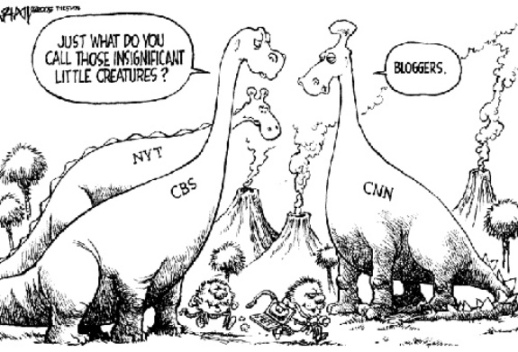
I survived mediasaurus - and lived to tell the tale!Precisely because I have access to various policy, development and research circles in Asia while (or despite?) being a blogger critiquing the same players, I exercise caution in quoting people or citing examples. Some meetings I attend discuss matters too sensitive for immediate publication; others operate on the Chatham House rule (generic points may be communicated, but without attribution). As a journalist, I’ve been trained to clarify what is on the record and what isn’t; in sourcing content for this blog, I follow the same principles.
Every writer, editor and publisher has her own agenda. Mine is fairly easy to discern, for example from the recurrent themes on this blog. These include: * humanising development communication (going beyond mere facts, figures, analysis and jargon); * demystifying and debunking self-serving development myths (for example, about community radio, or rural poverty); * practising what we preach (broadcasters addressing their own carbon emissions); * evolving more inclusive copyright policies (poverty and climate change as copyright free zones); and * engaging in simple, clear and effective communicating of science and technology in society.
For those who occasionally look for a hidden agenda, my only advice is: get a life. I write this blog for fun. I don’t set out to kick anyone – although I often get a kick out of receiving online or offline feedback.
And that’s my wish for the coming months and years: while I work hard to earn some honest bucks else where, may I continue to derive my kicks here. And if some of you also get a mental kick out of reading or commenting on this blog, that’s my bonus.
Since I remain open-minded and eager for new knowledge, my views on some topics and issues keep evolving over time. Although it’s tempting to go back and edit some of my earlier blog posts in the light of new knowledge or understanding, I refrain from doing so. And if that sometimes presents (minor) inconsistencies, I can only quote Walt Whitman in my defence: Do I contradict myself?
Very well then I contradict myself,
(I am large, I contain multitudes.)
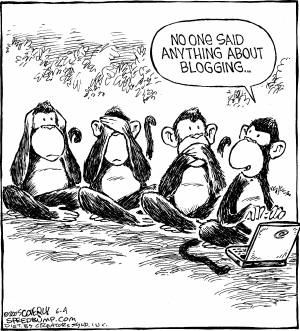
Being the fourth monkey?“Historically, organised and commercialised mass media have existed only in the past five centuries, since the first newspapers — as we know them — emerged in Europe. Before the printing press was invented, all news was local and there were few gatekeepers controlling its flow. Having evolved highly centralised systems of media for half a millennium, we are now returning to a second era of mass media — in the true sense of that term. Blogs, wikis and citizen journalism are all signs of things to come.”
This is how Sir Arthur C Clarke and I summed up the transformative change that is currently taking place in the world of mass media, in an essay we co-wrote for the Indian news magazine Outlook in October 2005.
We’d given it the title ‘From Citizen Kane to Citizen Journalist’ – a formulation that I’m still proud of – but the editors changed it to ‘Arise, Citizen Journalist!’. Of course, our original title made evocative sense only for those who knew the popular culture reference to the movie Citizen Kane.
I recently had a chance to revisit these issues and explore them further in a half-hour, in-depth TV interview with media researcher/activist and fellow citizen journalist Sanjana Hattotuwa. This was part of The Interview series produced by Young Asia Television, and broadcast on two Sri Lankan TV channels, TNL and ETV during the second week of February 2009.
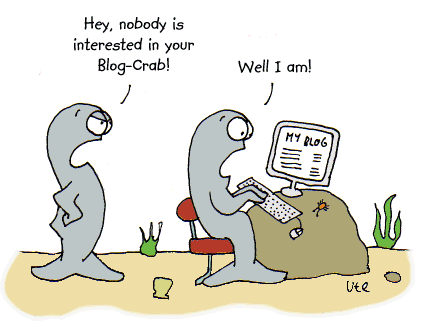
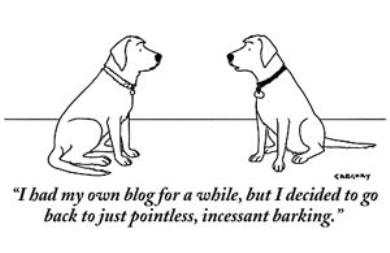
Sanjana covered a wide range in his questions. Starting with a brief reflection on my 21-year association with Sir Arthur Clarke, we moved on to the bewildering world of new media and its co-existence with the mainstream media. We discussed the fragmentation of audience and the concern that some current and would-be bloggers harbour: is anyone listening or reading?
And more importantly, how do we get conversations started and going. I look back on my own experience as an active blogger for almost two years, and assert that if we have something new and worthwhile to say, and know how to express it well, we can slowly build up an audience. There’s no blueprint or road map – everything is in ‘beta’ mode, and the name of the game is try-it-and-see!
Here’s that full interview on YouTube, broken into four parts:
Sanjana Hattotuwa talks to Nalaka Gunawardene – Part 1 of 4:
Sanjana Hattotuwa talks to Nalaka Gunawardene – Part 2 of 4:
Sanjana Hattotuwa talks to Nalaka Gunawardene – Part 3 of 4:
Sanjana Hattotuwa talks to Nalaka Gunawardene – Part 4 of 4:
The keynote address was delivered by Sri Lankan minister of environment and natural resources. The British Council asked me to speak a few words at the opening as TVE Asia Pacific is a local partner for this event.
Here’s what I said, which sums up why we are in this business:
We are delighted to be partners in hosting Wildscreen film festival in Sri Lanka. We thank our friends at the British Council and Wildscreen festival for this opportunity to join hands.
May I say a brief word about ourselves. We’re Television for Education Asia Pacific — trading as TVE Asia Pacific. We’re a regionally operating media foundation anchored in Colombo and engaging developing countries of Asia. We were set up in 1996 by a group of Asian and European filmmakers and TV professionals to cover the full range of development issues using broadcast television, narrowcast video and now, the web.
We are driven by a belief that what is happening in the world’s largest and most populous region has far-reaching implications not just for our region — but also for the entire planet.
When introducing our work, I like to recall the words of Mahatma Gandhi. Once, when asked by a visiting foreign journalist for his views on wildlife in India, he said: “Sadly, wildlife is declining in our jungles, but wild – life is increasing in our cities.”
It is precisely this wild–life that interests us more. In our work we keep asking: when life itself is going wild, what hope and prospects are there for wildlife, Nature and environment?
For example, we’ve literally just finished a short film looking at environmental restoration of Afghanistan. This will be screened to the environmental minister from around the world who will gather shortly for the UN Environment Programme’s Governing Council meeting in Nairobi.
We can't just walk into a glorious sunset and forget real world challenges - Photo by Niroshan Fernando, TVEAP
Capturing wild-life is now the focus and concern of wildlife and environmental film makers everywhere. There was a time, not too long ago, when films used to simply capture the beauty of Nature and the diversity or behaviour of plants and animals. Such documentation is still very necessary and useful — but it’s no longer sufficient.
In the past couple of decades, all film makers have been challenged to look at how our own ‘wild’ ways of living affects:
– each other in our own human species;
– the rest of Nature and other species; and
– also, the future of life on Earth.
We see this transformation reflected in the content of films entering Wildscreen and other film festivals. I saw early signs of this when I served as a juror at Wildscreen 2000 festival. This process has gathered momentum since.
To remain relevant and topical, films can no longer just cover ‘green’ subjects — they have to acknowledge the ‘brown’ issues as well as the harsh black-and-white, life-or-death concerns such as climate change.
At the same time, we have seen a rapid diversification of formats or genres — especially with the emergence of online and mobile platforms. These now compete with broadcast television to engage audiences. This is both good news and bad news for us engaged in film making and film outreach. Yes, we now have more ways of reaching people than ever before. But engaging audiences is harder: people have more choice — and more distractions!
Of course, we can’t just give up the good struggle and walk away into those beautiful sunsets. At TVE Asia Pacific, we believe that making good films is only half the job done. Distributing them far and wide is just as important. This is why the slogan of our own organisation is: Moving images, moving people!
In that process, film festivals such as this one play a key role. We’re very happy to add an extra day of screenings to this event. On Saturday in this auditorium, we’ll be showing a number of films on climate change and sustainable development drawn from our own catalogue of films we distribute to broadcast, civil society and educational users across Asia.
These are small efforts in a big world. I can only hope all these help us in winning history’s greatest race – which, according to H G Wells, is one between education and catastrophe!
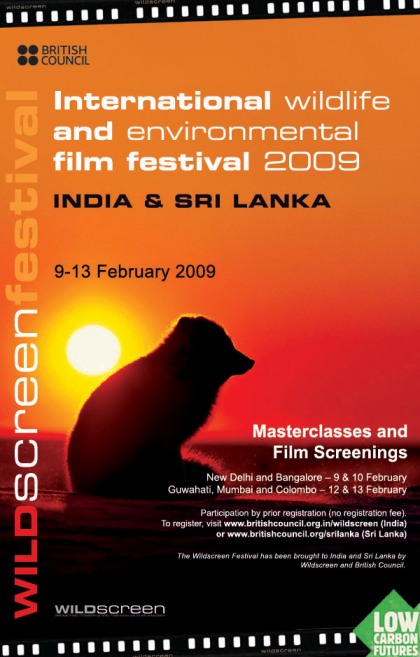
Wildscreen comes to ColomboWildscreen, the world’s largest and most prestigious wildlife and environmental film festival, will be touring India and Sri Lanka in February 2009.
Nine wildlife or environmental filmmakers from the UK will be coming to India and Sri Lanka as part of this event, organized by the British Council. The festival will also see screenings of wildlife and environmental films from across the world, some of them winners of the Wildscreen festival’s Panda Awards, the environmental equivalent of the Oscars.
The Wildscreen Festival was founded by Sir Peter Scott in 1982. It has been organised every alternate year for the past 25 years, and is now considered to be the world’s largest and most prestigious wildlife and environmental film festival. Held in Bristol, UK, it attracts hundreds of delegates from around the globe who work in film, television and new media, as well as those involved in environmental conservation.
The Festival is coming to Sri Lanka for the first time. The programme, held at the British Council Colombo on 12 – 13 February 2009, will screen several award winning films on climate change and wildlife, showcasing the best of current environmental film making worldwide. On 14 February 2009, TVE Asia Pacific will present a selection of films on environment and sustainable development drawn from their global catalogue, which includes some Sri Lankan and South Asian titles.
As I have explained elsewhere: “I’m strongly committed to promoting media freedom, but have never been the placard-carrying, slogan-shouting type. Street activism is necessary — but not sufficient. I’ve been more interested in studying trends and conditions, trying to anticipate what the next big threats, challenges and opportunities are, and how best we can respond to them.”
So I went to the vigil more for Lasantha the person and less for any organised effort. The invitation I received by SMS and email from several sources asked us to gather outside Colombo’s Vihara Maha Devi (formerly Victoria) Park at 5.15 pm. It was going to be a ‘joint civil society protest’ against Lasantha’s killing and the erosion of media freedom, democracy and human rights.
It turned out to be a well-intended but poorly-planned event lacking in vision and dynamism, perhaps a bit like our (very) civil society entities themselves. The couple of hundred people who joined it came mainly from Colombo’s high society, the ones who faithfully lapped up every word that Lasantha churned out week after week for nearly 15 years. Ironically, Lasantha and his newspaper were only loosely associated with this kind of (very) civil society – fellow companions on a shared journey, but not necessarily agreeing on priorities or strategies.
I remembered the battered face of an old lady who sat through the entire funeral service – and then left quietly, without even lining up with the rest of the crowd to take one last look at Lasantha as he lay amidst flowers. I remembered the handful of men and women dressed in bright coloured clothes – standing out amidst the sea of white or black clad people – who I later found out came from the Kotahena area and were part of Lasantha’s home town church.
Lighting candles was good. Keeping the flame alive is harder...
No one had sent SMS or emails asking them to turn up. Some of them might not have been readers of English newspapers, which circulate among a numerically small but socially and economically influential section of Lankan society. They came because they felt the fallen man had stood up and spoken out for them.
In comparison, the candlelight vigil was decidedly upmarket. Nothing wrong in that, for the chattering class is very much part of our society and have the same rights to dissent and protest. In some countries, the upper middle class even provides vision, articulation and leadership to mass struggles. Ours, sadly, is more characterised by part-time activists who move more in the cocktail circuits grumbling about everything yet doing precious little to change the status quo. Indeed, some of them in their day jobs benefit personally from the prevailing corruption and nepotism, no matter which political party is in office.
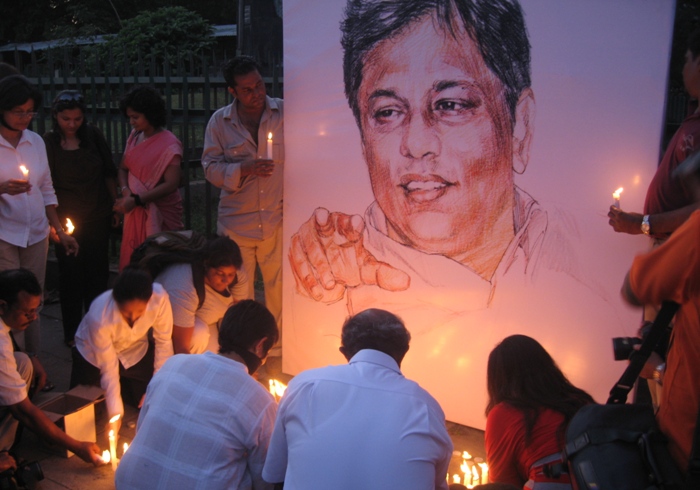
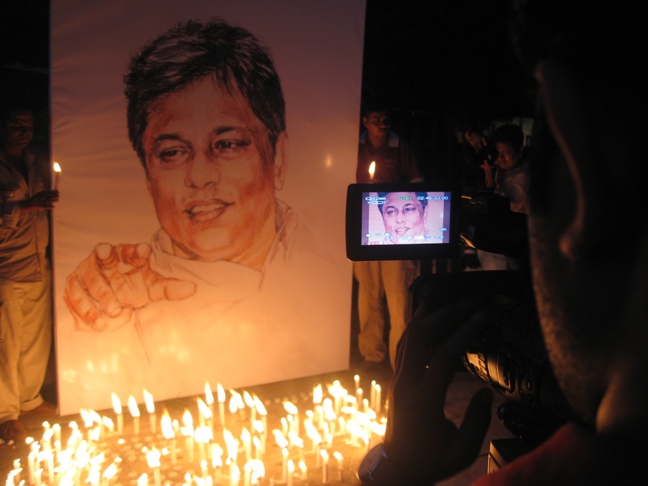
The vigil’s organisers – it wasn’t clear who exactly they were – had painstakingly got the material ready: a large painting of Lasantha, black cloth bands and, of course, candles. But they hadn’t given enough thought to the location. We initially gathered and spent over half an hour on a stretch of road (Green Path) where only motorists passed by, but absolutely no pedestrians. Then someone thought of moving to the nearby roundabout which was a more visible, strategic location.
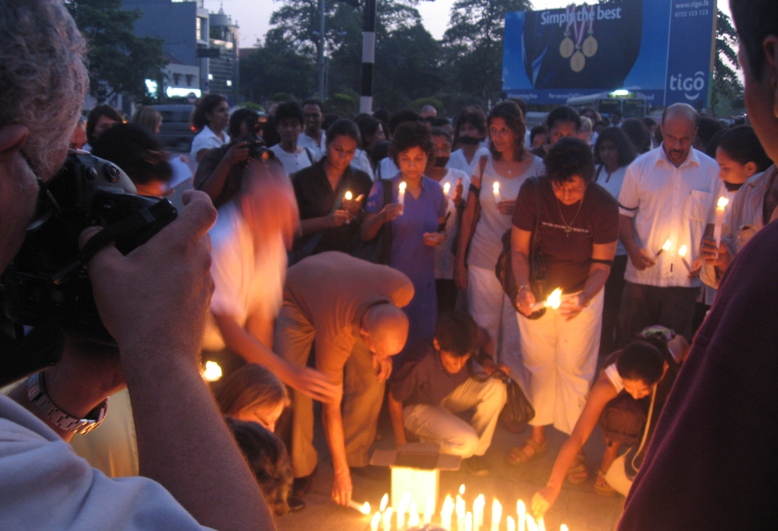
Not perfect, but better. By then, dusk was beginning to fall. We moved unhurriedly, chatting among ourselves, and slowly converged on a wide pavement. There, one by one, we started planting our candles on the ground in front of Lasantha’s picture. It was a moving moment captured in many still cameras and a handful of video cameras.
There we lingered for another hour or more, chatting with each other — and not necessarily about the lofty or somber matters. I was glad to catch up with several friends or associates active in artistic, journalistic or intellectual circles. I saw everybody else doing the same.
One of them, a human rights activist now turned peacenik, asked me many eager questions about blogging. A columnist for an English daily, he isn’t active online and his organisation is notably inept when it comes to mobilising the web for their cause. In his early 50s, he evidently hasn’t crossed what I call the Other Digital Divide. And he typifies the face of our organised civil society – a motley collection of do-gooders who are liberal, mostly secular, passionate yet largely ineffective in their advocacy for reform and change. They just can’t mobilise people power.
Candles burn out, but the image captured will live for longer...
Admittedly, it’s a quantum leap from the one-way street in op ed pages of mainstream print newspapers to the far less orderly, sometimes near-anarchic and often unpredictable world of the blogosphere. This might explain why a majority of Lankan civil society groups stay within their comfort zone and don’t engage the world of web 2.0
On the other hand, the younger, digitally-empowered activists who engage the web with technical savvy and passion are often too impatient or inexperienced (or both) with the necessarily tedious processes of institutional development – such as legal registration, financial management and putting in place mechanisms for the very ideals they advocate in governments and corporations: proper governance and accountability.
Fortunately, this offline/online divide is blurring, even if only slowly. Groups like Beyond Borders, which originated and found their feet in the new media world, are becoming more institutionalised. If they sustain themselves (and don’t lose their sharp edge), they can bridge the online world with the offline realities and needs.
Meanwhile, as some doggedly persistent citizen journalists and new media activists have shown in the days following Lasantha’s killing, it is now possible to stir up public discussion and debate on issues of rights, freedoms and democracy using dynamic websites, blogs, online video and other tools of web 2.0. See, for example, this reflection by the Editor of Groundviews.
Whether they are active online or offline, committed activists in Sri Lanka have their work cut out for them. If the candlelight vigil for Lasantha is an indication, far more work needs to be done in strategy, unity, networking and technology choices. The old order needs to pause, reflect and change their ways. If they can’t or won’t, at a minimum they must get out of the way. (Remember what happened to those dinosaur species that were vegetarian and harmless? They too went the way of T rex…)
Earlier on in the evening, as we were heading to the roundabout with burning candles in our hands, the wind suddenly picked up. Many of us struggled to keep the flame burning, sometimes shielding it with one palm. It wasn’t quite easy to do this while walking forward, watching our step. Amidst all this, we lost sense of where we were heading. We just followed those immediately in front of us, unsure who – if anyone – was leading. Not smart or strategic.
As I drove home, I realised how symbolic that candle-in-the-wind moment had been. Keeping the flames of truth, justice and fairness alive is hard enough. It becomes that much harder when winds of tribalism threaten to snuff it out. And in the thickening darkness, how do we make sure we are headed in the right direction?
The night is young and storm clouds are still gathering. We have miles to go before we can sleep.






 Open Minds!