Danny Schechter: Moving Images Person of the Year 2008

Moving Images Person of the Year 2008
Danny Schechter: Moving Images Person of the Year 2008

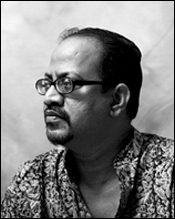
As 2008 – clearly an Annus horribilis for tens of millions around the world – draws to an end, we announce the Moving Images Person of the Year 2008: Danny Schechter.

Nicknamed “The News Dissector,” Danny is a television producer, independent filmmaker, blogger and media critic who writes and lectures frequently about the media in the United States and worldwide.

He has worked in print, radio, local news, cable news (CNN and CNBC), network news magazines (ABC) and as an independent filmmaker and TV producer with the award-winning independent company Globalvision. He is a blogger and editor of Mediachannel.org, a web and blog site that watches and critiques the print and broadcast media.

Another way to introduce Danny is to recall the scary headlines and TV news images that have dominated 2008 – of reputed banks going bust, leading stock markets crashing and these events triggering a global financial meltdown that, for now, has been slowed but not completely averted by unprecedented governmental intervention…by the very governments of the industrialised countries who should have kept a sharper eye on what was going on in their free market economies.

As the carnage on Wall Street and other global financial centres continued, some hard questions were asked: Did anyone see this coming? If so, why weren’t they listened to? What is the real cause of all this chaos? Where was the news media and why weren’t they doing their job of sounding the alarm?

Well, one man who saw it coming and tried very hard to raise the alarm was Danny Schechter. In 2006, as part of this effort, he made a documentary film called In Debt We Trust. In this, he was the first to expose Wall Street’s connection to subprime loans and predicted the global economic crisis.

This hard-hitting documentary investigated why so many Americans – college and high school students in particular – were being strangled by debt. Zeroing in on how the mall has replaced the factory as America’s dominant economic engine, Emmy Award-winning former ABC News and CNN producer Danny Schechter showed how college students were being forced to pay higher interest on loans while graduating, on average, with more than $20,000 in consumer debt.

An inconvenient truth that America ignored for too long...

The film empowers as it enrages, delivering an accessible and fascinating introduction to what former Reagan advisor Kevin Phillips has called “Financialization” — or the “powerful emergence of a debt-and-credit industrial complex.”

Danny and his film have done for global financial meltdown what Al Gore did for global warming with his own film: investigate rigorously, gather and present the evidence of a gathering storm, sound the alarm — and keep badgering until the warnings were heard. In both cases, the inconvenient truths they presented were ignored for too long — and we are paying the massive price for such indifference.

Watch the Trailer of In Debt We Trust:

Deborah Emin, writing in OpEdNews in October 2008, noted: “In Debt We Trust…brought Schechter a lot of grief. Rather than being seen as a prophet of doom, which in and of itself was not so terrible, he should have been lauded for sounding the alarm when it would have been in time. It is truly an amazing fact of American life that the powers that be can so disastrously determine what information we are able to see based on their subjective judgment of what is too negative or too harsh a view of a specific topic. From this perspective, we should judge all these gatekeepers as those on the Titanic who did not want to alarm the passengers that the ship was going down.”

Watch an extract from In Debt We Trust: How did we get into this mess?


Watch In Debt We Trust in full on Google Video

So here’s the trillion-dollar question: if this film was made in 2006, and has since been running to packed houses scaring a lot of thinking and caring people, why was its message not heard in the corridors of power in Washington DC — and elsewhere in the G8 countries’ capitals?

The short answer could be that there have been no thinking and caring people running the American government for the past eight years.

Read all about it!
Read all about it!
The long answer is found in a book that Danny published in mid 2008. Titled Plunder: Investigating Our Economic Calamity and the Subprime Scandal, it’s an outgrowth of – and update on – his 2006 film. It documents with shocking evidence how debt has restructured the American economy and put Americans under a burden that many will never overcome.

Plunder also offers an analysis based on current events, going behind the scenes, identifying the key players and culprits, challenging the financial industry, government deregulation — and the financial and most sections of the mainstream media who have been cheer-leading the financiers as the latter took ever larger risks. Danny also argues that this has been a criminal enterprise — a point only touched on in most media coverage — and of global significance, given the globalization of markets.

Read my Sep 2008 blog post: Financial Meltdown: Putting pieces together of a gigantic whodunnit


On a personal note, I have been a great admirer of Danny Schechter and his work since I first met him 13 years ago. In the Fall of 1995, he gave an inspiring and provocative talk to a group of journalists and producers from the developing world who were on a UN-organised media fellowship in New York. As part of our tour of media and development agencies in the US East Coast, we visited Danny’s GlobalVision productions.

Danny introduced himself as a ‘network refugee’ — one who had worked for the mainstream network television in the US and had left in disgust. From outside, he was trying to find alternative ways of speaking truth to power — the original mandate of the mass media which many corporatised media companies had abandoned, knowingly or otherwise.

In that pre-Internet era, Danny engaged in his media activism through independent filmmaking, through which he supported and often participated in struggles for social justice in his native United States as well as in places like apartheid-ridden South Africa and strife-torn Palestine.

www.newsdissector.com
http://www.newsdissector.com
Danny was one of the early media activists to take advantage of the web. In 2000, he co-founded with Rory O’Connor MediaChannel.org, the first media and democracy supersite on web. Operating on shoe-string budgets, it has sustained critical spotlight on the mainstream media (MSM) for 8 years in which the MSM landscape has been completely transformed. While its scrutiny and chronicling of the political economy of the media is more crucial than ever, and veterans like Walter Cronkite whole-heartedly endorse the effort, the non-profit effort struggles for survival.

Now in his 60s, Danny is simply indefatigable. Besides running MediaChannel and GlobalVision, he blogs every few hours, writes a regular column on Huffington Post, lectures on media, writes books and still has time to make investigative films. He is extremely well informed, witty, funny and completely irreverent. He writes and speaks with justified outrage but no malice. That’s a tough balance to maintain.

Danny visits Wall Street on 20 September 2007 – typical of his funny, incisive reporting:

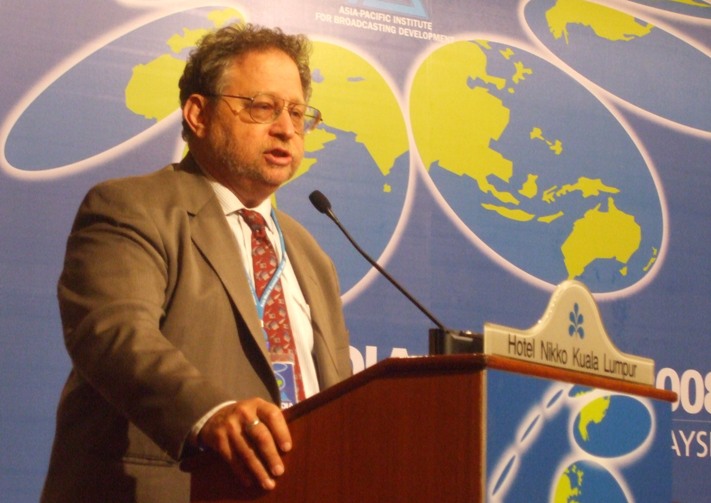
I was delighted to catch up with Danny in May 2008 when we both participated in Asia Media Summit in Kuala Lumpur. He and I were in a small minority of participants who were familiar with the inner works of the mainstream media and transformational potential of the new media. In characteristic style, Danny stirred things up, livening the usually staid proceedings, and I did my best to back him up from the audience. We both enjoyed asking irritating – if not outright annoying – questions from the 400+ media mandarins and press barons who’d come together for the Summit.

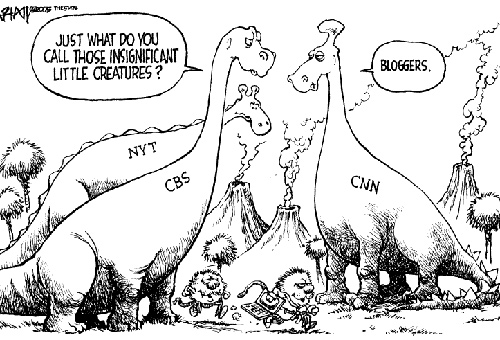
One evening, Danny and I had a drink with Malaysiakini’s CEO and leading new media activist Prem Chandran where we talked about the slow but inevitable decline of the mainstream media dinosaurs — or what Michael Crichton called Mediasaurus. The trouble with mediasaurus, we agreed, was that they are taking a long time going extinct and for now, they still command significant numbers of eyeballs and the dollars that follow.

After Prem left, Danny and I continued our chat into the evening. Over a spicy Indian meal, Danny gave me a crash course on subprime crisis (or sub-crime as he calls it) and how that was going to have a domino effect on markets everywhere. I listened with growing comprehension — and deep admiration for the man’s ability to communicate complexities without oversimplification.

Events in the weeks and months that followed have shown how remarkably prescient Danny Schechter was. And what a monumental, global scale mistake it was not to have heeded this man’s cautions in his blogs, films, columns and elsewhere.

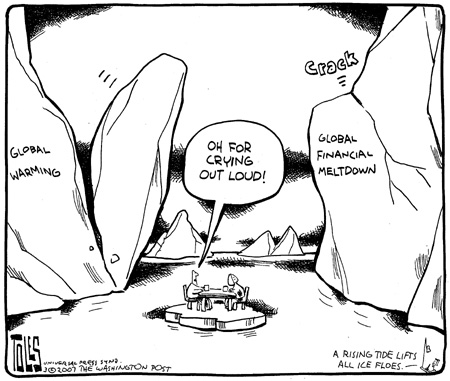
We end 2008 with my cartoon of the year. As I said in a blog post in September 2008: “This cartoon by Pulitzer prize winning Tom Toles first appeared in the Washington Post in 2007 – it brilliantly anticipated the global financial meltdown that we’re now experiencing. Coming in the wake of confirmed global warming, it is a double whammy.
Meltdown 2
Meltdown 2

Mumbai siege revisited: Live television, terrorvision or mass hysteria?

Courtesy Daylife.com

“The attack on Mumbai by ten highly trained gunmen on the night of Wednesday, November 26, and the drama that followed over the next 60 hours, was physically confined to one corner of a very big city. But it extended its ambit to the rest of the city, the country and the world because of the non-stop media coverage.

“For two days and three nights, television channels gave blanket coverage to the drama around the siege of two hotels, the Taj Mahal Palace and Towers, and the Oberoi and Trident Hotels, as well as Nariman House in Colaba, a synagogue and centre for a Jewish sect. And the entire country watched in horror and fascination.”

This is how my friend Kalpana Sharma, one of the most respected journalists in India, looks back at the momentous events that took place in her home city of Mumbai from 26 to 30 November 2008. In a thought-provoking analysis published on Tehelka.com, Kalpana assesses 60 hours of continuous media coverage of the Mumbai crisis and notes the significant gaps.

As Mumbai and India recover from the daring attack, the media continue to play the dramatic images over and over. I was in Hyderabad, in southern India (more than 700 km away from Mumbai) for a few days from November 30 and saw this first hand – especially on India’s several dozen 24/7 TV news channels in English and many local languages. Even before arriving in India, I was following the unfolding events on India’s leading English news channel NDTV 24/7 and their website.

Kalpana Sharma
Kalpana Sharma
I could see that the high adrenaline that every channel and reporter drew on during the 60 hours of drama has now changed into a mix of patriotism, jingoism and an incredible suspension of journalistic ethics and norms. This makes Kalpana’s reflections extremely timely and important.

She is not an armchair critic of the media, and understands the tough challenges that reporters and their gatekeepers face on a daily basis. “When such developments hit a city, it is understandable that there is a time lag before the media, particularly the electronic media, can react,” she acknowledges in her essay, and asks: “The electronic media, in particular, has to ask whether at a time when they were the only source of information for most of the city, and indeed the country, there should have been some restraint placed on information given out.”

I have met some professors of mass communication who have never been inside a news room and well-meaning media activists whose naive idealism makes me laugh. Kalpana, in contrast, counts over three decades of mainstream media experience and retired last year as Deputy Editor of The Hindu newspaper.

Read Kalpana’s full essay here: Unpacking The Pixel

Breaking News 24/7?
Breaking News 24/7?

Others inside and outside India are also offering critical analysis of media’s role in the siege of Mumbai, or India’s 26/11 as it’s being called. One is by Anjali Deshpande and S K Pande of the Delhi Union of Journalists who have written an interesting commentary in the South Asian mediawatch website, The Hoot.

They acknowledge how “24×7 reporting of terror has indeed been has also been a traumatic experience for our colleagues” and go on to say that “Some of them really did a good job under the circumstances”. But their piece is are less charitable than Kalpana when they say: “If there is one thing the electronic media helped in particular to do in the last three days was to bolster the confidence of terrorists and to give them a sense of achievement far greater than their action may have provided them.”

They note: “The initial role of some of the media was to grab the eyeballs rather than ask questions and reflect all facets of life as they unfold without adding to the tension strife and trauma in such situations. In some cases the ethics evolved over the years was thrown into the dustbin. Add to it all the fact, that when some restraint began more than a touch of jingoism took over.”

They add: “The media behaved as if the country was so terrified it came to a standstill. As if Madhya Pradesh did not go to polls, as if Delhi did not vote, as if a former Prime Minister, V P Singh did not pass away, as if nothing else happened in the country.”

Read the full essay in The Hoot: Three Days of Mumbai terror reporting.

There are dozens of other debates underway in the passionately argumentative Indian society, some of which are being conducted in the newspapers, news magazines, on the air and online. One that especially interested me was the role elitism played in how the media covered the siege of Mumbai.

The attacks took place at multiple locations in the heart of Mumbai, which included two leading hotels, a synagogue and Jewish centre and the main train station. But not all attacks lasted as long, and certainly not all of them received equal coverage.

Gnani Sankaran, a writer based in Tamil Nadu, southern India, asks some pertinent questions in a blog post titled Hotel Taj: Icon of whose India? “Watching at least four English news channels surfing from one another during the last 60 hours of terror strike made me feel a terror of another kind. The terror of assaulting one’s mind and sensitivity with cameras, sound bites and non-stop blabbers. All these channels have been trying to manufacture my consent for a big lie called — Hotel Taj the icon of India.

He adds: “It is a matter of great shame that these channels simply did not bother about the other icon that faced the first attack from terrorists – the Chatrapathi Shivaji Terminus (CST) railway station. CST is the true icon of Mumbai. It is through this railway station hundreds of Indians from Uttar Pradesh, Bihar, Rajasthan, West Bengal and Tamilnadu have poured into Mumbai over the years, transforming themselves into Mumbaikars and built the Mumbai of today along with the Marathis and Kolis

Chatrapathi Shivaji (Victoria) Terminus - the true icon of Mumbai

“But the channels would not recognise this. Nor would they recognise the thirty odd dead bodies strewn all over the platform of CST. No Barkha Dutt went there to tell us who they were. But she was at Taj to show us the damaged furniture and reception lobby braving the guards. And the TV cameras did not go to the government-run JJ hospital to find out who those 26 unidentified bodies were. Instead they were again invading the battered Taj to try in vain for a scoop shot of the dead bodies of the Page 3 celebrities.

Gnani Sankaran
Gnani Sankaran
“In all probability, the unidentified bodies could be those of workers from Bihar and Uttar Pradesh migrating to Mumbai, arriving by train at CST without cell phones and PAN cards to identify them. Even after 60 hours after the CST massacre, no channel has bothered to cover in detail what transpired there.”

Read his full blog post: Whose India, whose icon?

Another interesting critique that touched on elitism in media coverage appeared in The Telegraph newspaper, published from Kolkata on 4 December 2008. Titled “WE, THE PEOPLE: The Mumbai tragedy and the English language news media”, it was penned by Indian writer Mukul Kesavan.

He echoes the same point as Gnani Sankaran about the Victoria Terminus being much more iconic than the Taj hotel, and comes to the same conclusion: “I can’t remember the last time that social class so clearly defined the coverage of a public event, or one in which people spoke so unselfconsciously from their class positions. The English news channels became mega-churches in which hotel-going Indians found catharsis and communion. Person after person claimed the Taj as home. Memories of courtship, marriage, celebration, friendship, the quick coffee, the saved-up-for snack, the sneaked lavatory visit, came together to frame the burning Taj in a halo of affection.”

In his closing para, Kesavan also touches on how the foreign media covered the Mumbai attacks: “English and American papers treated the terror attack as an assault on the West. The terrorists had, after all, specifically looked for American and British citizens to murder. Ironically, even as NDTV, CNN-IBN and Times Now put hotel guests at the heart of the horror and bumped train commuters to its periphery, older English-speaking peoples counted their dead and dimly regretted all Indian casualties as collateral damage. In that residual category, if nowhere else, the Indian dead remained one People.”

Read full commentary by Mukul Kesavan

Another dimension in the media coverage following the Mumbai attacks is how it is affecting the relations between India and Pakistan, both nuclear powers. As The Hindu reported on 1 December 2008: “The escalating tensions between India and Pakistan over the Mumbai attacks have led to the declaration of hostilities in unexpected quarters – Pakistani media has declared a virtual war on Indian media for its ‘knee-jerk’ finger-pointing across the border, and its unquestioning acceptance of the Indian government’s ‘Pakistan-link’ theory.”

Moderate journalists and media-watchers across South Asia are calling for more restraint, self-reflection and plain common sense. On 4 December 2008, Himal Southasian – the independent and outspoken voice of South Asia – ran a special editorial which opened with these words:

“There is an attempt on to generate mass hysteria in India as television channels compete for ratings. The channels are using the Bombay attacks of last week in a dangerous game of TRP-upmanship which can well derail the political process and set back the India-Pakistan peace train. Going far beyond what is required of them even in times of crisis, some media houses are leading campaigns to get citizens to take pledges of patriotism. They are pushing a brittle, monochromatic vision of the resilient country we know as India.”

Read the full Himal editorial: No to mass hysteria

My journalist friend Beena Sarwar, based in Karachi, voiced her concerns in an op ed published in the leading Pakistani newspaper Dawn on 3 December 2008:

Beena Sarwar
Beena Sarwar
“Media might have brought the people closer but when nationalism rears its head, the beast of 24-hour television news also fuels conflict. This is where the commercial aspect comes in. When something big happens, the public seeks answers. The channels which cater to this need improve their ratings. Sensation sells. With viewers glued to the screens, channels keep them there with a continuous virtual reality show. They fill the time with speculative commentary, ‘expert’ guests and whatever footage is available. Sometimes such footage is repeated ad nauseum — like when the Twin Towers were destroyed on 9/11, when the Marriott hotel was attacked, when the FIA building in Lahore was struck.”

She adds: “Some Indian channels are running the Pakistan factor like a movie trailer, complete with sound effects and watch-for-the-next-episode commentary. This obviously fuels Pakistani indignation. However, this indignation could be tempered by being less reactive and empathising with the Indians’ pain and grief that many Pakistanis share. Zealous commentators could also recall the times that their own media houses sensationalised an issue.

“Journalists may argue that they are just the messenger, reflecting official or public opinion. But the media must also question, and get people to think. The stakes are high in our nuclear-armed countries, in a post-9/11 world where the major players include armed and trained men around the world who subscribe to the ideology of Al Qaeda and the Taliban.”

Full op ed by Beena Sarwar: Media falls into old trap

Ordinary people outside the media industry have also started expressing their concern.

“Media on both sides of the border has stopped reporting and started indulging in senseless rants. The media, particularly in India seems to have thrown logic to the wind,” wrote Anand Bala from Bangalore, in a letter to the South Asian mediawatch website The Hoot. “The screaming for war on the Indian side has reached a din. The media is manufacturing consent for a war and manufacturing consent for the very people who they are blaming – the politicians.

I would give the last word to Kalpana Sharma: “Media rarely pauses to analyse itself as it hurtles from one breaking story to another. But the Mumbai terror attack shows us that it is essential that reporters be trained to handle such extraordinary situations, that they learn the importance of restraint and cross-checking as at such times the media is the main source of information. Professionalism and accuracy will ensure that we don’t contribute to prejudice and panic.”

Michael Crichton (1942-2008): Foresaw the fate of ‘Mediasaurus’

Death has no sense of timing, but it sometimes leaves traces of irony. The day Americans were electing an energetic and articulate senator from Chicago as their next president, one of Chicago’s most celebrated citizens lost his battle with cancer.

Michael Crichton
, who died on 4 November 2008, was trained as a medical doctor but played several roles in the creative arts world. He was a prolific author of science fiction and medical fiction, whose books have sold over 150 million copies worldwide. He also produced and directed techno-thriller movies, and was the creator of the highly successful medical drama series on television, ER (Emergency Room), now in its 15th season.

In the domain of popular culture, Crichton was best known for writing Jurassic Park (1990). This cautionary tale on unrestrained biological tinkering was turned into a blockbuster movie by Steven Spielberg in 1993. It became the highest earning film up until that time.

Before and since, Crichton used his technical training, vivid imagination and mastery of English to spin some of the most enjoyable – and scary – stories that often depicted scientific advancements going awry, resulting in the worst-case scenarios. A notable recurring theme in Crichton’s plots is the pathological failure of complex systems and their safeguards, whether biological (Jurassic Park), military/organizational (The Andromeda Strain), technical (Airframe) or cybernetic (Westworld).

Crichton was also a talented essayist who wrote perceptive pieces of non-fiction about science, society and culture – including the role of media. It is one such essay that I would like to recall in his memory.

The media world was very different when, in 1993, Crichton riled the news business with an essay titled “Mediasaurus“. In this essay, written for the newly launched Wired magazine, he prophesied the death of the mass media — specifically the New York Times and the American commercial TV networks.

“To my mind, it is likely that what we now understand as the mass media will be gone within ten years. Vanished, without a trace,” he wrote.

Building on his credentials as the author of a best-seller on dinosaurs, Crichton called this endangered beast ‘mediasaurus’.

Mediasaurus - courtesy Slate
He added: “There has been evidence of impending extinction for a long time. We all know statistics about the decline in newspaper readers and network television viewers. The polls show increasingly negative public attitudes toward the press – and with good reason.”

He talked about technological advances — “artificial intelligence agents roaming the databases, downloading stuff I am interested in, and assembling for me a front page” — that would drive the mediasaurus to their inevitable doom.

Only those nimble, adaptable media products would survive, he said, noting that CNN and C-SPAN were steps in the right direction, giving viewers direct access to events as they happen.

But he had no sympathy for the media. “The media are an industry, and their product is information. And along with many other American industries, the American media produce a product of very poor quality. Its information is not reliable, it has too much chrome and glitz, its doors rattle, it breaks down almost immediately, and it’s sold without warranty. It’s flashy but it’s basically junk. So people have begun to stop buying it.”

Read the full essay: Mediasaurus by Michael Crichton, Wired Oct/Nov 1993

Like most people who dabble in the imperfect art of foreseeing the future, Crichton got the trend right but the timing somewhat wrong. The mainstream media (MSM) were indeed on the decline but not at the dramatic rate that he envisaged.

In February 2002, Jack Shafer wrote a piece in the online magazine Slate titled “Who You Calling Mediasaurus?” Its subtitle was: “The New York Times dodges Michael Crichton’s death sentence”. It asked and tried an answer the question: Where did Crichton go wrong?

Shafer wrote: “Fables of the near future have a way of never materializing, whether they be fevered dreams of nuclear energy too cheap to meter or fossil fuels too expensive to burn. To be fair, Crichton wasn’t the only one to get puking drunk on the new media moonshine. Many of us spent a lost weekend—sometimes months—in a stupor after reading early issues of Wired. But instead of blotting out conventional media, the emerging Infotopia seems only to have made the conventional media more ubiquitous.”

Shafer asked: “Who would have predicted in 1993 that America’s great dailies (minus the Wall Street Journal) and the news networks would dodge both extinction and irrelevance by erecting Web sites overnight and giving their content away? That they would use their Web sites to keep us informed 24-hours-a-day in a way that we take for granted today but that would have astonished us nine years ago?”

In an email interview with Shafer at the time, Crichton acknowledged his own limitations: “I don’t have a lot invested in whether my predictions are right or wrong; I assume that nobody can predict the future well. But in this particular case, I doubt I’m wrong, it’s just too early.”

In that interview, Crichton said he wished he had foreseen “the effect of big media conglomerates combined with the universal decision to make news into entertainment. It’s all headlines and chat now. Factual content is way down, accuracy has vanished (it’s not even a goal any longer), and public confidence in media is at an astonishing low. Not surprisingly, audiences are shrinking.”

Crichton admitted at the time that the personalized ‘infotopia’ he envisioned in 1993 had yet to arrive. He scoffed at the Web for being too slow. “Its page metaphor, too limiting. Design, awful. Excessive hypertexting, too distracting. Noise-to-signal ratio, too high.”

Who succeeds mediasaurus?
Now fast-forward to May 2008. The same Jack Shafer, once again writing in Slate, published a piece titled “Michael Crichton, Vindicated”. It was introduced as: “His 1993 prediction of mass-media extinction now looks on target”.

In this essay, Shafer wrote: “As we pass his prediction’s 15-year anniversary, I’ve got to declare advantage Crichton. Rot afflicts the newspaper industry, which is shedding staff, circulation, and revenues. It’s gotten so bad in newspaperville that some people want Google to buy the Times and run it as a charity! Evening news viewership continues to evaporate, and while the mass media aren’t going extinct tomorrow, Crichton’s original observations about the media future now ring more true than false. Ask any journalist.”

Read Jack Shafer’s full interview with Michael Crichton in Slate, May 2008

the weapon that killed Mediasaurus
Revealed: the weapon that killed Mediasaurus
By this time, Crichton was more positive about the web. He noted that the Web has “made it far easier for the inquisitive to find unmediated information, such as congressional hearings.” It’s much faster than it used to be, and more of its pages are professionally assembled.

Crichton suggested that readers and viewers could more objectively measure the quality of the news they consume by pulling themselves “out of the narcotizing flow of what passes for daily news.” Look at a newspaper from last month or a news broadcast.

“Look at how many stories are unsourced or have unnamed sources. Look at how many stories are about what ‘may’ or ‘might’ or ‘could’ happen,” he said. “Might and could means the story is speculation. Framing as I described means the story is opinion. And opinion is not factual content.”

He summed it up with something we already know: “The biggest change is that contemporary media has shifted from fact to opinion and speculation.”

It was interesting to note how mainstream media outlets paid tributes to Crichton this week. He was remembered for the entertaining story teller he truly was, and some even questioned his mixed legacy, for example being an ardent skeptic of global warming – thus batting for the fossil fuel cartels even if only inadvertently.
But I could find few references to his perceptive critique of the mass media.

Who says media likes to turn the spotlight on itself?

PS: I was intrigued to see The New York Times’ reasonably benign obit on the author who predicted their demise. Here’s a collection of Times commentary on him – and some op eds he wrote for them.

Meet the new Pied Pipers of our Global Village: the Media!

In the well known legend, the pied pier of Hamelin played his musical pipe to lure all the rats into the nearby Weser river. When the town reneged on the promised fee, he played a different tune to entice all its children away from the town.

Modern-day pied pipers use smooth talk and convincing images instead of hypnotic musical tunes to lead people astray. And they achieve much greater coverage today — thanks to the modern media.

When the media amplify pied piper tunes, how responsible are they for the resulting damage?

Then and now, we like to follow a tune...

This is the question I raise – and try to answer – in an op ed essay published this week by the Asian website Eye on Ethics.

‘When media amplify pied piper tunes…’ was inspired by a current experience in my native Sri Lanka. For the past few weeks, Sri Lankans have been shocked and dismayed to learn how thousands of middle-class adults have been hoodwinked by a confidence trickster who used paid advertisements in newspapers and on television to boost his image.

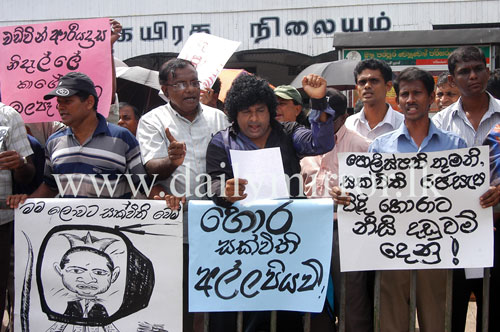
Sakvithi Ranasinghe, a populist tutor of English turned businessman, fled the country in mid-September 2008 after duping thousands of unsuspecting people to deposit money in an Ponzi-style investment scheme that offered abnormally high returns.

After the scandal broke, the media have been giving it a great deal of coverage. But most of it falls into follow-the-victim, blame-the-authorities style of journalism.

The main point of my essay: “Amidst the finger-pointing, arm-waving and name-calling, few have noticed the role of the media in promoting Ponzi schemes in the first place. Wittingly or otherwise, the media have helped amplify the mesmerizing tunes of pied pipers, and quietly collected substantial advertising revenue from such racketeers.”

Sakvithi's investment victims protest in Colombo - photo courtesy Daily Mirror

I also comment in this essay the blurring of what used to be a sacred divide in the media – between editorial content and paid advertising. Here’s an excerpt:

“Many people experience media products as a whole, and lack the media literacy to separate news, commentary and paid commercials. Besides, the once clear demarcations have blurred in recent years.

“Television’s seamless blending of news, entertainment and commercials can leave even the most media-literate people somewhat perplexed. News bulletins are sponsored variously by sellers of insurance, milk food or detergents, while current affairs shows are branded by various commercial products or services.

“In newspapers, the steady rise of ‘advertorials’—product promotions neatly dressed up as editorial content—makes it harder to discern where one ends and the other begins.”

Read and comment on my full essay at Eye on Ethics website

NHK: A public broadcaster that cares for its public

NHK is Japan's sole public broadcaster

My regular readers know the disdain with which I hold the so-called public broadcasters in my part of the world. In developing Asia, which lacks sufficient checks and balances to ensure independence of state broadcasters, the only thing ‘public’ about such channels is that they are often a drain on public money collected through taxes. Their service and loyalties are entirely to whichever political party, coalition or military dictator heading the government in office. A few months ago, I described Burmese TV as a good example.

I was delighted, therefore, to visit the headquarters of Japan’s sole public broadcaster NHK this week and find out how exceptional they are in being a public broadcaster that really cares for its funding and viewing public.

Nippon Hōsō Kyōkai has always identified itself to its audiences by the English pronunciation of its initials, NHK. Started as a radio service in 1926, it added television in 1953. Today, NHK runs two terrestrial TV channels, three satellite channels and three radio services – and has started offering more content online and for mobile devices as well. It also has international offerings in TV, radio and web through NHK World.

This massive broadcast operation is financed primarily by a license fee (called ‘receiving fee’ in Japan) paid by each Japanese household that owns a television set. Its TV channels don’t carry any advertising, although the corporation exploits its massive archive and often repurposes its products for commercial gain.

As NHK’s website says, “This (license) system enables the Corporation to maintain independence from any governmental and private organisation, and ensures that the opinions of viewers and listeners are assigned top priority.”

NHK’s license fee system is not unanimously endorsed by the Japanese public, and I later found out that growing numbers of households are declining to pay what currently works out to around US$30 per month (or a dollar a day). This debate has been sustained for several years, with public calls for administrative reform at NHK.

NHK Studio Park entrance

But NHK’s eagerness to engage the public is clearly evident, even to a visitor like myself who spent only an afternoon at NHK’s Studio Park in Shibuya. This is where the corporation’s production facilities are opened to the public every week day from 10 am to 5.30 pm.

NHK Studio Park is a living exhibit – the corporation’s executives and technical staff carry on with their real work amidst (mostly Japanese public) visitors who get to see how TV content is made. Part of the attraction is a museum of TV 55 years of TV broadcasting in Japan.

You're in our bigger picture!
Welcome to NHK: You're in our bigger picture!

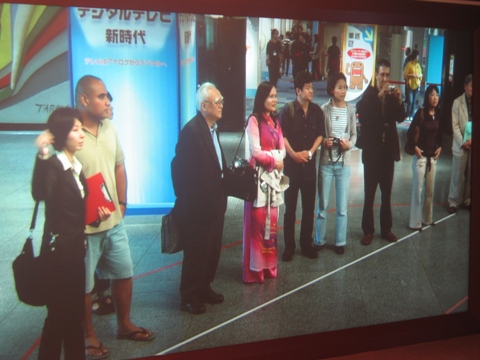
Every visitor is welcomed by being captured by a TV camera with the image being projected live on to a giant screen at the reception. The camera zoomed in on each one in our tour party of ten – and gave us our 10 seconds of fame!

From then on, it offers various displays and interactive opportunities to find out how TV broadcasting has evolved, where it is today – and glimpses of where it is headed. NHK has been an industry leader in technological innovation. It launched digital satellite TV broadcasting in December 2000 and introduced digital terrestrial broadcasts in December 2003. The core technology is Hi-Vision (HDTV), which delivers clear, vivid pictures and CD-quality sound. More than 90% of the programming on NHK is now produced and aired in Hi-Vision.

Japan's countdown to analog switch-off

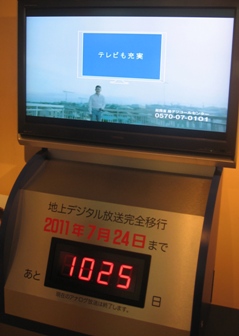
In fact, Japan will be fully switching on to digital and switching off all analog TV transmissions on 24 July 2011. The countdown has already started and on the day I visited NHK (2 October 2008), it was 1,025 days away.

Studio Park makes good use of corridor space for varied displays of photos and archival videos on memorable moments in Japanese and world broadcasting history. Highlights of NHK’s most enduring productions in news, current affairs, culture programming and sports are also shared.

Some of NHK’s cultural and entertainment programmes have been exported successfully to other parts of Asia, offering some counterbalance to the western TV content. One that I recognised was Oshin, a serial drama of 297 episodes made in the early 1980s that has since been aired in close to 60 countries.

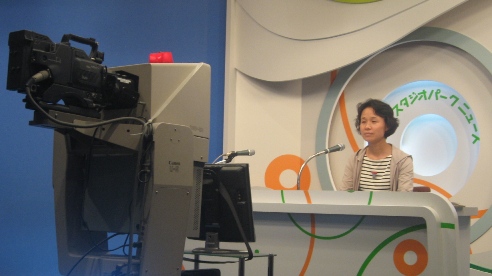
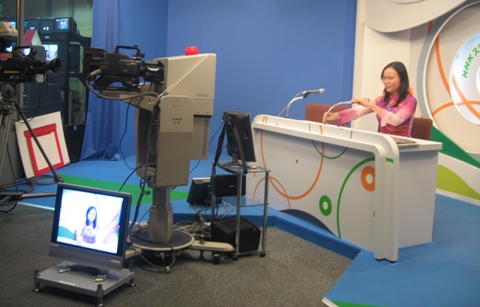
One of Studio Park’s star attractions offers to make a star of any visitor for a few minutes. It’s a newscasting studio where the visitor may sit and face the live camera and read a few lines suggested by the teleprompter – the device that enables news readers to look at their audience while sticking to a flowing text. The teleprompter text is available in Japanese and several other Asian languages.

Hu Jincao of China faces NHK camera
Pham Thuy Trang from Vietnam reads NHK news

Two members of our tour party took this news challenge (photos above), and being broadcast professionals, they performed admirably! While it was fun and games for us who are familiar with the medium’s inner working, I can imagine the educational and public relations value of this for people who only consume what television delivers every day and night.

We were also treated to a screening of what was called the world’s first 3D television without special glasses. It was a breathtaking film of about 10 minutes showing underwater scenes. In the dimly lit theatre, the screen felt more like a fish tank – the 3D effect was very real. Not being a techie, I don’t know how to verify the claim of this being a world first, but when this catches on, watching television will never be the same again…

As visitors move in and out of these interesting offerings, it was another day at work for NHK’s staff who carried on with their real productions in studios we passed by. We were allowed to photograph everything except across the viewing glass inside a studio when a recording was underway (lest the camera flashlights disturb it). The freedom to explore and experience, helped by the eternally courteous tour guides, was refreshing.

And what a contrast to many so-called public broadcast stations elsewhere in Asia which are more like battle fortresses with armed guards firmly keeping the public out (I suppose they expect their irate public to attack the stations because of the truly dreadful content they carry?).

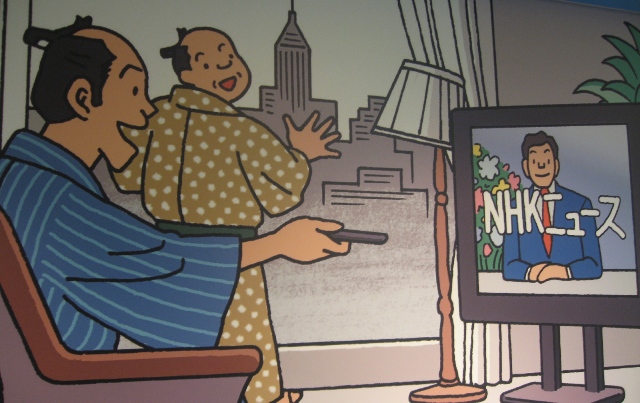
Well, at least NHK seems to know who their masters are – the paying public. And as this image in one exhibit shows, NHK is aware of that little gadget in every viewer’s hand that can instantly nullify all the irinvestment, technology and creativity. If wielded for long enough by sufficient numbers, this can put mighty broadcasters out of business.

It’s a message that Asia’s other broadcasters – public and private – would do well to remember.

NHK knows who its bosses are...

Note: My visit to Tokyo did not involve NHK funding in any manner. I was the guest of our partner TVE Japan, who paid for our admission tickets to enter NHK Studio Park.

Explore 50 years of NHK Television online

Do you believe everything you see on TV? Some do!

It's easy to be lulled by TV...

“I invested Rs. 2 million (US$ 18,550) of my money after seeing him on TV. I basically believe what I see on the TV and so was misled.”

I read this remark, by a hapless woman victim of an investment scam, in a Sri Lankan newspaper report last week. It got me thinking: where is our media literacy?

Sakvithi Ranasinghe, a populist tutor of English turned millionaire businessman, had just fled the country after duping thousands of unsuspecting people to deposit their life’s savings in his investment firm. Media reports have variously placed the number of victims between 1,500 and 4,000 — and some estimates place the total worth of his loot to be a whopping Rs. Nine billion (over USD 83.5 million).

This local scam may seem insignificant in the current global context when established and well respected banks and financial houses are collapsing one after the other in capitalism’s biggest crisis in decades. But for the several thousand victims, the effects are devastating.

The woman quoted in the news report is not an isolated case. Too many people, it seems, were mesmerised into parting with their money due to a deviously persuasive media campaign. For several years, Sakvithi ran English teaching programmes on Sri Lanka’s national television and other channels. On the guise of teaching English (which he didn’t do very well), Sakvithi manufactured a larger than life image for himself. He also ran regular newspaper advertisements in the highest circulating weekend newspapers. Some were in full colour, occupying an entire broadsheet page. These too reinforced his image as a benevolent, enterprising young Sinhala businessman doing social good.

Not everyone, it seems, heeds the common sense advice, ‘Don’t believe everything you read/hear in the media’. Indeed, the Sakvithi scandal once again brings into sharp focus the media’s — especially television’s — perceived role as the great authenticator of our times.

I have just written an op ed essay for the citizen journalism website Groundviews, where I suggest that the mainstream media outlets that repeatedly sold airtime or newspaper space to this man must now share part of the blame for misleading the public. I also argue that besides timely regulatory action and proper law enforcement, we also need greater vigilance by the media, and higher levels of media literacy in everyone to safeguard society from this kind of media manipulation.

Media illiteracy creates this!

Here’s an extract:

“I find it more than a tad ironic that the same media outlets are now peddling the tales of woe of the thousands of men and women tricked by their former, big-time customer. Knowingly or otherwise, these media have amplified the mesmerising tune of this pied piper of Nugegoda who lulled thousands into parting with their money.

“Their journalists would no doubt protest innocence, reminding us of the divide between editorial and advertising operations. And they are right: media practitioners and editorial gatekeepers don’t have much (or any) control over what fills up the commercially sold advertising space. But how many of their readers or viewers can distinguish the difference?

“Most people experience media products as a whole, and lack even the basic media literacy to separate news, commentary and paid commercials. Besides, with the rise of ‘advertorials’ — product promotions neatly dressed up as editorial content — it’s becoming harder to discern which is which.

Read the full essay on Groundviews.

Financial Meltdown: Putting pieces together of a gigantic whodunnit

this says it all...
My cartoon of the year: this says it all...

This cartoon by Pulitzer prize winning Tom Toles first appeared in the Washington Post in 2007 – it brilliantly anticipated the global financial meltdown that we’re now experiencing. Coming in the wake of confirmed global warming, it is a double whammy.

America has been hit hard by the sub-prime crisis. The social and human cost of financial failure has been enormous. An epidemic of home repossessions has left thousands of houses abandoned and boarded-up: whole suburbs are falling into disrepair and dereliction.

Financial institutions in America and in Britain had poured billions into investments backed by these mortgages. As more and more people have defaulted on their mortgage repayments, financial markets have collapsed, causing a crisis that has rippled across the Atlantic, sending the City of London into turmoil and pulling the plug on one now infamous British bank.

Some call it a financial tsunami not been seen since the Great Depression in the 1930s….a crisis that has forced the US government to step in and save the financial system after trillions were wiped off global stock markets and once revered institutions were swept off the face of Wall Street. Is the US intervention too little, too late to save the economy?

In fact, just a few days ago, the People’s Daily of China warned that a “financial tsunami” was approaching, which recalled the Great Depression in the US. It said: “As the contemporary economy has been integrated globally, American consumption and currency exchange rates will directly influence countries dependent on the US as the main export destination for economic growth and employment”.

The Chinese Communist Party organ complained that the US had unleashed financial “weapons of mass destruction” on the world economy in the form of subprime debts and related financial derivatives.

The world’s media have been scrambling to cover these rapidly unfolding events. In fact, many have been caught napping, or worse, been uncritical cheerleaders of the march of capital and credit. Most of them – even the respected financial journals – just didn’t see the crisis building up…or ignored the tell-tale signs that constituted an inconvenient truth.

Danny Schechter - wasnt crying wolf!
Danny Schechter - wasn't crying wolf!
“This didn’t just happen in the course of a usual business cycle,” insists the American investigative journalist and media analyst Danny Schechter, who has been tracking this issues for many months on his influential News Dissector blog and the MediaChannel that watches and critiques the media.

In his new book, aptly titled Plunder, Danny offers an in-depth investigation into the decline of the economy that’s causing millions to lose jobs and face foreclosures and across-the-board price hikes.

He says: “You wouldn’t know it by relying on our media, but the subprime scandal masks massing looting by Wall Street firms using carefully calculated predatory lending schemes enabled by regulators who don’t regulate and a media that looked the other way. We have lost trillions and dislocated millions with no relief in sight. Every American is paying for the greed of our financiers in the grocery store, gas pump and unemployment line. Bank robberies are not new — but banks doing the robbing is.”

Read the introduction to Danny Schechter’s Plunder.

In 2007, his film IN DEBT WE TRUST was the first to expose Wall Street’s connection to subprime loans, predicting the economic crisis that this book investigates.

I have been watching various news media analysis of the current crisis and want to share two that stood out from the rest: Inside Story by Al Jazeera English, and Dispatches by UK’s Channel 4.

In a special show from New York, Inside Story looks at the financial turbulence that rocked the US last week. Will the emergency measures by the US government be enough to stabilise the markets or has the financial system in the US been changed forever? The introductory report from AJE’s Washington correspondent Reynolds is particularly illuminating – he also writes the story for their website.

Inside Story – The US financial crisis – 21 Sep 2008 – Part 1

Inside Story – The US financial crisis – 21 Sep 2008 – Part 2

From the other side of the Atlantic comes a more investigative, one-hour special that was produced and broadcast in March 2008, when the early signs of the banking crisis were beginning to show – for anybody who cared to notice.

As Channel 4 introduces it: “This is a story about the destructive power of finance: what happens when banks are driven by short-termism; when bankers are rewarded with vast bonuses, free to operate under inadequate regulatory supervision, and with the complicity of a government too in awe of big business to step in.”

Dispatches: How The Banks Bet Your Money UK & US – part 1

In this edition of Dispatches, private equity financier Jon Moulton delivers a stinging rebuke to the banks for causing this financial meltdown and explains why the British taxpayer will now pay the price.

Dispatches: How The Banks Bet Your Money UK & US – part 2

Dispatches: How The Banks Bet Your Money UK & US – part 3

Dispatches: How The Banks Bet Your Money UK & US – part 4

Dispatches: How The Banks Bet Your Money UK & US – part 5

TV Southasia: Nothing official about this, yipee!

TV South Asia

Nearly one year ago, I wrote a blog post titled: Channel South Asia? Yes and No!

My closing words at the time were:
“I, for one, am relieved that South Asian governments are unlikely to come together in such a venture – we’ve suffered long enough and hard enough with our state-owned, government-controlled, ruling party mouthpieces (both radio and TV) that pollute our airwaves (a public commons) every day and night. Euphemistically called ‘national television’, these conduits of governmental propaganda have progressively lost audience share — and influence — since private channels started operating in the early 1990s. They are today reduced to vanity channels for vane politicians and bureaucrats. The mass audience has long ago abandoned them. I’d rather take chances with a South Asian Murdoch, than with our unaccountable, selfish governments.”

Chevaan Daniel, head of Sri Lanka’s enterprising Channel One MTV, posted a comment soon afterwards, on 27 July 2007, saying: “Maharaja Channels have pioneered this for Sri Lanka, by joining together in an initiative involving media companies from India, Pakistan, Nepal and Bangladesh to launch ‘The SouthAsian’. This collaboration includes a weekly programme produced in Calcutta, aired at the same time in the region. The next step is indeed a SouthAsian Channel, which we are working towards.

Well, I’m delighted to find that over the past 12 months, they have indeed been investing time, creative effort and money in this venture. TV Southasia is now a reality!

It’s a collaborative venture of commercial broadcasters in five countries of South Asia, who have joined hands to produce and share content across their national borders. Mercifully, no governments are involved and certainly none of the state-owned broadcasters (Babu TVs) whose lack of vision and creativity is only matched by their depleting audiences these days.

TV Southasia

Indeed, there’s nothing official about TV Southasia (TVSA), and that’s to be celebrated on its own merit. And if they get it right, TVSA founders — Rtv of Bangladesh, TARANEWS of India, Image Channel of Nepal, Aaj TV of Pakistan and News 1st of Sri Lanka — can tap into an enviably large audience. Between them, their countries have more than 1.5 billion people, most of who have access to television.

TVSA founders are taking one step at a time, perhaps knowing very well that cross-border ventures in South Asia need to be nursed slowly and incrementally, while dealing with assorted historical hang-ups and tonnes of red tape (or these days the colour could well be saffron or khaki, depending on where you live!).

It all started when a group of broadcasters and activists from across South Asia came together in Kolkata in December 2006 and agreed to forge the Southasian initiative. They swapped content to start producing a half-hour magazine programme (containing news analysis, music, features and interviews) from April 2007. Called Southasian, it was produced by Taranewz drawing on content from the participating channels, who then broadcast it weekly and also made it available online.

Taking the next logical step, the five broadcasters decided in August 2007 to form a channel, branded as TV Southasia. It started being previewed on 19 April 2008.
Read more about TV Southasia on its own website

The channel is being distributed by Thailand’s ThaiCom5 satellite, and would be available through cable operators across South Asia. It’s an English language channel, based on the reality that English is the only link language shared and understood by all countries of South Asia.

TVSA says it’s concentrating on talk shows, interviews, lifestyle, music, short films, sports, cuisine and quiz — most of this content is already available through many national channels and occasionally from global channels too. But TVSA can bring in a trans-boundary, pan South Asian outlook which is largely missing in these channels. In fact, it would be refreshing to see a TV channel covering South Asia as a whole, without giving into the frequent pressures or temptations of national tribalism and geopolitical posturing that we see all the time on both BabuTVs and many commercial channels.

Click here for programme lineup on TV Southasia

I have so far only caught glimpses of their offering, when Channel One MTV shows the Southasian magazine show. Going by this limited exposure, I can confirm that the products of this collaboration are superior to what BabuTVs have been struggling to do for two decades through the very official (read: officious and unimaginative) framework of SAARC Audio-Visual Exchange, or SAVE.

Started in 1987, just two years after the South Asian governments formed the regional grouping called South Asian Association for Regional Cooperation or SAARC, SAVE brought together the so-called national broadcasters in radio and TV. Trapped in inter-governmental bureaucracies, they tried to share and carry each other’s broadcast content. The officially sanctioned programmes, often made by committees, completely failed to capture the diversity and vibrancy of what’s going on in each South Asian country that interests the rest of the sub-region. I have no idea if SAVE still exists, because I don’t watch BabuTV anymore (does anybody?). Even in its formative days, I could tell that SAVE was beyond saving…

TV Southasia

Enter TV Southasia – and not a moment too soon. As its website says: “It is for the first time in history that the private electronic media channels have come together and have formed a collaborative channel sharing the same view points on diversity, heritage, bondage and possibilities.”

Unlike many broadcast ventures, TVSA declares its agenda – and it’s a lofty one. It wants to promote highly desirable values like liberalism, scientific temperament, education, heritage and cultural diversity. Rather courageously, it also declares what it is explicitly opposed to, which includes superstition, fundamentalism, corruption, violence, cultural hegemony and communalism — the long and depressing list of evils that keeps hundreds of millions of South Asians in misery, fear and trapped at the bottom of the development ladder. Read TVSA’s vision, mission and ideals

This agenda resonates with the equally passionate, secular idealism of Ujala TV, another satellite broadcast venture aimed at beaming to South Asia since mid 2006. I have been cheering them from the beginning, while my organisation TVE Asia Pacific has been a regular supplier of factual programming for them. Read my July 2007 blog post on Ujala TV – Enriching South Asian airwaves

Well, we need as many idealists as we can find in South Asia. Encouragingly, TV Southasia has already involved Himal Southasian founder and editor Kanak Mani Dixit, a great champion of people-to-people collaboration in South Asia. Perhaps it’s due to Kanak’s influence that the brave new channel is spelling Southasia as one word, as Himal Southasian has been doing for some years now. It might seem an aberration in spelling to some, but in fact, it separates these entirely unofficial, people’s ventures from the many committees and initiatives of the official SAARC, which are endlessly meeting yet constantly failing to forge regional trust, cooperation and cohesion.

The official, officious and unproductive SAARC will be on parade once again at the next Summit due in late July 2008. My SAARCasm is shared by many journalists, intellectuals and activists across South Asia who have tracked the origins and evolution of this grouping since its founding in Dhaka in 1985. To put it charitably, at 23 years of age, SAARC has the mental development of a 3-year-old (if that). We only need to take a look at the People’s SAARC Declaration, adopted in Kathmandu in March 2007, to realise how much the official SAARC has failed to accomplish.

That’s in spite of its frequent and highly expensive meetings. Alas, this time they have chosen to meet in my city of Colombo, which means – after footing a massive Summit bill of LKR 2.8 billion (over USD 27 million) – we ordinary citizens will very likely be kept under virtual house arrest for its duration. All in the name of security, of course.

I hope I can catch a bit more of TV Southasia when the visiting SAARC-babus drive us off our own streets.

Photos and images all courtesy TV Southasia

Below – photos from TV Southasia launch

Who is afraid of Citizen Journalists? Thoughts on World Press Freedom Day

Today, May 3, is World Press Freedom Day. Proclaimed by the UN General Assembly in 1993, the day is celebrated each year on May 3 — the anniversary of the Declaration of Windhoek, a statement of free press principles put together by African newspaper journalists in 1991.

I’m holed up in a hotel in Singapore this whole weekend, attending the annual Board meeting of Panos South Asia, which works to promote greater public discussion and debate on development issues through the media. Our Board is drawn from Bangladesh, India, Nepal, Pakistan and Sri Lanka and includes leading journalists, publishers and social activists.

I’ve been busy preparing for and attending the intensive Board meeting that I’ve not had the time to do an original blog post on this important day. So like any resourceful journalist, I’m doing the second best thing – ‘recycling’ some material that I was recently associated with in producing.

First, here’s an extract from a chapter that I invited Sri Lankan ICT activist Sanjana Hattotuwa to write for Communicating Disasters: An Asia Pacific Resource Book that I edited last year. Sanjana traces the growing role played by digitally empowered citizens while disasters unfold as well as after disasters have struck. He then turns attention to the wider and more generic challenges faced by citizen journalists everywhere, especially in countries where democracy is under siege:

Who’s Afraid of Citizen Journalists?

But is it all good and positive? Put another way, merely because we now have access to a hundred times more content on a disaster than before does not mean that we get any closer to understanding it or responding to it.

Information overload is a real problem, as is the subjectivity of citizens, who only capture what they feel is important and often ignore aspects to a disaster beyond their own comfort zone and prejudices. There is still no widely accepted standard for citizen journalists, though organizations such as the Centre for Citizen Media are actively working towards such standards .

There are other challenges associated with citizen journalism, especially in a context of violent conflict. This author receives vicious hate mail, suffers public insults, is branded a ‘terrorist’ and even receives the occasional death threat – all because of the content he promotes on the citizen journalism websites he edits.

Not all citizens, even when they can do so and have access to digital devices, record disasters or human rights abuses – especially when their own security could be compromised for having done so. Governments can also clamp down hard on citizen journalism. The French Constitutional Council approved a law in early 2007 that criminalizes the filming or broadcasting of acts of violence by people other than professional journalists. The law could lead to the imprisonment of eyewitnesses who film acts of police violence, or operators of Web sites publishing the images. Sri Lanka unofficially banned a pro-Tamil nationalist website in 2007 and regularly cuts off mobile phone and Internet services in the North and East of the country.

Scared by the potential for embarrassment, political debacles and popular uprisings, countries such as Egypt, Iran, Cuba, North Korea and China vigorously censor and monitor content on blogs and exchanges through SMS, prompting Julien Pain, head of the Internet freedom desk at Reporters Without Borders (RSF) to note: “… all authoritarian regimes are now working to censor the Web, even countries in sub-Saharan Africa. The Ethiopian regime of Prime Minister Meles Zenawi has blocked openly critical Web sites and blogs since May 2006, and President Robert Mugabe of Zimbabwe is considering a law allowing security forces to intercept online messages without reference to the courts. One of the first moves by Thailand’s military rulers after their September (2006) coup was to censor news Web sites, even foreign ones, that criticized the takeover.”

Read Sanjana’s full chapter in Communicating Disasters book, placed online at TVEAP website

* * * * * *

When Citizens Turn on Journalists

The second extract is from my own recent essay under the above title, which was published by the Asia Media website managed by the University of California Los Angeles (UCLA). In this piece, written only a few weeks ago, I comment on a disturbing new threat to media freedom in my native Sri Lanka: misguided citizen vigilantes suspecting and attacking professional journalists engaging in their legitimate news and/or image gathering work in public places. When accredited journalists are affected by this paranoia, I point out how much more difficult it is for citizen journalists who lack the institutionalised media behind them.

Public interest blogging in Sri Lanka has been growing slowly but steadily since the Indian Ocean tsunami of December 2004, which marked a turning point for citizen journalism. According to researcher and new media activist Sanjana Hattotuwa, citizen journalists are increasingly playing a major role in meaningfully reporting deaths, the humanitarian fallout and hidden social costs of violent conflict that are often glossed over or sensationalised by the mainstream media.

Hattotuwa acknowledges, however, that the ready availability of information and communication technologies (ICTs) does not guarantee public-spirited citizen journalism.

“In Sri Lanka, the significant deterioration of democracy in 2006-2007 has resulted in a country where anxiety and fear overwhelm a sense of civic duty to bear witness to so much of what is wrong. No amount of mobile phones and PCs is going to magically erase this deep rooted fear of harm for speaking one’s mind out,” says Hattotuwa.

This makes the courage and persistence of the few citizen journalists even more remarkable. Unlike mainstream journalists, they lack official accreditation, trade unions and pressure groups to safeguard their interests. The state does not recognize bloggers as journalists; despite their growing influence online, most local news websites don’t enjoy any formal status either.

For now, the citizen journalist in Sri Lanka is very much a loner — and very vulnerable.

Read my full op ed essay on AsiaMedia website

Read my blog post for World Press Freedom Day 2007:
Press freedom in the digital age: Seeing beyond our noses and tummies

August 2007: The Road from Citizen Kane to Citizen Journalist

Adrees Latif wins Pulitzer: Captured a shot heard around the world

Photo courtesy Reuters

A wounded Japanese photographer, Kenji Nagai, lay before a Burmese soldier yesterday in Yangon, Myanmar, as troops attacked protesters. Mr. Nagai later died. Published 28 September 2007 (Adrees Latif, Reuters)

This dramatic photograph, one of the harrowing and yet enduring images of 2007, has just won its photographer a Pulitzer Prize, announced in New York on 7 April 2008.

Ironically, the last defiant act of one courageous photojournalist has landed one of journalism’s most prestigious awards for another of his kind. Adrees Latif, a Pakistan-born American, had concealed his identity by blending in with the crowd in Rangoon/Yangon, and captured Nagai’s killing on film.

Read my 30 Sep 2007 post: Kenji Nagai (1957-2007): Filming to the last moment

Here’s the official citation from Pulitzer jury:

For a distinguished example of breaking news photography in black and white or color, which may consist of a photograph or photographs, a sequence or an album, in print or online or both, Ten thousand dollars ($10,000).

Awarded to Adrees Latif of Reuters for his dramatic photograph of a Japanese videographer, sprawled on the pavement, fatally wounded during a street demonstration in Myanmar.

Adrees Latif, addressing meeting in Japan March 2008

Born in Lahore, Pakistan on July 21, 1973, Adrees Latif lived in Saudi Arabia before immigrating with his family to Texas in 1980. Latif worked as a staff photographer for The Houston Post from 1993 to 1996 before joining Reuters. Latif graduated from the University of Houston in 1999 with a Bachelor of Arts in Journalism. Latif has worked for Reuters in Houston, Los Angeles before moving to Bangkok in 2003 where he covers news across Asia.

Latif’s collection of photos from his days in Burma, “Myanmar Marooned,” recently won an award given by the prestigious Japanese photographic magazine Days Japan.

Reuters blog: Latif tells the story behind the Pulitzer photo

Japan Times, 11 March 2008: Witness recalls the day of Nagai shooting