President Obama and the call at 3 am... “Congratulations for restoring sanity and intelligence to Washington…and giving the world its first President. Real hard work begins now. Look after him!”
This was my brief message to American friends soon after they elected Barack Obama as the 44th President of the United States of America.
It was entirely appropriate that I sent this message via mobile phone text (SMS). For Obama’s trail-blazing campaign to the White House used the new media innovatively while also using the old media (such as broadcast television) in a complementary manner.
Obama’s rise has epitomised change in many ways. Among other things, he is the first elected leader of a major democracy who shows understanding and mastery over the New Media World, which is radically different from the old media order.
As AFP reported in a story titled ‘Obama surfs the web to the White House‘: “Social networks and Twitter messages may have helped but analysts agree it was the Democrat’s impressive online organization and Internet fund-raising that fueled his victory over Republican John McCain in Tuesday’s election.”
It quoted Julie Germany, director of George Washington University’s Institute for Politics Democracy & the Internet, as saying: “No one’s going to say Obama won the election because of the Internet but he wouldn’t have been able to win without it. From the very beginning the Obama campaign used the Internet as a tool to organize all of its efforts online and offline. It was like the central nervous system of the campaign.”
Both Obama and McCain campaigns had slick websites and TV campaigns. But additionally, Obama inspired thousands of web-savvy volunteers to extend his message way beyond the official outreach. Doing so risked diluting the campaign or losing tight control, but that gamble paid off.
Al Gore, US vice president from 1992 to 2000, also understood the potential of new media, especially the transformative nature of the Internet. But at the time he was in office, the new media tools were not being used by sufficiently large numbers of people for it to make a difference in political campaigning or citizen engagement.
Both the timing and technologies favoured Obama, who successfully tapped into Digital Natives — those relatively younger people who have grown up with digital technology such as computers, the Internet, mobile phones and MP3. (In contrast, Digital Immigrants are those individual who grew up without digital technology and adopted it later.)
But as many commentators are pointing out, the real fight has just begun. It remains to be seen how Obama and his team use New Media tools, platforms and potential to deliver the promise of change.
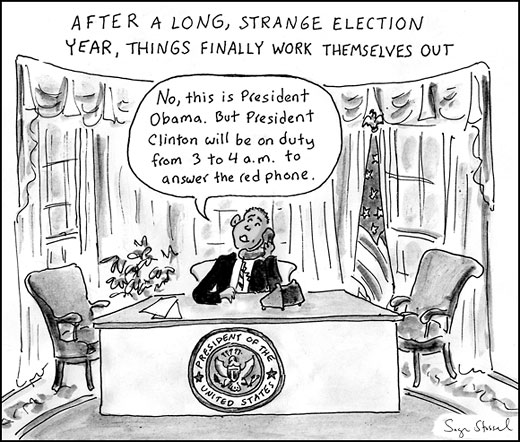
Meanwhile, my own favourite cartoon of Obama election is the one above – and funnily enough, it concerns a piece of old technology: the good old fixed phone. If you recall, in long-drawn campaign for Obama to secure Democratic Party nomination, his rival Hillary Clinton ran this TV commercial which peddled her credentials for being familiar with the corridors of power.
It’s 3 AM and your children are safe and asleep. But there’s a phone in the White House and it’s ringing.
Something’s happening in the world. Your vote will decide who answers that call…
Hillary’s original ad:
Obama’s official response:
There were various unofficial spoofs created by Digital Natives who love to play with new media tools. Just run a search for ‘3 am’ or ‘red phone’ on YouTube and you can watch many of these online!
By the way, isn’t it time that the old-fashioned Red Phone in the White House – the American President’s Hotline to save the world – was replaced with a more modern looking instrument? One more thing for the New Media President Obama…
This is the main thrust of my latest op ed essay, just published by the Science and Development Network (SciDev.Net) anchored in London, UK. It’s titled: Planet before profit for climate change films.
I’m challenging broadcasters to put their money where their mouth is.
Here’s an excerpt:
“Broadcast mandarins routinely support global struggles against poverty, HIV, corruption and climate change by offering free airtime to carry public interest messages. But few let go of their own products on these very subjects for non-broadcast uses.
“Making climate change a ‘copyright free zone’ for media products would increase the resource materials available to thousands of educators, social activists and trainers struggling to communicate this complex topic to audiences across the world. Moving images would make their task easier.
“The climate crisis challenges everyone to adopt extraordinary measures. Broadcasters and film-makers need to balance their financial interests with planetary survival.
“What use is intellectual property on a dead planet?”
In September 2006, speaking at the United Nations headquarters (photo below), I called for poverty to be recognised as a copyright free zone. The idea was to have broadcasters and other electronic publishers release copyrights on TV, video and online content relating to poverty and development issues -– at least until (MDG target year of) 2015.
The TV broadcast and film communities have reacted to this proposal with disdain or indifference, but I keep badgering on. If poverty didn’t motivate broadcasters to change business as usual, I hope, the planetary threat posed by climate change would.
In the well known legend, the pied pier of Hamelin played his musical pipe to lure all the rats into the nearby Weser river. When the town reneged on the promised fee, he played a different tune to entice all its children away from the town.
Modern-day pied pipers use smooth talk and convincing images instead of hypnotic musical tunes to lead people astray. And they achieve much greater coverage today — thanks to the modern media.
When the media amplify pied piper tunes, how responsible are they for the resulting damage?
Then and now, we like to follow a tune...
This is the question I raise – and try to answer – in an op ed essay published this week by the Asian website Eye on Ethics.
‘When media amplify pied piper tunes…’ was inspired by a current experience in my native Sri Lanka. For the past few weeks, Sri Lankans have been shocked and dismayed to learn how thousands of middle-class adults have been hoodwinked by a confidence trickster who used paid advertisements in newspapers and on television to boost his image.
Sakvithi Ranasinghe, a populist tutor of English turned businessman, fled the country in mid-September 2008 after duping thousands of unsuspecting people to deposit money in an Ponzi-style investment scheme that offered abnormally high returns.
After the scandal broke, the media have been giving it a great deal of coverage. But most of it falls into follow-the-victim, blame-the-authorities style of journalism.
The main point of my essay: “Amidst the finger-pointing, arm-waving and name-calling, few have noticed the role of the media in promoting Ponzi schemes in the first place. Wittingly or otherwise, the media have helped amplify the mesmerizing tunes of pied pipers, and quietly collected substantial advertising revenue from such racketeers.”
I also comment in this essay the blurring of what used to be a sacred divide in the media – between editorial content and paid advertising. Here’s an excerpt:
“Many people experience media products as a whole, and lack the media literacy to separate news, commentary and paid commercials. Besides, the once clear demarcations have blurred in recent years.
“Television’s seamless blending of news, entertainment and commercials can leave even the most media-literate people somewhat perplexed. News bulletins are sponsored variously by sellers of insurance, milk food or detergents, while current affairs shows are branded by various commercial products or services.
A communications tower located in Shiba Park, Minato, Tokyo, the Tokyo Tower is 332.6 meters (1,091 ft) tall – which makes it the tallest self-supporting steel structure in the world. Built in 1958, this Eiffel Tower-like structure supports an antenna that broadcasts television and radio signals for important Japanese media outlets including NHK, TBS and Fuji TV.
At the base of the tower, I had an unexpected encounter with an old friend. I know him as Gnana Katha Malliya, the name given to him in the Sinhalese adaptation that I watch on Sri Lankan television.
But everyone in Japan knows him by his original name: Anpanman. He is one of the most popular anime cartoon series (manga) in Japan. It is produced by Nippon Television Network Corporation.
Anpanman is the creation of Takashi Yanase, a Japanese writer of children’s stories. Each animated cartoon is approximately 24 minutes long, split into 2 episodes of approximately 12 minutes each.
Yanase has been writing Anpanman since 1968. He became inspired by the idea of Anpanman while struggling to survive as a soldier in World War II. He had frequently faced the prospect of starvation which made him dream about eating a bean-jam filled pastry called Anpan.
Anpanma is indeed a superman made by a baker. His head is a bun made by Jam Ojisan, a kind-hearted baker. He was created when a shooting star landed in Jam Ojisan’s oven while he was baking.
Anpanma’s name comes from the fact that he is a man with a head made of bread that is filled with bean jam called an anpan. His weakness is water or anything that makes his head dirty. He regains his health and strength when Jam Ojisan bakes him a new head and it is placed on his shoulders. Anpanman’s damaged head, with Xs in his eyes, flies off his shoulders once a new baked head lands.
The most endearing attribute of Anpanman is his sense of sacrifice. When he comes across a starving creature or person, he lets the unfortunate creature or person eat part of his head. Jam Ojisan has to keep baking an endless supply of heads for our hero.
And it gives a whole new meaning to the phrase ‘eat my head off’.
Baikinman is the villain in the stories. He comes from the “Germ World” and is the leader of the viruses. His name means “Germ Man”, and his ambition is to destroy Anpanman and turn the planet into another “Germ World”.
According to the Wikipedia, as of September 2006, Anpanman’s books had collectively sold over 50 million copies in Japan.
The Anpanman television series is called Soreike! Anpanman (meaning ‘Go! Anpanman’) – it has been on the air in Japan since 1988. More than 800 episodes have been made to date. There are also 18 cinematic films featuring the characters.
According to the Japanese toy company Bandai, Anpanma is the most popular fictional character from age 0 to 12 years in Japan.
As I found out, Anpanman is such a cultural icon in Japan that his images adorn railway carriages, and there is an Anpanman museum opened in Yokohama in 2007.
Anpanman is also popular in many countries across Asia. He has a large following in China and Korea, where the comics and TV series have been a popular Japanese cultural export for years.
And, as it turns out, I’d been enjoying his exploits on Sri Lankan television for years without even knowing his original Japanese name! This reinforces the point I made in Feb 2008, writing about another favourite character Madeline – originally French, but whom I encountered on a visit to Manila and Los Banos in January this year.
I wrote: “It’s becoming impossible to discern or define what is ‘local’ anymore in this rapidly globalising and integrating world. Sociologists and communication researchers who split hairs about preserving ‘local content’ have a romanticised notion that is hard to find in the real world.”
OK, this is hot off my imaginative mind. I was writing an op ed essay today and turning phrases over in my mind when I came up with this…which neatly sums up what I’ve been saying for a while: confronted with the climate crisis, broadcasters and film-makers need to adopt a more liberal approach to copyrights on their creations.
Onion News Network - for news you can't afford to miss
The American presidential election race is entering its last lap. And the world watches the campaign trail with baited breath.
Democratic presidential candidate Barack Obama enjoys more international support than his Republican rival John McCain, as most people outside the US prefer the Democrat leader to become next US president, according to a BBC poll in September 2008. Most of the people questioned in the global poll conducted by international polling institute GlobeScan believe that US relations with the rest of the world would improve under the presidentship of Obama.
While so much of American and international news media time is being spent on covering the campaign and various opinion polls, some comic relief comes from The Onion – that wickedly funny and innovative website which now produces a steady stream of videos spoofing the news media’s worse excesses.
The Onion calls it the ‘War for the White House’ and has set up its ‘election analysis bunker’ from where its intrepid reporters are bringing us news that you – and major news organisations – have somehow managed to miss. They call is Onion News Network, ONN for short.
They’ve been doing it for the better part of a year, and here are some of my favourites from The Onion YouTube channel:
Caution: There’s a slight bias towards Senator Obama in some of these news reports, but then, he’s been the liberal media’s darling for much of this campaign year.
October 2008: McCain Left On Campaign Bus Overnight
Campaign officials downplayed the incident, saying the senator was fine as soon as he was fed and taken to the bathroom.
October 2008: Gifted Youngster Sells Cookies To Buy Attack Ad
In this installment of Beyond The Facts, a precocious 8-year-old girl participates in grown-up politics by spreading smears and lies.
September 2008: McCains Economic Plan: ‘Everyone Marry A Beer Heiress’
McCain pointed to his personal success in marrying a wealthy beer heiress to prove how the plan could benefit every American.
September 2008: Obama Runs Constructive Criticism Ad On McCain
In response to Republican attacks, Barack Obama unleashed a series of slightly negative ads that gently point out how McCain could be doing a better job.
August 2008: Portrayal Of Obama As Snob Hailed As Step Forward For Blacks
Overjoyed civil rights leaders say that Barack Obama has paved the way for future black politicians to be smeared as country club snobs.
March 2008: Poll: Bullshit Is Most Important Issue For 2008 Voters
For a majority of likely voters, meaningless bullshit will be the most important factor in deciding who they will vote for in 2008.
January 2008: The Onion: More Candidates Court Fat Vote
Presidential candidates are reaching out to fat voters on the campaign trail by eating large amounts of fattening food.
ONN’s self-introduction says its “style of hard-hitting, on-the-ground coverage of live news events has become a standard in the news industry. The network can be viewed in 92.2 million U.S. households and more than 500,000 American prison cells, making it the most-watched cable network in the world. It can currently be seen in 312 countries, with broadcasts in 52 different languages“.
My regular readers know the disdain with which I hold the so-called public broadcasters in my part of the world. In developing Asia, which lacks sufficient checks and balances to ensure independence of state broadcasters, the only thing ‘public’ about such channels is that they are often a drain on public money collected through taxes. Their service and loyalties are entirely to whichever political party, coalition or military dictator heading the government in office. A few months ago, I described Burmese TV as a good example.
I was delighted, therefore, to visit the headquarters of Japan’s sole public broadcaster NHK this week and find out how exceptional they are in being a public broadcaster that really cares for its funding and viewing public.
Nippon Hōsō Kyōkai has always identified itself to its audiences by the English pronunciation of its initials, NHK. Started as a radio service in 1926, it added television in 1953. Today, NHK runs two terrestrial TV channels, three satellite channels and three radio services – and has started offering more content online and for mobile devices as well. It also has international offerings in TV, radio and web through NHK World.
This massive broadcast operation is financed primarily by a license fee (called ‘receiving fee’ in Japan) paid by each Japanese household that owns a television set. Its TV channels don’t carry any advertising, although the corporation exploits its massive archive and often repurposes its products for commercial gain.
As NHK’s website says, “This (license) system enables the Corporation to maintain independence from any governmental and private organisation, and ensures that the opinions of viewers and listeners are assigned top priority.”
NHK’s license fee system is not unanimously endorsed by the Japanese public, and I later found out that growing numbers of households are declining to pay what currently works out to around US$30 per month (or a dollar a day). This debate has been sustained for several years, with public calls for administrative reform at NHK.
NHK Studio Park entrance
But NHK’s eagerness to engage the public is clearly evident, even to a visitor like myself who spent only an afternoon at NHK’s Studio Park in Shibuya. This is where the corporation’s production facilities are opened to the public every week day from 10 am to 5.30 pm.
NHK Studio Park is a living exhibit – the corporation’s executives and technical staff carry on with their real work amidst (mostly Japanese public) visitors who get to see how TV content is made. Part of the attraction is a museum of TV 55 years of TV broadcasting in Japan.
Welcome to NHK: You're in our bigger picture!
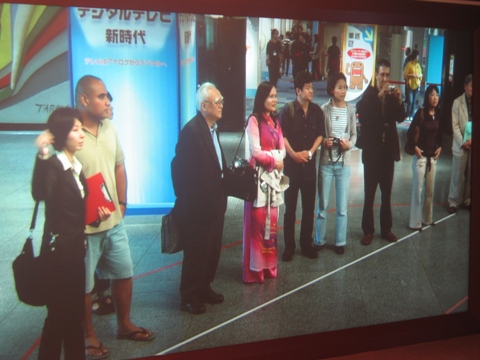
Every visitor is welcomed by being captured by a TV camera with the image being projected live on to a giant screen at the reception. The camera zoomed in on each one in our tour party of ten – and gave us our 10 seconds of fame!
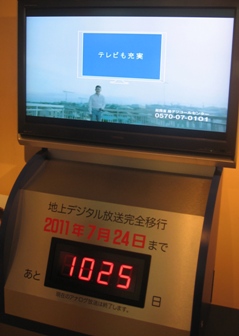
From then on, it offers various displays and interactive opportunities to find out how TV broadcasting has evolved, where it is today – and glimpses of where it is headed. NHK has been an industry leader in technological innovation. It launched digital satellite TV broadcasting in December 2000 and introduced digital terrestrial broadcasts in December 2003. The core technology is Hi-Vision (HDTV), which delivers clear, vivid pictures and CD-quality sound. More than 90% of the programming on NHK is now produced and aired in Hi-Vision.Japan's countdown to analog switch-off
Studio Park makes good use of corridor space for varied displays of photos and archival videos on memorable moments in Japanese and world broadcasting history. Highlights of NHK’s most enduring productions in news, current affairs, culture programming and sports are also shared.
Some of NHK’s cultural and entertainment programmes have been exported successfully to other parts of Asia, offering some counterbalance to the western TV content. One that I recognised was Oshin, a serial drama of 297 episodes made in the early 1980s that has since been aired in close to 60 countries.
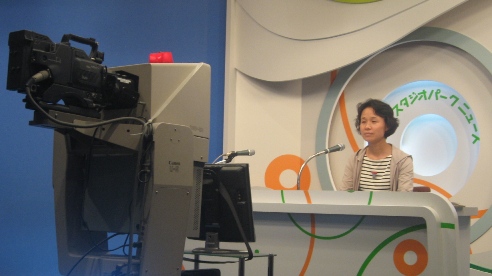
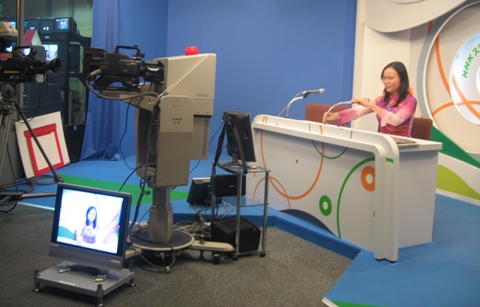
One of Studio Park’s star attractions offers to make a star of any visitor for a few minutes. It’s a newscasting studio where the visitor may sit and face the live camera and read a few lines suggested by the teleprompter – the device that enables news readers to look at their audience while sticking to a flowing text. The teleprompter text is available in Japanese and several other Asian languages.
Hu Jincao of China faces NHK cameraPham Thuy Trang from Vietnam reads NHK news
Two members of our tour party took this news challenge (photos above), and being broadcast professionals, they performed admirably! While it was fun and games for us who are familiar with the medium’s inner working, I can imagine the educational and public relations value of this for people who only consume what television delivers every day and night.
We were also treated to a screening of what was called the world’s first 3D television without special glasses. It was a breathtaking film of about 10 minutes showing underwater scenes. In the dimly lit theatre, the screen felt more like a fish tank – the 3D effect was very real. Not being a techie, I don’t know how to verify the claim of this being a world first, but when this catches on, watching television will never be the same again…
As visitors move in and out of these interesting offerings, it was another day at work for NHK’s staff who carried on with their real productions in studios we passed by. We were allowed to photograph everything except across the viewing glass inside a studio when a recording was underway (lest the camera flashlights disturb it). The freedom to explore and experience, helped by the eternally courteous tour guides, was refreshing.
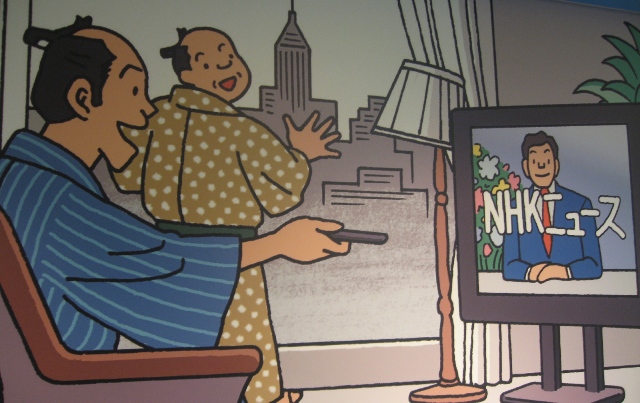
Well, at least NHK seems to know who their masters are – the paying public. And as this image in one exhibit shows, NHK is aware of that little gadget in every viewer’s hand that can instantly nullify all the irinvestment, technology and creativity. If wielded for long enough by sufficient numbers, this can put mighty broadcasters out of business.
It’s a message that Asia’s other broadcasters – public and private – would do well to remember.
NHK knows who its bosses are...
Note: My visit to Tokyo did not involve NHK funding in any manner. I was the guest of our partner TVE Japan, who paid for our admission tickets to enter NHK Studio Park.
“I invested Rs. 2 million (US$ 18,550) of my money after seeing him on TV. I basically believe what I see on the TV and so was misled.”
I read this remark, by a hapless woman victim of an investment scam, in a Sri Lankan newspaper report last week. It got me thinking: where is our media literacy?
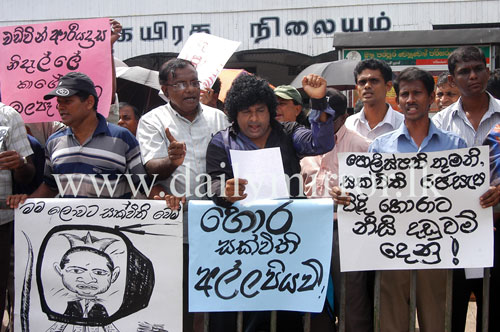
The woman quoted in the news report is not an isolated case. Too many people, it seems, were mesmerised into parting with their money due to a deviously persuasive media campaign. For several years, Sakvithi ran English teaching programmes on Sri Lanka’s national television and other channels. On the guise of teaching English (which he didn’t do very well), Sakvithi manufactured a larger than life image for himself. He also ran regular newspaper advertisements in the highest circulating weekend newspapers. Some were in full colour, occupying an entire broadsheet page. These too reinforced his image as a benevolent, enterprising young Sinhala businessman doing social good.
Not everyone, it seems, heeds the common sense advice, ‘Don’t believe everything you read/hear in the media’. Indeed, the Sakvithi scandal once again brings into sharp focus the media’s — especially television’s — perceived role as the great authenticator of our times.
I have just written an op ed essay for the citizen journalism website Groundviews, where I suggest that the mainstream media outlets that repeatedly sold airtime or newspaper space to this man must now share part of the blame for misleading the public. I also argue that besides timely regulatory action and proper law enforcement, we also need greater vigilance by the media, and higher levels of media literacy in everyone to safeguard society from this kind of media manipulation.
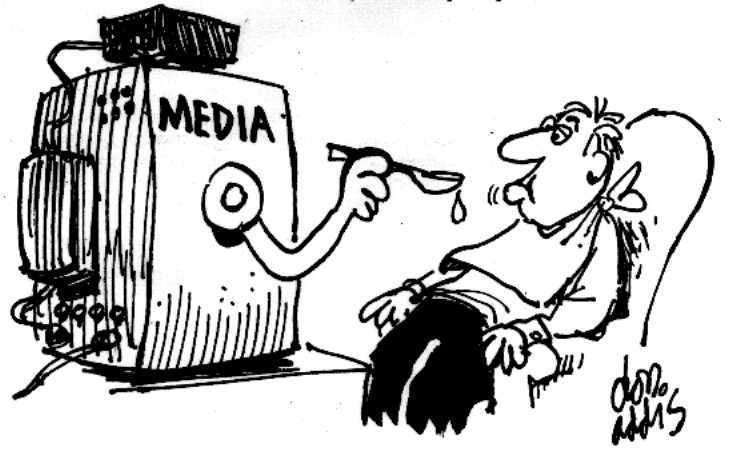
Media illiteracy creates this!
Here’s an extract:
“I find it more than a tad ironic that the same media outlets are now peddling the tales of woe of the thousands of men and women tricked by their former, big-time customer. Knowingly or otherwise, these media have amplified the mesmerising tune of this pied piper of Nugegoda who lulled thousands into parting with their money.
“Their journalists would no doubt protest innocence, reminding us of the divide between editorial and advertising operations. And they are right: media practitioners and editorial gatekeepers don’t have much (or any) control over what fills up the commercially sold advertising space. But how many of their readers or viewers can distinguish the difference?
“Most people experience media products as a whole, and lack even the basic media literacy to separate news, commentary and paid commercials. Besides, with the rise of ‘advertorials’ — product promotions neatly dressed up as editorial content — it’s becoming harder to discern which is which.
Elected political leaders are driven out of office by various factors – ranging from military coup de’tat and popular revolt to corruption or sex scandals. But it’s not common for a head of government to lose his job for appearing on television.
But that’s just what happened on 9 September 2008 to Thailand’s prime minister…and the headline writers worldwide couldn’t resist every imaginable cooking cliche at his expense: “Cooking show lands Thai PM in hot water”, “Thai PM grilled over cooking show”, “Thai PM in a soup”, etc.
Samak Sundaravej has hosted "Tasting and Complaining" cooking show for years on Thai TV
The court judgment, broadcast live on television and radio, was greeted with loud cheers and claps from Samak’s opponents who have occupied his office compound since Aug. 26 to demand his resignation. Some protesters wept with emotion.
The 73-year-old Samak, who has cooked for visiting leaders, hosted a popular television cooking show — “Tasting and Complaining” — for seven years before becoming prime minister in early 2008 after his his People Power Party (PPP) and five others won a general election. He returned Thailand to civilian rule after the army had captured power in September 2006, ousting the former populist prime minister Thaksin Shinawatra.
Some say this is the first time a professional chef has become prime minister anywhere. Samak had made several TV appearances after taking office, which the court held was breaking a constitutional prohibition on private employment while in office.
As of this writing, the ruling coalition is trying to find a political leader who can form a government. The street demonstrators, one of whose main demands was the resignation of PM Samak, are watching developments with a sharp eye.
In recent weeks Samak’s government, though duly elected, has been under siege from PAD which draws its strength from among city dwellers and the elite. Although I have been visiting Thailand for 20 years, I don’t claim to understand the murky world of Thai politics. But until recently, Thais had somehow managed to keep their politics and business separate, allowing the latter to continue largely unaffected.
In the end, Samak lost his job not for any substantive lapses of governance – his opponents had lined up a long list of these – but on a legal technicality.
Samak's TV show brandingSamak has been involved in Thai politics for over 30 years, and since the 1990s has been promoting the art of Thai cooking on both radio and television. He started cooking at the age of 7, and his popular cookbook Chimpai Bonpai (“Tasting, Complaining”) is now in it’s 9th edition. One innovative Samak recipe: he makes pork leg stew with coca-cola.
Surely, Samak is not the first or last politician to sustain a parallel second career on television – the most dominant mass medium in most parts of Asia. Serving and aspiring leaders across Asia have deals with popular television networks that help boost their image and help their approval ratings. And in immature democracies, state-owned TV networks are grossly abused by politicians of ruling parties for outright propaganda.
Samak’s mistake was not so much continuing his TV career, but getting paid for it while holding public office. He should have just stuck to the publicity value. After all, with Thai cuisine among the most popular in the world, he could have gone far combining his culinary talents with hosting TV shows. Instead, he cooked up an avoidable storm…
Here’s the bright side: if Samak leaves politics, he has a choice of at least two lucrative careers.
Celebrity Thai chefs, anyone?
Watch the ousted Thai PM cooking in this news report on ITN News (UK):
Never underestimate the power of moving images. Al Gore tipped the balance in the long-drawn climate change debate with his Oscar-winning film, An Inconvenient Truth. The rest is recent history.
Thanks to the film – and sustained advocacy of hundreds of scientists and activists – climate change is no longer a speculative scenario; it’s widely accepted. The challenge now is to understand how it impacts different people in a myriad ways.
Called Vulnerability Exposed, the contest is open to anyone anywhere in the world who wishes to have their voice heard. The submitted films should innovatively illustrate the consequences of climate change through one of the following theme categories: conflict, migration, the urban space, rural institutions, drylands, social policy, indigenous peoples, gender, governance, forests, and/or human rights. The submission period ends on 24 October 2008.
Caroline Kende-Robb, Acting Director, Social Development Department, said, “There is a need to see climate change as an issue of global social justice. The rights, interests and needs of those affected by climate change must be acknowledged.”
Watch the Bank’s short video, where she explains further:
The contest has two award categories:
1) Social Dimensions of Climate Change Award (general category) – open to professional and amateur; and
2) Young Voices of Climate Change (youth category) – open to entries submitted by filmmakers under 24 years old.
Award winners will be chosen through a combination of public voting and a judging panel. The film with the most public votes in each theme category will receive honorable mention.
Vulnerability Exposed film competition: Judging process
This contest indicates that the World Bank is slowly but surely opening up to the currently untapped communication potential of web 2.0 – the very point I made in a recent op ed essay.
There are several noteworthy aspects in this competition, some more positive than others. I offer this critique in the spirit of improving a commendable initiative.
Three cheers to the bank for accommodating both amateurs and professionals. It’s about time those who don’t video film for a living (some of who are no less talented in the craft) had more opportunities to showcase their products.
It’s good to see the preference for shorter films, in this contest defined between 2 and 5 mins in duration. This certainly resonates with TVE Asia Pacific’s experience with Asian broadcasters, many of who now prefer shorter films. Longer films have their place, of course, but shorter ones are clear favourites of 24/7 news channels and also online.
Most film contests are judged exclusively by an all-powerful jury (I’ve been on several over the years), but here the online public have a chance to vote for their favourite entries. Let’s hope the judges will consider the story telling power of entries as the most important deciding factor. (The examples in the YouTube film given above are misleading – they all seem extracts from expensively made documentaries.)
The big challenge for many aspiring contestants would be to relate climate change to daily realities in their societies. Despite global headlines and the development community’s current frenzy about it, climate change as a phrase and concept still isn’t clearly understood in all its ramifications. If science now knows 100 facts about the murky processes of climate change, the average public knows less than 25 and understands even less. So it will be interesting to see how entries relate the big picture to their individual small pictures.
I’m a bit disappointed that the World Bank is not offering any cash prize to the winners. Instead, “the winners will receive an all expenses paid trip to Washington, DC for a screening of their film and will have the opportunity to attend a series of networking and learning events organized by…the World Bank in December 2008.” This is all useful, but video – even at the low end – is not exactly cheap, and even labour of love creations cost money to make. We are currently running a comparable the Asia Pacific Rice Film Award – which seeks entries no longer than 10 mins on any aspect of rice – and despite being a non-profit, civil society initiative we have a prize of US$ 2,000 to the winner. And we wish we could offer more.
But my biggest concern is the unequal, unfair terms of copyrights found in the small print of the competition rules. This is where the lawyers have done their usual handiwork, and with the usually lopsided results. The World Bank wants all contestants to make absolutely sure that all material used is fully owned by the contestants, or properly licensed. That’s fine. But tucked away on page 7, under section 12 titled Entrant’s permission to the organiser, is a set of conditions which will allow all affiliated institutions of the World Bank group to use the submitted material for not just promoting this contest (a standard clause in most competitions), but for ‘climate change work program of the organiser’.
What this means, in simpler terms, is that without offering a single dollar in prize money, the World Bank is quietly appropriating the unlimited user rights for any and all the submitted material. These are the core materials in the moving images industry, and nothing is more precious to their creators.
I have long advocated a more balanced, equitable and liberal approach to managing copyrights and intellectual property by both the broadcast television industry and development community — especially where public funded creations are concerned. I have nothing but contempt for lawyers and accountants who often determine the copyrights policies in large broadcast and development organisations. They set out terms that may be justified in strict legal terms, but are totally unfair, unjust and, in the end, counterproductive to the development cause and process. It seems that while our friends in the social and communication divisions were not looking, the Bank’s lawyers have done their standard hatchet job.
While this doesn’t detract from the overall value of Vulnerability Exposed, it diminishes its appeal and potential. Many professional video film-makers who value their footage – gathered with much trouble and expense – may not want to sign future user rights away for simply entering this contest. And worse, the unsuspecting enthusiasts who don’t necessarily earn their living from making films – but are entitled to the same fair treatment of their creations – would be giving away material whose industrial value they may not even fully appreciate.
It’s certainly necessary and relevant for development organisations like the World Bank and the UN system to engage web 2.0. But they must be careful not to import or impose rigid, one-sided and outdated copyright regimes of the past on this new media.
I hope the Bank would consider revising these unfair copyright terms, and treat the submitted material with greater discretion and respect. If not, all entrants risk seeing their material popping out of bluechip films produced by top-dollar production companies in North America and Europe who have ‘mining rights’ to the Bank’s video archives.
Vulnerability Exposed can have more meanings than one. We’d rather not consider some.











 Open Minds!