The keynote address was delivered by Sri Lankan minister of environment and natural resources. The British Council asked me to speak a few words at the opening as TVE Asia Pacific is a local partner for this event.
Here’s what I said, which sums up why we are in this business:
We are delighted to be partners in hosting Wildscreen film festival in Sri Lanka. We thank our friends at the British Council and Wildscreen festival for this opportunity to join hands.
May I say a brief word about ourselves. We’re Television for Education Asia Pacific — trading as TVE Asia Pacific. We’re a regionally operating media foundation anchored in Colombo and engaging developing countries of Asia. We were set up in 1996 by a group of Asian and European filmmakers and TV professionals to cover the full range of development issues using broadcast television, narrowcast video and now, the web.
We are driven by a belief that what is happening in the world’s largest and most populous region has far-reaching implications not just for our region — but also for the entire planet.
When introducing our work, I like to recall the words of Mahatma Gandhi. Once, when asked by a visiting foreign journalist for his views on wildlife in India, he said: “Sadly, wildlife is declining in our jungles, but wild – life is increasing in our cities.”
It is precisely this wild–life that interests us more. In our work we keep asking: when life itself is going wild, what hope and prospects are there for wildlife, Nature and environment?
For example, we’ve literally just finished a short film looking at environmental restoration of Afghanistan. This will be screened to the environmental minister from around the world who will gather shortly for the UN Environment Programme’s Governing Council meeting in Nairobi.
We can't just walk into a glorious sunset and forget real world challenges - Photo by Niroshan Fernando, TVEAP
Capturing wild-life is now the focus and concern of wildlife and environmental film makers everywhere. There was a time, not too long ago, when films used to simply capture the beauty of Nature and the diversity or behaviour of plants and animals. Such documentation is still very necessary and useful — but it’s no longer sufficient.
In the past couple of decades, all film makers have been challenged to look at how our own ‘wild’ ways of living affects:
– each other in our own human species;
– the rest of Nature and other species; and
– also, the future of life on Earth.
We see this transformation reflected in the content of films entering Wildscreen and other film festivals. I saw early signs of this when I served as a juror at Wildscreen 2000 festival. This process has gathered momentum since.
To remain relevant and topical, films can no longer just cover ‘green’ subjects — they have to acknowledge the ‘brown’ issues as well as the harsh black-and-white, life-or-death concerns such as climate change.
At the same time, we have seen a rapid diversification of formats or genres — especially with the emergence of online and mobile platforms. These now compete with broadcast television to engage audiences. This is both good news and bad news for us engaged in film making and film outreach. Yes, we now have more ways of reaching people than ever before. But engaging audiences is harder: people have more choice — and more distractions!
Of course, we can’t just give up the good struggle and walk away into those beautiful sunsets. At TVE Asia Pacific, we believe that making good films is only half the job done. Distributing them far and wide is just as important. This is why the slogan of our own organisation is: Moving images, moving people!
In that process, film festivals such as this one play a key role. We’re very happy to add an extra day of screenings to this event. On Saturday in this auditorium, we’ll be showing a number of films on climate change and sustainable development drawn from our own catalogue of films we distribute to broadcast, civil society and educational users across Asia.
These are small efforts in a big world. I can only hope all these help us in winning history’s greatest race – which, according to H G Wells, is one between education and catastrophe!
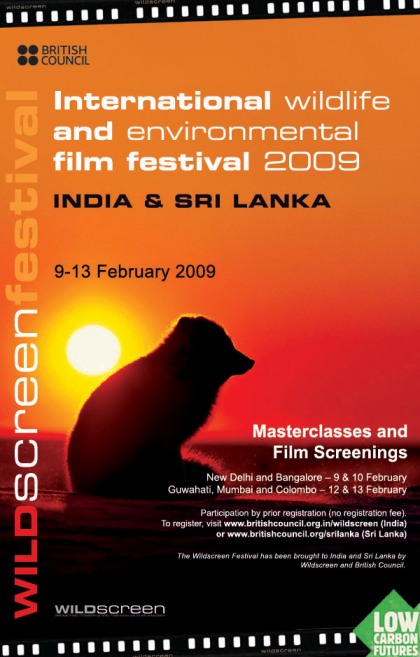
Wildscreen comes to ColomboWildscreen, the world’s largest and most prestigious wildlife and environmental film festival, will be touring India and Sri Lanka in February 2009.
Nine wildlife or environmental filmmakers from the UK will be coming to India and Sri Lanka as part of this event, organized by the British Council. The festival will also see screenings of wildlife and environmental films from across the world, some of them winners of the Wildscreen festival’s Panda Awards, the environmental equivalent of the Oscars.
The Wildscreen Festival was founded by Sir Peter Scott in 1982. It has been organised every alternate year for the past 25 years, and is now considered to be the world’s largest and most prestigious wildlife and environmental film festival. Held in Bristol, UK, it attracts hundreds of delegates from around the globe who work in film, television and new media, as well as those involved in environmental conservation.
The Festival is coming to Sri Lanka for the first time. The programme, held at the British Council Colombo on 12 – 13 February 2009, will screen several award winning films on climate change and wildlife, showcasing the best of current environmental film making worldwide. On 14 February 2009, TVE Asia Pacific will present a selection of films on environment and sustainable development drawn from their global catalogue, which includes some Sri Lankan and South Asian titles.
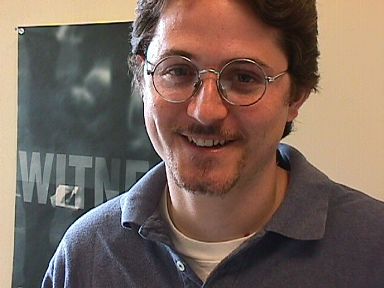
Sam Gregory“It’s an immensely exciting time for people working with video. More and more people creating and using video, more places to share it, more ways to place it in front of people who can make a difference.
“It raises challenges too: saturation of images and compassion-fatigue, finding your place to be heard, and the safety and security and consent issues that arise when many more people are filming each other.
“But overall I think we’re seeing a really powerful moment for individual expression but also collective accountability being supported via image-making.”
So says Sam Gregory programme director of Witness, a human rights organisation which uses video and online technologies to open the eyes of the world to human rights violations. The New York-anchored organisation works around the world to ’empower people to transform personal stories of abuse into powerful tools for justice, promoting public engagement and policy change’.
http://www.witness.orgSam recalls how he was once making films and also involved in activism, and ‘frustrated at how the two didn’t fit together’.
He adds: “In the traditional TV documentary world, the advocacy purpose of film was under-utilized. The fact that you got 500,000 viewers for a TV broadcast told you nothing about whether that turned into action. So I started looking for ways to really make the video fit as a tool for real advocacy and change-making, and came upon WITNESS.”
We at TVE Asia Pacific worked closely with Sam in 2002-2004, when we implemented a collaborative Asian regional project called Truth Talking where Witness was a partner. It was through Witness that I met courageous info activists like Joey R B Lozano.
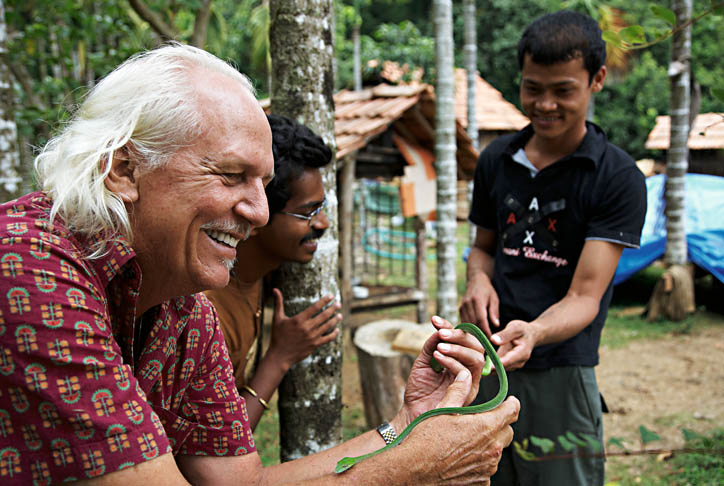
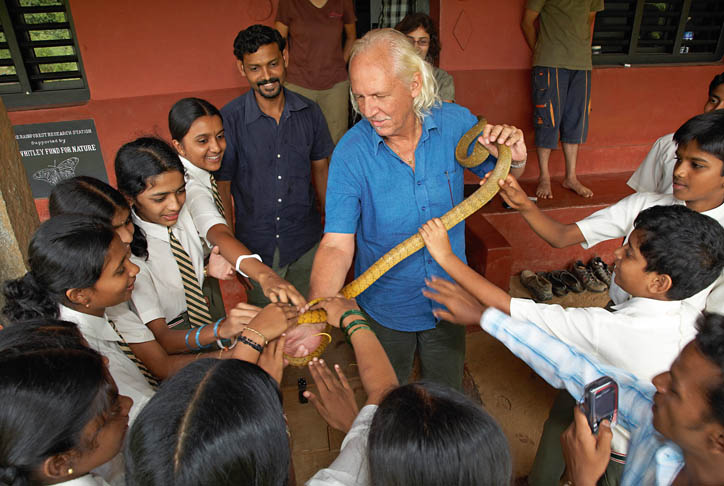
Romulus Whitaker introduces a young volunteer to a snake at Agumbe research station, Tamil Nadu, India – photo courtesy Rolex Awards
“I haven’t had to do a nine-to-five job ever in my life, and that is a very envious situation to be in if you like the wild. Life has been much like a river in that it picks you up and carries you along. I have got into things as they come towards me.”
That’s how Romulus Whitaker, reptile and amphibian specialist, conservationist and filmmaker sums up his long, eventful and illustrious career. At 65, he is full of zest for life, ready to take on new challenges in protecting India’s forests and wildlife.
I caught up with this American-born, naturalised Indian citizen a few days ago when he and fellow Indian Moji Riba were presented with their Rolex awards at a ceremony in New Delhi.
Of course, I’d heard about Romulus (Rom) Whitaker for years and seen some of his natural history films. In some ways, his style was a bit like that of ‘The Crocodile Hunter’ Steve Irwin — putting himself in the picture, sometimes in daring encounters with potentially dangerous animals…all in the name of bringing nature a bit closer to us in our living rooms.
But such similarities go only so far. Rom takes a less dramatic and more philosophical approach to humans’ relationship with Nature. For him, television is only a means to an end. As Rolex award profile put it, “the combination of a foreign name, mildly Viking looks inherited from his Swedish mother, an unexpected fluency in local Indian dialects and a thoroughly irreverent attitude” makes him “a highly unconventional yet effective conservationist in a country far from his birthplace”.
To catch a glimpse of this remarkable man, watch this ‘Incredible India’ PSA featuring Romulus Whitaker:
Rom was the founder director of the Snake Park in Chennai. The park was established in 1972 ‘to preserve the endangered reptile species in the sub continent’.
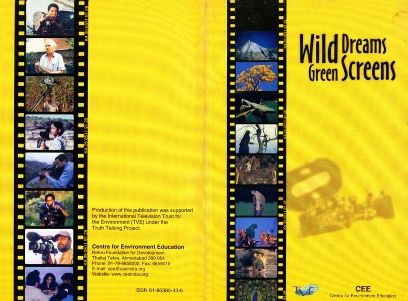
Rom’s career in film making was a byproduct of his life-long desire to bring people and Nature closer. He chronicled his venture into the world of television and film in a chapter he wrote for a book published by India’s Centre for Environment Education and TVE Asia Pacific in 2002. In that book, titled Wild Dreams, Green Screens, eight leading Indian film-makers shared insights about their careers, including how and when they decided to get involved in this field. They also talked about some of the exciting — and frustrating — experiences they have had while filming nature and wildlife.
From dreams to screen…
In the early 1970s, Rom worked with a Russian film crew who turned up to do a sequence on snakes for a film based on the famous Kipling story, Rikki Tikki Tavi. “It was fun for me to help them figure out how to film a snake stealing an egg from a bird’s nest – and it took a whole week to do it. I was impressed by their patience and persistence,” Rom recalled in the book.
After that, every few months, some film crew would show up to do either a short news story on the Snake Park, or a short film on Indian snakes for foreign audiences. India’s stereotyped reputation as a land of snakes and snake-charmers partly fueled this interest.
Rom continues: “By the 1980s, I started thinking I knew something about making wildlife films – even though I didn’t have a TV, and there weren’t really very many such documentaries screened anywhere in India. I was aware that films could show and teach people about my beloved reptiles like nothing else. Surely the Snake Park with nearly a million visitors a year could make good use of such films, and I knew the visitors would go away with a new awareness of how beautiful, graceful and interesting reptiles are. A single broadcast on a TV channel and 20 million people would be able to see it all at once!”
Determined to do his own films, Rom teamed up with two school friends John and Louise Riber, and Shekar Dattatri, to make a film on India’s snakebite problem. They had a tiny budget (Indian Rupees 50,000, which is approximately US$ 1,000 today), an old Arri camera and ‘a lot of enthusiasm’.
One thing led to another. “‘Snakebite’ turned out to be a good little half-hour film which was translated into several Indian languages… Amazingly, this little film won a first prize at a festival in the United States, and was awarded the Golden Eagle by the American Movie and Television Federation. Lo and behold, I was a filmmaker!”
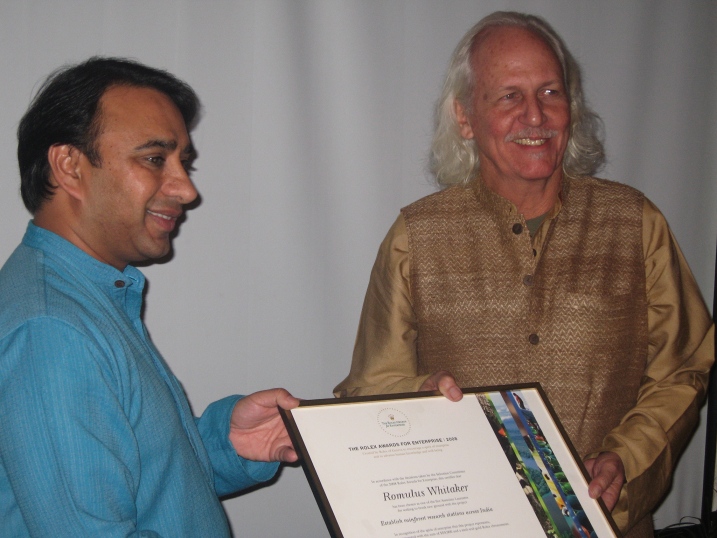
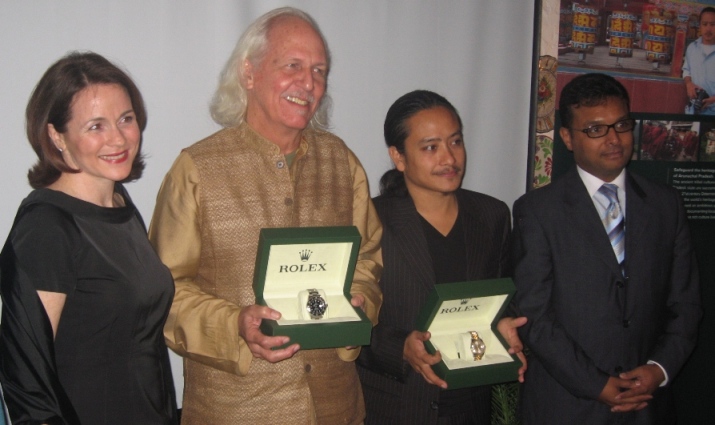
Vikram Akula (left) presents Rolex Awards certificate to Romulus Whitaker in Delhi, 22 January 2009
We missed Shekar at the Delhi event – he couldn’t make it due to scheduling difficulties. But as Rom has written, the Whitaker-Dattatri partnership continued for several years while they struggled with ‘very crude equipment’ and tiny budgets. Films like ‘Seeds of Hope’ (on tree planting) and ‘A Cooperative for Snake Catchers’ followed.
Rom further writes in his chapter: “We worked hard on these films, learning as we went along month after month, working with really good people like the tree planters of Auroville and the Palni Hills Conservation Council, and, of course, the fantastic Irula tribals. We did have a few narrow escapes with snakes, but we always felt we were in much more danger driving down National Highway 45, than from any of our venomous subjects!”
Rom’s film making in the past two decades has taken him not only to the far corners of India, but to other biodiversity hotspots of the world – such as Indonesia. As the years passed, his enhanced reputation attracted big names in wildlife films, such as National Geographic, Discovery/Animal Planet and BBC Natural History. Combining his conservation knowledge with public education skills, Rom has also been presenter of several films.
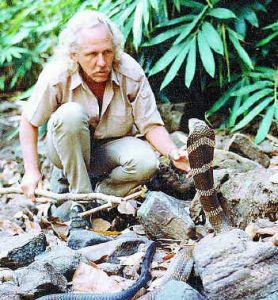
The King (Cobra) and I
These multiple involvements have earned him a string of awards – his documentary King Cobra made for National Geographic won him an Emmy award, considered the television equivalent of the Oscars.
Despite the rigorous demands of film making (and the occasional lure of television medium), Rom has remained active in conservation circles both within India and at global level. While many conservationists in India focus their attention on charismatic megafauna like tigers and elephants, Rom has stayed faithful to his chosen field of reptiles and amphibians. Years ago he realized that his beloved species cannot survive unless their natural habitats do. So, like many others, he evolved from naturalist to conservationist.
“A lot of us get wrapped up in our own little special animal and then we wake up and start thinking it has got to be habitat and it has to be eco-development that involves people and, now, in my case, it has crystallized into the whole idea of water resources,” he says.
Rom’s colourful career has itself become a subject for other filmmakers. In 2007, he was featured in a critically-acclaimed documentary produced by PBS, under their “Nature” banner, on “super-sized” crocodiles and alligators, which was filmed in India, East Africa and Australia.
And in January 2009, Whitaker returned to the small screen in another “Nature” documentary on real-life reptiles such as Komodo dragons and Dracos that inspired tales of dragons.
The man who turned to moving images in the 1980s to move people’s minds towards conservation is still engaged in that business. He is a conservationist who puts a premium on public engagement, and especially on working with children and young people.
He says: “We are doing a lot of work with young people, bringing them to the forest and showing them what happens here and why it matters. It can be very difficult to change adult attitudes, but with the young, it is easier to get across the knowledge that what we are doing to the forests we are doing to ourselves.”
In Romulus Whitaker\’s hands, snakes become educational tools for children and icons of nature conservation. Photo courtesy Rolex Awards
A race against time: Moji Riba capturing living cultural heritage before it's too late...
When young Moji Riba started taking an interest in video cameras and filming, his father was a bit concerned.
“I don’t want my son to end up as a cameraman,” he said, reflecting on the fact that a videographer was considered to be no more than a skilled worker in some sections of Indian society.
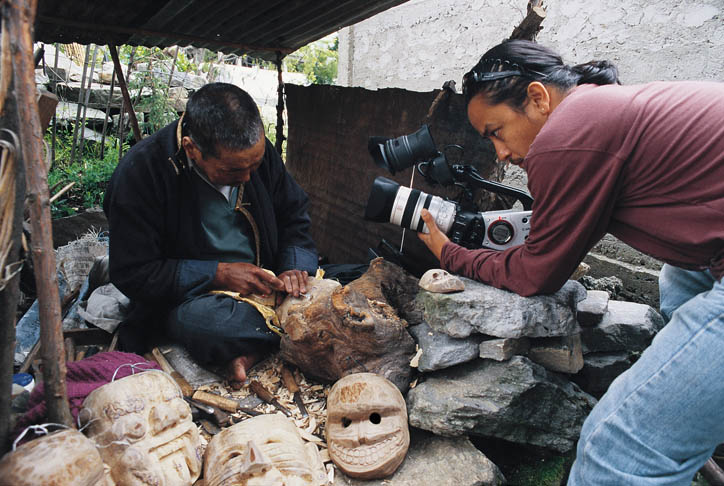
He need not have worried. Moji went on to become both a well respected film maker and a teacher of mass communications. But more importantly, he has turned his skill into capturing and preserving the highly diverse cultures and traditions of his home state of Arunachal Pradesh in India’s north-east.
Working below the mainstream media’s radar and improvising with available resources, Moji has been engaged in this pursuit passionately and diligently for nearly a dozen years. These efforts finally came into global spotlight in November 2008 when he was selected for a prestigious Rolex Award for Enterprise.
Rolex recognised Moji for ‘helping to preserve and document the rich cultural heritage of India’s Arunachal Pradesh tribes’. He was among the 10 winners of the 2008 Rolex Awards, which for more than 30 years have supported pioneering work in science and medicine, technology and innovation, exploration and discovery, the environment and cultural heritage.
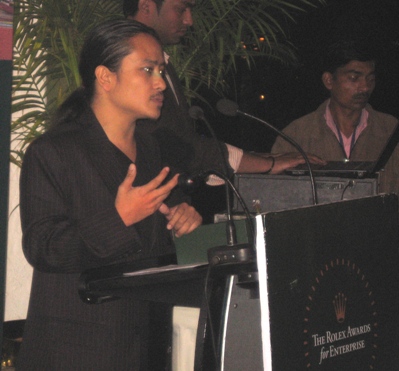
Moji Riba accepting Rolex Award 2008 in DelhiThe award was presented to him at a simple ceremony held in New Delhi on 22 January 2009. I was glad to be a ‘fly on the wall’ on that joyous occasion, when Moji and fellow winner Romulus Whitaker were felicitated.
Accepting his award certificate and Rolex chronometer, Moji said: “In the end, this award is not about material rewards. Our most important gain was the process of the application and evaluation which were so intense and demanding that we have had to go through a lot of introspection.”
He added: “That process made us pause and ask ourselves: why are we doing our work, are we doing it right and what results are we going to achieve. That was worth a great deal for us.”
In his short and witty acceptance speech, Moji thanked everyone who has believed and supported his team’s work. His wife Purnima and two young children were there, along with several friends some of who had especially flown in for the occasion. Moji acknowledged his father, who, alas, didn’t live to share this proud moment.
Through a rigorous and discerning selection process, Rolex Awards support path-breaking work in progress, giving laureates new momentum and recognition. In the 2008 award cycle, Moji was one of 10 enterprising individuals chosen from among nearly 1,500 applicants in 127 countries by an independent panel of scientists, educators, economists and other experts.
L to R: Barbara Geary of Rolex Awards secretariat, Romulus Whitaker, Moji Riba & Yogesh Shah, CEO of Rolex India
Enthused by the Rolex Award, Moji will return to pursue his most ambitious project yet to preserve the living cultural heritage of Arunachal Pradesh, home to 26 major tribal communities. Each one has its own distinctive dialect, lifestyle, faith, traditional practices and social mores. They live side by side with about 30 smaller communities. Moji sees this richness “like a wonderful shawl woven in a myriad of colours and patterns”.
In recent years, this heritage has come under pressure from economic development, improved means of communication, the exodus of the young and the gradual renunciation of animist beliefs for mainstream religions. Instead of challenging these larger processes beyond anybody’s control, Moji is trying to harness digital technology to capture at least the essence of it for posterity.
That’s the basic idea behind the Mountain Eye Project, an unconventional initiative of his Centre for Cultural Research and Documentation (CCRD) based in Naharlagun. Magic Eye aims to create a ‘cinematic time capsule’ documenting a year in the life of 15 different ethnic groups.
Moji will train young people from each community to do the filming. This gives him access to enough film-makers as well as access to people with an intimate understanding of village life. Beginning in early 2009, these novice film-makers will capture a broad range of the tribes’ oral histories, as well as the rituals, ceremonies and festivals that take place over a year in their villages.
Moji expects to collect about 300 hours of film per village, all of which will be recorded and archived in their native languages. He believes that the resulting 4,000+ hours of video will provide an invaluable record of life as it has been lived in his state for centuries. The project will also engage scholars belonging to the 15 tribes from the Rajiv Gandhi University at Itanagar to analyse and translate this vast amount of data and organize it in a publicly accessible database.
This innovative work epitomises the spirit of Rolex Awards, which nurture excellence in individuals who often work against many odds — determined women and men lighting a few candles on their own, instead of just cursing the darkness…
As I enjoyed the company of Moji, Romulus and their many admirers well into Delhi’s chilly evening, these words the Malaysian social and environmental activist Anwar Fazal kept turning in my mind: “In a world that is increasingly violent, wasteful and manipulative, every effort at developing islands of integrity, wells of hope and sparks of action must be welcomed, multiplied and linked…”
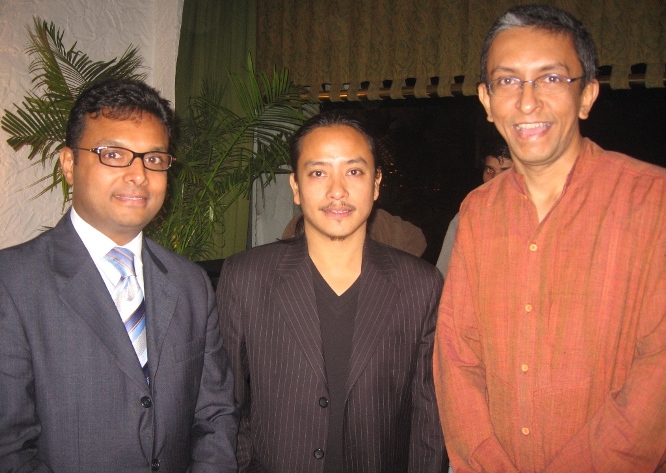
One more shot: L to R - Yogesh Shah, Moji Riba, Nalaka Gunawardene
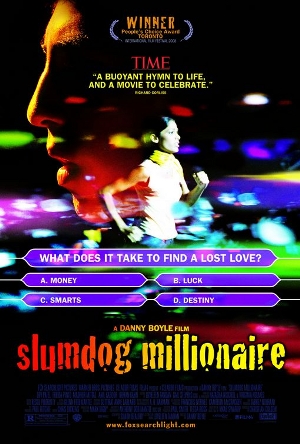
Who wants to be a Slumdog Millionaire?“All the world is a quiz, and all the men and women merely players.” That’s how the late Magnús Magnússon, iconic host of BBC TV’s long-running quiz Mastermind, once described the scope for his line of work.
These words came to my mind as I watched the new Danny Boyle movie Slumdog Millionaire in New Delhi on its opening night on 23 January 2009. For two hours, it held me spellbound and transported me, alternately, to the rough world of Mumbai slums and the glitzy world of television quizzing in Bollywood.
It’s a feel-good, rags-to-riches story about Jamal Malik, an 18 year-old orphan from the slums of Mumbai who goes on to win a staggering 20 million Indian Rupees (a little over US$ 400,000) on India’s version of the popular TV game show Who Wants To Be A Millionaire?. The story, adapted from an award-winning novel Q&A(2005) by Indian diplomat Vikas Swarup, resonated strongly with me given my own, long-standing association with the overlapping worlds of quizzing and TV hosting.
As the story unfolds, we find out how and why Jamal – who has had little or no formal schooling and lacks ambition to win the quiz – got on the show: for a very personal reason. Through a series of amazing coincidences, well known in the movies that often ask us to suspend disbelief, the answer to each question he faces is deeply etched in his memory from his tumultuous past.
When the show breaks for the night, Jamal is only one question away from winning the show’s grand prize, which can make him a multi-millionaire. But the show’s organisers just can’t believe that an uneducated street kid (or a ‘slum dog’) has made it thus far on his own. So they call in the police.
As the police inspector says: “Doctors… Lawyers… never get past 60 thousand rupees. He’s on 6 million.” The question for everyone is: how does he do it?
Jamal is arrested on suspicion of cheating, and police torture him overnight to find out how. Desperate to prove his innocence, Jamal tells the story of his life in the slum where he and his brother Salim grew up, of their adventures together on the road, of vicious encounters with local gangs, and of Latika, the girl he loved and lost. Each chapter of his story reveals the key to the answer to one of the game show’s questions…
Watch the official movie trailer for Slumdog Millionaire:
Jamal returns the next evening – straight from police custody – to face the final question. The right answer would earn him 20 million; giving the wrong answer would lose all his winnings so far. By this time, his meteoric rise to the final question has made news headlines and tens of millions of TV viewers across India are watching the show and cheering for him. Among them is the young woman for whom Jamal got on the show in the first place…
The dramatic story ends on a happy note, in true Bollywood style, when boy meets his long-lost girl. One of its sub-plots offers insights into the high adrenalin world of quiz shows, which are now being played for high stakes.
Is that your final answer?
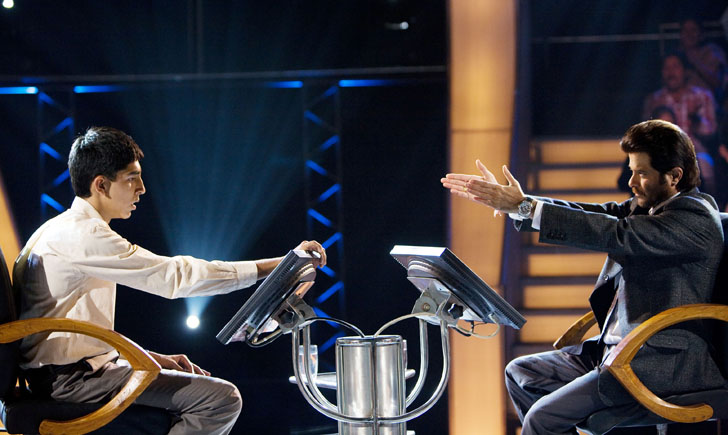
The film uses the actual set of Kaun Banega Crorepati (KBC), the Indian version of the globally popular game show, Who Wants to be a Millionaire? which offers large cash prizes for correctly answering 15 (or in some countries, 12) consecutive multiple-choice questions of increasing difficulty. It represents the highly commercialised end of the quizzing world, which traditionally shunned cash rewards for performance. For example, the winner of BBC Mastermind receives nothing more than the coveted title.
I can’t remember exactly when I first took part in a general knowledge quiz — that is now buried too deep in the sediments of my memory. But I have been an active participant in the fascinating world of quizzing for at least three quarters of my 42 years, first as a quiz kid and then as a quiz master.
Slumdog Millionaire reinforces a point I have been making for years: not to equate knowledge with intelligence. Quizzes of every kind only test the general knowledge and quick recollection ability among participants — but not necessarily their intelligence. Measuring intelligence (that is, determining intelligence quotient, or IQ) is a specialised and complicated process. In any case, scientists acknowledge that such measurements are not always accurate because of cultural diversity and other variables. Although someone excelling in quiz would, in all likelihood, also have a high level of intelligence, quiz performance by itself is no measure of someone’s IQ.
Similarly, there is also no direct co-relation between the level of educational attainment and performance at general knowledge quizzes. While good quiz kids generally tend to be high achievers in their curriculum studies, that is not always so. I remember a London taxi driver once beating dozens of academics and professionals to become the overall winner in Brain of Britain, the BBC’s long-running radio quiz show. Apparently he used to read a great deal while waiting for hires.
Finally, I know of serious quiz enthusiasts who frown upon game shows like KBC as a dumbing down of the cerebral art. But there’s no denying that, by invoking popular culture, the new formats have hugely enhanced the audiences following quizzing on TV. For the true aficionados, there’s always Mastermind and other ‘pure’ forms of quizzing that remain above the fray of commerce. For the rest, there are shows that mix the quest for knowledge with the pursuit of happiness through material rewards.
As I wrote at the time: “The few of us thus became the first outsiders to see the film which I found both deeply moving and very ironic. With minimal narration, he allows the local people to tell their own story. There’s only one expert who quickly explains just what is going on in this particularly weather-prone part of the world.”
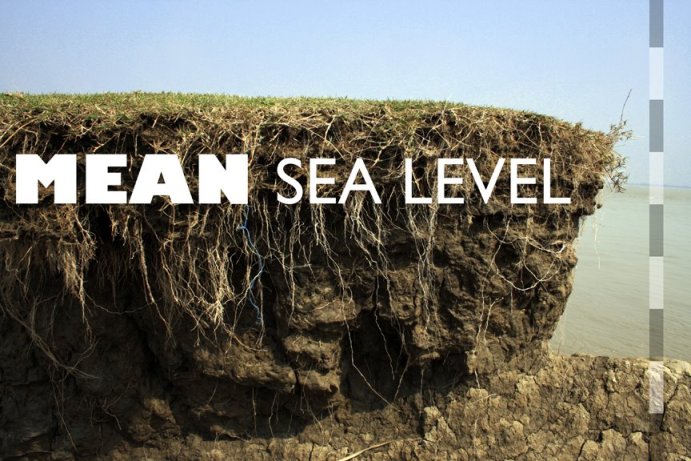
The world’s rich are having a party, and millions living in poverty are the ones footing the bill. This is the premise of the film, which looks at the impact of climate change on the inhabitants of Ghoramara and Sagar islands in the the Sundarban delta region in the Bay of Bengal.
Almost 7,000 inhabitants have been forced to leave Ghoramara in the last 30 years, as the island has become half in size. The biggest island, Sagar which hosted refugees from other islands all these years is witnessing massive erosion now. 70,000 people in the 9 sea-facing islands are at the edge of losing land in next 15 years. For these people climate change is real.
As the sea level rises and takes with it homes and livelihoods in the delta, the villagers of Sagar are paying a hefty price for a problem that they did not create. Meanwhile, middle class India and the political elite are becoming aware of the problem of global warming, but prefer to look the other way.
I’m glad to note that the film is now being screened to various audiences and making ripples. By showing people – including those still not convinced about climate change – what sea level rise is already doing to poor people, the film is stretching the limits of debate and focusing attention on the need to act, not just talk.
It’s also creating ripples in environmental and/or human rights activist circles where all too often, passionate discussions don’t go very far beyond the rhetoric to bring in the real world voices and testimonies. Pradip’s film accomplishes this with authenticity and empathy yet, mercifully, without the shrill and overdose of analysis found in activist-made films. It powerfully and elegantly tells one of the biggest stories of our times.
Pradip SahaIn November 2008, Pradip showed and talked about his film at a screening organised by SACREDMEDIACOW (SMC), an independent postgraduate collective on Indian media research and production (and much more) at the School of Oriental and African Studies (SOAS) at the University of London. Before it started, Pradip told his audience to ‘forget that this is a documentary about climate change’ and just watch.
As one member of his audience, Sophia Furber, later wrote: “The film’s approach to climate change is completely non-didactic. Mean Sea Level is no acronym-fest sermon or disaster story, but an intimate portrait of a way of life which is on the verge of going underwater.”
In his day job as editor of Down to Earth magazine, published from India with a global outlook, Pradip excels in wading through the (rapidly expanding) sea of jargon and acronyms surrounding many topics related to science, environment and development. In typical style, his recently started blog is named alphabet soup @ climate dinner.
Read Sophia Furber’s account of SOAS screening in London
The more Pradip shares his film, the more people who notice the irony that I experienced in Tokyo. A short review by the Campaign against Climate Change says: “There is a greater irony. These poor people got nothing out of the economy that created climate change, nor do they contribute to global warming. Mean Sea Level is a testimony of reckless political economy of our times. Climate change is real, and only a sign of our recklessness.”
Last heard, Pradip was planning to screen MEAN Sea Level on Sagar Island so that the story’s participants can see the film for themselves. The idea was to power the event entirely through renewable energy sources, such as solar power.
I hope he will soon place his film – or at least highlights/extracts – online on YouTube or another video sharing platform. This film is too important to be confined to film festivals and public screenings. Whether it would also be broadcast on television in India and elsewhere, we’ll just have to wait and see. I won’t hold my breath on that one…
I was run over by the truth one day.
Ever since the accident I’ve walked this way
So stick my legs in plaster
Tell me lies about Vietnam…
With these lines opened the bitterly sarcastic reaction to the televised horrors of the Vietnam War by British poet, playwright and performer Adrian Mitchell.
He first read his best-known poem, called To Whom It May Concern (also known as Tell Me Lies), to thousands of anti-war protesters who flocked into London’s Trafalgar Square on the afternoon of Easter Monday 1964. As Mitchell delivered his lines from the pavement above in front of the National Gallery, angry demonstrators in the square below scuffled with police.
Adrian Mitchell (1932 - 2008)Mitchell, who died on 20 December 2008 aged 76, occasionally updated the poem to take into account the subsequent wars and resulting tragedies in places as far apart as Iraq, Burma, Afghanistan and Israel/Palestine.
“It is about Vietnam, But it is still relevant,” Mitchell said in 2001. “It’s about sitting faithfully in England while thousands of miles away terrible atrocities are being committed in our name.”
As Michael Kustow wrote in an obituary in The Guardian: “Mitchell’s original plays and stage adaptations, performed on mainstream national stages and fringe venues, on boats and in nature, add up to a musical, epic and comic form of theatre, a poet’s drama worthy of Aristophanes and Lorca. Across the spectrum of his prolific output, through wars, oppressions and deceptive victories, he remained a beacon of hope in darkening times. He was a natural pacifist, a playful, deeply serious peacemonger and an instinctive democrat.”
The one time journalist and television critic was fired by The Sunday Times (UK) for reviewing Peter Watkins’ 1965 anti-nuclear TV film The War Game. Its depiction of the impact of Soviet nuclear attack on Britain had caused such dismay within the BBC and British government that the public broadcaster cancelled its scheduled transmission on 6 August 1966 (the 21 anniversary of the Hiroshima attack). It was finally broadcast in 1985, with the corporation stating that “the effect of the film has been judged by the BBC to be too horrifying for the medium of broadcasting”.
But Auntie Beeb and the rest of the Establishment couldn’t stop Mitchell, whose satirical poems continued to demolish myths emanating from the propaganda mills of the military-industrial complex and their allies in the mainstream media.
As Kustow recalled: “To Whom It May Concern, a riveting poem against bombs and cenotaphs and the Vietnam war, with which he stirred a capacity audience in Mike Horovitz’s pioneering Poetry Olympics at the Albert Hall in 1965, has lasted through the too many wars since: a durable counting-rhyme to a rhythm and blues beat.”
Watch Adrian Mitchell recite/sing his poem in 1965 (black and white film):
As Jan Woolf wrote in another tribute: “To watch Adrian Mitchell…prepare his body for a performance of To Whom It May Concern – chin cupped in hand, eyes focused, back tense, ‘I got run over by the truth one day…’ – was to see a great poet steadying himself with all the focus and tension of a warrior. When those blue suede shoes got moving, the poem came alive. He breathed it, lived it, became it. It was as if he were dancing with language to get at the truth.”
Woolf recalls that Mitchell’s reading of Tell Me Lies at a City Hall benefit just before the 2003 invasion of Iraq was electrifying. “Of course, he couldn’t stop that war, but he performed as if he could.”
The 21st century re-mix ends with these words:
“You put your bombers in, you put your conscience out
You take the human being, and you twist it all about
So scrub my skin with women
So chain my tongue with whisky
Stuff my nose with garlic
Coat my eyes with butter
Fill my ears with silver
Stick my legs in plaster
Tell me lies about –
Iraq
Burma
Afghanistan
BAE Systems
Israel
Iran
Tell me lies Mr Bush
Tell me lies Mr Blairbrowncameron
Tell me lies about Vietnam”
For some strange reason that has nothing to do with Adrian Mitchell’s recent departure, these words and the whole poem keep turning in my mind over and over again.
Danny Schechter: Moving Images Person of the Year 2008
As 2008 – clearly an Annus horribilis for tens of millions around the world – draws to an end, we announce the Moving Images Person of the Year 2008: Danny Schechter.
Nicknamed “The News Dissector,” Danny is a television producer, independent filmmaker, blogger and media critic who writes and lectures frequently about the media in the United States and worldwide.
He has worked in print, radio, local news, cable news (CNN and CNBC), network news magazines (ABC) and as an independent filmmaker and TV producer with the award-winning independent company Globalvision. He is a blogger and editor of Mediachannel.org, a web and blog site that watches and critiques the print and broadcast media.
Another way to introduce Danny is to recall the scary headlines and TV news images that have dominated 2008 – of reputed banks going bust, leading stock markets crashing and these events triggering a global financial meltdown that, for now, has been slowed but not completely averted by unprecedented governmental intervention…by the very governments of the industrialised countries who should have kept a sharper eye on what was going on in their free market economies.
As the carnage on Wall Street and other global financial centres continued, some hard questions were asked: Did anyone see this coming? If so, why weren’t they listened to? What is the real cause of all this chaos? Where was the news media and why weren’t they doing their job of sounding the alarm?
Well, one man who saw it coming and tried very hard to raise the alarm was Danny Schechter. In 2006, as part of this effort, he made a documentary film called In Debt We Trust. In this, he was the first to expose Wall Street’s connection to subprime loans and predicted the global economic crisis.
This hard-hitting documentary investigated why so many Americans – college and high school students in particular – were being strangled by debt. Zeroing in on how the mall has replaced the factory as America’s dominant economic engine, Emmy Award-winning former ABC News and CNN producer Danny Schechter showed how college students were being forced to pay higher interest on loans while graduating, on average, with more than $20,000 in consumer debt.
An inconvenient truth that America ignored for too long...
The film empowers as it enrages, delivering an accessible and fascinating introduction to what former Reagan advisor Kevin Phillips has called “Financialization” — or the “powerful emergence of a debt-and-credit industrial complex.”
Danny and his film have done for global financial meltdown what Al Gore did for global warming with his own film: investigate rigorously, gather and present the evidence of a gathering storm, sound the alarm — and keep badgering until the warnings were heard. In both cases, the inconvenient truths they presented were ignored for too long — and we are paying the massive price for such indifference.
Watch the Trailer of In Debt We Trust:
Deborah Emin, writing in OpEdNews in October 2008, noted: “In Debt We Trust…brought Schechter a lot of grief. Rather than being seen as a prophet of doom, which in and of itself was not so terrible, he should have been lauded for sounding the alarm when it would have been in time. It is truly an amazing fact of American life that the powers that be can so disastrously determine what information we are able to see based on their subjective judgment of what is too negative or too harsh a view of a specific topic. From this perspective, we should judge all these gatekeepers as those on the Titanic who did not want to alarm the passengers that the ship was going down.”
Watch an extract from In Debt We Trust: How did we get into this mess?
So here’s the trillion-dollar question: if this film was made in 2006, and has since been running to packed houses scaring a lot of thinking and caring people, why was its message not heard in the corridors of power in Washington DC — and elsewhere in the G8 countries’ capitals?
The short answer could be that there have been no thinking and caring people running the American government for the past eight years.
Read all about it!The long answer is found in a book that Danny published in mid 2008. Titled Plunder: Investigating Our Economic Calamity and the Subprime Scandal, it’s an outgrowth of – and update on – his 2006 film. It documents with shocking evidence how debt has restructured the American economy and put Americans under a burden that many will never overcome.
Plunder also offers an analysis based on current events, going behind the scenes, identifying the key players and culprits, challenging the financial industry, government deregulation — and the financial and most sections of the mainstream media who have been cheer-leading the financiers as the latter took ever larger risks. Danny also argues that this has been a criminal enterprise — a point only touched on in most media coverage — and of global significance, given the globalization of markets.
Read my Sep 2008 blog post: Financial Meltdown: Putting pieces together of a gigantic whodunnit
On a personal note, I have been a great admirer of Danny Schechter and his work since I first met him 13 years ago. In the Fall of 1995, he gave an inspiring and provocative talk to a group of journalists and producers from the developing world who were on a UN-organised media fellowship in New York. As part of our tour of media and development agencies in the US East Coast, we visited Danny’s GlobalVision productions.
Danny introduced himself as a ‘network refugee’ — one who had worked for the mainstream network television in the US and had left in disgust. From outside, he was trying to find alternative ways of speaking truth to power — the original mandate of the mass media which many corporatised media companies had abandoned, knowingly or otherwise.
In that pre-Internet era, Danny engaged in his media activism through independent filmmaking, through which he supported and often participated in struggles for social justice in his native United States as well as in places like apartheid-ridden South Africa and strife-torn Palestine.
http://www.newsdissector.comDanny was one of the early media activists to take advantage of the web. In 2000, he co-founded with Rory O’Connor MediaChannel.org, the first media and democracy supersite on web. Operating on shoe-string budgets, it has sustained critical spotlight on the mainstream media (MSM) for 8 years in which the MSM landscape has been completely transformed. While its scrutiny and chronicling of the political economy of the media is more crucial than ever, and veterans like Walter Cronkite whole-heartedly endorse the effort, the non-profit effort struggles for survival.
Now in his 60s, Danny is simply indefatigable. Besides running MediaChannel and GlobalVision, he blogs every few hours, writes a regular column on Huffington Post, lectures on media, writes books and still has time to make investigative films. He is extremely well informed, witty, funny and completely irreverent. He writes and speaks with justified outrage but no malice. That’s a tough balance to maintain.
Danny visits Wall Street on 20 September 2007 – typical of his funny, incisive reporting:
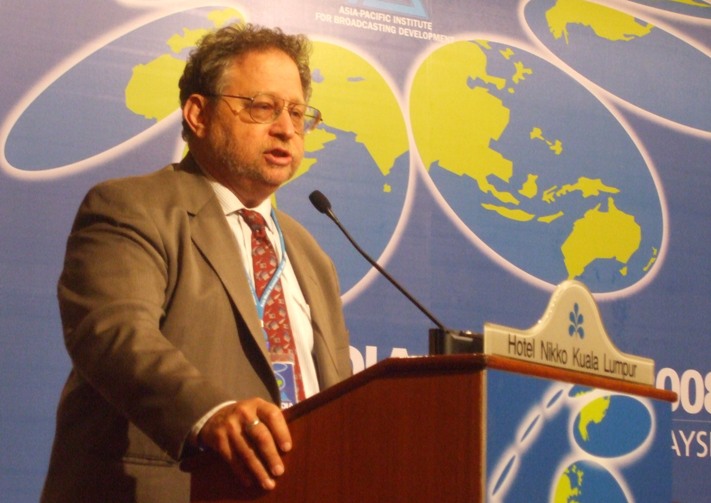
I was delighted to catch up with Danny in May 2008 when we both participated in Asia Media Summit in Kuala Lumpur. He and I were in a small minority of participants who were familiar with the inner works of the mainstream media and transformational potential of the new media. In characteristic style, Danny stirred things up, livening the usually staid proceedings, and I did my best to back him up from the audience. We both enjoyed asking irritating – if not outright annoying – questions from the 400+ media mandarins and press barons who’d come together for the Summit.
One evening, Danny and I had a drink with Malaysiakini’s CEO and leading new media activist Prem Chandran where we talked about the slow but inevitable decline of the mainstream media dinosaurs — or what Michael Crichton called Mediasaurus. The trouble with mediasaurus, we agreed, was that they are taking a long time going extinct and for now, they still command significant numbers of eyeballs and the dollars that follow.
After Prem left, Danny and I continued our chat into the evening. Over a spicy Indian meal, Danny gave me a crash course on subprime crisis (or sub-crime as he calls it) and how that was going to have a domino effect on markets everywhere. I listened with growing comprehension — and deep admiration for the man’s ability to communicate complexities without oversimplification.
Events in the weeks and months that followed have shown how remarkably prescient Danny Schechter was. And what a monumental, global scale mistake it was not to have heeded this man’s cautions in his blogs, films, columns and elsewhere.
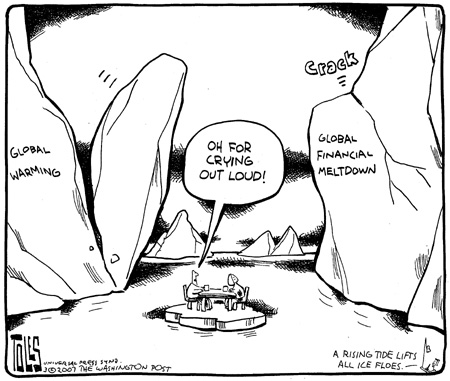
We end 2008 with my cartoon of the year. As I said in a blog post in September 2008: “This cartoon by Pulitzer prize winning Tom Toles first appeared in the Washington Post in 2007 – it brilliantly anticipated the global financial meltdown that we’re now experiencing. Coming in the wake of confirmed global warming, it is a double whammy. Meltdown 2
Jantakarn Thep-Chuay, known as Beam
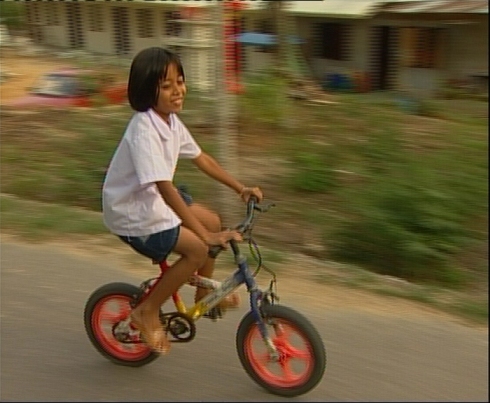
For many weeks, Jantakarn Thep-Chuay — nicknamed Beam -– did not understand why her father was not coming home. The eight-year-old girl, in Takuapa in Thailand’s southern district of Phang Nga, had last seen him go to work on the morning of 26 December 2004.
“On that Sunday, the day there was a wave, my dad wore his tennis shoes,” she recalls as she gets into his pair of sandals. “My dad didn’t have to do much work — he just walked around looking after workers.”
Beam’s father Sukaroak –- a construction supervisor at a new beach resort in Khao Lak –- was one of thousands of Thais and foreign tourists killed when the Asian Tsunami hit without warning. His body was never found.
For months, Beam would draw pictures of her family. These, and family photos of happier times, helped her to slowly come to terms with what happened.
The first year was long and hard for the family Sukaroak left behind: Beam, her two-year-old brother Boom, and mother Sumontha, 28. The determined young widow struggled to keep home fires burning -– and to keep her troublesome in-laws at bay.
As if that were not enough, she also had to engage assorted bureaucracies: even obtaining an official death certificate for her late husband entailed much effort.
Just a few weeks after the disaster, the local authorities approached Sumontha suggesting that she gives away one or both her children for adoption. Apparently a foreigner was interested. She said a firm ‘No’.
“Her dad wanted Beam to become an architect. He was hoping for a day when he could build something she draws,” says Sumontha. “If I am still alive, I want to raise my own children. I am their mother. For better or worse, I want to raise them myself.”
The Tsunami destroyed Beam’s school, but she continued to attend a temporary school set up with local and foreign help. Before the year ended, she moved to a brand new ‘Tsunami School’ that the King of Thailand built to guarantee education for all children affected by the disaster.
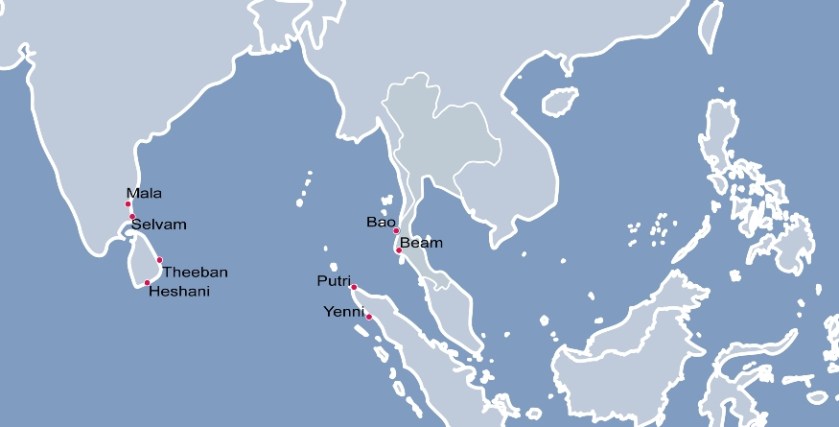
Sumontha, Beam and Boom are three ordinary Asians who have shown extraordinary courage, resilience and resourcefulness as they coped with multiple challenges of rebuilding their lives after the Tsunami. Theirs is one of eight families that we followed throughout 2005, under our empathetic communication initiative called Children of Tsunami: Rebuilding the Future.
It was a multi-country, multi-media project that tracked how ordinary Asians rebuilt their lives, livelihoods and futures after one of the biggest disasters in recent years. We at TVE Asia Pacific documented on TV, video and web the personal recovery stories of eight affected families in India, Indonesia, Sri Lanka and Thailand for a year after the disaster. Our many media products — distributed on broadcast, narrowcast and online platforms -– inspired wide ranging public discussion on disaster relief, recovery and rehabilitation. In that process, we were also able to demonstrate that a more engaged, respectful kind of journalism was possible when covering post-disaster situations.
Four countries, eight locations: where Children of Tsunami stories were filmed for much of 2005
Meet the Children of Tsunami…
They have never met each other. Yet they were united first in grief, then in survival. Five girls and three boys, between 8 to 16 years of age, living in eight coastal locations in four countries. Their families were impacted by the Asian Tsunami in different ways. Some lost one or both parents -– or other family members. Some had their homes or schools destroyed. Others found their parents thrown out of a job. During the year, these families faced many hardships and challenges in rebuilding their futures.
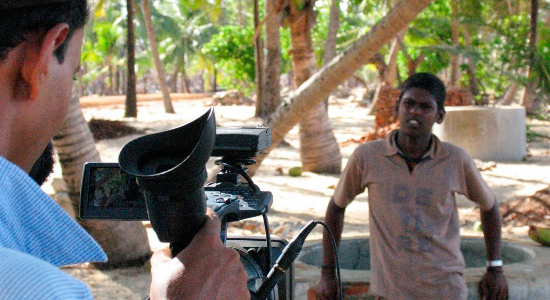
Filming with Theeban in eastern Sri Lanka...now only a memory
As I recalled in early 2007, when we tragically lost one of eight survivor children – Theeban – to Sri Lanka’s civil war: “As journalists, we have been trained not to get too attached to the people or subjects we cover, lest they affect our judgment and dilute our objectivity. The four production teams involved in Children of Tsunami initially agreed to follow this norm when we met in Bangkok in early 2005 for our first (and only) planning meeting. We also resolved not to reward our participating families in cash or kind, as they were all participating voluntarily with informed consent.
“But the ground reality was different. 2005, Asia’s longest year, wore on. As survivors slowly patched their lives together again, our film teams found themselves becoming friends of families or playing Good Samaritan. Sometimes our teams would find a survivor family close to starvation and — acting purely as human beings, not journalists — they would buy dry rations or a cooked meal. At other times, finding the children restless or aimless, they would buy them a football, kite or some other inexpensive toy that would produce hours of joy and cheer.
“As commissioners and publishers of Children of Tsunami stories, we didn’t object to these acts of kindness. Journalism with empathy was far preferable to the cold detachment that textbooks recommend.”
Children of Tsunami: No More Tears (25 mins) was the shorter version of the end-of-year film that captured the highlights and ‘lowlights’ of our families’ first year following the disaster. We co-produced it with the Singapore-based regional broadcaster Channel News Asia.






 Open Minds!