October 8 is the International Day for Disaster Reduction. The United Nations system observes the day ‘to raise the profile of disaster risk reduction, and encourage every citizen and government to take part in building more resilient communities and nations’.
Disaster risk reduction (abbreviated as DRR) is the common term for many and varied techniques that focus on preventing or minimising the effects of disasters. DRR measures either seek to reduce the likelihood of a disaster occurring, or strengthen the people’s ability to respond to it.
DRR is not just another lofty piece of developmentspeak. Unlike many other development measures that are full of cold statistics and/or hot air, this one directly (and quietly) saves lives, jobs and properties.
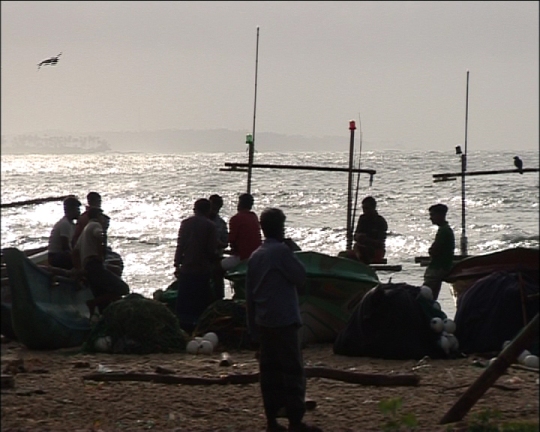
And it gives people peace of mind – we can’t put a value on that. That was the point I made in a blog post written in December 2007, on the third anniversary of the Indian Ocean Tsunami. Taking the personal example of J A Malani, an ordinary Sri Lankan woman living in Hambantota, on the island’s southern coast, I talked about how she has found peace of mind from a DRR initiative.
Recently, IDRC’s inhouse series ‘Research that Matters’ has published an article about the project. Titled “For Easy Sleep Along the Shore: Making Hazard Warnings More Effective” its blurb reads: “In Sri Lanka, a grassroots pilot study combines advanced communication technologies with local volunteer networks to alert coastal villages to danger coming from the sea.”
TVE Asia Pacific also made a short video film in late 2007. Called The Long Last Mile, it can be viewed on YouTube in two parts:
The Long Last Mile, part 1 of 2:
The Long Last Mile, part 2 of 2:
The recent IDRC article ends with this para: “A related challenge concerns the shortness of any society’s attention span. In the absence of frequent crises and alerts, how can a nation — or even a village — sustain the continuing levels of preparedness essential to ensure that, when the next big wave comes rolling in and the sirens sound, its people will have the motivation and the capacity to act? The follow-up project seeks to address this worry by preparing the hotels and villages to respond to different types of hazards, rather than only to the relatively rare tsunamis.”
Never underestimate the power of moving images. Al Gore tipped the balance in the long-drawn climate change debate with his Oscar-winning film, An Inconvenient Truth. The rest is recent history.
Thanks to the film – and sustained advocacy of hundreds of scientists and activists – climate change is no longer a speculative scenario; it’s widely accepted. The challenge now is to understand how it impacts different people in a myriad ways.
Called Vulnerability Exposed, the contest is open to anyone anywhere in the world who wishes to have their voice heard. The submitted films should innovatively illustrate the consequences of climate change through one of the following theme categories: conflict, migration, the urban space, rural institutions, drylands, social policy, indigenous peoples, gender, governance, forests, and/or human rights. The submission period ends on 24 October 2008.
Caroline Kende-Robb, Acting Director, Social Development Department, said, “There is a need to see climate change as an issue of global social justice. The rights, interests and needs of those affected by climate change must be acknowledged.”
Watch the Bank’s short video, where she explains further:
The contest has two award categories:
1) Social Dimensions of Climate Change Award (general category) – open to professional and amateur; and
2) Young Voices of Climate Change (youth category) – open to entries submitted by filmmakers under 24 years old.
Award winners will be chosen through a combination of public voting and a judging panel. The film with the most public votes in each theme category will receive honorable mention.
Vulnerability Exposed film competition: Judging process
This contest indicates that the World Bank is slowly but surely opening up to the currently untapped communication potential of web 2.0 – the very point I made in a recent op ed essay.
There are several noteworthy aspects in this competition, some more positive than others. I offer this critique in the spirit of improving a commendable initiative.
Three cheers to the bank for accommodating both amateurs and professionals. It’s about time those who don’t video film for a living (some of who are no less talented in the craft) had more opportunities to showcase their products.
It’s good to see the preference for shorter films, in this contest defined between 2 and 5 mins in duration. This certainly resonates with TVE Asia Pacific’s experience with Asian broadcasters, many of who now prefer shorter films. Longer films have their place, of course, but shorter ones are clear favourites of 24/7 news channels and also online.
Most film contests are judged exclusively by an all-powerful jury (I’ve been on several over the years), but here the online public have a chance to vote for their favourite entries. Let’s hope the judges will consider the story telling power of entries as the most important deciding factor. (The examples in the YouTube film given above are misleading – they all seem extracts from expensively made documentaries.)
The big challenge for many aspiring contestants would be to relate climate change to daily realities in their societies. Despite global headlines and the development community’s current frenzy about it, climate change as a phrase and concept still isn’t clearly understood in all its ramifications. If science now knows 100 facts about the murky processes of climate change, the average public knows less than 25 and understands even less. So it will be interesting to see how entries relate the big picture to their individual small pictures.
I’m a bit disappointed that the World Bank is not offering any cash prize to the winners. Instead, “the winners will receive an all expenses paid trip to Washington, DC for a screening of their film and will have the opportunity to attend a series of networking and learning events organized by…the World Bank in December 2008.” This is all useful, but video – even at the low end – is not exactly cheap, and even labour of love creations cost money to make. We are currently running a comparable the Asia Pacific Rice Film Award – which seeks entries no longer than 10 mins on any aspect of rice – and despite being a non-profit, civil society initiative we have a prize of US$ 2,000 to the winner. And we wish we could offer more.
But my biggest concern is the unequal, unfair terms of copyrights found in the small print of the competition rules. This is where the lawyers have done their usual handiwork, and with the usually lopsided results. The World Bank wants all contestants to make absolutely sure that all material used is fully owned by the contestants, or properly licensed. That’s fine. But tucked away on page 7, under section 12 titled Entrant’s permission to the organiser, is a set of conditions which will allow all affiliated institutions of the World Bank group to use the submitted material for not just promoting this contest (a standard clause in most competitions), but for ‘climate change work program of the organiser’.
What this means, in simpler terms, is that without offering a single dollar in prize money, the World Bank is quietly appropriating the unlimited user rights for any and all the submitted material. These are the core materials in the moving images industry, and nothing is more precious to their creators.
I have long advocated a more balanced, equitable and liberal approach to managing copyrights and intellectual property by both the broadcast television industry and development community — especially where public funded creations are concerned. I have nothing but contempt for lawyers and accountants who often determine the copyrights policies in large broadcast and development organisations. They set out terms that may be justified in strict legal terms, but are totally unfair, unjust and, in the end, counterproductive to the development cause and process. It seems that while our friends in the social and communication divisions were not looking, the Bank’s lawyers have done their standard hatchet job.
While this doesn’t detract from the overall value of Vulnerability Exposed, it diminishes its appeal and potential. Many professional video film-makers who value their footage – gathered with much trouble and expense – may not want to sign future user rights away for simply entering this contest. And worse, the unsuspecting enthusiasts who don’t necessarily earn their living from making films – but are entitled to the same fair treatment of their creations – would be giving away material whose industrial value they may not even fully appreciate.
It’s certainly necessary and relevant for development organisations like the World Bank and the UN system to engage web 2.0. But they must be careful not to import or impose rigid, one-sided and outdated copyright regimes of the past on this new media.
I hope the Bank would consider revising these unfair copyright terms, and treat the submitted material with greater discretion and respect. If not, all entrants risk seeing their material popping out of bluechip films produced by top-dollar production companies in North America and Europe who have ‘mining rights’ to the Bank’s video archives.
Vulnerability Exposed can have more meanings than one. We’d rather not consider some.
Nelson Mandela‘s long walk to freedom is an epic story of our times, one that continues to inspire millions everywhere who are deprived of that freedom by state tyranny or economic hardships.
As Mandela turns 90 years today, we join people all over the world to celebrate his life and reiterate his message.
And as Mandela himself reminded us in London during the June 2008 mega musical concert to celebrate his 90th birthday: “Even as we celebrate, let us remind ourselves that our work is far from complete. Where there is poverty and sickness, including AIDS, where human beings are being oppressed , there is more work to be done. Our work is for freedom for all.“
American film-maker, social activist and blogger Danny Schechter — who filmed Mandela’s struggle to end apartheid and restore democracy in South Africa — has just remarked: “He (Mandela) is one of those leaders who not only helped free his own country and people but became an icon and symbol for freedom in the world. At a time when darkness seems to be descending again, with the economy on the edge amidst protracted wars and pervasive abuses of powers, he is the one person that people the world over look to as a symbol of that saying that ‘another world is possible.’ He is not perfect – who is? He has taken great risks, and made his share of mistakes, but the love and adoration he inspires speaks to how special he is – even as he sees himself as part of a collective, a movement…“
The Mandela story has been told many times by many film-makers, writers and journalists. Few other leaders have engaged the media’s attention and popular imagination — both in and out of office — as Mandela has, and with reason.
This is how the BBC in the UK reported the release of Nelson Mandela, by then the world’s most celebrated prisoner, on 11 February 1990.
I find it interesting to go back and watch TV coverage of important events as they unfolded. They say journalists write the first draft of history — that’s done on the run, without the benefit of hindsight or chance to reflect for too long.
In that sense, this BBC television reportage did reasonably well to capture the historic moment of Mandela’s release — the reporter and presenter couldn’t have known what lay ahead for South Africa.
In the report, available on YouTube, there’s a reference to South African television giving live coverage for Mandela’s release. That would have been perfectly logical from a ‘breaking news’ point of view — but there is something very significant and symbolic about that.
During the 1950s and 1960s, South Africa was the only wealthy country in the world that did not have a national television broadcasting service. In fact, despite being the most economically advanced country on the continent, South Africa was among the last in Africa to introduce television broadcasting. The main reason: television was viewed as potentially undermining the apartheid government’s ideology. The white minority regime saw it as a threat to its control of the broadcasting media, even though the state-controlled South African Broadcasting Corporation (SABC) had a virtual monopoly on radio broadcasting.
The minister of broadcasting, Albert Hertzog, simply refused to permit television. He said that TV would come to South Africa “over my dead body”. He denounced it as “a miniature bioscope [cinema] over which parents would have no control.” He also argued that “South Africa would have to import films showing race mixing; and advertising would make (non-white) Africans dissatisfied with their lot.”
Many white South Africans, including Afrikaners, didn’t share Hertzog’s views, and regarded the hostility towards what he called “the little black box” as absurd. When Neil Armstrong became the first man to walk on the moon in 1969, South Africa was one of the few countries unable to watch the event live, prompting one newspaper to remark that “The moon film has proved to be the last straw… The situation is becoming a source of embarrassment for the country.”
But Hertzog was adamant. A few months later, in an interview with The Cape Times on 1 Dec 1969, he admitted: “If, at the present time, you introduce television, you will pay for it with the end of the white man…”
That was an extremely perceptive remark. From the white minority regime’s point of view, the minister was right: if the pen is mightier than the sword, the camera can be mightier than both.
No wonder that most governments, whether liberal or otherwise, try to control – or manipulate – what appears on television, especially domestic transmissions that a majority of their people regularly watch. The power of the idiot box is not to be underestimated, even if it’s often dominated by….well, idiots.
As events turned out, the national and international media – especially television – did play a major role in the transformation of South Africa during the last two decades of the twentieth century.
And we now know: Albert Hertzog’s worst fears came true.
But the world’s worst fears of South Africa descending into utter chaos did not — thanks, largely, to the compassionate vision and leadership of Nelson Mandela.
Watch Nelson Mendela’s inauguration speech, when he was sworn in as the 11th President of South Africa on 27 April 1994:
Historical footnote from Wikipedia:
In 1971, the SABC was finally allowed to introduce a television service. Initially, the proposal was for two television channels, one in English and Afrikaans, aimed at white audiences, and another, known as TV Bantu, aimed at black viewers, but when television was finally introduced, there was only one channel. Experimental broadcasts in the main cities began on 5 May 1975, before nationwide service commenced on 5 January 1976.
The Mandela legacy continues, on air and off air, and more films are still being made about his remarkable life and times. The latest is a new documentary being released this month to mark his 90th birthday. SABC television will premiere it in 18 July during prime time – how times have changed!
Here’s part of the press release from the South African production company that made it:
Viva Madiba: A Hero For All Seasons, a feature length film produced by Anant Singh and Videovision Entertainment as a 90th Birthday Tribute to former president, Nelson Mandela, will have its World Premiere when it is broadcast on Friday, 18 July 2008 on SABC 2 at 21h00.
Viva Madiba: A Hero For All Seasons is a celebration of Nelson Mandela’s epic life and his status as an international icon. In this, the year of his 90th birthday, he remains a man at the centre of attention, not only in South Africa, but around the world as a moral leader, an elder statesman and an exceptional human being.
Viva Madiba: A Hero For All Seasons takes one on a journey behind the headlines and away from the public eye and looks at Madiba as a loyal friend, a dependable comrade, a trusted confidant, a respected mentor, and a man who has touched and transformed countless lives.
For the first time his complete story is being told – a life of struggle, humanity, destiny and greatness is recalled and celebrated by those who knew him best and who worked with him in the quest to break the chains of oppression, taking us beyond the political and into the personal. The programme features exclusive interviews with politicians, close friends and comrades of Madiba, among whom are Archbishop Desmond Tutu, Oliver Tambo, George Bizos, Ahmed Kathrada, Pik Botha, Dorothy Masuka, Nthato Motlana, Cyril Ramaphosa, Helen Suzman, Zolani Mkiva, Jessie Duarte, Francois Pienaar, Sydney Kentridge, Mac Maharaj, Christo Brand and Gill Marcus.
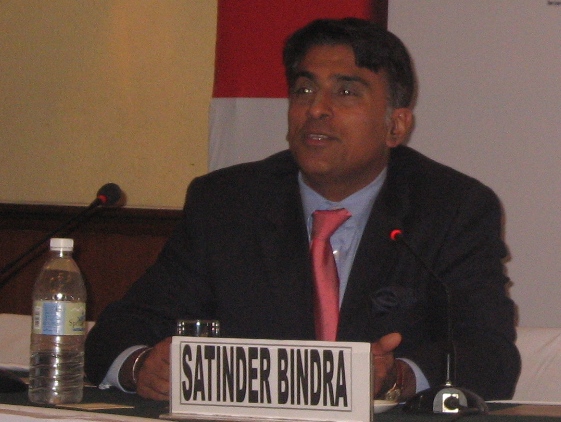
With these words, UNEP’s newly appointed Director of Communications and Public Information, Satinder Bindra (photo, above), engaged my attention at a meeting in Paris earlier this week.
I almost jumped up in total agreement — this is just what we’ve been saying for years, especially to those who support information, education and communication activities in UN agencies.
Unlike many career UN officials, Satinder knows what he’s talking about. He comes to UNEP with over two decades of wide and varied experience in journalism and broadcasting – the last 10 years spent as a Senior International Correspondent/South Asia Bureau Chief for CNN based in New Delhi, India.
In the hard headed and hard nosed world of international news and current affairs television, distribution and outreach can make or break any content provider. This is something that the two leading news channels BBC World and CNN International know very well — and the more recent entrant Al Jazeera English is still finding out.
Satinder’s remark, in this instance, was more to do with how to get information and analysis on sustainable development out to as many people as possible in all corners of the planet. This is part of UNEP’s core mission since its founding in 1972 — and as chief of communication and public information, Satinder now takes on this formidable challenge.
Com+ is a “partnership of international organizations and communications professionals from diverse sectors committed to using communications to advance a vision of sustainable development that integrates its three pillars: economic, social and environmental”. TVE Asia Pacific was admitted to the partnership a few months ago.
As I’m sure Satinder realises, at stake in his new assignment is a lot more than audience ratings, market share or revenue stream of a single broadcaster. Those are important too, but not in the same league as ensuring life on Earth – in all its diversity and complexity – continues and thrives.
Satinder struck me as a practical and pragmatic journalist who wants to get the job done efficiently. We can only hope the rest of UNEP will keep up with him — or at least they don’t get too much in his way!
As he finds his way around the globally spread, multidisciplinary and sometimes heavily bureaucratic UN organisation, Satinder will come across some incongruities, cynicism and institutional inertia all of which have held UNEP back from being the dynamic global leader in our pursuit of elusive sustainable development.
At the big picture level, communication at UNEP has often been defined narrowly as institutional promotion – delivering UNEP logo to the news media of the world, or boosting the image of its executive director and other senior officials. We don’t grudge anyone enjoying their 15 minutes of fame, but a technical agency like UNEP has so much more to offer — in terms of rigorous science, multiple perspectives, wide ranging consultation and bringing diverse players to a common platform.
The Nobel Peace Prize winning Inter-governmental Panel on Climate Change (IPCC), co-supported by UNEP and World Meteorological Organisation, is a good recent example of how solid science, communicated through the media, can inspire governments, industry and rest of society to find solutions to a major global challenge.
There’s a lot more good science and tons of good stories lurking inside UNEP — if only its experts know how to get these out, and if only its bean-counters won’t stand in the way.
Then there is the whole scandalous situation where UNEP-funded environmental films are released with needlessly excessive copyright restrictions. As I have been saying, this is the big mismatch in environment and development film-making: many films are made using donor (i.e. public or tax payer) funds, but due to the ignorance or indifference of funders, the copyrights are retained by private individuals or companies involved in the production.
In UNEP’s case, for years it has been commissioning (and sometimes funding) a London-based production company, with a charitable arm, to produce environmental films. That’s certainly a choice for UNEP if the agency feels it continues to get value for its money. But tragically, the producers jealously guard all the copyrights, releasing these only under rigid conditions to a select few.
Whatever outreach figures they might claim, these cannot match what the same films would achieve if the copyrights were not so restrictive. Freed from crushing rights, such environmental films – made with UNEP funding or blessings or both – could benefit thousands of groups engaged in awareness, advocacy, activism, education and training.
For sure, we’ve heard the arguments in favour of tight copyright regimes. Film-makers have every right to be acknowledged for their creative efforts, but public funded products must not be locked up by greedy lawyers and accountants — or even by selfish film-making charities. And millions of users around the world should be able to access such products without having to get through the eye of the copyright needle first. July 2007 blog post: Lawyers who locked up the butterfly tree
Can Satinder Bindra overcome these hurdles that have for so long inhibited UNEP from reaching its potential? We just have to wait and see.
When he talks about distribution being God, we have to readily agree. But he will soon find some elements within UNEP – or in crony partnerships with UNEP – that stand between him and this God.
To be fair, there’s only so much that an inter-governmental agency like UNEP – beholden to its member governments – can really accomplish. That’s why it needs partners from corporate, civil society, activist and academic spheres. Some of us can easily say and do things that UNEP would, in all sincerity, like to — but cannot.
Satinder sounds like he can forge broad alliances that go beyond monopolist partnerships. Here’s wishing him every success….for everyone’s sake!
“Our teacher said our country is small and is surrounded by the sea….she showed it on the globe.”
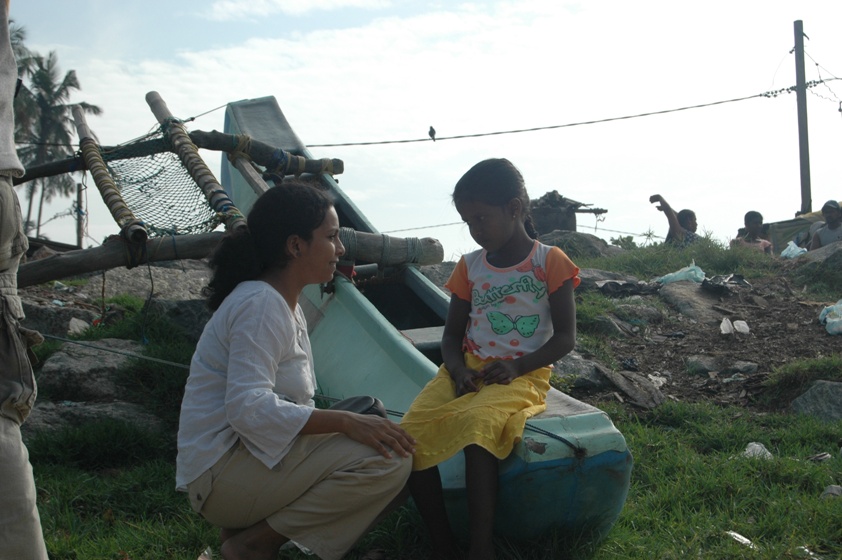
With these words, young Lakshani Fernando (photo, above) begins telling us the compact story of her short life.
Lakshani, 9, has lived by the sea (Indian Ocean) from the time she was born. When she was just six, the Asian Tsunami of December 2004 destroyed their beachfront house in Koralawella, Moratuwa, on Sri Lanka’s western coast. More than three years later, when my colleague Buddhini Ekanayake met Lakshani in March 2008, the family was still struggling to raise their heads from that massive blow.
In the film, Lakshani shares the highlights of a typical day. That includes going for a walk on the polluted beach with her fisherman father, spending a few hours at the nearby school and playing with neighbourhood children. While at it, she tells us her wishes for a cleaner beach and a better neighbourhood.
Buddhini called Lakshani a ‘Child of the Sea’. Even the cruel waves of the tsunami didn’t scare Lakshani away for too long.
“I love to play with waves…” Lakshani says towards the end of the film. Then she looks far out at the horizon, and talks again. “There are ships far out at sea. That’s all there is…”
She might not yet imagine lands beyond ships and waves, but last week, her story travelled across the seas. Over 500 broadcast media managers, journalists and researchers from around the world, who’d gathered in Kuala Lumpur, Malaysia, for Asia Media Summit 2008, had a glimpse of Lakshani when the first 90 seconds of the film was screened during plenary.
Elizabeth Smith, secretary general of the Commonwealth Broadcasting Association (CBA), chose an extract from Lakshani’s story to introduce the media initiative. Sitting in the audience, I immediately texted the news to Buddhini.
Watch “I am A Child of the Sea”:
This film forms part of a series that has 20 TV producers from 13 countries engaging in a co-production of a short programmes series (mini documentaries) about and for children. The series is the outcome of a regional project organised by the Asia Pacific Institute for Broadcasting Development (AIBD) in collaboration with the French Ministry of Foreign affairs, the Commonwealth Broadcasting Association (CBA),Thomson Foundation, Prix Jeunesse, Children and Broadcasting Foundation for Africa and RTM-IPTAR of Malaysia.
The project tries to capture cultural diversity through the eyes of children. When its concept first reached us, it was defined very narrowly in terms of ethnicity and/or religion. TVE Asia Pacific being a strictly secular organisation, we couldn’t fit into such a tight range. Besides, we realised that many modern day children have a self identity that goes above and beyond the race and religion that blind chance of birth assigned to them.
So we took an editorial decision: instead of doing a story that highlights factors that utterly and bitterly divide humanity (such as race and religion, both of which fuel the long-drawn war in Sri Lanka), we would look for a unifying factor. The tsunami’s killer waves, when they rolled in, didn’t care for our petty human divisions. For a few days and weeks following the tragedy, Sri Lanka was united in shock and grief in a manner I have never seen in my 42 years of living here. (Then we went back to killing each other again.)
The result of our search was Lakshani and her story captured in ‘I am a Child of the Sea’.
Buddhini chose to feature Lakshani after interviewing 10 children from different localities and a diversity of cultural backgrounds. (Never once did she ask for the child’s religion, which unlike ethnicity is not always apparent from the name.) There was some significance in featuring a child who identifies herself closely with the Sea in a country where tens of thousands of tsunami-affected people have still not come to terms with the sea. Even after the tsunami destroyed their home, Lakshani’s family moved to a ‘temporary’ shelter within sight of the sea. Thus, her story had a close association with the sea which formed part of her lifestyle, environment and culture.
Buddhini developed the script after several leisurely chats with Lakshani, based partly on the child’s own writing about herself. Filming the story took place in early March 2008, with the full consent of her parents, extended family and neighbours. Read more about the making of this film on TVEAP website and on Buddhini’s own blog.
Lakshani’s story is symbolic at another level. It reveals how, despite receiving a massive outpouring of donations from all over the world, some tsunami-affected families are still struggling to put together their shattered lives. The litany of woes, missed opportunities and sometimes outright plundering of donations came out strongly in the first hand accounts of affected people (in India, Indonesia, Sri Lanka and Thailand) who spoke to us during the Children of Tsunami media project. Read our reflections on the project in Communicating Disasters book published in 2007.
Lakshani’s family is not typical of Sri Lanka’s tsunami affected persons. Unlike most such families, the Fernandos live on the western coast, relatively close to Colombo. Although wave action destroyed or damaged beachfront homes in these areas, most attention was focused on areas in the south, east and north of the island that were hit much harder. So those affected and living on the west coast have often been overlooked or dismissed lightly. In this sense, Lakshani’s family has some parallels with what I called ‘step-children of tsunami’.
There is a bit more cheerful post-script to this story. During several visits to Lakshani and family for researching, filming and editing this film, Buddhini (who has a daughter aged four herself) bonded with the girl. It became more than a mere film-making venture, and has led to a lasting relationship. Meanwhile, young voice artiste Shanya Fernando, who rendered Lakshani’s Sinhala voice into English for an international audience, has also felt an attachment to the ‘star’ of our film.
While the film was made with the informed consent of Lakshani’s family who received no material benefits for their participation, both Buddhini and Shanya have since presented some basic educational gifts to Lakshani — who is certainly in need of such help. And who am I to stand in the way of such gestures of human kindness?
On this World Telecommunication and Information Society Day (May 17), I have a confession to make. I carry a murder weapon on my person every day and night, and I go to bed with it next to me within easy reach. I rely on it for my work, my leisure and my pleasure. And I won’t part with it under any circumstances.
I’m talking about the humble and increasingly ubiquitous mobile phone, now the world’s most widely used and fastest spreading consumer technology item.
And if any paranoid law enforcement agency worries about its murder potential…relax, people – we are talking figuratively here!
How come it’s a murder weapon when it has no sharp edges and is too light weight to do much damage?
What the mobile has already stabbed, and is in the process of effectively finishing off, is the development sector’s over-hyped and under-delivered phenomenon called the ‘telecentre’.
For those outside the charmed development circles (which is most of humanity), the Wikipedia describes telecentre as “a public place where people can access computers, the Internet and other digital technologies that enable people to gather information, create, learn and communicate with others while they develop essential 21st century digital skills.”
So how is the mobile phone slowly killing the telecentres, into which governments, the United Nations agencies and other development organisations have pumped tens of millions of dollars of development aid money in the past decade?
Well, it’s rapidly making telecentres redundant by putting most or all of their services into literally pocket-sized units. If everyone could carry around a miniaturised, personalised gadget that has the added privacy value, why visit a community access point?
At least this is the persuasive point made by LIRNEasia researcher Helani Galpaya, who made a presentation in September 2007 at the Annenberg School for Communication in the US.
She argued that, although telecentres, which have become the bright “stars” in many e-development programs in Asian countries, do have a role to play in providing ‘higher’-end citizen services to people at the bottom of the pyramid (BOP) in India, Sri Lanka, Pakistan, Philippines and Thailand, telephones are the cheaper, immediate and ubiquitous tool for Asian governments to inform, transact and interact with almost 400 million of their most needy citizens.
And in these emerging Asian economies, when we talk of telephones it’s predominantly mobiles. In my native Sri Lanka, for example, there were 10.7 million phone subscribers by end 2007 – of them, almost 8 million were mobile users. Mobiles outnumber fixed phones by 3 to 1, and the disparity continues to widen.
The song has been the subject of various parodies, and Helani’s isn’t the first or last. But in this instance, I would heartily cheer the rapid demise of the telecentre, which is both conceptually and operationally flawed in many developing countries where it has been tried out. (While at it, let me repeat something that baffles me: how is it that not a single development donor or UN agency foresaw the phenomenal rise of mobile phones in the majority world, and instead bet all their ICT money on computers and internet? And why can’t some of them still appreciate the potential of mobiles, keep harping on obsolete telecentres and other troubled initiatives like One Laptop Per Child?).
It’s also worth noting that hard core development activists were initially against mobile phones, arguing instead for more public payphones, especially in rural areas. Only very recently have they started acknowledging that, just maybe, mobile phone can create or improve jobs, generate incomes and move millions out of poverty. In the humanitarian sector, as I wrote in October 2007, aid workers are still uncertain how to make best use of mobiles in their relief work.
Why are mobile phones somehow not ‘sexy enough’ for these men and women in suits who typically look at our real world problems from 33,000 feet above the ground?
But hey, why bother with doomed concepts like telecentres, when we can instead discuss about the lively and vibrant mobiles? (When the telecentres finally die after being kept on life support by gullible aid donors for a few more years, I hope to write a suitable obituary.)
Meanwhile, who’s afraid of mobile phones except the failed prophets of development and unimaginative humanitarian workers? There’s a handful of crusty, old fashioned people, usually those who can’t figure out just how to use the new fangled devices that do a lot more than just talk. Then there are tyrannical governments who fear the power of instant communication being in the hands of their own people.
The rest of us have now adjusted to Life After the Mobile Arrived. We may love it, or love to hate it — but can we imagine life without it?
The film’s synopsis reads:
With the next billion telecom users expected mainly from the emerging markets, we urgently need to understand telecom use, especially at the bottom of the pyramid. Who is using what devices for which purposes — and how much are they willing or able to pay? Capturing highlights of LIRNEasia’s 2006 survey in India, Pakistan, the Philippines, Sri Lanka and Thailand, this film shows that when it comes to phone use, the poor are not very different from anyone else.
Teleuse@BOP Part 1 of 2
Teleuse@BOP Part 2 of 2
And now, just when you think I’m a harmless mobile junkie, here’s my real confession:
I own more than one mobile phone (hey, doesn’t everybody?) and stashed away in my travel bag I have a collection of SIM cards with active mobile accounts in half a dozen Asian countries that I visit regularly.
One day soon, when there are enough people like myself moving across jealously guarded political borders, those ITU statistics on ICTs would become seriously skewed….
I have nothing against reality television. It’s a TV programming format that, according to Wikipedia, presents purportedly unscripted dramatic or humorous situations, documents actual events, and features ordinary people instead of professional actors.
In fact, I’ve been telling my friends who are factual film-makers that we can learn a thing or two from the recent successes of some reality TV shows.
But everything has its sane limits — and evidently these were exceeded in the recent controversy involving a British TV production company that stands accused of starting a ‘flu epidemic that left four people from a tribe of isolated Peruvian Indians dead and others seriously ill.
Matt Currington (in photo above, on the right), a London-based documentary maker, has been blamed for triggering a “mini-epidemic” in the village of 250 people which led to the deaths of three children and one adult of the Matsigenka people, who live in the isolated Amazonian Cumerjali area of south-eastern Peru.
The 38-year-old was employed by Cicada Films as researcher when he travelled to the area with a guide last year to scout for locations for the World’s Lost Tribes series, which airs on the Discovery Channel.
Here are some extracts from the story that appeared in The Guardian newspaper in the UK on 27 March 2008, written by its environment correspondent John Vidal:
The regional Indian rights organisation Fenama, government officials and a US anthropologist working in the region said in statements seen by the Guardian that a two-person crew working for London-based Cicada Films had visited groups of isolated Indian communities despite being warned not to. Fenama said the film team travelled far upriver and provoked an epidemic. It accused them of threatening the lives of Indians and called for Cicada Films to be barred from entering the area again.
It is understood the company was scouting for a location to set a TV show for Mark Anstice and Olly Steeds, in which the two British presenters would live with a remote tribe, in exchange for gifts. The company has already filmed episodes in New Guinea.
According to the Peruvian government’s protected areas department, Cicada was given a permit to visit only the community of Yomybato. It expressly prohibited visits to uncontacted or recently contacted Indians. “The Cicada team entered [remote headwaters] which are part of the strictly protected zone,” it said.
The American anthropologist, Glenn Shepard, who met the film team on location, said he had urged them not to make the trip to the Cumerjali settlements, “where people were vulnerable to western illnesses”. “Reality tv seeks ever more dangerous, remote and exotic locales and communities,” he said.
According to Survival International, Cicada Films previously caused controversy with a documentary about an expedition to visit Indians in Ecuador, which allegedly provoked an attack from uncontacted Waorani Indians.
But Cicada is certainly not alone when it comes to exploiting marginalised people in the global South in the course of film-making. And reality TV is not the only format of TV film making that often oversteps the ethical boundaries in search of a ‘good story’.
As I have been saying for sometime now, documentary film-makers and TV news gathering crews are equally guilty of many excesses, lapses and gross abuses all perpetrated in the name of media freedom. Aug 2007 blog: Wanted – Ethical sourcing of international TV News
Nor is this sinister trend entirely new. I opened a September 2007 blog post with this bizarre request: “Can you help us to film a child’s leg being broken?” This was made by a visiting Canadian TV crew in the 1970s to my friend Darryl D’Monte, one of the most senior journalists in India and former editor of the Times of India.
This was in connection with a brutal practice that was believed to exist in India, so that forcefully maimed children could be employed as beggars. When Darryl was outraged, the film crew had shrugged off saying: “It’s going to happen anyway”.
Film-makers and TV journalists roam the planet exercising their license to protect and promote the people’s right to know, and in the public interest. But this privileged position is grossly abused when they allow the end to justify their highly questionable means.
Commenting on TV’s latest crime against voiceless people, India’s Down to Earth magazine (30 April 2008 issue) says:
“These forays of reality tv perpetuate an imagery conceived by a 19th century alliance of anthropologers and photographers, that of tribals in their “innocent” state. It’s another matter these images were taken after the tribal groups were ravaged by colonialism.
“Today in the era of digital images when computer games mimic real wars, it might be hard for even the most naive eye to believe what it sees. But tv casts an enormous sway over audience perception and digitization has, in fact, aided it. We know of the images, not the circumstances in which they were taken. We believe them though they might be contrived. That’s why reality tv is dangerous.”
“Violence against women threatens the lives of more young women than cancer, malaria or war. It affects one in three women worldwide. It leaves women mentally scarred for life — and it is usually inflicted by a family member.”
With these words, Annie Lennox, the British singer and social activist, presents a new global series of investigative television documentaries called Women on the Frontline that begins on the global satellite TV channel BBC World today, 18 April 2008.
The seven half-hour films shine a light on violence against women and girls in different parts of the world – East and West, North and South. The series takes the front to homes, villages and cities of our world where a largely unreported war against females is being waged.
The films cover Nepal, where thousands of women are trafficked each year; Turkey, where killing in the name of honour continues; Morocco, where women political activists who have survived torture and imprisonment testify before a government truth and reconciliation commission; the DRC, where women bear the brunt of a 10-year war in the eastern provinces; Colombia, where women have been tortured in the shadow of a guerilla war; Mauritania, where women who have been raped may go to prison; and Austria, where, under a new law, perpetrators of domestic violence are forced to leave home.
Here’s the line up of depressing reports in this series, produced by Geneva-based dev tv and London-based One Planet Pictures – both international partners of TVE Asia Pacific.
On the Frontline… is a ‘vehicle’ for independent producers to tell compelling stories about the people who uphold civil society where it is most at threat. The strand started with the 2006 pilot series Doctors on the Frontline, a profile of Medecins Sans Frontieres (MSF) field doctors made by Dev TV film-makers.
Since then, the series has covered villages battling desertification and land degradation, nurses and para-medics on humanitarian missions in hot spots of the world, and children living with social and environmental disintegration.
“On the Frontline has gone behind the lines with rebels and filmed among violent street gangs but this time we’ve taken the frontline mostly into the home, where even after 20 years in production, I’m still shocked to see how many obstacles lie between women and equality, and the violence they must still endure,” said Robert Lamb, Executive Director of the series.
A number of UN agencies, including UNFPA and UNIFEM, donor countries such as Austria, non-governmental organizations and other partners provided information and support for the latest series of Women on the Frontline.
Soon after its initial run on BBC World, the series will be distributed in the Asia Pacific region by TVE Asia Pacific.
The grand prize of the festival was awarded to a stunning science documentary on the story of oil, produced by the Australian Broadcasting Corporation (ABC). Here’s the basic information:
Crude: the Incredible Journey of Oil
The world’s oil fields are deposits of phytoplankton on the ocean floor from the Jurassic period. Will our mass consumption of oil in the last 150 years thrust us back climatically to the warm primeval age when oil fields were formed?
(2007/Australia/90min/Director:Richard Smith)
Crude is one of several films that have come out recently exploring the many facets of oil and our civilisation’s dependence (addiction) on it. In March 2007, I wrote about Addicted to Oil, a documentary presented by the New York Times columnist Thomas L Friedman.
David Suzuki, environmentalist, author and long-standing presenter of the natural history series The Nature of Things has called this “a thoughtful, surprising and really important film”.
This is what Manori reported about Crude:
Produced and directed by Richard Smith, this 90 min journey sweeps through the ages: from the birth of oil deep in the dinosaur-inhabited past, to its ascendancy as the indispensable ingredient of modern life.
As Smith states, “Oil is perhaps the single most important commodity shaping the economy, politics and environment of the modern world, and yet most people have only vague notions of where it comes from. I wanted to take the audience back into the ancient oceans in which oil was formed and reveal how intimately the creation of a major oil deposit is connected to the long-term regulation of the planet’s climate”.
“I saw the film as a sort of essential primer for people to begin to make sense of both the coming oil and climate crises. I make no apologies for such apparent certainty that we will face these two dilemmas. From my understanding of the science and the facts, these are the logical conclusions to the planet carrying on with a business-as-usual, or indeed a business-at-any-cost approach. The worst effects of both are probably avoidable, but only if people understand why there is an urgent need to act.”
Crude was first broadcast on ABC TV in May 2007 and is now being distributed worldwide. It has already won two awards at the 2007 Jackson Hole Wildlife Film Festival: the Best Earth Sciences Film award and the Special Jury Recognition Award.
In this, I briefly comment on Sir Arthur’s accomplishments in popular science communication and his life-long crusade against pseudo-science — two important facets of the multi-faceted author, science populariser and underwater explorer who died on 19 March 2008.
Excerpts:
“Clarke’s forte was not only extrapolating about humanity’s technological abilities, but also exploring the nexus between science and society. With his death, science has lost an articulate and passionate promoter who challenged scientists to play a greater role in public policy and demanded that political leaders should take science seriously.
“But he was never an uncritical cheerleader for science, and that will be part of his enduring legacy. In an essay in Science, he cautioned, ‘For more than a century science and its occasionally ugly sister technology have been the chief driving forces shaping our world. They decide the kinds of futures that are possible. Human wisdom must decide which are desirable.'”
In my essay, I talk about how Sir Arthur readily took on a formidable array of anti-science beliefs and superstitious practices, from creationism and scientology to astrology and fire-walking. In these endeavours he joined other campaigners against pseudoscience, including scientists Carl Sagan and Stephen Jay Gould and the magician James Randi.
“For a while, Clarke even made a modest living as a professional sceptical enquirer. Beginning with Arthur C Clarke’s Mysterious World (1980), he hosted three television series that probed – and sometimes exposed – numerous mysteries, superstitions and the paranormal.
“Even when Clarke didn’t find full explanations, he invariably demonstrated the value of keeping an open mind and asking the right questions. And instead of ignoring or dismissing popular obsessions, he tried engaging their proponents in rational discussion. That was characteristic of Clarke, a genial moderator who always sought to build bridges — whether between scientists and the public, or across the “two cultures” divide between the arts and the sciences.”
These series had numerous re-runs for years on Discovery and other TV channels all over the world. They are still available on DVD. While some of the content is now dated by more information or insights emerging since their production, the series still inspires critical thinking – not to mention TV emulations that come out with many more frills than was possible in the 1980s.
Watch the opening of the first series, where Sir Arthur offered his own classification of mysteries (9 mins 21 secs):
Sir Arthur filmed all his pieces to camera from different, scenic locations in his adopted home in Sri Lanka. Few Sri Lankans realised at the time that this generated millions of dollars worth of free promotion for the country as a tourist destination.
In fact, I end my editorial by looking at Arthur C Clarke the public intellectual in Sri Lanka, where he lived since 1956. I look at how he won some battles with rational arguments while lost others (e.g. Sri Lankan obsession with astrology). This is clearly a subject I will return to in greater depth and analysis in the coming months.
In the modest cough department, I am immensely proud of how I sign off on this editorial: Arthur C. Clarke mentored Sri Lankan journalist Nalaka Gunawardene and they worked together for 20 years.
SciDev.Net – the Science and Development Network – is a not-for-profit organisation dedicated to providing reliable and authoritative information about science and technology for the developing world. Through http://www.scidev.net, it gives policymakers, researchers, the media and civil society information and a platform to explore how science and technology can reduce poverty, improve health and raise standards of living around the world. SciDev.Net is co-sponsored by the leading journals Nature and Science.









 Open Minds!
