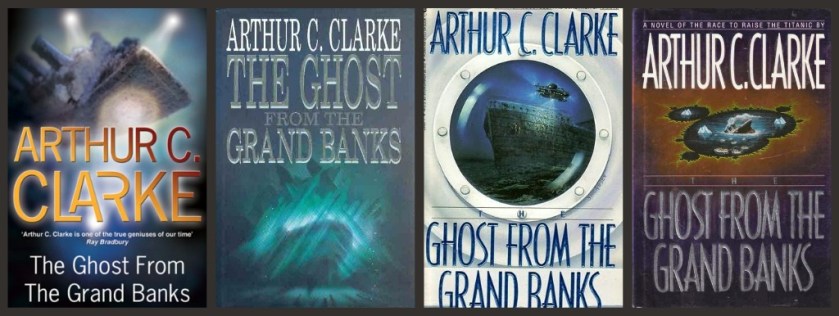
The Ghost from the Grand Banks - many covers, one story
Writing the Foreword to the book on ‘Communicating Disasters‘ that I co-edited in 2007, Sir Arthur C Clarke said: “I was born five years after the biggest maritime disaster the world had known: the sinking of the ‘unsinkable’ RMS Titanic while on her maiden voyage. My home town Minehead, in Somerset, was not more than a couple of hundred kilometres from Southampton, from where the Titanic set off. All my life, I have been intrigued by the Titanic disaster.”
The Titanic — whose wreck not discovered at the time — made a cameo appearance in his 1976 novel, Imperial Earth. For the Quincentennial of the United States, the wreck is raised and carried to New York.
But he continued to be haunted by the mighty ship (as did, and do, many others). He finally had to write a whole novel to exorcise it from his mind.
One day in early 1989, Sir Arthur asked me: “Does ‘Ghost from the Grand Banks’ mean anything to you?”
It didn’t — but that wasn’t surprising as I’d been raised on the other side of the planet, in an entirely different generation.
The Grand Banks of Newfoundland are a group of underwater plateaus southeast of Newfoundland on the North American continental shelf. The cold Labrador Current mixes with the warm waters of the Gulf Stream here — making it one of the richest fishing grounds in the world.
It is also close to where the Titanic sank on the night of 14/15 April 1912, and has served as the launching point of various shipwreck expeditions.
That heralded the genesis of an entirely new Arthur C Clarke novel. For me, it was the beginning of an exhilarating journey across space and time, supporting the creative process of one of the finest science fiction writers of the 20th Century.
I was working as Sir Arthur’s research assistant at the time, two years into my fascinating association with the late author (which lasted 21 years).
Over the next few months, I was to research and/or cross-check all sorts of records, data and other nuggets of information, which Sir Arthur — the master weaver of narratives — then worked into an entirely new novel.
The novel, published in late 1990 as The Ghost from the Grand Banks, was an ocean-based thriller set in the (then) near future. It revolved around rival British-American and Japanese teams trying to raise the legendary ship’s wreck in time for the centenary in 2012. Both teams mobilise mega-bucks and cutting edge technology: while one team relies on 50 billion little glass balls, the other’s ambitious plan involves making the world’s largest ice cube…
Two weeks before the centenary of the Titanic‘s maiden voyage – and its tragic sinking – I re-read the novel. On the information society front, at least, I found that The Ghost from the Grand Banks stands up remarkably well in 2012.
Living as we do at the time when his story culminated, we can now compare Sir Arthur’s ‘extrapolations of the future’ – he carefully avoided labelling any of his ideas as ‘predictions’ – with what has become our reality.
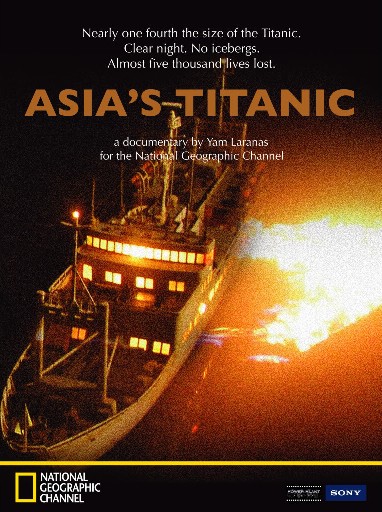
Asia's Titanic - NatGeo poster for 2009 filmHow and where do you begin to tell the story of the biggest peace-time disaster at sea in modern times — where only 24 people survived and more than 4,000 perished within an hour or two?
That was the challenge that my Filipino filmmaker friend Baby Ruth Villarama and her colleagues faced, when they made an hour-long documentary, Asia’s Titanic, which National Geographic TV broadcast in mid 2009.
Former television journalist and now an independent TV producer, Baby Ruth Villarama specialises in story research and documentary producing. Runs her own production company, Voyage Film, based in Manila but active across Asia.
Ruth was the researcher and assistant producer of Asia’s Titanic, directed by award-winning Filipino director Yam Laranas.
A few days ago, I asked Ruth for her own memories and reflections. This is what she shared with me, in her own words — the moving story behind the moving images creation:
With the Doña Paz story, sharing their memories was the most difficult part of covering it as the tragedy is something they’d rather not talk about – and, if possible, forget.
I spent a year ‘off-the-record’ understanding the holes in their memories. I felt I had to retrace the steps of these 4,000 souls and learn the relationship of man and the sea.
They’ve lost their children, parents and comrades on Christmas eve over a sea mishap – drowning and burning in the quiet water. We can only imagine the pain they went through.
The tragedy is the peak of memory they have left of their loved ones too, so every Christmas, some relatives of the dead gather together to live the lives their loved ones would have wanted to continue.
I joined that gathering for about three Christmases in between my research efforts. It was then that I began to understand the rabbit holes in each one of them — and the rabbit hole I had in me for not knowing my mother personally.
We started sharing pains and the “what-could-have-beens” of those lost memories. That was the connection they were looking for: to be able to speak of the pain to a stranger, or worst, to a group of filmmakers who would broadcast their story to millions of households around the globe.
This documentary was initiated not just to tell their story but to attempt to fill a hole of justice to the many casualties and their families.
It was through them that we were able to speak to the remaining living survivors. We became part of that annual gathering. Despite the requirements of the studio and my director to deliver deadlines, we tried my best to balance their readiness to speak. Good thing NatGeo was willing to wait 3 – 5 years in the timeline…
I remember visiting a survivor in his sleepy town in the province of Samar sometime in 2005. He owns a small sari-sari (convenient) store then. He said that it took him a year to speak again after the tragedy — and another year before he could eat properly because he couldn’t swallow soups and liquids right.
He never really set foot outside his island again – always fearing for fire and water, including the air as he vividly remembers how it added fume to the fire on that fateful night at sea.
After a while, he started talking about the details of that trip. He stopped, wept and couldn’t carry on anymore. He couldn’t breathe and seemingly battled against the air.
A huge part of me personally felt wrong seeing him again but I know that if we do not tell this story, no one will — and the world will just forget about this huge ‘mistake’ in navigational history.
I’d like to think that the impact of the story outside the Philippines is to remind the world fact that Titanic is not the worst maritime disaster — that somewhere in South East Asia, there was a small ship that killed more than 4,000 lives. It created maritime talks in international forums and the fact that accidents in this magnitude didn’t occur anymore — I think people are more careful now.
It’s a shame that Doña Paz was not as celebrated as the Titanic. One big difference between the Titanic and Doña Paz, aside from its route and technical specifications, is the status of passengers.
The Titanic carried a large number of wealthy westerners. Those who boarded the Doña Paz were mostly average Filipinos — no names, no status in society, even in their own country.
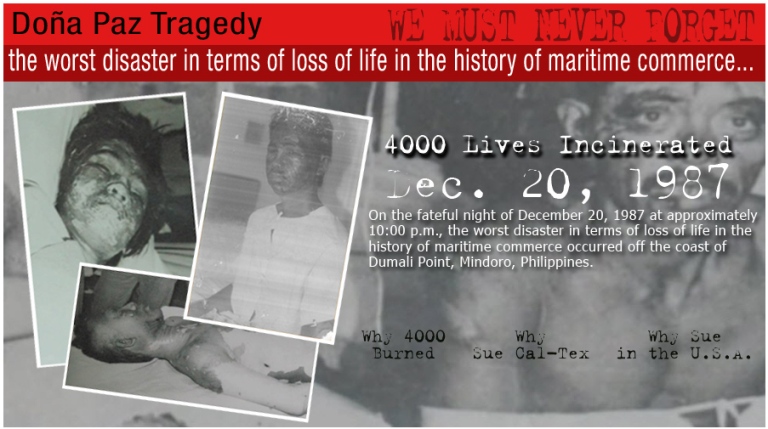
Dona Paz tragedy - image from the survivor website
What is the world’s worst peace-time maritime disaster?
No, it’s not the sinking of the Titanic. It’s a disaster that happened 75 later, on the other side of the planet – in Asia.
It is the sinking of the MV Doña Paz, off the coast of Dumali Point, Mindoro, in the Philippines on 20 December 1987. That night, the 2,215-ton passenger ferry sailed into infamy with a loss of over 4,000 lives – many of them burnt alive in an inferno at sea.
Nobody is certain exactly how many lives were lost — because many of them were not supposed to be on that overcrowded passenger ferry, sailing in clear tropical weather on an overnight journey.
Passenger ferries like the Doña Paz are widely used in the Philippines, an archipelago in Southeast Asia comprising over 7,000 islands. They are among the cheapest and most popular ways to travel.
Just 5 days before Christmas of 1987, hundreds of ordinary people boarded the Doña Paz for a 24-hour voyage from the Leyte island to Manila, the capital.
The Doña Paz – originally built and used in Japan in 1963 and bought by a Filipino ferry company in 1975 — was authorized to carry a maximum load of 1,518 passengers.
But the on the night of the accident, survivors say there may have been more than 4,000 people on board – a gross violation of safety procedures.
Only 24 of them survived the journey — and only just. The entire crew and most of its passengers perished in an accident happened due to negligence, recklessness and callous disregard for safety.
For a glimpse of what happened, watch these first few minutes from 2009 National Geographic documentary,Asia’s Titanic:
For a summary compiled from several journalistic and activist sources, read on…
The Doña Paz had an official passenger list of 1,493 with a crew of 59 on board. But later media investigations showed that the list did not include as many as 1,000 children below the age of four — and many passengers who paid their fare after boarding.
The ship was going at a steady pace. The passengers were settling in for the night. The Doña Paz was scheduled to arrive in Manila by morning. A survivor later said that the weather that night was clear, but the sea was choppy.
Around 10.30 pm local time, without any warning, the Doña Paz collided with another vessel. It was no ordinary ship: the MT Vector was en route from Bataan to Masbate, carrying 8,800 barrels of gasoline, diesel and kerosene owned by Caltex Philippines.
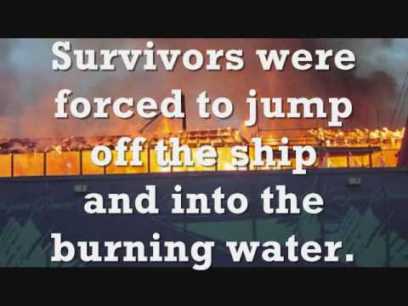
Immediately upon collision, the tanker’s cargo ignited, setting off a massive fire that soon engulfed both ships. Thousands of passengers were trapped inside the burning ferry.
Dozens of passengers leaped into the sea without realizing that the petroleum products had also set the surrounding seas ablaze. Those in the water had to keep diving to avoid the flames spreading on the surface.
Of all the passengers and crew on board, only 24 survived. Everything known about this maritime disaster is based largely on their accounts – and investigative work done by a handful of journalists.
MV Doña Paz in 1984, three years before its tragic end - Photo courtesy Wikimedia Commons - lindsaybridge
One survivor claimed that the lights onboard went out soon after the collision: there had been no life vests on the Doña Paz, and that none of the crew was giving any orders. It was later said that the life jackets were locked up beyond emergency reach.
The few survivors were later rescued swimming among many charred bodies in the shark-infested Tablas Strait that separates Mindoro and Panay islands.
The first help arrived at the scene around one and a half hours after the collision – it was another passing ship. By this time, most passengers of the ferry were dead.
The Doña Paz sank within two hours of the collision, while the Vector sank in four hours. The sea is about 545 meters deep in the collision site.
The Philippines Coast Guard did not learn about the disaster until eight hours after it happened. An official search and rescue mission took more hours to get started.
In the days that followed, the full scale of the horrible tragedy became clear. The ferry’s owner company, Sulpicio Lines, argued that the ferry was not overcrowded. It also refused to acknowledge anyone other than those officially listed on its passenger manifest.
Manifests on Philippine inter-island vessels are notoriously inaccurate. They often record children as “half-passengers” or disregard them entirely. Corrupt officials frequently accept bribes to allow overloading.
Many victims were probably incinerated when the vessels exploded and will never be accounted for. Rescuers found only 108 bodies, many of them charred and mutilated beyond recognition. More bodies were later washed ashore to nearby islands where the local people buried them after religious rituals.
All officers on board the Doña Paz were killed in the disaster, and the two from the Vector who survived had both been asleep at the time. This left the field entirely to lawyers from all sides to endlessly argue over what went wrong, how – and who was responsible.
It was later found that, at the time of the collision, both ships had been moving slowly: the Doña Paz at 26 km per hour, and Vector at 8 km per hour. They were surrounded by 37 square km of wide open sea – plenty of time and space to avoid crashing into each other!
Experts also wondered why the two ships had not communicated with each other before the crash. It is internationally required that all ships carry VHF radio. The Vector was found to have an expired radio license. The radio license for the Doña Paz was a fake.
Survivors told investigators that the crew of the Doña Paz were having a party on board minutes before it collided with the oil tanker. Some reports suggested that the captain himself had been among the revelers.
Being ordinary people, the passenger didn’t know details of maritime rank or procedure. It is likely that a mate or apprentice was steering the Doña Paz. Not a single crew member survived to tell their version of the incident.
After a long and contentious inquiry, the investigators placed the blame on the Vector.
Independent analyses have identified multiple factors that contributed to this tragedy: lack of law enforcement arising from corruption and connivance; under-qualified and overworked crew; telecommunications failures; and inadequate search and rescue efforts in the event of accidents.
Asia's Titanic - NatGeo poster for 2009 filmIn August 2009, National Geographic Channel broadcast an investigative documentary titled Asia’s Titanic that tried to piece together the evidence and understand what happened.
Directed by award-winning Filipino director Yam Laranas, it was the first for any Filipino filmmaker to direct a full-length documentary for the global channel noted for its factual films.
Through dramatic first hand accounts from survivors and rescuers, transcripts from the Philippine congressional inquiry into the tragedy, archival footage and photos and a re-enactment of the collision, dissect the unfolding tragedy of Doña Paz.
The 10-million Filipino peso project took more than 3 years to make, but even its makers could not find all the answers.
“The truth may never be known. In the years after the Doña Paz tragedy, shipping disasters continue to plague the Philippines,” says the documentary as it ends.
Simple explanations are always the best - but not entertaining enough?
So 2012 is finally here! I’ve been waiting for you…
Citing various ancient lore, some say this year will see the end of the world — where have we heard that before?
The Wikipedia describes the ‘2012 phenomenon’ as comprising a range of eschatological beliefs according to which cataclysmic or transformative events will occur on 21 December 2012.
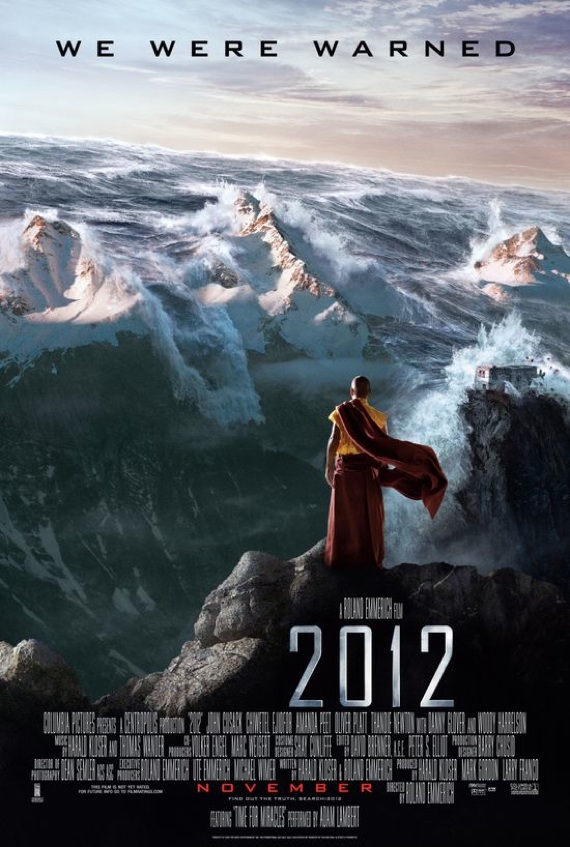
And to think that a blockbuster Hollywood movie, rather than any ancient prophecy, likely triggered this wave of public concern!
Wikipedia notes: “The 2009 disaster film 2012 was inspired by the phenomenon, and advance promotion prior to its release included a stealth marketing campaign in which TV spots and websites from the fictional ‘Institute for Human Continuity’ called on people to prepare for the end of the world. As these promotions did not mention the film itself, many viewers believed them to be real and contacted astronomers in panic.”
The campaign was heavily criticized by scientists, of course, but the public chose to believe the scary make-believe rather than the more sober reality.
Will life imitate art? Find out on 21 Dec 2012The film 2012 became one of the most successful of that year, grossing nearly $770 million worldwide. So the film’s producers were laughing all the way to their bank…
The US space agency NASA has stepped into the debate with sobering analysis. Its website says: “Impressive movie special effects aside, Dec. 21, 2012, won’t be the end of the world as we know. It will, however, be another winter solstice.”
Recalling the Year 2000 computer bug (Y2K problem) that didn’t quite materialise, it says: “Much like Y2K, 2012 has been analyzed and the science of the end of the Earth thoroughly studied. Contrary to some of the common beliefs out there, the science behind the end of the world quickly unravels when pinned down to the 2012 timeline.”
Meanwhile, a few weeks before 2012 started, Lankan astrophysicist Dr Kavan Ratnatunga issued a public challenge on prime time TV.
“I will give 10% of the value of any property to (its) legal owner who will write a deed of sale of their property to me, effective from 22 December 2012, after that owner is so confident the World was going to end on December 21st!”
So far, Kavan has had no takers.
But the hype continues, with the media stirring things up as much as they can: after all, if Hollywood made money from people’s gullibility, why not others?
So might End-of-the-World industries end this year? Not a chance. A sucker is born every minute, and this is one industry that will continue to thrive as long as there are credulous believers.
Breaking News indeed!
I can remember exactly where I was and what I was doing when the news of 9/11 attacks on the World Trade Centre Twin Towers in New York reached me.
It was around 1.15 pm in the UK, a bright sunny afternoon. I was just entering London’s Kings Cross Station to buy tickets. My colleague Marietta, walking with me, received a call to her mobile phone giving the breaking news that somebody had just flown a plane into WTC.
Another clumsy pilot, I thought — recalling how a B-25 Mitchell bomber aeroplane had once accidentally crashed into the Empire State Building, back in 1945. But as we soon found out, this was no accident: it was a dastardly terrorist attack by suicidal fanatics who somehow penetrated the already high aviation security arrangements.
Life in London continued normally, but we were all completely distracted. I had work to do in an office, but can’t remember any of us actually focusing on our chores. Instead, we just watched the live TV coverage of unfolding events across the Atlantic with mounting horror. So did over a billion other people around the world.
It was a world changing event about which much has been written and said. More reflective and less impulsive commentary on this 10th anniversary puts events and their aftermath in better perspective. Of course, we now have the benefit of hindsight.
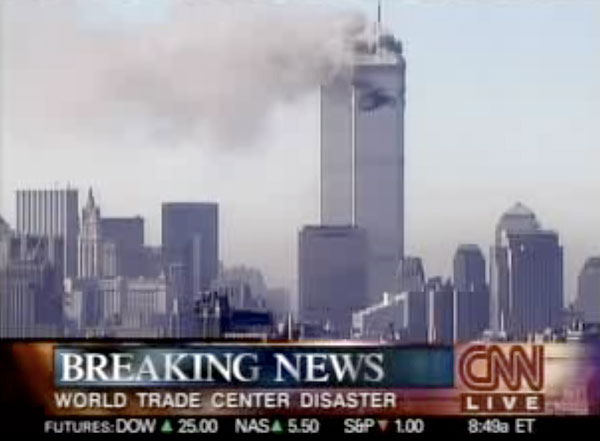
Journalism is the first rough draft of history. The reporters on duty that day were challenged to cover a breaking news event whose magnitude and historical context would become clearer only as the hours and days passed. CNN was the first to break the news live on the air, followed by the rest of the news pack. On the whole, journalists in all media rose to the enormous challenges of covering a scary, bewildering and earth-shattering story.
CNN Breaks the Big News at 8.49 am Eastern Standard Time on 9/11:
If anyone thought (like I did, for a few minutes) that it was a terrible accident, all doubts were removed when the second plane hit. By this time, all cameras were focused on the already burning first tower.
News networks cover the second plane crashing into the second tower LIVE on air at 9.03 am EST
And now, a decade later, media professionals and researchers are looking back at their own impressionistic, on-the-run coverage. Among the many attempts at retrospection, I’ve found two particularly interesting:
Understanding 9/11: A Television News Archive.
This collection contains television news programs recorded live from around September 11, 2001 by the non-profit Television Archive to help patrons research this important part of United States history. These materials were originally available on the televisionarchive.org site from October 2001 through 2003.
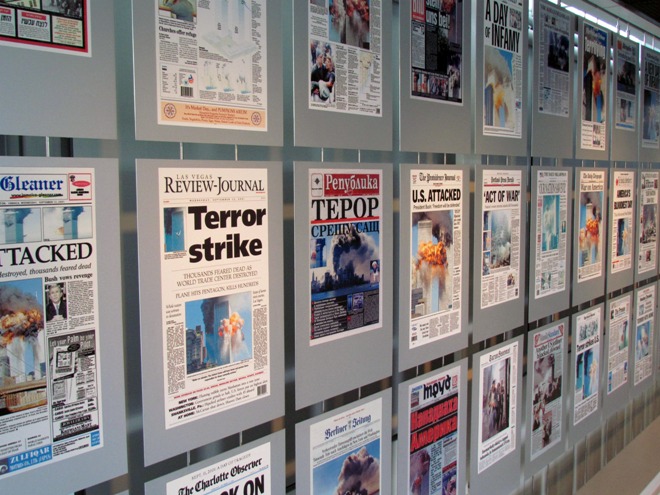
This gallery explores the horrendous events of Sept. 11, 2001, and the extraordinary challenges that faced the journalists trying to report the news to a shaken nation and world. The gallery includes a tribute to photojournalist William Biggart — a journalist who died covering the attacks — and some of the final photographs he took. Also featured are front pages from around the globe about the attacks and first-person accounts from reporters and photographers who covered the story.
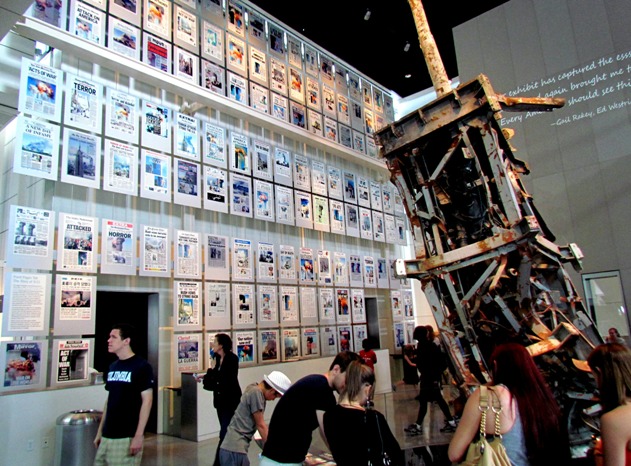
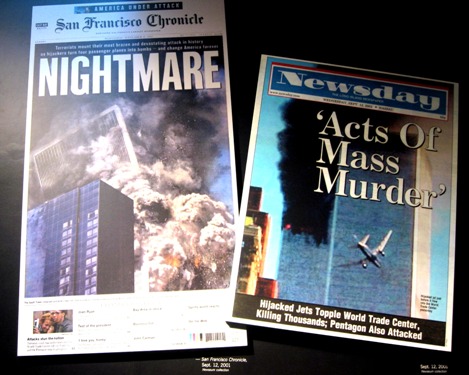
9-11 Frontpages at Newseum, photo by Nalaka Gunawardene Visitors to 9/11 Frontpages exhibit at Newseum in Washington DC, photo by Nalaka Gunawardene Front pages of fear, fury and more...
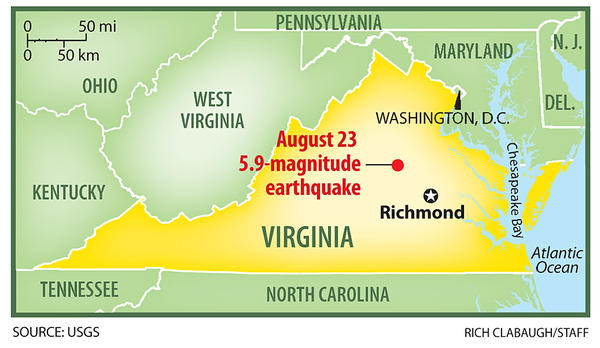
Map courtesy Christian Science MonitorI’ve been travelling for 25 years, but never once experienced an earthquake. Oh, I regularly visit places located in highly seismically active zones: Japan, Indonesia and Nepal among them. However, I’ve never been in the right place at the right time — or should it be ‘the wrong place at the wrong time’?
That was finally corrected with the US East Coast earthquake on 23 August,the last day of my visit to Washington DC, where I’d been staying with a friend in Alexandria, Virginia. Daughter Dhara and I had just finished packing for our long return journey and making ourselves some lunch. Our friends were at work; we were alone with another visitor.
Around 2 pm, and without any warning, the whole house started shaking. The basement made the biggest noise and a cupboard full of glassware next to the dining table rattled quite hard – for a moment I thought it was going to crash forward.
But luckily it didn’t. The noise and vibrations last for about 20-30 seconds. By then I figured that it was an earthquake. We were within a few feet of the front door, so we quick ran outside. Wrong move, we later heard (we should instead have crept under a table and waited for things to settle). But all our neighbours too did the same, rushing out looking all panicked…
Things settled down soon enough, and no further tremours were felt. After a few minutes, we went back inside.
But I was puzzled: the US East Coast is not known to be seismically that active. Yet a few minutes later the US Geological Survey, which monitors earthquakes worldwide, posted an update: this was indeed a magnitude 5.8 quake which was centred in the state of Virginia — the epicentre was only around 50km from where we are at the time. The largest previous earthquake (magnitude 4.8) in this area had occurred in 1875. Smaller earthquakes that cause little or no damage are felt each year or two.
Within an hour of the incident (late by social media standards!), I tweeted: “After 25 yrs of world travel, incl a dozen visits to Japan, I’ve finally experienced a #quake in Virginia, USA. Shaken but not stirred…”
What I didn’t express, until now, is the sense of relief that as quakes go, this was a relatively harmless tremour!
As news started coming in, we heard that the impact had been felt more forcefully in nearby towns and neighbourhoods. Government and corporate offices – including the US Congress and Pentagon (Defence Dept) — evacuated as a precautionary measure. Many shopping malls and other public places closed up in a hurry. The cell phone networks were clogged with too many people calling each other. It was a mild form of panic, something the Californians on the West Coast — so accustomed to tremours in their lives — found amusing.
The US media — perhaps starved of breaking news in the lazy days of Summer — went into overdrive with saturation coverage. Much of it was cacophonous, but some outlets were more informed and measured.
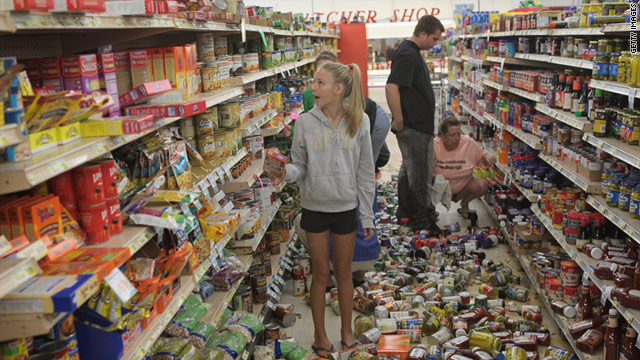
Volunteers help restock shelves in Mineral, Virginia, just a few miles from the epicenter of Aug 23 earthquake - Image courtesy CNN.com
Among the more perceptive pieces was what an op ed that appeared on CNN.com and written by Christa von Hillebrandt-Andrade, manager of the Caribbean Tsunami Warning Program of the U.S. National Weather Service and president of the Seismological Society of America, She noted: “Although seismologists, historians and emergency managers have recognized the potential for an earthquake along the East Coast for years, most people were caught by surprise and so responded inappropriately. The ground doesn’t shake as much in the East as it does in California, Alaska, the Pacific Northwest, Puerto Rico or the Virgin Islands. But because of the great concentration of population and infrastructure in the East, it’s an area of immense risk.”
She added: “Since earthquakes are infrequent in this region, most people don’t know earthquake preparedness measures. Instead of running out of buildings, they should have dropped, covered and held on. Earthquakes are natural phenomena that become disasters when we don’t prepare adequately — or are not educated in proper measures.
“The 2004 tsunami is an example of a rare event catching people unprepared, with catastrophic results. In December of that year, more than 230,000 lives were lost in countries around the Indian Ocean. Residents and tourists were taken by surprise — they were not warned, nor did they recognize the natural signs.”
She also cited the exception to that norm: the British school girl Tilly Smith who was vacationing on a Thai beach that day and recognised the tell-tale signs of the oncoming tsunami. In the wake of the Virginia quake, my Oct 2007 blog post about Tilly has attracted considerable attention.
Asking questions. Connecting the dots. Explaining matters.
These actions sum up what I have been doing in the spheres of communication and development for over 20 years. They form the cornerstone in my attempts to make sense of our globalised world and heady times.
As a journalist, I was trained to look for what’s New, True and Interesting (‘NTI Test’). Early on, I went beyond just reporting events, and probed the underlying causes and processes. With experience, I can now offer my audiences something more: perspective and seasoned opinion.
I look back (slightly) and look around (a lot) in a half-hour, in-depth TV interview with media researcher/activist and fellow citizen journalist Sanjana Hattotuwa. This was part of The Interview (third series) produced by Young Asia Television, and broadcast on two Sri Lankan TV channels, TNL and ETv on May 8 (with repeats).
Watch the full interview online: Sanjana Hattotuwa talks to Nalaka Gunawardene
I have always worn multiple ‘hats’, and dabbled in multiple pursuits rather than follow narrow paths of enquiry. I see myself continuing to oscillate between the ‘geeks’ and greens, and where possible, bridging their worlds.
I sometimes feel a strange kinship with the ancient Greeks, who first asked some fundamental questions about the universe. They didn’t always get the answers right, and neither do I.
But it’s very important that we question and critique progress – I do so with an open mind, enthusiasm and optimism.
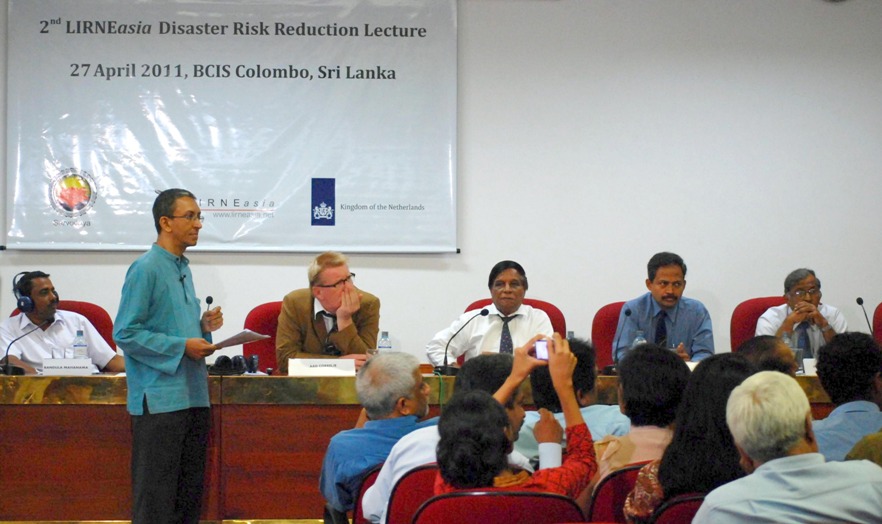
2nd LIRNEasia Disaster Risk Reduction Lecture, 27 April 2011 in Colombo: Nalaka Gunawardene (standing) moderates panel discussionWriting on 20 April 2011, exactly 25 years after the Kantale large dam breached and washed away downstream villages, I posed the question: “If there were to be a catastrophic dam failure in Sri Lanka today, is there a warning system in place to detect the failure and issue timely warnings? Have the downstream communities participated in evacuation drills and know what action needs to be taken when a warning is issued?”
I’ve been asking such questions for a while. In fact, the post-mortem of the Kantale dam breach was one of the bigger stories I covered soon after I entered mainstream journalism in late 1987. By then, a few months after the incident, a presidential commission of inquiry was looking into what caused that particular disaster.
My interest in this subject is perhaps inevitable. I live in a country that has a high concentration of man-made water bodies. There are approximately 320 large and medium sized dams in Sri Lanka, and over 10,000 smaller dams, referred to as “wewas”, most of them built more than 1,000 years ago. In fact, Sri Lanka probably has the highest number of man-made water bodies in the world. According to the Sri Lanka Wetlands Database, the major irrigation reservoirs (each more than 200 hectares) cover an area of 7,820 hectares, while the seasonal/minor irrigation tanks (each less than 200 hectares) account for 52,250 hectares. This adds up to 60,070 hectares or just over 600 square kilometres — nearly a tenth of the island’s total land area.
Lankans are justifiably proud of their ancient hydrological civilisation — but don’t take enough care of it. Nothing lasts forever, of course, but irrigation systems can serve for longer if properly maintained. In a world where extreme weather is becoming increasingly commonplace, we can’t afford to sit on 25 centuries of historical laurels. Unless we maintain the numerous dams and irrigation systems – most of which are still being used for farming – heritage can easily turn into hazard.
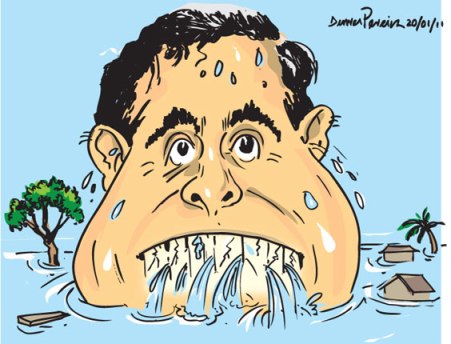
Cartoon from Daily Mirror, 20 Jan 2011As indeed happened in early 2011, when massive and successive floods lashed the country’s Dry Zone where most reservoirs are located. It was a strong reminder how dams and reservoirs not only attenuate the effects of heavy rains, but if breached, can magnify the effects of such rainfall.
More than 200 small dams did breach during those rains, causing extensive damage to crops and infrastructure. The most dangerous form of breach, the over-topping of the earthen dams of large reservoirs, was avoided only by timely measures taken by irrigation engineers — at considerable cost to those living downstream. This irrigation emergency was captured by a local cartoonist: the head in this caricature is that of the minister of irrigation.
In early February, Sri Lanka announced that it will expand its dam safety programme to cover more large reservoirs and will ask for additional funding from the World Bank following recent floods. Never mind the irony of a proud heritage now having to be maintained with internationally borrowed money. Public safety, not national vanity, comes first.
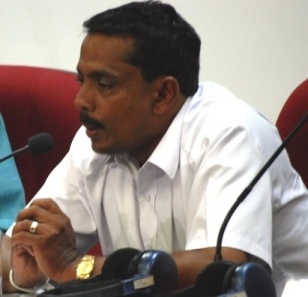
Bandula MahanamaThe main lecture was delivered by Dr Aad Correlje of the Delft University of Technology, the Netherlands. The response panel comprised Bandula Mahanama (a farmer organisation leader from one of the worst flood-affected areas in the Polonnaruwa District), S Karunaratne (Sri Lanka National Committee on Large Dams), Dr Kamal Laksiri (Ceylon Electricity Board) and U W L Chandradasa (Disaster Management Center). A summary is found on LIRNEasia’s blog.
Dams and irrigation systems are widely seen as the exclusive domain of civil engineers. They certainly have a critical role to play, but are not the only stakeholders. I was very glad that both our panel and audience included voices from many of these groups — especially the many communities who live immediately downstream of dams and reservoirs. Some of them are always in the shadow of a dam hazard, and yet helpless about it.
This was the gist of farmer leader Bandula Mahanama’s remarks – he made a passionate plea for a more concerted effort to improve proper maintenance of dams and reservoirs. “Wewas are part of our life, but right now our lives are in danger because the irrigation heritage is in a state of disrepair,” he noted.
I will write more about this in the coming weeks. My last thought from the chair was something I first heard many years ago in a global documentary. When it comes to water management, everybody lives downstream.
That’s certainly the case — but some are more downstream than others. And not everyone lives with the same peace of mind. We need to do something about it.
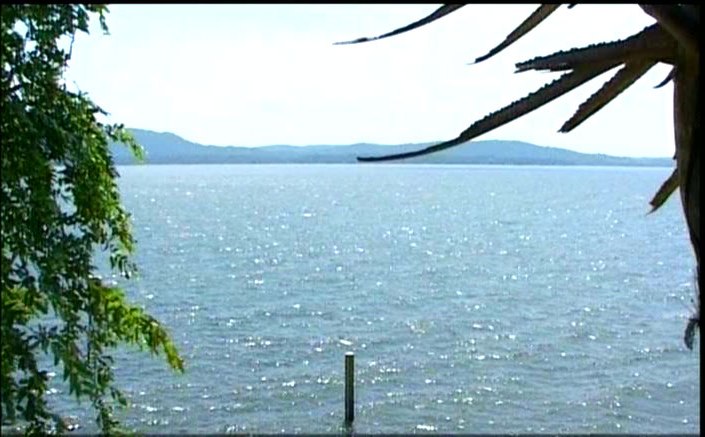
Kantale Reservoir: Full again, but what if another dam breach happens as in April 1986?
There are approximately 320 medium and large dams in Sri Lanka and over 10,000 small dams, most of which were built more than 1,000 years ago. The consequences of a major dam failure in Sri Lanka can be devastating to life, property and the environment.
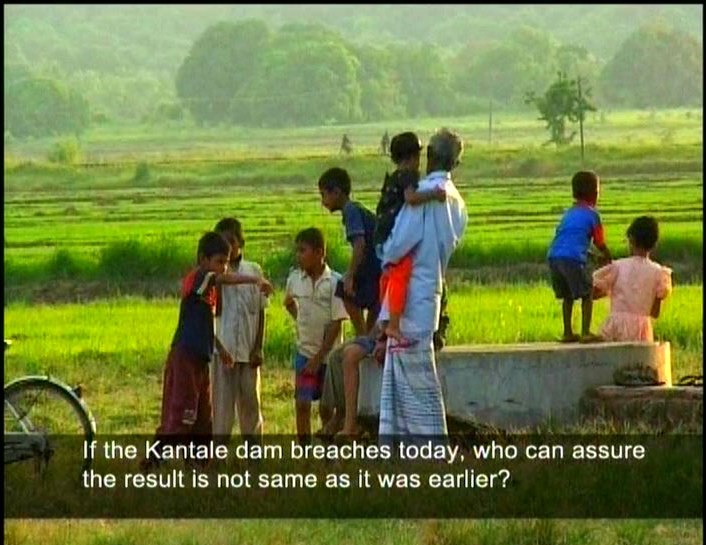
One such dam disaster happened exactly 25 years ago, on 20 April 1986, when the ancient Kantale dam, 50 feet high and over 13,000 feet long, breached. Its waters rapidly flooded several villages downstream, killing 127 people and destroying over 1,600 houses and paddy lands.
A short documentary made in 2005 revisited the scene of this disaster 19 years later to gather memories and opinions of the affected people and engineers involved. The film, made by Divakar Gosvami, was part of a 2005 study on dam safety by LIRNEasia, Vanguard Foundation, Sri Lanka National Committee of Large Dams and Sarvodaya. Its final report asked: if there were to be a catastrophic dam failure in Sri Lanka today, is there a warning system in place to detect the failure and issue timely warnings? Have the downstream communities participated in evacuation drills and know what action needs to be taken when a warning is issued?
Kantale Dam Breach Revisited: Part 1 of 2
Kantale Dam Breach Revisited: Part 2 of 2
This film is not merely documenting a tragic moment of recent history. It also carries the caution: have we learned the lessons from this incident?
Dr Rohan Samarajiva, Chair and CEO of LIRNEasia, has just written: “As I watch it again in April 2011, I wonder whether all that they had built up since 1986 had got washed away, again. Two successive periods of heavy rainfall at the beginning of the year devastated the livelihoods of the people of the wav bandi rajje, the irrigation civilization we are so proud of. Flood upon flood. More than 200 small tanks breached; big tanks were saved by the emergency actions of irrigation engineers.”
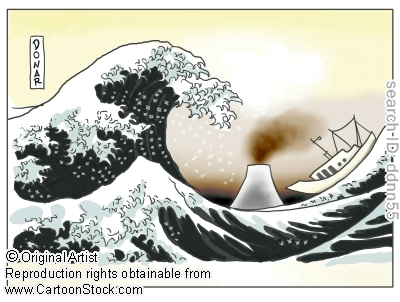
Image courtesy Vision MagazineEarth, water, fire and air.
These are the four basic elements of matter as seen in ancient Greek, Hindu and other traditions. Each had different names for them, but the concepts were similar.
And in recent days, Japan has been experiencing multiple disasters involving all these elements.
It started with the 9.0-magnitude megathrust earthquake off the coast of Japan that occurred at 2.46 pm Japan time on 11 March 2011. Its epicentre was 130 kilometres off the east coast of the Oshika Peninsula of Tohoku, near Sendai. The earthquake triggered highly destructive tsunami waves of up to 10 meters (33 ft) that struck nearby coastal areas minutes after the quake, and in some cases travelled up to 10 km (6 miles) inland. The earthquake and tsunami waves killed over 5,000 people, caused massive property damage and started fires in some affected locations. Most worrying was the damage caused to the Fukushima II nuclear power plant where reactors damaged by the quake and tsunami led to an accidental leak of radioactivity.
Japan has a long history of living and coping with disasters, but the magnitude and confluence of multiple disasters has plunged the country into the worst crisis since the Second World War. This week’s Wiz Quiz devotes several questions to the history and science of tsunamis.
As it turns out, thanks to Japan’s strict building codes and preparedness, the country could absorb much of the powerful earthquake. But the massive tsunami is what caused most of the damage — there is little defence against the mighty waves that come roaring inland, wiping out everything in their path…





 Open Minds!