This is one of my favourite photos in media and development. It was taken by Reza Deghati, the renowned Iranian-French photojournalist (who works under the name Reza). I don’t know the story behind this photo, but even without a single word of annotation, it says a great deal.
I like this photo partly because it symobolises the enduring appeal of broadcast television in much of the developing world. For long years, the old-fashioned, boxy TV set used to be the top-selling consumer electronic item in the world — until the mobile phone came along. But even now, the much-maligned idiot box hasn’t lost its appeal to a significant section of humanity, never mind what the jaded academics and geeks might say.
So I was intrigued to read, in the latest issue of TIME Magazine, development economist Charles Kenny, reminding us that television is still the most influential medium around. In this gizmo-ridden new media age, it takes much courage to say so in public.
In a powerful short essay titled ‘TV Will Save the World’, he writes: “Forget Twitter and Facebook, Google and the Kindle. Forget the latest sleek iGadget. Television is still the most influential medium around. Indeed, for many of the poorest regions of the world, it remains the next big thing — poised, finally, to attain truly global ubiquity. And that is a good thing, because the TV revolution is changing lives for the better.”
Across the developing world, he says, some 60% of the households had their own TV set in 2005 — up from 45% in 1995. He adds: “Five million more households in sub-Saharan Africa will get a TV over the next five years. In 2005, after the fall of the Taliban, which had outlawed TV, 1 in 5 Afghans had one. The global total is another 150 million by 2013 — pushing the numbers to well beyond two-thirds of households.”
He ends his essay with these words that strongly resonate with me: “Too much TV has been associated with violence, obesity and social isolation. But TV is having a positive impact on the lives of billions worldwide, and as the spread of mobile TV, video cameras and YouTube democratize both access and content, it will become an even greater force for humbling tyrannical governments and tyrannical husbands alike.”
As Sir Arthur C Clarke, inventor of the communications satellie whose second death anniversary we mark this week, told me in a 2003 interview: “I’m not impressed by the attacks on television because of some truly dreadful programmes. I believe that every TV programme has some educational content. The cathode ray tube – and now the plasma screen – is a window to the world. Often it may be a very murky window, but I’ve slowly come to the conclusion that, on balance, even bad TV is preferable to no TV at all.”
Image courtesy Foreign PolicyThe TIME essay is a much compacted version of what he wrote in November 2009 issue of Foreign Policy magazine, titled Revolution in a Box. That article noted the continuing global spread of television sets and an explosion of viewer choice driven by cable, satellite and digital technologies. It suggested this is a good thing, pointing to evidence that access to competitive television can improve womens’ standing in the home, increase girls schooling, reduce fertility rates, lower drug use, improve governance and (possibly) help foster global peace.
The editors of Foreign Policy ran the following blurb: “It’s not Twitter or Facebook that’s reinventing the planet. Eighty years after the first commercial broadcast crackled to life, television still rules our world. And let’s hear it for the growing legions of couch potatoes: All those soap operas might be the ticket to a better future after all.”
The full essay is well worth a careful read. At a time when I have been questioning many of the founding premises of my own work at TVE Asia Pacific, he has provided conceptual clarity and sharper focus.
Television has been called many names in the few decades it’s been around – among them the Great Wasteland and Idiot Box. Television used to be the favourite whipping boy of those who love to criticise communication technologies and consumer gadgets — until the Internet and mobile phones came along.
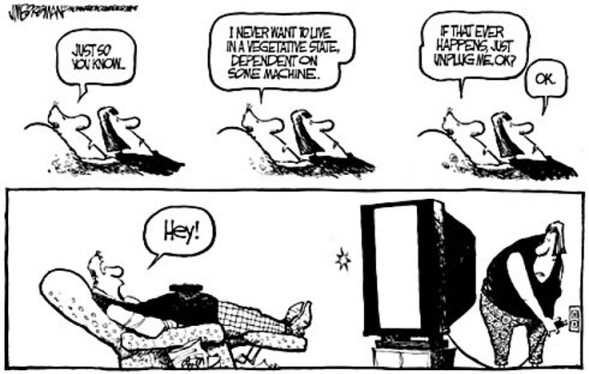
Couch potatoes of the world have ignored all snide remarks, and just carried on their sedentary practice.
Now they might have to think again: Television may be hazardous to your health in more ways than previously imagined. In fact, it might shorten your life.
The report, which appears in the journal Circulation,says every extra hour spent watching television increases people’s risk of premature death.
Professor David Dunstan of the Baker IDI Heart and Diabetes Institute in Melbourne, followed more than 8000 Australian adults for six years.
The team discovered that the people who watched the most TV died younger.
“What this study provides is the first compelling evidence linking television viewing to an increased risk of early death,” says Dunstan. “People who watch four or more hours of television a day have a 46% higher risk of death from all causes and 80% increased risk of death from cardiovascular disease.”
Trivia: Robert Armstrong, an artist from California, developed the term couch potato in 1976. Several years later, he listed the term as a trademark with the United States government. Armstrong also helped illustrate a funny book about life as a full-time television watcher. It is called the “Official Couch Potato Handbook.”
Where the island of Sri Lanka was concerned, it was the first solar eclipse of the broadband internet era — and that showed.
The last solar eclipse seen in Sri Lanka was two generations ago, on 20 June 1955. That was almost pre-historic in mass media terms. The newly independent Ceylon had a single, state-owned radio station and a handful of newspapers. There was no television, and the internet was not even conceived.
Yet, paradoxically, the media’s influence over the 8 million people then living on the island seem to have been greater at the time. As astronomer Dr Kavan Ratnatunga recalled: “A quack physician cum astrologer, recommended that women wanting to become fair and lovely should drink a decoction of which the main ingredient was “Vada Kaha” (Sweet Flag or Acorus Calamus) at the time of the total eclipse, preferably unseen by others. Many who took his advice ended up in hospital.”
Solar eclipse on 15 Jan 2010 seen in Anuradhapura, north-central Sri Lanka - photos by ReutersIn contrast, in 21st Century Sri Lanka, the January 15 eclipse was not much of a news story. I don’t claim to have done a systematic analysis, but my impressions are drawn from scanning the major newspaper websites in English and Sinhala, and surfing the dozen or more terrestrial (free-to-air, not cable) TV channels that were on the air during the three hours or so of the eclipse. (Sorry: I missed out radio, and I’m not proficient in Tamil.)
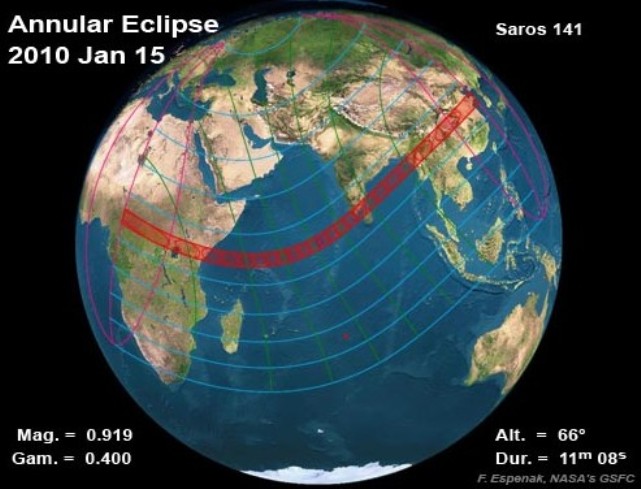
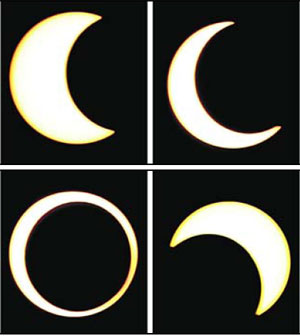
Broadcast television was my biggest disappointment. Solar eclipses are a visual spectacular, and literally heaven-sent for live television. Yet, not a single Lankan TV channel carried a live broadcast of the event, either from northern Sri Lanka where it was best seen (in its annular form, with ‘ring of fire’ effect), or from elsewhere on the island as a partial eclipse.
It seemed as if the Colombo-based media were completely preoccupied with the intense build-up to the presidential election scheduled for 26 January 2010 — a case of politics eclipsing the solar eclipse?
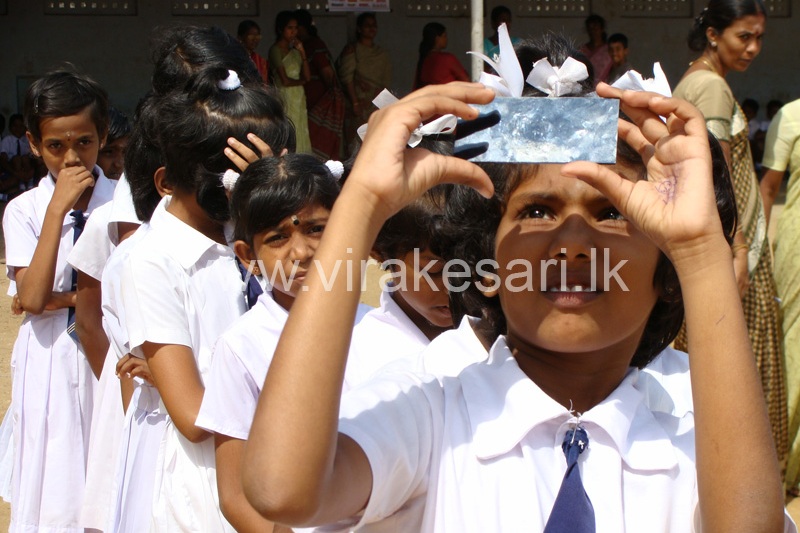
Jaffna school children view the solar eclipse - Photo courtesy Virakesari
But there were a couple of honourable exceptions – and thank heavens for that! One was the leading Tamil daily Virakesari, which sponsored an expedition to Jaffna, in northern Sri Lanka, by a group of professional and amateur astronomers from SkyLk.com. According to one member of this expedition, Thilina Heenatigala, this newspaper provided the widest and most uptodate coverage of the annular eclipse from Jaffna.
SkyLk.com collaborated with the Hindu College in Jaffna, whose playground was converted into an open air observation camp. Thilina says over 2,000 people – including school children and adults – had converged to witness the event. A large screen was set up on to which the live image from a telescope was projected.
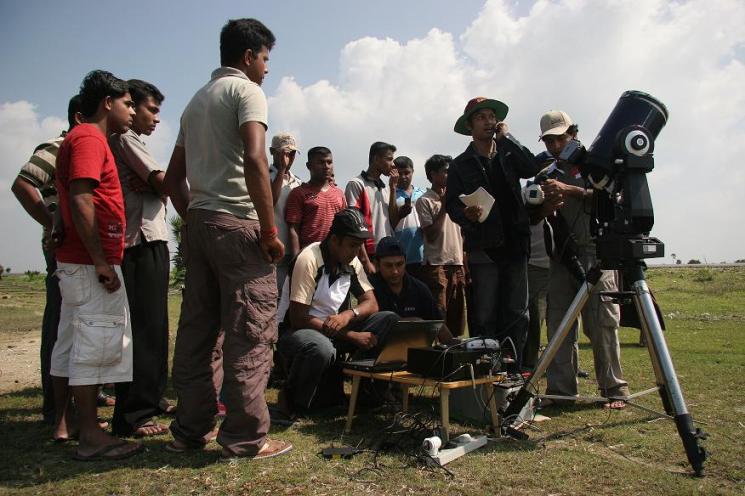
Not far from there, a group of engineering students and teachers from the University of Moratuwa was doing a more scientific observation. Later that day, team leader Dr Rohan Munasinghe reported in an email: “We have recorded the solar eclipse from Kayts (lat 9d,37m N, Long 79d,58 E), the biggest island off Jaffna Sri Lanka. We have timestamped the video with GPS (Garmin 18) accuracy.”
University of Moratuwa team observing the clipse - photo courtesy Dr Rohan Munasinghe
Elsewhere across the island of Sri Lanka, there was plenty of interest among the people from all walks of life — as seen from the thousands who stepped out during mid-day to take a peek at the celestial phenomenon. Not all of them followed the safety precautions to prevent eye damage, disseminating which the media had done a good job in the preceding days.
Clearly, this high level of public interest was not reflected in how the rest of Lankan mainstream media covered the eclipse. But if the mainstream media’s gaze was firmly fixed on the gathering election storm on the ground, the new media created opportunities for others to step into that void. Citizen scientists joined hands with citizen journalists to capture and share the eclipse with each other — and the world. These unpaid enthusiasts used commonly available digital tools and online platforms for this purpose.
Some of them uploaded dozens of photos for public viewing on image sharing sites like Flickr. A good example is what Shehal Joseph and Romayne Anthony did. There were many others.
SkyLk.com group was more ambitious: they actually webcast the eclipse live online from their public observation camp at Hindu College grounds. Stuck in Colombo with its sub-optimal viewing conditions for this eclipse, this was the best chance for people like myself to catch the annular part of the phenomenon.
“We were struggling with bandwidth limitations most of the time,” Thilina Heenatigala says. “We used a Dialog HSPA modem to connect to the web, and line speeds kept fluctuating. We were not the only ones uploading still photos or video to the web from different locations in northern Sri Lanka — and apparently all of us were slowing down each other.”
Being the tech-savvy planner he is, Thilina had alerted Dialog telecom company about the likely peaking of bandwidth demand. But he is not sure if any temporary enhancing was done, even though Dialog currently claims to be the ‘first and best’ to offer telecom coverage in the north. Certainly, the live eclipse webcast was not of uniform quality — it’s a small miracle it happened at all: until a few months ago, this was part of the theatre of war in northern Sri Lanka.
In fact, SkyLk.com had used the web to build up public awareness and interest using video trailers on YouTube. Here is one of several simulations they had up from December, thus one for Anuradhapura, Sri Lanka (simulation):
In the end, however, SkyLk.com became a victim of its own success. The live webcast was followed by hundreds, and then thousands of online visitors from different parts of the world. This apparently overshot the usual allocations provided by the offshore hosting company (in the US), which suspended the account. Right now SkyLk.com website is not accessible (as at 16 January 2010, 15:00 UTC/GMT).
Within hours of the eclipse, several individuals and groups also uploaded highlights of their eclipse videos on to the YouTube. Here are the most striking ones I came across in a quick search:
Solar Eclipse 2010 Sri Lanka Scientific Record – by University of Moratuwa
Scientific recording of the annular solar eclipse on 15 January 2010 was carried out from the Island Kayts (Lat +09d 37m North and Long +79d 58m East) of Sri Lanka.
Orion Video’s coverage from Nallur, Jaffna:
Not in the same league as the above two videos, this was Nishan Perera’s personal observations from Ratnapura, south-western Sri Lanka:
It’s too early to draw firm conclusions from this random evidence, but in all likelihood, we passed thresholds in both citizen journalism and citizen science with this eclipse. Clearly, the mainstream media’s monopoly/domination over reporting of such an event has been shattered: their indifference will no longer stand in the way of information and images being disseminated.
Perhaps just as important, it is no longer possible for a couple of self-appointed ‘public astronomers’ to dominate the public information channels on an occasion like this, mostly for shameless self-promotion. As Dr Kavan Ratnatunga, President of the Sri Lanka Astronomical Association, noted in an article: “I am amazed as to how many who have never even seen a Solar Eclipse, will gladly talk about it to an equally ignorant journalist, resulting in some totally misleading and sometimes hilarious information being published in both the English and Sinhala media. In a nation which believes in pseudo astrology, I am sure it is just a matter of time before quacks start using it to predict influence on local events and politics. However, there is absolutely no influence on any person by any of these celestial events.”
At the end of the day, however, astronomy aficionados are emphatic that no amount of media coverage can really substitute the experience of being there and experiencing it ourselves. As Kavan says: “A solar Eclipse is event which must be experience and observed. No video can do justice to that experience. It can also become addictive. In the modern age when the Internet and TV can bring events to your home, one may wonder why some Eclipse chasers travel round the world to see an Eclipse of the Sun.”
The next solar eclipse visible from Sri Lanka will be on 26 December 2019. I wonder what kind of media and ICT landscape would cover that event…
Last chance...?Here’s a winning idea for a new business venture in these lean times: make an always-agreeable ‘magic’ mirror — and the vane and wicked will beat a path to your door.
Well, at least half the politicians in Sri Lanka would. They’d rather not see their true selves on any mirror.
The magic mirror idea was popularised many years ago by Snow White and the Seven Dwarfs, whose wicked and vain queen had an unusual mirror that talked back, each time she asked: ‘Mirror, mirror, on the wall. Who’s the fairest of them all?’.
The queen wasn’t looking for honest answers; she just wanted to hear she was always the prettiest and fairest in the land. (All competition – real and imagined – was dealt with brutally.)
Little has changed, even in this 21st Century. We may not have too many monarchs left in the world, but our uncrowned rulers can be equally vain and ruthless. They are obsessed with self-aggrandizing sycophancy – they’d only tolerate magic mirrors that totally boost their egos.
If I seem to be preoccupied with mirrors, that’s nothing to do with my own vanity. In this digital age, the mirror is still a pretty good metaphor for the media industry that I have been part of, in one way or another, for over 20 years. At its very basic, the media are expected to reflect our society and our times.
But some people don’t like what they see on a true mirror. In 2009, we saw a spate of mirror smashing or media bashing in Sri Lanka. It started on 6 January, when the studio of the Maharaja Television/Broadcasting Network (MTV/MBC, popularly known as Sirasa Group) was attacked by armed gunmen who almost blew up the country’s most popular private broadcast organisation. On 8 January, exactly a year ago today, Lasantha Wickrematunga, editor of The Sunday Leader, was shot dead by two men on a motorcycle as he drove to work in suburban Colombo.
Sirasa & Lasantha: Refused to be magic mirrorsOne year later, both crimes remain unsolved. They have joined a long list of crimes against journalists and media organisations in Sri Lanka, most of which have never led to any prosecution of the perpetrators.
As Reporters Without Borders noted in a statement this week: “The emotion and anger have not gone away in the year since this famous Sri Lankan journalist’s death. The anger is being sustained by the government’s flagrant obstruction of the investigation. Lasantha Wickrematunge’s name and memory will not disappear and, in that sense, those who were behind his murder made a mistake.”
Commenting on the MTV/MBC (Sirasa) attack, I described the typical reaction of the mirror-bashers: “…if you don’t like what you see in the mirror – which is what media is to society – just kick it, shatter it and hammer it into dust so that it won’t reflect anymore. Destroy all the mirrors of the land, and we’ll finally be the fairest and prettiest in the whole world. That seems to be the perverse logic that fuels attacks of this nature.”
Rex de Silva, the first editor that Lasantha worked for in the late 1970s cautioned that Lasantha’s murder was the beginning of ‘the sound of silence’ for the press in Sri Lanka. As I asked on the day of Lasantha’s emotionally-charged funeral: “Can this sound of silence be shattered by the silent, unarmed majority of liberal, peace-loving Lankans who were represented at the funeral service and the Colombo cemetery today?”
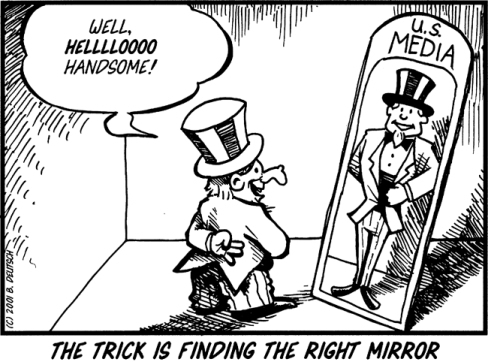
Back to mirrors. While the true mirrors were getting bashed, those who played being ‘magic mirrors’ have done well for themselves (and are probably laughing all the way to their banks). But that’s not a phenomenon confined to the little island of Sri Lanka. A good part of the US Media did the same under the hawkish Bush Administration, which prompted the cartoon below.
It’s not just ‘Dubya’ who is addicted to such agreeable mirrors. Indeed, for many modern-day rulers, an essential trapping of power involves surrounding themselves with spin doctors, press commissioners and other manipulators or manufacturers of image. In mature democracies, there are certain checks and balances which usually guard against the worst excesses (but there are notable exceptions – look at Italy!).
In immature, fragile or pseudo democracies, mirrors obey the laws of physics (optics) at grave risk to themselves. If you want proof, just talk to the staff of Sirasa or The Sunday Leader in Sri Lanka…
When I was in my early teens (back in the early 1980s), I developed a great interest in radio. Not just in listening to radio broadcasts, which I did regularly while growing up in a country that had no television, but also in building a radio that could both receive and transmit signals.
My school teacher father, who encouraged me in many of my diverse pursuits, bought transistors, condensers and other ‘building blocks’ for a basic radio set. With the help of an amateur radio handbook, and through trial and error, he and I actually built a functional transmitter. It was exhilarating to listen to local and shortwave broadcasts on a home-made radio set, but even more exciting to be able to transmit rudimentary signals.
Even as a kid, I was not contented in being a passive recipient of information; I wanted to give out as much as I received…
That particular fancy didn’t last long: I soon moved on to other challenges, and never persisted with being a serious amateur radio enthusiast (or ‘radio ham’), but it left a lasting impression. A few years later, after leaving high school, I became a regular freelancer at the local radio station. By age 23, I was hosting my own weekly show on national radio, and my association with the radio medium would last for much of my 20s.
The humble low tech that saved the day...My interest in amateur radio lay dormant — until five years ago, when I read reports about how radio hams helped revive emergency communications in the immediate aftermath of the Indian Ocean Tsunami.
The decades old practice was hailed as the ‘low tech’ miracle that literally helped save lives. Where electricity and telephone services — both fixed and mobile — had been knocked down, radio hams restored the first communication links. They were at the forefront of relief efforts, for example, in the Andaman and Nicobar Islands in India, and in Hambantota in southern Sri Lanka.
This intrigued Sir Arthur C Clarke, inventor of the communications satellite and long time resident of Sri Lanka. Shortly afterwards, he wrote in Wired magazine: “We might never know how many lives they saved and how many minds they put at ease, but we owe a debt to Marconi’s faithful followers.”
If Sir Arthur were alive, he would have been dismayed to find what has happened since. Notwithstanding their celebrated role after the tsunami, radio hams have been sidelined in Sri Lanka. Their very hobby is being frowned upon by the state on the grounds of…national security.
Looking back, it seems like the public-spirited radio hams were given their 15 minutes of fame and then soundly ignored. Worse, the short-lived prominence may have attracted new bureaucratic hurdles.
“As the applause died away, everything was forgotten,” I quote Victor Goonetilleke, one time President and current Secretary of the Radio Society of Sri Lanka, which networks amateur radio practitioners in the country.
One reason for this bureaucratic fear and negativity, I argue, may be simple ignorance of what amateur radio really is — reflecting the disturbingly low levels of media literacy in Sri Lanka.
Read the full essay, and join the conversation on Groundviews, or on this blog.
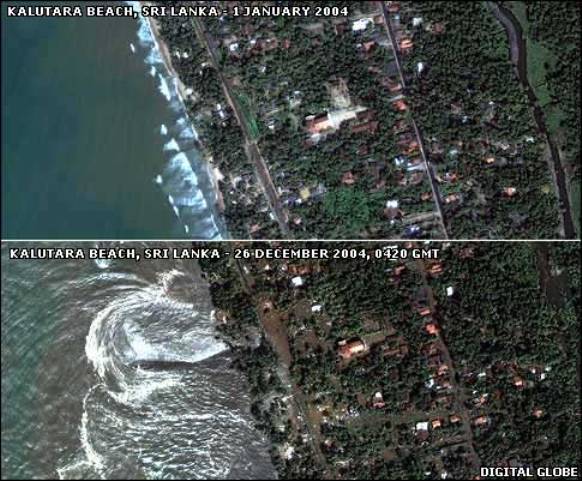
Kalutara beach in south-western Sri Lanka before & during the 2004 tsunami - Satellite image courtesy Digital Globe
This montage of satellite images was taken by the DigitalGlobe Quickbird satellite. It shows a portion of the south-western coast of Sri Lanka, in Kalutara, some 40km south of the capital Colombo. The lower image was taken on Sunday 26 December 2004, at 10.20 am local time, shortly after the moment of impact of the Indian Ocean tsunami that wreaked havoc in South and Southeast Asia that day. For comparison, we have an image of the same location on a normal day a few months earlier.
For many of us in the media and communication sectors, this was the biggest story of our lives. Because the killer waves hit numerous coastal locations in several countries, this disaster’s ‘Ground Zero’ was scattered far and wide. Not even the largest news organisations could see, hear and capture everything. Everyone had to choose.
And not just geographically, but thematically too, the tsunami’s impact was felt across sectors, issues and concerns. That provided both ample scope and many challenges for journalists, aid workers and others who rushed to the multiple scenes of disaster.
But there was a downside. Because the tsunami’s scale was so vast and its effects spread so wide, no single individual or organisation could comprehend the full picture for months. For many of us in the Indian Ocean rim, culturally unfamiliar with tsunamis, it was as if a Godzilla had stomped through our coasts. Grasping the full, strange phenomenon was hard.
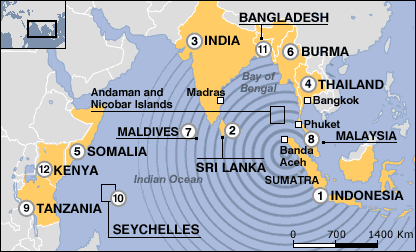
Countries affected by 2004 Dec tsunami - map courtesy BBCJournalists, professionally trained to hastily produce ‘first drafts of history’, found it a bit like being close to a huge tapestry still being woven: we all absorbed parts of the unfolding complexity. We reported or analysed those elements that held our interest. But we were too close, and too overwhelmed, for much perspective.
Five years on, we can ‘zoom out’ more easily to see the bigger picture. When I do, one overarching factor stands out as the most important and lasting lesson of the tsunami: the need for better governance.
The absence of good governance was at the root of most major stories about the tsunami. It cut across every level in our societies — politics, public institutions, corporate sector, humanitarian agencies, academia and civil society.
This is the thrust of my latest op ed essay, written in time for the tsunami’s fifth anniversary being marked today. I briefly recall three aspects of the tsunami that I covered as a journalist — early warnings, deluge of aid and environmental lessons — to show how the absence of governance aggravated matters in each case.
The lesson is not simply one of academic interest: it holds many practical, survival level implications. I end by quoting Maldivian President Mohamed Nasheed, who argues that democracy and good governance are also the most important elements in climate change adaptation.
The wide-ranging interview was originally filmed in November 2005 in Bangkok, Thailand, by Thai journalist and film maker friend Pipope Panitchpakdi. He used excerpts at the time for a Thai documentary to mark the first anniversary of the tsunami. It remains one of the best media interviews I have given, for which all credit goes to Pipope.
Here’s a little mystery: why do most TV stations in tropical Asia dream of white Christmases?
Browse through the dozens (or hundreds) of channels that we Asians can now access on cable, and the chances are that many are displaying gently descending snow flakes, decorated evergreen coniferous trees, Santa Claus and other well known images of Christmas.
Nothing wrong with that – except that snowy Christmases aren’t very common close to the Equator — unless you climb to very high elevations. And for our friends in the southern hemisphere, this time of the year is actually summer! But hey, why let any of these facts get in the way of a nice fantasy?
Speaking of unusual or indigenous Christmases, I just came across this very funny version of ‘Jingle Bells‘ by A R Rachman, who won two Academy Awards for Best Original Music Score and Best Original Song at the 2009 Oscars for Slumdog Millionaire.
“Jingle Bells” is one of the best known and commonly sung winter songs in the world. It was written by James Lord Pierpont (1822–1893) and copyrighted under the title “One Horse Open Sleigh” on September 16, 1857. Despite being inextricably connected to Christmas, it is not specifically a Christmas song.
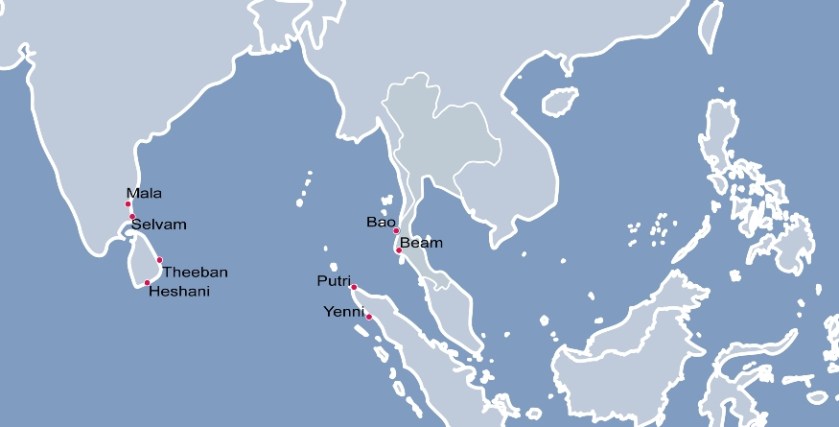
Four countries, eight locations: where Children of Tsunami stories were filmed for much of 2005 They have never met each other. Some have never travelled beyond their native village. On December 26 2004, the sea rose and rose and took everything they cherished.
Documented over the year, locally-based filmmakers returned to Asia’s battered coasts in India, Indonesia, Sri Lanka and Thailand to track the healing and the hurt through the eyes of children.
Asia’s recovery process from the tsunami is being captured through the stories of three girls and two boys aged 8 to 16 years.
Of different races, worshipping different Gods, they live on different shores in different countries. They are the tsunami generation, sharing the vulnerability of a child and the legacy of the tragic tides.
Young survivors of the Asian tsunami let us into their lives to personalise the mass of statistics, aid pledges and recovery plans. “Children of Tsunami” is a tapestry of intimate stories, woven by voices of individual and collective resilience, heroism and recovery.
Children of Tsunami: No More Tears – Part 1 of 3
Part 2 of 3
Part 3 of 3
Duration: 24 mins
Year of production: 2005
Countries filmed in: India, Indonesia, Sri Lanka, Thailand
In each country, a locally based production crew carried out filming for TVE Asia Pacific.
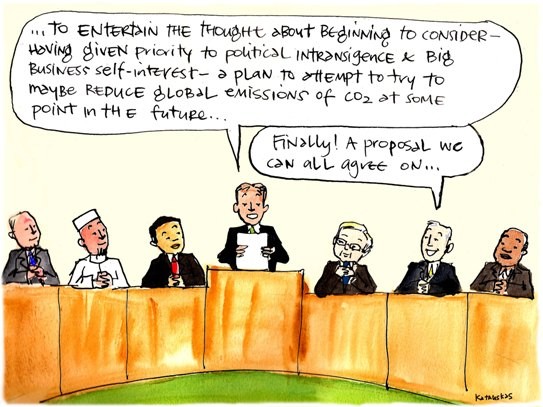
Polite or dodgy? Did anything more than this happen in Copenhagen?
What happens when over 3,500 journalists from all over the world roam around a two-week long UN conference that saw plenty of loud bickering and hot air in the name of saving the planet from global warming? Well, the media pack adds to the noise levels and hot air, for sure — and they are not above bickering themselves.
At least, that’s the report from Copenhagen, where the UN climate conference COP15 ended on Dec 18 with a watered down, disappointing something called the Copenhagen Accord.
Darryl D'MonteI’ve just read an interesting report filed from the Ground Zero of that half-event by my Indian friend (and senior journalist turned climate columnist) Darryl D’Monte.
He says: “The media in Copenhagen has been an unmanageable and unruly lot. There are some 3,500 of us covering the summit, most having come this week, and journalists – once again, the electronic media – don’t think twice about carrying on conversations at the loudest decibel levels, turning the room into a virtual Tower of Babel. The TV crews in particular are like packs of wolves. They station themselves at every available nook and corner where some VIP may enter and exit and try to get that exclusive byte as he or she makes an appearance“.

 Across the developing world, he says, some 60% of the households had their own TV set in 2005 — up from 45% in 1995. He adds: “Five million more households in sub-Saharan Africa will get a TV over the next five years. In 2005, after the fall of the Taliban, which had outlawed TV, 1 in 5 Afghans had one. The global total is another 150 million by 2013 — pushing the numbers to well beyond two-thirds of households.”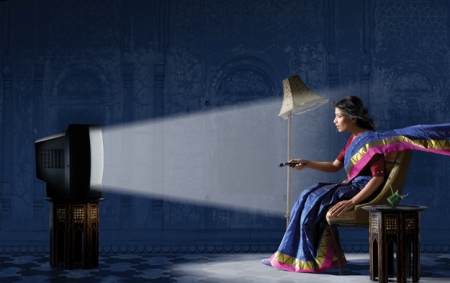





 Open Minds!