Broadcasters and climate change: Turn off your lights, but not your minds!

Let there be darkness!

That could well be a message from your local radio this weekend. Radio channels across Asia would be asking their listeners to turn off their lights for an hour or two today, 21 June 2008.

The Asia Pacific Broadcasting Union (Abu), an alliance of (mostly government-owned) radio and television stations across Asia, has urged broadcasters to join a campaign to encourage listeners to “Turn off Your Lights” for one or two hours as a step to raise awareness of global warming.

According to Abu, the Tokyo Broadcasting System (TBS) made the suggestion at a meeting in Tehran in November 2007. The Japanese broadcaster hopes that the event will encourage the public “to not only to save energy but to give consideration to wider global warming issues.”

Global warming and resulting climate change are such major concerns that every action counts. So we hope the Abu-inspired campaign, although hardly original, will be successful.

It might have made more sense for the broadcast alliance to be part of the more widely observed Earth Hour — an annual international event created by The World Wide Fund for Nature (WWF), held on the last Saturday of March, that asks households and businesses to turn off their non-essential lights and electrical appliances for one hour to raise awareness towards the need to take action on climate change. It was pioneered by WWF Australia and the Sydney Morning Herald in 2007, and achieved worldwide participation in 2008.

As this composite NASA image of the Earth at night shows, energy use is proportionate to the level of economic activity and social development. Asia accounts for a good deal of the world’s lights at night.

Earth at night - NASA composite image

But at the bigger picture level, broadcasters can and must do a great deal more than merely talk about the multi-faceted, rapidly-evolving issue. For a start, they need to take a closer look at their own industry, which is not known to be particularly efficient in its resource and energy use.

I’ve been writing and talking about the need for the TV broadcast and film-making industries to become more climate friendly (even if everybody can’t immediately become carbon-neutral). These industries are not particularly known for their energy or resource use efficiency.

At Asia Media Summit 2007 held in Kuala Lumpur, Malaysia, Abu’s secretary general himself chaired a session on climate change and the broadcsat media.

We heard passionate and articulate views from radio and television managers in Asia on how the airwaves can carry various messages that would sensitise governments, industry and individuals on the climate crisis — and how to live with its many impacts. But I was frustrated that the session was entirely on broadcasters carrying climate change related news and content.

All that’s necessary – but not sufficient. Surely, carrying relevant content is only one part of what broadcasters can do. When it was question time, I asked the more than 400 media managers in the audience: how can our own industries reorient core operations to become more climate friendly?

I noted that a good deal of carbon dioxide – the principal gas that warms up the planet – is emitted by the radio and TV production and broadcast processes, through the use of lights, cameras, transportation and transmitters, etc. Broadcast Television, in particular, is on a high energy mode with a fondness for dazzling lights, super-cooled studios and heavy production gear. The digital revolution has helped bring down size and weight, but it’s not yet a particularly light-weight business.

And energy is consumed not just at the production and transmission end, but when signals are received too. News from that front is not very encouraging: new plasma screens for High-definition Television (HDTV), the trendy new wave, gobble up more power at the viewing end too.

Have Asia Pacific companies engaged in the broadcast industry addressed these integral issues? How many of them calculate carbon dioxide emissions from their day-to-day operations and offset it by comparable investments in renewable energy or support for community-operated greening efforts?

I didn’t get clear answers to any of these questions from the dozens of movers and shakers in Asian broadcasting in the audience — which indicated that these concerns have not been given sufficient thought.

This was disappointing, but I can only hope it doesn’t stay that way for too long. Other players in the communication sector, such as telecom companies, have already started addressing industry-wide, smart contributions they can make in the pursuit of a more climate friendly society.

Lights, camera, action!

So here’s the challenge to radio and TV broadcasters across Asia: by all means, ask your audiences to turn unnecessary lights off every now and then, or even every day. But like charity, good climate conduct begins at home. It’s just not enough being a diligent distributor of climate messages or a mirror of contemporary society’s attempts to adopt climate-friendly lifestyles.

To confront climate change effectively and sincerely, broadcasters must turn those bright lights on to themselves — and adopt meaningful, lasting ways to contain and then reduce their own industry’s emissions.

That’s when they can switch from being part of the problem to part of the solution.
Who’s Afraid of Citizen Journalists 2: Reflections from Asia Media Summit 2008

On World Press Freedom Day 3 May 2008, I wrote a blog post titled Who is Afraid of Citizen Journalists. The answer included the usual suspects: tyrannical governments, corrupt military and business interests, and pretty much everybody else who would like to suppress the free flow of information and public debate.

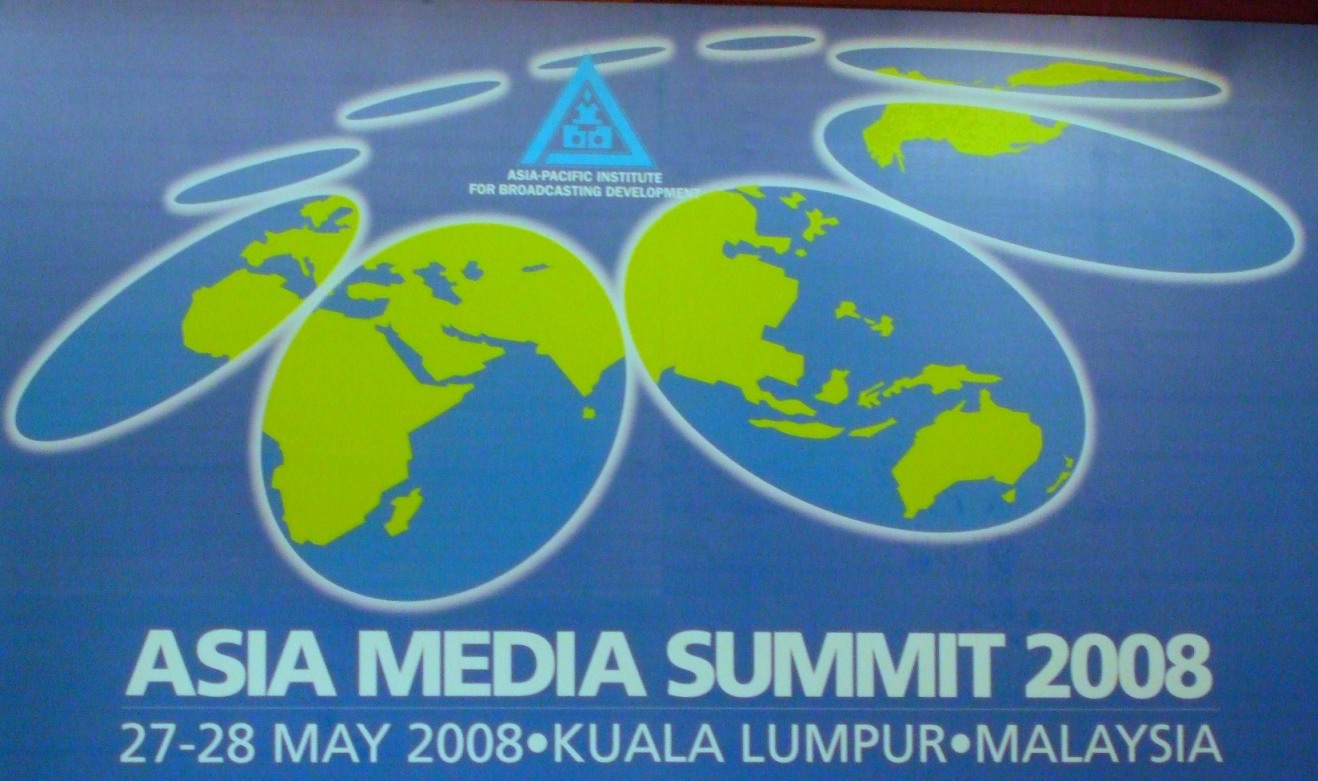
By end May, I realised that some people in the mainstream media (abbreviated MSM, and less charitably called old media or dinonaur media) are also afraid of citizen journalists. That was one insight I drew from attending Asia Media Summit 2008 in Kuala Lumpur, Malaysia (27-28 May 2008).

Asia Media Summit 2008

The two day event drew 530 broadcast CEOs, managing directors, media experts and senior representatives of development and academic institutions from more than 65 countries in Asia, Europe and the Middle East. Over eight plenary sessions and twice as many pre-summit events, they examined ‘new visions and new strategies broadcasters need to pursue to address the demands of new technologies, stiff competition, media liberalization and globalization’.

As I shared in my first impressions from the Summit, this annual event is still warming up to the new media. That’s understandable considering that most participants are those who work in MSM/OM/DM. Some, like myself, have been flirting or experimenting with new media in recent years, but even my own organisation, TVE Asia Pacific, still works largely with television broadcasters going out on terrestrial, cable or satellite platforms.

While the death of MSM/OM/DM has been greatly hyped, it’s a fact that they face more competition today than ever before. And instead of competing for eyeballs (and other sensory organs) with better content and higher levels of product customisation, some sections of MSM/OM/DM are trying to impose their own, obsolete mindset on the new media.

A session on ‘Regulations and New Media Models’ brought this into sharp focus. The session raised questions such as: Should we apply some principles from traditional media (meaning MSM) to the new media? Should we adopt some minimum rules to allow for sufficient legal space for new media businesses to find their niche in the market and evolve to fit the needs of consumers? What are the policy implications of User-Generated Content (UGC) with regard to copyright infringement, information accuracy and content quality?

The panel comprised three Europeans and one American, all working in MSM or academia (it wasn’t immediately clear if any of them blogged personally). For the most part, they said predictably nice and kind things about new media. It was interesting to see how these professionals or managers – who have had their careers entirely or mostly working in or studying about MSM – were trying to relate to a new and different sector like the new media.

But the panel’s cautious attitude about the new media went overboard on the matter of regulation. This is where matters are highly contentious and hotly debated: while most of us agree that there should be some basic regulation to ensure cyber security and to keep a check on content that is widely deemed as unacceptable – for example, hate speech – there is no consensus on what content should be regulated by whom under which guiding principles.

Ruling unanimously in Reno v. ACLU, the US Supreme Court declared the Internet to be a free speech zone in 1997, saying it deserved at least as much First Amendment protection as that afforded to books, newspapers and magazines. The government, the Court said, can no more restrict a person’s access to words or images on the Internet than it could be allowed to snatch a book out of a reader’s hands in the library, or cover over a statue of a nude in a museum.

It was during question time that the discussion took a cynical – even hostile – attitude on the new media. Some members of the audience engaged Dr Venkat Iyer, a legal academic from University of Ulster in the UK, in a narrowly focused discussion on how and where bloggers may be sued for the opinions expressed on their blogs. The issue of multiple jurisdictions came up, along with other aspects of cyber libel and how those affected by criticism made online by individual bloggers (as opposed to companies or organisations producing online content) may ‘seek justice’.

These discussions were more than academic, especially in view of worrying trends in host Malaysia and neighbouring Singapore where bloggers have been arrested or are being prosecuted in recent weeks.
Asia Media Forum: Restrictions follow critics to cyber space
IHT: Malaysian blogger jailed over article


From the floor, I remarked that I was disturbed by the tone and narrow vision of this discussion, which merely repeated new media bashing by those who failed to understand its dynamics. Acknowledging the need for restraint where decency and public safety were concerned, I argued that it is a big mistake to analyse the new media from the business models or regulatory frameworks that suit the old media.

There are mischief makers and anti-social elements using the new media just as there have always been such people using the old media. Their presence, which is statistically small, does not warrant a knee-jerk reaction to over-regulate or over-legislate all activity online, as some Summit participants were advocating. To do that would be akin to throwing the baby out with the bathwater.

I continued: “This is not a healthy attitude to adopt, especially when we look at the bigger picture. In many countries where freedom of expression and media freedom are threatened or suppressed by intolerant governments and/or other vested interests, new media platforms have become the only available opportunity for citizens to organise, protest and sustain struggles for safeguarding human rights, better governance and cleaner politics. In countries where the mainstream media outlets are either state owned or under pressure from government (or military), and where newspapers, radio and TV have already been intimidated into silence, citizen journalists are the last line of defence…”

I also noted with interest that on this panel was Mogens Schmidt, UNESCO’s Deputy Assistant Director-General for Communication and Information (in charge of freedom of expression), and said that this was not the kind of rolling back of freedoms of expression that UNESCO was publicly advocating. In a brief response immediately afterwards, Schmidt said that he fully agreed with my views, and that this was UNESCO’s position as well.

Another panel member, Dr Jacob van Kokswijk, secretary of the International Telecom User Group in the Netherlands, noted that the new media required a totally new thinking and approach where its content is concerned – the rules that have worked for the old media can’t be applied in the same manner. He added that only 3 to 4 per cent of Internet content could be considered as ‘bad’ (by whatever definition he was using), and that should not blind us to seizing the potential of new media.

Another panel member, Joaquin F Blaya, a Board member of Radio Free Asia (RFA), made a categorical statement saying he was opposed to any and all forms of censorship. He knows what that means – RFA says its mission is ‘to provide accurate and timely news and information to Asian countries whose governments prohibit access to a free press’.

By the end of the session, I was relieved to see a more balanced view on the new media emerging in our discussion, with more moderate voices taking to the floor. No, we didn’t resolve any of the tough issues of new media regulation during the 90 mins of that session, but we at least agreed that the old media mindset of command-and-control was not going to work in the new media world.

From its inception in 2003, the annual Asia Media Summit has been very slow to come to terms with this reality, but this year the event moved a bit closer to that ideal – partly because they invited leading new media activist Danny Schechter to be a speaker.

We just have to wait and see if this momentum can be sustained next year when the Summit is hosted by the Macau Special Administrative Region of China.

I’m going to keep an open mind about this — but won’t bet on it…

3 May 2008: Who’s afraid of citizen journalists? Thoughts on World Press Freedom Day

Telecom Without Tears: Book Review

My review of the book, ICT Infrastructure in Emerging Asia: Policy and Regulatory Roadblocks, was printed in Financial Times on Sunday, Sri Lanka, on 18 May 2008.

The book, co-edited by Rohan Samarajiva (in photo, below) and Ayesha Zainudeen, is published jointly by Sage Books and Canada’s IDRC. It is based largely on the work of my friends and colleagues at LIRNEasia.

Although the book showcases recent telecom and ICT reform experiences in five economies in South and Southeast Asia (Bangladesh, India, Indonesia, Nepal and Sri Lanka), my review takes a closer look at the Sri Lankan situation partly because I live and work there, and because the review was intended more at a Sri Lankan readership.

Here’s my opening:

“In the early 1990s, I had to wait for nearly six years for my first (fixed) telephone – I refused to pay bribes or use ‘connections’ to bypass thousands of others on the notorious waiting list. Earlier this year, when I bought an extra mobile phone SIM from Dialog GSM, it took six hours for the company to connect it. I found that a bit too long.

“How things have changed! Connectivity without (social) connections, and practically off-the-shelf, is now possible in most parts of Sri Lanka. Telecommunications is the fastest growing sector in the economy, recording 47 per cent growth in 2007 (and 58 per cent in 2006). The country’s tele-density (number of telephones per 100 persons) jumped to 54 in 2007, from 36 at the end of 2006 -– thanks largely to the phenomenal spread of mobile phones, which now outnumber fixed phones by three to one.”

One quick – albeit a bit unfortunate – way to introduce this book is that it apparently scared some sections of Sri Lanka’s state bureaucracy. When copies arrived from the Indian publisher earlier this year, they were held up at Customs for over three months for no logical or coherent reason. The editors speculated whether it had something to do with one chapter (among 13) looking at telephone use in war-ravaged Jaffna during the ceasefire (which lasted from 2002 to 2008), but this was neither confirmed nor denied.

In my review, I make the point: “It was a stark reminder, if any were needed, of the turbulent settings and often paranoid times in which telecom liberalisation has been taking place in many parts of emerging Asia.”

And I return to the larger political reality in my conclusion, as follows:
“Now that the ICT genie has been set loose, it’s impossible to push it back into the dusty lamp of the monopolist past, even under that much-abused bogey of ‘national security’ (or its new, freshly squeezed version, ‘war against terror’). Despite this, the officialdom and its ultra-nationalist cohorts don’t give up easily. While this book was in ‘state custody’, Sri Lankans experienced the first government-sanctioned blocking of mobile phone SMS – ironically on the day marking 60 years of political independence.

Photo below shows several contributing authors at the book’s launch in Chennai in December 2007


Read the review online

Download the review as a pdf document (47kb)
telecom-without-tears-by-nalaka-gunawardene-may-2008

Read or download the book electronically from IDRC website

I just called to say….I love my mobile phone!

On this World Telecommunication and Information Society Day (May 17), I have a confession to make. I carry a murder weapon on my person every day and night, and I go to bed with it next to me within easy reach. I rely on it for my work, my leisure and my pleasure. And I won’t part with it under any circumstances.

Neither would more than 3.3 billion people worldwide — or half of humanity.

I’m talking about the humble and increasingly ubiquitous mobile phone, now the world’s most widely used and fastest spreading consumer technology item.

And if any paranoid law enforcement agency worries about its murder potential…relax, people – we are talking figuratively here!

How come it’s a murder weapon when it has no sharp edges and is too light weight to do much damage?

What the mobile has already stabbed, and is in the process of effectively finishing off, is the development sector’s over-hyped and under-delivered phenomenon called the ‘telecentre’.

For those outside the charmed development circles (which is most of humanity), the Wikipedia describes telecentre as “a public place where people can access computers, the Internet and other digital technologies that enable people to gather information, create, learn and communicate with others while they develop essential 21st century digital skills.”

So how is the mobile phone slowly killing the telecentres, into which governments, the United Nations agencies and other development organisations have pumped tens of millions of dollars of development aid money in the past decade?

Well, it’s rapidly making telecentres redundant by putting most or all of their services into literally pocket-sized units. If everyone could carry around a miniaturised, personalised gadget that has the added privacy value, why visit a community access point?

At least this is the persuasive point made by LIRNEasia researcher Helani Galpaya, who made a presentation in September 2007 at the Annenberg School for Communication in the US.

Courtesy Joy of Tech

She argued that, although telecentres, which have become the bright “stars” in many e-development programs in Asian countries, do have a role to play in providing ‘higher’-end citizen services to people at the bottom of the pyramid (BOP) in India, Sri Lanka, Pakistan, Philippines and Thailand, telephones are the cheaper, immediate and ubiquitous tool for Asian governments to inform, transact and interact with almost 400 million of their most needy citizens.

And in these emerging Asian economies, when we talk of telephones it’s predominantly mobiles. In my native Sri Lanka, for example, there were 10.7 million phone subscribers by end 2007 – of them, almost 8 million were mobile users. Mobiles outnumber fixed phones by 3 to 1, and the disparity continues to widen.

Mobile kills the telecentre star‘ was the title of Helani’s presentation – it’s a play on a 1979 song celebrating the golden era of radio, “Video killed the radio star.” For the trivia buffs, it was the first music video shown on MTV.

The song has been the subject of various parodies, and Helani’s isn’t the first or last. But in this instance, I would heartily cheer the rapid demise of the telecentre, which is both conceptually and operationally flawed in many developing countries where it has been tried out. (While at it, let me repeat something that baffles me: how is it that not a single development donor or UN agency foresaw the phenomenal rise of mobile phones in the majority world, and instead bet all their ICT money on computers and internet? And why can’t some of them still appreciate the potential of mobiles, keep harping on obsolete telecentres and other troubled initiatives like One Laptop Per Child?).

It’s also worth noting that hard core development activists were initially against mobile phones, arguing instead for more public payphones, especially in rural areas. Only very recently have they started acknowledging that, just maybe, mobile phone can create or improve jobs, generate incomes and move millions out of poverty. In the humanitarian sector, as I wrote in October 2007, aid workers are still uncertain how to make best use of mobiles in their relief work.

Why are mobile phones somehow not ‘sexy enough’ for these men and women in suits who typically look at our real world problems from 33,000 feet above the ground?

But hey, why bother with doomed concepts like telecentres, when we can instead discuss about the lively and vibrant mobiles? (When the telecentres finally die after being kept on life support by gullible aid donors for a few more years, I hope to write a suitable obituary.)

Meanwhile, who’s afraid of mobile phones except the failed prophets of development and unimaginative humanitarian workers? There’s a handful of crusty, old fashioned people, usually those who can’t figure out just how to use the new fangled devices that do a lot more than just talk. Then there are tyrannical governments who fear the power of instant communication being in the hands of their own people.

The rest of us have now adjusted to Life After the Mobile Arrived. We may love it, or love to hate it — but can we imagine life without it?

And since we’re a blog about moving images, here’s a short film that I wrote and TVE Asia Pacific produced for LIRNEasia in late 2007. It was filmed in the Philippines and Sri Lanka, and was based on
LIRNEasia’s path-breaking 2006 survey on telephone use at the bottom of the pyramid in emerging Asia. We
premiered at the 3rd Global Knowledge conference in Kuala Lumpur in December 2007.

The film’s synopsis reads:
With the next billion telecom users expected mainly from the emerging markets, we urgently need to understand telecom use, especially at the bottom of the pyramid. Who is using what devices for which purposes — and how much are they willing or able to pay? Capturing highlights of LIRNEasia’s 2006 survey in India, Pakistan, the Philippines, Sri Lanka and Thailand, this film shows that when it comes to phone use, the poor are not very different from anyone else.

Teleuse@BOP Part 1 of 2

Teleuse@BOP Part 2 of 2

And now, just when you think I’m a harmless mobile junkie, here’s my real confession:
I own more than one mobile phone (hey, doesn’t everybody?) and stashed away in my travel bag I have a collection of SIM cards with active mobile accounts in half a dozen Asian countries that I visit regularly.

One day soon, when there are enough people like myself moving across jealously guarded political borders, those ITU statistics on ICTs would become seriously skewed….

TVE Asia Pacific News: Film highlights telephone revolution in Asia’s emerging markets
Teleuse@BOP Film screened at GK3
LIRNEasia 2006 survey on telephone use at the bottom of the pyramid in emerging Asia

Amitav Ghosh on Cyclone Nargis: High tech alone can’t save us!

Whenever Burma hits the international news headlines, I think of author Amitav Ghosh. His 2002 historical novel, The Glass Palace, was my introduction to Burma’s recent history. It describes – with historical accuracy and detail – how the British colonised a land of prosperity in 1824 and left it an impoverished nation in 1948.

I was intrigued, therefore, to read an excellent op ed essay by Amitav Ghosh in The New York Times of 10 May 2008. Titled When Death Comes Ashore, it is a commentary on the aftermath of Cyclone Nargis that particularly hit Burma in recent days. Ghosh offers both comfort and worry.

The bad news, as he puts it, is that “for the rapidly growing countries that surround the Bay of Bengal there is an increasing urgency to find a way to protect themselves. They have experienced some of the world’s most devastating storms.”

Courtesy Wikipedia

He makes a strong call for cooperation among the countries who surround the Bay of Bengal, which means Bangladesh, Burma, India, (part of) Indonesia and Thailand.

As he says: “Nation-states tend to see their interests as being confined within their own borders. But the reality is that the people who live around the Bay of Bengal have a vital interest in common that they do not share with their compatriots in the hinterlands: they are joined by the furies (and let it be said also, the blessings) of that body of water.”

To me, the most important point he makes is about disaster preparedness, a topic we covered in some depth and detail in Communicating Disasters: An Asia Pacific Resource Book that I co-edited last year.

“Recent experience has demonstrated in spectacular ways that rich, technologically advanced nations are not invulnerable to extreme weather. What has also been demonstrated, but more quietly, is that a nation need not be wealthy or technologically advanced to be well prepared for natural disasters.”

Ghosh talks about Mauritius, a small Indian Ocean island that meteorologists call a ‘cyclone factory’, which has “evolved a sophisticated system of precautions, combining a network of cyclone shelters with education (including regular drills), a good early warning system and mandatory closings of businesses and schools when a storm threatens.

He adds: Mauritius is a country that has learned, through trial and experience, that early warnings are not enough — preparation also demands public education and political will. In an age when extreme weather events are clearly increasing in frequency, the world would do well to learn from it.”

Let’s hope the Indian Ocean rim countries – especially those that share the Bay of Bengal’s blessings and lashings – would heed the celebrated Indian author’s call. After the 2004 tsunami, we saw a flurry of activity to set up high-tech and high cost early warning systems for future tsunamis. The United Nations and development donors huddled together in various exotic locations of our region to work out the details.

But I wrote in a SciDev.Net opinion piece in December 2005: “Setting up a state-of-the-art, high tech and high cost system is not a solution by itself. Because the most advanced early warning system in the world can only do half the job: alert governments and other centres of power (e.g. military) of an impending disaster. The far bigger challenge is to disseminate that warning to large numbers of people spread across vast areas in the shortest possible time“.

I called it the Long Last Mile (sorry, metric fans, it just doesn’t read right to say the last kilometre!), a phrase that I also used in the book chapter and the short film that I scripted for TVE Asia Pacific in 2007.

LIRNEasia’s National early warning system for Sri Lanka

LIRNEasia’s 2006-2007 project to Evaluate the Last Mile Hazard Information Dissemination

Read the full essay: Death Comes Ashore, By AMITAV GHOSH, in The New York Times, 10 May 2008
(requires free registration to read online)

Burmese television: Meet Asia’s model public broadcaster!

Photo courtesy Associated Press

In the wake of Cyclone Nargis that wreaked havoc in Burma, the world has once again realised the brutality and ruthlessness of the military regime that runs the country.

And as the United Nations and aid agencies struggle with the incredibly uncaring Burmese bureaucracy to get much needed emergency relief for the affected Burmese people, the media outside Burma are having great difficulty accessing authentic information and images.

Despite the massive disaster and resulting tragedy, Burma remains closed to foreign journalists, especially the visual media. No doubt the memories of the monk-led pro-democracy protests of late 2007 are still fresh in the minds of the ruling junta and their propagandists. The few courageous foreign reporters who managed to get in at the time ran enormous personal risks, and Japanese photojournalist Kenji Nagai was shot dead by a Burmese soldier while filming demonstrations.

Unable to report from the multiple scenes of disaster, and lacking a wide choice of reliable local sources willing to go on the record, international news agencies and broadcasters have been forced to quote the government-owned Burmese television station, MRTV.

Global news leaders like Al Jazeera, BBC and CNN have all used MRTV visuals to illustrate their news and current affairs reportage. A recent example from Al Jazeera, posted on 8 May 2008:

The image monopoly by MRTV wouldn’t have mattered so much if they at least provided an accurate account of the unfolding events in its own country. But that seems far too much to expect of this mouthpiece of the Rangoon regime. In Burma’s darkest hour in recent memory, MRTV would much rather peddle the official propaganda – never mind the millions made homeless by the recent disaster.

Here’s an insight from the Inter Press Service, the majority world’s own news agency, reporting from their Asia Pacific headquarters in Bangkok, Thailand:

BURMA: Cyclone Nargis Exposes Junta’s Anti-People Attitude
By Larry Jagan, IPS

Worse, there is evidence emerging that the military authorities had ample warning of a storm brewing in the Bay of Bengal but chose to ignore, or even suppress, it.

The Indian Meteorological Department (IMD) which keeps a close track of geo-climatic events in the Bay of Bengal and releases warnings not only to provinces on the Indian east coast but also to vulnerable littoral countries said it warned Burmese authorities of Cyclone Nargis’ formation and possible approach as early as on Apr. 26.

“We continuously updated authorities in Myanmar (as Burma is officially called) and on Apr. 30 we even provided them a details of the likely route, speed and locations of landfall,’’ IMD director B.P. Yadav told IPS correspondent in New Delhi, Ranjit Devraj.

Burma’s meteorology department did post a warning on its official website on Apr. 27 but no effort was made to disseminate information to the people, much less to carry out evacuations along the coastline or from the islands on the Irrawaddy Delta.

By the time state-run media, which has been continuously spewing propaganda and exhorting the public to vote ‘yes’ to Saturday’s constitution referendum, issued its first cyclone alert on Friday afternoon it was too late for the hapless residents of Rangoon.

courtesy Reuters

Elsewhere in the report, IPS says:

Pictures of soldiers removing fallen trees and clearing roads in Rangoon on the state-run television have further infuriated many in the city. “This is pure propaganda and it’s far from the truth,” e-mailed a Burmese journalist, asking not to be identified for fear of the consequences. “Why do foreign broadcasters show them too –Burmese government propaganda is a disgrace enough to journalism,” he fumed.

“I saw some soldiers getting onto a truck yesterday,” said a 50-year-old resident. “They had no sweat on their shirts, despite what was shown on TV!”

“My wife saw three truckloads of soldiers parked in front of a fallen tree, none of them got down to remove it,” he added.

And here is what Dinyar Godrej has to say on the website of New Internationalist, another pro-South, liberal media outlet. In a post titled ‘Seeing but not believing’, he says:

“Burma is shut off from foreign journalists (unless they are invited in by the military regime to cover specific showpiece events). Western news channels have had to rely on state run television for their moving images.

“So while the death toll is now officially 22,000 (unofficially up to 50,000), with 40,000 people missing and a million homeless; and while the regime is coming in for bitter criticism for its foot-dragging over opening up to international aid and the utter incompetence of its own relief effort so far (which has reached only a tiny fraction of the people affected), we are watching on our television screens soldiers handing over food parcels. We can see nothing of the grief or rage of the people going hungry and thirsty (many water sources are too contaminated to use). They do not talk on camera. Instead they sit obediently in the state TV images, taking what’s given to them. And we watch them, while listening to the numbers and being told of the heightening crisis.”

Appalling as these revelations are, they don’t surprise us. Indeed, MRTV is not alone in this kind of shameless abuse and prostitution of the airwaves, a common property resource. A vast majority of the so-called ‘public’ broadcasters in Asia behave in exactly the same callous manner. This is why I don’t use the term ‘public broadcaster’ to describe these government propaganda channels – because, whatever lofty ideals their founding documents might have, most of them are not serving the public interest any more (if they ever did).

As I commented in Feb 2008: “In developing Asia, which lacks sufficient checks and balances to ensure independence of state broadcasters, the only thing public about such channels is that they are often a drain on public money collected through taxes. Their service and loyalties are entirely to whichever political party, coalition or military dictator in government. When the divide between governments and the public interest is growing, most ‘public’ channels find themselves on the wrong side. No wonder, then, that discerning views have abandoned them.”

Read Feb 2008 post: Why do development Rip van Winkles prefer ‘Aunties’ without eyeballs?

I don’t hold a grudge against the hapless staff of MRTV, who simply must remain their Masters’ Voice at all times to stay alive. Those working for government channels in countries with greater levels of democratic freedom can’t take refuge in this excuse. They must be held accountable for their continuing propagandising and the disgusting pollution of the airwaves.

And the incredibly naive and sycophantic UN agencies – especially UNESCO – also share the blame for their feeble yet persistent defence of the so-called public broadcasters. Years ago, I stopped attending meetings discussing public service broadcasting (PSB) in Asia, which these agencies equate with what the government channels are doing. I see yet another of these exercises in futility being lined up as part of the Asia Media Summit 2008 coming up in a few days in Kuala Lumpor.

As I wrote in February, if these development agencies are seriously interested in broadcasting that serves the public interest, they must engage the privately-owned, commercially operated TV channels, which are the market leaders in much of Asia.

Except, that is, in tightly controlled, closed societies like Burma, where government channels are the only terrestrial TV available for the local people.

Images courtesy AP and Reuters, as published by The New York Times online

Adrees Latif wins Pulitzer: Captured a shot heard around the world

Photo courtesy Reuters

A wounded Japanese photographer, Kenji Nagai, lay before a Burmese soldier yesterday in Yangon, Myanmar, as troops attacked protesters. Mr. Nagai later died. Published 28 September 2007 (Adrees Latif, Reuters)

This dramatic photograph, one of the harrowing and yet enduring images of 2007, has just won its photographer a Pulitzer Prize, announced in New York on 7 April 2008.

Ironically, the last defiant act of one courageous photojournalist has landed one of journalism’s most prestigious awards for another of his kind. Adrees Latif, a Pakistan-born American, had concealed his identity by blending in with the crowd in Rangoon/Yangon, and captured Nagai’s killing on film.

Read my 30 Sep 2007 post: Kenji Nagai (1957-2007): Filming to the last moment

Here’s the official citation from Pulitzer jury:

For a distinguished example of breaking news photography in black and white or color, which may consist of a photograph or photographs, a sequence or an album, in print or online or both, Ten thousand dollars ($10,000).

Awarded to Adrees Latif of Reuters for his dramatic photograph of a Japanese videographer, sprawled on the pavement, fatally wounded during a street demonstration in Myanmar.

Adrees Latif, addressing meeting in Japan March 2008

Born in Lahore, Pakistan on July 21, 1973, Adrees Latif lived in Saudi Arabia before immigrating with his family to Texas in 1980. Latif worked as a staff photographer for The Houston Post from 1993 to 1996 before joining Reuters. Latif graduated from the University of Houston in 1999 with a Bachelor of Arts in Journalism. Latif has worked for Reuters in Houston, Los Angeles before moving to Bangkok in 2003 where he covers news across Asia.

Latif’s collection of photos from his days in Burma, “Myanmar Marooned,” recently won an award given by the prestigious Japanese photographic magazine Days Japan.

Reuters blog: Latif tells the story behind the Pulitzer photo

Japan Times, 11 March 2008: Witness recalls the day of Nagai shooting

Remembering Dith Pran, photojournalist – A ‘Pineapple’ in ‘The Killing Field’

Courtesy The New York Times

“You have to be a pineapple. You have to have a hundred eyes.”

That’s how Dith Pran, the Cambodian journalist and photographer who survived the Khmer Rouge’s genocide, summed up the challenge of a photojournalist.

Dith, who died on March 30 in New Jersey, USA, had both the talent and tenacity for his chosen profession. His experience as an interpreter for The New York Times, for which he later worked as a photographer after migrating to the US, and his ordeal surviving the Khmer Rouge became the basis of the Hollywood movie The Killing Fields (1984).

Watch the trailer for The Killing Fields here:

Here’s Dith’s story as summed up in his Wikipedia entry:
In 1975, Pran and New York Times reporter Sydney Schanberg stayed behind in Cambodia to cover the fall of the capital Phnom Penh to the communist Khmer Rouge forces. Schanberg and other foreign reporters were allowed to leave, but Pran was not permitted to leave the country. When Cambodians were forced to work in forced labor camps, Pran had to endure four years of starvation and torture before finally escaping to Thailand in 1979. He coined the phrase “killing fields” to refer to the clusters of corpses and skeletal remains of victims he encountered during his 40-mile escape. His three brothers were killed back in Cambodia.

“I’m a very lucky man to have had Pran as my reporting partner and even luckier that we came to call each other brother,” Schanberg was quoted in the New York Times tribute to Dith Pran. “His mission with me in Cambodia was to tell the world what suffering his people were going through in a war that was never necessary. It became my mission too. My reporting could not have been done without him.”

In another tribute to Dith, the executive editor of the New York Times, Bill Keller, said: “To all of us who have worked as foreign reporters in frightening places, Pran reminds us of a special category of journalistic heroism — the local partner, the stringer, the interpreter, the driver, the fixer, who knows the ropes, who makes your work possible, who often becomes your friend, who may save your life, who shares little of the glory, and who risks so much more than you do.”

This is a highly significant statement, coming from a major media house of the western world. Acknowledging – let alone celebrating – the contributions of unsung local counterparts is not yet a routine practice among many western media professionals covering the global South. More often then not, the fixers are used, paid and dismissed. They are lucky to get proper credit. And if things go wrong, the western media companies would bring in top lawyers and diplomatic pressures to get their own out of trouble; never mind what happens to the locals who are part of that same team.

Something like this happened to a Bangladeshi journalist friend Saleem Samad in November 2002. He was working with a TV crew from the UK’s Channel 4 doing an investigative documentary on the state of Bangladesh, when the whole crew was arrested (we won’t go into the rights and wrongs of their conduct here). I later heard from Saleem and other Bangladeshi friends how Channel 4’s main concern had been to get the British and Italian members of the crew out of jail and out of Bangladesh. Saleem’s fate was a secondary concern. Read ‘A Prisoner’s Tale’ by Saleem Samad in Time, 4 Feb 2003

Even after being released, Saleem Samad was hounded and harassed in his native country that he went into exile in Canada. Read his profile here, and connect to his blog.

This scenario keeps repeating with different names and in different southern locations all the time. In such a harsh, selfish world, Dith Pran was certainly fortunate to have worked with Sydney Schanberg who stood by and for his local colleague. When Schanberg returned to the US and was awarded a Pulitzer Prize for his reporting from Cambodia, he accepted it on behalf of Dith as well.

Schanberg continued to search for, and write about Dith in newspaper articles – one was in The New York Times Magazine, in a 1980 cover article titled “The Death and Life of Dith Pran., which later became a book by the same title in 1985. Dith’s story became the basis of The Killing Fields.

Haing Ngor, the Cambodian-American doctor who played Dith Pran in the movie, worked with Dith in real life to promote human rights in their native Cambodia and to prevent genocide everywhere. Ngor was shot dead in 1996 in Los Angeles.

As the New York Times noted, Dith’s greatest hope was to see leaders of the Khmer Rouge tried for war crimes against his native country; preparations for these trials are finally under way.

Courtesy The New York Times
A 1974 photo by Mr. Dith of the wife and mother of a government soldier as they learned of the soldier’s death in combat southwest of Phnom Penh. (Photo: Dith Pran/The New York Times)

Courtesy The New York Times
In 1979, Mr. Dith escaped over the Thai border. He returned to Cambodia in the summer of 1989, at the invitation of Prime Minister Hun Sen. At left, Mr. Dith visited an old army outpost in Siem Riep where skulls of Khmer Rouge victims were kept. (Photo: Steve McCurry/Magnum)

Courtesy The New York Times
Mr. Dith joined The Times in 1980 as a staff photographer. He photographed people rallying in Newark in support of the rights of immigrants on Sept. 4, 2006. (Photo: Michael Nagle/Getty Images)

Watch Dith Pran speak on NYT Video Feature

All photos linked to from the New York Times online

TVE Asia Pacific says Thank You to Sir Arthur C Clarke

In his 1992 book How the World Was One, Sir Arthur C Clarke described a dream: one day in the near future, CNN founder (and then owner) Ted Turner is offered the post of World President, but he politely turns it down – because he didn’t want to give up power!

Just three years later, the then Secretary General of the UN suggested that CNN should be the 16th member of the Security Council. Sir Arthur was fond of quoting this, and once famously told Turner: “You owe me 10 per cent of your income”.

These references – illustrating the power of globalised satellite television – are recalled in TVE Asia Pacific‘s official tribute to Sir Arthur C Clarke, who passed away on March 19 aged 90.

“With the death of Sir Arthur C Clarke, TVE Asia Pacific has lost a long-standing friend and supporter,” the tribute says.

It adds: “Since our establishment in 1996, Television for Education Asia Pacific – to use our full name – has been engaged in pursuing Sir Arthur’s vision of using the potential of moving images to inform and educate the public. Our founders chose to focus on covering development and social issues, with emphasis on the Asia Pacific region – home to half of humanity and where Sir Arthur spent the last half century of his life.”

Although he never held a formal position at TVEAP, Sir Arthur was an informal adviser and mentor to the regional media organisation whose work across Asia Pacific is only possible thanks to the comsat that invented and the web that he inspired.

By the time TVEAP was created in the mid 1990s, the satellite TV revolution was well underway in the Asia Pacific region, and the internet revolution was just taking off. In informal discussions, Sir Arthur advised us to always keep our eyes open on what’s coming up. In the ICT sector, he cautioned, being too closely wedded to one technology or system could lead to rapid obsolescence.

The tribute mentions Sir Arthur’s specific support for the Children of Tsunami media project, and the Communicating Disasters publication.

We also talk about Sir Arthur’s concerns about using information and communication technologies (ICTs) to benefit the poor and other disadvantaged groups – a process that he aptly described as ‘geek to meek’.

We end by recalling how TVEAP recorded and uploaded to YouTube Sir Arthur’s last public video address – his 90th birthday reflections in December 2007.

Read TVEAP’s tribute to Sir Arthur C Clarke, 1917-2008

sir-arthur-clarke-reflecting-on-90-orbits.jpg

Communicating Disasters book launched among communicators

TVE Asia Pacific’s latest publication, Communicating Disasters: An Asia Pacific Resource Book, had its Sri Lankan launch on 19 February 2008.

The multi-author book focusing on how information, education and communication can help create disaster resilient communities across the Asia Pacific was released at the auditorium of Sri Lanka Press Institute (SLPI) in Colombo.

We had invited all contributing authors who are based in Sri Lanka. Six of our 21 contributors currently live in Greater Colombo, and four of them made it: Patrick Fuller, Buddhi Weerasinghe, Manori Wijesekera and myself. We missed Sanjana Hattotuwa (who is overseas) and Chanuka Wattegama.

The news story on the launch event can be read on TVEAP website.

Here are some additional photographs of the event, attended by close to 50 persons working in media, communication and humanitarian sectors.

copy-of-communicating-disaster-book-launch25.jpg

Above and below: Nalaka Gunawardene introduces the what, why and how of the new book

communicating-disaster-book-launch.jpg

copy-of-communicating-disaster-book-launch48.jpg

Contributing authors (L to R) Patrick Fuller, Nalaka Gunawardene, Buddhi Weerasinghe and Manori Wijesekera talk about their chapters in the book.

communicating-disaster-book-launch-buddhi-weerasinghe-speaks.jpg

Buddhi Weerasinghe responds to an audience question

manori-wijesekera.jpg

Above: Manori Wijesekera talks about Children of Tsunami

copy-of-communicating-disaster-book-launch58.jpg

Above and below: Sections of the audience

communicating-disaster-book-launch96.jpg

Photos courtesy: Indika Wanniarachchi and Wipula Dahanayake, TVE Asia Pacific