Reality TV with a purpose: Stars of Science on Pan Arab TV network
“I believe that every TV programme has some educational value. The cathode ray tube – and now the plasma screen – is a window to the world.”
So said Sir Arthur C Clarke, inventor of the communications satellite and one of the greatest science communicators of our time. He knew what he was talking about: he was not only a prolific and well-loved science writer, but also a genial host of popular science programmes on TV that made his a household name (and face) around the world.
I have sometimes wondered if he would still have endorsed the television medium so enthusiastically if he saw some of the reality TV shows that have become a staple of ratings-craving broadcasters in recent years. This obsession with reality TV – which presents purportedly unscripted dramatic or humorous situations, documents actual events, and features ordinary people instead of professional actors – has sometimes appeared like a race to the bottom.
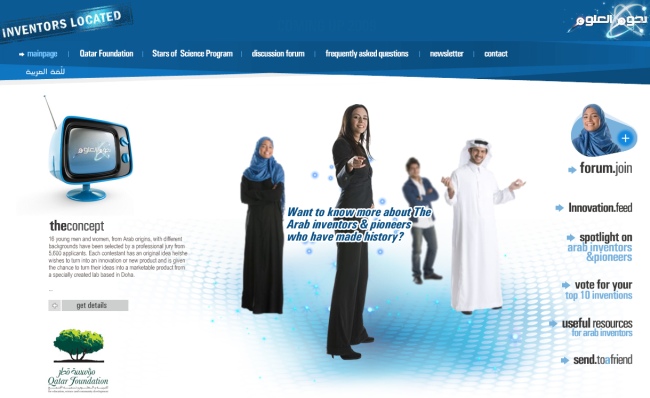
I’m all for trying out new formats, and been telling my friends who are factual film-makers that we can learn a thing or two from the recent successes of some reality TV shows. I’m delighted, therefore, to hear about Stars of Science, a new reality TV show being beamed across the Arab world, where brainy youngsters compete to produce the best invention.
The weekly programme, which started airing on 16 pan Arabic TV channels from end May 2009, differs from existing reality shows: it will not emphasize and showcase the best voices, appearances or dance abilities, and instead seek out the best brains and problem solving skills.
Stars of Science rising over the Arab worldThroughout the five weeks the first series will air, young participants (aged 21 to 30 years) will have the opportunity to develop their inventions from mere ideas on paper to actual products that can be mass produced and sold worldwide. Throughout this processes, cameras follow their every move, capturing their successes – as well as their failures – as they are confronted by the many challenges that come with creating new technologies.
This show has an interactive format. During the final episode, to be broadcast live from Aspire Sports Academy in Doha, Qatar, on 26 June 2009, will have the two finalists given the opportunity to launch their product. Viewers will vote by SMS and telephone to decide the winner of a US$300,000 grand prize.
The programme attracted more than 5,600 applicants from across the Arab world, from among whom 100 were selected to vie for the 16 positions on the air.
The newly inaugurated Science and Technology Park in Doha is hosting the reality show. State of the art workshops, classrooms and lounging areas have been built specifically for the show. The innovative programme is the initiative of Qatar Foundation for Education, Sciences and Community Development, who aim to “endorse a healthy competitive spirit, encourage creativity, team-building and innovative careers amongst the youth in the Arab world.
“The show has deliberately eschewed the cruelty of booting out losing candidates: instead, they are invited to team up with successful competitors,” says British journalist Ruth Sutherland, writing in The Observer, London. “Stars of Science encapsulates the huge faith Qatar puts in research and innovation; the contrast between it and our version of reality TV also says something about the arrogance of assuming western cultural values are automatically superior…”
Added on 27 June 2009: Watch Al Jazeera International’s news story on this series: TV contest promotes Arab entrepreneurs
Al Jazzera: Audience offer opinions at ‘Stars of Science’ contest
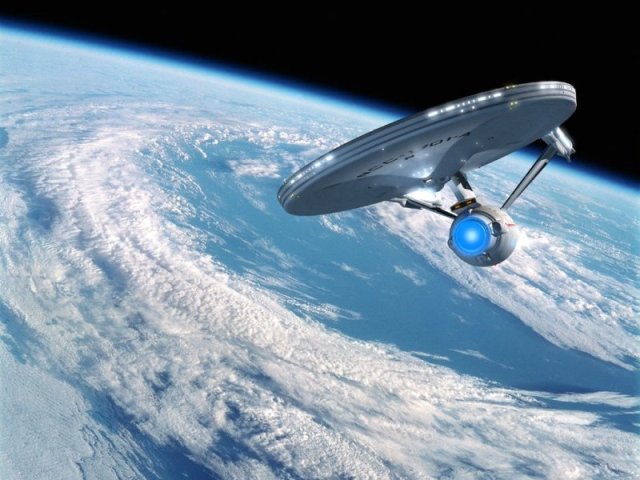
Going where no trekkie has gone before?I’m exactly as old as Star Trek: we were both born a few months apart in 1966 (I’m older by seven months). But because we grew up on opposite sides of planet Earth in the pre-Internet era, our worlds didn’t collide until we were both well into our teens. From then on, I’ve been a Trekkie/Trekker since.
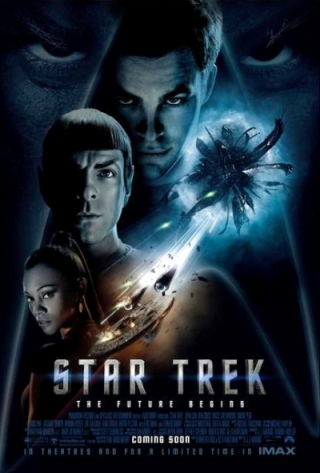
I can’t wait to see the latest (11th) Star Trek movie that opened on 8 May 2009. It’s an ‘origins’ movie – a chronicle of the early days of Captain James T. Kirk and his fellow USS Enterprise crew members. Read plot on Wikipedia.
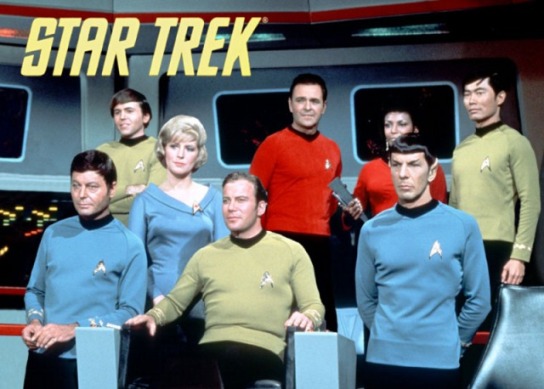
Our world was very different when the one-time US Army pilot, screenwriter and TV producer Gene Roddenberry created Star Trek, the original series. It started airing on the US network NBC in September 1966. The Space Age was less than a decade old, and only a few men (and a couple of women) had made short trips to near Earth orbit. The great Space Race was in full swing, and NASA was spearheading the largest peace-time operation in history, aimed at landing men on the Moon and getting them safely back before the decade was out.
Star Trek, in contrast, offered ambition and hope. Every week at the appointed time, the United Star Ship Enterprise and its intrepid crew took viewers roaming around the universe. The stories appealed as much for insights into the infinite possibilities (and combinations) of life, technology, compassion and power at a cosmic scale, as for its glimpses of the near-Utopian human society in the 23rd century.
As Manohla Dargis, said this week reviewing the latest Star Trek movie (2009) in The New York Times: “Initially aired in 1966, Star Trek was a utopian fantasy of the first order, a vision of the enlightened future in which whites, blacks, Asians and one pokerfaced Vulcan are united by their exploratory mission (“to boldly go”), a prime directive (do no harm) and the occasional dust up.”
According to Dargis, the enduring appeal of Star Trek and the global cult following it inspired is “a testament to television’s power as myth-maker, as a source for some of the fundamental stories we tell about ourselves, who we are and where we came from.”
And, we might add, where we are headed. The show was unique, for its time, for its portrayal of diversity and unity among the wider cast of characters. As the Wikipedia notes: “The show was unique, for its time, for its portrayal of diversity and unity among the wider cast of characters. As the Wikipedia notes: “At a time when there were few non-white or foreign roles in American television dramas, Roddenberry created a multi-ethnic crew for the Enterprise, including an African woman, a Scotsman, a Japanese American, and—most notably—an alien, the half-Vulcan Spock. In the second season, reflecting the contemporaneous Cold War, Roddenberry added a Russian crew member. “
This utopian scenario needs to be contrasted with the prevailing reality of the American Space Programme. No American had ventured beyond near Earth orbit in 1966, and NASA was struggling to catch up with the Russians. Yet, by the time Star Trek original series finished its initial run in September 1969, Neil Armstrong and Edwin Aldrin had returned safely and triumphantly from the Moon. In the event, the Apollo programme landed a dozen astronauts on the Moon, all of who returned safely – as did the astronauts of the disaster-stricken mission, Apollo XIII. Without exception, all of them were white and male.
The journey has only just begun...It took many years for reality to catch up with Star Trek‘s vision, and then, only just. Although a Russian (Valentina Tereshkova) had become the first woman in space early on in 1963, it took the Americans another 20 years to have their first woman astronaut: Sally Ride, who traveled to Earth orbit on the Space Shuttle in June 1983. A few weeks later, in August that year, Guion “Guy” Bluford, Jr., became the first black American astronaut. Multi-cultural crews did not become commonplace until the late 1990s, when the International Space Station became operational.
It wasn’t just racial equality and harmony that Star Trek advocated in its subtext. While bringing intellectually stimulating entertainment, it also celebrated values like compassion and tolerance. In the Cold War world locked into Mutual Assured Destruction (MAD), Star Trek gently reminded viewers that mutual co-existence was a viable option…if only enough effort was invested in it.
As space visionary and science fiction grandmaster Sir Arthur C Clarke noted in a 40th anniversary tribute to the series in 2007: “Appearing at such a time in human history, Star Trek popularised much more than the vision of a space-faring civilisation. In episode after episode, it promoted the then unpopular ideals of tolerance for differing cultures and respect for life in all forms – without preaching, and always with a saving sense of humour.”
He then added, in characteristic style: “Over the years, the sophistication of storylines and special effects has certainly improved, but Star Trek retains its core values – still very much needed in our sadly divided and quarreling world.”
The Enterprise will be cruising the galaxy for centuries to come...
The power of three...to do good!Just imagine…
You do a favour that really helps someone, and tell him/her not to pay it back…
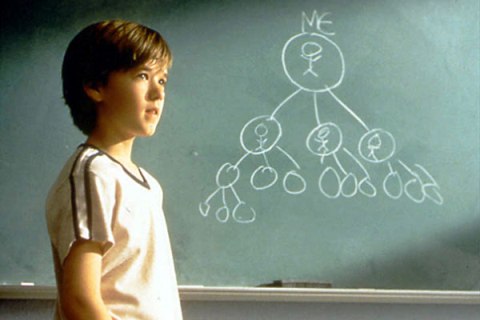
Instead, you ask that it be paid FORWARD to three other people who, in turn, must each pay it forward to three more…and so on.
Impossible? Well, not quite – if you believe (as I do) in the essential goodness of human beings, no matter what their class, race and other divisive factors are.
This idea is known as ‘Pay it forward’. It is really simple: it asks that a good turn be ‘repaid’ by having it done to others instead. Paying it forward has been around as a concept for more than two millennia, from the time of ancient Greece. It was rediscovered in modern times by Benjamin Franklin and later, by Ralph Waldo Emerson, one of my favourite essayists.
In his 1841 essay titled ‘Compensation’, Emerson wrote: “In the order of nature we cannot render benefits to those from whom we receive them, or only seldom. But the benefit we receive must be rendered again, line for line, deed for deed, cent for cent, to somebody.”
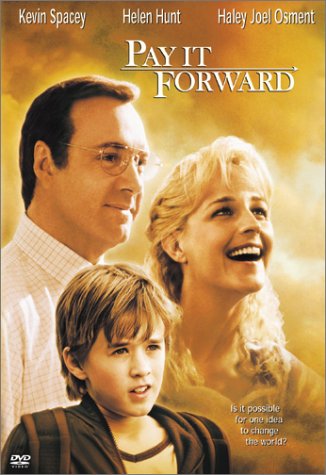
During the Twentieth Century, science fiction author Robert A Heinlein popularised the concept in his book Between Planets (1951). It formed the central theme of Pay It Forward (2000), a novel by Catherine Ryan Hyde, which was soon turned into a movie by the same name.
In that story, a thoughtful teacher challenges his seventh grade students with ‘an assignment to save the world’. One perceptive student devices a scheme where one has to carry out three good deeds for others as repayment of a good deed received. Such good deeds should be things that the beneficiaries cannot accomplish on their own.
It was through Pay It Forward the movie, made in 2000 and directed by Mimi Leder, that I first came cross the idea. It’s one of those simple and elegant ideas that packs so much power to change people and the world. Its implementation requires trust, honour and imagination, which most human beings can muster in sufficient quantity when challenged.
Then I realised that, without a conscious plan and not labelling it as such, I was already ‘paying it forward’ myself — and not just to three new people, but many. That was the least I could do for the many breaks, blessings and opportunities I had received in my professional life.
More about that in a minute. First, take a look at the official trailer for Pay it Forward:
And this is how it all started in the movie, with one thoughtful class teacher challenging his seventh grade pupils with ‘an assignment to save the world’:
Here’s an extended, unofficial trailer remixed by a fan using the official trailer, some scenes from the movie and a few interviews with the key stars:
Journalism – especially the industrialised, mainstream version of it – is by definition a highly collaborative business: newspapers, magazines, as well as TV/radio broadcasts are produced by several or many people working together, each playing a specified part.
And because the media are a mirror on our society and our times, the stories we journalists produce just won’t be possible unless our sources share their information, experiences and insights. This is why Bill Moyers, one of the most respected and credible voices in American broadcasting (a land where such professionals are endangered), says: “We journalists are simply beachcombers on the shores of other people’s knowledge, other people’s experience, and other people’s wisdom. We tell their stories.”
During the early years of my career as a science writer and journalist, I was enormously lucky in both respects. I had kind, indulgent, nurturing senior colleagues who showed me the ropes, expecting nothing in return except good stories. And I benefited much from the kindness and thoughtfulness of many accomplished men and women – mostly in the worlds of science, environment and development – who took the time and trouble to talk to me, clarify even basics to a rookie like myself, and allow me to attribute information or quotes them. I was a complete stranger to many of them, yet they cared enough in spite of busy schedules (there were also a few didn’t, but that’s only to be expected).
Then there were opportunities, some competitively earned, others bestowed on me. In those formative years, the opportunities for training, mentoring and other influences sharpened my skills and shaped my worldview. It was easy to grow up angry with the world and seeing conspiracies everywhere; it was much harder to acquire a balanced view of the world and to become a skeptical enquirer without turning into an incurable cynic.
Among those early influences were:
• Working with the Centre for Science and Environment (CSE) in India, under the late Anil Agarwal and his worthy successor Sunita Narain
• Regional and international training programmes, organised by various UN agencies and other entities such as the Abdus Salam International Centre for Theoretical Physics in Trieste, Italy
• Invaluable support from the International Science Writing Association (ISWA), which leverages far more benefits than its modest resources would indicate at first glance (again, the power of networking!)
• Editorial training and global syndication from Panos, which provided my first outlet to publish internationally through Panos Features (sadly, no more).
Then there was my mentor Sir Arthur C Clarke, who gave me the rare privilege of spending 21 years as his research assistant — a long and unique apprenticeship that enriched me so much.
These and others helped fill gaps in my formal training in science journalism. And such exposure was worth so much more in the days before commercial internet connectivity. There was no Google or YouTube, and early versions of email were just beginning to roll out.
Just do it, and hope others will keep doing it too...And now it’s my turn to ‘pay it forward’. It’s plain and simple; there’s no grand pledge or plan. No one asked me to sign up to any binding agreement. There is no spiritual or intellectual compulsion. I just do it, because that’s a good thing to do.
This is also why I spent a good part of my recent Easter/New Year holidays putting together a detailed response to a young script writer who is passionately promoting a film project related to climate change. I have never met him in person, and until a few weeks ago, I’d never heard of him. A cynical British colleague used to caution me that any crazy nut sitting under a banyan tree can write a letter (or more likely an email these days) claiming to be anything he wasn’t. There’s always that risk. But I’m taking my chances.
Years ago I stopped counting the favours I paid forward, and I no longer even keep track of the people that I give little nudges along the way. Being a secular rationalist with no absolutely religious belief of any kind, I don’t collect brownie points for any ‘next world account’. I just do these little good deeds to make this world a little better place.
If further justification were needed, I cannot say it better than Steven Grellet, a prominent French Quaker missionary who once said (and I quote him for its secular essence): “I expect to pass through this world but once; any good thing therefore that I can do, or any kindness that I can show to any fellow creature, let me do it now; let me not defer or neglect it, for I shall not pass this way again.”
The legend lives on: Arthur C Clarke (1917 - 2008) - photos by Rohan de Silva
Today we mark the first death anniversary of Sir Arthur C Clarke. Exactly one year ago, when he passed away aged 90, I was thrust into a media frenzy. I’d been Sir Arthur’s research assistant and, in later years, his media spokesman and in the hours and days following his death, the family asked me to continue that role.
This blog recorded my experiences and emotions as they happened (see several posts in the latter half of March 2008). A year later, all of us who worked closely with him still miss Sir Arthur, but I can now take a more detached, longer-term view. And that’s what I’ve just done.
In an op ed essay published today in Groundviews website, I argue that sparking imagination and nurturing innovation are the best ways in which Sri Lanka can cherish Sir Arthur’s memory in the land he called home for half a century.
Despite his well known ego, Sir Arthur never sought personal edifices to be put up in his honour or memory. When a visiting journalist once asked him about monuments, he said: “Go to any well-stocked library, and just look around…”
In the weeks and months following Sir Arthur’s death, many have asked me what kind of monument was being planned in his memory. As far as the Arthur C Clarke Estate is concerned, there is none –- and that seems to surprise many.
Yet it is fully consistent with the man of ideas, imagination and dreams that Sir Arthur Clarke was. Monuments of brick and mortar — or even of steel and silicon — seem superfluous for a writer who stretched the minds of millions. Commemorative lectures or volumes cannot begin to capture the spirit and energy of the visionary who invented the communications satellite and inspired the World Wide Web.
A life of no regrets...except for a minor complaint In my essay, I suggested: “Instead of dabbling in these banalities, Sri Lanka should go for the ‘grand prize’: nurturing among its youth the intellectual, cultural and creative attributes that made Arthur C Clarke what he was. In other words, we must identify and groom the budding Arthur Clarkes of the 21st century!”
Easier said than done. In fact, in a country like Sri Lanka that is still partly feudal, insular and stubbornly clinging on to the past instead of facing the present and future, this becomes formidable. This is why I noted: “But can imagination and innovation take root unless we break free from the shackles of orthodoxy? For transformative change to happen, we will need to rethink certain aspects of our education, bureaucracy, social hierarchies and culture. Are we willing and able to attempt these?”
I then discuss some of the key challenges involved in nurturing imagination and innovation. I end my essay with these words: “Let’s not kid ourselves: sparking imagination and innovation is much harder than launching a gleaming new satellite in Sir Arthur’s name. But the rewards would also be greater: if we get it right this time, Sri Lanka can finally take its rightful place in the 21st century.”
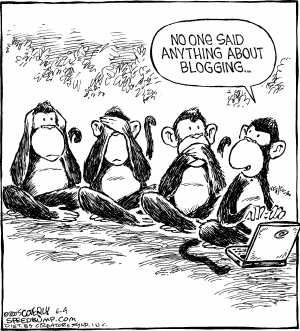
Being the fourth monkey?“Historically, organised and commercialised mass media have existed only in the past five centuries, since the first newspapers — as we know them — emerged in Europe. Before the printing press was invented, all news was local and there were few gatekeepers controlling its flow. Having evolved highly centralised systems of media for half a millennium, we are now returning to a second era of mass media — in the true sense of that term. Blogs, wikis and citizen journalism are all signs of things to come.”
This is how Sir Arthur C Clarke and I summed up the transformative change that is currently taking place in the world of mass media, in an essay we co-wrote for the Indian news magazine Outlook in October 2005.
We’d given it the title ‘From Citizen Kane to Citizen Journalist’ – a formulation that I’m still proud of – but the editors changed it to ‘Arise, Citizen Journalist!’. Of course, our original title made evocative sense only for those who knew the popular culture reference to the movie Citizen Kane.
I recently had a chance to revisit these issues and explore them further in a half-hour, in-depth TV interview with media researcher/activist and fellow citizen journalist Sanjana Hattotuwa. This was part of The Interview series produced by Young Asia Television, and broadcast on two Sri Lankan TV channels, TNL and ETV during the second week of February 2009.
Sanjana covered a wide range in his questions. Starting with a brief reflection on my 21-year association with Sir Arthur Clarke, we moved on to the bewildering world of new media and its co-existence with the mainstream media. We discussed the fragmentation of audience and the concern that some current and would-be bloggers harbour: is anyone listening or reading?
And more importantly, how do we get conversations started and going. I look back on my own experience as an active blogger for almost two years, and assert that if we have something new and worthwhile to say, and know how to express it well, we can slowly build up an audience. There’s no blueprint or road map – everything is in ‘beta’ mode, and the name of the game is try-it-and-see!
Here’s that full interview on YouTube, broken into four parts:
Sanjana Hattotuwa talks to Nalaka Gunawardene – Part 1 of 4:
Sanjana Hattotuwa talks to Nalaka Gunawardene – Part 2 of 4:
Sanjana Hattotuwa talks to Nalaka Gunawardene – Part 3 of 4:
Sanjana Hattotuwa talks to Nalaka Gunawardene – Part 4 of 4:
The tsunami was triggered by a massive quake that erupted off the coast of Sumatra, and 6 miles deep under the Indian Ocean’s seabed. The estimated 9.1 to 9.3 magnitude earthquake was the strongest in 40 years and the fourth largest in a century. The U.S. Geological Survey later estimated that the amount of energy released was equivalent to the energy of 23,000 Hiroshima-type atomic bombs.
Despite a lag of up to several hours between the earthquake and the impact of the tsunami, nearly all affected people were taken completely by surprise. There were no tsunami warning systems in the Indian Ocean to detect tsunamis or to warn those living on the Indian Ocean rim areas. This cost the lives of over 225,000 people in 11 countries — many of who could have lived if only they had a timely warning to rush inland.
In the past four years, there have been various efforts to set up such early warning systems – as well as effective ways to deliver credible warnings to large numbers of people quickly. These are meant to provide 24/7 coverage to Indian Ocean countries in the same way the Pacific Tsunami Warning Centre has been covering Pacific Ocean countries for many years.
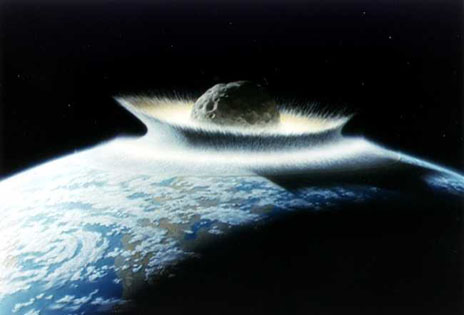
All this is necessary – but not sufficient – to guard ourselves against future tsunamis. For it’s not just earthquakes undersea that can trigger tsunamis. An asteroid impact could trigger the mother of all tsunamis that can impact coastal areas all over the planet.
An asteroid that struck the Earth 65 million years ago wiped out the dinosaurs and 70 per cent of the species then living on the planet. The destruction of the Tunguska region of Siberia in June 1908 – whose centenary was marked this year – is known to have been caused by the impact of a large extraterrestrial object.
Space artist David Hardy's vision...When discussing the possible consequences of asteroid impacts on Earth, more attention has been given to the destruction it can cause by such a falling piece of the sky hitting inhabited areas of land. Some people seem to be comforted by the fact that two thirds of the planet’s surface is ocean — thus increasing changes that an impact would likely happen at sea.
In fact, we should worry more. Duncan Steel, an authority on the subject, has done some terrifying calculations. He took a modest sized space rock, 200 metres in diameter, colliding with Earth at a typical speed of 19 kilometres per second. As it is brought to a halt, it releases kinetic energy in an explosion equal to 600 megatons of TNT — 10 times the yield of the most powerful nuclear weapon tested (underground). Even though only about 10 per cent of this energy would be transferred to the tsunami, such waves will carry this massive energy over long distances to coasts far away. They can therefore cause much more diffused destruction than would have resulted from a land impact. In the latter, the interaction between the blast wave and the irregularities of the ground (hills, buildings, trees) limits the area damaged. On the ocean, the wave propagates until it runs into land.
Scientists have been talking about asteroid impact danger for decades. Arthur C Clarke suggested – in his 1973 science fiction novel Rendezvous with Rama – that as soon as the technology permitted, we should set up powerful radar and optical search systems to detect Earth-threatening objects. The name he suggested was Spaceguard, which, together with Spacewatch, has now been widely accepted.
In November 2008, a group of the world’s leading scientists urged the United Nations to establish an international network to search the skies for asteroids on a collision course with Earth. The spaceguard system would also be responsible for deploying spacecraft that could destroy or deflect incoming objects.
The group – which includes the Royal Society president Sir Martin Rees and environmentalist Sir Crispin Tickell – said that the UN needed to act as a matter of urgency. Although an asteroid collision with the planet is a relatively remote risk, the consequences of a strike would be devastating.
Not if, but when...The International Panel on Asteroid Threat Mitigation, chaired by former American astronaut Russell Schweickart, urged: “The international community must begin work now on forging three impact prevention elements – warning, deflection technology and a decision-making process – into an effective defence against a future collision.”
This is exactly the message in an excellent documentary called Planetary Defence made by Canadian filmmaker M Moidel, who runs the Space Viz production company. Over the past many months, the film has been screened at the United Nations, on various TV channels and at high level meetings of people who share this concern.
Its main thrust: Scientists and the military have only recently awakened to the notion that asteroid impacts with Earth do happen. Planetary Defense meets with both the scientific and military communities to study our options to mitigate an impact. It makes the pivotal point: “Civilization is ill prepared for the inevitable. It’s not if an impact will happen with the Earth, it’s when!”
In such an event, the film asks, who will save Earth? The 48 minute documentary explores the efforts underway to detect and mitigate an impact with Earth from asteroids and comets, collectively known as NEO’s (Near Earth Objects).
Watch the trailer of Planetary Defence on YouTube:
Neil deGrasse Tyson, Astrophysicist and Director, American Museum of Natural History, in New York, says: “Planetary Defense, the film, is a documentary that explores how ill-prepared we are to prevent our own extinction from asteroid and comet impacts. Filmmaker M Moidel interviewed all the right people, asked them all the right questions, and leaves the viewer scared for our future, but empowered to do something about it.”
Although we have never met, I have been in email contact with M Moidel for several years. I know how deeply committed he is to each of his documentary projects. Working on incredibly tight budgets and performing multiple tasks on his own, this brilliant Canadian has made some eminently accessible, timely and captivating documentaries on ‘big picture’ topics such as the search for intelligent life in the universe, the future of space exploration and, of course, coping with asteroid impacts.
Sir Arthur, whose Sri Lankan diving school was destroyed by the 2004 tsunami, wrote a few days after the disaster: “Contrary to popular belief, we science fiction writers don’t predict the future — we try to prevent undesirable futures. In the wake of the Asian tsunami, scientists and governments are scrambling to set up systems to monitor and warn us of future hazards from the sea.
“Let’s keep an eye on the skies even as we worry about the next hazard from the depths of the sea.”
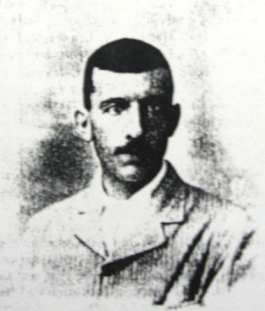
Percy B MolesworthIt was Sir Arthur C Clarke who first told me, nearly a quarter of a century ago, about a forgotten Ceylonese astronomer who has a Martian crater named after him. His name was Percy Molesworth, and I was fascinated by the story of this man who lived and died in a world so different from ours…and the trails he blazed.
Christmas Day 2008 marks the hundredth death anniversary of this remarkable man who pioneered astronomical observations in colonial Ceylon (now Sri Lanka). Most people in the land of his birth have never heard of him, and therein hangs a sad tale of how the country neglects its intellectual and scientific heritage.
By profession, Percy Braybrooke Molesworth (1867 – 1908) was a major in corps of Royal Engineers, but he is better remembered as one of the world’s leading amateur astronomers at the beginning of the Twentieth Century. From his personal observatory in Trincomalee, on Ceylon’s east coast, Molesworth both observed the night sky and photographed celestial bodies, the results of which he shared with leading astronomical groups in the west. Armed only with a basic telescope, a sharp eye and good drawing skills, he made significant contributions to advancing our knowledge of the heavens at the time.
In these articles, I weave together material gleaned from a dozen different sources, including obituaries of Molesworth published by the British Astronomical Association (BAA) and Royal Astronomical Society (RAS), and later papers and reviews of the formidable body of work that Molesworth left behind after a short but highly productive life of 41 years.
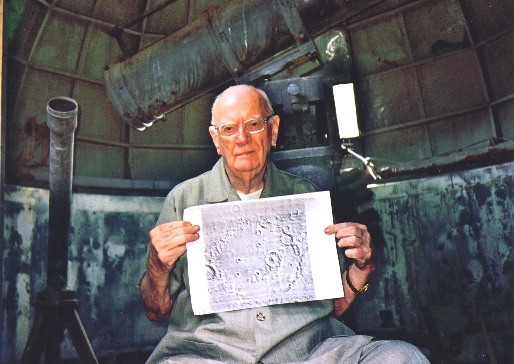
Sir Arthur Clarke, sitting next to the historic telescope, shows a photo of Crater MolesworthOne of my principal sources is Sir Arthur C Clarke, another astronomically-inclined Englishman who was to settle down in Ceylon decades later, and with whom I worked for over 20 years as a research assistant. Molesworth combined in him several elements that resonated with Sir Arthur -– Ceylon, Trincomalee, night sky observations and Mars. In the years that followed my introduction to Molesworth, Sir Arthur allowed me unrestricted access to his library and archives where I read more about Molesworth, principally from BAA and RAS journals and newsletters.
I also had the privilege of associating the late Herschel Gunawardena, who co-founded the Ceylon Astronomical Association (CAA) with Arthur Clarke in 1959, and served as its first secretary and later president. Herschel told me details of his personal quest for Molesworth, which he had chronicled in an article he wrote in the CAA journal, Equatorial, in 1971.
Others who gave me information or insights into this story include the late Dr V K Samaranayake, who played a part in restoring the telescope in the 1960s, and Fr Dr Mervyn Fernando, a keen amateur astronomer who continues to promote the subject in the local languages through the Subodhi Astronomy and Space Study Centre.
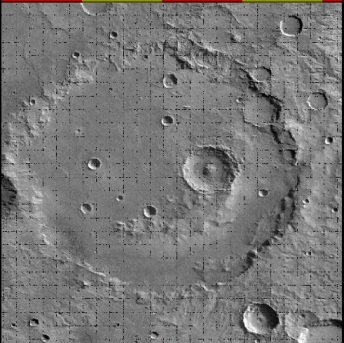
Crater MolesworthMy own connection with Molesworth happened over 20 years ago. In early 1988, while Sri Lanka was engulfed in a brutal southern insurgency, vandals looted the Colombo University dome – by then housing the Molesworth telescope – and removed several parts purely for their metallic value. I covered that incident as a young science journalist working for The Island newspaper, and later wrote a feature article titled ‘The death of an observatory’ (published on 26 March 1988).
Given the political turmoil at the time, it barely made any ripples. I still remember being ridiculed by some for reviving the memory of a long dead man at a time when hundreds of innocent, non-combatant lives were being lost every week due to extra-judicial killings.
Indeed, for much of the past 30 years, Trincomalee has been affected by Sri Lanka’s long-drawn civil war in the country’s north and east. I had planned to visit Trincomalee this year to personally find out the current status of the Molesworth bungalow and tombstone. But that didn’t happen due to the pressure of work and other distractions. I might well do that in 2009, now designated the International Year of Astronomy.
Naming celestial objects is a serious business, carried out by the International Astronomical Union (IAU) through a careful process. There are hundreds of thousands of craters on Mars, but only some of them have names. The Wikipedia has a list of Martian craters which are by convention named after famous scientists and science fiction authors, or if less than 60 km in diameter, after towns on Earth.
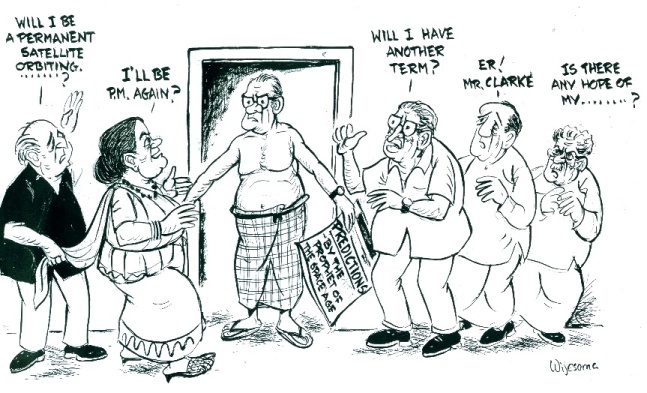
Space prophet mobbed by anxious politicians: Cartoon by W R Wijesoma in The Observer (Sri Lanka)
This cartoon is nearly as old as myself! It was drawn by Sri Lanka’s leading political cartoonist W R Wijesoma and appeared in The Observer newspaper of Colombo sometime in the late 1960s (I haven’t been able to ascertain the exact date).
It shows science fiction writer (later Sir) Arthur C Clarke, already settled down in Ceylon (later Sri Lanka) and ‘Serendipitised’ enough to sport the native attire of sarong, being mobbed by the island’s leading politicians — all of them now departed — each wanting to know what he can foresee or foretell about their personal political futures.
Sir Arthur, whose 91st birth anniversary falls today, took pains to explain that science fiction writers like himself were not soothsayers with powers to predict the future. He was fond of quoting fellow SF writer Ray Bradbury’s famous saying: “People ask me to predict the future, when all I want to do is prevent it.”
But that kind of reason never deterred politicians of every colour and hue, who are always anxious to know just when they can get elected – or return – to high office and all the trappings of power that go with it.
To mark the birth anniversary – the first since his death in March 2008 – I have just published an op ed essay, titled Sir Arthur C Clarke: A life-long public intellectual, on Groundviews website. In this essay I explore, briefly, some of his life-long pursuits for more rational discussion and debate in public policy. I also wonder how and why he lost his struggle against Sri Lankans’ obsession with astrology.
Here’s an excerpt:
But even half a century of Arthur C Clarke could not shake Sri Lankans off their deep obsession with astrology — the unscientific belief that human destinies are somehow shaped and controlled by celestial bodies millions of kilometres away. A life-long astronomy enthusiast, he repeatedly invited astrologers to rationally explain the basis of their calculations and predictions. This challenge was craftily avoided by astrologers who continue to exercise much influence over politics, public policy, business and everyday life in Sri Lanka.
Despite his broad-mindedness, Clarke couldn’t understand how so many highly educated Sri Lankans practised astrology with a faith bordering on the religious (another topic on which he held strong views). Ironically, even the government-run technical institute named after him used astrologically chosen ‘auspicious times’ for commissioning its new buildings. In later years, Clarke would only say, jokingly: “I don’t believe in astrology; but then, I’m a Sagittarius — and we’re very sceptical.”
On a personal note, I’m truly privileged to have known and worked with both Sir Arthur Clarke and his cartoonist W R Wijesoma (who was my senior colleague at The Island newspaper which he joined at its inception in 1981). I know how much Sir Arthur liked this cartoon, the original of which he obtained from Wijesoma and preserved among dozens of other souvenirs and mementos.
Alas, Wijesoma left us in January 2006 — or he might just have drawn another brilliant cartoon to send off Sir Arthur on his final journey. In fact, a worthy follower of Wijesoma’s cartoon tradition did just that earlier this year – see this blog post of mine from March 2008: Arthur C Clarke autographing all the way to the Great Beyond….?
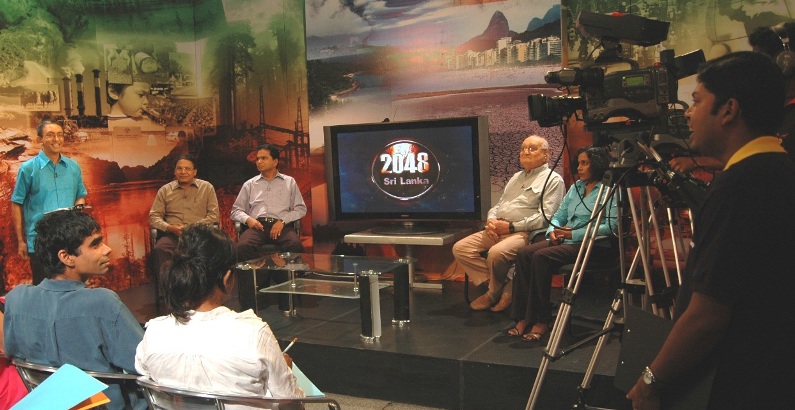
On the set of Sri Lanka 2048: Living with climate change
I have finally done it…and not a moment too soon!
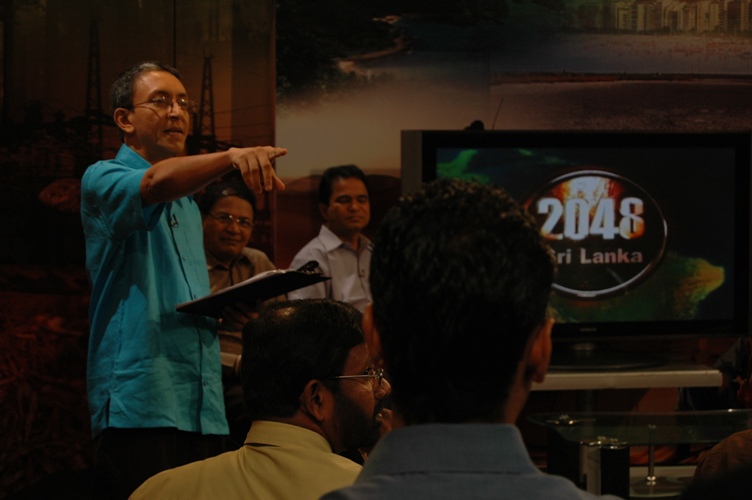
There I was, moderating an hour-long TV debate on Saturday evening prime time television on Sri Lanka’s premier English language Channel One MTV. Our topic for this edition of Sri Lanka 2048 was living with climate change. After exploring its many facets, I was beginning to wind up.
But not before underlining the need for us to take personal responsibility for changing our lifestyles whose cumulative impact on the planet is significant.
The philosophical and political debates over climate change will continue for a long time, I said. Meanwhile, we have to live with climate change impacts that are already happening…and change how we use energy and resources so that we don’t make matters any worse.
This means we must consume less, share more, live simply and pursue smart solutions through green technologies. Of course, at the basis of all this is finding meaningful, practical ways of kicking our addiction to oil.
That’s when I put my hand up and admitted, on air, my own substance addiction: I am hooked on hydrocarbons, a.k.a. petroleum. I’m struggling to break free from it, but it’s not easy.
Of course, my individual addiction pales into insignificance when we look at how entire industries, sectors and countries are addicted to oil and stubbornly insist on continuing the status quo. But we must be the change we seek, so it’s never too late for me to work on my oil problem. When enough of us individuals do, countries and economies will follow.
But people with addictions often need expert guidance, as well as to keep the company of fellow addicts who are similarly trying to kick the habit. That’s why those having drinking problems find help in Alcoholics Anonymous.
Nalaka Gunawardene moderates Sri Lanka 2048: Race Against Time
Here’s what the promotional blurb for last weekend’s show said:
Sri Lanka 2048 looks at living with climate change: how challenges can become opportunities
Climate change is no longer a theory; it’s already happening. What awaits Sri Lanka – and how best can we adapt to live with extreme weather events, disrupted rainfall, sea level rise and other projected impacts? How can Sri Lanka play a meaningful role in mitigating further damage to the world’s climate?
These and related questions will be raised in this week’s Sri Lanka 2048, the series of TV debates exploring Sri Lanka’s prospects for a sustainable future in the Twenty First Century. The one-hour debate, in English, will be shown on Channel One MTV from 8 to 9 pm on Saturday, 26 July 2008.
Titled Race Against Time, this week’s debate brings together concerned Sri Lankans from academic, corporate, civil society and government backgrounds to discuss the many challenges of living with climate change. The debate looks at aspects such as promoting renewable energy to reduce our carbon emissions, and emerging opportunities for individuals, communities and businesses to adopt low carbon lifestyles and practices.
This week’s panel comprises: Dr. W. L. Sumathipala Director, National Ozone Unit, Ministry of Environment & Natural Resources; Dr. Suren Batagoda, CEO, Sri Lanka Carbon Fund; Dr Ray Wijewardene, Eminent engineer and specialist in renewable energies; and Darshani de Silva, Environmental Specialist, World Bank Office in Colombo. The debate is moderated by TVE Asia Pacific’s Director Nalaka Gunawardene.
The debate also seeks answers to questions such as: What niche can Sri Lanka occupy in the fast-growing global carbon market? How much money can we make from this market? What is the role of the recently established Sri Lanka Carbon Fund? Is the Clean Development Mechanism the right way forward?
The debate concludes with the recognition that climate Change is not just an environmental concern, but also has economic, social, political and security implications. While the philosophical and political debates over climate change will continue for a long time, everyone has to learn fast to live with it. This calls for consuming less, sharing more, living simply and pursuing smart solutions that reduce carbon emissions without compromising the quality of living.
Sri Lanka 2048 debates are co-produced by TVE Asia Pacific, an educational media foundation, and IUCN, the International Union for Conservation of Nature, in partnership with MTV Channel (Private) Limited. This editorially independent TV series is supported under the Raising Environmental Consciousness in Society (RECS) project, sponsored by the Government of the Netherlands.
It’s now three months since Sir Arthur C Clarke abandoned his 91st orbit around the Sun and headed back to the stars. We who knew and worked closely with him are still getting used to living in the post-Clarke world.
That Sir Arthur changed our world beyond recognition – by inventing the communication satellite and through his visionary writings – has been acknowledged far and wide. In the days and weeks following his demise, his views on the Next World have also attracted considerable attention.
Sir Arthur was a life-long disbeliever: he was against all forms of organised religion, and considered religion to be the worst form of ‘mind virus’.
As he said: “One of the great tragedies of mankind is that morality has been hijacked by religion. So now people assume that religion and morality have a necessary connection. But the basis of morality is really very simple and doesn’t require religion at all. It’s this: “Don’t do unto anybody else what you wouldn’t like to be done to you.” It seems to me that that’s all there is to it.”
I have just recalled that in his last published story, he envisioned a world without religions by the year 2500. He offered this in a futuristic piece titled The View From 2500 A.D., published in Forbes.com in November 2007, as part of a special online edition on the future.
Sir Arthur described the development of reliable psychological probes, using which any suspected individual could be ‘painlessly and accurately interrogated, by being asked to answer a series of questions’. While its original purpose is to keep the world safe from criminals and terrorists, the “Psi-probe” soon proves to be useful on another front: to weed out religious fanaticism which is a greater threat to humanity.
In his own words:
“One outcome of this–the greatest psychological survey in the whole of history–was to demonstrate conclusively that the chief danger to civilization was not merely religious extremism but religions themselves. This was summed up in a famous saying: ‘All Religions were invented by the Devil to conceal God from Mankind.’
“Billions of words of pious garbage spoken by statesmen, clerics and politicians down the ages were either hypocritical nonsense or, if sincere, the babbling of lunatics. The new insights enabled by the Psi-probe helped humans finally recognize organized religions as the most malevolent mind virus that had ever infected human minds.
“Now that the Psi-probe allows us to link millions of minds together electronically, it has been suggested that something like a ‘supermind’ might be attempted. There is a danger that this will erase the individuality of its components, and whether this is a good or a bad thing has been the subject of endless debate. There are those who think that such a merging would be a blessing–perhaps the only way to reach a true Utopia.”







 Open Minds!