How do you measure progress? Count simply the economic growth numbers? Or something more? Are people in richer countries necessarily happier? If not, what’s the key to real progress that makes people better economically, environmentally and socially?
The Organisation for Economic Co-operation and Development (OECD) wants to hear from young people about these issues through a video competition. To celebrate the OECD’s 50th Anniversary, young people worldwide are invited to create a short video describing their vision of Progress. In 3 mins, or 180 secs. The competition is open to young people (18-25 years) in every country worldwide.
Upload your video on YouTube and register online before MIDNIGHT (Paris time) on 1 March 2011. Details here. Promo video below:
It’s the film award season once again! Awards for the best performances and technical accomplishments in feature films released during 2010 will be announced during the first quarter of 2011.
‘A handful of Oscars’ is the title on our weekly Wiz Quiz this week in Daily News. Film buff Vindana Ariyawansa and I have chosen a few of the great many records and outstanding feats from the rich and colourful history of Oscar awards.
There aren’t too many notable Asians in this history, but we’ve focused on some: Satyajit Ray, Dr Haing S. Ngor
Akira Kurosawa and Ang Lee among them.
The first Academy/Oscar Awards ceremony was held on 16 May 1929, at the Hotel Roosevelt in Hollywood to honour outstanding film achievements of the 1927/1928 film season. The 83rd Oscar awards ceremony is scheduled for 27 February 2011, and will honour the best of films released during 2010. Nominations for the 2010 Awards have just been announced, on 25 January 2011.
Click here to see full list of Oscar Award nominations for 2010
Time is ticking away...but crises also mean opportunities
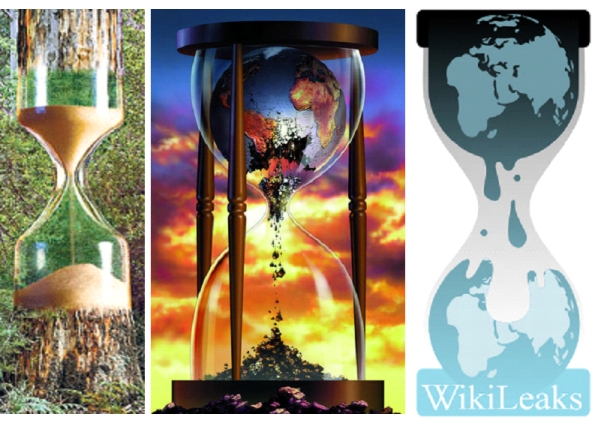
I like to think and speak in metaphors, especially visual metaphors. Sometimes I coin or design new ones. This illustration is the latest example.
Individual elements in this came from very different sources (thanks to them all). I just mixed them together to make two points during a talk I just gave at the Colombo University.
We live in a crisis-ridden world where we have to cope with multiple emergencies unfolding at the same time, impacting us on different fronts. This illustration captures three of them: crisis in biodiversity, man-made climate change, and the new reality of living in a rapidly WikiLeakable world — what I called the Global Glass House.
We don’t get to choose the timing, severity or duration of any challenge. But we do have some choice over how we respond: we can despair and grumble (blaming the Gods or karma if we believe in those); we can become really alarmist (a la Chicken Little); or we can be measured and smart in how we deal with the seemingly overwhelming situations.
Speaking at the Leaders in Environmental Advocacy Forum (LEAF) on Preserving the Past, Securing the Future on 22 January 2011 at the University of Colombo, I advocated this last option. I also pulled together a number of ideas mentioned on this blog over the past four years.
LEAF was a two-day summit held in Colombo, Sri Lanka, hosted by members of the Elon University’s Periclean Scholar Class of 2011, in partnership with the University of Colombo, the United States Embassy in Colombo, the National Science Foundation of Sri Lanka and Rainforest Rescue International.
In fact, some challenges of living on a warming planet are comparable to coping with a WikiLeakable world: both demand quick adaptation to a new reality. In both cases, governments and society have to change mindset and practices on the go — business as usual is no longer an option. Denialism, or demonising the messenger, won’t take us forward. We need more measured, sometimes even pragmatic responses.
In that process, all-or-nothing is not a viable approach. Waiting for full knowledge and understanding is not feasible either. As I once described it, responding to the planet’s climate and other ecological crisis with partial scientific understanding is akin to many pages of our planet’s ‘operations manual’ being still completely blank — and yet we have to manage the planet to the best of our knowledge, intuition and common sense.
Many of the same principles apply to living in the modern networked info society, where no secrets can be kept that way for too long. The sooner we come to terms with this new reality and adapt, the better.
I’m delighted to see others are addressing these parallels. In my talk, I mentioned a recent essay titled Could climate science become open source? by Brendan Barrett and Sulayman K. Sowe, published earlier this month on the UN University’s Our World 2.0 website.
In their perceptive piece, the authors ask whether climate science would benefit by being more firmly grounded in the principles of openness, perhaps along the lines of the free and open source software communities and open content movements. “The concept of openness behind free and open source software describes a mode of creative knowledge production and sharing in which individuals and communities freely generate and adapt or remix resources (content or software) without licensing restrictions.”
They add: “Proposing a move to a new model of climate science in no way suggests that climate change is not a real and present threat or that we cannot rely on the integrity of our contemporary climate science institutions and scientists. Rather, the argument here is that learning from the way free and open source software projects and communities work may be an important way forward in engendering more effective global, national and local responses to climate change.”
I have always worn multiple ‘hats’, and dabbled in multiple pursuits rather than follow narrow paths of enquiry. I see myself continuing to oscillate between the ‘geeks’ and greens, and where possible, bridging their worlds. It’s really encouraging to see some others straddling the two spheres.
Skip Williamson's Facebook profile photoWow, isn’t the Facebook a great place to connect people, ideas and creativity? I never thought much about it, but maybe I ought to spend more time there…
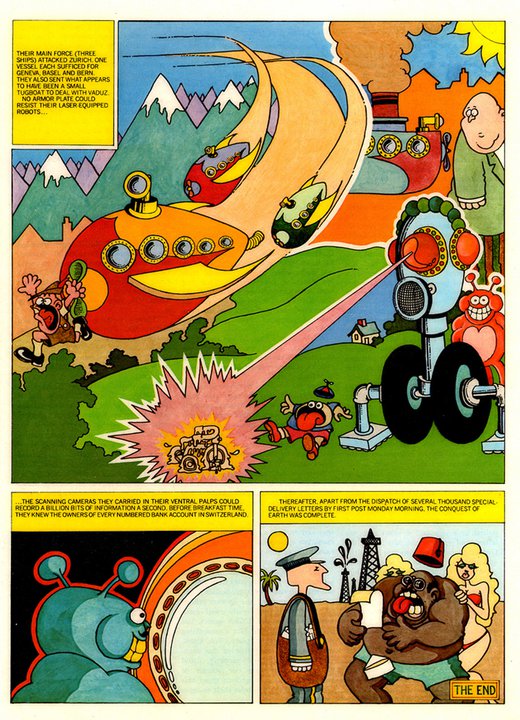
Yesterday, I published a semi-serious essay called WikiLeaks, Swiss Banks and Alien invasions, which was about an obscure short story by Arthur C Clarke describing an unlikely alien invasion of the Earth. For once, the invaders used brain and cunning rather than fire power, and against this onslaught, our planet’s rulers had no defence…
I mentioned how PLAYBOY Magazine had used that story as the basis for a psychedelic comic strip illustrated by the American underground cartoonist Skip Williamson. At the time of writing, I had not been able to locate the comic strip that was published in their issue of May 1972. I wondered: “…it’s either behind a pay-wall, or lies somewhere with little or no indexing by search engines.”
Turns out to be the latter. In less than 24 hours, there was a response from Skip Williamson himself saying the artwork is on his Facebook page, http://www.facebook.com/skip.williamson.
Many thanks to Skip Williamson for posting the link…and while at it, for all his brilliantly cheeky and subversive creations over the years! I hope he doesn’t mind my reproducing the comic strip (all of 2 pages) below:
When the Twerms Came - Comic Strip - Page 1 of 2When the Twerms Came - Comic Strip page 2 of 2
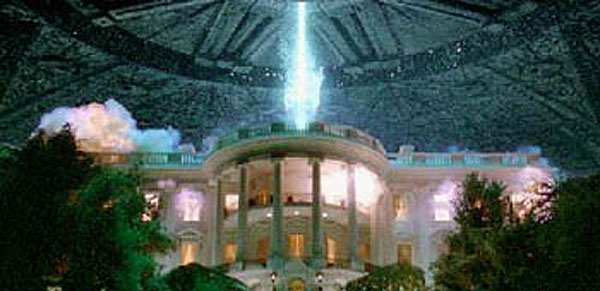
Why waste all that energy when there are smarter ways? Image courtesy movie 'Independence Day'
It’s time to come clean: I have a fascination with alien invasions of our planet.
As a kid, I was an avid listener of radio (my only electronic medium, as I grew up in a land without television, and in a time before the Internet) — and expected the regular transmissions to be interrupted any moment to break the news of an alien invasion underway. The spoilsports shattered my childhood dreams everyday.
Now slightly older, I keep looking for the perfect moments for that history-shattering event. A widely reproduced op ed essay I wrote in July 2010 opened with these words:
“If you’re an alien planning to invade the Earth, choose July 11. Chances are that our planet will offer little or no resistance. Today, most members of the Earth’s dominant species – the nearly 7 billion humans – will be preoccupied with 22 able-bodied men chasing a little hollow sphere. It’s only a game, really, but what a game: the whole world holds its breath as the ‘titans of kick’ clash in the FIFA World Cup Final…”
The careless aliens didn’t heed my advice, but I live in hope. I keep looking for the strategic moments and smart ways to take over the planet — with as little violence as possible. After all, I’m a peace-loving person (even if I’m unhappy with the planet’s current management).
I’m not alone in this noble quest. Science fiction writers have been at it for decades, and future Earth invaders are well advised to first study these useful instructions masquerading as popular literature. In an op ed essay published today, I highlight one such story by Sir Arthur C Clarke.
Click on this ONLY if you're a prude...I wrote WikiLeaks, Swiss Banks and Alien invasions with my tongue in my cheek about half the time (go figure!). I’ve been following the WikiLeaks cablegate saga for several weeks, and was intrigued to read that other critically sensitive secrets — that have nothing to do with garrulous American diplomats — were also reaching this online platform for assorted whistle-blowers.
I describe how PLAYBOY Magazine used the story as a basis for a psychedelic comic strip illustrated by the American underground cartoonist Skip Williamson. That appeared in their issue for May 1972 — and I’m still trying to locate that story. All in the interests of pop culture, of course.
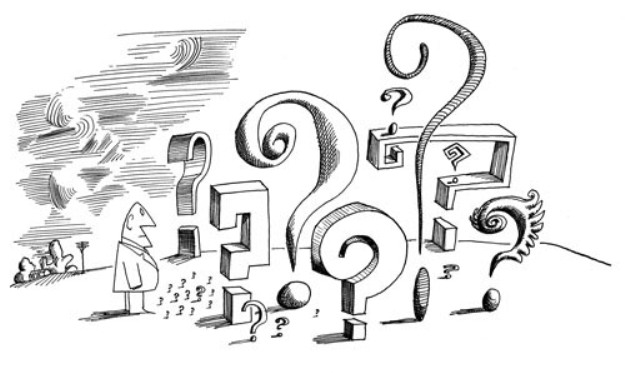
By Saul Steinberg (1914-1999), American cartoonist and illustrator
Question: Who said: “All the world is a quiz, and all the men and women merely players”?
Answer: The late Magnús Magnússon, iconic host of BBC television’s long-running quiz Mastermind.
I am fond of quoting these words, which sum up what quizzing is all about. I’ve been involved in quizzing most of my life, now for over 30 years. I was an avid ‘quiz kid’ in my time and later became a quiz compiler and quizmaster – I’ve been hosting long-running quizzes on radio and television in both in English and Sinhala.
The latest venture in that quiz career was launched today, with a new weekly quiz column in Daily News, Sri Lanka. It’s called Wiz Quiz. The first installment is found here, a quick look at 2011.
Every week, we will present a new set of 15 questions, and publish the answers to the previous week’s questions. The newspaper is arranging for prizes for those who get all the answers right.
I am partnering on this with my friend and long-standing quiz enthusiast (and film buff) Vindana Ariyawansa. Vindana too started quizzing as a school boy aged 13, and was later a member of University of Kentucky quiz team for three years. In 2008, he published a Quiz Book in English containing 1,000 questions and answers on general knowledge.
As we say in today’s intro: “We don’t want to ask questions that elicit esoteric answers that nobody knows. Instead of such trivial pursuits, we want to keep this quiz focused on interesting insights and factoids related to our island and the wider world outside.”
And while on the subject, here’s a great new quizzing website I’ve just discovered: Quizzing.in
The Earth is one, but the world is not... As I wrote the other day, during 2011, human numbers will add up to 7 billion. That is 7,000,000,000 living and breathing people.
But how many of us can grasp such a large number? I can size up a gathering of a few hundred people, or at the most, a couple of thousand. After that, I lose count…and I’m not alone.
That’s why the idea of a Global Village of 100 is so very useful. It’s based on a simple yet profound premise: if we could reduce the world’s population to a village of precisely 100 people, with all existing human ratios remaining the same, what would it look like?
The idea was the brainchild of Donella Meadows, a pioneering American environmental scientist, teacher and writer. She is best known as lead author of the influential book The Limits to Growth (1972).
It was first published in May 1990 with the title “State of the Village Report”, and Meadows originally envisaged a village of one thousand people. This approach to showing the global disparities was so refreshing and accessible that it soon spread among educators, journalists and activists — in today’s Internet terms, we would call that ‘going viral’.
David Copeland, a surveyor and environmental activist, revised the report to reflect a village of 100 and single-handedly distributed 50,000 copies of a Value Earth poster at the 1992 Earth Summit in Rio de Janiero.
What happened after that is recounted in this brief history by Carolyn Jones, adapted by Bob Abramms.
The analogy has been revised every few years to reflect the changing demographics and global development trends. The practice is now sustained by the Miniature Earth Project, whose latest animated video version for 2010 runs as this:
There is also the 100 People Foundation (www.100people.org) which is “committed to simplifying and humanizing complex global statistics by looking at the world as a community of 100 people”. They provide media and educational tools to teachers around the world to help them teach a global view, and inspire their students to learn more about their global neighbors. Here’s their own video:
100 People: A World Portrait Trailer
Here’s another variation on the theme, set to John Lenon’s ‘Imagine’:
If the world were a village of 100 people…
This cartoon animation uses the same approach, but with emphasis on linguistic and cultural diversity.
Coming soon to a planet near you: 7 Billion...and counting
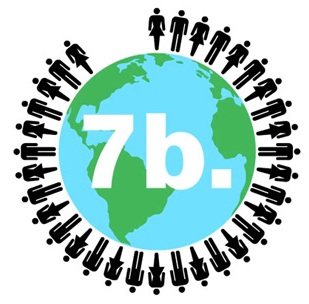
Sometime during 2011, human numbers will add up to 7 billion.
That is 7,000,000,000 living and breathing people — all of who will need to be fed, clothed, sheltered and cared for in many other ways.
During this year, National Geographic magazine will publish a 7-part series examining specific challenges and solutions to the issues we face. The magazine introduces the series with its January cover story “7 Billion,” offering a broad overview of demographic trends that got us to today and will impact us all tomorrow. The first in-depth story will appear in the March issue, focusing on humans’ impact on the planet’s geology. Other stories will follow throughout 2011.
This clever video accompanies the coverage:
Correction added by NatGeo editors: in 2050, 70% of the population will be living in “urban areas,” not “megacities” as stated in an earlier version of this video.
I don’t like the word population: it sounds cold, clinical and detached. Zoologists can talk about ant populations or elephant populations, but when demographers (and others, including journalists) refer to our the counting of species as human population, I somehow feel it’s too impersonal. Aren’t we more than mere numbers?
So in my own writing and TV scripts, I use the phrase human numbers.
Can you visualise 7 billion?Semantics apart, our rising numbers are indeed a cause for concern. We didn’t quite see the ‘population bomb’ go off the way we were warned about – thank the secular Force – but we still face formidable challenges.
In 1987 — the year I entered journalism — human numbers passed five billion. A dozen years later, in 1999, the six billion was reached. By then, I too had added my contribution of one co-produced human being. Soon in 2011, we will be seven billion.
Our planet’s natural systems are over-stretched not only by our sheer numbers, but also by our technologies and consumption. The many signs of planetary stress include accelerated loss of species, fast spreading deserts, and declining air and water quality. To cap it all, scientists now confirm that human activity is changing our climate.
On the New York Times Dot Earth blog, science writer Andrew C. Revkin regularly examines efforts to balance human affairs with the planet’s limits.
The stats helper monkeys at WordPress.com mulled over how this blog did in 2010, and here’s a high level summary of its overall blog health:
The Blog-Health-o-Meter™ reads Wow.
Crunchy numbers
The Louvre Museum has 8.5 million visitors per year. This blog was viewed about 210,000 times in 2010. If it were an exhibit at The Louvre Museum, it would take 9 days for that many people to see it.
In 2010, there were 91 new posts, growing the total archive of this blog to 575 posts. There were 284 pictures uploaded, taking up a total of 22mb. That’s about 5 pictures per week.
2011 is here! We’re not ones to be easily affected by a mere landmark in our particular system of chronology, but as watchers of popular culture, we go along with the mood of the moment — if only to blend in with the planet’s natives…
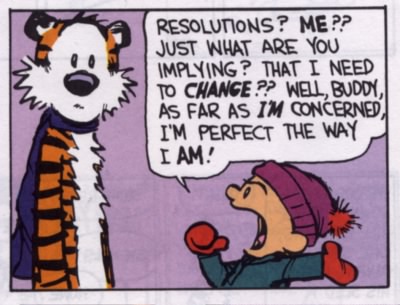
As for our own mind (which is large and contains multitudes), Bill Watterson – the inimitable creator of Calvin and Hobbes – has once again captured my thoughts so well…and so colourfully.
The future isn't what it used to be!
As for resolutions, the only one I have is that I get to write more, and get read more widely. What more can a wordsmith ask for?
Besides, I tend to agree with Calvin when he says here…






 Open Minds!