Louder, please?Why do people – especially middle aged men – yell into their mobile phones?
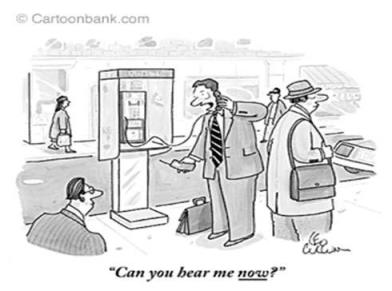
This is one of those widely asked questions in relation to communications technologies that have become part of our daily lives. Mobile phone etiquette hasn’t evolved as fast as phone coverage, so this behaviour remains a regular source of irritation at hotels, restaurants, airports and other public places.
So why do people with normal speaking volumes yell into their cell phones? I came across an interesting explanation, which also suggests that it’s a trait more common among Digital Immigrants.
Here’s an extract: “Household telephones, or landlines, have a microphone in the receiver that amplifies your voice into the ear piece. When you talk into a landline, your voice is captured and replayed through the ear piece, so you hear your own voice loud and clear….With cell phones, your own voice is not amplified into the earpiece, so the only sound you hear is from your mouth. Seem like this wouldn’t be a huge difference, but the volume level of words coming from your mouth through the air and into your ear is a pretty big difference from sounds coming from a phone speaker that’s pressed directly against your ear.”
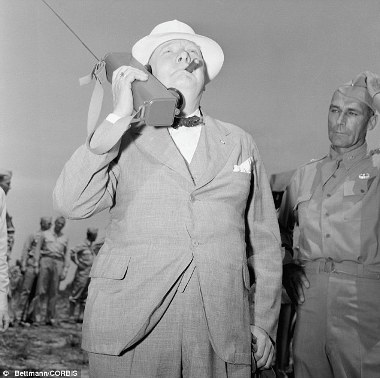
No, Sir Winston is not using an early mobile phone - it's a field radio receiver!Hmm. So there’s hope that the trait will become less common in the coming years.
Of course, the habit goes a long way back to the days when phone lines rarely offered good audio quality. There is the true story of how Sir Winston Churchill had to suffer a Cabinet colleague who was a loud phone talker. During the Second World War, they were sharing crammed war cabins.
One day the Minister was once again talking very loudly on the phone. Churchill asked his secretary to go over and tell Mr Brown not to talk at the top of his voice. The secretary returned and told the PM: ‘Sir, the Minister is talking to Scotland.’
Without batting an eyelid, Churchill replied: ‘Yes, I’m sure he is. But tell him to use the phone!’
I once saw a sports car on the narrow streets of Malé, capital of the Maldives (total population 350,000). Nothing unusual about it — except that the whole of Malé is about two square km: we can WALK the length and breadth of the crowded capital in 10 or 15 minutes. The other 1,200 islands that make up the Indian Ocean archipelago are even smaller.
That reality didn’t stop an optimistic Maldivian from investing in a fast vehicle – after all, a car (especially a sports model) is more just a means of transport.
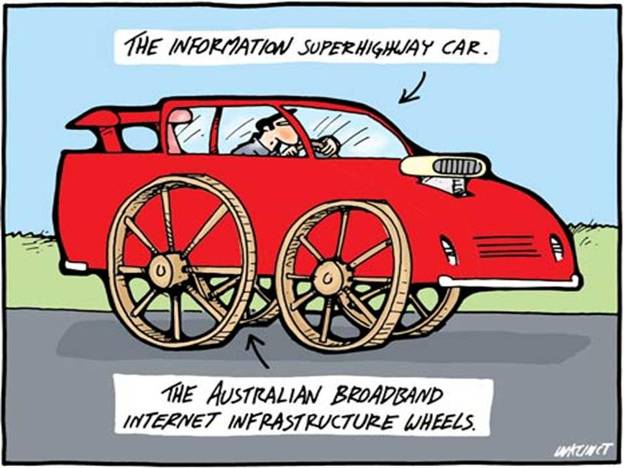
Something akin to this plays out in the virtual world everyday in many parts of developing Asia. Many Internet users have state of the art access devices — ranging from the latest laptops and high-speed desk tops to ipads and internet-enabled mobile phones. But most of the time the users and devices are held up by poor quality internet connections. I mean patchy, uneven, really S-L-O-W ones.
So part of the time — how often and how long depends on where you are, and who your internet service provider or ISP is — we are all like that Maldivian sports car owner. Dressed up and rearing to go, but not really going very far. Because our network is overloaded.
What can you do when your broadband internet connectivity slows down, making some web applications tedious or impossible? How can you measure and compare the quality of broadband service within the same telecom network or across different service providers?
As consumers, we have limited options. We can grin and bear, and be grateful that we are among the 2 billion (and counting) human beings who regularly access the Internet. We can grumble and rant, and even complain to our ISP. But chances are that they’ll plead it was a system fluke, an exception to the norm.
Now there’s another option. The Ashoka-Tissa method, a simple and free software developed by LIRNEasia and IIT Madras, enables just that: with it, you can gather evidence before taking it up with telecom operators.
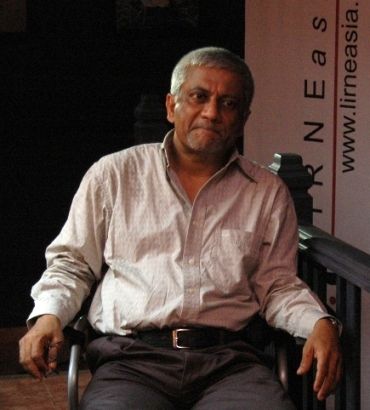
Rohan Samarajiva: Fraudband-buster?At TVE Asia Pacific , we have just produced a short video in which LIRNEasia — a regional ICT policy and regulation think tank active across the Asia Pacific — sums up their experience in developing a user-friendly method to measure broadband quality of service experience. It also shows how they engaged telecom operators and regulators in South and Southeast Asia from 2007 t0 2010.
“256 kbps up and down is the minimum definition (of broadband),” says Dr Rohan Samarajiva, LIRNEasia’s Chair and CEO. “There are various people debating about it: whether it should be 2Mbps and so on, but I will give an acceptable minimum definition…Our research shows that, in fact, many broadband products that say they are giving 2Mbps don’t even meet this minimum rate.”
The former Sri Lankan telecom regulator adds: “Then of course there is this whole story of companies promising all kinds of things. 2Mbps up, 2Mbps down and various other things being promised and giving not even 256kbps. So there is almost like a dishonesty factor here. As one of my friends says, this is not broadband; this is fraudband!”
PS: While writing this blog post, I was frustrated by the poor quality of my own supposedly high-speed broadband connection, provided by Sri Lanka’s oldest telecom operator.
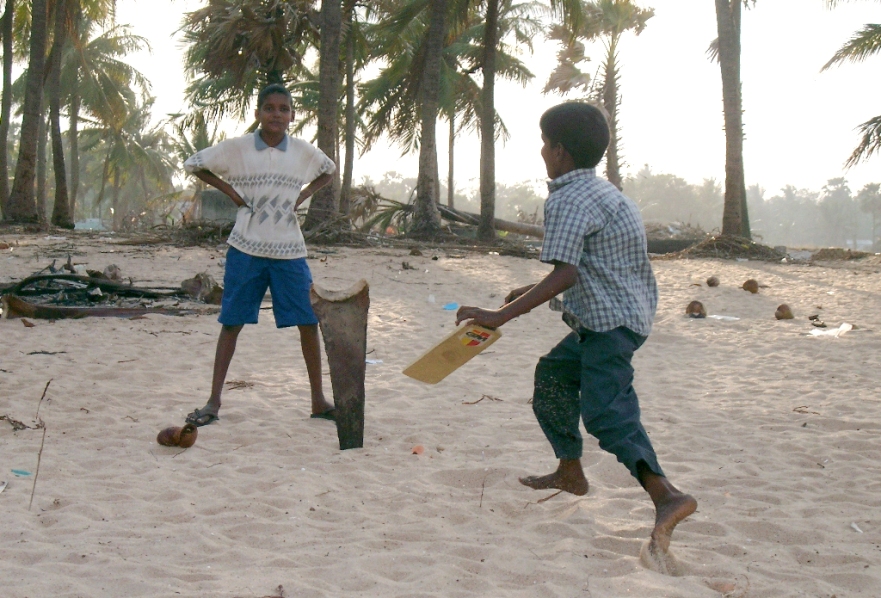
Boys playing cricket on tsunami hit beach in eastern Sri Lanka, January 2005 (photo by Video Image)
Two boys playing cricket on a beach, with a makeshift bat and wicket. What could be more ordinary than this in cricket-crazy Sri Lanka, where every street, backyard or bare land can host an impromptu game?
But the time and place of this photo made it anything but ordinary. This was somewhere along Sri Lanka’s east coast, one day in mid January 2005. Just a couple of weeks after the Indian Ocean tsunami had delivered a deadly blow to this part of the island on 26 December 2004.
My colleagues were looking for a survivor family whose story we could document for the next one year as part of the Children of Tsunami media project that we had just conceived. On their travels, they came across these two boys whose family was hit hard by the tsunami: they lost a sibling and their house was destroyed.
They were living in a temporary shelter, still recovering from the biggest shock of their short lives. But evidently not too numbed to play a small game of cricket. Perhaps it was part of their own way of coping and healing.
More than six years and many thousand images later, I still remember this photo for the quiet defiance and resilience it captured. Maybe that moment in time for two young boys on a devastated beach is symbolic of the 20 million plus men, women and children living in post-war Sri Lanka today.
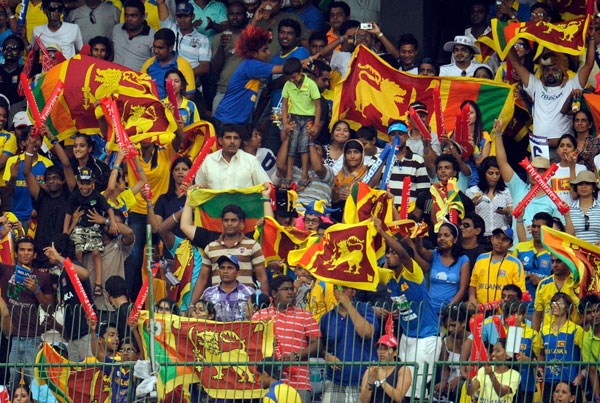
We are playing cricket, or cheering cricket passionately and wildly even as we try to put a quarter century of war, destruction and inhumanity behind us. And at least on the cricket front, we’re doing darn well: the Sri Lanka national team beat New Zealand on March 29 to qualify for the ICC Cricket World Cup finals on April 3 in Mumbai.
We’ve been here once before – in March 1996 – and won the World Cup against many odds. Can we repeat or improve that performance? We’ll soon know.
Of course, rebuilding the war-ravaged areas and healing the deep-running wounds of war is going to be much harder than playing the ball game.
A few days ago, Captain of Lankan cricket team Kumar Sangakkara described post-war northern Sri Lanka as a scene of devastation after paying his first visit to the region. People of the north have been deprived for 30 years of everything that is taken for granted in Colombo, he told the media.
He toured the north with team mate and wiz bowler Muttiah Muralitharan, who is patron of the Foundation of Goodness. The charity, itself a response to the 2004 tsunami, “aims to narrow the gap between urban and rural life in Sri Lanka by tackling poverty through productive activities”.
Earlier this month, Lankan novelist Shehan Karunatilaka wrote a highly moving essay in the London Observer titled ‘How cricket saved Sri Lanka’. The blurb read: “As co-host of the current World Cup, Sri Lankans are relishing their moment on the sport’s biggest stage. And no wonder. For them, cricket is much more than a game. After years of civil war, the tsunami and floods, it’s still the only thing holding their chaotic country together.”
In that essay, which is well worth a read, he noted: “Many of us believe in the myth of sport; some more than others. Clint Eastwood and Hollywood have turned the 1995 Rugby World Cup into a sport-conquers-apartheid fantasy in Invictus. CLR James believed cricket to be the catalyst for West Indian nationalism. A drunk in a Colombo cricket bar once told me that Rocky IV had hastened the fall of the Soviet Empire.”
He added: “Let’s abandon the myths for now. Sport cannot change a world. But it can excite it. It can galvanise a nation into believing in itself. It can also set a nation up for heartbreak.”
Cricket has indeed excited the 20 million Lankans from all walks of life, and across the various social, economic and cultural divides. It has rubbed off on even a cricket-skeptic like myself.
We will soon know whether the Cricket World Cup will be ours again. Whatever happens at the Wankhede Stadium in Mumbai on April 2, we have a long way to go on the road to recovery and reconciliation.
Colombo, 29 March 2011: When Sri Lanka beat New Zealand to qualify for Cricket World Cup 2011 Finals
Would 2 billion recognise this?What’s the first image that comes to your mind when you hear the word ‘Internet’?
If you’re a techie or geek, you’ll probably come up with a detailed answer that is technically accurate or precise. But most of the 2 billion plus people who use the Internet worldwide are not techies. They don’t know – or care – about the back-end technicalities.
A good icon is simple, language-neutral, and can be understood across different cultures and by people with very different educational backgrounds. For example, telephones – both fixed and mobile – have established symbols or icons. Sure, the devices have evolved beyond the well known imagery, but everybody recognises these.
So what’s the equivalent for the Internet, never mind its multitudinous applications and delivery methods?
We’re currently editing a short video on LIRNEasia’s broadband quality of service experience (QoSE) in emerging Asian economies. We play with images to tell complex stories in non-technical terms. We wanted to use an icon for the Internet (broadband or otherwise) — and couldn’t immediately think of one visual that everybody knows and recognises unambiguously as representing the global Internet.
So we searched. Our usually reliable friend Google wasn’t of much help. Google image search for ‘internet icon’ brought up hundreds of results — but none that is a universally accepted or recognised. But the search itself was interesting and revealing.
Some images, like Microsoft’s Internet Explorer browser’s famous ‘e’, are well known but are branded to one product and company.
Others, like the ethernet cable’s plug pin, are widely used — but how many non-techies will recognise it? Besides, when broadband access is increasingly going wireless, do the cables matter as much as they used to?
The same goes for those colourful images of fibre optic cables — dazzling points of light, but how many Digital Immigrants (or even Digital Natives) will know what they are?
At least wireless Internet seems to have settled its iconography — or has it? The little antenna transmitting omni-directionally seems to pop up everywhere these days, at least where such coverage is available. But there too, we have more than one icon — even if their main visual symbols are similar.
Then there’s the ubiquitous @ sign — originally introduced for, and still an integral part of, email addresses. But hey, Internet is a lot more than emails!
Are we settled on this?We asked around IT industry friends and IT-watchers, but none could give us a definitive answer. The most that they could agree on was that the 3-letter formulation www (signifying the World Wide Web) comes close to a universally recognised sign for the Internet.
Hmm, that’s far from being a visually elegant design. And it’s decidedly biased to the roman alphabet too (ok, that’s the language of science).
But is there a better icon for the whole Internet, irrespective of delivery method and language-neutral? If not, isn’t it about time we agreed on one?
Designers, geeks and others with spare creative capacity, please take this up.
Image courtesy Vision MagazineEarth, water, fire and air.
These are the four basic elements of matter as seen in ancient Greek, Hindu and other traditions. Each had different names for them, but the concepts were similar.
And in recent days, Japan has been experiencing multiple disasters involving all these elements.
It started with the 9.0-magnitude megathrust earthquake off the coast of Japan that occurred at 2.46 pm Japan time on 11 March 2011. Its epicentre was 130 kilometres off the east coast of the Oshika Peninsula of Tohoku, near Sendai. The earthquake triggered highly destructive tsunami waves of up to 10 meters (33 ft) that struck nearby coastal areas minutes after the quake, and in some cases travelled up to 10 km (6 miles) inland. The earthquake and tsunami waves killed over 5,000 people, caused massive property damage and started fires in some affected locations. Most worrying was the damage caused to the Fukushima II nuclear power plant where reactors damaged by the quake and tsunami led to an accidental leak of radioactivity.
Japan has a long history of living and coping with disasters, but the magnitude and confluence of multiple disasters has plunged the country into the worst crisis since the Second World War. This week’s Wiz Quiz devotes several questions to the history and science of tsunamis.
As it turns out, thanks to Japan’s strict building codes and preparedness, the country could absorb much of the powerful earthquake. But the massive tsunami is what caused most of the damage — there is little defence against the mighty waves that come roaring inland, wiping out everything in their path…
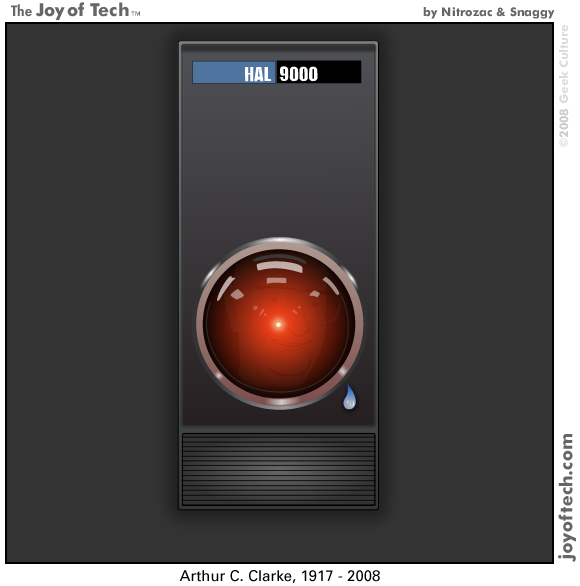
Among the numerous tributes that poured out all over the world following his departure, I found one especially poignant. It was the ‘Joy of Tech’ cartoon above, showing the sentient computer HAL 9000 (from 2001: A Space Odyssey) shedding a single tear in his memory…
In fact, researchers in artificial intelligence (AI) are still trying to create a real-life HAL, which remains the ‘Holy Grail’ in their line of work: a machine-based intelligence that mimics the human mind in all its nuances, and not just in raw processing power.
This is proving much harder than creating chess-playing or quiz-winning computers: human beings are capable of a wide range of emotions some of which – such as intuition and sense of humour – are still not within the capabilities of advanced AI systems.
In this week’s Wiz Quiz, I pay tribute to both HAL and his creator with a few questions on the march of supercomputers. We ask the long-running question: Can computers outsmart us?
Indeed, that prospect is becoming more real every passing year. An IBM supercomputer named Deep Blue created history in May 1997 when it won a six-game match by two wins to one with three draws against the then world chess champion. A few weeks ago, another human bastion fell — and this one concerns me more as a quiz enthusiast (I never learnt the rules of chess, and don’t understand what all that fuss is about.)
On 17 February 2011, a supercomputer owned by the IBM Corporation beat two veteran quizzers to win a high profile game in the long-running US quiz show called Jeopardy. The supercomputer won with US$77,147, while its nearest rival Ken Jennings, a 74-time winner of the popular trivia quiz, came in second with US$24,000. Brad Rutter, who has in previous appearances won a total of US$3.3 million, was third with US$21,600. IBM plans to donate the computer’s winnings to charity.
What was the name of this quiz-winning supercomputer?
In HAL 9000’s name, what did the letters HAL stand for?
Which famous rocket scientist once said: “Man is the best computer we can put aboard a spacecraft…and the only one that can be mass produced with unskilled labour”?
These are among the 15 questions in this week’s Wiz Quiz. Test your brains against ours (supercomputers may not participate!).
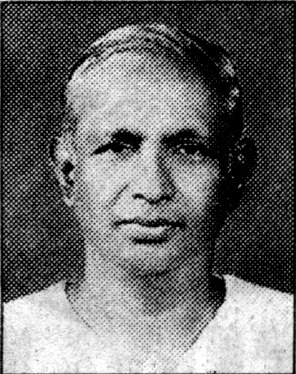
Tambiaiah SabaratnamI seem to be writing a few fond farewells to fellow travellers every year, becoming an obituarist of sorts in that process. I don’t go to funerals if I can help it (they’re too depressing), and instead I withdraw to a corner to write my memories. Some are published; others are privately circulated.
I’ve just published such a tribute on veteran Lankan journalist T (Tambiaiah) Sabaratnam, who died on March 5 aged 79. He was a senior colleague when I entered the world of journalism in the late 1980s. He retired (sort of) in 1997, but remained active in the world of media to the very end.
He was an outstanding journalistic story-teller. As I wrote in the tribute: “He was a pathfinder and leading light in Sri Lankan science journalism for over a generation. Throughout his long association with the English and Tamil press, he advocated the pursuit of public science: tax-payer funded scientific research for the benefit of the people and economy.”
Here’s another excerpt, more personalised:
“He was a source of inspiration and encouragement to me during my early years in science journalism. Our paths crossed often in the late 1980s and early 1990s when he and I covered many of the same scientific events. He was approachable and helpful, but I could never bring myself to call him ‘Saba’. When I knew him, he had already been in journalism for longer than I’d been alive. To me, he was always ‘Mr Sabaratnam’.
“He reached out despite our generational, media house and other divides. He was genuinely interested in my progress as a science journalist, and offered me advice on both style and substance. Occasionally, he also cautioned about on various ‘pitfalls’ in the local scientific scene — personal rivalries, exaggerated claims or oversized egos.”
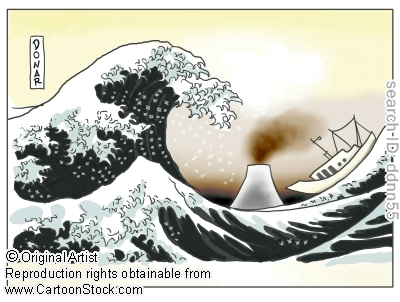
Cartoon by Geneva-based Patrick Chappatte, who works for International Herald and Le Temps
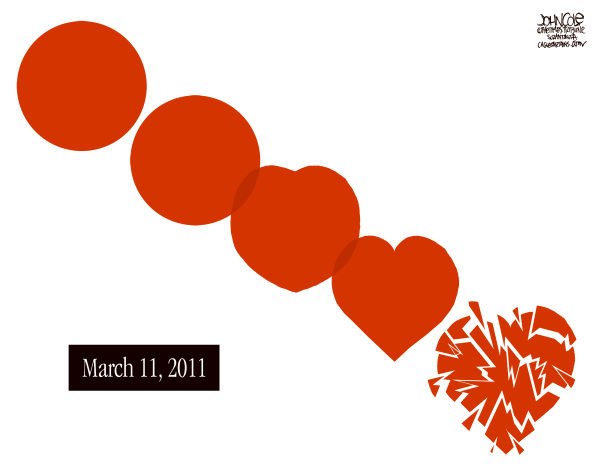
Since Friday March 11 afternoon, I’ve been watching the unfolding humanitarian tragedy in Japan caused by multiple disasters — 8.9 earthquake, tsunami, dam burst, fires, and now the meltdown of three nuclear reactors.
Our heart-felt sympathy goes out to all Japanese people, among whom I count many friends. No nation deserves to be battered simultaneously like this by natural and (partly) man-made calamities.
Yet, few nations are better prepared and equipped to deal with such crises. Japan may be reeling right now, but things could have been far worse if not for their readiness to face emergencies both at individual and institutional levels.
Amidst scenes of utter destruction and dislocation, the Japanese people were reacting with the stoic calm for which Japan is famous. “What’s amazing is that everyone I saw — cops on their white bicycles, boys reading comics in alleys, kids walking home with their parents — appeared graceful under this unexpected disaster,” Tokyo resident Irie Otoko wrote to The New York Times.
But make no mistake: this is a big one as disasters come. The death toll is feared to exceed 10,000, and the property damage alone is likely to be tens of billions of dollars. The societal, economic and emotional costs are hard to quantify at this early stage.
It was only a couple of weeks ago that I was walking the streets of Tokyo, enjoying the calm and orderly life in the modern Roppongi and the old world charm of Kagurazaka. But once again, Planet Earth has reminded us who is in charge.
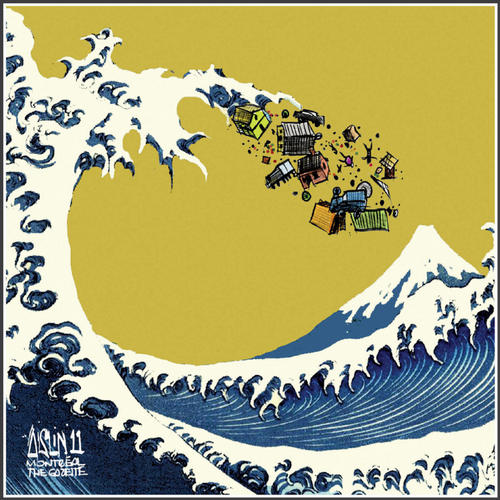
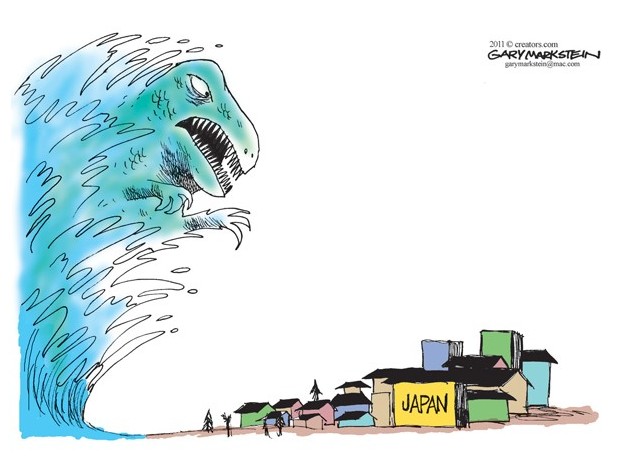
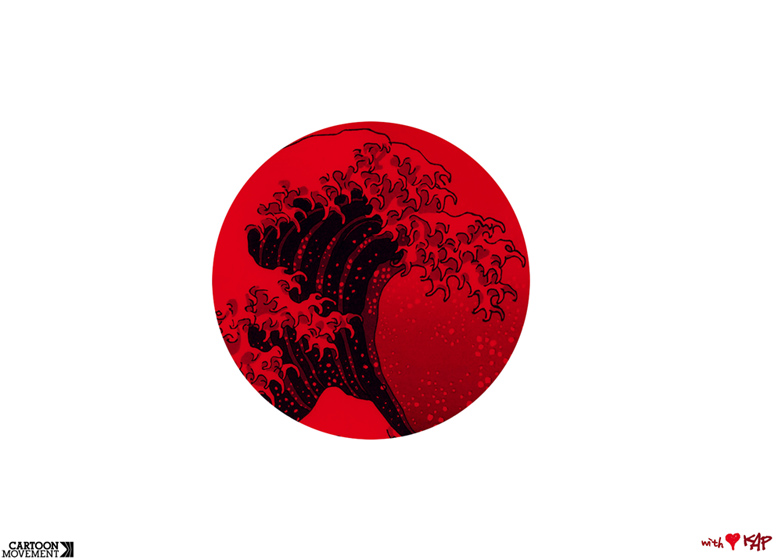
And cartoonists are capturing the planetary sentiment with their usual economy of words.
Cartoon by Terry Mosher, The Star, Toronoto, CanadaCartoon by Gary Markstein, Copyright 2011 Creators SyndicateCourtesy: Cartoon Movement
There is a well known Chinese proverb, which was supposedly favoured by Mao Zedong, saying “Women hold up half the sky.” Despite this, women have had to fight for their rightful place society for much of history — and the struggle for gender equality continues in the 21st Century.
International Women’s Day (IWD), which falls on March 8, symbolizes this long-running quest. This year marks the centenary of the worldwide observance that started in Europe.
Wiz Quiz this week, coinciding with IWD, starts off with a few questions on women’s rights and gender equality, and then roams the knowledge universe exploring other topical matters.
But not before we talk about the Convention on the Elimination of All Forms of Discrimination Against Women (CEDAW), adopted by the United Nations General Assembly some years ago, and UN Women , the newest UN agency established on in July 2010 ‘to lead, support and coordinate the work on gender equality and the empowerment of women at global, regional and country levels’.







 Open Minds!