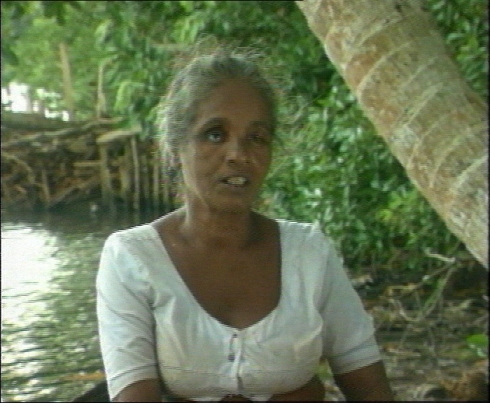
Lakshani: A child of the sea travels beyond the seas…

Lakshani photo by TVEAP

Our teacher said our country is small and is surrounded by the sea….she showed it on the globe.”

With these words, young Lakshani Fernando (photo, above) begins telling us the compact story of her short life.

Lakshani, 9, has lived by the sea (Indian Ocean) from the time she was born. When she was just six, the Asian Tsunami of December 2004 destroyed their beachfront house in Koralawella, Moratuwa, on Sri Lanka’s western coast. More than three years later, when my colleague Buddhini Ekanayake met Lakshani in March 2008, the family was still struggling to raise their heads from that massive blow.

A day in Lakshani’s life is the story of a short, 3-minute film that Buddhini produced for TVE Asia Pacific a few weeks ago. It’s part of an Asian and African television co-production project that is about, for and by children.

In the film, Lakshani shares the highlights of a typical day. That includes going for a walk on the polluted beach with her fisherman father, spending a few hours at the nearby school and playing with neighbourhood children. While at it, she tells us her wishes for a cleaner beach and a better neighbourhood.

Buddhini called Lakshani a ‘Child of the Sea’. Even the cruel waves of the tsunami didn’t scare Lakshani away for too long.

I love to play with waves…” Lakshani says towards the end of the film. Then she looks far out at the horizon, and talks again. “There are ships far out at sea. That’s all there is…

She might not yet imagine lands beyond ships and waves, but last week, her story travelled across the seas. Over 500 broadcast media managers, journalists and researchers from around the world, who’d gathered in Kuala Lumpur, Malaysia, for Asia Media Summit 2008, had a glimpse of Lakshani when the first 90 seconds of the film was screened during plenary.

Elizabeth Smith, secretary general of the Commonwealth Broadcasting Association (CBA), chose an extract from Lakshani’s story to introduce the media initiative. Sitting in the audience, I immediately texted the news to Buddhini.

Watch “I am A Child of the Sea”:

This film forms part of a series that has 20 TV producers from 13 countries engaging in a co-production of a short programmes series (mini documentaries) about and for children. The series is the outcome of a regional project organised by the Asia Pacific Institute for Broadcasting Development (AIBD) in collaboration with the French Ministry of Foreign affairs, the Commonwealth Broadcasting Association (CBA), Thomson Foundation, Prix Jeunesse, Children and Broadcasting Foundation for Africa and RTM-IPTAR of Malaysia.

The project tries to capture cultural diversity through the eyes of children. When its concept first reached us, it was defined very narrowly in terms of ethnicity and/or religion. TVE Asia Pacific being a strictly secular organisation, we couldn’t fit into such a tight range. Besides, we realised that many modern day children have a self identity that goes above and beyond the race and religion that blind chance of birth assigned to them.

So we took an editorial decision: instead of doing a story that highlights factors that utterly and bitterly divide humanity (such as race and religion, both of which fuel the long-drawn war in Sri Lanka), we would look for a unifying factor. The tsunami’s killer waves, when they rolled in, didn’t care for our petty human divisions. For a few days and weeks following the tragedy, Sri Lanka was united in shock and grief in a manner I have never seen in my 42 years of living here. (Then we went back to killing each other again.)

The result of our search was Lakshani and her story captured in ‘I am a Child of the Sea’.

Buddhini chose to feature Lakshani after interviewing 10 children from different localities and a diversity of cultural backgrounds. (Never once did she ask for the child’s religion, which unlike ethnicity is not always apparent from the name.) There was some significance in featuring a child who identifies herself closely with the Sea in a country where tens of thousands of tsunami-affected people have still not come to terms with the sea. Even after the tsunami destroyed their home, Lakshani’s family moved to a ‘temporary’ shelter within sight of the sea. Thus, her story had a close association with the sea which formed part of her lifestyle, environment and culture.

Buddhini developed the script after several leisurely chats with Lakshani, based partly on the child’s own writing about herself. Filming the story took place in early March 2008, with the full consent of her parents, extended family and neighbours. Read more about the making of this film on TVEAP website and on Buddhini’s own blog.

TVEAP crew filming Lakshani's story

Lakshani’s story is symbolic at another level. It reveals how, despite receiving a massive outpouring of donations from all over the world, some tsunami-affected families are still struggling to put together their shattered lives. The litany of woes, missed opportunities and sometimes outright plundering of donations came out strongly in the first hand accounts of affected people (in India, Indonesia, Sri Lanka and Thailand) who spoke to us during the Children of Tsunami media project. Read our reflections on the project in Communicating Disasters book published in 2007.

Lakshani’s family is not typical of Sri Lanka’s tsunami affected persons. Unlike most such families, the Fernandos live on the western coast, relatively close to Colombo. Although wave action destroyed or damaged beachfront homes in these areas, most attention was focused on areas in the south, east and north of the island that were hit much harder. So those affected and living on the west coast have often been overlooked or dismissed lightly. In this sense, Lakshani’s family has some parallels with what I called ‘step-children of tsunami’.

There is a bit more cheerful post-script to this story. During several visits to Lakshani and family for researching, filming and editing this film, Buddhini (who has a daughter aged four herself) bonded with the girl. It became more than a mere film-making venture, and has led to a lasting relationship. Meanwhile, young voice artiste Shanya Fernando, who rendered Lakshani’s Sinhala voice into English for an international audience, has also felt an attachment to the ‘star’ of our film.

While the film was made with the informed consent of Lakshani’s family who received no material benefits for their participation, both Buddhini and Shanya have since presented some basic educational gifts to Lakshani — who is certainly in need of such help. And who am I to stand in the way of such gestures of human kindness?
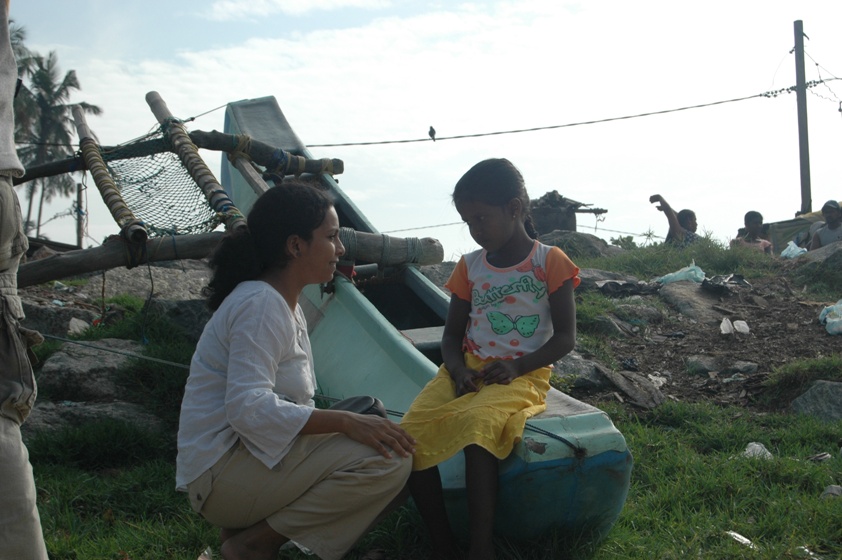
Producer BUddhini with Lakshani

Photos by Amal Samaraweera, TVE Asia Pacific
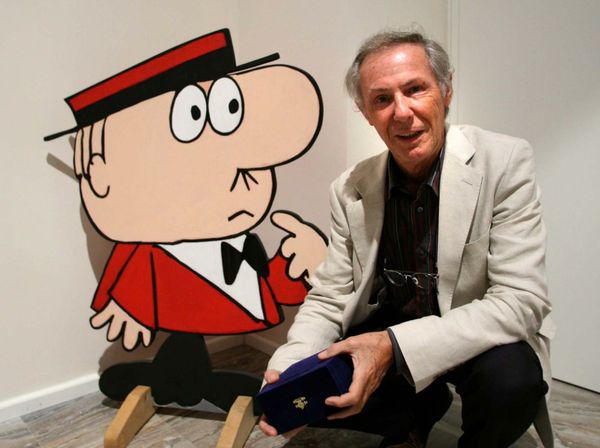
Don’t say a word: Men, women and Bruno Bozzetto

I just wrote a blog post titled Children of Heaven: Appreciating the sound of silence. Reviewing the 1997 movie by Majid Majidi, I remarked about his strategic use of silences in his soundtrack – we must never underestimate its power in the right place.

Other creators of moving images do their magic with a good sound track – but sometimes without using a word of dialog. Here’s a clever example I’ve found on YouTube – it is by Italy’s leading animator, Bruno Bozzetto (photos below, courtesy Bruno Bozzetto website).

Bruno Bozzetto

Titled Femminile & Maschile (Feminine and Masculine), this 2-D animation was made in 2004. I can’t find a synopsis online, but one website introduced it simply as follows: Some situations that show the difference of behaviour between men and women in the everyday life.

Anyone with a sense of humour can appreciate this piece – and I hope that includes die-hard feminists…

Here’s the intro from Wikipedia:
Bruno Bozzetto (born March 3, 1938 in Milan, Italy) is an Italian cartoon animator, creator of many short pieces, mainly of a political or satirical nature. He created his first animated short “Tapum! the weapons’ story” in 1958 at the age of 20. His most famous character, a hapless little man named “Signor Rossi” (Mr. Rossi), has been featured in many animated shorts as well as starring in three feature films: “Mr. Rossi Looks for Happiness” (1976), “Mr. Rossi’s Dreams” (1977), and “Mr. Rossi’s Vacation” (1977). Read the rest of his profile on Wikipedia

Earlier this week, to mark Earth Day on 22 April 2008, I took part in a half hour, live interview with Sri Lanka’s highest rated, most popular channel, Sirasa TV. I wanted to relate the global to not just the local but also to the individual and family level. To discuss how our lifestyle choices and consumer decisions affect that planet, I used a series of brilliant cartoon animations that Bruno Bozzetto had done some years ago for WWF.

Again, without having his characters utter a single word, Bozzetto gives out profound messages through images and musical sound track. This is why I keep saying that when it comes to the sheer economy of words, we writers just can’t beat cartoonists.

Sorry, I can’t locate these anywhere online (YouTube lists dozens of his other creations, but not this series — which I can’t even find on his own website.) It’s time for someone to revive this series, for their message is even more relevant for today’s climate-challenged world…

Bruno Bozzetto entry on Internet Movie Database
Visit the official website of Bruno Bozzetto
Watch other Bruno Bozzetto short animations online

TVE Asia Pacific says Thank You to Sir Arthur C Clarke

In his 1992 book How the World Was One, Sir Arthur C Clarke described a dream: one day in the near future, CNN founder (and then owner) Ted Turner is offered the post of World President, but he politely turns it down – because he didn’t want to give up power!

Just three years later, the then Secretary General of the UN suggested that CNN should be the 16th member of the Security Council. Sir Arthur was fond of quoting this, and once famously told Turner: “You owe me 10 per cent of your income”.

These references – illustrating the power of globalised satellite television – are recalled in TVE Asia Pacific‘s official tribute to Sir Arthur C Clarke, who passed away on March 19 aged 90.

“With the death of Sir Arthur C Clarke, TVE Asia Pacific has lost a long-standing friend and supporter,” the tribute says.

It adds: “Since our establishment in 1996, Television for Education Asia Pacific – to use our full name – has been engaged in pursuing Sir Arthur’s vision of using the potential of moving images to inform and educate the public. Our founders chose to focus on covering development and social issues, with emphasis on the Asia Pacific region – home to half of humanity and where Sir Arthur spent the last half century of his life.”

Although he never held a formal position at TVEAP, Sir Arthur was an informal adviser and mentor to the regional media organisation whose work across Asia Pacific is only possible thanks to the comsat that invented and the web that he inspired.

By the time TVEAP was created in the mid 1990s, the satellite TV revolution was well underway in the Asia Pacific region, and the internet revolution was just taking off. In informal discussions, Sir Arthur advised us to always keep our eyes open on what’s coming up. In the ICT sector, he cautioned, being too closely wedded to one technology or system could lead to rapid obsolescence.

The tribute mentions Sir Arthur’s specific support for the Children of Tsunami media project, and the Communicating Disasters publication.

We also talk about Sir Arthur’s concerns about using information and communication technologies (ICTs) to benefit the poor and other disadvantaged groups – a process that he aptly described as ‘geek to meek’.

We end by recalling how TVEAP recorded and uploaded to YouTube Sir Arthur’s last public video address – his 90th birthday reflections in December 2007.

Read TVEAP’s tribute to Sir Arthur C Clarke, 1917-2008

sir-arthur-clarke-reflecting-on-90-orbits.jpg

Sir Arthur C Clarke, 1917-2008: The Final Goodbye from Colombo

Later blog post on 23 March 2008: Arthur C Clarke embarks on Final Odyssey

the-last-goodbye-from-colombo-photo-by-shahidul-alam.jpg

‘This is Arthur Clarke, saying goodbye from Colombo….’

This was the characteristic signing off Sir Arthur C Clarke used whenever he made a video greeting to an international meeting on some important issue somewhere on the planet.

From disarmament and new communications technologies to space exploration and conservation, he would offer the uniquely Clarkian take on the subject – in his witty, insightful and funny style.

I have worked with and for him for half my life – 21 years – as part of his personal office in Colombo, Sri Lanka (not to be confused with the government-run Arthur C Clarke Institute which he had nothing to do with). In that time, I helped film a significant number of video greetings to gatherings of the world’s movers and shakers.

Some of these were assemblies of sombre men and women in suits at the United Nations, Davos or Pentagon. Sir Arthur would deliberately poke fun at the pomposity and self-importance of these types, in a way that they could still laugh – even at their expense.

Other events were less formal, but no less important: glittering gatherings of Hollywood or Silicon Valley professionals – some of who have more ‘soft power’ worldwide than military generals or secretary generals. Again, he would challenge the boundaries of imagination of these professionals whose mega-billion industries were built largely on imagination.

In all these and more, Sir Arthur demonstrated another quality: the great economy of words. He hardly spoke for longer than ten minutes, or 600 seconds. The Grandmaster of the Soundbyte that he was, he knew just how to pack the right mix of power, fun and sense of wonder into each second.

Confined to a wheelchair in Sri Lanka – the country he adopted – in later years due to Post Polio, Sir Arthur used either satellite links or the web to connect to many important scientific, literary and entertainment gatherings in far corners of the planet.

And yes, he did often remind his eager listeners that he invented the communications satellite in his spare time in 1945 – and one of short stories (Dial F for Frankenstein) inspired a British computer scientist to invent the world wide web.

When Sir Arthur said his Final Goodbye from Colombo in the early hours of 19 March 2008 at Colombo’s Apollo Hospital, there was no global witness. He was in the company of just five people – comprising family and staff.

Aptly, however, the news of his demise went right around the world at the speed of light thanks to the comsat and web. In less than an hour, the whole world knew.

And now its the world’s turn to say Goodbye to its most trusted ‘Man in the Future’. The world remembers, salutes and celebrates his genius, humanity and imagination.

In doing so, many have turned to the last video greeting that Sir Arthur made, just a few days ahead of his 90th birthday (16 Dec 2007). This is about how that video was made.

For once, there was no specific invitation from anywhere. But for several weeks running up to his birthday, we had seen considerable media and fan interest on how he feels like completing 90 orbits around the Sun.

So in the last days of November 2007, I suggested to Sir Arthur that we should film a short video message – openly addressed to the whole world, sharing his reflections on turning 90. He liked the idea, and as has been the custom in recent years, asked me to draw up his speaking points.

I spent several days going through dozens of his essays and speeches, both published and unpublished. When I had a draft, we worked long and hard on it to get everything just right. I saw how he could still ‘Clarkise’ any piece of writing, which showed no sign of wear and tear for the 90 orbits.

This was a ‘no-budget’ production. Sir Arthur’s personal photographer Rohan de Silva had done many video greetings using a home video camera, but he and I agreed that this should be done more professionally. I mentioned the idea to our friends at Video Image (Private) Limited, the country’s top production company who had filmed with Sir Arthur for so many global TV channels and international clients. They immediately agreed to do it – for free.

We didn’t have a tele-prompter, but realised the importance of Sir Arthur looking straight at his audience. So in just a couple of days, Brian Ratnasekera of Video Image improvised a working unit.

I directed the shoot with Video Image crew on 5 December at Sir Arthur’s home. Allowing several breaks for him to catch his breath, our filming took the better part of that morning.

The filming got off to a bumpy start. First the improvised tele-prompter had some teething problems, but these were quickly sorted. Then, in a very rare moment of disagreement, Sir Arthur said he wanted to be filmed wearing his Nehru jacket (which he affectionately called ‘My Doctor No suit’).

We had already donned him in a colourful bush shirt and crew and I felt that this was the right attire for a message that was intensely personal and somewhat wistful. The shirt with large prints was far more characteristic of Arthur C Clarke than any formal suit. At that moment, I was the shoot’s director and not his long-standing spokesperson who would be more agreeable with his views and wishes.

A few tense moments passed. Then one of Sir Arthur’s valets had a brainwave. Why not use the casual NASA jacket that Sir Arthur often wore when he felt the air conditioning was getting a bit too cold?

That saved our shoot. He compromised, trading Nehru for NASA. Within seconds, he was back to his normal cheerful self. When the shoot got underway, he was at ease, speaking right to the camera and looking straight at millions of unknown viewers who would watch it for years to come.

Reading our text scrolling gently upward on the tele-prompter, he missed out just one word out of nearly 900. We only needed to do a single re-take. That was impressive for a man who’d recently had cataract operations in both eyes.

In the end, I knew we had a great piece – one where he looked back at a most remarkable career of our time, and looked forward to what lies in store for humanity.

Over the next two days, my colleagues at TVE Asia Pacific did a simple edit – stringing together the few segments he’d filmed with breaks in between. Our IT Specialist Indika Wanniarachchi uploaded it to TVEAP’s YouTube channel on 9 December 2007. The next day, VideoImage uploaded it to their YouTube channel.

This itself made some international news and and soon became a hit on YouTube.

Read the full transcript on TVEAP website

After surveying what has, by all measures, been a highly remarkable life and the astounding rate of technological development he has witnessed, Sir Arthur listed three ‘Big Wishes’ that he wanted to see happen – ideally in his life time (alas, that was not to be).

Finally, he offered some personal views on posterity – a subject on which he’d been ambivalent at times.

This is perhaps the most consequential of his birthday reflections. In his own words: “I’m sometimes asked how I would like to be remembered. I’ve had a diverse career as a writer, underwater explorer, space promoter and science populariser. Of all these, I want to be remembered most as a writer – one who entertained readers, and, hopefully, stretched their imagination as well.”

He ended the message by quoting another English writer — who, coincidentally, also spent most of his life in the East — Rudyard Kipling:
“If I have given you delight
by aught that I have done.
Let me lie quiet in that night
which shall be yours anon;

And for the little, little span
the dead are borne in mind,
seek not to question other than,
the books I leave behind.”

That’s also how he ended his 9-minute birthday video – but upon reflection, it seems to me that he used that to bid a fond farewell to his millions of fans and readers worldwide. Perhaps his famous crystal ball told him something…

He signed off: This is Arthur Clarke, saying Thank You and Goodbye from Colombo!

nalaka-gunawardene-with-sir-arthur-clarke-photo-by-shahidul-alam.jpg

And this is Nalaka Gunawardene, saying Thank You and Goodbye to Sir Arthur. It was the greatest privilege of my life to have worked with you.

Photos by Shahidul Alam, Drik Picture Library, taken in Sir Arthur’s study in Colombo in Feb 2007

Read Shahidul’s recollections: Venturing into the impossible


Posted on 23 March 2008: Arthur C Clarke: Of Nukes and Impotent Nations

Posted on 23 March 2008: Arthur C Clarke: My Vision for Sri Lanka in 2048

Unseen women, unheard agonies

In January 2008, I wrote about Lakshmi and Me, a recent Indian documentary that portrayed a domestic worker woman whom my friend Kalpana Sharma aptly called an invisible superwoman.

A colleague who read my piece reminded me about a series of five short films on working women in Sri Lanka that I had executive produced in 1999-2000. Produced originally in Sinhala for a national audience, the series was titled Oba Nodutu Eya (The Unseen Woman). In fact, it featured not one but several women workers in two different sectors in the country’s informal economy: the coconut husk (coir) industry in the south and agricultural settlements in the Dry Zone in the north-central areas of the island.

The following is adapted from a story I wrote about this series for a book that TVE Asia Pacific published in 2002. I have not gone back to my sources to check how much – or how little – has changed in the past several years.

yasawathie-from-a-voice-without-a-sound.jpg

This is Yasawathie. She has suffered physical and mental abuse most of her adult life. Her alcoholic husband beat her regularly for years, but she dared not complain for fear of reprisal.

“He injured my head, stabbed me and once fractured my arm” she says, showing a scar of a healed wound.

As if this suffering was not enough, she lost sight in one eye a few years ago in a bizarre hospital accident. She had gone to the government hospital seeking treatment for a chest ailment. There were more patients than beds, so she was forced to sleep on the floor. While sleeping, a nurse carelessly dropped a saline stand on to Yasawathie’s face.

The entire incident was hushed up, and the poor woman was intimidated into silence. “Sometimes patients even die at our hands,” the nurse told her threateningly.

Injured by the healthcare system, battered by her own husband and pressurised by her family circles to keep quiet about, this middle aged Sri Lankan woman has run out of options. She was not aware she could claim damages for the accidental loss of her eye. She does not realise there is legal redress for domestic violence – her family and in laws wouldn’t allow it in any case.

Sadly, Yasawathie is not alone. There are tens of thousands of women like her who live on the margins of society, and whose suffering goes largely unnoticed. The island nation is often cited as a South Asian success story: its women were the first in Asia to vote; female literacy is nearly universal; and a higher percentage of girls and young women are in school than boys.

But hidden beneath these national accomplishments, there are huge gender-based disparities and gaps, especially in economic, labour, family and property related matters. Studies have found that many women, particularly the poorer ones, don’t know their human and legal rights.

And even women who do know their civil and political rights often do not assert their right to safeguard themselves from domestic violence or gender-based discrimination in family and society.

Yasawathie’s story was one of several that were featured in a television documentary series that probed how Sri Lankan women’s economic and legal rights operate in the real world. Produced in 1999-2000 by TVE Asia Pacific in collaboration with the Sri Lanka Environmental Television Project (SLETP), the series went beyond the oft-repeated claim of women’s emancipation in Sri Lanka. It uncovered a shocking reality of wide spread rights denial, physical abuse and gender-based violence.

The series used a mixture of short drama segments, interviews and background commentary. “These films don’t offer comprehensive surveys of the situation, but they provide useful glimpses of how economic and legal rights apply at the grassroots for women,” said accomplished fim-maker Inoka Satyangani, who directed the series. “We raise broader concerns, and point out changes that society needs to make to ensure that women can assert their rights.”

Violence against women is both a public and private matter in Sri Lanka, says the Committee on the Elimination of Discrimination against Women (CEDAW), a body of global experts which monitors whether governments are honouring their commitments to the 1981 United Nations’ Women’s Convention. Although violence affects women of every class and ethnicity, it is seldom reported.

In recent years, human rights abuses in Sri Lanka’s conflict ridden north and the east have received international scrutiny; both the government forces and Tamil Tiger rebels have committed atrocities. But violence against women is not confined to the war or the conflict-affected areas: as one rights activist has remarked, “everyone becomes part of the larger system of brutality”.

CEDAW has stressed that Sri Lanka needs specific legislation to address violence behind closed doors.

from-oba-nodutu-eya-tv-series.jpg

The TV series also found how women get paid less than men for agricultural manual labour, and how government-driven land development schemes favour men to inherit state land distributed among the landless. Government agricultural extension programmes help male farmers to obtain skills training, credit and subsidies while women farmers are constantly ignored. Women interviewed had stories that shattered the myth of women’s liberation and equality in Sri Lanka.

Read individual synopses of the five films in The Unseen Woman series

Read recent blog post: Half the sky, most of the suffering and seeking everyone’s attention

Fighting for our right to ‘shoot’: A struggle in New York…and Colombo!

Courtesy AP

Photojournalists usually bear witness to unfolding events, and then share it with the rest of us. It’s not everyday that they make the news themselves.

This photojournalist, Gemunu Amarasinghe working for Associated Press in Sri Lanka, just did. Earlier this week, he was detained, questioned and released by police — all for taking photographs near a well-known Colombo school.

According to news reports, Gemunu was apprehended by a group of parents who formed the school’s civil defence committee. They had handed him over to soldiers on duty near by, and he was briefly detained by the Narahenpita police. Sri Lanka’s Free Media Movement has already protested to the police chief on this – the latest in a series of worrying incidents.

This might seem a minor incident in the context of highly dangerous conditions in which Sri Lankan journalists operate today. It was only a few days earlier that the World Association of Newspapers ranked Sri Lanka as the third deadliest place for journalists (6 killed in 2007), behind only Iraq and Somalia.

In an op ed essay published today on the citizen journalism website Groundviews, I have discussed the far reaching implications of this latest trend – when misguided citizens turn on professional or citizen journalists simply taking photos in public places. That’s still not illegal in Sri Lanka, where many liberties have been curtailed in the name of anti-terrorism.

Read my full essay: Endangered – Our Right to ‘Shoot’ in Public

As I write: “Gemunu’s experience is highly significant for two reasons. Firstly, it is depressing that some members of the public have resorted to challenging and apprehending journalists lawfully practising their profession which responds to the public’s right to know. Battered and traumatised by a quarter century of conflict, Sri Lankan society has become paranoid. Everything seems to be ‘high S’: practically every city corner a high security place; every unknown person deemed highly suspicious; and everybody, highly strung.

Courtesy Daily Mirror - Sri Lanka Cartoon from Daily Mirror, Sri Lanka

“Secondly, far from being an isolated incident, this seems to be part of a disturbing new trend. Anyone with a still or video camera in a public place is suspected – and presumed guilty until proven otherwise. This endangers everyone’s basic right to click for personal or professional purposes.”

I mention some examples of this cameraphobia. In recent months, pedestrians who filmed public bomb attacks on their mobile phones have been confronted by the police. One citizen who passed on such footage to an independent TV channel was later vilified as a ‘traitor’. Overly suspicious (or jealous?) neighbours called the police about a friend who was running his video editing business from home in suburban Colombo.

None of these individuals had broken any known law. Yet each one had to protest their innocence.

It may not be illegal, but it sure has become difficult and hazardous to use a camera in public in Sri Lanka today. Forget political demonstrations or bomb attacks that attract media attention. Covering even the most innocuous, mundane aspects of daily life can be misconstrued as a ‘security threat’.

I stress the point that, unlike journalists working in the mainstream media, citizen journalists lack trade unions or pressure groups to safeguard their interests. The citizen journalist in Sri Lanka is very much a loner — and very vulnerable.

And it’s not just in war-torn Sri Lanka that the right to take photos or film video is under siege. I cite a recent example from what is supposed to be a more liberal democracy: in the US, where New York city officials last year proposed new regulations that could have forced tourists taking snapshots in Times Square and filmmakers capturing street scenes to obtain permits and $1 million in liability insurance. The plans were shelved only in the face of strong public protests, spearheaded by an Internet campaign that included an online petition signed by over 31,000 and a rap video that mocked the new rules. Photographers, film-makers and the New York Civil Liberties Union played a lead role in this campaign, which asked people to ‘picture New York without pictures of New York’.

Read my full essay: Endangered – Our Right to ‘Shoot’ in Public

Sep 2007 blog post: Kenji Nagai (1957 – 2007): Filming to the last moment

Dec 2007 blog post: Asian tsunami – A moving moment frozen in time

Suharto’s legacy: Mass grave Indonesia

“One death is a tragedy. A million deaths is just a statistic,” said Joseph Stalin — and he knew what he was talking about.

These words came to my mind as I followed the news coverage and commentary about the death on 27 January 2008 of Suharto, the former Indonesian military leader, and the second President of Indonesia, who was in office from 1967 to 1998.

Many western and globalised media reports touched on Suharto regime’s alleged mass-scale corruption, and the dizzy heights that crony capitalism reached under his watch.

But few talked about the genocide of unarmed, innocent civilians that took place in the years that brought him to power, 1965-67. Another blood bath took place in 1975 when Indonesian forces invaded and took over East Timor. Even those that touched on the subject used varying estimates of how many perished.

The Guardian (UK) obituary estimated the number killed in 1965-67 to be around 600,000. Others, such as BBC News, placed it at half a million, noting that “the bloodshed which accompanied his rise to power, after a mysterious coup attempt in 1965 which he blamed on Indonesia’s then-powerful Communist Party, was on a scale matched only in Cambodia in this region”.

In all probability, no one really knows the real number of Indonesians were slaughtered as the army – cheered by anti-communist west – cracked down on members and supporters of the Communist Party of Indonesia, at that time a legal political party. Genocidists don’t like to keep detailed records.

The New York Times, a long-standing cheer-leader of the ‘smiling general’, acknowledged that Suharto’s 32-year-long dictatorship was ‘one of the most brutal and corrupt of the 20th century’.

NYT added: “His rule was not without accomplishment; he led Indonesia to stability and nurtured economic growth. But these successes were ultimately overshadowed by pervasive and large-scale corruption; repressive, militarized rule; and a convulsion of mass bloodletting when he seized power in the late 1960s that took at least 500,000 lives.”

On the whole, however, the mainstream media has been far more preoccupied with the (admittedly important) issue of how much Suharto and family stole than how many people were killed extra-judicially during his regime.

In that respect, things haven’t changed all that much since Suharto was driven out of power by mass protests. American economist and media analyst Edward S Herman, who co-authored Manufacturing Consent with Noam Chomsky, wrote a commentary nearly 10 years ago titled Good and Bad Genocide: Double standards in coverage of Suharto and Pol Pot.

His opening para:
“Coverage of the fall of Suharto reveals with startling clarity the ideological biases and propaganda role of the mainstream media. Suharto was a ruthless dictator, a grand larcenist and a mass killer with as many victims as Cambodia’s Pol Pot. But he served U.S. economic and geopolitical interests, was helped into power by Washington, and his dictatorial rule was warmly supported for 32 years by the U.S. economic and political establishment. The U.S. was still training the most repressive elements of Indonesia’s security forces as Suharto’s rule was collapsing in 1998, and the Clinton administration had established especially close relations with the dictator (“our kind of guy,” according to a senior administration official quoted in the New York Times, 10/31/95).”

Suharto’s demise reminded me of a powerful short documentary I saw a few years ago. Titled Mass Grave Indonesia, it was directed by courageous young Indonesian journalist Lexy Junior Rambadeta (photos below).

Lexy Rambadeta

He works as a freelance TV journalist for international news agencies, and is a key member of the Jakarta-based media collective Off-Stream. It was started Off Stream in 2001 by journalists, filmmakers, photographers and multimedia artists “who have strong commitments and creativities on catering, promoting, covering, documenting and producing multiculturalism documentary video/film, photography and multimedia products”.

OffStream lists as its mission: To give a voice to “survivors of horror”; To tear down walls of “silence”; and To denounce “injustice” and “barbarism”.

One of their first productions was Mass Grave Indonesia, whose synopsis reads:
“Approximate between from 500 000 to 3 million of people in Indonesia have been killed by Soeharto’s regimes and buried somewhere in the wood distributed. A full and frank account of what happened in the reburial of 26 victims of horror in the 1965 mass killings. This documentary film weaves its story against the tide by presenting evidence of cruelties sponsored by the military in two regions of Central Java.”

I have just tracked down the 19-minute film on YouTube, presented in two parts:

Mass Grave – Indonesia: Part 1 of 2

Mass Grave – Indonesia: Part 2 of 2

This is no western film, filmed by visiting foreign journalists who might be accused of having one agenda or another. This is a film made by Indonesia’s own journalists who found their voice and freedom after the Suharto regime ended in 1998.

I have emailed Lexy this week asking how this film – and agitation by many human rights and democracy activists – have helped bring about belated justice to his own people. I await his reply, which will be published when received.

Engaging new media: prepare to lose control!

The development community never tires of talking about the value of participatory, two-way communication. Every workshop, report and discussion has a dose of this mantra sprinkled all over.

Yet when it comes to actually practising communication, most development agencies I know are so concerned with complete control – they want to edit endlessly, fine-tune their messages to the last letter and comma, and regulate how and where the message is disseminated.

There’s no harm in being organised and focused. But when communication officers are pushed into becoming publicity agents (or worse, spin doctors!) for their agencies, controlling the message becomes obsessive.

I’ve had more than my fair share of this. One example was when working on a documentary for a leading UN agency in Asia that my organisation, TVE Asia Pacific, was commissioned to produce. Now, films cannot be made by committees, but UN agencies never stop trying. At one point, over-zealous agency officials were tinkering with the post-shooting script so much that they edited even the interview clips included in the draft.

That only stopped when I pointed out that hey, those are transcribed verbatim from interviews we’d already filmed!

So imagine how hard it would be for such organisations to let go of the Complete Control over communications that they’ve aspired to perfect for so long.

And yet, as I told a small meeting convened by UNEP in Bangkok last week to plan their next ozone communication strategy for Asia Pacific, that’s not a choice, but an imperative with today’s new media.

In the four years since we worked on the last ozone communication strategy and action plan for the Asia Pacific, we have seen the emergence of web 2.0 – which is really a catch-all term that covers many second generation, interactive platforms and opportunities that have emerged using the global Internet.

Among these are blogs, wikis, social networking sites (e.g. MySpace, Facebook), social bookmarking (e.g. del.icio.us), video exchange platforms (e.g. YouTube), online games and mobile applications.

These and other new media tools enable development communicators to reach out to, and engage, many people – especially the youth who make up more than half of all Asians.

web-20-illustrationsvg.png

But that’s part of the challenge, I said, referring to what I call the ‘Other Digital Divide’ – one that separates (most members of) the development community from ‘Digital Natives’, young people who have grown up taking these digital media and tools completely for granted.

I referred to my remarks at the IUCN Asia Conservation Forum in Kathmandu in September 2007, where I stressed the urgent need for the conservation and development communities to cross this divide if they want to reach out to the dominant demographic group in our vast region, home to half of humanity.

Engaging new media is not just setting up a Facebook account, taking a YouTube channel or opening a blog that’s infrequently updated. All that’s useful, for sure, but they represent only the tentative first steps to the wide and varied new media world.

As with the more established print and broadcast media, development organisations need to have a strategy and a plan based on some research, analysis and reflection.

And willing to let go of that control – so cherished by so many development professionals – is an essential part of that adjustment to the new media reality.

Failure to adjust can result in future shocks – and in the very near future! Perhaps I should also have drawn their attention to what I wrote in October 2007: New media tsunami hits global humanitarian sector; rescue operations now on

We didn’t spend too much time talking about new media at the Bangkok meeting, but I did caution that there is a lot of digital hype out there. I’m no expert on this (is anyone, really?) but my team at TVEAP and I keep trying new ways of doing things with the new media. So here are a few quick insights I offered the UNEP meeting:

• New media lot more interactive, which means they demand a lot of time and effort to engage the audience – which in turn generates huge capacity requirements for any development organisation venturing into such media.

• You can’t always control your messages on new media! This unnerves many development agencies and professionals who are so used to exercising such control – in the new media world, they just have to learn to let go!

• A core value is user-generated content (USG). You need to find creative ways to allow your audiences to generate part of the content. Control lost again!

• Citizen journalists have now established themselves online as text and/or video bloggers. Governments and corporations have acknowledged their presence — serious bloggers have recently been granted media accreditation to the UN. What does this mean for future ozone media training and journalists engagement?

• There are many companies and agencies claiming to have cracked the new media challenge – and don’t believe them! Everyone is learning, some admittedly faster than others, but there’s no substitute to actually doing it.

• And there’s no road map to the new media world, which is being created every day and night by an army of geeks and enthusiasts. There are only a few rough guides and travellers’ tales from some like ourselves who have ventured into this realm.

Note: I am grateful to my colleagues at TVE Asia Pacific who have developed and/or tested out some ideas in this blog post: Manori Wijesekera, Indika Wanniarachchi and Nadeeja Mandawala. I stand on their shoulders, hopefully lightly!

Release Ozzy Ozone held prisoner by brand guardians!

In September 2007, I wrote about Ozzy Ozone, an energetic, cheerful little ozone molecule – part of the ozone layer in the upper atmosphere that prevents the Sun’s harmful ultra-violet rays from coming through and causing skin cancer, cataract and other health problems.

Ozzy Ozone is part of a global public education effort by the UN Environment Programme (UNEP) to tell everyone how harmful UV rays are to our health, and how Ozzy and his fellow ozone molecules are literally protecting life on earth from being zapped out.

I called Ozzy the little molecule on a big mission — to tell all humans to soon phase out using certain chemicals that, when released to the air, go up and destroy his kind.

Last week, while attending a UNEP meeting in Bangkok to plan the next ozone communication strategy for Asia Pacific, I heard some disturbing news: little Ozzy has become a prisoner of his brand guardians. As a result, he is not as free as he could be to roam the planet, spreading the vital ozone message.

Anne Fenner, Information Officer of UNEP’s OzonAction Programme revealed how she routinely turns down requests to produce toys and other material using the popular character.

“I have had so many requests from companies, but we cannot allow commercial exploitation of this brand,” Anne said.

I was stunned. Here is one of the more popular communication products to emerge from the UN, not generally known for such successful engagement of popular culture. And there we were, brainstorming on ways to get the ozone message to large, scattered (and distracted) audiences.

Ozzy was created by a graphic artist in Barbados, as part of a government-supported campaign to raise public awareness on ozone layer thinning. This cartoon character served as a “mascot” and was very effective in raising awareness in Barbados. The cartoon series was printed in local newspapers. Additionally, promotional items produced for local public awareness and education campaigns using the Ozzy graphic include posters, key rings, rulers, erasers, refrigerator magnets, mouse pads, pens, pencils, stickers, and envelopes.

The character was so popular that UNEP struck a deal with Barbados to ‘globalize’ Ozzy. An animated video was produced, along with a dedicated website, comic strips and other media adaptations.

Ozzy has been a run-away success, giving UNEP a high profile, widely popular character — and a great deal of media coverage and interest. The kind of media engagement that is typically enjoyed by Unicef, the most media-savvy of all UN agencies.

But we now know that Ozzy’s brand guardians don’t allow him to go as far as he could. They may be playing by the rules, but do they realise that huge opportunities are being lost?

There we were, a small group of journalists, communicators, scientists and government officials discussing for three days how to get the biggest bang for our collectively limited buck where ozone messaging is concerned.

It was frustrating to know that the best brand ambassador has been locked up in brand integrity and copyright restrictions.

I suggested to Anne Fenner that protecting the brand integrity need not be so rigidly pursued. For example, careful franchising could be undertaken based on a set of guidelines — and the royalty could go into a trust fund that supports ozone communication work.

Indeed, the challenge for development communicators everywhere is to find the common ground between the public interest and the commercial interest. In this era of globalised media and CSR, the two interests are no longer mutually exclusive. Some might argue they never were.

The long-established copyright regimes themselves are being questioned, challenged and bypassed by a growing number of research, advocacy and activist groups. Many now publish their academic or artistic work under Creative Commons licenses, that enable their creators to be acknowledged and retain some control — and yet allow many types of uses without excessive restriction.

When TVE Asia Pacific recently released an Asian regional book called Communicating Disasters, our co-publisher UNDP Regional Centre in Bangkok proposed that the book be under Creative Commons Attribution 3.0 license. We were happy to go along.

UNEP has some catching up to do. Turning the pages of lavishly illustrated Ozzy Ozone comic story books (of which 3 titles have come out so far), I found that UNEP has the standard copyright restriction. However, they add a line: “This publication may be reproduced in whole or part and in any form for educational or non-profit purposes without special permission from the copyright holder, provided acknowledgement of the source is made.”

That’s encouraging – but not good enough. What happens if a commercially operated media organisation wants to use this content for public interest? Will they qualify under ‘educational or non-profit purposes’?

Probably not. And that’s when the dreaded copyright lawyers could come marching out.

It’s the assorted lawyers and over-cautious officials who are keeping Ozzy Ozone a virtual prisoner.

And sadly, little Ozzy is not alone. Everywhere in the publishing and media world, we can find many examples of how creative works are being held back – usually by over-protective lawyers or accountants. Sometimes that’s the case even if the artistes or media professionals themselves would much rather let go of the rights.

In July 2007, I wrote a blog post called ‘The lawyers who locked up the butterfly tree’ — which revealed how lawyers working for the publicly-funded BBC had systematically blocked a multi-award winning African documentary film from being used for environmental education, awareness and advocacy. All because the BBC had partly funded its production, and therefore had a claim on its copyright.

So here’s our plea to Ozzy’s brand guardians in UNEP: let him roam free, taking the vital message to millions. And while at it, let him make some money (from franchisees) which can suppot the rest of UNEP’s ozone communication work.

And if some spoilsport of a copyright lawyer gets in the way, tell him/her to take a beach vacation — without sunblock.

Related links:
Sep 2006: Make poverty a copyright free zone

May 2007: TVEAP renews call for poverty as a copyright free zone

Race to Save the Sky…by 2010

This is the opening segment of an Asian film that we at TVE Asia Pacific produced in 2006 for the UN Environment Programme (UNEP).

Called Return of the Ozone Layer: Are We There Yet? (30 mins, 2006), it tells the story of how the Asia Pacific – home to half of humanity – holds the key to saving the ozone layer…from man-made chemicals eating it up.

We presented it as a race…against time, and against many odds. Here’s how it opens.

You wouldn’t notice it even if you look carefully…but the Asia Pacific is running an important race.

It’s a race to phase out a group of chemicals used in industry, agriculture or consumer products.

When released to the atmosphere, these chemicals damage the Earth’s protective ozone layer. This ‘ozone shield’ protects all life from the Sun’s harmful ultraviolet rays.

These chemicals are used in refrigerators, air conditioners, fire fighting equipment, farming and a range of other products and processes.

The industrialised countries have already stopped producing these chemicals. This happened thanks to an international environmental treaty called the ‘Montreal Protocol on Substances that Deplete the Ozone Layer’. It was adopted in 1987 in response to the thinning of the ozone layer – or the ‘Ozone Hole’ –discovered two years earlier.

The Montreal Protocol sets time-bound, measurable targets for managing nearly 100 different chemicals.

These are closely tied to economic activity, public health and safety. Therefore, developing countries and economies in transition were given more time to reduce consumption — with the same goal of eventually phasing them out.

20 years on, the Montreal Protocol’s implementation has produced tremendous benefits to our health and environment.

But it’s a bit too early to celebrate.

Many challenges remain.

Developing countries now have to show they are making good use of the extra time and resources given to them.

It is the Asia Pacific that now produces and consumes most of the world’s Ozone Depleting Substances – or ODS. .

All production and use of CFCs in developing countries must stop in 2010.

But it’s easier said than done. The region has tens of thousands of small scale industries and farms that still use ozone damaging chemicals.

To accomplish the remaining phase-out targets, all
of them need to be engaged.

In this film, we look at key challenges the Asia Pacific region faces on the road to 2010. Meeting these challenges would ensure timely compliance of phase-out targets.

Clearly, governments alone cannot win this race. Millions of ordinary citizens have to join in.

Millions like the five we feature in this film.

Making this 30-minute documentary was a challenge. For a start, we had to grapple with complex scientific, economic and political issues and present them in a non-technical, accessible manner. We knew the average viewer was not interested in the intricacies of inter-governmental negotiations or atmospheric chemical reactions.

Talking about the ozone layer – which is out of sight, lying a few kilometers above the Earth’s surface – is never easy. It’s harder to get people to pay attention that sustained action is needed to remove man-made threats to the ozone layer.

Our challenge was to tell the story in a simple, engaging way — and UNEP wanted it to be different from many ozone layer documentaries already made. That’s when we decided to focus on five ordinary Asians who were doing their bit to save the ozone layer.

As our opening narration put it:

Five ordinary people, living and working in the Asia Pacific – the world’s largest and most diverse region.

Their actions will impact the future of life on our planet.

And there are millions more like them.

This is their story.

Watch the entire film (in several parts) on TVEAP’s YouTube channel.


September 2007 blog post: Ozzy Ozone: The Little molecule on a big mission