From footprints to handprints: Treading lightly on Earth…

Nalaka Gunawardene

This is me making an impression at the Global Knowledge 3rd Conference held in Kuala Lumpur, Malaysia, in December 2007. Everyone was asked to dip a hand in a saucer of paint and then press it on a large sheet of paper. In the end it created a montage of hand prints from people all over the world.

The idea was a neatly symbolic one, but as with everything else at the GK3 conference (and with its organiser, the GKP), it didn’t go any further. Good intentions, poor implementation.

But the same concept of hand print was used far more cleverly and innovatively at another large international conference I attended in November 2007. The 4th International Conference on Environment Education , hosted by the Government of India and co-sponsored by the UNESCO and UNEP, was held at the Centre for Environment Education (CEE), Ahmedabad. That multi-faceted event saw the launch of several initiatives, including Handprint – action towards sustainability.

The concept of Handprint is to decrease our ecological footprints by taking more actions towards Education for Sustainable Development (ESD).

Ecological Footprint (EF) as a concept has been around for over 15 years. The term and concept of Ecological Footprint were proposed in 1992 by William Rees, a Canadian professor at the University of British Columbia. In 1995, Rees and coauthor Mathis Wackernagel published Our Ecological Footprint: Reducing Human Impact on the Earth.

EF quantifies our demand on Nature and natural systems. It measures the amount of biologically productive land and water required to meet our demands (for food, timber, shelter), and to absorb the pollution we generate. Using this assessment, it is possible to estimate how many planet Earths it would take to support all of humanity if everybody lived a given lifestyle.

For example, if everyone aspires to European lifestyles, we are going to need three planets. And for American way of life, four.

As of now, the Earth is the only naturally habitable planet that we know and have — which drives home the point that we have to contain, and eventually reduce, our ecological footprint. Some, like this cartoonist, fear that it’s already too late…

Read Sep 2007 blog post: Talking Big Foot in Yetiland
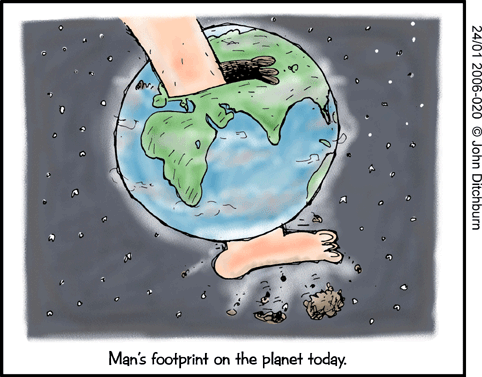
2006-020-footprint-on-the-planet.gif

Ecological footprint is a useful – in fact, revealing – measure of our species living beyond its ecological means. But it’s an inherently negative one. This is what promoted our colleagues at CEE – an internationally acknowledged centre for excellence in education for sustainable development – to come up with the related, but wholly more positive, concept of Handprint.

Whereas footprint measures our impact on the planet and its resources, Handprint will help quantify what we do to tread lightly on Earth — reducing our consumption of energy and resources, and being more considerate about the waste we generate.

As CEE says, there are many drivers of change to lessen the footprint. ESD is one of the important ones. Others include technology, policy, legal measures, systems and financial incentives.

Handprint is specifically a measure of ESD action. In the presence of over 1,000 officials, educators, activists and youth, Handprint was launched with the call: Increase your handprint; decrease your footprint!

A new website will soon be online at http://www.handsforchange.org, expanding on this concept.

While CEE is taking the concept to a whole new level and to millions who need to know and heed this message, the idea itself has been talked about by others for sometime.

For example, in May 2006, Alex Steffen wrote about it in the highly informative and inspirational website Worldchanging.

Steffen, who is executive editor of Worldchanging, wrote: “If we can imagine going climate negative, why can’t we imagine shrinking our ecological footprint until we zip past having any negative net ecological impact at all, until the operation of our daily lives heals the planet instead of hurts it? Until we transform, as I’ve said before, our ecological footprints into ecological handprints?”

TVE Asia Pacific‘s Saving the Planet TV series, currently in production, will feature a number of initiatives that will have a positive Handprint on the environment in selected countries in the Asia Pacific.

Clearly, Handprint is an area where interest and action will grow in the coming months and years.

Watch this space.

Related: Sep 2007: Way to blow our nose without blowing the planet

Photo courtesy Sasa Kralj

Can Rambo take on the Burmese junta? Not quite in 90 minutes…

Hollywood’s attempts to support progressive causes in movies continue with Rambo 4, starring Sylvester Stallone.

In the fourth and latest installment of the violent adventures of John Rambo, the Vietnam veteran takes on the Burmese junta who have held the Southeast Asian country in its crushing, ruthless grip since 1962.

Inter Press Service (IPS) journalist Lynette Lee Corporal has just written an interesting article where she talked to Burmese exiles and others involved in Burma issues. Excerpts:

“In his latest caper, a bored-looking Rambo ekes out a living catching cobras in the jungles of Mae Sot in Thailand, near the border with Burma. But the arrival of a group of Christian missionaries, whose idealism and naivete literally led them to a slaughterhouse, changes Rambo’s zombie-like existence and brings back the days of gore and bloodbath.

“The film is unapologetic in its use of cliches. It’s the same tired story: Everything is black and white, good and evil, with lots of do-or-die moments thrown in for good measure.

“‘Rambo IV’ – which started showing in Asian cinemas in January and is due to open in mid-March in Thailand — is replete with stereotypes, especially when it comes to pointing out differences between the east and the west, symbolically played out in the kindness, idealism and determination of the Caucasian missionaries and the uncouth, barbaric bad guys in the form of the Burmese pirates and military.”

She says that while reports of the cruelty of the Burmese junta have been well-documented, the depiction of these stereotypes glosses over much more complex issues too deep to dig up in a 90-minute action movie.

Her article quotes freelance Burmese journalist Phyo Win Latt as saying: “The Burmese army in the movie is different from real-life. The film is filled with exaggeration and inaccuracies. Army officers, for example, don’t wear sunglasses while engaged in battle and although there are rape cases in remote ethnic villages, I’ve never heard of such things like ethnic women being forced to dance in front of the soldiers.”

Exiled Burmese appear to have given it some positive feedback. According to a report by the Norway-based Democratic Voice of Burma (DVB), about 600 Burmese who watched the film in Singapore became very emotional, chanted slogans and distributed political leaflets at the screening.

The crowd “clapped non-stop for 80 seconds to show respect to the movie audience gathered there and to show unity” in their fight for democracy, DVB reported.

Read her full article on Asia Media Forum

I’ll just take Lynette’s word for all this, because I’m not going to see this film – I can’t take a killing every few seconds.

Watch Rambo 4 official trailer on YouTube:
Caution: Extreme violence – but then, what else do you expect in Rambo?

Rambo may have discovered Burma’s long-drawn suffering only recently, but activist film-makers have been using moving images for many years to sustain international attention on Burma’s human rights and humanitarian issues.

Almost five years ago, in May 2003, TVE Asia Pacific website ran a feature titled ‘Documentaries keep Burma issues alive‘. It was written by Indian film-maker and journalist Teena Amrit Gill, who at that time was based in Chiang Mai, Thailand — where many Burma activists are concentrated.

Excerpts:

“Long drawn internal conflicts are often overlooked or completely ignored by the global media that often chase the latest stories as they unfold. It often takes a few dedicated activists and committed film-makers to sustain focus on conflicts that no longer grab headlines – but continue to affect hundreds of thousands of people.

“As Burma and the struggle of its people, especially its ethnic minorities, against four decades of military dictatorship begin to fade from international attention, a number of new television documentaries are attempting to keep the issue alive.

“Some have been made by television professionals for international broadcast. Others have used amateur or activist footage and aim at mobilising public concern and supporting campaigns to maintain pressure on the regime.”

Teena reviewed three new films that had been produced in 2001-2002 about the plight of minority groups like the Karen, Shan and Karenni who live along Burma’s borders with Thailand, China and Laos. These minorities are the target of repressive policies of the ruling military junta in Rangoon.

Read the full article, Documentaries keep Burma issues alive

Sep 2007 blog post: Kenji Nagai (1957 – 2007): Filming to the last moment

Another point of view: Entertainment the Burmese military way, by Ye Thu on DVB website

Fighting for our right to ‘shoot’: A struggle in New York…and Colombo!

Courtesy AP

Photojournalists usually bear witness to unfolding events, and then share it with the rest of us. It’s not everyday that they make the news themselves.

This photojournalist, Gemunu Amarasinghe working for Associated Press in Sri Lanka, just did. Earlier this week, he was detained, questioned and released by police — all for taking photographs near a well-known Colombo school.

According to news reports, Gemunu was apprehended by a group of parents who formed the school’s civil defence committee. They had handed him over to soldiers on duty near by, and he was briefly detained by the Narahenpita police. Sri Lanka’s Free Media Movement has already protested to the police chief on this – the latest in a series of worrying incidents.

This might seem a minor incident in the context of highly dangerous conditions in which Sri Lankan journalists operate today. It was only a few days earlier that the World Association of Newspapers ranked Sri Lanka as the third deadliest place for journalists (6 killed in 2007), behind only Iraq and Somalia.

In an op ed essay published today on the citizen journalism website Groundviews, I have discussed the far reaching implications of this latest trend – when misguided citizens turn on professional or citizen journalists simply taking photos in public places. That’s still not illegal in Sri Lanka, where many liberties have been curtailed in the name of anti-terrorism.

Read my full essay: Endangered – Our Right to ‘Shoot’ in Public

As I write: “Gemunu’s experience is highly significant for two reasons. Firstly, it is depressing that some members of the public have resorted to challenging and apprehending journalists lawfully practising their profession which responds to the public’s right to know. Battered and traumatised by a quarter century of conflict, Sri Lankan society has become paranoid. Everything seems to be ‘high S’: practically every city corner a high security place; every unknown person deemed highly suspicious; and everybody, highly strung.

Courtesy Daily Mirror - Sri Lanka Cartoon from Daily Mirror, Sri Lanka

“Secondly, far from being an isolated incident, this seems to be part of a disturbing new trend. Anyone with a still or video camera in a public place is suspected – and presumed guilty until proven otherwise. This endangers everyone’s basic right to click for personal or professional purposes.”

I mention some examples of this cameraphobia. In recent months, pedestrians who filmed public bomb attacks on their mobile phones have been confronted by the police. One citizen who passed on such footage to an independent TV channel was later vilified as a ‘traitor’. Overly suspicious (or jealous?) neighbours called the police about a friend who was running his video editing business from home in suburban Colombo.

None of these individuals had broken any known law. Yet each one had to protest their innocence.

It may not be illegal, but it sure has become difficult and hazardous to use a camera in public in Sri Lanka today. Forget political demonstrations or bomb attacks that attract media attention. Covering even the most innocuous, mundane aspects of daily life can be misconstrued as a ‘security threat’.

I stress the point that, unlike journalists working in the mainstream media, citizen journalists lack trade unions or pressure groups to safeguard their interests. The citizen journalist in Sri Lanka is very much a loner — and very vulnerable.

And it’s not just in war-torn Sri Lanka that the right to take photos or film video is under siege. I cite a recent example from what is supposed to be a more liberal democracy: in the US, where New York city officials last year proposed new regulations that could have forced tourists taking snapshots in Times Square and filmmakers capturing street scenes to obtain permits and $1 million in liability insurance. The plans were shelved only in the face of strong public protests, spearheaded by an Internet campaign that included an online petition signed by over 31,000 and a rap video that mocked the new rules. Photographers, film-makers and the New York Civil Liberties Union played a lead role in this campaign, which asked people to ‘picture New York without pictures of New York’.

Read my full essay: Endangered – Our Right to ‘Shoot’ in Public

Sep 2007 blog post: Kenji Nagai (1957 – 2007): Filming to the last moment

Dec 2007 blog post: Asian tsunami – A moving moment frozen in time

Why do Development Rip Van Winkles prefer ‘Aunties’ without eye-balls?

When I was growing up in suburban Colombo in the 1980s, we had a family friend who worked at the Sri Lanka Broadcasting Corporation (SLBC). When anyone asked him where he worked, he would simply reply: “I’m in broadcasting.”

That answer was perfectly adequate at the time, when the fully state-owned and government-controlled SLBC was the only domestic broadcaster. The FM radio band was eerily silent, and only die-hard enthusiasts would persist with shortwave crackle to listen to foreign broadcasts like BBC, Voice of America or Radio Veritas from thousands of kilometres away. We also had two state TV channels still learning the ropes.

Today, that kind of answer would mean nothing. Two dozen FM radio channels crowd the airwaves. In the western province, there are 15 free-to-air terrestrial TV channels – and counting.

Most of these are privately owned and commercially operated channels, all started after broadcasting was (partially) liberalised in 1992. They compete fiercely for a share of audience – and advertising revenue. While that can sometimes be a race to the bottom, it’s infinitely better than the bad old days when we had no choice but to tune into ruling party propaganda masquerading as public broadcasting.

The situation is broadly the same in many other countries in the Asia Pacific region. With a few exceptions, the state-owned, government-controlled broadcasters have seen their monopolies end – and as their long-suffering audiences might confirm, not a moment too soon. They now have to compete with younger, more dynamic and decidedly more interesting private channels.

And in every market, former monopolists have seen their audience share shrink, in some cases dramatically. The one-time lords of the airwaves have been reduced to minority players. Many are struggling to make ends meet, and some are kept alive only because governments keep pumping in large volumes of tax-payer funds.

Meanwhile, the eye-balls and advertising revenues have migrated to the privately owned, commercially operated TV stations. They entertain, amuse and sometimes titillate. But they also inform and occasionally educate their audiences.

And yes, many are making money too – and that’s neither illegal nor immoral in market economies.

Alas, the former monopolists haven’t yet stopped crying foul. They allege that the commercial stations are playing by a different set of rules, allowing the latter to play the market and maximise returns. In contrast, the government channels claim to have a ‘public service mandate’ that’s harder to fulfill and not always popular or populist.

Note that I have not used the term ‘public broadcaster’ to describe the government channels – because, whatever their founding documents might say, most of them are not serving the public interest. In developing Asia, which lacks sufficient checks and balances to ensure independence of state broadcasters, the only thing public about such channels is that they are often a drain on public money collected through taxes. Their service and loyalties are entirely to whichever political party, coalition or military dictator in government.

When the divide between governments and the public interest is growing, most ‘public’ channels find themselves on the wrong side. No wonder, then, that discerning views have abandoned them.

Interestingly, old habits and brand loyalty might explain why at least a minority audience still remains for state broadcasters. The state channels have been around for longer, and for years, they were the only show in town. Some of them occupy large swaths of the UHF and VHF spectrum, making their signals easier to catch.

But these advantages would diminish over time. For one thing, young people far outnumber older persons in most parts of developing Asia (almost 62 per cent of the world’s youth – aged between 15 and 24 – are in Asia: that was 716 million in 2005). For another thing, the more dynamic private competition is finding new pathways to reach youthful audiences.

State broadcasters may be venerable to some, but no one thinks of them as ‘cool’. Even the BBC – which is far better shielded from governmental manipulation than its Asian counterparts – has yet to shed its old nickname and image of “Auntie”, originating from its old-fashioned “Auntie knows best” attitude.

In Asia, now home to the world’s largest combined television audience, it’s more a case of grandma knows best. The other day, I asked a young Filipino film-maker and TV journalist about who watches her country’s National Broadcasting Network. “In my family, only grandma watches it,” she replied, adding that the only time others tune in to that channel is to watch lottery results.

This is not an isolated insight. Across Asia, FM radio and commercial TV have captured the markets of the young and young-at-heart.

Nobody grudges grandmas and grandpas being served by their favourite channels. But we have to ask how and why decades of public investments in broadcast infrastructure and institutions are not serving a wider spectrum of the population. Dishing out lottery results and pandering to Narcissistic politicians cannot quite pass as serving the public interest.

Meanwhile, in a welcome trend, the market-leading commercial broadcasters are increasingly turning their massive outreach and influence to serve the public interest. It goes against the conventional wisdom of ivory tower researchers and media activists who cry themselves hoarse accusing commercial broadcasters of reaping profits without returning something to the community. But it’s real.

In market after market, country after country all over the Asia Pacific, privately owned, commercially successful radio and TV channels are championing the public interest. They may not have a UNESCO-articulated grand agenda, but they see it as serving the needs and wants of their loyal audiences.

The services are as diverse as the needs themselves. Some channels are dispensing practical information and advice on all sorts of everyday matters from traffic congestion and vaccination to school admissions and crime prevention. Others have gone further, for example launching national campaigns against narcotic drugs or corruption, and advocating better care for persons living with HIV.

In covering these and other public interest or development issues, commercial channels bring in a healthy dose of creativity, dynamism and innovation. They don’t preach or pontificate. Instead they make it fun, hop and cool to do what we should be doing anyway in our self interest.

See, for example, my Sep 2007 blog post on MTV Exit: Entertainment TV takes on human trafficking

And I don’t mind if some of them laugh all the way to their banks at the end of each financial year. (In reality, many operate on thin margins and few make significant profits.)

A few commercial broadcasters go even further. On a visit to Manila last week, I heard how ABS-CBN – the country’s privately owned, market-leading broadcast group – is doing much for science popularisation and public education. These are done through charitable foundations that deliver public goods through private means.

While all this is happening, the development community seems trapped in a time warp – clinging on to an outdated notion that state broadcasters alone can serve the public interest (if you ask me, they never did). Perhaps out of habit, they keep turning to such channels with their ever-shrinking audiences.

A few weeks ago, a senior official at Sri Lanka’s largest development organisation Sarvodaya told me how hard it was for them to have their development films broadcast. The two state broadcasters had both demanded money for air time.

Strangely, he had not even considered engaging a commercial broadcaster. “After all, we want to be seen our national channels,” he explained.

This Rip Van Winkle attitude doesn’t help anyone, and least of all those communities that development agencies are trying to reach through media-based communication.

As I asked at a recent UNEP-convened meeting in Bangkok: “If in our technical work we are evidence-based, why can’t we be evidence-based in our communication strategies and decisions as well? We must define the priority audiences we want to reach, and find out their media preferences. We need to use independent audience ratings, and not personal perceptions or biases in choosing which stations we work with.”

Thus, if the development community is serious about engaging the broadcast media, they must first awake from their long slumber and quickly update themselves on current realities in Asian broadcasting.

It’s not who owns that decides the public spirited character of a radio or TV station. In today’s complex and nuanced media landscape, it’s the performance and delivery that count.

Aunties without eyeballs can trudge along on government’s crutches. The rest of us have miles to go before we can rest.

What’s local in our mixed up, globalised world?

I belong to what’s arguably the biggest club in the world, whose members number not in millions but billions. Everywhere I go, I meet fellow members and, sooner or later, conversation drifts to our shared membership in – parenthood.

Last weekend, I was absorbing the sights, sounds and smells of the Laguna province in the Philippines in the exalted company of academic colleagues from the College of Development Communications, University of Philippines Los Banos. At one point, we walked past some old houses designed in Spanish style – a reminder of the country’s strong Spanish legacy.

I heard how the Filipino language has absorbed or adapted hundreds of Spanish words, so much so that the younger generations don’t realise the Spanish origins of many words they use everyday.

One colleague related a story. Her daughter (now 16) had been a fan of ‘Madeline‘ – an animated series based on the popular children’s books by Ludwig Bemelmans, an American author of Austrian and German origins. Read more about Madeline animated TV series.

Happy coincidence: my daughter Dhara (still 11) and I are fans too of the smart and adventurous little French girl who lives with 11 other kids Miss Clavelle’s boarding school in Paris. Although the smallest girl, Madeline nevertheless manages to get herself into one predicament after another, giving her friends and teachers much to worry about. In the end, though, she always comes out all right.

Madeline is a good friend of the Spanish Ambassador’s son, Pepito. The young boy occasionally slips in a few Spanish words or phrases. This happened in one episode when Pepito was talking about sombreros.

The Filipino girl was excited. She exclaimed: “Mom, Pepito is talking in Filipino!”

It’s a small reminder of how delightfully mixed up our cultures are – and not just in language. Many of our metaphors, references and other expressions have been borrowed and adapted from other cultures and traditions in far corners of the planet. After a generation or two, few remember the origins.

It’s becoming impossible to discern or define what is ‘local’ anymore in this rapidly globalising and integrating world. Sociologists and communication researchers who split hairs about preserving ‘local content’ have a romanticised notion that is hard to find in the real world.

‘Content creation’ describes something that we journalists, as well as film-makers, writers and creative artistes have been doing for centuries. For much of that period, content was entirely local. It was only in recent decades that information and communications technologies (ICTs) enabled content to be swapped around the world at the speed of light.

And some ICT activists feel the need to make content more local again. No doubt an ideal. But I keep asking them: just what is local anymore in our rapidly integrating and hopelessly mixed up world?

Does it really matter anyway, except to the cultural purists who live in ivory towers?

Dewitt Wallace, the American founder of the Reader’s Digest magazine, was fond of pointing out how much his publication had become a part of the everyday lives of millions of people worldwide. One of his favourite anecdotes was about two children born and raised on a Caribbean island.

On their first visit to the United States, the kids were walking on the streets of New York, in the magazine’s home state of New York (Reader’s Digest is owned and published by The Reader’s Digest Association, a privately held company based in Chappaqua, New York, but the mailing address is actually Pleasantville, New York). On seeing the magazine on sale at newsstands, one of them exclaimed: “Look dad, they have the Reader’s Digest here too!”.

I personally think we should focus more on content that is locally relevant and locally useful. If it is also locally generated, that’s well and good — but does the point of origin matter too much in this knowledge society, when we are swapping electrons and ideas across political boundaries?

Release Ozzy Ozone held prisoner by brand guardians!

In September 2007, I wrote about Ozzy Ozone, an energetic, cheerful little ozone molecule – part of the ozone layer in the upper atmosphere that prevents the Sun’s harmful ultra-violet rays from coming through and causing skin cancer, cataract and other health problems.

Ozzy Ozone is part of a global public education effort by the UN Environment Programme (UNEP) to tell everyone how harmful UV rays are to our health, and how Ozzy and his fellow ozone molecules are literally protecting life on earth from being zapped out.

I called Ozzy the little molecule on a big mission — to tell all humans to soon phase out using certain chemicals that, when released to the air, go up and destroy his kind.

Last week, while attending a UNEP meeting in Bangkok to plan the next ozone communication strategy for Asia Pacific, I heard some disturbing news: little Ozzy has become a prisoner of his brand guardians. As a result, he is not as free as he could be to roam the planet, spreading the vital ozone message.

Anne Fenner, Information Officer of UNEP’s OzonAction Programme revealed how she routinely turns down requests to produce toys and other material using the popular character.

“I have had so many requests from companies, but we cannot allow commercial exploitation of this brand,” Anne said.

I was stunned. Here is one of the more popular communication products to emerge from the UN, not generally known for such successful engagement of popular culture. And there we were, brainstorming on ways to get the ozone message to large, scattered (and distracted) audiences.

Ozzy was created by a graphic artist in Barbados, as part of a government-supported campaign to raise public awareness on ozone layer thinning. This cartoon character served as a “mascot” and was very effective in raising awareness in Barbados. The cartoon series was printed in local newspapers. Additionally, promotional items produced for local public awareness and education campaigns using the Ozzy graphic include posters, key rings, rulers, erasers, refrigerator magnets, mouse pads, pens, pencils, stickers, and envelopes.

The character was so popular that UNEP struck a deal with Barbados to ‘globalize’ Ozzy. An animated video was produced, along with a dedicated website, comic strips and other media adaptations.

Ozzy has been a run-away success, giving UNEP a high profile, widely popular character — and a great deal of media coverage and interest. The kind of media engagement that is typically enjoyed by Unicef, the most media-savvy of all UN agencies.

But we now know that Ozzy’s brand guardians don’t allow him to go as far as he could. They may be playing by the rules, but do they realise that huge opportunities are being lost?

There we were, a small group of journalists, communicators, scientists and government officials discussing for three days how to get the biggest bang for our collectively limited buck where ozone messaging is concerned.

It was frustrating to know that the best brand ambassador has been locked up in brand integrity and copyright restrictions.

I suggested to Anne Fenner that protecting the brand integrity need not be so rigidly pursued. For example, careful franchising could be undertaken based on a set of guidelines — and the royalty could go into a trust fund that supports ozone communication work.

Indeed, the challenge for development communicators everywhere is to find the common ground between the public interest and the commercial interest. In this era of globalised media and CSR, the two interests are no longer mutually exclusive. Some might argue they never were.

The long-established copyright regimes themselves are being questioned, challenged and bypassed by a growing number of research, advocacy and activist groups. Many now publish their academic or artistic work under Creative Commons licenses, that enable their creators to be acknowledged and retain some control — and yet allow many types of uses without excessive restriction.

When TVE Asia Pacific recently released an Asian regional book called Communicating Disasters, our co-publisher UNDP Regional Centre in Bangkok proposed that the book be under Creative Commons Attribution 3.0 license. We were happy to go along.

UNEP has some catching up to do. Turning the pages of lavishly illustrated Ozzy Ozone comic story books (of which 3 titles have come out so far), I found that UNEP has the standard copyright restriction. However, they add a line: “This publication may be reproduced in whole or part and in any form for educational or non-profit purposes without special permission from the copyright holder, provided acknowledgement of the source is made.”

That’s encouraging – but not good enough. What happens if a commercially operated media organisation wants to use this content for public interest? Will they qualify under ‘educational or non-profit purposes’?

Probably not. And that’s when the dreaded copyright lawyers could come marching out.

It’s the assorted lawyers and over-cautious officials who are keeping Ozzy Ozone a virtual prisoner.

And sadly, little Ozzy is not alone. Everywhere in the publishing and media world, we can find many examples of how creative works are being held back – usually by over-protective lawyers or accountants. Sometimes that’s the case even if the artistes or media professionals themselves would much rather let go of the rights.

In July 2007, I wrote a blog post called ‘The lawyers who locked up the butterfly tree’ — which revealed how lawyers working for the publicly-funded BBC had systematically blocked a multi-award winning African documentary film from being used for environmental education, awareness and advocacy. All because the BBC had partly funded its production, and therefore had a claim on its copyright.

So here’s our plea to Ozzy’s brand guardians in UNEP: let him roam free, taking the vital message to millions. And while at it, let him make some money (from franchisees) which can suppot the rest of UNEP’s ozone communication work.

And if some spoilsport of a copyright lawyer gets in the way, tell him/her to take a beach vacation — without sunblock.

Related links:
Sep 2006: Make poverty a copyright free zone

May 2007: TVEAP renews call for poverty as a copyright free zone

Can Your Film Change the World? Find out on Pangea Day!

Here’s an extraordinary invitation to all who love to watch, create or critique moving images.

Either watch the above video, linked to PangeaDay YouTube channel, or (if your bandwidth does not allow easy playing of online video) read the text I have just transcribed off the video:

In this age
Images are powerful.
Powerful enough to divide…
…to spread fear…
…to remove hope.

Powerful enough to unite
to build trust, to inspire action.

Until now, images of the many
have been held in the hands of the few.

Finally, that is changing.

Millions of people around the world
are telling their own stories.

For the first time in history
we have a chance to see the world differently.
To see it through the eyes of each other.

Imagine if we could get inside
each other’s heads for a day!
What would we see?

We are about to find out.
A worldwide search has begun
to find films of unique power.

Films that provoke…
…entertain…
…inspire.

Films made by the world
for the world.

On May 10, 2008
millions of people across the globe
will gather to witness these films
in a spectacular event
broadcast live to the entire world.

Visionaries…
…and musicians
will join the celebration.

And it will continue afterwards in cyberspace
as a newly connected global community.

You can be part of it.

Pangea Day.

Here’s the blurb from the official website:

Pangea Day taps the power of film to strengthen tolerance and compassion while uniting millions of people to build a better future.

In a world where people are often divided by borders, difference, and conflict, it’s easy to lose sight of what we all have in common. Pangea Day seeks to overcome that – to help people see themselves in others – through the power of film.

On May 10, 2008 – Pangea Day – sites in Cairo, Dharamsala, Kigali, London, New York City, Ramallah, Rio de Janeiro, and Tel Aviv will be videoconferenced live to produce a 4-hour program of powerful films, visionary speakers, and uplifting music.

When the Waves Came – the story behind the verse

I am a word-smith. Trained as a journalist and writer, I play with words (and occasionally make an honest living of it ) — but almost all of my published output over more than 20 years has been in prose. Not yet a creative writer (maybe someday!), I write mostly fact-based analysis or opinions.

One rare exception was when the Asian Tsunami struck three years ago in the last week of 2004. Extraordinary situations prompt extraordinary responses – and I went on to write the only verse I have so far published: When the waves came.

I was recovering from chicken pox when the mega-disaster that struck on 26 December 2004. The killer waves spared the Colombo city on the western part of coastal Sri Lanka where I live – and we were extremely lucky. But with close to 40,000 persons dead or missing (which was 1 in 500 of us), it was not a time to heave sighs of relief. We all knew people who were directly affected in one way or another: losing loved ones, suffering property damage, or seeing their jobs go up in the waves.

In the days following the disaster, the entire country was a giant funeral house. For a short while, at least, our utterly divided nation of Lanka was united — first in horror and then in grief.

creating-disaster-resilience-everywhere.jpg

I first heard about the disaster on local television – whose newscasters were struggling to make sense of what was happening. Tsunamis were not known in the Indian Ocean until then, and most people had not even heard of the term. Broadcast journalists had to improve with terms like ‘ferocious wave action’, ‘seas flooding land’ and ‘seas spilling over to coastal areas’, etc.

As the international news media started reporting the extent of devastation from all over South Asia and Southeast Asia, we realised that Sri Lanka was not alone – even though it had been battered very badly.

By Monday 27 December, the scale of the disaster was clearer, and the Sri Lankan death toll was already past 25,000 -– and counting. Search and rescue efforts were now underway, and relief agencies were continually updating their assessments of damage. The grim statistics kept rising by the hour.

The global family first watched in shock — and then started to react. Around the world, hundreds of caring people were dropping everything they had lined up for their Seasonal holidays and rushing to volunteer in Sri Lanka and other disaster hit countries. Inspired by the saturation media coverage, especially on television, caring women and men in far away corners of our planet were donating generously for disaster relief support. Children were breaking open their tills in which they’d carefully saved small change for months or years. Church congregations had special collections. Performing artistes were getting ready to have Tsunami aid concerts. Spurred and partly embarrassed by these citizen actions, governments belatedly started pledging massive volumes of aid. The worldwide response to Asia’s tragedy was deeply moving (the bickering and swindling came later).

My office (TVE Asia Pacific) was closed that week for Seasonal holidays, but I decided to go in and follow the disaster’s news coverage online (I didn’t have ADSL at home then.) Websites were often giving better coverage than TV channels, and the bloggers were rising to the challenge from many locations in impacted Asia.

I spent most of December 27 and 28 in my office. Weakened as I was by chicken pox, I didn’t rush out to help with relief efforts. I knew my limits. Instead, I was emailing regular updates to our friends and partners from many parts of the world who were concerned and anxious about our safety and well-being. Not being a blogger myself then, I was doing it on a one-to-one basis.

I slowly came to terms with a deep anguish that had built up since I first heard the dreadful news. I was badly shaken and numbed by the unfolding human tragedy and humanitarian crisis all around myself. No, I didn’t lose a loved one, or suffer personal property damage, but it was impossible not to be moved by the carnage and destruction all around. And at a scale that was unprecedented in my lifetime.

For hours on 28 December 2004, I watched the ‘doom and gloom’ television news coverage and monitored news updates online. At that stage, with little news yet emerging from Aceh, Indonesia, Sri Lanka had reported the highest death toll and the greatest damage. It was the biggest disaster in the island’s living memory.

When I finally gathered enough sense and wits, I wrote a verse ‘When the waves came’ – it was one way of coming to terms with the calamity. Its basic premise was that the killer waves had been a brutal ‘equaliser’ of all men and women. It no longer mattered on which side of law, morality, economics or social class they stood.

To drive home the point, I sprinkled the words of William Makepeace Thackeray throughout the verse:
“Good or bad, guilty or innocent —
they are all equal now.”

The verse was not meant for publication, and was only privately circulated for a few days. One friend who received it, Bircan Unver in New York, wanted to publish it on her Light Millennium website. After some persuasion, I agreed.

tsunami-survivor-children-return-to-the-sea-in-suduwella-southern-sri-lanka.jpg

I wrote this verse with tears running down both my cheeks. I kept on typing, without wiping my face, as words poured out from my grief-stricken mind. This was the least I could do, as my tribute to everyone who perished or suffered by nature’s incredible fury.

Writing this verse was cathartic for me. Three years after it happened, I can now disclose what followed my writing of this verse: I closed the laptop, sat down on the floor, and completely broke down.

I have no idea for how long I cried: it must have been 20 or 30 minutes. There was no one in the office that day so I didn’t have to subdue myself. Of course, my tears were nowhere near as abundant as those who lost their loved ones to the tsunami. But they were no less sincere.

Looking back, I suspect that during those hours of sorrowful solitude, Children of Tsunami was conceived.

But that’s another story.

Photos courtesy TVE Asia Pacific

Communicating Disasters: Lessons From Titanic to Asian Tsunami by Arthur C Clarke

What do the RMS Titanic, which sank on her maiden voyage in April 1912, and the Asian Tsunami of December 2004 have in common?

Both were maritime disasters and, when they happened, both shook the world as few others did before or since.

And now, Sir Arthur C Clarke has linked the two tragedies that happened 92 years apart: he says they both illustrate how communications failures can compound the impact of a disaster.

Writing a foreword to Communicating Disasters: An Asia Pacific Resource Book (co-edited by myself and Frederick Noronha, and just released), the inventor of the communications satellite revisits the two disasters that left deep impressions in his mind.

communicating-disasters-an-asia-pacific-resource-book-by-tveap-and-undp.jpg sir-arthur-clarke-by-shahidul-alam.jpg

Arthur C Clarke was born five years after the sinking of the ‘unsinkable’ RMS Titanic while on her maiden voyage. His home town Minehead, in Somerset, was not more than a couple of hundred kilometres from Southampton, from where the Titanic set off, he says, adding: “All my life, I have been intrigued by the Titanic disaster.”

He is particularly interested in what happened to the Titanic’s distress call after she hit the iceberg at 11.40 pm on the night of 14 April 1912. “A series of unfortunate factors compounded the disaster. The most ironic among them was that the wireless operator on the Californian, located closest to the Titanic, had shut down for the day just 30 minutes before the first distress call was sent out. Had the Californian been listening, it could have responded hours before the Carpathia, the eventual rescue vessel.”

The Titanic disaster prompted the shipping community to introduce a 24-hour radio watch on all ships at sea. It also consolidated the role of maritime radio in distress signalling and rescue operations.

But, as fate would have it, the absence of a timely warning once again characterised the second disaster to touch Sir Arthur’s life. Arriving 10 days after his 87th birthday, the Asian Tsunami of December 2004 left a massive trail of destruction in his adopted country Sri Lanka and several other countries bordering the Indian Ocean.

He reflects:
“Astonishingly, a full century after the invention of radio, the Tsunami arrived without any public warning. The disaster’s death toll could have been drastically reduced if its occurrence — already known to scientists — was disseminated quickly and effectively to millions of coastal dwellers living on its predictable path. Even a half hour’s notice would have allowed people to run away from the coast, and in many affected locations there was just enough time to get to safety. But alas, that didn’t happen — and tens of thousands perished.

“It was appalling that our sophisticated local and global communications systems completely failed us that fateful day. The communications satellites that I invented, and the global Internet that one of my stories inspired, could have spread the warning, with the hundreds of radio and television channels across coastal Asia amplifying it.

“It is now known that the failures were human, not technological. To ensure better results next time, we need to achieve an optimum mix of technology, management systems and community preparedness — not just for tsunamis, but for many other hazards that we live with. We have to remember that delivering credible early warnings to those who are most at risk is both an art and a science.”

copy-of-tsunamis-legacy-in-southern-sri-lanka.jpg

In his foreword, Sir Arthur sees the Asian Tsunami as a turning point for citizen journalism – ordinary people armed with digital tools bearing witness to unfolding events and then sharing it with others. He writes: “On 26 December 2004, many holiday-makers on affected beaches were armed with video cameras, and it was their ‘amateur’ images that later showed us the full force and fury of the unfolding disaster. Because it was distributed over a large area and occurred during peak holiday season, the Asian Tsunami was probably the most widely filmed disaster in history.”

This was not the first disaster that ‘citizen journalists’ covered, says Sir Arthur, but it marked a turning point in the growing phenomenon enabled by information and communications technologies (ICTs). “The post-Tsunami coverage showed that the professional and amateur divide had now blurred; there is a clear (and complementary) role that each can play.”

ICTs can do much in good times and bad, but as Sir Arthur recalls, the Tsunami also reminded us how disasters can make our information society vulnerable. “When electricity and telephone services — both fixed and mobile – went down in the worst affected areas, a century old technology came to the rescue: amateur radio enthusiasts restored the first communication links with the outside world, sometimes using the Morse Code to economise the power of car batteries.”

He quotes the President of the Radio Society of Sri Lanka as saying, “When all else is dead, short wave is alive.”

Sir Arthur’s perceptive foreword is a sobering counterpoint to the post-tsunami frenzy that we witnessed in the Indian Ocean rim countries. Yes, lacking a tsunami warning system – such as the one Pacific Ocean countries have – is a big gap that needed to be filled. But governments and development donors have rushed into setting up high tech, high cost early warning systems without due consideration for social, cultural and political realities of the intended beneficiary countries.

As we saw with some subsequent undersea quakes – such as the one off the resort town of Pangandaran, Java, on 17 July 2006, and the one off off Bengkulu, Sumatra, on 12 September 2007 – we have yet to achieve the right mix of technology, management systems and community preparedness in most coastal countries in Asia.

Governments, donors and UN agencies would do well do heed the wise words of Sir Arthur Clarke, who concludes his Foreword with these words:

“Communicating disasters — before, during and after they happen — is fraught with many challenges. Today’s ICT tools enable us to be smart and strategic in gathering and disseminating information. But there is no silver bullet that can fix everything. We must never forget how even high tech (and high cost) solutions can fail at critical moments. We can, however, contain these risks by addressing the cultural, sociological and human dimensions — aspects that this book explores in some depth and detail, from the perspective of both media professionals and disaster managers.

“The lessons of history are clear: if we are not careful, we can easily lull ourselves into the same kind of false confidence that doomed the Titanic.”

Read the full text of “Communicating Disasters: A Century of Lessons”, By Sir Arthur C Clarke
communicating-disasters-a-century-of-lessons-by-arthur-c-clarke.pdf

Or download foreword as contained in the printed book

Tsunami Stories: How a film saved lives in Kosgoda, southern Sri Lanka

With the third anniversary of the Asian Tsunami drawing close, we are reliving memories of the mega-disaster that hit many parts of coastal Asia on 26 December 2004.

On 10 October 2007, I wrote the story of Tilly Smith, the 11-year-old English school girl whose geography knowledge helped save hundreds of lives on the Maikhao Beach in Thailand that day.

Here’s another story, which was related by Thyagee de Zoysa, a young Sri Lankan woman who until recently was working as Project Officer of CEE Sri Lanka, a non-profit educational charity that I am associated with.

In January 2007, Thyagee spoke at the European launch of TVE Asia Pacific’s latest environmental television series, The Greenbelt Reports</em>, held in Athens, Greece. There she made a passionate appeal for education and awareness to be put into action.

She drew from her personal experience, having survived the Indian Ocean Tsunami in her native village of Kosgoda in southern Sri Lanka. These are her exact words:

“I, myself, am particularly willing to participate in this project, as I was at my home on the 26th of December 2004, with my parents, until we heard a young man crying ‘Run to the temple, run to the hill, the sea is coming’. We ran — and it saved our lives.

“The young man told me later that he knew that the sea was going to come with full power because of a film that he had seen. A film, which was about a meteorite impact with earth and how a tsunami happens after that. He knew that, if there comes a day when the sea goes back towards the horizon, it then comes back again to take your life.

“It does not matter in what way you create awareness on the environment, be it books, films or the Internet. What matters is that you do it and make somebody understand the possible actions to take up. Believe me, I am grateful to this young man for saving my life and that of my family…”

Neither Thyagee nor the young life-saver could recall the name of the film, but it doesn’t matter. The film left a bit of knowledge in the young man’s mind which surfaced instantly just when it was needed. That helped save lives.

Alas, there were very few Sri Lankans – young or old – who had any idea about tsunamis prior to that fateful Boxing Day 2004.

Writing a foreword to Communicating Disasters: An Asia Pacific Resource Book (co-edited by Nalaka Gunawardene and Frederick Noronha), Sir Arthur C Clarke refers to another rare exception: a retired sailor living in the coastal village of Galbokka recognised the tell-tale signs of the on-coming tsunami and rushed the entire community to safety.

The challenge we still face is to build everybody’s awareness on multiple hazards and what to do when hazards turn into disasters.