The other side of Reality TV: When Cicadas kill innocent people…

I have nothing against reality television. It’s a TV programming format that, according to Wikipedia, presents purportedly unscripted dramatic or humorous situations, documents actual events, and features ordinary people instead of professional actors.

In fact, I’ve been telling my friends who are factual film-makers that we can learn a thing or two from the recent successes of some reality TV shows.

But everything has its sane limits — and evidently these were exceeded in the recent controversy involving a British TV production company that stands accused of starting a ‘flu epidemic that left four people from a tribe of isolated Peruvian Indians dead and others seriously ill.

Matt Currington (in photo above, on the right), a London-based documentary maker, has been blamed for triggering a “mini-epidemic” in the village of 250 people which led to the deaths of three children and one adult of the Matsigenka people, who live in the isolated Amazonian Cumerjali area of south-eastern Peru.

The 38-year-old was employed by Cicada Films as researcher when he travelled to the area with a guide last year to scout for locations for the World’s Lost Tribes series, which airs on the Discovery Channel.

Here are some extracts from the story that appeared in The Guardian newspaper in the UK on 27 March 2008, written by its environment correspondent John Vidal:

The regional Indian rights organisation Fenama, government officials and a US anthropologist working in the region said in statements seen by the Guardian that a two-person crew working for London-based Cicada Films had visited groups of isolated Indian communities despite being warned not to. Fenama said the film team travelled far upriver and provoked an epidemic. It accused them of threatening the lives of Indians and called for Cicada Films to be barred from entering the area again.

It is understood the company was scouting for a location to set a TV show for Mark Anstice and Olly Steeds, in which the two British presenters would live with a remote tribe, in exchange for gifts. The company has already filmed episodes in New Guinea.

According to the Peruvian government’s protected areas department, Cicada was given a permit to visit only the community of Yomybato. It expressly prohibited visits to uncontacted or recently contacted Indians. “The Cicada team entered [remote headwaters] which are part of the strictly protected zone,” it said.


Read the full story: British reality TV crew accused as flu kills four in isolated Peruvian tribe

In case you think this is some left-wing or liberal conspiracy, read also The Times London story: TV researcher brought fatal flu to Amazon tribe.

The American anthropologist, Glenn Shepard, who met the film team on location, said he had urged them not to make the trip to the Cumerjali settlements, “where people were vulnerable to western illnesses”. “Reality tv seeks ever more dangerous, remote and exotic locales and communities,” he said.

Stephen Corey of the international tribal rights organization, Survival International, agreed. “There has been a whole rash of bizarre and extreme programmes on tribal rights. The key issue here is sensitivity which is not often a priority for television companies,” he said.

Survival International news: British TV company accused of bringing ‘epidemic’ to isolated Indians

British TV company deny allegations about Peru visit

Image from Survival International Image from Survival International

According to Survival International, Cicada Films previously caused controversy with a documentary about an expedition to visit Indians in Ecuador, which allegedly provoked an attack from uncontacted Waorani Indians.

But Cicada is certainly not alone when it comes to exploiting marginalised people in the global South in the course of film-making. And reality TV is not the only format of TV film making that often oversteps the ethical boundaries in search of a ‘good story’.

As I have been saying for sometime now, documentary film-makers and TV news gathering crews are equally guilty of many excesses, lapses and gross abuses all perpetrated in the name of media freedom.
Aug 2007 blog: Wanted – Ethical sourcing of international TV News

Nor is this sinister trend entirely new. I opened a September 2007 blog post with this bizarre request: “Can you help us to film a child’s leg being broken?” This was made by a visiting Canadian TV crew in the 1970s to my friend Darryl D’Monte, one of the most senior journalists in India and former editor of the Times of India.

This was in connection with a brutal practice that was believed to exist in India, so that forcefully maimed children could be employed as beggars. When Darryl was outraged, the film crew had shrugged off saying: “It’s going to happen anyway”.

December 2007: “Hands up who’s poor, speaks English – and looks good on TV!”

Film-makers and TV journalists roam the planet exercising their license to protect and promote the people’s right to know, and in the public interest. But this privileged position is grossly abused when they allow the end to justify their highly questionable means.

Commenting on TV’s latest crime against voiceless people, India’s Down to Earth magazine (30 April 2008 issue) says:

“These forays of reality tv perpetuate an imagery conceived by a 19th century alliance of anthropologers and photographers, that of tribals in their “innocent” state. It’s another matter these images were taken after the tribal groups were ravaged by colonialism.

“Today in the era of digital images when computer games mimic real wars, it might be hard for even the most naive eye to believe what it sees. But tv casts an enormous sway over audience perception and digitization has, in fact, aided it. We know of the images, not the circumstances in which they were taken. We believe them though they might be contrived. That’s why reality tv is dangerous.”
Read Down to Earth leader: Television has new stars

Don’t say a word: Men, women and Bruno Bozzetto

I just wrote a blog post titled Children of Heaven: Appreciating the sound of silence. Reviewing the 1997 movie by Majid Majidi, I remarked about his strategic use of silences in his soundtrack – we must never underestimate its power in the right place.

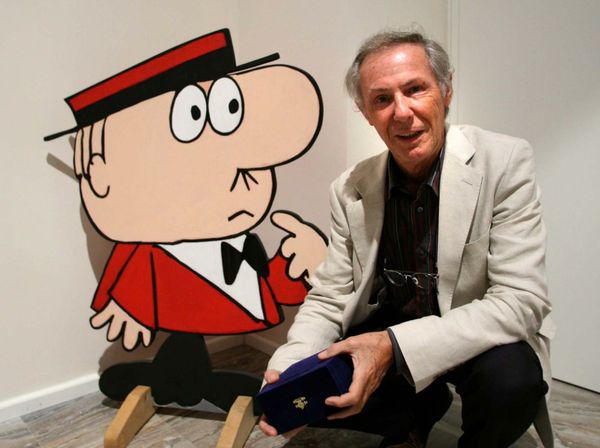
Other creators of moving images do their magic with a good sound track – but sometimes without using a word of dialog. Here’s a clever example I’ve found on YouTube – it is by Italy’s leading animator, Bruno Bozzetto (photos below, courtesy Bruno Bozzetto website).

Bruno Bozzetto

Titled Femminile & Maschile (Feminine and Masculine), this 2-D animation was made in 2004. I can’t find a synopsis online, but one website introduced it simply as follows: Some situations that show the difference of behaviour between men and women in the everyday life.

Anyone with a sense of humour can appreciate this piece – and I hope that includes die-hard feminists…

Here’s the intro from Wikipedia:
Bruno Bozzetto (born March 3, 1938 in Milan, Italy) is an Italian cartoon animator, creator of many short pieces, mainly of a political or satirical nature. He created his first animated short “Tapum! the weapons’ story” in 1958 at the age of 20. His most famous character, a hapless little man named “Signor Rossi” (Mr. Rossi), has been featured in many animated shorts as well as starring in three feature films: “Mr. Rossi Looks for Happiness” (1976), “Mr. Rossi’s Dreams” (1977), and “Mr. Rossi’s Vacation” (1977). Read the rest of his profile on Wikipedia

Earlier this week, to mark Earth Day on 22 April 2008, I took part in a half hour, live interview with Sri Lanka’s highest rated, most popular channel, Sirasa TV. I wanted to relate the global to not just the local but also to the individual and family level. To discuss how our lifestyle choices and consumer decisions affect that planet, I used a series of brilliant cartoon animations that Bruno Bozzetto had done some years ago for WWF.

Again, without having his characters utter a single word, Bozzetto gives out profound messages through images and musical sound track. This is why I keep saying that when it comes to the sheer economy of words, we writers just can’t beat cartoonists.

Sorry, I can’t locate these anywhere online (YouTube lists dozens of his other creations, but not this series — which I can’t even find on his own website.) It’s time for someone to revive this series, for their message is even more relevant for today’s climate-challenged world…

Bruno Bozzetto entry on Internet Movie Database
Visit the official website of Bruno Bozzetto
Watch other Bruno Bozzetto short animations online

Women on the Frontline: Reporting from the battlefront at…home!

“Violence against women threatens the lives of more young women than cancer, malaria or war. It affects one in three women worldwide. It leaves women mentally scarred for life — and it is usually inflicted by a family member.”

With these words, Annie Lennox, the British singer and social activist, presents a new global series of investigative television documentaries called Women on the Frontline that begins on the global satellite TV channel BBC World today, 18 April 2008.

The seven half-hour films shine a light on violence against women and girls in different parts of the world – East and West, North and South. The series takes the front to homes, villages and cities of our world where a largely unreported war against females is being waged.

Read my Feb 2008 blog post: Half the sky, most of the suffering…

The films cover Nepal, where thousands of women are trafficked each year; Turkey, where killing in the name of honour continues; Morocco, where women political activists who have survived torture and imprisonment testify before a government truth and reconciliation commission; the DRC, where women bear the brunt of a 10-year war in the eastern provinces; Colombia, where women have been tortured in the shadow of a guerilla war; Mauritania, where women who have been raped may go to prison; and Austria, where, under a new law, perpetrators of domestic violence are forced to leave home.

Here’s the line up of depressing reports in this series, produced by Geneva-based dev tv and London-based One Planet Pictures – both international partners of TVE Asia Pacific.

Nepal: A Narrow Escape
Turkey: Killing in the Name of Honour
Morocco: Never Again
Democratic Republic of Congo: Find a Word for It
Austria: Showing the Red Card
Mauritania: No film name known yet
Colombia: Justice in the Region of Death

Check dev tv website for broadcast times on BBC World

On the Frontline… is a ‘vehicle’ for independent producers to tell compelling stories about the people who uphold civil society where it is most at threat. The strand started with the 2006 pilot series Doctors on the Frontline, a profile of Medecins Sans Frontieres (MSF) field doctors made by Dev TV film-makers.

Since then, the series has covered villages battling desertification and land degradation, nurses and para-medics on humanitarian missions in hot spots of the world, and children living with social and environmental disintegration.

On the Frontline has gone behind the lines with rebels and filmed among violent street gangs but this time we’ve taken the frontline mostly into the home, where even after 20 years in production, I’m still shocked to see how many obstacles lie between women and equality, and the violence they must still endure,” said Robert Lamb, Executive Director of the series.

A number of UN agencies, including UNFPA and UNIFEM, donor countries such as Austria, non-governmental organizations and other partners provided information and support for the latest series of Women on the Frontline.

Soon after its initial run on BBC World, the series will be distributed in the Asia Pacific region by TVE Asia Pacific.

Read official brochure of Women on the Frontline TV series

March 2008 blog post: Unseen women, unheard voices

Crude: The incredible journey of oil (humanity’s substance addiction)

My colleague Manori Wijesekera returned last month from Tokyo, having participated in Earth Vision – the 16th Earth Vision Global Environmental Film Festival. She represented TVE Asia Pacific as director of one of its finalist films.

The grand prize of the festival was awarded to a stunning science documentary on the story of oil, produced by the Australian Broadcasting Corporation (ABC). Here’s the basic information:

Crude: the Incredible Journey of Oil
The world’s oil fields are deposits of phytoplankton on the ocean floor from the Jurassic period. Will our mass consumption of oil in the last 150 years thrust us back climatically to the warm primeval age when oil fields were formed?
(2007/Australia/90min/Director:Richard Smith)

See the full list of awards presented at Earth Vision 2008

Crude is one of several films that have come out recently exploring the many facets of oil and our civilisation’s dependence (addiction) on it. In March 2007, I wrote about Addicted to Oil, a documentary presented by the New York Times columnist Thomas L Friedman.

David Suzuki, environmentalist, author and long-standing presenter of the natural history series The Nature of Things has called this “a thoughtful, surprising and really important film”.

This is what Manori reported about Crude:

Produced and directed by Richard Smith, this 90 min journey sweeps through the ages: from the birth of oil deep in the dinosaur-inhabited past, to its ascendancy as the indispensable ingredient of modern life.

As Smith states, “Oil is perhaps the single most important commodity shaping the economy, politics and environment of the modern world, and yet most people have only vague notions of where it comes from. I wanted to take the audience back into the ancient oceans in which oil was formed and reveal how intimately the creation of a major oil deposit is connected to the long-term regulation of the planet’s climate”.

“I saw the film as a sort of essential primer for people to begin to make sense of both the coming oil and climate crises. I make no apologies for such apparent certainty that we will face these two dilemmas. From my understanding of the science and the facts, these are the logical conclusions to the planet carrying on with a business-as-usual, or indeed a business-at-any-cost approach. The worst effects of both are probably avoidable, but only if people understand why there is an urgent need to act.”

Crude was first broadcast on ABC TV in May 2007 and is now being distributed worldwide. It has already won two awards at the 2007 Jackson Hole Wildlife Film Festival: the Best Earth Sciences Film award and the Special Jury Recognition Award.

Watch Crude: The incredible journey of oil at ABC’s interactive website

Read production details and short profiles of the film-makers

Krishnendu Bose, Manori Wijesekera and Richard Smith at Earth Vision 2008

Photo: Finalist film directors Krishnendu Bose, Manori Wijesekera and Richard Smith at Earth Vision 2008 in Tokyo

All images of Crude courtesy ABC

Internet Society interviews the web’s inspiation, Arthur C Clarke

In his 1964 short story, “Dial F for Frankenstein”, the late Arthur C Clarke speculated the world’s inter-connected telephone system becoming a conscious entity that then takes over the world. Years later, in 1989, this inspired the British computer scientist Tim Berners-Lee to invent the World Wide Web, a system of interlinked hypertext documents accessed via the Internet.

When Berners-Lee acknowledged his inspiration in media interviews, Sir Arthur exclaimed: “Oh dear, what have I done?”

But in later years, Sir Arthur took pride in being described as the inspiration for the web, which came on top of his much more widely acclaimed recognition of being the inventor of the communication satellite.

It was entirely appropriate, then, that most tributes to Sir Arthur would appear online. The news of his death, on 19 March 2008 in Colombo, Sri Lanka, went round the world at the speed of light thanks largely to the web. This triggered a virtual explosion of tributes, comments and eulogies from ordinary people – ranging from science fiction readers and movie buffs to computer geeks and space enthusiasts.

Among the thousands paying tribute to the grandmaster of science fiction was the Internet Society, a non-profit organisation founded in 1992 to provide leadership in Internet related standards, education, and policy. They called Sir Arthur “a visionary of science and technology, whose ideas and legacy can be seen woven through many modern communication technologies, including the Internet itself”.

As a tribute to Sir Arthur, the Internet Society has placed online, rather belatedly, an interview filmed with Sir Arthur at his Colombo home in 2002. The interview, conducted by Alan Greenberg and George Sadowsky, then Trustees of the Internet Society, is presented in four parts.

In this wide-ranging interview, a very relaxed Sir Arthur talks about the history of 20th century communications and his own role in shaping the events in the past 60 years. Here, in one place, are the reflections and extrapolations of the man who always connected the present with the future. He also touches on the future of space exploration, and the urgent need to develop clean energy sources for a world addicted to oil.

Part 1 of 4 (8 mins 51 secs):

Part 2 of 4 (9 mins 30 secs):

Part 3 of 4 (7 mins 11 secs):

Part 4 of 4 (6 mins 26 secs):

Comment: Although it’s the Internet Society, no less, they seem to be rather limited in their ability to promote these videos placed on the public video exchange platform, YouTube. These remain virtually hidden away, with a single tag (movie) which obscures them from online searches. In nearly three weeks since they were placed online (24 March 2008), these have been viewed by just a few hundred people. In contrast, other tributes and archival material of Sir Arthur are attracting thousands of views and a growing number of comments on the same YouTube.

Mallika Wanigasundara: Trail-blazer in issue-based journalism

I seem to be writing many obituaries and tributes these days. Following the several I wrote on Sir Arthur C Clarke and the blog post I did on Cambidian photojournalist Dith Pran, I want to share this tribute I wrote today on a senior Sri Lankan journalist who embarked on her final voyage this weekend.


Mallika Wanigasundara:
Trail-blazer in issue-based journalism

Mallika Wanigasundara, who passed away on 4 April 2008 aged 81, was a talented and sensitive Sri Lankan journalist who went in search of causes and process that shape the everyday news headlines. In doing so, she blazed new trails in issue-based journalism, covering topics ranging from health and environment to children, women and social justice.

It was only last year that the Editors Guild of Sri Lanka and the Sri Lanka Press Institute presented her the Lifetime Achievement Gold Medal for Excellence in Journalism.

Mallika was associated with the Sri Lankan media in one capacity or another for over half a century. Starting her professional career in 1956 with the Sinhala evening daily Janatha, she later moved on to English language journalism at Lake House where she worked first in The Observer and then at Daily News. It was as Features Editor of this oldest English daily that she played a key role in practising and nurturing development journalism. She helped evolve the genre to new levels of professionalism, liberating it from the typecast of politically motivated, sometimes fabricated ‘sunshine’ stories that had been forced on the state-owned Lake House newspapers during the 1970s.

Mallika also helped put Sri Lanka on the world map of development journalism. Beginning in the early 1980s, she contributed Sri Lankan stories to Depthnews, published by the Press Foundation of Asia based in Manila, and to Panos Features, syndicated globally by the Panos Institute in London. In those pre-web days, these services – when printed in newspapers and magazines – were among the most dependable sources for ground level reporting from far corners of the world. (Alas, both services have since gone the way of the Dodo – not to mention Asiaweek, South and Gemini.)

Although I grew up in the 1980s reading her writing in Daily News, my own contacts with Mallika were few and far between. The first was indirect and happened in the late 1980s, when as an eager young reporter I started contributing to Panos Features, syndicated from London to several hundred newspapers around the world. Mallika remained the Panos Sri Lanka correspondent and I was merely a stringer. Donatus de Silva, then head of programmes at Panos London, somehow found a clear niche for both of us. At the time, Mallika and I exchanged occasional communications.

As a novice, I studied Mallika’s approach and style, and emulated them both. Hers was an easy, reader-friendly prose: it brought in both expert views and grassroots insights, but with none of the technicality or pomposity – and very little editorialising. Although she was fully supportive of the various social and environmental causes, she didn’t allow activist rhetoric to dominate her journalism. She also ventured beyond the predictable ‘green’ issues to cover many ‘brown’ issues. Two decades after the Brundtland Commission on Environment and Development (1987) that thrust sustainable development into the global agenda, it’s precisely this kind of journalism that’s needed to make sense of our fast-moving, slowly-baking, topsy-turvy world.

Mallika continued to be an active freelancer after she retired from Lake House. She seemed more prolific in retirement – she continued to chronicle the rise of the environmental movement in Sri Lanka, which emerged from citizen campaigns to save the Sinharaja rain forest from state-sponsored logging and evolved through crises and protests in the 1980s and beyond.

In 1990, she was selected by the United Nations Environment Programme for the Global 500 award that recognised environmental achievements of individuals and organisations. She was the first Sri Lankan journalist to be thus honoured, and one of only four Sri Lankans to be inducted into this global roll of honour that eventually included over 600 persons or entities worldwide.

At the time, I was hosting a weekly TV quiz show on Rupavahini (national TV) and decided to set one of my questions on Mallika receiving the Global 500. I phoned her to offer my congratulations and asked for a photo that we may use on the TV show. She was happy to be the basis of a question, but declined giving a photo, saying: ‘I don’t look good in photos or on TV’.

It was characteristic of many accomplished journalists of her generation that they remained mostly in the background, shaping news coverage and analysis. Some even didn’t nurture a personal by-line, writing under pseudonyms or simply not signing their names on their work. What a contrast with the image-conscious, in-your-face radio and TV journalism of today, where even respected newspaper editors eagerly pursue parallel careers as talk show hosts or TV pundits.

Read my essay on environmental journalism 20 years after Brundtland, published in SciDev.Net in April 2007

Arthur C Clarke tribute: Science’s critical cheerleader

scidevnet-logo.jpg scidevnet-logo.jpg

My guest editorial on the late Sir Arthur C Clarke has just been published by the London-based Science and Development Network, SciDev.Net:

Arthur C Clarke: Science’s critical cheerleader

In this, I briefly comment on Sir Arthur’s accomplishments in popular science communication and his life-long crusade against pseudo-science — two important facets of the multi-faceted author, science populariser and underwater explorer who died on 19 March 2008.

Excerpts:

“Clarke’s forte was not only extrapolating about humanity’s technological abilities, but also exploring the nexus between science and society. With his death, science has lost an articulate and passionate promoter who challenged scientists to play a greater role in public policy and demanded that political leaders should take science seriously.

“But he was never an uncritical cheerleader for science, and that will be part of his enduring legacy. In an essay in Science, he cautioned, ‘For more than a century science and its occasionally ugly sister technology have been the chief driving forces shaping our world. They decide the kinds of futures that are possible. Human wisdom must decide which are desirable.'”

In my essay, I talk about how Sir Arthur readily took on a formidable array of anti-science beliefs and superstitious practices, from creationism and scientology to astrology and fire-walking. In these endeavours he joined other campaigners against pseudoscience, including scientists Carl Sagan and Stephen Jay Gould and the magician James Randi.

“For a while, Clarke even made a modest living as a professional sceptical enquirer. Beginning with Arthur C Clarke’s Mysterious World (1980), he hosted three television series that probed – and sometimes exposed – numerous mysteries, superstitions and the paranormal.

“Even when Clarke didn’t find full explanations, he invariably demonstrated the value of keeping an open mind and asking the right questions. And instead of ignoring or dismissing popular obsessions, he tried engaging their proponents in rational discussion. That was characteristic of Clarke, a genial moderator who always sought to build bridges — whether between scientists and the public, or across the “two cultures” divide between the arts and the sciences.”

In all, Sir Arthur hosted three TV series over 15 years:
Arthur C Clarke’s Mysterious World (1980)
Arthur C Clarke’s World of Strange Powers (1985)
Arthur C Clarke’s Mysterious Universe (1994)

These series had numerous re-runs for years on Discovery and other TV channels all over the world. They are still available on DVD. While some of the content is now dated by more information or insights emerging since their production, the series still inspires critical thinking – not to mention TV emulations that come out with many more frills than was possible in the 1980s.

Watch the opening of the first series, where Sir Arthur offered his own classification of mysteries (9 mins 21 secs):

Sir Arthur filmed all his pieces to camera from different, scenic locations in his adopted home in Sri Lanka. Few Sri Lankans realised at the time that this generated millions of dollars worth of free promotion for the country as a tourist destination.

In fact, I end my editorial by looking at Arthur C Clarke the public intellectual in Sri Lanka, where he lived since 1956. I look at how he won some battles with rational arguments while lost others (e.g. Sri Lankan obsession with astrology). This is clearly a subject I will return to in greater depth and analysis in the coming months.

In the modest cough department, I am immensely proud of how I sign off on this editorial:
Arthur C. Clarke mentored Sri Lankan journalist Nalaka Gunawardene and they worked together for 20 years.

SciDev.Net – the Science and Development Network – is a not-for-profit organisation dedicated to providing reliable and authoritative information about science and technology for the developing world. Through http://www.scidev.net, it gives policymakers, researchers, the media and civil society information and a platform to explore how science and technology can reduce poverty, improve health and raise standards of living around the world. SciDev.Net is co-sponsored by the leading journals Nature and Science.

Remembering Dith Pran, photojournalist – A ‘Pineapple’ in ‘The Killing Field’

Courtesy The New York Times

“You have to be a pineapple. You have to have a hundred eyes.”

That’s how Dith Pran, the Cambodian journalist and photographer who survived the Khmer Rouge’s genocide, summed up the challenge of a photojournalist.

Dith, who died on March 30 in New Jersey, USA, had both the talent and tenacity for his chosen profession. His experience as an interpreter for The New York Times, for which he later worked as a photographer after migrating to the US, and his ordeal surviving the Khmer Rouge became the basis of the Hollywood movie The Killing Fields (1984).

Watch the trailer for The Killing Fields here:

Here’s Dith’s story as summed up in his Wikipedia entry:
In 1975, Pran and New York Times reporter Sydney Schanberg stayed behind in Cambodia to cover the fall of the capital Phnom Penh to the communist Khmer Rouge forces. Schanberg and other foreign reporters were allowed to leave, but Pran was not permitted to leave the country. When Cambodians were forced to work in forced labor camps, Pran had to endure four years of starvation and torture before finally escaping to Thailand in 1979. He coined the phrase “killing fields” to refer to the clusters of corpses and skeletal remains of victims he encountered during his 40-mile escape. His three brothers were killed back in Cambodia.

“I’m a very lucky man to have had Pran as my reporting partner and even luckier that we came to call each other brother,” Schanberg was quoted in the New York Times tribute to Dith Pran. “His mission with me in Cambodia was to tell the world what suffering his people were going through in a war that was never necessary. It became my mission too. My reporting could not have been done without him.”

In another tribute to Dith, the executive editor of the New York Times, Bill Keller, said: “To all of us who have worked as foreign reporters in frightening places, Pran reminds us of a special category of journalistic heroism — the local partner, the stringer, the interpreter, the driver, the fixer, who knows the ropes, who makes your work possible, who often becomes your friend, who may save your life, who shares little of the glory, and who risks so much more than you do.”

This is a highly significant statement, coming from a major media house of the western world. Acknowledging – let alone celebrating – the contributions of unsung local counterparts is not yet a routine practice among many western media professionals covering the global South. More often then not, the fixers are used, paid and dismissed. They are lucky to get proper credit. And if things go wrong, the western media companies would bring in top lawyers and diplomatic pressures to get their own out of trouble; never mind what happens to the locals who are part of that same team.

Something like this happened to a Bangladeshi journalist friend Saleem Samad in November 2002. He was working with a TV crew from the UK’s Channel 4 doing an investigative documentary on the state of Bangladesh, when the whole crew was arrested (we won’t go into the rights and wrongs of their conduct here). I later heard from Saleem and other Bangladeshi friends how Channel 4’s main concern had been to get the British and Italian members of the crew out of jail and out of Bangladesh. Saleem’s fate was a secondary concern. Read ‘A Prisoner’s Tale’ by Saleem Samad in Time, 4 Feb 2003

Even after being released, Saleem Samad was hounded and harassed in his native country that he went into exile in Canada. Read his profile here, and connect to his blog.

This scenario keeps repeating with different names and in different southern locations all the time. In such a harsh, selfish world, Dith Pran was certainly fortunate to have worked with Sydney Schanberg who stood by and for his local colleague. When Schanberg returned to the US and was awarded a Pulitzer Prize for his reporting from Cambodia, he accepted it on behalf of Dith as well.

Schanberg continued to search for, and write about Dith in newspaper articles – one was in The New York Times Magazine, in a 1980 cover article titled “The Death and Life of Dith Pran., which later became a book by the same title in 1985. Dith’s story became the basis of The Killing Fields.

Haing Ngor, the Cambodian-American doctor who played Dith Pran in the movie, worked with Dith in real life to promote human rights in their native Cambodia and to prevent genocide everywhere. Ngor was shot dead in 1996 in Los Angeles.

As the New York Times noted, Dith’s greatest hope was to see leaders of the Khmer Rouge tried for war crimes against his native country; preparations for these trials are finally under way.

Courtesy The New York Times
A 1974 photo by Mr. Dith of the wife and mother of a government soldier as they learned of the soldier’s death in combat southwest of Phnom Penh. (Photo: Dith Pran/The New York Times)

Courtesy The New York Times
In 1979, Mr. Dith escaped over the Thai border. He returned to Cambodia in the summer of 1989, at the invitation of Prime Minister Hun Sen. At left, Mr. Dith visited an old army outpost in Siem Riep where skulls of Khmer Rouge victims were kept. (Photo: Steve McCurry/Magnum)

Courtesy The New York Times
Mr. Dith joined The Times in 1980 as a staff photographer. He photographed people rallying in Newark in support of the rights of immigrants on Sept. 4, 2006. (Photo: Michael Nagle/Getty Images)

Watch Dith Pran speak on NYT Video Feature

All photos linked to from the New York Times online

TVE Asia Pacific says Thank You to Sir Arthur C Clarke

In his 1992 book How the World Was One, Sir Arthur C Clarke described a dream: one day in the near future, CNN founder (and then owner) Ted Turner is offered the post of World President, but he politely turns it down – because he didn’t want to give up power!

Just three years later, the then Secretary General of the UN suggested that CNN should be the 16th member of the Security Council. Sir Arthur was fond of quoting this, and once famously told Turner: “You owe me 10 per cent of your income”.

These references – illustrating the power of globalised satellite television – are recalled in TVE Asia Pacific‘s official tribute to Sir Arthur C Clarke, who passed away on March 19 aged 90.

“With the death of Sir Arthur C Clarke, TVE Asia Pacific has lost a long-standing friend and supporter,” the tribute says.

It adds: “Since our establishment in 1996, Television for Education Asia Pacific – to use our full name – has been engaged in pursuing Sir Arthur’s vision of using the potential of moving images to inform and educate the public. Our founders chose to focus on covering development and social issues, with emphasis on the Asia Pacific region – home to half of humanity and where Sir Arthur spent the last half century of his life.”

Although he never held a formal position at TVEAP, Sir Arthur was an informal adviser and mentor to the regional media organisation whose work across Asia Pacific is only possible thanks to the comsat that invented and the web that he inspired.

By the time TVEAP was created in the mid 1990s, the satellite TV revolution was well underway in the Asia Pacific region, and the internet revolution was just taking off. In informal discussions, Sir Arthur advised us to always keep our eyes open on what’s coming up. In the ICT sector, he cautioned, being too closely wedded to one technology or system could lead to rapid obsolescence.

The tribute mentions Sir Arthur’s specific support for the Children of Tsunami media project, and the Communicating Disasters publication.

We also talk about Sir Arthur’s concerns about using information and communication technologies (ICTs) to benefit the poor and other disadvantaged groups – a process that he aptly described as ‘geek to meek’.

We end by recalling how TVEAP recorded and uploaded to YouTube Sir Arthur’s last public video address – his 90th birthday reflections in December 2007.

Read TVEAP’s tribute to Sir Arthur C Clarke, 1917-2008

sir-arthur-clarke-reflecting-on-90-orbits.jpg

Unseen women, unheard agonies

In January 2008, I wrote about Lakshmi and Me, a recent Indian documentary that portrayed a domestic worker woman whom my friend Kalpana Sharma aptly called an invisible superwoman.

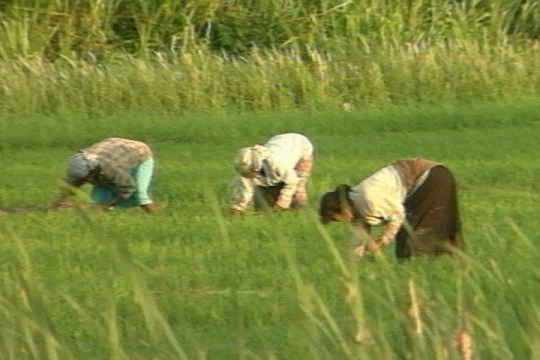
A colleague who read my piece reminded me about a series of five short films on working women in Sri Lanka that I had executive produced in 1999-2000. Produced originally in Sinhala for a national audience, the series was titled Oba Nodutu Eya (The Unseen Woman). In fact, it featured not one but several women workers in two different sectors in the country’s informal economy: the coconut husk (coir) industry in the south and agricultural settlements in the Dry Zone in the north-central areas of the island.

The following is adapted from a story I wrote about this series for a book that TVE Asia Pacific published in 2002. I have not gone back to my sources to check how much – or how little – has changed in the past several years.

yasawathie-from-a-voice-without-a-sound.jpg

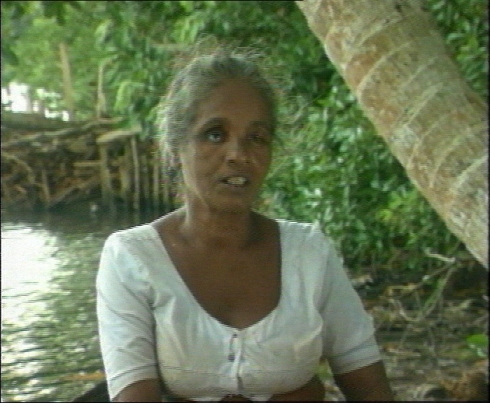
This is Yasawathie. She has suffered physical and mental abuse most of her adult life. Her alcoholic husband beat her regularly for years, but she dared not complain for fear of reprisal.

“He injured my head, stabbed me and once fractured my arm” she says, showing a scar of a healed wound.

As if this suffering was not enough, she lost sight in one eye a few years ago in a bizarre hospital accident. She had gone to the government hospital seeking treatment for a chest ailment. There were more patients than beds, so she was forced to sleep on the floor. While sleeping, a nurse carelessly dropped a saline stand on to Yasawathie’s face.

The entire incident was hushed up, and the poor woman was intimidated into silence. “Sometimes patients even die at our hands,” the nurse told her threateningly.

Injured by the healthcare system, battered by her own husband and pressurised by her family circles to keep quiet about, this middle aged Sri Lankan woman has run out of options. She was not aware she could claim damages for the accidental loss of her eye. She does not realise there is legal redress for domestic violence – her family and in laws wouldn’t allow it in any case.

Sadly, Yasawathie is not alone. There are tens of thousands of women like her who live on the margins of society, and whose suffering goes largely unnoticed. The island nation is often cited as a South Asian success story: its women were the first in Asia to vote; female literacy is nearly universal; and a higher percentage of girls and young women are in school than boys.

But hidden beneath these national accomplishments, there are huge gender-based disparities and gaps, especially in economic, labour, family and property related matters. Studies have found that many women, particularly the poorer ones, don’t know their human and legal rights.

And even women who do know their civil and political rights often do not assert their right to safeguard themselves from domestic violence or gender-based discrimination in family and society.

Yasawathie’s story was one of several that were featured in a television documentary series that probed how Sri Lankan women’s economic and legal rights operate in the real world. Produced in 1999-2000 by TVE Asia Pacific in collaboration with the Sri Lanka Environmental Television Project (SLETP), the series went beyond the oft-repeated claim of women’s emancipation in Sri Lanka. It uncovered a shocking reality of wide spread rights denial, physical abuse and gender-based violence.

The series used a mixture of short drama segments, interviews and background commentary. “These films don’t offer comprehensive surveys of the situation, but they provide useful glimpses of how economic and legal rights apply at the grassroots for women,” said accomplished fim-maker Inoka Satyangani, who directed the series. “We raise broader concerns, and point out changes that society needs to make to ensure that women can assert their rights.”

Violence against women is both a public and private matter in Sri Lanka, says the Committee on the Elimination of Discrimination against Women (CEDAW), a body of global experts which monitors whether governments are honouring their commitments to the 1981 United Nations’ Women’s Convention. Although violence affects women of every class and ethnicity, it is seldom reported.

In recent years, human rights abuses in Sri Lanka’s conflict ridden north and the east have received international scrutiny; both the government forces and Tamil Tiger rebels have committed atrocities. But violence against women is not confined to the war or the conflict-affected areas: as one rights activist has remarked, “everyone becomes part of the larger system of brutality”.

CEDAW has stressed that Sri Lanka needs specific legislation to address violence behind closed doors.

from-oba-nodutu-eya-tv-series.jpg

The TV series also found how women get paid less than men for agricultural manual labour, and how government-driven land development schemes favour men to inherit state land distributed among the landless. Government agricultural extension programmes help male farmers to obtain skills training, credit and subsidies while women farmers are constantly ignored. Women interviewed had stories that shattered the myth of women’s liberation and equality in Sri Lanka.

Read individual synopses of the five films in The Unseen Woman series

Read recent blog post: Half the sky, most of the suffering and seeking everyone’s attention