Sri Lanka’s Sacred Cows and Orbital Dreams: Asking difficult questions

Holy cow! How does she do it?
Cows have been a part of South Asian cultures, economics and societies for millennia. Many among us are connected to cows in one way or another – some worship them while others feast on them. Even a secular vegetarian in South Asia – like myself – can’t avoid bumping into the occasional cow on our delightfully messy streets…

We probably gave the term ‘sacred cow’ to the English language. It means an object or practice which is considered immune from criticism, especially unreasonably so. As the Wikipedia explains, “The term is based on the popular understanding of the place of cows in Indian religions as objects that have to be treated with respect, no matter how inconvenient.”

Well, some of us beg to differ on modern-day sacred cows. My latest op ed essay, just published on Groundviews.org, is all about sacred cows in rapidly modernising South Asia. It starts with my experience as a young science journalist covering the impending launch of Pakistan’s first digital communications satellite, Badr 1, in early 1990.

At the time, Pakistan had recently returned to civilian rule after many years of dictatorship, and Benazir Bhutto was Prime Minister (in her first term). The political mood was generally upbeat. But I soon found out — from Pakistani journalists and independent scientists — that they weren’t allowed to ask critical questions about the country’s nuclear or space programmes.

In Sacred Cows and Orbital Dreams in Sri Lanka, I write: “The message was clear: democracy or not, some sacred cows always enjoy their privileged status! This has certainly been the case with both the space and nuclear programmes in India and Pakistan: they have been shielded from public and media scrutiny for decades.

What price for having our own?
“For the past few months, it seemed as if we too were following this South Asian tradition. Plans to build Sri Lanka’s own satellites were announced and pursued with little information disclosure and no public debate. The government wanted to launch our very own ‘sacred cows’ into orbit. We the public were to just applaud on cue, and then cough up the money for it…”

The essay is a critique of Sri Lanka’s much hyped plans to build its own satellites. The project was announced in February 2009 and appeared to gain momentum during the year. Going by official statements and media reports, the plan was to launch not one but two satellites.

Suddenly, there seems to be a change of heart. In a interview on 6 June 2010 covering a range of issues, head of the Telecom Regulatory Commission (TRC) disclosed that the government was not going ahead with the much-hyped project. At least not in its originally announced form. The reason: the very high cost, and the need to ‘explore other options such as hiring satellites’ instead of building our own.

Hmmm. Better to be wise later than never. This is the first time in over 15 months that the high costs of this high cost project have been acknowledged.

The satellite is not the only mega-science project being pursued in post-war Sri Lanka. In June 2009, the Ministry of Science and Technology directed the Atomic Energy Authority to set up a national committee to study technical and financial aspects of setting up a nuclear power plant.

Again, this mega project has not been opened up for public discussion and debate, in spite of a few citizens and activists expressing concern, highlighting safety and public health risks, high cost of construction and the unresolved problem of nuclear waste disposal.

I end the essay arguing that as long as public safety and public funds are involved, sacred cows – whether orbital or radioactive – can’t be allowed free range.

Read the full essay on Groundviews: Sacred Cows and Orbital Dreams in Sri Lanka

A compact version appeared in The Sunday Times, 13 June 2010: Sri Lanka’s Satellite: Lost in Space?
Making of ‘The Greenbelt Reports’ recalled in ‘The Green Pen’

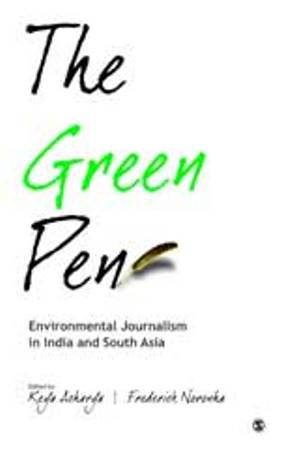
The process of producing and distributing TVE Asia Pacific’s educational TV series, The Greenbelt Reports, is showcased in a new book on environmental journalism in South Asia, just published by Sage, a globally operating company that specialises in bringing out academic and professional books.

The book, titled The Green Pen: Environmental Journalism in India and South Asia, is edited by two senior Indian journalists, both good friends – Keya Acharya of Bangalore, and Frederick Noronha based in Goa. (In 2007, Fred and I co-edited Communicating Disasters: An Asia Pacific Resource Book.)

Arranged in 10 sections, the book brings together contributions from three dozen journalists, broadcasters and film makers in South Asia. It opens with a foreword by Darryl D’Monte, one time editor of The Times of India and Chair, Forum of Environmental Journalists of India (FEJI).

I co-wrote the chapter titled ‘Dispatches from the Frontline: Making of The Greenbelt Reports’ with my colleague Manori Wijesekera, TVEAP’s Regional Programme Manager. I was researcher and script writer of the 12-part, 4-country series that we made in 2006, in which Manori was series producer. The series looked at the environmental lessons of the 2004 Indian Ocean tsunami.

The title reflects the lingering print bias in media related discussions: in our case, the content we produced was disseminated on broadcast television, narrowcast DVD and online. We wielded cameras rather than pens, but are still very glad to share our experience in this book.

Keya Acharya (left) and Fred Noronha
The publisher’s blurb says: “This collection of essays by some of the most prominent environmental journalists in Indian and South Asia gives deep insights into their profession and its need and relevance in society. It looks at this ‘specialisation’ of journalism both in the past and the present. Underlying almost all the essays is the changing nature of media in the region and the dilemmas facing environmental journalists. The varied background of the writers ensures the showcasing of a wide range of realities and experiences from the field. Contributions include essays by Darryl D’Monte, the late Anil Agarwal and Sunita Narain, among others.”

“This is the first book of its kind on environmental journalism, which would be an excellent resource to aid the future evolution of the enterprise in the region. Apart from essays from India, there are contributions from Pakistan, Bangladesh, Sri Lanka, Nepal and the Maldives. The book will interest a wide readership, any informed reader, besides journalists and environmentalists.”

It’s an honour to be part of a book which features the work of respected seniors like Anil, Darryl and Sunita – all of who have influenced my own career and I’m privileged to count among my friends (alas, Anil is no longer with us). In fact, I have either met, worked with or am friends with more than half the three dozen contributing authors of this book.

Who says South Asia is large?

More in TVEAP news story: The Greenbelt Reports featured in new book on environmental journalism in South Asia

Ahead of tsunami, journalist foresaw coastal disaster in Sri Lanka: “A Catastrophe Waiting to Happen”

Dilrukshi Handunnetti in Deep Divide film
Contrary to a popular belief, journalists don’t enjoy being able to say ‘I told you so!’. They much rather prefer if their investigative or analytical work in the public interest are heeded in time.

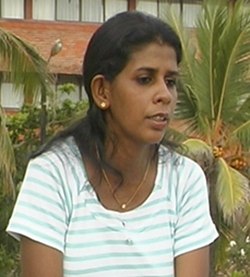
A few months before the Indian Ocean tsunami of December 2004, my friend and journalist Dilrukshi Handunnetti wrote an investigative story on how coastal zone management laws and regulations were openly flouted by developers. She cautioned that it was a ‘disaster waiting to happen’

She had no idea how forcefully her point will be driven home before that year ended.

“Little did anyone realise the price coastal communities would have to pay for the greed of a few dozen developers,” she said after the tsunami, interviewed for Deep Divide, a South Asian documentary on environmental justice that TVE Asia Pacific produced in 2005.

Watch Deep Divide – story from Sri Lanka:

Here’s the blurb I wrote at the time to promote the story:

Sri Lanka’s economic activities are concentrated in coastal areas: 80 per cent of the tourist related activities are found there, along with one third of the population. Seeking to accelerate economic growth, the Sri Lankan government took measures to develop the island’s coastal regions. Shrimp and prawn farming was encouraged, while many incentives were provided for developing tourist resorts along the island’s scenic beaches.

As the shrimp exports grew and tourist arrivals increased, there was a ‘cost’ that only local residents and a few environmentalists cared about: mangrove forests were cleared, coral reefs were blasted, and the coastal environment was irreversibly changed.

Shrimp farming damaged mangroves, aggravated tsunami impactCoastal zone management regulations and guidelines were openly flouted by developers. Local communities were the last to benefit from this development boom — they watched silently as their fish catch dwindled and their coastal environment was pillaged. But little did anyone realise the price coastal communities would have to pay for the greed of a few dozen developers.

When the tsunami struck, there were very few natural barriers to minimise its impact. More than 40,000 people died or went missing, while hundreds of thousands lost their homes and livelihoods. It was the biggest single disaster in the island’s history.

Dilrukshi reflects: “Post-tsunami, people realised that the mangroves have protected these little, you know, landmass. And where you find a little bit of protected mangroves, you also find the landmass protected.”

She adds: “I think we have committed lot of excesses and we have been made to answer for those sins. Hereafter, we cannot afford to not do it right.”

Filmed on location in India, Nepal and Sri Lanka, Deep Divide explores the reality of environmental justice in South Asia — home to 500 million people living in absolute poverty, or 40 per cent of the world’s total poor. Everywhere, it finds environmental injustice. This investigative film builds on the work by three local journalists, who act as our guides to understanding the complexities and nuances of development amidst poverty and social disparities.

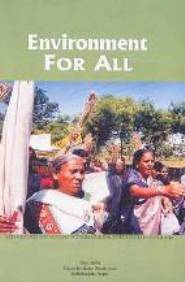
Environment For All book coverThe origins of Deep Divide go back to 2002. Panos South Asia, a regionally operating non-profit organization analyzing development issues, awarded media fellowships to selected journalists from five South Asian countries to explore specific cases of environmental injustice in their countries. They were to investigate issues as varied as land degradation, food and water insecurity, rising pollution, and mismanaged development.

Their findings were initially published in the local media – in the newspapers or magazines they worked for. In 2004, Panos South Asia compiled the articles in a book titled Environment for All. Three stories from this book were adapted into the documentary, directed by Indian film maker Moji Riba.

South Asian Sanitation Conclave: Who’s afraid of Pee and Poop?

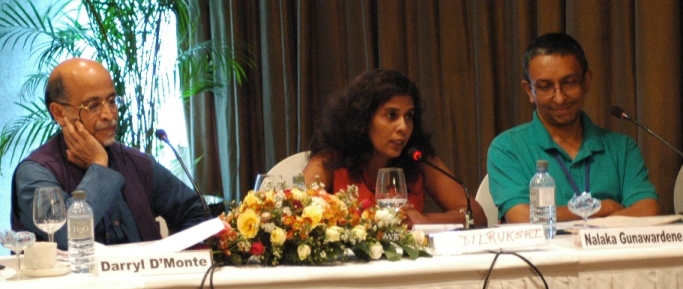
L to R - Darryl D'Monte, Dilrukshi Handunnetti, Nalaka Gunawardene

Who’s afraid of Pee and Poop?

That’s the innocent but slightly provocative question I posed to a South Asian Conclave on sanitation that I addressed today at the Colombo Hilton.

My audience was a group of South Asians – drawn mainly from Bangladesh, India, Pakistan and Sri Lanka – working in government, mainstream media or development agencies, all sharing an interest in water supply and sanitation (wat-san) issues.

I was asked to speak about Telling the Sanitation Story using Moving Images. But after listening to the fairly staid and often technocratic discussions preceding my presentation, I changed it. In doing so, I said that especially in broadcast television, the window of opportunity to attract the viewer is a tight one – it used to be 45 seconds, but these days more likely 30 seconds.

Sanitation is both an issue that is both urgent and important. As I noted on World Toilet Day marked on 19 Nov 2009, 2.5 billion people do not have somewhere safe, private or hygienic to go to the toilet.

And as C. Ajith Kumar of the Water and Sanitation Program (WSP) – convenors of the Conclave – reminded us at the outset, South Asia is where most of these people live. Lacking any alternative, more than a billion (yes, 1,000 million) South Asians defecate in the open on a daily basis.

That’s a lot of poop, folks — and it’s completely untreated, uncovered and responsible for too many preventable illnesses and deaths.

Despite this dire emergency at individual and society levels, officials and activists concerned with wat-san issues continue to tip-toe around this poop. Or so it seemed to me — after two days, not once had the words poop or shit been mentioned in discussions. Instead, everyone was using the more politically correct terms such as faeces, excreta and excrement.

“Most of those billion people pooping in the open are not going to understand the lofty terms used in the charmed development circle,” I said. “You’ve got to talk in a language that ordinary, real people can and will understand – that’s the first step in effective communication.”

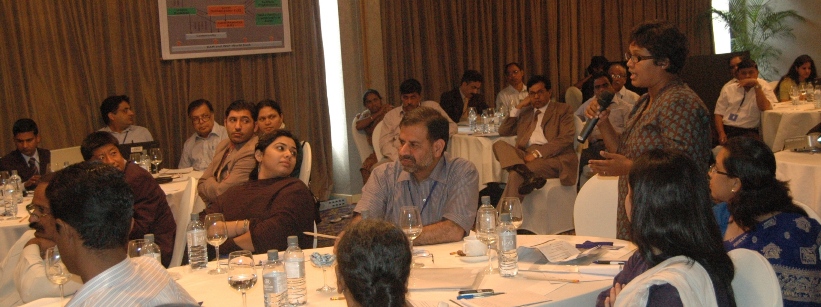
South Asian Conclave on Sanitation in Colombo, 8 Dec 2009
The meeting had already acknowledged that improving sanitation involved a lot more than providing running water or building toilets. The development experience in the past three decade shows that infrastructure alone does not, automatically, lead to better sanitation. The biggest challenge remains in promoting hygienic practices among all – and that requires behaviour change, a slow and gradual process in any society.

I reminded everyone that when it comes to sanitation, the command-and-control approach that our South Asian governments are so used to adopting just won’t work. There are at least three aspects of life where choices and conduct are strictly personal: what happens in the bed room, bath room (toilet) and the shrine room.

As I summed it up in these words that I asked my audience to reflect on: Governments don’t defecate; people do.

“Please remember this if you really want to reach out and engage ordinary people who are living, breathing and pooping everyday in the real, harsh world.”

More of my presentation will be shared on this blog in the coming days.

Photos by Amal Samaraweera, TVE Asia Pacific

Little strokes make big pictures: Covering climate change in South Asian media

Given the surfeit of media stories on climate in the build-up to the Copenhagen climate conference (7-18 Dec 2009), it would appear that journalists have little or no difficulty in covering this literally hot topic, right?

Wrong. The planet is warming, but not all editors and other media gate-keepers have yet warmed up to the topic. (We might even say: some are thawing more slowly than glaciers these days!).

“While environment is fast becoming a trendy topic, environmental journalists say they are finding it increasingly difficult to sell their stories to editors. This is a confounding trend in the news media, given the increasing confusion – and resultant calls for clarity – about scientific data for climate change in the run up to the United Nations Climate Change Conference in Copenhagen. The experts, however, say the trick is to repackage the story alluringly.”

Zofeen T Ebrahim
This is the thrust of an article just written by the experienced Pakistani journalist and blogger Zofeen T. Ebrahim on Dawn.com. In Little strokes make big pictures, she probes the challenges that South Asian journalists continue to face in reporting and analysing on climate change in their mainstream media.

Zofeen, who was with me at the recent IFEJ congress in New Delhi a few weeks ago, quotes me in her article: “Nalaka Gunawardene, a senior award-winning science writer from Sri Lanka, recalls that his mentor, Tarzie Vittachi, once advised that ‘ordinary people live and work in the day-to -day weather. Most can’t relate to long-term climate. It’s our job, as journalists, to make those links clear.’ Of course, three decades ago, well before climate change was a hot topic, Vittachi was speaking metaphorically. But the words have great import today.”

She also quotes South Asian colleagues like Kunda Dixit, Joydeep Gupta, Nirmal Ghosh and Aroosa Masroor Khan (all men, although they are among the finest in the profession :)).

Her conclusion: environmental stories may still be a hard sell in many media outlets, but committed journalists have found ways to market their stories first within their organisations, and then to their respective audiences. That is some good news as the crucial climate talks open in the cool climes of Copenhagen.

Read the full article: Little strokes make big pictures, by Zofeen T Ebrahim

Zofeen T. Ebrahim is a Karachi-based independent journalist and has been writing for IPS since April 2003. She also writes for Women’s Feature Service, IRIN and Indo Asian News Service. The stories she has covered include human rights, specially pertaining to women and children, health and how development impacts environment.

No full-stops (periods) in good journalism, only commas…

A S Panneerselvan
In any meeting, we can count on Indian journalist A S Panneerselvan to liven up the discussion. He didn’t let us down when a two dozen South Asians came together last weekend in New Delhi at a Symposium on Science, Environment and Media: Discussing Experiences in South Asia.

“There are no full-stops in good journalism, only commas,” he declared. He was referring to two of the most commonly used punctuation marks in modern writing.

This metaphor neatly sums up the nature of journalism, whose coverage of public affairs and society is often on-going, unfinished and open-ended. This prompted Phil Graham, the former publisher of the Washington Post, to describe journalism as the “first rough draft of history”. The reason is that journalists, in the performance of their duty often record important events, producing hurried written reports (in text, sound or pictures) often generated on short deadlines.

Panneer, who likes to call himself ‘a failed physicist and a failed journalist’, added that the intrinsic value of a journalist as one who tries to bring back the idea of commons — resources that are collectively owned, which can range from physical goods to artistic or creative products.

Panneer was speaking to the journalists, broadcasters, academics and activists brought together by Panos South Asia, IIT Delhi, and Centre for Studies in Science Policy, Jawaharlal Nehru University, for the two-day symposium on 15 – 16 November 2009.

I always welcome occasions when his and my paths cross as we move in overlapping South Asian circles. Listening to him this time around, I recalled his clear, emphatic words on a previous occasion, at an Asian regional brainstorming on ‘Communicating Disasters: Building on the tsunami experience and responding to future challenges’ that I convened in December 2006 in Bangkok, Thailand.

He said the media is plural term, not a singular one. This implies that the media are not a monolith. Some are excellent; many are mediocre; some are downright bad. Some in the media are also indifferent to some issues but may be outstanding in addressing other issues.

He added that media is also very much a contested and contentious space where arguments rage on. Not everything is moderate, balanced or ‘evidence-based’.

Panneer’s day job is as the executive director of Panos South Asia. He was formerly the managing editor of Sun TV and bureau chief for Outlook magazine in India. Having been with the mainstream media for 20 years, he is now moving in that interesting overlap between media and development sectors. This gives him both insight and perspective.

Contributing a chapter to Communicating Disasters: An Asia Pacific Resource Book in 2007, Panneer wrote: “Development agencies rarely bring journalists into their universe at a stage which can be called ‘work-in-progress’. They usually just come to the media with a finished product. There is hardly any joint exploration. When presented with a finished product, there is just one alternative for a reporter — that is, to review the product that is already done.

“Imagine a scenario where journalists are brought into the process right from the word go. There would have been a series of stories, and when the final report of the development agencies is realised, that may well serve as the winding-up story tracking the entire trajectory.

“A journalist is expected to report and not just reproduce. Development agencies like their versions to be reproduced to a large extent. This becomes an assault on the journalists’ work-pride. He or she would like to do a field report, taking a cue or two from the work of the development agency. But, to merely reproduce a report is seen only as providing a free plug, an unpaid advertisement, and doing a stenographer’s job.”

Read his full chapter online: Engaging the Media: A Rough Guide by A S Panneerselvan

‘Small Islands – Big Impact’ film making waves in the world’s Biggest Polluter…

Dilrukshi Handunnetti
Dilrukshi Handunnetti: Making waves
My good friend Dilrukshi Handunnetti, a leading investigative journalist in Sri Lanka, is currently on a Jefferson Fellowship traveling in the United States. She is one of a dozen journalists from the Asia Pacific who have been competitively chosen to participate in this prestigious programme, which in 2009 is focusing on the theme, The Right Climate for Confronting Climate Change?

I finished my latest climate film, Small Islands – Big Impact, only the day before Dilrukshi left for Hawaii, her first stop in the multi-destination, intensive programme. Given her long standing coverage of the Maldivian political affairs as well as Asian/global environmental issues, I gave her a DVD of the film to take along.

I’m delighted to hear that she has been showing Small Islands – Big Impact in various presentations, often producing a…big impact wherever it was shared. It’s always good to have such feedback — here’s an excerpt from an email she has just sent me from Boulder, Colorado:

“I liked presenting your short film and the response it generated. The film generated a discussion on promoting the concept of (climate) adaptation as a human right – just as I felt it would be such a catch phrase here. I also had the (media coverage of) the underwater Cabinet meeting with me. So Maldives got a lot of attention despite not having a Maldivian here.

“Several wanted to know about the actual risk level of the Maldives and the possibility of the islands being submerged. They also asked about purchasing land elsewhere and whether the Maldives had the financial capability to do that. Others wanted to know about depleting fish catch President Nasheed spoke about as this was a common concern to Indonesia, Southern India and Vietnam.

President Nasheed
President Nasheed: Stop pointing fingers, extend a helping hand...
“Some queried whether President Nasheed was going to Copenhagen to state his case. Two others asked whether lobby groups were behind his thinking. Several found, including American, Chinese and Indian participants, that President Nasheed’s call to end the blame game should be heeded by all. There was collective agreement that others’ behaviour impacted on the likes of President Nasheed and vulnerable communities.

“Interestingly, everyone found his interview a STORY. Something that they would want to report on in their respective media. We continue to discuss the same on our tours and walkathons from venue to venue for various meetings. In fact, I had the American participant asking our resource persons (IPCC types, no less!) whether they were willing to acknowledge the concept of climate refugees directly in relation to the Maldives.

“I think the movie served a great purpose of awakening the minds of many to the threat level faced by some communities on low lying coastal nations – like the pacific Islands and the Maldives. A senior broadcaster from the Tonga Broadcasting Corporation personally thanked me for wanting to highlight their plight as a small island nation.”

You can watch Small Islands – Big Impact online here:

Read the full text of my interview with President Nasheed on TVEAP website

As with all TVEAP films, this one too is available free of license fees and copyright restrictions to broadcast, civil society and educational users anywhere in the world. It’s now a year since I wrote a widely reproduced op ed essay on Planet before profit for climate change films — I practise what I preach!

A journalist for over 17 years, Dilrukshi Handunnetti has extensively covered politics, the environment, culture, and history and gender issues. In her current role, she writes the parliamentary column for the newspaper in addition to writing and editing investigative stories carried in her publication. Dilrukshi has also covered the ethnic conflict from a non-military perspective and written extensively on issues of good governance, graft and corruption. Dilrukshi is the recipient of many national journalism awards in Sri Lanka, including: the Young Reporter of the Year 2001, Best Environment Reporter of the year 2002, Best Environment Reporter of the year 2003, Best English Journalist of the Year 2004 (Merit) Award and D B Dhanapala Award for the Best English Journalist of the Year 2005, all presented by the Editors’ Guild of Sri Lanka.

In this extract from our 2005 film Deep Divide, Dilrukshi talks about Sri Lanka’s coastal resource development challenges before and after the 2004 Asian Tsunami:

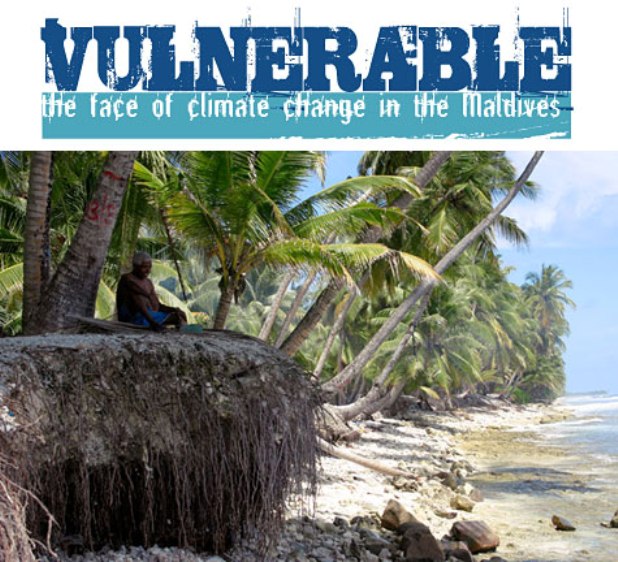
VULNERABLE: Still images of a moving story…from Bluepeace, in the Maldives

bluepeace-maldives2
Bluepeace at 20: Voices from the waves...

Bluepeace, the first environmental organisation in the Maldives, recently marked their 20th anniversary.

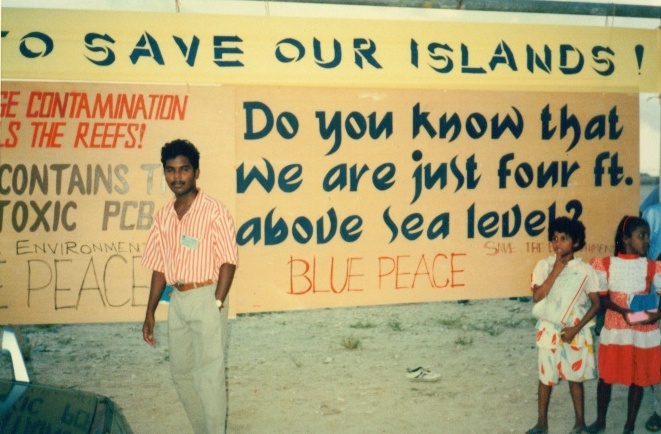
In November 1989, less than three months after Bluepeace was formed, the first small states conference on sea level rise was held in the Maldives. As a dramatic conclusion to the conference, a demonstration was held in Male’, in which students and the general public spoke on the imminent dangers of living in a low-lying country. A large billboard placed by Bluepeace asked the question “Do you know we are just four feet above sea level?”

Bluepeace was vocal, even at 2 months. Photo by Nalaka Gunawardene: Male, November 1989

I’m not a professional photographer, but as a journalist I often carry a camera and take photos of what interests me. So I’m very glad to have captured that historic bill board as a journalist covering the conference. Bluepeace still uses it in their records, always with acknowledgement.

Ali Rilwan, Bluepeace co-founder whom I photographed as a young man, says: “Twenty years later, we need not ask the same question, as the world is well-aware of the dangers Maldives faces. However, we face the urgent need to talk and work with the rest of the world to find solutions.”

Now, Bluepeace is actively using photographs as part of their climate advocacy.

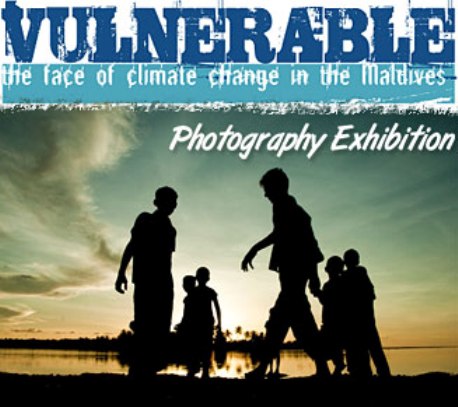
vulnerable-photo-exhibition09
Images from the frontlines of climate impact...

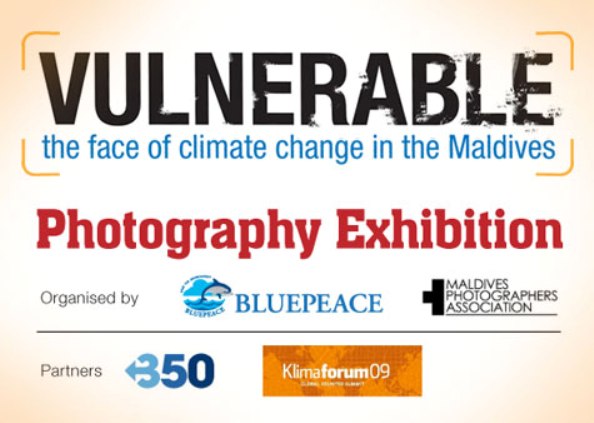
VULNERABLE is a photo exhibition organised by Bluepeace. To celebrate the 20th anniversary of Bluepeace, and to join the global environmental movement bringing attention to the dangers of climate change in the run up to United Nations Conference on Climate Change (COP15), Bluepeace presents VULNERABLE, which showcases the face of climate change in the Maldives. The exhibition documents the vulnerability of the fragile coral islands of the Maldives to climate change, through pictures from talented Maldivian photographers. It depicts a nation under threat, as it tries to safeguard an age-old culture and lifestyle that could be erased with rising seas and climate change.

VULNERABLE was launched online on October 24, the International Day of Climate Action organised by 350.org, which calls for a reduction of global carbon emissions below 350 parts per million.

In the coming weeks and months the exhibition will move to different locations in the Maldives and other countries, including Copenhagen in December 2009, where it will be hosted by Klimaforum09, an alternate climate summit with participation from global environmental movements and civil society organisations.

I can’t wait to see the exhibit in a physical display, which is more powerful than viewing it online. For now, here are some glimpses…

vulnerable image
Under seige from the deep blue?

vulnerable3

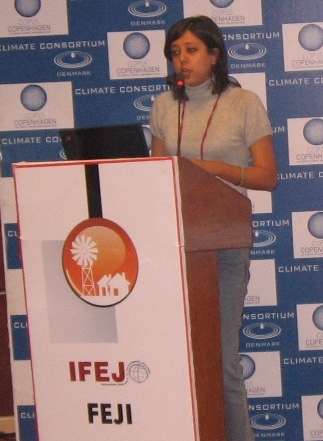
Linking ‘weather’ to ‘climate’: Journalists’ big challenge then…and now!

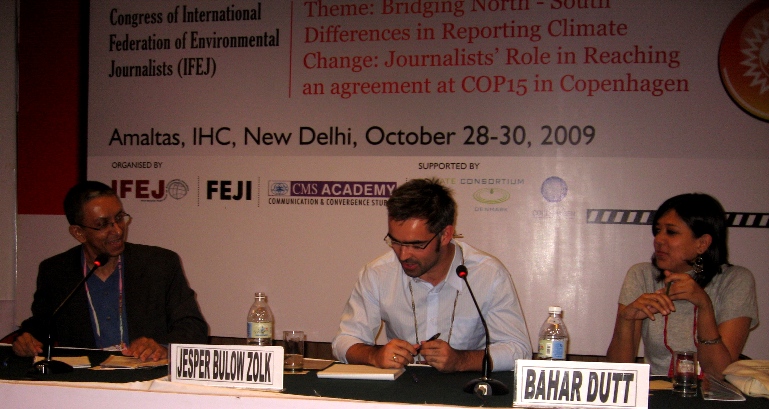
L to R - Nalaka Gunawardene, Jesper Zolk and Bahar Dutt
At IFEJ 2009 Congress on 28 Oct 2009: From L to R: Nalaka Gunawardene, Jesper Zolk and Bahar Dutt

I used to describe my job as one where I try to make sense of our topsy-turvy world. But I’d happily settle for the simpler description ‘connecting the dots’. This is what we as journalists covering development issues must do everyday in our work:
• link the macro with the micro; and
• find inter-relationships and inter-dependencies that aren’t always very self-evident.

This reminds of me a piece of advice given by the late Tarzie Vittachi (1921-1993), the Sri Lankan-born journalist and editor who was a pioneer in development journalism in the 1960s and 1970s. Long before climate change became an issue, he was speaking metaphorically to fellow journalists when he said: “Ordinary people live and work in the day-to -day weather. Most can’t relate to long-term climate. It’s our job, as journalists, to make those links clear.”

When Tarzie made this remark, some three decades ago, he was speaking metaphorically. Times have changed and now we are literally dealing with weather and climate issues.

Making those links is not always easy, especially if we want to avoid sensationalism, scare-mongering and other excesses that often characterize media coverage on climate change.

I made these observations when chairing a session on the North-South differences in the electronic media (television) coverage of climate change in New Delhi, India, this week. It was part of the latest international congress of the International Federation of Environmental Journalists (IFEJ), held at India Habitat Centre from 28 to 30 October 2009. Its theme was “Bridging North-South Differences in Reporting Climate Change: Journalists’ role in Reaching an Ambitious Agreement at COP15 in Copenhagen”.

Participants – over 100 journalists covering science and environmental issues, from all over the world – recognised how climate concerns have extended beyond strict environmental (or ‘green’) issues to mainstream political, business and even security coverage in the media.

Joining me on the TV panel were two experienced journalists from news and current affairs channels — Jesper Zolk, Climate Editor of TV2 News, Denmark, and Bahar Dutt, Environment Editor of CNN/IBN, India.

As it turned out, they were a great panel – they knew a lot, and being TV journalists, also knew how to say it well and concisely. This was the second time that Bahar – one of the best known faces on Indian television today – and I have been on a panel together: almost four years ago, at IFEJ Congress 2005, also in New Delhi, she joined me to discuss ‘Does TV do a better job on environmental reporting?’

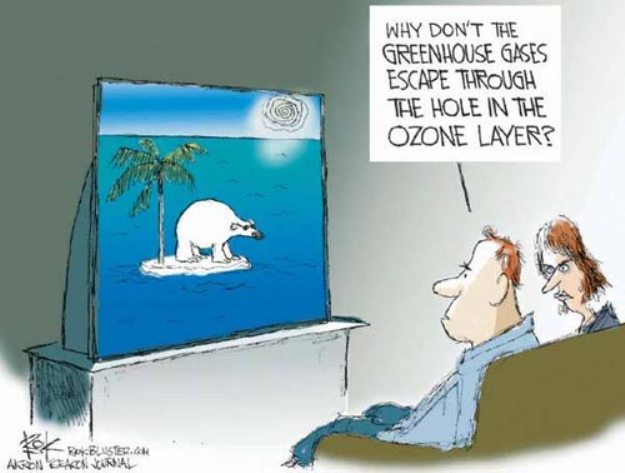
I opened my panel by showing this cartoon, one of my favourite when it comes to climate coverage in the media:

Can we blame him for the confusion?

We cannot assume much more knowledge and understanding in our average TV viewer than the confused guy in this cartoon, I said. So just how do we reach out and engage millions like him (and also the better informed viewers like his fellow viewer)? How do we tell this complex, still unfolding story within the time limits of 24/7 news television, I asked.

We didn’t find all the answers in 75 minutes of our session, but at least we clarified and agreed on a few points. Bahar Dutt’s observations were particularly relevant, especially since India now has over 500 news and current affairs TV channels broadcasting to a billion plus audience in over a dozen languages.

At a time when mainstream media elsewhere in the world are struggling to stay on in business, the Indian broadcast media remain ‘chaotic but robust’, she said. “But editorial filtering is not always very strong in some of our channels, which sees climate coverage ranging from no coverage at all to hysteria,” she added.

According to Bahar, much of the climate coverage in the Indian media overlooks the links with broader development issues. “Focus is often on climate treaty negotiations, or what individual experts or politicians say. These elements are only part of the bigger picture, and we need to look further and dig deeper.”

Bahar Dutt
Bahar Dutt at IFEJ 2009
“Environmental journalists are not green activists, and our role is to be watchdogs – keeping a sharp eye on government, industry and even civil society,” Bahar said. “But sometimes I find this watchdog role lacking in our media.”

Her advice to fellow journalists: stop seeing environment as simply a green and ‘cuddly’ sector, and move it into the political arena.

Jesper Zolk, Climate Editor of Denmark’s TV2 News, said his biggest challenge was how to get the pampered western viewers to change their lifestyles to be more climate friendly.

He urged journalists to focus not just on problems, but also on viable solutions. He expressed a concern that some journalists covering environmental issues sound more like green activists — a point that Bahar Dutt also agreed on.

She made another perceptive observation: people who have the least carbon footprint are the most keen to take action to mitigate climate change. That’s because they realise they are often the first to be impacted.

Our genial and erudite host Darryl D’Monte, chair of the Forum of Environmental Journalists of India (FEJI), had earlier asked participants to reflect on whether the media is part of the problem or the solution in the current crisis.

On the road to Copenhagen and beyond, we have our work cut out for us. As the Danish Ambassador to India, Ole Lønsmann Poulsen, quoted John F Kennedy in his opening remarks as saying: “The great enemy of the truth is very often not the lie, deliberate, contrived and dishonest, but the myth, persistent, persuasive and unrealistic.”

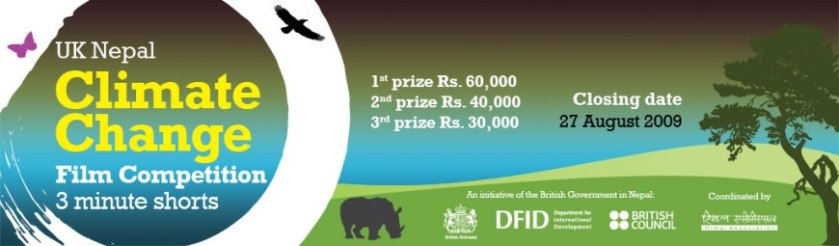
UK Nepal Climate Change Film Competition: We’re toast in 3 minutes!

Tell a climate story in just 180 seconds...

In July 2007, we had an interesting discussion on this blog on the shrinking durations of Nature and environment films and TV programmes. The moving images community is divided on this, with some purists holding out that to pack complex, nuanced messages into a few minutes is akin to dumbing everything down. Noted film-makers like Neil Curry disagreed.

I revisited this topic in August 2008, saying: “But there’s no argument of the sheer power of well produced public service announcements (PSAs) to move people with a specific, short message. Nothing can beat them for the economy of time and efficacy of delivery.”

Kathmandu to Copenhagen - in three minutes?
The trend to make ever shorter films has been fuelled by the growth of online video, where the dominant value seems to be: less is certainly more! This is the premise, for example, of the current competition One Minute to Save the World.

In Nepal, they were more generous — and allowed three minutes. I recently came across the winners of the UK Nepal Climate Change Film Competition, where Nepali film makers were invited to “make short, effective films of up to 3 minutes on the theme of Climate Change”. The submitted films had to be original in concept, innovative and highly motivational – no restrictions were set in terms of discipline or genre. It was organised by our friends at Himal Association, better known for sustaining Film South Asia festival for a decade.

The winning films were screened at an awards ceremony in September 2009 at the Regional Climate Change Conference in Kathmandu. They will also be screened at Kathmandu International Mountain Film Festival 2009 (10-14 December) and will be broadcast on television.

The winning film, Act locally think globally, was directed by Santoshi Nepal and Ishu Lama:

First runner-up, Jeopardy, is an animation directed by Shiva Sharan Koirala:

Second runner-up, 3 Cs of Climate Change, directed by Binod K Dhami and Padam Raj Paneru:

The competition attracted an impressive 124 entries. Angelo D’Silva, an educationist and media critic in Kathmandu, recently reviewed the entries in Himal Southasian special issue on climate change. He wrote: “In cash-strapped times, these contests focusing on climate change prove to be a cost-effective strategy in generating content. With no funding directed to the filmmaker for production, and prize money amounting to NPR 130,000 (USD 1700) for the three winners, the climate-change film contest is a way to make a splash on the cheap.”

He added: “While the filmmakers, all of whom were Nepali, exhibited an impressive range and quality, it was a range obscured by the selection of some fairly typical public-service-announcement-type finalists. Hopefully, however, two sets among the entries will soon see the light of day: those documenting the effects of climate change on Nepali communities, and those exploring (and exploiting) anxieties and fears about the burgeoning climate crisis.”

Read full review here.

I have only seen the three winning entries that are available online, so it would be unfair to comment on other entries. But I found the three winners predictably text-bookish. For sure, simple awareness raising is always helpful, but much more is needed – and urgently so – to deal with climate change. Film can be a powerful force for changing lifestyles, and not all of them have to be feature film length in Al Gore style.